


Overweight and obesity are now recognised as worldwide public health problems that increase risk of a number of chronic diseases(Reference Beaglehole, Irwin and Prentice1). A positive relationship between time spent watching television and body weight has been consistently documented(Reference Robinson2–Reference Coon and Tucker4). Compounding the fact that television watching is a sedentary activity, advertisements for foods high in fat, salt and sugar are common on television, encouraging unhealthy food choices amongst viewers(Reference Hastings, Stead and McDermott5). Advertising clearly has the potential to influence individuals' preferences and behaviours and the near ubiquity of food advertisements, alongside their potential impact on diet and body weight, has led to increasing demands for regulation, particularly on children's television(Reference Nestle6–11).
A 2003 systematic review of the effects of food promotion on children concluded that whilst ‘with this kind of research, incontrovertible proof simply isn't attainable … the literature does suggest food promotion is influencing children's diet in a number of ways’(Reference Hastings, Stead and McDermott5). In particular, television food advertising appears to influence children's food preferences and purchasing behaviour(Reference McGinnis, Goolman and Kraak12). Although potentially modest, these effects appear to be both independent of other effects, and occurring at the product as well as category level. Thus, children exposed to food advertisements are more likely to choose the advertised product but also to express a general preference for less healthy foods(Reference Hastings, Stead and McDermott5). Children who are exposed to more adverts and are more attentive to them also appear to make more purchasing requests to parents: so-called ‘pester power’(Reference Hastings, Stead and McDermott5). In addition, there is potential for wider, indirect effects of television advertising of advertised foods, in terms of normalising such products and making them more salient to consumers(13). Television food advertising, therefore, has the potential to influence the development of overweight, obesity and related conditions in otherwise healthy children(Reference McGinnis, Goolman and Kraak12). The impact of television food advertising on adults is less well documented but, given the amount of food advertising revenue spent (television food advertising spend in the UK is in the hundreds of millions of pounds(14)), is unlikely to be negligible.
Numerous content analyses have documented food advertising on television(Reference Hastings, Stead and McDermott5, Reference Ostbye, Pomerleau and White15–Reference Dibb and Gordon21). Whilst broad food categories are often described, detailed data on the specific nutritional content of television food advertisements are less commonly published(Reference Hastings, Stead and McDermott5) and the methods used by those studies that do document nutritional content vary widely(Reference Powell, Szczypka and Chaloupka22–Reference Dibb and Castell24). Furthermore, almost all previous analyses have focused on children's television, either by restricting analysis to specific children's channels, programmes or time periods(Reference Connor17–Reference Rodd and Patel19, Reference Hammond, Wyllie and Casswell25–Reference Outley and Taddese28) or using viewing figures to identify those programmes most popular with children(Reference Powell, Szczypka and Chaloupka22, Reference Harrison and Marske23). There has been little focus on the wider television advertising landscape as watched by adults, as well as children(Reference Østbye, Pomerleau and White27, Reference Byrd-Bredbenner and Grasso29–Reference Story and Faulkner31). Thus, despite evidence that television food advertising affects children's food preferences and behaviour and the strong possibility that this effect extends to adults, there is currently little detailed data available on the exact nutritional content of the foods that are being advertised on mainstream television, particularly outside of the USA.
Although some data on international variations in the frequency of television food advertisements has been published(Reference Lobstein and Dibb32), it is not clear if there are important international differences in the nutritional content of foods advertised on television. Nor has substantial data been published on changes in television food advertising over time. Health promoters, consumer groups and politicians in many developed countries are now calling for increased regulation of TV food advertising(Reference Nestle6–11, 33–37) and industry may respond with increased self-regulation(Reference Hawkes38). Whilst there is evidence from both the USA and Australia that the proportion of all television advertisements that are for food has decreased over time(Reference Byrd-Bredbenner and Grasso39–Reference Kelly, Smith and King41), and from Australia that the proportion of food advertisements that are for ‘unhealthy’ foods also decreased over time(Reference Hattersley, Kelly and King40, Reference Kelly, Smith and King41), time trends in other countries have not been documented.
In order to fill some of these gaps, we analysed food-related advertisements, and the nutrient content of advertised foods, during ‘prime-time’ television in Canada and the UK in 1991 and 2006.
Methods
The present study built on previous work on television food advertising in Canada in 1991(Reference Ostbye, Pomerleau and White15) using the same methods, as far as possible.
Channels and times of interest
In 1991 five channels broadcast in Ontario, Canada, that represented 65 % of ‘prime-time’ viewership, were studied: CBC (English), CBC (French), CTV, CFPL and Much Music. The equivalent, free-to-view, channels included in 2006 were CBC (Toronto), SRC (Montreal), CTV (Toronto) and A-channel (a re-branding of CFPL). Much Music was no longer free-to-view in 2006. In the UK all commercial terrestrial channels were included in both years: ITV and Channel 4 in 1991, supplemented by Channel 5 in 2006. Terrestrial channels in the UK are those that are free-to-view and do not require specialist receiver equipment. In 1991, commercial terrestrial channels in the UK accounted for 52 % of viewing, falling to 35 % in 2006 as more digital and cable channels became available(42).
All advertisements broadcast during prime-time in the week beginning the last Monday of October were studied in both years (26 October to 1 November 1991; 30 October to 5 November 2006). This represented a typical week, not too close to season premieres or the holiday season. As previously, prime-time was defined as 19.00–22.59 hours(Reference Ostbye, Pomerleau and White15, Reference Byrd-Bredbenner and Grasso39), giving a total of 28 h of programming per channel per country per year.
Advertisements broadcast
Information on all advertisements broadcast during the times of interest in Canada in 1991 was obtained by video-recording the study channels. In all other cases, data were purchased from audience research bureaux: the British Audience Research Board (BARB) for UK data in 1991, Attentional Ltd for UK data in 2006, and BBM Analytics for Canadian data in 2006. With the exception of BARB (which is funded directly by broadcasters), these bureaux are commercial organisations that supply data to broadcasters, manufacturers and advertisers to help them plan and evaluate their broadcast strategies.
For each advertisement, the main product or brand range promoted was recorded. As we did not have access to the actual advertisements broadcast in the majority of cases, we did not have information on what other products may have been shown incidentally in advertisements, or the creative techniques used to promote products.
Categorical analysis of food-related advertisements
All advertisements for food and food retailers (food stores and restaurants) were identified. These are termed ‘food-related advertisements’ and were categorised using a schema of categories and sub-categories based on the groupings used in the Canadian Nutrition Recommendations (see Table 1) (43, 44). In this schema, advertisements for specific fast-food products (e.g. McDonald's Big Mac or Happy Club Meal) were categorised as ‘Meals: hamburgers & fast food’ whilst advertisements for fast-food chains that did not mention specific products were categorised as ‘Restaurants: fast food’.
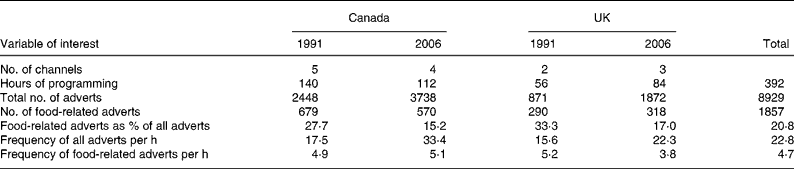
Summary of hours of programming studied and number, proportion and frequency of food-related advertisements†
† For details of procedures, see Methods.
Variations in the proportion of food advertisements that fell into each main category between years in each country, and between countries in each year, were assessed using the χ2 test of difference in proportion with Yates' correction or Fisher's exact test where appropriate. Within- and between-country comparisons were not performed for sub-categories in order to avoid multiple comparisons.
Nutritional analysis of food advertisements and estimation of the ‘TV diet’
The sub-group of food-related advertisements for specific foods (e.g. excluding those advertisements for food stores and restaurants) were then subject to a nutritional analysis. For each food advertisement, the energy, protein, carbohydrate, sugar, fat, alcohol, fibre and sodium content of the main product advertised was determined. This was done using computer software in 1991 (Nutritionist III from N-Square Computing, 1985 (Canada) and Microdiet (UK)), supplemented by manufacturers' data displayed on packaging where necessary. In 2006, product-specific data displayed on packaging and manufacturers' websites was used as far as possible, supplemented with standard food table data where necessary(45, 46). The sodium content of foods advertised in Canada in 1991 was not available.
For advertisements for brand ranges, rather than specific products (e.g. Fox's Biscuits, rather than Fox's Classic), a single ‘default’ product was identified and the nutritional content for that product was used in analyses. The choice of ‘default’ products was based on the authors' consensus judgement of the most popular products within brand ranges.
In order to summarise the nutritional content of foods advertised, we used the concept of the ‘TV diet’(Reference Østbye, Pomerleau and White27). To determine the composition of the ‘TV diet’, each advertisement broadcast was assumed to represent one portion of the product advertised, with portion sizes determined from standard tables(Reference Pennington47) for Canadian products in 1991 and package sizes or information displayed on packages in all other cases. The total percentage of energy from each macronutrient, as well as dietary fibre and sodium density (in g/1000 kJ) for all foods advertised was then calculated.
Information on the reported diets of Canadian and British adults in 1991 and 2006 were obtained from large, national nutritional surveys and, in the case of sugar and alcohol consumption by Canadians in 2006 where recent data is not available, estimates from available food and energy in the national food supply, adjusted for losses(42, 48–Reference Henderson, Gregory and Swan50). The nutrient content of advertised foods was compared both to these reported diets and to recommended nutritional guidelines published by the Canadian and UK governments current in 2006(44, 51–53).
Results
A total of 8929 advertisements broadcast over 392 h of programming were analysed (see Table 1). Of these, 1857 (20·8 %) advertisements were for food-related products, an average of 4·7 food-related advertisements per hour of programming. In 1991, the frequency of food-related advertisements was approximately the same in Canada (4·9/h) and the UK (5·2/h). Between 1991 and 2006 in both Canada and the UK, the proportion of all advertisements that were food-related decreased and the frequency of advertisements in general increased. Whilst in Canada this led to a similar frequency of food-related advertisements in both 1991 (4·9/h) and 2006 (5·1/h), in the UK there was a decrease in the frequency of food-related advertisements between 1991 (5·2/hour) and 2006 (3·8/hour).
Categorical analysis of food-related advertisements
The number and proportion of food-related advertisements that fell into each category and sub-category, with the results of within- and between-country tests of difference in proportion across main categories only, are shown in Table 2.
Food and food-related advertisements in 1991 and 2006 in Canada and UK by food category†

–, Within- and between-country differences not calculated for sub-categories in order to avoid multiple comparisons.
χ2 values were significant: *P < 0·05, **P < 0·01, ***P < 0·001.
† For details of procedures, see Methods.
The most common categories of food-related advertisements in both countries in 1991 were beverages (21·6 % of food advertisements in Canada; 19·3 % in the UK) and meals (16·1 % in Canada; 22·1 % in the UK). By 2006, these had changed to meals (29·5 %) and restaurants (15·6 %) in Canada, and food stores (30·5 %) and beverages (22·3 %) in the UK. The proportion of advertisements for food stores increased more than six-fold between 1991 and 2006 in the UK (from 4·5 to 30·5 %), but advertisements for food stores were relatively uncommon in Canada in both years (5·0 % in 1991; 5·8 % in 2006). Similarly, there was more than a six-fold increase in the proportion of food-related advertisements that were for restaurants from 1991 to 2006 in Canada (from 2·4 to 15·6 %), but there were no advertisements for restaurants in either year in the UK.
In 1991, a significantly higher proportion of food-related advertisements were for fruits, vegetables and juices in Canada compared with the UK (8·0 % v. 1·0 %, χ2 = 17·6, P < 0·001), and a significantly lower proportion for sweets and candy (7·2 % v. 14·1 %, χ2 = 11·6, P < 0·001). By 2006 the first of these trends had reversed (1·6 % in Canada, 7·2 % in the UK, χ2 = 18·8, P < 0·001) and the proportion of advertisements for sweets and candy in the UK decreased to the degree that, by 2006, there was no difference between the countries (6·3 % in Canada, 6·6 % in the UK).
Overall, twenty-eight (4·1 %) advertisements were for fast-food products or restaurants in Canada in 1991. This increased substantially to 141 (24·7 %) in 2006. In the UK, twelve (4·1 %) advertisements were for fast-food products or restaurants in 1991, increasing less rapidly than in Canada, to thirty-three (10·4 %) in 2006.
Substantial between-channel heterogeneity in the proportion of food-related advertisements in many categories was seen in the earlier Canadian sample(Reference Ostbye, Pomerleau and White15) and this was partially followed through to 2006 (data not shown). In contrast, little between-channel heterogeneity was seen in the UK in either year.
Nutritional analysis of food advertisements and estimation of the ‘TV diet’
The nutritional content of all foods advertised (the ‘TV diet’) during the periods of interest is summarised in Table 3. In both 1991 and 2006, the percentage of energy derived from protein, carbohydrate and sugar in the Canadian TV diet were all within 2006 recommended ranges. However, in both years the fibre content of the Canadian TV diet was substantially lower than recommended (1·0 g/1000 kJ in 1991 and 1·2 g/1000 kJ in 2006, compared to recommendation of 3·0 g/1000 kJ). In 1991, the percentage of energy derived from alcohol in the Canadian TV diet was higher than recommended but this reduced to within recommended ranges by 2006 (7 % in 1991, 3 % in 2006, compared to recommendation of ≤ 5 %). A small increase in the percentage of energy derived from fat in the Canadian TV diet between 1991 and 2006 meant that this was higher than recommended in 2006 (34 % in 1991, 36·6 % in 2006, compared to recommendation of 20–35 %). The sodium content of the Canadian TV diet in 1991 was not available, but in 2006 it was twice recommended limits (0·4 g/1000 kJ, compared to recommendation of 0·2 g/1000 kJ).
Nutritional content of foods advertised in 1991 and 2006 in Canada and the UK, with contemporaneous actual and recommended dietary intakes†

–, Data not available.
† For details of procedures, see Methods.
‡ Average of the average intake for men and women, aged 16–64, Dietary and Nutrition Survey of British Adults, 1986/7.
§ Average of the average intake for men and women, age 19–64, National Diet and Nutrition Survey, 2000/1 and, in the case of nutrients measured in g/1000 kJ, an assumed daily energy intake of 10 460 kJ.
∥ Average of the reference nutrient intake for adult men and adult women and, in the case of nutrients measured in g/1000 kJ, an assumed daily energy intake of 10 460 kJ.
¶ Calculated from total available sugars and syrups, and total available energy per person per year (adjusted for losses) in 2006.
†† Calculated from total available alcoholic beverages, and total available energy per person per year (adjusted for losses) in 2006.
‡‡ Calculated from an assumed daily energy intake of 10 460 kJ/d.
§§ Average of the recommended adequate intake for adult men and adult women and assumed daily energy intake of 10 460 kJ.
∥∥ Tolerable upper level of daily sodium intake.
¶¶ From www.salt.co.uk
††† Achievable daily sodium intake.
The TV diet in the UK differed more from recommendations than that in Canada. The percentage of energy derived from protein in the UK TV diet was higher in both 1991 and 2006 than recommended (11·5 % in 1991, 12·8 % in 2006, compared to recommendation of 9 %). The percentage of energy derived from carbohydrate was lower in both years than recommended (40·9 % in 1991, 45·9 % in 2006, compared to recommendation of 50 %). The percentage of energy derived from sugar and alcohol was higher in the UK TV diet in both 1991 and 2006 compared to recommendations (sugar 13·3 % in 1991, 15·5 % in 2006, compared to recommendation of 11 %; alcohol 7·5 % in 1991, 6·6 % in 2006, compared to recommendation of 6 %). Furthermore, in both years the fibre content of the UK TV diet was lower than recommended and the sodium content higher than recommended (fibre 0·8 g/1000 kJ in 1991, 1·3 g/1000 kJ in 2006, compared to recommendation of 4·3 g/1000 kJ; sodium 0·5 g/1000 kJ in 1991, 0·4 g/1000 kJ in 2006, compared to recommendation of 0·2 g/1000 kJ).
The most notable differences in the Canadian TV diet in 1991 compared to the reported diet of Canadians in 1991 was a substantially lower fibre content (1·0 v. 1·4–1·9 g/1000 kJ), a lower percentage of energy derived from protein (12 v. 15 %) and a lower percentage of energy derived from fat (34 v. 36·6 %). In 2006, there remained a substantially lower fibre content in the Canadian TV diet, compared to the reported diet of Canadians (1·2 v. 2·0 g/1000 kJ). In addition, compared to the reported diet of Canadians, the Canadian TV diet in 2006 had a much greater percentage of energy derived from sugar (18·5 v. 10·4 %) and a greater sodium content (0·4 v. 0·2 g/1000 kJ).
Compared to the reported diet in the UK in 1991, the 1991 UK TV diet was noticeably higher in percentage of energy derived from alcohol (7·5 v. 4·9 %) and fat (44·7 v. 38·4 %), but the percentage of energy derived from protein was markedly lower (11·5 v. 14·7 %). By 2006, the UK TV diet differed most from reported diets in terms of sodium content (0·4 v. 0·3 g/1000 kJ) and percentage of energy derived from alcohol (6·6 v. 5·2 %) and sugar (15 v. 12·8 %).
The most striking differences seen between the Canadian TV diet in 1991 and 2006 was a large drop in the percentage of energy derived from alcohol (from 7 to 6·4 %) and an increase in fibre density (from 1·0 to 1·2 g/1000 kJ). There was also a marked increase in the percentage of energy derived from protein (from 12 to 14·1 %). The most marked differences between the UK TV diets in 1991 and 2006 were decreases in the percentage of energy derived from fat (from 44·7 to 32·5 %) and sodium density (from 0·5 to 0·4 g/1000 kJ) and a large increase in the fibre density of advertised foods (from 0·8 to 1·3 g/1000 kJ).
Comparing the TV diet in the UK in 1991 to that in Canada, the largest differences were a greater percentage of energy derived from fat (44·7 v. 34 %), a lower percentage of energy derived from sugar (13·3 v. 17 %), and a lower fibre content (0·8 v. 1·0 g/1000 kJ) in the UK compared to Canada. In 2006, the most noticeable differences when comparing the UK to Canadian TV diet were a much greater percentage of energy derived from alcohol (6·6 v. 3 %), and a lower percentage of energy derived from sugar (15·5 v. 18·5 %) and fat (32·5 v. 36·6 %) in the UK compared to the Canadian TV diet.
Discussion
Summary of main results
We compared food-related advertisements and the nutritional content of foods advertised during prime-time television in a single autumn week in Canada and the UK in 1991 and 2006. Whilst the proportion of all advertisements that were food-related decreased substantially between 1991 and 2006 in both countries, the frequency of food-related advertisements per programming hour was relatively constant in Canada but decreased between 1991 and 2006 in the UK. In 1991, advertisements for beverages and meals predominated in both countries. By 2006, food-related advertisements in Canada were dominated by meals and restaurants, whilst in the UK almost half of all food-related advertisements were for either food stores or beverages.
The advertised TV diet in Canada in 1991 could be described as relatively high in fat, high in alcohol and low in fibre, compared to current recommendations. By 2006, this had changed to high in fat and sodium and low in fibre (data on sodium was not available for Canada in 1991). The TV diet in the UK in 1991 was high in fat, sodium, sugar and alcohol and low in fibre compared to current recommendations. By 2006, all of these labels persisted, except for the high fat, leaving a TV diet that could be described as high in sodium, sugar and alcohol and low in fibre.
Some improvements were seen in the nutritional content of the TV diet between 1991 and 2006 in both countries with the percentage of energy derived from alcohol decreasing and the fibre density increasing in both countries. In addition, the percentage of energy derived from fat and the sodium content of the UK TV diet decreased over time. However, deterioration also took place with the percentage of energy derived from sugar increasing in both countries between 1991 and 2006.
Explanation and interpretation of the findings in relation to the literature
Most previous research on television food advertising has focused on children's television(Reference Chapman, Nicholas and Supramaniam16–Reference Chestnutt and Ashraf20, Reference Hammond, Wyllie and Casswell25, Reference Kotz and Story26, Reference Outley and Taddese28). In contrast, we analysed prime-time television, when most viewing takes place. As in previous work, we found that the proportion of all advertisements that were for food-related products has decreased over time(Reference Byrd-Bredbenner and Grasso39–Reference Kelly, Smith and King41). However, the ‘big five’ of commonly advertised foods on children's television, consisting of fast food, high-sugar soft drinks, salty snacks, high-sugar breakfast cereals, and confectionery(Reference Hastings, Stead and McDermott5, Reference Ostbye, Pomerleau and White15–Reference Rodd and Patel19, Reference Hammond, Wyllie and Casswell25, Reference Kotz and Story26, Reference Outley and Taddese28) was not predominant in our analyses.
The rising dominance of advertisements for meals and restaurants in Canada and food stores in the UK in 2006 may reflect changing social patterns in these countries. In the UK, food retailing is increasingly dominated by four supermarket chains(Reference Garner54), whilst British and Canadian adults now spend less that 45 minutes per day, on average, cooking and washing up(55, Reference Lader and Meltzer56). It is possible that restaurants in the UK are less ‘branded’ (i.e. less likely to be chains) that those in Canada and so less able to purchase television advertising, but this is difficult to confirm without substantial further investigation. An increase in the proportion of food advertisements for restaurants over time has also been noted in US data(Reference Byrd-Bredbenner and Grasso39).
The growth in advertisements for food stores and restaurants between 1991 and 2006 may also reflect changing regulatory climates. New regulations on television food advertising to children came into force in the UK in April 2007(Reference Rayner, Scarborough and Boxer57) whilst self-regulated advertising codes of practice were strengthened in Canada(58). Both standards focus on food products only and do not cover advertisements for restaurants or food stores. It is possible that advertisers were already changing their pattern of marketing in late 2006 in anticipation of the introduction of these new regulations and in response to increasing lobbying from pressure groups(59).
Like recent findings from Australia(Reference Hattersley, Kelly and King40, Reference Kelly, Smith and King41), we found some evidence of improvement in the nutritional quality of advertised foods over time. However, these were not universal and some deterioration also occurred. In addition to the ‘high fat, salt, sugar’ label often applied to foods advertised on children's television(60), we would also add ‘low fibre’. There is little evidence that television food advertising reflects a particularly healthful diet or even the healthfulness of the diets of individuals living in the UK and Canada.
Limitations of the study
We attempted to maintain a constant approach to data collection and analysis across all four data sets. However, we were necessarily limited by changes in technology and data availability over time and between Canada and the UK. We also attempted to replicate, as far as possible, the methods of a previous analysis based on data collected more than 15 years ago and this necessarily imposed limitations on our approach to the analysis of the more recent data.
As we have focused on only one week in 1991 and 2006, we were unable to study any seasonal variations in television food advertising and our results are not necessarily generalisable to other times of year. However, by using the same week in all cases, it is unlikely that such seasonal variations contribute to the differences reported here.
We restricted our analysis to prime-time television. Although relatively short in duration, prime-time routinely attracts the largest audiences and most attention from both programme makers and advertisers. Following changes in what commercial channels are available in both Ontario and the UK, the channels included in 1991 and 2006 are not identical. Whilst this may influence the mix of food-related advertisements included in our samples, it also reflects real-life changes in television viewed. Analyses restricted to only those channels that were available in both years led to very similar patterns of results to those reported here (data not shown). By restricting our analyses to free-to-view channels, the present results are not necessarily generalisable to all channels available. Furthermore, as digital, cable and satellite channels have proliferated in recent years, the 2006 data may be less generalisable across all channels available than the 1991 data.
The present data on what products were promoted came, in the main, from audience research bureaux. Given that these are commercial organisations who sell data to broadcasters, manufacturers and advertisers, the data they supplied are likely to be accurate. However, as we did not view the majority of advertisements, we had to rely on the audience research bureaux interpretation of what products were advertised. We were not, therefore, able to take into account incidental shots or mentions of other related products during advertisements. Neither did we include instances of programmes sponsored by food products or food product placement within programming.
The method of assigning nutritional data to advertised food products varied between 1991 (when computer software was used to assign values based on generic foods) and 2006 (where product-specific data was used as far as possible). Whilst the 2006 nutritional data are likely to be more product-specific than the 1991 data, there is no reason to believe that the 1991 data was biased in any particular direction.
Our use of ‘default’ products to represent the nutrient content of advertisements for brand ranges may have introduced some error. Although a very similar pattern of results to those reported here was found when using the mean nutrient content of all products in the brand ranges advertised (data not shown), the assumption that advertisements for brand ranges are comparable to advertisements for single products may be wrong. In particular, we did not elect a default product to represent advertisements for food stores and restaurants, which could also be considered to be marketing brands. As the new UK regulations only apply to product-specific advertisements, advertisements for brand ranges may become more common over time as a way to ‘side-step’ the regulations.
We used standard portion sizes to determine the weight or volume of advertised products that contributed to the overall ‘TV diet’. This approach has been used in other analyses of television food advertising(Reference Powell, Szczypka and Chaloupka22, Reference Harrison and Marske23). Whilst standard portion sizes may substantially underestimate the true weight of products that individuals consume, they appear to do this to a consistent degree meaning that relative nutritional composition of diets estimated by standard and actual portion sizes are highly correlated(Reference Welten, Carpenter and McPherson61). Our approach to quantifying the TV diet is, therefore, likely to represent a good estimation of the nutritional composition of eating one real-life portion of every food advertised. However, the concept of the TV diet is intended more as a method of summarising advertised products, rather than an indication of what television viewers are assumed to eat. Individuals are unlikely to consume a diet entirely guided by the advertisements they have watched and some advertisements may be more effective in encouraging consumption than others.
Finally, these analyses describe the food advertisements broadcast and provide no information on the effect of advertisements on actual behaviour.
Conclusions and future directions
We have found that the proportion of all advertisements that were for food-related products decreased between 1991 and 2006 in both Canada and the UK. Whilst the frequency of food-related advertisements also decreased over time in the UK it stayed constant in Canada. This occurred alongside a fairly steady increase in the prevalence of overweight and obesity in the UK and Canada(Reference Katzmarzyk and Mason62, Reference Craig and Mindell63). The ‘big five’ categories of food traditionally described as predominating in food advertising on children's television(Reference Hastings, Stead and McDermott5, Reference Ostbye, Pomerleau and White15–Reference Rodd and Patel19, Reference Hammond, Wyllie and Casswell25, Reference Kotz and Story26, Reference Outley and Taddese28) were not seen in our analyses. Although there were some indications that the nutritional content of the TV diet was healthier in 2006 compared to 1991 in both countries, the TV diet in 2006 remained consistently low in fibre and high in sodium in both countries, and also high in fat in Canada and high in sugar and alcohol in the UK. The present results suggest that whilst there are key differences between food-related advertising on television specifically targeted at children and those during more mainstream programming broadcast during prime-time, the overall story is the same: foods advertised on television do not reflect a healthful diet.
Alongside the substantial research available on television food advertising to children, it is important to also consider the effects of such advertising on adults. Despite adults' increased understanding of the aims and tricks of marketing, there may be good reason, in public health terms, for restricting all television food advertising.
Further research is required to document and assess the impact of food advertising in other television and non-television spheres. Alongside burgeoning numbers of commercial television channels, additional opportunities for advertising, such as mobile telephones and the Internet, have also developed over recent years. It will be important to document food advertising in these spheres as well as any differences in television food advertisements across different types of channels and according to whether programmes are watched as broadcast, following recording, or on on-line play-back services. The changes in television food advertising regulations in Canada, the UK, and other places, may increasingly push manufacturers and retailers into less regulated marketing spaces such as the Internet(Reference Linn and Novosat64).
During debates on food advertising, food manufacturers stress their right to make consumers aware of new products, broadcasters stress the importance of advertising to fund high-quality output, and adult consumers say that they often enjoy advertising for themselves (although not necessarily for their children) and object to government interference in everyday life(14, Reference Caraher, Landon and Dalmeny65, Reference Graff66). There is clearly a difficult balance to be struck between public health concerns and the rights of industry, broadcasters and individuals(Reference Caraher, Landon and Dalmeny65). Obesity is also a complex phenomenon. Whilst increasing regulation of television food advertising may play some role in preventing and reversing overweight and obesity in both children and adults, multi-pronged intervention strategies will be required to halt and reverse the obesity epidemic(Reference Butland, Jebb and Kopelman67).
Acknowledgements
The work described in this paper was performed at the Institute of Health and Society, Newcastle University, UK and the Department of Family Relations and Applied Nutrition, University of Guelph, Canada. This research was supported by the Medical Research Council (grant number G106/1253). The authors have no conflicts of interest to declare. T. Ø. led the original study of Canadian data in 1991 and M. W. contributed to it. J. A. and M. W. conceived the idea for the 2006 analysis. All authors contributed to study design. J. A. and K. H.-P. performed the data analysis. All authors contributed to data interpretation. J. A. drafted the manuscript. All authors commented on earlier drafts of the manuscript and approved the final version.



