





1 Introduction
A subset A of the nonnegative integers $\mathbb {N}$
is said to be a Sidon set if for every
$\mathbb {N}$
is said to be a Sidon set if for every $x \in \mathbb {N}$
the equation
$x \in \mathbb {N}$
the equation
 $$ \begin{align*}x=a+b\end{align*} $$
has at most one solution $(a,b) \in A^2$
with
$(a,b) \in A^2$
with $a\le b$
. The aim of this note is to show that, from a topological point of view, most subsets of
$a\le b$
. The aim of this note is to show that, from a topological point of view, most subsets of $\mathbb {N}$
are not Sidon sets (also its simple analog from the measure viewpoint holds, see Remark 1.1 below).
$\mathbb {N}$
are not Sidon sets (also its simple analog from the measure viewpoint holds, see Remark 1.1 below).
More generally, given an abelian semigroup S, an element $x \in S$
, and an integer
$x \in S$
, and an integer $h\ge 2$
, we denote by
$h\ge 2$
, we denote by $r_{A,h}(x)$
the number of solutions
$r_{A,h}(x)$
the number of solutions $(a_1,\ldots ,a_h) \in A^h$
of the equation
$(a_1,\ldots ,a_h) \in A^h$
of the equation $x=a_1+\cdots +a_h$
, where we consider two such solutions to be the same if they differ only in the ordering of the summands. It is worth to remark that, given an integer
$x=a_1+\cdots +a_h$
, where we consider two such solutions to be the same if they differ only in the ordering of the summands. It is worth to remark that, given an integer $g\ge 1$
, sets
$g\ge 1$
, sets $A\subseteq S$
which satisfy
$A\subseteq S$
which satisfy
 $$ \begin{align*}\forall x \in S, \quad r_{A,h}(x) \le g \end{align*} $$
are usually called $B_h[g]$
sets; if
$B_h[g]$
sets; if $g=1$
, they are simply called
$g=1$
, they are simply called $B_h$
sets. We denote by
$B_h$
sets. We denote by $\mathcal {B}_{h,g}$
the family of all
$\mathcal {B}_{h,g}$
the family of all $B_h[g]$
sets. Of course, in the case
$B_h[g]$
sets. Of course, in the case $S=\mathbb {N}$
, a set
$S=\mathbb {N}$
, a set $A\subseteq \mathbb {N}$
is Sidon if and only if it is a
$A\subseteq \mathbb {N}$
is Sidon if and only if it is a $B_2$
set (i.e.,
$B_2$
set (i.e., $r_{A,2}(n) \le 1$
for all
$r_{A,2}(n) \le 1$
for all $n \in \mathbb {N}$
); we refer to [Reference Cilleruelo, Ruzsa and Vinuesa3, Reference Nathanson14] and references contained therein for related literature about
$n \in \mathbb {N}$
); we refer to [Reference Cilleruelo, Ruzsa and Vinuesa3, Reference Nathanson14] and references contained therein for related literature about $B_h[g]$
sets.
$B_h[g]$
sets.
Remark 1.1 It is easy to see that, from a measure point of view, most subsets of $\mathbb {N}$
are not
$\mathbb {N}$
are not $B_{h}[g]$
sets. To this aim, identify the family of infinite sets
$B_{h}[g]$
sets. To this aim, identify the family of infinite sets $A\subseteq \mathbb {N}$
with the set of reals in
$A\subseteq \mathbb {N}$
with the set of reals in $(0,1]$
through their unique nonterminating dyadic expansion, and denote by
$(0,1]$
through their unique nonterminating dyadic expansion, and denote by $\lambda : \mathscr {M}\to \mathbb {R}$
the Lebesgue measure, where
$\lambda : \mathscr {M}\to \mathbb {R}$
the Lebesgue measure, where $\mathscr {M}$
stands for the completion of the Borel
$\mathscr {M}$
stands for the completion of the Borel $\sigma $
-algebra on
$\sigma $
-algebra on $(0,1]$
. Let
$(0,1]$
. Let $\mathcal {H}$
be the family of sets
$\mathcal {H}$
be the family of sets $A\subseteq \mathbb {N}$
which admit asymptotic density
$A\subseteq \mathbb {N}$
which admit asymptotic density  . It follows by Borel’s normal number theorem that $\mathcal {H} \in \mathscr {M}$
and
$\mathcal {H} \in \mathscr {M}$
and $\lambda (\mathcal {H})=1$
(see, e.g., [Reference Billingsley1, Theorem 1.2]. Then
$\lambda (\mathcal {H})=1$
(see, e.g., [Reference Billingsley1, Theorem 1.2]. Then $\mathcal {H}$
does not contain any
$\mathcal {H}$
does not contain any $B_h[g]$
set. In fact, fix
$B_h[g]$
set. In fact, fix $A\in \mathcal {H}$
and observe that
$A\in \mathcal {H}$
and observe that
 $$ \begin{align*}\sum_{i=0}^{hn}r_{A,h}(i) \ge \binom{|A\cap [0,n]|}{h} \gg \binom{n/2}{h} \gg n^{h} \quad \text{ as }n\to \infty. \end{align*} $$
By the pigeonhole principle, there exist $c>0$
and infinitely many
$c>0$
and infinitely many $n \in \mathbb {N}$
such that
$n \in \mathbb {N}$
such that $r_{A,h}(n)\ge \frac {1}{hn+1}\sum _{i\le hn}r_{A,h}(i) \ge cn$
. Therefore,
$r_{A,h}(n)\ge \frac {1}{hn+1}\sum _{i\le hn}r_{A,h}(i) \ge cn$
. Therefore, $\lambda (\{A\subseteq \mathbb {N}: A \text { is }B_h[g]\})=0.$
In our first main result, we show, from a topological viewpoint, that most subsets of $\mathbb {N}$
are not
$\mathbb {N}$
are not $B_h[g]$
. We identify
$B_h[g]$
. We identify $\mathcal {P}(\mathbb {N})$
with the Cantor space
$\mathcal {P}(\mathbb {N})$
with the Cantor space $\{0,1\}^{\mathbb {N}}$
. In particular, we can speak about the topological complexity of subsets of
$\{0,1\}^{\mathbb {N}}$
. In particular, we can speak about the topological complexity of subsets of $\mathcal {P}(\mathbb {N})$
.
$\mathcal {P}(\mathbb {N})$
.
Theorem 1.2 Each $\mathcal {B}_{h,g}$
is closed and with empty interior (hence, meager).
$\mathcal {B}_{h,g}$
is closed and with empty interior (hence, meager).
In particular, because the family of meager sets is a $\sigma $
-ideal, it follows by Theorem 1.2 that the family of sets
$\sigma $
-ideal, it follows by Theorem 1.2 that the family of sets $A\subseteq \mathbb {N}$
which are
$A\subseteq \mathbb {N}$
which are $B_h[g]$
sets for some
$B_h[g]$
sets for some $h\ge 2$
and
$h\ge 2$
and $g\ge 1$
is a meager subset of
$g\ge 1$
is a meager subset of $\mathcal {P}(\mathbb {N})$
(of course, this is meaningful since the
$\mathcal {P}(\mathbb {N})$
(of course, this is meaningful since the $\mathcal {P}(\mathbb {N})$
is a Polish space, hence it is not meager in itself).
$\mathcal {P}(\mathbb {N})$
is a Polish space, hence it is not meager in itself).
We are going to strengthen the meagerness claim given in Theorem 1.2 in two directions. To this aim, recall that
 $$ \begin{align} r_{\{0,1,\ldots,n\},\,h}(n) \sim \frac{n^{h-1}}{h!(h-1)!} \quad \text{ as }n\to \infty \end{align} $$
for all integers $h\ge 2$
; see [Reference Erdös and Lehner4, Section 4], and cf. also [Reference Nathanson12] and [Reference Ramírez Alfonsín15, Theorem 4.2.1] for an improvement on (1.1) (which will not be needed in our proofs).
$h\ge 2$
; see [Reference Erdös and Lehner4, Section 4], and cf. also [Reference Nathanson12] and [Reference Ramírez Alfonsín15, Theorem 4.2.1] for an improvement on (1.1) (which will not be needed in our proofs).
First, we show that the behavior of $r_{A,h}$
is really wild for most sets A. Taking into account (1.1), the next result is optimal.
$r_{A,h}$
is really wild for most sets A. Taking into account (1.1), the next result is optimal.
Theorem 1.3 Fix an integer $h\ge 2$
and pick a map
$h\ge 2$
and pick a map $f: \mathbb {N}\to \mathbb {N}$
such that
$f: \mathbb {N}\to \mathbb {N}$
such that $\lim _n f(n)=+\infty $
and
$\lim _n f(n)=+\infty $
and $f(n)=o(n^{h-1})$
as
$f(n)=o(n^{h-1})$
as $n\to \infty $
. Then the family of all sets
$n\to \infty $
. Then the family of all sets $A\subseteq \mathbb {N}$
such that
$A\subseteq \mathbb {N}$
such that
 $$ \begin{align*}\liminf_{n\to \infty}r_{A,h}(n)=0 \quad \text{ and }\quad \limsup_{n\to \infty}\frac{r_{A,h}(n)}{f(n)}=\infty \end{align*} $$
is comeager.
Observe that the condition $\liminf _{n}r_{A,h}(n)=0$
is equivalent to the existence of infinitely many
$\liminf _{n}r_{A,h}(n)=0$
is equivalent to the existence of infinitely many $n \in \mathbb {N}$
such that
$n \in \mathbb {N}$
such that $r_{A,h}(n)=0$
; in other words, A is not an asymptotic basis of order h (see, e.g., [Reference Erdős and Nathanson5, Reference Erdős and Nathanson6]).
$r_{A,h}(n)=0$
; in other words, A is not an asymptotic basis of order h (see, e.g., [Reference Erdős and Nathanson5, Reference Erdős and Nathanson6]).
Second, we improve the meagerness claim in Theorem 1.2 in a different sense: informally, most subsets of $\mathbb {N}$
and all their “small perturbations” are not
$\mathbb {N}$
and all their “small perturbations” are not $B_h[g]$
sets. This goes in the analog direction of [Reference Leonetti10]. For, we denote by
$B_h[g]$
sets. This goes in the analog direction of [Reference Leonetti10]. For, we denote by $\mathsf {d}_\star (A)$
the lower asymptotic density of a subset
$\mathsf {d}_\star (A)$
the lower asymptotic density of a subset $A\subseteq \mathbb {N}$
, that is,
$A\subseteq \mathbb {N}$
, that is,
 $$ \begin{align*}\mathsf{d}_\star(A):=\liminf_{n\to \infty}\frac{|A\cap [0,n)|}{n}, \end{align*} $$
see, e.g., [Reference Leonetti and Tringali11].
Theorem 1.4 The family of subsets $A\subseteq \mathbb {N}$
which admit, for some integers
$A\subseteq \mathbb {N}$
which admit, for some integers $h\ge 2$
and
$h\ge 2$
and $g\ge 1$
, a
$g\ge 1$
, a $B_h[g]$
set
$B_h[g]$
set $B\subseteq \mathbb {N}$
such that
$B\subseteq \mathbb {N}$
such that $\mathsf {d}_\star (A\bigtriangleup B)<1$
is meager.
$\mathsf {d}_\star (A\bigtriangleup B)<1$
is meager.
It is worth remarking that Theorems 1.3 and 1.4 (unlike Theorem 1.2) do not describe the topological complexities of the claimed sets.
Lastly, on the opposite direction of all the above results, we conclude by showing that the family of $B_h[g]$
sets is comeager in the realm of finite subsets of a given cardinality. This extends a recent result of [Reference Nathanson14] (which coincides with the case
$B_h[g]$
sets is comeager in the realm of finite subsets of a given cardinality. This extends a recent result of [Reference Nathanson14] (which coincides with the case $g=1$
and X finite dimensional) and answers the open question contained therein.
$g=1$
and X finite dimensional) and answers the open question contained therein.
Proposition 1.5 Let X be a (real or complex) topological vector space and fix integers $n,h \ge 2$
, and
$n,h \ge 2$
, and $g\ge 1$
. Then the family of all
$g\ge 1$
. Then the family of all $B_h[g]$
subsets
$B_h[g]$
subsets $A\subseteq X$
with
$A\subseteq X$
with $|A|=n$
can be regarded as an open dense (hence, comeager) subset of
$|A|=n$
can be regarded as an open dense (hence, comeager) subset of $X^n$
.
$X^n$
.
Thus, it follows by Proposition 1.5 that the family of all $A\subseteq X$
with cardinality n which are
$A\subseteq X$
with cardinality n which are $B_h[g]$
sets for every
$B_h[g]$
sets for every $h\ge 2$
and
$h\ge 2$
and $g\ge 1$
can be regarded as a dense
$g\ge 1$
can be regarded as a dense $G_\delta $
subset of
$G_\delta $
subset of $X^n$
, hence comeager. We remark that Proposition 1.5 is also related to [Reference Nathanson13, Theorem 2], where it is shown that the family of
$X^n$
, hence comeager. We remark that Proposition 1.5 is also related to [Reference Nathanson13, Theorem 2], where it is shown that the family of $B_h[g]$
subsets
$B_h[g]$
subsets $A\subseteq \{1,2,\ldots ,n\}$
with cardinality k is asymptotic to
$A\subseteq \{1,2,\ldots ,n\}$
with cardinality k is asymptotic to $\binom {n}{k}$
, provided that
$\binom {n}{k}$
, provided that $k=o(n^{g/(2g+2)})$
as
$k=o(n^{g/(2g+2)})$
as $n\to \infty $
. A combinatorial result in the same direction can be found in [Reference Nathanson13]. All proofs are given in the next section.
$n\to \infty $
. A combinatorial result in the same direction can be found in [Reference Nathanson13]. All proofs are given in the next section.
We leave as open question to check whether our results hold replacing $r_{A,h}(n)$
with the number of solutions
$r_{A,h}(n)$
with the number of solutions $(a_1,\ldots ,a_h) \in A^h$
of the equation
$(a_1,\ldots ,a_h) \in A^h$
of the equation $n=a_1b_1+\cdots +a_hb_h$
, where the coefficients
$n=a_1b_1+\cdots +a_hb_h$
, where the coefficients $b_1,\ldots ,b_h \in S$
are given (this is certainly the case of Proposition 1.5, adapting its proof with the obvious modifications).
$b_1,\ldots ,b_h \in S$
are given (this is certainly the case of Proposition 1.5, adapting its proof with the obvious modifications).
Lastly, it is worth to remark that $\mathcal {P}(\mathbb {N})$
supports many additional Polish topologies (i.e., separable and completely metrizable) (see [Reference Keith8, Reference Keith and Leonetti9]). Hence, we also leave as open question whether the analogs of our main results hold in these settings.
$\mathcal {P}(\mathbb {N})$
supports many additional Polish topologies (i.e., separable and completely metrizable) (see [Reference Keith8, Reference Keith and Leonetti9]). Hence, we also leave as open question whether the analogs of our main results hold in these settings.
2 Proofs
Proof of Theorem 1.2
Since $\mathcal {P}(\mathbb {N})$
is identified with
$\mathcal {P}(\mathbb {N})$
is identified with $\{0,1\}^{\mathbb {N}}$
, a basic open set in
$\{0,1\}^{\mathbb {N}}$
, a basic open set in $\mathcal {P}(\mathbb {N})$
will be a cylinder of the type
$\mathcal {P}(\mathbb {N})$
will be a cylinder of the type $\{A\subseteq \mathbb {N}: A \cap [0,k]=F\}$
for some integer
$\{A\subseteq \mathbb {N}: A \cap [0,k]=F\}$
for some integer $k \in \mathbb {N}$
and some (possibly empty) finite set
$k \in \mathbb {N}$
and some (possibly empty) finite set $F\subseteq [0,k]$
.
$F\subseteq [0,k]$
.
First, let us show that $\mathcal {B}_{h,g}$
is closed. This is obvious if
$\mathcal {B}_{h,g}$
is closed. This is obvious if $\mathcal {B}_{h,g}=\mathcal {P}(\mathbb {N})$
. Otherwise, pick a set
$\mathcal {B}_{h,g}=\mathcal {P}(\mathbb {N})$
. Otherwise, pick a set $A_0\notin \mathcal {B}_{h,g}$
. Hence, there exists
$A_0\notin \mathcal {B}_{h,g}$
. Hence, there exists $n_0 \in \mathbb {N}$
such that
$n_0 \in \mathbb {N}$
such that $r_{A_0,h}(n_0)\ge g+1$
. At this point, define the open set
$r_{A_0,h}(n_0)\ge g+1$
. At this point, define the open set
 $$ \begin{align*}\mathcal{U}:=\left\{A\subseteq \mathbb{N}: A \cap [0,n_0]=A_0 \cap [0,n_0]\right\}. \end{align*} $$
It would be enough to note that $\mathcal {U} \cap \mathcal {B}_{h,g}=\emptyset $
: in fact, if
$\mathcal {U} \cap \mathcal {B}_{h,g}=\emptyset $
: in fact, if $A \in \mathcal {U}$
, then
$A \in \mathcal {U}$
, then $r_{A,h}(n_0)=r_{A_0,h}(n_0)\ge g+1$
, hence A is not a
$r_{A,h}(n_0)=r_{A_0,h}(n_0)\ge g+1$
, hence A is not a $B_{h,g}$
set.
$B_{h,g}$
set.
Lastly, we need to show that $\mathcal {B}_{h,g}$
has empty interior. In fact, suppose that there exists a nonempty finite set
$\mathcal {B}_{h,g}$
has empty interior. In fact, suppose that there exists a nonempty finite set $F_0\subseteq \mathbb {N}$
such that each
$F_0\subseteq \mathbb {N}$
such that each $A\subseteq \mathbb {N}$
is a
$A\subseteq \mathbb {N}$
is a $B_h[g]$
set whenever
$B_h[g]$
set whenever ${F_0\subseteq A}$
. At this point, define the finite set
${F_0\subseteq A}$
. At this point, define the finite set
 $$ \begin{align*}A:=F_0\cup \{x_0,x_0+1,\ldots,h(x_0+g)\}, \end{align*} $$
where $x_0:=1+\max F_0$
. Note that, for each
$x_0:=1+\max F_0$
. Note that, for each $i \in \{0,1,\ldots ,g\}$
, we have
$i \in \{0,1,\ldots ,g\}$
, we have
 $$ \begin{align*}h(x_0+g)=(h-2)(x_0+g)+(x_0+g+i)+(x_0+g-i), \end{align*} $$
and that all the above variables belong to A. This provides at least $g+1$
distinct representations of the integer
$g+1$
distinct representations of the integer $h(x_0+g)$
, that is,
$h(x_0+g)$
, that is, $r_{A,h}(h(x_0+g))\ge g+1$
. Therefore, A is not a
$r_{A,h}(h(x_0+g))\ge g+1$
. Therefore, A is not a $B_h[g]$
set, completing the proof.
$B_h[g]$
set, completing the proof.
Proof of Theorem 1.3
Let $\mathcal {S}$
be the family of sets defined in Theorem 1.3. We are going to use the Banach–Mazur game defined as follows, see [Reference Kechris7, Theorem 8.33]: Players I and II choose alternatively nonempty open subsets of
$\mathcal {S}$
be the family of sets defined in Theorem 1.3. We are going to use the Banach–Mazur game defined as follows, see [Reference Kechris7, Theorem 8.33]: Players I and II choose alternatively nonempty open subsets of $\{0,1\}^{\mathbb {N}}$
as a nonincreasing chain
$\{0,1\}^{\mathbb {N}}$
as a nonincreasing chain $ \mathcal {U}_0\supseteq \mathcal {V}_0 \supseteq \mathcal {U}_1 \supseteq \mathcal {V}_1\supseteq \cdots , $
where Player I chooses the sets
$ \mathcal {U}_0\supseteq \mathcal {V}_0 \supseteq \mathcal {U}_1 \supseteq \mathcal {V}_1\supseteq \cdots , $
where Player I chooses the sets $\mathcal {U}_0,\mathcal {U}_1,\ldots $
; Player II is declared to be the winner of the game if
$\mathcal {U}_0,\mathcal {U}_1,\ldots $
; Player II is declared to be the winner of the game if
 $$ \begin{align} \bigcap\nolimits_{m\ge 0} \mathcal{V}_m \cap \, \mathcal{S}\neq \emptyset. \end{align} $$
Then Player II has a winning strategy (i.e., he is always able to choose suitable sets $\mathcal {V}_0, \mathcal {V}_1,\ldots $
so that (2.1) holds at the end of the game) if and only if
$\mathcal {V}_0, \mathcal {V}_1,\ldots $
so that (2.1) holds at the end of the game) if and only if $\mathcal {S}$
is a comeager set in the Cantor space
$\mathcal {S}$
is a comeager set in the Cantor space $\{0,1\}^{\mathbb {N}}$
.
$\{0,1\}^{\mathbb {N}}$
.
At this point, we define the strategy of player II recursively as it follows. Suppose that the nonempty open sets $\mathcal {U}_0\supseteq \mathcal {V}_0 \supseteq \cdots \supseteq \mathcal {U}_{m}$
have been already chosen, for some
$\mathcal {U}_0\supseteq \mathcal {V}_0 \supseteq \cdots \supseteq \mathcal {U}_{m}$
have been already chosen, for some $m \in \mathbb {N}$
. Then there exists a nonempty finite set
$m \in \mathbb {N}$
. Then there exists a nonempty finite set $F_m \subseteq \mathbb {N}$
and an integer
$F_m \subseteq \mathbb {N}$
and an integer $k_m \ge \max F_m$
such that
$k_m \ge \max F_m$
such that
 $$ \begin{align*}\forall A\subseteq \mathbb{N}, \quad A\cap [0,k_m]=F_m \implies A \in \mathcal{U}_m. \end{align*} $$
Set $x_m:=h(1+k_m)+1$
and let
$x_m:=h(1+k_m)+1$
and let $t_m$
be an integer such that
$t_m$
be an integer such that $t_m\ge hx_m$
and
$t_m\ge hx_m$
and
 $$ \begin{align*}r_{\{x_m, x_m+1, \ldots,t_m\},\,h}(t_m) \ge mf(t_m). \end{align*} $$
Note that this integer $t_m$
actually exists since it follows by (1.1) that
$t_m$
actually exists since it follows by (1.1) that
 $$ \begin{align*}r_{\{x_m, x_m+1, \ldots,n\},\,h}(n)=r_{\{0,1,\ldots,n-hx_m\},h}(n-hx_m) \sim \frac{n^{h-1}}{h!(h-1)!} \end{align*} $$
as $n\to \infty $
. Lastly, define the open set
$n\to \infty $
. Lastly, define the open set
 $$ \begin{align*}\mathcal{V}_m:=\left\{A\subseteq \mathbb{N}: A \cap [0,t_m]=F_m \cup \{x_m,x_m+1,\ldots,t_m\}\right\}. \end{align*} $$
To complete the proof, it is enough to show that this is indeed a winning strategy for Player II. In fact, pick $A \in \bigcap _m \mathcal {V}_m$
(which is possible). It follows that, for each
$A \in \bigcap _m \mathcal {V}_m$
(which is possible). It follows that, for each $m \in \mathbb {N}$
, the equation
$m \in \mathbb {N}$
, the equation $h(1+k_m)=a_1+\cdots +a_h$
with
$h(1+k_m)=a_1+\cdots +a_h$
with $a_1,\ldots ,a_h \in A$
does not have solutions since
$a_1,\ldots ,a_h \in A$
does not have solutions since $x_m> \max \{a_1,\ldots ,a_h\} \ge h(1+k_m)/h>k_m$
and, by construction,
$x_m> \max \{a_1,\ldots ,a_h\} \ge h(1+k_m)/h>k_m$
and, by construction, $(k_m,x_m) \cap A=\emptyset $
. It follows that
$(k_m,x_m) \cap A=\emptyset $
. It follows that
 $$ \begin{align*}r_{A,h}(h(1+k_m))=0 \end{align*} $$
for all $m \in \mathbb {N}$
, hence
$m \in \mathbb {N}$
, hence $\liminf _n r_{A,h}(n)=0$
. In addition, by construction, we have
$\liminf _n r_{A,h}(n)=0$
. In addition, by construction, we have
 $$ \begin{align*}r_{A,h}(t_m)\ge r_{A\cap [x_m,t_m],h}(t_m) \ge mf(t_m) \end{align*} $$
for all $m\in \mathbb {N}$
, so that
$m\in \mathbb {N}$
, so that $\limsup _n r_{A,h}(n)/f(n)=+\infty $
. Therefore,
$\limsup _n r_{A,h}(n)/f(n)=+\infty $
. Therefore, $A \in \mathcal {S}$
.
$A \in \mathcal {S}$
.
Proof of Theorem 1.4
Fix integers $h\ge 2$
and
$h\ge 2$
and $g\ge 1$
, and let
$g\ge 1$
, and let $\mathcal {M}$
be the family of subsets
$\mathcal {M}$
be the family of subsets $A\subseteq \mathbb {N}$
such that, for all sets
$A\subseteq \mathbb {N}$
such that, for all sets $B\subseteq \mathbb {N}$
such that
$B\subseteq \mathbb {N}$
such that $\mathsf {d}_\star (A\bigtriangleup B)<1$
, B is not a
$\mathsf {d}_\star (A\bigtriangleup B)<1$
, B is not a $B_h[g]$
set. It is enough to show that
$B_h[g]$
set. It is enough to show that $\mathcal {M}$
is comeager. We are going to use the same strategy used in the proof of Theorem 1.3.
$\mathcal {M}$
is comeager. We are going to use the same strategy used in the proof of Theorem 1.3.
The strategy of Player II is defined as follows: suppose that the open set $\mathcal {U}_m$
has been chosen, and define
$\mathcal {U}_m$
has been chosen, and define $F_m$
and
$F_m$
and $k_m$
as in the proof of Theorem 1.3. Pick an integer
$k_m$
as in the proof of Theorem 1.3. Pick an integer $y_m>mk_m$
and define
$y_m>mk_m$
and define
 $$ \begin{align*}\mathcal{V}_m:=\left\{A\subseteq \mathbb{N}: A \cap [0,y_m]=F_m\cup \{k_m+1,k_m+2,\ldots,y_m\}\right\}. \end{align*} $$
To conclude the proof, it is enough to show this is indeed a winning strategy for Player II. To this aim, pick $A \in \bigcap _m \mathcal {V}_m$
and fix
$A \in \bigcap _m \mathcal {V}_m$
and fix $B\subseteq \mathbb {N}$
such that
$B\subseteq \mathbb {N}$
such that
 $$ \begin{align*}\alpha:=\mathsf{d}_\star(A\bigtriangleup B)\in [0,1). \end{align*} $$
We claim that B is not a $B_h[g]$
set. For, suppose by contradiction that
$B_h[g]$
set. For, suppose by contradiction that $r_{B,h}(n)\le g$
for all
$r_{B,h}(n)\le g$
for all $n \in \mathbb {N}$
. Pick a positive integer
$n \in \mathbb {N}$
. Pick a positive integer $m_0$
such that
$m_0$
such that $\alpha <1-1/m_0$
and
$\alpha <1-1/m_0$
and $|(A\bigtriangleup B) \cap [1,n]|\le n(1-1/m_0)$
for all
$|(A\bigtriangleup B) \cap [1,n]|\le n(1-1/m_0)$
for all $n\ge m_0$
. Observe also that
$n\ge m_0$
. Observe also that $y_m> mk_m$
implies
$y_m> mk_m$
implies
 $$ \begin{align*}\frac{|A\cap [1,y_m]|}{y_m}\ge \frac{|A\cap (k_m,y_m]|}{y_m} \ge 1-\frac{1}{m+1} \end{align*} $$
for all $m\in \mathbb {N}$
. Setting
$m\in \mathbb {N}$
. Setting $c:=1/m_0-1/(m_0+1)>0$
, it follows that
$c:=1/m_0-1/(m_0+1)>0$
, it follows that
 $$ \begin{align} \begin{aligned} \frac{|B\cap (k_m,y_m]|}{y_m}&\ge \frac{|A\cap (k_m,y_m]|-|(A\bigtriangleup B) \cap [1,n]|}{y_m} \\ &\ge 1-\frac{1}{m+1}-\left(1-\frac{1}{m_0}\right)\ge c \end{aligned} \end{align} $$
for all $m\ge m_0$
. Since there are at least
$m\ge m_0$
. Since there are at least $cy_m$
integers in
$cy_m$
integers in $B \cap (k_m,y_m]$
and all sums of h distinct terms from
$B \cap (k_m,y_m]$
and all sums of h distinct terms from $B \cap [0,y_m]$
are upper bounded by
$B \cap [0,y_m]$
are upper bounded by $hy_m$
, we obtain
$hy_m$
, we obtain
 $$ \begin{align*}\binom{\lceil cy_m\rceil }{h} \le \sum_{n=1}^{hy_m}r_{B,h}(n) \le hg y_m \end{align*} $$
for all $m\ge m_0$
. However, the latter inequality fails if m is sufficiently large since the left-hand side is
$m\ge m_0$
. However, the latter inequality fails if m is sufficiently large since the left-hand side is $\gg y_m^h$
(and
$\gg y_m^h$
(and $h\ge 2$
). This concludes the proof.
$h\ge 2$
). This concludes the proof.
Proof of Proposition 1.5
Identify each set $A=\{a_1,\ldots ,a_n\}\subseteq X$
with the vector
$A=\{a_1,\ldots ,a_n\}\subseteq X$
with the vector $(a_1,\ldots ,a_n) \in X^n$
. Hence, we need to show that the set
$(a_1,\ldots ,a_n) \in X^n$
. Hence, we need to show that the set $\mathcal {V}$
of vectors
$\mathcal {V}$
of vectors $a \in X^n$
with pairwise distinct coordinates such that
$a \in X^n$
with pairwise distinct coordinates such that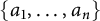 $\{a_1,\ldots ,a_n\}$
is a
$\{a_1,\ldots ,a_n\}$
is a $B_h[g]$
set is open dense in
$B_h[g]$
set is open dense in $X^n$
. For, note that
$X^n$
. For, note that $a\notin \mathcal {V}$
if and only if either
$a\notin \mathcal {V}$
if and only if either $a_i=a_j$
for some
$a_i=a_j$
for some $i\neq j$
or there exist pairwise distinct vectors
$i\neq j$
or there exist pairwise distinct vectors $\alpha _1,\ldots ,\alpha _{g+1} \in \mathbb {N}^n$
such that
$\alpha _1,\ldots ,\alpha _{g+1} \in \mathbb {N}^n$
such that
 $$ \begin{align*}\sum_{i=1}^n\alpha_{1,i}=\cdots=\sum_{i=1}^n\alpha_{g+1,i}=h \end{align*} $$
and
 $$ \begin{align*}\sum_{i=1}^n\alpha_{1,i}a_i=\cdots=\sum_{i=1}^n\alpha_{g+1,i}a_i. \end{align*} $$
In both cases, a belongs to a finite intersection of hyperplanes $\mathcal {H}_\gamma \subseteq X^n$
of the type
$\mathcal {H}_\gamma \subseteq X^n$
of the type $\sum _i\gamma _ix_i=0$
for some
$\sum _i\gamma _ix_i=0$
for some $\gamma \in \Gamma :=(\mathbb {Z} \cap [-h,h])^n\setminus \{0\}$
. Notice that
$\gamma \in \Gamma :=(\mathbb {Z} \cap [-h,h])^n\setminus \{0\}$
. Notice that $\Gamma $
is finite, and that each
$\Gamma $
is finite, and that each $\mathcal {H}_\gamma $
is the kernel of the nonzero continuous linear operator
$\mathcal {H}_\gamma $
is the kernel of the nonzero continuous linear operator $T_\gamma : X^n\to X$
defined by
$T_\gamma : X^n\to X$
defined by $T_\gamma (x):=\sum _i\gamma _ix_i$
, hence
$T_\gamma (x):=\sum _i\gamma _ix_i$
, hence $\mathcal {H}_\gamma $
is closed and has empty interior (see, e.g., [Reference Bogachev and Smolyanov2, Propositions 1.9.6 and 1.9.9]). It follows that
$\mathcal {H}_\gamma $
is closed and has empty interior (see, e.g., [Reference Bogachev and Smolyanov2, Propositions 1.9.6 and 1.9.9]). It follows that
 $$ \begin{align*}X^n\setminus \mathcal{V} \end{align*} $$
can be rewritten as a finite union of finite intersections of hyperplanes $\mathcal {H}_\gamma $
. Thus
$\mathcal {H}_\gamma $
. Thus $X^n\setminus \mathcal {V}$
is closed with empty interior, which is equivalent to our claim.
$X^n\setminus \mathcal {V}$
is closed with empty interior, which is equivalent to our claim.
Acknowledgements
The author is grateful to Melvyn Nathanson and the anonymous referee for a careful reading and useful comments on the manuscript.


 Open access

