Nutrition and obesity are public health priorities due to their links with chronic diseases and the associated costs(Reference Devi, Surender and Rayner1). Obesity in childhood and adolescence is fast becoming a global epidemic and within the UK is at unprecedented levels; 28 % and 31 % of 2–15-year-old girls and boys, respectively, are classified as obese or overweight(2). The rolling programme of the National Diet and Nutrition Survey reported that teenagers’ diet was high in saturated fat and sugar, along with low fruit and vegetable consumption(Reference Bates, Lennox and Bates3). In addition, mean intakes of Fe, Ca, Mg, K and Zn were below recommended levels for teenage boys and girls, the latter also having low intakes of iodine and Se(Reference Bates, Lennox and Bates3). Social deprivation is associated with a poorer nutrient intake profile(Reference Darmon and Drewnowski4, Reference Cummins and Macintyre5). Eating behaviour is learnt early on and food preferences established in childhood and adolescence tend to persist into adult life(Reference Mikkila, Rasanen and Raitakari6, Reference Lien, Lytle and Klepp7), with related consequences for long-term health. Healthy eating habits are crucial to reducing children's risk of health problems, both long- and short-term(Reference Condon, Crepinsek and Fox8). As such, the school food environment is an obvious public health intervention, particularly as children today seem to rely more on school food than three decades ago(Reference Belot and James9).
There are more than 8 million schoolchildren in England(10) and more than 3 million eat a school meal every day, contributing to 590 million school lunches consumed every year(11, Reference Nelson, Nicholas and Riley12). School meals can substantially affect a student's diet and overall health and well-being(Reference Harper and Wood13). School lunch take up has fluctuated over recent years, and in the 2010–2011 school year stood at 44·1 % in primary schools (up by 2·7 % from the previous year) and 37·6 % in secondary schools (also up, by 1·8 %)(Reference Nelson, Nicholas and Riley12).
School food is seen as a way of addressing dietary disparities between children of different socio-economic backgrounds(Reference Belot and James9); health inequalities can be tackled through immediate provision of a nutritious diet, as well as by establishing healthy eating habits that will be carried into adulthood. The Free School Meal programme, which provides a free school meal (FSM) for students from low-income families, can make an important contribution to the diet of poorer children, especially where there may be little guarantee of nutritious food at home. Indeed many such children depend on school meals for their main source of nutrition(Reference Harper and Wood13). FSM are a means-tested entitlement available to families in receipt of Income Support, Jobseeker's Allowance, Child Tax Credit (with an income threshold, currently £16 190 per annum) as well as some other benefits. In secondary schools, 15·9 % of students were eligible for FSM(10) and FSM take up was 69 % of those registered for FSM(Reference Nelson, Nicholas and Riley12).
Full legislation (food-based standards and nutrient-based standards)(14, 15) relating to the provision of food in schools has now been in place since September 2009. The food-based standards stipulate provision, restriction or prohibition of certain foods, e.g. provision of fruit and vegetables, oily fish; restriction of meat products and deep-fried foods; prohibition of confectionery. The nutrient-based standards stipulate the maximum levels for fats, sugars and Na, as well as minimum requirements for some vitamins and minerals in an average lunch.
This average lunch is based on assumptions and approximations. Schools typically operate a 3- or 4-week menu cycle that offers three main meals (‘dishes of the day’) as well as other ‘grab-and-go’ options such as pizza, sandwiches and jacket potatoes. The dishes of the day form the backbone of the menu cycle; their weighting in the menu cycle ensures that an average lunch meets food and nutrient targets, especially for micronutrients such as Ca and Fe. As such, dishes of the day are acknowledged as more nutritionally sound, and ‘schools providing a high proportion of grab and go items or cakes relative to the proportion of main meals provided may find it more challenging to meet the nutrient-based standards, as these items are often less nutrient-dense than main meals’(16). The eating patterns of students in schools and their particular selection of food items from a cafeteria-type menu are critical to the ongoing debate surrounding school food. The present study sought to address the key question of how students’ school food choice relates to current school food standards, and how socio-economic disadvantage, as assessed by FSM entitlement, affects school food choice.
Methods
Data were collected from two large secondary schools located within the same Local Authority (LA) in Yorkshire, England. Both schools held National Healthy Schools Status and utilised the LA catering service. Take up of FSM in School A was 9 %, which is below the national average of 15·9 %(10), while in School B the corresponding figure was 17%.
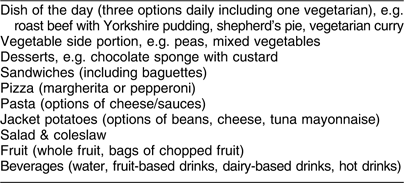
The kitchens of both schools operated a 3-week menu cycle; Table 1 lists some of the items provided. A large selection of foods and beverages were on offer daily including three dishes of the day, which were freshly cooked in-house, as well as other grab-and-go options such as pizza, sandwiches and salad tubs. Students made their selections and paid using a cashless system, now used by more than half of LA catering providers(Reference Nelson, Nicholas and Riley12). Food and beverages chosen are keyed in at the till in the form of price look-up (PLU) codes.
Items typically available to students

A sales database obtained from each school and featuring 80+ PLU codes for a period of more than seven months during the academic year 2010–2011 was analysed. This study period equated to 145 and 125 school days for School A and School B, respectively (the difference being due to the date of data acquisition). The data corresponded to the school food choice for students from Year 7 (age 11–12 years) to Year 11 (age 15–16 years) for School A, and from Year 7 (age 11–12 years) to Year 13 (age 17–18 years) for School B. Each database amounted to more than 130 000 transactions and included all students who made a purchase at any time during the period. Thus, the data corresponded to the school food choice of 1265 and 1395 students, representing 89 % and 81 % of the student population of School A and School B, respectively.
Data analysis
A classification of food type was developed based on PLU code, in conjunction with detailed caterer's food descriptions. All items were categorised into ‘accompaniments’, ‘snacks’, ‘main foods’, ‘desserts, ‘beverages’ and ‘others’. The main foods were categorised further into dishes of the day, pizza, etc. The data were imported and all analyses were conducted using IBM SPSS Statistics version 19. The data were then aggregated by day to give average popularity of food categories, and also by student to obtain information on student choice. Independent t tests were carried out to compare FSM and non-FSM students in each school.
Multiple linear regression models were developed for the dependent variables – number of days a main food was chosen as a percentage of all days any item was chosen (% MAIN) and number of days a dish of the day was chosen as a percentage of days on which main foods were chosen (% DISH) – using FSM and year group as independent variables. We also used an interaction term between year group and FSM. Gender could not be included in the modelling as this information was not available.
Results
Overall choice
A total of 226 611 and 177 763 items were sold over the 7-month period for School A and School B, respectively. The average number of items chosen by students daily was 1563 and 1422 items for School A and School B, respectively.
Figure 1 shows the breakdown of items chosen and compares students’ choice by food category, as a percentage of all items chosen. Main food items comprised the largest proportion of students’ choice (40·1 % and 34·3 % of items for Schools A and B, respectively). Sandwiches and pizza were popular main food items accounting for 40·4 % and 31·2 %, respectively, in School A, and 48·3 % and 27·3 %, respectively, in School B. The freshly prepared dishes of the day, which are more nutritionally valuable, accounted for 8·7 % and 8·3 % of main foods for School A and School B, respectively. This equated to sales of fifty-four and forty portions daily for School A and B, respectively; the corresponding numbers for pizza were 195 and 133 portions daily.
School food choice among students (n 2660) aged 11–18 years from two large secondary schools ( , School A;
  , School B) in Yorkshire, England, academic year 2010–2011. (a) All items (number of items chosen as a percentage of all items chosen; School A, 226 611 items; School B, 177 763 items); (b) main foods (number of items chosen as a percentage of main food items chosen; School A, 90 796 main food items; School B, 60 980 main food items)
Free school meal comparison
FSM students comprised 9 % and 22 % of the students using the catering facilities, and contributed 11·8 % and 36·6 % of the transactions, at School A and School B, respectively. In both schools, FSM students used the catering facilities significantly more (P < 0·001) than non-FSM students (School A: FSM students 102 (sd 36·4) d, non-FSM students 79 (sd 47·2) d; School B: FSM students 91 (sd 31·3) d, non-FSM students 44 (sd 38·9) d). FSM students also ordered main meals on significantly (P < 0·001) more days (School A: FSM students 91 (sd 36·1) d, non-FSM students 63 (sd 46·0) d; School B: FSM students 68 (sd 32·2) d, non-FSM students 30 (sd 32·8) d).
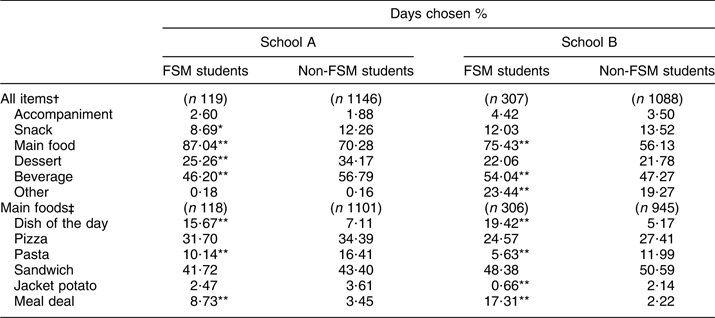
The breakdown of food choices for FSM students and non-FSM students is given in Table 2. The dish of the day, the more nutritionally valuable option, was chosen on a significantly greater (P < 0·001) percentage of days by the FSM students compared with the non-FSM students in both schools. The differential is greater in School B, which had a greater number of FSM students. The percentage of days a ‘meal deal’ was chosen was significantly higher (P < 0·001) for FSM students compared with non-FSM. This preference is relevant as the meal deal includes a dish of the day as well as a side portion of vegetables.
School food choice according to eligibility for free school meals (FSM) and school among students (n 2660) aged 11–18 years from two large secondary schools in Yorkshire, England, academic year 2010–2011
Significantly different from non-FSM students in the school: *P ≤ 0·05, **P ≤ 0·001.
†Number of days an item was chosen as a percentage of all days any item was chosen by a student.
‡Number of days an item was chosen as a percentage of days on which main foods were chosen by a student.
The models developed to predict % MAIN were significant for both schools (School A: F 3,1261 = 14·016, P < 0·001, adjusted R 2 = 3·0 %; School B: F 3,1391 = 31·479, P < 0·001, adjusted R 2 = 6·2 %). For School A and School B, FSM was a significant predictor of main meal uptake (School A: B = 19·2, P < 0·001; School B: B = 16·8, P < 0·001). Year group was not a significant predictor (School A: B = 0·3, NS; School B: B = −4·82 × 10−3, NS) and, likewise, the interaction term between FSM and year group was not a significant predictor of % MAIN (School A: B = −1·3, NS; School B: B = 1·1, NS).
The models which predicted % DISH were also statistically significant (School A: F 3,1215 = 26·051, P < 0·001, adjusted R 2 = 5·8 %; School B: F 3,1247 = 47·106, P < 0·001, adjusted R 2 = 10·0 %). It was found that FSM (School A: B = 7·701, P = 0·002; School B: B = 7·733, P < 0·001) was a significant predictor of dish of the day uptake. Year group was a significant predictor of this meal choice for School A (B = −2·056, P < 0·001) but not School B (B = 0·289, NS). Interaction between FSM and year group was found to be significant in School B only (School A: B = 0·377, NS; School B: B = 3·024, P < 0·001).
Figure 2 shows the results of the regression models. In both schools, FSM students were more likely to choose main foods and more likely to choose a dish of the day; this was consistent for all year groups. For School A, a decrease in dish of the day was seen with increasing year group for both FSM and non-FSM students. In School B, the take up of dish of the day by non-FSM students remained steady for all year groups. However, there was a dramatic increase in take up by year group for FSM students. This interaction between FSM status and year group is clearly seen in Fig. 2.
Effects of eligibility for free school meals ( , FSM;
  , non-FSM) and year group on school food choice among students (n 2660) aged 11–18 years from two large secondary schools in Yorkshire, England, academic year 2010–2011. (a) % MAIN (number of days a main food was chosen as a percentage of all days any item was chosen); (b) % DISH (number of days a dish of the day was chosen as a percentage of days on which main foods were chosen)
Discussion
While the catering company provided nutritionally sound dishes of the day, these were not popular among students, with sandwiches and pizzas dominating their food selection. Such choices are far from the theoretical menu cycle, where dishes of the day play a key role in ensuring school food meets the nutrient-based standards. When selecting main food items, FSM students in both schools chose the freshly prepared dishes of the day more frequently than non-FSM students. Furthermore, in School B (with the higher FSM status), take up of dish of the day for FSM students increased with increasing year group. This interaction between age and food choice may have arisen because the dish of the day may contribute better to the physiological energy requirement increases with age. Further research is needed to examine this and to explore, using qualitative methods, other possible factors underpinning the interaction.
Strengths and limitations of analysis
The study examined school food choice by all students during a substantial part of an academic year and its strength comes from the high number of transactions involved, as well as the inclusion of two different schools. Previous studies utilising the data generated from cashless systems have demonstrated feasibility and power(Reference Lambert, Plumb and Looise17–Reference Lambert, Plumb and Looise19). This is particularly useful as few methods can accurately and unobtrusively record food choice within a school setting(Reference Martin, Thomson and LeBlanc20).
The study has limitations: the data are for students’ choice and not consumption. Nevertheless, choice is the overriding influence upon consumption. Also, data are for food items with varying specificity, e.g. some related to only one product, whereas others related to a group of items such as sandwiches.
Studies have evaluated packed lunches(Reference Evans, Greenwood and Thomas21), vending provision(Reference Matthews, Nelson and Kaur22), and school lunch provision and consumption within primary schools(Reference Haroun, Harper and Wood23, Reference Golley, Pearce and Nelson24) against the food-based and nutrient-based standards. While there is the possibility that the mismatch between students’ food choice and the theoretical menu cycle used to satisfy the standards may be peculiar to these two schools, this is unlikely. Both schools were large schools with no obvious demographic characteristic to set them apart from the mainstream. Despite our two schools having different FSM profiles (one below and one above the national average), students’ preference for sandwiches and pizza v. dish of the day was seen across both schools. This consistency in food ranking is congruent with many studies which have highlighted poor dietary and nutritional choices by children and adolescents(Reference Martin, Thomson and LeBlanc20, Reference Gould, Russell and Barker25, Reference Noble, Corney and Eves26), as well as a preference for fast-food snack options(Reference Noble, Corney and Eves26–Reference Moreno, Kersting and de Henauw28).
It seems that the stringent standards for school food provision are being undermined in the first place by students’ choice. Standards and legislation for school food should be reassessed to take into account students’ food choice behaviour, which clearly challenges the theoretical menu cycle of provision. Secondly, compliance with the standards within the secondary sector is inconsistent and should also be addressed. Compliance with the nutrient-based standards is currently reported to be 76 % for LA catering and 64 % for non-LA catering provision; for the food-based standards, it is 90 % and 80 %, respectively(Reference Nelson, Nicholas and Riley12). Furthermore, a themed inspection by Ofsted (the official body for inspecting schools in England) found only eight out of the sixteen secondary schools visited to be compliant or almost compliant with the food-based and nutrient-based standards(29). Ofsted's new inspection regime does not assess implementation of the standards at all, and schools are no longer expected to report their compliance. Moreover, new academies (formed since September 2010) are not even required to comply with school food standards(30).
Implications for policy and practice
While the introduction of the standards has provided the opportunity for students to choose more nutritionally balanced options, the reality is that students in the present study generally did not do so. Research has shown that students have a good understanding of health and nutrition, are aware of what constitutes a healthy option(Reference Devi, Surender and Rayner1, Reference Noble, Corney and Eves26, Reference Fitzgerald, Heary and Nixon31), but are more likely to make food choices within a school setting for convenience, taste and sociocultural reasons(Reference Noble, Corney and Eves26, Reference Fitzgerald, Heary and Nixon31). Marketing, a key factor in maintaining or improving take up of healthy meals(Reference Nelson, Nicholas and Riley12), undoubtedly has a role to play. In the ultimate pursuit to improve school food, another way forward is to restrict food to healthy options thereby making it easier for healthy choices to be made or introduce a pricing policy in favour of healthier options. Having established that students overwhelmingly prefer grab-and-go food items, this now affords an opportunity to improve their nutrient density.
The current study has highlighted areas for further research. Perhaps most interesting is that FSM students are more likely to select dishes of the day and meal deals compared with non-FSM students. It is not clear why FSM students make healthier choices, given that they have the same free choice as non-FSM students, albeit within the limit of the daily allowance provided to them. Further research to investigate the factors that underpin this healthier choice is needed, in order to establish whether regulation through FSM entitlement could improve students’ diets. The set price of meal deals and dishes of the day (£1·70 and £1·05, respectively) may be a factor but this needs to be explored further.
The Free School Meals programme aims to target the most economically vulnerable in our society. However a study examining the relationship between eligibility and household income has revealed that only a quarter to a half of those children eligible for FSM are in the lowest-income households(Reference Hobbs and Vignoles32), and another study reported that approximately a third of children living in poverty are not entitled to FSM(Reference Royston, Rodrigues and Hunsell33). To ensure the poorest students are captured within the FSM system, a universal FSM policy has been mooted and debated in many quarters(34, Reference Green35). Indeed a £28 million initiative piloted a universal FSM policy in Newham and Durham primary schools for 2 years. The study reported a significant positive impact on the take up of school meals, as well as educational attainment, with pupils making up to 8 weeks’ more progress than similar pupils in comparison areas(Reference Kitchen, Tanner and Brown36). Pupils were also reported to be more willing to try new foods and showed an increased preference for hot foods(Reference Kitchen, Tanner and Brown36). An earlier programme ‘Eat Well, Do Well’ conducted in Hull had multiple benefits, including an increase in lunch take up from 36 % to 64 %, healthier food choices made by students(37) and increased levels of energy and alertness reported by teachers(Reference Colquhoun, Wright and Pike38). The behavioural and educational implications of good diet have been reported in other studies(Reference Belot and James9, Reference Storey, Pearce and Ashfield-Watt39, Reference Golley, Baines and Bassett40), and indeed this has been acknowledged by the Department for Education(Reference Gove41). While universal provision of FSM in England would be costly, estimated at £816 million for secondary schools(37), this has the potential to be offset by reductions in obesity-related health costs.
Conclusions
The food-based and nutrient-based standards have undoubtedly improved the provision of school food, most notably through the prohibition and restriction of sources of high fat and sugar, such as confectionery, crisps and carbonated soft drinks. Our finding of a large discrepancy between foods comprising the theoretical menu cycle and real choices made by students, however, highlights a need for a reassessment of the school food standards.
There is a great deal of momentum in improving the diet of the nation's schoolchildren and public health policy can be a means of propelling this momentum to effect real change. Our results point in the direction of the nutritional advantage of the choices made by FSM students. Further research to understand the key factors driving school food choice towards dish of the day is needed to inform strategy and policy. While there is a commitment to increase the uptake of FSM to those currently eligible(Reference Gove41), there may also be justification for the extension of FSM provision. Such a strategy – although costly at the outset – has the potential to effect substantial change in the diets of students. This would surely reap dividends with reduced public health costs, as well as economic advantage at individual and societal level because students are more likely to go on to fulfil their potential.
Acknowledgements
Sources of funding: This research received no specific grant from any funding agency in the public, commercial or not-for-profit sectors. Conflicts of interest: All authors declare that they had no financial or other contractual agreements that might cause conflicts of interest. A family member of H.E. was employed at one of the participating schools during the period of the study. Authors’ contributions: H.E. conceived the study and recruited the schools and catering company with advice from M.E.B. H.E., M.E.B. and J.R. designed the study. J.R. constructed the data sets. H.E. and J.R. analysed the results. H.E. wrote the first draft of the article, with advice from M.E.B. and J.R. All authors contributed to the drafting and approval of the final manuscript. Acknowledgements: The authors are very grateful to the two schools and LA catering service for participating in the study.