





Hypertension has become a major and increasingly prevalent health concern worldwide. Data from 2023 indicated that approximately 29·4 % of Korean adults aged ≥ 20 years, or approximately 12·6 million individuals, had hypertension in 2020. The prevalence of diagnosed cases more than tripled between 2002 and 2020. Correspondingly, the number of individuals using antihypertensive medication increased nearly 4-fold, while adherence increased more than 12-fold(Reference Kim, Lee and Lee1). Hypertension, defined as a systolic blood pressure (SBP) of 140 mmHg or higher, or a diastolic blood pressure (DBP) of 90 mmHg or higher(Reference Elliott2), is affected by various lifestyle and dietary factors. Notably, high Na consumption significantly impacts hypertension(Reference Luft and Weinberger3). The WHO recommends a daily Na intake of < 2000 mg, but the average Na consumption among Koreans is 3477·2–3889·6 mg per d. Choosing high-Na foods, such as kimchi and instant noodles, contributes to increased Na levels(Reference Jeong, Kim and Lee4). Hence, managing risk factors for developing hypertension is essential among Korean adults.
Tomatoes contain several vitamins, minerals, fibre and carbohydrates and are associated with various positive health effects. Their antioxidant potential is mainly owing to lycopene compounds, which possess beneficial effects at different stages of atherosclerosis. Lycopene influences serum lipid levels, endothelial dysfunction, inflammation, blood pressure and antioxidant potential(Reference Khan, Sevindik and Zarrabi5). Additionally, the potassium in tomatoes improves endothelial and smooth muscle function(Reference Ekmekcioglu, Elmadfa and Meyer6). Research has consistently demonstrated that adequate intake of potassium helps regulate blood pressure to more desirable levels. The blood pressure-lowering effects of potassium have been observed in various intervention trials and reported in meta-analyses(Reference Aburto, Hanson and Gutierrez7,Reference Filippini, Naska and Kasdagli8) .
In 2022, a study found an inverse relationship between tomato intake and the risk of developing hypertension(Reference Zhao, Tian and Liang9). Another study demonstrated that supplementation with 250 mg of lycopene-rich tomato extract significantly reduces SBP and DBP among patients with grade 1 hypertension, indicating that the antioxidant and vasodilating properties of lycopene may contribute to improved blood pressure regulation(Reference Engelhard, Gazer and Paran10). However, limited research has investigated the relationship between tomato consumption and hypertension risk, particularly among Korean adults. Given the evidence suggesting that lycopene and potassium, both abundant in tomatoes, may help lower blood pressure(Reference Khan, Sevindik and Zarrabi5,Reference Ekmekcioglu, Elmadfa and Meyer6) , analysing the relationship between tomato consumption and hypertension is essential in this population.
As the prevalence of hypertension among Koreans continues to increase, its treatment and management have received considerable attention. Prehypertension has recently been identified as a potential predictor of clinical hypertension and, by extension, an indicator of increased cardiovascular risk(Reference Davinelli and Scapagnini11). Therefore, in this prospective cohort study, we aimed to investigate the relationship between tomato consumption and the prevalence of prehypertension in Korean adults.
Methods
Study population
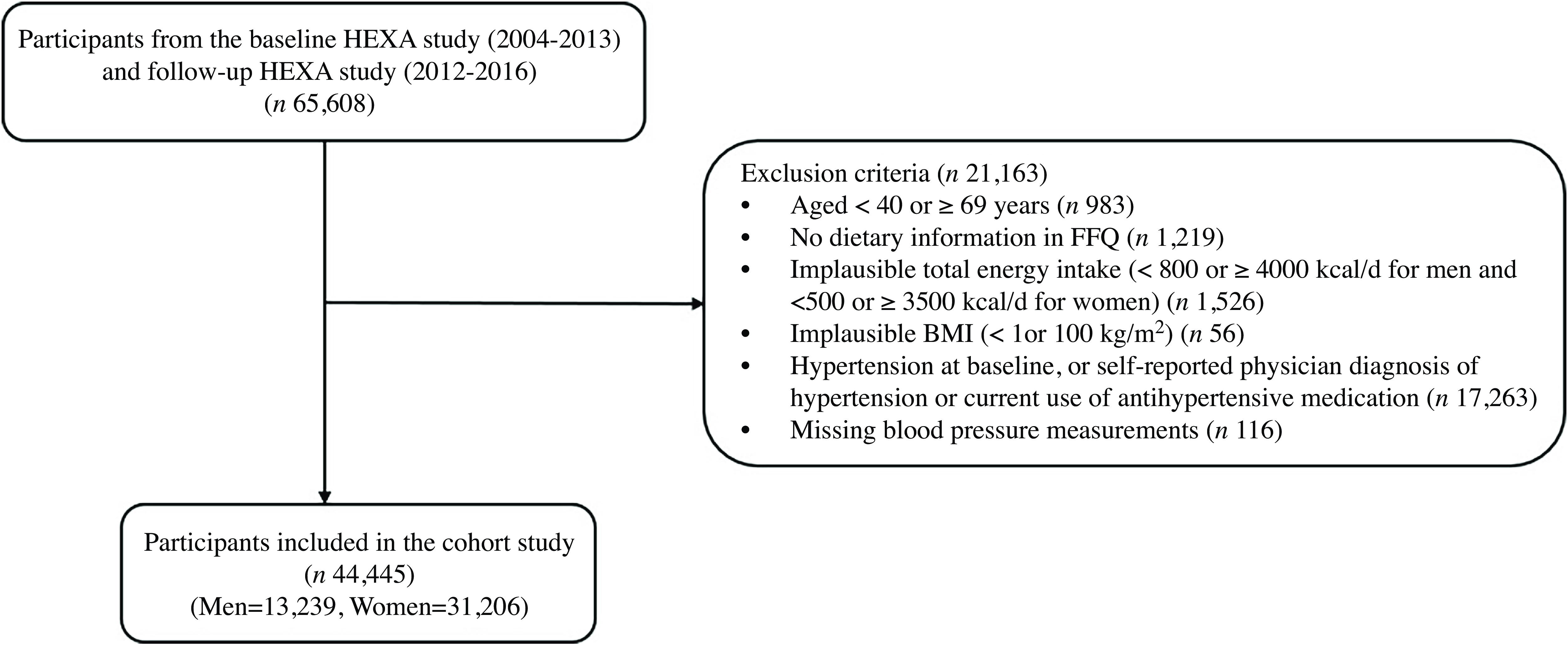
Participants were selected from the Health Examinees study (HEXA), part of the Korean Genome and Epidemiology Study (KoGES), which is a large-scale genomic cohort study designed to investigate the epidemiological and genetic characteristics of chronic diseases in Korea(Reference Kim and Han12). From 2004 to 2013, 173 195 participants aged 40–79 years attended thirty-eight general hospitals and health screening centres across eight regions in Korea for initial interviews and measurements. Of these, 65 608 participants completed the follow-up survey between 2012 and 2016. For this study, 21 163 participants were excluded under the following criteria: those younger than 40 years or older than 69 years (n 983); those without dietary information from the FFQ (n 1219); those with implausible energy intake (< 800 or ≥ 4000 kcal/d for men and < 500 or ≥ 3500 kcal/d for women) (n 1526); those with implausible BMI (< 1 or > 100 kg/m2) (n 56); those with hypertension at baseline, or self-reported physician diagnosis of hypertension or current use of antihypertensive medication (n 17 263); and those with missing blood pressure measurements (n 116). This yielded a final sample of 44 445 participants (13 239 men and 31 206 women) (Figure 1).
Flow chart of study participants from the Health Examinees (HEXA) study in Korea.

Dietary data assessment
Tomato intake was assessed using a validated semi-quantitative FFQ comprising 106 food items. Participants reported how often and how much of each food they had consumed during the previous year. Consumption frequency was categorised into nine levels ranging from ‘never or seldom’ to ‘three times per day’. The average daily intake of raw tomatoes, cherry tomatoes and tomato juice was estimated for each participant. To reduce random within-person variation, this average daily intake was calculated across the two surveys. The KoGES FFQ has been validated against twelve 3-d diet records collected over four seasons, with energy-adjusted correlation coefficients ranging from 0·23 (vitamin A) to 0·64 (carbohydrate) and a median of 0·39 across nutrients, and reproducibility assessed 1 year apart showing a median correlation of 0·45 for nutrient intakes(Reference Ahn, Kwon and Shim13). Participants were then categorised into sex-specific quintiles (Q1–Q5), with Q1 representing the lowest and Q5 the highest. Median values were calculated for each quintile and assigned to participants to allow tests of linear trend across categories in regression analyses. Tomato intake was analysed as unadjusted (absolute) values, with total energy intake included as a covariate in multivariable models. In addition, sensitivity analyses were performed using the residual method (online Supplementary Table 1).
Definition of hypertension and prehypertension
Blood pressure (SBP and DBP) was measured twice using standardised mercury sphygmomanometers, and the average of the two readings was used in the analysis. According to the Korean Society of Hypertension, hypertension is defined as SBP of 140 mmHg or higher or DBP of 90 mmHg or higher. Prehypertension was defined as SBP ranging from 130 to 139 mmHg or DBP from 80 to 89 mmHg, in accordance with the same guidelines. In addition, participants who reported a physician diagnosis of hypertension or current use of antihypertensive medication were also classified as hypertensive(14).
Covariate variables
Sociodemographic and lifestyle factors that are known to influence hypertension were included as covariates: age, sex, household income, education level, alcohol consumption, smoking status, BMI, energy intake and physical activity. Information on these variables was collected at baseline through self-reported questionnaires, apart from BMI, which was calculated from the measured height and weight. Age was categorised into three groups: 40–49 years, 50–59 years and 60–69 years. Household income was categorised as < 3 million won and ≥ 3 million won. Education level was divided into three groups: below middle school, high school and over college. Alcohol consumption was categorised as non-drinker, past drinker and current drinker. Smoking status was categorised as never smoker, past smoker and current smoker. BMI categories were underweight (< 18·5 kg/m2), normal (18·5–22·9 kg/m2), overweight (23·0–24·9 kg/m2) and obese (≥ 25·0 kg/m2)(Reference Kim, Haam and Kim15). Energy intake classifications were > 800 kcal/d to < 4000 kcal/d for men and > 500 kcal/d to < 3500 kcal/d for women. Physical activity was categorised as active or inactive.
Statistical analysis
All analyses were conducted using SAS version 9.4 (SAS Institute). Differences in general participant characteristics according to tomato consumption levels were assessed using χ2 tests for categorical variables and general linear regression for continuous variables. Cox proportional hazards regression models were used to estimate hazard ratios (HR) and 95 % CI for the association between tomato consumption and the risk of prehypertension. Tomato intake was analysed both as categorical variables (quintiles of daily intake, with the lowest quintile as reference) and as a continuous variable (per 1 sd increase in intake).
Multivariable models were adjusted sequentially: model 1 was unadjusted; model 2 was adjusted for age and BMI; and model 3 was further adjusted for income, education, alcohol consumption, smoking status, physical activity and total energy intake. Tests for linear trend (Pfor trend) were conducted by modelling the median value of each consumption category as a continuous variable in the Cox regression. To assess potential effect modification, stratified analyses were conducted according to age (< 53 years and ≥ 53 years), BMI (< 23·0 kg/m2 and ≥ 23·0 kg/m2), alcohol consumption status (non-drinker, past drinker and current drinker) and smoking status (never smoker, past smoker and current smoker). The statistical significance level was set at P < 0·05. Interaction terms between tomato intake and each stratifying variable were added to the multivariable Cox models, and the statistical significance of interaction was evaluated using the likelihood ratio test (P for interaction). The proportional hazards assumption was assessed by examining log(−log) survival curves across exposure categories and by including time-dependent covariates, with no meaningful violations observed.
Results
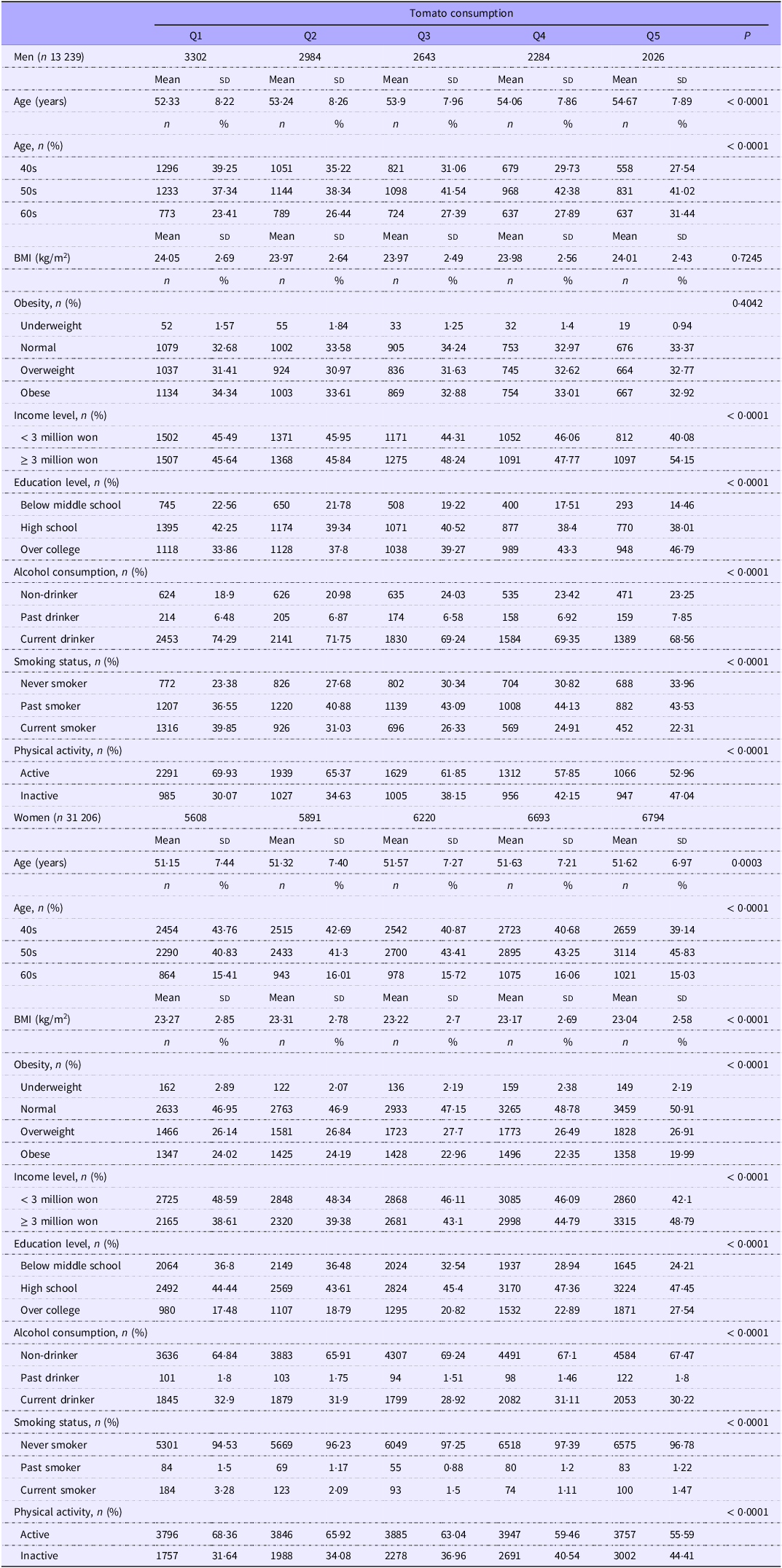
A total of 44 445 participants (13 239 men and 31 206 women) were included in the analysis. Table 1 presents the general characteristics of participants based on tomato consumption levels. Increased tomato consumption was observed among women, as well as among those with higher household income and higher educational levels. Physical inactivity was prevalent among those with higher tomato consumption in both men and women (P < 0·0001). Among men, higher tomato consumption correlated with lower alcohol consumption and a higher likelihood of being a non-smoker (P < 0·0001).
Baseline characteristics of participants according to the quartiles of tomato consumption

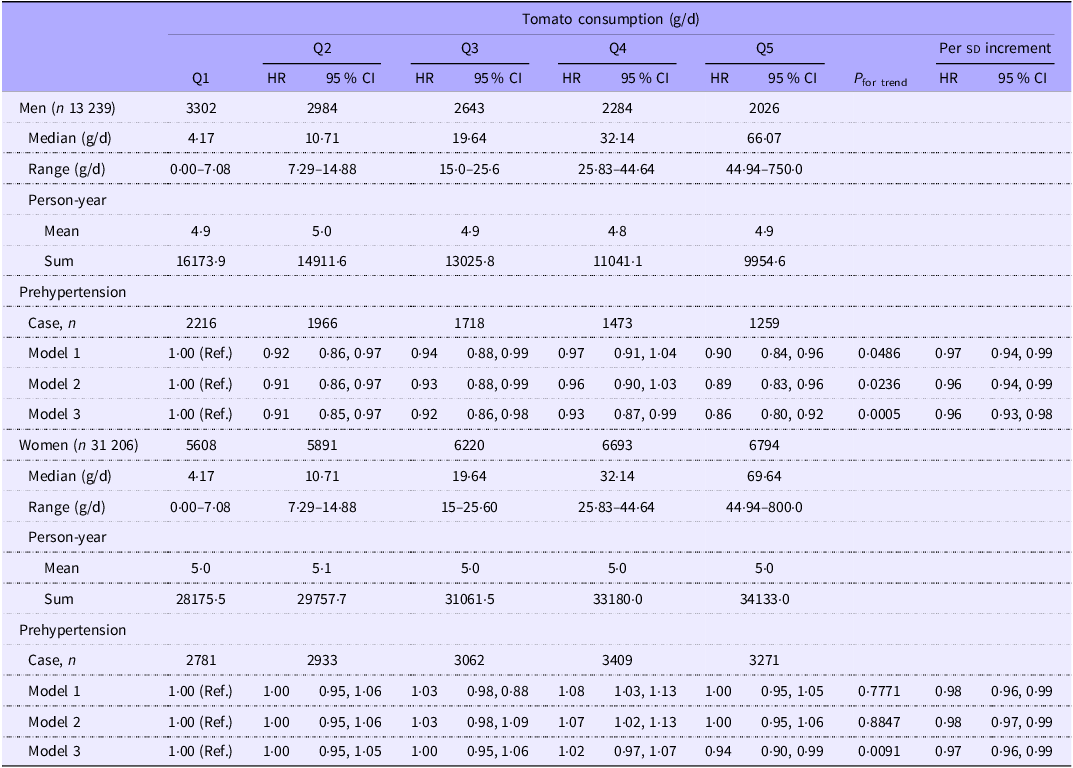
Table 2 shows the HR and 95 % CI for prehypertension according to quintiles of tomato consumption. Participants with higher tomato consumption exhibited a trend towards better blood pressure levels than those with lower intake. After adjusting for all covariates, the highest quintile of tomato consumption was associated with a lower risk of prehypertension in men (HR: 0·86, 95 % CI 0·80, 0·92, P for trend: 0·0005) and women (HR: 0·94, 95 % CI 0·90, 0·99, P for trend: 0·0091). When we analysed as a continuous variable, each 1-sd increase in tomato intake was associated with a lower risk of prehypertension in both men (HR 0·96, 95 % CI 0·93, 0·98) and women (HR 0·97, 95 % CI 0·96, 0·99) in the fully adjusted model. These findings were consistent with results from the quintile-based analyses. Notably, in women, the association was not evident in the crude model but became significant after multivariable adjustment, suggesting potential confounding by lifestyle factors.
HR and 95 % CI for prehypertension according to tomato consumption

HR, hazard ratios.
n 44 445; values are presented as n, median (min-max) and HR (95 % CI).
Model 1: Crude model.
Model 2: Adjusted for age and BMI.
Model 3: Additionally adjusted for education level, income level, smoking status, alcohol consumption and total energy intake; P values for trends were calculated using multivariable Cox proportional hazards regression.
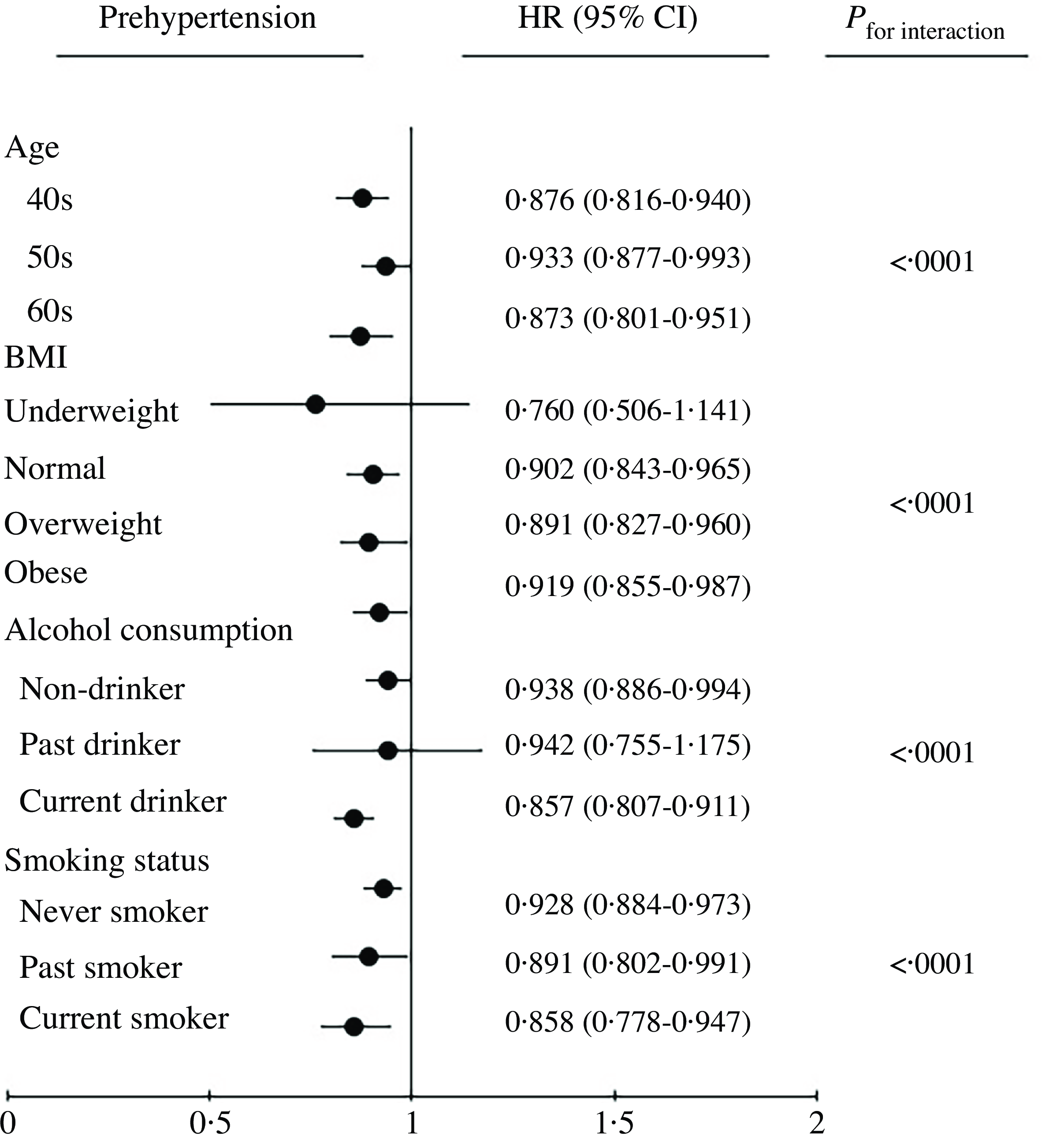
Stratified analyses were also conducted to assess the association between tomato consumption and prehypertension across subgroups based on age, BMI, alcohol consumption status and smoking status as shown in Figure 2. The protective effect of higher tomato consumption was significant in most subgroups, except for the underweight group and past drinkers (all P for interaction < 0·05).
HR and 95 % CI for prehypertension in the comparison of the highest quintile of tomato consumption as stratified covariates. Values are presented as HR (95 % CI). Non-drinker: never consumed alcohol; past drinker: previously consumed alcohol but no longer does; current drinker: currently consumes alcohol. Never smoker: never smoked cigarettes; past smoker: previously smoked > 400 cigarettes but no longer does; current smoker: currently smokes and has smoked > 400 cigarettes in their lifetime. HR, hazard ratio.

Discussion
This comprehensive cohort study analysed the relationship between tomato consumption and prehypertension risk in a large sample of Korean adults. Findings revealed that higher tomato intake was associated with a reduced risk of prehypertension in both men and women, even after adjusting for potential confounders. These findings are consistent with those reported by previous studies highlighting the cardiovascular benefits of tomato consumption and its bioactive components. For instance, a cohort study of 11 460 Chinese adults aged > 18 years reported a 49–58 % lower risk of new-onset hypertension in those who were in the tomato-fed group than those in the non-fed groups(Reference Zhao, Tian and Liang9). In addition, recent studies have shown that higher consumption of tomatoes and lycopene is significantly associated with reduced risks of total mortality, CHD and cerebrovascular mortality, suggesting the potential health benefits of incorporating these foods into a balanced diet(Reference Mazidi, Katsiki and George16). In animal studies, mice supplemented with tomato products and lycopene exhibited reduced blood sugar levels, favourable inflammatory responses and enhanced metabolite profiles linked to antioxidant activity(Reference Fenni, Hammou and Astier17,Reference Jesuz, Elias Campos and Rosse de Souza18) . These beneficial effects may be contributed to the presence of beneficial constituents, such as lycopene, flavonoids and ascorbic acid. Lycopene, one of the most potent antioxidants and the most commonly found carotenoid in human plasma(Reference Mordente, Guantario and Meucci19), is presumed to be an active compound responsible for the advantage of tomato consumption(Reference Mein, Lian and Wang20). However, excessive tomato consumption may weaken their protective effects, which are associated with excessive solanine consumption(Reference Zhao, Tian and Liang9).
The blood pressure-lowering properties of tomatoes and lycopene are known to be due to stimulating nitric oxide production in endothelial cells(Reference Umans and Levi21). Daily consumption of tomato extract or juice for at least 4 weeks significantly reduces blood pressure(Reference John, Ziebland and Yudkin22,Reference Paran, Novack and Engelhard23) . Oxidative stress plays a key role in hypertension by generating reactive oxygen species that impair vascular function, leading to reduced nitric oxide synthesis and diminished antioxidant bioavailability(Reference Griendling, Camargo and Rios24). Animal studies have shown that long-term lycopene consumption effectively protects against oxidative stress-induced DNA damage in the liver(Reference Li, Deng and Liu25). In addition, data from the National Health and Nutrition Examination Survey indicated an inverse relationship between plasma lycopene levels and hypertension prevalence in overweight and obese individuals(Reference Han, Meza and Soliman26). In addition to lycopene, tomatoes are rich in hydrophilic compounds particularly polyphenols, such as flavonoids and phenolic acids, which modulate hypertension risk through various mechanisms(Reference Raiola, Rigano and Calafiore27,Reference Uddin, Biswas and Ghosh28) . A randomised controlled trial found that these hydrophilic compounds beneficially lower blood pressure in men with prehypertension by inhibiting angiotensin-converting enzyme activity(Reference John, Ziebland and Yudkin22). Potassium also contributes to blood pressure reduction, and 100 g of tomatoes contains 212 mg of potassium, helping to prevent the harmful effects of Na(Reference Perveen, Suleria and Anjum29).
A key strength of this study is its use of large cohort data and extended follow-up periods among Korean adults to examine the association between tomato consumption and hypertension. The use of a validated FFQ, standardised blood pressure measurements and extensive covariate adjustment further strengthened the reliability of our findings. In addition, the large and geographically diverse sample enhances the generalisability of the results to middle-aged and older Korean adults. However, the limitations should be considered. First, the study did not distinguish between raw and processed tomato products, which may have differing health effects owing to added Na or other ingredients. Second, nutrient-level variables such as lycopene and potassium were not included in our analysis, which limited direct evaluation of their specific contributions. Further studies are needed to disentangle these effects by incorporating nutrient-level covariates or biomarker data, such as plasma lycopene and serum potassium levels. Although such analyses were beyond the scope of the present dataset, further research with detailed nutrient composition or biomarker information will help clarify whether the observed protective association is attributable to specific components or to the overall food matrix of tomato consumption. Finally, a considerable number of participants were excluded because of missing or implausible dietary data and pre-existing hypertension; however, these exclusions were determined by predefined and objective criteria to ensure validity of the measurements. Such exclusion approaches are widely applied in large-scale cohort studies(Reference Lee, Woo and Cho30). While some degree of selection bias cannot be completely ruled out, the final analytic sample was sufficiently large and broadly representative of middle-aged and older Korean adults.
The study’s findings emphasise the potential of dietary interventions, particularly increased tomato consumption, as a strategy to prevent prehypertension and hypertension. This observation is pertinent in countries like Korea, where high Na intake poses significant public health challenges. Future research should include longitudinal dietary assessments and examine the distinct effects of raw v. processed tomato products to provide more precise dietary recommendations.
In conclusion, this study contributes to the increasing evidence that higher tomato consumption is associated with a reduced risk of prehypertension. Incorporating tomatoes into a balanced diet may provide significant benefits for blood pressure management and could be promoted as a preventive measure to mitigate the progression to clinical hypertension.
Supplementary material
For supplementary material/s referred to in this article, please visit https://doi.org/10.1017/S0007114525105710
Acknowledgements
This study used data from the HEXA study, which was supported by the National Genome Research Institute and the Korea Centres for Disease Control and Prevention. This study was also supported by the Chung-Ang University Young Scientist Scholarship (CAYSS) in 2024.This work was supported by the National Research Foundation of Korea (NRF) grant funded by the Korea government (MSIT) (RS-2025-00556573).
W. K.: Conceptualisation, Methodology, Formal analysis, Data curation, Writing – original draft and Writing – review and editing. D. K., H. K. and E. C.: Formal analysis, Data curation and Writing – original draft. K. L.: Validation, Writing – review and editing, and Supervision. S. S.: Conceptualisation, Methodology, Visualisation, Supervision, Project administration and Funding acquisition. The authors declare that there are no commercial or financial relationships that could be perceived as a potential conflict of interest in relation to this research.


 Open access

