




1. Introduction
Pronunciation instruction has received different degrees of attention throughout the history of language teaching. For much of the history of language teaching, pronunciation instruction was tied to the belief that learners should sound as close to native speakers as possible. Even when pronunciation was pushed to the margins, as in Kelly’s (Reference Kelly1969) metaphor calling pronunciation the “Cinderella” of language teaching, the underlying goal remained nativeness.
At the same time, there were early challenges to this assumption. Abercrombie (Reference Abercrombie1949) pioneered the argument that intelligibility, rather than copying native models, should be the primary goal of pronunciation teaching. This idea was taken further in a series of studies by Smith and colleagues. Smith and Rafiqzad (Reference Smith and Rafiqzad1979), for instance, found that, contrary to common assumptions, the American native speaker was consistently ranked as one of the least intelligible speakers. This challenged the dogma that a native-speaker model is essential for international communication. Smith and Bisazza (Reference Smith and Bisazza1982) broadened this research, testing the comprehensibility of different English varieties across seven countries and again demonstrating that native norms were not the only route to understanding. Later, Smith and Nelson (Reference Smith and Nelson1985) proposed three terms—intelligibility, comprehensibility, and interpretability—and emphasized that native speakers are not the only judges of intelligibility and are not always more intelligible.
It is important to distinguish between the concept of intelligibility, as explored by Smith and Nelson (Reference Smith and Nelson1985), and the Intelligibility Principle, formally proposed by Levis (Reference Levis2005) as a pedagogical framework for pronunciation teaching. Although these earlier studies on intelligibility did not immediately reshape classroom practices, they set out an alternative vision of pronunciation goals. Their insights can be seen in later work: Munro and Derwing (Reference Munro and Derwing1995) and Derwing and Munro (Reference Derwing and Munro1997) showed that speech could be heavily accented yet highly intelligible, and Jenkins’ (Reference Jenkins2000) Lingua Franca Core (LFC) identified specific phonological features essential for communication among diverse non-native speakers. Together, this body of work facilitated an important shift in pedagogical goals for pronunciation teaching.
Building on this foundation, Levis (Reference Levis2005) coined the term “Intelligibility Principle,” contrasting it with the Nativeness Principle, which maintains that learners should approximate native-speaker norms. According to Levis (Reference Levis2005, p. 370), the Intelligibility Principle holds that “learners simply need to be understandable” and it recognizes that “communication can be remarkably successful when foreign accents are noticeable or even strong” and that “certain types of pronunciation errors may have a disproportionate role in impairing comprehensibility.” This principle represents a specific pedagogical perspective: pronunciation instruction should focus on being understood rather than being dependent on native-speaker norms, which is consistent with earlier research that highlighted the importance of teaching pronunciation features most crucial to understanding (Jenkins, Reference Jenkins2000), the legitimacy of multicompetent second language (L2) users (Cook, Reference Cook1999), and the role of intelligibility and comprehensibility in communication (Munro & Derwing, Reference Munro and Derwing1995).
Although the distinction between the goals of the Nativeness and Intelligibility Principles is now widely recognized, debates surrounding their practical implementation remain unresolved (Hodgetts, Reference Hodgetts2020; Jarosz, Reference Jarosz2019; Pennington & Rogerson-Revell, Reference Pennington and Rogerson-Revell2019; Wang & Wen, Reference Wang and Wen2023).
The global shift toward the Intelligibility Principle in the early twenty-first century was gradually echoed in China, albeit amid deeply rooted traditions that favor native-like pronunciation. Initial exposure to the principle can be traced back to the post-2000 era, when Chinese scholars began engaging with international debates on English as a Lingua Franca (ELF) and intelligibility. From both ideological and empirical perspectives, early academic discussions in China began to question the exclusive pursuit of native-speaker norms (Qiong, Reference Qiong2004) and explored the intelligibility of Chinese-accented English (Wang & van Heuven, Reference Wang, van Heuven, Cornips and Fikkert2003). Qiong (Reference Qiong2004) revealed through a survey that most learners in China still regarded American or British English as their ultimate goal, but she argued that it was neither desirable nor attainable for Chinese learners to conform to these standards, especially in pronunciation, and proposed the recognition of “China English” as a legitimate variety. Wang and van Heuven (Reference Wang, van Heuven, Cornips and Fikkert2003) tested mutual intelligibility among Chinese, Dutch, and American speakers of English at the segment, word, and sentence levels. Chinese-accented English was found to be more difficult to understand; their results also revealed a significant shared-first language (L1) advantage, demonstrating the importance of a listener’s background in perceiving English speech. Chen (Reference Chen2011) reported that Chinese-accented English was 70% intelligible to listeners of different language backgrounds, including Filipino, Pakistani, Japanese, and Korean. Together with insights from Jenkins’ (Reference Jenkins2000) LFC and Derwing and Munro’s (Reference Derwing and Munro2005) pedagogical recommendations, these works sparked preliminary debates in Chinese journals about redefining objectives of English teaching (Fan, Reference Fan2007; Luo & Zhang, Reference Luo and Zhang2002; Pei, Reference Pei2014; Wen & Yu, Reference Wen and Yu2003).
By the late 2000s, empirical studies began exploring intelligibility in Chinese contexts. For instance, Hardman’s (Reference Hardman2010) study on listener perceptions of accented English discovered that deviations from native norms did not necessarily hinder comprehension, particularly in interactions between Chinese speakers and other non-native users of English. Such findings not only supported Munro and Derwing (Reference Munro and Derwing1995) but also challenged the assumption that native-like accuracy was essential for effective communication.
As for education policies, some acknowledgments of the Intelligibility Principle can be found. Although native English models remained dominant in teaching materials, China’s National English Curriculum Standards after 2017 have used descriptions such as “communicative effectiveness” and “context-appropriate pronunciation.” At the same time, teacher training programs began to include sessions on intelligibility (Bai & Yuan, Reference Bai and Yuan2019; Zhang, Reference Zhang2022).
Because of the preferences for native accents in high-stakes testing (e.g., the College English Test [CET]) and societal prestige attached to “standard” pronunciation, progress has not been significant (Huang & Hashim, Reference Huang and Hashim2021). Moreover, the lack of localized guidelines for implementing intelligibility-focused instruction has left teachers uncertain about which features should be prioritized (Tan, Reference Tan2023). Despite these challenges, recent years have seen growing advocacy for the principle, particularly in response to China’s global engagement. Scholars argue that intelligibility aligns with the country’s need for English as a tool for international communication (Wang & Wen, Reference Wang and Wen2023). This dynamic environment sets the stage for examining how the Intelligibility Principle is currently received and implemented, or resisted, in the Chinese English as a Foreign Language (EFL) context.
This article explores key questions about the reception and implementation of the Intelligibility Principle in China, home to the world’s largest population of EFL learners (Osnos, Reference Osnos2008; Wang & Wen, Reference Wang and Wen2023) and a representative country in Kachru’s expanding circle (Reference Kachru1986) by tracing the dominance of the Nativeness Principle in China’s English education and the emerging, though limited, influence of the Intelligibility Principle. It also identifies barriers to wider adoption and proposes strategies for a more inclusive, intelligibility-focused approach to pronunciation teaching.
2. Nativeness Principle dominating in China
Before the 1960s, the Nativeness Principle dominated pronunciation teaching (Levis, Reference Levis2005). In spite of substantial evidence opposing it, the principle continues to influence pronunciation teaching, which can be seen in China’s national curriculum standards, instructional materials, and teachers’ beliefs and practices.
The development of national curriculum standards for English-language education in China has developed through five distinct phases, as discussed by scholars (Dai & Hu, Reference Dai and Hu2009; Liu & Wu, Reference Liu and Wu2015; Wang & Wen, Reference Wang and Wen2023). These phases are: Beginning Independent Development (1949–1977), Starting Consistent English Language Education (1978–1990), Integrating with Globalization (1991–2000), Deepening Reform and Innovation (2001–2017), and Further Innovation (2018–present). Different educational, social, and global priorities are reflected in the different phases (Wang & Wen, Reference Wang and Wen2023).
Table 1 shows the pronunciation guidelines outlined in key national curriculum documents across five historical phases of English education in China. As noted by Wang and Wen (Reference Wang and Wen2023), during the phase of Starting Consistent English Language Education (1978–1990), China took significant steps in the direction of formalizing English-language teaching across the country. The frequent use of terms like “standard,” “accurate,” and “correct” when describing English pronunciation requirements can be found in this period (see the “Quotes” column in Table 1). These terms were used to emphasize the importance of teaching English in a way that was deemed linguistically precise, with a particular focus on pronunciation.
Pronunciation policy shifts in the National English Curriculum Standards (five phases)
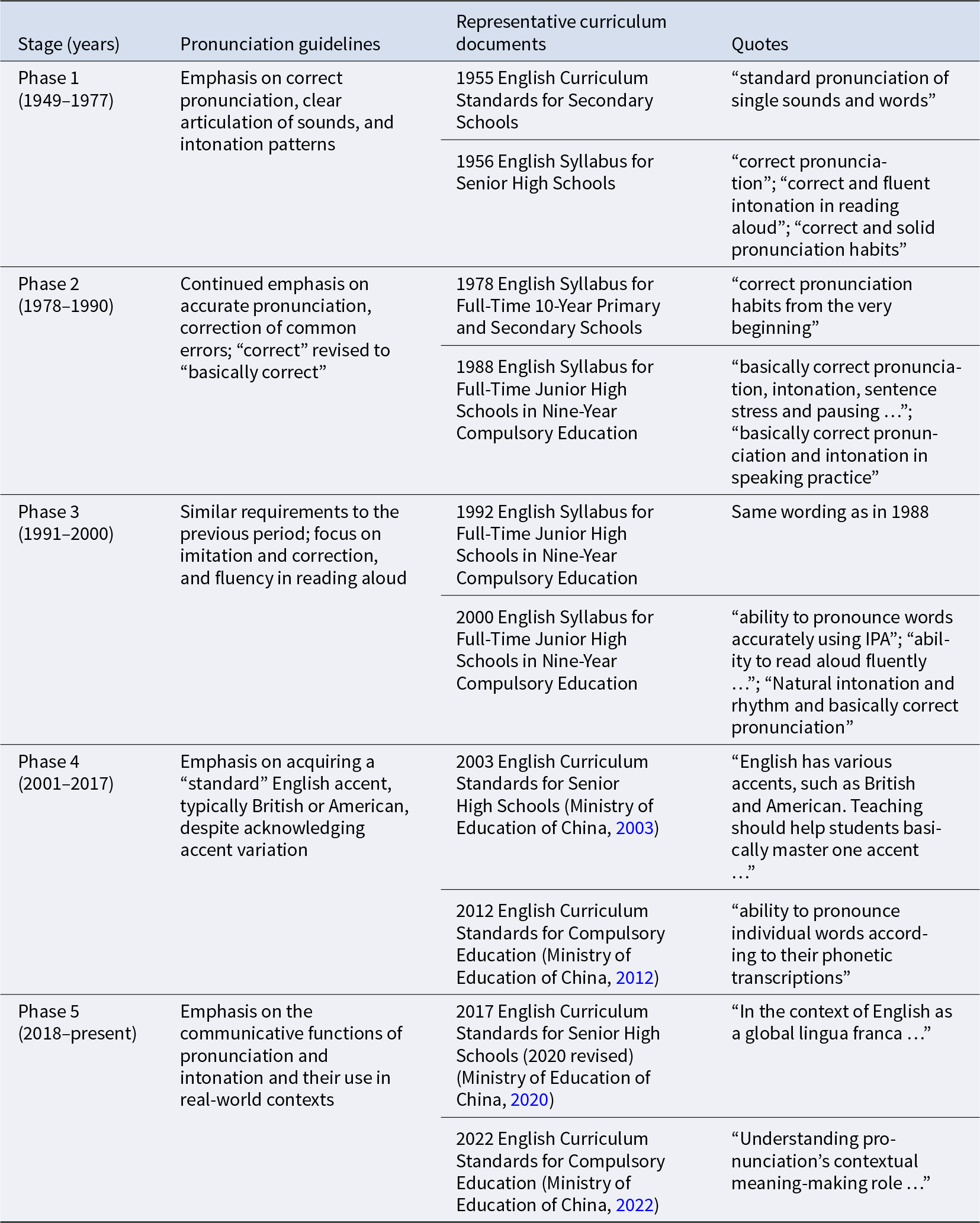
Table 1 Long description
The table outlines shifts in pronunciation guidelines within the National English Curriculum Standards across five phases from 1949 to the present. Initially, there was a strong emphasis on correct pronunciation and articulation, which gradually shifted towards focusing on communicative functions and real-world application. Phase 1 emphasized correct pronunciation and intonation, while Phase 2 introduced the concept of 'basically correct' pronunciation. Phase 3 maintained similar requirements but added fluency in reading aloud. Phase 4 focused on mastering a 'standard' English accent, acknowledging variations. Phase 5 highlights the importance of pronunciation in communication and its contextual role. The evolution reflects a broader trend towards practical language use in global contexts.
Note: Information for documents up to 2000 is based on Dai and Hu (Reference Dai and Hu2009) and Wang and Wen (Reference Wang and Wen2023).
As the country moved into Phase 2 (1978–1990), the words used in official documents describing requirements for the English syllabus began to change slightly, with phrases like “basically correct” or “basically accurate” becoming more prevalent. This softening indicates an implicit recognition by policymakers that strict adherence to native-speaker norms may not be entirely realistic or necessary. However, this ambiguity raises a critical question: how did this early standard-setting influence later pronunciation instruction in China?
The answer can be found in curriculum documents issued during the phase of Deepening Reform and Innovation (2001–2017): the early emphasis on native-like pronunciation continued to influence the requirements throughout this phase. For instance, the 2003 and 2012 standards explicitly suggested that students should master one of the major English accents, typically British or American, while acknowledging the existence of accent variation. This description reinforced the dominance of native-like pronunciation models, reflecting the belief that aligning students’ speech with native-speaker norms was the goal. But was this focus on native-like pronunciation effective for communicative competence? Evidence suggests that it was not. Chen (Reference Chen2021) revealed that an overemphasis on native-speaker models can lead to pronunciation anxiety and decreased willingness to communicate among learners. Additionally, while the policy discourse promoted native-like pronunciation as the goal, it largely overlooked practical constraints such as the limited exposure of Chinese learners to native speakers and the lack of pronunciation training in teacher education programs.
The dominance of native-speaker norms continues to shape both classroom practices and attitudes of teachers and students to English pronunciation. For example, achieving a native-like accent is evident in the accompanying audio materials provided with textbooks used throughout the country. This emphasis underscores the continued preference for native models of English. Several studies (Jin, Reference Jin2017; Zhu, Reference Zhu2018) have noted that the Received Pronunciation (RP) phonetic system is widely used in textbooks and teaching resources across China and is regarded as the principal phonetic system in the country’s English-language teaching programs. This preference for RP highlights the deep-seated belief in the superiority of native-speaker pronunciation, especially British English, as the standard model for learners. This perception is not unique to China but aligns with global trends where native-speaker norms have historically shaped EFL instruction (Wach, Reference Wach2011).
Scholars have further observed that English accent varieties presented in textbooks in China are rather limited, with a clear focus on “standard English” varieties. Research by Bai (Reference Bai2013), Shen (Reference Shen2014), and Huang (Reference Huang2019) confirms that the inclusion of other varieties of English, such as regional or international English accents, is still minimal, leading to a narrow representation of the global diversity of English pronunciation. Textbooks published by the People’s Education Press (PEP) and Longman Group Ltd. have been staple resources for English-language learners in schools across the country. In the mid-to-late 1990s, the accent featured in the audio recordings accompanying PEP’s English textbooks was overwhelmingly RP, reflecting the national preference for this prestigious British accent as the model for teaching pronunciation. As Wang and Wen (Reference Wang and Wen2023) noted, this continued focus on RP as the model for English pronunciation in educational materials clearly indicated the long-standing influence of the Nativeness Principle in shaping English-language instruction in China. Despite some gradual changes, the dominance of RP continues to play a central role in English-language teaching resources and practices. This limited attention to alternative pronunciation models raises concerns about whether learners are being adequately prepared for communication in real-world contexts, where English is spoken with a multitude of accents.
Given that numerous studies have demonstrated the guiding influence of curriculum standards on teachers’ beliefs and instructional practices (Borg, Reference Borg2003; Tan, Reference Tan2023; Wang & Luo, Reference Wang, Luo and Gao2019), and that the accents presented in the audio recordings serve as pronunciation models, it is not surprising that many non-native English-speaking (NNES) teachers hold the belief that achieving a native-like pronunciation should be the ultimate goal for their students and that pronunciation is best taught by native speakers of English, who are often seen as the ultimate authority on correctly pronouncing English words (Bai & Yuan, Reference Bai and Yuan2019). These beliefs extend beyond classroom instruction to shape institutional hiring preferences. Wang (Reference Wang2018) observed that, when recruiting English teachers, school administrators often prefer hiring native speakers of English, prioritizing this characteristic over other qualifications. This practice, which is based on the belief that native speakers are better at teaching English pronunciation than non-native speakers, may contribute to the marginalization of NNES teachers. It is worth noting that this practice overlooks growing research that highlights the strengths of NNES teachers, particularly in pronunciation pedagogy. For instance, Wang (Reference Wang2023) argues that NNES teachers’ own experiences as English learners enable them to provide targeted instruction that helps students grasp pronunciation elements more accurately. Additionally, the shared mother tongue (e.g., Mandarin Chinese) between NNES teachers and Chinese learners further enhances their effectiveness in pronunciation teaching, and an increasing number of studies have highlighted the benefits of leveraging L1 in this context (Jiao, Reference Jiao2012; Liu, Reference Liu2014; Yuan, Reference Yuan2017). This hiring practice in turn reinforces the ideology that sustains native-speaker dominance and makes it more difficult to realize intelligibility-focused pronunciation instruction.
In addition, the case study on primary school English teachers’ pronunciation instruction conducted by Yao (Reference Yao2016) revealed a striking paradox: although these teachers acknowledged that pronunciation should be as important as grammar, writing, and reading, they allocated significantly less instructional time for teaching pronunciation. This mismatch was attributed to the exam-oriented curriculum prioritizing grammar, writing, and reading, as well as a lack of pronunciation-focused teacher training, and the absence of clear instructional guidelines. Similar findings were observed by Tan (Reference Tan2023) among junior high school English teachers, further indicating that this issue is systemic rather than isolated.
On the whole, the emphasis on native-like accents in curriculum standards, reliance on RP in textbooks, and the impact on teachers’ beliefs in teaching pronunciation and hiring practices are closely aligned with the key characteristics of the Nativeness Principle, which sees helping learners achieve a native-like accent as the primary goal of English pronunciation teaching.
3. Subtle shift influenced by the Intelligibility Principle in China
With the rapid growth of English as an international language during the 1970s and 1980s, many researchers in English teaching and applied linguistics shifted focus from strict nativeness to mutual intelligibility and communicative effectiveness. Kachru’s concept of World Englishes (Reference Kachru1986) challenged native norms, validating diverse English varieties in Outer and Expanding Circles. Jenkins’ LFC (Reference Jenkins2000 Reference Jenkins2004), Levis’ advocacy for intelligibility-focused classrooms (Reference Levis2018), and Jenkins and Leung’s call for alternative proficiency assessments (Reference Jenkins and Leung2019) further strengthened a framework prioritizing intelligibility over native-like accuracy in English-language teaching. This also has contributed to the advancement of the Intelligibility Principle in English-language teaching in China, as seen in national curriculum standards, instructional materials, and teachers’ beliefs and practices.
In China, the latest revisions of the national English Curriculum Standards (Phase 5) present a significant change in how pronunciation is understood and taught. These revisions can be found in the 2022 English Curriculum Standards for Compulsory Education, as well as the General Senior High School standards, which were first issued in 2017. As summarized in Table 1, compared to earlier curriculum standards, the new guidelines place a stronger emphasis on the communicative roles that pronunciation and intonation play in language learning, with intonation mentioned separately to reflect the terminology in the curriculum standards. This represents a noteworthy distinction from previous curriculum standards, whose focus on pronunciation was often more narrowly defined in terms of achieving “native-like” speech and less in terms of its function in actual communication.
For the first time, these standards explicitly point out the importance of pronunciation and intonation as tools for meaning-making and effective expression, emphasizing the need for students to be able to apply their pronunciation knowledge in real-life contexts, suggesting that pronunciation instruction should be practical, relevant, and tied to real-world communication scenarios. This emphasis aligns with the features of the intelligibility-based approach to pronunciation instruction (Levis, Reference Levis2018): for example, pronunciation instruction should be seen in communicative settings rather than being treated as an isolated skill.
Moreover, the 2022 English Curriculum Standards for Compulsory Education introduce the concept of “lingua franca” to describe the role of English in global communication. This recognition of ELF further challenges the traditional emphasis on native-like pronunciation and highlights the growing importance of communication effectiveness and intelligibility in a world where English is spoken by non-native speakers across various contexts.
However, this emerging emphasis in curriculum standards contrasts with how pronunciation models are represented in practice, particularly in textbooks. Since the early twenty-first century, American English accents have been increasingly used in the audio resources of English textbooks, which historically favored British English (Wang & Wen, Reference Wang and Wen2023). The newest edition of textbooks published by the PEP, introduced in September 2024, adopts General American (GA) as the primary pronunciation model. However, this shift from RP to GA reflects a change within the native-speaker framework rather than a departure from it.
Even though only RP and GA are currently included in textbook materials, the narrow range of pronunciation models has at least started to gain prominence in scholarly and pedagogical discussions, particularly in light of research indicating that Chinese university students majoring in English tend to exhibit a relatively conservative attitude toward phonetic variation in the language. For example, Xu’s (Reference Xu2018) study has shown that many of these students adhere to a monolithic perspective that prioritizes the norms of British and American standard English, often perceiving them as the most prestigious or authoritative models of pronunciation. This might be explained by results of some empirical research suggesting that repeated exposure to particular accents in instructional resources can reinforce students’ preferences for those varieties, thereby influencing their beliefs about what constitutes “correct” or “acceptable” pronunciation (Lin et al., Reference Lin, Li, Li, Zhang and Luo2019).
Changes in teachers’ beliefs about pronunciation instruction can be seen from diverse perspectives on teaching goals, instructor identity, and the role of the mother tongue in English pronunciation teaching. Concerning teaching goals, Liu (Reference Liu2020) found that while some teachers still emphasized the importance of students acquiring a native-like accent, others have started to prioritize effective communication. Regarding instructor identity, some scholars have recognized the effectiveness of NNES teachers, especially those who share the same L1 as their students. Wang (Reference Wang2023) claimed that their experience of being English learners allows them to provide targeted instruction that helps learners grasp these elements more accurately. As for the role of the mother tongue, an increasing number of studies have highlighted its benefits in pronunciation instruction when shared between teacher and students (Jiao, Reference Jiao2012; Liu, Reference Liu2014; Yuan, Reference Yuan2017). More specifically, Yu (Reference Yu2015) observed that when teaching English consonants and vowels, teachers can draw comparisons between English and Chinese pronunciation, enhancing their understanding of the differences between the two sound systems by making use of students’ existing linguistic knowledge. Moreover, Zou (Reference Zou2014) argued that explaining pronunciation knowledge and rules in L1 is particularly helpful for junior high school students, who have the cognitive maturity to engage with such instruction more analytically than primary-level learners.
Although changes can be observed in English Curriculum Standards, these changes have not yet produced a significant impact on practical classroom teaching regarding the application of the Intelligibility Principle. One of the primary reasons is the persistent disconnect between academic research and actual teaching practices, a challenge widely acknowledged in the field of language education (Lysenko et al., Reference Lysenko, Abrami, Bernard, Dagenais and Janosz2014; Nozaleda & Calubaquib, Reference Nozaleda and Calubaquib2020; Sifakis, Reference Sifakis and Cavalheiro2018). This gap is further reinforced by systemic barriers. High-stakes examinations such as the CET-SET (Spoken English Test, the extension of the CET) continue to reinforce native-speaker norms, explicitly including “accuracy” in pronunciation and intonation among the dimensions on which candidates are scored, along with grammar, vocabulary, and appropriacy. CET exerts strong washback effects on teaching (Jin, Reference Jin2022). In addition, many teachers also lack training in how to integrate intelligibility into their instruction. Furthermore, there are still unresolved questions and challenges hindering the effective implementation of the Intelligibility Principle in pronunciation teaching, which will be discussed in the following section.
4. From subtle shift to significant change: challenges
In China, national curriculum standards play a pivotal role in shaping teachers’ beliefs and practices, serving as a foundation for teaching objectives, instructional strategies, and assessment methods. The 2022 Compulsory Education English Curriculum Standards introduced core competencies such as cultural awareness, critical thinking, and learner autonomy, emphasizing the holistic development of students (Wang, Reference Wang2022). These competencies aim to encourage learners to appreciate diverse linguistic and cultural contexts. Since the release of the latest standards in April 2022, extensive efforts have been made to push forward their implementation, including nationwide teacher training workshops, professional development programs, and revisions to textbook content. The shift in curriculum standards has also generated significant academic interest. According to the CNKI database, nearly 1,000 articles related to the 2022 standards have been published, reflecting the attention the standards have received from researchers and educators.
However, despite the growing emphasis on cultural awareness and inclusivity in Chinese curriculum standards, the transition from the Nativeness to the Intelligibility Principle in pronunciation teaching remains limited. Although Levis (Reference Levis2005) does not explicitly link the Intelligibility Principle to cultural awareness or inclusivity, he emphasizes that accent is shaped by sociolinguistic realities and identity positioning. More recently, Levis (Reference Levis2020) argues that the Intelligibility Principle inherently respects linguistic diversity by treating social variation in accent as “variation to embrace” (p. 323), rather than a deficit—an approach that aligns with broader goals of inclusivity. Levis (Reference Levis2024) further critiques the Nativeness Principle for perpetuating discrimination by judging “based not on merit but birth” (p. 221), while showing how the Intelligibility Principle fosters professional legitimacy for non-native speakers by prioritizing expertise over accent conformity. These views suggest that adopting intelligibility-based approaches may help mitigate social stigma tied to non-native accents (Levis, Reference Levis2005; Lippi-Green, Reference Lippi-Green2012).
Similarly, Jenkins (Reference Jenkins2000) and Levis (Reference Levis, Levis, Derwing and Munro2022, Reference Levis2024) argue that intelligibility-oriented instruction challenges accent bias and native-speakerism, promoting greater inclusion and respect for speaker diversity. Sifakis et al. (Reference Sifakis, Lopriore, Dewey, Bayyurt, Vettorel, Cavalheiro, Siqueira and Kordia2018) add that such pedagogy supports “ELF awareness,” encouraging teachers and learners to critically reflect on global communication and to accept diverse English accents as valid forms of communication.
Therefore, even though recent Chinese curriculum reforms indicate a shift toward intelligibility-based teaching, it is still premature to determine how these changes will transform classroom practices. This section analyzes the underlying reasons for this stagnation and explores potential solutions using the 5W1H framework.
(1) Who: The question of “who” in pronunciation instruction involves two dimensions: who teaches and who is taught. Regarding who teaches, the Intelligibility Principle affirms the legitimacy of both native-speaking and NNES instructors. Rather than valuing teachers based on accent conformity, intelligibility-based pedagogy emphasizes teaching expertise, such as the ability to identify and address pronunciation challenges effectively (Levis, Reference Levis, Levis, Derwing and Munro2022). As Levis (Reference Levis, Levis, Derwing and Munro2022) notes, the Nativeness Principle has privileged native-like accents in hiring and evaluation practices, “passing over” many well-qualified NNES teachers. In contrast, the Intelligibility Principle recognizes that non-native teachers bring unique strengths to pronunciation teaching precisely because of their own experiences learning the L2, which can enable them to guide students with empathy and practical insight.
As for who is taught, the Intelligibility Principle is particularly relevant for adolescent and adult learners whose phonological systems are less malleable due to age. The unrealistic expectations of the Nativeness Principle are questioned by the Critical Period Hypothesis (Lenneberg, Reference Lenneberg1967), which posits that the capacity for acquiring native-like pronunciation significantly declines after puberty. Empirical studies have confirmed this trend. For example, Flege et al. (Reference Flege, Yeni-Komshian and Liu1999) found that younger learners are more likely to attain native-like accents, whereas older learners often retain noticeable foreign-accent features despite years of study. In the Chinese context, formal English education begins around age nine, theoretically within the critical period. However, the EFL environment provides limited authentic input and communicative opportunities, making native-like pronunciation an unrealistic goal for most students. Therefore, the Intelligibility Principle remains highly relevant: it promotes attainable, communication-oriented goals that support learners’ confidence and identity development rather than forcing them to conform to unattainable native-speaker models.
The next element will further explore the theoretical and practical rationale for adopting the Intelligibility Principle, addressing the fundamental question of “Why.”
(2) Why: The Intelligibility Principle is supported by two key arguments. The first argument challenges the necessity of achieving a native-like accent for effective communication, as emphasized by the Nativeness Principle. While traditional language teaching methods often promote native-like pronunciation as the ultimate goal, research has demonstrated that this expectation is both unrealistic and unnecessary. As discussed in Section 1, plenty of studies (Chen, Reference Chen2011; Derwing & Munro, Reference Derwing and Munro1997; Munro & Derwing, Reference Munro and Derwing1995) have shown that speech with a strong accent can still be highly intelligible. Moreover, Xue et al. (Reference Xue, Shan, Wang and Dunham2023) found that listeners’ L1 and the L2 proficiency of speakers influence how foreign accents are judged. For instance, Chinese listeners were more tolerant of Chinese-accented English than Spanish listeners, and listeners with higher English proficiency relied on different acoustic cues when assessing accents. Because perceptions of accent vary according to listeners’ linguistic backgrounds, chasing a native-like accent may not be the most efficient way to ensure mutual understanding.
The second argument is related to the role of English as a global language. English has been a primary tool for communication among individuals from different linguistic backgrounds, as non-native speakers of English outnumber native speakers. Therefore, the ability to communicate clearly across diverse contexts is considered a more practical and attainable objective than reducing foreign-accent features. China has the largest population of English learners in the world. Estimates suggest that around 300–400 million people in China are currently learning English, which is almost as many as the total number of native English speakers worldwide (Ploscaru, Reference Ploscaru2025). English learners in China frequently engage in communication not only with native English speakers but also with other non-native speakers from various linguistic backgrounds (Wen, Reference Wen2016). Some recent studies have begun to focus on interactions between Chinese learners and non-native English speakers. For instance, Peng (Reference Peng2025) examined Chinese perceptions of English used in Malaysia in the context of university international cooperation, and Zeng (Reference Zeng2024) investigated the international intelligibility of English spoken by college students in the Bashu dialect area of China. With this reality in mind, it is not hard to understand that placing excessive emphasis on native-like pronunciation is neither necessary nor beneficial for the majority of Chinese learners of English. The Intelligibility Principle, focusing more on communicative effectiveness, aligns more closely with the needs of English learners in China.
Taken together, these two arguments demonstrate that the Intelligibility Principle offers a realistic and practical framework for pronunciation teaching. However, in order to effectively apply this principle in classrooms, particularly in EFL contexts such as China, teachers need clearer pedagogical guidance that takes learners’ age, proficiency level, and instructional environment into account.
The first practical issue to address, then, is what pronunciation content should be prioritized at different stages of learning to ensure that instruction can be both developmentally appropriate and communicatively effective.
(3) What: In Chinese EFL contexts, determining what pronunciation content to prioritize in teaching should combine international research on intelligibility (e.g., the LFC, functional load) with findings from local empirical studies. Among this research, Jenkins’ (Reference Jenkins2000) LFC has been acknowledged as an influential contribution to the field of intelligibility-based pronunciation instruction. Supported by evidence from research involving non-native speakers and listeners, Jenkins challenged the traditional focus on native-speaker norms by proposing a more communication-oriented approach, identifying key pronunciation features that had been shown to support mutual understanding in ELF interactions.
However, despite LFC’s contributions to pronunciation teaching, there are still unanswered questions about certain aspects of the LFC. One of the most debated aspects is how it addresses vowel sounds. The LFC prioritizes vowel quantity—that is, the relative length of vowels—over vowel quality, which includes tongue and lip positioning. Notably, Jenkins’ model includes only one vowel, /ɜː/, when discussing the influence of vowel quality on intelligibility. This selective emphasis has generated debates among scholars. Some of them argue that vowel quality plays a more important role in guaranteeing comprehensibility than the LFC suggests. For example, Kennedy (Reference Kennedy2012), O’Neal (Reference O’Neal2015), and Kim and Billington (Reference Kim and Billington2018) have all provided empirical evidence that vowel quality influences intelligibility across different English varieties. Additionally, as Thir (Reference Thir2020a) reported, the impact of /ɜː/ on intelligibility diminishes when phonetic substitutions occur rather than phonemic changes, questioning the privileged position of /ɜː/ within the LFC framework. While these debates highlight the LFC’s overemphasis on vowel quantity (length) over quality, they do not negate the importance of vowel length itself. Empirical findings from Chinese classrooms support the importance of a wider range of phonological features for intelligibility. For instance, Zhang (Reference Zhang2015, p. 51) observed several key issues that hinder intelligibility in Chinese-accented English in 45 international listeners from 22 countries representing Kachru’s three-circle model of English: vowel length distinctions (e.g., /iː/ vs. /ɪ/, /ɔː/ vs. /ɒ/), vowel quality (e.g., /e/ vs. /ʌ/), diphthong simplification, voiced-voiceless plosive conflation, dental fricative substitution (/θ/, /ð/ with /s/, /z/, /t/, /d/), nasal confusion (/m/ vs. /n/, /n/ vs. /ŋ/), lateral and rhotic confusion (/l/ vs. /r/, /l/ vs. /n/), and issues with stress, rhythm, and intonation. These findings suggest that segmental and suprasegmental features, including those not identified in the LFC, impact intelligibility in Chinese EFL contexts.
Other linguistic factors have also been found to affect intelligibility, which makes this issue more complicated. For example, research has shown that functional load also plays a crucial role in affecting how mispronunciations impact communication (Munro & Derwing, Reference Munro and Derwing2006; Suzukida & Saito, Reference Suzukida and Saito2021). In addition, Thir (Reference Thir2020a, Reference Thir, Mauranen and Vetchinnikova2020b) confirmed that contextual factors, such as familiarity with a speaker’s accent or the communicative setting, can influence how easily L2 speech is understood. Therefore, it is difficult to establish clear and universal guidelines for pronunciation teaching for developers of a national curriculum.
As clarified under element (1) “Who,” the Intelligibility Principle applies to English learners across all age groups. Levis (Reference Levis2018) supports this view, noting that “pronunciation can improve, no matter the age of the learner” (p. 223). However, what should be taught should vary by age, as learners’ cognitive and linguistic capacities differ. Younger learners, typically in Piaget’s concrete operational stage (Reference Piaget, Gabain and Weaver1969), would benefit more from broad exposure to varied pronunciation input than from abstract rule explanation and analysis. In contrast, older learners, with greater metalinguistic awareness (Gombert, Reference Gombert1992), can handle more explicit instruction and focus on intelligibility-related features.
For this reason, we propose that primary school students in China be exposed to the full range of English sounds, not only those classified as essential by frameworks like the LFC, to help build a strong foundation in phonological awareness. This view aligns with Skutnabb-Kangas and Philipson’s (Reference Skutnabb-Kangas and Philipson1994) argument that learners deserve access to comprehensive language instruction, including a full spectrum of pronunciation input. Pronunciation instruction should remain experiential and auditory, focusing on sound discrimination, imitation, and playful phonological awareness activities rather than abstract phonetic analysis.
For students aged 12 and above, who are usually in junior high school or beyond in China, it is appropriate to carry out a more targeted instructional approach. At this stage, teachers can focus more on features shown to affect intelligibility in international communication. These may include features from the LFC (Jenkins, Reference Jenkins2000), as well as features identified through empirical studies in specific contexts, including China (e.g., Zhang, Reference Zhang2015). Research also suggests that suprasegmental features, such as stress, rhythm, and intonation, can have a particularly strong influence on listeners’ perceptions of non-native speakers’ oral proficiency (Kang, Reference Kang, Levis and LeVelle2013). Therefore, teachers may consider prioritizing these features by emphasizing them in reading aloud, role-play, or listening-response activities. Equally important, teachers should encourage learners to embrace their linguistic identities while teaching pronunciation. To do so, teachers can include English with different accents in listening exercises, helping students become familiar with diverse pronunciations and build confidence as English speakers with non-native accents. This reinforces that clarity, rather than native-likeness, is the ultimate goal.
In addition to teaching segmental and suprasegmental features, a focus on intelligibility is also valuable to introduce students to accommodation strategies, such as simplification, paraphrasing, and other real-time adjustments, that can enhance both speaking and listening in multilingual interactions. Research in ELF contexts (Jenkins, Reference Jenkins2000, Reference Jenkins and Walkinshaw2022) has shown that such strategies often emerge among non-native speakers seeking mutual intelligibility, rather than conforming to native-speaker models. While Jenkins (Reference Jenkins and Walkinshaw2022) identifies five types of accommodation in ELF conversations (pre-emptive, spontaneous, responsive, oblivious, and deliberately non-accommodating), this area of research still needs broader reflection on how communicative flexibility can be fostered in English classrooms.
(4) When: Moving forward to the question of “When” the Intelligibility Principle should be implemented, two key aspects must be considered: the appropriate timing at the whole-school level and the scheduling of pronunciation instruction within individual classes. Since the whole-school level discussion was addressed under element (3) “What,” this element turns to how pronunciation can be effectively integrated at the individual class level.
At the individual class level, an important consideration is the allocation of instructional time for pronunciation practice. Studies indicate that junior (Huang, Reference Huang2023; Zhang, Reference Zhang2024) and senior high school English teachers (Zhao, Reference Zhao2025) in China rarely set aside dedicated time for pronunciation instruction, instead integrating it into broader language lessons. While this embedded approach allows pronunciation to be addressed in context, it may not provide students with sufficient opportunities to focus explicitly on pronunciation, potentially limiting their ability to develop strong intelligibility skills.
To address this challenge, we recommend a structured yet flexible approach to pronunciation instruction, with the allocation of time adjusted according to the learners’ developmental stage. For primary school students, it is essential to set aside dedicated time for pronunciation practice to ensure that learners develop a clear understanding of the English sound system using experiential and auditory activities rather than formal phonetic explanation, as discussed under element (3) “What”.
For junior and senior high school students, pronunciation instruction can take a more flexible form, either as a fixed component of the curriculum or as an integrated aspect of other language skills. For instance, teachers can provide targeted pronunciation feedback during reading-aloud exercises, helping students refine their articulation of key sounds. Similarly, in listening activities, teachers can highlight pronunciation features that influence intelligibility, encouraging students to recognize these sounds in context. Additional practice of these sounds can be provided in speaking exercises afterward. By strategically focusing on pronunciation features related to the LFC and overall intelligibility, educators can ensure that pronunciation remains a consistent and meaningful part of language learning across all grade levels.
By adopting this structured yet adaptable approach, pronunciation instruction can be effectively tailored to meet the needs of Chinese learners at different stages of their education. Ensuring that students receive both comprehensive phonetic exposure in primary school and intelligibility-focused refinement in later years will equip them with the necessary skills to communicate confidently and clearly in diverse linguistic environments.
(5) Where: In China, pronunciation instruction is traditionally conducted through teacher-led explanations, reinforced by repetitive practice activities and evaluated mainly by teachers, occasionally incorporating peer feedback (Yao, Reference Yao2016). This instructional process largely relies on face-to-face interactions between teachers and students, as well as among students themselves. While this approach ensures direct engagement, it also presents notable challenges. Teachers must balance pronunciation instruction with other language skills that carry more weight in exams, often leading to pronunciation being sidelined in the curriculum (Yao, Reference Yao2016). Additionally, providing timely and individualized feedback on pronunciation is difficult within the constraints of a typical classroom setting (Xue & Dunham, Reference Xue and Dunham2023; Zhang, Reference Zhang2010). As a result, pronunciation instruction in China is frequently underemphasized, limiting students’ opportunities to refine their intelligibility and pronunciation skills effectively (Chen, Reference Chen2015; Shi & Ling, Reference Shi and Ling2005; Yang, Reference Yang2021).
To enhance traditional instruction, researchers and practitioners have explored the potential of computer-assisted and artificial intelligence (AI)-powered tools in pronunciation instruction. These tools are designed to complement, rather than replace, in-person instruction by offering automated yet interactive feedback, a practice supported by empirical research. For example, studies have shown that integrating Automatic Speech Recognition (ASR) technology with peer correction can provide instant, data-driven feedback, supporting students in ways that are challenging in traditional teacher-led settings (Dennis, Reference Dennis2024; Sun, Reference Sun2023). Chang (Reference Chang2018) introduced the Communicative Framework Instruction using Computer-Assisted Pronunciation Training (CAPT), highlighting its ability to pinpoint pronunciation errors while enabling learners to interact dynamically with corrective feedback.
Moreover, AI-powered speech evaluation systems, such as Liulishuo, IELTS Liulishuo, EAP Talk, and Shanbay, have been reported to provide detailed textual feedback and personalized suggestions, giving learners additional opportunities for self-monitoring and improvement (Zou et al., Reference Zou, Du, Wang, Chen and Zhang2023). Mingyan et al. (Reference Mingyan, Noordin and Razali2025) found that students who used the AI-powered mobile application Liulishuo showed significant improvements in pronunciation and fluency, although gains in vocabulary and grammar were not statistically significant. The study also reported that AI-driven tools automate the evaluation process while still allowing learners to engage in interactive exercises, providing opportunities for repeated attempts and personalized adjustments. Bu et al. (Reference Bu, Ma, Li, Zhou, Jia, Chen and Liu2021) introduced PTeacher, a CAPT system that offers personalized exaggerated audio-visual corrective feedback for mispronunciations. The AI-based instruction utilizing the Duolingo application was found effective in designing and delivering interactive exercises that enhanced students’ pronunciation (Qiao & Zhao, Reference Qiao and Zhao2023). Other empirical research further supports that AI-driven pronunciation tools enhance learner engagement by facilitating repeated practice, adaptive feedback loops, and interactive pronunciation exercises (Hincks & Edlund, Reference Hincks and Edlund2009; Mubarok & Aziez, Reference Mubarok and Aziez2024; Thomson, Reference Thomson2011).
However, integrating these tools in a way that aligns with the Intelligibility Principle presents significant challenges. A primary concern is the persistent algorithmic bias in AI-powered speech recognition when assessing diverse non-native accents. While recent studies confirm that ASR accuracy for L2 speakers has improved considerably overall—with Google Voice Typing reducing the accuracy disparity between native and non-native speakers from 18–20% to just 3–5% (McCrocklin & Edalatishams, Reference McCrocklin and Edalatishams2020)—other studies question this optimistic view. Chan et al. (Reference Chan, Choe, Li, Chen, Gao and Holliday2022) found that the performance of Otter, a transcription system, was worse for speakers from tonal language backgrounds, such as Mandarin Chinese (Chan et al., Reference Chan, Choe, Li, Chen, Gao and Holliday2022). Del Río et al. (Reference Del Río, Miller, Profant, Drexler-Fox, Mcnamara, Bhandari, Delworth, Pirkin, Jetté, Chandra, Ha and Westerman2023) quantify this disparity, finding that commercial ASR systems exhibit 3–5 times higher error rates for Asian accents and accents associated with Romance languages other than Spanish and Portuguese compared to inner-circle English varieties, a pattern of bias well-documented in other studies (DiChristofano et al., Reference DiChristofano, Shuster, Chandra and Patwari2023; Koenecke et al., Reference Koenecke, Nam, Lake and Goel2020; Tatman & Kasten, Reference Tatman and Kasten2017).
Another issue is that existing studies are primarily designed to assess segmental accuracy of ASR systems, often by summarizing frequently misrecognized words or phonological features. For instance, McCrocklin and Edalatishams (Reference McCrocklin and Edalatishams2020) reported that Google Voice Typing frequently misrecognized words containing non-native substitutions such as /ð/ → /d/, as in “clothes” being transcribed as “clouds.” Chen et al. (Reference Chen, Inceoglu and Lim2020) revealed that ASR tools struggle with common phonological challenges such as the /i:/–/ɪ/ distinction. The influence of suprasegmental features such as stress, rhythm, and intonation, which can have a significant impact on intelligibility (Levis, Reference Levis2018), has been largely overlooked, as acknowledged by McCrocklin and Edalatishams (Reference McCrocklin and Edalatishams2020). Some research suggests that incorporating suprasegmental features can substantially improve ASR performance (Dong et al., Reference Dong, Cucchiarini, van Hout and Strik2025), though the number of studies remains limited.
To mitigate bias and enhance effectiveness for diverse learner populations, several evidence-informed strategies can be implemented. A promising approach is training AI models on localized speech corpora. Specifically, to address the notable performance gap observed among Chinese EFL learners (Chan et al., Reference Chan, Choe, Li, Chen, Gao and Holliday2022; Del Río et al., Reference Del Río, Miller, Profant, Drexler-Fox, Mcnamara, Bhandari, Delworth, Pirkin, Jetté, Chandra, Ha and Westerman2023), future research could focus on developing and fine-tuning AI models using Chinese learner speech data, for example, the English Speech Corpus of Chinese Learners (Chen et al., Reference Chen, Wen and Li2008), to model pronunciation patterns in Chinese-accented English, such as distinguishing /i:/–/ɪ/ while accounting for their frequency and contextual distribution. Complementarily, large-scale Chinese language corpora, such as the BCC Corpus (Beijing Language and Culture University Corpus, n.d.), can be used to explore L1 phonological influences. For instance, BCC data can help explain how Mandarin phonological patterns contribute to learners’ difficulties in distinguishing /i:/–/ɪ/ contrasts in English. Second, rather than prioritizing native-like accuracy, AI tools could employ algorithms that prioritize functional intelligibility metrics, such as vowel length, vowel quality, syllable stress, and intonation patterns that also impact communication. Third, AI-generated assessments should incorporate human-in-the-loop approaches, allowing teachers or trained raters to review and adjust machine-generated feedback, especially in high-stakes assessments. Finally, continuous bias auditing should be conducted by regularly evaluating AI tools across diverse speaker populations to identify, monitor, and address emerging biases.
(6) How: Although Munro and Derwing (Reference Munro, Derwing, Reed and Levis2015) have outlined key priorities and strategies for implementing pronunciation instruction under the Intelligibility Principle, and Levis (Reference Levis2018) has identified essential features of an intelligibility-focused classroom, there remains a notable gap in detailed, practical teaching guidelines. Many existing frameworks focus on broad theoretical principles rather than concrete classroom applications, leaving teachers with limited resources on how to effectively integrate intelligibility-focused instruction into their daily teaching practices. This lack of practical guidance presents a significant challenge for educators seeking to adopt intelligibility-based approaches in real-world classroom settings. As Munro and Derwing (Reference Munro and Derwing2011) noted, “it is not possible to teach intelligibility without a clear understanding of what it is and how it can be achieved” (p. 317). To bridge this gap and promote wider adoption of the Intelligibility Principle, targeted curricular and assessment reforms are essential.
Curricula should embed intelligibility-focused goals into national standards, prioritizing listener comprehension over native-like pronunciation. Textbooks need to include model activities addressing features such as suprasegmentals and high functional load sounds (Choi & Kang, Reference Choi and Kang2023; Kang & Moran, Reference Kang and Moran2014). Teacher training should not only provide educators with practical strategies through workshops and classroom-based examples, but also help them understand why the Intelligibility Principle offers a more realistic and communicatively effective goal.
Encouragingly, China’s Standards of English Language Ability (Ministry of Education of China & National Language Commission, 2024) already reflect aspects of the Intelligibility Principle. For example, at Level 7 of oral ability, learners are expected to “pronounce clearly with natural intonation” and to “accurately produce sentence stress and rhythmic contrasts,” aligning with the key components of intelligibility such as clarity and listener orientation.
In spite of the occurrence of these descriptions reflecting the Intelligibility Principle, more changes are needed for effective implementation. Teachers need accessible assessment tools aligned with the standards, including rubrics that emphasize intelligibility, stress, rhythm, and listener comprehension. What is more, only when teachers grasp why intelligibility-focused instruction is essential, and are supported by assessment reforms that provide clear, practical guidance, can they confidently and consistently integrate these principles into their teaching.
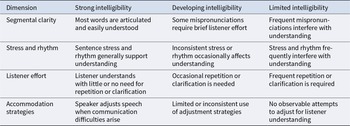
Table 2 presents a concise sample rubric illustrating how intelligibility-focused criteria may be applied in a practical classroom pronunciation assessment. This rubric is offered as a conceptual illustration rather than a validated assessment tool, and further empirical research is needed to refine the descriptors and establish context-specific intelligibility benchmarks.
An illustrative intelligibility-oriented pronunciation assessment rubric
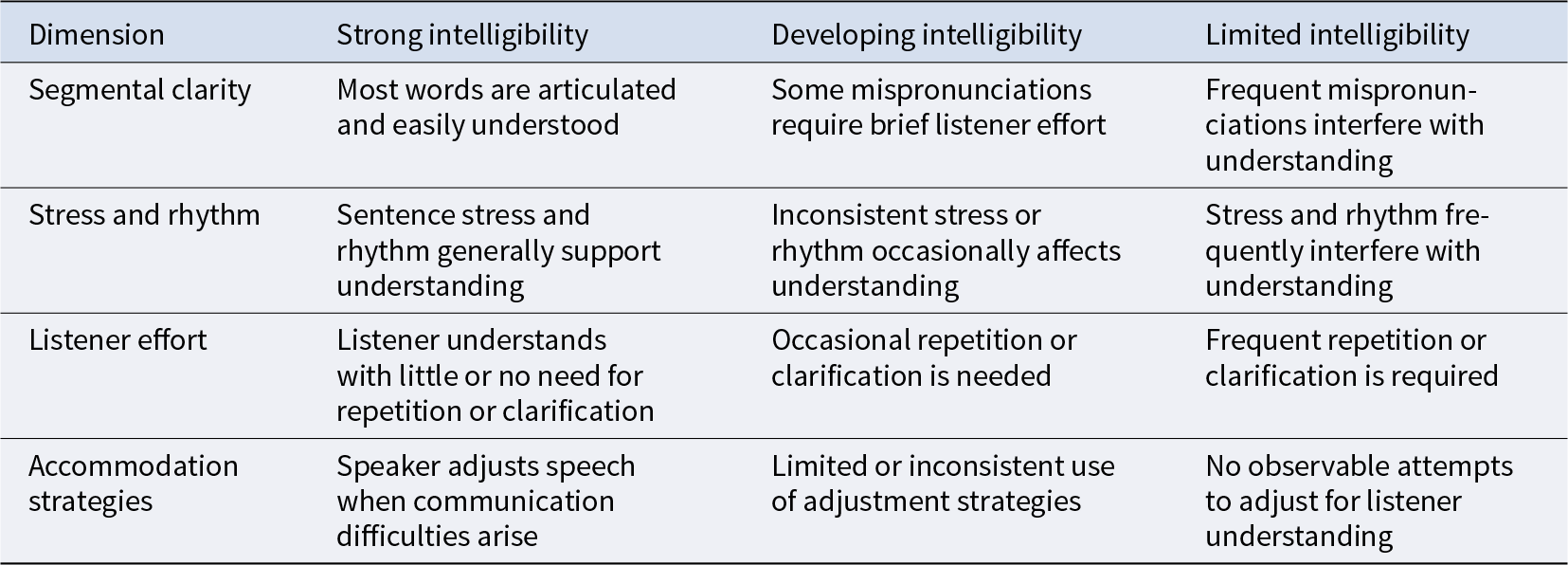
Table 2 Long description
The table assesses pronunciation intelligibility through four dimensions: segmental clarity, stress and rhythm, listener effort, and accommodation strategies. Strong intelligibility is characterized by clear articulation, supportive stress and rhythm, minimal listener effort, and effective accommodation strategies. Developing intelligibility shows some mispronunciations and inconsistent stress, requiring occasional listener effort and limited adjustment strategies. Limited intelligibility involves frequent mispronunciations and stress issues, necessitating repeated listener clarification and showing no adjustment attempts. The table highlights the importance of clear pronunciation and effective communication strategies for understanding.
Another critical issue concerns how teachers evaluate students’ speech intelligibility, particularly when both teachers and students share the same L1. Munro and Derwing (Reference Munro, Derwing, Reed and Levis2015) observed that diverse groups of listeners generally agree on the relative comprehensibility and intelligibility of different L2 speakers. However, some empirical studies noticed and proved the phenomenon, which is called the Interlanguage Speech Intelligibility Benefit (ISIB). It suggests that listeners tend to perceive speech from speakers who share their L1 as more intelligible than speech from speakers with different linguistic backgrounds (Bent & Bradlow, Reference Bent and Bradlow2003; Hayes-Harb et al., Reference Hayes-Harb, Smith, Bent and Bradlow2008; Major et al., Reference Major, Fitzmaurice, Bunta and Balasubramanian2002; Xie & Fowler, Reference Xie and Fowler2013; Xue et al., Reference Xue, Shan, Wang and Dunham2023). Several studies have specifically compared Chinese listeners’ intelligibility judgments of Chinese-accented English with those of listeners whose L1 is not Chinese, providing empirical evidence of ISIB in Chinese EFL contexts (Xie & Fowler, Reference Xie and Fowler2013; Xue et al., Reference Xue, Shan, Wang and Dunham2023). This raises concerns about the accuracy and validity of intelligibility judgments made by Chinese English teachers when evaluating their Chinese students’ pronunciation. If a student’s speech is judged as intelligible within the Chinese educational context, does that necessarily mean it will be equally intelligible to listeners from different linguistic backgrounds? This issue has important implications for assessing the broader applicability and effectiveness of intelligibility-based instruction since Chinese students are more likely to use English to communicate with speakers who do not share the same language backgrounds than with fellow Chinese speakers.
Several measures can be considered to address this challenge. For example, pronunciation assessment practices can include judgments of listeners from diverse linguistic backgrounds, either through technology-enhanced platforms or international collaborations. While several recent studies show international or cross-institutional implementation of pronunciation instruction via technology (e.g., Dalman, Reference Dalman2025; Zhang & AlSaqqaf, Reference Zhang and AlSaqqaf2025), fewer examine intelligibility judgments by listener groups from diverse L1 backgrounds via connected platforms. Therefore, future research is needed to evaluate the effectiveness and practicality of involving diverse listener groups in technology-mediated assessment contexts. Complementary to this broader assessment perspective, teachers also need training to recognize potential L1 bias and to interpret speech intelligibility through a more global lens. This involves developing an awareness of how familiarity with local accents may unconsciously shape evaluations and learning to interpret speech from a more global or lingua franca perspective. Studies have proved that teachers’ cognition plays a crucial role in shaping their teaching practices in classrooms (Baker & Murphy, Reference Baker and Murphy2011; Couper, Reference Couper2019, Reference Couper2021). Teacher education programs could include practical modules where teachers compare native, non-native, and local-accented speech samples to calibrate their judgment of intelligibility.
5. Conclusion
This article reviews the impact of the Intelligibility Principle on English education in China, emphasizing the subtle shifts in curriculum standards, teaching materials, and teachers’ beliefs and practices. It also analyzes the challenges associated with the broader adoption of the Intelligibility Principle and offers suggestions structured around the 5W1H framework: Who, Why, What, When, Where, and How.
By challenging the assumption that native-like pronunciation is essential for effective communication, we argue that English-language teaching in China is well-positioned for instruction focused on intelligibility. For younger learners, we propose a model ensuring comprehensive phonetic instruction, aiming to help students lay a solid foundation and build strong phonological awareness to help future learning. For learners in higher grades, we recommend that teachers focus on pronunciation features that empirical studies have shown to be critical for being understood and providing opportunities for students to be exposed to various English accents, rather than being limited to RP or Standard American English. Regarding the allocation of time for pronunciation instruction, we propose a structured yet flexible approach where the amount of time dedicated to pronunciation varies by grade level, ensuring that instruction is appropriately tailored to students’ developmental stages and learning needs.
For these classroom adjustments to take root, they must be supported by broader systemic change. This requires policy-level reforms that ensure curricula, teacher preparation, and assessment rubrics are aligned with intelligibility as the central goal of pronunciation teaching and learning. In this way, it can be ensured that educators understand its rationale and are equipped with practical strategies and clear standards to implement it effectively in the classroom.
For future research, the following areas should be addressed: (1) More studies are needed to explore the role of explicit training in accommodation strategies for both teachers and learners, including how such training impacts learners’ confidence and effectiveness in real-world ELF interactions. This could involve designing classroom activities that reflect multilingual scenarios. For example, at the primary school level, sound variation games—such as having the teacher play different versions of the same word spoken by different non-native speakers—can be used to help learners become aware of accent diversity and develop expectations of variability in spoken English. At the junior and senior secondary levels, tasks with higher interactional demands can be introduced, such as simulated role-plays with mixed L1 backgrounds. For example, explaining a science experiment to Brazilian English speakers, during which teachers can guide students to clarify technical terms through adjustments to intonation. (2) Further investigations into the effectiveness of AI-powered tools in assessing the intelligibility of English across different accents are also needed. While these tools offer personalized feedback, their potential bias (DiChristofano et al., Reference DiChristofano, Shuster, Chandra and Patwari2023) may weaken their effectiveness in diverse contexts. Hence, we still need studies to evaluate whether AI systems trained on datasets that include different accent varieties can reliably prioritize intelligibility over accent. (3) The validity of intelligibility judgments by Chinese teachers, who share their students’ L1, demands empirical validation. Comparative studies could determine whether shared linguistic backgrounds help listeners’ perception (e.g., replicating ISIB frameworks by Bent & Bradlow, Reference Bent and Bradlow2003) and how such biases influence classroom practices. (4) Future research could consider establishing context-specific intelligibility benchmarks to meet regional communication needs. To determine pedagogical priorities, studies could identify thresholds through listener surveys and corpus analyses of key interactions and perception experiments, thereby ensuring that instruction meets learners’ needs.
Acknowledgements
Xiaojiao Xue gratefully acknowledges that the writing of this manuscript was carried out during a visiting scholarship at Northern Arizona University, supported by the China Scholarship Council. Sincere thanks are extended to Professor Okim Kang for her valuable insights on the Intelligibility Principle, which informed the development of this work. The authors would also like to thank Dr. Graeme Porte and anonymous reviewers for their constructive and thoughtful feedback, which greatly improved the quality of the manuscript.
Funding statement
This research was supported by a grant from the National Office for Philosophy and Social Sciences of China (Project No. 23BYY147).
Competing interests
The authors declare none.
Xiaojiao Xue received her Ph.D. degree in English language and literature from the University of Seoul, South Korea, in 2015. She then joined the College of International Studies at Yangzhou University, China, where she works as an associate professor. Her research interests include second language acquisition, English phonetics, and teaching English as a second language.
Chenyi Wu received her undergraduate degree in English Education from Yangzhou University, China, in 2023. Currently, she is a graduate student in Foreign Linguistics and Applied Linguistics at Yangzhou University. Her research interests include English phonetics, second language acquisition, and English education.

 Open access

