


Interest in the home food environment as a determinant of food intake and body weight has increased in recent years(Reference Pearson, Biddle and Gorely1, Reference Story, Kaphingst and Robinson-O’Brien2). Observation of all foods in the home can provide highly accurate information that can be used directly in studies of the home food environment and provide a criterion measure against which less intensive measures, such as questionnaires, can be validated. A recent review by our group of existing measures of home food availability(Reference Bryant and Stevens3) identified three studies(Reference Coates, Jeffery and Wing4–Reference Terry and Beck6) conducted in the past 50 years in which the investigators observed all foods in the home using pen and paper tools. More recently, other researchers have attempted to inventory foods in the home using universal product code (UPC) scanners(Reference Weinstein, Phillips and MacLeod7, Reference Byrd-Bredbenner and Maurer Abbot8). Weinstein et al.(Reference Weinstein, Phillips and MacLeod7) conducted repeated assessments in thirty-two low-income, mixed-ethnicity households with children of pre-school age. Of the ninety-five completed home food inventories, forty-four failed to retrieve usable data due to technical problems that occurred when downloading the scanners. Nevertheless, UPC scanning offered a 31·8 % time saving over the traditional line-item inventory approach. UPC were linked to food identities using a proprietary database. In 2009, Byrd-Brenner et al.(Reference Byrd-Bredbenner and Maurer Abbot8) published results from single inventories in 100 homes with families of predominantly white ethnicity. That study focused on differences in food supplies in households with and without overweight individuals. Few details on the characteristics of the method were provided.
Our group conducted a pilot study in eight households using UPC scanners to collect UPC on foods present and hand-entered the UPC into a readily available Internet site (www.upcdatabase.com) to match codes for food information. This method identified product descriptions for only half the items scanned and 12 % of food items could not be scanned because the UPC was missing or damaged. Thus, we identified the following limitations in the method: (i) need for databases that can automatically link UPC to foods and corresponding nutrients; (ii) missing information in the available database for a large proportion of UPC; and (iii) foods without UPC.
We addressed these limitations by developing the Exhaustive Home Food Inventory (EHFI), a method for the comprehensive measurement of all food and drink items in all areas of the home. We describe characteristics of the data collection process including the time required to conduct the assessments. We hypothesised that the method would allow identification of all foods in the home and that the time to conduct the measurements would decrease as we built the number of foods and UPC codes in the database.
Experimental methods
Development of the Exhaustive Home Food Inventory
The software visual FoxPro 6·0 (Microsoft Corp, Redmond, WA, USA) was used to create a data entry programme designed to link UPC to a reference database containing food identification and nutrient information. When foods were not in the database, the programme allowed manual entry of UPC identification information using a series of data screens. The newly entered UPC data information was combined in a master database at approximately 4-week intervals by a programmer who acted as gatekeeper. The master database was updated on staff laptops so that the captured UPC were recognised automatically during future scanning. The software also had the capacity to accept UPC information from existing databases and to accept hand-entered barcodes (useful when the numbers were legible but the barcode would not scan).
A commercially available database with 60 000 food items (Gregg London©, http://www.glondon.com/) was uploaded to serve as the basis of our reference database. This database included the UPC, product description, product weight and nutrient information. All food products in the house were scanned systematically using a handheld scanner linked to a laptop computer. To capture foods that had no UPC (e.g. fresh produce and foods stored in household containers), we generated barcodes using Wasp labeler version 6·0 software (Wasp Barcode Technologies, Plano, TX, USA). All food and drink items in all areas of the home were recorded except for herbs, spices (but including salt) and leftovers.
During the measurement period we tested the quality of measurement collection by comparing data collected by staff against measurements made by the trainer in two households. Foods in the open space, one shelf in a selected cupboard and all shelves in one refrigerator were assessed by both the data collectors and the trainer. Data were compared and the average percentage of exact duplication was computed for the number of items, UPC, energy per serving, fat per serving, fibre per serving and food category.
Participants
Participants were recruited from those enrolled in the Infant Care Project, a longitudinal study of African-American first-time mother/infant dyads, who were observed in their home environments(Reference Laraia, Borja and Bentley9–Reference Thompson, Mendez and Borja11). Participants in the Infant Care Project were recruited through clinics for the Special Supplemental Food Program for Women, Infants, and Children (WIC) in Orange, Wake and Durham counties in North Carolina. The study design included plans for three assessments in each household, each separated by approximately 2 months. Since our goal was to perform repeated measures of the same household environment, we considered participants ineligible after a move to a new residence. The present study was approved by the University of North Carolina public health institutional review board on research involving human subjects and informed consent was obtained.
Other measurements
Anthropometry and self-reported information on age and household size and composition were collected. Adult height was measured using a portable stadiometer to the nearest 0·5 cm. Infant recumbent length was measured using a portable rigid length board to the nearest 0·1 cm. Weight was measured on an electronic digital scale to the nearest 0·1 kg.
Statistical methods
All data analyses were implemented in the SAS statistical software package version 9.1 (SAS Institute, Cary, NC, USA). We evaluated the efficiency of the methodology by the total number of minutes required to perform each home inventory and the average number of minutes to record a single item. Generalised estimating equations (GEE) were then used to account for correlated data from repeated measures from households(Reference Diggle, Heagerty and Liang12).
Results
Description of the sample
We contacted 112 eligible mothers with 12–18-month-old infants and eighty (71 %) agreed to participate. Of the eighty participating households, sixty-four were successfully measured three times, ten were measured twice and six were measured once, in sum producing 218 inventories. The main reason for not participating in the repeat assessments was change in residence. Six women declined participation in an additional round of measurement. There were no statistically significant differences in mother’s age, mother’s BMI, child’s age, child’s weight or adjusted household size for those who participated in the complete measurements compared with those who did not.
Descriptive information on the participants is shown in Table 1. The mean age of mothers and infants was 24·7 years and 23·3 months, respectively. In all, 71 % of the mothers were overweight or obese and 24 % of the infants studied were above the 85th percentile of BMI Z-score. At baseline, 17·5 % of households included a maternal grandmother. Only one household included a paternal grandmother. On average, there were 1·9 adults in each household and one male adult in every two households.
Description of households at baseline (n 80)
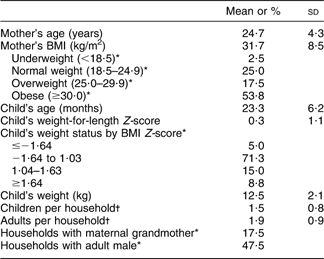
*Values are expressed in percentage.
†Children <19 years of age; adults ≥19 years of age.
Exhaustive home food inventory assessments
During the data collection period, approximately 3800 of the 60 000 UPC/food items in the purchased database were used and 8400 UPC/food items were added to the database. Thus, approximately 12 200 different food items were recorded. Data collected by staff compared with the trainer in three specified spaces in the houses of two participants resulted in repeated measurements of fifty-two items. Reproducibility averaged 100 % for the number of items, 100 % for UPC, 98 % for energy per serving, 98 % for fat per serving, 100 % for fibre per serving and 93 % for food categorisation.
Table 2 shows that the efficiency of data collection increased over time. The average time to complete the initial home visit decreased by 21 min between the first third and the last third of the visits (despite the fact that the number of food items increased over time). Over the same period, the average time per item captured was about the same, but the median time decreased by 19 s (P = 0·04). Paralleling this reduction in time was a reduction in the percentage of items that had to be manually added from 65 % to 38 %. The percentage of items coded using our notebook of generated barcodes and items with food identification and nutrient information but no UPC remained stable. Using the EHFI methodology, 100 % of foods in the home were identified.
Data collection characteristics over calendar time of first visits and repeated visits to households

UPC, universal product code.
*P < 0·05 for difference between first visit and third visit to same household.
**P < 0·05 for difference between first third and last third of households when measured for the first time.
The amount of time to conduct the food availability assessment and the number of food items that had to be manually entered were lower with repeated visits to the same households. In the sixty-four households in which three assessments were performed, the time required decreased from 145 to 97 min as did the time per item from 1·10 to 0·73 min. At the last visit, only 20 % of the food items required food identification and nutrient information to be entered by hand.
Discussion
The EHFI software successfully addressed three limitations that were identified in our pilot study. The new method automated the linking of scanned UPC to relevant databases, enabled entry of foods missing in the database and facilitated the entry of foods that were not packaged with a UPC that could be scanned. All foods in the home could be entered. Continued implementation of the method and expansion of the database improved efficiency as assessed by the reduction in the amount of time required for data collection.
Here, the participant recruitment rate was 71 %. Nevertheless, recruitment rates could be lower in situations without established relationships between potential participants and study staff, as was the case for the present study(Reference Himes-Martin, Speck and Stetson13–Reference Sweet, Legro and Coney15). Administration of the EHFI ranged between 97 and 157 min duration, and this lengthy data collection could have implications for subject participation. In the present study of eighty households, six refused to participate in a repeated measurement, so although the method was generally accepted there was some lack of repeated participation.
An exhaustive inventory of all foods in the home can provide data that allow the investigator to describe the total amount of foods and nutrients available in the home and provides a denominator for relative assessments (e.g. percentage of household energy available from fruits and vegetables). Thus, the amount of a targeted food in the home is put into the context of the total amount of food in the home. Different from a checklist, an exhaustive inventory does not require the investigator to choose which foods to measure, but allows measurement of all the foods the participants have chosen. Given how little is known about the home food environment and its influences, it can be useful to have a measure that does not make assumptions about these influences. Detailed inventories can also be a useful aide for researchers who are seeking a criterion method with which to validate questionnaires or check lists developed with the goal of measuring the home food environment by participant report. Currently available checklists have been validated using direct observation of specific foods or food categories. This approach requires searching through food storage areas for specific foods and is likely to be more prone to error than systematic measurement of all foods in each storage area.
A related method is the assessment of foods purchased. French et al.(Reference French, Shimotsu and Wall16) have developed a method that involves participant annotation of receipts and investigator entry of the food information along with additional self-report information on foods obtained. Although both the receipt annotation and the EHFI methods have strengths and weaknesses(Reference Byrd-Bredbenner, Bryant and Stevens17, Reference French, Shimotsu and Wall18), a salient point is that UPC scanning methodologies rely much less on participant self-report than does receipt annotation. We consider the ability to collect objective measures of foods in the home to be a strong advantage over methods that require subject report.
The EFHI has the potential to provide valid and precise information about foods in the home; however, in its current form the method has several limitations. Reliance on a professional programmer to update the master database with newly collected data from several data entry points may be a barrier to other investigators who would like to use this method. Automation of this step could increase efficiency. The commercial database used in the present study was the most complete we were able to identify at the time the research was conducted, and it contained less than one-third of the UPC information needed. The creation of a central, complete repository of food UPC matched to their food name, package size, number of portions in the package, nutrient content and relevant food grouping would be of great assistance to nutrition scientists with an interest in food availability. Unfortunately, no such resource is currently readily available. The EHFI software will allow the use of scanning to collect information on all foods in the home even when the available UPC database is incomplete.
Conclusions and future directions
There are many possible future enhancements and applications of the UPC scanning of food labels. Linking UPC to pricing databases would allow the estimation of food costs. Store records linked to shopper loyalty cards could be used to assess food purchase records. Participants could scan their own food purchases, which would allow assessments of food entry into the home and shopping patterns. UPC scanning could also be applied in interventions that seek to give feedback to participants about the attributes of foods in a rapid manner. It is likely that future research will explore the use of UPC scanning in a variety of applications and that methods such as those presented here will acquire increasing efficiency, accuracy and sophistication.
Acknowledgements
The present study was funded by a grant from the National Cancer Institute (R21CA125735) and the National Institute of Child Health and Development (R5-R01 HD0422119-02). Dr Stevens is the recipient of a Distinguished Professorship awarded by the American Institute for Cancer Research. She has led or been a co-investigator on research projects funded by the National Institutes of Health, the Centers for Disease Control, the American Heart Association, Nestle Waters, Sanofi-Aventis and Gatorade. Drs Wang, Bryant and Borja declare no potential conflict of interest (NIH funding only). Dr Bentley has led or been a co-investigator on research projects funded by the National Institutes of Health, the Centers for Disease Control, The United States Agency for International Development, the Ford Foundation, The Thrasher Research Fund and the Mathile Institute. J.S. and M.B. contributed towards study design, data management, analysis and drafting the manuscript. L.W. performed the statistical analysis. J.B. and M.E.B. participated in study coordination and helped to draft the manuscript. All authors read and approved the final manuscript.



