Contents
Research Article
Groupoïdes Automorphes Par Le Groupe Cyclique
-
- Published online by Cambridge University Press:
- 20 November 2018, pp. 321-335
-
- Article
-
- You have access
- Export citation
New Characterizations of Polyhedral Cones
-
- Published online by Cambridge University Press:
- 20 November 2018, pp. 1-4
-
- Article
-
- You have access
- Export citation
Some Global Theorems on Hypersurfaces
-
- Published online by Cambridge University Press:
- 20 November 2018, pp. 5-14
-
- Article
-
- You have access
- Export citation
A Note on the Mathieu Groups
-
- Published online by Cambridge University Press:
- 20 November 2018, pp. 15-18
-
- Article
-
- You have access
- Export citation
Relative Cohomology
-
- Published online by Cambridge University Press:
- 20 November 2018, pp. 19-34
-
- Article
-
- You have access
- Export citation
Some Remarks on Noetherian Rings
-
- Published online by Cambridge University Press:
- 20 November 2018, pp. 35-37
-
- Article
-
- You have access
- Export citation
Spaces Of Dimension Zero
-
- Published online by Cambridge University Press:
- 20 November 2018, pp. 38-46
-
- Article
-
- You have access
- Export citation
Matrices with Elements in a Boolean Ring
-
- Published online by Cambridge University Press:
- 20 November 2018, pp. 47-59
-
- Article
-
- You have access
- Export citation
-
1. Introduction. Let
 be a Boolean ring of at least two elements containinga unit 1. Form the set
  of matrices A, B, … of order n havingentries aiJ , bij , … (i, j = 1, 2, …, n), which are members of . A matrix U of is called unimodular if there exists a matrix V of such that VU= I, the identity matrix. Two matrices A and B are said to be left-associates if there exists a unimodular matrix U satisfying UA = B.
 be a Boolean ring of at least two elements containinga unit 1. Form the set
  of matrices A, B, … of order n havingentries a
Characteristic Polynomials
-
- Published online by Cambridge University Press:
- 20 November 2018, pp. 60-67
-
- Article
-
- You have access
- Export citation
Some Theorems About pr (n)
-
- Published online by Cambridge University Press:
- 20 November 2018, pp. 68-70
-
- Article
-
- You have access
- Export citation
-
If n is a non-negative integer, define pr (n) as the coefficient of xn in
 ;
;otherwise define pr (n) as 0. In a recent paper (1) the author has proved that if r has any of the values 2, 4, 6, 8, 10, 14, 26 and p is a prime > 3 such that r(p + 1) ≡ 0 (mod 24), then
1
 ,
,  ,
,where n is an arbitrary integer.

Classes of Positive Definite Unimodular Circulants
-
- Published online by Cambridge University Press:
- 20 November 2018, pp. 71-73
-
- Article
-
- You have access
- Export citation
-
All matrices considered here have rational integral elements. In particular some circulants of this nature are investigated. An n × n circulant is of the form
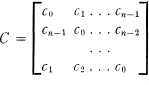
The following result concerning positive definite unimodular circulants was obtained recently (3 ; 4 ):
Let C be a unimodular n × n circulant and assume that C = AA' where A is an n × n matrix and A' its transpose. Then it follows that C = C1C1', where C1 is again a circulant.
Simultaneous Pairs of Linear and Quadratic Equations In a Galois Field
-
- Published online by Cambridge University Press:
- 20 November 2018, pp. 74-78
-
- Article
-
- You have access
- Export citation
-
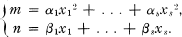
Let F denote the Galois field GF(pr) with pr elements, where p is an odd prime and r is a positive integer. Suppose further that m and n are arbitrary elements of F and that αi, βi pt (i = 1, …, s) are nonzero elements of F. The purpose of this paper is to evaluate the function N s(m, n), defined, for an arbitrary positive integer s, to be the number of simultaneous solutions in F of the equations
1.1
 .
.
The Set of all Generalized Limits of Bounded Sequences
-
- Published online by Cambridge University Press:
- 20 November 2018, pp. 79-89
-
- Article
-
- You have access
- Export citation
-
Let M be the normed linear space whose general element, x, is a bounded sequence

of real numbers, and ‖x‖ = l.u.b. |ξn |. Let T denote the linear operation (of norm 1) defined by Tx = (ξ2, ξ3, … , ξn+1,…). A generalized limit is a linear functional ϕ on M which satisfies the conditions
 .
.

A Note on Asymptotic Series
-
- Published online by Cambridge University Press:
- 20 November 2018, pp. 90-95
-
- Article
-
- You have access
- Export citation
On Ward's Perron-Stieltjes Integral
-
- Published online by Cambridge University Press:
- 20 November 2018, pp. 96-109
-
- Article
-
- You have access
- Export citation
A Generalization of the Cauchy Principal Value
-
- Published online by Cambridge University Press:
- 20 November 2018, pp. 110-117
-
- Article
-
- You have access
- Export citation
-
If a < u < b and n > 0 then
(1)

is a so-called improper integral owing to the infinity in the integrand at x = u. When n = 0 we have associated with (1) the well-known Cauchy principal value, namely
(2)
 .
.Hadamard (1, p. 117 et seq.) derives from an improper integral an expression which he calls its finite part and which, as he shows, possesses many important properties.

On The Zeros of the Fresnel Integrals
-
- Published online by Cambridge University Press:
- 20 November 2018, pp. 118-131
-
- Article
-
- You have access
- Export citation
-
This paper is concerned with the Fresnel integrals
1.1

in the complex domain.
Recent research work in different fields of physical and technical applications of mathematics shows that an increasing number of problems require a detailed knowledge of elementary and higher functions for complex values of the argument.
A Minimum-Maximum Problem for Differential Expressions
-
- Published online by Cambridge University Press:
- 20 November 2018, pp. 132-140
-
- Article
-
- You have access
- Export citation
-
In the study of approximate methods for solving ordinary differential equations, an interesting question arises. To state it roughly for a single first order expression, let y 0(t) be the solution of the equation
(1.1)

which satisfies the initial condition y(a) = n a. Let n b be an approximation to the value of y 0 at a later time, t = b.

A Mixed Problem for Normal Hyperbolic Linear Partial Differential Equations of Second Order
-
- Published online by Cambridge University Press:
- 20 November 2018, pp. 141-160
-
- Article
-
- You have access
- Export citation
Hyperbolic Mixed Problems for Harmonic Tensors
-
- Published online by Cambridge University Press:
- 20 November 2018, pp. 161-179
-
- Article
-
- You have access
- Export citation