





Many colorectal cancer (CRC) survivors who completed treatment continue to experience symptoms related to the disease and/or treatment; those symptoms can have a large impact on their health-related quality of life (HRQoL)(Reference Han, Yang and Syrjala1). Cancer-related fatigue (hereafter referred to as ‘fatigue’) is among the most reported and severe problems during CRC survivorship(Reference Han, Yang and Syrjala1). The prevalence of fatigue in the first 5 years after diagnosis ranges from roughly 40 % to 70 %, depending on sociodemographic (e.g. sex and age) and clinical (e.g. treatment and number of co-morbidities) characteristics(Reference Adam, van de Poll-Franse and Mols2–Reference Husson, Mols and van de Poll-Franse4). Fatigue can persist many years after diagnosis, as shown by a registry-based study conducted in France that reported the prevalence of fatigue to be 45 % in CRC survivors 15 years after diagnosis(Reference Gernier, Joly and Klein5).
Fatigue is a multifactorial symptom and can be influenced by demographic, medical, psychosocial, behavioural and biological factors(Reference Bower6). Currently, there is no golden standard for the treatment of fatigue(Reference Bower6). Observational data suggest that having a healthier lifestyle, including the consumption of a healthy diet and being sufficiently physically active, is associated with less fatigue after completion of cancer treatment in CRC survivors(Reference Wesselink, van Baar and van Zutphen7–Reference van Veen, Mols and Bours9).
Recently, we reviewed and summarised the literature on lifestyle interventions that targeted fatigue among cancer survivors who finished treatment(Reference de Vries-ten Have, Winkels and Kampman10), where lifestyle interventions were defined as either physical activity and/or nutrition-related interventions. The review showed that only three out of twenty-nine randomised controlled trials specifically targeted CRC survivors(Reference Kim, Lee and Lee11–Reference Pinto, Papandonatos and Goldstein13). CRC survivors may have different factors that influence healthy eating, physical activity and/or exercise than other cancer survivors, as CRC survivors may have a stoma and/or bowel dysfunction, which requires tailoring of the intervention to specifically CRC survivors(Reference Denlinger and Barsevick14). Three additional lifestyle studies with CRC survivors(Reference Courneya, Friedenreich and Quinney15–Reference Hawkes, Chambers and Pakenham17) were identified that were not included in our review(Reference de Vries-ten Have, Winkels and Kampman10), as those studies also included survivors who were still receiving adjuvant treatment, while our review focused on studies that included survivors who had completed treatment.
One of these six previously conducted trials with CRC survivors took both physical activity and nutrition into account(Reference Hawkes, Chambers and Pakenham17), whereas the other studies focused only on physical activity(Reference Kim, Lee and Lee11–Reference Pinto, Papandonatos and Goldstein13,Reference Courneya, Friedenreich and Quinney15) or yoga(Reference Cramer, Pokhrel and Fester16). None of these trials showed statistically significant differences in changes in fatigue over time between the intervention group(s) and control group(Reference Kim, Lee and Lee11–Reference Pinto, Papandonatos and Goldstein13,Reference Courneya, Friedenreich and Quinney15–Reference Hawkes, Chambers and Pakenham17) . Important to state is that none of the six trials recruited participants based on their level of fatigue, making it difficult to detect improvements in fatigue as not all participants experienced fatigue(Reference Bower6,Reference de Vries-ten Have, Winkels and Kampman10) . Thus, there is a clear need for a randomised controlled trial that investigates the effectiveness of a combined diet and physical activity lifestyle intervention on fatigue among CRC survivors who completed treatment and who experience fatigue.
This randomised controlled trial was conducted with the primary aim to test the effect of a 6-month person-centred lifestyle intervention including both diet and physical activity on fatigue in CRC survivors who completed treatment and who experience fatigue. Since fatigue is rarely an isolated symptom, the effect of the lifestyle intervention on HRQoL was examined as a secondary outcome.
Methods
Study design
The study was called the SoFiT study and was a two-arm parallel randomised controlled trial with an intervention group and a control group. Details of the design of the study have been previously described(Reference de Vries-ten Have, Manusama and Verkaar18). The study was approved by a Medical Research Ethics Committee (CMO region Arnhem-Nijmegen, NL75999.091.21, METC nr 2021-8182). All participants provided written informed consent.
Eligibility criteria
Persons were eligible when they were adult CRC survivors who completed CRC treatment for stage I–III disease at least 6 months but no longer than 5 years ago and were experiencing fatigue according to the Functional Assessment of Chronic Illness Therapy (FACIT) – Fatigue Scale(Reference Yellen, Cella and Webster19). A score lower than 34 was defined as experiencing fatigue, as this was previously identified as a cut-off point for the diagnosis of cancer-related fatigue(Reference Van Belle, Paridaens and Evers20). Additional inclusion criteria were that persons had to live within a reasonable distance from the research centre (within approximately 1·5 h of driving by car from Wageningen University & Research), had to be willing to be randomised into either the intervention or control group and had to be able to speak, write and read Dutch. Persons were not eligible when they participated in another study that could interfere with the current study, had chronic drug abuse and excessive alcohol consumption (more than four glasses/d on average), or were unwilling or unable to comply with the intervention (e.g. through dementia or severe mental illness).
Recruitment and screening
Three different recruitment routes were used: (1) recruitment through regional hospitals, (2) recruitment through the ‘Prospectief Landelijk’ CRC cohort (PLCRC, Prospective National CRC cohort)(Reference Burbach, Kurk and Coebergh van den Braak21,Reference Derksen, Vink and Elferink22) and (3) recruitment through local and social media. Persons who expressed interest in participation through any of these routes were screened for eligibility using an online (or paper) questionnaire through Castor Electronic Data Capture (Castor EDC). The questionnaire consisted of the FACIT-Fatigue Scale and a questionnaire to assess the other inclusion and exclusion criteria.
Randomisation and blinding
The study team visited participants at the participants’ homes for baseline data collection. To avoid bias in baseline data due to group allocation, participants were randomised to the intervention or control group at the end of this home visit. A stratified block randomisation procedure was used with permuted blocks of varying block sizes (4, 6 and 8). We stratified for the level of fatigue (extreme fatigue ≤ 20, or fatigue > 20, as determined by the FACIT-Fatigue Scale) and for chemotherapy as part of the treatment (self-reported chemotherapy: yes/no) and used the randomisation module of Castor EDC for the randomisation process. The nature of the intervention did not allow us to blind participants to group allocation as participants were aware whether they were in the intervention or control group. Assigned participant IDs were pseudo-anonymised. An independent researcher assigned random letters to the treatment groups, concealing which group was the intervention group and which was the control group, to ensure that data analysis was conducted in a blinded manner.
Intervention group
Participants randomised to the intervention group received a 6-month lifestyle programme. The design and content of the lifestyle programme have been previously described in detail(Reference de Vries-ten Have, Manusama and Verkaar18). The lifestyle programme focused on lifestyle improvements that can be maintained over the long term to achieve sustained behaviour change. Each participant worked with one of two lifestyle coaches for 6 months to gradually increase adherence to the World Cancer Research Fund cancer prevention guidelines on healthy diet and physical activity(23). The lifestyle coach contacted each participant every 2 weeks, for a total of twelve appointments, over the course of 6 months. This included four home visits and eight telephone or video calls. Participants received a handbook and brochures to assist in making lifestyle changes. The programme adopted a person-centred approach by (1) tailoring to the participant’s current lifestyle and personal characteristics, (2) targeting personal behavioural determinants and (3) considering the participant’s preferences, opportunities and disease-related barriers(Reference de Vries-ten Have, Manusama and Verkaar18). The lifestyle coaches applied behaviour change techniques tailored to each participant and session(Reference de Vries-ten Have, Manusama and Verkaar18).
Control group
The control group did not receive lifestyle coaching sessions during the 6-month period. To promote retention, participants in the control group received newsletters after 1·5 and 4·5 months with content unrelated to lifestyle behaviour. At 3 months, they received a small incentive, a postcard, a questionnaire and a phone call as part of the data collection. To promote retention, we also informed participants in the control group that they were entitled to receive two lifestyle coaching sessions and the same lifestyle information materials that the intervention group received after completion of the 6-month study period. The control group continued to receive their care as usual by their treating physicians, which may include survivorship care.
Data collection
Data were collected via online questionnaires and during home visits at baseline and at 6 months. Upon request, participants could receive paper versions of questionnaires, which the research team entered in Castor EDC. All data were entered and collected via Castor EDC.
Description of anthropometrics, dietary intake and physical activity
We assessed anthropometrics, dietary intake and physical activity to describe lifestyle behaviour at baseline and 6 months. Anthropometrics included body weight, height and waist circumference. During the home visits, researchers measured participants’ body weight with a calibrated scale, waist circumference with a tape measure and height with a stadiometer.
To assess habitual dietary intake at baseline and 6 months, participants completed a semi-quantitative FFQ. This FFQ was designed and validated by the Division of Human Nutrition and Health of Wageningen University(Reference Feunekes, Van Staveren and Graveland24,Reference Verkleij-hagoort, de Vries and Stegers25) . The FFQ included eighty-five questions about food items. Participants reported the intake of foods and drinks consumed during the previous month; frequencies of intake were combined with standard portion sizes and household measures to quantify intake. Nutritional intake of fibre and alcohol was calculated by linking food and drink items according to the Dutch National Food Consumption Tables (NEVO 2010). The FFQ was used to quantify dietary intake in g/d, or glasses per week for the alcohol guideline. For the guideline on ‘fast foods’ and other processed foods, we took all foods and drinks into account that were high in fat, starches and/or sugars (e.g. (fried) foods, cookies, sweets and sauces). For the guideline on red and processed meat, we made the distinction between red meat and processed meat, where we included processed red meat as processed meat. Each food or drink item was assigned to only one food group.
Physical activity was measured both subjectively and objectively with a questionnaire and an accelerometer at baseline and 6 months. For the subjective measurement of physical activity, the Short Questionnaire to Assess Health (SQUASH)-enhancing physical activity(Reference Wendel-Vos, Schuit and Saris26) was used. The questions in the SQUASH were asked during the home visits and were pre-structured in commuting, work/school activities, household activities, leisure time and sports. The two questions in the SQUASH survey, ‘days per week’ and ‘average time per day’, were used to estimate physical activity of a usual week in the past months. Scores were assigned to the different reported activities based on intensities in metabolic equivalent (MET) according to a previously published compendium(Reference Ainsworth, Haskell and Herrmann27). This was translated to minutes of moderate and vigorous physical activity (MVPA) per week. Activities were scored as MVPA when they had a MET score of ≥ 3. We also estimated the number of days participants did muscle- and bone-enhancing activities using the classification of the physical activity guidelines report of the Dutch National Institute for Public Health and the Environment(Reference Wendel-Vos, van den Berg and Duijvestijn28). In that report, bone-enhancing activities are defined as strength training, or as activities that involve bearing the body’s own weight (e.g. walking, boxing and tennis), while muscle-enhancing activities are defined as activities that focus on endurance (e.g. cycling, swimming and fitness)(Reference Wendel-Vos, van den Berg and Duijvestijn28). All activities that are bone-strengthening are also considered to be muscle-strengthening. Some activities are only muscle-strengthening and not bone-strengthening, and there are no activities that are muscle-strengthening but not bone-strengthening(Reference Wendel-Vos, van den Berg and Duijvestijn28).
For the objective measurement, MVPA (i.e. activities with MET ≥ 3 in min/week) was assessed by placing an accelerometer, the activPAL3 micro (PAL Technologies Ltd, Glasgow, UK), on the upper thigh and wearing it for 24 h a day during nine consecutive days. During the baseline house visit, the accelerometer was placed by the researcher. At the end of the intervention, participants received the accelerometer with placement instructions via post. Participants placed the accelerometer themselves and wore it during the 9 d before the house visit, during which it was collected by the researcher. Raw accelerometer data were processed with PAL analysis software (PAL Software Suite, version 8, PAL Technologies) and analysed using a script based on the algorithm of Winkler et al. (Reference Winkler, Bodicoat and Healy29). The accelerometer was worn for a median of eight valid days at baseline (interquartile range 7–8) and for a median of seven valid days at the end of the study (interquartile range 6–7). At baseline, nine persons had less than four valid days, and at 6 months, eleven persons had less than four valid days. The number of valid days was similar across timepoints and groups.
Primary outcome: cancer-related fatigue
Fatigue was assessed during screening to assess eligibility and was again assessed at baseline and 6 months with the thirteen-item FACIT-Fatigue Scale, which is a widely used, validated, reliable and recommended questionnaire(Reference Fisher, Cohn and Harrington30,Reference Minton and Stone31) . Each item is scored with a five-point Likert scale, which results in a score that ranges from 0 to 52(Reference Yellen, Cella and Webster19). Lower scores indicate higher fatigue levels.
Secondary outcome: health-related quality of life
As fatigue is rarely an isolated symptom, we also assessed whether HRQoL changed during the 6 months of the study. The thirty-six-item Functional Assessment of Cancer Therapy – Colorectal (FACT-C) questionnaire was used for this assessment at baseline and 6 months(Reference Ward, Hahn and Mo32). Of these thirty-six items, thirty-four items are used to calculate a score ranging from 0 to 136; the remaining two items are only relevant for persons with an ostomy but were not used in the current study. HRQoL is assessed with the following domains: physical well-being, social/family well-being, emotional well-being, functional well-being and CRC subscale(Reference Ward, Hahn and Mo32). Higher scores indicate better HRQoL.
Other study parameters: baseline characteristics
Sociodemographic information (i.e. age, sex, living situation, education and employment), smoking status and number of co-morbidities were self-reported and collected with questionnaires at baseline. The clinical parameters time since last treatment, tumour location, stage of disease and information on cancer treatment were obtained via the Netherlands Cancer Registry managed by the Netherlands Comprehensive Cancer Organisation (IKNL). Information on whether participants had a stoma was collected by the FACT-C CRC subscale.
Data analysis
An estimated sample size of 184 participants was previously calculated to provide 80 % power to detect an effect on the primary outcome. In this calculation, we considered that a three-point differential change between groups would be a clinically important difference with an sd of 6·7 and accounted for 15 % drop-out(Reference de Vries-ten Have, Manusama and Verkaar18). Due to an ending of grant funding, we did not reach the intended sample size and had to stop recruitment after including 161 participants, of which fourteen participants dropped out (see results for further information). This means we had 77 % power in this study.
To test the effect of the lifestyle intervention on the primary outcome – fatigue – an ANCOVA was performed. In the ANCOVA analysis, fatigue at 6 months was compared between intervention and control group while adjusting for fatigue at baseline. Additionally, the stratification factors used during randomisation (i.e. extreme fatigue ≤ 20, or fatigue > 20 on the FACIT-Fatigue Scale and chemotherapy yes or no) were included in the ANCOVA model(Reference Kahan and Morris33). The primary analysis was conducted on an intention-to-treat basis.
Missing data for fatigue at 6 months (9·3 %) were imputed using multiple imputation. There were no missing data for fatigue at baseline. Missing data at 6 months occurred because participants did not complete the questionnaires, dropped out of the study and/or were taken out of the study by the study team due to recurrence or development of a second primary cancer during the study. Multiple imputation by chained equations (MICE), a fully conditional specification method, was conducted using the ‘mice’ package for R software, drafting ten datasets and using ten iterations(Reference Van Buuren and Groothuis-Oudshoorn34). In the imputation process, we used a correlation matrix to determine which predictors should be added: predictors with a correlation higher than 0·1 or lower than –0·1 with the outcome were added. In case of a high correlation between predictors (higher than 0·7/lower than –0·7), we only added the predictor with the highest correlation with the outcome.
Two sensitivity analyses were conducted to assess the robustness of the effect on the primary outcome. First, a complete case analysis was conducted, which included only those participants who had complete data on fatigue at baseline and follow-up. Second, a per-protocol analysis was conducted, in which the participants in the intervention group who were adherent to the protocol were compared with the control group. Per protocol was defined as ‘attended at least 11 out of the 12 scheduled coaching sessions’. Missing data for fatigue for the per-protocol analysis were imputed in the same manner as for the primary analysis.
The secondary outcome, HRQoL, was analysed in the same manner as the primary outcome by using a series of ANCOVA models. Missing data were imputed for total HRQoL and subdomains at baseline (0–0·6 %) and at 6 months (9·3–10·6 %). We reported the total HRQoL score and scores on the separate domains.
After conducting all analyses according to the pre-specified data analysis plan, we decided to add the following three analyses to the results of this paper. The first post hoc analysis included those participants who were classified as ‘experiencing fatigue’ (score of < 34 on the FACIT-Fatigue Scale) according to their baseline data. Participants were eligible for the trial when they were experiencing fatigue during screening. Nevertheless, fatigue was reassessed at baseline; there were roughly 4 weeks between the screening and the baseline visit. The result of that baseline assessment differed from the assessment of fatigue during screening/eligibility testing.
The second post hoc analysis included only participants who had received chemotherapy as part of their treatment, as fatigue levels might be higher in CRC survivors who underwent chemotherapy(Reference Husson, Mols and van de Poll-Franse4,Reference Vardy, Dhillon and Pond35) , potentially leaving more room for improvement.
The third post hoc analysis included only participants who only had surgery as part of their treatment. All post hoc analyses were conducted in the same manner as the primary analysis. R Studio version 4.3.1 was used for the analyses, and a two-sided alpha of 0·05 was employed.
Results
Characteristics of the study population
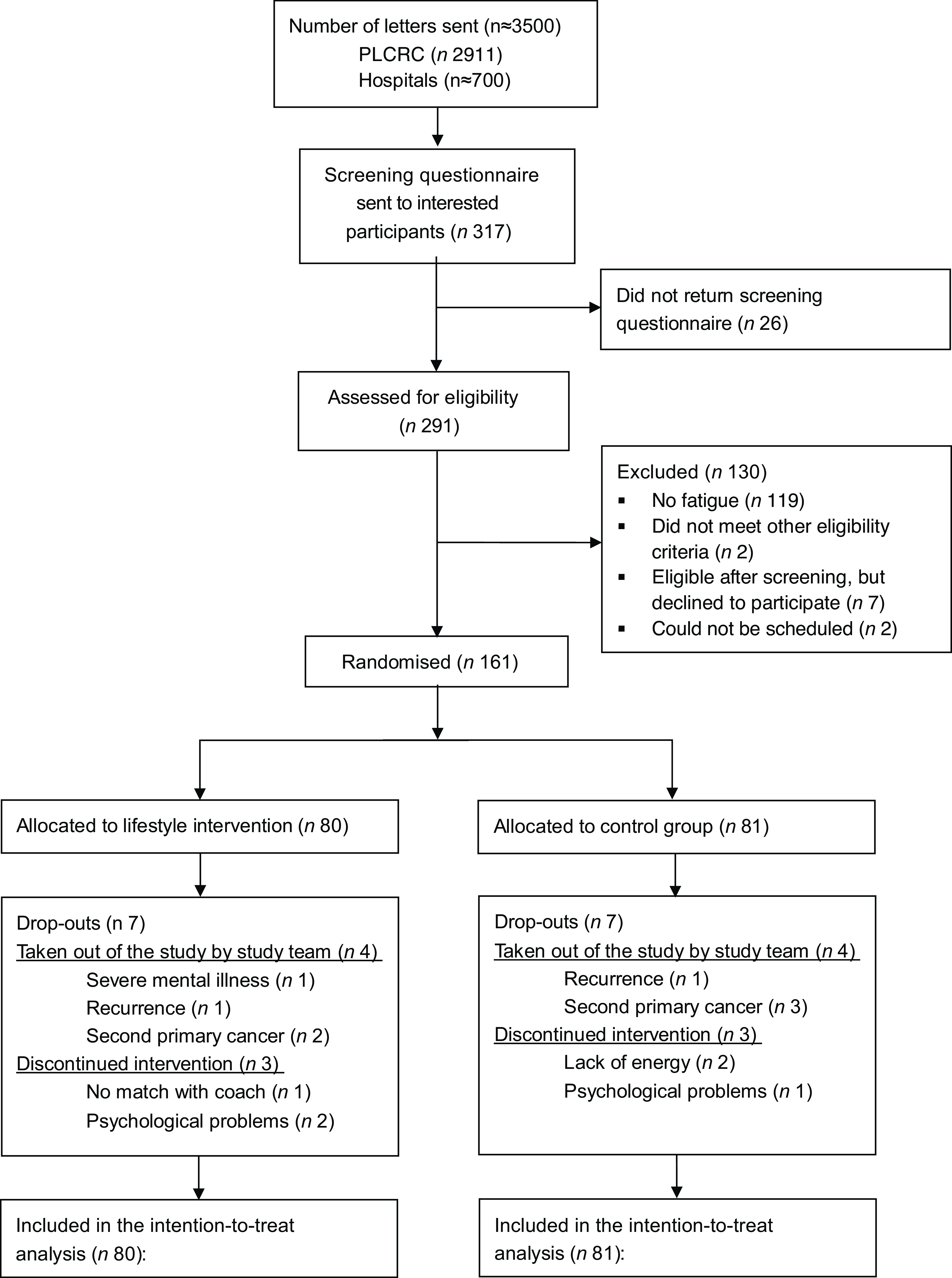
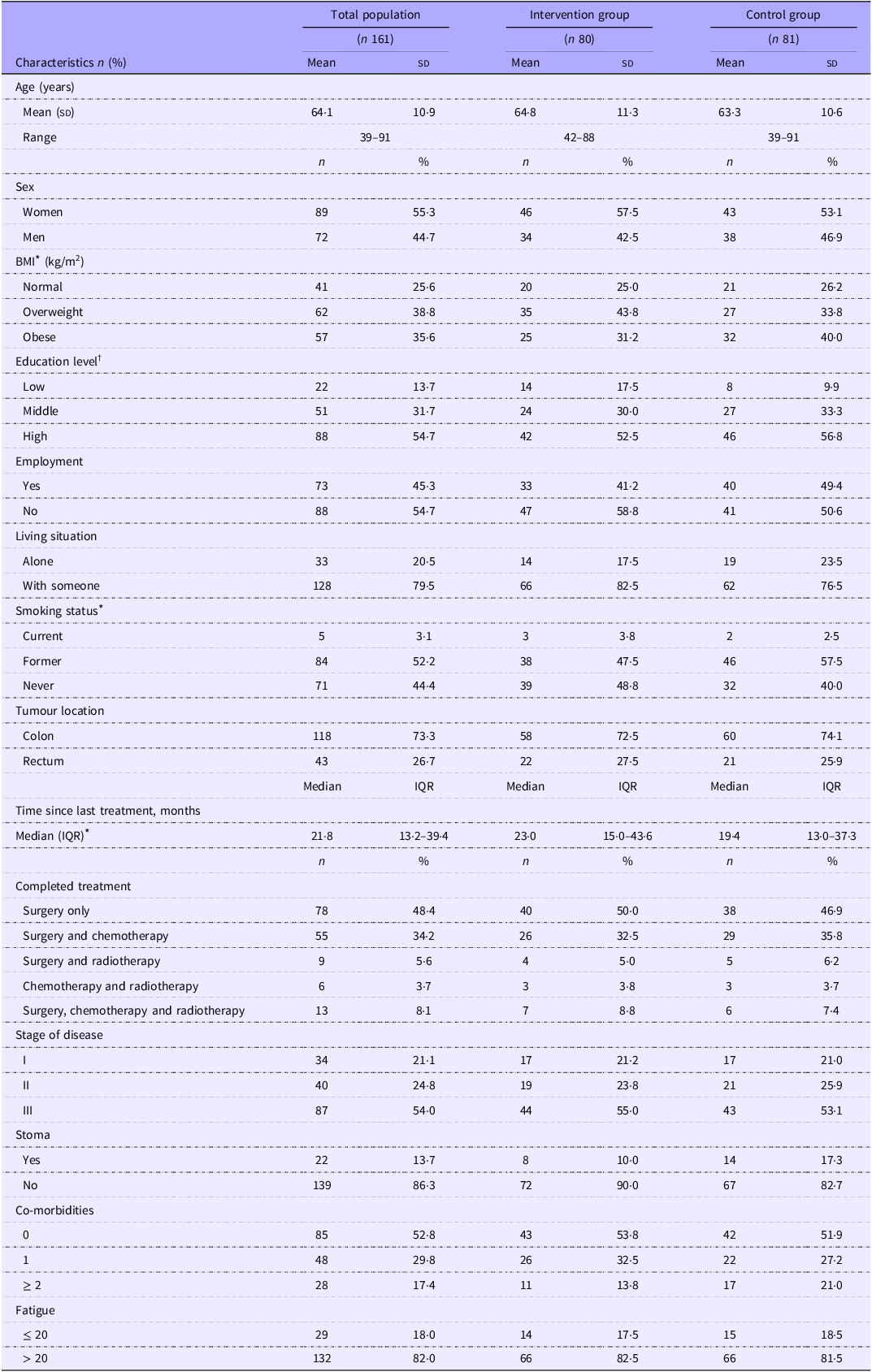
In total, 317 persons showed interest in the study and received a screening questionnaire. This was returned by 291 persons, of which 161 participants were eligible and included in the study; see Figure 1. The primary reason for ineligibility was not being classified as experiencing fatigue according to the FACIT-Fatigue Scale. Of the eligible 161 participants, eighty were randomised to the intervention group and eighty-one were randomised to the control group. Fourteen participants (8·7 %), seven in each group, were excluded or dropped out of the study. Reasons for exclusion or drop-out were psychological problems, development of second primary cancer, or a recurrence, lack of energy to continue with the study, having no match with the lifestyle coach or severe mental illness. The baseline characteristics, including fatigue assessed during screening/recruitment and baseline, and HRQoL, were similar between the intervention and control group (Tables 1, 2 and 3). The mean age of the population was 64·1 (sd 10·9) years, with 55·3 % women, and over half of the population was highly educated (54·7 %). Most participants had colon cancer (72 %), and over half of the participants had stage III disease (54 %). The median time since treatment was 21·8 months, and 46 % of participants had received chemotherapy as part of treatment.
Flow chart of participants included in the randomised controlled trial and in the analyses of the primary and secondary outcomes. PLCRC, Prospectief Landelijk CRC Cohort.

Baseline characteristics of a randomised controlled trial on lifestyle and fatigue, shown for the total study population and separately for the intervention and control group

IQR, interquartile range.
* Data missing for 1 participant.
† Education was categorised in low (elementary school and secondary education), middle (secondary vocational education) and high (higher professional and university education).
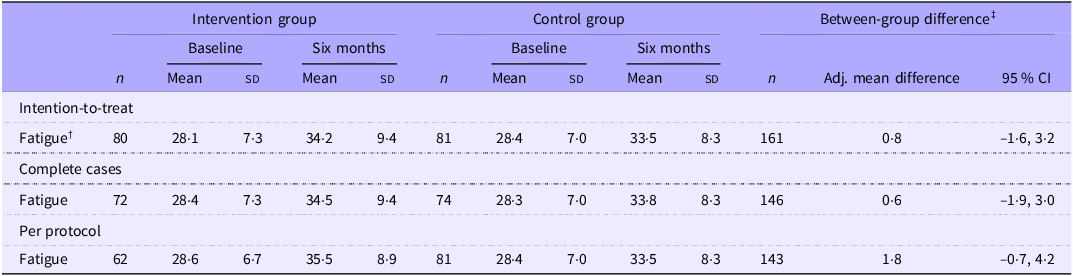
Between-group differences in changes in fatigue in a randomised controlled study among colorectal cancer survivors

† Fatigue was measured with the Functional Assessment of Chronic Illness Therapy (FACIT) – Fatigue Scale with score range 0–52.
‡ Between-group mean differences were adjusted for fatigue at baseline and for the stratification factors used during randomisation. Missing data were imputed for the intention-to-treat and per-protocol analysis. For the complete case analysis, data were analysed for participants who had complete data on fatigue at baseline and at 6 months. Per protocol was defined as ‘attended at least 11 out of the 12 scheduled coaching sessions’.
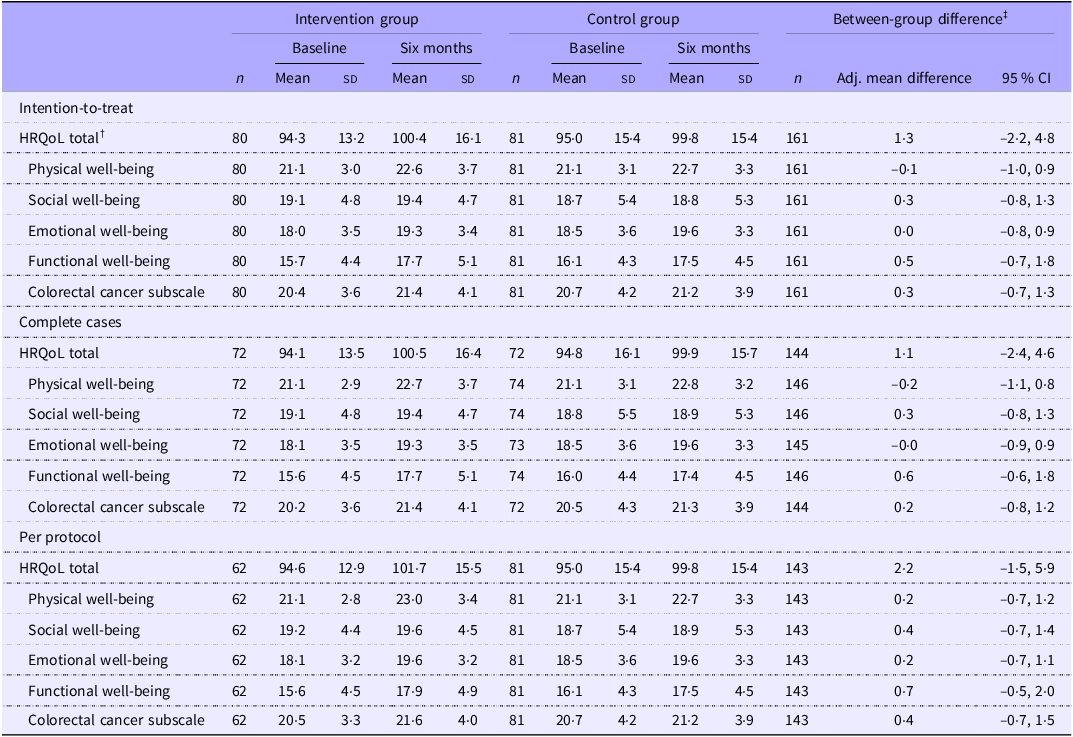
Between-group differences in changes in health-related quality of life in a randomised controlled study among colorectal cancer survivors

HRQoL, health-related quality of life.
† HRQoL, assessed with the Functional Assessment of Cancer Therapy (FACT) – Colorectal (FACT-C) questionnaire with score range 0–136. Subscales range from 0 to 28 for physical, social/family and functional well-being and the colorectal cancer subscale, and from 0 to 24 for the emotional well-being subscale.
‡ Between-group mean differences were adjusted for HRQoL at baseline and for the stratification factors used during randomisation. Missing data were imputed for the intention-to-treat and per-protocol analysis. For the complete case analysis, data were analysed for participants who had complete data on HRQoL at baseline and at 6 months. Per protocol was defined as ‘attended at least 11 out of the 12 scheduled coaching sessions’.
Anthropometrics, dietary intake and physical activity
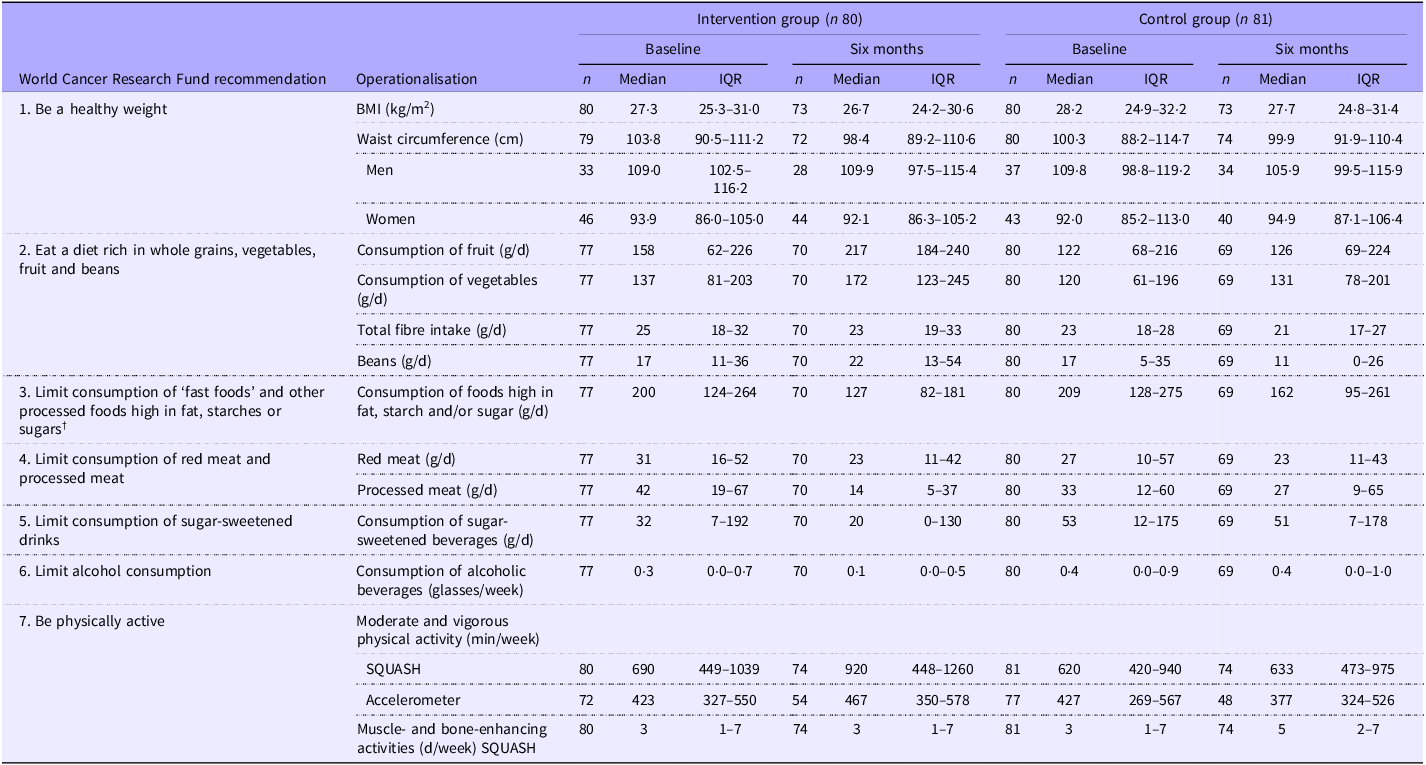
Over time, the intervention group reported increases in the consumption of fruit and vegetables and decreases in the consumption of processed meat and sugar-sweetened beverages (Table 4). In the control group, most food groups appeared to remain relatively stable over time. Although both groups reported reduced fast-food intake, this reduction seems more pronounced in the intervention group. BMI and waist circumference appeared relatively stable over time in both groups (Table 4). In the intervention group, MVPA appeared to increase in the intervention group and not in the control group according to data of the SQUASH. The accelerometer data suggested an increase in MVPA in the intervention and a decrease in the control group. The control group reported an increase in bone- and muscle-enhancing activities as assessed by the SQUASH, while these activities appeared to remain similar over time in the intervention group. Walking was the most predominant bone- and muscle-enhancing activity that was conducted by the participants. After leaving out ‘walking’ from this category, the median number of bone- and muscle-enhancing activities was zero across timepoints and groups.
Adherence to the World Cancer Research Fund cancer prevention recommendations at baseline and 6 months, shown for the intervention and for the control group

IQR, interquartile ranges; SQUASH, the Short Questionnaire to Assess Health.
† All foods and drinks that were high in fat, starches or sugars were included (e.g. (fried) foods, cookies, sweets and sauces).
Cancer-Related fatigue
At baseline, the intervention group had a mean fatigue score of 28·1 (sd 7·3), and the control group had a mean fatigue score of 28·4 (sd 7·0) (Table 2). At 6 months, the intervention group showed a slightly greater improvement in fatigue (+6·1) compared with the control group (+5·1). There was no statistically significant differential change in fatigue over time between the intervention and control group (0·8; 95 % CI −1·6, 3·2; Table 2).
Health-Related quality of life
At baseline, the intervention group had a mean total HRQoL score of 94·3 (sd 13·2) and the control group had a mean total HRQoL score of 95·0 (sd 15·4) (Table 3). At 6 months, the intervention group showed a slightly greater improvement in total HRQoL (+6·1) compared with the control group (+4·8). There was no statistically significant differential change in total HRQoL over time between the intervention and control group (total HRQoL 1·3; 95 % CI −2·2, 4·8) or in any of the subscales (Table 3).
Additional analyses
Sensitivity analyses
Results for the complete case analysis were comparable to the primary analyses. For the per-protocol analyses, we included sixty-two out of eighty participants of the intervention group (77·5 %) as they adhered to the study protocol and completed at least eleven out of twelve lifestyle coaching sessions. The results for the per-protocol analyses were comparable to the primary analyses for fatigue and HRQoL (Tables 2 and 3).
Post hoc analyses
Upon recruitment, all participants (n 161) were classified as experiencing fatigue based on their responses to the recruitment questionnaires. Based on the baseline questionnaire that was administered about 4 weeks after recruitment, the number of participants who were classified as experiencing fatigue was lower (n 120) at that timepoint. The first post hoc analysis that included only those 120 participants showed comparable results as the primary analyses for fatigue (1·7; 95 % CI −1·1, 4·5), for total HRQoL (1·6; 95 % CI −2·2, 5·4) and for HRQoL subscales (online Supplementary Table S1 and S2). The second post hoc analysis that only included those participants who received chemotherapy (n 74) showed slightly larger, but statistically non-significant differential changes over time compared with the primary analyses for fatigue (2·3; 95 % CI −1·6, 6·1) and for total HRQoL (2·6; 95 % CI −3·2, 8·4) (online Supplementary Table S1 and S2). The third post hoc analysis included participants who only had surgery as part of their CRC treatment (n 78). Among those participants, the difference in change in fatigue over time between the groups was 0·3 (95 % CI −3·1, 3·6) and for total HRQoL it was −0·6 (95 % CI −6·0, 4·7) (online Supplementary Table S1 and S2).
Discussion
We examined the effect of a 6-month person-centred lifestyle intervention on fatigue among CRC survivors who completed treatment and who experienced fatigue. There were favourable changes in dietary behaviours and physical activity in the intervention group, whereas the control group did not show these changes to the same extent. The programme, however, did not result in statistically significant differential changes in fatigue or HRQoL of life between the intervention and control group.
Even though changing lifestyle behaviours may not significantly impact fatigue in CRC survivors who completed treatment, our study demonstrates that it is feasible to improve lifestyle behaviours even among CRC survivors who experience fatigue. This is beneficial as healthy dietary behaviours and sufficient physical activity are associated with lower all-cause mortality and CRC-specific mortality in CRC survivors(Reference Ratjen, Schafmayer and di Giuseppe36–Reference van Zutphen, van Duijnhoven and Wesselink39). Our finding that changing lifestyle behaviours may not significantly impact fatigue in CRC survivors who completed treatment seems to be supported by findings of earlier conducted comparable trials. We can compare our results to six previous randomised controlled trials of which three were conducted among CRC survivors who had completed treatment(Reference Kim, Lee and Lee11–Reference Pinto, Papandonatos and Goldstein13), and three other studies were conducted among CRC survivors who were either undergoing or who had completed treatment(Reference Courneya, Friedenreich and Quinney15–Reference Hawkes, Chambers and Pakenham17). Similar to our study, those six studies did not find statistically significant changes in fatigue over time between the intervention group(s) and control group(Reference Kim, Lee and Lee11–Reference Pinto, Papandonatos and Goldstein13,Reference Courneya, Friedenreich and Quinney15–Reference Hawkes, Chambers and Pakenham17) .
Within groups, we observed a clinically relevant reduction in fatigue of 6·1 points in the intervention group and 5·1 points in the control group, which is almost twice as large as the estimated clinically relevant difference of 3 points for the FACIT-Fatigue Scale(Reference Cella, Eton and Lai40) and larger than the change reported in previous conducted trials(Reference Kim, Lee and Lee11,Reference Pinto, Papandonatos and Goldstein13,Reference Courneya, Friedenreich and Quinney15–Reference Hawkes, Chambers and Pakenham17) . Fatigue scores may have partly improved in both groups due to regression to the mean, but it is unsure how large this effect was. Also, fatigue levels may have naturally improved over time post-treatment(Reference Bower6,Reference Husson, Mols and van de Poll-Franse41) , independent of the study participation. Additionally, fatigue might have improved in both groups due to receiving recognition and attention for the fatigue and cancer journey. The between-group change in fatigue (+0·8) is not clinically relevant; thus, lifestyle changes did not account for the observed improvements in fatigue in both groups. Cancer-related fatigue is a complex symptom and has a multifactorial aetiology(Reference Bower6), for which changing lifestyle may not be sufficient to address all the contributing factors.
Fatigue typically increases during cancer treatment, such as chemotherapy, and typically improves in the year after completion of treatment(Reference Husson, Mols and van de Poll-Franse4,Reference Bower6,Reference Vardy, Dhillon and Pond35) . Nevertheless, fatigue can be persistent in the years after completion of treatment, which is why we specifically targeted our trial towards persons who were continuing to experience fatigue after completion of treatment. As fatigue is highly prevalent during chemotherapy(Reference Bower6), it can be speculated that survivors who received chemotherapy as part of their cancer treatment are the ones that most likely benefit from a lifestyle intervention after completion of treatment, as fatigue levels may be higher among survivors who had chemotherapy(Reference Bower6,Reference Vardy, Dhillon and Pond35) . In our post hoc analysis that included only those participants who received chemotherapy as part of their treatment (n 74), we observed that the effect of the lifestyle intervention compared with the control group was more pronounced than in the total study (2·3 points v. 0·8 points improvement in the total group). This 2·3 is close to a clinically relevant improvement in fatigue (3 points(Reference Cella, Eton and Lai40)), but it was not statistically significant. Interestingly, baseline levels of fatigue of this subgroup were similar to the fatigue levels of the total population; thus, we speculate that there are other reasons than the severity of fatigue that can explain this trend. Our post hoc analysis had a smaller sample size, which reduced the statistical power of this analysis. Given that this was a post hoc analysis, results should be interpreted as hypothesis-generating but suggest that studies focusing specifically on those who underwent chemotherapy may be relevant.
Our results suggest that improving lifestyle behaviours may not significantly impact HRQoL in CRC survivors who completed treatment. We observed improvements in total HRQoL for both the intervention group and the control group, but these changes were not statistically different between groups. Our results agree with a meta-analysis on the effect of exercise on HRQoL in CRC survivors after treatment (n 379) that also showed no meaningful effects (standard mean difference 0·25; 95 % CI −0·01, 0·51)(Reference Razak, Azhar and Baharuddin42). This supports our findings that lifestyle changes do not result in clinically important improvement in HRQoL in CRC survivors after treatment. As fatigue largely impacts HRQoL(Reference Han, Yang and Syrjala1,Reference Bower6) and the intervention was not effective in improving fatigue, it is not surprising that HRQoL was not significantly improved as well.
Careful consideration of how to quantify behavioural changes is crucial to evaluate actual behaviour change and its impact on the effectiveness of changing fatigue. In this trial, we showed that the intervention group reported substantial changes in dietary and physical activity behaviour. However, accurately quantifying those changes comes with challenges. Dietary intake was reported with an FFQ to give a quantitative ranking of changes in diet. We cannot fully rule out that social desirability in reporting dietary intake and levels of physical activity might have occurred more in the intervention group, since participants in the intervention group received coaching, information and feedback on their lifestyle behaviours during the study by the lifestyle coaches. To reduce the social desirability bias, especially in the intervention group, lifestyle coaches were not involved in data collection of lifestyle behaviours, fatigue and HRQoL. To reduce social desirability bias in capturing changes in specifically physical activity, we used both a subjective and objective measure: a questionnaire to capture physical activity in the last month and an accelerometer to capture physical activity over the last week. Both measurements come with challenges, such as setting thresholds for the accelerometer(Reference Vähä-Ypyä, Sievänen and Husu43) and over-reporting for questionnaires(Reference Mazzoni, Nordin and Berntsen44–Reference Harrigan, Cartmel and Loftfield46). Although those two methods also show different results, they both support our findings that the intervention group appears more active than the control group at 6 months.
Strengths and limitations
There are several strengths to this study. First, we included only participants who experienced fatigue (i.e. FACIT-Fatigue Scale < 34), in contrast to previous trials(Reference Kim, Lee and Lee11–Reference Pinto, Papandonatos and Goldstein13,Reference Courneya, Friedenreich and Quinney15–Reference Hawkes, Chambers and Pakenham17) . If participants are not experiencing substantial fatigue at the start of the study, then not much improvement in fatigue can be expected(Reference Pinto, Papandonatos and Goldstein13,Reference Hawkes, Chambers and Pakenham17,Reference Machado, Morgado and Raposo47) . Thus, to account for this possibility of ceiling effects of fatigue and as widely recommended in literature(Reference Bower6,Reference de Vries-ten Have, Winkels and Kampman10,Reference Pinto, Papandonatos and Goldstein13,Reference Hawkes, Chambers and Pakenham17,Reference Machado, Morgado and Raposo47,Reference Barsevick, Irwin and Hinds48) , we only included persons who were classified as experiencing fatigue. Second, the drop-out rate was low (8·7 %), while some other studies reported drop-out rates of 15–20 %(Reference Kim, Lee and Lee11,Reference Cramer, Pokhrel and Fester16,Reference Hawkes, Chambers and Pakenham17) . Efforts were made for high retention, especially in the control group, such as offering the control group a brief intervention at the end of 6 months, which likely added to the low drop-out(Reference Bisschop, Courneya and Velthuis49). Third, we had a good rate of participants complying with attending the scheduled lifestyle sessions (77·5 %).
There are also limitations of this study to consider. First, unlike previous trials(Reference Brown, Damjanov and Courneya12,Reference Pinto, Papandonatos and Goldstein13,Reference Cramer, Pokhrel and Fester16,Reference Hawkes, Chambers and Pakenham17) , we intentionally chose not to select participants based on how healthy their baseline lifestyle was, arguing that every participant could benefit from making changes aligned with the World Cancer Research Fund recommendations, regardless of their starting point. As a result, baseline levels for some of the recommendations were already relatively good (e.g. dietary fibre and alcohol intake). Despite this, we observed evident lifestyle improvements in the intervention group, while the control group did not show changes to the same extent. Second, in similar studies, changes often occur in both the intervention group and control group, as reported by previous trials(Reference Pinto, Papandonatos and Goldstein13,Reference Courneya, Friedenreich and Quinney15,Reference Hawkes, Chambers and Pakenham17) . Improvements in the control group may contribute to reduced intervention effects. Even though our intervention group made evident lifestyle improvements, and our control group appeared to make fewer changes, we cannot entirely rule out the possibility that changes made by the control group influenced the effects of the intervention. Third, we cannot guarantee that our participants are generalisable to the general CRC survivor population. Less than 10 % of CRC survivors responded to our study invitation letters. Therefore, it could be that we reached a select group of CRC survivors. Among the participants, the percentage of higher education (55 %) was higher than in two cohorts of Dutch CRC survivors (19–35 %)(Reference Smit, Derksen and Stellato50,Reference van Putten, Husson and Mols51) . The last limitation that we need to address is that we did not fully reach the intended sample size of 184 participants. Due to an ending of grant funding, we had to stop recruitment after including 161 participants. However, this does not limit the validity of the findings. The observed difference in change in fatigue between groups was 0·8, whereas the sample size calculation was based on detecting a difference of 3. This suggests that the actual effect of lifestyle on fatigue is smaller than we originally anticipated. Nevertheless, it is important to acknowledge that a larger number of participants would not necessarily have resulted in ‘statistically significant results’. This modest observed effect is likely reflective of the true impact of lifestyle, rather than a consequence of sample size constraints.
Conclusion
We demonstrated that a person-centred lifestyle intervention was able to change lifestyle behaviour but was not effective in reducing cancer-related fatigue or in improving HRQoL. Favourable changes were observed in dietary behaviours and physical activity in the intervention group, whereas the control group did not show changes to the same extent. Our results may suggest that lifestyle changes may particularly benefit participants who received chemotherapy, but larger studies are needed to validate these results. The study demonstrates that it is feasible to improve lifestyle behaviours even among CRC survivors who experience fatigue, which is beneficial as a healthy lifestyle is associated with lower all-cause mortality and CRC-specific mortality in CRC survivors.
Supplementary material
For supplementary material/s referred to in this article, please visit https://doi.org/10.1017/S0007114525105862
Acknowledgements
The authors would like to thank the following persons: Petra Kellerhuis of Stichting Darmkanker, Annelies Visser, Anne Marie Bloo, Jolanda Aerts, Iris Krabbenborg and all master students in Nutrition and Health who contributed to the data collection for the project. The authors also thank Tjarda N.T. van Heek, MD, PhD, Gastrointestinal and Oncological Surgeon, for her advice on clinical aspects during the study. The authors thank the project team of PLCRC (Prospectief Landelijk CRC Cohort), collaborators at Hospital Gelderse Vallei Ede, Rijnstate Hospital Arnhem, FlevoHospital Almere, Hospital Deventer and Slingeland Hospital Doetinchem for their contribution to the recruitment, and the registration team of the Netherlands Comprehensive Cancer Organisation (IKNL) for the collection of data for the Netherlands Cancer Registry.
This work was conducted with funding from grant (IIG_2019_1981) from ‘Wereld Kanker Onderzoek Fonds’ (WKOF) as part of the World Cancer Research Fund International grant programme. In addition, internal funding was received from the Division of Human Nutrition and Health from Wageningen University & Research. LW is part of the 4TU programme RECENTRE (Risk-based lifEstyle Change: daily-lifE moNiToring and REcommendations). RECENTRE is funded by the 4TU programme High Tech for a Sustainable Future (HTSF). 4TU is the federation of the four technical universities in the Netherlands (Delft University of Technology, DUT; Eindhoven University of Technology, TU/e; University of Twente, UT; and Wageningen University and Research, WUR). Funders were not involved in the study design, in the collection, analysis and interpretation of data, or in the publications that will result from this study.
Formulation of research questions and design of the study: J. dV-tH., L. H. H. W., A. J. C. F. V., K. M., S. A. G. B., D. W. S., E. K. and R. M. W. Recruitment of participants: J. dV-Th., L. H. H. W., A. J. C. F. V., S. A. G. B., L. S., K. M., R. M. W., D. W. S., R. R. J. P. E., F. K. and A. G. Carrying out the study: J. dV-Th., A. J. C. F. V., S. A. G. B., L. S., K. M., L. H. H. W. and R. M. W. Writing of the manuscript: J. dV-th. All authors provided input on and approved the final version of the manuscript.
The authors declare that they have no competing interests.
Data will be made available upon reasonable request.
Funding Statement
Open access funding provided by Wageningen University & Research.


 Open access

