


Introduction
Numbers of the Chinese pangolin Manis pentadactyla have decreased by 90% between the 1960s and 1990s, and the species is consequently categorized as Critically Endangered on the IUCN Red List (Challender et al., Reference Challender, Wu, Kaspal, Khatiwada, Ghose and Ching-Min Sun2019). Research on the distribution of Chinese pangolin burrows and associated habitat characteristics can provide guidance for local conservation actions (Wu et al., Reference Wu, Ma, Tang, Chen and Liu2002; Xia et al., Reference Xia, Lam and Sonne2021). However, in China the development of effective conservation management strategies for the species is hindered by a paucity of data on its distribution range and population dynamics (Shirley et al., Reference Shirley, Gerard, Panjang, Sun and Heighton2023). These data are required to formulate conservation plans and implement protective measures for this species (Hu et al., Reference Hu, Peng, Yu, Wang, Xin and Zhang2010; Sharma et al., Reference Sharma, Sharma, Chaulagain, Katuwal and Belant2020; Kong et al., Reference Kong, Li, Liu, Zhou, Li and Yu2021). Nature conservation in many regions of China is managed at the county level, at which there is no standardized methodology for biodiversity surveys or designing conservation actions, including for pangolin transect surveys, identification of burrows and prioritization of habitats for protection. A standardized survey protocol would support conservation across regions, facilitating the sharing and comparing of results, and maximizing conservation effectiveness.
As the Chinese pangolin is nocturnal and lives at low population densities (Sharma et al., Reference Sharma, Sharma, Chaulagain, Katuwal and Belant2020), conducting sighting surveys is a challenge. However, studying their burrows can provide insights into habitat preferences and illuminate the relationship between burrow locations and the local environment. This information could serve as a foundation for conservation measures (Wu et al., Reference Wu, Liu, Ma, Xu and Chen2003; Thapa et al., Reference Thapa, Khatiwada, Nepali and Paudel2014; Sharma et al., Reference Sharma, Sharma, Chaulagain, Katuwal and Belant2020).
There are two major constraints on research regarding the influence of microhabitats on the distribution of Chinese pangolin burrows. Firstly, there is a lack of data on the microhabitats of Chinese pangolins in important areas of their distribution such as Fujian, despite studies having been conducted in Hainan and Guangdong in China, and in Nepal (Wu et al., Reference Wu, Liu, Ma, Xu and Chen2003; Tamang et al., Reference Tamang, Sharma and Belant2022). Secondly, although the influence of microhabitats has been studied, their relative importance has not been analysed in detail (Wu et al., Reference Wu, Liu, Ma, Xu and Chen2003; Tamang et al., Reference Tamang, Sharma and Belant2022), making it challenging to identify critical microhabitats for protection or to develop targeted conservation strategies.
We investigated the microhabitat preferences of the Chinese pangolin at a local scale. Based on the species’ burrows and habitat associations, we propose conservation recommendations and a standardized protocol for surveys and research. Our research can serve as a template for similar investigations in other regions, and enable administrative departments to share results effectively and maximize the scientific value of research for the conservation of the Chinese pangolin.
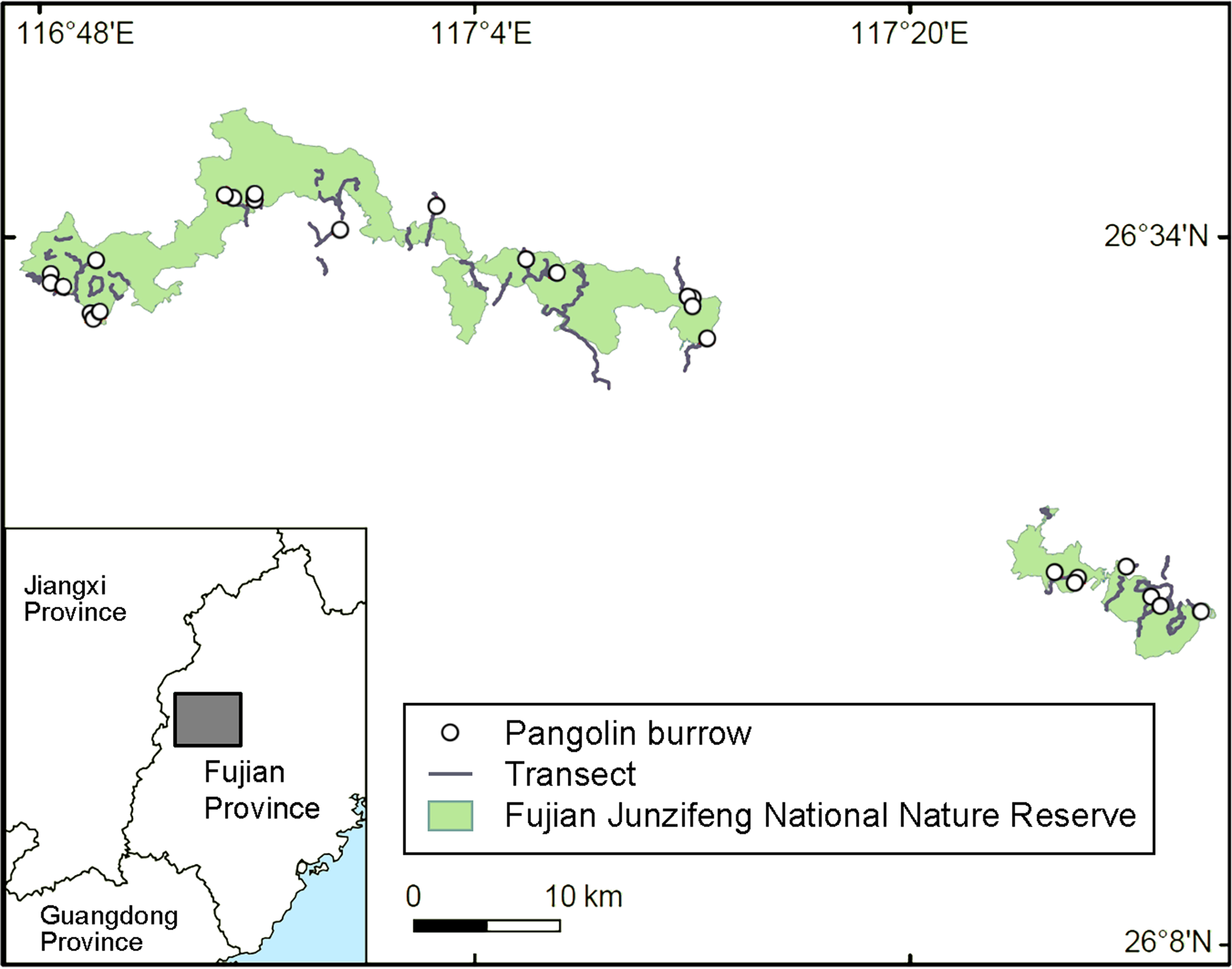
Study area, with transects and Chinese pangolin Manis pentadactyla burrows in Fujian Junzifeng National Nature Reserve, China. We surveyed a total of 70 transects and recorded a total of 87 burrows.

Study area
The Wuyi Mountains are recognized as an important potential habitat for the Chinese pangolin (Yang et al., Reference Yang, Chen, Challender, Waterman, Zhang and Huo2018; Peng, Reference Peng2020; Zhou, Reference Zhou2022). We conducted our study in the Fujian Junzifeng National Nature Reserve, which extends from the north-west to the east of Mingxi County, Fujian Province (Wang et al., Reference Wang, Chen, Lin, Zhong, Huang and Ding2022), in the eastern Wuyi Mountains (Fig. 1). The climate is subtropical monsoonal, with an annual mean temperature of 18 °C and a total annual precipitation of c. 2,000 mm (Shi, Reference Shi2021). Mingxi County has forest coverage of > 80%, with rich biodiversity (Guo & Xiao, Reference Guo and Xiao2015; Wang et al., Reference Wang, Hu, Feng, Chen, Zhong, Seah and Ding2023). The Reserve comprises farmlands predominantly cultivated with rice; bamboo forests characterized by Phyllostachys edulis; broadleaf forests characterized by Phoebe bournei, Castanopsis eyrei and Castanopsis carlesii; coniferous forests characterized by Cunninghamia lanceolata and Pinus massoniana; and mixed conifer and broadleaf forests characterized by P. massoniana and trees of the family Fagaceae (Lin et al., Reference Lin, Li and Zhang2005; Huang, Reference Huang2023).
Methods
Transect surveys
We surveyed 70 transects during November 2022–February 2023. We laid transects randomly in areas with five different land-cover types within the Fujian Junzifeng National Nature Reserve (Fig. 1): 17 in broadleaf forest, 12 in coniferous forest, 12 in mixed conifer and broadleaf forest, 13 in bamboo forest and 16 in farmland. Each transect was linear, ≥ 2 km long and 10 m wide.
We defined fixed 10 × 10 m quadrats at the midpoint of each transect as random (i.e. non-burrow) locations for recording environmental data: geographical coordinates, altitude, slope, aspect, forest type, plant cover, canopy closure and soil hardness (using a soil hardness meter IN-JSD1 from Laiyin Technology, China; sensitivity 2.0 ± 0.1 mv/V).
For herbal plant cover and soil hardness, we calculated the mean value from measurements taken in five 1 × 1 m quadrats (at the four corners and the centre) within each 10 × 10 m quadrat. We measured canopy closure (the degree to which the sky was obscured by vegetation) at heights of 3 m and 6 m above the ground.
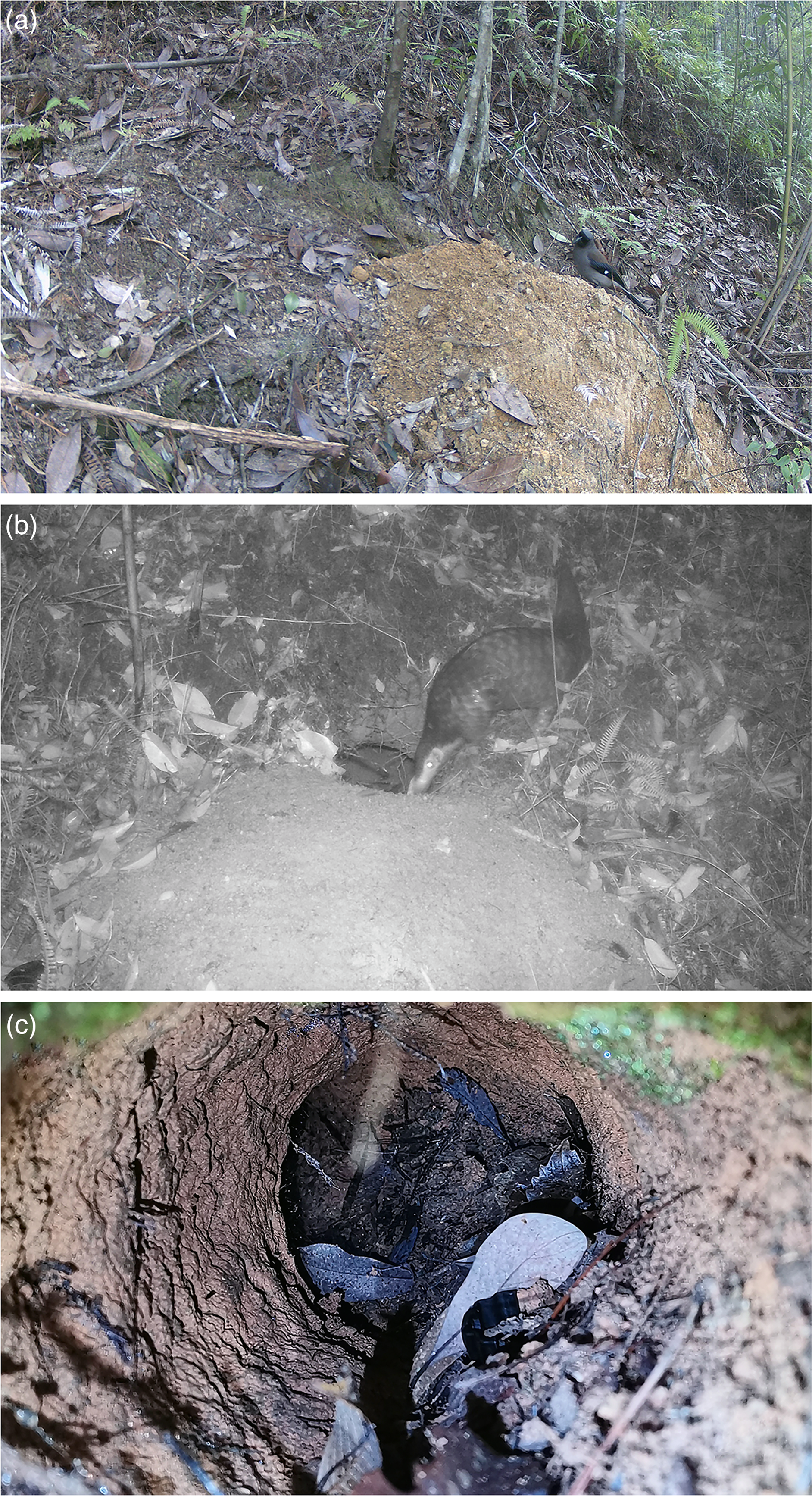
We identified pangolin burrows from their large soil mounds with a fish-scale-like pattern on the inner wall (Plate 1). For each pangolin burrow we encountered, we recorded the length and width of the opening and environmental parameters within a 10 × 10 m quadrat centred on the burrow (in the same way as for the quadrats at the midpoint of the transects that were used as random locations). If there were two or more burrows within 100 m of each other, we only recorded the first encountered burrow. We differentiated between new and old burrows: new burrows have mounds of freshly excavated soil that are notably different in colour compared to the surrounding soil (Plate 1); the soil outside old burrows is often covered with leaves and/or moss, and sometimes the soil mound is not obvious.
Data analysis
We employed a generalized linear model (GLM) in R 4.3.3 (R Core Team, 2024) to examine the recorded burrows and habitat information collected from the 70 transects. We chose this model as it is flexible, estimates parameters efficiently, and effectively avoids the potential pitfalls associated with transformation bias and related complexities (Warton et al., Reference Warton, Lyons, Stoklosa and Ives2016). We conducted Spearman’s correlation analysis on all variables, retaining only one of any two variables that showed significant correlation (ρ < 0.05). Forest type, herbal coverage, slope, soil hardness, aspect and altitude were retained for the model analysis. To evaluate the potential effects of multicollinearity, we used the vif function from the car package in R to calculate the variance inflation factor (VIF) for each explanatory factor (Fox & Weisberg, Reference Fox and Weisberg2019). The VIFs for all six variables were < 2.
Firstly, we analysed the differences in environmental characteristics between new and old burrows using a GLM. The results showed no significant differences between new and old burrows (Supplementary Tables 1 & 2). Consequently, we combined the data from new and old burrows to collectively represent burrow data, and compared these with the random plots for differential analysis.
We used burrow location vs random location (i.e. no burrow) as the dependent variable, with a binomial distribution (family = binomial) and a logit link function (link = logit). We then included all non-correlated environmental factors in the GLM, and compared the Akaike information criterion corrected for small sample sizes (AICc) values to select the optimal model set. The models with a ΔAICc value < 2 (compared to the best-performing model) were selected as optimal models. Finally, we obtained the average optimal model by averaging the models within the optimal model set. This analysis was conducted within the MuMIn package in R (Bartoń, Reference Bartoń2023).
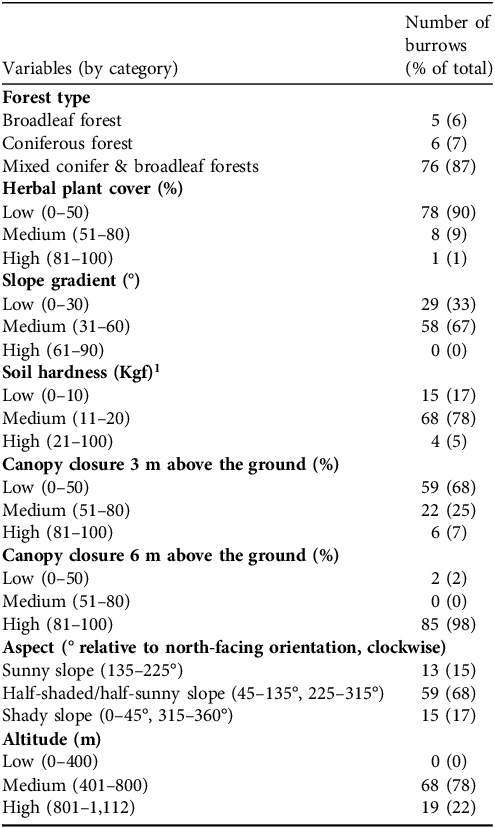
Distribution of environmental variables at the locations of Chinese pangolin Manis pentadactyla burrows encountered during transect surveys in Fujian Junzifeng National Nature Reserve, China. We encountered 87 pangolin burrows in total. Detailed results are presented in Supplementary Tables 3 and 4.

1 When measuring soil hardness, Kgf stands for kilogram-force, the gravitational force acting on a 1 kg mass under the standard acceleration caused by gravity.
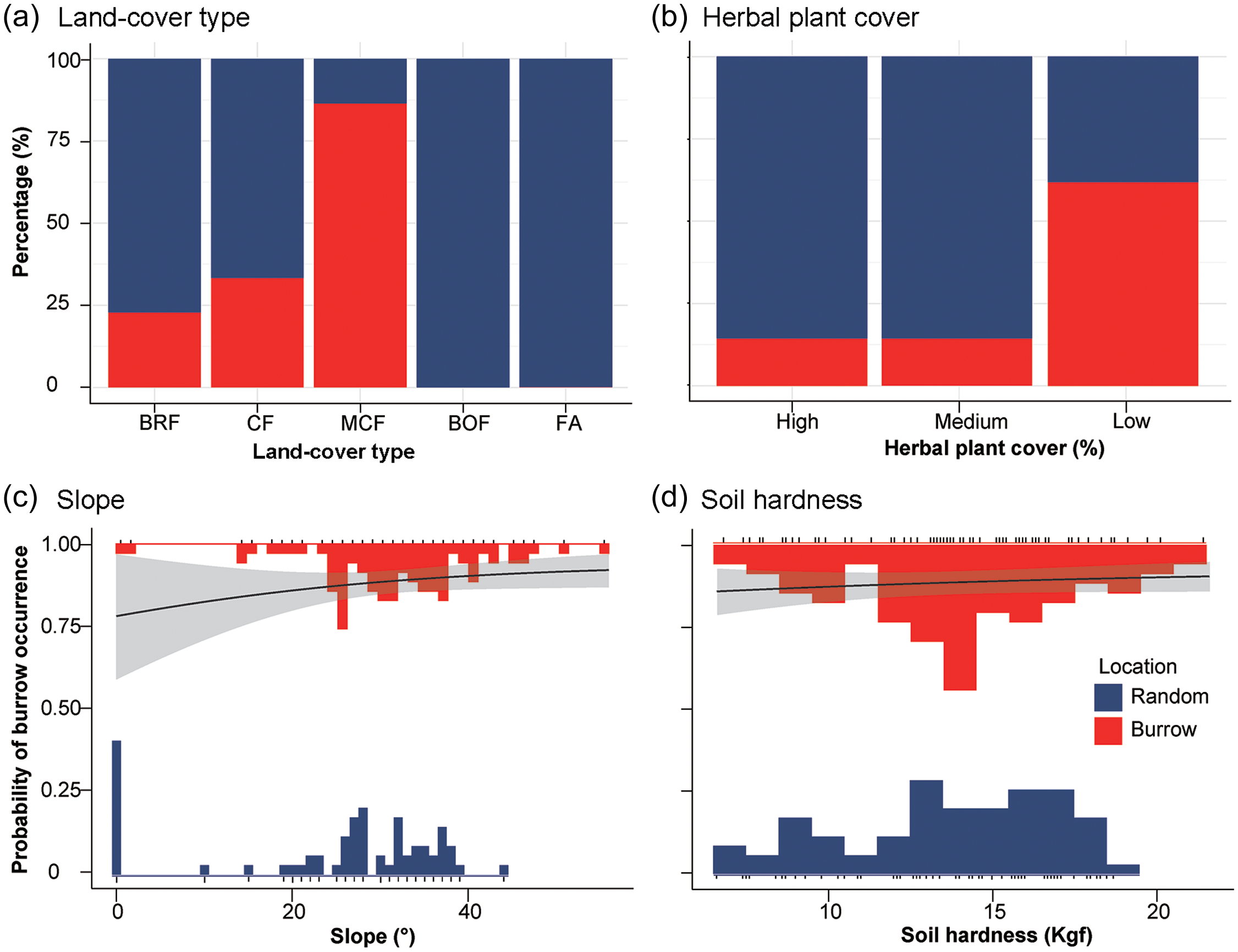
Differences in land-cover types, herbal plant cover, slope and soil hardness between random (non-burrow) and burrow locations. Random locations were at the midpoint of each transect (Fig. 1). (a) Per cent of burrow locations across five land-cover types (BRF, broadleaf forest; CF, coniferous forest; MBF, mixed conifer and broadleaf forest; BOF, bamboo forest; FA, farmland). Most burrows were in mixed conifer and broadleaf forests (Table 3). (b) Per cent of burrow locations for different levels of herbal plant cover (see Table 1 for category definitions). (c) Relationship between slope and probability of burrow occurrence. (d) Relationship between soil hardness and probability of burrow occurrence. In (c) and (d) the mean value (black curve) and SE (grey shaded area) are shown. The histograms depict the frequency of different slopes or soil hardness values across the burrow locations (top) and random locations (bottom).

Optimal model set of microhabitat characteristics at Chinese pangolin burrows based on generalized linear models (GLM). The table shows the number of model parameters (K), degrees of freedom (df), the log-likelihood value (logLik), Akaike information criterion corrected for small sample sizes (AICc), the difference in AICc compared to the best-performing model (ΔAICc) and the Akaike weight for each model.

Results
We recorded a total of 87 burrows (Supplementary Table 3), with no significant difference between forest types in the occurrence of old and new burrows. Burrows were most common in mixed conifer and broadleaf forest (87%), followed by coniferous forest and broadleaf forest (Table 1). We did not record burrows in bamboo forest or farmland (Table 1, Fig. 2a).
Of the four GLMs with ΔAICc < 2 (Table 2), forest type + herbal plant cover had the smallest ΔAICc value, followed by forest type + herbal plant cover + slope; the difference in ΔAICc values between these two models was relatively small. The next best model was forest type + herbal plant cover + soil hardness, followed by forest type + herbal plant cover + soil hardness + slope. All four models included the variables forest type and herbal plant cover.
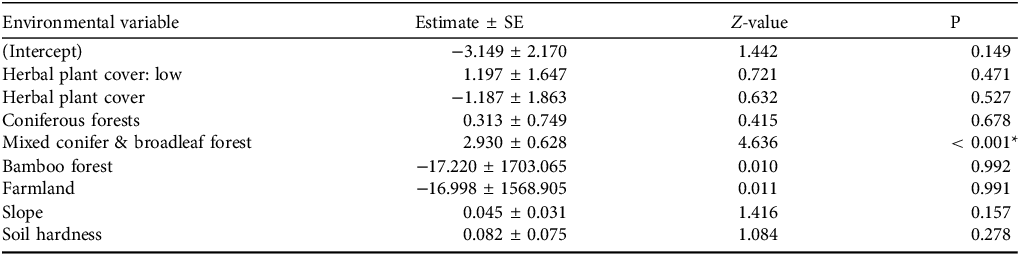
The average optimal model ensemble for microhabitat characteristics at Chinese pangolin burrows, based on GLM.

*Statistically significant effect.
Burrows and photos of the Chinese pangolin Manis pentadactyla in Fujian Junzifeng National Nature Reserve, China: (a) a pangolin burrow, with a grey treepie Dendrocitta formosae on the soil mound, (b) camera-trap photo of the Chinese pangolin, (c) entrance to a pangolin burrow, with the burrow walls exhibiting the characteristic fish-scale-like pattern.

The averaged model of the top model set included three environmental variables (Table 3). The models highlighted that mixed conifer and broadleaf forests had significant impacts on the distribution of Chinese pangolin burrows (P < 0.05, Table 3). Although herbal coverage, slope and soil hardness appeared in the averaged model, none showed a significant effect (Table 3, Fig. 2b–d).
Discussion
In this study, we focused on a specific reserve in the subtropical region of eastern China and, through transect surveys and habitat analysis, examined the relationship between the distribution of Chinese pangolin burrows and environmental factors. We analysed the microhabitat characteristics of Chinese pangolin burrows and explored how these characteristics influence the species’ distribution in the region. Similar to findings reported in an earlier study (Wu et al., Reference Wu, Liu, Ma, Xu and Chen2003), our results indicate that forest type influenced habitat selection of Chinese pangolins, with a clear preference for mixed conifer and broadleaf forests. Based on our findings, we recommend specific conservation actions to ensure the protection of this Critically Endangered species. Although the local forest coverage is high, coniferous forests occupy a significant proportion, mainly consisting of plantations dominated by Chinese fir Cunninghamia lanceolata (Liu et al., Reference Liu, Song, Wang, Shuai, Xiao and Bu2024). The area of mixed conifer and broadleaf forests is relatively small, suggesting an urgent need to strengthen the protection and restoration of this habitat.
Pangolins prefer mixed forests in our study area probably because of the abundance of food resources, especially ants and termites, that such environments offer (Peng, Reference Peng2020). Additionally, the diverse vegetation structure of mixed forests provides shelter and cover for pangolins, and the soil texture is conducive to the excavation of their burrows (Sun, Reference Sun2022). The stable microclimate and limited human disturbance in these habitats may also be favourable for pangolins. However, the specific factors affecting pangolin habitat preferences may vary between regions, necessitating further local-level research.
In recent years, local residents in several areas of eastern China (including Shaxian and Jiangle counties in Sanming City) have discovered Chinese pangolins, reported them to local authorities, and the animals were subsequently released back into the wild (Zhou, Reference Zhou2022). These rescue events occurred near our study area, in locations with similar vegetation types; we therefore recommend protecting mixed conifer and broadleaf forests in those areas as well.
Protecting pangolins requires field-based research at the local level because habitat factors influencing their distribution may vary between different local habitats. Such local-scale geographical and climatic differences could lead to different environmental preferences of Chinese pangolins in different regions. Previous research has shown that factors such as slope aspect and gradient, and availability of shelter, play an important role in influencing the distribution of Chinese pangolins (e.g. in Daliang Mountain Nature Reserve; Wu et al., Reference Wu, Liu, Ma, Xu and Chen2003). Similarly, studies conducted on Neilingding Island have highlighted the impact of shrub cover on the species’ distribution (Wang et al., Reference Wang, Wang, Dou, Xv, Chen, Hou and Hua2021). In Nepal, surface cover, leaf litter thickness, canopy cover, distance to roads, and slope gradient have been identified as influential factors for Chinese pangolin distribution (Katuwal et al., Reference Katuwal, Sharma and Parajuli2017; Sharma et al., Reference Sharma, Sharma, Chaulagain, Katuwal and Belant2020).
The Critically Endangered status of the Chinese pangolin underscores the urgent need to intensify awareness campaigns and law enforcement efforts for the protection of this species and its habitat. Inspired by giant panda conservation (Zhang & Wei, Reference Zhang and Wei2006), we support the establishment of a specialized conservation alliance in eastern China that includes nongovernmental organizations, the IUCN, and scientists (Yang et al., Reference Yang, Chen, Challender, Waterman, Zhang and Huo2018; Xia et al., Reference Xia, Lam and Sonne2021; Zhang et al., Reference Zhang, Wang, Mahmood, Wu, Li and Xu2021). This alliance should raise awareness and provide education related to the protection of the Chinese pangolin and mixed conifer and broadleaf forests. It should also support conservation efforts for both the pangolin and its habitat, such as raising public awareness about the illegality of capturing and consuming Chinese pangolins, and curbing illegal logging and other deforestation activities. Protection initiatives should be focused on existing nature reserves, including the Fujian Junzifeng National Nature Reserve, and involve targeted rescue and conservation measures. Specifically, the destruction of mixed conifer and broadleaf forests habitats should be strictly prohibited, and human activities in the mixed conifer and broadleaf forests habitats within the Reserve should be limited. In addition, the exploitation of pangolins for Asian traditional medicinal practices needs to be addressed, not only to protect pangolin populations, but also because of the risk of zoonotic disease outbreaks linked to pangolin consumption. To this end, the alliance should raise public awareness about the plight of pangolin populations and the associated risks to human health, and support the development of supplemental medicine products that use alternatives to pangolin scales. Comprehensive protective measures addressing all these aspects are needed to make progress towards achieving UN Sustainable Development Goal 15, which aims to safeguard biodiversity in terrestrial ecosystems.
Through our transect surveys for pangolin burrows combined with the collection and analysis of environmental data, we gained insights into the habitat requirements of Chinese pangolins at a local scale. We identified mixed conifer and broadleaf forests as the species’ most important habitat, providing a scientific basis for its conservation in the study area. Our survey methods are applicable to Chinese pangolin surveys at the county or nature reserve level, offering a standardized survey protocol for conservation efforts in these areas. Although the results from our study are not universally applicable as different areas vary in their habitat types, characteristics and specific local circumstances, the survey methods can and should be standardized to allow for meaningful comparisons. The survey methods employed in our study are suitable for a variety of different locations and contexts, and we hope they will guide future field surveys of Chinese pangolins in other regions.
The supplementary material for this article is available at doi.org/10.1017/S0030605324001637
Author contributions
Study conception and design: WL, FY; data collection: RW, XN, XC, YH, NG, MS, YZ; data analysis: RW, XN, YX; writing: WL, YX, FY.
Acknowledgements
This work was supported by the National Natural Science Foundation of China (NSFC, No. 32371609), Henan University Science and Technology Innovation Talent Project (22HASTIT033) and the Special Fund for Wildlife Protection of the National Forestry and Grassland Administration of China (HZ2022026-2023). We thank Professor Yongjie Wu from Sichuan University for his valuable suggestions.
Conflicts of interest
None.
Ethical standards
This research abided by the Oryx guidelines on ethical standards.



 Open access

