







1 Introduction and main results
1.1 Motivation
Let $a\in (0,1)$
be a constant and let
$a\in (0,1)$
be a constant and let $\{\xi _n\}_{n\ge 1}$
be independent identically distributed random variables. Consider a recursive sequence
$\{\xi _n\}_{n\ge 1}$
be independent identically distributed random variables. Consider a recursive sequence
 $$ \begin{align} X_{n+1}=a X_n+\xi_{n+1},\quad n\ge0, \end{align} $$
where the starting point $X_0$
is independent of
$X_0$
is independent of $\{\xi _n\}_{n\ge 1}$
. This Markov chain is usually called an autoregressive sequence of order 1, or AR(
$\{\xi _n\}_{n\ge 1}$
. This Markov chain is usually called an autoregressive sequence of order 1, or AR( $1$
) in short. We will denote the distribution of
$1$
) in short. We will denote the distribution of $\{X_n\}_{n\ge 0}$
by
$\{X_n\}_{n\ge 0}$
by $\mathbb P_{\nu }$
when
$\mathbb P_{\nu }$
when $\nu $
is the distribution of
$\nu $
is the distribution of $X_0$
, or simply by
$X_0$
, or simply by $\mathbb P_x$
when
$\mathbb P_x$
when $X_0=x$
is a fixed real number.
$X_0=x$
is a fixed real number.
We are interested in the asymptotic behaviour of the so-called persistence probability that the chain remains non-negative for a long time. That is, we want to determine the tail asymptotics for the stopping time
 $$ \begin{align} \tau:=\inf\{n\ge0: X_n< 0\}. \end{align} $$
The rough logarithmic asymptotics of $\mathbb P_x(\tau>n)$
is known under quite weak restrictions on the distribution of the innovations
$\mathbb P_x(\tau>n)$
is known under quite weak restrictions on the distribution of the innovations $\{\xi _n\}$
: by [Reference Hinrichs, Kolb and Wachtel17, Theorem 1], if
$\{\xi _n\}$
: by [Reference Hinrichs, Kolb and Wachtel17, Theorem 1], if $\mathbb {E}\log (1+|\xi _1|)<\infty $
,
$\mathbb {E}\log (1+|\xi _1|)<\infty $
, $\mathbb {E}(\xi _1^+)^\delta <\infty $
for some
$\mathbb {E}(\xi _1^+)^\delta <\infty $
for some $\delta>0$
, and
$\delta>0$
, and $\mathbb {P}(\xi _1>0)\mathbb {P}(\xi _1<0)>0$
, then there exists a
$\mathbb {P}(\xi _1>0)\mathbb {P}(\xi _1<0)>0$
, then there exists a $\unicode{x3bb} _a\in (0,1)$
such that
$\unicode{x3bb} _a\in (0,1)$
such that

as $n \to \infty $
for any starting point
$n \to \infty $
for any starting point $x>0$
. The proof of this result is based on a rather simple subadditivity argument, which allows one to prove the existence of
$x>0$
. The proof of this result is based on a rather simple subadditivity argument, which allows one to prove the existence of $\unicode{x3bb} _a$
, but gives no information about any further properties of this exponent.
$\unicode{x3bb} _a$
, but gives no information about any further properties of this exponent.
It is much harder to determine the exact tail asymptotics for $\tau $
. To the best of our knowledge, the most general result was obtained in [Reference Hinrichs, Kolb and Wachtel17]: if
$\tau $
. To the best of our knowledge, the most general result was obtained in [Reference Hinrichs, Kolb and Wachtel17]: if $0<\mathbb {E}(\xi _1^+)^t<\infty $
for all
$0<\mathbb {E}(\xi _1^+)^t<\infty $
for all $t>0$
,
$t>0$
, $0<\mathbb {E}(\xi _1^-)^\delta <\infty $
for some
$0<\mathbb {E}(\xi _1^-)^\delta <\infty $
for some $\delta>0$
, and the distribution of innovations is absolutely continuous with a density that is either strictly positive almost everywhere on
$\delta>0$
, and the distribution of innovations is absolutely continuous with a density that is either strictly positive almost everywhere on $\mathbb R$
or has bounded support, then there exists a strictly positive function
$\mathbb R$
or has bounded support, then there exists a strictly positive function $V(x)$
such that, as
$V(x)$
such that, as $n\to \infty $
,
$n\to \infty $
,

The assumption that all moments of $\xi _1^+$
are finite is optimal, see [Reference Hinrichs, Kolb and Wachtel17, Proposition 19]. In contrast, the assumption on absolute continuity of the distribution of innovations was prompted by the method of the proof, which relied on compactness properties of the transition operator P of the Markov chain
$\xi _1^+$
are finite is optimal, see [Reference Hinrichs, Kolb and Wachtel17, Proposition 19]. In contrast, the assumption on absolute continuity of the distribution of innovations was prompted by the method of the proof, which relied on compactness properties of the transition operator P of the Markov chain $\{X_n\}$
killed at exiting
$\{X_n\}$
killed at exiting $[0,\infty )$
. To clarify, this operator that acts on measurable functions on
$[0,\infty )$
. To clarify, this operator that acts on measurable functions on $[0, \infty )$
by
$[0, \infty )$
by  , and the killed chain is the sequence $\{X_n\}_{0 \le n < \tau }$
.
$\{X_n\}_{0 \le n < \tau }$
.
It is hard to imagine that the local structure of the distribution of innovations can be crucial for the tail behaviour of $\tau $
. However, it is absolutely unclear how to adapt the compactness approach of [Reference Hinrichs, Kolb and Wachtel17] to innovations with a generic discrete distribution. In the present paper, we do this for the most simple discrete distribution of innovations, given by
$\tau $
. However, it is absolutely unclear how to adapt the compactness approach of [Reference Hinrichs, Kolb and Wachtel17] to innovations with a generic discrete distribution. In the present paper, we do this for the most simple discrete distribution of innovations, given by
 $$ \begin{align} \mathbb P(\xi_1=1)=p, \quad \mathbb P(\xi_1=-1)=q, \quad q = 1 - p. \end{align} $$
It is known as the Rademacher distribution when $p=1/2$
.
$p=1/2$
.
The key to the compactness approach is in finding a right functional space for the action of the transition operator of the killed chain. Our choice of the space is prompted by a certain deterministic dynamical system defined by the piecewise linear mapping $x \mapsto x/a + 1/2\ \pmod 1$
. The details and explanation of the logic leading to this solution are given in §2.3.
$x \mapsto x/a + 1/2\ \pmod 1$
. The details and explanation of the logic leading to this solution are given in §2.3.
Initially, we attempted a different approach, based on the observation that for every $a \in (0, \tfrac 23)$
,
$a \in (0, \tfrac 23)$
, $\tau $
is the hitting time of zero for a non-negative Markov chain
$\tau $
is the hitting time of zero for a non-negative Markov chain $\{Y_n\}$
obtained from
$\{Y_n\}$
obtained from $\{X_n\}$
by a certain aggregation of states. This aggregated (or lumped) chain has a finite number of states for almost every a. For such a,
$\{X_n\}$
by a certain aggregation of states. This aggregated (or lumped) chain has a finite number of states for almost every a. For such a, $\unicode{x3bb} _a$
is the Perron–Frobenius eigenvalue of the substochastic matrix corresponding to the transition operator of
$\unicode{x3bb} _a$
is the Perron–Frobenius eigenvalue of the substochastic matrix corresponding to the transition operator of $\{Y_n\}$
killed at reaching
$\{Y_n\}$
killed at reaching $0$
. This approach is worth the attention even though it does not cover the remaining values of a on the set of measure zero. We give the details in §2.2.
$0$
. This approach is worth the attention even though it does not cover the remaining values of a on the set of measure zero. We give the details in §2.2.
Unfortunately, neither of the two approaches works for arbitrary $a> \tfrac 23$
aside from some exceptional values (see Remark 9). The case
$a> \tfrac 23$
aside from some exceptional values (see Remark 9). The case $a \in (0, \tfrac 12]$
can be solved by a simple direct argument, which gives that
$a \in (0, \tfrac 12]$
can be solved by a simple direct argument, which gives that $\unicode{x3bb} _a=p$
for such a. Therefore, our main interest in
$\unicode{x3bb} _a=p$
for such a. Therefore, our main interest in $a \in (\tfrac 12, \tfrac 23]$
.
$a \in (\tfrac 12, \tfrac 23]$
.
Let us comment on the background and the related literature in addition to [Reference Hinrichs, Kolb and Wachtel17]. The standard Perron–Frobenius method allows one to find the asymptotics of the probability that a finite state Markov chain avoids a subset of its states for a long time. Extending this to an infinite state space requires compactness properties of the transition operator of the corresponding killed chain. For persistence of general Markov chains, this is explored in [Reference Aurzada, Mukherjee and Zeitouni3], which gives further references and considers many examples including autoregressive chains with absolutely continuous innovations. A different approach is used in [Reference Alsmeyer, Bostan, Raschel and Simon1], which gives explicit combinatorial formulae for persistence probabilities of the AR( $1$
) chain with symmetric uniformly distributed innovations. The case where the innovations have logarithmic tail probabilities is considered in [Reference Denisov, Hinchrich, Kolb and Wachtel13]. For a general background on persistence problems, which have been extensively studied for many types of stochastic processes, we refer to the surveys [Reference Aurzada and Simon4, Reference Bray, Majumdar and Schehr10], where the second one gives a theoretical physics perspective.
$1$
) chain with symmetric uniformly distributed innovations. The case where the innovations have logarithmic tail probabilities is considered in [Reference Denisov, Hinchrich, Kolb and Wachtel13]. For a general background on persistence problems, which have been extensively studied for many types of stochastic processes, we refer to the surveys [Reference Aurzada and Simon4, Reference Bray, Majumdar and Schehr10], where the second one gives a theoretical physics perspective.
1.2 Main results
It is easy to see that if the starting point x is not greater than $1/(1-a)$
, then all values of the chain
$1/(1-a)$
, then all values of the chain $\{X_n\}$
do not exceed
$\{X_n\}$
do not exceed $1/(1-a)$
. If the starting point x is greater than
$1/(1-a)$
. If the starting point x is greater than $1/(1-a)$
, then the trajectory of the chain is monotonically decreasing before the downcrossing of the level
$1/(1-a)$
, then the trajectory of the chain is monotonically decreasing before the downcrossing of the level $1/(1-a)$
. For this reason, it is natural to restrict our consideration to the starting points in the interval
$1/(1-a)$
. For this reason, it is natural to restrict our consideration to the starting points in the interval $[0, {1}/({1-a})]$
, which we will always regard as the state space of the chain
$[0, {1}/({1-a})]$
, which we will always regard as the state space of the chain $\{X_n\}$
killed at the exit time
$\{X_n\}$
killed at the exit time $\tau $
. We stress that our results can be easily generalized to arbitrary starting points
$\tau $
. We stress that our results can be easily generalized to arbitrary starting points $x \ge 0$
; see, for example, Corollary 2.
$x \ge 0$
; see, for example, Corollary 2.
Assume that $a \in [\tfrac 12, \tfrac 23)$
and consider the mapping
$a \in [\tfrac 12, \tfrac 23)$
and consider the mapping
 $$ \begin{align} T_a(x)= \begin{cases} \dfrac{1}{a}(x+1), & 0 \le x \le \dfrac{2a-1}{1-a},\\[7pt] \dfrac{1}{a}(x-1), &1 \le x \le \dfrac{1}{1-a}. \end{cases} \end{align} $$
We underline that $T_a$
is defined on the set
$T_a$
is defined on the set $[0,{1}/({1-a})]\setminus I_a$
, where
$[0,{1}/({1-a})]\setminus I_a$
, where
 $$ \begin{align*} I_a=\bigg(\dfrac{2a-1}{1-a},1\bigg). \end{align*} $$
This mapping plays a key role for our paper. In particular, it features in the following remarkable property that the killed AR( $1$
) chain is deterministic in the reversed time: for any
$1$
) chain is deterministic in the reversed time: for any $n \ge 1$
, on the event
$n \ge 1$
, on the event $\{\tau>n\}$
, we have
$\{\tau>n\}$
, we have
 $$ \begin{align} X_{n-k}=T_a^k(X_n), \quad 0 \le k \le n. \end{align} $$
A similar property is known to hold for the stationary AR( $1$
) chains in the case when
$1$
) chains in the case when $1/a$
is an integer and the innovations are discrete uniform on
$1/a$
is an integer and the innovations are discrete uniform on $\{0, 1, \ldots , 1/a-1\}$
, see the discussion of Bartlett [Reference Bartlett6]. We will prove these properties in §2.1.
$\{0, 1, \ldots , 1/a-1\}$
, see the discussion of Bartlett [Reference Bartlett6]. We will prove these properties in §2.1.
We can also consider the case when $a=\tfrac 23$
, where we define
$a=\tfrac 23$
, where we define $T_{2/3}$
as above but specify that
$T_{2/3}$
as above but specify that $T_{2/3}(1)=0$
because (5) gives two values at
$T_{2/3}(1)=0$
because (5) gives two values at $x=1$
. Note that (6) ceases to hold for
$x=1$
. Note that (6) ceases to hold for $a=\tfrac 23$
: if
$a=\tfrac 23$
: if $X_n=1$
and
$X_n=1$
and $\tau>n$
, then we have two possible values for
$\tau>n$
, then we have two possible values for $X_{n-1}$
, namely
$X_{n-1}$
, namely $0$
and
$0$
and $3$
.
$3$
.
Since $T_a$
is defined on
$T_a$
is defined on $[0,{1}/({1-a})]\setminus I_a$
, the iterates
$[0,{1}/({1-a})]\setminus I_a$
, the iterates $T_a^k(x)$
are defined only up to the first hitting time of
$T_a^k(x)$
are defined only up to the first hitting time of $I_a$
, given by
$I_a$
, given by
 $$ \begin{align} \varkappa_a(x)=\inf\{k\ge0: T_a^{k}(x)\in I_a\} \in[0,\infty]. \end{align} $$
In particular, x is a possible value of $X_n$
on the event
$X_n$
on the event $\{\tau>n\}$
if and only if
$\{\tau>n\}$
if and only if $T_a^k(x)\notin I_a$
for all
$T_a^k(x)\notin I_a$
for all $0 \le k<n$
. Furthermore, put
$0 \le k<n$
. Furthermore, put

and define the occupation times of $[0,1)$
by
$[0,1)$
by
 $$ \begin{align} L_0(x)= 0 \quad \text{and} \quad L_k(x) = \sum_{i=0}^{k-1} \delta_i(x), \quad 1 \le k < \varkappa_a(x)+1. \end{align} $$
We omitted the index a to simplify the notation.
To interpret the quantities $\delta _k(x)$
and
$\delta _k(x)$
and $L_k(x)$
, we note that the mapping
$L_k(x)$
, we note that the mapping $T_a$
is closely related to the mapping
$T_a$
is closely related to the mapping $\widehat T_a$
given by
$\widehat T_a$
given by $\widehat T_a(x)= x/a + 1/2\ \pmod 1$
for
$\widehat T_a(x)= x/a + 1/2\ \pmod 1$
for $ 0 \le x \le 1$
. Namely, since
$ 0 \le x \le 1$
. Namely, since
 $$ \begin{align*} \widehat T_a \bigg(\dfrac{ax}{2}\bigg) = \begin{cases} \dfrac12 (x +1), & 0 \le x < 1, \\[7pt] \dfrac12(x-1), & 1 \le x < 3, \\[7pt] \dfrac12(x-3), & 3 \le x \le \dfrac2a, \\ \end{cases} \end{align*} $$
we have $T_a(x) = {2}\widehat T_a({ax}/{2})/a$
for all x in the domain of
$T_a(x) = {2}\widehat T_a({ax}/{2})/a$
for all x in the domain of $T_a$
excluding
$T_a$
excluding $x=3$
when
$x=3$
when $a=\tfrac 23$
. Consequently, for every
$a=\tfrac 23$
. Consequently, for every $k \ge 1$
and
$k \ge 1$
and $x \neq 3$
such that
$x \neq 3$
such that $\varkappa _a(x) \ge k$
,
$\varkappa _a(x) \ge k$
,
 $$ \begin{align} T_a^k(x) = \dfrac{2}{a}\widehat T_a^k \bigg(\dfrac{ax}{2} \bigg). \end{align} $$
Note in passing that the sequences $ \{2 \widehat T_a^k({ax}/{2})/a\}_{k \ge 0}$
with
$ \{2 \widehat T_a^k({ax}/{2})/a\}_{k \ge 0}$
with $x \in [0, {1}/({1-a})]$
can enter the set
$x \in [0, {1}/({1-a})]$
can enter the set $[3, 2/a]$
only through the ‘hole’
$[3, 2/a]$
only through the ‘hole’ $I_a$
. The related dynamical systems defined by the
$I_a$
. The related dynamical systems defined by the $\beta $
-transformations
$\beta $
-transformations $x \mapsto \beta x\ \pmod 1$
with a hole were studied in [Reference Clark12, Reference Glendinning and Sidorov15].
$x \mapsto \beta x\ \pmod 1$
with a hole were studied in [Reference Clark12, Reference Glendinning and Sidorov15].
However, $\widehat T_a$
is one of the linear mod 1 mappings
$\widehat T_a$
is one of the linear mod 1 mappings $\widehat T_{\beta , \alpha }(x)=\beta x + \alpha\ \pmod 1$
, where
$\widehat T_{\beta , \alpha }(x)=\beta x + \alpha\ \pmod 1$
, where $\beta>1$
and
$\beta>1$
and $\alpha \in [0, 1)$
. By Parry [Reference Parry21, p. 101], every
$\alpha \in [0, 1)$
. By Parry [Reference Parry21, p. 101], every $y \in [0,1)$
can be written as
$y \in [0,1)$
can be written as
 $$ \begin{align} y = \sum_{k=0}^\infty (d_k(y) - \alpha ) \frac{1}{\beta^{k+1}}, \end{align} $$
where $d_k(y)$
are the ‘digits’ of y given by
$d_k(y)$
are the ‘digits’ of y given by $d_k(y) = [ \beta \widehat T_{\beta , \alpha }^k(y) + \alpha ]$
, with
$d_k(y) = [ \beta \widehat T_{\beta , \alpha }^k(y) + \alpha ]$
, with $[ \cdot ]$
denoting the integer part. This is a particular representation of y in the base
$[ \cdot ]$
denoting the integer part. This is a particular representation of y in the base $\beta $
, which we call the
$\beta $
, which we call the $(\beta , \alpha )$
-expansion of y. Such expansions were first studied by Parry [Reference Parry21]. In the particularly important case
$(\beta , \alpha )$
-expansion of y. Such expansions were first studied by Parry [Reference Parry21]. In the particularly important case $\alpha =0$
(and non-integer
$\alpha =0$
(and non-integer $\beta $
), these are the so-called
$\beta $
), these are the so-called $\beta $
-expansions introduced by Rényi [Reference Rényi22].
$\beta $
-expansions introduced by Rényi [Reference Rényi22].
It follows from (10) that $1-\delta _k(x)$
, for
$1-\delta _k(x)$
, for $0 \le k < \varkappa _a(x)+1 $
, are the first digits in the
$0 \le k < \varkappa _a(x)+1 $
, are the first digits in the $(1/a, 1/2) $
-expansion of
$(1/a, 1/2) $
-expansion of $ax/2$
(unless
$ax/2$
(unless $x = 3$
) and, thus,
$x = 3$
) and, thus, $L_k(x)$
is the number of
$L_k(x)$
is the number of $0$
s in the first k digits of this expansion. Moreover, we will also show that
$0$
s in the first k digits of this expansion. Moreover, we will also show that $\delta _0(x), \delta _1(x), \ldots $
for
$\delta _0(x), \delta _1(x), \ldots $
for ${a=\tfrac 23}$
are the digits of the
${a=\tfrac 23}$
are the digits of the $\tfrac 32$
-expansion of
$\tfrac 32$
-expansion of $1-x/3$
(up to a minor modification); see (78), where we write
$1-x/3$
(up to a minor modification); see (78), where we write $T_{2/3}$
in terms of the
$T_{2/3}$
in terms of the $\tfrac 32$
-transformation
$\tfrac 32$
-transformation $\widehat T_{3/2, \, 0}$
. There are many works on digit frequencies in
$\widehat T_{3/2, \, 0}$
. There are many works on digit frequencies in $\beta $
-expansions, including [Reference Boyland, de Carvalho and Hall9, Reference Schmeling24]; unfortunately, they hardly consider concrete values of
$\beta $
-expansions, including [Reference Boyland, de Carvalho and Hall9, Reference Schmeling24]; unfortunately, they hardly consider concrete values of $(\beta ,x)$
.
$(\beta ,x)$
.
The orbits of $0$
and
$0$
and $1$
have a distinguished role for the linear mod
$1$
have a distinguished role for the linear mod $1$
transformations; for example, they appear in (68) for the invariant density of
$1$
transformations; for example, they appear in (68) for the invariant density of $\widehat T_{\beta , \alpha }$
. Similarly, the orbit of zero under
$\widehat T_{\beta , \alpha }$
. Similarly, the orbit of zero under $T_a$
, that is,
$T_a$
, that is, $\{T_a^k(0): 0 \le k < \varkappa _a(0) +1 \}$
, is very important for our analysis. For this reason, we denote
$\{T_a^k(0): 0 \le k < \varkappa _a(0) +1 \}$
, is very important for our analysis. For this reason, we denote
 $$ \begin{align} \varkappa_a=\varkappa_a(0), \quad \delta_k=\delta_k(0), \quad L_k=L_k(0). \end{align} $$
It will be crucial whether the orbit of zero is finite or not, so we put
 $$ \begin{align} S= \{a \in [1/2, 2/3]: \varkappa_a=\infty \}. \end{align} $$
Because $\varkappa _a$
can be infinite due to either chaotic or cyclic behaviour of the orbit, define
$\varkappa _a$
can be infinite due to either chaotic or cyclic behaviour of the orbit, define
 $$ \begin{align*} \varkappa_a' = \# \{T_a^k(0) : 0 \le k < \varkappa_a+1\} - 1 \end{align*} $$
to distinguish between these cases. If $\varkappa _a'<\infty $
but
$\varkappa _a'<\infty $
but $\varkappa _a=\infty $
, we say that the orbit of zero is eventually periodic, otherwise, we call it aperiodic. Then,
$\varkappa _a=\infty $
, we say that the orbit of zero is eventually periodic, otherwise, we call it aperiodic. Then, $\varkappa _a=\varkappa ^{\prime }_a$
if and only if the orbit is aperiodic. We specify that the orbit is purely periodic when
$\varkappa _a=\varkappa ^{\prime }_a$
if and only if the orbit is aperiodic. We specify that the orbit is purely periodic when $T_a^{\varkappa _a'}(0)=1$
.
$T_a^{\varkappa _a'}(0)=1$
.
It is easy to see that if $\varkappa _a <\infty $
, then the sequence
$\varkappa _a <\infty $
, then the sequence $\{\widehat T_a^k(0)\}_{k \ge \varkappa _a}$
strictly increases until it hits
$\{\widehat T_a^k(0)\}_{k \ge \varkappa _a}$
strictly increases until it hits $[3a/2, 1)$
at some moment
$[3a/2, 1)$
at some moment $k'$
; hence,
$k'$
; hence, $d_{k'}(0)=2$
. Then,
$d_{k'}(0)=2$
. Then,
 $$ \begin{align*} a \in S \text{ if and only if } \text{there are no } 2\text{s in the } \bigg(\dfrac{1}{a}, \dfrac12 \bigg)\text{-expansion of }0. \end{align*} $$
Similarly, for any fixed $a \in (\tfrac 12, \tfrac 23]$
, the set
$a \in (\tfrac 12, \tfrac 23]$
, the set
 $$ \begin{align*} Q_a=\{x \in [0, 1/(1-a)]: \varkappa_a(x) = \infty\} \end{align*} $$
can be described as follows:
 $$ \begin{align*} x \in Q_a \text{ if and only if } \text{there are no } 2\text{s in the } \bigg(\dfrac{1}{a}, \dfrac12 \bigg)\text{-expansion of }ax/2, \end{align*} $$
once we re-define the digits of the $(\tfrac 32, \tfrac 12)$
-expansion of
$(\tfrac 32, \tfrac 12)$
-expansion of $1$
as
$1$
as $0111\! \ldots. $
Thus,
$0111\! \ldots. $
Thus, $Q_a$
is fully analogous to the Cantor ternary set. Lastly, we note that in the case when
$Q_a$
is fully analogous to the Cantor ternary set. Lastly, we note that in the case when $a \in (\tfrac 23,1)$
, which is excluded from our consideration, the
$a \in (\tfrac 23,1)$
, which is excluded from our consideration, the $(1/a, 1/2)$
-expansion of any point in
$(1/a, 1/2)$
-expansion of any point in $[0,1]$
has no
$[0,1]$
has no $2$
s.
$2$
s.
We can now state our main result.
Theorem 1. Let $\{X_n\}$
be a Markov chain defined by (1) with some
$\{X_n\}$
be a Markov chain defined by (1) with some $a \in (\tfrac 12, \tfrac 23]$
. Assume that the innovations
$a \in (\tfrac 12, \tfrac 23]$
. Assume that the innovations $\{\xi _n\}$
satisfy (4) with some
$\{\xi _n\}$
satisfy (4) with some $p \in (0,1)$
. Then, there exists a constant
$p \in (0,1)$
. Then, there exists a constant $c \in (0,1)$
such that, uniformly in
$c \in (0,1)$
such that, uniformly in $x \in [0,{1}/({1-a})]$
, we have
$x \in [0,{1}/({1-a})]$
, we have

as $n \to \infty $
, where
$n \to \infty $
, where $\unicode{x3bb} _a=\unicode{x3bb} _a(p)> p$
is the unique positive solution to
$\unicode{x3bb} _a=\unicode{x3bb} _a(p)> p$
is the unique positive solution to
 $$ \begin{align} \sum_{k=0}^{\varkappa_a} \delta_k \bigg(\frac{p}{\unicode{x3bb}}\bigg)^{k+1} \bigg( \frac{q}{p} \bigg)^{L_k} =1 \end{align} $$
and

with $\delta _k$
and
$\delta _k$
and $L_k$
defined in (8), (9) and (12). The constant c is given in (40).
$L_k$
defined in (8), (9) and (12). The constant c is given in (40).
The function $a \mapsto \unicode{x3bb} _a$
satisfies
$a \mapsto \unicode{x3bb} _a$
satisfies $\unicode{x3bb} _{1/2}=p$
and is continuous and non-decreasing on
$\unicode{x3bb} _{1/2}=p$
and is continuous and non-decreasing on $[\tfrac 12, \tfrac 23]$
. More specifically, it is constant on every interval contained in
$[\tfrac 12, \tfrac 23]$
. More specifically, it is constant on every interval contained in $[\tfrac 12, \tfrac 23] \setminus S$
and is constant on no open interval intersecting S, which is a closed set of Lebesgue measure zero defined in (13). In other words, the Lebesgue–Stieltjes measure
$[\tfrac 12, \tfrac 23] \setminus S$
and is constant on no open interval intersecting S, which is a closed set of Lebesgue measure zero defined in (13). In other words, the Lebesgue–Stieltjes measure $d \unicode{x3bb} _a$
on
$d \unicode{x3bb} _a$
on $[\tfrac 12, \tfrac 23]$
has no atoms, is singular and its topological support is S.
$[\tfrac 12, \tfrac 23]$
has no atoms, is singular and its topological support is S.
Moreover, the conditional distributions converge weakly, uniformly in $x,y \in [0, {1}/({1-a})]$
:
$x,y \in [0, {1}/({1-a})]$
:

where the right-hand side is the distribution function of a probability measure $\nu _a$
on
$\nu _a$
on $[0, {1}/({1-a})]$
. This measure is quasi-stationary, that is,
$[0, {1}/({1-a})]$
. This measure is quasi-stationary, that is,
 $$ \begin{align} \mathbb P_{\nu_a}(X_1\in A|\tau>1)=\nu_a(A), \quad A\in\mathcal{B}([0,1/(1-a)]). \end{align} $$
This measure has no atoms and is singular with respect to the Lebesgue measure, except in the case when $a=\tfrac 23$
and
$a=\tfrac 23$
and $p=\tfrac 12$
, where
$p=\tfrac 12$
, where $\nu _{2/3}$
is the uniform distribution on
$\nu _{2/3}$
is the uniform distribution on $[0,3]$
. The topological support of
$[0,3]$
. The topological support of $\nu _a$
is the set of non-isolated points of
$\nu _a$
is the set of non-isolated points of $Q_a$
, that is,
$Q_a$
, that is, $Q_a$
itself if there is no integer
$Q_a$
itself if there is no integer $k \ge 1$
such that
$k \ge 1$
such that $T^k_a(0) = {1}/({1-a})$
, and otherwise,
$T^k_a(0) = {1}/({1-a})$
, and otherwise, $Q_a \setminus \bigcup _{k=0}^\infty T_a^{-k}(0)$
.
$Q_a \setminus \bigcup _{k=0}^\infty T_a^{-k}(0)$
.
Corollary 2. Under the assumptions of Theorem 1, for every $x \ge 0$
, we have
$x \ge 0$
, we have

where
 $$ \begin{align*} \sigma:=\inf \{n \ge 0: X_n \le 1/(1-a)\}. \end{align*} $$
Moreover, the weak convergence (17) holds true for all $x \ge 0$
.
$x \ge 0$
.
Let us make a few comments.
Remark 3. (a) The value of $\unicode{x3bb} _a$
is rather explicit from (15) when
$\unicode{x3bb} _a$
is rather explicit from (15) when $\varkappa _a' <\infty $
; see Figure 1. In this case, the left-hand side in (15) can be written as a finite sum even if
$\varkappa _a' <\infty $
; see Figure 1. In this case, the left-hand side in (15) can be written as a finite sum even if $\varkappa _a=\infty $
because then, the sequence
$\varkappa _a=\infty $
because then, the sequence $\{\delta _k\}$
is eventually periodic. Thus,
$\{\delta _k\}$
is eventually periodic. Thus, $\unicode{x3bb} _a$
is a solution to a polynomial equation of order
$\unicode{x3bb} _a$
is a solution to a polynomial equation of order $\varkappa _a'+1$
and we will give some of its values in § 2.2. See Figure 2 for a graph of
$\varkappa _a'+1$
and we will give some of its values in § 2.2. See Figure 2 for a graph of $\varkappa _a'$
. If
$\varkappa _a'$
. If $\varkappa _a'=\infty $
, no simplification of (15) appears to be possible because of chaotic behaviour of the orbit of zero, unless
$\varkappa _a'=\infty $
, no simplification of (15) appears to be possible because of chaotic behaviour of the orbit of zero, unless $a=\tfrac 23$
and
$a=\tfrac 23$
and $p=\tfrac 12$
. In this case,
$p=\tfrac 12$
. In this case,

see Proposition 10. We found this value by computing the left-hand side of (15) for $\unicode{x3bb} = ap$
using the
$\unicode{x3bb} = ap$
using the $(1/a, 1/2)$
-expansion of
$(1/a, 1/2)$
-expansion of $0$
. In §2.4, we will present an alternative way to compute
$0$
. In §2.4, we will present an alternative way to compute $\unicode{x3bb} _{2/3}(1/2)$
and to establish (14) with explicit expressions for c and
$\unicode{x3bb} _{2/3}(1/2)$
and to establish (14) with explicit expressions for c and $V(x)$
in the case
$V(x)$
in the case $a=\tfrac 23$
and
$a=\tfrac 23$
and $p=\tfrac 12$
, based on a close connection between the transition operator of
$p=\tfrac 12$
, based on a close connection between the transition operator of $\{X_n\}$
killed at leaving
$\{X_n\}$
killed at leaving $[0,\infty )$
and the transfer operator associated with
$[0,\infty )$
and the transfer operator associated with $T_{2/3}$
.
$T_{2/3}$
.
The graphs of $\unicode{x3bb} _a(p)$
for fixed p.
$\unicode{x3bb} _a(p)$
for fixed p.

The graph of $\varkappa _a'$
.
$\varkappa _a'$
.

The distribution functions of $\nu _a$
for
$\nu _a$
for $p=0.3$
,
$p=0.3$
, $p=0.5$
,
$p=0.5$
, $p=0.7$
(top to bottom plots in all four subfigures), where (a) a = 0.55, (b) a = 0.6, (c) a = 0.65, and (d) a =
$p=0.7$
(top to bottom plots in all four subfigures), where (a) a = 0.55, (b) a = 0.6, (c) a = 0.65, and (d) a = $\tfrac{2}{3}$
.
$\tfrac{2}{3}$
.

(b) The mapping $a\mapsto \unicode{x3bb} _a$
has intervals of constancy essentially due to discreteness of the innovations. These intervals are the intervals of constancy of
$a\mapsto \unicode{x3bb} _a$
has intervals of constancy essentially due to discreteness of the innovations. These intervals are the intervals of constancy of $a\mapsto \varkappa _a'$
, cf. Figures 1 and 2. In contrast, the mapping
$a\mapsto \varkappa _a'$
, cf. Figures 1 and 2. In contrast, the mapping $a\mapsto \unicode{x3bb} _a$
is strictly increasing if the innovations have a density that is strictly positive on
$a\mapsto \unicode{x3bb} _a$
is strictly increasing if the innovations have a density that is strictly positive on $\mathbb R$
and log-concave, see Aurzada et al [Reference Aurzada, Mukherjee and Zeitouni3, Theorem 2.7]. In the particular case of the standard normal innovations, Aurzada and Kettner [Reference Aurzada and Kettner2] derived a series expansion for
$\mathbb R$
and log-concave, see Aurzada et al [Reference Aurzada, Mukherjee and Zeitouni3, Theorem 2.7]. In the particular case of the standard normal innovations, Aurzada and Kettner [Reference Aurzada and Kettner2] derived a series expansion for $\unicode{x3bb} _a$
. For the uniformly distributed innovations,
$\unicode{x3bb} _a$
. For the uniformly distributed innovations, $\unicode{x3bb} _a$
was found in a rather explicit form by Alsmeyer et al [Reference Alsmeyer, Bostan, Raschel and Simon1, Propositions 2.4 and 3.11, and Remark 5.9(b)]. Based on numerical evidence, it appears that
$\unicode{x3bb} _a$
was found in a rather explicit form by Alsmeyer et al [Reference Alsmeyer, Bostan, Raschel and Simon1, Propositions 2.4 and 3.11, and Remark 5.9(b)]. Based on numerical evidence, it appears that $ a\mapsto \unicode{x3bb} _a$
is strictly increasing in this case as well.
$ a\mapsto \unicode{x3bb} _a$
is strictly increasing in this case as well.
(c) The fact that $\nu _a$
is singular continuous for every
$\nu _a$
is singular continuous for every $a\in (\tfrac 12, \tfrac 23)$
and absolutely continuous for
$a\in (\tfrac 12, \tfrac 23)$
and absolutely continuous for $a=\tfrac 23$
and
$a=\tfrac 23$
and $p=\tfrac 12$
reminds us strongly of the same type of behaviour for Bernoulli convolutions. Recall that the Bernoulli convolution with parameter a is the distribution
$p=\tfrac 12$
reminds us strongly of the same type of behaviour for Bernoulli convolutions. Recall that the Bernoulli convolution with parameter a is the distribution $\pi _a$
of the series
$\pi _a$
of the series $\sum _{k=1}^\infty a^{k-1}\xi _k$
. This is the stationary distribution for the chain
$\sum _{k=1}^\infty a^{k-1}\xi _k$
. This is the stationary distribution for the chain $X_n$
. It is well known that if
$X_n$
. It is well known that if $p=\tfrac 12$
, then
$p=\tfrac 12$
, then $\pi _a$
is singular continuous for all
$\pi _a$
is singular continuous for all $a<\tfrac 12$
,
$a<\tfrac 12$
, $\pi _{1/2}$
is the uniform distribution on
$\pi _{1/2}$
is the uniform distribution on $[-2,2]$
and
$[-2,2]$
and $\pi _a$
is absolutely continuous for almost all
$\pi _a$
is absolutely continuous for almost all $a\in (\tfrac 12,1)$
; see [Reference Solomyak25]. In §2.1, we shall describe the relation between our model and Bernoulli convolutions in more detail.
$a\in (\tfrac 12,1)$
; see [Reference Solomyak25]. In §2.1, we shall describe the relation between our model and Bernoulli convolutions in more detail.
(d) The rate of convergence in (14) and (17) is exponential; see (43) and (75). Moreover, we extend (17) to convergence of the conditional functionals of the form ${\mathbb E_x(f(X_n)|\tau>n)}$
, which also holds true at an exponential rate; see Proposition 18.
${\mathbb E_x(f(X_n)|\tau>n)}$
, which also holds true at an exponential rate; see Proposition 18.
We now consider the case $a\in [0,\tfrac 12]$
. Here, the analysis of persistence is rather straightforward. By
$a\in [0,\tfrac 12]$
. Here, the analysis of persistence is rather straightforward. By ${1}/({1-a}) \le 1/a$
, for any starting point
${1}/({1-a}) \le 1/a$
, for any starting point $x \in [0, {1}/{a})$
, we have
$x \in [0, {1}/{a})$
, we have ${\tau =\inf \{n\ge 1:\xi _n=-1\}}$
. Consequently, for such x, we have
${\tau =\inf \{n\ge 1:\xi _n=-1\}}$
. Consequently, for such x, we have $\mathbb P_x(\tau>n) = p^n$
and thus,
$\mathbb P_x(\tau>n) = p^n$
and thus,

This allows us to obtain the following analogue of Theorem 1 and Corollary 2 for all $x \ge 0$
.
$x \ge 0$
.
Proposition 4. Let $\{X_n\}$
be a Markov chain defined by (1) with some
$\{X_n\}$
be a Markov chain defined by (1) with some $a \in (0, \tfrac 12]$
. Assume that the innovations
$a \in (0, \tfrac 12]$
. Assume that the innovations $\{\xi _n\}$
satisfy (4) with some
$\{\xi _n\}$
satisfy (4) with some $p \in (0,1)$
. Denote
$p \in (0,1)$
. Denote
 $$ \begin{align*} \sigma'=\inf \{n \ge 0: X_n <1/a \}, \quad \sigma"=\inf \{n \ge 0: X_n <6 \}. \end{align*} $$
Then, for any $x \ge 0$
when
$x \ge 0$
when $a <\tfrac 12$
and any
$a <\tfrac 12$
and any $x \in [0,2)$
when
$x \in [0,2)$
when $a =\tfrac 12$
, for all integer n large enough, we have
$a =\tfrac 12$
, for all integer n large enough, we have
 $$ \begin{align} \mathbb P_x( \tau>n) = \mathbb E_x p^{-\sigma'} \cdot p^n, \end{align} $$
and for any $x \ge 2$
when
$x \ge 2$
when $a = \frac 12$
, we have
$a = \frac 12$
, we have
 $$ \begin{align} \mathbb P_x(\tau>n ) \sim q\mathbb E_x p^{-\sigma"} \cdot np^{n-1} \end{align} $$
as $n \to \infty $
. Moreover, for any
$n \to \infty $
. Moreover, for any $x \ge 0$
, the conditional distributions
$x \ge 0$
, the conditional distributions $\mathbb P_x(X_n \in \cdot \mid \tau>n)$
converge weakly to the
$\mathbb P_x(X_n \in \cdot \mid \tau>n)$
converge weakly to the $\delta $
-measure at point
$\delta $
-measure at point ${1}/({1-a})$
. This measure is quasi-stationary when
${1}/({1-a})$
. This measure is quasi-stationary when $a <\tfrac 12$
, in the sense of (18). There is no quasi-stationary probability measure when
$a <\tfrac 12$
, in the sense of (18). There is no quasi-stationary probability measure when $a=\tfrac 12$
.
$a=\tfrac 12$
.
Notably, the order of asymptotics in (21) differs from that in (14) and (20).
1.3 Outline of the approach and generalizations
Our study of the asymptotics of the persistence probability $\mathbb P_x(\tau>n)$
uses one of the most standard approaches via (quasi-) compactness of the transition operator P of
$\mathbb P_x(\tau>n)$
uses one of the most standard approaches via (quasi-) compactness of the transition operator P of $\{X_n\}$
killed at leaving
$\{X_n\}$
killed at leaving $[0,\infty )$
. The main novelty consists in the choice of an appropriate Banach space. Our choice is prompted by the connection between our AR
$[0,\infty )$
. The main novelty consists in the choice of an appropriate Banach space. Our choice is prompted by the connection between our AR $(1)$
chain with the
$(1)$
chain with the $\pm 1$
innovations and the dynamical system given by the iterations of
$\pm 1$
innovations and the dynamical system given by the iterations of $T_a$
. This is explained in detail in §2.3. We will see that P is quasi-compact on a certain closed subspace of the Banach space
$T_a$
. This is explained in detail in §2.3. We will see that P is quasi-compact on a certain closed subspace of the Banach space $BV$
of functions of bounded variation on
$BV$
of functions of bounded variation on $[0, {1}/({1-a})]$
, where P can be represented by a linear operator acting on summable sequences of length
$[0, {1}/({1-a})]$
, where P can be represented by a linear operator acting on summable sequences of length $\varkappa _a'+1$
; see Proposition 14 and Remark 15. We will use this representation to show that the leading eigenvalue of P is
$\varkappa _a'+1$
; see Proposition 14 and Remark 15. We will use this representation to show that the leading eigenvalue of P is $\unicode{x3bb} _a$
and the corresponding eigenfunction is V, and then prove (14). To prove the convergence of conditional distributions in (17), we consider the operator P on the whole of
$\unicode{x3bb} _a$
and the corresponding eigenfunction is V, and then prove (14). To prove the convergence of conditional distributions in (17), we consider the operator P on the whole of $BV$
and derive an appropriate version of the Perron–Frobenius theorem for P, see §6.1. We will also show that P is quasi-compact on
$BV$
and derive an appropriate version of the Perron–Frobenius theorem for P, see §6.1. We will also show that P is quasi-compact on $BV$
; see Remark 20.
$BV$
; see Remark 20.
In all of our proofs, it takes much more effort to consider the case $p < 1/2$
, where we need to use uniform upper bounds for the frequencies
$p < 1/2$
, where we need to use uniform upper bounds for the frequencies $L_n(x)/n$
of zeros in the
$L_n(x)/n$
of zeros in the $(1/a, 1/2)$
-expansion of
$(1/a, 1/2)$
-expansion of $ax/2$
. We believe that such bounds, presented in §3, are of independent interest.
$ax/2$
. We believe that such bounds, presented in §3, are of independent interest.
Remark 5. Our approach can be extended to study persistence of the AR(1) chains with the innovations that take two arbitrary values of different sign. Indeed, thanks to a multiplicative rescaling, it suffices to consider the case where $\mathbb P(\xi _1=1)=p$
and
$\mathbb P(\xi _1=1)=p$
and $\mathbb P(\xi _1=-b)=q=1-p$
for some
$\mathbb P(\xi _1=-b)=q=1-p$
for some $b>0$
. Then, for any
$b>0$
. Then, for any $a \in ({b}/({b+1}), ({b+1})/({b+2}))$
, the deterministic relation in reversed time (6) remains valid if we substitute
$a \in ({b}/({b+1}), ({b+1})/({b+2}))$
, the deterministic relation in reversed time (6) remains valid if we substitute $T_a$
by the mapping
$T_a$
by the mapping $T_{a, b}$
that is defined by
$T_{a, b}$
that is defined by
 $$ \begin{align*} T_{a,b}(x)= \begin{cases} \dfrac{1}{a}(x+b), & 0 \le x \le \dfrac{a(b+1)-b}{1-a},\\[7pt] \dfrac{1}{a}(x-1), &1 \le x \le \dfrac{1}{1-a}. \end{cases} \end{align*} $$
Define $\varkappa _{a,b}(x)$
as in (7) with
$\varkappa _{a,b}(x)$
as in (7) with $I_a$
replaced by
$I_a$
replaced by $(({a(b+1)-b})/({1-a}),1)$
.
$(({a(b+1)-b})/({1-a}),1)$
.
It is easy to check that, for any a as above, our proofs of (14) and (17) carry over without change, and these relations remain true when $\unicode{x3bb} _a$
,
$\unicode{x3bb} _a$
, $\delta _k$
, etc. are replaced by the corresponding quantities
$\delta _k$
, etc. are replaced by the corresponding quantities $\unicode{x3bb} _{a,b}$
,
$\unicode{x3bb} _{a,b}$
, $\delta _k^{(b)}$
, etc., defined in terms of
$\delta _k^{(b)}$
, etc., defined in terms of $T_{a, b}$
and
$T_{a, b}$
and $\varkappa _{a,b}$
in place of
$\varkappa _{a,b}$
in place of $T_a$
and
$T_a$
and $\varkappa _a$
. In general, it can be that
$\varkappa _a$
. In general, it can be that $\varkappa _{a,b}=1$
, as opposed to
$\varkappa _{a,b}=1$
, as opposed to $\varkappa _a \ge 2$
. Furthermore, it follows that
$\varkappa _a \ge 2$
. Furthermore, it follows that $1-\delta _k^{(b)}(x)$
, for
$1-\delta _k^{(b)}(x)$
, for $0 \le k < \varkappa _{a, b}(x)+1 $
, are the first digits in the
$0 \le k < \varkappa _{a, b}(x)+1 $
, are the first digits in the $(\beta , \alpha )$
-expansion of
$(\beta , \alpha )$
-expansion of ${ax}/({b+1})$
with
${ax}/({b+1})$
with $\beta = {1}/{a}$
and
$\beta = {1}/{a}$
and $\alpha = {b}/({b+1})$
. For the critical value
$\alpha = {b}/({b+1})$
. For the critical value $a = ({b+1})/({b+2})$
, our proofs of (14) and (17) remain valid without change if the orbit of
$a = ({b+1})/({b+2})$
, our proofs of (14) and (17) remain valid without change if the orbit of $0$
under
$0$
under $T_{a,b}$
does not hit
$T_{a,b}$
does not hit $1$
, yielding
$1$
, yielding

The structure of the rest of the paper is clear from the titles of the following sections.
2 Deterministic dynamics under time reversal and three approaches to persistence
In this section, we prove the deterministic dynamics in the reverse time, given by (6), and describe the three possible approaches to persistence of the AR( $1$
) chains with
$1$
) chains with $\pm 1$
innovations. All these approaches use the dynamical system featuring in (6). The first method is based on a reduction to finite Markov chains. Unfortunately, this reduction does not work for all values of the parameter a. For this reason, we introduce an alternative, more analytic approach based on compactness properties of the operator P. The third approach works only for
$\pm 1$
innovations. All these approaches use the dynamical system featuring in (6). The first method is based on a reduction to finite Markov chains. Unfortunately, this reduction does not work for all values of the parameter a. For this reason, we introduce an alternative, more analytic approach based on compactness properties of the operator P. The third approach works only for $a=\tfrac 23$
. Although we do not make use of it, we present it to highlight a connection to the well-developed theory of transfer operators.
$a=\tfrac 23$
. Although we do not make use of it, we present it to highlight a connection to the well-developed theory of transfer operators.
The following formula consistently extends the definition of $T_a$
to all
$T_a$
to all $a \in (0,1)$
:
$a \in (0,1)$
:
 $$ \begin{align*} T_a(x)= \begin{cases} \dfrac{1}{a}(x+1), & 0 \le x < 1 \text{ and } x \le \dfrac{2a-1}{1-a},\\[7pt] \dfrac{1}{a}(x-1), &1 \le x \le \dfrac{1}{1-a}. \end{cases} \end{align*} $$
2.1 Deterministic behaviour in reverse time
Let us prove the deterministic dynamics of $\{X_n\}$
in the reversed time as described in (6), extending the range of the parameter to
$\{X_n\}$
in the reversed time as described in (6), extending the range of the parameter to $a \in (0, \tfrac 23)$
. Namely, we claim that for all
$a \in (0, \tfrac 23)$
. Namely, we claim that for all $n \ge 1$
and all starting points
$n \ge 1$
and all starting points $x \in [0, {1}/({1-a})]$
, on the event
$x \in [0, {1}/({1-a})]$
, on the event $\{\tau>n\}$
, it holds that
$\{\tau>n\}$
, it holds that $X_{n-k}=T_a^k(X_n)$
for
$X_{n-k}=T_a^k(X_n)$
for $1 \le k \le n$
.
$1 \le k \le n$
.
This is trivial for $a \in (0, \tfrac 12)$
because on the event
$a \in (0, \tfrac 12)$
because on the event $\{\tau>n\}$
, it must be
$\{\tau>n\}$
, it must be $X_k=a X_{k-1} + 1$
for all
$X_k=a X_{k-1} + 1$
for all $1 \le k \le n$
, because otherwise,
$1 \le k \le n$
, because otherwise, $X_k<0$
by
$X_k<0$
by
 $$ \begin{align} X_k=a X_{k-1} - 1 \le \frac{a}{1-a}-1 =\frac{2a-1}{1-a}. \end{align} $$
Hence, $X_k\ge 1$
and
$X_k\ge 1$
and $X_{k-1}=(X_k-1)/a = T_a(X_k)$
, as claimed.
$X_{k-1}=(X_k-1)/a = T_a(X_k)$
, as claimed.
Let us prove (6) for $a \in [\tfrac 12, \tfrac 23)$
. If
$a \in [\tfrac 12, \tfrac 23)$
. If $X_n<1$
, then
$X_n<1$
, then $X_n =a X_{n-1} -1$
because the other option
$X_n =a X_{n-1} -1$
because the other option $X_n =a X_{n-1} +1$
is impossible by
$X_n =a X_{n-1} +1$
is impossible by $a X_{n-1} +1 \ge 1$
on
$a X_{n-1} +1 \ge 1$
on $\{ \tau>n\}$
. Hence,
$\{ \tau>n\}$
. Hence, ${X_n\le ({2a-1})/({1-a})}$
by (22). Thus,
${X_n\le ({2a-1})/({1-a})}$
by (22). Thus, $X_n$
is in the domain of
$X_n$
is in the domain of $T_a$
and we can write
$T_a$
and we can write $X_{n-1} = (X_n+1)/a = T_a(X_n)$
. If
$X_{n-1} = (X_n+1)/a = T_a(X_n)$
. If $X_n \ge 1$
, then
$X_n \ge 1$
, then $X_n =a X_{n-1} +1$
because otherwise,
$X_n =a X_{n-1} +1$
because otherwise, ${X_n =a X_{n-1} -1<1}$
by (22). Then,
${X_n =a X_{n-1} -1<1}$
by (22). Then, $X_{n-1}=(X_n-1)/a=T_a(X_n)$
. We thus checked that
$X_{n-1}=(X_n-1)/a=T_a(X_n)$
. We thus checked that $X_{n-1}=T_a(X_n)$
holds true on
$X_{n-1}=T_a(X_n)$
holds true on $\{\tau>n\}$
in either case, and (6) follows by induction.
$\{\tau>n\}$
in either case, and (6) follows by induction.
Note that the above argument does not work when $a \ge \tfrac 23$
because it is impossible to specify whether
$a \ge \tfrac 23$
because it is impossible to specify whether $X_{n-1}\hspace{-1pt}=\hspace{-1pt}(X_n-1)/a$
or
$X_{n-1}\hspace{-1pt}=\hspace{-1pt}(X_n-1)/a$
or $X_{n-1}\hspace{-1pt}=\hspace{-1pt}(X_n+1)/a$
for
$X_{n-1}\hspace{-1pt}=\hspace{-1pt}(X_n+1)/a$
for $ {X_n\hspace{-1pt} \in\hspace{-1pt} [1, ({2a\hspace{-1pt}-\hspace{-1pt}1})/({1\hspace{-1pt}-\hspace{-1pt}a})]}$
.
$ {X_n\hspace{-1pt} \in\hspace{-1pt} [1, ({2a\hspace{-1pt}-\hspace{-1pt}1})/({1\hspace{-1pt}-\hspace{-1pt}a})]}$
.
The argument above also shows that for $a \in [\tfrac 12, \tfrac 23)$
, on the event
$a \in [\tfrac 12, \tfrac 23)$
, on the event $\{\tau>n\}$
, we can recover the innovations as follows:
$\{\tau>n\}$
, we can recover the innovations as follows:

In other terms, by (10),
 $$ \begin{align} \xi_{n-k}= (-1)^{1-d_k(a X_n/2)} = 2 d_k(a X_n/2) -1. \end{align} $$
Thus, $(\xi _{n-k}+1)/2$
for
$(\xi _{n-k}+1)/2$
for $0 \le k \le n-1$
are the first n digits in the
$0 \le k \le n-1$
are the first n digits in the $(1/a, 1/2)$
-expansion of
$(1/a, 1/2)$
-expansion of $a X_n/2$
.
$a X_n/2$
.
The deterministic dynamics in the reversed time described above is essentially the reason for singular continuity of the quasi-stationary distributions $\nu _a$
. The same effect can be also observed in the unconditional setting. More precisely, we shall now show that the unconditioned chain
$\nu _a$
. The same effect can be also observed in the unconditional setting. More precisely, we shall now show that the unconditioned chain $\{X_n\}$
is deterministic in the reversed time for every
$\{X_n\}$
is deterministic in the reversed time for every $a\in (0, \tfrac 12)$
. We first notice that
$a\in (0, \tfrac 12)$
. We first notice that $|X_k|\ge ({1-2a})/({1-a})$
for all
$|X_k|\ge ({1-2a})/({1-a})$
for all $k\ge 1$
and for all starting points
$k\ge 1$
and for all starting points ${x\in [-{1}/({1-a}), {1}/({1-a})]}$
; this follows as in (22). Assume that
${x\in [-{1}/({1-a}), {1}/({1-a})]}$
; this follows as in (22). Assume that $X_n\ge ({1-2a})/({1-a})$
. In general, we have two possibilities for
$X_n\ge ({1-2a})/({1-a})$
. In general, we have two possibilities for $X_{n-1}$
, namely
$X_{n-1}$
, namely $X_{n-1}= (X_n+1)/a$
and
$X_{n-1}= (X_n+1)/a$
and $X_{n-1}=(X_n-1)/a$
. The assumption
$X_{n-1}=(X_n-1)/a$
. The assumption $X_n\ge ({1-2a})/({1-a})$
implies that the case where
$X_n\ge ({1-2a})/({1-a})$
implies that the case where $X_{n-1}=(X_n+1)/a$
is not possible since
$X_{n-1}=(X_n+1)/a$
is not possible since
 $$ \begin{align*} \dfrac{1}{a}\bigg(\dfrac{1-2a}{1-a}+1\bigg) =\dfrac{2-3a}{a(1-a)}>\dfrac{1}{1-a}. \end{align*} $$
Similar arguments show that $X_{n-1}=(X_n+1)/a$
in the case where
$X_{n-1}=(X_n+1)/a$
in the case where $X_n\le -({1-2a})/ ({1-a})$
. As a result, we have
$X_n\le -({1-2a})/ ({1-a})$
. As a result, we have
 $$ \begin{align} X_{n-k}=G^k_a(X_n),\quad 0 \le k\le n, \end{align} $$
where
 $$ \begin{align*} G_a(x)= \begin{cases} \dfrac{1}{a}(x+1), & x\in\bigg[-\dfrac{1}{1-a},-\dfrac{1-2a}{1-a}\bigg],\\[9pt] \dfrac{1}{a}(x-1), & x\in \bigg[\dfrac{1-2a}{1-a},\dfrac{1}{1-a}\bigg]. \end{cases} \end{align*} $$
This property implies that the limiting distribution $\pi _a$
is supported on the points z whose orbit under
$\pi _a$
is supported on the points z whose orbit under $G_a$
does not hit the interval
$G_a$
does not hit the interval $(-({1-2a})/({1-a}),({1-2a})/({1-a}))$
. The set of such points has Lebesgue measure zero. Since the two ‘branches’ of
$(-({1-2a})/({1-a}),({1-2a})/({1-a}))$
. The set of such points has Lebesgue measure zero. Since the two ‘branches’ of $G_a$
are onto the whole of the interval
$G_a$
are onto the whole of the interval $[-{1}/({1-a}),{1}/({1-a})]$
, in addition to showing that the distribution
$[-{1}/({1-a}),{1}/({1-a})]$
, in addition to showing that the distribution $\pi _a$
is singular and continuous, one can compute the Hausdorff dimension of its support. The proof of these properties via deterministic evolution in the reversed time can be found from Bovier [Reference Bovier7, Lemma 2]. Relation (II-17) there is equivalent to (24).
$\pi _a$
is singular and continuous, one can compute the Hausdorff dimension of its support. The proof of these properties via deterministic evolution in the reversed time can be found from Bovier [Reference Bovier7, Lemma 2]. Relation (II-17) there is equivalent to (24).
2.2 Reduction to a finite chain when $\varkappa ^{\prime }_a<\infty $

In this section, we explain the approach based on reduction to a Markov chain obtained by lumping the states between the points of the orbit of $0$
under
$0$
under $T_a$
. This Markov chain has a finite number of states when
$T_a$
. This Markov chain has a finite number of states when $\varkappa ^{\prime }_a<\infty $
, which allows one to find the asymptotics in the exit problem using the classical Perron–Frobenius theorem for non-negative matrices. This also allows us to determine the exponent
$\varkappa ^{\prime }_a<\infty $
, which allows one to find the asymptotics in the exit problem using the classical Perron–Frobenius theorem for non-negative matrices. This also allows us to determine the exponent $\unicode{x3bb} _a$
numerically.
$\unicode{x3bb} _a$
numerically.
The key to the approach is a coupling property for the stopped Markov chain $\{X_{n \wedge \tau }\}_{n \ge 0}$
started from different points. To state this property, we introduce additional notation. For any real x, denote by
$\{X_{n \wedge \tau }\}_{n \ge 0}$
started from different points. To state this property, we introduce additional notation. For any real x, denote by $\{X_n^x\}_{n\ge 0}$
the autoregressive sequence defined in (1) starting at
$\{X_n^x\}_{n\ge 0}$
the autoregressive sequence defined in (1) starting at ${X_0=x}$
, and put
${X_0=x}$
, and put
 $$ \begin{align*} \tau_x:=\inf\{n\ge0: X_n^x< 0\} \end{align*} $$
as in (2). Consider the following set of non-decreasing functions on $\mathbb R$
:
$\mathbb R$
:

Proposition 6. Assume that $a\in (0,\tfrac 23]$
and
$a\in (0,\tfrac 23]$
and $f \in U_+$
. Then, for any
$f \in U_+$
. Then, for any $x, y \in [0, {1}/({1-a})]$
such that
$x, y \in [0, {1}/({1-a})]$
such that $f(x)=f(y)$
, we have
$f(x)=f(y)$
, we have $\tau _x = \tau _y$
and
$\tau _x = \tau _y$
and
 $$ \begin{align} f(X_{n \wedge \tau_x}^x) = f(X_{n \wedge \tau_y}^y), \quad n \ge 1. \end{align} $$
Proof. Assume that $a \in (0, \tfrac 12)$
. We have
$a \in (0, \tfrac 12)$
. We have $\varkappa _a'=0$
and, thus, f is constant on
$\varkappa _a'=0$
and, thus, f is constant on $[0, {1}/({1-a})]$
. Therefore,
$[0, {1}/({1-a})]$
. Therefore, $f(X_{n \wedge \tau _x}^x)$
stays constant until
$f(X_{n \wedge \tau _x}^x)$
stays constant until $\{X_n\}$
leaves
$\{X_n\}$
leaves $[0, {1}/({1-a})]$
at the moment
$[0, {1}/({1-a})]$
at the moment $\tau _x$
. Noting now that
$\tau _x$
. Noting now that $\tau _x=\inf \{n \ge 1: \xi _n =-1\}$
for every
$\tau _x=\inf \{n \ge 1: \xi _n =-1\}$
for every $x\in [0, {1}/({1-a})]$
, we obtain the equalities
$x\in [0, {1}/({1-a})]$
, we obtain the equalities $\tau _x=\tau _y$
and (25).
$\tau _x=\tau _y$
and (25).
Assume now that $a \in [\tfrac 12, \tfrac 23)$
. From the representation
$a \in [\tfrac 12, \tfrac 23)$
. From the representation
 $$ \begin{align*} X_{(n+1) \wedge \tau_z}^z = \begin{cases} a X_{n \wedge \tau_z}^z + \xi_{n+1} &\text{if } \tau_z>n,\\ X_{ n \wedge \tau_z}^z & \text{if } \tau_z \le n, \end{cases} \end{align*} $$
which holds true for every real z, and the facts that $X_{\tau _z}^z<0$
and
$X_{\tau _z}^z<0$
and $f=0$
on
$f=0$
on $(-\infty , 0)$
, we see that equality (25) follows by a simple inductive argument if we prove it for
$(-\infty , 0)$
, we see that equality (25) follows by a simple inductive argument if we prove it for $n=1$
.
$n=1$
.
Fix an x and consider the set
 $$ \begin{align*} J=f^{-1}(f(x)) \cap \bigg[0, \frac{1}{1-a}\bigg]. \end{align*} $$
Assume that $y \in J$
is distinct from x, otherwise, the claim is trivial. The assumption
$y \in J$
is distinct from x, otherwise, the claim is trivial. The assumption $f \in U_+$
implies that f is the distribution function of a finite atomic measure supported at the points of
$f \in U_+$
implies that f is the distribution function of a finite atomic measure supported at the points of $\{T_a^k(0): 0 \le k < \varkappa _a +1 \}$
. Hence, f jumps at each of these points and is right-continuous there, and is continuous at all the other points. Therefore, since the set J contains at least two points x and y, it is an interval that has no point of
$\{T_a^k(0): 0 \le k < \varkappa _a +1 \}$
. Hence, f jumps at each of these points and is right-continuous there, and is continuous at all the other points. Therefore, since the set J contains at least two points x and y, it is an interval that has no point of $\{T_a^k(0): 0 \le k < \varkappa _a + 1\}$
in its interior. This interval always includes its left endpoint and it does include the right one whenever this point is not in
$\{T_a^k(0): 0 \le k < \varkappa _a + 1\}$
in its interior. This interval always includes its left endpoint and it does include the right one whenever this point is not in $\{T_a^k(0): 0 \le k < \varkappa _a + 1 \}$
.
$\{T_a^k(0): 0 \le k < \varkappa _a + 1 \}$
.
To prove (25), we shall show that f is constant on both intervals $aJ \pm 1$
.
$aJ \pm 1$
.
We first argue that f is constant on the interiors of these intervals. This can be violated only if there is an integer $0 \le k \le \varkappa _a$
such that
$0 \le k \le \varkappa _a$
such that $T_a^k(0)$
is in the interior of one of these intervals. Equivalently, there is a
$T_a^k(0)$
is in the interior of one of these intervals. Equivalently, there is a $z \in \operatorname *{\mathrm {int}} J$
such that
$z \in \operatorname *{\mathrm {int}} J$
such that $az+1 = T_a^k(0)$
or
$az+1 = T_a^k(0)$
or $az-1 = T_a^k(0)$
. In the former case, we have
$az-1 = T_a^k(0)$
. In the former case, we have $T_a^k(0) \ge 1$
, and hence,
$T_a^k(0) \ge 1$
, and hence, $k < \varkappa _a$
and
$k < \varkappa _a$
and ${z = (T_a^k(0)-1)/a = T_a^{k+1}(0)}$
, which is impossible. In the latter case, we have
${z = (T_a^k(0)-1)/a = T_a^{k+1}(0)}$
, which is impossible. In the latter case, we have ${T_a^k(0) < {a}/({1-a})-1=({2a-1})/({1-a}) \le 1}$
by
${T_a^k(0) < {a}/({1-a})-1=({2a-1})/({1-a}) \le 1}$
by $a \le \tfrac 23$
and
$a \le \tfrac 23$
and $z<{a}/({1-a})$
, and hence,
$z<{a}/({1-a})$
, and hence, $k < \varkappa _a$
and
$k < \varkappa _a$
and $z = (T_a^k(0)+1)/a = T_a^{k+1}(0)$
, which is again impossible.
$z = (T_a^k(0)+1)/a = T_a^{k+1}(0)$
, which is again impossible.
Denote by r the right endpoint of J. By right-continuity of f, the value of f at the left endpoint of $aJ - 1$
equals the value of f on
$aJ - 1$
equals the value of f on $\operatorname *{\mathrm {int}}(aJ-1)$
, and the same applies to
$\operatorname *{\mathrm {int}}(aJ-1)$
, and the same applies to $aJ +1$
. This establishes constancy of f on the whole of
$aJ +1$
. This establishes constancy of f on the whole of $aJ - 1$
and on the whole of
$aJ - 1$
and on the whole of $aJ +1$
if
$aJ +1$
if $r \not \in J$
because in this case, the intervals
$r \not \in J$
because in this case, the intervals $aJ \pm 1$
do not include their right endpoints.
$aJ \pm 1$
do not include their right endpoints.
In the opposite case when $r \in J$
, it remains to check that f is continuous at
$r \in J$
, it remains to check that f is continuous at $ar \pm 1$
. This can be violated only if there is an integer
$ar \pm 1$
. This can be violated only if there is an integer $0 \le k \le \varkappa _a$
such that
$0 \le k \le \varkappa _a$
such that $ar+1=T_a^k(0) $
or
$ar+1=T_a^k(0) $
or $ar-1=T_a^k(0) $
. In the former case, the argument above applied for r instead of z shows that
$ar-1=T_a^k(0) $
. In the former case, the argument above applied for r instead of z shows that $r=T_a^{k+1}(0)$
for a
$r=T_a^{k+1}(0)$
for a $k < \varkappa _a$
, and hence, f is discontinuous at r, which contradicts the assumption that
$k < \varkappa _a$
, and hence, f is discontinuous at r, which contradicts the assumption that $r \in J$
. In the latter case, we arrive at the same contradiction because the argument above applies verbatim unless
$r \in J$
. In the latter case, we arrive at the same contradiction because the argument above applies verbatim unless $r={a}/({1-a})$
and
$r={a}/({1-a})$
and $a=\tfrac 23$
, in which case, the equality
$a=\tfrac 23$
, in which case, the equality $T_a^k(0)=1$
is impossible, see § 2.3. Thus, f is constant on
$T_a^k(0)=1$
is impossible, see § 2.3. Thus, f is constant on $aJ \pm 1$
in either case, which proves (25).
$aJ \pm 1$
in either case, which proves (25).
Lastly, the equality $\tau _x=\tau _y$
follows from (25), and the facts that
$\tau _x=\tau _y$
follows from (25), and the facts that $f =0$
on
$f =0$
on $(-\infty , 0)$
and
$(-\infty , 0)$
and $f> 0$
on
$f> 0$
on $[0, \infty )$
.
$[0, \infty )$
.
Corollary 7. For any $x \in [0, {1}/({1-a})]$
, the sequence
$x \in [0, {1}/({1-a})]$
, the sequence  is a time-homogeneous non-negative Markov chain under $\mathbb P_x$
and it is true that
$\mathbb P_x$
and it is true that $\tau _x = \inf \{n \ge 1: f(X_n)=0\}$
. If
$\tau _x = \inf \{n \ge 1: f(X_n)=0\}$
. If $\varkappa ^{\prime }_a<\infty $
, this chain has
$\varkappa ^{\prime }_a<\infty $
, this chain has $\varkappa ^{\prime }_a +2$
states, including the absorbing state at zero.
$\varkappa ^{\prime }_a +2$
states, including the absorbing state at zero.
Proof. We first restrict both function f and the stopped Markov chain $\{X_{n \wedge \tau }\}$
to the set
$\{X_{n \wedge \tau }\}$
to the set $(-\infty , {1}/({1-a})]$
. Then, Proposition 6 implies that the distribution of
$(-\infty , {1}/({1-a})]$
. Then, Proposition 6 implies that the distribution of $f(X_{1 \wedge \tau })$
under
$f(X_{1 \wedge \tau })$
under $\mathbb P_z$
does not change as z varies over any level set of f. This condition is known to ensure, see e.g. [Reference Burke and Rosenblatt11, Corollary 1] (this particular reference applies only for countable chains), that the lumped sequence
$\mathbb P_z$
does not change as z varies over any level set of f. This condition is known to ensure, see e.g. [Reference Burke and Rosenblatt11, Corollary 1] (this particular reference applies only for countable chains), that the lumped sequence $\{f(X_{n \wedge \tau })\}_{n \ge 0}$
is a Markov chain on the range of f. This set has cardinality
$\{f(X_{n \wedge \tau })\}_{n \ge 0}$
is a Markov chain on the range of f. This set has cardinality $\varkappa _a'+2$
when
$\varkappa _a'+2$
when $\varkappa _a'<\infty $
. The state zero is clearly absorbing. Since
$\varkappa _a'<\infty $
. The state zero is clearly absorbing. Since $f=0$
on
$f=0$
on $(-\infty , 0)$
, we have
$(-\infty , 0)$
, we have  . Thus,
  is a Markov chain. The equality for $\tau $
follows because
$\tau $
follows because $f> 0$
on
$f> 0$
on $[0, \infty )$
by
$[0, \infty )$
by $f \in U_+$
.
$f \in U_+$
.
Note that if $\varkappa ^{\prime }_a<\infty $
, we can relabel the states, and hence, the result of Corollary 7 remains valid for the function
$\varkappa ^{\prime }_a<\infty $
, we can relabel the states, and hence, the result of Corollary 7 remains valid for the function  that satisfies $f(T_a^k(0)) = k+1$
for all integer
$f(T_a^k(0)) = k+1$
for all integer $0 \le k \le \varkappa ^{\prime }_a$
. For this f, the transition probabilities of the chain
$0 \le k \le \varkappa ^{\prime }_a$
. For this f, the transition probabilities of the chain  satisfy $p_{0,0}=1$
,
$p_{0,0}=1$
, $p_{1,0}=1-p$
and
$p_{1,0}=1-p$
and
 $$ \begin{align*} p_{k+1, k} =(1- p) \delta_{k-1} + p(1- \delta_{k-1}), \quad 1 \le k \le \varkappa^{\prime}_a. \end{align*} $$
The latter equalities follow from
 $$ \begin{align*} T_a^{k-1}(0)= \begin{cases} a T_a^k(0)-1 \quad\text{if } T_a^{k-1}(0)<1,\\ a T_a^k(0)+1 \quad\text{if } T_a^{k-1}(0) \ge 1. \end{cases} \end{align*} $$
Moreover, for $1 \le k \le \varkappa ^{\prime }_a$
such that
$1 \le k \le \varkappa ^{\prime }_a$
such that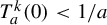 $T_a^k(0)<1/a$
, we complement the relations above by
$T_a^k(0)<1/a$
, we complement the relations above by $p_{k+1,0}=1-p$
(and for such k, it must be
$p_{k+1,0}=1-p$
(and for such k, it must be $p_{k+1,k}=p$
since
$p_{k+1,k}=p$
since $\delta _{k-1}=0$
). In addition, if
$\delta _{k-1}=0$
). In addition, if $\varkappa _a<\infty $
, we have
$\varkappa _a<\infty $
, we have $\varkappa _a=\varkappa ^{\prime }_a$
and
$\varkappa _a=\varkappa ^{\prime }_a$
and $p_{1,\varkappa ^{\prime }_a +1} =p$
because
$p_{1,\varkappa ^{\prime }_a +1} =p$
because $\mathbb P_0(X_1=1)=p$
and
$\mathbb P_0(X_1=1)=p$
and ${f(1)=f(T_a^{\varkappa ^{\prime }_a}(0))}$
since there are no points of the orbit of zero in
${f(1)=f(T_a^{\varkappa ^{\prime }_a}(0))}$
since there are no points of the orbit of zero in $(T_a^{\varkappa ^{\prime }_a}(0), 1]$
. For the remaining
$(T_a^{\varkappa ^{\prime }_a}(0), 1]$
. For the remaining $0 \le k \le \varkappa ^{\prime }_a$
, we cannot give a simple expression for the unique
$0 \le k \le \varkappa ^{\prime }_a$
, we cannot give a simple expression for the unique $k'$
such that
$k'$
such that $p_{k+1, k'}=1-p_{k+1, k}$
.
$p_{k+1, k'}=1-p_{k+1, k}$
.
Let us give two examples. Suppose that $\varkappa ^{\prime }_a = 2$
. Equivalently,
$\varkappa ^{\prime }_a = 2$
. Equivalently,
 $$ \begin{align*} \frac{2a-1}{1-a} < T_a^2(0)= \frac{1-a}{a^2}\le 1, \end{align*} $$
that is,
 $$ \begin{align*} 0.618 \approx \frac{\sqrt5 -1}{2} \le a < \dfrac16 \Big(2 -\sqrt[3]{6 \sqrt{33} - 26} + \sqrt[3]{6 \sqrt{33} + 26} \Big) \approx 0.6478. \end{align*} $$
In this case, the transition matrix of the lumped chain is given by
 $$ \begin{align*} \begin{pmatrix} 1 & 0 & 0&0 \\ 1-p & 0 & 0 & p\\ 0& 1-p & p & 0 \\ 1-p & 0 & p & 0\\ \end{pmatrix}. \end{align*} $$
Then, $\unicode{x3bb} _a$
is the leading eigenvalue of the
$\unicode{x3bb} _a$
is the leading eigenvalue of the $3 \times 3 $
matrix obtained by discarding the first row and the first column from the matrix above. This matches (15).
$3 \times 3 $
matrix obtained by discarding the first row and the first column from the matrix above. This matches (15).
Suppose that $\varkappa ^{\prime }_a = 3$
. Equivalently,
$\varkappa ^{\prime }_a = 3$
. Equivalently, $({2a-1})/({1-a}) = ({1-a})/{a^2}$
, that is,
$({2a-1})/({1-a}) = ({1-a})/{a^2}$
, that is, $ {a \approx 0.6478}$
, or
$ {a \approx 0.6478}$
, or
 $$ \begin{align*} \frac{2a-1}{1-a} < T_a^3(0)= \frac{1-a-a^2}{a^3}\le 1 < T_a^2(0)= \frac{1-a}{a^2}, \end{align*} $$
that is, approximately, $0.5437 \le a < 0.5825$
. In these cases, the transition matrices of the lumped chains are given respectively by
$0.5437 \le a < 0.5825$
. In these cases, the transition matrices of the lumped chains are given respectively by
 $$ \begin{align*} \begin{pmatrix} 1 & 0 & 0&0 &0\\ 1-p & 0 & 0 & p&0\\ 0& 1-p & p & 0 &0 \\ 1-p & 0 & p & 0 &0\\ 0& 0& 0& 1-p &p \\ \end{pmatrix} \quad \text{and}\quad \begin{pmatrix} 1 & 0 & 0&0 &0\\ 1-p & 0 & 0 & 0&p\\ 0& 1-p & p & 0 &0 \\ 1-p & 0 & p & 0 &0\\ 1-p& 0& 0& p &0 \\ \end{pmatrix}. \end{align*} $$
Remark 8. We do not know how to make use of the lumped Markov chain  when
when $\varkappa ^{\prime }_a=\infty $
. In particular, it is unclear how to describe concisely the transition probabilities of this chain because it may have uncountably many states even though every function
$\varkappa ^{\prime }_a=\infty $
. In particular, it is unclear how to describe concisely the transition probabilities of this chain because it may have uncountably many states even though every function $f \in U_+$
has countably many jumps.
$f \in U_+$
has countably many jumps.
In the next section, we present a different approach, which works for all values of ${a \in (0, \tfrac 23]}$
, unlike the reduction described above. This method is based on the compactness properties of the transition operator of the killed chain
${a \in (0, \tfrac 23]}$
, unlike the reduction described above. This method is based on the compactness properties of the transition operator of the killed chain $\{X_n\}$
.
$\{X_n\}$
.
2.3 Compactness approach
Let P be the transition operator of $\{X_n\}$
killed at exiting
$\{X_n\}$
killed at exiting $[0,{1}/({1-a})]$
. It acts on a measurable bounded function f on
$[0,{1}/({1-a})]$
. It acts on a measurable bounded function f on $[0,{1}/({1-a})]$
as follows:
$[0,{1}/({1-a})]$
as follows:
 $$ \begin{align*} Pf(x)=\mathbb E_x[f(X_1);\tau>1]. \end{align*} $$
Under assumption (4) that the innovations are $\pm 1$
, we have
$\pm 1$
, we have

We can see that if f has finite right and left limits at every point, then the same is true for $Pf$
. We will consider only such functions in what follows.
$Pf$
. We will consider only such functions in what follows.
Since

we seek to find a Banach space of functions on $[0, 1/(1-a)]$
where P would be compact or quasi-compact, expecting that the asymptotics of
$[0, 1/(1-a)]$
where P would be compact or quasi-compact, expecting that the asymptotics of  is defined by the spectral radius of P, which should be the largest eigenvalue of P. To this end, let us consider the behaviour of the set of discontinuities $D_f$
of a function f under the action of P, with continuity at the endpoints
$D_f$
of a function f under the action of P, with continuity at the endpoints $0$
and
$0$
and $1/(1-a)$
understood as one-sided continuity.
$1/(1-a)$
understood as one-sided continuity.
(1) The case $a \in (0, \tfrac 23)$
. Assume that
$a \in (0, \tfrac 23)$
. Assume that $a \in [\tfrac 12, \tfrac 23)$
. If
$a \in [\tfrac 12, \tfrac 23)$
. If $Pf$
is discontinuous at an
$Pf$
is discontinuous at an ${x \in [0,{1}/({1-a})]}$
, then the same holds true for at least one of the two terms in (26). Note that
${x \in [0,{1}/({1-a})]}$
, then the same holds true for at least one of the two terms in (26). Note that $f(ax+1)$
is discontinuous at x if and only if f is discontinuous at
$f(ax+1)$
is discontinuous at x if and only if f is discontinuous at $y = ax +1$
; here,
$y = ax +1$
; here, ${y \in [1,{1}/({1-a})]}$
and
${y \in [1,{1}/({1-a})]}$
and $x=(y-1)/a$
. However,
$x=(y-1)/a$
. However,  is discontinuous at x if and only if f is discontinuous at $y = ax -1$
or it holds that
$y = ax -1$
or it holds that $x = 1/a, f(0)\neq 0$
; here,
$x = 1/a, f(0)\neq 0$
; here, $y \in [0,({2a-1})/({1-a})]$
and
$y \in [0,({2a-1})/({1-a})]$
and $x=(y+1)/a$
in both cases.
$x=(y+1)/a$
in both cases.
If $a \in (0, \tfrac 12)$
, then the second term in (26) vanishes, but the analysis of the first term remains unchanged.
$a \in (0, \tfrac 12)$
, then the second term in (26) vanishes, but the analysis of the first term remains unchanged.
The observations above can be summed up using the mapping
 $$ \begin{align*} T_a(x)= \begin{cases} \dfrac{1}{a}(x+1), & 0 \le x \le \dfrac{2a-1}{1-a},\\[7pt] \dfrac{1}{a}(x-1), &1 \le x \le \dfrac{1}{1-a}, \end{cases} \end{align*} $$
as follows: we showed that if $Pf$
is discontinuous at x, then
$Pf$
is discontinuous at x, then $x=T_a(y)$
for some
$x=T_a(y)$
for some ${y \in D_f \setminus I_a}$
or it holds that
${y \in D_f \setminus I_a}$
or it holds that $x=1/a$
,
$x=1/a$
, $f(0) \neq 0$
,
$f(0) \neq 0$
, $a \ge \tfrac 12$
. In other words, for all
$a \ge \tfrac 12$
. In other words, for all $a \in (0, \tfrac 23)$
, we have
$a \in (0, \tfrac 23)$
, we have
 $$ \begin{align} D_{Pf} \subset T_a((D_f \cup \{0\}) \setminus I_a ). \end{align} $$
It follows from (27) that for $a \in (0, \tfrac 23)$
, the set of measurable bounded functions on
$a \in (0, \tfrac 23)$
, the set of measurable bounded functions on $[0,{1}/({1-a})]$
that are continuous at every point outside of
$[0,{1}/({1-a})]$
that are continuous at every point outside of $\{T_a^k(0): 0 \le k < \varkappa _a +1 \}$
is closed under the action of P; recall that
$\{T_a^k(0): 0 \le k < \varkappa _a +1 \}$
is closed under the action of P; recall that
 $$ \begin{align*} \varkappa_a=\inf\{k\ge0:\, T_a^{k}(0)\in I_a\}. \end{align*} $$
This suggests to consider the set of functions

on $[0, {1}/({1-a})]$
, because we know how P transforms the jumps of functions and every function in U is defined by its jumps. The idea to consider general right-continuous step functions with countably many jumps (called saltus functions) in the context of linear mod 1 transforms goes back to Halfin [Reference Halfin16].
$[0, {1}/({1-a})]$
, because we know how P transforms the jumps of functions and every function in U is defined by its jumps. The idea to consider general right-continuous step functions with countably many jumps (called saltus functions) in the context of linear mod 1 transforms goes back to Halfin [Reference Halfin16].
We will show that the set U is closed under the action of P. Then, we will give a simple, explicit description of this action and show that P is a quasi-compact operator on U; see Proposition 14 and Remark 15.
(2) The case $a \in [\tfrac 23, 1)$
. Here,
$a \in [\tfrac 23, 1)$
. Here, $({2a-1})/({1-a}) \ge 1$
and thus, the mapping
$({2a-1})/({1-a}) \ge 1$
and thus, the mapping $T_a$
does not account for the discontinuities of
$T_a$
does not account for the discontinuities of $Pf$
arising from the discontinuities of f on
$Pf$
arising from the discontinuities of f on $[1, ({2a-1})/({1-a})]$
due to the second term in (26). The argument above gives
$[1, ({2a-1})/({1-a})]$
due to the second term in (26). The argument above gives
 $$ \begin{align} D_{Pf} \subset T_a (D_f \cup \{0\}) \cup \bigg\{\dfrac1a(y+1): y \in D_f \cap \bigg[1, \frac{2a-1}{1-a} \bigg] \bigg\}. \end{align} $$
The right-hand side simplifies when f has no discontinuities in $[1, ({2a-1})/({1-a})]$
. This motivates us to introduce
$[1, ({2a-1})/({1-a})]$
. This motivates us to introduce
 $$ \begin{align*} \varkappa_a=\inf \bigg\{k\ge0:\, T_a^{k}(0)\in \bigg[1, \frac{2a-1}{1-a} \bigg] \bigg\}. \end{align*} $$
Let us check that this definition matches that in (7) when $a =\tfrac 23$
. To this end, we shall show that the orbit of zero under
$a =\tfrac 23$
. To this end, we shall show that the orbit of zero under $T_{2/3}$
is not purely periodic, that is, it does not include
$T_{2/3}$
is not purely periodic, that is, it does not include $1$
(note in passing that the orbit is actually aperiodic). We use the identity
$1$
(note in passing that the orbit is actually aperiodic). We use the identity
 $$ \begin{align*} T_a^k(0) = -\sum_{i=0}^{k-1} (-1)^{\delta_i} a^{i-k}, \quad 1 \le k < \varkappa_a+1, \end{align*} $$
which holds true for every $a \in [\tfrac 12, \tfrac 23]$
and follows by simple induction. Hence, if
$a \in [\tfrac 12, \tfrac 23]$
and follows by simple induction. Hence, if ${T_{2/3}^k\, (0)=1}$
, then
${T_{2/3}^k\, (0)=1}$
, then $2^k=-\sum _{i=0}^{k-1} (-1)^{\delta _i} 3^{k-i} 2^i$
, which is impossible because the right-hand side is odd.
$2^k=-\sum _{i=0}^{k-1} (-1)^{\delta _i} 3^{k-i} 2^i$
, which is impossible because the right-hand side is odd.
With this extended definition of $\varkappa _a$
, the functional space U introduced in (28) is again closed under the action of P if
$\varkappa _a$
, the functional space U introduced in (28) is again closed under the action of P if $a \in [\tfrac 23 , 1)$
is such that
$a \in [\tfrac 23 , 1)$
is such that $\varkappa _a = \infty $
. The set of such a is contained in
$\varkappa _a = \infty $
. The set of such a is contained in $[\tfrac 23, {\sqrt 2}/{2})$
because
$[\tfrac 23, {\sqrt 2}/{2})$
because $T_a(0) \not \in [1, ({2a-1})/({1-a})]$
only when
$T_a(0) \not \in [1, ({2a-1})/({1-a})]$
only when $({2a-1})/({1-a})< {1}/{a}$
, and hence,
$({2a-1})/({1-a})< {1}/{a}$
, and hence, $2a^2<1$
. It is possible to show that this set has Lebesgue measure zero. Note that it contains points other than
$2a^2<1$
. It is possible to show that this set has Lebesgue measure zero. Note that it contains points other than $a=2/3$
, for example, the unique solution to
$a=2/3$
, for example, the unique solution to $T_a^5(0)=1/a$
on
$T_a^5(0)=1/a$
on $[2/3,1)$
, which is
$[2/3,1)$
, which is $a \approx 0.691$
.
$a \approx 0.691$
.
Remark 9. Our method of proving tail asymptotics (14) seems to work unchanged for every $a \in (\tfrac 23 , 1)$
such that
$a \in (\tfrac 23 , 1)$
such that $\varkappa _a = \infty $
.
$\varkappa _a = \infty $
.
There is no reason to restrict our consideration merely to discontinuities. A similar argument yields the following representation for the killed transition operator in (26): for any $a \in (0, \tfrac 23]$
and
$a \in (0, \tfrac 23]$
and $x \in [0, {1}/({1-a})] \setminus \{3\}$
, we have
$x \in [0, {1}/({1-a})] \setminus \{3\}$
, we have

2.4 Transfer operator approach
Assume that $a=\tfrac 23$
and use the shorthand
$a=\tfrac 23$
and use the shorthand $T=T_{2/3}$
. The mapping T is defined on the whole of
$T=T_{2/3}$
. The mapping T is defined on the whole of $[0, {1}/({1-a})]$
. Equation (30) now means that the killed transition operator P is a weighted transfer (or the Ruelle) operator associated with T, where the weight takes two values p and q. The weighted transfer operators are considered, e.g. in the book by Baladi [Reference Baladi5]. The important particular case is the standard transfer (or the Perron–Frobenius) operator
$[0, {1}/({1-a})]$
. Equation (30) now means that the killed transition operator P is a weighted transfer (or the Ruelle) operator associated with T, where the weight takes two values p and q. The weighted transfer operators are considered, e.g. in the book by Baladi [Reference Baladi5]. The important particular case is the standard transfer (or the Perron–Frobenius) operator $P_T$
, defined by
$P_T$
, defined by $P_Tf(x)=\sum _{y \in T^{-1}(x)} f(y)/|T'(y)|$
for
$P_Tf(x)=\sum _{y \in T^{-1}(x)} f(y)/|T'(y)|$
for $x \in [0,3]$
. If
$x \in [0,3]$
. If $f \ge 0 $
, then
$f \ge 0 $
, then $P_Tf$
is the density of the measure with density f pushed forward by T.
$P_Tf$
is the density of the measure with density f pushed forward by T.
Assume now that $p=\tfrac 12$
. Then, by (30), we have
$p=\tfrac 12$
. Then, by (30), we have
 $$ \begin{align*} Pf(x)=\tfrac34 P_T f(x), \quad 0 \le x <3, \end{align*} $$
and thus, $P=\tfrac 34 P_T$
as operators on
$P=\tfrac 34 P_T$
as operators on $L^1([0,3])$
. Since T is piecewise linear and expanding (that is,
$L^1([0,3])$
. Since T is piecewise linear and expanding (that is, $\operatorname *{\mbox {ess inf}}_{0 \le x \le 3} |T'(x)|>1$
), the operator
$\operatorname *{\mbox {ess inf}}_{0 \le x \le 3} |T'(x)|>1$
), the operator $P_T$
is quasi-compact on the space of functions of bounded variation on
$P_T$
is quasi-compact on the space of functions of bounded variation on $[0,3]$
(with almost everywhere equal functions identified); see e.g. Boyarsky and Góra [Reference Boyarsky and Góra8, Theorem 7.2.1]. The leading eigenvalue of
$[0,3]$
(with almost everywhere equal functions identified); see e.g. Boyarsky and Góra [Reference Boyarsky and Góra8, Theorem 7.2.1]. The leading eigenvalue of $P_T$
is simple and equals
$P_T$
is simple and equals $1$
, and this gives
$1$
, and this gives $\unicode{x3bb} _{2/3}(1/2)=3/4$
and also implies (14), together with an alternative way of finding the function V. To explain this, note that the eigenfunction h corresponding to the leading eigenvalue
$\unicode{x3bb} _{2/3}(1/2)=3/4$
and also implies (14), together with an alternative way of finding the function V. To explain this, note that the eigenfunction h corresponding to the leading eigenvalue $1$
of
$1$
of $P_T$
is the invariant density under the transformation T. Its scaled version
$P_T$
is the invariant density under the transformation T. Its scaled version $\widehat h(x)=3h(3x)$
on
$\widehat h(x)=3h(3x)$
on $[0,1]$
is invariant under
$[0,1]$
is invariant under $\widehat T_{2/3}$
. This density was found explicitly by Parry [Reference Parry21] and it is given (up to a multiplicative factor) by (68). Simplifying this formula and rescaling back to
$\widehat T_{2/3}$
. This density was found explicitly by Parry [Reference Parry21] and it is given (up to a multiplicative factor) by (68). Simplifying this formula and rescaling back to $[0,3]$
, we can recover our function V given in (16) for
$[0,3]$
, we can recover our function V given in (16) for $a=\tfrac 23$
and
$a=\tfrac 23$
and $p=\tfrac 12$
. In this case,
$p=\tfrac 12$
. In this case, $h=c V/3$
is a probability density. This normalization can be seen by integrating V and combining (40) for c with the equations
$h=c V/3$
is a probability density. This normalization can be seen by integrating V and combining (40) for c with the equations $\tfrac 13 T^k_{2/3}(0) = 1- \sum _{n \ge 0}^\infty (\tfrac 23)^{n+1} \delta _{k+n} $
for integer
$\tfrac 13 T^k_{2/3}(0) = 1- \sum _{n \ge 0}^\infty (\tfrac 23)^{n+1} \delta _{k+n} $
for integer $k \ge 0$
, which in turn follow from (10) and (11).
$k \ge 0$
, which in turn follow from (10) and (11).
We also have an alternative proof of our result that the quasi-invariant distribution $\nu _{2/3}$
is uniform when
$\nu _{2/3}$
is uniform when $p=\tfrac 12$
. Indeed, it is easy to show that the density of
$p=\tfrac 12$
. Indeed, it is easy to show that the density of $\nu _{2/3}$
is an eigenfunction of the composition (or the Koopman) operator that is dual to
$\nu _{2/3}$
is an eigenfunction of the composition (or the Koopman) operator that is dual to $P_T$
. The constant density is its eigenfunction and there are no other eigenfunctions by [Reference Boyarsky and Góra8, Theorem 3.5.2]. Therefore, the density of
$P_T$
. The constant density is its eigenfunction and there are no other eigenfunctions by [Reference Boyarsky and Góra8, Theorem 3.5.2]. Therefore, the density of $\nu _{2/3}$
is constant.
$\nu _{2/3}$
is constant.
3 Existence of a positive solution to (15)
Consider the function
 $$ \begin{align*} R_a(\unicode{x3bb})=\sum_{k=0}^{\varkappa_a} \delta_k (p/\unicode{x3bb})^{k+1} (q/p)^{L_k}, \end{align*} $$
which represents the left-hand side of (15). We need to show that the equation $R_a(\unicode{x3bb} )=1$
has exactly one positive solution
$R_a(\unicode{x3bb} )=1$
has exactly one positive solution $\unicode{x3bb} =\unicode{x3bb} _a$
. This equation arises naturally in the next section. We will establish existence together with the following bounds.
$\unicode{x3bb} =\unicode{x3bb} _a$
. This equation arises naturally in the next section. We will establish existence together with the following bounds.
Proposition 10. Let $a \in (\tfrac 12, \tfrac 23]$
. Then, for every
$a \in (\tfrac 12, \tfrac 23]$
. Then, for every $p \in (0, 1)$
, (15) has a unique positive solution
$p \in (0, 1)$
, (15) has a unique positive solution $\unicode{x3bb} _a =\unicode{x3bb} _a(p)$
. Moreover, there exists a constant
$\unicode{x3bb} _a =\unicode{x3bb} _a(p)$
. Moreover, there exists a constant $C=C_a>0$
such that for every
$C=C_a>0$
such that for every $p \in (0, 1)$
, we have
$p \in (0, 1)$
, we have

and
 $$ \begin{align} L_n(x) - L_k(x) \le C (n-k+1) + 1 \end{align} $$
for all $x \in [0, 1/(1-a)]$
and all integers
$x \in [0, 1/(1-a)]$
and all integers $0 \le k \le n \le \varkappa _a(x)$
. The first inequality in (31) is strict unless
$0 \le k \le n \le \varkappa _a(x)$
. The first inequality in (31) is strict unless $a=\tfrac 23$
and
$a=\tfrac 23$
and $p=\tfrac 12$
, in which case
$p=\tfrac 12$
, in which case $\unicode{x3bb} _{2/3}(1/2) = 3/4$
.
$\unicode{x3bb} _{2/3}(1/2) = 3/4$
.
The choice of C is rather explicit. For example, it is easy to see from the proof that we can take $C=1/3$
when
$C=1/3$
when $a=2/3$
. This gives an upper bound for the limiting frequency of
$a=2/3$
. This gives an upper bound for the limiting frequency of $1$
s in the
$1$
s in the $\tfrac 32$
-expansions, and this bound is sharp (as there are cycles of length
$\tfrac 32$
-expansions, and this bound is sharp (as there are cycles of length $3$
). The set of all limit frequencies in
$3$
). The set of all limit frequencies in $\beta $
-expansions is described by Boyland et al [Reference Boyland, de Carvalho and Hall9, Example 47].
$\beta $
-expansions is described by Boyland et al [Reference Boyland, de Carvalho and Hall9, Example 47].
It takes us much more effort to prove Proposition 10 when $\varkappa _a = \infty $
and
$\varkappa _a = \infty $
and $q> p$
. The key to our proof is the following assertion, where we essentially compare the (inverse) number of
$q> p$
. The key to our proof is the following assertion, where we essentially compare the (inverse) number of $0$
s among the first digits of the
$0$
s among the first digits of the $(1/a, 1/2)$
-expansions of
$(1/a, 1/2)$
-expansions of $0$
and of an arbitrary
$0$
and of an arbitrary $x \in [0,1)$
. This is in the spirit as reported by Parry [Reference Parry20, Theorem 1]. To state our result, denote by
$x \in [0,1)$
. This is in the spirit as reported by Parry [Reference Parry20, Theorem 1]. To state our result, denote by $\sigma _a(x)$
the total number of returns to
$\sigma _a(x)$
the total number of returns to $[0,1)$
of the trajectory of x under
$[0,1)$
of the trajectory of x under $T_a$
and by
$T_a$
and by $t_k(x)$
the corresponding return times:
$t_k(x)$
the corresponding return times:

and
 $$ \begin{align*} t_k(x)= \inf \{n> t_{k-1}(x) : T^n_a (x)<1\}, \quad 1 \le k < \sigma_a(x) +1, \end{align*} $$
where $t_0(x)=0$
. Put
$t_0(x)=0$
. Put $\sigma _a=\sigma _a(0)$
and
$\sigma _a=\sigma _a(0)$
and $t_k=t_k(0)$
.
$t_k=t_k(0)$
.
Lemma 11. Let $a \in (\tfrac 12, \tfrac 23]$
and denote
$a \in (\tfrac 12, \tfrac 23]$
and denote
 $$ \begin{align*} d_n= \begin{cases} t_1, & n=0, \\ \min \bigg\{\dfrac{t_1+1}{1}, \ldots, \dfrac{t_n +1}{n}, \dfrac{t_{n+1}}{n+1} \bigg \}, & 1 \le n < \sigma_a, \\[7pt] \min \bigg\{\dfrac{t_1+1}{1}, \ldots, \dfrac{t_n +1}{n}\bigg \}, & n =\sigma_a \text{ and } \sigma_a < \infty.\\ \end{cases} \end{align*} $$
Then, for any $x \in [0,1)$
and integers
$x \in [0,1)$
and integers $k, n$
such that
$k, n$
such that $0 \le n \le \sigma _a$
and
$0 \le n \le \sigma _a$
and $0 \le k \le \sigma _a(x)$
, we have
$0 \le k \le \sigma _a(x)$
, we have $d_n \ge t_1$
and
$d_n \ge t_1$
and

Proof. Assume that $x < ({2a-1})/({1-a})$
, otherwise, (33) is trivial. We prove by induction in k for each fixed n. In the basis case
$x < ({2a-1})/({1-a})$
, otherwise, (33) is trivial. We prove by induction in k for each fixed n. In the basis case $k=0$
, inequality (33) is trivial.
$k=0$
, inequality (33) is trivial.
We now prove the step of induction. Put
 $$ \begin{align*} m= \max\{0 \le i \le \min(k, n): t_j(x)=t_j\text{ for all }j\le i\} \end{align*} $$
and
 $$ \begin{align*} m'=\min(m, \sigma_a-1). \end{align*} $$
If $m=k$
, then (33) immediately follows from the definition of
$m=k$
, then (33) immediately follows from the definition of $d_n$
. From now on, we assume that
$d_n$
. From now on, we assume that $m < k$
and we claim that
$m < k$
and we claim that
 $$ \begin{align} T_a^{t_i}(0) \le T_a^{t_i}(x)=T_a^{t_i(x)}(x)<\frac{2a-1}{1-a}, \quad 0 \le i \le m'. \end{align} $$
We prove this by induction, assuming that $n \ge 1$
, otherwise, there is nothing to prove. In the basis case
$n \ge 1$
, otherwise, there is nothing to prove. In the basis case $i=0$
, this is true by the assumption. If we already established this for all
$i=0$
, this is true by the assumption. If we already established this for all $i \le j$
for some
$i \le j$
for some $j < m'$
, then
$j < m'$
, then $ 1 \le T_a^{t_j+1}(0) \le T_a^{t_j +1}(x)$
since
$ 1 \le T_a^{t_j+1}(0) \le T_a^{t_j +1}(x)$
since $T_a$
increases on the interval
$T_a$
increases on the interval $[0, ({2a-1})/({1-a}))$
. Then,
$[0, ({2a-1})/({1-a}))$
. Then, $T_a^{\ell }(0) \le T_a^{\ell }(x)$
for all
$T_a^{\ell }(0) \le T_a^{\ell }(x)$
for all $t_j+1 \le \ell \le t_{j+1}$
since
$t_j+1 \le \ell \le t_{j+1}$
since $T_a$
increases on
$T_a$
increases on $[1, {1}/({1-a})]$
. Moreover,
$[1, {1}/({1-a})]$
. Moreover, $T_a^{t_{j+1}}(x) = T_a^{t_{j+1}(x)}(x) < ({2a-1})/({1-a})$
since
$T_a^{t_{j+1}}(x) = T_a^{t_{j+1}(x)}(x) < ({2a-1})/({1-a})$
since $j +1 \le m' < \min (\sigma _a (x), \sigma _a)$
. This establishes (34).
$j +1 \le m' < \min (\sigma _a (x), \sigma _a)$
. This establishes (34).
Furthermore, by the same reasoning, it follows from (34) that $t_{m'+1}(x) \ge t_{m'+1}(0)$
and
$t_{m'+1}(x) \ge t_{m'+1}(0)$
and
 $$ \begin{align} T_a^{t_{m'+1}}(0) <1 \ \text{ and } \ T_a^{t_{m'+1}}(0) \le T_a^{t_{m'+1}}(x). \end{align} $$
Consider three cases. If $m'=n$
, then
$m'=n$
, then $n< \sigma _a$
, and by the definition of
$n< \sigma _a$
, and by the definition of $d_n$
,
$d_n$
,
 $$ \begin{align*} t_{m'+1}(x) \ge t_{m'+1}(0) \ge (m'+1) d_n. \end{align*} $$
If $m'<n$
and
$m'<n$
and $m'=m$
, then
$m'=m$
, then $m < \sigma _a$
and
$m < \sigma _a$
and $m'=m<n$
, and
$m'=m<n$
, and $t_{m'+1}(x) = t_{m'+1}(0)$
is impossible by the definition of m. Hence, by the definition of
$t_{m'+1}(x) = t_{m'+1}(0)$
is impossible by the definition of m. Hence, by the definition of $d_n$
,
$d_n$
,
 $$ \begin{align*} t_{m'+1}(x) \ge t_{m'+1}(0) +1 \ge (m'+1) d_n. \end{align*} $$
The remaining case $m'<n$
and
$m'<n$
and $m'=\sigma _a-1<m$
is impossible, because otherwise,
$m'=\sigma _a-1<m$
is impossible, because otherwise, $m=n = \sigma _a$
and it follows from the definition of m and inequalities (35) that
$m=n = \sigma _a$
and it follows from the definition of m and inequalities (35) that $({2a-1})/({1-a}) < T_a^{t_m}(x) <1$
. Thus,
$({2a-1})/({1-a}) < T_a^{t_m}(x) <1$
. Thus, $\sigma _a(x)=m$
, which contradicts our earlier assumption that
$\sigma _a(x)=m$
, which contradicts our earlier assumption that $m<k$
.
$m<k$
.
Thus, in all possible cases, we have $t_{m'+1}(x) \ge (m'+1) d_n$
, where
$t_{m'+1}(x) \ge (m'+1) d_n$
, where $1 \le m' +1 \le k$
. Consequently,
$1 \le m' +1 \le k$
. Consequently,
 $$ \begin{align*} t_k(x) = t_{m'+1}(x)+ t_{k-m'-1}(T_a^{t_{m'+1}(x)}(x)) \ge (m'+1) d_n + t_{k-m'-1}(T_a^{t_{m'+1}(x)}(x)). \end{align*} $$
Therefore, if we already proved (33) for all $k \le j$
so some
$k \le j$
so some $0 \le j < \sigma _a(x)$
, then
$0 \le j < \sigma _a(x)$
, then

This finishes the proof of (33). In particular, (33) implies that $t_k \ge k d_0 = k t_1$
for all integer
$t_k \ge k d_0 = k t_1$
for all integer $1 \le k \le \sigma _a(x)$
. This in turn implies that
$1 \le k \le \sigma _a(x)$
. This in turn implies that $d_n \ge t_1$
for all integer
$d_n \ge t_1$
for all integer $0 \le n \le \sigma _a $
, as needed.
$0 \le n \le \sigma _a $
, as needed.
We will also need the following result, where we list properties of the iterates of $T_a$
for a fixed a and describe their domains, that is, the sets
$T_a$
for a fixed a and describe their domains, that is, the sets $\{x: \varkappa _a(x)\ge k\} $
.
$\{x: \varkappa _a(x)\ge k\} $
.
Lemma 12. Let $k \ge 1$
be an integer. Define
$k \ge 1$
be an integer. Define
 $$ \begin{align*} G_k= \bigcup_{n=0}^k T_a^{-n}(0) \cap \{x: \varkappa_a(x)\ge k\} \quad \text{and} \quad D_k= \bigcup_{n=0}^{k-1} T_a^{-n} \bigg(\frac{2a-1}{1-a} \bigg) \cup \bigg \{ \frac{1}{1-a} \bigg\}, \end{align*} $$
and put $g_k(x)=\max \{y \in G_k: y \le x \}$
.
$g_k(x)=\max \{y \in G_k: y \le x \}$
.
-
(a) For any
$a \in (\tfrac 12, \tfrac 23)$
, the following is true. The set
$\{x: \varkappa _a(x)\ge k\} $
is a union of finitely many disjoint intervals
$\{ [g_k(y),y]: y \in D_k\}$
. The set of the left endpoints of these intervals is
$G_k$
. On each of these intervals, the functions
$\delta _0(x), \delta _1(x), \ldots , \delta _{k-1}(x)$
are constant and
$T_a^1(x), \ldots , T_a^k(x)$
are continuous and strictly increasing. -
(b) The assertions of part (a) remain valid for
$a=\tfrac 23$
if we substitute the set of intervals by
$\{ [g_k(y-),y): y \in D_k, y \neq 3\} \cup \{[g_k(3), 3]\}$
.



Proof. (a) We argue by induction. In the basis case $k\kern1.2pt{=}\kern1.2pt 1$
, we have
$k\kern1.2pt{=}\kern1.2pt 1$
, we have $D_1\kern1.2pt{=}\kern1.2pt\{({2a\kern1.2pt{-}\kern1.2pt1})/({1\kern1.2pt{-}\kern1.2pt a}), {1}/({1-a})\}$
, and hence, the set
$D_1\kern1.2pt{=}\kern1.2pt\{({2a\kern1.2pt{-}\kern1.2pt1})/({1\kern1.2pt{-}\kern1.2pt a}), {1}/({1-a})\}$
, and hence, the set $\{x: \varkappa _a(x)\ge 1\} $
, which is
$\{x: \varkappa _a(x)\ge 1\} $
, which is $[0,{1}/({1-a})] \setminus I_a$
, is of the form stated. The claims concerning
$[0,{1}/({1-a})] \setminus I_a$
, is of the form stated. The claims concerning $\delta _0(x)$
and
$\delta _0(x)$
and $T_a(x)$
are clearly satisfied.
$T_a(x)$
are clearly satisfied.
Assume that the statements are proved for all $1 \le k \le n$
. Fix a
$1 \le k \le n$
. Fix a $y \in D_n$
and consider three cases.
$y \in D_n$
and consider three cases.
If $T_a^n(g_n(y)) \ge 1$
, then
$T_a^n(g_n(y)) \ge 1$
, then $\{x \in [g_n(y),y]: T_a^n(x) \not \in I_a \}=[g_n(y),y]$
, and this is a maximal interval contained in
$\{x \in [g_n(y),y]: T_a^n(x) \not \in I_a \}=[g_n(y),y]$
, and this is a maximal interval contained in $\text {dom}(T^{n+1}_a)$
. We have
$\text {dom}(T^{n+1}_a)$
. We have $g_n(y) \in G_{n+1}$
by
$g_n(y) \in G_{n+1}$
by $G_n \cap \{x: \varkappa _a(x) \ge n+1\} \subset G_{n+1}$
and the fact that
$G_n \cap \{x: \varkappa _a(x) \ge n+1\} \subset G_{n+1}$
and the fact that $\varkappa _a(y)\ge n+1$
, and also
$\varkappa _a(y)\ge n+1$
, and also $y \in D_{n+1}$
by
$y \in D_{n+1}$
by $D_n \subset D_{n+1}$
. The interval
$D_n \subset D_{n+1}$
. The interval $(g_n(y),y)$
contains no points of
$(g_n(y),y)$
contains no points of $G_{n+1}$
since it contains no points of
$G_{n+1}$
since it contains no points of $G_n$
and
$G_n$
and $T_a^{n+1}(y) \neq 0$
for every
$T_a^{n+1}(y) \neq 0$
for every $x\in (g_n(y),y)$
by
$x\in (g_n(y),y)$
by $T_a^n(x)>T_a^n(g_n(y)) \ge 1$
. Hence,
$T_a^n(x)>T_a^n(g_n(y)) \ge 1$
. Hence, $g_{n+1}(y)=g_n(y)$
.
$g_{n+1}(y)=g_n(y)$
.
If $({2a-1})/({1-a}) < T_a^n(g_n(y)) < 1$
, then by
$({2a-1})/({1-a}) < T_a^n(g_n(y)) < 1$
, then by $T_a^n(y) = {1}/({1-a})>1$
, there is a unique
$T_a^n(y) = {1}/({1-a})>1$
, there is a unique $z \in [g_n(y),y]$
such that
$z \in [g_n(y),y]$
such that $T_a^n(z)=1$
. Then,
$T_a^n(z)=1$
. Then, $z \in G_{n+1}$
by
$z \in G_{n+1}$
by $T_a^{n+1}(z)=T_a(1)=0$
, and
$T_a^{n+1}(z)=T_a(1)=0$
, and $ y \in D_{n+1}$
. By the same argument as in the previous case,
$ y \in D_{n+1}$
. By the same argument as in the previous case, $[z,y]$
is the maximal subinterval of
$[z,y]$
is the maximal subinterval of $[g_n(y),y]$
contained in
$[g_n(y),y]$
contained in $\text {dom}(T^{n+1}_a)$
, and hence,
$\text {dom}(T^{n+1}_a)$
, and hence, $g_{n+1}(y)=z$
.
$g_{n+1}(y)=z$
.
Lastly, if $0 \le T_a^n(g_n(y)) \le ({2a-1})/({1-a})$
, then by
$0 \le T_a^n(g_n(y)) \le ({2a-1})/({1-a})$
, then by $T_a^n(y)>1$
, there exist unique
$T_a^n(y)>1$
, there exist unique $z_1, z_2 \in [g_n(y),y]$
such that
$z_1, z_2 \in [g_n(y),y]$
such that $T_a^n(z_1) = ({2a-1})/({1-a})$
and
$T_a^n(z_1) = ({2a-1})/({1-a})$
and $T_a^n(z_2)=1$
. Similarly to the previous cases,
$T_a^n(z_2)=1$
. Similarly to the previous cases, $[g_n(y),z_1]$
and
$[g_n(y),z_1]$
and $[z_2, y]$
are the maximal subintervals of
$[z_2, y]$
are the maximal subintervals of $[g_n(y),y]$
contained in
$[g_n(y),y]$
contained in $\text {dom}(T^{n+1}_a)$
, and there are no other ones. It holds
$\text {dom}(T^{n+1}_a)$
, and there are no other ones. It holds $z_1, y \in D_{n+1}$
and
$z_1, y \in D_{n+1}$
and $g_n(y), z_2 \in D_{n+1}$
. We also have
$g_n(y), z_2 \in D_{n+1}$
. We also have $g_{n+1}(z_1)=g_n(y)$
,
$g_{n+1}(z_1)=g_n(y)$
, $g_{n+1}(y)=z_2$
.
$g_{n+1}(y)=z_2$
.
The above consideration of the three cases combined with the representation
 $$ \begin{align*} \{x: \varkappa_a(x)\ge n+1\} = \{x: \varkappa_a(x)\ge n, T_a^n(x) \not \in I_a \} =\bigcup_{z \in D_n} \{x \in [g_n(z),z]: T_a^n(x) \not \in I_a \} \end{align*} $$
imply that the set $\{x: \varkappa _a(x)\ge n+1\}$
is a union of the intervals
$\{x: \varkappa _a(x)\ge n+1\}$
is a union of the intervals $\{[g_{n+1}(z),z]: z \in D_{n+1}\}$
and moreover, we have
$\{[g_{n+1}(z),z]: z \in D_{n+1}\}$
and moreover, we have
 $$ \begin{align*} \{g_{n+1}(z): z \in D_{n+1}\}=\{g_n(z): z \in D_n, \varkappa_a(z) \ge n+1\} \cup T_a^{-n}(1). \end{align*} $$
Hence, $G_{n+1} = \{g_{n+1}(z): z \in D_{n+1}\}$
by the assumption of induction and the fact that
$G_{n+1} = \{g_{n+1}(z): z \in D_{n+1}\}$
by the assumption of induction and the fact that $T_a^{-n}(1)=T_a^{-(n+1)}(0)$
. The set
$T_a^{-n}(1)=T_a^{-(n+1)}(0)$
. The set $D_{n+1}$
is finite because so is
$D_{n+1}$
is finite because so is $D_n$
. The intervals
$D_n$
. The intervals $\{[g_{n+1}(z),z]: z \in D_{n+1}\}$
are disjoint as subintervals of disjoint intervals
$\{[g_{n+1}(z),z]: z \in D_{n+1}\}$
are disjoint as subintervals of disjoint intervals $\{ [g_n(z),z]: z \in D_n\}$
.
$\{ [g_n(z),z]: z \in D_n\}$
.
Furthermore, in either of the three cases, the function $T_a^{n+1}$
is continuous and strictly increasing on
$T_a^{n+1}$
is continuous and strictly increasing on $[g_{n+1}(y),y]$
as a composition of
$[g_{n+1}(y),y]$
as a composition of $T_a$
and
$T_a$
and $T_a^n$
, which have these properties on
$T_a^n$
, which have these properties on $[1, {1}/({1-a})]$
and
$[1, {1}/({1-a})]$
and $[g_n(y),y]$
, respectively. Then,
$[g_n(y),y]$
, respectively. Then, $\delta _n$
is constant on
$\delta _n$
is constant on $[g_{n+1}(y),y]$
. In the third case,
$[g_{n+1}(y),y]$
. In the third case, $T_a^{n+1}$
and
$T_a^{n+1}$
and $\delta _n$
also have these respective properties on
$\delta _n$
also have these respective properties on $[g_{n+1}(z_1), z_1]$
because on this interval
$[g_{n+1}(z_1), z_1]$
because on this interval $T_a^n$
does not exceed
$T_a^n$
does not exceed $({2a-1})/({1-a})$
and
$({2a-1})/({1-a})$
and $T_a$
is continuous and strictly increasing on
$T_a$
is continuous and strictly increasing on $[0, ({2a-1})/({1-a})]$
.
$[0, ({2a-1})/({1-a})]$
.
(b) The proof for $a=\tfrac 23$
is analogous. It suffices to replace throughout
$a=\tfrac 23$
is analogous. It suffices to replace throughout $[g_n(y), y]$
by
$[g_n(y), y]$
by $[g_n(y-), y)$
for all
$[g_n(y-), y)$
for all $y \in D_n \setminus \{3\}$
and use that
$y \in D_n \setminus \{3\}$
and use that $T_{2/3}^n(y-)=3$
instead of
$T_{2/3}^n(y-)=3$
instead of $T^n_a(y) = {1}/({1-a})$
.
$T^n_a(y) = {1}/({1-a})$
.
We are now ready to prove the main result of the section.
Proof of Proposition 10
Let us show that the equation $R_a(\unicode{x3bb} )=1$
has exactly one positive solution
$R_a(\unicode{x3bb} )=1$
has exactly one positive solution $\unicode{x3bb} =\unicode{x3bb} _a$
. This is evident when
$\unicode{x3bb} =\unicode{x3bb} _a$
. This is evident when $\varkappa _a$
is finite because in this case,
$\varkappa _a$
is finite because in this case, $R_a$
is a continuous strictly decreasing function on
$R_a$
is a continuous strictly decreasing function on $(0, \infty )$
which satisfies
$(0, \infty )$
which satisfies $R_a(p)>1$
by
$R_a(p)>1$
by $\delta _0=1$
and
$\delta _0=1$
and $R_a\, (+\infty ) =0$
. Then, there is a unique solution
$R_a\, (+\infty ) =0$
. Then, there is a unique solution $\unicode{x3bb} _a$
, which satisfies
$\unicode{x3bb} _a$
, which satisfies $\unicode{x3bb} _a> p$
. Moreover, this reasoning applies easily when
$\unicode{x3bb} _a> p$
. Moreover, this reasoning applies easily when $\varkappa _a = \infty $
and
$\varkappa _a = \infty $
and $q \le p$
. In this case,
$q \le p$
. In this case, $R_a$
is finite on
$R_a$
is finite on $(p, \infty )$
and satisfies
$(p, \infty )$
and satisfies $R_a(p)=R_a(p+)$
by the monotone convergence theorem, and hence,
$R_a(p)=R_a(p+)$
by the monotone convergence theorem, and hence, $1<R_a(p')< \infty $
for some
$1<R_a(p')< \infty $
for some $p'>p$
.
$p'>p$
.
In the remaining case where $\varkappa _a=\infty $
and
$\varkappa _a=\infty $
and $p<1/2$
, put
$p<1/2$
, put $r=q/p$
. We will use the following representation:
$r=q/p$
. We will use the following representation:
 $$ \begin{align*} R_a(\unicode{x3bb}) = \sum_{k=0}^{\varkappa_a} \delta_k (p/\unicode{x3bb})^{k+1} (q/p)^{L_k}= \sum_{k=0}^{\sigma_a} (p/\unicode{x3bb})^{t_k+1} r^k. \end{align*} $$
We first assume that $\sigma _a = \infty $
. Denote
$\sigma _a = \infty $
. Denote $d=\sup _{n \ge 0} d_n$
and
$d=\sup _{n \ge 0} d_n$
and $\theta =\liminf _{n \to \infty } t_n/n $
. By the Cauchy–Hadamard formula,
$\theta =\liminf _{n \to \infty } t_n/n $
. By the Cauchy–Hadamard formula, $R_a(\unicode{x3bb} )$
is finite for
$R_a(\unicode{x3bb} )$
is finite for $\unicode{x3bb}>p$
when
$\unicode{x3bb}>p$
when
 $$ \begin{align*} r < \frac{1}{\limsup_{k \to \infty} (p/\unicode{x3bb})^{(t_k+1)/k}} =\frac{1}{(p/\unicode{x3bb})^\theta}, \end{align*} $$
that is, for $\unicode{x3bb}> p r^{1/\theta }$
. Notice that
$\unicode{x3bb}> p r^{1/\theta }$
. Notice that $\theta \ge d \ge t_1$
by Lemma 11.
$\theta \ge d \ge t_1$
by Lemma 11.
If $d_n= {t_{n+1}}/({n+1})$
for all
$d_n= {t_{n+1}}/({n+1})$
for all $n \ge 1$
, then
$n \ge 1$
, then $d \ge t_n/n$
for all
$d \ge t_n/n$
for all $n \ge 1$
. Therefore, for
$n \ge 1$
. Therefore, for $C=1/d$
, we have
$C=1/d$
, we have $n \ge C t_n$
for all
$n \ge C t_n$
for all $n \ge 1$
. Hence, by
$n \ge 1$
. Hence, by $r>1$
,
$r>1$
,
 $$ \begin{align*} R_a(pr^C) =\sum_{k=0}^\infty r^{-(t_k+1)C+k} \ge r^{-C} \sum_{k=0}^\infty r^0 =\infty. \end{align*} $$
If there exists an $n_0 \ge 1$
such that
$n_0 \ge 1$
such that $d_{n_0}< {t_{n_0+1}}/({n_0+1})$
, then
$d_{n_0}< {t_{n_0+1}}/({n_0+1})$
, then $d_{n_0} = ({t_{k_0} +1})/{k_0}$
for some
$d_{n_0} = ({t_{k_0} +1})/{k_0}$
for some $1 \le k_0 \le n_0$
, and hence, for
$1 \le k_0 \le n_0$
, and hence, for $C=1/d_{n_0}$
,
$C=1/d_{n_0}$
,
 $$ \begin{align*} R_a(p r^C)> r^{-(t_{k_0}+1)C+k_0} = r^0=1. \end{align*} $$
In either case, we have $C \ge 1 /\theta $
. Therefore,
$C \ge 1 /\theta $
. Therefore, $1<R_a(p')< \infty $
for some
$1<R_a(p')< \infty $
for some $p'>p r^C$
by the same argument as above for
$p'>p r^C$
by the same argument as above for $p\ge 1/2$
, and there exists a unique solution
$p\ge 1/2$
, and there exists a unique solution $\unicode{x3bb} _a$
to
$\unicode{x3bb} _a$
to $R_a(\unicode{x3bb} )=1$
, which satisfies
$R_a(\unicode{x3bb} )=1$
, which satisfies $\unicode{x3bb} _a> p' > p r^C$
.
$\unicode{x3bb} _a> p' > p r^C$
.
If $\sigma _a$
is finite, then we have
$\sigma _a$
is finite, then we have $R_a(p r^C)>1$
for
$R_a(p r^C)>1$
for $C=1/d_{\sigma _a}$
and
$C=1/d_{\sigma _a}$
and $\unicode{x3bb} _a> p r^C$
, exactly as above.
$\unicode{x3bb} _a> p r^C$
, exactly as above.
We now prove inequality (32). Fix an $x \in [0, 1/(1-a)]$
.
$x \in [0, 1/(1-a)]$
.
First, assume that $\sigma _a(x) = \infty $
. Fix a
$\sigma _a(x) = \infty $
. Fix a $k \ge 0$
and put
$k \ge 0$
and put $x'= T_a^k(x)$
if
$x'= T_a^k(x)$
if $T_a^k(x)<1$
and
$T_a^k(x)<1$
and ${x'=T_a^{t_1(T_a^k(x))}}$
otherwise. It follows from Lemma 11 that
${x'=T_a^{t_1(T_a^k(x))}}$
otherwise. It follows from Lemma 11 that $t_{\lceil Ck' \rceil }(x') \ge \lceil kC' \rceil /C -1\ge k'-1$
for all integer
$t_{\lceil Ck' \rceil }(x') \ge \lceil kC' \rceil /C -1\ge k'-1$
for all integer $k' \ge 1$
such that
$k' \ge 1$
such that $1 \le \lceil Ck' \rceil \le \sigma _a(x')$
. Substituting
$1 \le \lceil Ck' \rceil \le \sigma _a(x')$
. Substituting $n-k=k'-1$
, we get
$n-k=k'-1$
, we get
 $$ \begin{align*} L_n(x) - L_k(x) = L_{n-k}(T_a^k(x)) \le L_{n-k}(x') \le L_{t_{\lceil Ck'\rceil}(x')}(x') = \lceil C(n-k+1)\rceil \end{align*} $$
for all integer $n \ge k$
since
$n \ge k$
since $\sigma _a(x')=\sigma _a(x)=\infty $
. Then,
$\sigma _a(x')=\sigma _a(x)=\infty $
. Then,
 $$ \begin{align*} L_n(x) - L_k(x) \le C(n-k+1) \end{align*} $$
because the left-hand side is integer. This proves inequality (32) when $\sigma _a(x) = \infty $
.
$\sigma _a(x) = \infty $
.
We now assume that $\sigma _a(x) <\infty $
, which is possible only when
$\sigma _a(x) <\infty $
, which is possible only when $a <\tfrac 23$
. We argue by reduction to the previous case. Assume that
$a <\tfrac 23$
. We argue by reduction to the previous case. Assume that $\varkappa _a(x)\ge 1$
, otherwise, there is nothing to prove. Fix an integer
$\varkappa _a(x)\ge 1$
, otherwise, there is nothing to prove. Fix an integer $1 \le n \le \varkappa _a(x)$
. By Lemma 12(a), there exists a unique
$1 \le n \le \varkappa _a(x)$
. By Lemma 12(a), there exists a unique $y \in D_n$
such that
$y \in D_n$
such that $x \in [g_n(y), y]$
.
$x \in [g_n(y), y]$
.
We first assume that $g_n(y) \neq y$
. Since the functions
$g_n(y) \neq y$
. Since the functions $z \mapsto L_k(z)$
for
$z \mapsto L_k(z)$
for $0 \le k \le n$
are constant on
$0 \le k \le n$
are constant on $[g_n(y), y]$
by Lemma 12(a), inequality (32) follows instantly from the result in the previous case if we prove that there is an
$[g_n(y), y]$
by Lemma 12(a), inequality (32) follows instantly from the result in the previous case if we prove that there is an $x' \in [g_n(y), y]$
such that
$x' \in [g_n(y), y]$
such that $\sigma _a(x') =\infty $
. We will use that there exist periodic orbits of
$\sigma _a(x') =\infty $
. We will use that there exist periodic orbits of $T_a$
starting arbitrarily close to the left of y. Consider two cases. If
$T_a$
starting arbitrarily close to the left of y. Consider two cases. If $T_a^m(y) = ({2a-1})/({1-a})$
for a unique
$T_a^m(y) = ({2a-1})/({1-a})$
for a unique $0 \le m \le n-1$
, then
$0 \le m \le n-1$
, then $T_a^m < ({2a-1})/({1-a})$
on
$T_a^m < ({2a-1})/({1-a})$
on $[g_n(y), y)$
by Lemma 12(a). By piecewise continuity of
$[g_n(y), y)$
by Lemma 12(a). By piecewise continuity of $T_a$
, the equation
$T_a$
, the equation $z = T_a^{t_1(z)}(z)$
admits infinitely many solutions, which accumulate to
$z = T_a^{t_1(z)}(z)$
admits infinitely many solutions, which accumulate to $({2a-1})/({1-a})$
from the left. Pick any solution
$({2a-1})/({1-a})$
from the left. Pick any solution $z' \in [ T_a^m(g_n(y)), ({2a-1})/({1-a}))$
and then take the unique
$z' \in [ T_a^m(g_n(y)), ({2a-1})/({1-a}))$
and then take the unique $x' \in [g_n(y), y]$
that solves
$x' \in [g_n(y), y]$
that solves $T_a^m(x')=z'$
. In the second case when
$T_a^m(x')=z'$
. In the second case when ${y = {1}/({1-a})}$
, we argue similarly and take any
${y = {1}/({1-a})}$
, we argue similarly and take any $x' \ge g_n(y)$
that satisfies
$x' \ge g_n(y)$
that satisfies $x' = T_a^{t_1(x')+1}(x')$
.
$x' = T_a^{t_1(x')+1}(x')$
.
We now assume that $g_n(y) =y$
. This is possible only when
$g_n(y) =y$
. This is possible only when $G_n$
intersects
$G_n$
intersects $D_n$
, that is, when the orbit of zero hits
$D_n$
, that is, when the orbit of zero hits $({2a-1})/({1-a})$
. Then,
$({2a-1})/({1-a})$
. Then, $T_a^{k_1}(x)=0$
and
$T_a^{k_1}(x)=0$
and $T_a^{k_2}(x) = ({2a-1})/({1-a})$
for the unique
$T_a^{k_2}(x) = ({2a-1})/({1-a})$
for the unique $k_1$
,
$k_1$
, $k_2$
such that
$k_2$
such that $0 \le k_1 < k_2 \le n-1$
. Thus,
$0 \le k_1 < k_2 \le n-1$
. Thus, $x \in G_{k_2}$
and by Lemma 12(a), there exists a unique
$x \in G_{k_2}$
and by Lemma 12(a), there exists a unique $y' \in D_{k_2}$
such that
$y' \in D_{k_2}$
such that $g_{k_2}(y')=x$
. In other words,
$g_{k_2}(y')=x$
. In other words, $\varkappa _a(z) = k_2$
for every
$\varkappa _a(z) = k_2$
for every $z \in (g_{k_2}(y'), y')$
. Clearly,
$z \in (g_{k_2}(y'), y')$
. Clearly, $g_{k_2}(y') \neq y'$
and we can apply the result of the previous case for all k satisfying
$g_{k_2}(y') \neq y'$
and we can apply the result of the previous case for all k satisfying $0 \le k \le k_2$
. Therefore, since the functions
$0 \le k \le k_2$
. Therefore, since the functions $z \mapsto L_k(z)$
for
$z \mapsto L_k(z)$
for $0 \le k \le k_2$
are constant on
$0 \le k \le k_2$
are constant on $[g_{k_2}(y'), y']$
,
$[g_{k_2}(y'), y']$
,
 $$ \begin{align*} L_n(x) - L_k(x)= L_{k_2}(y') + 1 - L_k(y') \le C (k_2 - k+1) +1 \le C (n - k+1) + 1. \end{align*} $$
However, $L_n(x) - L_k(x)=0$
for all k satisfying
$L_n(x) - L_k(x)=0$
for all k satisfying $k_2 +1 \le k \le n$
. This finishes the proof of (32). Notice that in the last case,
$k_2 +1 \le k \le n$
. This finishes the proof of (32). Notice that in the last case, $\delta _n (x)=0$
for all
$\delta _n (x)=0$
for all $n \ge k_2+1$
, therefore, we actually proved that
$n \ge k_2+1$
, therefore, we actually proved that
 $$ \begin{align} \delta_n (x) L_n(x) \le C (n+1), \quad 0 \le n \le \varkappa_a(x). \end{align} $$
Finally, we prove the upper bound in (31). For $p\ge 1/2$
, we have
$p\ge 1/2$
, we have $r \le 1$
and we use the
$r \le 1$
and we use the $(1/a, 1/2)$
-expansion (11) to estimate
$(1/a, 1/2)$
-expansion (11) to estimate
 $$ \begin{align*} R_a (p/a) &= \sum_{k=0}^{\varkappa_a} \delta_k a^{k+1} r^{L_k} \le \sum_{k=0}^\infty (1- d_k(0)) a^{k+1} \\ &=\frac{a}{2(1-a)}+ \sum_{k=0}^\infty \bigg(\dfrac12- d_k(0) \bigg)a^{k+1} = \dfrac{a}{2(1-a)} \le 1. \end{align*} $$
Hence, $\unicode{x3bb} _a \le p/a$
, and both inequalities above turn into equalities only when
$\unicode{x3bb} _a \le p/a$
, and both inequalities above turn into equalities only when $a = 2/3$
and
$a = 2/3$
and $p=1/2$
. In this case,
$p=1/2$
. In this case, $R_{2/3}(3/4)=1$
and thus,
$R_{2/3}(3/4)=1$
and thus, $\unicode{x3bb} _{2/3}(1/2) = 3/4$
.
$\unicode{x3bb} _{2/3}(1/2) = 3/4$
.
For $p<1/2$
, we use a similar bound based on (36):
$p<1/2$
, we use a similar bound based on (36):
 $$ \begin{align*} R_a ( p r^C/a ) = \sum_{k=0}^{\varkappa_a} \delta_k a^{k+1} r^{L_k - C (k+1)} \le \sum_{k=0}^\infty (1- d_k(0)) a^{k+1} \le 1. \end{align*} $$
The second inequality turns into an equality only in the case where $a=2/3$
, when the first inequality is strict since the orbit of zero under
$a=2/3$
, when the first inequality is strict since the orbit of zero under $T_{2/3}$
is not periodic. Hence,
$T_{2/3}$
is not periodic. Hence,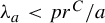 $\unicode{x3bb} _a < p r^C/a$
.
$\unicode{x3bb} _a < p r^C/a$
.
Remark 13. For any $a \in (\tfrac 12, \tfrac 23]$
and
$a \in (\tfrac 12, \tfrac 23]$
and $p\in (0, \tfrac 12)$
, inequalities (31) and (32) are satisfied with
$p\in (0, \tfrac 12)$
, inequalities (31) and (32) are satisfied with
 $$ \begin{align*} C= C_a:=\min_{0 \le n \le \sigma_a \wedge (q/p)^{1/t_1}} 1/d_n. \end{align*} $$
This follows exactly as in the proof of Proposition 10 except for a slight modification of the argument for the lower bound in (31). Namely, if there exist integers $1 \le k_0 \le n_0 \le \sigma _a \wedge r^{1/t_1}$
such that
$1 \le k_0 \le n_0 \le \sigma _a \wedge r^{1/t_1}$
such that $d_{n_0}= ({t_{k_0}+1})/{k_0}$
, then
$d_{n_0}= ({t_{k_0}+1})/{k_0}$
, then $C \le 1/d_{n_0}$
, and we get
$C \le 1/d_{n_0}$
, and we get
 $$ \begin{align*} R_a(p r^C) \ge R_a(p r^{1/d_{n_0}})> r^{-(t_{k_0}+1)C+k_0} =1. \end{align*} $$
Otherwise, $d_n= {t_{n+1}}/({n+1})$
for all
$d_n= {t_{n+1}}/({n+1})$
for all $0 \le n \le r^{1/t_1}$
and
$0 \le n \le r^{1/t_1}$
and $\sigma _a>r^{1/t_1}$
; hence,
$\sigma _a>r^{1/t_1}$
; hence, $n+1 \ge t_{n+1}/d_n \ge C t_{n+1}$
for such n and we get
$n+1 \ge t_{n+1}/d_n \ge C t_{n+1}$
for such n and we get
 $$ \begin{align*} R_a(pr^C) =\sum_{n=0}^{\sigma_a} r^{-(t_n+1)C+n} \ge r^{-C} \sum_{n=0}^{[r^{1/t_1}]+1} r^0 \ge r^{-1/d_0} ([r^{1/t_1}]+2)>1. \end{align*} $$
4 Spectral properties of the killed transition operator on U
In this section, we establish the tail asympotics of $\tau $
, given in (15). To do this, we first provide a simple representation of the action of the killed transition operator P on the space U of functions defined in (28). To this end, let us introduce the following notation.
$\tau $
, given in (15). To do this, we first provide a simple representation of the action of the killed transition operator P on the space U of functions defined in (28). To this end, let us introduce the following notation.
Denote by $\operatorname *{\mathrm {Var}}[f]$
the total variation of a function f on
$\operatorname *{\mathrm {Var}}[f]$
the total variation of a function f on $[0, 1/(1-a)]$
. Then,
$[0, 1/(1-a)]$
. Then,
 $$ \begin{align} \|f\|=|f(0)|+\operatorname*{\mathrm{Var}}[f], \end{align} $$
the norm on the space of functions of bounded variation, is a norm on U.
We can regard functions in U as (right-continuous) distribution functions of finite signed atomic measures supported at $\{T^k_a(0): 0 \le k < \varkappa _a +1\}$
, the orbit of zero. Then, it is easy to see that the mapping
$\{T^k_a(0): 0 \le k < \varkappa _a +1\}$
, the orbit of zero. Then, it is easy to see that the mapping $M: U \to \mathbb R^{\varkappa _a'+1}$
, defined by
$M: U \to \mathbb R^{\varkappa _a'+1}$
, defined by
 $$ \begin{align*} (M f)_k = f(T_a^k(0)) - f(T_a^k(0)-), \quad 0 \le k < \varkappa_a' +1, \end{align*} $$
where we put $f(0-)=0$
, is a bijective isometry between
$f(0-)=0$
, is a bijective isometry between $(U, \| \cdot \|)$
and
$(U, \| \cdot \|)$
and $(\mathbb R^{\varkappa _a'+1}, {\| \cdot \|}_1)$
.
$(\mathbb R^{\varkappa _a'+1}, {\| \cdot \|}_1)$
.
Furthermore, let A be the linear operator on $(\mathbb R^{\varkappa _a +1}, {\| \cdot \|}_1)$
defined by
$(\mathbb R^{\varkappa _a +1}, {\| \cdot \|}_1)$
defined by
 $$ \begin{align*} {(Au)}_0=p\sum_{k=0}^{\varkappa_a}\delta_ku_k\quad \text{ and }\quad {(Au)}_k=c_{k-1}u_{k-1},\quad 1 \le k < \varkappa_a+1, \end{align*} $$
where

and let $v \in \mathbb R^{\varkappa _a +1}$
and
$v \in \mathbb R^{\varkappa _a +1}$
and $ v^* \in \mathbb R^{\varkappa _a' +1}$
be the vectors with coordinates
$ v^* \in \mathbb R^{\varkappa _a' +1}$
be the vectors with coordinates

and

Notice that $\|v\|_1$
and
$\|v\|_1$
and $\|v^*\|_\infty $
are finite by
$\|v^*\|_\infty $
are finite by $\unicode{x3bb} _a>p$
if
$\unicode{x3bb} _a>p$
if $p \ge 1/2$
and by (32) if
$p \ge 1/2$
and by (32) if $p<1/2$
. Notice also that
$p<1/2$
. Notice also that  is exactly the function introduced in (16).
The main difficulty is when the orbit of zero under $T_a$
is infinite and aperiodic. In this case, the operator A acts on the space of infinite summable sequences
$T_a$
is infinite and aperiodic. In this case, the operator A acts on the space of infinite summable sequences $\ell _1$
, and the adjoint operator
$\ell _1$
, and the adjoint operator $A^*$
on
$A^*$
on $\ell _\infty $
is defined by the standard duality
$\ell _\infty $
is defined by the standard duality $(\cdot , \cdot )$
between
$(\cdot , \cdot )$
between $\ell _1$
and
$\ell _1$
and $\ell _\infty $
. If
$\ell _\infty $
. If $\varkappa _a'<\infty $
, we use
$\varkappa _a'<\infty $
, we use $(\cdot , \cdot )$
to denote the scalar product on
$(\cdot , \cdot )$
to denote the scalar product on $\mathbb R^{\varkappa _a'+1}$
.
$\mathbb R^{\varkappa _a'+1}$
.
Proposition 14. For any $a \in (\tfrac 12, \tfrac 23]$
, the following is true depending on the type of the orbit of zero under
$a \in (\tfrac 12, \tfrac 23]$
, the following is true depending on the type of the orbit of zero under $T_a$
.
$T_a$
.
If the orbit is aperiodic (that is, $\varkappa _a=\varkappa _a'$
), then the restriction of the killed transition operator P to U is equivalent to A (that is,
$\varkappa _a=\varkappa _a'$
), then the restriction of the killed transition operator P to U is equivalent to A (that is, $P= M^{-1} A M$
). The quantity
$P= M^{-1} A M$
). The quantity $\unicode{x3bb} _a$
, defined in (15), is the leading eigenvalue of A (that is, every other eigenvalue
$\unicode{x3bb} _a$
, defined in (15), is the leading eigenvalue of A (that is, every other eigenvalue $\unicode{x3bb} $
satisfies
$\unicode{x3bb} $
satisfies $|\unicode{x3bb} |< \unicode{x3bb} _a$
), and v and
$|\unicode{x3bb} |< \unicode{x3bb} _a$
), and v and $v^*$
are the eigenvectors of A and
$v^*$
are the eigenvectors of A and $A^*$
corresponding to
$A^*$
corresponding to $\unicode{x3bb} _a$
, respectively. Moreover, there exist constants
$\unicode{x3bb} _a$
, respectively. Moreover, there exist constants $C_1>0$
and
$C_1>0$
and $\gamma \in (0,1)$
such that for every
$\gamma \in (0,1)$
such that for every $u \in (\mathbb R^{\varkappa _a'+1}, {\| \cdot \|}_1)$
and integer
$u \in (\mathbb R^{\varkappa _a'+1}, {\| \cdot \|}_1)$
and integer $n \ge 0$
,
$n \ge 0$
,

If the orbit is eventually periodic, then the restriction of P to U is equivalent to the linear operator $\widehat A$
on
$\widehat A$
on $\mathbb R^{\varkappa _a' +1}$
defined by
$\mathbb R^{\varkappa _a' +1}$
defined by

where $k_0$
is the smallest integer such that
$k_0$
is the smallest integer such that $T_a^{k_0}(0)=T_a^{\varkappa _a'+1}(0)$
. Then,
$T_a^{k_0}(0)=T_a^{\varkappa _a'+1}(0)$
. Then, $\unicode{x3bb} _a$
is leading eigenvalue of
$\unicode{x3bb} _a$
is leading eigenvalue of $\widehat A$
, and
$\widehat A$
, and $Mv$
and
$Mv$
and $v^*$
are the eigenvectors of
$v^*$
are the eigenvectors of $\widehat A$
and
$\widehat A$
and ${\widehat A}^*$
corresponding to
${\widehat A}^*$
corresponding to $\unicode{x3bb} _a$
, respectively. Equation (39) remains true when A is replaced by
$\unicode{x3bb} _a$
, respectively. Equation (39) remains true when A is replaced by $\widehat {A}$
and v is replaced by
$\widehat {A}$
and v is replaced by $MV$
.
$MV$
.
Remark 15. Recall that a bounded linear operator Q on a Banach space is called quasi-compact if there exists a compact operator $Q_c$
such that
$Q_c$
such that $\rho (Q)> \rho (Q-Q_c)$
, where
$\rho (Q)> \rho (Q-Q_c)$
, where $\rho $
stands for the spectral radius. Assertion (39) implies that A and
$\rho $
stands for the spectral radius. Assertion (39) implies that A and $\widehat A$
are quasi-compact. This implies that the operator P is quasi-compact on U for all
$\widehat A$
are quasi-compact. This implies that the operator P is quasi-compact on U for all $a \in (\tfrac 12, \tfrac 23]$
.
$a \in (\tfrac 12, \tfrac 23]$
.
We postpone the proof of Proposition 14 and use this result to establish the tail asymptotics (14) with the constant

We first assume that the orbit of zero is aperiodic, that is, $\varkappa _a=\varkappa _a'$
. We compute the constant factor
$\varkappa _a=\varkappa _a'$
. We compute the constant factor $(v,v^*)$
in (39) using the equality
$(v,v^*)$
in (39) using the equality $\varkappa _a=\varkappa _a'$
and the definition (15) of
$\varkappa _a=\varkappa _a'$
and the definition (15) of $\unicode{x3bb} _a$
:
$\unicode{x3bb} _a$
:

Now, assume that the orbit of zero is eventually periodic. Equation (39) is valid with A replaced by $\widehat {A}$
and v replaced by
$\widehat {A}$
and v replaced by $MV$
. Let us compute the constant factor
$MV$
. Let us compute the constant factor $(Mv,v^*)$
there. Put
$(Mv,v^*)$
there. Put $n_0=\varkappa '-k_0+1$
and let
$n_0=\varkappa '-k_0+1$
and let $\bar v_k^*$
be defined as in (38) for all
$\bar v_k^*$
be defined as in (38) for all $k \ge 0$
. The sequence
$k \ge 0$
. The sequence $\{\delta _k\}$
is eventually periodic; hence, so is
$\{\delta _k\}$
is eventually periodic; hence, so is $\{L_k\}$
, and hence, so is
$\{L_k\}$
, and hence, so is $\{\bar v_k^*\}$
. Therefore, using equality (59),
$\{\bar v_k^*\}$
. Therefore, using equality (59),
 $$ \begin{align*} (MV, v^*) = \sum_{k=0}^{k_0-1} v_k v_k^* + \sum_{k=k_0}^{\varkappa_a'} \sum_{m=0}^{\infty} v_{k+mn_0} v_k^* = \sum_{k=0}^{k_0-1} v_k \bar v_k^* + \sum_{k=k_0}^{\varkappa_a'} \sum_{m=0}^{\infty} v_{k+mn_0} \bar v_{k+mn_0}^*, \end{align*} $$
and hence, $(MV, v^*)=(v, \bar v^*) = 1/c$
as in the aperiodic case.
$(MV, v^*)=(v, \bar v^*) = 1/c$
as in the aperiodic case.
To state (39) in terms of the operator P, use that $P^nf = M^{-1} A^n Mf $
. We have
$P^nf = M^{-1} A^n Mf $
. We have $M^{-1} v =V$
if the orbit of zero is aperiodic and
$M^{-1} v =V$
if the orbit of zero is aperiodic and $M^{-1}(M V) = V$
if it is eventually periodic. Therefore, (39) directly implies that for every
$M^{-1}(M V) = V$
if it is eventually periodic. Therefore, (39) directly implies that for every $a \in (\tfrac 12, \tfrac 23]$
, we have
$a \in (\tfrac 12, \tfrac 23]$
, we have

Clearly, $\unicode{x3bb} _a$
is the leading eigenvalue of P and the corresponding eigenfunction is V. Since
$\unicode{x3bb} _a$
is the leading eigenvalue of P and the corresponding eigenfunction is V. Since
 $$ \begin{align} |f(x)| \le |f(0)| + |f(x)-f(0)| \le \|f\| \end{align} $$
for every $x \in [0, {1}/({1-a})]$
, it follows from (41) that
$x \in [0, {1}/({1-a})]$
, it follows from (41) that

Finally, we determine the tail asymptotics for $\tau $
. We have
$\tau $
. We have  and the constant function
  belongs to U. Since
  , we get
  by (38), and the asymptotic relation (14) follows from (43).
Proof of Proposition 14
In the proof, we shall omit the subscript a in $T_a$
,
$T_a$
, $\varkappa _a$
and
$\varkappa _a$
and $\varkappa _a'$
.
$\varkappa _a'$
.
For every function $f \in U$
, which is of the form
$f \in U$
, which is of the form  , one has

Consider the first sum in the last line. We notice that for every $k<\varkappa $
, it is true that
$k<\varkappa $
, it is true that

and

If $\varkappa $
is finite, then
$\varkappa $
is finite, then $T^\varkappa (0)\in (({2a-1})/({1-a}),1)$
and therefore,
$T^\varkappa (0)\in (({2a-1})/({1-a}),1)$
and therefore, $\delta _\varkappa =1$
and
$\delta _\varkappa =1$
and $(T^\varkappa (0)-1)/ a<0$
. Hence,
$(T^\varkappa (0)-1)/ a<0$
. Hence,

To rewrite the second sum, we notice that for every $k<\varkappa $
, it is true that
$k<\varkappa $
, it is true that

and

because in the case when $a =2/3$
, where
$a =2/3$
, where $2/a=1/(1-a)$
, we have
$2/a=1/(1-a)$
, we have $T^k(0) \neq 1$
; see §2.3. If
$T^k(0) \neq 1$
; see §2.3. If $\varkappa $
is finite, then
$\varkappa $
is finite, then $T^\varkappa (0){\kern-1pt}\in{\kern-1pt} (({2a{\kern-1pt}-{\kern-1pt}1})/({1{\kern-1pt}-{\kern-1pt}a}),1)$
and therefore,
$T^\varkappa (0){\kern-1pt}\in{\kern-1pt} (({2a{\kern-1pt}-{\kern-1pt}1})/({1{\kern-1pt}-{\kern-1pt}a}),1)$
and therefore, $(T^\varkappa (0){\kern-1pt}+{\kern-1pt}1)/a{\kern-1pt}>{\kern-1pt} 1/(1{\kern-1pt}-{\kern-1pt}a)$
. Hence,
$(T^\varkappa (0){\kern-1pt}+{\kern-1pt}1)/a{\kern-1pt}>{\kern-1pt} 1/(1{\kern-1pt}-{\kern-1pt}a)$
. Hence,

Putting (44) and (45) together, and using that $c_k=q\delta _k+p(1-\delta _k)$
, we conclude that
$c_k=q\delta _k+p(1-\delta _k)$
, we conclude that

We now consider the two cases separately.
The orbit of zero is aperiodic. Comparing the coefficients at  in the equalities
  and (46), we see that the restriction of P to the space U is equivalent to the linear operator A on $(\mathbb R^{\varkappa _a +1}, {\| \cdot \|}_1)$
.
$(\mathbb R^{\varkappa _a +1}, {\| \cdot \|}_1)$
.
Consider the eigenvalue problem $Au=\unicode{x3bb} u$
. By the definition of A,
$Au=\unicode{x3bb} u$
. By the definition of A,
 $$ \begin{align*} p\sum_{k=0}^\varkappa \delta_ku_k=\unicode{x3bb} u_0 \quad\text{and}\quad c_{k-1}u_{k-1}=\unicode{x3bb} u_k, \quad 1 \le k < \varkappa +1. \end{align*} $$
These equations imply that
 $$ \begin{align} u_k= u_0 \frac{c_0 c_1 \cdot \cdots \cdot c_{k-1}}{\unicode{x3bb}^k},\quad 1 \le k < \varkappa +1. \end{align} $$
Since $\delta _0=1$
, we see that there is a non-trivial solution only if
$\delta _0=1$
, we see that there is a non-trivial solution only if $\unicode{x3bb} $
satisfies the equation
$\unicode{x3bb} $
satisfies the equation
 $$ \begin{align} \unicode{x3bb}= p + p\sum_{k=1}^\varkappa \delta_k \frac{c_0 c_1 \cdot \cdots \cdot c_{k-1}}{\unicode{x3bb}^k}. \end{align} $$
Recalling that $L_k = \sum _{i=0}^{k-1} \delta _i$
and
$L_k = \sum _{i=0}^{k-1} \delta _i$
and $c_i=q\delta _i+p(1-\delta _i)$
, we get
$c_i=q\delta _i+p(1-\delta _i)$
, we get
 $$ \begin{align} c_0 c_1 \cdot \cdots \cdot c_{k-1}= p^k (q/p)^{L_k}. \end{align} $$
Hence, (48) is equivalent to (15), which has a unique positive solution $\unicode{x3bb} _a>p$
, as we showed in §3.
$\unicode{x3bb} _a>p$
, as we showed in §3.
Notice that in the case when $\varkappa _a = \infty $
, the vectors u defined by (47) with
$\varkappa _a = \infty $
, the vectors u defined by (47) with $\unicode{x3bb} =\unicode{x3bb} _a$
satisfy
$\unicode{x3bb} =\unicode{x3bb} _a$
satisfy $u \in \ell _1$
by
$u \in \ell _1$
by $\unicode{x3bb} _a>p$
if
$\unicode{x3bb} _a>p$
if $p \ge 1/2$
and by (32) if
$p \ge 1/2$
and by (32) if $p<1/2$
. Then, it follows that the vector v, which is proportional to such u, is the eigenvector of A corresponding to
$p<1/2$
. Then, it follows that the vector v, which is proportional to such u, is the eigenvector of A corresponding to $\unicode{x3bb} _a$
.
$\unicode{x3bb} _a$
.
We now consider the eigenvalue problem $A^* u^* =\unicode{x3bb} _a u^*$
. Invoking the definition of A, we get the following coordinate-wise equations:
$A^* u^* =\unicode{x3bb} _a u^*$
. Invoking the definition of A, we get the following coordinate-wise equations:

Setting

where $c_0c_1\cdots c_{-1} = 1$
by convention, we get the equations
$c_0c_1\cdots c_{-1} = 1$
by convention, we get the equations

Therefore,

and using the definition of $\unicode{x3bb} _a$
and (49), we obtain
$\unicode{x3bb} _a$
and (49), we obtain

Consequently,

Notice that in the case of infinite $\varkappa $
, the vectors
$\varkappa $
, the vectors $u^*$
satisfy
$u^*$
satisfy $u^* \in \ell _\infty $
by
$u^* \in \ell _\infty $
by $\unicode{x3bb} _a>p$
if
$\unicode{x3bb} _a>p$
if $p \ge 1/2$
and by (32) if
$p \ge 1/2$
and by (32) if $p<1/2$
. In the case of finite
$p<1/2$
. In the case of finite $\varkappa $
, the equation in the second line of (50) is satisfied since
$\varkappa $
, the equation in the second line of (50) is satisfied since $\delta _\varkappa =1$
. It follows that the vector
$\delta _\varkappa =1$
. It follows that the vector $v^*$
, which is proportional to such
$v^*$
, which is proportional to such $u^*$
, is the eigenvector of
$u^*$
, is the eigenvector of $A^*$
corresponding to
$A^*$
corresponding to $\unicode{x3bb} _a$
.
$\unicode{x3bb} _a$
.
Furthermore, we already know that there are no positive eigenvalues of A other than $\unicode{x3bb} = \unicode{x3bb} _a$
. Assume that
$\unicode{x3bb} = \unicode{x3bb} _a$
. Assume that $\unicode{x3bb} \in \mathbb C \setminus (0, \infty )$
is a different eigenvalue of A. By (48), we have
$\unicode{x3bb} \in \mathbb C \setminus (0, \infty )$
is a different eigenvalue of A. By (48), we have
 $$ \begin{align} |\unicode{x3bb}|-p<|\unicode{x3bb}-p| =\bigg|p\sum_{k=1}^\varkappa \delta_k (p/\unicode{x3bb})^k (q/p)^{L_k}\bigg| \le p\sum_{k=1}^\varkappa \delta_k (p/|\unicode{x3bb}|)^k (q/p)^{L_k}. \end{align} $$
This implies that $R(|\unicode{x3bb} |)>1$
, and hence,
$R(|\unicode{x3bb} |)>1$
, and hence, $|\unicode{x3bb} |<\unicode{x3bb} _a$
. Thus,
$|\unicode{x3bb} |<\unicode{x3bb} _a$
. Thus, $\unicode{x3bb} _a$
is the leading eigenvalue of A. Denote
$\unicode{x3bb} _a$
is the leading eigenvalue of A. Denote $\varrho '=0$
if A has no other eigenvalues, otherwise, put
$\varrho '=0$
if A has no other eigenvalues, otherwise, put

Assume that $\varkappa $
is finite. It is easy to see that the matrix
$\varkappa $
is finite. It is easy to see that the matrix $\mathcal A$
that represents A in the standard basis has non-negative entries and is irreducible, that is, for some
$\mathcal A$
that represents A in the standard basis has non-negative entries and is irreducible, that is, for some $m \in \mathbb N$
, all entries of
$m \in \mathbb N$
, all entries of $\mathcal A+{\mathcal A}^2 + \cdots + {\mathcal A}^m$
are strictly positive. Then,
$\mathcal A+{\mathcal A}^2 + \cdots + {\mathcal A}^m$
are strictly positive. Then, $\unicode{x3bb} _a$
is a simple root of the characteristic polynomial of
$\unicode{x3bb} _a$
is a simple root of the characteristic polynomial of $\mathcal A$
and
$\mathcal A$
and ${\mathcal A}^n/\unicode{x3bb} _a^n \to v v^*/ v^* v$
(with
${\mathcal A}^n/\unicode{x3bb} _a^n \to v v^*/ v^* v$
(with $v^*$
regarded as a row vector) in the operator norm as
$v^*$
regarded as a row vector) in the operator norm as $n \to \infty $
by the classical Perron–Frobenius theorem; see [Reference Meyer19, p. 673 and (8.3.10)]. For the rate of this convergence, the spectral resolution theorem for
$n \to \infty $
by the classical Perron–Frobenius theorem; see [Reference Meyer19, p. 673 and (8.3.10)]. For the rate of this convergence, the spectral resolution theorem for $A^n$
implies the bound (39) for any
$A^n$
implies the bound (39) for any $\gamma \in (\varrho '/\unicode{x3bb} _a, 1)$
; see [Reference Meyer19, (7.9.9) and the last equation on p. 629].
$\gamma \in (\varrho '/\unicode{x3bb} _a, 1)$
; see [Reference Meyer19, (7.9.9) and the last equation on p. 629].
From now on, we assume that the orbit of zero is infinite (and still aperiodic). Notice that $\varrho '< \unicode{x3bb} _a$
, otherwise, there is a convergent sequence of eigenvalues
$\varrho '< \unicode{x3bb} _a$
, otherwise, there is a convergent sequence of eigenvalues $\{\mu _n\}$
such that
$\{\mu _n\}$
such that ${|\mu _n| \to |\unicode{x3bb} _a|}$
. If
${|\mu _n| \to |\unicode{x3bb} _a|}$
. If $p\ge 1/2$
, then R is analytic on the set
$p\ge 1/2$
, then R is analytic on the set $D=\{\unicode{x3bb} \in \mathbb C:|\unicode{x3bb} |>p \}$
, which contains
$D=\{\unicode{x3bb} \in \mathbb C:|\unicode{x3bb} |>p \}$
, which contains $\mu _n$
for all n large enough by
$\mu _n$
for all n large enough by $\unicode{x3bb} _a>p$
. If
$\unicode{x3bb} _a>p$
. If $p< 1/2$
, then it follows from (32) that R is analytic on the set
$p< 1/2$
, then it follows from (32) that R is analytic on the set $D=\{\unicode{x3bb} \in \mathbb C:|\unicode{x3bb} |>p (q/p)^C \}$
, which contains
$D=\{\unicode{x3bb} \in \mathbb C:|\unicode{x3bb} |>p (q/p)^C \}$
, which contains $\mu _n$
for all n large enough since
$\mu _n$
for all n large enough since $\unicode{x3bb} _a>p (q/p)^C$
by (31). In either case, it must be that
$\unicode{x3bb} _a>p (q/p)^C$
by (31). In either case, it must be that $R \equiv 1 $
on D by
$R \equiv 1 $
on D by $R(\mu _n)\equiv 1$
, which is a contradiction.
$R(\mu _n)\equiv 1$
, which is a contradiction.
We now show that the spectrum of A without the point $\unicode{x3bb} _a$
is contained in the closed centred ball of radius
$\unicode{x3bb} _a$
is contained in the closed centred ball of radius $\varrho =\max (\varrho ', p, p (q/p)^C)$
, where
$\varrho =\max (\varrho ', p, p (q/p)^C)$
, where $\varrho < \unicode{x3bb} _a$
. Equivalently, the resolvent operator
$\varrho < \unicode{x3bb} _a$
. Equivalently, the resolvent operator $(A-\unicode{x3bb} I)^{-1}$
is bounded for every
$(A-\unicode{x3bb} I)^{-1}$
is bounded for every $\unicode{x3bb} \neq \unicode{x3bb} _a$
with
$\unicode{x3bb} \neq \unicode{x3bb} _a$
with $|\unicode{x3bb} |>\varrho $
.
$|\unicode{x3bb} |>\varrho $
.
We first prove that the equation $(A-\unicode{x3bb} I)u=w$
has a unique solution for every
$(A-\unicode{x3bb} I)u=w$
has a unique solution for every $w\in \ell _1$
. Writing this equation coordinatewise, we have
$w\in \ell _1$
. Writing this equation coordinatewise, we have
 $$ \begin{align} \begin{array}{cl} &(p-\unicode{x3bb})u_0+p\sum_{k=1}^\infty\delta_ku_k=w_0,\\ &c_{k-1}u_{k-1}-\unicode{x3bb} u_k=w_k,\quad k\ge1. \end{array} \end{align} $$
It is easy to see that
 $$ \begin{align} u_k=\frac{c_0c_1\cdots c_{k-1}}{\unicode{x3bb}^k}u_0- \sum_{j=1}^k w_j\frac{c_jc_{j+1}\cdots c_{k-1}}{\unicode{x3bb}^{k-j+1}}, \quad k \ge 1, \end{align} $$
is the unique solution to the equations in the second line of (52). Therefore,
 $$ \begin{align} \bigg(p-\unicode{x3bb}+p\sum_{k=1}^\infty\delta_k\frac{c_0c_1\cdots c_{k-1}}{\unicode{x3bb}^k}\bigg)u_0 =w_0 + p\sum_{k=1}^\infty\delta_k \sum_{j=1}^k w_j\frac{c_jc_{j+1}\cdots c_{k-1}}{\unicode{x3bb}^{k-j+1}}, \end{align} $$
and thus, $u_0$
is defined uniquely since
$u_0$
is defined uniquely since $\unicode{x3bb} $
is not an eigenvalue of A and therefore, the factor of
$\unicode{x3bb} $
is not an eigenvalue of A and therefore, the factor of $u_0$
on the left-hand side is non-zero by (48).
$u_0$
on the left-hand side is non-zero by (48).
We now estimate the norm of u. Assume first that $p \ge 1/2$
. Then,
$p \ge 1/2$
. Then,
 $$ \begin{align} \nonumber \sum_{k=1}^\infty|u_k| &\le |u_0|\sum_{k=1}^\infty\frac{c_0c_1\cdots c_{k-1}}{|\unicode{x3bb}|^k} +\sum_{k=1}^\infty\sum_{j=1}^k|w_j| \frac{c_jc_{j+1}\cdots c_{k-1}}{|\unicode{x3bb}|^{k-j+1}}\\ \nonumber &\le |u_0|\sum_{k=1}^\infty\bigg(\frac{p}{|\unicode{x3bb}|}\bigg)^k +\sum_{j=1}^\infty|w_j|\sum_{k=j}^\infty\frac{p^{k-j}}{|\unicode{x3bb}|^{k-j+1}}\\ &\le \frac{p|u_0|}{|\unicode{x3bb}|-p}+\frac{1}{|\unicode{x3bb}|-p}\sum_{j=1}^\infty|w_j| \end{align} $$
and
 $$ \begin{align} |\unicode{x3bb} (R(\unicode{x3bb})-1) ||u_0| & \le |w_0|+p\sum_{k=1}^\infty\delta_k \sum_{j=1}^k|w_j|\frac{p^{k-j}}{|\unicode{x3bb}|^{k-j+1}} \le |w_0|+\frac{p}{|\unicode{x3bb}|-p}\sum_{j=1}^\infty|w_j|. \end{align} $$
Consequently, for every $\unicode{x3bb} \neq \unicode{x3bb} _a$
with
$\unicode{x3bb} \neq \unicode{x3bb} _a$
with $|\unicode{x3bb} |>\varrho $
, there exists a constant
$|\unicode{x3bb} |>\varrho $
, there exists a constant $C(\unicode{x3bb} )$
such that
$C(\unicode{x3bb} )$
such that
 $$ \begin{align} { \|(A-\unicode{x3bb} I)^{-1} \|}_1\le C(\unicode{x3bb}) {\|w\|}_1. \end{align} $$
Let us estimate the norm of u in the case when $p < 1/2$
. Using the first line in (55) and recalling that
$p < 1/2$
. Using the first line in (55) and recalling that $c_0c_1\cdots c_{j-1}=p^jr^{L_j}$
with
$c_0c_1\cdots c_{j-1}=p^jr^{L_j}$
with $r=q/p$
, we obtain
$r=q/p$
, we obtain
 $$ \begin{align*} \sum_{k=1}^\infty|u_k| &\le |u_0|\sum_{k=1}^\infty\frac{p^kr^{L_k}}{|\unicode{x3bb}|^k} +\sum_{k=1}^\infty\sum_{j=1}^k\frac{p^{k-j}r^{L_k-L_j}}{|\unicode{x3bb}|^{k-j+1}}|w_j|\\ &=|u_0|\sum_{k=1}^\infty\frac{p^kr^{L_k}}{|\unicode{x3bb}|^k} +\sum_{j=1}^\infty|w_j|\sum_{k=j}^\infty\frac{p^{k-j}r^{L_k-L_j}}{|\unicode{x3bb}|^{k-j+1}}. \end{align*} $$
Applying now (32), we get
 $$ \begin{align*} \sum_{k=1}^\infty|u_k| &\le |u_0|r^{C+1}\sum_{k=1}^\infty\frac{p^k r^{Ck}}{|\unicode{x3bb}|^k} +\frac{r^{C+1}}{|\unicode{x3bb}|}\sum_{j=1}^\infty|w_j| \sum_{k=j}^\infty\bigg(\frac{pr^C}{|\unicode{x3bb}|}\bigg)^{k-j}\\ &\le |u_0|r^{C+1}\frac{pr^C}{|\unicode{x3bb}|-pr^C} +r^{C+1}{\|w\|}_1\frac{1}{|\unicode{x3bb}|-pr^C}. \end{align*} $$
Similar arguments lead to the following estimate:
 $$ \begin{align*} |\unicode{x3bb}(R(\unicode{x3bb})-1)||u_0| &\le |w_0|+p\sum_{k=1}^\infty\delta_k\sum_{j=1}^k|w_j|\frac{p^{k-j}r^{L_k-L_j}}{|\unicode{x3bb}|^{k-j+1}}\\ &\le|w_0|+\frac{pr^{C+1}}{|\unicode{x3bb}|}\sum_{j=1}^\infty|w_j| \sum_{k=j}^\infty\bigg(\frac{pr^C}{|\unicode{x3bb}|}\bigg)^{k-j}\\ &\le |w_0|+pr^{C+1}{\|w\|}_1\frac{1}{|\unicode{x3bb}|-pr^C}. \end{align*} $$
We know from (31) that $\unicode{x3bb} _a>pr^C$
, and hence, (57) is also valid in the case
$\unicode{x3bb} _a>pr^C$
, and hence, (57) is also valid in the case $p<1/2$
. Consequently, for every
$p<1/2$
. Consequently, for every $p \in (0,1)$
, the spectrum of A without the point
$p \in (0,1)$
, the spectrum of A without the point $\unicode{x3bb} _a$
is contained in the closed centred ball of radius
$\unicode{x3bb} _a$
is contained in the closed centred ball of radius $\varrho <\unicode{x3bb} _a$
.
$\varrho <\unicode{x3bb} _a$
.
The property of the spectrum shown just above implies that the operator A is quasi-compact. If one shows additionally that A possesses certain additional positivity properties, then one can apply a Krein–Rutman type result, for example, [Reference Sasser23, Theorems 6 and 7]. In our particular case, we will arrive at the same conclusion by the direct calculations presented below, which are quite standard for the area of quasi-compact operators.
Define the linear operators $Qu=({(u,v^*)}/{(v,v^*)})v$
and
$Qu=({(u,v^*)}/{(v,v^*)})v$
and $Bu=A(u-Qu)$
on
$Bu=A(u-Qu)$
on $\ell _1$
, where
$\ell _1$
, where $(v,v^*) \ge v_0 v_0^*>0$
by (38). Clearly,
$(v,v^*) \ge v_0 v_0^*>0$
by (38). Clearly, $Q^2=Q$
. Since v and
$Q^2=Q$
. Since v and $v^*$
are the eigenvectors corresponding to
$v^*$
are the eigenvectors corresponding to $\unicode{x3bb} _a$
, we have
$\unicode{x3bb} _a$
, we have $AQu=\unicode{x3bb} _a Qu$
and
$AQu=\unicode{x3bb} _a Qu$
and

Thus, A and Q are commuting and $QB=BQ=0$
. These properties of the operators A, B and Q imply that
$QB=BQ=0$
. These properties of the operators A, B and Q imply that

We claim that the spectral radius $\rho (B)$
of B satisfies
$\rho (B)$
of B satisfies $\rho (B)\le \varrho $
. Then, the estimate (39) for any
$\rho (B)\le \varrho $
. Then, the estimate (39) for any $\gamma \in (\varrho /\unicode{x3bb} _a, 1)$
follows from the representation (58) combined with Gelfand’s formula
$\gamma \in (\varrho /\unicode{x3bb} _a, 1)$
follows from the representation (58) combined with Gelfand’s formula $\rho (B)=\lim _{n \to \infty } \|B^n\|^{1/n}$
.
$\rho (B)=\lim _{n \to \infty } \|B^n\|^{1/n}$
.
To prove the claim, we consider the closed linear subspace
 $$ \begin{align*} Y=\{u\in\ell_1: (u,v^*)=0\}. \end{align*} $$
Since $Bu\in Y$
for any
$Bu\in Y$
for any $u\in \ell _1$
, it suffices to consider the restriction of B to this subspace, which we denote by
$u\in \ell _1$
, it suffices to consider the restriction of B to this subspace, which we denote by $B_Y$
. In fact, we have
$B_Y$
. In fact, we have $\rho (B)=\rho (B_Y)$
, where the inequality
$\rho (B)=\rho (B_Y)$
, where the inequality ${\rho (B)\ge \rho (B_Y)}$
is immediate from Gelfand’s formula and the reverse one follows from the said formula by
${\rho (B)\ge \rho (B_Y)}$
is immediate from Gelfand’s formula and the reverse one follows from the said formula by
 $$ \begin{align*} \rho(B)= \lim_{n\to \infty} \sup_{u\in \ell_1: \|u\| \le 1} \| B^n u\|^{1/n} \le \lim_{n\to \infty} \sup_{v\in Y: \|v\| \le \| B\|} \| B^{n-1} v\|^{1/n} = \rho(B_Y). \end{align*} $$
We first show that the spectrum of $B_Y$
is a subset of the spectrum of A. Let
$B_Y$
is a subset of the spectrum of A. Let $\unicode{x3bb} $
be any regular value of A, that is,
$\unicode{x3bb} $
be any regular value of A, that is, $(A-\unicode{x3bb} I)u=w$
is solvable for every
$(A-\unicode{x3bb} I)u=w$
is solvable for every $w\in \ell _1$
. Assume now that
$w\in \ell _1$
. Assume now that $w\in Y$
and let
$w\in Y$
and let $u_w$
denote the solution to
$u_w$
denote the solution to $(A-\unicode{x3bb} I)u=w$
. Then,
$(A-\unicode{x3bb} I)u=w$
. Then,

Since $\unicode{x3bb} \neq \unicode{x3bb} _a$
, we have
$\unicode{x3bb} \neq \unicode{x3bb} _a$
, we have $(u_w,v^*)=0$
. In other words,
$(u_w,v^*)=0$
. In other words, $u_w\in Y$
and
$u_w\in Y$
and $Qu_w=0$
. Consequently,
$Qu_w=0$
. Consequently,
 $$ \begin{align*} (B_Y-\unicode{x3bb} I_Y)u_w=(A-\unicode{x3bb} I)u_w=w \end{align*} $$
and $\unicode{x3bb} $
is regular for
$\unicode{x3bb} $
is regular for $B_Y$
. Since the spectrum of A without point
$B_Y$
. Since the spectrum of A without point $\unicode{x3bb} _a$
is contained in the closed centred ball of radius
$\unicode{x3bb} _a$
is contained in the closed centred ball of radius $\varrho $
, it remains to show that
$\varrho $
, it remains to show that $\unicode{x3bb} _a$
is regular for
$\unicode{x3bb} _a$
is regular for $B_Y$
. We need to show that the equation
$B_Y$
. We need to show that the equation $(B_Y-\unicode{x3bb} _a I_Y)u=w$
for
$(B_Y-\unicode{x3bb} _a I_Y)u=w$
for $w \in Y$
has a solution
$w \in Y$
has a solution $u \in Y$
. Since
$u \in Y$
. Since $B_Y=A$
on Y, this is equivalent to showing that
$B_Y=A$
on Y, this is equivalent to showing that $(A- \unicode{x3bb} _a I)u=w$
has a solution
$(A- \unicode{x3bb} _a I)u=w$
has a solution $u \in Y$
. Therefore, we can take
$u \in Y$
. Therefore, we can take $\unicode{x3bb} =\unicode{x3bb} _a$
in (53) and notice that (54) is satisfied when
$\unicode{x3bb} =\unicode{x3bb} _a$
in (53) and notice that (54) is satisfied when $\unicode{x3bb} =\unicode{x3bb} _a$
for any
$\unicode{x3bb} =\unicode{x3bb} _a$
for any $u_0$
because in this case, the right-hand side of (54) is
$u_0$
because in this case, the right-hand side of (54) is $(w, v^*)$
. It remains to determine
$(w, v^*)$
. It remains to determine $u_0$
from the equation
$u_0$
from the equation $(u,v^*)=0$
.
$(u,v^*)=0$
.
Alternatively, we can solve $(B_Y-\unicode{x3bb} _a I_Y)u=w$
as follows. Let
$(B_Y-\unicode{x3bb} _a I_Y)u=w$
as follows. Let $u^{(\unicode{x3bb} )}$
denote the solution to
$u^{(\unicode{x3bb} )}$
denote the solution to $(B_Y-\unicode{x3bb} I_Y)u=w$
for
$(B_Y-\unicode{x3bb} I_Y)u=w$
for $\unicode{x3bb} $
such that
$\unicode{x3bb} $
such that $0<|\unicode{x3bb} -\unicode{x3bb} _a|<\unicode{x3bb} _a - \varrho $
. Then, by (54),
$0<|\unicode{x3bb} -\unicode{x3bb} _a|<\unicode{x3bb} _a - \varrho $
. Then, by (54),
 $$ \begin{align*} \unicode{x3bb}(R(\unicode{x3bb})-1)u_0^{(\unicode{x3bb})} =w_0+p\sum_{k=1}^\infty\delta_k \sum_{j=1}^k w_j\frac{c_jc_{j+1}\cdots c_{k-1}}{\unicode{x3bb}^{k-j+1}}. \end{align*} $$
Using the condition $(w,v^*)=0$
and the explicit form of the vector
$(w,v^*)=0$
and the explicit form of the vector $v^*$
, one gets easily
$v^*$
, one gets easily

Dividing both sides by $\unicode{x3bb} -\unicode{x3bb} _a$
and letting
$\unicode{x3bb} -\unicode{x3bb} _a$
and letting $\unicode{x3bb} \to \unicode{x3bb} _a$
, we obtain
$\unicode{x3bb} \to \unicode{x3bb} _a$
, we obtain

Using now (53) with $\unicode{x3bb} =\unicode{x3bb} _a$
and
$\unicode{x3bb} =\unicode{x3bb} _a$
and $u_0=u_0^{(\unicode{x3bb} _a)}$
defined just above, we find the unique solution
$u_0=u_0^{(\unicode{x3bb} _a)}$
defined just above, we find the unique solution $u^{(\unicode{x3bb} _a )} $
to
$u^{(\unicode{x3bb} _a )} $
to $(B_Y-\unicode{x3bb} _a I_Y)u=w$
. It follows from Proposition 10 that
$(B_Y-\unicode{x3bb} _a I_Y)u=w$
. It follows from Proposition 10 that $u^{(\unicode{x3bb} _a )} \in \ell _1$
. Then,
$u^{(\unicode{x3bb} _a )} \in \ell _1$
. Then, ${u^{(\unicode{x3bb} _a )} \in Y}$
since Y is closed in
${u^{(\unicode{x3bb} _a )} \in Y}$
since Y is closed in $\ell _1$
. This completes the proof in the aperiodic case.
$\ell _1$
. This completes the proof in the aperiodic case.
The orbit of zero is eventually periodic. By definition, $k_0 \ge 0$
is the minimal integer such that
$k_0 \ge 0$
is the minimal integer such that $T^{k_0}(0)=T^{\varkappa '+1}(0)$
. The orbit of zero has
$T^{k_0}(0)=T^{\varkappa '+1}(0)$
. The orbit of zero has $\varkappa '+1$
points and the space
$\varkappa '+1$
points and the space $(U, \| \cdot \|)$
is isometric to
$(U, \| \cdot \|)$
is isometric to $(\mathbb R^{\varkappa '+1}, {\| \cdot \|}_1)$
. The isometry M between these spaces can be written as follows: for any function
$(\mathbb R^{\varkappa '+1}, {\| \cdot \|}_1)$
. The isometry M between these spaces can be written as follows: for any function $f \in U$
, which is of the form
$f \in U$
, which is of the form  for some $u \in \ell _1$
,
$u \in \ell _1$
,
 $$ \begin{align} (Mf)_k=u_k,\quad 0 \le k < k_0 \quad \text{and} \quad (Mf)_k= \sum_{m=0}^\infty u_{k+m(\varkappa'-k_0+1)},\quad k_0 \le k \le \varkappa'. \end{align} $$
Every $f \in U$
admits a unique representation
$f \in U$
admits a unique representation  with
with ${s_k = (Mf)_k}$
. Hence, by (46),
${s_k = (Mf)_k}$
. Hence, by (46),

Since in the second sum the term with $k=\varkappa '+1$
is
$k=\varkappa '+1$
is  , we see that P is equivalent to the finite dimensional linear operator $\widehat {A}$
on
$\widehat {A}$
on $\mathbb R^{\varkappa '+1}$
given by
$\mathbb R^{\varkappa '+1}$
given by

We first note that the operator $\widehat A$
is non-negative and irreducible. Moreover, the matrix that represents
$\widehat A$
is non-negative and irreducible. Moreover, the matrix that represents $\widehat A$
in the standard basis is primitive, that is, it does not have a cyclic structure, see [Reference Meyer19, p. 680]. Therefore, by the Perron–Frobenius theorem,
$\widehat A$
in the standard basis is primitive, that is, it does not have a cyclic structure, see [Reference Meyer19, p. 680]. Therefore, by the Perron–Frobenius theorem, $\widehat {A}$
has a positive simple eigenvalue that strictly exceeds the maximum
$\widehat {A}$
has a positive simple eigenvalue that strictly exceeds the maximum $\varrho '$
of absolute values of all other eigenvalues.
$\varrho '$
of absolute values of all other eigenvalues.
Let us solve the equation $\widehat {A}s=\unicode{x3bb} s$
to determine this leading eigenvalue. It is immediate from the second line in (60) that
$\widehat {A}s=\unicode{x3bb} s$
to determine this leading eigenvalue. It is immediate from the second line in (60) that
 $$ \begin{align} s_k=\frac{c_0c_1\cdots c_{k-1}}{\unicode{x3bb}^k}s_0,\quad k=1, \ldots,k_0-1, \end{align} $$
and
 $$ \begin{align} s_k=\frac{c_{k_0}c_{k_0+1}\cdots c_{k-1}}{\unicode{x3bb}^{k-k_0}}s_{k_0}, \quad k=k_0+1,\ldots,\varkappa'. \end{align} $$
Assume first that $k_0 \neq 0$
. From the second line in (60) for
$k_0 \neq 0$
. From the second line in (60) for $k=k_0$
, we get
$k=k_0$
, we get
 $$ \begin{align*} \unicode{x3bb} s_{k_0}&=c_{k_0-1}s_{k_0-1}+c_{\varkappa'}s_{\varkappa'}=\frac{c_0c_1\cdots c_{k_0-1}}{\unicode{x3bb}^{k_0-1}}s_0 +\frac{c_{k_0}c_{k_0+1}\cdots c_{\varkappa'}}{\unicode{x3bb}^{\varkappa' - k_0}}s_{k_0}. \end{align*} $$
The positive solution to $\unicode{x3bb} ^{\varkappa '-k_0+1}=c_{k_0}c_{k_0+1}\cdots c_{\varkappa '}$
is not an eigenvalue of
$\unicode{x3bb} ^{\varkappa '-k_0+1}=c_{k_0}c_{k_0+1}\cdots c_{\varkappa '}$
is not an eigenvalue of $\widehat A$
. Indeed, in this case,
$\widehat A$
. Indeed, in this case, $s_0 = 0$
, and plugging (61) and (62) into the first line of (60) gives an impossible identity
$s_0 = 0$
, and plugging (61) and (62) into the first line of (60) gives an impossible identity
 $$ \begin{align*} \sum_{k=k_0}^{\varkappa'}\delta_k\frac{c_{k_0}c_1\cdots c_{k-1}}{\unicode{x3bb}^{k-k_0}} =0. \end{align*} $$
Consequently,
 $$ \begin{align} s_{k_0}=\frac{c_0c_1\cdots c_{k_0-1}}{\unicode{x3bb}^{k_0}} \bigg(1-\frac{c_{k_0}c_{k_0+1}\cdots c_{\varkappa'}}{\unicode{x3bb}^{\varkappa'-k_0+1}}\bigg)^{-1} s_0. \end{align} $$
Plugging (61), (62) and (63) into the first line of (60), we conclude that the leading eigenvalue satisfies the equation
 $$ \begin{align} \unicode{x3bb}=p\sum_{k=0}^{k_0-1}\delta_k\frac{c_0c_1\cdots c_{k-1}}{\unicode{x3bb}^k} +p\bigg(1-\frac{c_{k_0}c_{k_0+1}\cdots c_{\varkappa'}}{\unicode{x3bb}^{\varkappa'-k_0+1}}\bigg)^{-1} \sum_{k=k_0}^{\varkappa'}\delta_k\frac{c_0c_1\cdots c_{k-1}}{\unicode{x3bb}^k}. \end{align} $$
Let us show that this equation is equivalent to (15) for all possible $k_0$
, including
$k_0$
, including $k_0=0$
. To this end, we notice that periodicity of the orbit implies that
$k_0=0$
. To this end, we notice that periodicity of the orbit implies that $\delta _k=\delta _{(\varkappa '-k_0+1)m+k}$
and
$\delta _k=\delta _{(\varkappa '-k_0+1)m+k}$
and $c_k=c_{(\varkappa '-k_0+1)m+k}$
for all
$c_k=c_{(\varkappa '-k_0+1)m+k}$
for all $k=k_0,k_0+1,\ldots ,\varkappa '$
and all
$k=k_0,k_0+1,\ldots ,\varkappa '$
and all $m\ge 0$
. Then,
$m\ge 0$
. Then,
 $$ \begin{align} \nonumber p\sum_{k=k_0}^\infty\delta_k\bigg(\frac{p}{\unicode{x3bb}}\bigg)^k \bigg(\dfrac{q}{p}\bigg)^{L_k} &=p\sum_{k=k_0}^\infty\delta_k\frac{c_0c_1\cdots c_{k-1}}{\unicode{x3bb}^k}\\ \nonumber &=p\sum_{m=0}^\infty\sum_{k=k_0}^{\varkappa'} \delta_{(\varkappa'-k_0+1)m+k}\frac{c_0c_1\cdots c_{(\varkappa'-k_0+1)m+k-1}}{\unicode{x3bb}^{(\varkappa'-k_0+1)m+k}}\\ \nonumber &=p\sum_{k=k_0}^{\varkappa'}\delta_k\frac{c_0c_1\cdots c_{k-1}}{\unicode{x3bb}^k}\sum_{m=0}^\infty\bigg(\frac{c_{k_0}c_{k_0+1}\cdots c_{\varkappa'}}{\unicode{x3bb}^{\varkappa'-k_0+1}}\bigg)^m\\ &=\bigg(1-\frac{c_{k_0}c_{k_0+1}\cdots c_{\varkappa'}}{\unicode{x3bb}^{\varkappa'-k_0+1}}\bigg)^{-1} p\sum_{k=k_0}^{\varkappa'}\delta_k\frac{c_0c_1\cdots c_{k-1}}{\unicode{x3bb}^k}, \end{align} $$
and thus, (15) and (64) are indeed equivalent.
We now consider the purely periodic case $k_0 = 0$
. Plugging (62) into the first line of (60), we get
$k_0 = 0$
. Plugging (62) into the first line of (60), we get
 $$ \begin{align*} \unicode{x3bb} s_0=p\sum_{k=0}^{\varkappa'}\delta_k \frac{c_0c_1\cdots c_{k-1}}{\unicode{x3bb}^k}s_0+ \frac{c_0c_1\cdots c_{\varkappa'}}{\unicode{x3bb}^{\varkappa'}}s_0. \end{align*} $$
Consequently, a non-trivial solution exists if and only if $\unicode{x3bb} $
satisfies the equation
$\unicode{x3bb} $
satisfies the equation
 $$ \begin{align} \unicode{x3bb}=p\sum_{k=0}^{\varkappa'}\delta_k \frac{c_0c_1\cdots c_{k-1}}{\unicode{x3bb}^k}+ \frac{c_0c_1\cdots c_{\varkappa'}}{\unicode{x3bb}^{\varkappa'}}. \end{align} $$
However, by (65), we have that (15) is equivalent to
 $$ \begin{align*} \unicode{x3bb} \bigg(1-\frac{c_0c_1\cdots c_{\varkappa'}}{\unicode{x3bb}^{\varkappa'+1}}\bigg) = p\sum_{k=0}^{\varkappa'}\delta_k\frac{c_0c_1\cdots c_{k-1}}{\unicode{x3bb}^k}. \end{align*} $$
We now easily see that (66) is equivalent to (15) in the purely periodic case. Therefore, $\unicode{x3bb} _a$
is the leading eigenvalue of
$\unicode{x3bb} _a$
is the leading eigenvalue of $\widehat A$
for all possible
$\widehat A$
for all possible $k_0$
.
$k_0$
.
The eigenspace corresponding to $\unicode{x3bb} _a$
has dimension one by the Perron–Frobenius theorem. It is spanned by the vector
$\unicode{x3bb} _a$
has dimension one by the Perron–Frobenius theorem. It is spanned by the vector $MV$
. In the case
$MV$
. In the case $k_0\neq 0$
, this can be seen from (61), (62), (63) and (59). In the purely periodic case
$k_0\neq 0$
, this can be seen from (61), (62), (63) and (59). In the purely periodic case $k_0=0$
, this is readily seen from (62) and (59).
$k_0=0$
, this is readily seen from (62) and (59).
Lastly, we find the eigenvectors $ {\widehat A}^* u^* = \unicode{x3bb} _a u^*$
. Using the definition of
$ {\widehat A}^* u^* = \unicode{x3bb} _a u^*$
. Using the definition of $\widehat A$
, we get the coordinate-wise equations
$\widehat A$
, we get the coordinate-wise equations

We solve them exactly as we did in the aperiodic case for (50). This gives us the same answer $u_k^* = u_0^* v_k^* $
for
$u_k^* = u_0^* v_k^* $
for $1 \le k \le \varkappa '$
because the first
$1 \le k \le \varkappa '$
because the first $\varkappa '$
equations are the same and we did not use the equation in the second line. It is not hard to check that this last equation is indeed satisfied for such
$\varkappa '$
equations are the same and we did not use the equation in the second line. It is not hard to check that this last equation is indeed satisfied for such $u^*$
. Then,
$u^*$
. Then, $v^*$
, which is proportional to
$v^*$
, which is proportional to $u^*$
, is the eigenvector of
$u^*$
, is the eigenvector of ${\widehat A}^*$
corresponding to
${\widehat A}^*$
corresponding to $\unicode{x3bb} _a$
. Therefore, (39) follows for any
$\unicode{x3bb} _a$
. Therefore, (39) follows for any $\gamma \in (\varrho '/\unicode{x3bb} _a, 1)$
as in the aperiodic case with finite
$\gamma \in (\varrho '/\unicode{x3bb} _a, 1)$
as in the aperiodic case with finite $\varkappa $
.
$\varkappa $
.
5 Properties of the mapping
$a \mapsto \unicode{x3bb} _a$

In this section, we prove the properties of $\unicode{x3bb} _a$
stated in Theorem 1. We first study the properties of the trajectory of
$\unicode{x3bb} _a$
stated in Theorem 1. We first study the properties of the trajectory of $0$
under
$0$
under $T_a$
as a function of parameter a.
$T_a$
as a function of parameter a.
Lemma 16. For any integer $k \ge 2$
, the following is true.
$k \ge 2$
, the following is true.
-
(a) The set
$\{a \in [1/2,2/3]: \varkappa _a \ge k\}$
is a finite union of closed non-degenerate intervals. On each of these intervals, the functions
$T_a^1(0), \ldots , T_a^k(0)$
are strictly decreasing and continuous, and
$\delta _1, \ldots , \delta _{k-1}$
are constant. -
(b) The set
$\{a \in [1/2,2/3]: \varkappa _a = k\}$
is a union of all disjoint open intervals
$(a",a')$
such that
$T_{a"}^k(0)=1$
and
$T_{a'}^k(0)=({2a'-1})/({1-a'})$
.


Proof. We argue by induction. In the basis case $k=2$
, we have
$k=2$
, we have $\{a \in [\tfrac 12, \tfrac 23]: \varkappa _a \ge k\}= [\tfrac 12, \tfrac 23]$
, where both functions
$\{a \in [\tfrac 12, \tfrac 23]: \varkappa _a \ge k\}= [\tfrac 12, \tfrac 23]$
, where both functions $T_a^1(0)=1/a$
and
$T_a^1(0)=1/a$
and $T_a^2(0)=({1-a})/{a^2}$
are strictly decreasing and continuous. Therefore, since the range of the second one is
$T_a^2(0)=({1-a})/{a^2}$
are strictly decreasing and continuous. Therefore, since the range of the second one is $[\tfrac 34,2]$
and the function
$[\tfrac 34,2]$
and the function $({2a-1})/({1-a})$
increases on
$({2a-1})/({1-a})$
increases on $[\tfrac 12, \tfrac 23]$
from
$[\tfrac 12, \tfrac 23]$
from $0$
to
$0$
to $1$
, we have
$1$
, we have
 $$ \begin{align*} \{a \in [1/2,2/3]: \varkappa_a = 2\} = \{a\in [1/2,2/3]: T_a^2(0) \in I_a\}= (a",a') \end{align*} $$
for the unique $a'$
and
$a'$
and $a"$
such that
$a"$
such that $T_{a"}^2(0)=1$
and
$T_{a"}^2(0)=1$
and $T_{a'}^2(0)= ({2a'-1})/({1-a'})$
.
$T_{a'}^2(0)= ({2a'-1})/({1-a'})$
.
Assume now that the claims are proved for all $2\le k\le n$
. Let J be a maximal closed interval contained in
$2\le k\le n$
. Let J be a maximal closed interval contained in $\{a \in [1/2,2/3]: \varkappa _a \ge n\}$
. It is non-degenerate (not a point) by the assumption of induction. Since
$\{a \in [1/2,2/3]: \varkappa _a \ge n\}$
. It is non-degenerate (not a point) by the assumption of induction. Since
 $$ \begin{align*} \{a : \varkappa_a \ge n\} = \bigg[\dfrac12, \dfrac23 \bigg]\setminus \bigcup_{i=2}^{n-1} \{a : \varkappa_a = i\} \end{align*} $$
and the sets under the union are disjoint, it follows from the assumption of induction for part (b) that $J = [a',a"]$
for some distinct
$J = [a',a"]$
for some distinct $a' < a"$
that satisfy the following restrictions. If
$a' < a"$
that satisfy the following restrictions. If $\tfrac 12 \in J$
, then
$\tfrac 12 \in J$
, then ${a'=\tfrac 12}$
and
${a'=\tfrac 12}$
and $T_{a"}^i(0)=1$
for some integer
$T_{a"}^i(0)=1$
for some integer $2 \le i \le n-1$
. If
$2 \le i \le n-1$
. If $\tfrac 23 \in J$
, then
$\tfrac 23 \in J$
, then $a"=\tfrac 23$
and
$a"=\tfrac 23$
and $T_{a'}^i(0)=({2a'-1})/({1-a'})$
for some integer
$T_{a'}^i(0)=({2a'-1})/({1-a'})$
for some integer $2 \le i \le n-1$
. Otherwise,
$2 \le i \le n-1$
. Otherwise, $T_{a"}^i(0)=1$
and
$T_{a"}^i(0)=1$
and $T_{a'}^j(0)=({2a'-1})/({1-a'})$
for some integers
$T_{a'}^j(0)=({2a'-1})/({1-a'})$
for some integers $2 \le i, j \le n-1$
. Notice that in all these cases, we have
$2 \le i, j \le n-1$
. Notice that in all these cases, we have
 $$ \begin{align} T^n_{a'}(0)= \frac{1}{1-a'} \quad \text{and} \quad \text{either } T^n_{a"} (0)\ge 1 \text{ or }T^n_{a"}(0) < \frac{2a"-1}{1-a"}. \end{align} $$
Indeed, if $a" =\tfrac 23$
, then the dichotomy above is trivial because in this case,
$a" =\tfrac 23$
, then the dichotomy above is trivial because in this case, $({2a"-1})/ ({1-a"})=1$
, otherwise, the orbit of zero under
$({2a"-1})/ ({1-a"})=1$
, otherwise, the orbit of zero under $T_{a"} $
is purely periodic and thus,
$T_{a"} $
is purely periodic and thus, $0$
is its only point in
$0$
is its only point in $[0,1)$
.
$[0,1)$
.
If $T^n_{a"} (0)\ge 1$
, then
$T^n_{a"} (0)\ge 1$
, then $\{a \in J: \varkappa _a \ge n+1\} = J$
. Otherwise, since the mapping
$\{a \in J: \varkappa _a \ge n+1\} = J$
. Otherwise, since the mapping ${a \mapsto T_a^n(0)}$
is continuous and strictly decreasing on J, it follows from (67) that there exist unique
${a \mapsto T_a^n(0)}$
is continuous and strictly decreasing on J, it follows from (67) that there exist unique $b', b" \in (a',a")$
such that
$b', b" \in (a',a")$
such that $T_{b"}^n(0)=1$
and
$T_{b"}^n(0)=1$
and $T_{b'}^n(0)=({2b'-1})/({1-b'})$
; consequently,
$T_{b'}^n(0)=({2b'-1})/({1-b'})$
; consequently,
 $$ \begin{align*} \{a \in J: \varkappa_a \ge n+1\} = [a', b"] \cup [b',a"] \quad \text{and} \quad \{a \in J: \varkappa_a = n+1\} = (b",b'). \end{align*} $$
Thus, since $\{a:\varkappa _a \ge n\} $
is a finite union of closed disjoint non-degenerate intervals, the set
$\{a:\varkappa _a \ge n\} $
is a finite union of closed disjoint non-degenerate intervals, the set $\{a:\varkappa _a \ge n+1\} $
is so. The assertion of part (b) follows for
$\{a:\varkappa _a \ge n+1\} $
is so. The assertion of part (b) follows for $k=n+1$
because every interval contained in
$k=n+1$
because every interval contained in $\{a: \varkappa _a = n+1\} $
is a subinterval of a maximal interval in
$\{a: \varkappa _a = n+1\} $
is a subinterval of a maximal interval in $\{a:\varkappa _a \ge n\} $
.
$\{a:\varkappa _a \ge n\} $
.
Furthermore, let $J' = J$
if
$J' = J$
if $T^n_{a"} (0)\ge 1$
, otherwise, let
$T^n_{a"} (0)\ge 1$
, otherwise, let $J'$
be either of the intervals
$J'$
be either of the intervals $[a', b"]$
and
$[a', b"]$
and $[b',a"]$
. Consider the mapping
$[b',a"]$
. Consider the mapping $(a, x) \mapsto T_a(x)$
defined on its domain D given by
$(a, x) \mapsto T_a(x)$
defined on its domain D given by
 $$ \begin{align*} D= \bigg \{(a,x): a \in \bigg[\dfrac12, \dfrac23 \bigg], \, x \in \bigg[0, \frac{2a-1}{1-a} \bigg] \cup \bigg[1, \dfrac{1}{1-a}\bigg] \bigg\}. \end{align*} $$
This mapping is continuous on $D \setminus \{(\tfrac 23,1)\}$
. We have
$D \setminus \{(\tfrac 23,1)\}$
. We have $(a, T_a^n(0)) \in D \setminus \{(\tfrac 23,1)\}$
for every
$(a, T_a^n(0)) \in D \setminus \{(\tfrac 23,1)\}$
for every $a \in J'$
by the choice of
$a \in J'$
by the choice of $J'$
and the fact that the orbit of
$J'$
and the fact that the orbit of $0$
under
$0$
under $T_{2/3}$
does not hit
$T_{2/3}$
does not hit $1$
, as shown in § 2.3. Therefore,
$1$
, as shown in § 2.3. Therefore, $T_a^{n+1}(0)$
is continuous on
$T_a^{n+1}(0)$
is continuous on $J'$
, as claimed, by
$J'$
, as claimed, by $T_a^{n+1}(0) = T_a(T_a^{n}(0))$
. Clearly,
$T_a^{n+1}(0) = T_a(T_a^{n}(0))$
. Clearly, $\delta _n$
is constant on
$\delta _n$
is constant on $J'$
, as claimed.
$J'$
, as claimed.
Lastly, pick any $a,b \in J'$
that satisfy
$a,b \in J'$
that satisfy $a> b$
. To finish the proof, we claim that
$a> b$
. To finish the proof, we claim that
 $$ \begin{align*} T^{n+1}_{a}(0)=T_{a}(T^n_{a}(0)) < T_{a}(T^n_b(0)) < T_b(T^n_b(0)) = T^{n+1}_b(0). \end{align*} $$
Indeed, in the first inequality, we used that $T^n_{a}(0) < T^n_b(0)$
by the assumption of induction and the facts that: (i)
$T^n_{a}(0) < T^n_b(0)$
by the assumption of induction and the facts that: (i) $T_a(x)$
increases in x on each of the intervals
$T_a(x)$
increases in x on each of the intervals $[0, ({2a-1})/({1-a}))$
and
$[0, ({2a-1})/({1-a}))$
and $[1, {1}/({1-a})]$
; and (ii) one of these intervals contains both quantities
$[1, {1}/({1-a})]$
; and (ii) one of these intervals contains both quantities $T^n_{a}(0)$
and
$T^n_{a}(0)$
and $T^n_{b}(0)$
by the choice of
$T^n_{b}(0)$
by the choice of $J'$
. In the second inequality, we used that
$J'$
. In the second inequality, we used that $T_a(x) < T_b(x)$
for every fixed x in the domain of
$T_a(x) < T_b(x)$
for every fixed x in the domain of $T_b$
, which contains
$T_b$
, which contains $T^n_b(0)$
(by the choice of b), and is included in the domain of
$T^n_b(0)$
(by the choice of b), and is included in the domain of $T_a$
.
$T_a$
.
We now prove the properties of $\unicode{x3bb} _a$
stated in Theorem 1.
$\unicode{x3bb} _a$
stated in Theorem 1.
(1) It is evident from (1) and a simple coupling argument that the persistence probabilities $\mathbb P_x(\tau>n)$
are monotone in a for every fixed x and n. Together with (3), this yields monotonicity of
$\mathbb P_x(\tau>n)$
are monotone in a for every fixed x and n. Together with (3), this yields monotonicity of $\unicode{x3bb} _a$
on
$\unicode{x3bb} _a$
on $(0,1)$
.
$(0,1)$
.
Note in passing that it is easy to give a self-contained proof of the monotonicity using the facts that $\unicode{x3bb} _a$
is constant on every interval in
$\unicode{x3bb} _a$
is constant on every interval in $[\tfrac 12, \tfrac 23] \setminus S$
and is constant on no open interval that meets S. We will prove these facts later on using (15).
$[\tfrac 12, \tfrac 23] \setminus S$
and is constant on no open interval that meets S. We will prove these facts later on using (15).
(2) Let us show that the function $\unicode{x3bb} $
is continuous at every
$\unicode{x3bb} $
is continuous at every $a' \in [\tfrac 12, \tfrac 23]$
.
$a' \in [\tfrac 12, \tfrac 23]$
.
Assume that $\varkappa _{a'}=k_0$
is finite. It follows from Lemma 16 that the functions
$\varkappa _{a'}=k_0$
is finite. It follows from Lemma 16 that the functions ${a \mapsto \delta _1, \ldots , \delta _{k_0}, \varkappa _a}$
are constant on the maximal open interval that includes
${a \mapsto \delta _1, \ldots , \delta _{k_0}, \varkappa _a}$
are constant on the maximal open interval that includes $a'$
and is contained in the set
$a'$
and is contained in the set $\{a: \varkappa _a = k_0\}$
. Then,
$\{a: \varkappa _a = k_0\}$
. Then, $\unicode{x3bb} _a$
is constant on this interval and, therefore, continuous at
$\unicode{x3bb} _a$
is constant on this interval and, therefore, continuous at $a'$
.
$a'$
.
We now assume that $\varkappa _{a'}= \infty $
. Denote by
$\varkappa _{a'}= \infty $
. Denote by $ \delta _k', L_k'$
the respective values of
$ \delta _k', L_k'$
the respective values of $\delta _k, L_k$
at
$\delta _k, L_k$
at ${a=a'}$
.
${a=a'}$
.
(a) Assume first that $\{ T_{a'}^k(0): k \ge 0 \}$
hits neither of the points
$\{ T_{a'}^k(0): k \ge 0 \}$
hits neither of the points $1$
and
$1$
and $({2a'-1})/({1-a'})$
; then,
$({2a'-1})/({1-a'})$
; then, $a' \neq \tfrac 12$
. Consider the case where
$a' \neq \tfrac 12$
. Consider the case where $a' \neq \tfrac 23$
. Then, for every
$a' \neq \tfrac 23$
. Then, for every $N \ge 1$
, the point
$N \ge 1$
, the point $a'$
is in the interior of some maximal interval contained in the set
$a'$
is in the interior of some maximal interval contained in the set $\{a: \varkappa _a \ge N\}$
, because otherwise,
$\{a: \varkappa _a \ge N\}$
, because otherwise, $a'$
is an endpoint of some maximal interval in one of these sets, which is a contradiction by Lemma 16(b). Therefore, by Lemma 16(a), for every
$a'$
is an endpoint of some maximal interval in one of these sets, which is a contradiction by Lemma 16(b). Therefore, by Lemma 16(a), for every $N \ge 1$
, there exists an
$N \ge 1$
, there exists an $\varepsilon>0$
such that
$\varepsilon>0$
such that $(a'-\varepsilon , a'+ \varepsilon ) \subset (1/2, 2/3)$
, and
$(a'-\varepsilon , a'+ \varepsilon ) \subset (1/2, 2/3)$
, and $|a-a'|< \varepsilon $
implies that
$|a-a'|< \varepsilon $
implies that $\varkappa _a \ge N$
and
$\varkappa _a \ge N$
and $\delta _0= \delta _0', \ldots , \delta _N=\delta _N'$
. For any
$\delta _0= \delta _0', \ldots , \delta _N=\delta _N'$
. For any $a \in (a'-\varepsilon , a')$
, we have
$a \in (a'-\varepsilon , a')$
, we have $\unicode{x3bb} _a \le \unicode{x3bb} _{a'}$
and by (15),
$\unicode{x3bb} _a \le \unicode{x3bb} _{a'}$
and by (15),

The last expression tends to zero as $N \to \infty $
as a remainder of a converging series. This proves left continuity of
$N \to \infty $
as a remainder of a converging series. This proves left continuity of $\unicode{x3bb} _a$
at
$\unicode{x3bb} _a$
at $a'$
. Similarly, for any
$a'$
. Similarly, for any $a \in (a', a'+\varepsilon )$
, we get
$a \in (a', a'+\varepsilon )$
, we get

with $C=C_a>0$
given in Remark 13 if
$C=C_a>0$
given in Remark 13 if $p < 1/2$
and
$p < 1/2$
and $C= 0$
if
$C= 0$
if $p \ge 1/2$
. The last expression above tends to zero as
$p \ge 1/2$
. The last expression above tends to zero as $N \to \infty $
uniformly in
$N \to \infty $
uniformly in $a \in (a', a'+\varepsilon )$
. This is obvious if
$a \in (a', a'+\varepsilon )$
. This is obvious if $p \ge 1/2$
, otherwise, this follows from the inequality
$p \ge 1/2$
, otherwise, this follows from the inequality $\unicode{x3bb} _{a'}> p (q/p)^{C_{a'}}$
and the fact that
$\unicode{x3bb} _{a'}> p (q/p)^{C_{a'}}$
and the fact that $C_a=C_{a'}$
for all
$C_a=C_{a'}$
for all $a \in (a', a'+\varepsilon )$
when
$a \in (a', a'+\varepsilon )$
when $N \ge t_{[(q/p)^{1/t_1}]}$
. This proves right continuity of
$N \ge t_{[(q/p)^{1/t_1}]}$
. This proves right continuity of $\unicode{x3bb} _a$
at
$\unicode{x3bb} _a$
at $a'$
.
$a'$
.
For $a'=\tfrac 23$
, we need to prove only the left continuity of
$a'=\tfrac 23$
, we need to prove only the left continuity of $\unicode{x3bb} _a$
, which follows as above.
$\unicode{x3bb} _a$
, which follows as above.
(b) Assume now that $T_{a'}^{k_0}(0)=({2a'-1})/({1-a'})$
for some
$T_{a'}^{k_0}(0)=({2a'-1})/({1-a'})$
for some $k_0 \ge 0$
. If
$k_0 \ge 0$
. If $a' \neq 1/2$
, it follows from Lemma 16(b) that the functions
$a' \neq 1/2$
, it follows from Lemma 16(b) that the functions $a \mapsto \delta _1, \ldots , \delta _{k_0}, \varkappa _a$
are constant on the maximal open interval that has the right endpoint
$a \mapsto \delta _1, \ldots , \delta _{k_0}, \varkappa _a$
are constant on the maximal open interval that has the right endpoint $a'$
and is contained in the set
$a'$
and is contained in the set $\{a: \varkappa _a = k_0\}$
. Moreover,
$\{a: \varkappa _a = k_0\}$
. Moreover, $\delta _k=\delta ^{\prime }_k$
for all
$\delta _k=\delta ^{\prime }_k$
for all $k\le k_0$
. Then,
$k\le k_0$
. Then, $a \mapsto \unicode{x3bb} _a$
is constant on this interval and, therefore, we will prove left-continuity of this mapping at
$a \mapsto \unicode{x3bb} _a$
is constant on this interval and, therefore, we will prove left-continuity of this mapping at $a'$
if we show that
$a'$
if we show that $\unicode{x3bb} _a=\unicode{x3bb} _{a'}$
for all a in this interval. To this end, we notice that
$\unicode{x3bb} _a=\unicode{x3bb} _{a'}$
for all a in this interval. To this end, we notice that $T_{a'}^k(0)={1}/({1-a'})$
for all
$T_{a'}^k(0)={1}/({1-a'})$
for all $k>k_0$
. Consequently,
$k>k_0$
. Consequently, $\varkappa _{a'}=\infty $
and
$\varkappa _{a'}=\infty $
and $\delta _k=0$
for all
$\delta _k=0$
for all $k>k_0$
. Using these properties, we can represent (15) in the following way:
$k>k_0$
. Using these properties, we can represent (15) in the following way:
 $$ \begin{align*} 1=\sum_{k=0}^{\varkappa_{a'}}\delta_k'\bigg(\frac{p}{\unicode{x3bb}}\bigg)^{k+1}\bigg(\frac{q}{p}\bigg)^{L_k'} =\sum_{k=0}^{k_0}\delta_k'\bigg(\frac{p}{\unicode{x3bb}}\bigg)^{k+1}\bigg(\dfrac{q}{p}\bigg)^{L_k'} =\sum_{k=0}^{\varkappa_a}\delta_k\bigg(\frac{p}{\unicode{x3bb}}\bigg)^{k+1}\bigg(\dfrac{q}{p}\bigg)^{L_k}. \end{align*} $$
Therefore, $\unicode{x3bb} _a=\unicode{x3bb} _{a'}$
as required and the proof of left-continuity of
$\unicode{x3bb} _a=\unicode{x3bb} _{a'}$
as required and the proof of left-continuity of $\unicode{x3bb} _a$
at
$\unicode{x3bb} _a$
at $a'$
is completed.
$a'$
is completed.
Furthermore, for every $N \ge k_0$
,
$N \ge k_0$
, $a'$
is the left endpoint of some maximal interval contained in the set
$a'$
is the left endpoint of some maximal interval contained in the set $\{a: \varkappa _a \ge N\}$
. By Lemma 16(a), for every
$\{a: \varkappa _a \ge N\}$
. By Lemma 16(a), for every $N \ge k_0$
, there exists an
$N \ge k_0$
, there exists an $\varepsilon\hspace{-0.5pt} \in\hspace{-0.5pt} (0, 2/3-a')$
such that
$\varepsilon\hspace{-0.5pt} \in\hspace{-0.5pt} (0, 2/3-a')$
such that $a\hspace{-0.5pt}\in\hspace{-0.5pt} (a', a'+ \varepsilon )$
implies that
$a\hspace{-0.5pt}\in\hspace{-0.5pt} (a', a'+ \varepsilon )$
implies that $\varkappa _a\hspace{-0.5pt} \ge\hspace{-0.5pt} N$
and
$\varkappa _a\hspace{-0.5pt} \ge\hspace{-0.5pt} N$
and ${\delta _0\hspace{-0.5pt}=\hspace{-0.5pt} \delta _0', \ldots , \delta _N\hspace{-0.5pt}=\hspace{-0.5pt}\delta _N'}$
. Hence, for the constant
${\delta _0\hspace{-0.5pt}=\hspace{-0.5pt} \delta _0', \ldots , \delta _N\hspace{-0.5pt}=\hspace{-0.5pt}\delta _N'}$
. Hence, for the constant $C_a$
given in Remark 13, it is true that
$C_a$
given in Remark 13, it is true that $C_{a'} \ge C_a$
when
$C_{a'} \ge C_a$
when $a\in (a', a'+ \varepsilon )$
. Then, right continuity of
$a\in (a', a'+ \varepsilon )$
. Then, right continuity of $\unicode{x3bb} _a$
at
$\unicode{x3bb} _a$
at $a'$
follows as above in Case (a).
$a'$
follows as above in Case (a).
(c) Assume that $ T_{a'}^k(0) = 1$
for some
$ T_{a'}^k(0) = 1$
for some $k \ge 0$
. The left-continuity of
$k \ge 0$
. The left-continuity of $\unicode{x3bb} _a$
at
$\unicode{x3bb} _a$
at $a'$
follows as above in Case (a). The right-continuity of
$a'$
follows as above in Case (a). The right-continuity of $\unicode{x3bb} _a$
at
$\unicode{x3bb} _a$
at $a'$
follows as above in case of finite
$a'$
follows as above in case of finite $\varkappa _{a'}$
since the orbit of zero is purely periodic and, therefore,
$\varkappa _{a'}$
since the orbit of zero is purely periodic and, therefore, $\unicode{x3bb} _{a'}$
satisfies (66).
$\unicode{x3bb} _{a'}$
satisfies (66).
(3) Let us prove that the (topological) support of the Lebesgue–Stieltjes measure $d \unicode{x3bb} _a$
on
$d \unicode{x3bb} _a$
on $[1/2,2/3]$
is the set S, which is closed and has measure zero.
$[1/2,2/3]$
is the set S, which is closed and has measure zero.
Recall that $S= \{ a \in [1/2,2/3]: \varkappa _a =\infty \}$
and
$S= \{ a \in [1/2,2/3]: \varkappa _a =\infty \}$
and $\widehat T_a(x)=x/a + 1/2\, \pmod 1$
for
$\widehat T_a(x)=x/a + 1/2\, \pmod 1$
for ${ 0 \le x \le }1$
. By Parry [Reference Parry21, Theorem 6] and Halfin [Reference Halfin16, Theorem 4.4], the mapping
${ 0 \le x \le }1$
. By Parry [Reference Parry21, Theorem 6] and Halfin [Reference Halfin16, Theorem 4.4], the mapping $\widehat T_a$
has an absolutely continuous invariant probability measure
$\widehat T_a$
has an absolutely continuous invariant probability measure $\widehat \mu _a$
on
$\widehat \mu _a$
on $[0,1]$
with the density proportional to
$[0,1]$
with the density proportional to

Note in passing that there are no other invariant probability densities for $\widehat T_a$
.
$\widehat T_a$
.
It follows from (10) that $\varkappa _a=\inf \{k\ge 0:\widehat T_a^k(0)\in \widehat I_a \}$
, where
$\varkappa _a=\inf \{k\ge 0:\widehat T_a^k(0)\in \widehat I_a \}$
, where $\widehat I_a = ({a(2a-1)}/ ({2(1-a)}),{a}/{2})$
. According to Faller and Pfister [Reference Faller and Pfister14, Corollary 1], the orbit of zero
$\widehat I_a = ({a(2a-1)}/ ({2(1-a)}),{a}/{2})$
. According to Faller and Pfister [Reference Faller and Pfister14, Corollary 1], the orbit of zero $\{\widehat T_a^k(0): k \ge 0\}$
is
$\{\widehat T_a^k(0): k \ge 0\}$
is $\widehat \mu _a$
-normal for almost all values of a. This means that for every continuous function f on
$\widehat \mu _a$
-normal for almost all values of a. This means that for every continuous function f on $[0,1]$
, we have
$[0,1]$
, we have
 $$ \begin{align*} \lim_{n\to\infty}\dfrac{1}{n}\sum_{i=0}^{n-1}f(\widehat T_a^k(0)) =\int_0^1 f(x) \widehat \mu_a(dx). \end{align*} $$
However, for $a\in (\tfrac 12,\tfrac 23)$
, we have
$a\in (\tfrac 12,\tfrac 23)$
, we have $\widehat \mu _a(\widehat I_a)>0$
by Hofbauer [Reference Hofbauer18, Theorem 3], which asserts that the support of
$\widehat \mu _a(\widehat I_a)>0$
by Hofbauer [Reference Hofbauer18, Theorem 3], which asserts that the support of $\widehat \mu _a$
is the whole of the interval
$\widehat \mu _a$
is the whole of the interval $[0,1]$
. Hence,
$[0,1]$
. Hence, $\varkappa _a$
is finite for almost all
$\varkappa _a$
is finite for almost all $a\in (\tfrac 12,\tfrac 23)$
, and thus, S has Lebesgue measure zero.
$a\in (\tfrac 12,\tfrac 23)$
, and thus, S has Lebesgue measure zero.
The set S is closed because its complement in $[\tfrac 12,\tfrac 23]$
is open by Lemma 16(b). The topological support of
$[\tfrac 12,\tfrac 23]$
is open by Lemma 16(b). The topological support of $d \unicode{x3bb} _a$
is a subset of S since
$d \unicode{x3bb} _a$
is a subset of S since $\unicode{x3bb} _a$
is constant on every interval contained in
$\unicode{x3bb} _a$
is constant on every interval contained in $[\tfrac 12,\tfrac 23] \setminus S$
, as we proved above in item (2). Then,
$[\tfrac 12,\tfrac 23] \setminus S$
, as we proved above in item (2). Then, $d \unicode{x3bb} _a$
is singular with respect to the Lebesgue measure. It remains to show that
$d \unicode{x3bb} _a$
is singular with respect to the Lebesgue measure. It remains to show that $\unicode{x3bb} _a$
is constant on no open interval that meets S.
$\unicode{x3bb} _a$
is constant on no open interval that meets S.
To this end, we first observe that if $T^{k_0}_{a'}(0)=({2a'-1})/({1-a'})$
for some
$T^{k_0}_{a'}(0)=({2a'-1})/({1-a'})$
for some $k_0 \ge 1$
, then
$k_0 \ge 1$
, then $\unicode{x3bb} _{a'} < \unicode{x3bb} _a$
whenever
$\unicode{x3bb} _{a'} < \unicode{x3bb} _a$
whenever $a'< a \le 2/3$
. Indeed, pick the
$a'< a \le 2/3$
. Indeed, pick the $\varepsilon>0$
defined in item (2b) above for
$\varepsilon>0$
defined in item (2b) above for $N=k_0$
. If there is an
$N=k_0$
. If there is an $\varepsilon _1 \in (0, \varepsilon )$
such that
$\varepsilon _1 \in (0, \varepsilon )$
such that $\unicode{x3bb} _a = \unicode{x3bb} _{a'}$
for any
$\unicode{x3bb} _a = \unicode{x3bb} _{a'}$
for any $a \in (a', a'+\varepsilon _1)$
, then for such a, it follows from (15) that
$a \in (a', a'+\varepsilon _1)$
, then for such a, it follows from (15) that

because $\delta _k'=0$
for all
$\delta _k'=0$
for all $k> k_0$
. At least one term in the sum is strictly positive because
$k> k_0$
. At least one term in the sum is strictly positive because $1 \le T_a^{k_0+1}(0) < {1}/({1-a})$
, and hence, the trajectory of
$1 \le T_a^{k_0+1}(0) < {1}/({1-a})$
, and hence, the trajectory of $0$
eventually returns to
$0$
eventually returns to $[0,1)$
. This is a contradiction.
$[0,1)$
. This is a contradiction.
Now, assume that $a' \in S$
and
$a' \in S$
and $\{ T_{a'}^k(0): k \ge 1 \}$
does not hit the point
$\{ T_{a'}^k(0): k \ge 1 \}$
does not hit the point $({2a'-1})/({1-a'})$
. Then,
$({2a'-1})/({1-a'})$
. Then, $a'>\tfrac 12$
, and since the set S has measure
$a'>\tfrac 12$
, and since the set S has measure $0$
, there exists an increasing sequence
$0$
, there exists an increasing sequence $\{a_n\}_n \subset (1/2, a') \setminus S$
that converges to
$\{a_n\}_n \subset (1/2, a') \setminus S$
that converges to $a'$
as
$a'$
as $n \to \infty $
. Denote by
$n \to \infty $
. Denote by $a_n'$
the right endpoint of the maximal open interval in
$a_n'$
the right endpoint of the maximal open interval in $[\tfrac 12, \tfrac 23]\setminus S$
that contains
$[\tfrac 12, \tfrac 23]\setminus S$
that contains $a_n$
. The sequence
$a_n$
. The sequence $a_n'$
increases and converges to
$a_n'$
increases and converges to $a'$
. We have
$a'$
. We have $a_n'< a'$
for every
$a_n'< a'$
for every $n $
because otherwise,
$n $
because otherwise, $ T_{a'}^k(0)= ({2a'-1})/({1-a'})$
for some
$ T_{a'}^k(0)= ({2a'-1})/({1-a'})$
for some $k \ge 1$
by Lemma 16(b). Then,
$k \ge 1$
by Lemma 16(b). Then, $\unicode{x3bb} _{a_n'} < \unicode{x3bb} _{a'}$
, as shown above, and hence,
$\unicode{x3bb} _{a_n'} < \unicode{x3bb} _{a'}$
, as shown above, and hence, $\unicode{x3bb} _a < \unicode{x3bb} _{a'}$
for all
$\unicode{x3bb} _a < \unicode{x3bb} _{a'}$
for all $a<a'$
. Thus, we showed that
$a<a'$
. Thus, we showed that $\unicode{x3bb} _a$
is constant on no open neighbourhood of
$\unicode{x3bb} _a$
is constant on no open neighbourhood of $a'$
.
$a'$
.
(4) The equality $\unicode{x3bb} _{1/2}(p)=p$
for all
$\unicode{x3bb} _{1/2}(p)=p$
for all $p \in (0,1)$
is already established in (19).
$p \in (0,1)$
is already established in (19).
6 Convergence to the quasi-stationary distribution
$\nu _a$
and its properties

In this section, we prove convergence of the conditional distributions stated in (17). Then, we prove the properties of the limiting quasi-stationary distribution $\nu _a$
stated in Theorem 1.
$\nu _a$
stated in Theorem 1.
6.1 Convergence of the conditional distributions
The functional space U, which we used in our analysis of the probabilities $\mathbb P_x(\tau>n)$
, is quite narrow. This space does not contain indicator functions of all subintervals of
$\mathbb P_x(\tau>n)$
, is quite narrow. This space does not contain indicator functions of all subintervals of $[0,1/(1-a)]$
and therefore, we cannot use U to study the distribution of
$[0,1/(1-a)]$
and therefore, we cannot use U to study the distribution of $X_n$
conditioned on
$X_n$
conditioned on $\{\tau>n\}$
. For this reason, we shall now regard P as an operator acting on the larger space
$\{\tau>n\}$
. For this reason, we shall now regard P as an operator acting on the larger space $BV$
of functions of bounded variation on
$BV$
of functions of bounded variation on $[0, 1/(1-a)]$
equipped with the standard norm (37).
$[0, 1/(1-a)]$
equipped with the standard norm (37).
We will use the following decomposition of the operator P. Define

and

Then, $P=P_1+P_2$
and
$P=P_1+P_2$
and $P_1f\in U$
for every function f of bounded variation on
$P_1f\in U$
for every function f of bounded variation on $[0, 1/(1-a)]$
.
$[0, 1/(1-a)]$
.
Using induction, one can easily show that
 $$ \begin{align} P^nf=P_2^nf+\sum_{j=0}^{n-1}P^{n-j-1}(P_1P_2^jf), \quad n\ge1. \end{align} $$
Since each function $P_1P_2^jf$
belongs to U, it follows from (43) that
$P_1P_2^jf$
belongs to U, it follows from (43) that

as $n \to \infty $
for every fixed
$n \to \infty $
for every fixed $j \ge 0$
and
$j \ge 0$
and $x \in [0, 1/(1-a)]$
. Moreover, by (42), for every
$x \in [0, 1/(1-a)]$
. Moreover, by (42), for every $n \ge 1$
,
$n \ge 1$
,

For now, it suffices to consider the step functions  for
for $z \in [0, 1/ (1-a)]$
. Let us compute
$z \in [0, 1/ (1-a)]$
. Let us compute $P_1 P_2^j f_z$
for a fixed z. Denote
$P_1 P_2^j f_z$
for a fixed z. Denote
 $$ \begin{align*} c_k(z)=p(1-\delta_k(z))+q\delta_k(z) \quad\text{for } 0 \le k < \varkappa_a(z)+1, \end{align*} $$
where, recall,  . By the definition of $P_2$
, we have
$P_2$
, we have

Considering the three possible positions of z relative to the set $I_a$
, it is easy to check that
$I_a$
, it is easy to check that  for
for $z \not \in I_a$
and
$z \not \in I_a$
and $P_2f_z\equiv 0$
for
$P_2f_z\equiv 0$
for $z\in I_a$
. Iterating this, we get
$z\in I_a$
. Iterating this, we get

for all integer $j \le \varkappa _a(z)$
and
$j \le \varkappa _a(z)$
and $P_2^jf_z\equiv 0$
for
$P_2^jf_z\equiv 0$
for $j>\varkappa _a(z)$
. Therefore, since
$j>\varkappa _a(z)$
. Therefore, since
 $$ \begin{align} P_1 P_2^j f_z(x) = p P_2^j f_z(1) \quad\text{for every }x\in [0,1/(1-a)], \end{align} $$
we obtain

Combining equalities (71) and (72) with estimate (70), where  for the constant function
  by (38), and estimating the reminder of the sum in (73), we obtain

Denote $r=\max (1, q/p)$
and
$r=\max (1, q/p)$
and $C_2'=C_1+ \gamma \unicode{x3bb} _a/p+ cV({1}/({1-a}))$
. Since
$C_2'=C_1+ \gamma \unicode{x3bb} _a/p+ cV({1}/({1-a}))$
. Since $V(x) \le V({1}/({1-a}))$
, by Proposition 10, we get
$V(x) \le V({1}/({1-a}))$
, by Proposition 10, we get

This implies that for any $\gamma _1 \in (\max (\gamma , p r^C / \unicode{x3bb} _a),1 )$
, there exists a constant
$\gamma _1 \in (\max (\gamma , p r^C / \unicode{x3bb} _a),1 )$
, there exists a constant $C_2>0$
such that
$C_2>0$
such that

for every $x, z \in [0,1/(1-a)]$
and
$x, z \in [0,1/(1-a)]$
and $n \ge 1$
. In particular, (74) implies that
$n \ge 1$
. In particular, (74) implies that $\overline {F}_a(z)$
is finite.
$\overline {F}_a(z)$
is finite.
Finally, using (74) and taking (43) into account, we conclude that

uniformly in $x,z \in [0,1/(1-a)]$
since
$x,z \in [0,1/(1-a)]$
since $V(x) \ge V(0) \ge 1$
. This limit does not depend on the starting point x. It also follows that the function
$V(x) \ge V(0) \ge 1$
. This limit does not depend on the starting point x. It also follows that the function $\overline {F}_a$
is non-increasing. Therefore, the conditional distributions converge weakly to the measure
$\overline {F}_a$
is non-increasing. Therefore, the conditional distributions converge weakly to the measure $\nu _a$
on
$\nu _a$
on $[0, {1}/({1-a})]$
such that
$[0, {1}/({1-a})]$
such that
 $$ \begin{align*} \nu_a\bigg(\bigg(z,\frac{1}{1-a}\bigg]\bigg) =\overline{F}_a(z) \end{align*} $$
whenever $\overline {F}_a$
is continuous at z. This measure is a probability because the conditional distributions are tight, since they are supported on
$\overline {F}_a$
is continuous at z. This measure is a probability because the conditional distributions are tight, since they are supported on $[0,1/(1-a)]$
.
$[0,1/(1-a)]$
.
6.2 Support and non-atomicity of
$\nu _a$

Fix an $a \in (\tfrac 12, \tfrac 23]$
. It is readily seen from (15) that
$a \in (\tfrac 12, \tfrac 23]$
. It is readily seen from (15) that $\overline {F}_a(0) =1$
, therefore,
$\overline {F}_a(0) =1$
, therefore, $\nu _a(\{0\})=0$
for every a. Let us check continuity of the function
$\nu _a(\{0\})=0$
for every a. Let us check continuity of the function $\overline {F}_a$
at an arbitrary point z.
$\overline {F}_a$
at an arbitrary point z.
We first assume that $\varkappa _a(z)$
is finite. Then, the orbit of z does not hit the point
$\varkappa _a(z)$
is finite. Then, the orbit of z does not hit the point $({2a-1})/({1-a})$
. If the orbit does not hit
$({2a-1})/({1-a})$
. If the orbit does not hit $1$
, then by piecewise continuity of the iterations of
$1$
, then by piecewise continuity of the iterations of $T_a$
, there exists an
$T_a$
, there exists an $\varepsilon>0$
such that
$\varepsilon>0$
such that $|z-z'|<\varepsilon $
implies that
$|z-z'|<\varepsilon $
implies that $\varkappa _a(z')=\varkappa _a(z)$
,
$\varkappa _a(z')=\varkappa _a(z)$
, $L_j(z')=L_j(z)$
and
$L_j(z')=L_j(z)$
and $\delta _j(z)=\delta _j(z')$
for all
$\delta _j(z)=\delta _j(z')$
for all $j\le \varkappa _a(z)$
; cf. Lemma 12. Consequently,
$j\le \varkappa _a(z)$
; cf. Lemma 12. Consequently,
 $$ \begin{align*} \overline{F}_a(z)=\overline{F}_a(z'),\quad |z-z'|<\varepsilon. \end{align*} $$
Therefore, z is not in the support of $\nu _a$
.
$\nu _a$
.
Assume that $T^k_a(z)=1$
for some
$T^k_a(z)=1$
for some $k\ge 0$
. Let
$k\ge 0$
. Let $k_0$
be the minimal integer with this property. By a continuity argument as above combined with piecewise monotonicity of
$k_0$
be the minimal integer with this property. By a continuity argument as above combined with piecewise monotonicity of $T_a$
(cf. Lemma 12 and use that
$T_a$
(cf. Lemma 12 and use that $z \in G_{\varkappa _a(z)}$
), there exists an
$z \in G_{\varkappa _a(z)}$
), there exists an $\varepsilon>0$
such that
$\varepsilon>0$
such that $\varkappa _a(z)=\varkappa _a(z')$
and
$\varkappa _a(z)=\varkappa _a(z')$
and $\overline {F}_a(z)=\overline {F}_a(z')$
for all
$\overline {F}_a(z)=\overline {F}_a(z')$
for all $z' \in [z, z+\varepsilon )$
. To consider the values of
$z' \in [z, z+\varepsilon )$
. To consider the values of $\overline {F}_a(z')$
for
$\overline {F}_a(z')$
for $z'<z$
(if
$z'<z$
(if $z>0$
), we note that
$z>0$
), we note that $T^{k_0+j+1}_a(z)=T^j_a(0)$
and thus,
$T^{k_0+j+1}_a(z)=T^j_a(0)$
and thus, $L_{k_0+j+1}(z) = L_{k_0+1}(z) + L_j$
for every integer
$L_{k_0+j+1}(z) = L_{k_0+1}(z) + L_j$
for every integer $0 \le j \le \varkappa _a$
. Therefore,
$0 \le j \le \varkappa _a$
. Therefore,

Taking into account the equalities $L_{k_0+1}(z) - L_{k_0}(z)=\delta _{k_0}(z)=0$
and (15), we arrive at
$L_{k_0+1}(z) - L_{k_0}(z)=\delta _{k_0}(z)=0$
and (15), we arrive at

which is valid even if $\varkappa _a(z)=\infty $
. Using this representation and repeating the argument which we gave above for
$\varkappa _a(z)=\infty $
. Using this representation and repeating the argument which we gave above for $z'\ge z$
(cf. Lemma 12 and use that
$z'\ge z$
(cf. Lemma 12 and use that $z \in G_{k_0+1}$
), we can assume without loss of generalization that
$z \in G_{k_0+1}$
), we can assume without loss of generalization that $\varkappa _a(z')=k_0$
for
$\varkappa _a(z')=k_0$
for $z' \in (z-\varepsilon , z)$
and
$z' \in (z-\varepsilon , z)$
and $\overline {F}_a(z)=\overline {F}_a(z')$
for
$\overline {F}_a(z)=\overline {F}_a(z')$
for $z' \in (z-\varepsilon , z)$
. Thus,
$z' \in (z-\varepsilon , z)$
. Thus, $\overline {F}_a$
is constant on the whole of
$\overline {F}_a$
is constant on the whole of $(z-\varepsilon , z+\varepsilon )$
.
$(z-\varepsilon , z+\varepsilon )$
.
Thus, recalling that $Q_a=\{z:\varkappa _a(z)=\infty \}$
, in either case, we showed that if
$Q_a=\{z:\varkappa _a(z)=\infty \}$
, in either case, we showed that if $z \not \in Q_a$
, then
$z \not \in Q_a$
, then $\nu _a((z-\varepsilon , z+\varepsilon )) = 0$
and the interval
$\nu _a((z-\varepsilon , z+\varepsilon )) = 0$
and the interval $(z-\varepsilon , z+\varepsilon ) $
does not intersect
$(z-\varepsilon , z+\varepsilon ) $
does not intersect $Q_a$
. Hence, the set
$Q_a$
. Hence, the set $Q_a$
is closed and
$Q_a$
is closed and $\nu _a$
is supported on
$\nu _a$
is supported on $Q_a$
. As we have already mentioned in §5, for every
$Q_a$
. As we have already mentioned in §5, for every $a \in (\tfrac 12, \tfrac 23)$
, the invariant measure
$a \in (\tfrac 12, \tfrac 23)$
, the invariant measure $\widehat \mu _a$
of the transformation
$\widehat \mu _a$
of the transformation $\widehat {T}_a$
is ergodic and is equivalent to the Lebesgue measure on
$\widehat {T}_a$
is ergodic and is equivalent to the Lebesgue measure on $[0,1]$
by [Reference Hofbauer18, Theorem 3]. Hence, for every
$[0,1]$
by [Reference Hofbauer18, Theorem 3]. Hence, for every $a \in (\tfrac 12, \tfrac 23)$
, almost all orbits
$a \in (\tfrac 12, \tfrac 23)$
, almost all orbits $\{\widehat T_a^k(z):k\ge 0\}$
are normal. This implies that the set
$\{\widehat T_a^k(z):k\ge 0\}$
are normal. This implies that the set $Q_a$
has Lebesgue measure zero, and thus, the measure
$Q_a$
has Lebesgue measure zero, and thus, the measure $\nu _a$
is singular.
$\nu _a$
is singular.
We now assume that $\varkappa _a(z)$
is infinite. Denote
$\varkappa _a(z)$
is infinite. Denote

If the orbit of z does not hit the points $({2a-1})/({1-a})$
and
$({2a-1})/({1-a})$
and $1$
, then for any
$1$
, then for any $N>0 $
, there exists an
$N>0 $
, there exists an $\varepsilon (N)>0$
such that
$\varepsilon (N)>0$
such that
 $$ \begin{align*} \overline{F}_a(z, N)=\overline{F}_a(z', N), \quad |z-z'|<\varepsilon(N), \end{align*} $$
as in the case of finite $\varkappa _a(z)$
. We arrive at the same conclusion if the orbit of z hits
$\varkappa _a(z)$
. We arrive at the same conclusion if the orbit of z hits $1$
but does not hit
$1$
but does not hit $({2a-1})/({1-a})$
, once we separately consider the points
$({2a-1})/({1-a})$
, once we separately consider the points $z' < z $
and
$z' < z $
and $z' \ge z$
, as in the finite case; here,
$z' \ge z$
, as in the finite case; here, $\varkappa _a(z')$
and
$\varkappa _a(z')$
and $\overline {F}_a(z')$
are constant on
$\overline {F}_a(z')$
are constant on $(z-\varepsilon , z)$
for some
$(z-\varepsilon , z)$
for some $\varepsilon>0$
and
$\varepsilon>0$
and $\varkappa _a(z') \to \infty $
as
$\varkappa _a(z') \to \infty $
as $z' \to z+$
. Likewise, we arrive at the same conclusion if the orbit of z hits
$z' \to z+$
. Likewise, we arrive at the same conclusion if the orbit of z hits $({2a-1})/({1-a})$
, but does not hit
$({2a-1})/({1-a})$
, but does not hit $1$
; here,
$1$
; here, $\varkappa _a(z')$
and
$\varkappa _a(z')$
and $\overline {F}_a(z')$
are constant on
$\overline {F}_a(z')$
are constant on $(z, z+\varepsilon )$
for some
$(z, z+\varepsilon )$
for some $\varepsilon>0$
and
$\varepsilon>0$
and $\varkappa _a(z') \to \infty $
as
$\varkappa _a(z') \to \infty $
as $z' \to z-$
if
$z' \to z-$
if $z>0$
(the case
$z>0$
(the case $z=0$
is possible). In each of the three cases, we have
$z=0$
is possible). In each of the three cases, we have

with $r = \max (1, q/p)$
and the constant
$r = \max (1, q/p)$
and the constant $C>0$
as in Proposition 10. Taking
$C>0$
as in Proposition 10. Taking $N \to \infty $
establishes continuity of
$N \to \infty $
establishes continuity of $\overline {F}_a$
at point z.
$\overline {F}_a$
at point z.
It remains to consider the case where the orbit of z hits both points $({2a-1})/({1-a})$
and
$({2a-1})/({1-a})$
and $1$
. This can only happen if
$1$
. This can only happen if $T_a^{k_1}(z)=1$
and
$T_a^{k_1}(z)=1$
and $T_a^{k_2}(z) = ({2a-1})/({1-a})$
for some
$T_a^{k_2}(z) = ({2a-1})/({1-a})$
for some ${0 \le k_1 < k_2}$
(and hence,
${0 \le k_1 < k_2}$
(and hence, $T_a^{k_2-k_1}(0)={1}/({1-a}))$
. It is easy to see that in this case, there is an
$T_a^{k_2-k_1}(0)={1}/({1-a}))$
. It is easy to see that in this case, there is an $\varepsilon>0$
such that
$\varepsilon>0$
such that $\varkappa _a(z')=k_1$
on
$\varkappa _a(z')=k_1$
on $(z-\varepsilon , z)$
;
$(z-\varepsilon , z)$
; $\varkappa _a(z')=k_2$
on
$\varkappa _a(z')=k_2$
on $(z,z+\varepsilon )$
; and
$(z,z+\varepsilon )$
; and $\overline {F}_a$
is constant on the whole of
$\overline {F}_a$
is constant on the whole of $(z-\varepsilon , z+\varepsilon )$
by (76). In this case, z, which is an isolated point of
$(z-\varepsilon , z+\varepsilon )$
by (76). In this case, z, which is an isolated point of $Q_a$
, is not in the support of
$Q_a$
, is not in the support of $\nu _a$
. This completes the proof of continuity of
$\nu _a$
. This completes the proof of continuity of $\overline {F}_a$
on the whole of the interval
$\overline {F}_a$
on the whole of the interval $[0,{1}/({1-a})]$
.
$[0,{1}/({1-a})]$
.
It remains to show that the topological support of $\nu _a$
is the set
$\nu _a$
is the set $Q_a \setminus H_a$
, where
$Q_a \setminus H_a$
, where $H_a = \varnothing $
if
$H_a = \varnothing $
if $T^k_a(0) \neq {1}/({1-a})$
for all integer
$T^k_a(0) \neq {1}/({1-a})$
for all integer $1 \le k \le \varkappa _a$
, and
$1 \le k \le \varkappa _a$
, and $H_a = \bigcup _{k=0}^\infty T_a^{-k}(0)$
otherwise. Our proof above of the continuity of
$H_a = \bigcup _{k=0}^\infty T_a^{-k}(0)$
otherwise. Our proof above of the continuity of $\overline {F}_a$
at points z with
$\overline {F}_a$
at points z with $\varkappa _a(z)=\infty $
actually showed that
$\varkappa _a(z)=\infty $
actually showed that $\nu _a$
is supported on
$\nu _a$
is supported on $Q_a \setminus H_a$
, and that each
$Q_a \setminus H_a$
, and that each $z \in H_a$
is an isolated point of
$z \in H_a$
is an isolated point of $Q_a$
.
$Q_a$
.
We first assume that $a< \tfrac 23$
. Let z be a point in
$a< \tfrac 23$
. Let z be a point in $Q_a \setminus H_a$
. If
$Q_a \setminus H_a$
. If $T_a^{k_0}(z) =({2a-1})/({1-a})$
for some
$T_a^{k_0}(z) =({2a-1})/({1-a})$
for some $k_0 \ge 0$
, then
$k_0 \ge 0$
, then $z \neq 0$
and
$z \neq 0$
and $T_a^k(z) \neq 1$
for all
$T_a^k(z) \neq 1$
for all $k < k_0$
. Therefore, in this case, we can choose an
$k < k_0$
. Therefore, in this case, we can choose an $\varepsilon>0$
such that
$\varepsilon>0$
such that $z' \in (z-\varepsilon , z)$
implies that
$z' \in (z-\varepsilon , z)$
implies that $\varkappa _a(z') \ge k_0$
and
$\varkappa _a(z') \ge k_0$
and $\delta _j(z)=\delta _j(z')$
for all
$\delta _j(z)=\delta _j(z')$
for all $j\le k_0$
. Hence,
$j\le k_0$
. Hence, $\overline {F}_a(z')> \overline {F}_a(z) $
for such
$\overline {F}_a(z')> \overline {F}_a(z) $
for such $z'$
, because
$z'$
, because $\delta _j(z)=0$
for all
$\delta _j(z)=0$
for all $j>k_0$
and there exists an integer
$j>k_0$
and there exists an integer $j_0(z')$
such that
$j_0(z')$
such that $k_0 < j_0(z') \le \varkappa _a(z')$
and
$k_0 < j_0(z') \le \varkappa _a(z')$
and $\delta _{j_0(z')}(z')=1$
. Then,
$\delta _{j_0(z')}(z')=1$
. Then, $\overline {F}_a(z')> \overline {F}_a(z) $
for all
$\overline {F}_a(z')> \overline {F}_a(z) $
for all $z'<z$
.
$z'<z$
.
If $T_a^k(z) \neq ({2a-1})/({1-a})$
for all
$T_a^k(z) \neq ({2a-1})/({1-a})$
for all $k \ge 0$
and
$k \ge 0$
and $z \neq {1}/({1-a})$
, then since
$z \neq {1}/({1-a})$
, then since $Q_a$
has measure zero, we can choose a strictly decreasing sequence
$Q_a$
has measure zero, we can choose a strictly decreasing sequence $\{z_n\} \in [0, {1}/({1-a})] \setminus Q_a$
that converges to z. Denote
$\{z_n\} \in [0, {1}/({1-a})] \setminus Q_a$
that converges to z. Denote $k_n=\varkappa _a(z_n)$
and
$k_n=\varkappa _a(z_n)$
and $z_n' = \max (D_{k_n +1} \cap [0, z_n]) $
. Then,
$z_n' = \max (D_{k_n +1} \cap [0, z_n]) $
. Then, $z_n' \to z+$
as
$z_n' \to z+$
as $n \to \infty $
, and
$n \to \infty $
, and $z_n'>z$
for every n because
$z_n'>z$
for every n because $z_n' \in D_{k_n +1}$
by Lemma 12(a) and
$z_n' \in D_{k_n +1}$
by Lemma 12(a) and $z \not \in D_{k_n +1}$
by the assumption. Therefore,
$z \not \in D_{k_n +1}$
by the assumption. Therefore, $\overline {F}_a(z)> \overline {F}_a(z_n') $
for every n, as shown above. Hence,
$\overline {F}_a(z)> \overline {F}_a(z_n') $
for every n, as shown above. Hence, $\overline {F}_a(z)> \overline {F}_a(z') $
for all
$\overline {F}_a(z)> \overline {F}_a(z') $
for all $z'>z$
.
$z'>z$
.
Lastly, it is clear that $0=\overline {F}_a({1}/({1-a})) < \overline {F}_a(z')$
for all
$0=\overline {F}_a({1}/({1-a})) < \overline {F}_a(z')$
for all $z'< {1}/({1-a})$
. Thus, we showed that if
$z'< {1}/({1-a})$
. Thus, we showed that if $a \in (\tfrac 12, \tfrac 23)$
, then
$a \in (\tfrac 12, \tfrac 23)$
, then $\overline {F}_a$
is constant on no open neighbourhood of any point in the set
$\overline {F}_a$
is constant on no open neighbourhood of any point in the set $Q_a \setminus H_a$
, which therefore is the topological support of
$Q_a \setminus H_a$
, which therefore is the topological support of $\nu _a$
. It has no isolated points since
$\nu _a$
. It has no isolated points since $\overline {F}_a$
is continuous.
$\overline {F}_a$
is continuous.
It remains to consider the case $a=2/3$
, where we shall prove that the support of
$a=2/3$
, where we shall prove that the support of $\nu _{2/3}$
is
$\nu _{2/3}$
is $[0,3]$
. Let
$[0,3]$
. Let $J \subset [0,3]$
be an open interval. We need to show that
$J \subset [0,3]$
be an open interval. We need to show that $\nu _{2/3}(J)>0$
.
$\nu _{2/3}(J)>0$
.
The invariant measure $\widehat \mu _{2/3}$
of the transformation
$\widehat \mu _{2/3}$
of the transformation $\widehat {T}_{2/3}$
is ergodic and is equivalent to the Lebesgue measure on
$\widehat {T}_{2/3}$
is ergodic and is equivalent to the Lebesgue measure on $[0,1]$
by [Reference Hofbauer18, Corollary to Theorem 2]. Then, the measure
$[0,1]$
by [Reference Hofbauer18, Corollary to Theorem 2]. Then, the measure $\mu _{2/3}$
, defined by
$\mu _{2/3}$
, defined by $\mu _{2/3}(A)=\widehat \mu _{2/3}(A/3)$
for every Lebesgue measurable set
$\mu _{2/3}(A)=\widehat \mu _{2/3}(A/3)$
for every Lebesgue measurable set $A \subset [0,3]$
, is invariant and ergodic for
$A \subset [0,3]$
, is invariant and ergodic for $T_{2/3}$
. Therefore, almost all orbits
$T_{2/3}$
. Therefore, almost all orbits $\{T_{2/3}^k(z):k\ge 0\}$
are normal, and there exist a
$\{T_{2/3}^k(z):k\ge 0\}$
are normal, and there exist a $z \in J$
and an
$z \in J$
and an $\varepsilon \in (0,1)$
such that the orbit of z hits the interval
$\varepsilon \in (0,1)$
such that the orbit of z hits the interval $(1-\varepsilon , 1)$
and
$(1-\varepsilon , 1)$
and $(z, z+\varepsilon ) \subset J$
. Denote by
$(z, z+\varepsilon ) \subset J$
. Denote by $k_0 \ge 0$
the first hitting time. Since the mapping
$k_0 \ge 0$
the first hitting time. Since the mapping $T_a$
is piecewise continuous and satisfies
$T_a$
is piecewise continuous and satisfies $T_a'=1/a>1$
on the interior of its domain, it follows that there exists a
$T_a'=1/a>1$
on the interior of its domain, it follows that there exists a $z' \in (z, z+\varepsilon )$
such that
$z' \in (z, z+\varepsilon )$
such that $T_{2/3}^{k_0}(z') =1$
. Then,
$T_{2/3}^{k_0}(z') =1$
. Then, $\delta _j(z)=\delta _j(z')$
for all
$\delta _j(z)=\delta _j(z')$
for all $0 \le j \le k_0 -1$
. Since
$0 \le j \le k_0 -1$
. Since $T_{2/3}(1-)=3$
, it is easy to show, using representation (76) and arguing as above, that
$T_{2/3}(1-)=3$
, it is easy to show, using representation (76) and arguing as above, that $\overline {F}_{2/3}(z)> \overline {F}_{2/3}(z') $
. Therefore,
$\overline {F}_{2/3}(z)> \overline {F}_{2/3}(z') $
. Therefore, $\overline {F}_{2/3}$
is not constant on J, and thus,
$\overline {F}_{2/3}$
is not constant on J, and thus, $\nu _{2/3}(J)>0$
, as needed.
$\nu _{2/3}(J)>0$
, as needed.
6.3 Singularity properties of
$\nu _{2/3}$

In this part of the proof, we assume throughout that $a=2/3$
. To start, note that for the
$a=2/3$
. To start, note that for the $\tfrac 32$
-transformation
$\tfrac 32$
-transformation $\overline T(x)=\tfrac 32 x\ \pmod 1$
, we have
$\overline T(x)=\tfrac 32 x\ \pmod 1$
, we have
 $$ \begin{align*} T_{2/3}(x)=3(1-\overline T(1-x/3)), \quad x \in [0, 1) \cup (1, 3]. \end{align*} $$
In fact, this equality holds true for $x\in \{0,3\}$
and the functions on both sides of the equality are piecewise linear with the only discontinuity at
$x\in \{0,3\}$
and the functions on both sides of the equality are piecewise linear with the only discontinuity at $x=1$
, where they have the same one-sided limits. Then, it follows by induction that
$x=1$
, where they have the same one-sided limits. Then, it follows by induction that
 $$ \begin{align*} T_{2/3}^k(x) = 3 (1 - \overline T^k(1-x/3)), \quad x \in [0,3] \setminus H, k \ge 1, \end{align*} $$
where $H=\{z:T_{2/3}^n(z)=1\text { for some }n \ge 0\}$
. Hence, for all
$H=\{z:T_{2/3}^n(z)=1\text { for some }n \ge 0\}$
. Hence, for all $x \in [0,3] \setminus H$
and
$x \in [0,3] \setminus H$
and $k \ge 0$
,
$k \ge 0$
,

In particular, $\delta _0, \delta _1, \ldots $
are the digits in the
$\delta _0, \delta _1, \ldots $
are the digits in the $\tfrac 32$
-expansion of
$\tfrac 32$
-expansion of $1$
, because the orbit of zero under
$1$
, because the orbit of zero under $T_{2/3}$
does not include
$T_{2/3}$
does not include $1$
, as shown in §2.3.
$1$
, as shown in §2.3.
We know that $\unicode{x3bb} _{2/3}=3/4$
when
$\unicode{x3bb} _{2/3}=3/4$
when $p=q=1/2$
. Therefore, by (11),
$p=q=1/2$
. Therefore, by (11),
 $$ \begin{align*} \overline{F}_{2/3}(z) =\sum_{k=0}^{\varkappa_{2/3}(z)} \delta_k(z) \bigg(\dfrac23\bigg)^{k+1}=1-\dfrac{z}{3},\quad z\in[0,3]\setminus H. \end{align*} $$
Since the set H of exceptional points is countable, the above means that in the symmetric case $p=q$
, the distribution
$p=q$
, the distribution $\nu _{2/3}$
is uniform on
$\nu _{2/3}$
is uniform on $[0,3]$
.
$[0,3]$
.
Let us prove that $\nu _{2/3}$
is singular when
$\nu _{2/3}$
is singular when $p \neq 1/2$
. For any
$p \neq 1/2$
. For any $x \in [0,3]$
and any real
$x \in [0,3]$
and any real $\varepsilon \neq 0$
such that
$\varepsilon \neq 0$
such that $x+ \varepsilon \in [0,3]$
, denote
$x+ \varepsilon \in [0,3]$
, denote
 $$ \begin{align*} k_x(\varepsilon)= \min \{n \ge 0: \delta_n(x) \neq \delta_n(x+\varepsilon)\}. \end{align*} $$
We need the following result, which we will prove shortly afterwards.
Lemma 17. For almost every $x \in (0,3)$
, it is true that
$x \in (0,3)$
, it is true that $k_x(\varepsilon ) \sim \log _{2/3} |\varepsilon |$
as
$k_x(\varepsilon ) \sim \log _{2/3} |\varepsilon |$
as $\varepsilon \to 0$
.
$\varepsilon \to 0$
.
Combined with (77), this result implies that for every $\delta \in (0,1)$
and almost every
$\delta \in (0,1)$
and almost every ${x \in (0,3)}$
, there exist constants
${x \in (0,3)}$
, there exist constants $\varepsilon _\delta (x)>0$
and
$\varepsilon _\delta (x)>0$
and $C_\delta (x)>0$
such that if
$C_\delta (x)>0$
such that if $0<|\varepsilon | < \varepsilon _\delta (x)$
, then
$0<|\varepsilon | < \varepsilon _\delta (x)$
, then

where $r =\max (1, q/r)$
and the constant
$r =\max (1, q/r)$
and the constant $C>0$
is as in Proposition 10. If
$C>0$
is as in Proposition 10. If $p \neq 1/2$
, then
$p \neq 1/2$
, then $p r^C/\unicode{x3bb} _{2/3} \in (2/3, 1)$
by (31). Therefore, by choosing
$p r^C/\unicode{x3bb} _{2/3} \in (2/3, 1)$
by (31). Therefore, by choosing $\delta $
to be small enough, we see that
$\delta $
to be small enough, we see that $|\overline {F}_{2/3}(x)- \overline {F}_{2/3}(x+\varepsilon )|= o(\varepsilon )$
for almost every x. Thus,
$|\overline {F}_{2/3}(x)- \overline {F}_{2/3}(x+\varepsilon )|= o(\varepsilon )$
for almost every x. Thus, $\overline {F}_{2/3}'(x)=0$
for such x, which implies that
$\overline {F}_{2/3}'(x)=0$
for such x, which implies that $1-\overline {F}_{2/3}$
is a singular distribution function. It remains to prove the lemma.
$1-\overline {F}_{2/3}$
is a singular distribution function. It remains to prove the lemma.
Proof. It is easy to show by induction that for every $x \in [0,3]$
and non-zero
$x \in [0,3]$
and non-zero $\varepsilon \in [-x, 3-x]$
,
$\varepsilon \in [-x, 3-x]$
,
 $$ \begin{align} T_{2/3}^n(x) - T_{2/3}^n(x+\varepsilon) = \varepsilon(3/2)^n, \quad 0 \le n \le k_x(\varepsilon). \end{align} $$
Therefore, since $|y - y'|>2$
implies that
$|y - y'|>2$
implies that $\delta _0(y) \neq \delta _0(y')$
for any
$\delta _0(y) \neq \delta _0(y')$
for any $y, y' \in [0,3]$
, it follows that
$y, y' \in [0,3]$
, it follows that $|\varepsilon | (3/2)^{k_x(\varepsilon ) - 1} \le 2$
. Hence,
$|\varepsilon | (3/2)^{k_x(\varepsilon ) - 1} \le 2$
. Hence,
 $$ \begin{align} k_x(\varepsilon) \le \log_{2/3} |\varepsilon/3|. \end{align} $$
Let us obtain a matching lower bound. Notice that the density of the invariant measure $\mu _{2/3}$
of
$\mu _{2/3}$
of $T_{2/3}$
, which is
$T_{2/3}$
, which is $\widehat h_{2/3}(x/3)/3$
, is bounded by (68). Combined with the Borel–Cantelli lemma, this implies that for
$\widehat h_{2/3}(x/3)/3$
, is bounded by (68). Combined with the Borel–Cantelli lemma, this implies that for $\mu _{2/3}$
-almost every x, there exists an
$\mu _{2/3}$
-almost every x, there exists an $n_0(x) \ge 1$
such that
$n_0(x) \ge 1$
such that
 $$ \begin{align} |T_{2/3}^n(x) - 1| \ge 1/n^2, \quad n \ge n_0(x). \end{align} $$
However, for every $x \in (0,3) \setminus H$
, it follows from piece-wise continuity of
$x \in (0,3) \setminus H$
, it follows from piece-wise continuity of $T_{2/3}$
(cf. Lemma 12(b)) that
$T_{2/3}$
(cf. Lemma 12(b)) that $k_x(\varepsilon ) \to \infty $
as
$k_x(\varepsilon ) \to \infty $
as $\varepsilon \to 0$
. Together with (81), this implies that for
$\varepsilon \to 0$
. Together with (81), this implies that for $\mu _{2/3}$
-almost every x, there exists an
$\mu _{2/3}$
-almost every x, there exists an $\varepsilon _0(x) \in (0, 2/3)$
such that for every non-zero
$\varepsilon _0(x) \in (0, 2/3)$
such that for every non-zero $\varepsilon \in (-\varepsilon _0(x) , \varepsilon _0(x) )$
, the following implication is true:
$\varepsilon \in (-\varepsilon _0(x) , \varepsilon _0(x) )$
, the following implication is true:
 $$ \begin{align*} \text{if }|T_{2/3}^n(x) - T_{2/3}^n(x+\varepsilon)| < 1/n^2 \text{ for all } 0 \le n \le k \quad \text{then } k_x(\varepsilon)> k. \end{align*} $$
Combined with equality (79), this implies by induction that the following is true:
 $$ \begin{align*} \text{if } |\varepsilon| (3/2)^k <1/k^2 \quad \text{then } k_x(\varepsilon)> k. \end{align*} $$
Let us take $k=\log _{2/3} |\varepsilon | + 3 \log _{2/3} \log _{2/3} |\varepsilon |$
. For
$k=\log _{2/3} |\varepsilon | + 3 \log _{2/3} \log _{2/3} |\varepsilon |$
. For $0<|\varepsilon |<2/3$
, we have
$0<|\varepsilon |<2/3$
, we have $k>\log _{2/3}\, |\varepsilon | > 1$
and
$k>\log _{2/3}\, |\varepsilon | > 1$
and
 $$ \begin{align*} |\varepsilon| (3/2)^k = \frac{1}{\log_{2/3}^3 |\varepsilon| } < \frac{1}{\log_{2/3}^2 |\varepsilon| } < \frac{1}{k^2}. \end{align*} $$
Therefore, we obtain that for $\mu _{2/3}$
-almost every x,
$\mu _{2/3}$
-almost every x,
 $$ \begin{align*} k_x(\varepsilon)>\log_{2/3} |\varepsilon| + 3 \log_{2/3} \log_{2/3} |\varepsilon|, \quad 0<|\varepsilon| < \varepsilon_0(x). \end{align*} $$
Combined with (80), this finishes the proof once we recall that $\mu _{2/3}$
is equivalent to the Lebesgue measure on
$\mu _{2/3}$
is equivalent to the Lebesgue measure on $[0,3]$
.
$[0,3]$
.
6.4 Rate of convergence on test functions in BV
Recall that $\operatorname *{\mathrm {Var}}[f]$
denotes the total variation of a function f. We claim the following proposition.
$\operatorname *{\mathrm {Var}}[f]$
denotes the total variation of a function f. We claim the following proposition.
Proposition 18. Let $a \in (\tfrac 12, \tfrac 23]$
and
$a \in (\tfrac 12, \tfrac 23]$
and $p \in (0,1)$
. Then, there exist constants
$p \in (0,1)$
. Then, there exist constants $C_3>0$
and
$C_3>0$
and $\gamma _1 \in (0,1)$
such that for every function f of bounded variation on
$\gamma _1 \in (0,1)$
such that for every function f of bounded variation on $[0, 1/(1-a)]$
,
$[0, 1/(1-a)]$
, $x \in [0, 1/(1-a)]$
and
$x \in [0, 1/(1-a)]$
and $n \ge 1$
, we have
$n \ge 1$
, we have
 $$ \begin{align} \bigg |\mathbb E_x( f (X_n)| \tau>n) - \int_{[0,\frac{1}{1-a}]} f \,d \nu_a \bigg | \le C_3 \gamma_1^n \operatorname*{\mathrm{Var}}[f]. \end{align} $$
Proof. We extend the argument we gave above in §6.1 for $f_z$
to an arbitrary function f of bounded variation. To this end, we estimate the spectral radius of the operator
$f_z$
to an arbitrary function f of bounded variation. To this end, we estimate the spectral radius of the operator $P_2$
. First,
$P_2$
. First,

where the last inequality is trivial when $a \in (\tfrac 12, \tfrac 23)$
, while in the case when
$a \in (\tfrac 12, \tfrac 23)$
, while in the case when $a=\tfrac 23$
, we used that
$a=\tfrac 23$
, we used that
 $$ \begin{align*} \operatorname*{\mathrm{Var}} [{f|}_{[0,1]}]+ \operatorname*{\mathrm{Var}} [ {f|}_{[1, 3]}] = \operatorname*{\mathrm{Var}} [{f|}_{[0,1)}]+ |f(1)-f(1-)| + \operatorname*{\mathrm{Var}} [ {f|}_{[1, 3]}] = \operatorname*{\mathrm{Var}}[f]. \end{align*} $$
Therefore, $\|P_2^n\|\le p^n$
if
$\|P_2^n\|\le p^n$
if $p\ge 1/2$
, otherwise, we need a more delicate estimate as follows.
$p\ge 1/2$
, otherwise, we need a more delicate estimate as follows.
Proposition 19. Let $a \in (\tfrac 12, \tfrac 23]$
,
$a \in (\tfrac 12, \tfrac 23]$
, $p \in (0,1)$
and
$p \in (0,1)$
and $n \in \mathbb N$
. Then,
$n \in \mathbb N$
. Then,
 $$ \begin{align} \|P_2^n \| \le p^n \sup_{\substack{x \in [0, 1/(1-a)]: \\ \varkappa_a(x) \ge n}}(q/p)^{L_n(x)}. \end{align} $$
We postpone the proof of this estimate and first finish the proof of Proposition 18; note that the right-hand side of (83) equals $p^n$
when
$p^n$
when $p \ge 1/2$
.
$p \ge 1/2$
.
Remark 20. Proposition 19 combined with the estimates of Proposition 10 imply that the spectral radius of $P_2$
on
$P_2$
on $BV$
satisfies
$BV$
satisfies $\rho (P_2) < \unicode{x3bb} _a$
. This implies that the operator P is quasi-compact on
$\rho (P_2) < \unicode{x3bb} _a$
. This implies that the operator P is quasi-compact on $BV$
for all
$BV$
for all $a \in (\tfrac 12, \tfrac 23]$
, since
$a \in (\tfrac 12, \tfrac 23]$
, since $\rho (P) \ge \unicode{x3bb} _a$
and the operator
$\rho (P) \ge \unicode{x3bb} _a$
and the operator $P_1=P-P_2$
is compact because its range is two-dimensional; cf. Remark 15.
$P_1=P-P_2$
is compact because its range is two-dimensional; cf. Remark 15.
Since (82) clearly holds true for constant functions, we can assume without loss of generalization that $f(0)=0$
, and thus,
$f(0)=0$
, and thus, $\|f\|=\operatorname *{\mathrm {Var}}[f]$
. Repeating the argument from §6.1 and using Proposition 19 combined with the bound
$\|f\|=\operatorname *{\mathrm {Var}}[f]$
. Repeating the argument from §6.1 and using Proposition 19 combined with the bound $|(M(P_1 P_2^j f), v^*)| \le \| P_2^j f \| {\|v^*\|}_\infty $
instead of (71) and (72), we obtain the following counterpart to (74):
$|(M(P_1 P_2^j f), v^*)| \le \| P_2^j f \| {\|v^*\|}_\infty $
instead of (71) and (72), we obtain the following counterpart to (74):

where $C_4=C_2 {\|v^*\|}_\infty /p$
and the constants
$C_4=C_2 {\|v^*\|}_\infty /p$
and the constants $C_2>0$
and
$C_2>0$
and $\gamma _1 \in (0,1)$
are as in (74).
$\gamma _1 \in (0,1)$
are as in (74).
The factor $(\cdot\, , \cdot )$
in (84) equals
$(\cdot\, , \cdot )$
in (84) equals $\int _{[0,{1}/({1-a})]} f d \nu _a$
, which we denote by
$\int _{[0,{1}/({1-a})]} f d \nu _a$
, which we denote by $\nu _a(f)$
. This follows from the weak convergence in (17) combined with the continuous mapping theorem, which applies because the limiting distribution
$\nu _a(f)$
. This follows from the weak convergence in (17) combined with the continuous mapping theorem, which applies because the limiting distribution $\nu _a$
has no atoms and every function of bounded variation has at most countable number of discontinuities. We have
$\nu _a$
has no atoms and every function of bounded variation has at most countable number of discontinuities. We have $|\nu _a(f)| \le {\|f\|}_\infty \le \operatorname *{\mathrm {Var}}[f]$
by (42), and it is easy to obtain from (43) and (84) that
$|\nu _a(f)| \le {\|f\|}_\infty \le \operatorname *{\mathrm {Var}}[f]$
by (42), and it is easy to obtain from (43) and (84) that

for every $x,z \in [0,1/(1-a)]$
and
$x,z \in [0,1/(1-a)]$
and $n \ge 1$
, where
$n \ge 1$
, where  is strictly positive by (43) and the fact that $V(0)=1$
. This proves (82) with
$V(0)=1$
. This proves (82) with $C_3=(C_1+C_4)C_5^{-1}$
.
$C_3=(C_1+C_4)C_5^{-1}$
.
It remains to prove Proposition 19. To this end, we need the following auxiliary result.
Lemma 21. Assume that $a \in (\tfrac 12, \tfrac 23]$
and
$a \in (\tfrac 12, \tfrac 23]$
and $n \in \mathbb N$
. Then, for every
$n \in \mathbb N$
. Then, for every $x \in [0, {1}/({1-a})] \setminus \! \{3\}$
, we have
$x \in [0, {1}/({1-a})] \setminus \! \{3\}$
, we have
 $$ \begin{align} P_2^n f(x)= \sum_{y \in T_a^{-n}(x)} [f(y)-f(g_n(y))] p^n (q/p)^{L_n(y)}. \end{align} $$
Proof. We first show by induction that for every $x \in [0, {1}/({1-a})] \setminus \! \{3\}$
,
$x \in [0, {1}/({1-a})] \setminus \! \{3\}$
,
 $$ \begin{align} P^n f(x)= \sum_{y \in T_a^{-n}(x)} f(y) p^n (q/p)^{L_n(y)}. \end{align} $$
In the basis case $n=1$
, this holds true by (30). The step of induction is justified by
$n=1$
, this holds true by (30). The step of induction is justified by
 $$ \begin{align*} P^{n+1} f(x) &= \sum_{y \in T_a^{-1}(x)} p (q/p)^{\delta_0(y)} P^n f(y) \\ &= \sum_{y \in T_a^{-1}(x)} p (q/p)^{\delta_0(y)} \sum_{z \in T_a^{-n}(y)} f(z) p^n (q/p)^{L_n(z)} \\ &= \sum_{y \in T_a^{-1}(x)} \sum_{z \in T_a^{-n}(y)} f(z) p^{n+1} (q/p)^{L_n(z) + \delta_0(T_a^n(z))} \\ &= \sum_{z \in T_a^{-(n+1)}(x)} f(z) p^{n+1} (q/p)^{L_{n+1}(z)}, \end{align*} $$
where in the second equality, we applied the assumption of induction using that $3 \not \in T_a^{-1}(x)$
.
$3 \not \in T_a^{-1}(x)$
.
Second, we claim that for every $x \in [0, {1}/({1-a})] \setminus \{3\}$
,
$x \in [0, {1}/({1-a})] \setminus \{3\}$
,

Indeed, in the case when $a < \tfrac 23$
, we have
$a < \tfrac 23$
, we have

since by Lemma 12(a), $L_n(y)$
is constant on each of the intervals
$L_n(y)$
is constant on each of the intervals $[g_n(u), u]$
, whose disjoint union constitutes the domain of
$[g_n(u), u]$
, whose disjoint union constitutes the domain of $T^n_a$
. Then, equality (87) follows for
$T^n_a$
. Then, equality (87) follows for $a< \tfrac 23$
since
$a< \tfrac 23$
since $T_a^n(x)$
is increasing on
$T_a^n(x)$
is increasing on $[g_n(u), u]$
and
$[g_n(u), u]$
and $T_a^n(u)= {1}/({1-a}) \ge x$
for
$T_a^n(u)= {1}/({1-a}) \ge x$
for $u \in D_n$
. In the case when
$u \in D_n$
. In the case when ${a=\tfrac 23}$
and
${a=\tfrac 23}$
and $x \neq 3$
, equality (88) remains valid if on its right-hand side for every
$x \neq 3$
, equality (88) remains valid if on its right-hand side for every $u \in D_n$
, we replace
$u \in D_n$
, we replace $g_n(u)$
by
$g_n(u)$
by $g_n(u-)$
and
$g_n(u-)$
and $[g_n(u), u]$
by
$[g_n(u), u]$
by $[g_n(u-), u)$
. Then, (87) follows for
$[g_n(u-), u)$
. Then, (87) follows for $a=\tfrac 23$
from this version of (88) and the fact that
$a=\tfrac 23$
from this version of (88) and the fact that $T_{2/3}^n(u-)= 3>x$
.
$T_{2/3}^n(u-)= 3>x$
.
Furthermore, it follows from (86) and (87) that (85) is equivalent to

We prove this equality by induction. In the basis case $n=1$
, it holds true by the definition of
$n=1$
, it holds true by the definition of $P_2$
. Assuming that equality (89) is satisfied for a concrete n, we get
$P_2$
. Assuming that equality (89) is satisfied for a concrete n, we get

For every $z \in [1, 1/(1-a)]$
, denote
$z \in [1, 1/(1-a)]$
, denote  . Then, by the definition of $P_2$
,
$P_2$
,

It is easy to check (considering five cases) that $P_2 f_z(x)\equiv 0$
if
$P_2 f_z(x)\equiv 0$
if $z \in I_a \cup \{0,1\}$
, otherwise,
$z \in I_a \cup \{0,1\}$
, otherwise,  since
since $x \neq 3$
. Hence, by (86) and (90),
$x \neq 3$
. Hence, by (86) and (90),

and since $(q/p)^{L_n(y)} c_0(T_a^n(y))= p (q/p)^{L_{n+1}(y)}$
for every y in the domain of
$(q/p)^{L_n(y)} c_0(T_a^n(y))= p (q/p)^{L_{n+1}(y)}$
for every y in the domain of $T_a^n$
, we get
$T_a^n$
, we get

using that $G_{n+1}$
is a union of three disjoint sets
$G_{n+1}$
is a union of three disjoint sets
 $$ \begin{align*} (G_n \cap \{z: \varkappa_a(z)>n\}) \setminus (T^{-n}(0) \cup T^{-n}(1)), \ T^{-n}(0)\quad \text{and}\quad T^{-n}(1). \end{align*} $$
This finishes the proof of equality (89), which is equivalent to (85).
Proof of Proposition 19
Assume that $a \in (\tfrac 12, \tfrac 23)$
. By Lemma 12(a) and equality (85), we have
$a \in (\tfrac 12, \tfrac 23)$
. By Lemma 12(a) and equality (85), we have

because $L_n(y)$
is constant and
$L_n(y)$
is constant and $T_a^n(y)$
is bijective on each of the intervals
$T_a^n(y)$
is bijective on each of the intervals $[g_n(u), u]$
. Since
$[g_n(u), u]$
. Since $P_2^n f(0)=0$
and each of the functions under the second sum vanishes at
$P_2^n f(0)=0$
and each of the functions under the second sum vanishes at $x=0$
,
$x=0$
,

where the first equality holds true because $T_a^n$
is continuous and strictly increasing on each interval
$T_a^n$
is continuous and strictly increasing on each interval $[g_n(u), u]$
. By Lemma 12(a), this yields estimate (83) for
$[g_n(u), u]$
. By Lemma 12(a), this yields estimate (83) for $a<\tfrac 23$
.
$a<\tfrac 23$
.
We now assume that $a=\tfrac 23$
. Arguing as above gives
$a=\tfrac 23$
. Arguing as above gives
 $$ \begin{align} \operatorname*{\mathrm{Var}} [{(P_2^n f)|}_{[0,3)}] \le \sum_{u \in D_n} p^n (q/p)^{L_n(g_n(u-))} \operatorname*{\mathrm{Var}} [{f|}_{[g_n(u-), u)}], \end{align} $$
as Lemma 21 does not cover the case $x=3$
.
$x=3$
.
Furthermore, it follows from (85) that
 $$ \begin{align*} P_2^n f(1) -P_2^n f(1-) =\sum_{y \in T_{2/3}^{-n}(1)} [f(y)-f(y-)] p^n (q/p)^{L_n(y)} \end{align*} $$
since by Lemma 12(b), the functions $g_n(x)$
and
$g_n(x)$
and $L_n(x)$
under the sum in (85) are constant in a small neighbourhood of every point in the set
$L_n(x)$
under the sum in (85) are constant in a small neighbourhood of every point in the set $T_{2/3}^{-n}(1)$
, which does not meet
$T_{2/3}^{-n}(1)$
, which does not meet $D_n$
. Then, by the definition of
$D_n$
. Then, by the definition of $P_2$
,
$P_2$
,
 $$ \begin{align*} & P_2^{n+1} f(3) -P_2^{n+1} f(3-) \\ &\quad= p (P_2^n f(3) - P_2^n f(3-) ) + q (P_2^n f(1) - P_2^n f(1-)) \\ &\quad= p (P_2^n f(3) - P_2^n f(3-)) + \sum_{y \in T_{2/3}^{-n}(1)} [f(y)-f(y-)] q p^n (q/p)^{L_n(y)}, \end{align*} $$
and since $L_{n+1}(y-) = L_n(y) + 1$
for every
$L_{n+1}(y-) = L_n(y) + 1$
for every $y \in T_{2/3}^{-k}(1)$
, it follows that
$y \in T_{2/3}^{-k}(1)$
, it follows that
 $$ \begin{align*} P_2^n f(3) -P_2^n f(3-) = p^n (f(3) - f(3-)) + \sum_{k=0}^{n-1} \sum_{y \in T_{2/3}^{-k}(1)} [f(y)-f(y-)] p^n (q/p)^{L_{k+1}(y-)}. \end{align*} $$
Hence, using in the case when $q>p$
that
$q>p$
that $L_k(x)$
is non-decreasing in k for all fixed
$L_k(x)$
is non-decreasing in k for all fixed ${x \in [0,3]}$
and in the case when
${x \in [0,3]}$
and in the case when $q \le p$
that
$q \le p$
that $L_n(3-)=0$
, we obtain
$L_n(3-)=0$
, we obtain
 $$ \begin{align*} |P_2^n f(3) -P_2^n f(3-)| \le p^n \sup_{y \in D_n} (q/p)^{L_n(y-)} \sum_{y \in D_n} |f(y)-f(y-)|. \end{align*} $$
Combined with (91), this implies estimate (83) for $a=\tfrac 23$
.
$a=\tfrac 23$
.
7 Large starting points
In this section, we prove the last remaining statements, Corollary 2 and Proposition 4. The main step is to consider the case where the starting point $X_0=x$
of the chain
$X_0=x$
of the chain $\{X_n\}$
is outside of the absorbing interval
$\{X_n\}$
is outside of the absorbing interval $[0, {1}/({1-a})]$
. For such x, the chain strictly decreases until the stopping time
$[0, {1}/({1-a})]$
. For such x, the chain strictly decreases until the stopping time
 $$ \begin{align*} \sigma=\inf \{n \ge 0: X_n \le 1/(1-a) \}. \end{align*} $$
Proof of Corollary 2
In view of Theorem 1, we only need to consider $x> {1}/({1-a})$
. Define the stopping time
$x> {1}/({1-a})$
. Define the stopping time
 $$ \begin{align*} \sigma"'=\inf \{n \ge 0: X_n \le (2-a)/(a(1-a)) \}. \end{align*} $$
It is upper-bounded almost surely by a deterministic constant because $X_n < x a^n + {1}/({1-a})$
for all n. Since
$X_n < x a^n + {1}/({1-a})$
for all n. Since $\sigma =\inf \{n> \sigma "': \xi _n=-1\}$
, this implies that for some constant
$\sigma =\inf \{n> \sigma "': \xi _n=-1\}$
, this implies that for some constant $C(x)=C_{a,p}(x)>0$
,
$C(x)=C_{a,p}(x)>0$
,
 $$ \begin{align} \mathbb P_x(\sigma=n)\le C(x)p^n, \quad n \ge 1. \end{align} $$
For any $y \in [0, {1}/({1-a})]$
, by conditioning on
$y \in [0, {1}/({1-a})]$
, by conditioning on $\sigma $
and
$\sigma $
and $X_\sigma $
, and using the Markov property of the chain
$X_\sigma $
, and using the Markov property of the chain $\{ X_n\}$
, we get
$\{ X_n\}$
, we get
 $$ \begin{align} \mathbb P_x(X_n \le y, \tau>n) = \sum_{k=1}^n \int_{[0, \frac{1}{1-a}]} \mathbb P_z(X_{n-k} \le y, \tau >n-k) \mathbb P_x(X_\sigma \in dz, \sigma =k). \end{align} $$
Notice that for the integrand, by (14) and (17), we have

for every fixed $k \ge 1$
and
$k \ge 1$
and $z \in [0, {1}/({1-a})]$
, and we also have the bound
$z \in [0, {1}/({1-a})]$
, and we also have the bound

for some constant $C'>0$
and every integer
$C'>0$
and every integer $k, n \ge 1$
and
$k, n \ge 1$
and $z \in [0, {1}/({1-a})]$
. Since
$z \in [0, {1}/({1-a})]$
. Since $\mathbb E_x \unicode{x3bb} _a^{-\sigma }<\infty $
by (92), by the dominated convergence theorem, it follows from (93) and (94) that
$\mathbb E_x \unicode{x3bb} _a^{-\sigma }<\infty $
by (92), by the dominated convergence theorem, it follows from (93) and (94) that

for every fixed x and $ y$
. Taking
$ y$
. Taking $y={1}/({1-a})$
gives the first claim of Corollary 2 and this in turn implies that (17) is valid for every
$y={1}/({1-a})$
gives the first claim of Corollary 2 and this in turn implies that (17) is valid for every $x \ge 0$
.
$x \ge 0$
.
Proof of Proposition 4
Assume throughout that $X_0=x \ge 0$
and recall that
$X_0=x \ge 0$
and recall that
 $$ \begin{align*} \sigma'=\inf \{n \ge 0: X_n <1/a \}, \quad \sigma"=\inf \{n \ge 0: X_n < 6 \}. \end{align*} $$
We already used in the introduction that for any starting point $x \in [0, {1}/{a})$
, it is true that
$x \in [0, {1}/{a})$
, it is true that $\tau =\inf \{n\ge 1:\xi _n=-1\}$
. For any
$\tau =\inf \{n\ge 1:\xi _n=-1\}$
. For any $x \ge 1/a$
, we note that
$x \ge 1/a$
, we note that $\sigma '$
is upper-bounded by a deterministic constant when
$\sigma '$
is upper-bounded by a deterministic constant when $a <\tfrac 12$
because
$a <\tfrac 12$
because $X_n < x a^n + {1}/({1-a})$
and in this case,
$X_n < x a^n + {1}/({1-a})$
and in this case, ${1}/({1-a}) < 1/a$
. Therefore, for every
${1}/({1-a}) < 1/a$
. Therefore, for every $x \ge 0$
when
$x \ge 0$
when $a<\tfrac 12$
and for every
$a<\tfrac 12$
and for every $0 \le x <2$
when
$0 \le x <2$
when $a=\tfrac 12$
(call these two options Case 1), for all n large enough, we get
$a=\tfrac 12$
(call these two options Case 1), for all n large enough, we get
 $$ \begin{align*} \mathbb P_x( \tau>n) = \mathbb E_x p^{-\sigma'} \cdot p^n \end{align*} $$
by conditioning on $\sigma '$
and
$\sigma '$
and $X_{\sigma '}$
. This proves (20).
$X_{\sigma '}$
. This proves (20).
For $a =\tfrac 12$
and
$a =\tfrac 12$
and $x \ge 2$
(call this Case 2), the random variable
$x \ge 2$
(call this Case 2), the random variable $\sigma '$
is not bounded and it is easy to see that
$\sigma '$
is not bounded and it is easy to see that $\mathbb E_x p^{-\sigma '} = \infty $
. However, we can write
$\mathbb E_x p^{-\sigma '} = \infty $
. However, we can write $\sigma ' = \inf \{ n> \sigma ": \xi _n=-1\}$
, where
$\sigma ' = \inf \{ n> \sigma ": \xi _n=-1\}$
, where $\sigma " \le C(x)$
for some deterministic integer constant
$\sigma " \le C(x)$
for some deterministic integer constant $C(x)=C_a(x)$
by the same reasoning as above in Case 1. We also have
$C(x)=C_a(x)$
by the same reasoning as above in Case 1. We also have $\tau = \inf \{ n> \sigma ': \xi _n=-1\}$
. Now, use that
$\tau = \inf \{ n> \sigma ': \xi _n=-1\}$
. Now, use that ${\tau = (\tau - \sigma ') + (\sigma ' - \sigma ")+ \sigma "}$
, where the three terms on the right-hand side are independent random variables and the first two of them are geometric with parameter q. Conditioning on
${\tau = (\tau - \sigma ') + (\sigma ' - \sigma ")+ \sigma "}$
, where the three terms on the right-hand side are independent random variables and the first two of them are geometric with parameter q. Conditioning on $\sigma "$
and
$\sigma "$
and $X_{\sigma "}$
, we get
$X_{\sigma "}$
, we get
 $$ \begin{align*} \mathbb P_x(\tau>n ) = \!\sum_{k=0}^{C(x)}\! \mathbb P_x(\sigma"=k) \mathbb P_x(\tau - \sigma"\!>n-k) = \! \sum_{k=0}^{C(x)} \!\mathbb P_x(\sigma"=k) (q (n-k)+p)p^{n-k-1}\!. \end{align*} $$
Hence,
 $$ \begin{align*} \mathbb P_x(\tau>n ) \sim q \mathbb E_x p^{-\sigma"} \cdot n p^{n-1} \end{align*} $$
as $n \to \infty $
, establishing (21).
$n \to \infty $
, establishing (21).
To prove the conditional weak convergence of $X_n$
, notice that we always have
$X_n$
, notice that we always have $X_{\sigma '} \ge 0$
. On the event
$X_{\sigma '} \ge 0$
. On the event $\{\sigma ' \le n, \tau> n\}$
, we have
$\{\sigma ' \le n, \tau> n\}$
, we have $X_n = a^{n-\sigma '} X_{\sigma '} + (1-a^{n-\sigma '})/(1-a)$
. Therefore, for a fixed
$X_n = a^{n-\sigma '} X_{\sigma '} + (1-a^{n-\sigma '})/(1-a)$
. Therefore, for a fixed $y <1/(1-a)$
, there exists an
$y <1/(1-a)$
, there exists an $M>0$
large enough such that
$M>0$
large enough such that
 $$ \begin{align*} \mathbb P_x(X_n \le y, \tau> n) = \mathbb P_x (X_n \le y, n-M \le \sigma' \le n, \tau > n ) \le \mathbb P_x (\sigma' \ge n-M ). \end{align*} $$
In Case 1, $\sigma '$
is bounded, and hence,
$\sigma '$
is bounded, and hence, $\mathbb P_x (\sigma ' \ge n-M )=0$
for all n large enough. In Case 2, we have
$\mathbb P_x (\sigma ' \ge n-M )=0$
for all n large enough. In Case 2, we have
 $$ \begin{align*} \mathbb P_x (\sigma' \ge n-M ) \le \mathbb P_x (\sigma'- \sigma" \ge n-M - C(x)) = o(\mathbb P_x(\tau>n)) \end{align*} $$
as $n \to \infty $
since
$n \to \infty $
since $\sigma '- \sigma "$
is geometric. Thus, in either case,
$\sigma '- \sigma "$
is geometric. Thus, in either case, $\mathbb P_x(X_n \ge y| \tau> n) \to 1$
. This implies that
$\mathbb P_x(X_n \ge y| \tau> n) \to 1$
. This implies that $\mathbb P _x(X_n \in \cdot \, | \tau>n)$
converges weakly to
$\mathbb P _x(X_n \in \cdot \, | \tau>n)$
converges weakly to $\delta _{1/(1-a)}$
since we always have
$\delta _{1/(1-a)}$
since we always have ${X_n < x a^n + {1}/({1-a})}$
.
${X_n < x a^n + {1}/({1-a})}$
.
The $\delta $
-measure at
$\delta $
-measure at ${1}/({1-a})$
is quasi-stationary in the sense of (18) for
${1}/({1-a})$
is quasi-stationary in the sense of (18) for $a<\tfrac 12$
since
$a<\tfrac 12$
since
 $$ \begin{align*} \mathbb P_{{1}/({1-a})} (X_1 \in \cdot \, | \tau>1) = p^{-1} \mathbb P\, \bigg(\frac{a}{1-a} + \xi_1 \in \cdot \,, \xi_1=1\bigg) = \delta_{{1}/({1-a})}. \end{align*} $$
It remains to argue that there is no quasi-stationary probability measure when $a=\tfrac 12$
. Suppose that
$a=\tfrac 12$
. Suppose that $\nu $
is such a probability. Put
$\nu $
is such a probability. Put $b=\nu (\{{a}/({1-a})\})$
. If
$b=\nu (\{{a}/({1-a})\})$
. If $b=0$
, then for any
$b=0$
, then for any ${y \in [1, {1}/({1-a})]}$
,
${y \in [1, {1}/({1-a})]}$
,
 $$ \begin{align*} \nu([0,y))= \mathbb P_\nu(X_1 <y | \tau>1) = p^{-1} \mathbb P_\nu(a X_0 + \xi_1 <y, \xi_1 =1) = \nu ([0,(y-1)/a)). \end{align*} $$
Hence, it follows by induction that $\nu ([0,\sum _{k=0}^n a^k))=0$
for every integer
$\nu ([0,\sum _{k=0}^n a^k))=0$
for every integer $n \ge 0$
. Therefore,
$n \ge 0$
. Therefore, $\nu =0$
, which is a contradiction. If
$\nu =0$
, which is a contradiction. If $b>0$
, we arrive at a contradiction by
$b>0$
, we arrive at a contradiction by
 $$ \begin{align*} b=\mathbb P_\nu \bigg(X_1= \frac{a}{1-a} \bigg| \tau>1 \bigg) = \frac{bp}{\mathbb P_\nu(\tau>1)} = \frac{bp}{p(1-b)+b} <b. \\[-42pt] \end{align*} $$
Acknowledgements
We thank Denis Denisov for discussions on the problem. V.V. was supported in part by Dr Perry James (Jim) Browne Research Centre. V.W. was supported by the Deutsche Forschungsgemeinschaft (DFG, German Research Foundation) – Project-ID 317210226 – SFB 1283.


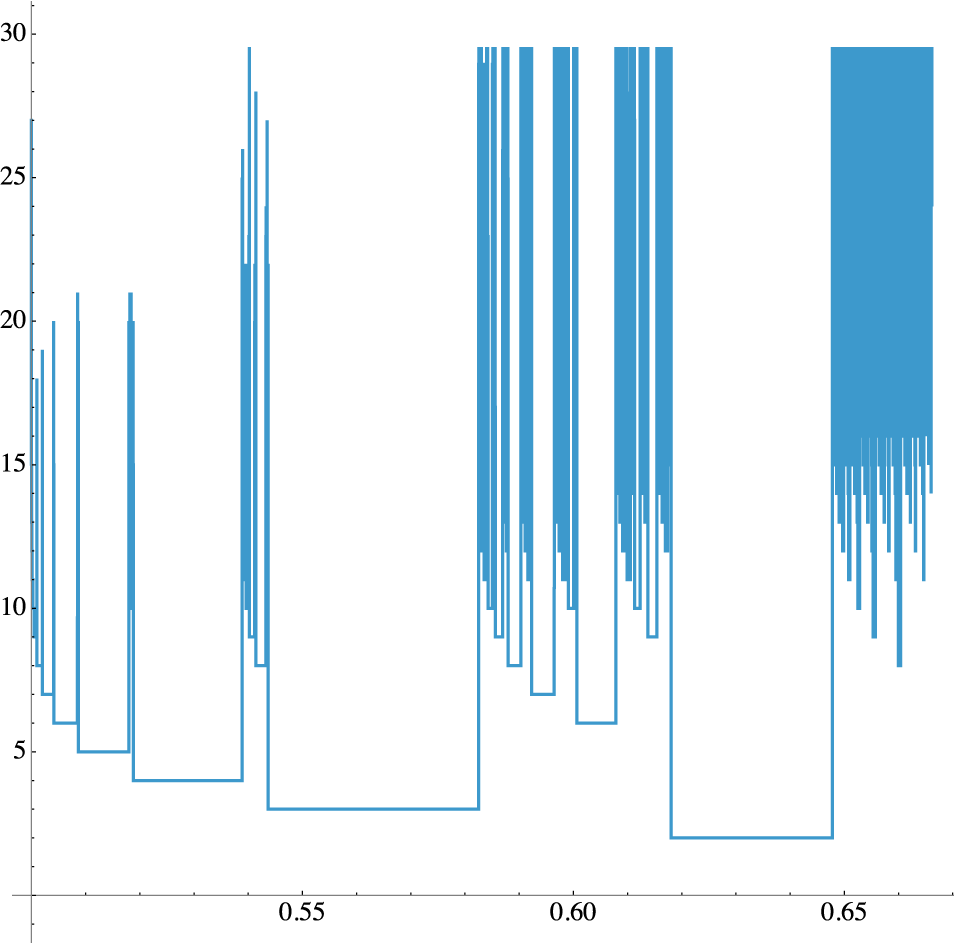


 Open access

