

The Spanish kings Charles V and Philip II were deeply interested in collecting information about the type and quality of horses in their realms. Such concerns were a fundamental preoccupation of the monarchy due to the historical importance of horse ownership and horse breeding in defining noble status and establishing municipal governance in conquest territories, whether in Iberia or the Americas. As horse breeding had spread from the Iberian Peninsula to the Caribbean and settlements north and south, various cities, missionaries, and viceroys sent numerous notices of unruly equine herds back to the court. The kings also received offers of prime horse specimens from horse breeders and officials in the Americas. The language of “casta” and “raza” categorized the different types of horses and facilitated discussion of the relative quality of horse populations.
The abundance of horses in the Americas and concerns about their quality threw into stark relief deep-seated concerns about a scarcity of horses in the Iberian Peninsula. Fears of a shortage of horses and the declining quality of horses had appeared with regularity in decrees related to horse breeding and which attempted to enforce the obligations of municipal officials and social elites in the Iberian Peninsula. Measures imposed by the monarchy to improve the state of the horse population in Spain culminated in twin efforts during the mid-sixteenth century. First, the monarchy conducted an exhaustive survey of horses and horse breeding methods among Iberian municipalities to improve the casta and raza of Spanish horses – the occasion for the first use of raza in a legal context. Second, the king established an initiative to breed a new raza of horses to improve the Spanish horse.
At this historical juncture, government regulations for horse breeding and the language of casta and raza were closely linked to aspects of social identity in the Spanish empire. This chapter examines the use of these terms within the regulatory framework of horse breeding in sixteenth-century Spain to understand their implications as a core component in empire building. Legal regulations for horse breeding generated a specific body of archival documents surrounding the reproductive management of animal populations that were important for governing land use and people’s social status. Encompassing royal decrees, reports on horse breeding at the municipal level, and mandates for new royal breeding programs, this corpus of documents offers a unique comparison of the legal uses of these terms and their parallel uses to describe the practices and practical knowledge of horse breeding. Strikingly, in the context of horse breeding, the use of the terms casta and raza focused on building a line of defense against the detrimental effects of inbreeding while supporting values of hybridity, rather than purity, in Spanish horse populations.
To understand the significance of this observation, an overview of the relationship between regulation, reproduction, and social hierarchy is helpful. The interaction of animal bodies and politics has resonance in larger historical debates about racial ideas and biopolitics. In his seminal exposition of biopolitics, Foucault considered how the state’s coordination of life-forms, through techniques of measurement or regulation of bodies, reproduction, and sexuality, established social boundaries that defined subjects of the state, and, by their exclusion, nonsubjects. Postmodern and post-humanist scholars have noted how biopolitics has the power to exclude marginalized populations by categorizing them as subhuman or nonhuman, and have drawn contemporary parallels between racism and speciesism.Footnote 1 More broadly, regulating “the animal” denotes a relationship of power that marginalizes anyone identified with animalistic qualities, and this form of dehumanizing and marking “the other” appears in many histories of race and racial thought.Footnote 2 Along these lines, applying animal terminology to human populations has also been used to enact a racial logic (i.e., essentializing qualities are ascribed to a group of people and that standard of difference is reproduced through its regulation).
Biopolitics, however, also marks a distinctive rupture or discontinuity that defines modernity, and studies of race tied to modern technologies of surveillance, the nation state, or the science of biology and genetics are temporally bounded and do not easily or directly apply to premodern contexts.Footnote 3 A vital and active area of research, therefore, has examined the ramifications of premodern taxonomies and classifications of difference with respect to power and authority in earlier periods, when fundamental concepts of the state and science looked different. Studies of early ethnographies and natural histories have traced continuities and changes from classical and medieval knowledge traditions to aspects of modern thought that are defined by species and race concepts, linked variously through categories of religion, climate, skin color, genealogy, astrology, blood, and other markers of difference.Footnote 4 Moving beyond conceptual histories, attention to the role of artisanal practices in generating new knowledge and vocabularies has brought nontraditional areas such as mining, metallurgy, and animal husbandry into the conversation.Footnote 5 In general, and especially in Iberian and Latin American histories, the situated and context-dependent development of these taxonomies underscore that they were social constructs applied to mark differences and shape social identity.Footnote 6
Attempts to pinpoint the “racial” and essentializing consequences of taxonomies of difference have homed in on a point of origin in the late medieval to early modern period related to the newly emerging terminology of race (raza and the related term casta, including its variations in other European languages: raça, razza, etc.). Notably, some of the earliest uses of this terminology in Spanish appear in reference to horses.Footnote 7 Research investigating when this term acquired the force of racial logic finds this overlap to be a critical development for thinking that ascribes race as a permanent and transferrable characteristic in European history.Footnote 8 Linking the terminology of race in horses (and other animals) to race in human groups presupposes a time and place in which the idea of race became a real and natural (if not yet biological) concept with the potential to sustain racial social frameworks.Footnote 9 However, a rigorous debate centers on whether it is necessary to identify a conceptual or linguistic moment that pairs bodily difference with naturalized or essentialized qualities, with some scholars arguing that racial phenomena are evident in structural and cultural relationships regardless of the presence of a specific vocabulary or rationale that justifies such distinctions.Footnote 10 In other words, if race itself is not biologically real (but has real sociological effects), then it does not also need to be found to be historically “real” before it could be operative in premodern eras.Footnote 11
In the context of this debate, examining the use of casta and raza in legal regulations and horse breeding practices contributes insights that are relevant to histories of race and racialization. The language of casta and raza in horse breeding is of interest to historians of race because it suggests a natural realism linking lineage and purity that can be used to regulate social identities. Casta is often defined as lineage or breed, a definition that has been extrapolated to explain the sistema de castas (caste system) in the Americas as akin to racial categories, although careful scholarship has pointed out complexities in the use of the term and questioned whether this could be said to apply systematically.Footnote 12 Raza is likewise translated and defined as breed, but the term more specifically points out the inheritance of a stain or defect within a lineage and its transfer across generations.Footnote 13 Both terms have been described in relation to limpieza de sangre (purity of blood) statutes, lineage-based rules for establishing social hierarchy that excluded subjects with Jewish or Muslim ancestry in medieval Iberia and were then extended to colonial settings.Footnote 14 In other words, the use of casta and raza is taken to imply a practical understanding of lineage that is useful for distinguishing those populations that were more pure than others, particularly in a context of legal regulation.
Looking at how these terms were used in the government’s regulation of horse populations in sixteenth-century Spain unearths interesting and surprising variations on the meaning of casta and raza. Decrees regulating horse breeding from the fourteenth to the sixteenth century aimed to influence physical traits and the casta of horses, but these laws and associated practices did not focus on blood or lineage purity. Surveys issued by Philip II to systematically collect information about the casta and raza of horses throughout Spain investigated the failures of breeding regulations and offered new recommendations: primarily, to reduce factors leading to inbreeding, and to focus on hybridity rather than purity as a management strategy. Even the king’s own program to develop a new “race” of horses emphasizes hybrid interbreeding rather than breeding within a single lineage. In these examples, horse breeding regulations did not reflect an interest in purity in order to shape or define the casta and raza of Spanish horses. In fact, competing uses of these terms could be in play at the same time.
Uncovering contradictory and unexpected uses and meanings of casta and raza contributes more broadly to decoupling a history of race terminology from the historical operation of racial thought. Although horse breeding manipulated the forms of real bodies across generations, these practices did not mean that casta or raza had a singular and consistent meaning or use that was related to purity of lineage. In fact, practices of horse breeding were fundamentally hybrid and notions of breed (casta or raza) necessarily constructed. Indeed, the use of casta and raza in the context of regulating horse breeding illustrated an early modern awareness that there were no natural breeds and there was no permanence in the concept of breed itself.
The multiple and contrasting uses of casta and raza in circulation in the early modern era also indicate for historians that animal breed is not synonymous with race as a real, historical category that offered a rationale for racial ideas. Nevertheless, narratives of purity about horse breeds could still be invented and applied, regardless of their discordance with contemporary breeding practices. This invention of narratives about breed mimics narratives about race, illustrating that polemics stem from similar social interests.Footnote 15 In this sense, the regulation of horse breeding in the Iberian empire reveals how boundaries of breed purity were negotiated and constructed in the early modern world.
6.1 Regulating Horses and Horse Breeding: Law and Language
The monarchy’s strategy for ensuring a supply of horses was originally based on horse ownership, required in the frontier institution of the caballería de cuantía (a registry of cavalry reserves in each municipality) as a requirement for holding municipal office. Written registries for horses first emerged in the fourteenth century, particularly for those areas in the southern Iberian frontiers that could control the flow of horses.Footnote 16 These registries served to certify horse ownership, for example, in order to issue permits for riding mules in 1348, and included the owner’s name and the age and color of the horse (presumably to identify unique horses and prevent the sharing or false registration of a horse). The monarchy’s interests in enforcing obligations to own horses increased the scope of these registries over time. By 1493, all horses needed to be included in an annual registration in a given municipality, and by 1528, such records were supposed to be sent to the court twice a year to confirm the issuance of exemptions and permits related to horse ownership and mule riding.Footnote 17
A tactical shift occurred in late fifteenth-century legislation aimed at ensuring that a plentiful quantity of horses was available for the militias, and this focus on the civic responsibilities of horse ownership was reoriented into a focus on the civic responsibility to inspect these same horses within a municipality for their potential for breeding with each year. In 1492, the Catholic Monarchs appointed a new set of veedores (royal overseers) to conduct inspections of the annual breeding of mares in particular municipalities; this represents the first reference to casta in laws or decrees about horses. These inspectors were instructed to ensure that the stallions “sean buenos e de buen cuerpo e casta” (were good, and of good body and casta).Footnote 18 The term was used again in 1499 as the criteria for choosing candidates for breeding that were of “good body and casta.” At this stage, certifying a horse’s casta was not explicitly defined in law, but from context, it was meant to assure the availability of horses suitable for use in war among the offspring of the stallions and mares bred each year.
Spurred by the noncompliance of knights and nobles who were supposed to be providing their horses for inspection within municipalities on an annual basis, continued concerns about a shortage of horses led to more specific legal instructions.Footnote 19 Certifying a horse’s casta became more selective: Stallions needed to be of a particular size, rather than just generally suitable for carrying a man at arms into battle. In 1528, Charles V reiterated that his subjects were responsible for providing proof of horse ownership by sending signed testimony from a corregidor, the alcalde mayor (a local judge), and a town notary to the court every six months.Footnote 20 Charles V was primarily concerned with the lack of horses suitable for carrying men at arms, and he consequently made the registry of horses more specific, requiring that they reach a cierta marca (certain size).Footnote 21 Defined as one- and two-thirds varas (a standardized unit of length, equivalent to just under 33 inches), this measurement was equivalent to at least fourteen hands in contemporary terms – an above-average but not exceptional height.Footnote 22
The new registry requirements aimed to increase the number of horses maintained for the militia and, more specifically, the number of horses of a size suitable for war. Rather than specifying a type of horse that could be understood as a breed, this legislation indicated a particular function for the horse and a notion of casta based on physical requirements of size. Size is an inherited quality based on both parents, but selecting for tall horses did not require maintenance of specific lineages. Nevertheless, the king’s attempt to exert and maintain control of horse quality through cierta marca also indicated interest in the physical features of horses. Official registries for horses and oversight of breeding by municipal councils and royal inspectors also grew during the fifteenth and sixteenth centuries, and came to encompass not only inspections of the militia to ensure that caballeros owned a horse and books registering exemptions to horse-ownership requirements, but also inspections of quality of these horses for breeding.Footnote 23
Beyond the legal decrees themselves, concerns from residents offer insight into the casta of horses in Spain. Complaints brought to the Cortes (a representative assembly, or parliament, of the medieval Iberian kingdoms) reflected the consequences of officials and inspectors flexing their privilege and power in local jurisdictions and not abiding by the standardized inspections and requirements for size imposed on municipalities. One case in 1548 noted that the municipal councilmen conducting the annual inspection of horses had abused their privileges by choosing a stallion from among their own horses. Not only were they enriching themselves on the stud fees collected, they were also breeding too many mares to the same stallion and harming the quality of local horses by such preferential and limited use of stallions.Footnote 24 A petition filed in 1559 complained more pointedly about the consequences of these evasions: As a result of not picking the best stallions, the quality of horses in Andalusia had decreased.Footnote 25 In this context, royal regulations were aimed at inspecting stallions for their casta to ensure a numerous population of horses of a size suitable for carrying men at arms. Complaints about how these regulations were actually implemented demonstrated that inspections that should have been based on the physical traits of individual specimens were instead inflected by favoritism and personal bias for particular lineages, which reduced the quality or casta of horses involved.
In addition to the challenges of ensuring that the municipal obligations for horse breeding were being fulfilled, other external factors presented challenges to Iberian horse populations. Severe droughts in the sixteenth century periodically wiped out grain crops, making feed expensive and starving livestock. For example, in 1568, the requirements of the contioso (knights belonging to the caballeros de cuantía) to own a horse were suspended due to the lack of grass and fodder for the horses.Footnote 26 Even a nobleman whose family was famed for breeding horses wrote to Philip II to deplore how his family’s stock of horses had been greatly diminished.Footnote 27 Additionally, defense of sprawling dynastic claims, new imperial acquisitions, and Mediterranean coastal invasions in the sixteenth century at once depleted the horse population and increased the noble class’s financial obligation to maintain and supply horses. Although it is difficult to determine population numbers based on anecdotal evidence, certainly the cost of keeping horses had risen and made ownership onerous. The ongoing demands of war and drought left the peninsula short of horses that met royal standards.
6.2 Relaciones de la Cría Caballar (Reports on Horse Breeding)
In the mid-sixteenth century, Philip II launched a new effort to address the quality of horses bred in Spain that made the first mention of raza in legal documentation. He faced several civil disturbances from internal pretenders to the throne during the first half of his reign, and thus was particularly concerned about the horse’s importance for the defense of his realms.Footnote 28 Although the nobility traditionally provided defense with horses for the cavalry, in reality, the supply of horses was a point of contention between the king and regional nobility based both on increasing costs and broader changes to the role of the nobility as court bureaucrats versus military agents. Long-standing fears about the shortage of horses in the Iberian Peninsula came to a head in the mid-sixteenth century.
Philip II’s 1562 initiative to increase Spanish mounted defenses had three basic components: secure an auxiliary militia force, reestablish the caballeros de cuantía, and conduct an extensive geographical survey of the state of horse breeding. Horses were the centerpiece of this project, and concerns about their scarcity led to an interest in collecting information about horse breeding practices and the outcomes of horse breeding regulations across the Iberian Peninsula. The survey set out to discover the areas with the best horses and the practices that ensured the best quality and greatest number of horses, with dual aims: to improve breeding practices and to bring to heel the municipal elites who influenced these outcomes.
An ordinance issued in 1562 expressed Philip II’s concern that the realm lacked horses, that the “la cría y raça y trato” (the breeding and trade in horses) had ceased, and indicated the need to improve the casta and raza of the Spanish horse. It also stated the aim of improving both the quantity and quality of horses in Spain: “what form and order should be had so that the casta of the horses is conserved and augmented in number as in quality.”Footnote 29 Subsequently, the Cámara de Castilla (an advisory council to the king) distributed a parallel set of inquiries to the kingdoms of Toledo, León, Seville, Córdoba, Jaén, Murcia, and Granada in 1562. This series of relaciones de la cría caballar (centrally organized questionnaires) inquired into each region’s disposition for horse breeding, seeking further knowledge about current breeding practices and recommendations from local experts about how to cultivate horse breeding on a regional basis throughout Spain. The instructions called for gathering the town council to consult experts on horses in their region in order to delimit land that could be assigned as pasture if approved by the crown, and it proposed ordinances that would best ensure “the casta and raza of horses be conserved in number and in excellence.” The survey followed this model preguntario:
1. “Primer Capítulo: si ay disposicion en esta ciudad y su tierra para criar cavallos y para que se conserven en ella” (If there is disposition in this city and its territory for the breeding/raising of horses so that it may be conserved there.)
2. “Segundo Capitulo: si ay suficientes pastos para ello” (If there is sufficient pasture for this.)
3. “Tercer Capitulo: de en que partes y lugares ay pastos y si son pu/cos concejiles o dehesas o prados de personas particulares” (In which parts and places there are pastures and if these are public or the estates of particular people.)
4. “Quarto Capitulo: si se podran dehesar algunas partes de los baldios de la ciudad y sus terminos para sola la cria de los cavallos e si de lo rresultara daño e perjuicio y a quien y por que causa” (If any parts of the “baldíos” of the city and its territory can be made into pastures exclusively for the breeding/raising of horses, and if this will result in any harm or injury, and to whom and for what reason.)
5. “Quinto Capitulo: si en esta ciudad y sus jurisdicion ay personas que acrian cavallos y en que cantidad o si los a avido en algunas tienpos y por que causa los ayan dexado” (If in this city and its jurisdiction there are people who are raising horses and in what quantity, or if there have been in prior times and for what reason they stopped raising horses.)
6. “Sesto Capitulo: de que forma y orden se podra dar y que hordenacas se podrian hazer para que la casta y raca de cavallos se conserve ansi en numero como en bondad” (What form and order can be given and what ordinances can be made so that the casta y raza of the horses be conserved likewise in number as in quality.)Footnote 30
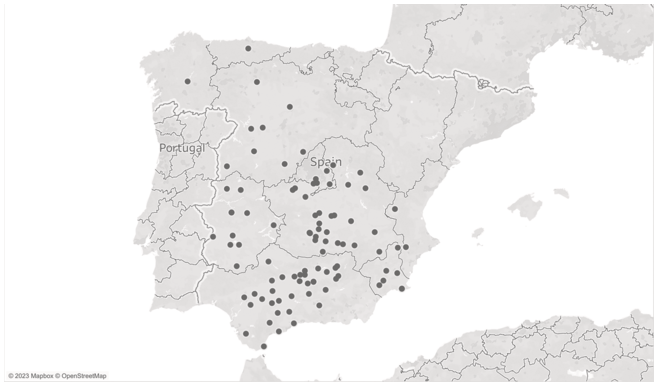
The tenor of these survey questions can be compared to other relaciones in Spain and its colonies between 1550s and 1580s, which have been proposed as a form of generating empirical knowledge that contributed to the systematization of natural history within Europe.Footnote 31 Beginning with a series of fifty questions issued by Juan Páez de Castro before 1560, the first relaciones topográficas made inquiries into the types of land in each province and their resources. Although this particular project was abandoned, a new variation under the direction of the royal cosmographer Juan López de Velasco in 1574 focused on political boundaries to make the “Escorial Map” of Spanish territory.Footnote 32 Based on similar projects for gathering information in the Americas and Spanish colonies, sets of relaciones geográficas were developed and issued at various dates with broad attention to the distribution of population and resources. This particular set of relaciones de la cría caballar, collected and used for improving the management of horse breeding within Spain, represents an early example of this type of information management (Map 6.1).Footnote 33
Map of reports on horse breeding, 1561–1594Footnote 33
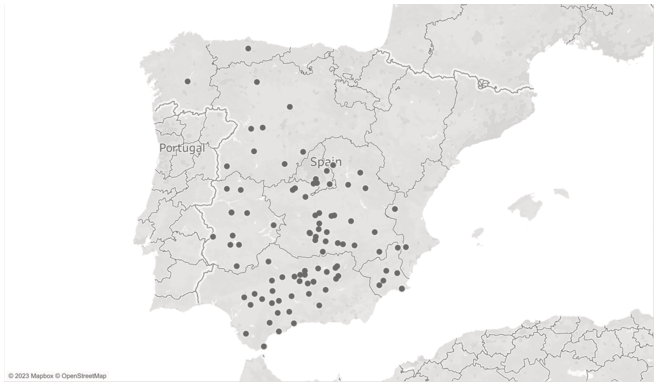
The records of these surveys are found in both the Libro de Cédulas (register of royal orders), which record their issue, and in the files of the Cámara de Castilla, which received their replies. Although neither set is complete, it can be estimated that at least fifty such questionnaires were issued, and close to seventy responses received in the first stages (1562–1568). The available responses range in length from a single-page letter to dockets of over a hundred folios, and represent a wide variety of content. A very rapid response could be returned in the vicinity of one month, while the more typical response was received within a few months, and some closer to six months later. Some responses simply confirmed the intention to complete these activities, others provided summaries of the information collected, and yet others provided detailed records of the discussions and proclamations, and even returned complete lists of the newly registered horses in their jurisdiction. These recommendations were received by the Crown sometime between 1562 and 1568; some towns only responded after additional requests for information. As the responses came in, the Crown’s fiscal (attorney or prosecutor) would make a follow-up visit to verify the lands that could be designated for horse pastures and provide additional recommendations for implementing these improvements. Following inquiries and responses continued into the 1590s. The responses collected from this survey offer insight into the operation of casta and raza in the regulation of horse breeding and help to understand the activities of local authorities and practitioners of horse breeding at the time.
In response to the first question about the current disposition for the breeding and raising of horses in a municipality, many towns responded that they did not have horses of “good casta” because they did not have good pasture, due to cold, dry, and mountainous terrain or recent drought, which resulted in small horses and a local preference for mules. Drought and an overall shortage of feed also contributed to poor results, as did a lack of protections for young horses against wolves. The second to fourth questions in the survey continue in this vein about available pasture and terrain, indicating the importance of climate and environmental resources relevant to supporting a good casta of horses. In many of these examples, casta seems to refer generally to the size and health of a regional population related to local resources for pasturage.
However, poor local conditions alone did not explain a lack of casta. The casta within a specific population could improve or decline over time within the same region, suggesting the role of selection as well. To counteract the effect of environment in the town of Ávila, for example, stallions “of the casta of Andalusia” were brought in for breeding purposes.Footnote 34 The town of Aguilar de la Frontera near Córdoba also reported that they had very poor and limited pasture, but that other villages still came to buy or use their stallions because of their casta.Footnote 35 These examples introduce the importance of breeding selection to improve the local casta; in this sense, the use of casta as a classification could travel with a local population. The nature of these desirable qualities, however, is not tied to specific features but to more general qualities of health in individual horses. Without being as specific as a “type,” casta seems to refer to a generalized breeding group in which the desired qualities of size and health are the result of a combination of local conditions and selection of specimens for breeding that had the desired traits.
In response to the fifth question about current breeders of horses, comments on breeding practices suggest that norms of horse breeding passed down from Latin and Greek sources were closely followed. These approximated the best age of stallions and mares for breeding, the number of mares that each stallion could be bred to, and the appropriate age to separate young horses from their mothers.Footnote 36 In these scenarios, the lackluster casta of a region was frequently blamed on not using stallions and mares that themselves were of a sufficient casta. But male productivity was also fragile based on the frequency of their mating. Limits on the number of mares that they could be bred with were offered as a guard against overbreeding, which would reduce the potency of the original stallion’s own casta from being passed onto his progeny. Allowing stallions and mares to breed at liberty introduced competing elements in the pasture, such as the possibility of mating with rocines (horses of lesser quality). Selection and management also hinged on careful prevention of incest: Allowing colts to run in pasture with their mothers at the age of two or older, once they were sexually active, could result in incestuous offspring and lead to a decline in the overall casta.Footnote 37 These examples highlighted the problems of incest and overbreeding in maintaining a casta.
In response to the sixth question about proposals to improve the casta and raza of horses, in number and in quality, the towns offered several different solutions to the Crown. One type of recommendation focused on environmental threats to the horses, such as protecting pastures specifically for horses so that youngsters or pregnant mares were not competing for resources with other livestock like oxen. The threats to young horses were numerous, not only in terms of nutrition but also in their vulnerability to predators like wolves, and many towns suggested that watchmen guard the pastures to eliminate that threat to the new foals. A second type of recommendation focused on the selection and maintenance of the stallions to be used for breeding purposes. To curb the favoritism of elite members of the community in selecting their own stallions and collecting the fees, it was suggested that the regulation that only stallions of casta be selected needed to be more stringently enforced. This proposal took two forms: having a certified and registered person who was impartial to select the stallions to be used by the community; or having the community purchase and maintain the stallions so that they would be equally accessible for all the local mares. A third set of suggestions dealt with managing the mares, especially not keeping mares where they might mate at liberty with other pastured horses and not keeping mares with their colts such that inbreeding could take place. Although there was near universal agreement about the prohibition of breeding mares to donkeys, there were little in the way of novel suggestions for enforcing this ideal. Nevertheless, the methods of pasturing the mares were intended to prevent unsolicited or unsupervised breeding with horses of lesser caliber or too closely related forms of incest.
The Crown adopted certain proposals in response to this survey. Overseers were assigned to inspect and select stallions used for breeding every year to ensure that they were de casta and escogido (of casta and selected). These stallions were rigorously inspected for their health and maintained by the town using the breeding fees collected by the municipal council. Each stallion was limited to be bred with twenty-five mares to ensure the potency of the stallion. This initiative emphasized the city’s responsibility in systematically recording and selectively breeding their stallions and mares, and maintaining detailed records of their foals from year to year’ the death of any foals would have to be reported in order to justify the annual accounting of registered horses. With regards to mares, the Crown wanted to register every single mare annually and to breed any that were not pregnant with one of the selected stallions. To improve the quality of horses, this breeding would ideally be limited to broodmares that were also healthy and de casta. Proposals for converting agricultural land to dehesa grazing would be granted with royal licenses, and new tax incentives were proffered for maintaining broodmares and training colts to be ridden and sold in public markets.
In addition to formalizing and centralizing the registration of horses and their breeding, the survey shows increasing attention to selective breeding. Selecting the best specimens to breed across different populations and preventing incest or inbreeding were dominant ideas in maintaining a robust horse population. The primary determinant of a “good” casta had to do with overall size and health, and required an impartial selection (as opposed to the biased selection encouraged by nepotism) that de-emphasized particular lineages with the general aim of improving casta. Although the horse’s casta might be influenced by the environment and geography, it was still a category that required constant maintenance rather than something that could be said to develop naturally.
These policies served to select physical types, and casta was related to the intergenerational transfer of traits and its maintenance included registering mares, stallions, offspring and sometimes branding them. However, these aspects of casta did not define a breed, nor did they establish a formal pedigree or “pure” lineage.Footnote 38 In the annual breeding of horses within a municipality, common land was typically used to gather the local mares for insemination by selected stallions in exchange for a fee known as a caballaje, but breeding regulations did not emphasize inbreeding or breeding closely within lineages. The herd in any given town would not be very large; estimates from the surveys range from three to seventy. The larger concern was actually in preventing the regular inbreeding or overbreeding that was more likely in this scenario. Preventing the loss of casta, in fact, required crossbreeding these horse populations rather than relying on the lineages of stallions from powerful local families.
There was little to no discussion of raza in the responses made by the municipalities describing cría (breeding) or the fomento de la raza caballar (the promotion of the horse breed). Trujillo reported in 1562 that the city possessed good land for raising the casta and raza of horses together in one phase, without distinguishing the quality of their casta of horses from the quality of their pasture and environs.Footnote 39 In Seville, a slightly later report simply confirmed a state of decline and indicated that soon there would be no raza of horses large enough for any caballero to ride; raza here referred to the size and quality of the animal.Footnote 40 The relative absence of the use of raza in legal documents related to managing and regulating horse populations is notable, however, as it suggests that that casta was the more important quality for regulation.
Forms of casta and raza were in use in the early fifteenth century in Romance languages across western Europe, appearing together, for example, in a Catalan and later Spanish translation of an Italian agricultural manual describing the breeding of horses: “haber cobdicia raza o casta buena y hermosa” (if one desires a good raza and casta of horses).Footnote 41 Raza generally referred to horses belonging to a particular person, likely a nobleman, who was able to own and select his own horses for breeding (the razze of the house of the Dukes of Mantua in Italy or the raza of the Valenzuela/Guzmán family in Andalusia).Footnote 42 Several etymological studies have traced the earliest uses of the term “race” in Romance languages (Italian razza, French race, Spanish raza) to the thirteenth century. In one line of investigation, the Italian razza is thought to be a translation of the Norman-French haras for the stud, or the site where breeding stallions were kept.Footnote 43 Its appearance in Catalan and Spanish vernaculars appears to arrive through a fourteenth-century translation of a thirteenth-century veterinary treatise, which refers to raza as an equine hoof disease.Footnote 44 Regardless, it is clear that the term “race” circulated in a limited fashion in the fourteenth century, with its very earliest uses in relation to hunting dogs and horses. Insofar as it was primarily used in association with noble families, raza points to a more specific and contained breeding population.
Whereas casta might be categorized as physical health and sexual potency that passes from one generation to the next, raza has more potential to indicate qualities that could be attributed to lines of descent. These qualities are of particular interest in alleviating the problems of incest that were brought to the fore in the breeding regulations for Iberian municipalities. The king’s response to the survey addressed two major issues: first, remedying carelessness or lack of oversight in breeding horses, which tended to produce a smaller-than-average horse; and second, addressing the ill effects of extensive inbreeding by bringing in prime individual stallions to achieve the benefits of new blood – what today we might think of as the advantages of outbreeding for a locally constrained population. In brief, the survey highlighted the importance of crossbreeding in developing the casta and raza of the Spanish horse.
6.3 Creating and Debating the King’s Race
The inquiry into horse breeding across the kingdom was a prelude to the king’s interest in establishing a new royal breeding facility in Córdoba, another branch of his initiative to improve the casta and raza of horses in Spain. Philip II issued his surveys about horse breeding throughout Castile in the mid-sixteenth century, at the same time that he began a program to improve his own stock of horses at a new royal stud, the Caballeriza Real of Córdoba (1562–1572). He intended to address the “public good of these realms so that the cría y casta of the horses in them [would] grow.”Footnote 45 This program sparked debates about the best methods for horse breeding that informed longer-term choices about managing horses.
Spanish kings had actively experimented with breeding their own stock of horses. Sometimes this took the form of a personal hobby, as befitted the training and appreciation of the horse that was required for the martial and courtly arts. At other times, these breeding experiments served the diplomatic purpose of gifting valuable horses to other princely courts.Footnote 46 The Spanish monarchy had special caballerizas (stables) for such horses, primarily housed in the Real Sitios, a series of royal palaces with extended hunting grounds. Aranjuez, founded as the royal stud in the twelfth century, served this role under the Catholic Monarchs and eventually housed all kinds of local and exotic animals.Footnote 47 The circuit expanded to include sites surrounding Segovia and the Cuenca del Alta Manzañares around Madrid, and additional territory maintained by Carthusian monasteries and the Military Order of Calatrava.
These sites provided the kings with the opportunity to engage in joint breeding experiments. The Mexía family was already famous for raising horses during the time of the Catholic Monarchs, and Rodrigo Mexía was asked to teach Charles V the system of breeding that his father, Don Gonzalo Mexía, had developed in creating “la casta del señor de Santo Firnia” (Santa Eufemia). Rodrigo Mexía served as regidor of Jaen and as a mozo de las espuelas (page of the queen). When ordered to find horses for Charles V, however, he responded that there were not many good ones left in Andalusia. This partnership continued, and Charles V corresponded with him about horses he raised in Quesada, near the headwaters of the Guadalquivir River.Footnote 48
Philip II, named regent in 1543, became involved with the administration of the Indies and influenced horse breeding regulations implemented there, before presiding over the Cortes of Catalonia in 1547. In 1549, he toured princely courts in Europe and took a special excursion from Tortosa to look at horses from Hungary. He established a new yeguada or site for broodmares in Segovia in 1556, and by 1560 had collected ninety-five mares for his own projects, which were overseen by the caballerizo mayor, Antonio de Toledo.Footnote 49 This mix included the horses from the Mexía family, among other grandees (Marqués de Gibraleón, the Marqués de Mondéjar, Manrique, etc.), as well as mares from Leopoldo de Austria (the Bishop of Córdoba and illegitimate uncle of Charles V).Footnote 50 The stables also recorded two dozen Friesians, imported via Naples from the Low Countries (Friesland), near the Duchy of Burgundy, and another twenty mares from Denmark.Footnote 51 By 1567, the stables recorded 244 mares of different ages.
When Philip II founded a new royal stud in Córdoba, he had an ambitious plan to breed six hundred mares to create a new raza of horses. The stable where the stallions were kept began with seventy-two stalls in 1565 and doubled by 1578.Footnote 52 To build this program, a group of mares from the royal grounds of Aranjuez were sent to Córdoba, and additional mares from Andalusia were acquired from well-known breeders, particularly from grandees (the Mexía and Manrique families, the Marqués de Gibraleón, and the Marqués de Mondéjar). The cities of Jerez and Jaen each provided pasture for four hundred and two hundred mares, respectively.
One function of the network of royal stables was to generate horses for the royal court’s use, as well as for the army to use on military campaigns. Horses would be sold to alleviate scarcity and improve horse quality. Out of the new foals, of which there were projected to be four hundred per year, the best would be reserved for the royal stables, and the rest sold (at three hundred ducados a piece) to make up the costs of maintenance over and above the annual budget (six thousand ducados).Footnote 53 These public sales are evident in the stables in both Córdoba and Sardinia.Footnote 54 Records of deliveries between points within the Spanish royal stable network substantiate these motivations, as accounts from picadors (horse trainers) and other stable officials document moving horses from Naples, Córdoba, Sardinia, and Madrid into the early 1600s.Footnote 55
By 1572, Diego López de Haro was appointed caballerizo mayor in Córdoba and charged with improving and preserving the casta and raza of the King’s horses. A report from the Córdoba stud circa 1572–1575 noted that the stables contained twenty-six “stallions of all nations,” and that one of the stallions used for breeding a new line of horses was itself a cross between Friesian and Spanish parents.Footnote 56 In the program López de Haro described to the king’s council, he advised supervised breeding of mares, rather than breeding at liberty in open pastures, in order to know which mares were bred with which stallions, and which colts were born of which “origin and casta.”Footnote 57 He also advised breeding “each raza to itself” and having the offspring branded accordingly. To have horses of the best raza, it was not sufficient simply to choose the best of the new batch of colts and sell the rest. Although López de Haro was optimistic about the future of the “king’s raza” (“each day it is becoming more perfect, and within a few years will be at its height”), he nevertheless cautioned that the quality of a horse really only emerged during training.
Not everyone approved of Philip II’s methods. Diego Ramírez de Haro, a high-ranking noble, contradicted the policies in place to improve the Spanish horse in a lengthy manuscript entitled Tratado de la brida y gineta, which he wrote sometime between the initiation of the king’s project in 1562 and his own death in 1587.Footnote 58 Ramírez de Haro lamented that the “raza of the King” produced very inconsistent horses: “it has one good horse for twenty bad.”Footnote 59 This unequal output, Ramírez argued, was the result of the great differences between the stallions and mares – many of which were from different countries of origin. He objected particularly to the method of choosing stallions according to their physical health and body type as individual specimens, be they foreign imports or from other regions of Spain. Even though Ramírez considered the health and age of the parents at the moment of conception to be critical to the health and strength of the offspring (e.g., a lame and old stallion would produce inferior offspring because of his condition at the time of breeding rather than his previous looks or ability), he argued that the policy of only choosing based on health and conformation and then crossbreeding with horses from other nations did nothing to benefit the Spanish horse and its casta.
Ramírez’s complaint about these crosses extended to the selection of horses for breeding throughout Spain, as it was implemented in all municipalities under the king’s recent directives. The assigned overseers who purchased stallions to service local mares, selecting them based on health and body type, followed a practice that Ramírez thought provoked the same problem of inconsistency in terms of casta: “It is a great inconvenience to follow this order that the towns purchase stallions to be assigned for the mares in their jurisdiction … it ought to be one that comes from the same casta, taking care to breed each one to one female of the casta in order to maintain purity.” Ramírez’s argument dealt with practical results from breeding horses, but given the conflict between the municipalities, the king, and noble families over horse ownership and horse breeding regulations, this debate also could be used as a proxy for arguments about the state of nobility. Promoting the use of local Spanish horses and breeding within the casta also made a political point about the value of purity for asserting noble privilege vis-à-vis the Crown.
The office held by López de Haro passed to Juan de Sandoval, el Marqués de Villamizar, and then to Juan Gerónimo Tinti, a native of Naples, both of whom continued to import horses from Naples and Austria. When Alonso Carrillo Lasso (son of the president of the Consejo de Indias) took over this office in 1622, the new stable master conducted a review of the records of the royal stables of Córdoba. He published his views on this topic to explain how, despite the king’s best efforts, the quality of the royal horses in Spain had been destroyed.Footnote 60 Carrillo Lasso argued that the selection of “foreign mares” had indiscriminately mixed too many factors within the lineages of the chosen stallions, producing unwanted effects. When originally the mares had been brought to Córdoba, the many different races from Andalusia had been mingled together in the same herds and then bred without preserving their different regional origins. For this reason, it was not possible to pair stallions and mares of the same race and conserve their distinct qualities. In reaction to the problems of mixed breeding, Carrillo Lasso argued that the loss of equine quality under Philip II could be remedied by greater focus on selective breeding among native stock. That is, rather than merely rejecting the interpolation of foreign blood, he proposed maintaining distinct strains within native Andalusian horse populations to preserve genetic resources as reservoirs of quality and purity.
Philip II’s attempts to govern the selection and breeding of these horses elicited concerns about preserving the casta of Spanish horses. The king’s raza sought to introduce and cross local horses with imported types to protect against the detrimental effects to casta created by such close breeding.Footnote 61 The effort to create the “king’s raza” reveals that between the 1530s and the 1630s, the consensus on how to supply horses to the Spanish courts shifted dramatically, from incorporating specimens imported from abroad to focusing on distinct, localized strains. This shift demonstrates awareness of the complexity of factors influencing “breed” and varied approaches to breeding horses that were employed. Lineage was one component, but it was not the only means of achieving a “type” of horse with desired traits.
Environmental influence shaped concerns about the degeneration of imported livestock and underwrote regional classifications of excellence, while on-the-ground experience with domesticated livestock both confirmed and contradicted the expectation that the environment had such a strong role. With breeding selections guided largely by the demands of function, breeders paired mates to create a variety of trait combinations, which could vary from one breeder to another. As Edmund Russell has termed it, such methods of “environmental breeding” generated desired phenotypes: Without necessarily fixing these traits as consistently reproducible across generations, they nevertheless effectively directed the expression of genetic resources through an active practice of culling and selection.Footnote 62
In this context, crossbreeding animals from different points of origin had the great benefit of introducing desired traits and ameliorating the detrimental effects of excessive inbreeding that had been observed in classical agricultural reference manuals used throughout Europe. At the same time, evidence for the practice of maintaining small populations in isolation, with the express purpose of defining and emphasizing subvarieties within established lineages, also demonstrates the ability to use crossbreeding to establish novel outcomes (despite the gamble of heterogeneous genes, as later described by Mendelian probabilities). This aspect of horse breeding did not simply advance a case for purity, but also institutionalized arguments for hybrid health.
6.4 Constructing Race
The use of the terms “caste” and “race” are noteworthy in the context of arguments made to try to understand the historical origins of racial thought – that is, the ways in which essentializing and embodied constructs of difference have been justified and applied. By connecting animal breeding to ideas about race, some scholars argue implicitly that animal breeding established a physical logic across generations. The argument of animal origins posits that the shift towards race is grounded in specific qualities of generation in the body, which animal husbandry had made known, practically speaking, if not yet scientifically. But horse breeding also made visible the problems of formulating concepts of purity of lineage and establishing desired physical types.
An animal point of origin has been incorporated into larger arguments about the meaning of lineage, blood, and purity in the development of racial thought.Footnote 63 Medievalist David Nirenberg, for example, points out that the term raza emerged in the Spanish language in reference to horse’s veterinary care and breeding in the fifteenth century, at the same time that it was applied to the Jewish population; he takes this convergence to mean that the terms raza and casta were “already embedded in identifiably biological ideas about animal breeding and reproduction.”Footnote 64 Javier Irigoyen-Garcia has traced the erasure of any original mixture of Indigenous Iberian and North African rams in the breeding of Merino sheep as they were redefined as “purely Spanish,” and notes slippages between zoological and ethnocentric language: “Because of its economic importance, its social ubiquity, and its ability to provide a visual model for issues of selected breeding and segregation, sheep herding furnished early modern racial thought with the terminology and logic needed to convey ethnocentric conceptions of social policy, mainly by borrowing its terminology from the vocabulary of marking ownership and evaluating wool quality.”Footnote 65 Latin Americanist María Martínez has argued that later colonial castas used a lexicon of biological reproduction from horse breeding to mark racial categories; she traces the “religious-cultural identity” marked by Spanish purity of blood statutes and ascribes their transformation in the sixteenth century to a naturalized racial category to the use of raza (breed) as a replacement for lineage.Footnote 66
Looking more closely at the use of casta and raza in the regulation of horse breeding, however, does not indicate that animal breeding itself offered a simple source of racial logic that was easily transferred to people in this period. Efforts to improve the quantity and quality of horses also demonstrate knowledge that horse breeding required efforts to maintain and cultivate casta and raza – these were not natural categories based on lineage, in a simple sense. Casta had many inputs: climate and environment, health, generational lineage, human selection, and behavior. Raza is more closely related to lineage, but establishing a new raza had fundamentally hybrid origins and required strategically crossing horses from different populations to construct the desired outcome. Breeding horses with socially desirable qualities did not conform to social ideas of purity, and in fact required careful avoidance of inbreeding and the strategic mixing and crossbreeding of animals of different origins. Awareness of the drawbacks of intensive inbreeding for the sake of purity suggests an early modern understanding of the constructed nature of horse breeds, in contrast to the use of breed as a synonym for a natural and essentialized intergenerational transfer of traits.
This is not to deny evidence of racial thinking in the early modern era, but rather to point out that the recommended practices of horse breeding could be at odds with the discursive demands of purity associated with their elite milieu. Analogies used by contemporaries are more likely a projection of purity than indicative of how animals were bred. Martínez, for example, pointed to Juan de Pineda’s Diálogos familiares de la agricultura cristiana for its analogy that one should breed horses within the same casta and should maintain those same boundaries with humans. This only represents half of the importance of casta in horse breeding, where defining a lineage was useful but needed to be balanced by outcrossing or crossbreeding.
The direct translation of the terms casta or raza to the present-day category of animal “breed” (itself a term first used in English in the sixteenth century) takes on some of the cultural mythologizing of “purebred” animals.Footnote 67 Standards for purity are assumed to be reflected in purebred animals, when in reality the practices that established purebred animals themselves indicate that what should be called “pure” was carefully negotiated and was only codified in the late 1800s. The most famous of these is the establishment of a registered pedigree and closed studbook for the Thoroughbred horse, in which the pedigree serves as a social guarantee for the horse to be purchased, while the breed itself was founded on hybrid crosses between English and imported horses, and lineage itself could not guarantee the traits or qualities of the individual horses belonging to that breed. However, these public lineages permitted linebreeding, or breeding within known lineages without crossing into excessive inbreeding and its detrimental effects. An alternative formulation of purity came from intensive inbreeding and selecting specifically for physical traits in offspring, without concern about the effects of inbreeding on the population as a whole or the health of the individual specimen; that was used effectively to develop meat-producing cattle and sheep.Footnote 68
Creating or identifying new breeds through hybrid crosses, or “improving” a breed through the strategic introduction of hybrid crosses makes clear the artificiality of animal breeds. Within each breed category, a genetic lineage is present based on the exhibition of inherited traits transmitted from one generation to the next. The frequency with which these traits are expressed is often a measure of permanence, also known as “fixing” or “true to type” breed quality. That said, each subtype is also affected by natural genetic mutations, so that a desired phenotype might also be selected from a population without strictly following a specific genetic line. Rarely are these stable enough to justify hard or natural subtypes. Attempts to create new breeds or to “conserve” historic breeds demonstrate the problems with considering breed a natural concept and the problems of purity for breed.Footnote 69
Breeds themselves are inventions, in this sense.Footnote 70 Being purebred refers to different strategies for managing the importance of mixing strains and avoiding inbreeding, precisely because breeds do not exist naturally or permanently as types. Narratives of breed purity are constructed after the fact, and there is always a point of hybridity at their origin. As Donna Landry has argued in relation to histories of the Arabian to the Thoroughbred to the Lipizanner, “a breed is a fictive construction … a form of interested knowledge.”Footnote 71 Breed categories are used to define essential characteristics and then to divide, promote, improve, or purify populations. Regardless of the method of breeding used, the breed narrative itself can be racialized and deployed in various ways to describe naturalized and essential traits.
In the early modern period, horse breed was not a stable signifier for race, even if it potentially appeared in cultural discourses about purity and miscegenation. That is, the way race operated in animal husbandry differs from the ways racial thought applied in human populations.Footnote 72 This conclusion is important in light of Rebecca Earle apt demonstration that the emergence of “racial thought” did not rely on contemporary frameworks of scientific thought.Footnote 73 Rather, discussion of the deeply malleable and porous nature of the horse’s body existed side by side with cultural anxieties and desires to apply essentializing categories to humans.Footnote 74 Localized in specific populations of horses, breeding practices tested the malleable body and contributed to a developing vocabulary of race and caste in the early modern Iberian world. Examining the concept of race from the point of view of animal husbandry contributes to the multiplicity of possible “racisms” in a premodern context.Footnote 75 What remains then is the need to examine when and how decisions to apply racial thought were made in practice.

 Open access