





1. Introduction
The McKean–Vlasov stochastic differential equation (SDE) has been introduced to describe the limit of a large-population system, where each particle dynamic is ruled by an SDE whose coefficient depends on an interaction term given by the empirical distribution induced by the whole population. In the symmetric setting, where each particle SDE has the same coefficient functions and is driven by an independent Brownian motion, the interaction term converges to the distribution of a representative particle as the number of particles tends to infinity. Let us mention the pioneering work of McKean [Reference McKean26] and Kac [Reference Kac21], and the pedagogical lecture notes of Snitzman [Reference Sznitman30] for the early development of the subject. Recently, McKean–Vlasov SDEs have drawn much attention, partially due to the development of mean-field game theory introduced independently and simultaneously in [Reference Huang, Malhamé and Caines17, Reference Lasry and Lions25].
While standard McKean–Vlasov SDEs describe a large-population system, the population size stays unchanged from the beginning to the end. In this paper we will study the McKean–Vlasov SDE in a setting where the population size evolves according to a branching process. The mathematical modelling of population dynamics has been intensively studied for more than a century. In particular, the branching process theory has been greatly developed due to its various applications in biology, ecology, medicine, etc., for which let us simply refer to [Reference Bansaye and Méléard1]. We are particularly interested in the branching diffusion process, which is a branching process where each particle has a feature, such as its spatial position, whose dynamic is ruled by a diffusion process. Such processes were first studied in [Reference Skorokhod28] and [Reference Ikeda, Nagasawa and Watanabe18] in the 1960s, notably to represent a class of nonlinear partial differential equations (PDEs) as an extension of the Feynman–Kac formula. It has also been extended to represent a larger class of semilinear PDEs, and to serve within a Monte Carlo method to solve the corresponding PDEs; see, e.g., [Reference Henry-Labordere, Oudjane, Tan, Touzi and Warin15, Reference Henry-Labordere, Tan and Touzi16]. Additionally, the control of branching diffusion processes has been studied in a context without mean-field interaction; see, e.g., [Reference Claisse4, Reference Kharroubi and Ocello22, Reference Nisio27, Reference Ustunel31]. We also mention the recent work in [Reference Claisse, Ren and Tan6] where the authors study a controlled branching diffusion process with interaction in a mean-field game setting.
In this paper we will study a class of McKean–Vlasov branching diffusion processes where the coefficient functions depend on an interaction term given by the distribution of the process itself. Equivalently, it is an extension of the McKean–Vlasov SDE, where the population size dynamic is ruled by a branching process. Such processes have already been studied in [Reference Fontbona and Méléard12, Reference Fontbona and Muñoz-Hernández13], in a setting where the branching process is a birth–death process and the interaction is given by a convolution type term. While a weak-convergence-type propagation of chaos result is obtained in [Reference Fontbona and Méléard12], a convergence rate result under the dual bounded-Lipschitz norm is given by [Reference Fontbona and Muñoz-Hernández13] using a coupling argument. In both [Reference Fontbona and Méléard12, Reference Fontbona and Muñoz-Hernández13], the finite population branching processes are constructed explicitly, while the limit McKean–Vlasov branching process is implicitly described by the Fokker–Planck equation. Here we will describe the limit McKean–Vlasov branching diffusion process by using a more explicit SDE formulation and then study its well-posedness. Moreover, we will consider a branching diffusion with more general interaction under a path-dependent setting, in the sense that the coefficient functions (drift, volatility, and branching parameters) are general functions of the whole path of the process and the interaction measure, and the interaction term is a measure on the path space as well. As in the classical SDE theory, we will first apply the contraction argument in order to obtain an existence and uniqueness result for strong solutions. Next, we consider the notion of weak solution as well as the related martingale problem formulation to obtain a general existence result. Based on this well-posedness result, an optimal control problem of the McKean–Vlasov branching diffusion processes is studied in [Reference Claisse, Kang, Lan and Tan5], and the corresponding Hamilton–Jacobi–Bellman master equation is studied in [Reference Ekren, He, Lan and Tan10]. Moreover, we provide a propagation of chaos result, that is, the McKean–Vlasov branching diffusion describes the limit of a large-population branching diffusion process with interaction given by the empirical distribution induced by the whole population. The result is based on the weak convergence technique and hence qualitative. Let us also mention that a quantitative propagation of chaos result with convergence rate is further obtained in [Reference Cao, Ren and Tan3] under additional regularity conditions.
The rest of the paper is organized as follows. In Section 2, we formulate the McKean–Vlasov branching diffusion and then provide our main results, including strong existence and uniqueness, weak existence, and propagation of chaos. In Section 3, we provide the proof of strong existence and uniqueness by contraction arguments. Finally, the proofs of weak existence as well as a propagation of chaos result by a weak convergence technique are completed in Section 4.
1.1. Notation
Let us first introduce some notation used in the rest of the paper.
First, let $(X, \rho)$
be a non-empty metric space. We denote by
$(X, \rho)$
be a non-empty metric space. We denote by $\mathcal{P}(X)$
(resp.
$\mathcal{P}(X)$
(resp. $\mathcal{M}(X)$
) the space of all Borel probability measures (resp. non-negative finite measures) on X. Given a measure
$\mathcal{M}(X)$
) the space of all Borel probability measures (resp. non-negative finite measures) on X. Given a measure $\mu\in\mathcal{M}(X)$
and a mapping
$\mu\in\mathcal{M}(X)$
and a mapping $f\colon E\to\mathbb{R}$
, we denote the integration by
$f\colon E\to\mathbb{R}$
, we denote the integration by $\langle\mu,f\rangle \,:\!=\, \int_E f(x)\,\mu({\mathrm{d}} x)$
. Further, for
$\langle\mu,f\rangle \,:\!=\, \int_E f(x)\,\mu({\mathrm{d}} x)$
. Further, for $p\geq1$
, we denote by
$p\geq1$
, we denote by $\mathcal{P}_p(X)$
the space of probability measures on X with p-order moment, i.e.
$\mathcal{P}_p(X)$
the space of probability measures on X with p-order moment, i.e. $\mathcal{P}_p(X)\,:\!=\,\big\{\mu\in\mathcal{P}(X)\colon\int_{X}\rho(x,x_0)^p\,\mu({\mathrm{d}} x)<+\infty\big\}$
for some (and thus all) fixed point
$\mathcal{P}_p(X)\,:\!=\,\big\{\mu\in\mathcal{P}(X)\colon\int_{X}\rho(x,x_0)^p\,\mu({\mathrm{d}} x)<+\infty\big\}$
for some (and thus all) fixed point $x_0\in X$
. Let us equip
$x_0\in X$
. Let us equip $\mathcal{P}_p(X)$
with the Wasserstein metric
$\mathcal{P}_p(X)$
with the Wasserstein metric $\mathcal{W}_p$
given by
$\mathcal{W}_p$
given by
 \begin{align*} \mathcal{W}_p(\mu,\nu) \,:\!=\, \inf_{\lambda\in\Lambda(\mu,\nu)}\Bigg(\int_{X\times X}\rho(x,y)^p\, \lambda({\mathrm{d}} x,{\mathrm{d}} y)\Bigg)^{1/p},\end{align*}
where $\Lambda(\mu,\nu)$
is the collection of all Borel probability measures
$\Lambda(\mu,\nu)$
is the collection of all Borel probability measures $\lambda$
on
$\lambda$
on $X\times X$
whose marginals are
$X\times X$
whose marginals are $\mu$
and
$\mu$
and $\nu$
respectively.
$\nu$
respectively.
Next, to describe the genealogy of the branching process, we use the classical Ulam–Harris–Neveu notation. Let $\mathbb{K}\,:\!=\, \{\emptyset\}\cup\bigcup_{n=1}^{+\infty}\mathbb{N}^n$
be the set of labels. Given
$\mathbb{K}\,:\!=\, \{\emptyset\}\cup\bigcup_{n=1}^{+\infty}\mathbb{N}^n$
be the set of labels. Given $k, k'\in\mathbb{K}$
with
$k, k'\in\mathbb{K}$
with $k=k_1\ldots k_n$
and
$k=k_1\ldots k_n$
and $k'=k'_1\ldots k'_m$
, we define the concatenation of labels
$k'=k'_1\ldots k'_m$
, we define the concatenation of labels $kk'\,:\!=\, k_1\ldots k_nk'_1\ldots k'_m$
, and write
$kk'\,:\!=\, k_1\ldots k_nk'_1\ldots k'_m$
, and write $k\prec k'$
if there exists
$k\prec k'$
if there exists $\tilde{k}$
such that
$\tilde{k}$
such that $k'=k\tilde{k}$
, which means that k
′ is a descendant of k. Let us define
$k'=k\tilde{k}$
, which means that k
′ is a descendant of k. Let us define
 \begin{align*} E \,:\!=\, \bigg\{\sum_{k\in K}\delta_{(k,x^k)}\colon K\subset\mathbb{K}\ \text{is finite},\, x^k\in\mathbb{R}^d, \text{ for all } k, k' \in K,\, k\nprec k'\bigg\},\end{align*}
where the Dirac measure $\delta_{(k,x^k)}$
corresponds to a particle identified by a label k and a position
$\delta_{(k,x^k)}$
corresponds to a particle identified by a label k and a position $x^k$
. The condition on the set of labels K ensures consistency with the genealogy of a population. Motivated by the study of superprocesses, it has become common to represent branching diffusions as measure-valued processes; see, e.g., [Reference Dawson, Maisonneuve, Spencer and Dawson7, 11]. Let
$x^k$
. The condition on the set of labels K ensures consistency with the genealogy of a population. Motivated by the study of superprocesses, it has become common to represent branching diffusions as measure-valued processes; see, e.g., [Reference Dawson, Maisonneuve, Spencer and Dawson7, 11]. Let $\mathbb{K}$
be equipped with the discrete topology; then E is a closed subspace of
$\mathbb{K}$
be equipped with the discrete topology; then E is a closed subspace of $\mathcal{M}(\mathbb{K}\times\mathbb{R}^d)$
under the weak convergence topology and thus E is a Polish space. We provide a metric
$\mathcal{M}(\mathbb{K}\times\mathbb{R}^d)$
under the weak convergence topology and thus E is a Polish space. We provide a metric $d_E$
on E which is consistent with the weak convergence topology: for all
$d_E$
on E which is consistent with the weak convergence topology: for all $e_1, e_2\in E$
such that
$e_1, e_2\in E$
such that $e_1 = \sum_{k\in K_1} \delta_{(k, x^k)}$
and
$e_1 = \sum_{k\in K_1} \delta_{(k, x^k)}$
and $e_2 = \sum_{k\in K_2} \delta_{(k, y^k)}$
,
$e_2 = \sum_{k\in K_2} \delta_{(k, y^k)}$
,
 \begin{equation} d_E(e_1,e_2) \,:\!=\, \sum_{k\in K_1\cap K_2}(|x^k-y^k|\wedge1) + \#(K_1\triangle K_2),\end{equation}
where $K_1\triangle K_2 \,:\!=\, (K_1\setminus K_2) \cup (K_2\setminus K_1)$
and
$K_1\triangle K_2 \,:\!=\, (K_1\setminus K_2) \cup (K_2\setminus K_1)$
and $\#(K_1\triangle K_2)$
is the number of elements in
$\#(K_1\triangle K_2)$
is the number of elements in $K_1\triangle K_2$
. Let
$K_1\triangle K_2$
. Let $f\,:\!=\,(\,f^k)_{k\in\mathbb{K}}\colon\mathbb{K}\times\mathbb{R}^d\rightarrow\mathbb{R}$
be a function and
$f\,:\!=\,(\,f^k)_{k\in\mathbb{K}}\colon\mathbb{K}\times\mathbb{R}^d\rightarrow\mathbb{R}$
be a function and $e\,:\!=\,\sum_{k\in K}\delta_{(k,x^k)}\in E$
; we write
$e\,:\!=\,\sum_{k\in K}\delta_{(k,x^k)}\in E$
; we write $\langle e,f\rangle = \sum_{k\in K}f^k(x^k)$
. We also fix the reference point
$\langle e,f\rangle = \sum_{k\in K}f^k(x^k)$
. We also fix the reference point $e_0 \in E$
, the null measure, which means that the associated set of particles is empty.
$e_0 \in E$
, the null measure, which means that the associated set of particles is empty.
Finally, we fix a constant $T > 0$
and an integer
$T > 0$
and an integer $d \ge 1$
throughout the paper, and denote by
$d \ge 1$
throughout the paper, and denote by $\mathcal{C}^d\,:\!=\,C([0,T],\mathbb{R}^d)$
the space of all
$\mathcal{C}^d\,:\!=\,C([0,T],\mathbb{R}^d)$
the space of all $\mathbb{R}^d$
-valued continuous paths on [0, T] equipped with the uniform convergence norm
$\mathbb{R}^d$
-valued continuous paths on [0, T] equipped with the uniform convergence norm $\|\omega\| \,:\!=\, \sup\nolimits_{0 \le t \le T} |\omega_t|\wedge 1$
. Next, we denote by
$\|\omega\| \,:\!=\, \sup\nolimits_{0 \le t \le T} |\omega_t|\wedge 1$
. Next, we denote by $\mathcal{D}_E\,:\!=\,D([0,T], E)$
the Skorokhod space of all E-valued càdlàg paths on [0, T]. For the weak formulation, we work with the classical Skorokhod metric on
$\mathcal{D}_E\,:\!=\,D([0,T], E)$
the Skorokhod space of all E-valued càdlàg paths on [0, T]. For the weak formulation, we work with the classical Skorokhod metric on $\mathcal{D}_E$
, while, for the strong formulation, we consider the uniform convergence metric on
$\mathcal{D}_E$
, while, for the strong formulation, we consider the uniform convergence metric on $\mathcal{D}_E$
given by
$\mathcal{D}_E$
given by
 \begin{equation} d(\omega^1, \omega^2) \,:\!=\, \sup\nolimits_{0\leq t \leq T}d_E(\omega^1_t,\omega^2_t) \quad \text{for all } \omega^1, \omega^2 \in \mathcal{D}_E,\end{equation}
and the truncated metric $d_t(\omega^1,\omega^2) \,:\!=\, d(\omega^1_{t\wedge\cdot},\omega^2_{t\wedge\cdot})$
for all
$d_t(\omega^1,\omega^2) \,:\!=\, d(\omega^1_{t\wedge\cdot},\omega^2_{t\wedge\cdot})$
for all $\omega^1, \omega^2 \in \mathcal{D}_E$
and
$\omega^1, \omega^2 \in \mathcal{D}_E$
and $t\in[0,T]$
, so that
$t\in[0,T]$
, so that
 \begin{equation} \mathcal{P}_1(\mathcal{D}_E) = \Bigg\{\mu\in\mathcal{P}(\mathcal{D}_E) \colon \int_{\mathcal{D}_E}\sup\nolimits_{t\in[0,T]}\langle\omega_t,\mathbf{1}\rangle\,\mu({\mathrm{d}}\omega) < \infty\Bigg\}\end{equation}
since $d_E(\omega_t, e_0) = \langle\omega_t,\mathbf{1}\rangle$
, where
$d_E(\omega_t, e_0) = \langle\omega_t,\mathbf{1}\rangle$
, where $\mathbf{1}\colon\mathbb{K}\times\mathbb{R}^d \longrightarrow \mathbb{R}$
is the constant function defined by
$\mathbf{1}\colon\mathbb{K}\times\mathbb{R}^d \longrightarrow \mathbb{R}$
is the constant function defined by $\mathbf{1}(k,x) = 1$
for all
$\mathbf{1}(k,x) = 1$
for all $k \in \mathbb{K}$
,
$k \in \mathbb{K}$
, $x\in\mathbb{R}^d$
.
$x\in\mathbb{R}^d$
.
Let us also define the stopping operator $\pi_t \colon \mathcal{C}^d \longrightarrow \mathcal{C}^d$
(resp.
$\pi_t \colon \mathcal{C}^d \longrightarrow \mathcal{C}^d$
(resp. $\pi_t\colon \mathcal{D}_E \longrightarrow \mathcal{D}_E$
) by
$\pi_t\colon \mathcal{D}_E \longrightarrow \mathcal{D}_E$
) by $\pi_t(\omega)\,:\!=\,\omega_{t\wedge\cdot}$
for all
$\pi_t(\omega)\,:\!=\,\omega_{t\wedge\cdot}$
for all $\omega \in \mathcal{C}^d$
(resp.
$\omega \in \mathcal{C}^d$
(resp. $\omega \in \mathcal{D}_E$
). Moreover, given a probability measure
$\omega \in \mathcal{D}_E$
). Moreover, given a probability measure $m \in \mathcal{P}(\mathcal{D}_E)$
and
$m \in \mathcal{P}(\mathcal{D}_E)$
and $t \ge 0$
, we define the pushforward measure
$t \ge 0$
, we define the pushforward measure $m_t\,:\!=\, m \circ (\pi_t)^{-1}$
.
$m_t\,:\!=\, m \circ (\pi_t)^{-1}$
.
2. Main results
2.1. McKean–Vlasov branching diffusion
Let us introduce first the McKean–Vlasov branching diffusion process by means of a pathwise description. We consider the coefficient functions
 \begin{align*} \big(b,\sigma,\gamma,(p_{\ell})_{\ell\in\mathbb{N}}\big) \colon [0,T]\times\mathcal{C}^d\times\mathcal{P}(\mathcal{D}_E) \longrightarrow \mathbb{R}^d\times\mathbb{R}^{d\times d}\times[0,\bar\gamma]\times[0,1]^{\mathbb{N}},\end{align*}
where $\bar \gamma > 0$
is a fixed constant. Namely, b and
$\bar \gamma > 0$
is a fixed constant. Namely, b and $\sigma$
are the drift and diffusion coefficients for the movement of each particle,
$\sigma$
are the drift and diffusion coefficients for the movement of each particle, $\gamma$
is the death rate, and
$\gamma$
is the death rate, and $(p_{\ell})_{\ell \in \mathbb{N}}$
is the probability mass function of the progeny distribution. In particular,
$(p_{\ell})_{\ell \in \mathbb{N}}$
is the probability mass function of the progeny distribution. In particular, $p_{\ell}(\!\cdot\!) \in [0,1]$
for each
$p_{\ell}(\!\cdot\!) \in [0,1]$
for each $\ell \in \mathbb{N}$
, and
$\ell \in \mathbb{N}$
, and $\sum_{\ell \in \mathbb{N}} p_{\ell}(\!\cdot\!) = 1$
. Let us also define a partition
$\sum_{\ell \in \mathbb{N}} p_{\ell}(\!\cdot\!) = 1$
. Let us also define a partition $(I_{\ell}(\!\cdot\!))_{\ell \in \mathbb{N}}$
of [0,1) by
$(I_{\ell}(\!\cdot\!))_{\ell \in \mathbb{N}}$
of [0,1) by $I_{\ell}(\!\cdot\!) \,:\!=\, \big[\sum_{i=0}^{\ell -1}p_i(\!\cdot\!),\sum_{i=0}^{\ell}p_i(\!\cdot\!)\big)$
for each
$I_{\ell}(\!\cdot\!) \,:\!=\, \big[\sum_{i=0}^{\ell -1}p_i(\!\cdot\!),\sum_{i=0}^{\ell}p_i(\!\cdot\!)\big)$
for each $\ell\in\mathbb{N}$
.
$\ell\in\mathbb{N}$
.
Let $(\Omega, \mathcal{F}, \mathbb{P})$
be a probability space with filtration
$(\Omega, \mathcal{F}, \mathbb{P})$
be a probability space with filtration $\mathbb{F} = (\mathcal{F}_t)_{t \ge 0}$
, equipped with an
$\mathbb{F} = (\mathcal{F}_t)_{t \ge 0}$
, equipped with an $\mathcal{F}_0$
-measurable E-valued random variable
$\mathcal{F}_0$
-measurable E-valued random variable $\xi$
, and a family of mutually independent,
$\xi$
, and a family of mutually independent, $\mathbb{R}^d$
-valued Brownian motions
$\mathbb{R}^d$
-valued Brownian motions $(W^k)_{k\in\mathbb{K}}$
and Poisson random measures
$(W^k)_{k\in\mathbb{K}}$
and Poisson random measures $(Q^k(ds,dz))_{k\in\mathbb{K}}$
on
$(Q^k(ds,dz))_{k\in\mathbb{K}}$
on $[0,T] \times [0, \bar \gamma] \times [0,1]$
with Lebesgue intensity measure
$[0,T] \times [0, \bar \gamma] \times [0,1]$
with Lebesgue intensity measure ${\mathrm{d}} s$
,
${\mathrm{d}} s$
, ${\mathrm{d}} z$
.
${\mathrm{d}} z$
.
We consider first a branching diffusion process with a fixed environment measure $\mu\in \mathcal{P}(\mathcal{D}_E)$
and initial state
$\mu\in \mathcal{P}(\mathcal{D}_E)$
and initial state $\xi$
. It corresponds to an E-valued process
$\xi$
. It corresponds to an E-valued process $(Z_t)_{t \in [0,T]}$
given by
$(Z_t)_{t \in [0,T]}$
given by
 \begin{equation} Z_t \,:\!=\, \sum_{k\in K_t}\delta_{(k,X^k_t)}, \quad t \in [0,T],\end{equation}
where $K_t$
denotes the collection of all labels of particles alive at time
$K_t$
denotes the collection of all labels of particles alive at time $t \in [0,T]$
and
$t \in [0,T]$
and $X^k_t$
corresponds to the position of particle
$X^k_t$
corresponds to the position of particle $k\in K_t$
. In particular, we have
$k\in K_t$
. In particular, we have $Z_0 = \xi = \sum_{k \in K_0} \delta_{(k, X^k_0)}$
. Then, for each
$Z_0 = \xi = \sum_{k \in K_0} \delta_{(k, X^k_0)}$
. Then, for each $k\in K_t$
, the position
$k\in K_t$
, the position $X^k_t$
evolves as a diffusion process characterized by the SDE
$X^k_t$
evolves as a diffusion process characterized by the SDE
 \begin{equation} {\mathrm{d}}X^k_t = b\big(t,X^k_{t\wedge\cdot},\mu_t\big)\,{\mathrm{d}} t + \sigma\big(t,X^k_{t\wedge\cdot},\mu_t\big)\,{\mathrm{d}} W^k_t,\end{equation}
where $\mu_t$
is the pushforward measure
$\mu_t$
is the pushforward measure $\mu_t \,:\!=\, \mu \circ \pi_t^{-1}$
. We also denote by
$\mu_t \,:\!=\, \mu \circ \pi_t^{-1}$
. We also denote by $S_k$
the birth time of particle k. In particular,
$S_k$
the birth time of particle k. In particular, $S_k = 0$
for each initial particle
$S_k = 0$
for each initial particle $k \in K_0$
. Then, each particle k runs a death clock with intensity
$k \in K_0$
. Then, each particle k runs a death clock with intensity $\gamma(t, X^k_{t\wedge\cdot}, \mu_t)$
, i.e. its death time
$\gamma(t, X^k_{t\wedge\cdot}, \mu_t)$
, i.e. its death time $T_k$
is given by
$T_k$
is given by
 \begin{align*} T_k \,:\!=\, \inf\big\{t>S_k \colon Q^k\big(\{t\}\times\big[0,\gamma\big(t,X^k_{t\wedge\cdot},\mu_t\big)\big] \times[0,1] \big) = 1\big\}.\end{align*}
Let $U_k$
be a random variable satisfying
$U_k$
be a random variable satisfying $Q^k \big(\{T_k\} \times [0,\gamma(T_k,X^k_{T_k\wedge\cdot},\mu_{T_k})] \times \{U_k\} \big) =1$
, and note that
$Q^k \big(\{T_k\} \times [0,\gamma(T_k,X^k_{T_k\wedge\cdot},\mu_{T_k})] \times \{U_k\} \big) =1$
, and note that $U_k$
is uniformly distributed over the interval [0,1]. When
$U_k$
is uniformly distributed over the interval [0,1]. When $U_k \in I_{\ell}\big(T_k, X^k_{T_k\wedge\cdot}, \mu_{T_k}\big)$
, at time
$U_k \in I_{\ell}\big(T_k, X^k_{T_k\wedge\cdot}, \mu_{T_k}\big)$
, at time $T_k$
the particle k dies and gives birth to
$T_k$
the particle k dies and gives birth to $\ell$
offspring particles
$\ell$
offspring particles $\{k1, \ldots, k \ell \}$
, so that
$\{k1, \ldots, k \ell \}$
, so that
 \begin{equation*} K_{T_k} = (K_{T_k-} \setminus \{k\}) \cup \{k1, \ldots,k \ell\}.\end{equation*}
In particular, the birth time of the offspring particles corresponds to the death time of the parent particle, i.e. $S_{ki}\,:\!=\, T_k$
for
$S_{ki}\,:\!=\, T_k$
for $i = 1, \ldots , \ell$
. Further, the offspring particles start from the position of the parent particle, i.e.
$i = 1, \ldots , \ell$
. Further, the offspring particles start from the position of the parent particle, i.e. $X^{ki}_{S_{ki}} = X^k_{T_k-}$
for
$X^{ki}_{S_{ki}} = X^k_{T_k-}$
for $i = 1, \ldots, \ell$
. Moreover, for a path-dependent treatment, we define
$i = 1, \ldots, \ell$
. Moreover, for a path-dependent treatment, we define $X^{ki}_t$
as its ancestor position before the birth time, i.e.
$X^{ki}_t$
as its ancestor position before the birth time, i.e. $X^{ki}_t = X^k_t$
for
$X^{ki}_t = X^k_t$
for $t< S_k$
and
$t< S_k$
and $i = 1, \ldots , \ell$
.
$i = 1, \ldots , \ell$
.
Then the McKean–Vlasov branching diffusion corresponds to the situation where the environment measure $\mu$
coincides with the law of the branching diffusion process Z, i.e.
$\mu$
coincides with the law of the branching diffusion process Z, i.e. $\mu = \mathbb{P}\circ Z^{-1}$
, or equivalently,
$\mu = \mathbb{P}\circ Z^{-1}$
, or equivalently, $\mu_t = \mathbb{P} \circ (Z_{t \wedge \cdot})^{-1}$
for all
$\mu_t = \mathbb{P} \circ (Z_{t \wedge \cdot})^{-1}$
for all $t\in[0,T]$
.
$t\in[0,T]$
.
Alternatively, let us provide a characterization of the McKean–Vlasov branching diffusion described above through a family of SDEs. Denote by $\mathcal{L}$
the infinitesimal generator of the diffusion
$\mathcal{L}$
the infinitesimal generator of the diffusion $(b,\sigma)$
, i.e., for all
$(b,\sigma)$
, i.e., for all $(t, \mathrm{x} ,m)\in[0,T]\times\mathcal{C}^d\times\mathcal{P}(\mathcal{D}_E)$
and
$(t, \mathrm{x} ,m)\in[0,T]\times\mathcal{C}^d\times\mathcal{P}(\mathcal{D}_E)$
and $f\in C^{2}_{\mathrm{b}}(\mathbb{R}^{d},\mathbb{R})$
,
$f\in C^{2}_{\mathrm{b}}(\mathbb{R}^{d},\mathbb{R})$
,
 \begin{equation*} \mathcal{L} f(t, \mathrm{x}, m) \,:\!=\, \frac{1}{2}\operatorname{Tr}(\sigma\sigma^{\top}(t,\mathrm{x},m)D^2f(\mathrm{x}_t)) + b(t,\mathrm{x},m)\cdot Df(\mathrm{x}_t).\end{equation*}
Then the McKean–Vlasov branching diffusion with initial condition $\xi$
can be characterized as the solution, for all
$\xi$
can be characterized as the solution, for all $f=(f^k)_{k\in\mathbb{K}} \in C^2_{\mathrm{b}} (\mathbb{K} \times \mathbb{R}^d, \mathbb{R})$
,
$f=(f^k)_{k\in\mathbb{K}} \in C^2_{\mathrm{b}} (\mathbb{K} \times \mathbb{R}^d, \mathbb{R})$
, $t\in[0,T]$
, to the SDE
$t\in[0,T]$
, to the SDE
 \begin{align} \langle Z_t, f \rangle & = \langle\xi ,f\rangle + \int_0^t\sum_{k\in K_s}\mathcal{L}f^k\big(s,X^k_{s\wedge\cdot},\mu_s\big)\,{\mathrm{d}} s \nonumber \\[2pt] & \quad + \int_0^t\sum_{k\in K_s}Df^k(X^k_s)\sigma\big(s,X^k_{s\wedge\cdot},\mu_s\big)\,{\mathrm{d}} W^k_s \nonumber \\[2pt] & \qquad\quad\; \times \int_{(0,t]\times[0,\bar\gamma]\times[0,1]}\sum_{k\in K_{s-}}\sum_{\ell\geq0}\Bigg(\sum_{i=1}^{\ell}f^{ki}-f^k\Bigg) (X^k_s) \nonumber \\[2pt] & \qquad\qquad\qquad \times \mathbf{1}_{[0,\gamma(s,X^k_{s\wedge\cdot},\mu_s)]\times I_{\ell}(s,X^k_{s\wedge\cdot},\mu_s)}(z)\, Q^k({\mathrm{d}} s,{\mathrm{d}} z) \end{align}
with the condition
 \begin{equation} \mu_t = \mathbb{P} \circ (Z_{t\wedge \cdot})^{-1} \quad \text{for all }t \in [0,T].\end{equation}
Remark 1.
-
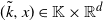
(i) In the SDE (6), the random processes $X^k_s$
and the random set
$K_s$
act together as part of the E-valued process Z via the relation (4). Conversely, we can represent
$X^k_s$
from
$Z_s$
by using the relation
$X^k_s = \langle Z_s, I_k \rangle$
with
$I_k (\tilde{k},x) \,:\!=\, x \mathbf{1}_{\{\tilde{k} = k\}}$
for all
$(\tilde{k},x)\in\mathbb{K}\times\mathbb{R}^d$
.
$X^k_s$
and the random set
$K_s$
act together as part of the E-valued process Z via the relation (4). Conversely, we can represent
$X^k_s$
from
$Z_s$
by using the relation
$X^k_s = \langle Z_s, I_k \rangle$
with
$I_k (\tilde{k},x) \,:\!=\, x \mathbf{1}_{\{\tilde{k} = k\}}$
for all
$(\tilde{k},x)\in\mathbb{K}\times\mathbb{R}^d$
. -
(ii) When the environment measure
$\mu\in\mathcal{P}(\mathcal{D}_E)$
is fixed, it becomes a classical branching diffusion process, whose well-posedness is ensured by standard Lipschitz and boundedness conditions; see, e.g., [Reference Claisse4, Proposition 2.1]. The crucial point here is therefore the requirement in (7) that
$\mu = \mathcal{L}(Z)$
. -
(iii) It might be of interest to consider, as in [Reference Claisse, Ren and Tan6], an interaction term of the form
$(\nu_t)_{t\in[0,T]}$
,
$\nu_t\in\mathcal{M}(\mathbb{R}^d)$
, where, for all
$f\colon\mathbb{R}^d\to \mathbb{R}$
bounded and measurable,
This case is clearly encompassed in our setting.
\begin{equation*} \int_{\mathbb{R}^d}{f(x)\,\nu_t({\mathrm{d}} x)} = \mathbb{E}[\langle Z_t,f\rangle] = \mathbb{E}\bigg[\sum_{k\in K_t}{f(X_t^k)}\bigg]. \end{equation*}
-
(iv) It might be more natural to consider
$\mu_{t-}$
instead of
$\mu_t$
in the dynamic described above. However, although the process Z has jumps in E, the mapping
$t \mapsto \mu_t= \mathbb{P} \circ (Z_{t\wedge\cdot})^{-1}$
is continuous on [0, T]. Indeed, since the death time
$T_k$
of each particle is generated by the Poisson random measure
$Q^k$
, we have
$\mathbb{P}(T_k = t) = 0$
and thus
$\mathbb{P}(Z_t = Z_{t-}) = 1$
for all
$t \in [0,T]$
.










2.2. Strong solution and well-posedness
Let us first consider the strong formulation of the McKean–Vlasov branching diffusion.
Definition 1.
(Strong solution.) A strong solution to the McKean–Vlasov branching diffusion SDE (6) with (7) in a given probability space $(\Omega, \mathcal{F}, \mathbb{P})$
with respect to an initial condition
$(\Omega, \mathcal{F}, \mathbb{P})$
with respect to an initial condition $\xi$
and a fixed family of independent, Brownian motions
$\xi$
and a fixed family of independent, Brownian motions $(W^k)_{k\in\mathbb{K}}$
and Poisson random measures
$(W^k)_{k\in\mathbb{K}}$
and Poisson random measures $(Q^k)_{k\in\mathbb{K}}$
on
$(Q^k)_{k\in\mathbb{K}}$
on $[0,T] \times [0, \bar \gamma] \times [0,1]$
with Lebesgue intensity measure is an E-valued càdlàg process
$[0,T] \times [0, \bar \gamma] \times [0,1]$
with Lebesgue intensity measure is an E-valued càdlàg process $Z = (Z_t)_{t \in [0,T]}$
adapted to the (augmented) natural filtration of
$Z = (Z_t)_{t \in [0,T]}$
adapted to the (augmented) natural filtration of $(\xi,(W^k,Q^k)_{k\in\mathbb{K}})$
satisfying the branching diffusion SDE (6) together with the McKean–Vlasov condition (7).
$(\xi,(W^k,Q^k)_{k\in\mathbb{K}})$
satisfying the branching diffusion SDE (6) together with the McKean–Vlasov condition (7).
Under the following assumptions, we can show the existence and uniqueness of a McKean–Vlasov branching diffusion in the strong sense. Recall that $\mathcal{D}_E$
is equipped with the uniform convergence metric defined in (2) so that the Wasserstein distance
$\mathcal{D}_E$
is equipped with the uniform convergence metric defined in (2) so that the Wasserstein distance $\mathcal{W}_1$
on
$\mathcal{W}_1$
on $\mathcal{P}_1(\mathcal{D}_E)$
is defined with respect to this metric.
$\mathcal{P}_1(\mathcal{D}_E)$
is defined with respect to this metric.
Assumption 1.
-
(i) The coefficient functions
$(b, \sigma, \gamma, (p_{\ell})_{\ell \ge 0})$
are progressive in the sense that
$(b,\sigma,\gamma,$
$(p_{\ell})_{\ell \ge 0})(t,\mathrm{x},m) = \big(b,\sigma,\gamma,(p_{\ell})_{\ell \ge 0}\big)(t,\mathrm{x}_{t \wedge \cdot},m_t)$
for all
$(t,\mathrm{x}, m) \in [0,T] \times \mathcal{C}^d \times \mathcal{P}_1(\mathcal{D}_E)$
. -
(ii) The coefficient functions
$(b, \sigma, \gamma, (p_{\ell})_{\ell \ge 0})$
are uniformly bounded. The same holds for the function
$\sum_{ \ell \ge 0} \ell p_{\ell}$
and we write
$M\,:\!=\,\big\|\sum_{\ell \ge 0}\ell p_{\ell}\big\|_{\infty} < +\infty$
.







Assumption 2.
-
(i) The coefficient functions
$b,\sigma,\gamma$
are Lipschitz in
$(\mathrm{x}, m)$
in the sense that there exists a constant
$L>0$
such that
for all
\begin{equation*} \big|(b,\sigma,\gamma)(t,\mathrm{x},m) - (b,\sigma,\gamma)(t,\mathrm{x}',m')\big| \leq L\big(\|\mathrm{x}_{t\wedge\cdot} - \mathrm{x}_{t\wedge\cdot}'\| + \mathcal{W}_{1}(m_t,m'_t)\big) \end{equation*}
$(t,\mathrm{x},\mathrm{x}',m,m') \in [0,T]\times\mathcal{C}^d\times\mathcal{C}^d\times \mathcal{P}_1(\mathcal{D}_E)\times\mathcal{P}_1(\mathcal{D}_E)$
.
-
(ii) There exist positive constants
$(C_{\ell})_{\ell \ge 0}$
such that
$M' \,:\!=\, \sum_{\ell \in\mathbb{N}} \ell C_{\ell} < \infty$
and
for all
\begin{equation*} \big|p_\ell(t,\mathrm{x},m) - p_\ell(t,\mathrm{x}',m')\big| \leq C_{\ell}\big(\|\mathrm{x}_{t\wedge\cdot} - \mathrm{x}'_{t\wedge\cdot}\| + \mathcal{W}_{1}(m_t,m'_t)\big) \end{equation*}
$(t,\mathrm{x},\mathrm{x}',m,m') \in [0,T]\times\mathcal{C}^d\times\mathcal{C}^d\times \mathcal{P}_1(\mathcal{D}_E)\times\mathcal{P}_1(\mathcal{D}_E)$
and
$\ell \in \mathbb{N}$
.








Remark 2. Let us provide a simple example of a Lipschitz function on $\mathcal{P}_1(\mathcal{D}_E)$
. Let
$\mathcal{P}_1(\mathcal{D}_E)$
. Let $f = (f^k)_{k \in \mathbb{K}}\colon \mathbb{K} \times \mathbb{R}^d \to \mathbb{R}$
and assume that there exists
$f = (f^k)_{k \in \mathbb{K}}\colon \mathbb{K} \times \mathbb{R}^d \to \mathbb{R}$
and assume that there exists $C>0$
such that
$C>0$
such that $|f^k(x)| \le C$
and
$|f^k(x)| \le C$
and $|f^k(x)-f^k(y)| \le C|x-y|$
for all
$|f^k(x)-f^k(y)| \le C|x-y|$
for all $k\in\mathbb{K}$
,
$k\in\mathbb{K}$
, $x,y\in\mathbb{R}^d$
. Define
$x,y\in\mathbb{R}^d$
. Define $F\colon [0,T]\times \mathcal{P}_1(\mathcal{D}_E) \to \mathbb{R}$
by
$F\colon [0,T]\times \mathcal{P}_1(\mathcal{D}_E) \to \mathbb{R}$
by
 \begin{equation*} F(t,m) \,:\!=\, \int_{\mathcal{D}_E} \langle z(t), f\rangle \,m({\mathrm{d}} z). \end{equation*}
Then we can easily check that $| F(t,m^1) - F(t,m^2)| \le C \mathcal{W}_1(m^1_t,m^2_t)$
for all
$| F(t,m^1) - F(t,m^2)| \le C \mathcal{W}_1(m^1_t,m^2_t)$
for all $m^1, m^2 \in \mathcal{P}_1(\mathcal{D}_E)$
. Indeed, given
$m^1, m^2 \in \mathcal{P}_1(\mathcal{D}_E)$
. Indeed, given $Z^1_t = \sum_{k\in K_t}\delta_{(k,X^{1,k}_t)}$
and
$Z^1_t = \sum_{k\in K_t}\delta_{(k,X^{1,k}_t)}$
and $Z^2_t = \sum_{k \in K'_t} \delta_{(k, X^{2,k}_t)}$
, two arbitrary càdlàg E-valued processes with distributions
$Z^2_t = \sum_{k \in K'_t} \delta_{(k, X^{2,k}_t)}$
, two arbitrary càdlàg E-valued processes with distributions $m^1$
and
$m^1$
and $m^2$
respectively, it follows by straightforward computation that
$m^2$
respectively, it follows by straightforward computation that
 \begin{equation*} |F(t, m^1) - F(t, m^2)| = \Bigg|\mathbb{E}\Bigg[\sum_{k\in K^1_t}f^k(X^{1,k}_t) - \sum_{k\in K^2_t}f^k(X^{2,k}_t)\Bigg]\Bigg| \le C\mathbb{E}[d_E(Z^1_t,Z^2_t)]. \end{equation*}
Theorem 1. Let Assumptions 1 and 2 hold, and assume further that the initial condition $\xi$
satisfies
$\xi$
satisfies $\mathbb{E}[\langle\xi,\mathbf{1}\rangle] = \mathbb{E}[\#K_0] < \infty$
. Then there exists a unique strong solution Z to the McKean–Vlasov branching diffusion SDE (6) with (7) in the sense of Definition 1, and it satisfies
$\mathbb{E}[\langle\xi,\mathbf{1}\rangle] = \mathbb{E}[\#K_0] < \infty$
. Then there exists a unique strong solution Z to the McKean–Vlasov branching diffusion SDE (6) with (7) in the sense of Definition 1, and it satisfies $\mathbb{E}\big[\!\sup\nolimits_{0\leq t\leq T}\langle Z_t,\mathbf{1}\rangle\big] = \mathbb{E}\big[\!\sup\nolimits_{0\leq t\leq T}\#K_t\big] < \infty$
.
$\mathbb{E}\big[\!\sup\nolimits_{0\leq t\leq T}\langle Z_t,\mathbf{1}\rangle\big] = \mathbb{E}\big[\!\sup\nolimits_{0\leq t\leq T}\#K_t\big] < \infty$
.
The proof of Theorem 1 relies on a contraction argument; it is postponed to Section 3.2. Additionally, by using the estimates needed for this contraction argument, we can easily establish a companion stability property for McKean–Vlasov branching diffusion with respect to the initial condition and the coefficient functions. See Appendix A for more details.
Remark 3. In contrast to the classical literature on McKean–Vlasov diffusion, where the Lipschitz condition on the coefficients hold with respect to the metric $\mathcal{W}_2$
(see, e.g., [Reference Jourdain, Méléard and Woyczynski20, Reference Sznitman30]), we perform our analysis with the metric
$\mathcal{W}_2$
(see, e.g., [Reference Jourdain, Méléard and Woyczynski20, Reference Sznitman30]), we perform our analysis with the metric $\mathcal{W}_1$
in this setting. We refer to Remark 6 for more details.
$\mathcal{W}_1$
in this setting. We refer to Remark 6 for more details.
2.3. Weak solution and propagation of chaos
As in classical SDE theory, we can consider the notion of weak solution by letting the probability space as well as the Brownian motions and the Poisson random measures be part of the solution. This allows us to establish the existence of McKean–Vlasov branching diffusion under relaxed conditions on the coefficients. Since there is no fixed probability space, we are given a measure $m_0 \in \mathcal{P}(E)$
as an initial condition rather than a random variable
$m_0 \in \mathcal{P}(E)$
as an initial condition rather than a random variable $\xi$
with distribution
$\xi$
with distribution $m_0$
.
$m_0$
.
Definition 2. A weak solution to the McKean–Vlasov branching diffusion SDE (6) and (7) with initial condition $m_0 \in \mathcal{P}(E)$
is a term
$m_0 \in \mathcal{P}(E)$
is a term $\alpha = (\Omega,\mathcal{F},\mathbb{F},\mathbb{P},Z,\mu,(W^k,Q^k)_{k\in\mathbb{K}})$
satisfying the following conditions:
$\alpha = (\Omega,\mathcal{F},\mathbb{F},\mathbb{P},Z,\mu,(W^k,Q^k)_{k\in\mathbb{K}})$
satisfying the following conditions:
-
(i)
$(\Omega,\mathcal{F},\mathbb{F},\mathbb{P})$
is a filtered probability space, equipped with a family of mutually independent Brownian motions
$(W^k)_{k\in\mathbb{K}}$
and Poisson random measures
$(Q^k)_{k\in\mathbb{K}}$
with Lebesgue intensity measure on
$[0,T] \times [0,\bar\gamma] \times [0,1]$
. -
(ii) Z is an E-valued,
$\mathbb{F}$
-adapted càdlàg process such that
$\mathbb{P} \circ Z_0^{-1} = m_0$
. -
(iii)
$\mu$
is a
$\mathcal{P}(\mathcal{D}_E)$
-valued random variable independent of
$\big(Z_0,(W^k,Q^k)_{k\in\mathbb{K}}\big)$
such that
$\mu_t = \mathcal{L}(Z_{t\wedge\cdot}\mid\mu_t)$
,
$t \in [0,T]$
. -
(iv) The process
$Z_t = \sum_{k \in K_t}\delta_{(k, X^k_t)}$
satisfies the following SDE: for all
$f \in C^2_{\mathrm{b}} (\mathbb{K} \times \mathbb{R}^d, \mathbb{R})$
,
$t\in [0,T]$
,
(8)
\begin{align} \langle Z_t, f \rangle & = \langle Z_0 ,f\rangle + \int_0^t\sum_{k\in K_s}\mathcal{L}f^k\big(s,X^k_{s\wedge\cdot},\mu_s\big)\,{\mathrm{d}} s \nonumber \\[2pt] & \quad + \int_0^t\sum_{k\in K_s}D\,f^k(X^k_s)\sigma\big(s,X^k_{s\wedge\cdot},\mu_s\big)\,{\mathrm{d}} W^k_s \nonumber \\[2pt] & \quad + \int_{(0,t]\times[0,\bar\gamma]\times[0,1]}\sum_{k\in K_{s-}}\sum_{\ell\geq0} \Bigg(\sum_{i=1}^{\ell}{f^{ki}}-f^k\Bigg)(X^k_s) \nonumber \\[2pt] & \qquad\qquad\quad \times \mathbf{1}_{[0,\gamma(s,X^k_{s\wedge\cdot},\mu_s)]\times I_{\ell}(s,X^k_{s\wedge\cdot},\mu_s)}(z)\, Q^k({\mathrm{d}} s,{\mathrm{d}} z). \end{align}












Remark 4. Notice that $\mu$
is independent of
$\mu$
is independent of $Z_0$
in Definition 2. In particular,
$Z_0$
in Definition 2. In particular, $\mu_0 = \mathcal{L}(Z_{0 \wedge \cdot})\in\mathcal{P}(\mathcal{D}(E))$
is deterministic, completely characterized by
$\mu_0 = \mathcal{L}(Z_{0 \wedge \cdot})\in\mathcal{P}(\mathcal{D}(E))$
is deterministic, completely characterized by $m_0\in\mathcal{P}(E)$
.
$m_0\in\mathcal{P}(E)$
.
Under the following assumption, we can show the existence of a weak solution to the McKean–Vlasov branching diffusion SDE. Recall that $\mathcal{D}_E$
is equipped with the classical Skorokhod metric so that the continuity below has to be understood witb respect to this metric.
$\mathcal{D}_E$
is equipped with the classical Skorokhod metric so that the continuity below has to be understood witb respect to this metric.
Assumption 3. The coefficient functions $(b,\sigma,\gamma,(p_{\ell})_{\ell \ge 0})$
and
$(b,\sigma,\gamma,(p_{\ell})_{\ell \ge 0})$
and $\sum_{\ell\ge0}\ell p_{\ell}$
are continuous in
$\sum_{\ell\ge0}\ell p_{\ell}$
are continuous in $(\mathrm{x},m)$
.
$(\mathrm{x},m)$
.
Theorem 2. Let Assumptions 1 and 3 hold, and $m_0\in\mathcal{P}_1(E)$
. There exists a weak solution to the McKean–Vlasov branching diffusion SDE (6) and (7) in the sense of Definition 2.
$m_0\in\mathcal{P}_1(E)$
. There exists a weak solution to the McKean–Vlasov branching diffusion SDE (6) and (7) in the sense of Definition 2.
Theorem 2 is an immediate consequence of a propagation of chaos property established in Theorem 3. Namely, we consider a large number n of branching diffusion processes interacting through their empirical distribution in the sense of Definition 3, and we show that, when n goes to infinity, it converges to a McKean–Vlasov branching diffusion in the weak sense.
Definition 3. For each $n \ge 1$
, a weak notion of n interacting branching diffusions with initial condition
$n \ge 1$
, a weak notion of n interacting branching diffusions with initial condition $m_0 \in \mathcal{P}(E)$
is a term
$m_0 \in \mathcal{P}(E)$
is a term $\alpha_n = \big(\Omega^n,\mathcal{F}^n,\mathbb{F}^n,\mathbb{P}^n, (Z^{i})_{i = 1,\ldots,n},(W^{i,k},Q^{i,k})_{k\in\mathbb{K}, i = 1,\ldots,n}\big)$
satisfying the following conditions:
$\alpha_n = \big(\Omega^n,\mathcal{F}^n,\mathbb{F}^n,\mathbb{P}^n, (Z^{i})_{i = 1,\ldots,n},(W^{i,k},Q^{i,k})_{k\in\mathbb{K}, i = 1,\ldots,n}\big)$
satisfying the following conditions:
-
(i)
$(\Omega^n,\mathcal{F}^n,\mathbb{F}^n,\mathbb{P}^n)$
is a filtered probability space, equipped with a family of mutually independent Brownian motions
$(W^{i,k})_{k\in\mathbb{K}, i = 1, \ldots, n}$
and Poisson random measures
$(Q^{i,k})_{k\in\mathbb{K}, i = 1, \ldots, n}$
with Lebesgue intensity measure on
$[0,T] \times [0, \bar \gamma] \times [0,1]$
. -
(ii) For each
$i=1,\ldots,n$
,
$Z^{i}$
is an E-valued,
$\mathbb{F}^n$
-adapted càdlàg process such that
$Z^{1}_0, \ldots, Z^{n}_0$
are independent and identically distributed with distribution
$m_0$
. -
(iii) For each
$i=1,\ldots,n$
, the process
$Z^{i}_t = \sum_{k \in K^{i}_t} \delta_{(k, X^{i,k}_t)}$
satisfies the following SDE: for all
$f \in C^2_{\mathrm{b}} (\mathbb{K} \times \mathbb{R}^d, \mathbb{R})$
,
$t\in[0,T]$
,
(9)where
\begin{align} \langle Z^{i}_t, f \rangle & = \langle Z^{i}_0 ,f\rangle + \int_0^t\sum_{k\in K^{i}_s}\mathcal{L}f^k\big(s,X^{i,k}_{s\wedge\cdot},\mu^n_s\big)\, {\mathrm{d}} s \nonumber \\ & \quad + \int_0^t\sum_{k\in K^{i}_s}Df^k(X^{i,k}_s)\sigma\big(s,X^{i,k}_{s\wedge\cdot},\mu^n_s\big)\, {\mathrm{d}} W^{i,k}_s \nonumber \\ & \quad + \int_{(0,t]\times[0,\bar\gamma]\times[0,1]}\sum_{k\in K^{i}_{s-}}\sum_{\ell\geq 0} \Bigg(\sum_{j=1}^{\ell}{f^{kj}} - f^k\Bigg)(X^{i,k}_s) \nonumber \\ & \qquad\quad\qquad \times \mathbf{1}_{I_{\ell}(s,X^{i,k}_{s\wedge\cdot},\mu^n_{s-})\times[0,\gamma(s,X^{i,k}_{s\wedge\cdot},\mu^n_{s-})]}(z)\, Q^{i,k}({\mathrm{d}} s,{\mathrm{d}} z), \end{align}
$\mu^n_t$
corresponds to the empirical measure
$\mu^n_t \,:\!=\, (1/n)\sum_{i=1}^n \delta_{Z^{i}_{t \wedge \cdot}}$
.











Theorem 3. Let Assumptions 1 and 3 hold, and $m_0\in\mathcal{P}_1(E)$
. Then any sequence of distributions
$m_0\in\mathcal{P}_1(E)$
. Then any sequence of distributions $(\mathbb{P}^n \circ (\mu^n)^{-1})_{n \ge 1}$
of n interacting branching diffusions in the sense of Definition 3 admits a converging subsequence in
$(\mathbb{P}^n \circ (\mu^n)^{-1})_{n \ge 1}$
of n interacting branching diffusions in the sense of Definition 3 admits a converging subsequence in $\mathcal{P}(\mathcal{P}_1(\mathcal{D}_E))$
, and the limit identifies as the distribution
$\mathcal{P}(\mathcal{P}_1(\mathcal{D}_E))$
, and the limit identifies as the distribution $\mathbb{P} \circ \mu^{-1}$
of a McKean–Vlasov branching diffusion in the sense of Definition 2.
$\mathbb{P} \circ \mu^{-1}$
of a McKean–Vlasov branching diffusion in the sense of Definition 2.
The proof of Theorem 3 is postponed to Section 4.3. It relies on the weak convergence of solutions to appropriate martingale problems, equivalent to the notion of weak solutions.

3. Strong formulation and well-posedness
We consider in this section the strong formulation of the McKean–Vlasov branching diffusion processes. More precisely, we provide the proof of the strong existence and uniqueness result, Theorem 1 in Section 3.2. To this end, we start with a series of preliminary technical lemmas in Section 3.1. Throughout this section, we consider a fixed probability space $(\Omega, \mathcal{F}, \mathbb{P})$
equipped with an initial condition
$(\Omega, \mathcal{F}, \mathbb{P})$
equipped with an initial condition $\xi$
and a family of independent Brownian motions
$\xi$
and a family of independent Brownian motions $(W^k)_{k \in \mathbb{K}}$
and Poisson random measures
$(W^k)_{k \in \mathbb{K}}$
and Poisson random measures $(Q^k)_{k \in \mathbb{K}}$
on
$(Q^k)_{k \in \mathbb{K}}$
on $[0,T] \times [0, \bar \gamma] \times [0,1]$
with Lebesgue intensity measure. We assume that Assumptions 1 and 2 hold, and further that
$[0,T] \times [0, \bar \gamma] \times [0,1]$
with Lebesgue intensity measure. We assume that Assumptions 1 and 2 hold, and further that $\mathbb{E}[\langle\xi,\mathbf{1}{}\rangle] = \mathbb{E}[\# K_0]<+\infty$
.
$\mathbb{E}[\langle\xi,\mathbf{1}{}\rangle] = \mathbb{E}[\# K_0]<+\infty$
.
3.1. Technical lemmas
We start by studying the solution to SDE (6) when the environment measure is fixed. More precisely, assume that we are given a deterministic $\mu \in \mathcal{P}_1(\mathcal{D}_E)$
and consider
$\mu \in \mathcal{P}_1(\mathcal{D}_E)$
and consider $Z_t=\sum_{k\in K_t} {\delta_{(k,X^k_t)}}$
satisfying, for all
$Z_t=\sum_{k\in K_t} {\delta_{(k,X^k_t)}}$
satisfying, for all $f \in C^2_{\mathrm{b}} (\mathbb{K} \times \mathbb{R}^d, \mathbb{R})$
,
$f \in C^2_{\mathrm{b}} (\mathbb{K} \times \mathbb{R}^d, \mathbb{R})$
, $t\in[0,T]$
,
$t\in[0,T]$
,
 \begin{align} \langle Z_t, f \rangle & = \langle\xi ,f\rangle + \int_0^t\sum_{k\in K_s}\mathcal{L}f^k(s,X^k_{s\wedge\cdot},\mu_s)\,{\mathrm{d}} s \nonumber \\ & \quad + \int_0^t\sum_{k\in K_s}D\,f^k(X^k_s)\sigma(s,X^k_{s\wedge\cdot},\mu_s)\,{\mathrm{d}} W^k_s \nonumber \\ & \quad + \int_{(0,t]\times [0,\bar \gamma] \times [0,1]}\sum_{k\in K_{s-}}\sum_{ \ell \geq 0} \Bigg(\sum_{i=1}^{\ell}{f^{ki}} - f^k\Bigg)(X^k_s) \nonumber \\ & \qquad\qquad\! \times \mathbf{1}_{[0,\gamma(s,X^k_{s\wedge\cdot},\mu_s)]\times I_{\ell}(s,X^k_{s\wedge\cdot},\mu_s)}(z)\, Q^k({\mathrm{d}} s,{\mathrm{d}} z). \end{align}
By a simple extension of [Reference Claisse4, Proposition 2.1], existence and uniqueness of the strong solution holds for the above SDE.
Lemma 1. Let $\mu\in\mathcal{P}_1(\mathcal{D}_E)$
. Then there exists a unique E-valued càdlàg process Z adapted to the (augmented) natural filtration of
$\mu\in\mathcal{P}_1(\mathcal{D}_E)$
. Then there exists a unique E-valued càdlàg process Z adapted to the (augmented) natural filtration of $\big(\xi,(W^k,Q^k)_{k\in\mathbb{K}}\big)$
satisfying the branching diffusion SDE (10). In addition,
$\big(\xi,(W^k,Q^k)_{k\in\mathbb{K}}\big)$
satisfying the branching diffusion SDE (10). In addition, $\mathbb{E}\big[\sum_{k\in\mathbb{K}}\sup\nolimits_{0\leq t\leq T}\mathbf{1}_{k\in K_t}\big] \leq \mathbb{E}[\#K_0]{\mathrm{e}}^{\bar\gamma M T}$
.
$\mathbb{E}\big[\sum_{k\in\mathbb{K}}\sup\nolimits_{0\leq t\leq T}\mathbf{1}_{k\in K_t}\big] \leq \mathbb{E}[\#K_0]{\mathrm{e}}^{\bar\gamma M T}$
.
Proof. The proof of existence and uniqueness relies on the fact that the Lipschitz assumption on b and $\sigma$
ensures the existence and uniqueness of the strong solution to SDE (5) characterizing the movement of each particle. Then we can construct the process step by step by considering the successive branching times. It remains to rule out explosion: this follows from the boundedness assumption on
$\sigma$
ensures the existence and uniqueness of the strong solution to SDE (5) characterizing the movement of each particle. Then we can construct the process step by step by considering the successive branching times. It remains to rule out explosion: this follows from the boundedness assumption on $\gamma$
and
$\gamma$
and $\sum_{\ell\geq0} \ell p_\ell$
, which ensures that the population size has finite moments (see below) and thus remains finite. We refer to [Reference Claisse4, Proposition 2.1] for more details.
$\sum_{\ell\geq0} \ell p_\ell$
, which ensures that the population size has finite moments (see below) and thus remains finite. We refer to [Reference Claisse4, Proposition 2.1] for more details.
Let us turn now to the moment estimate. Denote by $\bar{N}_t\,:\!=\,\sum_{k\in\mathbb{K}}\sup\nolimits_{0\leq t\leq T}\mathbf{1}_{k\in K_t}$
the total number of particles having been alive in the time interval [0, T], and observe that it can be viewed as a modified branching process where particles give birth to new ones without dying. Then
$\bar{N}_t\,:\!=\,\sum_{k\in\mathbb{K}}\sup\nolimits_{0\leq t\leq T}\mathbf{1}_{k\in K_t}$
the total number of particles having been alive in the time interval [0, T], and observe that it can be viewed as a modified branching process where particles give birth to new ones without dying. Then
 \begin{equation*} \bar{N}_t = \#K_0 + \int_{(0,t]\times[0,\bar \gamma]\times[0,1]}\sum_{k\in K_{s-}}\sum_{\ell\geq0}\ell \mathbf{1}_{I_\ell(s,X^k_{s\wedge\cdot},\mu_s)\times[0,\gamma(s,X^k_{s\wedge\cdot},\mu_s)]}(z)\,Q^k({\mathrm{d}} s,{\mathrm{d}} z). \end{equation*}
We introduce the stopping times $\tau_n\,:\!=\,\inf\{t\geq0\colon\bar{N}_t\geq n\}$
. Then
$\tau_n\,:\!=\,\inf\{t\geq0\colon\bar{N}_t\geq n\}$
. Then
 \begin{align*} \mathbb{E}[\bar{N}_{T\wedge\tau_n}] & = \mathbb{E}[\#K_0] + \mathbb{E}\bigg[\int_0^{T\wedge\tau_n}\sum_{k\in K_t}\sum_{\ell\geq0} \ell p_\ell\big(t,X^k_{t\wedge\cdot},\mu_t\big)\gamma\big(t,X^k_{t\wedge\cdot},\mu_t\big)\,\unicode{x1E6D} \bigg] \\[2pt] & \leq \mathbb{E}[\#K_0] + \bar\gamma M\mathbb{E}\bigg[\int_0^{T\wedge\tau_n}\#{K_t}\,{\mathrm{d}} t\bigg] \leq \mathbb{E}[\#K_0] + \bar\gamma M\mathbb{E}\bigg[\int_0^T\bar{N}_{t\wedge\tau_n}\,{\mathrm{d}} t\bigg]. \end{align*}
By Grönwall’s lemma, we deduce that $\mathbb{E}[\bar{N}_{T\wedge\tau_n}] \leq \mathbb{E}[\#K_0]{\mathrm{e}}^{\bar\gamma M T}$
. The conclusion follows immediately from Fatou’s lemma.
$\mathbb{E}[\bar{N}_{T\wedge\tau_n}] \leq \mathbb{E}[\#K_0]{\mathrm{e}}^{\bar\gamma M T}$
. The conclusion follows immediately from Fatou’s lemma.
We now provide a stability result for the branching diffusion solution to SDE (10) with respect to the environment measure. It is the key to the contraction argument used in the proof of Theorem 1 and the main technical difficulty. As a preliminary result, we first establish the following technical lemma.
Lemma 2. Let Assumption 1 hold. For any $(t,\mathrm{x},\mathrm{x}',m,m') \in [0,T]\times\mathcal{C}^d\times\mathcal{C}^d\times\mathcal{P}_1(\mathcal{D}_E)\times\mathcal{P}_1(\mathcal{D}_E)$
,
$(t,\mathrm{x},\mathrm{x}',m,m') \in [0,T]\times\mathcal{C}^d\times\mathcal{C}^d\times\mathcal{P}_1(\mathcal{D}_E)\times\mathcal{P}_1(\mathcal{D}_E)$
, $\int_0^1\sum_{\ell,\ell'\geq0}|\ell-\ell'|\mathbf{1}_{I_\ell(t,\mathrm{x},m)\cap I_{\ell'}(t,\mathrm{x}',m')}(u)\,{\mathrm{d}} u \leq \sum_{\ell\geq0}\ell|p_\ell(t,\mathrm{x},m) - p_\ell(t,\mathrm{x}',m')|$
.
$\int_0^1\sum_{\ell,\ell'\geq0}|\ell-\ell'|\mathbf{1}_{I_\ell(t,\mathrm{x},m)\cap I_{\ell'}(t,\mathrm{x}',m')}(u)\,{\mathrm{d}} u \leq \sum_{\ell\geq0}\ell|p_\ell(t,\mathrm{x},m) - p_\ell(t,\mathrm{x}',m')|$
.
Proof. Fix $(t,\mathrm{x},\mathrm{x}',m,m')\in [0,T]\times\mathcal{C}^d\times\mathcal{C}^d\times \mathcal{P}_1(\mathcal{D}_E)\times\mathcal{P}_1(\mathcal{D}_E)$
and consider the two probability measures
$(t,\mathrm{x},\mathrm{x}',m,m')\in [0,T]\times\mathcal{C}^d\times\mathcal{C}^d\times \mathcal{P}_1(\mathcal{D}_E)\times\mathcal{P}_1(\mathcal{D}_E)$
and consider the two probability measures $P \,:\!=\,(p_\ell(t,\mathrm{x},m))_{\ell\in\mathbb{N}}$
and
$P \,:\!=\,(p_\ell(t,\mathrm{x},m))_{\ell\in\mathbb{N}}$
and $P'\,:\!=\,(p_\ell(t,\mathrm{x}',m'))_{\ell\in\mathbb{N}}$
, which belong to
$P'\,:\!=\,(p_\ell(t,\mathrm{x}',m'))_{\ell\in\mathbb{N}}$
, which belong to $\mathcal{P}_1(\mathbb{N})$
in view of Assumption 1. Denote the cumulative distribution functions of P and P
′ as F and F
′ respectively, and observe that the generalized inverses are given, for all
$\mathcal{P}_1(\mathbb{N})$
in view of Assumption 1. Denote the cumulative distribution functions of P and P
′ as F and F
′ respectively, and observe that the generalized inverses are given, for all $u\in[0,1]$
, as
$u\in[0,1]$
, as $F^{-1}(u) = \sum_{\ell\geq0}\ell\mathbf{1}_{I_\ell}(u)$
and
$F^{-1}(u) = \sum_{\ell\geq0}\ell\mathbf{1}_{I_\ell}(u)$
and $(F')^{-1}(u) = \sum_{\ell\geq0}\ell\mathbf{1}_{I'_{\ell}}(u)$
, where
$(F')^{-1}(u) = \sum_{\ell\geq0}\ell\mathbf{1}_{I'_{\ell}}(u)$
, where $I_\ell\,:\!=\,I_\ell(t,\mathrm{x},m)$
and
$I_\ell\,:\!=\,I_\ell(t,\mathrm{x},m)$
and $I'_{\ell}\,:\!=\,I_{\ell}(t,\mathrm{x}',m')$
for
$I'_{\ell}\,:\!=\,I_{\ell}(t,\mathrm{x}',m')$
for $\ell\in\mathbb{N}$
. Using the well-known representation of Wasserstein metric for one-dimensional distributions, we have
$\ell\in\mathbb{N}$
. Using the well-known representation of Wasserstein metric for one-dimensional distributions, we have
 \begin{equation*} \mathcal{W}_1(P,P') = \int_0^1|F^{-1}(u)-(F')^{-1}(u)|\,{\mathrm{d}} u = \int_0^1\sum_{\ell,\ell'\geq0}|\ell-\ell'|\mathbf{1}_{I_\ell\cap I'_{\ell'}}(u)\,{\mathrm{d}} u. \end{equation*}
In addition, by a change of variable, we also have that
 \begin{align*} \mathcal{W}_1(P,P') = \sum_{j\geq0}|F(j)-F'(j)| & = \sum_{j\geq0}\bigg|\sum_{\ell\leq j}p_\ell(t,\mathrm{x},m) - \sum_{\ell\leq j}p_\ell(t,\mathrm{x}',m')\bigg| \\[2pt] & \leq \sum_{j\geq0}\sum_{\ell>j}|p_\ell(t,\mathrm{x},m)-p_\ell(t,\mathrm{x}',m')| \\[2pt] & = \sum_{\ell\geq 0}\ell|p_\ell(t,\mathrm{x},m)-p_\ell(t,\mathrm{x}',m')|. \end{align*}
The conclusion follows immediately.
Lemma 3. Let $\mu^1,\mu^2\in\mathcal{P}_1(\mathcal{D}_E)$
. Denote by
$\mu^1,\mu^2\in\mathcal{P}_1(\mathcal{D}_E)$
. Denote by $Z^i$
the solution to SDE (10) given
$Z^i$
the solution to SDE (10) given $\mu^i$
,
$\mu^i$
, $Z^i_0=\xi$
for
$Z^i_0=\xi$
for $i=1,2$
respectively. Then there exist constants
$i=1,2$
respectively. Then there exist constants $c_d > 0$
,
$c_d > 0$
, $c_w> 0$
depending on L,
$c_w> 0$
depending on L, $\bar \gamma$
, M, and M′ such that, for all
$\bar \gamma$
, M, and M′ such that, for all $T' \in [0,T]$
satisfying
$T' \in [0,T]$
satisfying $T'+\sqrt{T'}<1/c_d$
,
$T'+\sqrt{T'}<1/c_d$
,
 \begin{equation*} \mathbb{E}[d_{T'}(Z^1,Z^2)] \leq \frac{c_w(T'+\sqrt{T'})}{1-c_d(T'+\sqrt{T'})} \mathbb{E}[\#K_0]{\mathrm{e}}^{\bar\gamma M T'}\mathcal{W}_1\big(\mu^1_{T'},\mu^2_{T'}\big). \end{equation*}
Proof. Fix some $T'\in[0,T]$
to be determined later. For
$T'\in[0,T]$
to be determined later. For $t\in[0,T']$
, consider the representations
$t\in[0,T']$
, consider the representations $Z^1_t = \sum_{k\in K^1_t}\delta_{(k,X^{1,k}_t)}$
and
$Z^1_t = \sum_{k\in K^1_t}\delta_{(k,X^{1,k}_t)}$
and $Z^2_t = \sum_{k\in K^2_t}\delta_{(k,X^{2,k}_t)}$
. Let us write
$Z^2_t = \sum_{k\in K^2_t}\delta_{(k,X^{2,k}_t)}$
. Let us write $K^{1\cap2}_t \,:\!=\, K^{1}_t \cap K^{2}_t$
and
$K^{1\cap2}_t \,:\!=\, K^{1}_t \cap K^{2}_t$
and $K^{1\triangle2}_t \,:\!=\, K^{1}_t \triangle K^{2}_t$
. Recall that
$K^{1\triangle2}_t \,:\!=\, K^{1}_t \triangle K^{2}_t$
. Recall that
 \begin{equation} d_{T'}(Z^1,Z^2) = \sup\nolimits_{0\le t\le T'}\Bigg\{\#K^{1\triangle 2}_t + \sum_{k\in K^{1\cap2}_t}\big|X^{1,k}_t-X^{2,k}_t\big|\wedge1\Bigg\}. \end{equation}
Step 1
We start by estimating the first term in (11), counting the number of particles with distinct labels in $Z^1$
and
$Z^1$
and $Z^2$
. For simplicity, for
$Z^2$
. For simplicity, for $i = 1,2$
,
$i = 1,2$
, $k\in\mathbb{K},$
and
$k\in\mathbb{K},$
and $t\in[0,T]$
, we write
$t\in[0,T]$
, we write $\gamma^{i,k}_t \,:\!=\, \gamma(t,X^{i,k}_{t\wedge\cdot},\mu^i_t)$
,
$\gamma^{i,k}_t \,:\!=\, \gamma(t,X^{i,k}_{t\wedge\cdot},\mu^i_t)$
, $I^{i,k}_{\ell,t} \,:\!=\, I_\ell(t,X^{i,k}_{t\wedge\cdot},\mu^i_t)$
, and
$I^{i,k}_{\ell,t} \,:\!=\, I_\ell(t,X^{i,k}_{t\wedge\cdot},\mu^i_t)$
, and $p^{i,k}_{\ell,t}\,:\!=\,p_\ell(t,X^{i,k}_{t\wedge\cdot},\mu^i_t)$
. We begin with the following observation:
$p^{i,k}_{\ell,t}\,:\!=\,p_\ell(t,X^{i,k}_{t\wedge\cdot},\mu^i_t)$
. We begin with the following observation:
 \begin{equation} \#K^{1\triangle 2}_t\leq J^1_t+J^2_t+J^3_t+J^4_t+J^5_t, \end{equation}
where
 \begin{align*} J^1_t & = \int_{(0,t]\times[0,\bar\gamma]\times[0,1]}\sum_{k\in K^1_{s-}\setminus K^2_{s-}}\sum_{\ell\geq0} \ell\mathbf{1}_{I^{1,k}_{\ell,s}\times[0,\gamma^{1,k}_s]}(z)\,Q^k({\mathrm{d}} s,{\mathrm{d}} z), \\[2pt] J^2_t & = \int_{(0,t]\times[0,\bar\gamma]\times[0,1]}\sum_{k\in K^2_{s-}\setminus K^1_{s-}}\sum_{\ell\geq0} \ell\mathbf{1}_{I^{2,k}_{\ell,s}\times[0,\gamma^{2,k}_s]}(z)\,Q^k({\mathrm{d}} s,{\mathrm{d}} z), \\[2pt] J^3_t & = \int_{(0,t]\times[0,\bar\gamma]\times[0,1]}\sum_{k\in K^{1\cap 2}_{s-}}\mathbf{1}_{\gamma^{1,k}_s>\gamma^{2,k}_s} \sum_{\ell\geq0}(\ell+1)\mathbf{1}_{I^{1,k}_{\ell,s}\times (\gamma^{2,k}_s, \gamma^{1,k}_s]}(z)\,Q^k({\mathrm{d}} s,{\mathrm{d}} z), \\[2pt] J^4_t & = \int_{(0,t]\times[0,\bar\gamma]\times[0,1]}\sum_{k\in K^{1\cap 2}_{s-}}\mathbf{1}_{\gamma^{1,k}_s<\gamma^{2,k}_s} \sum_{\ell\geq0}(\ell+1)\mathbf{1}_{I^{2,k}_{\ell,s}\times (\gamma^{1,k}_s,\gamma^{2,k}_s]}(z)\,Q^k({\mathrm{d}} s,{\mathrm{d}} z), \\[2pt] J^5_t & = \int_{(0,t]\times[0,\bar\gamma]\times[0,1]}\sum_{k\in K^{1\cap 2}_{s-}}\sum_{\ell,\ell'\geq0}|\ell-\ell'| \mathbf{1}_{I^{1,k}_{\ell,s}\cap I^{2,k}_{\ell',s}\times[0,\gamma^{1,k}_s\wedge\gamma^{2,k}_s]}(z)\,Q^k({\mathrm{d}} s,{\mathrm{d}} z). \end{align*}
To obtain this estimate, we distinguish between particles born from a parent in the common set $K^{1\cap2}_t$
or not. In the latter case, we assume that all newly born particles also lie in the set
$K^{1\cap2}_t$
or not. In the latter case, we assume that all newly born particles also lie in the set $K^{1\triangle 2}_t$
. Then
$K^{1\triangle 2}_t$
. Then $J^1_t$
and
$J^1_t$
and $J^2_t$
correspond to the case when parents are from
$J^2_t$
correspond to the case when parents are from $K^1_t\setminus K^2_t$
and
$K^1_t\setminus K^2_t$
and $K^2_t\setminus K^1_t$
respectively. In the former case, when parents are from
$K^2_t\setminus K^1_t$
respectively. In the former case, when parents are from $K^{1\cap2}_t$
, the terms
$K^{1\cap2}_t$
, the terms $J^3_t$
and
$J^3_t$
and $J^4_t$
take care of the case when a particle in one tree branches while the other particle sharing the same label does not. The last term
$J^4_t$
take care of the case when a particle in one tree branches while the other particle sharing the same label does not. The last term $J_t^5$
concerns particles in two trees sharing a common label branching simultaneously, but giving birth to different numbers of progeny.
$J_t^5$
concerns particles in two trees sharing a common label branching simultaneously, but giving birth to different numbers of progeny.
Let us deal with each term in (12) separately. Firstly, we have
 \begin{align*} \mathbb{E}\big[\!\sup\nolimits_{0\leq t\leq T'}J^1_t\big] & = \mathbb{E}\Bigg[\int_{(0,T']\times[0,\bar\gamma]\times[0,1]}\sum_{k\in K^1_{t-}\setminus K^2_{t-}}\sum_{\ell\geq 0} \ell\mathbf{1}_{I^{1,k}_{\ell,t}\times[0,\gamma^{1,k}_t]}(z)\,Q^k({\mathrm{d}} t,{\mathrm{d}} z)\Bigg] \\[2pt] & = \mathbb{E}\Bigg[\int_0^{T'}\sum_{k\in K^1_t\setminus K^2_t}\gamma^{1,k}_t\sum_{\ell\geq 0}\ell p^{1,k}_{\ell,t}\, {\mathrm{d}} t\Bigg] \leq \bar\gamma M\mathbb{E}\bigg[\int_0^{T'}\#(K^1_t\setminus K^2_t)\,{\mathrm{d}} t\bigg]. \end{align*}
Similarly, we have $\mathbb{E}\big[\!\sup\nolimits_{0\leq t\leq T'}J^2_t\big]\leq\bar\gamma M\mathbb{E}\big[ \int_0^{T'}\#(K^2_t\setminus K^1_t)\,{\mathrm{d}} t\big]$
. We deduce that
$\mathbb{E}\big[\!\sup\nolimits_{0\leq t\leq T'}J^2_t\big]\leq\bar\gamma M\mathbb{E}\big[ \int_0^{T'}\#(K^2_t\setminus K^1_t)\,{\mathrm{d}} t\big]$
. We deduce that
 \begin{equation} \mathbb{E}\big[\!\sup\nolimits_{0\leq t\leq T'}\{J^1_t + J^2_t\}\big] \leq \bar\gamma M\mathbb{E}\bigg[\int_0^{T'}\#K^{1\triangle 2}_t\,{\mathrm{d}} t\bigg]. \end{equation}
In addition, using the same approach,
 \begin{equation} \mathbb{E}\big[\!\sup\nolimits_{0\leq t\leq T'}\{J^3_t+J^4_t\}\big] \leq (M+1)\mathbb{E}\Bigg[\int_0^{T'}\sum_{k\in K^{1\cap2}_t}\big|\gamma^{1,k}_t-\gamma^{2,k}_t\big|\,{\mathrm{d}} t\Bigg]. \end{equation}
By the Lipschitz condition on $\gamma$
from Assumption 2, it follows that
$\gamma$
from Assumption 2, it follows that
 \begin{equation} \mathbb{E}\big[\!\sup\nolimits_{0\leq t\leq T'}\{J^3_t+J^4_t\}\big] \leq L(M+1)\mathbb{E}\Bigg[\int_0^{T'}\sum_{k\in K^{1\cap2}_t}\big( \big\|X^{1,k}_{t\wedge\cdot}-X^{2,k}_{t\wedge\cdot}\big\| + \mathcal{W}_1(\mu^1_t,\mu^2_t)\big)\,{\mathrm{d}} t\Bigg]. \end{equation}
Finally, using Lemma 2, we obtain that
 \begin{align} \mathbb{E}\big[\!\sup\nolimits_{0\leq t\leq T'}J^5_t\big] & \leq \bar\gamma\mathbb{E}\Bigg[\int_0^{T'}\sum_{k\in K^{1\cap2}_t}\int_0^1\sum_{\ell,\ell'\geq0}|\ell-\ell'| \mathbf{1}_{I^{1,k}_{\ell,t}\cap I^{2,k}_{\ell',t}}(u)\,{\mathrm{d}} u\,{\mathrm{d}} t\Bigg] \nonumber \\[2pt] & \leq \bar\gamma\mathbb{E}\Bigg[\int_0^{T'}\sum_{k\in K^{1\cap2}_t}\sum_{\ell\ge 0} \ell\big|p^{1,k}_{\ell,t}-p^{2,k}_{\ell,t}\big|\,{\mathrm{d}} t\Bigg]. \end{align}
Thus, by the Lipschitz assumption on $(p_\ell)_{\ell\in\mathbb{N}}$
from Assumption 2, we deduce as above that
$(p_\ell)_{\ell\in\mathbb{N}}$
from Assumption 2, we deduce as above that
 \begin{equation} \mathbb{E}\big[\!\sup\nolimits_{0\leq t\leq T'}J^5_t\big] \leq \bar\gamma M'\mathbb{E}\Bigg[\int_0^{T'}\sum_{k\in K^{1\cap2}_t} \big(\big\|X^{1,k}_{t\wedge\cdot}-X^{2,k}_{t\wedge\cdot}\big\| + \mathcal{W}_1(\mu^1_t,\mu^2_t)\big)\,{\mathrm{d}} t\Bigg]. \end{equation}
We finish this step by combining (12), (13), (15), and (17) to obtain
 \begin{equation} \mathbb{E}\big[\!\sup\nolimits_{0\leq t\leq T'}\#K^{1\triangle 2}_t\big] \leq C\mathbb{E}\Bigg[\int_0^{T'}\Bigg(\#K^{1\triangle 2}_t + \sum_{k\in K^{1\cap2}_t}\big(\big\|X^{1,k}_{t\wedge\cdot}-X^{2,k}_{t\wedge\cdot}\big\| + \mathcal{W}_1(\mu^1_t,\mu^2_t)\big)\Bigg)\,{\mathrm{d}} t\Bigg], \end{equation}
where the constant $C>0$
depends on
$C>0$
depends on $(\bar \gamma,L,M,M')$
.
$(\bar \gamma,L,M,M')$
.
Step 2
Now we turn to the second term in (11) measuring the distance between particles with common labels in $Z_t^1$
and
$Z_t^1$
and $Z_t^2$
. For simplicity, for
$Z_t^2$
. For simplicity, for $i = 1,2$
,
$i = 1,2$
, $k\in\mathbb{K}$
, and
$k\in\mathbb{K}$
, and $t\in[0,T]$
we write
$t\in[0,T]$
we write $b^{i,k}_t \,:\!=\, b(t,X^{i,k}_{t\wedge\cdot},\mu^i_t)$
and
$b^{i,k}_t \,:\!=\, b(t,X^{i,k}_{t\wedge\cdot},\mu^i_t)$
and $\sigma^{i,k}_t \,:\!=\, \sigma(t,X^{i,k}_{t\wedge\cdot},\mu^i_t)$
. We observe first that, for any
$\sigma^{i,k}_t \,:\!=\, \sigma(t,X^{i,k}_{t\wedge\cdot},\mu^i_t)$
. We observe first that, for any $k\in K^{1\cap2}_t$
,
$k\in K^{1\cap2}_t$
,
 \begin{equation*} X^{1,k}_t-X^{2,k}_t = X^{1,k}_{\bar{S}^k} - X^{2,k}_{\bar{S}^k} + \int_0^t\mathbf{1}_{k\in K^{1\cap2}_s}\big(b^{1,k}_s - b^{2,k}_s\big)\,{\mathrm{d}} s + \int_0^t\mathbf{1}_{k\in K^{1\cap2}_s}\big(\sigma^{1,k}_s - \sigma^{2,k}_s\big)\,{\mathrm{d}} W^k_s, \end{equation*}
where $\bar{S}^k=\max(S^{1,k},S^{2,k})$
is the maximum of both times of birth of particle k, so that
$\bar{S}^k=\max(S^{1,k},S^{2,k})$
is the maximum of both times of birth of particle k, so that $k\in K^{1\cap2}_s$
whenever
$k\in K^{1\cap2}_s$
whenever $s\in[\bar{S}^k,t]$
. It follows that
$s\in[\bar{S}^k,t]$
. It follows that
 \begin{align} \mathbf{1}_{k\in K^{1\cap2}_t}\big\|X^{1,k}_{t\wedge\cdot}-X^{2,k}_{t\wedge\cdot}\big\| & \le \mathbf{1}_{k\in K^{1\cap2}_t}\big\|X^{1,k}_{\bar{S}^k\wedge\cdot}-X^{2,k}_{\bar{S}^k\wedge\cdot}\big\| + \int_0^t\mathbf{1}_{k\in K^{1\cap2}_s}\big|b^{1,k}_s - b^{2,k}_s\big|\,{\mathrm{d}} s \nonumber \\[2pt] & \quad + \sup\nolimits_{0\le r\le t}\bigg|\int_0^r\mathbf{1}_{k\in K^{1\cap2}_s}\big(\sigma^{1,k}_s - \sigma^{2,k}_s\big)\, {\mathrm{d}} W^k_s\bigg|. \end{align}
Let us deal first with the last two terms on the right-hand side of (19). By using the Lipschitz condition on b and $\sigma$
from Assumption 2, we have, for all
$\sigma$
from Assumption 2, we have, for all $k\in\mathbb{K}$
,
$k\in\mathbb{K}$
,
 \begin{equation*} \mathbb{E}\bigg[\int_0^{t}\mathbf{1}_{k\in K^{1\cap2}_s}\big|b^{1,k}_s - b^{2,k}_s\big|\,{\mathrm{d}} s\bigg] \leq L\mathbb{E}\bigg[\int_0^{t}\mathbf{1}_{k\in K^{1\cap2}_s}\big(\big\|X^{1,k}_{s\wedge\cdot}-X^{2,k}_{s\wedge\cdot}\big\| + \mathcal{W}_1(\mu^1_s,\mu^2_s)\big)\,{\mathrm{d}} s\bigg], \end{equation*}
as well as
 \begin{align*} & \mathbb{E}\bigg[\sup\nolimits_{0\leq r\leq t}\bigg|\int_0^r\mathbf{1}_{k\in K^{1\cap2}_s} \big(\sigma^{1,k}_s-\sigma^{2,k}_s\big)\,{\mathrm{d}} W^k_s\bigg|\bigg] \\[3pt] & \qquad \leq C_1\mathbb{E}\bigg[\bigg(\int_0^{t}\mathbf{1}_{k\in K^{1\cap2}_s} \big|\sigma^{1,k}_s - \sigma^{2,k}_s\big|^2\,{\mathrm{d}} s\bigg)^{{1}/{2}}\bigg] \\[3pt] & \qquad \leq C_1\sqrt{t}\mathbb{E}\big[\!\sup\nolimits_{0\leq s\leq t}\mathbf{1}_{k\in K^{1\cap2}_s} \big|\sigma^{1,k}_s - \sigma^{2,k}_s\big|\big] \\[3pt] & \qquad \leq C_1L\sqrt{t}\mathbb{E}\big[\!\sup\nolimits_{0\leq s\leq t}\mathbf{1}_{k\in K^{1\cap2}_s} \big(\big\|X^{1,k}_{s\wedge\cdot}-X^{2,k}_{s\wedge\cdot}\big\| + \mathcal{W}_1(\mu^1_s,\mu^2_s)\big)\big], \end{align*}
where the first inequality follows from the Burkholder–Davis–Gundy inequality. Regarding the first term on the right-hand side of (19), we distinguish between particles whose parents are in the common set or not. In the latter case, we use the fact that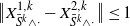 $\big\|X^{1,k}_{\bar{S}^k\wedge\cdot}-X^{2,k}_{\bar{S}^k\wedge\cdot}\big\|\le 1$
so that
$\big\|X^{1,k}_{\bar{S}^k\wedge\cdot}-X^{2,k}_{\bar{S}^k\wedge\cdot}\big\|\le 1$
so that
 \begin{align*} \mathbb{E}\Bigg[\sum_{k\in\mathbb{K}}\sup\nolimits_{0\le t\le T'}\mathbf{1}_{k\in K^{1\cap2}_t,k^-\in K^{1\triangle 2}_{\bar{S}^k-}} \big\|X^{1,k}_{\bar{S}^k\wedge\cdot}-X^{2,k}_{\bar{S}^k\wedge\cdot}\big\|\Bigg] & \le \mathbb{E}\Bigg[\sum_{k\in\mathbb{K}}\sup\nolimits_{0\le t\le T'} \mathbf{1}_{k\in K^{1}_t\cup K^{2}_t,k^-\in K^{1\triangle 2}_{\bar{S}^k-}}\Bigg] \\[2pt] & = \mathbb{E}\big[J^1_{T'} + J_{T'}^2\big] \le \bar\gamma M\mathbb{E}\bigg[\int_0^{T'}\#K^{1\triangle 2}_t\,{\mathrm{d}} t\bigg], \end{align*}
where $k^-$
denotes the parent of particle k, and the last inequality follows from (13). Note that
$k^-$
denotes the parent of particle k, and the last inequality follows from (13). Note that $\sum_{k\in\mathbb{K}}\sup\nolimits_{0\le t\le T'}\mathbf{1}_{k\in K^{1}_t\cup K^{2}_t,k^-\in K^{1\triangle 2}_{\bar{S}^k-}}$
corresponds to the total number of particles born from a parent in the distinct set
$\sum_{k\in\mathbb{K}}\sup\nolimits_{0\le t\le T'}\mathbf{1}_{k\in K^{1}_t\cup K^{2}_t,k^-\in K^{1\triangle 2}_{\bar{S}^k-}}$
corresponds to the total number of particles born from a parent in the distinct set $K^{1\triangle 2}$
before time T
′. Alternatively, when the parent belongs to the common set, we have
$K^{1\triangle 2}$
before time T
′. Alternatively, when the parent belongs to the common set, we have
 \begin{align*} & \mathbb{E}\Bigg[\sum_{k\in\mathbb{K}}\sup\nolimits_{0\le t\le T'}\mathbf{1}_{k\in K^{1\cap2}_t,k^-\in K^{1\cap 2}_{\bar{S}^k-}} \big\|X^{1,k}_{\bar{S}^k\wedge\cdot}-X^{2,k}_{\bar{S}^k\wedge\cdot}\big\|\Bigg] \\[2pt] & = \mathbb{E}\Bigg[\int_{(0,T']\times[0,\bar\gamma]\times[0,1]}\sum_{k\in K^{1\cap2}_{t-}}\sum_{\ell,\ell'\geq0} (\ell\wedge \ell')\mathbf{1}_{I^{1,k}_{\ell,t}\cap I^{2,k}_{\ell',t}\times[0,\gamma^{1,k}_t\wedge\gamma^{2,k}_t]}(z) \big\|X^{1,k}_{t\wedge\cdot}-X^{2,k}_{t\wedge\cdot}\big\|\,Q^k({\mathrm{d}} t,{\mathrm{d}} z)\Bigg] \\[2pt] & \leq \bar\gamma\mathbb{E}\Bigg[\int_0^{T'}\sum_{k\in K^{1\cap2}_t}\sum_{\ell,\ell'\geq0} \ell\,\big|I^{1,k}_{\ell,t}\cap I^{2,k}_{\ell',t}\big|\big\|X^{1,k}_{t\wedge\cdot}-X^{2,k}_{t\wedge\cdot}\big\|\, {\mathrm{d}} t\Bigg] \\[2pt] & = \bar\gamma\mathbb{E}\Bigg[\int_0^{T'}\sum_{k\in K^{1\cap2}_t}\sum_{\ell\geq0}\ell p^{1,k}_{\ell,t} \big\|X^{1,k}_{t\wedge\cdot}-X^{2,k}_{t\wedge\cdot}\big\|\,{\mathrm{d}} t\Bigg] \nonumber \\[2pt] & \leq \bar\gamma M\mathbb{E}\Bigg[\int_0^{T'}\sum_{k\in K^{1\cap2}_t} \big\|X^{1,k}_{t\wedge\cdot}-X^{2,k}_{t\wedge\cdot}\big\|\Bigg]. \end{align*}
Taking the supremum successively over $t\in[0,T']$
, the sum over
$t\in[0,T']$
, the sum over $k\in\mathbb{K}$
, and the expectation in (19), we conclude by combining the inequalities above that
$k\in\mathbb{K}$
, and the expectation in (19), we conclude by combining the inequalities above that
 \begin{align} & \mathbb{E}\bigg[\sum_{k\in\mathbb{K}}\sup\nolimits_{0\leq t\leq T'}\mathbf{1}_{k\in K^{1\cap2}_t} \big\|X^{1,k}_{t\wedge\cdot}-X^{2,k}_{t\wedge\cdot}\big\|\bigg] \nonumber \\[2pt] & \qquad \le C\sqrt{T'}\mathbb{E}\Bigg[\sum_{k\in\mathbb{K}}\sup\nolimits_{0\leq t\leq T'}\mathbf{1}_{k\in K^{1\cap2}_t} \big(\big\|X^{1,k}_{t\wedge\cdot}-X^{2,k}_{t\wedge\cdot}\big\| + \mathcal{W}_1(\mu^1_t,\mu^2_t)\big)\Bigg] \nonumber \\[2pt] & \qquad\quad + C\mathbb{E}\Bigg[\int_0^{T'}\Bigg(\#K^{1\triangle 2}_t + \sum_{k\in K^{1\cap2}_t}\big(\big\|X^{1,k}_{t\wedge\cdot}-X^{2,k}_{t\wedge\cdot}\big\| + \mathcal{W}_1\big(\mu^1_t,\mu^2_t\big)\big)\Bigg)\,{\mathrm{d}} t\Bigg], \end{align}
where the constant $C>0$
depends on
$C>0$
depends on $(\bar \gamma,L,M)$
.
$(\bar \gamma,L,M)$
.
Step 3
We write $\bar{d}_{T'}(Z^1,Z^2) \,:\!=\, \sup\nolimits_{0\leq t\leq T'}\#K^{1\triangle 2}_t + \sum_{k\in\mathbb{K}}\sup\nolimits_{0\leq t\leq T'}\mathbf{1}_{k\in K^{1\cap2}_t}\big\|X^{1,k}_{t\wedge\cdot}-X^{2,k}_{t\wedge\cdot}\big\|$
. Observe that
$\bar{d}_{T'}(Z^1,Z^2) \,:\!=\, \sup\nolimits_{0\leq t\leq T'}\#K^{1\triangle 2}_t + \sum_{k\in\mathbb{K}}\sup\nolimits_{0\leq t\leq T'}\mathbf{1}_{k\in K^{1\cap2}_t}\big\|X^{1,k}_{t\wedge\cdot}-X^{2,k}_{t\wedge\cdot}\big\|$
. Observe that
 \begin{equation*} \mathbb{E}\Bigg[\int_0^{T'}\Bigg(\#K^{1\triangle 2}_t + \sum_{k\in K^{1\cap2}_t}\big\|X^{1,k}_{t\wedge\cdot}-X^{2,k}_{t\wedge\cdot}\big\|\Bigg)\,{\mathrm{d}} t\Bigg] \le T'\mathbb{E}[\bar{d}_{T'}(Z^1,Z^2)], \end{equation*}
and
 \begin{align*} \mathbb{E}\Bigg[\int_0^{T'}\sum_{k\in K^{1\cap2}_t}\mathcal{W}_1\big(\mu^1_t,\mu^2_t\big)\,{\mathrm{d}} t\Bigg] & \le T'\mathbb{E}\Bigg[\sum_{k\in\mathbb{K}}\sup\nolimits_{0\leq t\leq T'}\mathbf{1}_{k\in K^{1\cap2}_t} \mathcal{W}_1\big(\mu^1_{t},\mu^2_{t}\big)\Bigg] \\[2pt] & \le T'\mathbb{E}[\#K_0]{\mathrm{e}}^{\bar\gamma M T'}\mathcal{W}_1\big(\mu^1_{T'},\mu^2_{T'}\big), \end{align*}
where the last inequality follows from Lemma 1 and $\mathcal{W}_1(\mu^1_{t},\mu^2_{t}) \le \mathcal{W}_1(\mu^1_{T'},\mu^2_{T'})$
for
$\mathcal{W}_1(\mu^1_{t},\mu^2_{t}) \le \mathcal{W}_1(\mu^1_{T'},\mu^2_{T'})$
for $t\in[0,T']$
. Combining (18) and (20) and using both inequalities above, we can find some positive constants
$t\in[0,T']$
. Combining (18) and (20) and using both inequalities above, we can find some positive constants $c_d>0$
and
$c_d>0$
and $c_w>0$
depending on
$c_w>0$
depending on $(\bar\gamma,L,M,M')$
such that
$(\bar\gamma,L,M,M')$
such that
 \begin{equation*} \mathbb{E}[\bar{d}_{T'}(Z^1,Z^2)] \le c_d(T'+\sqrt{T'})\mathbb{E}[\bar{d}_{T'}(Z^1,Z^2)] + c_w(T'+\sqrt{T'})\mathbb{E}[\#K_0]{\mathrm{e}}^{\bar\gamma M T'}\mathcal{W}_1(\mu^1_{T'},\mu^2_{T'}). \end{equation*}
Choosing $T'>0$
small enough to have
$T'>0$
small enough to have $1-c_d(T'+\sqrt{T'})>0$
, we deduce that
$1-c_d(T'+\sqrt{T'})>0$
, we deduce that
 \begin{equation*} \mathbb{E}[\bar{d}_{T'}(Z^1,Z^2)] \leq \frac{c_w(T'+\sqrt{T'})}{1-c_d(T'+\sqrt{T'})} \mathbb{E}[\#K_0]{\mathrm{e}}^{\bar\gamma M T'}\mathcal{W}_1\big(\mu^1_{T'},\mu^2_{T'}\big). \end{equation*}
The conclusion follows immediately by observing that $d_{T'}(Z^1,Z^2)\le \bar{d}_{T'}(Z^1,Z^2)$
.
$d_{T'}(Z^1,Z^2)\le \bar{d}_{T'}(Z^1,Z^2)$
.
3.2. Proof of Theorem 1
Proof of Theorem 1. We first outline the strategy of the proof. We initially establish the existence and uniqueness of the SDE (6) with (7) on a small interval [0, T ′] by constructing a contraction mapping. We then shift the time window to [T ′, 2T ′] and so forth to establish the global well-posedness.
Step 1
To establish existence and uniqueness on a small interval, we construct a mapping $\Psi_t\colon\mathcal{P}_1(\mathcal{D}_E)\rightarrow\mathcal{P}_1(\mathcal{D}_E)$
for each
$\Psi_t\colon\mathcal{P}_1(\mathcal{D}_E)\rightarrow\mathcal{P}_1(\mathcal{D}_E)$
for each $t\in[0,T]$
, to which we aim to apply a Picard fixed point iteration. Fix
$t\in[0,T]$
, to which we aim to apply a Picard fixed point iteration. Fix $\mu\in \mathcal{P}_1(\mathcal{D}_E)$
and denote by Z the solution to the branching diffusion SDE (10), which is well defined by Lemma 1. Then we define the map
$\mu\in \mathcal{P}_1(\mathcal{D}_E)$
and denote by Z the solution to the branching diffusion SDE (10), which is well defined by Lemma 1. Then we define the map $\Psi_t$
on
$\Psi_t$
on $\mathcal{P}_1(\mathcal{D}_E)$
onto itself as
$\mathcal{P}_1(\mathcal{D}_E)$
onto itself as $\Psi_t\colon\mu\in\mathcal{P}_1(\mathcal{D}_E) \mapsto \mathcal{L}(Z_{t\wedge\cdot})$
. Notice that
$\Psi_t\colon\mu\in\mathcal{P}_1(\mathcal{D}_E) \mapsto \mathcal{L}(Z_{t\wedge\cdot})$
. Notice that $\Psi_t(\mu)\in\mathcal{P}_1(\mathcal{D}_E)$
by Lemma 1 in view of (3). Therefore, the existence and uniqueness of a solution to the SDE (6) with (7) is equivalent to the existence and uniqueness of a fixed point
$\Psi_t(\mu)\in\mathcal{P}_1(\mathcal{D}_E)$
by Lemma 1 in view of (3). Therefore, the existence and uniqueness of a solution to the SDE (6) with (7) is equivalent to the existence and uniqueness of a fixed point $\mu = \Psi_T(\mu)$
. Actually, we would rather consider the localized version
$\mu = \Psi_T(\mu)$
. Actually, we would rather consider the localized version $\mu_t = \Psi_t(\mu_t)$
, where
$\mu_t = \Psi_t(\mu_t)$
, where $\mu_t\,:\!=\,\mu\circ(\pi_t)^{-1}\in\mathcal{P}_1(\mathcal{D}_E)$
.
$\mu_t\,:\!=\,\mu\circ(\pi_t)^{-1}\in\mathcal{P}_1(\mathcal{D}_E)$
.
Step 2
In this step, we prove that there exists $T'\in[0,T]$
such that the equation
$T'\in[0,T]$
such that the equation $\mu_{T'} = \Psi_{T'}(\mu_{T'})$
admits a unique solution. To this end, we aim to show that
$\mu_{T'} = \Psi_{T'}(\mu_{T'})$
admits a unique solution. To this end, we aim to show that $\Psi_{T'}$
is a contraction mapping when T’ is sufficiently small. Let us arbitrarily pick
$\Psi_{T'}$
is a contraction mapping when T’ is sufficiently small. Let us arbitrarily pick $\mu^1_{T'},\mu^2_{T'}\in\mathcal{P}_1(\mathcal{D}_E)$
. Denote by
$\mu^1_{T'},\mu^2_{T'}\in\mathcal{P}_1(\mathcal{D}_E)$
. Denote by $Z^i$
the unique solution to the SDE (10) given
$Z^i$
the unique solution to the SDE (10) given $\mu^i_{T'}$
for
$\mu^i_{T'}$
for $i=1,2$
. Notice first that
$i=1,2$
. Notice first that
 \begin{equation*} \mathcal{W}_1\big(\Psi_{T'}\big(\mu^1_{T'}\big),\Psi_{T'}\big(\mu^2_{T'}\big)\big) \leq \mathbb{E}\big[d\big(Z^1_{T'\wedge\cdot},Z^2_{T'\wedge\cdot}\big)\big] = \mathbb{E}[d_{T'}(Z^1,Z^2)]. \end{equation*}
In view of Lemma 3, there exist constants $c_d,c_w>0$
such that, for any
$c_d,c_w>0$
such that, for any $T'>0$
small enough to have
$T'>0$
small enough to have $1-c_d(T'+\sqrt{T'})>0$
,
$1-c_d(T'+\sqrt{T'})>0$
,
 \begin{equation*} \mathbb{E}[d_{T'}(Z^1,Z^2)] \leq \frac{c_w(T'+\sqrt{T'})}{1-c_d(T'+\sqrt{T'})} \mathbb{E}[\#K_0]{\mathrm{e}}^{\bar\gamma M T}\mathcal{W}_1\big(\mu^1_{T'},\mu^2_{T'}\big), \end{equation*}
where we also used the trivial inequality ${\mathrm{e}}^{\bar\gamma M T'} \le {\mathrm{e}}^{\bar\gamma M T}$
. Without loss of generality, we can take T’ even smaller to ensure that
${\mathrm{e}}^{\bar\gamma M T'} \le {\mathrm{e}}^{\bar\gamma M T}$
. Without loss of generality, we can take T’ even smaller to ensure that
 \begin{equation*} T'+\sqrt{T'} < \frac{1}{c_d+c_w\mathbb{E}[\#K_0]{\mathrm{e}}^{\bar\gamma M T}}, \end{equation*}
so that
 \begin{equation} 0 < \kappa \,:\!=\, \frac{c_w(T'+\sqrt{T'})}{1-c_d(T'+\sqrt{T'})}\mathbb{E}[\#K_0]{\mathrm{e}}^{\bar\gamma M T} < 1. \end{equation}
It follows that $\mathcal{W}_1\big(\Psi_{T'}\big(\mu^1_{T'}\big),\Psi_{T'}\big(\mu^2_{T'}\big)\big) \leq \kappa\mathcal{W}_1\big(\mu^1_{T'},\mu^2_{T'}\big)$
. In other words,
$\mathcal{W}_1\big(\Psi_{T'}\big(\mu^1_{T'}\big),\Psi_{T'}\big(\mu^2_{T'}\big)\big) \leq \kappa\mathcal{W}_1\big(\mu^1_{T'},\mu^2_{T'}\big)$
. In other words, $\Psi_{T'}$
is a contraction mapping on
$\Psi_{T'}$
is a contraction mapping on $(\mathcal{P}_1(\mathcal{D}_E),\mathcal{W}_1)$
. In particular, the uniqueness of the solution to the SDE (6) with (7) on [0, T
′] follows immediately. Regarding existence, it suffices to observe that the sequence of iterations
$(\mathcal{P}_1(\mathcal{D}_E),\mathcal{W}_1)$
. In particular, the uniqueness of the solution to the SDE (6) with (7) on [0, T
′] follows immediately. Regarding existence, it suffices to observe that the sequence of iterations $(\Psi^{(n)}_{T'}(\mu_{T'}))_{n\in\mathbb{N}}$
converges as a Cauchy sequence in
$(\Psi^{(n)}_{T'}(\mu_{T'}))_{n\in\mathbb{N}}$
converges as a Cauchy sequence in $(\mathcal{P}_1(\mathcal{D}_E),\mathcal{W}_1)$
, which is complete since
$(\mathcal{P}_1(\mathcal{D}_E),\mathcal{W}_1)$
, which is complete since $\mathcal{D}_E$
equipped with the uniform topology is complete (though not separable).
$\mathcal{D}_E$
equipped with the uniform topology is complete (though not separable).
Step 3
After establishing existence and uniqueness on [0, T
′] in Step 2, we now aim to extend these properties to a larger interval $[0,T'+\delta T]$
for some
$[0,T'+\delta T]$
for some $\delta T>0$
to be determined. We write
$\delta T>0$
to be determined. We write $T''\,:\!=\,T'+\delta T$
with
$T''\,:\!=\,T'+\delta T$
with $\delta T\le T-T'$
. Fix
$\delta T\le T-T'$
. Fix $\mu^1_{T''},\mu^2_{T''}\in\mathcal{P}_1(\mathcal{D}_E)$
such that
$\mu^1_{T''},\mu^2_{T''}\in\mathcal{P}_1(\mathcal{D}_E)$
such that $\mu^1_{T'}=\mu^2_{T'}=\mu_{T'}$
, where
$\mu^1_{T'}=\mu^2_{T'}=\mu_{T'}$
, where $\mu_{T'}$
is the unique solution to
$\mu_{T'}$
is the unique solution to $\Psi_{T'}(\mu_{T'})=\mu_{T'}$
constructed in Step 2. Let us denote by
$\Psi_{T'}(\mu_{T'})=\mu_{T'}$
constructed in Step 2. Let us denote by $Z^i\in\mathcal{D}_E$
the solution to (10) given
$Z^i\in\mathcal{D}_E$
the solution to (10) given $\mu^i_{T''}$
for
$\mu^i_{T''}$
for $i=1,2$
. In particular, it holds that
$i=1,2$
. In particular, it holds that $Z^1_{T'\wedge\cdot} = Z^2_{T'\wedge\cdot}$
by uniqueness in Lemma 1. It follows that
$Z^1_{T'\wedge\cdot} = Z^2_{T'\wedge\cdot}$
by uniqueness in Lemma 1. It follows that
 \begin{equation*} \mathcal{W}_1\big(\Psi_{T''}\big(\mu^1_{T''}\big),\Psi_{T''}\big(\mu^2_{T''}\big)\big) \leq \mathbb{E}\big[d\big(Z^1_{T''\wedge\cdot},Z^2_{T''\wedge\cdot}\big)\big] = \mathbb{E}\big[\!\sup\nolimits_{T'\leq t\leq T''}d_E(Z^1_t,Z^2_t)\big]. \end{equation*}
By a straightforward extension of Lemma 3, shifting the origin of time from 0 to T
′, we deduce that, for any $\delta T\in (0,T-T']$
such that
$\delta T\in (0,T-T']$
such that $1-c_d(\delta T+\sqrt{\delta T})>0$
,
$1-c_d(\delta T+\sqrt{\delta T})>0$
,
 \begin{equation*} \mathcal{W}_1\big(\Psi_{T''}\big(\mu^1_{T''}\big),\Psi_{T''}\big(\mu^2_{T''}\big)\big) \leq \frac{c_w(\delta T+\sqrt{\delta T})}{1-c_d(\delta T+\sqrt{\delta T})} \mathbb{E}[\#K_{T'}]{\mathrm{e}}^{\bar\gamma M\delta T}\mathcal{W}_1\big(\mu^1_{T''},\mu^2_{T''}\big), \end{equation*}
where $\# K_{T'}=\langle Z^1_{T'}, \mathbf{1}{}\rangle = \langle Z^2_{T'}, \mathbf{1}{}\rangle$
. In addition, Lemma 1 ensures that
$\# K_{T'}=\langle Z^1_{T'}, \mathbf{1}{}\rangle = \langle Z^2_{T'}, \mathbf{1}{}\rangle$
. In addition, Lemma 1 ensures that $\mathbb{E}[\#K_{T'}] \leq \mathbb{E}[\#K_0]{\mathrm{e}}^{\bar\gamma M T'}$
. It follows that
$\mathbb{E}[\#K_{T'}] \leq \mathbb{E}[\#K_0]{\mathrm{e}}^{\bar\gamma M T'}$
. It follows that
 \begin{equation*} \mathcal{W}_1\big(\Psi_{T''}\big(\mu^1_{T''}\big),\Psi_{T''}\big(\mu^2_{T''}\big)\big) \leq \frac{c_w(\delta T+\sqrt{\delta T})}{1-c_d(\delta T+\sqrt{\delta T})}\mathbb{E}[\#K_0] {\mathrm{e}}^{\bar\gamma MT}\mathcal{W}_1\big(\mu^1_{T''},\mu^2_{T''}\big), \end{equation*}
where we used the trivial inequality ${\mathrm{e}}^{\bar\gamma MT''} \le {\mathrm{e}}^{\bar\gamma MT}$
. Thus we can repeat the calculation from Step 2 and choose
${\mathrm{e}}^{\bar\gamma MT''} \le {\mathrm{e}}^{\bar\gamma MT}$
. Thus we can repeat the calculation from Step 2 and choose $\delta T = \min(T',T-T')$
so that
$\delta T = \min(T',T-T')$
so that $\mathcal{W}_1\big(\Psi_{T''}\big(\mu^1_{T''}\big),\Psi_{T''}\big(\mu^2_{T''}\big)\big) \leq \kappa\mathcal{W}_1\big(\mu^1_{T''},\mu^2_{T''}\big)$
, where
$\mathcal{W}_1\big(\Psi_{T''}\big(\mu^1_{T''}\big),\Psi_{T''}\big(\mu^2_{T''}\big)\big) \leq \kappa\mathcal{W}_1\big(\mu^1_{T''},\mu^2_{T''}\big)$
, where $0<\kappa<1$
is given by (21). It follows that the SDE (6) with (7) admits a unique solution on
$0<\kappa<1$
is given by (21). It follows that the SDE (6) with (7) admits a unique solution on $[0,T'+\delta T]$
. We conclude the proof by repeating the above procedure finitely many times in order to cover the whole interval [0, T].
$[0,T'+\delta T]$
. We conclude the proof by repeating the above procedure finitely many times in order to cover the whole interval [0, T].
Remark 6. We use a classical contraction argument to obtain the existence and uniqueness of the McKean–Vlasov branching diffusion. However, unlike most of the literature, we work with the metric $\mathcal{W}_1$
instead of
$\mathcal{W}_1$
instead of $\mathcal{W}_2$
and it appears that our contraction argument fails otherwise. Indeed, working along the lines of Lemma 3 to dominate
$\mathcal{W}_2$
and it appears that our contraction argument fails otherwise. Indeed, working along the lines of Lemma 3 to dominate $\mathbb{E}[d_T(Z^1,Z^2)^2]$
, we come by a term proportional to
$\mathbb{E}[d_T(Z^1,Z^2)^2]$
, we come by a term proportional to $\mathcal{W}_2\big(\mu^1_T, \mu^2_T\big)$
on the right-hand side which cannot be dominated by
$\mathcal{W}_2\big(\mu^1_T, \mu^2_T\big)$
on the right-hand side which cannot be dominated by $\mathcal{W}_2\big(\mu^1_T, \mu^2_T\big)^2$
.
$\mathcal{W}_2\big(\mu^1_T, \mu^2_T\big)^2$
.
4. Weak formulation and propagation of chaos
We provide here the proof of the propagation of chaos property established in Theorem 3, which induces the existence of weak solutions to the McKean–Vlasov branching diffusion SDE. The main idea is to consider the convergence of the martingale problem associated with the n interacting branching diffusions toward the martingale problem associated with the McKean–Vlasov branching diffusion. Similar techniques have been used in [Reference Djete, Possama and Tan9, Reference Lacker24] in the context of optimal control of McKean–Vlasov diffusion, and in [Reference He14] for the corresponding optimal stopping problem.
4.1. Martingale problem formulation
As in classical SDE theory, the notion of a weak solution can be equivalently formulated by means of an appropriate martingale problem defined on the canonical space.
4.1.1. Martingale problem for n interacting branching diffusions
Let us first consider the n interacting branching diffusion processes given in Definition 3. We introduce the corresponding canonical space $\bar\Omega_n \,:\!=\, \mathcal{D}_E^n$
, equipped with the canonical process
$\bar\Omega_n \,:\!=\, \mathcal{D}_E^n$
, equipped with the canonical process $(Z^{1}, \ldots, Z^{n})$
and the canonical filtration
$(Z^{1}, \ldots, Z^{n})$
and the canonical filtration $\bar{\mathbb{F}}^n = (\bar{\mathcal{F}}^n_t)_{t \in [0,T]}$
defined by
$\bar{\mathbb{F}}^n = (\bar{\mathcal{F}}^n_t)_{t \in [0,T]}$
defined by $\bar{\mathcal{F}}^n_t \,:\!=\, \sigma(Z^1_s, \ldots, Z^n_s, s \le t)$
. Let us also consider the empirical measure
$\bar{\mathcal{F}}^n_t \,:\!=\, \sigma(Z^1_s, \ldots, Z^n_s, s \le t)$
. Let us also consider the empirical measure $\mu^n_t \,:\!=\, (1/n)\sum_{i=1}^n\delta_{Z^i_{t \wedge \cdot}}$
. Further, given
$\mu^n_t \,:\!=\, (1/n)\sum_{i=1}^n\delta_{Z^i_{t \wedge \cdot}}$
. Further, given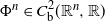 $\Phi^n \in C^2_{\mathrm{b}}(\mathbb{R}^n,\mathbb{R})$
and
$\Phi^n \in C^2_{\mathrm{b}}(\mathbb{R}^n,\mathbb{R})$
and $\bar{\varphi} = (\varphi_1, \ldots, \varphi_n)$
, where
$\bar{\varphi} = (\varphi_1, \ldots, \varphi_n)$
, where $\varphi_i = (\varphi_i^k)_{k\in \mathbb{K}} \in C^2_{\mathrm{b}}(\mathbb{K}\times\mathbb{R}^d,\mathbb{R})$
for each
$\varphi_i = (\varphi_i^k)_{k\in \mathbb{K}} \in C^2_{\mathrm{b}}(\mathbb{K}\times\mathbb{R}^d,\mathbb{R})$
for each $i =1, \ldots, n$
, we define
$i =1, \ldots, n$
, we define $\Phi^n_{\bar{\varphi}}\colon E^n \longrightarrow \mathbb{R}$
by
$\Phi^n_{\bar{\varphi}}\colon E^n \longrightarrow \mathbb{R}$
by $\Phi^n_{\bar{\varphi}}(e_1, \ldots, e_n) \,:\!=\,\Phi^n(\langle e_1,\varphi_1\rangle, \ldots, \langle e_n, \varphi_n \rangle)$
, as well as, for all
$\Phi^n_{\bar{\varphi}}(e_1, \ldots, e_n) \,:\!=\,\Phi^n(\langle e_1,\varphi_1\rangle, \ldots, \langle e_n, \varphi_n \rangle)$
, as well as, for all $t \in [0,T]$
,
$t \in [0,T]$
, $i=1,\ldots, n$
, and
$i=1,\ldots, n$
, and $\bar \omega = (\omega^1, \ldots, \omega^n) \in \bar \Omega_n$
with
$\bar \omega = (\omega^1, \ldots, \omega^n) \in \bar \Omega_n$
with $\omega^i_t = \sum_{k \in K^i_t} \delta_{(k,\mathrm{x}^{i,k}_t)}$
,
$\omega^i_t = \sum_{k \in K^i_t} \delta_{(k,\mathrm{x}^{i,k}_t)}$
,
 \begin{align*} \mathcal{H}^n_i\Phi^n_{\bar{\varphi}}(t,\bar\omega) & \,:\!=\, \frac{1}{2}\partial^2_{ii}\Phi^n_{\bar{\varphi}}(\bar\omega_t)\sum_{k\in K^i_t} \big|D\varphi^k_i\big(\mathrm{x}^{i,k}_t\big)\sigma\big(t,\mathrm{x}^{i,k}_{t\wedge\cdot},m^n_t\big)\big|^2 \\[2pt] & \quad + \partial_{i}\Phi^n_{\bar{\varphi}}(\bar\omega_t)\sum_{k\in K^i_t} \mathcal{L}\varphi^k_i\big(t,\mathrm{x}^{i,k}_{t\wedge \cdot},m^n_t\big) \\[2pt] & \quad + \sum_{k\in K^i_t}\gamma\big(t,\mathrm{x}^{i,k}_{t\wedge\cdot},m^n_t\big)\Bigg( \sum_{\ell\ge0}\Phi^n_{\bar{\varphi}}\Bigg(\omega^1_t,\ldots,\omega^i_{t-}-\delta_{(k,\mathrm{x}^{i,k}_{t-})} \\[2pt] & \qquad\qquad\qquad\qquad\qquad + \sum_{j=1}^{\ell}\delta_{(kj,\mathrm{x}^{i,k}_{t-})},\ldots,\omega^n_t\Bigg) p_{\ell}\big(t,\mathrm{x}^{i,k}_{t\wedge\cdot}, m^n_t\big) - \Phi^n_{\bar{\varphi}}(\bar\omega_{t-})\Bigg),\end{align*}
where $m^n_t \,:\!=\, (1/n)\sum_{j=1}^n\delta_{\omega^j_{t\wedge\cdot}}$
and
$m^n_t \,:\!=\, (1/n)\sum_{j=1}^n\delta_{\omega^j_{t\wedge\cdot}}$
and $\partial_{i}\Phi^n$
(resp.
$\partial_{i}\Phi^n$
(resp. $\partial^2_{ii}\Phi^n$
) respresents the first (resp. second) partial derivative of
$\partial^2_{ii}\Phi^n$
) respresents the first (resp. second) partial derivative of $\Phi^n$
with respect to the ith coordinate. Let us also define the process
$\Phi^n$
with respect to the ith coordinate. Let us also define the process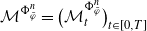 $\mathcal{M}^{\Phi^n_{\bar{\varphi}}} = \big(\mathcal{M}^{\Phi^n_{\bar{\varphi}}}_t\big)_{t \in [0,T]}$
on
$\mathcal{M}^{\Phi^n_{\bar{\varphi}}} = \big(\mathcal{M}^{\Phi^n_{\bar{\varphi}}}_t\big)_{t \in [0,T]}$
on $\bar \Omega_n$
by
$\bar \Omega_n$
by $\mathcal{M}^{\Phi^n_{\bar{\varphi}}}_t \,:\!=\, \Phi^n_{\bar{\varphi}}\big(Z^1_t,\ldots,Z^n_t\big) -\int_0^t\sum_{i=1}^n\mathcal{H}^n_i\Phi^n_{\bar{\varphi}}\big(s,Z^1_{s\wedge\cdot},\ldots,Z^n_{s\wedge\cdot}\big)\,{\mathrm{d}} s$
.
$\mathcal{M}^{\Phi^n_{\bar{\varphi}}}_t \,:\!=\, \Phi^n_{\bar{\varphi}}\big(Z^1_t,\ldots,Z^n_t\big) -\int_0^t\sum_{i=1}^n\mathcal{H}^n_i\Phi^n_{\bar{\varphi}}\big(s,Z^1_{s\wedge\cdot},\ldots,Z^n_{s\wedge\cdot}\big)\,{\mathrm{d}} s$
.
Definition 4. A solution to the martingale problem for n interacting branching diffusions with initial condition $m_0 \in \mathcal{P}(E)$
is a probability measure
$m_0 \in \mathcal{P}(E)$
is a probability measure $\bar{\mathbb{P}}^n$
on
$\bar{\mathbb{P}}^n$
on $\bar \Omega_n$
satisfying
$\bar \Omega_n$
satisfying
-
(i)
$\bar{\mathbb{P}}^n \circ \big(Z^1_0, \ldots, Z^n_0\big)^{-1} = m_0 \times \cdots \times m_0$
; -
(ii)
$\mathcal{M}^{\Phi^n_{\bar{\varphi}}}$
is a
$(\bar{\mathbb{P}}^n, \bar{\mathbb{F}}^n)$
-martingale for all
$\Phi^n \in C^2_{\mathrm{b}}(\mathbb{R}^n,\mathbb{R})$
and
$\bar{\varphi} = (\varphi_1,\ldots,\varphi_n)$
such that
$\varphi_i \in C^2_{\mathrm{b}}(\mathbb{K}\times\mathbb{R}^d,\mathbb{R})$
for each
$i =1,\ldots,n$
.



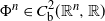



Proposition 1. Let Assumption 1 hold and $m_0\in\mathcal{P}_1(E)$
. Then the following assertions hold:
$m_0\in\mathcal{P}_1(E)$
. Then the following assertions hold:
-
(i) Let
$\alpha_n = (\Omega^n,\mathcal{F}^n,\mathbb{F}^n,\mathbb{P}^n,(Z^{i})_{i=1,\ldots,n}, (W^{i,k},Q^{i,k})_{k\in\mathbb{K},i=1,\ldots,n})$
be a weak solution in the sense of Definition 3. Then the probability
$\bar{\mathbb{P}}^n \,:\!=\, \mathbb{P}^n \circ (Z^{1}, \ldots, Z^{n})^{-1}$
solves the corresponding martingale problem for n interacting branching diffusions. -
(ii) Let
$\bar{\mathbb{P}}^n$
be a solution to the martingale problem for n interacting branching diffusions. Then there exist, in a possibly enlarged space, Brownian motions and Poisson random measures which, together with the canonical space
$\big(\bar\Omega_n,\bar{\mathcal{F}}^n_T,\bar{\mathbb{F}}^n,\bar{\mathbb{P}}^n\big)$
, give a weak solution in the sense of Definition 3. -
(iii) If we assume further that Assumption 3 holds, then there exists a solution to the martingale problem for n interacting branching diffusions in the sense of Definition 4.




Proof. The arguments are rather classical. Let us provide a sketch of the proof for completeness. First, to construct a solution to the martingale problem from a weak solution, it suffices to apply Itô’s formula as in [Reference Claisse4, Proposition 3.2]. Next, given a solution to the martingale problem $\bar{\mathbb{P}}^n$
, it is also classical to construct, in a possibly enlarged space, Brownian motions and Poisson random measures to represent the process by stochastic integrations; see, e.g., [Reference Kurtz23, Theorem 2.3]. This provides a weak solution. Finally, notice that the n-interacting-branching-diffusions solution to (9) is actually a standard branching diffusion process, in the sense that it does not exhibit nonlinearity in the sense of McKean. As a consequence, we can apply classical weak convergence techniques as in [Reference Stroock and Varadhan29, Chapter 6.1] to deduce existence of a weak solution provided that the coefficients are bounded continuous.
$\bar{\mathbb{P}}^n$
, it is also classical to construct, in a possibly enlarged space, Brownian motions and Poisson random measures to represent the process by stochastic integrations; see, e.g., [Reference Kurtz23, Theorem 2.3]. This provides a weak solution. Finally, notice that the n-interacting-branching-diffusions solution to (9) is actually a standard branching diffusion process, in the sense that it does not exhibit nonlinearity in the sense of McKean. As a consequence, we can apply classical weak convergence techniques as in [Reference Stroock and Varadhan29, Chapter 6.1] to deduce existence of a weak solution provided that the coefficients are bounded continuous.
4.1.2. Martingale problem for McKean–Vlasov branching diffusion
Let us now consider McKean–Vlasov branching diffusion in the sense of Definition 2. In this setting, we introduce two canonical spaces $\tilde \Omega \,:\!=\, \mathcal{D}_E$
and
$\tilde \Omega \,:\!=\, \mathcal{D}_E$
and $\bar\Omega \,:\!=\, \mathcal{D}_E\times\mathcal{P}(\mathcal{D}_E)$
. Let us denote by
$\bar\Omega \,:\!=\, \mathcal{D}_E\times\mathcal{P}(\mathcal{D}_E)$
. Let us denote by $\tilde Z$
the canonical process on
$\tilde Z$
the canonical process on $\tilde \Omega$
and by
$\tilde \Omega$
and by $\tilde{\mathbb{F}} = (\tilde{\mathcal{F}}_t)_{t \in [0,T]}$
,
$\tilde{\mathbb{F}} = (\tilde{\mathcal{F}}_t)_{t \in [0,T]}$
, $\tilde{\mathcal{F}}_t = \sigma(\tilde Z_s,\, s \le t)$
, the corresponding canonical filtration. Similarly, the canonical process on
$\tilde{\mathcal{F}}_t = \sigma(\tilde Z_s,\, s \le t)$
, the corresponding canonical filtration. Similarly, the canonical process on $\bar\Omega$
is denoted by
$\bar\Omega$
is denoted by $(\bar Z, \bar \mu)$
and the corresponding canonical filtration
$(\bar Z, \bar \mu)$
and the corresponding canonical filtration $\bar{\mathbb{F}} = (\bar{\mathcal{F}}_t)_{t \in [0,T]}$
is defined by
$\bar{\mathbb{F}} = (\bar{\mathcal{F}}_t)_{t \in [0,T]}$
is defined by $\bar{\mathcal{F}}_t \,:\!=\, \sigma(\bar Z_s, \bar \mu_s,\, s \le t)$
. Further, given
$\bar{\mathcal{F}}_t \,:\!=\, \sigma(\bar Z_s, \bar \mu_s,\, s \le t)$
. Further, given $\Phi\in C^2_{\mathrm{b}}(\mathbb{R},\mathbb{R})$
and
$\Phi\in C^2_{\mathrm{b}}(\mathbb{R},\mathbb{R})$
and $\varphi = (\varphi^k)_{k\in \mathbb{K}} \in C^2_{\mathrm{b}}(\mathbb{K}\times\mathbb{R}^d,\mathbb{R})$
, let us define
$\varphi = (\varphi^k)_{k\in \mathbb{K}} \in C^2_{\mathrm{b}}(\mathbb{K}\times\mathbb{R}^d,\mathbb{R})$
, let us define
 \begin{equation*} \Phi_{\varphi}(e) \,:\!=\, \Phi(\langle e,\varphi\rangle) = \Phi\Bigg(\sum_{k\in K}\varphi^k(x^k)\Bigg) \quad \text{for all}\ e\,:\!=\,\sum_{k\in K}\delta_{(k,x^k)}\in E,\end{equation*}
as well as, for $\tilde \omega \in \tilde \Omega$
with
$\tilde \omega \in \tilde \Omega$
with $\tilde \omega_t = \sum_{k \in K_t} \delta_{(k, \mathrm{x}^k_t)}$
and
$\tilde \omega_t = \sum_{k \in K_t} \delta_{(k, \mathrm{x}^k_t)}$
and $\tilde{m} \in \mathcal{P}(\tilde \Omega)$
,
$\tilde{m} \in \mathcal{P}(\tilde \Omega)$
,
 \begin{align*} \mathcal{H}\Phi_{\varphi}(t,\tilde\omega,\tilde{m}) & \,:\!=\, \frac{1}{2}\Phi_{\varphi}''(\tilde\omega_t)\sum_{k\in K_t} \big|D\varphi^k\big(\mathrm{x}^k_t\big)\sigma\big(t,\mathrm{x}^k_{t\wedge\cdot},\tilde{m}_t\big)\big|^2 \\[2pt] & \quad + \Phi_{\varphi}'(\tilde\omega_t)\sum_{k\in K_t}\mathcal{L}\varphi^k(t,\mathrm{x}^k_{t\wedge\cdot}, \tilde{m}_t) \\[2pt] & \quad + \sum_{k\in K_t}\gamma\big(t,\mathrm{x}^k_{t\wedge\cdot},\tilde{m}_t\big)\Bigg( \sum_{\ell\ge0}\Phi_{\varphi}\Bigg(\tilde\omega_{t-}-\delta_{(k,\mathrm{x}^k_{t-})} + \sum_{j=1}^{\ell}\delta_{(kj,\mathrm{x}^{k}_{t-})}\Bigg) \\[2pt] & \qquad\qquad\qquad\qquad\qquad \times p_{\ell}\big(t,\mathrm{x}^k_{t\wedge\cdot},\tilde{m}_t\big) - \Phi_{\varphi}(\tilde\omega_{t-})\Bigg).\end{align*}
Let us also define the process $\tilde{\mathcal{M}}^{\Phi_\varphi, \tilde{m}} = \big(\tilde{\mathcal{M}}^{\Phi_\varphi, \tilde{m}}_t\big)_{t \in [0,T]}$
on
$\tilde{\mathcal{M}}^{\Phi_\varphi, \tilde{m}} = \big(\tilde{\mathcal{M}}^{\Phi_\varphi, \tilde{m}}_t\big)_{t \in [0,T]}$
on $\tilde \Omega$
by
$\tilde \Omega$
by
 \begin{equation*} \tilde{\mathcal{M}}^{\Phi_\varphi, \tilde{m}}_t \,:\!=\, \Phi_{\varphi}(\tilde Z_t) - \int_0^t\mathcal{H}\Phi_{\varphi}\big(s,\tilde Z_{s\wedge\cdot},\tilde{m}_s\big)\,{\mathrm{d}} s.\end{equation*}
Definition 5. A solution to the martingale problem for McKean–Vlasov branching diffusion with initial condition $m_0 \in \mathcal{P}(E)$
is a probability measure
$m_0 \in \mathcal{P}(E)$
is a probability measure $\bar{\mathbb{P}}$
on the canonical space
$\bar{\mathbb{P}}$
on the canonical space $\bar \Omega$
such that
$\bar \Omega$
such that
-
(i)
$\bar{\mathbb{P}} \circ \bar Z_0^{-1} = m_0$
; -
(ii)
$\bar\mu_t = \mathcal{L}^{\bar{\mathbb{P}}}(\bar Z_{t\wedge\cdot}\mid\bar\mu_t)$
for all
$t\in[0,T]$
; -
(iii) for
$\bar{\mathbb{P}}$
-almost every
$\bar \omega \in \bar \Omega$
, the process
$\tilde{\mathcal{M}}^{\Phi_\varphi,\bar\mu(\bar\omega)}$
is a
$(\bar\mu(\bar\omega),\tilde{\mathbb{F}})$
-martingale for all
$\Phi\in C^2_{\mathrm{b}}(\mathbb{R},\mathbb{R})$
and
$\varphi = (\varphi^k)_{k\in \mathbb{K}} \in C^2_{\mathrm{b}}(\mathbb{K}\times\mathbb{R}^d,\mathbb{R})$
.





Proposition 2. Let Assumption 1 hold and $m_0 \in \mathcal{P}_1(E)$
. The following assertions hold:
$m_0 \in \mathcal{P}_1(E)$
. The following assertions hold:
-
(i) Given a weak solution
$\alpha = \big(\Omega,\mathcal{F},\mathbb{F},\mathbb{P},Z,\mu, (W^k,Q^k)_{k\in\mathbb{K}}\big)$
to the McKean–Vlasov branching diffusion SDE in the sense of Definition 2, the probability
$\bar{\mathbb{P}} \,:\!=\, \mathbb{P} \circ (Z, \mu)^{-1}$
provides a solution to the corresponding martingale problem in the sense of Definition 5. -
(ii) Given a solution
$\bar{\mathbb{P}}$
to the martingale problem for McKean–Vlasov branching diffusion in the sense of Definition 5, there exist, in a possibly enlarged space, Brownian motions and Poisson random measures which, together with the canonical space
$(\bar\Omega,\bar{\mathcal{F}}_T,\bar{\mathbb{F}},\bar{\mathbb{P}})$
, give a weak solution in the sense of Definition 2.




Proof. The proof is similar to [Reference Djete, Possama and Tan8, Lemma 4.4]. Let $\alpha$
be a weak solution defined as above, and
$\alpha$
be a weak solution defined as above, and $\bar{\mathbb{P}}\,:\!=\,\mathbb{P}\circ(Z,\mu)^{-1}$
. We aim to prove that
$\bar{\mathbb{P}}\,:\!=\,\mathbb{P}\circ(Z,\mu)^{-1}$
. We aim to prove that $\bar{\mathbb{P}}$
solves the martingale problem for McKean–Vlasov branching diffusion. It is straightforward to check that
$\bar{\mathbb{P}}$
solves the martingale problem for McKean–Vlasov branching diffusion. It is straightforward to check that $\bar{\mathbb{P}} \circ \bar Z^{-1}_0 = m_0$
and
$\bar{\mathbb{P}} \circ \bar Z^{-1}_0 = m_0$
and $\bar\mu_t = \mathcal{L}^{\bar{\mathbb{P}}}(\bar Z_{t\wedge\cdot}\mid\bar\mu_t)$
. Then, given
$\bar\mu_t = \mathcal{L}^{\bar{\mathbb{P}}}(\bar Z_{t\wedge\cdot}\mid\bar\mu_t)$
. Then, given $h\colon\mathcal{D}_E\to\mathbb{R}$
and
$h\colon\mathcal{D}_E\to\mathbb{R}$
and $g\colon\mathcal{P}(\mathcal{D}_E)\to\mathbb{R}$
arbitrary bounded measurable maps, we observe that, for any
$g\colon\mathcal{P}(\mathcal{D}_E)\to\mathbb{R}$
arbitrary bounded measurable maps, we observe that, for any $0\le s\le t\le T$
,
$0\le s\le t\le T$
,
 \begin{align*} \mathbb{E}^{\mathbb{P}}\big[h(Z_{s\wedge\cdot})g(\mu)\big(\tilde{\mathcal{M}}^{\Phi_\varphi,\mu}_t - \tilde{\mathcal{M}}^{\Phi_\varphi,\mu}_s\big)(Z)\big] & = \mathbb{E}^{\bar{\mathbb{P}}}\big[h(\bar Z_{s\wedge\cdot})g(\bar\mu) \big(\tilde{\mathcal{M}}^{\Phi_\varphi,\bar\mu}_t - \tilde{\mathcal{M}}^{\Phi_\varphi,\bar\mu}_s\big)(\bar Z)\big] \\[3pt] & = \mathbb{E}^{\bar{\mathbb{P}}}\big[\mathbb{E}^{\bar{\mathbb{P}}}\big[ h(\bar Z_{s\wedge\cdot})\big(\tilde{\mathcal{M}}^{\Phi_\varphi,\bar\mu}_t - \tilde{\mathcal{M}}^{\Phi_\varphi,\bar\mu}_s\big)(\bar Z)\mid\bar\mu\big]g(\bar\mu)\big] \\[3pt] & = \mathbb{E}^{\bar{\mathbb{P}}}\big[\mathbb{E}^{\bar\mu}\big[ h(\tilde Z_{s\wedge\cdot})\big(\tilde{\mathcal{M}}^{\Phi_\varphi,\bar\mu}_t - \tilde{\mathcal{M}}^{\Phi_\varphi,\bar\mu}_s\big)\big]g(\bar\mu)\big], \end{align*}
where the last equality comes from $\bar\mu = \mathcal{L}^{\bar{\mathbb{P}}}(\bar Z\mid\bar\mu)$
. In addition, it follows easily from Itô’s formula that
$\bar\mu = \mathcal{L}^{\bar{\mathbb{P}}}(\bar Z\mid\bar\mu)$
. In addition, it follows easily from Itô’s formula that $\mathbb{E}^{\mathbb{P}}\big[h(Z_{s\wedge\cdot})g(\mu)\big(\tilde{\mathcal{M}}^{\Phi_\varphi, \mu}_t - \tilde{\mathcal{M}}^{\Phi_\varphi,\mu}_s\big)(Z)\big]=0$
. By the arbitrariness of g, we deduce that
$\mathbb{E}^{\mathbb{P}}\big[h(Z_{s\wedge\cdot})g(\mu)\big(\tilde{\mathcal{M}}^{\Phi_\varphi, \mu}_t - \tilde{\mathcal{M}}^{\Phi_\varphi,\mu}_s\big)(Z)\big]=0$
. By the arbitrariness of g, we deduce that $\mathbb{E}^{\bar\mu(\bar\omega)}\big[h(\tilde Z_{s\wedge\cdot})\big(\tilde{\mathcal{M}}^{\Phi_\varphi,\bar\mu(\bar\omega)}_t - \tilde{\mathcal{M}}^{\Phi_\varphi,\bar\mu(\bar\omega)}_s\big)\big] = 0$
,
$\mathbb{E}^{\bar\mu(\bar\omega)}\big[h(\tilde Z_{s\wedge\cdot})\big(\tilde{\mathcal{M}}^{\Phi_\varphi,\bar\mu(\bar\omega)}_t - \tilde{\mathcal{M}}^{\Phi_\varphi,\bar\mu(\bar\omega)}_s\big)\big] = 0$
, $\bar{\mathbb{P}}$
-almost surely (a.s.). We conclude, by the arbitrariness of h, that
$\bar{\mathbb{P}}$
-almost surely (a.s.). We conclude, by the arbitrariness of h, that $\tilde{\mathcal{M}}^{\Phi_\varphi,\mu(\bar\omega)}$
is a
$\tilde{\mathcal{M}}^{\Phi_\varphi,\mu(\bar\omega)}$
is a $(\bar\mu(\bar\omega),\tilde{\mathbb{F}})$
-martingale for
$(\bar\mu(\bar\omega),\tilde{\mathbb{F}})$
-martingale for $\bar{\mathbb{P}}$
-almost every
$\bar{\mathbb{P}}$
-almost every $\bar\omega\in\bar\Omega$
.
$\bar\omega\in\bar\Omega$
.
Conversely, by similar arguments to Proposition 1, if we have a solution to the martingale problem, we can construct, in a possibly enlarged space, Brownian motions and Poisson random measures to obtain a weak solution to the McKean–Vlasov branching diffusion SDE.
4.2. Tightness of n interacting branching diffusions
Let $(\alpha_n)_{n \ge 1}$
be a sequence of n interacting branching diffusions in the sense of Definition 3, i.e.
$(\alpha_n)_{n \ge 1}$
be a sequence of n interacting branching diffusions in the sense of Definition 3, i.e. $\alpha_n = \big(\Omega^n, \mathcal{F}^n, \mathbb{F}^n, \mathbb{P}^n, (Z^{i})_{i = 1, \ldots, n}, (W^{i,k}, Q^{i,k})_{k\in\mathbb{K}, i = 1, \ldots, n} \big)$
is a weak solution to the SDE (9) with initial condition
$\alpha_n = \big(\Omega^n, \mathcal{F}^n, \mathbb{F}^n, \mathbb{P}^n, (Z^{i})_{i = 1, \ldots, n}, (W^{i,k}, Q^{i,k})_{k\in\mathbb{K}, i = 1, \ldots, n} \big)$
is a weak solution to the SDE (9) with initial condition $m_0 \in \mathcal{P}(E)$
. We consider the corresponding sequence of probability measures
$m_0 \in \mathcal{P}(E)$
. We consider the corresponding sequence of probability measures $(\bar{\mathbb{P}}^n)_{n \ge 1}$
on the canonical space
$(\bar{\mathbb{P}}^n)_{n \ge 1}$
on the canonical space $\bar \Omega = \mathcal{D}_E \times \mathcal{P}(\mathcal{D}_E)$
, given by
$\bar \Omega = \mathcal{D}_E \times \mathcal{P}(\mathcal{D}_E)$
, given by
 \begin{equation*} \bar{\mathbb{P}}^n \,:\!=\, \frac1n\sum_{i=1}^n\mathbb{P}^n \circ (Z^{i},\mu^n)^{-1}, \quad \text{where}\ \mu^n \,:\!=\, \frac1n \sum_{i=1}^n \delta_{Z^{i}}.\end{equation*}
The goal of this section is to establish the tightness of this sequence. To this end, we first provide an estimate for the number of particles in each of the n branching diffusion processes.
Lemma 4. Let Assumption 1 hold, and $m_0\in\mathcal{P}_1(E)$
. Then
$m_0\in\mathcal{P}_1(E)$
. Then $\sup\nolimits_{n\ge 1}\mathbb{E}^{\mathbb{P}^n}[\sup\nolimits_{0\leq t\leq T}\{\#K^{1}_t\}] < \infty$
.
$\sup\nolimits_{n\ge 1}\mathbb{E}^{\mathbb{P}^n}[\sup\nolimits_{0\leq t\leq T}\{\#K^{1}_t\}] < \infty$
.
Proof. By similar arguments to Lemma 1, we have $\mathbb{E}^{\mathbb{P}^n}[\sup\nolimits_{0\leq t\leq T}\{\#K^{1}_t\}] \leq \mathbb{E}^{\mathbb{P}^n}[\#K^{1}_0]{\mathrm{e}}^{\bar\gamma MT}$
. The conclusion then follows from the fact that
$\mathbb{E}^{\mathbb{P}^n}[\sup\nolimits_{0\leq t\leq T}\{\#K^{1}_t\}] \leq \mathbb{E}^{\mathbb{P}^n}[\#K^{1}_0]{\mathrm{e}}^{\bar\gamma MT}$
. The conclusion then follows from the fact that $\mathbb{E}^{\mathbb{P}^n}[\#K^{1}_0] = \int_E\langle e,\mathbf{1}\rangle\,m_0({\mathrm{d}} e) < +\infty$
.
$\mathbb{E}^{\mathbb{P}^n}[\#K^{1}_0] = \int_E\langle e,\mathbf{1}\rangle\,m_0({\mathrm{d}} e) < +\infty$
.
Proposition 3. Let Assumptions 1 and 3 hold, and $m_0\in\mathcal{P}_1(E)$
. Then the sequence
$m_0\in\mathcal{P}_1(E)$
. Then the sequence $(\bar{\mathbb{P}}^n)_{n \ge 1}$
is tight in
$(\bar{\mathbb{P}}^n)_{n \ge 1}$
is tight in $\mathcal{P}(\bar \Omega)$
.
$\mathcal{P}(\bar \Omega)$
.
Proof. In view of [Reference Sznitman30, Proposition 2.2(ii)], the tightness of $(\bar{\mathbb{P}}^n)_{n \ge 1}$
is equivalent to the tightness of
$(\bar{\mathbb{P}}^n)_{n \ge 1}$
is equivalent to the tightness of $(\mathbb{E}^{\mathbb{P}^n}[\mu^n])_{n \ge 1}$
, where, for all
$(\mathbb{E}^{\mathbb{P}^n}[\mu^n])_{n \ge 1}$
, where, for all $\varphi\colon \mathcal{D}_E\to \mathbb{R}$
measurable bounded,
$\varphi\colon \mathcal{D}_E\to \mathbb{R}$
measurable bounded,
 \begin{align*} \big\langle\mathbb{E}^{\mathbb{P}^n}[\mu^n],\varphi\big\rangle \,:\!=\, \mathbb{E}^{\mathbb{P}^n}[\langle\mu^n,\varphi\rangle] = \frac1n\sum_{i=1}^n\mathbb{E}^{\mathbb{P}^n}[\varphi(Z^{i})] = \mathbb{E}^{\mathbb{P}^n}[\varphi(Z^{1})]. \end{align*}
Therefore, it suffices to prove the tightness of $(\mathbb{P}^n \circ (Z^{1})^{-1})_{n \ge 1}$
in
$(\mathbb{P}^n \circ (Z^{1})^{-1})_{n \ge 1}$
in $\mathcal{P}(\mathcal{D}_E)$
.
$\mathcal{P}(\mathcal{D}_E)$
.
Recall that the process $Z^{1}_t=\sum_{k\in K^{1}_t} \delta_{(k,X^{1,k}_t)}$
takes values in E equipped with the distance
$Z^{1}_t=\sum_{k\in K^{1}_t} \delta_{(k,X^{1,k}_t)}$
takes values in E equipped with the distance $d_E$
defined in (1), and that we consider the associated Skorokhod topology on
$d_E$
defined in (1), and that we consider the associated Skorokhod topology on $\mathcal{D}_E$
. We aim to apply Aldous’ criterion of tightness (see, e.g., [Reference Billingsley2, Theorem 16.10]). Namely, we have to prove the following assertions:
$\mathcal{D}_E$
. We aim to apply Aldous’ criterion of tightness (see, e.g., [Reference Billingsley2, Theorem 16.10]). Namely, we have to prove the following assertions:
-
• For all
$\varepsilon>0$
, there exist
$n_0\in\mathbb{N}$
and
$K>0$
such that
(22)where
\begin{equation} \text{for all}\ n \geq n_0,\ \mathbb{P}^n\big(\!\sup\nolimits_{0\leq t\leq T}d_E(Z^{1}_t,e_0) \geq K\big) \leq \varepsilon, \end{equation}
$e_0$
is the null measure on
$\mathbb{K}\times\mathbb{R} ^d$
.
-
• For all
$\varepsilon>0$
,
(23)where
\begin{equation} \lim_{\delta\rightarrow0}\sup\nolimits_{{n\ge 1}}\sup\nolimits_{\tau\in\mathcal{T}^n} \mathbb{P}^n\big(d_E(Z^{1}_\tau, Z^{1}_{(\tau+\delta)\wedge T})>\varepsilon\big) = 0, \end{equation}
$\mathcal{T}^n$
is the collection of all [0, T]-valued stopping times on
$(\Omega^n, \mathcal{F}^n, \mathbb{F}^n)$
.


The first condition (22) follows directly from Lemma 4 and Markov’s inequality by observing that $d_E(Z^{1}_t,e_0)=\# K^{1}_t$
. Regarding the second condition (23), given
$d_E(Z^{1}_t,e_0)=\# K^{1}_t$
. Regarding the second condition (23), given $\delta >0$
,
$\delta >0$
, $n\ge 1$
, and
$n\ge 1$
, and $\tau\in\mathcal{T}^n$
, we write
$\tau\in\mathcal{T}^n$
, we write $\tau'\,:\!=\, (\tau + \delta)\wedge T$
and observe that
$\tau'\,:\!=\, (\tau + \delta)\wedge T$
and observe that
 \begin{align} & d_E(Z^{1}_\tau,Z^{1}_{\tau'}) \nonumber \\[2pt] & \quad \leq \sum_{k\in K^{1}_\tau}\big|X^{1,k}_{\tau'} - X^{1,k}_{\tau}\big| \wedge 1 \nonumber \\[2pt] & \qquad + \int_{(\tau,\tau']\times[0,\bar \gamma] \times [0,1]}\sum_{k\in K^{1}_{s-}}\sum_{\ell \geq0} (\ell +1)\mathbf{1}_{I_{\ell} (s,X^{1,k}_{s\wedge\cdot},\mu^n_{s-})\times[0,\gamma(s,X^{1,k}_{s\wedge\cdot},\mu^n_{s-})]}(z)\, Q^{1,k}({\mathrm{d}} s,{\mathrm{d}} z). \end{align}
The second term corresponds to the number of particles in $\cup_{\tau\le s\le \tau'} K^{1}_s \triangle K^{1}_{\tau'}$
as it counts the total number of particles born or dead between
$\cup_{\tau\le s\le \tau'} K^{1}_s \triangle K^{1}_{\tau'}$
as it counts the total number of particles born or dead between $\tau$
and
$\tau$
and $\tau'$
. As for the first term, it provides an upper bound for the contribution of particles in the common set
$\tau'$
. As for the first term, it provides an upper bound for the contribution of particles in the common set $K^{1}_\tau \cap K^{1}_{\tau'}$
to the distance
$K^{1}_\tau \cap K^{1}_{\tau'}$
to the distance $d_E$
by neglecting the potential death of particles. Here there is a slight abuse of notation as we need to extend the path of particles who have died before time
$d_E$
by neglecting the potential death of particles. Here there is a slight abuse of notation as we need to extend the path of particles who have died before time $\tau'$
as solution to SDE (5).
$\tau'$
as solution to SDE (5).
We start by dealing with the first term on the right-hand side of (24). Notice that
 \begin{equation*} \mathbb{E}^{\mathbb{P}^n}\Bigg[\sum_{k\in K^{1}_\tau}\!\big|X^{1,k}_{\tau'}-X^{1,k}_\tau\big|\!\Bigg] \leq \mathbb{E}^{\mathbb{P}^n}\Bigg[\sum_{k\in K^{1}_\tau} \! \bigg(\int_\tau^{\tau'}\!\!\big|b\big(s,X^{1,k}_{s\wedge\cdot},\mu^n_s\big)\big|\,{\mathrm{d}} s + \bigg|\int_\tau^{\tau'}\!\!\sigma\big(s,X^{1,k}_{s\wedge\cdot},\mu^n_s\big)\,{\mathrm{d}} W^{1,k}_s\big|\!\bigg)\!\Bigg]. \end{equation*}
On the one hand, we have $\mathbb{E}^{\mathbb{P}^n}\big[\sum_{k\in K^{1}_\tau}\int_\tau^{\tau'}\big|b(s,X^{1,k}_{s\wedge\cdot},\mu^n_s)\big|\,{\mathrm{d}} s\big] \leq \|b\|_\infty\delta\,\mathbb{E}^{\mathbb{P}^n}[\#K^{1}_\tau]$
. On the other hand, it follows from the Burkholder–Davis–Gundy inequality that
$\mathbb{E}^{\mathbb{P}^n}\big[\sum_{k\in K^{1}_\tau}\int_\tau^{\tau'}\big|b(s,X^{1,k}_{s\wedge\cdot},\mu^n_s)\big|\,{\mathrm{d}} s\big] \leq \|b\|_\infty\delta\,\mathbb{E}^{\mathbb{P}^n}[\#K^{1}_\tau]$
. On the other hand, it follows from the Burkholder–Davis–Gundy inequality that
 \begin{align*} \mathbb{E}^{\mathbb{P}^n}\Bigg[\sum_{k\in K^{1}_\tau}\bigg|\int_\tau^{\tau'}\sigma \big(s,X^{1,k}_{s\wedge\cdot},\mu^n_s\big)\,{\mathrm{d}} W^{1,k}_s\bigg|\Bigg] & = \sum_{k\in\mathbb{K}}\mathbb{E}^{\mathbb{P}^n}\bigg[\bigg|\int_\tau^{\tau'}\mathbf{1}_{k\in K^{1}_\tau} \sigma\big(s,X^{1,k}_{s\wedge\cdot},\mu^n_s\big)\,{\mathrm{d}} W^{1,k}_s\bigg|\bigg] \\[2pt] & \leq \sum_{k\in\mathbb{K}}C_1\mathbb{E}^{\mathbb{P}^n}\bigg[\bigg(\int_\tau^{\tau'} \mathbf{1}_{k\in K^{1}_\tau}\sigma\big(s,X^{1,k}_{s\wedge\cdot},\mu^n_s\big)^2\,{\mathrm{d}} s\bigg)^{1/2}\bigg] \\[2pt] & \leq C_1\|\sigma\|_\infty\sqrt{\delta}\,\mathbb{E}^{\mathbb{P}^n}[\#K^{1}_\tau]. \end{align*}
Combining both the above estimates, we deduce that
 \begin{align*} \mathbb{E}^{\mathbb{P}^n}\Bigg[\sum_{k\in K^{1}_\tau}\big|X^{1,k}_{\tau'}-X^{1,k}_\tau\big|\Bigg] \leq C(\delta+\sqrt{\delta})\mathbb{E}^{\mathbb{P}^n}[\!\sup\nolimits_{0\leq t \leq T}\# K^{1}_t]. \end{align*}
As for the second term on the right-hand side of (24), direct computation yields
 \begin{align*} & \mathbb{E}^{\mathbb{P}^n}\Bigg[\int_{(\tau,\tau']\times[0,\bar \gamma] \times [0,1]}\sum_{k\in K^{1}_{s-}}\sum_{\ell\geq0} (\ell+1)\mathbf{1}_{I_\ell(s,X^{1,k}_{s\wedge\cdot},\mu^n_{s-})\times[0,\gamma(s,X^{1,k}_{s\wedge\cdot},\mu^n_{s-})]}(z)\, Q^{1,k}({\mathrm{d}} s,{\mathrm{d}} z)\Bigg] \\[2pt] & \qquad\qquad = \mathbb{E}^{\mathbb{P}^n}\Bigg[\int_\tau^{\tau'}\sum_{k\in K^{1}_s} \gamma\big(s,X^{1,k}_{s\wedge\cdot},\mu^n_s\big)\sum_{\ell\geq0}(\ell+1) p_\ell\big(s,X^{1,k}_{s\wedge\cdot},\mu^n_s\big)\,{\mathrm{d}} s\Bigg] \\[2pt] & \qquad\qquad \leq \bar\gamma(M+1)\delta\,\mathbb{E}^{\mathbb{P}^n}[\sup\nolimits_{0\leq t\leq T}\# K^{1}_t]. \end{align*}
It follows that $\mathbb{E}^{\mathbb{P}^n}\big[d_E\big(Z^{1}_\tau,Z^{1}_{(\tau+\delta)\wedge T}\big)\big] \leq C(\delta + \sqrt{\delta})\mathbb{E}^{\mathbb{P}^n}[\sup\nolimits_{0\leq t\leq T}\#K^{1}_t]$
. In light of Lemma 4, we deduce that the second condition (23) holds by Markov’s inequality.
$\mathbb{E}^{\mathbb{P}^n}\big[d_E\big(Z^{1}_\tau,Z^{1}_{(\tau+\delta)\wedge T}\big)\big] \leq C(\delta + \sqrt{\delta})\mathbb{E}^{\mathbb{P}^n}[\sup\nolimits_{0\leq t\leq T}\#K^{1}_t]$
. In light of Lemma 4, we deduce that the second condition (23) holds by Markov’s inequality.
4.3. Proof of Theorem 3
Proof of Theorem 3. Recall that the tightness of $(\mathbb{P}^n \circ (\mu^n)^{-1})_{n \ge 1}$
was established in Proposition 3. More precisely, it was proved that the sequence
$(\mathbb{P}^n \circ (\mu^n)^{-1})_{n \ge 1}$
was established in Proposition 3. More precisely, it was proved that the sequence $\bar{\mathbb{P}}^n \,:\!=\, (1/n) \sum_{i=1}^n \mathbb{P}^n \circ (Z^{i}, \mu^n)^{-1}$
is tight in
$\bar{\mathbb{P}}^n \,:\!=\, (1/n) \sum_{i=1}^n \mathbb{P}^n \circ (Z^{i}, \mu^n)^{-1}$
is tight in $\mathcal{P}(\bar \Omega)$
. Let us consider a subsequence, still denoted by
$\mathcal{P}(\bar \Omega)$
. Let us consider a subsequence, still denoted by $(\bar{\mathbb{P}}^{n})_{n \ge 1}$
, converging weakly to
$(\bar{\mathbb{P}}^{n})_{n \ge 1}$
, converging weakly to $\bar{\mathbb{P}}$
. We aim to prove that
$\bar{\mathbb{P}}$
. We aim to prove that $\bar{\mathbb{P}}$
is a solution to the martingale problem for McKean–Vlasov branching diffusion in the sense of Definition 5. The conclusion then follows from Proposition 2.
$\bar{\mathbb{P}}$
is a solution to the martingale problem for McKean–Vlasov branching diffusion in the sense of Definition 5. The conclusion then follows from Proposition 2.
First, it is easy to check that $\bar{\mathbb{P}} \circ \bar Z_0^{-1} = m_0$
. Indeed, we have
$\bar{\mathbb{P}} \circ \bar Z_0^{-1} = m_0$
. Indeed, we have $\mathbb{P}^n \circ (Z^{i}_0)^{-1} = m_0$
for each
$\mathbb{P}^n \circ (Z^{i}_0)^{-1} = m_0$
for each $i = 1, \ldots, n$
, and so
$i = 1, \ldots, n$
, and so $\bar{\mathbb{P}}^n \circ \bar Z_0^{-1} = m_0$
. Then we can pass to the limit as
$\bar{\mathbb{P}}^n \circ \bar Z_0^{-1} = m_0$
. Then we can pass to the limit as $\bar Z_0$
is continuous for the Skorokhod topology.
$\bar Z_0$
is continuous for the Skorokhod topology.
Next, by the definition of $\bar{\mathbb{P}}^{n}$
, it is easy to see that
$\bar{\mathbb{P}}^{n}$
, it is easy to see that $\mathcal{L}^{\bar{\mathbb{P}}^{n}}(\bar Z_{t\wedge\cdot} \mid \bar\mu_t) = \bar\mu_t$
,
$\mathcal{L}^{\bar{\mathbb{P}}^{n}}(\bar Z_{t\wedge\cdot} \mid \bar\mu_t) = \bar\mu_t$
, $\bar{\mathbb{P}}^{n}$
-a.s. for all
$\bar{\mathbb{P}}^{n}$
-a.s. for all $t \in[0,T]$
. Indeed, for all
$t \in[0,T]$
. Indeed, for all $\phi \in C_{\mathrm{b}}( \mathcal{P}(\tilde \Omega), \mathbb{R})$
and
$\phi \in C_{\mathrm{b}}( \mathcal{P}(\tilde \Omega), \mathbb{R})$
and $\psi \in C_{\mathrm{b}}(\mathcal{D}_E, \mathbb{R})$
,
$\psi \in C_{\mathrm{b}}(\mathcal{D}_E, \mathbb{R})$
,
 \begin{align*} \mathbb{E}^{\bar{\mathbb{P}}^{n}}[\psi(\bar Z_{t\wedge \cdot})\phi(\bar\mu_t)] = \frac{1}{n}\sum_{i=1}^{n}\mathbb{E}^{\mathbb{P}^{n}}[\psi(Z^{i}_{t\wedge\cdot})\phi(\mu^{n}_t)] = \mathbb{E}^{\bar{\mathbb{P}}^{n}}[\langle\bar\mu_t, \psi\rangle\phi(\bar\mu_t)]. \end{align*}
It follows by passing to the limit that $\mathbb{E}^{\bar{\mathbb{P}}}[\psi(\bar Z_{t\wedge\cdot})\phi(\bar\mu_t)] = \mathbb{E}^{\bar{\mathbb{P}}}[\langle\bar\mu_t, \psi\rangle\phi(\bar\mu_t)]$
. We conclude that
$\mathbb{E}^{\bar{\mathbb{P}}}[\psi(\bar Z_{t\wedge\cdot})\phi(\bar\mu_t)] = \mathbb{E}^{\bar{\mathbb{P}}}[\langle\bar\mu_t, \psi\rangle\phi(\bar\mu_t)]$
. We conclude that $\mathcal{L}^{\bar{\mathbb{P}}}(\bar Z_{t\wedge\cdot} \mid \bar\mu_t) = \bar\mu_t$
,
$\mathcal{L}^{\bar{\mathbb{P}}}(\bar Z_{t\wedge\cdot} \mid \bar\mu_t) = \bar\mu_t$
, $\bar{\mathbb{P}}$
-almost everywhere for all
$\bar{\mathbb{P}}$
-almost everywhere for all $t \in [0,T]$
.
$t \in [0,T]$
.
It remains to prove that $\tilde{\mathcal{M}}^{\Phi_\varphi, \bar \mu(\bar \omega)}$
is a
$\tilde{\mathcal{M}}^{\Phi_\varphi, \bar \mu(\bar \omega)}$
is a $(\bar \mu(\bar \omega), \tilde{\mathbb{F}})$
-martingale for
$(\bar \mu(\bar \omega), \tilde{\mathbb{F}})$
-martingale for $\bar{\mathbb{P}}$
-almost every (a.e.)
$\bar{\mathbb{P}}$
-almost every (a.e.) $\bar \omega \in \bar \Omega$
. Equivalently, we aim to show that, for all
$\bar \omega \in \bar \Omega$
. Equivalently, we aim to show that, for all $0\le s\le t \le T$
and
$0\le s\le t \le T$
and $h\colon\tilde \Omega \to \mathbb{R}$
bounded continuous and
$h\colon\tilde \Omega \to \mathbb{R}$
bounded continuous and $\tilde{\mathcal{F}}_s$
–measurable,
$\tilde{\mathcal{F}}_s$
–measurable, $\mathbb{E}^{\bar{\mathbb{P}}}\big[\big\langle\bar\mu, \big(\tilde{\mathcal{M}}^{\Phi_\varphi,\bar\mu}_t-\tilde{\mathcal{M}}^{\Phi_\varphi,\bar\mu}_s\big)h\big\rangle^2\big] = 0$
. We start by observing that
$\mathbb{E}^{\bar{\mathbb{P}}}\big[\big\langle\bar\mu, \big(\tilde{\mathcal{M}}^{\Phi_\varphi,\bar\mu}_t-\tilde{\mathcal{M}}^{\Phi_\varphi,\bar\mu}_s\big)h\big\rangle^2\big] = 0$
. We start by observing that $\tilde{\mathcal{M}}^{\Phi_\varphi, \mu^n}_t(Z^{i})$
is a martingale under
$\tilde{\mathcal{M}}^{\Phi_\varphi, \mu^n}_t(Z^{i})$
is a martingale under $\mathbb{P}^n$
with representation
$\mathbb{P}^n$
with representation
 \begin{align*} \tilde{\mathcal{M}}^{\Phi_\varphi, \mu^n}_t(Z^{i}) & = \Phi_{\varphi}(Z^{i}_0) + \int_0^t\Phi_{\varphi}'(Z^{i}_s)\sum_{k\in K^{i}_s}D\varphi^k(X^{i, k}_s) \sigma\big(s,X^{i, k}_{s\wedge\cdot},\mu^n_s\big)\,{\mathrm{d}} W^{i,k}_s \\[2pt] & \quad + \int_{(0,t]\times[0,\bar \gamma] \times [0,1]}\sum_{k\in K^{i}_{s-}} G^{i,k}_s(z)\,\bar{Q}^{i,k}({\mathrm{d}} s,{\mathrm{d}} z), \end{align*}
where $\bar{Q}^{i,k}({\mathrm{d}} s,{\mathrm{d}} z)\,:\!=\,Q^{i,k}({\mathrm{d}} s,{\mathrm{d}} z) - {\mathrm{d}} s\,{\mathrm{d}} z$
is the compensated Poisson random measure, and
$\bar{Q}^{i,k}({\mathrm{d}} s,{\mathrm{d}} z)\,:\!=\,Q^{i,k}({\mathrm{d}} s,{\mathrm{d}} z) - {\mathrm{d}} s\,{\mathrm{d}} z$
is the compensated Poisson random measure, and
 \begin{equation*} G^{i,k}_s(z) \,:\!=\, \sum_{\ell\geq0}\Bigg(\Phi_{\varphi}\Bigg(Z^{i}_{s-}+\sum_{j=1}^{\ell}\delta_{(kj,X^{i, k}_s)}\Bigg) - \Phi_{\varphi}(Z^{i}_{s-})\Bigg) \mathbf{1}_{I_\ell(s,X^{i,k}_{s\wedge\cdot},\mu^n_{s-})\times[0,\gamma(s,X^{i,k}_{s\wedge\cdot},\mu^n_{s-})]}(z). \end{equation*}
Since $(W^{i,k},Q^{i,k})_{k\in\mathbb{K}, i=1\ldots,n}$
are independent Brownian motions and Poisson random measures, the martingales
$(W^{i,k},Q^{i,k})_{k\in\mathbb{K}, i=1\ldots,n}$
are independent Brownian motions and Poisson random measures, the martingales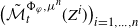 $\big(\tilde{\mathcal{M}}^{\Phi_\varphi, \mu^n}_t(Z^{i})\big)_{i=1,\ldots,n}$
are orthogonal under
$\big(\tilde{\mathcal{M}}^{\Phi_\varphi, \mu^n}_t(Z^{i})\big)_{i=1,\ldots,n}$
are orthogonal under $\mathbb{P}^n$
. It follows that
$\mathbb{P}^n$
. It follows that
 \begin{align*} \mathbb{E}^{\bar{\mathbb{P}}^n}\big[\big\langle\bar\mu,\big(\tilde{\mathcal{M}}^{\Phi_\varphi,\bar\mu}_t - \tilde{\mathcal{M}}^{\Phi_\varphi,\bar\mu}_s\big)h\big\rangle^2\big] & = \mathbb{E}^{\mathbb{P}^n}\Bigg[\Bigg(\frac{1}{n}\sum_{i=1}^n h(Z^{i}) \big(\tilde{\mathcal{M}}^{\Phi_\varphi,\mu^n}_t(Z^{i}) - \tilde{\mathcal{M}}^{\Phi_\varphi,\mu^n}_s(Z^{i})\big)\Bigg)^2\Bigg] \\[3pt] & = \frac{1}{n^2}\sum_{i=1}^n\mathbb{E}^{\mathbb{P}^n}\big[h(Z^{i})^2 \big(\tilde{\mathcal{M}}^{\Phi_\varphi,\mu^n}_t(Z^{i})-\tilde{\mathcal{M}}^{\Phi_\varphi,\mu^n}_s(Z^{i})\big)^2\big] \\[3pt] & = \frac{1}{n}\mathbb{E}^{\mathbb{P}^n}\big[h(Z^{1})^2 \big(\tilde{\mathcal{M}}^{\Phi_\varphi,\mu^n}_t(Z^{1})-\tilde{\mathcal{M}}^{\Phi_\varphi,\mu^n}_s(Z^{1})\big)^2\big]. \end{align*}
In addition, the increment $\tilde{\mathcal{M}}^{\Phi_\varphi, \mu^n}_t(Z^{1}) - \tilde{\mathcal{M}}^{\Phi_\varphi, \mu^n}_s(Z^{1})$
admits the following quadratic variation:
$\tilde{\mathcal{M}}^{\Phi_\varphi, \mu^n}_t(Z^{1}) - \tilde{\mathcal{M}}^{\Phi_\varphi, \mu^n}_s(Z^{1})$
admits the following quadratic variation:
 \begin{equation*} \int_s^t\Phi_{\varphi}'(Z^{1}_r)^2\sum_{k\in K^{1}_r} \big|D\varphi^k(X^{1,k}_r)\sigma(r,X^{1,k}_{r\wedge\cdot},\mu^n_r)\big|^2\,{\mathrm{d}} r + \int_s^t\int_{[0,\bar\gamma]\times[0,1]}\sum_{k\in K^{1}_r}G^{1,k}_r(z)^2\,{\mathrm{d}} z\,{\mathrm{d}} r. \end{equation*}
By Assumption 1, together with the fact that $\Phi\in C^2_{\mathrm{b}}(\mathbb{R})$
and
$\Phi\in C^2_{\mathrm{b}}(\mathbb{R})$
and $\varphi \in C^2_{\mathrm{b}}(\mathbb{K}\times\mathbb{R}^d)$
, there exists a constant
$\varphi \in C^2_{\mathrm{b}}(\mathbb{K}\times\mathbb{R}^d)$
, there exists a constant $C>0$
, which may vary from line to line, such that
$C>0$
, which may vary from line to line, such that
 \begin{equation*} \int_s^t\Phi_{\varphi}'(Z^{1}_r)^2\sum_{k\in K^{1}_r}\big|D\varphi^k(X^{1,k}_r) \sigma\big(r,X^{1,k}_{r\wedge\cdot},\mu^n_r\big)\big|^2\,{\mathrm{d}} r \leq C\int_s^t \# K^{1}_r\,{\mathrm{d}} r \end{equation*}
and
 \begin{align*} & \int_s^t\int_{[0,\bar\gamma]\times[0,1]}\sum_{k\in K^{1}_r}G^{1,k}_r(z)^2\,{\mathrm{d}} z\,{\mathrm{d}} r \\[2pt] & \quad = \int_s^t\sum_{k\in K^{1}_r}\gamma\big(r,X^{1,k}_{r\wedge\cdot},\mu^n_r\big)\sum_{\ell\geq0}\Bigg( \Phi_{\varphi}\Bigg(Z^{1}_r+\sum_{j=1}^{\ell}\delta_{(kj,X^{1,k}_r)}\Bigg) - \Phi_{\varphi}(Z^{1}_r)\Bigg)^2 p_\ell\big(r,X^{1,k}_{r\wedge\cdot},\mu^n_r\big)\,{\mathrm{d}} r \\[2pt] & \quad \leq C\int_s^t \# K^{1}_r\,{\mathrm{d}} r. \end{align*}
Along with Lemma 4, it follows that
 \begin{equation*} \mathbb{E}^{\bar{\mathbb{P}}^n}\big[\big\langle\mu,\big(\tilde{\mathcal{M}}^{\Phi_\varphi,\mu}_t - \tilde{\mathcal{M}}^{\Phi_\varphi,\mu}_s\big)h\big\rangle^2\big] \leq \frac{C\|h\|^2(t-s)}{n}\mathbb{E}^{\mathbb{P}^n}[\sup\nolimits_{s\leq r\leq t}\#K^{1}_r] \xrightarrow[n\rightarrow\infty]{} 0. \end{equation*}
Finally, following the arguments in the proof of [Reference Claisse, Ren and Tan6, Lemma 4.14], we can prove, up to the localizing sequence $\tilde{\tau}_{\tilde{n}}\,:\!=\,\inf\{r\ge 0;\, \langle \tilde Z_r,\mathbf{1}\rangle\ge \tilde{n}\}$
, that the following convergence holds: for all
$\tilde{\tau}_{\tilde{n}}\,:\!=\,\inf\{r\ge 0;\, \langle \tilde Z_r,\mathbf{1}\rangle\ge \tilde{n}\}$
, that the following convergence holds: for all $s, t\notin D_{\bar{\mathbb{P}}}$
, a countable subset of [0, T], such that
$s, t\notin D_{\bar{\mathbb{P}}}$
, a countable subset of [0, T], such that $s\le t$
,
$s\le t$
,
 \begin{align*} \mathbb{E}^{\bar{\mathbb{P}}^n}\big[\big\langle\bar\mu, \big(\tilde{\mathcal{M}}^{\Phi_\varphi,\bar\mu}_{t\wedge\tilde{\tau}_{\tilde{n}}} - \tilde{\mathcal{M}}^{\Phi_\varphi,\bar\mu}_{s\wedge\tilde{\tau}_{\tilde{n}}}\big)h\big\rangle^2\big] \xrightarrow[n\rightarrow\infty]{} \mathbb{E}^{\bar{\mathbb{P}}}\big[\big\langle\bar\mu, \big(\tilde{\mathcal{M}}^{\Phi_\varphi,\bar\mu}_{t\wedge\tilde{\tau}_{\tilde{n}}} - \tilde{\mathcal{M}}^{\Phi_\varphi,\bar\mu}_{s\wedge\tilde{\tau}_{\tilde{n}}}\big)h\big\rangle^2\big]. \end{align*}
Note that $\tilde{\tau}_{\tilde{n}}$
is continuous for the Skorokhod topology in view of [Reference Jacod and Shiryaev19, Proposition VI.2.7]. This proves that, for all
$\tilde{\tau}_{\tilde{n}}$
is continuous for the Skorokhod topology in view of [Reference Jacod and Shiryaev19, Proposition VI.2.7]. This proves that, for all $s, t \notin D_{\bar{\mathbb{P}}}$
,
$s, t \notin D_{\bar{\mathbb{P}}}$
, $\bar{\mathbb{P}}$
-a.e.
$\bar{\mathbb{P}}$
-a.e. $\bar\omega$
,
$\bar\omega$
, $\big\langle\bar\mu(\bar\omega),\big(\tilde{\mathcal{M}}^{\Phi_\varphi,\bar\mu(\bar\omega)}_{t\wedge\tilde{\tau}_{\tilde{n}}} - \tilde{\mathcal{M}}^{\Phi_\varphi,\bar\mu(\bar\omega)}_{s\wedge\tilde{\tau}_{\tilde{n}}}\big)h\big\rangle = 0$
. Using the right-continuity of
$\big\langle\bar\mu(\bar\omega),\big(\tilde{\mathcal{M}}^{\Phi_\varphi,\bar\mu(\bar\omega)}_{t\wedge\tilde{\tau}_{\tilde{n}}} - \tilde{\mathcal{M}}^{\Phi_\varphi,\bar\mu(\bar\omega)}_{s\wedge\tilde{\tau}_{\tilde{n}}}\big)h\big\rangle = 0$
. Using the right-continuity of $\tilde{\mathcal{M}}^{\Phi_\varphi,\bar\mu(\bar\omega)}$
, we obtain that this equality actually holds for all
$\tilde{\mathcal{M}}^{\Phi_\varphi,\bar\mu(\bar\omega)}$
, we obtain that this equality actually holds for all $0 \le s \le t \le T$
, and thus the stopped process
$0 \le s \le t \le T$
, and thus the stopped process $\tilde{\mathcal{M}}^{\Phi_\varphi,\bar\mu(\bar\omega)}_{\tilde{\tau}_{\tilde{n}}\wedge\cdot}$
is a
$\tilde{\mathcal{M}}^{\Phi_\varphi,\bar\mu(\bar\omega)}_{\tilde{\tau}_{\tilde{n}}\wedge\cdot}$
is a $(\bar\mu(\bar\omega),\tilde{\mathbb{F}})$
-martingale for
$(\bar\mu(\bar\omega),\tilde{\mathbb{F}})$
-martingale for $\bar{\mathbb{P}}$
–a.e.
$\bar{\mathbb{P}}$
–a.e. $\bar\omega$
. Finally, we observe that, by arguments similar to Lemma 4,
$\bar\omega$
. Finally, we observe that, by arguments similar to Lemma 4, $\mathbb{E}^{{\bar\mu(\bar\omega)}}[\sup\nolimits_{0\leq t\leq T}{\langle\tilde Z_t,\mathbf{1}\rangle}] < \infty$
,
$\mathbb{E}^{{\bar\mu(\bar\omega)}}[\sup\nolimits_{0\leq t\leq T}{\langle\tilde Z_t,\mathbf{1}\rangle}] < \infty$
, $\bar{\mathbb{P}}$
-a.s., so that the process
$\bar{\mathbb{P}}$
-a.s., so that the process $\tilde{\mathcal{M}}^{\Phi_\varphi,\bar\mu(\bar\omega)}$
is uniformly integrable and thus is a
$\tilde{\mathcal{M}}^{\Phi_\varphi,\bar\mu(\bar\omega)}$
is uniformly integrable and thus is a $(\bar\mu(\bar\omega),\tilde{\mathbb{F}})$
-martingale. This concludes the proof of Theorem 3.
$(\bar\mu(\bar\omega),\tilde{\mathbb{F}})$
-martingale. This concludes the proof of Theorem 3.
Appendix A. Stability of McKean–Vlasov branching diffusion
Let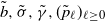 $\tilde{b},\tilde{\sigma},\tilde{\gamma},(\tilde{p}_\ell)_{\ell\geq0}$
be respectively the drift, diffusion coefficient, death rate, and progeny distribution satisfying Assumptions 1 and 2. Let
$\tilde{b},\tilde{\sigma},\tilde{\gamma},(\tilde{p}_\ell)_{\ell\geq0}$
be respectively the drift, diffusion coefficient, death rate, and progeny distribution satisfying Assumptions 1 and 2. Let $\tilde{\xi}$
be an E-valued
$\tilde{\xi}$
be an E-valued $\mathcal{F}_0$
-random variable such that
$\mathcal{F}_0$
-random variable such that $\mathbb{E}[\langle\tilde{\xi}, \mathbf{1}{}\rangle]< +\infty$
. Denote by
$\mathbb{E}[\langle\tilde{\xi}, \mathbf{1}{}\rangle]< +\infty$
. Denote by $\tilde{Z}_t\,:\!=\,\sum_{k\in \tilde{K}_t}\delta_{(k,\tilde{X}^k_t)}$
the unique solution to the SDE (6) and (7) with coefficients
$\tilde{Z}_t\,:\!=\,\sum_{k\in \tilde{K}_t}\delta_{(k,\tilde{X}^k_t)}$
the unique solution to the SDE (6) and (7) with coefficients $\tilde{b}$
,
$\tilde{b}$
, $\tilde{\sigma}$
,
$\tilde{\sigma}$
, $\tilde{\gamma}$
,
$\tilde{\gamma}$
, $(\tilde{p}_\ell)_{\ell\geq0}$
and initial condition
$(\tilde{p}_\ell)_{\ell\geq0}$
and initial condition $\tilde{\xi}$
instead of b,
$\tilde{\xi}$
instead of b, $\sigma$
,
$\sigma$
, $\gamma$
,
$\gamma$
, $(p_\ell)_{\ell\geq0}$
, and
$(p_\ell)_{\ell\geq0}$
, and $\xi$
.
$\xi$
.
Proposition 4. (Stability of SDE). Let Assumptions 1 and 2 hold, and assume that $\mathbb{E}[\langle\xi,\mathbf{1}\rangle] < +\infty$
. Let Z be the unique solution to the SDE (6) with (7), and
$\mathbb{E}[\langle\xi,\mathbf{1}\rangle] < +\infty$
. Let Z be the unique solution to the SDE (6) with (7), and $\tilde{Z}$
be defined as above. Then there exists a constant
$\tilde{Z}$
be defined as above. Then there exists a constant $C>0$
such that
$C>0$
such that
 \begin{equation*} \mathbb{E}[d(Z,\tilde{Z})] \leq C\bigg(\mathbb{E}[d_E(\xi,\tilde{\xi})] + \|b-\tilde{b}\|_{{\infty}} + \|\sigma-\tilde{\sigma}\|_{{\infty}} + \|\gamma-\tilde{\gamma}\|_{{\infty}} + \Bigg\|\sum_{\ell\geq 0}\ell|p_{\ell} - \tilde{p}_{\ell}|\Bigg\|_{{\infty}}\bigg). \end{equation*}
Proof. Most of the proof follows from the estimates established in Lemma 3. Write $K^{\triangle}_t \,:\!=\, K_t\triangle \tilde{K}_t$
and
$K^{\triangle}_t \,:\!=\, K_t\triangle \tilde{K}_t$
and $K^{\cap}_t = K_t\cap \tilde{K}_t$
, and recall that
$K^{\cap}_t = K_t\cap \tilde{K}_t$
, and recall that $d_{T}(Z,\tilde{Z}) = \sup\nolimits_{0\leq t\leq T} d_E(Z_t,\tilde{Z}_t)$
, where
$d_{T}(Z,\tilde{Z}) = \sup\nolimits_{0\leq t\leq T} d_E(Z_t,\tilde{Z}_t)$
, where $d_E(Z_t,\tilde{Z}_t) = \# K^{\triangle}_t + \sum_{k\in K^{\cap}_t} \big|X^k_t-\tilde{X}^k_t\big|\wedge 1$
. By using similar arguments to Step 1 of the proof of Lemma 3, namely, combining (12) with (13), (14), and (16), that
$d_E(Z_t,\tilde{Z}_t) = \# K^{\triangle}_t + \sum_{k\in K^{\cap}_t} \big|X^k_t-\tilde{X}^k_t\big|\wedge 1$
. By using similar arguments to Step 1 of the proof of Lemma 3, namely, combining (12) with (13), (14), and (16), that
 \begin{align*} \mathbb{E}[\sup\nolimits_{0\leq t\leq T}\#K^{\triangle}_t] & \leq \mathbb{E}[\#K^{\triangle}_0] + \bar\gamma M\mathbb{E}\bigg[\int_0^{T}\#K^{\triangle}_t\,{\mathrm{d}} t\bigg] \\[2pt] & \quad + \bigg((M+1)\|\gamma-\tilde{\gamma}\|_{{\infty}} + \bar\gamma\bigg\|\sum_{\ell\geq0}\ell|p_{\ell} - \tilde{p}_{\ell}|\bigg\|_{{\infty}}\bigg) \mathbb{E}\bigg[\int_0^{T}\#K^{\cap}_t\,{\mathrm{d}} t\bigg]. \end{align*}
In addition, it follows from similar arguments to Step 2 of the proof of Lemma 3 that
 \begin{align*} \mathbb{E}\bigg[\sup\nolimits_{0\leq t\leq T}\sum_{k\in K^{\cap}_t}\big|X^k_t-\tilde{X}^k_t\big| \wedge 1\bigg] & \leq \mathbb{E}\bigg[\sum_{k\in K^{\cap}_0}\big|X^k_0-\tilde{X}^k_0\big| \wedge 1\bigg] + \|b-\tilde{b}\|_{{\infty}}\mathbb{E}\bigg[\int_0^{T}{\#K^{\cap}_t}\,{\mathrm{d}} t\bigg] \\[2pt] & \quad + C_1\sqrt{T}\|\sigma-\tilde{\sigma}\|_{{\infty}} \mathbb{E}\bigg[\sum_{k\in\mathbb{K}}\sup\nolimits_{0\leq t\leq T}\mathbf{1}_{k\in K^{\cap}_t}\bigg] \\[2pt] & \quad + \bar\gamma M\mathbb{E}\bigg[\int_0^{T}\bigg({\#K^{\triangle}_t + \sum_{k\in K^\cap_t}\big\|X^k_{t\wedge\cdot}-\tilde{X}^k_{t\wedge\cdot}\big\|}\bigg)\,{\mathrm{d}} t\bigg]. \end{align*}
Combining both the above inequalities together with the following consequence of Lemma 1,
 \begin{equation*} \mathbb{E}\bigg[\int_0^{T}\#K^{\cap}_t\,{\mathrm{d}} t\bigg] \le T\mathbb{E}\Bigg[\sum_{k\in\mathbb{K}}\sup\nolimits_{0\leq t\leq T}\mathbf{1}_{k\in K^{\cap}_t}\Bigg] \le C_0T{\mathrm{e}}^{\bar\gamma MT}, \end{equation*}
where $C_0 \,:\!=\, \max\!(\mathbb{E}[\#K_0],\mathbb{E}[\#\tilde{K}_0])$
, we deduce that
$C_0 \,:\!=\, \max\!(\mathbb{E}[\#K_0],\mathbb{E}[\#\tilde{K}_0])$
, we deduce that
 \begin{align*} \mathbb{E}[d_{T}(Z,\tilde{Z})] & \leq \mathbb{E}[d_E(Z_0,\tilde{Z}_0)] + 2\bar\gamma M\int_0^T\mathbb{E}[d_t(Z,\tilde{Z})]\,{\mathrm{d}} t \\[2pt] & \quad + C\Bigg(\|b-\tilde{b}\|_{{\infty}} + \|\sigma-\tilde{\sigma}\|_{{\infty}} + \|\gamma-\tilde{\gamma}\|_{{\infty}} + \Bigg\|\sum_{\ell\geq0}\ell|p_{\ell}-\tilde{p}_{\ell}|\Bigg\|_{{\infty}}\Bigg) \end{align*}
for some constant $C>0$
. The conclusion follows immediately by Grönwall’s lemma.
$C>0$
. The conclusion follows immediately by Grönwall’s lemma.
Funding information
Xiaolu Tan’s research is partially supported by the Hong Kong RGC General Research Fund (projects 14302921).
Competing interests
There were no competing interests to declare which arose during the preparation or publication process of this article.

 Open access

