

Introduction
Over the last few decades, the conditions attached to the receipt of UK unemployment benefits have increased in number and scope as part of a trend across Organisation for Economic Co-operation and Development (OECD) countries towards ‘active’ labour market policies (Knotz, Reference Knotz2018). The 2012 Welfare Reform Act was a landmark in this process; alongside continuing to impose financial penalties on claimants who breach their agreed job search conditions (now called a Claimant Commitment), those who leave a job voluntarily and then apply for Universal Credit can now also face a sanction (see HM Government 2012: s49). The Act increased the severity of these sanctions, and they have been found by qualitative longitudinal researchers to have pushed people towards illness, criminality, and destitution (Wright and Patrick, Reference Wright and Patrick2019; Dwyer et al., Reference Dwyer, Scullion, Jones, McNeill and Stewart2023).
The tougher measures were defended by the 2012 Act’s architect Iain Duncan Smith as necessitated by a significant element among unemployed benefit claimants that lacks appropriate commitment to employment. Duncan Smith spoke of a TV documentary in which some unemployed claimants would not get ‘on a bus’ to a nearby city to broaden their job search (BBC Newsnight, 21 October 2010), and claimed companies had been ‘unable to get British people to fill’ some job vacancies, so ‘workers from overseas stepped in’ (Duncan Smith, Reference Duncan Smith2012). Most boldly, he was among those who asserted that a ‘culture of welfare dependency’ existed, whereby worklessness is seen to be transmitted through the generations of families, with some households said to contain three or more adult generations who have never experienced employment (see Wiggan, Reference Wiggan2012; MacDonald et al., Reference MacDonald, Shildrick and Furlong2014).
This article is about young adults’ attitudes to employment. More specifically, it is about attitudes relevant to the behavioural demands faced by unemployed benefit claimants; it asks if those who have expressed the attitude that it is worth avoiding or exiting a disliked or unattractive job are also those who tend to have spent a substantial amount of their adult lives unemployed. Conservative politicians’ claims about unemployed people’s attitudes to paid work have been subjected to a considerable critical response from academic researchers, and the next section re-examines relevant evidence. After discussing major empirical insights related to the culture of welfare dependency thesis and sociological theories about consumer culture and employment decisions, it focuses on existing empirical findings about unemployed people’s attitudes towards low status employment. It is suggested that some empirical issues directly relevant to politicians’ claims have gone unexplored. To help fill gaps in our knowledge, findings are then presented from an analysis of quantitative data from the Next Steps (previously known as the Longitudinal Study of Young People in England [LSYPE]) study of people born between September 1989 and August 1990. Uniquely, this dataset not only provides information on the attitudes to work and month-by-month employment/unemployment records of young UK adults, but it is also able to shed light on whether a dependency culture can be said to exist, via its data on the employment status of respondents’ parents/guardians during those respondents’ late childhood. The analysis focuses on responses to three attitude questions, asked at both age nineteen and twenty, that all offer respondents a choice between a disliked/unattractive job and being jobless. Its main research question is ‘do attitudes correlate with spending a considerable amount of time unemployed, when other relevant variables are controlled for?’. The survey respondents turned twenty-five at the time that the slow roll-out of the 2012 Welfare Reform Act’s new policies was gaining momentum, so the data relate to the last years before a substantial extension of conditionality took place. The article concludes by reflecting on the possible implications of its main findings.
Theories and evidence about unemployment and attitudes to employment
The ‘culture of welfare dependency’ thesis
The ‘culture of welfare dependency’ thesis asserts that historically generous social security payments for working-age people encourage more of them to claim benefits rather than undertake badly paid, low status jobs, and that this tendency to avoid work subsequently crystalises into a culture, concentrated among some poorer neighbourhoods and families, that places little or no moral value on being employed rather than living on state benefits (see Dean and Taylor-Gooby, Reference Dean and Taylor-Gooby1992; MacDonald et al., Reference MacDonald, Shildrick and Furlong2014). This is the same as Charles Murray’s (1990) controversial ‘underclass’ thesis, except that it stops short of proclaiming the emergence of a new social class and rarely mentions criminality. Despite a considerable amount of relevant UK empirical studies, no such culture has ever been found to exist.
An important development in the debate about this supposed culture concerns a key component of the thesis: that there are significant numbers of UK families or households containing three or more adult generations that have never been employed. MacDonald et al. (Reference MacDonald, Shildrick and Furlong2014: 200) quoted the following examples of politicians asserting this claim:
Behind the statistics lie households where three generations have never had a job. (Tony Blair, in 1997)
…on some estates…often three generations of the same family have never worked … (Iain Duncan Smith, former Secretary of State for Work and Pensions, in 2009)
…there are four generations of families where no-one has ever had a job. (Chris Grayling, the then Minister of State for Employment, in 2011)
Yet Harkness et al. (Reference Harkness, Gregg and MacMillan2012) established that only around 15,000 households contained two never-employed adult generations, most of which included a recent school leaver. Most tellingly, MacDonald et al. (Reference MacDonald, Shildrick and Furlong2014) sought out the supposed workless households or families in Glasgow and on Teesside, England, via methods that included leafleting relatively deprived areas and asking employees of local welfare-to-work organisations, and they could not find any. Thus, a central plank of politicians’ claims about the spread of worklessness amid a culture of welfare dependency is now widely considered to be a myth.
Yet little is known about whether there is a distinct pattern of attitudes to employment and claiming benefits among people who grew up in households whose adults were relatively rarely in employment. A possible, more moderate theory about worklessness – that amid the noted broad nationwide cultural homogeneity around work and welfare, a distinct pattern of attitudes might nevertheless exist among those who grew up in households in which adults are less often in employment – has not been tested. Existing research findings indicate that such a theory is worthy of empirical investigation. Payne (Reference Payne1987) suggested that those whose parents were often unemployed might make joblessness ‘appear more bearable’ (p. 211), or lead them towards defeatism, discouragement, and low expectations, which might therefore make them less inclined to aspire to being employed. Ekhaugen (Reference Ekhaugen2009: 98), when discussing Norway, suggested that young adults’ past experience of a parent’s joblessness could reduce their perceived level of ‘social stigma connected to unemployment’; Zwysen (Reference Zwysen2015: 3–4) added that this consideration might make them less unhappy when out of work themselves and therefore less pressured to ‘accept just any job’. A possible counter-effect was noted by Ekhaugen (Reference Ekhaugen2009: 98), who suggested that witnessing a parent’s unemployment might make them more aware of ‘the adverse consequences of unemployment’ and therefore ‘keen to avoid it’ themselves; indeed, this theme emerged from in-depth interviews with young adults who have grown up in UK households and neighbourhoods in which unemployment is relatively common (MacDonald and Marsh, Reference MacDonald and Marsh2005; Shildrick et al., Reference Shildrick, MacDonald, Webster and Garthwaite2012). In an all-too-rare quantitative investigation into parental joblessness and attitudes to work, Zwysen (Reference Zwysen2015) found that job satisfaction was lower among men who had grown up in households with a jobless father, even when job quality was controlled for. Nevertheless, while strong correlations between growing up in a jobless family and subsequently being unemployed have been found consistently for decades (White, Reference White1983; MacMillan, Reference MacMillan2013), until now no study has investigated how much, if any, of the strength of those correlations might be accounted for by attitudes towards employment and unemployment.
The conclusions drawn from empirical studies of the employment commitment of unemployed benefit claimants tend to differ depending on whether they are based on unemployed people’s accounts or those of welfare-to-work organisations’ employees. Shildrick et al. (Reference Shildrick, MacDonald, Webster and Garthwaite2012: 74–75) found that employers and employees of local agencies who work with young unemployed adults from jobless families on Teesside believe the category is generally more reluctant than others to enter employment. Despite these agency workers’ experience working with unemployed young people, the authors rejected their accounts because they contained an inaccurate perception that ‘a local culture of worklessness was a serious barrier to people getting jobs’ (2012: 74, emphasis added). Shildrick et al. (Reference Shildrick, MacDonald, Webster and Garthwaite2012) instead based their conclusions on the young people’s own accounts, including their professed ‘love’ of work (2012: 8). Likewise, MacDonald and Marsh’s (2005) earlier Teesside study of youth transitions drew conclusions almost entirely based on teenagers’ own accounts of their strong commitment to employment amid the considerable disadvantages they faced, with agency worker interview findings largely disregarded on that occasion too.
Yet there are strengths and limitations in accounts provided by both claimants and welfare-to-work employees (see Dunn, Reference Dunn2014: 172–174 for a more detailed discussion). Most importantly, staff sometimes exhibit prejudices and misapprehensions (such as a belief that there are ‘three generations’ in some families who have never been employed) but tend to possess detailed knowledge of clients’ job search behaviour; while claimants can draw upon all relevant circumstances they face, they sometimes fear that being candid runs a risk of being reported to the DWP. The issue is salient at present, as a DWP-funded study (Rahim et al., Reference Rahim, Graham, Kiss and Davies2017) included interviews with work coaches and concluded that increased conditionality had major positive effects (mainly on successfully pushing claimants to widen their job searches). Conversely, other major qualitative studies (see Patrick, Reference Patrick2017; Dwyer et al., Reference Dwyer, Scullion, Jones, McNeill and Stewart2023), which did not draw on work coaches’ views, concluded that the new policies’ effects have been almost wholly negative. Shildrick (Reference Shildrick2018: 67) remains convinced that agency workers in her study were wrong and, therefore, that increased conditionality was unnecessary, concluding that ‘where people can possibly find work – even that of very poor quality and pay – they will choose paid work over “welfare”’. Furthermore, while Dwyer et al.’s (Reference Dwyer, Scullion, Jones, McNeill and Stewart2023) book cites Rahim et al. (Reference Rahim, Graham, Kiss and Davies2017), it does not mention any differences between its own findings or conclusions and those of that DWP study.
Commitment to undertaking low status jobs in a society of consumer choice
Ray Pahl (Reference Pahl, Bryson and McKay1994) was perhaps the first to suggest that, as societies become more affluent and consumerist, young people entering the labour market will tend to apply more critical consumerist scrutiny than earlier generations when deciding which jobs they are willing to undertake. According to Zygmunt Bauman (Reference Bauman2005: 33), in a consumer society of ‘aesthetics not ethics’, the work ethic is in terminal decline and work is instead judged by its ‘capacity to generate pleasurable experience’. Bauman (Reference Bauman2005) pointed to evidence of increased workaholism among those with stimulating career jobs, which he contrasted with widespread unfilled vacancies for low paid and unstimulating jobs. The latter, he noted, tend to be only willingly undertaken by people who are as yet ‘unconverted to consumerism’, such as ‘immigrants’ (2005: 34).
It is now well established that UK employers tend to regard economic migrants as clearly more willing than the UK-born to apply for and undertake relatively badly paid, low status jobs (see Fitzgerald and Smoczyński, Reference Fitzgerald and Smoczyński2017). Whether this perceived higher employment commitment is connected to a lack of consumerism or, alternatively, to a different pattern of life circumstances, is not known. Hall et al.’s (Reference Hall, Winlow and Ancrum2008) in-depth interview research involving young adults with criminal convictions on a relatively deprived social housing estate in north-east England is the only published empirical study to use a framework of consumer capitalism and link it to UK-born respondents’ employment attitudes. These respondents aspired to the relatively high incomes necessary for excessive consumption, despite their low employability levels, so low status jobs tended not to offer enough reward to entice them off state benefits; a young adult male, for example, said he preferred unemployment, and the lower net income it entailed, to a job paying ‘a hundred and fifty quid a week’ because ‘at least then your life’s your own a bit’ (2008: 54–55). This finding clearly clashes with Shildrick’s (2018) view, but some other academic authors, particularly those specialising in the study of ‘race’ and ethnicity, have also claimed there is a gap between the employment commitment of migrants and non-migrants; for example, Craig (Reference Craig, Craig, Burchardt and Gordon2008: 232) observed that Britain was ‘happy to accept workers from elsewhere, to help fill the low-paid, dirty gaps in the labour market that the majority (usually white) residents are unwilling to take on’.
Apart from non-migrants, the only other group identified by researchers as being distinctly ‘choosy’ in the jobs they are willing to undertake is the more educationally qualified. McRae’s (1987) qualitative study of young unemployed people found that this group reported feeling least bored when unemployed due to activities such as reading, and least ashamed because their education steered them away from blaming only themselves for their plight. Dunn’s (2013, 2014) in-depth interviews, which investigated individuals’ attitudes to various jobs, their employment histories, and rationales for past labour market decisions, found that the more educated were the least attracted to the narrow economic rewards, opportunities for social contacts and intrinsic pleasures that low status jobs offered. Thus, education did not just raise their expectations, it also affected their labour market decisions via its influence on their preferences.
Importantly, one’s educational attainment is so closely linked to one’s employment chances that ‘highest academic qualification’ has sometimes been used by quantitative researchers as a proxy for employability (for example, Glyn and Salverda, Reference Glyn, Salverda, Gregory, Salverda and Bazen2000); therefore, the greater choosiness reported by the highly educated cannot be expected to result in many of them suffering long spells of unemployment (indeed, it might also help match them with a more suitable employer). Thus, any investigation into whether attitudes significantly affect the amount of time people spend unemployed will need to look beyond the role of educational attainment. It will also need to look beyond consumerism, which is, as Hall et al. (Reference Hall, Winlow and Ancrum2008) note, a phenomenon that stretches well beyond those most at risk of being unemployed.
Existing survey research on unemployment and attitudes to employment
Given the topic’s political salience, it is perhaps surprising there have been so few attempts to explore possible links between unemployment and attitudes towards paid work. The quantitative research about unemployed people’s work attitudes that does exist has delivered some contrasting findings. The ‘lottery’ or ‘millionaire’ question (‘would you still work if you had no financial need to?’) is the most frequently posed question in quantitative research about unemployment and the work ethic/attitudes to work (Gallie, Reference Gallie2019). Using it, Gallie and Vogler (Reference Gallie, Vogler, Gallie, Marsh and Vogler1994) found that UK unemployed people’s attitudes to employment were more positive than those of the employed. Likewise, Gallie and Alm (Reference Gallie, Alm, Gallie and Paugam2000) later found that in all fifteen EU countries surveyed, which included the UK, unemployed people were significantly more likely than employed people to indicate they would choose to work. Despite the arguable inappropriateness of a survey question that offers unemployed respondents a choice between being a busy and idle millionaire (a choice few of them have to make) Gallie and Vogler’s (1994) finding was cited uncritically countless times (see, for example, Dean, Reference Dean2003: 705).
Research on survey cohorts born in 1958 and 1970, using a question that gave employed and unemployed respondents a choice between ‘almost any job’ and ‘being unemployed’, found that the unemployed were significantly more likely to choose being unemployed (Dunn et al., Reference Dunn, Grasso and Saunders2014). Dunn (Reference Dunn2021) found that in both cohorts those who expressed this attitude were significantly more likely to have spent a substantial proportion of their lives unemployed between the ages of sixteen and forty-six; this attitude rivalled established unemployment risk variables, including low educational attainment, in strength as a predictor of spending at least five years out of thirty ‘unemployed and seeking work’. A similar pattern of results was found regardless of whether employment attitudes were measured against past, present, or future employment status (Dunn, Reference Dunn2021). The rest of this article discusses a research project that builds on these earlier studies by seeking possible correlations between the employment records and attitudes towards paid work of a much younger cohort.
Methods
The LSYPE/Next Steps study was chosen for the analysis presented here because it provides impressive data on both attitudes to work and employment history; not only does it include three survey questions all offering respondents a choice between a disliked/low status job and joblessness (questions which are therefore directly relevant to sanctionable behaviours under current social security law), it also provides month-by-month data on respondents’ employment and unemployment records up to age twenty-five. A further advantage is its data on parental joblessness, which was gathered from parents/guardians in the first three waves, when cohort members were fourteen, fifteen, and sixteen years of ageFootnote 1 .
The following three job attitude survey items featured in both waves six and seven, when respondents were age nineteen and twenty (the items’ shorthand descriptions used in this article are in brackets):
If I didn’t like a job I would pack it in, even if there was no other job to go to (Pack It In)
Having almost any job is better than being unemployed (Almost Any Job)
Once you’ve got a job it’s important to hang on to it even if you don’t really like it (Hang On)
All three items have four response options: ‘strongly agree’/‘agree’/‘disagree’/‘strongly disagree’ (the few ‘no response’/‘don’t knows’ are excluded from the analysis, as they are for all variables). Dichotomous variables, based on strongly agree/agree versus disagree/strongly disagree responses, are used because the first two survey response options clearly favour employment and the other two clearly favour joblessness; agreement implies favouring joblessness in the case of the Pack It In item, whereas disagreement does so for both the Almost Any Job and Hang On items.
The three attitude items are relevant to labour market choices in different ways. The Pack It In and Hang On items refer to the desirability of remaining in a disliked job, whereas Almost Any Job refers to what respondents perceive to be a baddish job, and whether this is preferable to being unemployed. The Pack It In item clearly invites responses based on what people would do, whereas Hang On is about what people should do, as it is framed as a general piece of advice to self and others. While Almost Any Job is less clear in this regard, interviews found that it is usually, though not always, interpreted as being about what respondents would do (see Dunn, Reference Dunn2014: 115–118).
Testing attitudes’ associations with employment status across seven years (from age eighteen to twenty-five) sits well with in-depth employment history research, which has found that respondents usually, though not always, reported that their attitudes towards being unemployed and towards a variety of jobs had remained stable over long periods (see Dunn, Reference Dunn2014: 86–113). Here, however, correlations between attitudes expressed at age nineteen and those expressed at twenty varied are only quite strong; tests produced Cramer’s V (ϕc) strength of correlation scores of 0.28 (Pack It In), 0.32 (Almost Any Job), and 0.44 (Hang On). Dunn’s (2014) interviews matched responses to Almost Any Job with long-term labour market orientations understood with reference to respondents’ post hoc rationalisations of their choices, finding a high level of consistency between the two.
While the LSYPE/Next Steps measure of ‘unemployed and seeking work’ does not precisely match a recognised definition or measure of unemployment, it has the advantage of being derived from a ‘main economic activity’ variable with categories for long-term sick/disabled, student, and ‘looks after home’; the presence of these other categories helps prevent respondents being misallocated as unemployed. Employed months are calculated as full-time equivalent (FTE) with 0.5 months allocated for part-time employment (the surveys do not enquire into the number of hours spent in part-time jobs). Cases with fewer than five years (or sixty months) of ‘activity records’ after the age of eighteen are excluded from all tests presented here. Age eighteen, not sixteen, is the starting point for measuring main activities here, as those born in 1989/90 were not usually entitled to claim unemployment benefits before the age of eighteen. Cases with missing values on any of the variables included in the analysis are excluded, leaving a reduced sample of 4477Footnote 2 .
Alongside measuring the total number of months a young person was ‘unemployed and seeking work’, the proportion of their total labour market time (meaning the total time they had spent either unemployed or employed) that they had spent unemployed was also measured. This is because young people inevitably varied in the amount of time they had spent in other ‘main activities’, such as full-time education and childcare. For these tests, respondents must have spent at least three years (thirty-six months) of total time either employed (FTE) or ‘unemployed and seeking work’, which reduced the sample (for these tests only) to 3424. The sixty- and thirty-six-month cut-off points were set at levels that balance the need for more complete details about individuals with the need to avoid a substantial loss of cases. Reduced sample data is available in Appendix A, Supplementary material; this data indicates that the loss of cases has not shifted the overall character of the sample. For all tests the weight variable for the most recent wave is applied – as recommended by those responsible for the dataset (DfE 2011: 75), so here data is weighted by the variable W8FINWT.
Logistic regression was chosen because the project sought to compare with other respondents those who have experienced an unusually large amount of unemployment, and because its predictors were all designed to capture a high risk of unemployment across the seven-year period. The terms ‘predictor’ and ‘outcome’ variables are preferred to the more misleading ‘independent’ and ‘dependent’, but here predictor should not be taken to mean predicting a future status. Moreover, prediction is distinct from causation, and only claims of correlations between variables can be made with certainty in this kind of research (indeed, the latter are subject to claims of statistical error). With the unemployed category weighted heavily in favour of certain socio-demographic groups (see, for example, Dunn, Reference Dunn2014: 27) these groups are included, where possible, as dichotomised predictor variables. ‘Single’ includes those who were not partnered in any of the three most recent waves – six (age nineteen), seven (twenty) and eight (twenty-five). ‘Male’ is based on gender data obtained in Wave 8. ‘Low or No Qualifications’ includes all qualifications accumulated by the age of twenty-five; its distinction between those with ‘O’ Level/CSE Grade 1/GCSE grade ‘C’ or above and others ensures it is a meaningful threshold in which tangible effects on individuals’ employability are incurred. ‘Parental Joblessness’ is measured as those who, in all waves in which parents/guardians were asked about their employment status (waves 1, 2, and 3), lived in a household in which no adult was employed. As well as being relevant to the earlier discussion about the supposed ‘culture of welfare dependency’, this variable captures low social class background and, as anticipated, it correlates quite strongly with a high deprivation score (>44 on the LSYPE’s own deprivation measure) at age fifteen (Cramer’s V [ϕc] = 0.22, P < 0.001). ‘Poor Health’ includes those who, in either wave 7 or wave 8, indicated that they had a limiting disability or illness that affected their day-to-day functioning in some way (these health questions were absent from wave 6); thus, it is ‘cut’ at a point that is likely to incur a labour market disadvantage. Unfortunately, the LSYPE/Next Steps lacks adequate sample sizes for most ethnic categories; given that migrants are of theoretical interest here, it is noteworthy that LYPSE/Next Steps respondents are overwhelmingly non-migrant. Unlike the earlier, similar analysis of National Child Development Study and British Cohort Study data (Dunn, Reference Dunn2021), the number of adult years covered was not adequate to deliver a meaningful statistical analysis of employment status before and after the years that attitudes were gathered; nor was there scope to carry out a meaningful analysis that might help explain why, for example, some spent at least eighteen months unemployed towards the end of the period while others spent the same period unemployed near the start, as the numbers in these categories were too small. Therefore, all available years of respondents’ labour market status are used in tests presented in the next section; while the approach of using data for the full seven years inevitably has its limitations (such as the inevitably crude measure of ‘Single’ status), it is clearly an appropriate way to address the article’s central research question.
Results
This section starts by examining possible associations between attitudes to work and those variables (where they are available) which were identified above as arguably important to the formation of those attitudes; these are parental joblessness and highest educational qualification (the latter is measured at age twenty-five, to distinguish graduates from non-graduates). Whether the young adult is in a jobless household at age twenty-five is also included, to see if any possible link between attitudes and joblessness is more predictive of future status than past status. High deprivation at age fifteen is included for comparison, too; anti-employment attitudes expressed by young people who grew up in jobless households might be symptomatic of defeatism or low expectations that are associated with social disadvantage, and hence have nothing to do with joblessness. To aid this comparison, the LSYPE’s own Income Deprivation Affecting Children (IDAC) index is split so that its more deprived category’s size is as close as possible to that of the jobless parent/s or guardian/s category; the proportion of the reduced sample with an IDAC index score of forty-five or more is the same (11.3 per cent) as the proportion who lived in a jobless household in all of waves 1, 2, and 3.
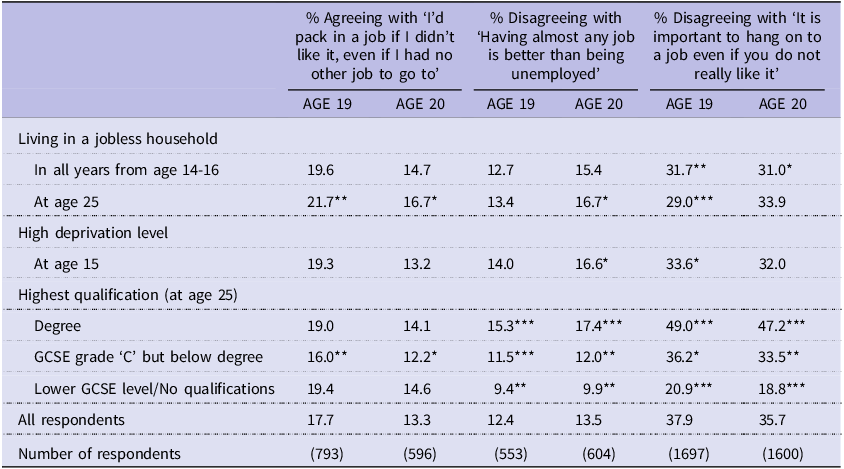
Being in a jobless household growing up does not associate significantly with expressing a pro-joblessness attitude in early adulthood (Table 1). In fact, being from a jobless household is associated with being significantly less likely to express a pro-joblessness attitude in response to the Hang On survey item. Note, however, that three of the six measures of attitudes favouring joblessness (Pack It In at age nineteen and twenty, and Almost Any Job at twenty) associate significantly with being in a jobless household at age twenty-five. Note also that the overall proportion of respondents who expressed an attitude favouring joblessness in response to the two items that are more about personal preference (and hence likely behaviour) – Pack It In and Almost Any Job – are all below eighteen per cent. While some might expect that, had economic migrants been surveyed, the corresponding percentages for that category would have been even lower, the low percentages for ‘all respondents’ in Table 1 supply evidence of strong employment commitment among young English adults.
Key theoretical variables and their associations with attitudes favouring joblessness

Table 1 Long description
A table with six rows and three columns comparing attitudes towards joblessness among young adults based on living in a jobless household, high deprivation level, and highest qualification at age 25. The columns represent percentages agreeing with 'I'd pack in a job if I didn't like it, even if I had no other job to go to' at ages 19 and 20, percentages disagreeing with 'Having almost any job is better than being unemployed' at ages 19 and 20, and percentages disagreeing with 'It is important to hang on to a job even if you do not really like it' at ages 19 and 20. Row 1: Living in a jobless household in all years from age 14-16, 19.6 percent agree at age 19, 14.7 percent agree at age 20, 12.7 percent disagree at age 19, 15.4 percent disagree at age 20, 31.7 percent disagree at age 19, 31.0 percent disagree at age 20. Row 2: Living in a jobless household at age 25, 21.7 percent agree at age 19, 16.7 percent agree at age 20, 13.4 percent disagree at age 19, 16.7 percent disagree at age 20, 29.0 percent disagree at age 19, 33.9 percent disagree at age 20. Row 3: High deprivation level at age 15, 19.3 percent agree at age 19, 13.2 percent agree at age 20, 14.0 percent disagree at age 19, 16.6 percent disagree at age 20, 33.6 percent disagree at age 19, 32.0 percent disagree at age 20. Row 4: Highest qualification at age 25 is a degree, 19.0 percent agree at age 19, 14.1 percent agree at age 20, 15.3 percent disagree at age 19, 17.4 percent disagree at age 20, 49.0 percent disagree at age 19, 47.2 percent disagree at age 20. Row 5: Highest qualification at age 25 is GCSE grade 'C' but below degree, 16.0 percent agree at age 19, 12.2 percent agree at age 20, 11.5 percent disagree at age 19, 12.0 percent disagree at age 20, 36.2 percent disagree at age 19, 33.5 percent disagree at age 20. Row 6: Highest qualification at age 25 is lower GCSE level/No qualifications, 19.4 percent agree at age 19, 14.6 percent agree at age 20, 9.4 percent disagree at age 19, 9.9 percent disagree at age 20, 20.9 percent disagree at age 19, 18.8 percent disagree at age 20. Row 7: All respondents, 17.7 percent agree at age 19, 13.3 percent agree at age 20, 12.4 percent disagree at age 19, 13.5 percent disagree at age 20, 37.9 percent disagree at age 19, 35.7 percent disagree at age 20.
Source: LSYPE/Next Steps data; Notes: P < 0.05=*, < 0.01=**, < 0.001=***; n (number of respondents) = 4477
Perhaps the stand-out finding from Table 1 is that, at both age nineteen and twenty, and across all three survey questions, those who went on to obtain a degree by the age of twenty-five were more likely to express an attitude favouring joblessness than were respondents in general; future graduates’ greater employability perhaps explains why they would choose unemployment above a disliked or low status job, as their chances of eventually finding a higher status job or one they do not dislike is inevitably generally high relative to other respondents. With the Hang On variable this difference is remarkably high, with respondents perhaps having in mind people with similar employment opportunities to themselves when assessing what people should do. The more pro-employment pattern of Pack It In scores for graduates perhaps reflects the question’s reference to a job that has already been obtained – so it must have been a job they wanted initially.
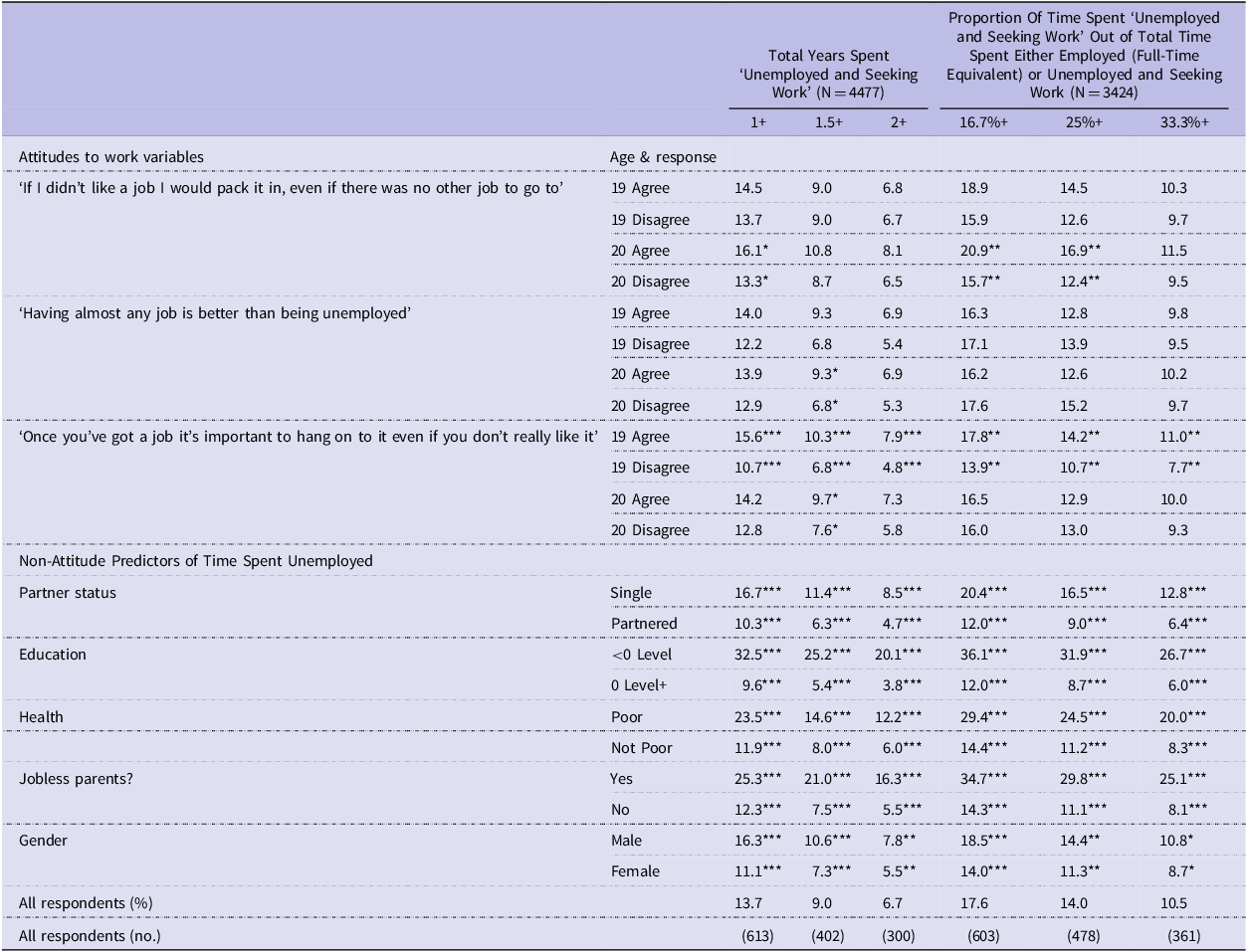
Tables 2, 3, and 4 present the main findings from the analysis. The bottom line of Table 2 shows the percentages of the entire samples that were unemployed for a particular amount of time (for example, 6.7 per cent were unemployed for at least two years). The detail provided in Table 2 exposes the relatively low number of statistically significant associations between attitudes to work variables and spending a long time in unemployment; while all thirty potential associations between the non-attitude unemployment risk variables and time spent unemployed are statistically significant (at P < 0.05), only eleven of thirty-six are for attitude variables. Of those eleven, only three are between an attitude favouring joblessness and time spent unemployed, all of which involve responses to the Pack It In survey item at age twenty; of the other eight, seven are significant associations between responses to Hang On (mostly at age nineteen) and the remaining one concerns Almost Any Job attitudes expressed at age twenty. The Hang On findings perhaps reflect the relatively low average educational attainment of those with pro-employment attitudes (see Table 1) – which serves as a reminder of the usefulness of an analysis that controls for other relevant variables.
Percentages of sub-categories who spent long periods unemployed between Wave 5 (age eighteen) and Wave 8 (age twenty-five)
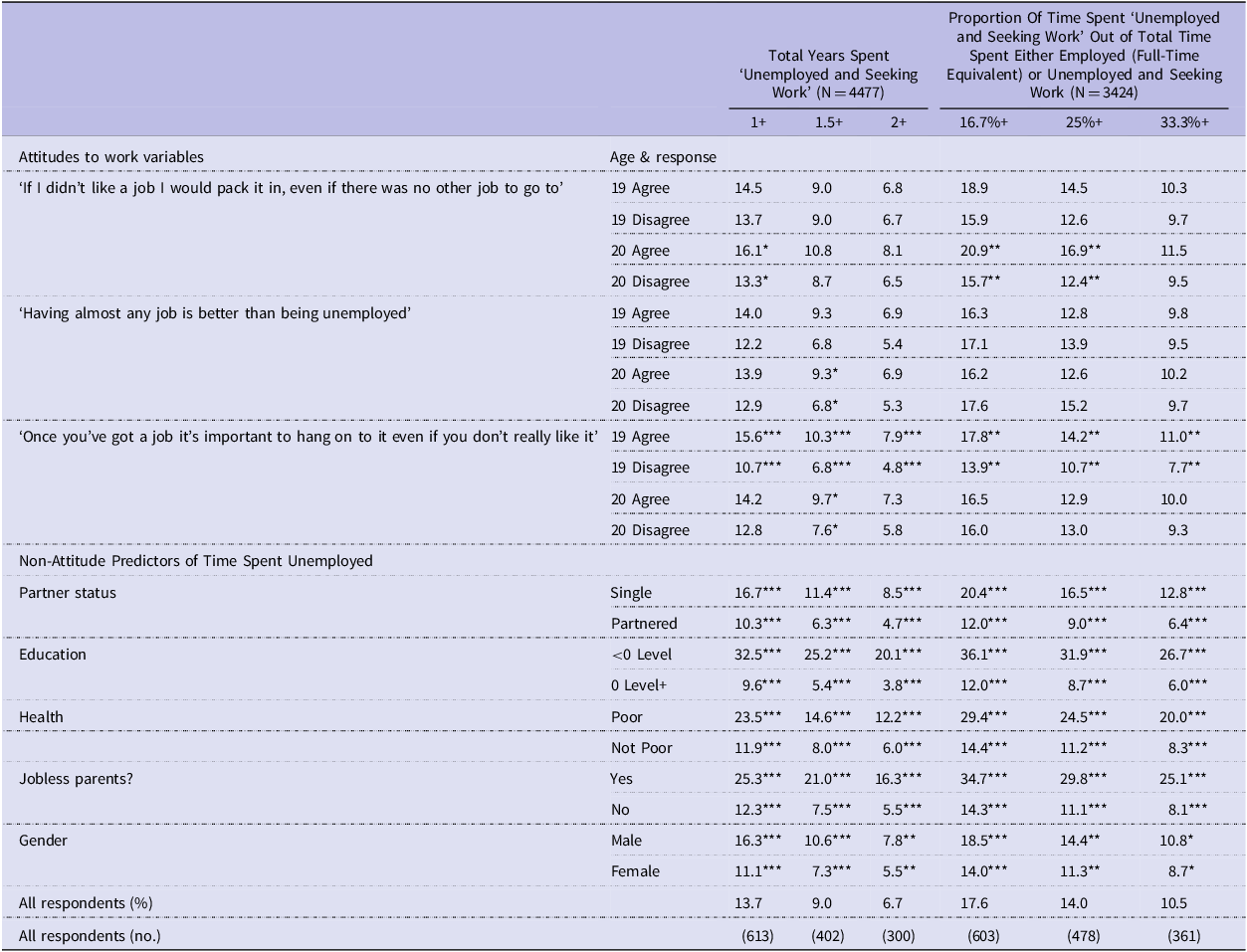
Table 2 Long description
A table with 12 rows and 10 columns showing the percentages of sub-categories who spent long periods unemployed between ages eighteen and twenty-five. The table includes data on attitudes to work variables and non-attitude predictors of time spent unemployed. The attitudes to work variables are divided into three categories: 'If I didn't like a job I would pack it in, even if there was no other job to go to', 'Having almost any job is better than being unemployed', and 'Once you've got a job it's important to hang on to it even if you don't really like it'. Each category is further divided by age and response. The non-attitude predictors include partner status, education, health, jobless parents, and gender. The table shows the total years spent unemployed and seeking work, as well as the proportion of time spent unemployed and seeking work out of total time spent either employed or unemployed. Each row provides specific percentages for different sub-categories and conditions.
Source: LSYPE/Next Steps data
Notes: P < 0.05=*, < 0.01=**, < 0.001=***
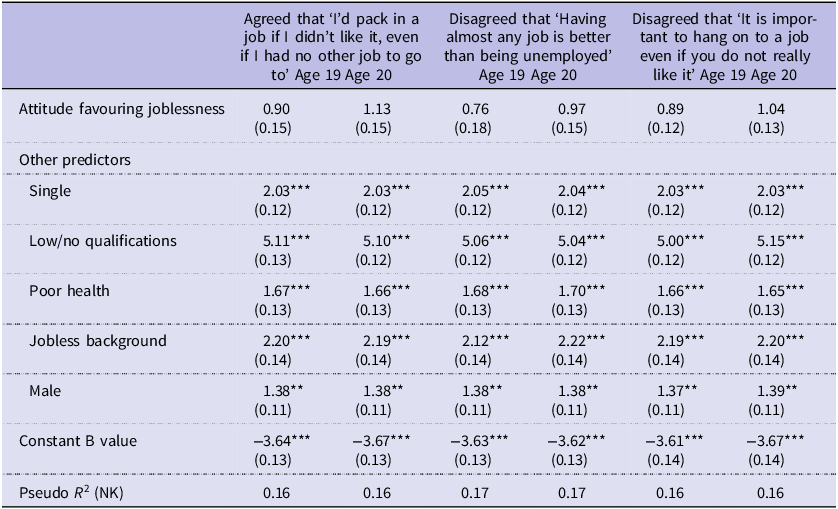
Logistic regression models predicting eighteen months or more ‘unemployed and seeking work’
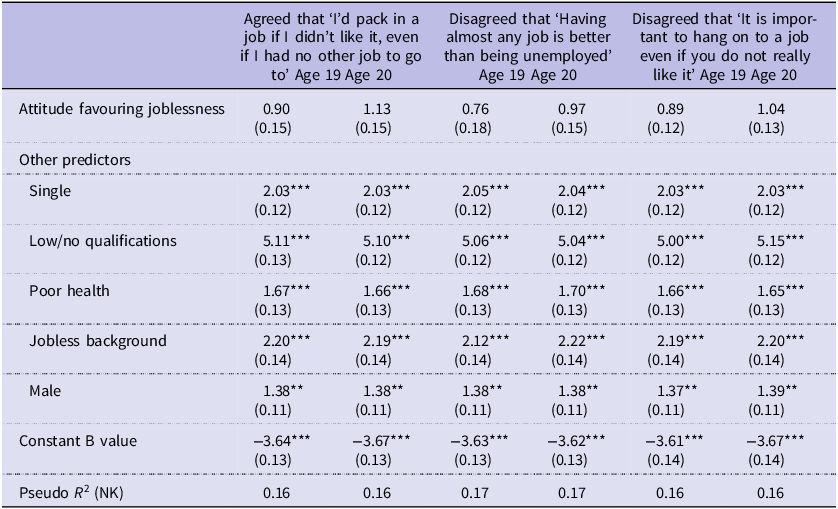
Table 3 Long description
A table with 11 rows and 8 columns. The table presents logistic regression models predicting eighteen months or more of unemployment and seeking work. The columns are labeled with different attitudes and predictors. The rows are labeled with age groups 19 and 20. The values in the table include statistical measures and their standard errors. The table is divided into sections: Attitude favouring joblessness, Other predictors, and Jobless background. Each section lists specific variables and their corresponding values for ages 19 and 20. The table provides a detailed comparison of how different attitudes and predictors influence the duration of unemployment.
Source: LSYPE/Next Steps data
Notes: Odds ratios and significance (P < 0.05=*, < 0.01=**, <0.001=***) are presented, Standard Errors are in brackets; number of respondents = 4477
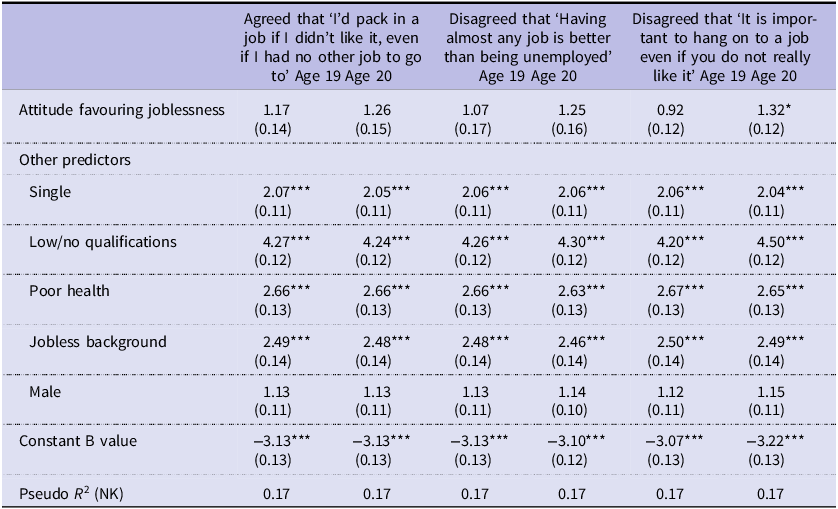
Logistic regression models predicting twenty-five per cent or more of labour market time spent ‘unemployed and seeking work’
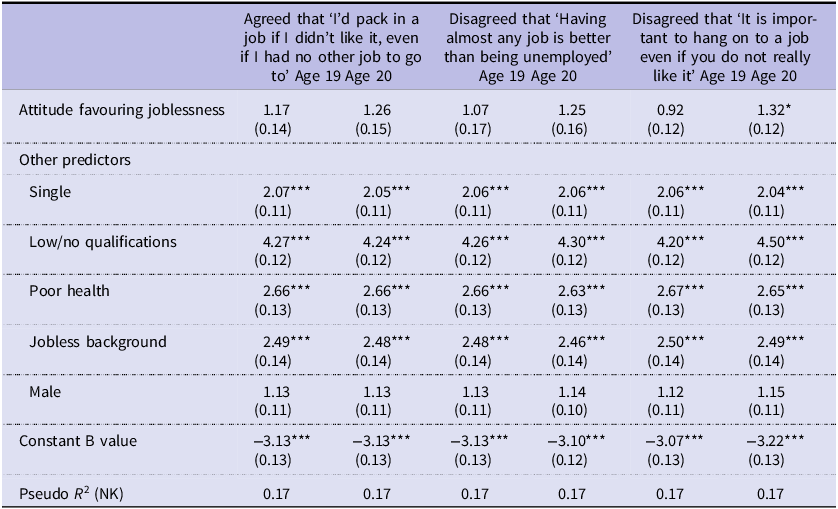
Table 4 Long description
A table with 11 rows and 8 columns. The table presents logistic regression models predicting the likelihood of spending 25 percent or more of labor market time unemployed and seeking work. The columns are labeled with different attitudes and predictors, including 'Attitude favouring joblessness', 'Single', 'Low/no qualifications', 'Poor health', 'Jobless background', 'Male', 'Constant B value', and 'Pseudo R^2 (NK)'. The rows are labeled with age groups 'Age 19' and 'Age 20'. Each cell contains regression coefficients with standard errors in parentheses. Notable trends include significant associations between various predictors and unemployment duration, with specific focus on attitudes towards work and other non-attitude variables.
Source: LSYPE/Next Steps data
Notes: Odds ratios and significance (P < 0.05 = *, < 0.01 = **, < 0.001 = ***) are presented, Standard Errors are in brackets; number of respondents = 3424
Findings from logistic regression analysis using the same list of unemployment risk variables as predictors in models, alongside one of the three attitude variables, are presented in Table 3 (tests predicting spending eighteen months or more unemployed) and Table 3 (tests predicting spending at least twenty-five per cent of labour market time unemployed). Correlation matrices for predictor variables are provided in Appendix B, Supplementary material.
In eleven of twelve tests presented across Tables 3 and 4 the attitude variable is not a statistically significant predictor (at P < 0.05) of time spent unemployed. The only significant predictor is ‘disagreeing’ with Hang On at age twenty, which predicts being unemployed for at least twenty-five per cent of young people’s labour market time (Table 4). However, its odds ratio is only one point three two, which means respondents who ‘disagreed’ are one point three two times as likely as those who ‘agreed’ to have been unemployed for that proportion of their time in the labour market. In fact, it is barely statistically significant at the conventional level, as its ninety-five per cent confidence interval almost reaches below one (there is a ninety-five per cent chance that the real odds ratio is found between 1.04 and 1.67). As in Table 2, note that the more established predictors of unemployment produce significant results (the only exception to this are for ‘Male’ in Table 4). Low/No qualifications is particularly predictive of unemployment, with all its odds ratios in Tables 3 and 4 over four, although the particularly high figures in Table 3 seem likely to be reflective of the less qualified tending to exit formal education earlier in their lives.
Conclusion
The research presented here asked whether young adults with attitudes favouring joblessness over a disliked or unattractive job were significantly more likely than others to have spent a large amount of their time unemployed between the ages of eighteen and twenty-five. It found that attitudes were almost never significant predictors of time spent unemployed when a range of unemployment risk variables were controlled for.
The findings contrast sharply with those from research involving older UK respondents. Dunn’s (2021) analysis of the same three attitude survey questions and unemployment records of people born in 1958 and 1970 found that attitudes were a strong predictor of time spent unemployed in both cohorts, even when relevant variables were controlled for. In that study, attitudes were gathered at age thirty/thirty-three and forty-two, and those gathered at thirty/thirty-three were found to correlate significantly with length of time spent unemployed both before and after that age (a limitation of the study presented here is that it did not cover enough years to investigate the sequence of attitudes and employment status this way). In attempting to explain the contrasting results, it might be suggested that attitudes expressed as early as age nineteen/twenty – when people tend to have limited experience of both employment and unemployment – are more changeable. Indeed, as was seen earlier, correlations between the attitudes that respondents expressed at nineteen and twenty were not very strong. Nevertheless, attitudes were gathered in two of the seven years covered by respondents’ labour market activity records, so it is certainly telling that they did not predict spending a large amount of time in unemployment. Perhaps a more plausible explanation for findings differing between age groups is that because Next Steps respondents always faced the tougher conditionality that accompanied the introduction of Jobseeker’s Allowance if they became unemployed (see, for example, Novak, Reference Novak1997), any pro-joblessness attitudes they held would be less easily translated into lengthy spells of unemployment. It might be that the unprecedented economic turmoil of the great recession impacted on those with greater self-perceived risk of unemployment, making them less likely to express a ‘choosy’ attitude; that we can only speculate about the possible reasons is a limitation of quantitative analyses. Nevertheless, findings from the younger respondents have more relevance to current and future policy debates, as those who featured in Dunn’s (2021) analysis are now approaching state pension age.
Social policy authors such as Shildrick (Reference Shildrick2018), Wright and Patrick (Reference Wright and Patrick2019), and Dwyer et al. (Reference Dwyer, Scullion, Jones, McNeill and Stewart2023), in arguing against the 2012 Welfare Reform Act’s extension of conditionality and sanctioning, have weighed the limited evidence of a lack of employment commitment among the unemployed, along with current policy’s modest net employment gains, against the human cost of the more severe sanctioning. Evidence presented in this article further strengthens their case. While attitudes research only tells us how people responded to a particular question worded a particular way, the questions used here were directly relevant to the extension of job search and job retention conditions that were coming into force across the country around the time that Next Steps respondents turned twenty-five. Survey respondents are under little pressure to ‘please the interviewer’, and these findings perhaps indicate that Shildrick et al. (Reference Shildrick, MacDonald, Webster and Garthwaite2012) were justified in their scepticism about the validity of what agency workers said about their unemployed clients. Additionally, the oft-supposed strong relationship between growing up in a jobless household and subsequent low commitment to employment in adulthood was not given any support by findings presented here – just as it was given no support by Shildrick et al.’s (Reference Shildrick, MacDonald, Webster and Garthwaite2012) in-depth interviews.
Supplementary material
To view supplementary material for this article, please visit https://doi.org/10.1017/S1474746425000016


 Open access

