This was supposed to be a different book. Intrigued by broadsheets that were reflections of early modern plays, such as the ballads of King Lear, The Spanish Tragedy and Arden of Faversham, I dreamed of gathering more such songs and then extracting ‘lost’ information from them about theatrical production. But while the book that follows does sometimes identify and assess such ballads – ballads written, that is to say, in the light of theatrical performance – the story of the relationship between early modern ballads and plays proved richer and more complicated than I had imagined. It swiftly became clear that not all ballads about plays were written afterwards; some were at least as likely to be play sources. So while the ballad of Romeo and Juliett, anonymous, lost, but recorded for publication in 1596, in some way advertised performance of William Shakespeare’s Romeo and Juliet, which was in production at that time but had not yet been printed, the ballad of Doctor Faustus, registered in 1589, may have preceded its play (thought to have been performed any time between 1587–9) and was, either way, intended too to advertise their mutual printed source, a lost chap-book translation of the German life of Doctor Faustus.Footnote 1 The ballad of A good warning for all Maidens, By the Example of Gods judgment shew’d upon one Jermans wife of Clifton, meanwhile, entered for publication in 1603, is definitely a source for William Sampson’s play The Vow Breaker (1636) which relates not only the story told in the ballad, but, in a metatheatrical, or perhaps metaballadical, moment, depicts how the ballad itself came to be written.Footnote 2 Even ballads that were manifestly reflections of plays were sometimes based on playbooks rather than performances, and seem designed to advertise those printed texts, like the ballad of The Spanish Tragedy, which shares story inconsistencies, character names, and even a purpose-cut picture with the playbook. Then there is the group of ballads that tell the story of moments, characters or images, rather than whole plots, written after plays but not mirrors of them: these are ‘fan fiction’ ballads that might flirt with different events or prioritise different characterisations, destabilising the play in the process. The ballad of Musidorus and Amadine, for instance, while based on the hero and heroine of the play Mucedorus, tells ‘only’ the story of their love, neglecting what might be thought to have made the play distinctive, its bear and cannibal.Footnote 3 This book will consider all such instances and more in order to categorise types of about-play ballad – source, performance reflection, book advertisement, fan fiction – bearing in mind that the longer a ballad was in existence, the more it could rotate through the different classifications: what was once a source ballad could then become a performance advertisement and thence a book advertisement; if it bears an indirect relationship to the play, it might be a fan fiction ballad too.
What also emerged was that other kinds of ballad entirely were part of the wider story of theatre’s relationship to song. Two chapters in this book will be on the ‘in-play ballads’ that Shakespeare and Jonson ‘product placed’ in their plays and sometimes seem to have released for separate sale as broadsheets too, including A Caveat for Cut-purses, sung onstage in Ben Jonson’s Bartholomew Fair, but also available as a paper ballad; and A Lovers complaint (now often called The Willow Song) sung by Desdemona in Othello, which exists on a broadsheet with the gender of the singer reversed. Often, as with the Othello ballad, available in 1615 if not before, these ballad snippets of play reached the press in advance of the playbook (Othello was first published in 1622) and might in origin be separate works that became part of the drama, or alternatively (or as well) the first printed bits of performance that could be taken home, functioning as something between a souvenir and a memory of the production. Sometimes, as with the ballad called The Man in the Moon Drinks Clarret (see Chapter 2, ‘Publishing and Writing Ballads’), they were the only bits of a play ever published, the dialogue itself, which did not reach print, being lost. Theatregoers who bought any of these on the way into the theatre on broadsheets will have been primed to join in, at least with the burdens or choruses, if encouraged, allowing productions to be mediated by print songs in ways that also made porous the distinction between on and offstage performer.
Finally, there were the ballads often performed at the end of plays and called jigs, from the Old French ‘gigue’, a fiddle, or ‘ginguer’, to leap or kick: they were dance ballads, often by or starring clowns. Because of the fact of jigs, a play that on the page appears to contain no ballads, is likely in performance to have included at least one; spectators, even for apparently balladless plays, can be imagined leaving the playhouse humming the tune of a jig ballad and ready therefore to make ballad purchases. Jig lyrics too were sometimes sold on broadsheets. They are hard to spot – jigs are seldom supplied at the end of playbooks, ‘When that I was and a little tine [sic: tiny] boy’ at the end of Twelfth Night being a rare exception – but broadsheets by company players, like A prettie newe Ballad, intytuled: the Crowe sits upon the wall (1592) by the clown Richard Tarlton, can be identified as probable jigs.Footnote 4 If printed jigs were acquired and bought by listeners on the way into the playhouse as well as on the way out, they will have been interactive texts that could be consulted, disputed and shared during performance; audiences with jig broadsheets in hand would also have been able and perhaps encouraged to sing along.
Collectively, this range of theatre ballads were not texts that came ‘after’ performance, as I had originally imagined, but during and beyond it: the purchasable interstices of plays that are also reflections on, and paratexts for them.
With the realisation of the range and variety of play-ballad connections came a revelation as disconcerting as it was fascinating: that the play was not always the central text attended upon by ballads. The ballads I had found were sometimes published before plays, and sometimes the only bit of plays ever published; they were generally sold all over the country while performances were geographically confined to one theatre at a time; and they were republished, reprinted and so reperformed over the centuries, often long after ‘their’ plays had rotated out of repertory, after, indeed, the original playhouses been plucked down. Early modern theatre ballads, individually ephemeral, had, through reprintings, a fixture and a permanence that plays, often only printed once, if at all, did not. So, this book, though framed as a story of plays and their accompanying ballads, is equally a story about the ballads that enlivened and led to and from plays and, in many ways and over many years, outshone them. Performed plays were just a manifestation of a narrative or a moment or an event that might have started in, or become, and certainly performed longer and more capaciously as, a popular song.
I.1 Theatre Ballads Defined
By ‘ballads’ this book means not the oral ‘minstrel ballads’ that were performed in grand houses by talented musicians, but the texts that largely replaced them: popular songs to well-known tunes, ‘usually narrative’, as OED notes, and, crucially, ‘often printed as broadsheets’ (ballad, n, 1.b). This book is on those purchasable broadsheets, which sometimes seem to have started life as print texts to be sold at the theatre, and sometimes, like jigs, seem to have been showcased in performance first but published and sold at the theatre thereafter; either way, once in print, they were pieces of paper that could be purchased, carried into the playhouse, consulted and perhaps even partially performed there, and then taken home and performed once again, well away from the stage, in drinking establishments, dairies and homes. Published theatre ballads have a unique relationship to performance and print, straddling the two, in ways that will have made them appealing to playing companies and stationers (publishers) from the start.
The paper stock used for ballads determined the way they were understood and used. Sold as large, flat sheets, they might be half folio in size (here called ‘broadsides’) or full folio in size (here called ‘broadsheets’): they were clearly designed for communal singing, being wide enough for several people to cluster around; they were, equally, pictorial enough to hang up to decorate houses, taverns and other public spaces; and they were low-quality enough to be recycled as spills for pipes, covers for jam or mustard pots and paper for ‘houses of office’ as privies were formally known.
The type used for ballads also made statements about their content. Ballads tended to be in the Gothic or textura typeface known as ‘black letter’ or sometimes ‘English letter’, a form going out of fashion for books but retained on proclamations and hornbooks (the alphabet batons, covered in horn, from which children learned to read). That meant that they looked admonitory, ‘nostalgic’ in that they combined Englishness and pastness, and also childish; they resembled texts from which one might learn to read; indeed, teaching literacy was one of the purposes they served (see Chapter 2).Footnote 5 The ballad’s chorus or ‘burden’, however, was usually in a different typeface, or set apart through indentation, a paper way of projecting and indicating the moment at which everyone could ‘join in’, so that ballads often had a visibly ‘communal’ section.
The layout of ballads highlighted what about them was new and what was old. The title, usually to be found at the top left, introduced the new lyrics, but typically concluded with an indication of old content, the tune, which was conveyed by name alone: ‘to the tune of Fortune my Foe’; ‘to the tune of Packington’s Pound’ and so forth. As the phrase ‘to the tune of’ suggests, the tunes were to be recalled from earlier ballads, a process of musical recycling that has come to be called ‘contrafactum’.Footnote 6 The tune often came with a primary meaning, inherited from the words of its first or ‘foundation’ ballad, that modified and contextualised any later words then sung to it. Or none! An extreme example is provided by the anonymous play of Richard II, where a tune that is merely whistled still carries the dangerous content of the foundation ballad’s words:
Nim: oh villayne he whissells treason […]
whis: whisselld treasone, alas Sr how can that be
Bayl: very easly Sr. thers a peece of treason that flyes up & downe the country in the liknes of a ballad, & this being the very tune of itt […]
whis: alas Sir ye knowe I spake not a word.Footnote 7
Because tunes were so often named from earlier ballads, they came, too, with memories of the ‘feel’ of the previous ballad, as well as whatever additional connotation, sorrowful or joyful, the tune itself conveyed. So we hear of ballads ‘compos’d upon some dismall or dolefull accident as may be sung to the tune of welladay’ that would be instantly recognisable as tragically mournful in content, while ‘Ballads made on thee, to the tune of the inconstant Lover’ would sonically relay a critical personal statement.Footnote 8 That meant that a balladsinger could, with a bar of tune or even with the ‘mere title’ of one, activate ‘the musical instincts of the potential consumer’, as Christopher Marsh remarks.Footnote 9 And, as buying a new ballad was, usually, to get a fresh set of words to a tune one already knew, so ballad broadsheets offered a delightful combination of novelty and familiarity.
Those recognisable tunes also rendered ballads somewhere between the songs they certainly were, and the dances they might also represent. Thomas Morley, the composer, even thinks of them as a form of dance, writing of a kind of music ‘which they tearme Ballete or daunces, and are songs, which being song to a dittie may likewise be daunced’.Footnote 10 Our word ‘ballet’, of course, descends from the dance meaning of the term: when Bruce R. Smith asks ‘what do ball, ballet, and ballad have in common?’ the answer is that the Latin ‘ballare,’ ‘to dance’, lies behind all three words.Footnote 11 With ballads, the tunes sometimes originated as dances in the first place: fifteen of the twenty-two tunes mentioned by Anthony Munday, of whom, more later, in his book of ballads, A Banquet of Daintie Conceits (1588) were, notes Diana Poulton, specifically dance tunes.Footnote 12 That said, there was no crisp distinction between a dance and a song, and one tune, and so one ballad, might be either depending on how the listener interacted with it.
The poetry of ballads was also simultaneously new and formulaic. The metrical form of ballads was dictated by the tunes, obviously: so Greensleeves and all ballads to its tune are in iambic tetrameter; while all ballads to Fortune my Foe are in iambic pentameter. The most common ballad meter was that used by the ballad Chevy Chase and was made up of alternating tetrameter and trimeter iambic lines in an a.b.c.b. rhyme scheme. So typical was this meter that it came to be called ‘ballad meter’, ‘common meter’, and even ‘Chevy Chase meter’. When Francis Wortley wrote his ‘loyal song of the royal feast’ in 1648, he did so with ‘Old Chevy Chase […] in mind’, as a result of which he feared some people would by association think his work ‘rhime dogrel’.Footnote 13 But in fact ballads, like poetry written to any other metrical form, were as good or as bad, as original or as imitative, as their (often anonymous) authors, with this exception: that new ballads sometimes consciously reflected their foundation predecessor, and that it was not unusual for them to inherit choruses and even rhymes from their forbears, their lyricism being thus, like their music, a kind of contrafactum.
Under the ballad’s title was at least one woodcut; generally, there was a row of them topping the different columns of verse. There was on average one image for every seventy-seven lines of verse, calculates Marsh, a much higher ratio than for pamphlets or plays, making ballads, perversely for texts intended for performance, the most consistently pictorial print medium there was.Footnote 14 The images, printed usually from reused woodblocks made for other texts, were often also recognisable from earlier iterations, and tended to be ‘stock’ pictures with vague rather than specific relevance to the individual ballad that featured them – a poor man, a vain woman, a king, a devil, a group of people carousing and so forth.Footnote 15 That also allowed the pictures to be, within reason, what the observer wanted them to be: ‘I like the Song well,’ says Budget to the man selling ballads, ‘but I would have a picture upon it like me’. ‘Look you here,’ replies the seller, ‘Her’s [sic: here’s] one as like you as if it had been spit out of your mouth, your nose, eye, lip, chin, sure, they printed it with your face […]’.Footnote 16 Many pictures were so memorable from earlier instantiations that they came with associations of their own, offering a kind of pictorial intertext.Footnote 17 William Cavendish has Gervas in his play The Triumphant Widow joyfully recognise a ‘brave Ballet you and I use to sing,’ because ‘I know it by the Picture’ (on this occasion he is right, though the same picture might decorate a different ballad entirely, of course).Footnote 18 So broadside ballads had a multimedia capaciousness that offered, as Patricia Fumerton put it, a ‘cross class and fully experiential moment more extensively and intensively than […] drama’.Footnote 19 They were recognisable and strange; old and new; excitingly multimedia, with their words, tunes, dances and picture; comfortably familiar as those tunes, pictures and sometimes choruses harked back to other, earlier ballad iterations.
It was the range of subjects on which ballads might be written that drew theatre close to the form, although ballads covered even more topics including, and not limited to, ‘real’ issues (floods, earthquakes, fires, battles, wars, plagues, crimes, executions, royal events); potentially real issues (monstrous births, libels, gossip, scandal); fictional stories (legends, classical tales, myths); historical stories (past monarchs, heroes and villains of yesteryear); international stories from other countries (news, politics, wars, historical heroes and villains, religious events); holy stories (from the Old and New Testaments and the apocrypha); ‘wonders’ (the supernatural, magic, monsters, fairies); advice (moralising, warnings, love and marriage guidance); jokes; lullabies; pornography; nonsense; celebrations of trade; celebrations of drinking; celebrations or renunciations of love. But they tended, within all of that, to be broadly comic or tragic (or historical) in approach, boasting the same essential range as plays even if they usually provided entire stories from one person’s perspective. They shared, with plays, too, extravagant titles, so that N. Spackman boasts that his sermon will not be ‘intituled like a ballat, or a play (the fond humor of some) but as it is’.Footnote 20 Like plays, ballads made what might be thought recondite knowledge available to everyone; indeed, a ballad often supplied classical or historical references enabling those who were without formal school education or who were illiterate, to recognise them when they were mentioned in plays. So John Aubrey explains how ‘my Nurse had the History from the Conquest downe to Carl. I. [King Charles I] in Ballad’; Francisco de Quevedo writes of the man who ‘would prate of the Turks, Gallies and Galligrosses, but it was only what he had read in Ballads, for he never had seen ship, the Sea, or any thing Sea-like’; in Lady Alimony, Tilly’s knowledge of the story of the Trojan war is traced to having ‘got by heart the Ballad of the Destruction of Troy to a syllable’.Footnote 21 Ballads and plays of course made their stories popular, accessible, compelling and understandable, no matter how elite and privileged their literary origins. For this reason, both were denigrated, often by writers who turned out also to be penning them.
I.2 Selling Theatre Ballads
The subset of ballads that are here called ‘theatre ballads’ because they are about-play, in-play or after-play songs, had a further relationship to plays because of place of sale. As this book will explore in detail, printed ballads, which could be put to sale wherever crowds were to be found, were available for purchase at playhouses. At, though, not in. Robert Greene describes the ‘unsufferable loytring qualitie’ of the people ‘singing of Ballets and songs at the doors of such houses where plaies are used’.Footnote 22 Ballads were sold by the playhouse’s external doors, to the queue waiting for entrance into the playhouse or, later, exiting from it. Ballads thus geographically framed theatre performances, and, as they were to be met with before the play started and after it had ended, they framed performances in temporal terms as well. That means that the relationship of ballad to play depends on what ‘play’ is taken to be, while the link between ballad and ‘playhouse’ depends likewise on how a ‘playhouse’ is defined. If a play is said to be a staged dialogue that happens within a playhouse’s doors, then paper ballads sold outside are therefore not part of it. But go back a step geographically, and reel back the minutes temporally, and the ballads sold around the theatre provide a context that shapes performance, introducing or reprising songs that will feature in or interpret the play itself. Ballads were something between paratext and premiere, or conclusory, text.
Balladmongers as they were called (‘monger’ meaning ‘trader’), who sung and sold the ballads, were also part of that broadly conceived performance paratext, for they were the first and last performers that audience members might encounter as they arrived at and left the theatre. Themselves, it will be seen, ‘threshold’ types, balladmongers were just one up from beggars, and often chose their job not because they were good at singing, but because they were destined to be stared at: they might be physically impaired, hail from overseas, or simply be women in a world where performers were generally men. That combination of ‘threshold’ characters performing on the threshold of a location, will have made their actual texts, as sung and sold, seem themselves ‘thresholdy’, both outside and beyond the play. And yet in surrounding the theatre, the balladmongers gave a powerful, even threatening, performative context for what happened within. Inside, on the stage, a group of white men desperately performed the range and diversity that naturally surrounded their buildings.
All of this will have had its effect on the would-be audience who were the purchasers of ballads outside a theatre. Those people bought texts that would affect their understanding of the performance beforehand, experience of it while it was happening (holders of relevant ballads were particularly likely to interact, in their heads or out loud, with the play songs) and memory of it afterwards. Ballads were entirely different from other ancillary bits of plays like prologues and epilogues, which were not participatory paratexts, and were not designed for separate sale or regular reperformance later at home. They were also entirely different from playbooks, for they might be purchased, owned and performed later by people for whom the dialogue had not been, and was sometimes never, made available. The one bit of play that a theatregoer was likely to own was a ballad.
It was, then, outside the theatre that the play/ballad link was forged. Ballads were performed (ballad seller/singers sold texts by performing them) as were plays; ballads were usually, and plays sometimes, printed; ballads were taken home to be reperformed later, as were moments and commonplaced passages from plays. Theatre ballads might, from the first, be seen as comments upon, modifications of, or even fulfilments of the play-ness of a play, that also recontextualised it somewhere else and as something else; they were metatheatrically referential but at one remove. Hence this book.
I.3 Why Now?
Given the number, range and importance of ballads to plays already touched upon here, it may seem odd that a book characterising them, categorising them, and comparing them has not been written before. There have, of course, been highly important books on particular ballad categories, like Ross W. Duffin’s brilliant work identifying, and trying to trace the tunes to, in-play ballads; and Roger Clegg and Lucie Skeaping’s tremendous study of after-play ballads, the jigs.Footnote 23 And there have, too, been wonderful studies of individual theatrical ballads by Bruce R. Smith, Macdonald P. Jackson, Christopher Marsh and Angela McShane amongst others, which will be addressed, with gratitude, later in this book. But no book has been written on all forms of theatre ballads because the distinctions of in-play, after-play and about-play song have not been recognised, meaning, too, that the nature and number of general theatre ballads has not been quantified.
One reason for the neglect of theatre ballads as a field of study is that they, like all ballads, are so scattered that until recently analysing them as a gathered field was impossible. Unlike rare books, which often survive in a range of major libraries, regularly in more than one copy, and are mostly available in facsimile and sometimes transcription on the magnificent website Early English Books Online (EEBO), ballads survive in ones and twos, sometimes in scrapbooks with other matter entirely, and often in small and not necessarily wealthy (or, therefore, digitised) libraries.
Two extraordinary websites have, however, revolutionised printed ballad research: the Bodleian Library’s Broadside Ballads Online and the University of Southern California at Santa Barbara’s English Broadside Ballads Archive (EBBA). The Bodleian’s Broadside Ballads Online made the ballad broadsheets from that Library’s collection available: a major resource that has now, unfortunately, been taken permanently offline as a cybersecurity precaution.Footnote 24 The EBBA website, meanwhile, has gathered, and is continuing to gather, surviving ballads from as many different libraries as it can, its aim being ultimately to capture all 12 000 known broadsheets and broadsides (sometimes ‘original’ and sometimes ‘repeats’ of one another) from before 1701.Footnote 25 A freely available website, it provides the ballads in photographic facsimile, accompanied by a full transcription, and an audio recording of a performance if the tune is known; it has a woodcut search facility that enables pictures used on one ballad to be traced on others. EBBA is a transformative website, and every bit of this book is shaped by it. Together, the two sites have made possible what was before impossible, and this book on theatre ballads is indebted to them.
Not all printed ballads are preserved on broadsheets, however. Sometimes, the ballads are instead contained within books dedicated to them, often called ‘garlands’ after the title of a famous book of ballads by Thomas Deloney (he chose the term both as a parody of the Greek word ‘anthology’ which meant ‘a collection of flowers’ and a defiant reference to the laurel wreaths bestowed on successful poets in classical literature; see Chapter 2). For garlands and other such collections, EEBO has been crucial. Other ballads only survive in manuscript, generally copied from a now-lost print source; they are to be found in commonplace books and miscellanies and other manuscript repositories, and are sometimes not to be found, as manuscript books do not always have separately catalogued content. Ballad Business is therefore also beholden to the eighteenth-, nineteenth- and twentieth-century ballad scholars who painstakingly sought out and edited some of the most significant ballad collections preserved in manuscript: Thomas Percy, ed., Reliques of Ancient English Poetry 3 vols (1765); Joseph Ritson, ed., Ancient Ballads in Select Collection of English Songs, 3 vols (1783); Francis James Child, ed., The English and Scottish Popular Ballads, 5 vols (1857); Richard Williams and Frederick J. Furnivall, ed., Ballads from Manuscripts, 2 vols (London: Ballad Society, 1873); Andrew Clark, ed., The Shirburn Ballads (Oxford: Clarendon Press, 1907); Hyder E. Rollins ed., Old English Ballads, 1553–1625, Chiefly from Manuscripts (1920).
Perversely, then, it would not have been possible to get a sense of the range and nature of early modern print theatre ballads until the digital age made print balladsheets and/or their contents generally available. But despite now having access to more ballads than ever before, it remains the case that, unfortunately, most ballads of the early modern period are lost. A disposable form, Tessa Watt estimates that only about one in ten thousand single-leaf ballad titles from the second half of the sixteenth century survives, and one in ten editions, though absence is hard to calculate, and other scholars guess even more drastic losses.Footnote 26 Troublingly, printed ballads are often more lost than other kinds of lost print texts, because the very fact that they ever existed is not necessarily recorded. Generally, if a stationer, the early modern term for a publisher, intended to publish a manuscript, he (or occasionally she) would pay to have that text overseen by a member of church or state (‘authorised’), then licensed by the stationers (‘licensed’) with the two transactions recorded in the Stationers’ Register (SR). The SR therefore is the place to look for the titles and publishers of extant and no-longer-extant texts. But of the c. 15 000 unique and different broadside ballads thought to have been published between 1557 and 1709, only 3081 are named in the SR, meaning that about four-fifths of all ballads are not recorded in that book.Footnote 27 As the chapter on publishers will reveal, ballads were so cheap to print and sell that paying to register them may not have seemed worth the money. Alternatively, ‘as authority’ and ‘license’ was written directly onto the manuscript ballads, generally by the Master of the Revels, the texts may not have required separate SR entrance. Whatever the reason, the SR is of less use with respect to ballads than other texts, and the numbers, and names, of lost ballads are hard to gauge.
Finally, it should be observed that all ballads, lost and surviving, are hard to date. Rare SR entrance sometimes comes from long after the ballad itself was first printed: in 1631, when Henry Goskin was in trouble for printing a blasphemous ballad, his defence was ‘that the same was printed before he was born, and he hath but renewed it’.Footnote 28 When a physical broadsheet ballad survives, that iteration of it can be somewhat dated – often, though, only to a range of decades, as ballads usually name stationer but not year – but the date will be of that instantiation of the text, not the text itself: surviving ballad broadsheets might come from years after the words were first written.
All in all, to come up with a full list of ballad texts to be compared with a full list of plays, themselves often lost and not always in the SR, and to give them all comparative dates, has been tricky. Any conclusion reached here is therefore contingent, in that more ballads, or the same ballads but from a different date, may yet emerge to query some of the suggestions made in this book. Ballad Business is therefore to be understood, like the songs of a single balladmonger outside one playhouse, as offering one version of one particular set of intertexts but not the only one, and not the last.
I.4 Thomas Percy and John Payne Collier
There is another reason why a book of this nature has not been attempted earlier. The two scholars who brilliantly recognised and created the subfield of theatre ballad study, Thomas Percy and John Payne Collier, also virtually destroyed it.
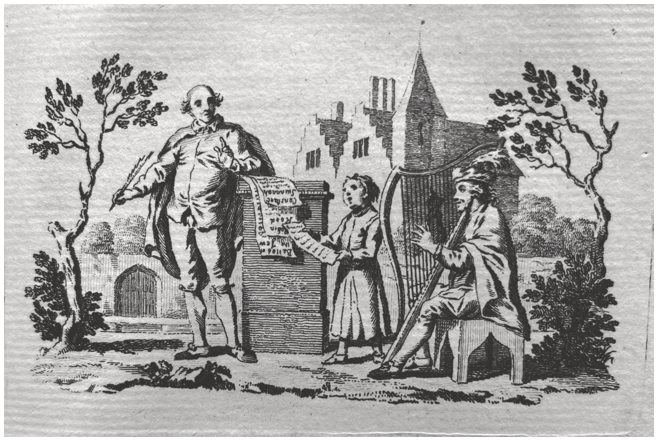
Bishop Thomas Percy (1729–1811) is responsible for bringing ballads – in general, not just theatre ballads – to intellectual prominence as a literary genre. In 1765 he published his attempt to rescue and categorise what he viewed as the best ballads of the past, the three-volume Reliques of Ancient Poetry, a collection he had been inspired to gather together when he found a servant lighting a fire with a book of ballad manuscript transcriptions. But the very title of his book, which uses the archaism ‘relique’ for ‘relic’, shows his agenda: he wished to find in ballads a relic or trace of an ancient, proud, native literature, good enough to rival classicism, but born and shaped in England.Footnote 29 The sixteen ‘Ballads that Illustrate Shakespeare’ (seventeen, if one includes Percy’s own additional pastiche) he selects for his book are part of his aim, and are chosen to prove that Shakespeare’s works were infused with native folk literature; he even speculates that ballads were sources of ‘one, if not more, of [Shakespeare’s] plays’, though which of the play and the ballad is the ‘original’ he found ‘not easy to decide’.Footnote 30 Percy instructed the artist Samuel Wale to produce an etching for the Shakespeare section of his book that would illustrate the link between Shakespeare and ballads. As he was not sure how Shakespeare interacted with ballads, however, the picture he requested was confusing. He asked Wale to depict Shakespeare standing ‘in the attitude he is represented on his Monument in Westminster Abbey’ – that is, recalling the statue executed by Peter Scheemakers for Poet’s Corner (Westminster Abbey, 1740) – but listening to a minstrel playing, accompanied by a singing boy. The resultant picture shows Shakespeare hearing a performance, beating time with one hand, and holding a quill in the other, with broadsheet ballads – ‘Ballad of the Jew’, ‘Robin Hood’, ‘Constant Suzanna’, shortened titles of ballads supplied in the Shakespeare section – flopping over the podium (where, on the statue, books are piled; see Figure I.1).Footnote 31
Samuel Wale, ‘Ballads that Illustrate Shakespeare’ in Thomas Percy, Reliques of Ancient English Poetry (1775), 1: 127
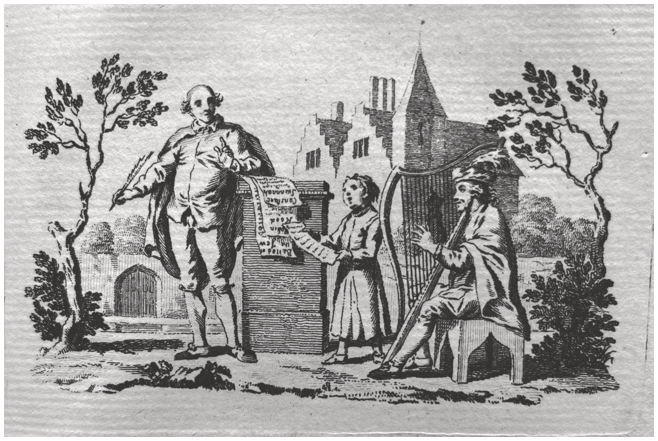
The quill confuses. Is Shakespeare here shown as a balladmaker (ballad writer), the pen in his right hand a sign that he has just composed the ballads in front of him and is ready to hand over to the performers? Or is he noting down the ballads as the child sings them and subsuming their ancient wisdom as sources for future plays or in-play songs? Or is he reading print ballads while hearing them performed, and being inspired to write plays through the process? Percy’s lack of clarity about Shakespeare is an extension of his own confusion: he had started out as an avid ballad collector and editor but ended up rewriting some of the songs to conform to what he thought they should be; sometimes, as with his final Shakespeare lyric, he wrote his own ballads altogether. ‘His’ Shakespeare is in his own muddled image, a writer-collector who may be noting, improving, or composing ballads, or using ballads to rethink literature more broadly. Percy’s uncertainty as to whether Shakespeare was author, editor or fan of ballads, problematised the very subfield he was defining.
Percy’s unearthing of a range of Shakespeare theatre ballads did, however, inspire the eminent Victorian scholar of early modern drama John Payne Collier (1789–1883) to find more ballads with Shakespeare links. When he failed to uncover enough, however, he went one further than Percy and forged them and their play connections entirely. A deeply respected Shakespearean, with access to any early modern document he wanted to examine, he doctored genuine manuscripts, muddling the field so much in the process that he still haunts it: it is not unusual to read a scholarly account of a ballad that is in fact by Collier. Of the over seventy ballads that Collier forged, often onto the blank leaves of genuine commonplace books and miscellanies of the period, are ‘about-play ballads’ like the ballad of ‘The Tragedie of Othello the Moore’, and the ballad of ‘The Atheist’s Tragedy’; and after-play ballads like ‘Tarlton’s Jig of the Horse-load of Fools’ supposedly by the clown Richard Tarlton.Footnote 32 He also forged ballad titles onto other documents in order to bring them into line with plays and counterfeit further connections between the two. Granted permission by the stationers to look at and transcribe the SR, he added fake entrances onto it for play ballads. For instance, under a genuine reference for a fine to be imposed on the stationer Thomas Millington, is a forged entry for ‘the ballad intuled [sic: entitled] The taming of a shrew. Also one other Ballad of Macdobeth’.Footnote 33 He likewise added false attributions into the SR, doctoring a genuine jig ballad by adding ‘Kempes’ in the margin (so suggesting it was by William Kempe, then clown of Shakespeare’s company).Footnote 34 Allowed to work with the ‘diary’ (largely an account book) of the theatrical entrepreneur Philip Henslowe, he added forged ballad references onto it too, inserting the words ‘or Northern Man’ by the entrance for a real play called ‘to[o] good to be trewe’, in order to associate it with a Martin Parker ballad, The King and Northern Man; he also added a play, Robin Goodfellow, to the repertory of Worcester’s Men, for the 7 and 9 September 1602 (dates Henslowe had left blank) in order to back-create its link with Goodfellow ballads.Footnote 35 The untold damage that Collier did to the field was not only in what he doctored and added, but what he took away: his need to forge ballads so comprehensively had the effect, when the extent of his fabrication was realised, of suggesting that theatre ballads do not survive in large numbers, hiding, therefore, the quantity that are extant but that do not take the form Collier wished.
I.5 Chapter Summaries
Because ballads are hard to date, Ballad Business: Selling Early Modern Theatre cannot have a tightly defined date range. It focuses on ballad texts of the early modern period, but sometimes only Restoration or even eighteenth-century examples of those early modern texts are extant: much reprinted and much lost, ballads survive when they survive, often from a period long after they first originated and sometimes in modified form. Not all plays can be easily dated either, of course: this book takes its performances dates from the ‘best guess’ of Martin Wiggins and Catherine Richardson in their magisterial British Drama. While, then, the subject of ballads and their connection to plays is incontrovertible, the nature of that connection – which was source and which was echo – is not always obvious.
As the subject of theatre ballads has not been written about in its entirety before, this book begins by defining terms and giving essential background in ‘Balladmongers’, a chapter on the performance aspect of ballads. It suggests that the place where balladmongers, the name for the singers and sellers of ballads and related chap-books, traded, at the doors of the playhouse, mirrors their threshold natures – they were often ‘outsiders’, the disabled, the migrants, the elderly, the women. They were, however, also like, and almost parodies of, actors: they performed print texts on tiny stages for money. Asking whether the threshold nature of the singers came to inflect their texts – themselves a distant paratext to plays – it concludes with an account of the way theatre ballads had a continued but ever more liminal theatre life when their purchasers (re)performed them, bringing the stage into domestic spaces where a steady rhythm was required, such as dairies, or where song was relished, such as alehouses and the home more generally.
The second chapter, ‘Publishing and Writing Ballads’, is on the print aspect of theatre ballads. It investigates who published them, who commissioned them, who paid for them and who wrote them. Asking whether stationers (publishers) sent balladmongers to market their texts at playhouses, and whether the theatre was passively or actively involved in the process of ballad sale, it explores the audience who took theatre ballads home for their print qualities: to use as wastepaper, decoration or reading matter.
The rest of the book consists of case studies of specific ballads and their playwright and play relationships. Starting with ‘in-play’ ballads, Chapter 3, ‘In-Play Ballads and More: Shakespeare’, investigates Shakespeare as a ballad writer, suggesting that he learned his poetic craft partly through penning libels, love and news ballads. As a playwright, it speculates, Shakespeare published, or allowed to have published, some of his play ballads on broadsheets; possible examples are explored from Hamlet, Othello and The Winter’s Tale.
The fourth chapter, ‘In-Play Ballads: Jonson’, considers how Ben Jonson’s print obsession seems to have led him to publish broadsheets from his play Bartholomew Fair as well as several of his masques, For the Honour of Wales, Gypsies Metamorphosed, and Masque of Augurs. Through ballads, it suggests, dramas that were themselves not performed more than a handful of times had an alternative and much longer life in paper and song form.
The fifth chapter, ‘After-Play Ballads: Jigs and More’, turns to a different kind of theatre ballad, performed inside the playhouse but when plays were over. It considers how jigs were written by a range of clowns, including Richard Tarlton, Robert Armin and William Kempe, and were often also available for print purchase; it looks at how ‘themes’ or poetic song exchanges, though not themselves printed, might nevertheless be used to enhance sales of other ballads to the same tune, and how ‘fan fiction’ ballads which take play characters and give them new songs, were produced often enough to suggest that they may themselves be jigs.
The final two chapters are on about-play ballads, another theatre ballad form. ‘About-Play Ballads: Marlowe and Others’, looks at extant and lost play ballads telling the stories of Christopher Marlowe’s Doctor Faustus, The Jew of Malta and Tamburlaine, before exploring ballads that narrate other plays from other periods and companies: William Sampson’s Vow Breaker; Anon’s The Puritan Widow; Thomas Kyd’s The Spanish Tragedy; Anon’s Arden of Faversham; Anon’s Mucedorus; Thomas Dekker, William Rowley, John Ford, John Webster’s The Late Murder in White Chapel or Keep the Widow Waking; and Thomas Heywood’s? Edward IV. Exploring ballads that are play sources, performance reflections and playbook reflections, it shows how plays and ballads were intertwined sometimes from the first, and sometimes later, but how there was always a commercial drive to bring the two together.
The final chapter, ‘About-Play Ballads: Shakespeare’ reveals that there are potentially many more ballads about Shakespeare plays than have previously been acknowledged, once it is realised that a play ballad does not necessarily tell all the story of all of the play, and might, in fan fiction fashion, focus on just a character or moment. With sections on potential play ballads, lost and extant, for Richard III, Titus Andronicus, Edward III, The Taming of the Shrew, Romeo and Juliet, Richard II, King John, The Merchant of Venice, Henry V, Troilus and Cressida, King Lear, and Antony and Cleopatra, it suggests that Shakespeare’s company may have been receptive to play ballads as part of its wider marketing, and that Shakespeare himself, the company’s resident poet, was fond of the form and knowing enough to let its benefits be exploited.
This book ultimately rethinks what plays are, because they are so often in close interaction with another genre, sometimes exploiting it, sometimes being exploited by it. Yes, the play is sometimes the founder of the literature it creates, but it is sometimes merely the response to a story more popular or lasting in another form. In restoring to prominence the musical texts that also occupied the play world, the book asks whether plays should be thought of as paratexts to ballads, as much as ballads are paratexts to plays, the two eternally bound, as this book will argue, by writers, publishers, sellers and ultimately by purchasers.