





Introduction
The trematode family Liolopidae Odhner 1912 comprises 15 species included in 5 genera. Adults of liolopid species parasitize the stomach and intestine of ectothermic tetrapods (Brooks and Overstreet, Reference Brooks and Overstreet1978; Dutton et al. Reference Dutton, DuPreez, Urabe and Bullard2022). Liolopids have been recorded from Africa (Democratic Republic of the Congo, Gabon, Mozambique, South Africa), Asia (Japan, South Korea), Australia, Central America (Panama), India, Philippines, South America (Brazil, Peru) and the United States of America [see Dutton et al. (Reference Dutton, DuPreez, Urabe and Bullard2022) and references therein]. There are only 4 liolopid adult species known from Africa (see Table 1). Of the 15 known liolopid species, molecular sequence data are available for only 4 species: Dracovermis occidentalis Brooks and Overstreet 1978, Harmotrema laticaudae Yamaguti 1933, Liolope copulans Cohn 1902 and Paraharmotrema karinganiense Dutton and Bullard in Dutton, Du Preez, Urabe and Bullard, 2022. Even less is known about the liolopid intermediate stages, their hosts and transmission pathways. The life cycle of only a single species, L. copulans, has been elucidated, and results showed that the freshwater snail, Semisulcospira libertina (Gould) (Cerithiodea: Semisulcospiridae) act as first intermediate hosts. The Japanese and Chinese giant salamanders, Andrias japonicus (Temminck) and Andrias davidianus (Blanchard) (Amphibia: Cryptobranchidae) are the natural definitive hosts (Ozaki and Okuda, Reference Ozaki and Okuda1951; Baba et al. Reference Baba, Hosoi, Urabe, Shimazu, Tochimoto and Hasegawa2011). The natural second-intermediate hosts remain unknown, though cypriniform fishes of the families Leuciscidae and Xenocyprididae were identified via experimental infection as viable intermediate hosts for this species (Ozaki and Okuda, Reference Ozaki and Okuda1951; Baba et al. Reference Baba, Hosoi, Urabe, Shimazu, Tochimoto and Hasegawa2011). To date, no complete natural life cycle for any liolopid has been elucidated.
Records of Liolopidae Odhner 1912 in Africa with respective hosts and localities

* KGR: Karingani Game Reserve; KZN: KwaZulu-Natal. Pelomedusoidea: Pelomedusidae.
Literature on digenetic trematodes in African temporary pools are limited. The only published studies were by Senghor et al. (Reference Senghor, Diaw, Doucoure, Seye, Talla, Diallo, Bâ and Sokhna2015) documenting snails as intermediate hosts in West Central Senegal, and Aisien et al. (Reference Aisien, Ayeni and Ilechie2004) on anuran trematodes in Nigeria. Along this, Barson et al. (Reference Barson, Bray, Ollevier and Huyse2008) and Nezhybová et al. (Reference Nezhybová, Reichard, Blažek and Ondračková2017) reported on metacercariae from fish hosts in Zimbabwe and Mozambique, respectively, and Dutton et al. (Reference Dutton, DuPreez, Urabe and Bullard2022) on adult digeneans recovered from chelonians in Mozambique.
Since temporary pools annually exhibit distinct dry and wet periods (Reichard et al. Reference Reichard, Janáč, Blažek, Žák, Alila and Polačik2022), the interaction of parasites and their hosts must be aligned within these temporary ecosystems to allow for parasite transmission and life cycle completion (Selbach and Paterson, Reference Selbach, Paterson, Smit and Sures2025).
During recent parasitological surveys of temporary pools in Mozambique, snails of the genus Lanistes Monfort infected with first-intermediate cercarial stages, and killifish of the genus Nothobranchius Peters harbouring metacercarial infections were collected. Given the limited knowledge on intermediate stages of trematodes in the region, the aim of the current study was to elucidate the complete life cycle based on morphological and molecular characterization of sporocysts, cercariae and metacercariae obtained from snails and fish.
Materials and methods
Sampling region
Karingani Game Reserve (KGR) spans over 100 000 km2 in Mozambique, South Africa, and Zimbabwe, with a semi-arid climate, characterized by distinct wet and dry seasons, April to October and November to March, respectively. As part of a wider assessment of biodiversity in temporary pool ecosystems in the southern section of Karingani Game Reserve (Gaza Province, southern Mozambique) (Figure 1), apple snails and killifish were collected from 8 pools during the early austral spring of 2024.
Map illustrating sampling sites inside and outside Karingani Game Reserve, southern Mozambique.

Host and parasite sampling
Snail hosts
Seventeen ampullariid snails were collected from 3 pools (P6–P8) (Figure 1), using a snail scoop, a 30 cm × 30 cm × 30 cm sweep net (1 mm mesh size) or hand-picked from the grassy emergent vegetation in pools. Snails were transported to a nearby field station in aerated bags and individually kept in containers with fresh rainwater at room temperature. There, the snails were continuously exposed to artificial light to stimulate cercarial emergence (Schwelm et al. Reference Schwelm, Selbach, Kremer and Sures2021). Each container was screened daily for emergent cercariae for a period of 3 days using a stereomicroscope. From the collected snails, 6 snails were randomly humanely killed and examined for dormant infections following Schwelm et al. (Reference Schwelm, Selbach, Kremer and Sures2021). The remaining 11 snails were kept alive and transported back to the National Aquatic Bioassay Facility (NABF) at North-West University, Potchefstroom, South Africa. Each snail was individually housed and acclimatized to artificial fresh water [150 grams (g) of sodium hydrogen carbonate and marine sea salt (Seachem® Vibrant Sea™) per 5 litres (L) of reverse-osmosis water] at a room temperature of 17.5–23°C and fed 5 mL of Selenastrum sp. microalgae twice per week. To stimulate cercarial shedding, exposure to artificial light was conducted ad hoc. Screening for cercarial emergence was continued for 38 weeks following collection. Thereafter, the snails were humanely killed and screened for intermediate stages. All intermediate stages found were preserved in 96% molecular grade ethanol and 4% neutrally buffered formalin (NBF) for molecular and morphological analyses. Tissue samples of the snail hosts were preserved in 96% molecular grade ethanol for molecular identification.
Experimental infection of fish with live cercariae
Spontaneously emerged cercariae were collected from one of the infected snails brought back to the NABF. Fifteen adult zebrafish Danio rerio (Hamilton) (Cyprinidae), bred in the NABF, were individually housed in 600 mL beakers with 500 mL aerated artificial freshwater. Zebrafish were exposed to 4 different cercarial volumes (10, 20, 40, 100 per 500 mL water) in triplicates (n = 3 fish per treatment). Four days after exposure, fish were transferred to 3.5 L Tecniplast ZebTEC tanks (n = 1 per tank). Fish were housed in a climatized room with 12:12 hour day–night cycles, temperature at 27–28°C and fed twice a day until satiation with ZM400 zebrafish feed (ZM Systems, United Kingdom). At 31 weeks post-exposure, fish were humanely killed, dissected and screened for metacercariae as described below.
Fish hosts
A total of 38 Nothobranchius spp. killifish were collected from 5 temporary pools (P1–P5), (Figure 1) using sweep nets.
Following capture, fish were placed in aerated bags with water from the respective sites, transported to the field station and temporarily held. Hereafter, fish were humanely killed using pithing followed by spinal severance, measured (total and standard lengths), weighed and photographed. The skin, fins and gills of each fish were screened for ectoparasites following Dávidová and Smit (Reference Dávidová, Smit, Scholz, Vanhove, Smit, Jayasundera and Gelnar2018) and Jurajda (Reference Jurajda, Scholz, Vanhove, Smit, Jayasundera and Gelnar2018), while all internal organs (i.e. intestine, stomach, spleen, gallbladder, heart, liver, swim bladder, eyes and brain) and body cavity were screened for endoparasites following Scholz et al. (Reference Scholz, Kuchta, Mašová, Kostadinova, Scholz, Vanhove, Smit, Jayasundera and Gelnar2018) using a Zeiss Stemi 305 compact stereomicroscope (Zeiss, Oberkochen, Germany). As Nothobranchius species are difficult to morphologically identify, a fin clip of each specimen was preserved in 96% molecular grade ethanol for molecular analysis and identification.
Morphological analyses
Cercariae and sporocysts
Live emergent cercariae from the snails were isolated from the containers in which snails were held, stained with Neutral Red, and observed using a Nikon Eclipse 80i, fitted with a Y-TV55 video camera and drawing tube attachment (Nikon Instruments, Tokyo, Japan). Video footage of their movement and swimming behaviour was also recorded. Cercariae were then preserved in 96% molecular grade ethanol for molecular analyses, and 70% ethanol or 4% NBF for morphological studies. Temporary mounts of unstained and permanent mounts of haematoxylin-stained specimens were observed using a Nikon Eclipse 80i microscope. Infected snails were crushed and sporocysts isolated from the infected tissue. Live images of the sporocysts were captured as above and specimens preserved in 96% ethanol for molecular and 4% NBF for morphological analyses. Illustrations of cercariae and sporocysts were made using the Nikon Eclipse 80i drawing tube attachment, digitized in Adobe Illustrator 29.5.1 and measured using Nikon Imaging Software (NIS) Elements BR 4.60 software.
Cercariae preserved in 70% ethanol and 4% NBF were used for Scanning Electron Microscopy (SEM). Formalin-fixed specimens were displaced twice in reverse-osmosis water each for 30 min. Following this, the specimens were dehydrated via an ethanol series to 70% ethanol. Thereafter, all cercariae were dehydrated further using a graded ethanol series and hexamethyldisilazane, mounted on aluminium SEM stubs with double sided Carbon tape, then coated in a SPI MODULE™ Sputter Coater with gold-palladium and studied using Phenom Pro Desktop SEM (Phenom World, Netherlands). The measurements for SEM were done using ImageJ software.
Metacercariae
Metacercariae were removed from dissected fish using fine needles, placed in water in a petri dish and counted. Hereafter, 10% of the total count were excysted, and the remaining encysted metacercariae were preserved in 96% molecular grade ethanol. Preserved specimens were studied using a Nikon Eclipse 80i compound microscope and morphometric measurements were made using the NIS Elements BR 4.60 software or ImageJ. Photohologenophores sensu Achatz et al. (Reference Achatz, Martens, Kudlai, Junker, Boe and Tkach2022) were captured and whole specimens were used for molecular analyses (see below).
Unless otherwise stated, all morphometric measurements are given in micrometers (µm) as means with the minimum and maximum values in parentheses. Where length follows width, measurements are separated by the symbol ‘×’. Selected permanent whole mounts of sporocysts and cercariae were submitted as vouchers to the parasitological collection of the National Museum, Bloemfontein (NMB).
Molecular analyses
Cercariae and metacercariae
Total genomic DNA from pooled samples of at least 10 morphologically similar cercariae and individual isolates of sporocysts and metacercariae were extracted. Extractions were performed using the PCRBiosystems Rapid Extract Lysis Kit (PCRBiosystems, Analytical Solutions, South Africa) following the manufacturer’s instructions, with buffer volume adjustments to 10 and 5 µL for Buffer A and Buffer B, respectively, and 200 µL molecular grade water for the final dilution.
For PCR amplification of the partial D1–D3 fragment of 28S ribosomal DNA (rDNA), ITS2 rDNA and the cytochrome oxidase I mitochondrial region (COI mtDNA), were performed with reaction solutions composed of 12.5 µL DreamTaq™ Hot Start Green PCR Master Mix 2 × (Thermo Fisher Scientific Baltics UAB, Lithuania), 1.25 µL of each primer (10 µM), 2 µL (28S rDNA), 3 µL (ITS2) or 4 µL (COI mtDNA) of DNA template, made up with molecular grade water to 25 µL for 28S rDNA and 20 µL for ITS2 rDNA and COI mtDNA regions. The 28S rDNA region was amplified using primers Digl2 (5’-AAG CAT ATC ACT AAG CGG- 3) (Tkach et al. Reference Tkach, Grabda-Kazubska, Pawlowski and Swiderski1999) and 1500 R (5’-GCT ATC CTG AGG GAA ACT TCG-3’) (Snyder and Tkach, Reference Snyder and Tkach2001). The PCR thermal cycling conditions for metacercariae followed Tkach et al. (Reference Tkach, Littlewood, Olson, Kinsella and Swiderski2003), while adjustments of the initial denaturation and subsequent denaturation steps to 95°C for 5 min and 30 sec were implemented for amplification of sporocysts and cercariae. The primer set 3S (5’-GGT ACC GGT GGA TCA CGT GGC TAG TG-3’) (Morgan and Blair, Reference Morgan and Blair1995) and ITS2.2 (5’-CCT GGT TAG TTT CTT TTC CTC CGC-3’) (Cribb et al. Reference Cribb, Anderson, Adlard and Bray1998) following the thermal profile provided by Yong et al. (Reference Yong, Cutmore, Miller, Wee and Cribb2016) was used for amplification of the ITS2 rDNA region for cercariae and metacercariae.
The forward primer Dice1F (5’-ATT AAC CCT CAC TAA ATT WCN TTR GAT CAT AAG-3’) and reverse primer Dice14R (5’-TAA TAC GAC TCA CTA TAC CHA CMR TAA ACA TAT GAT-3’) (van Steenkiste et al. Reference van Steenkiste, Locke, Castelin, Marcogliese and Abbott2015) was used to amplify the COI mtDNA gene region. PCR conditions followed that of van Steenkiste et al. (Reference van Steenkiste, Locke, Castelin, Marcogliese and Abbott2015), with an initial denaturation time adjusted to 4 min, an annealing temperature adjusted to 51°C and a final extension time adjusted to 10 min for both cercariae and metacercariae. For sporocysts, initial denaturation temperature and time were adjusted to 95°C and 2 min, the subsequent denaturation times to 30 sec, and the annealing temperature and time to 50°C and 30 sec.
The resulting amplicons were visualized on a 1% agarose gel electrophoresis with added 0.01% v/v SafeView™ Classic (Applied Biological Materials, Canada). Positive amplicons were sent to Inqaba Biotechnical Industries (Pty) Ltd (Pretoria, South Africa) for purification and Sanger cycle sequencing. Both forward and reverse DNA strands were sequenced with the respective amplification primers, with additional internal primers 300 F (5’-CAA GTA CCG TGA GGG AAA GTT G-3’) (Littlewood et al. Reference Littlewood, Curini-Galletti and Herniou2000) and ECD2 (5’-CTT GGT CCG TGT TTC AAG ACG GG-3’) (Littlewood et al. Reference Littlewood, Rohde and Clough1997) for the 28S rDNA region.
Host identification
Total genomic DNA was isolated from snail foot tissue and fish fin clips of each host individual using the NucleoSpin® Tissue extraction kit (Macherey-Nagel, Germany) following the manufacturer’s instructions. For fish, the COI mtDNA region was amplified using primers FISHCO1LBC (Fish-BCL) (5’-TCA ACY AAT CAY AAA GAT ATY GGC AC-3’) (Baldwin et al. Reference Baldwin, Mounts, Smith and Weigt2009) and FISHCO1HBC (Fish-BCH) (5’-ACT TCY GGG TGR CCR AAR AAT CA- 3’) (Handy et al. Reference Handy, Deeds, Ivanova, Hebert, Hanner, Ormos, Weigt, Moore and Yancy2011), and for snails, the universal primers LCO1490 (5’-GGT CAA CAA ATC ATA AAG ATA TTG G-3’) and HCO2198 (5’-TAA ACT TCA GGG TGA CCA AAA AAT CA-3’) (Folmer et al. Reference Folmer, Black, Hoeh, Lutz and Vrijenhoek1994) were used. For both snails and fish, PCRs were performed in 25 µL aliquots. The PCR for the Nothobranchius sp. comprised 10.5 µL PCR grade water, 0.5 µL of each primer (10 µM), 12.5 µL 2 × MyTaq HS Mix (Bioline), and 1 µL of DNA template. The thermal cycling profile of Christiansen et al. (Reference Christiansen, Fournier, Hellemans and Volckaert2018) was followed with an initial denaturation time of 1 min, a denaturation time of 15 sec, an annealing time of 10 sec, and extension and final extension times of 10 sec and 5 min, respectively.
Amplicons for the fish hosts were visualized on a 1.2% agarose gel electrophoresis, purified using CleanPCR (CleanNA, Netherlands) with a 0.8 × reaction volume of CleanPCR used instead of 1.8 ×. The plate incubation time was adjusted to 1 min after the second 70% ethanol wash step and PCR-grade water was used in place of elution buffer, and incubation of the plate at room temperature for 5 min instead of 2–3 min for elution. The purified amplicons were sent to Macrogen Europe Order System (Macrogen Europe, Amsterdam, Netherlands) for sequencing using the same primers used for amplification. For the amplification reaction of snail COI mtDNA, 7 µL of PCR grade water, 1.25 µL of each primer (10 µM) and 12.5 µL of DreamTaq™ Hot Start Green PCR Master Mix 2 × were used. The thermal cycling profile followed that of Popa et al. (Reference Popa, Marariu and Popa2007). Resulting amplicons were visualized and sequenced following the same protocol as described for cercariae and metacercariae.
Genetic distance analyses
Raw sequences were used to construct contiguous consensus sequences using Geneious Prime v. 11.0.20.1 (Kearse et al. (Reference Kearse, Moir, Wilson, Stones-Havas, Cheung, Sturrock, Buxton, Cooper, Markowitz, Duran, Thierer, Ashton, Meintjes and Drummond2012)). A comparative search was conducted with the consensus sequences using NCBI BLAST® (blastn suite) to identify congeneric or conspecific sequences for the snail and fish hosts, as well as sporocysts, cercariae and metacercariae. Genetic distance analyses of the host sequences centred solely on the COI mtDNA region, and for sporocysts, cercariae and metacercariae, sequences centred on the partial 28S rDNA and ITS2 rDNA regions, with the COI mtDNA region only being used to verify species identity and level of intraspecific variation, if any. Partial 28S rDNA, ITS2 rDNA and COI mtDNA sequences for sporocysts, cercariae and metacercariae were aligned with those of the Liolopidae retrieved from GenBank (Tables 2, 3 and 4) using Multiple Alignment Fast Fourier Transform (MAFFT) (Katoh et al. Reference Katoh, Misawa, Kuma and Miyata2002; Katoh and Standley, Reference Katoh and Standley2013), available in Geneious Prime, under default parameters. Sequence alignments were constructed with 10 28S rDNA, 6 ITS2 rDNA and 10 COI mtDNA sequences from this study and congeners retrieved from GenBank (Tables 2–4). Final alignments were manually trimmed and resulted in lengths of 659 bp (COI) and 858 bp (COI) for snails and fishes, respectively, 1308 bp (28S), 508 bp (ITS2) and 764 bp (COI) for sporocysts, cercariae and metacercariae.
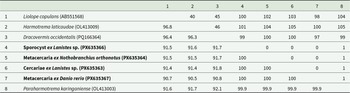
Nucleotide comparison of the partial 28S rDNA sequences of sporocysts, cercariae and metacercariae of Paraharmotrema karinganiense collected during the present study, based on 1,308 bp-long alignment. Bottom diagonal percentage (%) of bases/residues which are identical, top diagonal number of bases/residues which are not identical. Sequences generated in the present study are in bold

Nucleotide comparison of the partial ITS2 rDNA sequences of cercariae and metacercariae of Paraharmotrema karinganiense collected during the present study, based on 508 bp-long alignment. Bottom diagonal percentage (%) of bases/residues which are identical, top diagonal number of bases/residues which are not identical. Sequences generated in the present study are in bold

Nucleotide comparison of the partial COI mtDNA sequences of sporocysts, cercariae and metacercaria of Paraharmotrema karinganiense collected during the present study, based on 764 bp-long alignment. Bottom diagonal percentage (%) of bases/residues which are identical, top diagonal number of bases/residues which are not identical. Sequences generated in the present study are in bold

Results
General results
A total of 17 snails representing Lanistes sp. from 3 localities and 38 killifish representing Nothobranchius sp. from 4 of the 5 localities were collected, dissected and subjected to parasitological examination. Parasites were found on the body surface, fins, opercula and the tongue of the killifish.
For snail identification, the ampullariid snail species were preliminary morphologically identified as Lanistes ovum Troschel. However, the NCBI BLAST® (blastn suite) search resulted in the closest similarity of 90.26% to Lanistes nyassanus Dohrn. A comparative analysis of partial COI mtDNA regions conducted with representative Lanistes spp. sequences retrieved from GenBank and this study’s sequences resulted 90.1% and 90.3% identical base pairs to Lanistes sp. and L. nyassanus from Malawi, respectively (Supplementary Table 1). Therefore, based on both morphological and molecular data generated, it can be confirmed that the snail species from this study has not been sequenced before, and is, given the degree of variation among existing sequences and molecularly uncharacterized species of Lanistes, designated as Lanistes sp. Two new partial COI mtDNA sequences of 628–637 bp were generated for this study’s Lanistes sp. (GenBank PX568652 and PX568653).
Of the 11 snails brought back to the NABF, 2 shed furcocercaria-type trematodes. The 1 snail shed 9 days after collection, and the second snail had its first shedding event 3 months following collection. The first snail shed cercariae for only 1 week during its entire time at the NABF, releasing approximately 200 cercariae. The second snail retained potential cercarial emergence as it only shed 3 months after collection and exhibited an ‘on/off’ shedding regime, following small cercarial bursts (n = 1–4) ad hoc followed by 1-month of no shedding (halt) in between. Four months after collection, this snail shed an excess of more than 500 cercariae within 1 week, followed by a great reduction in cercarial numbers as the snail got older until humanely killed. The only cercariae shed was furcocercaria type. The cercariae were propelled by the tail and furcae in an inverted position. The cercarial swimming activity was stereotypical, occurring intermittently from an upward-directed burst movement followed by a passive sinking phase.
Of the 6 snails collected and screened in the field, 1 was infected with furcocercariae. In addition, 1 of 2 snails returned to the NABF was screened after shedding had ceased and yielded more than 100 daughter sporocysts.
Molecular sequencing analysis of the COI mtDNA region confirmed the fish as Nothobranchius orthonotus Peters (Supplementary Table 2). Comparison to other N. orthonotus sequences revealed 95.7–99.8% identical base pairs, with 1–26 bp differences, with this study’s sequence revealing 1 base pair difference and 99.8% identical base pairs to N. orthonotus (JN021649). One new partial COI sequence for N. orthonotus of 654 bp was generated (GenBank PX568659).
From the 38 N. orthonotus killifish screened, 26 were infected with digenean trematodes belonging to 4 different metacercarial families: Diplostomidae, Echinochasmidae, Microphalloidea and Liolopidae (results on the Diplostomidae, Echinochasmidae, Microphalloidea will be published elsewhere). Of these, 1 N. orthonotus specimen had a single encapsulated metacercaria on the body surface (head region) identified as a species of the Liolopidae. Of the 15 zebrafish exposed to 4 different cercarial concentrations, single metacercaria were recovered from the caudal fins of 2 individuals exposed to the highest cercarial concentration (100 c/500 mL).
Molecular sequencing results
The sporocysts, cercariae and metacercariae sequences generated in this study were first compared to each other, then with previously submitted liolopid sequences. The sequences of sporocysts, cercariae and metacercariae from this study were 100% identical with no base pair differences for 28S rDNA region. For the ITS2 rDNA region, only cercariae and metacercaria sequence data from experimentally infected D. rerio were generated and sequences of this study were 100% identical with no base pair differences. As all the sequences were 100% identical, only one representative sequence of each isolate was used for the respective comparisons (Tables 2 and 3). The sequences from this study were 99.9% identical to the previously described adult of P. karinganiense with 1 base pair difference for 28S rDNA (Table 2) and 100% identical with no base pair differences for ITS2 rDNA (Table 3). For COI mtDNA region, there were very small variabilities. For cercariae from the two snail hosts, isolates were 98.7–100% identical with 2–9 bp differences (Table 4). Between the sporocyst, cercariae and metacercariae, the sequences were 98.6–100% identical with 1–11 bp differences. This intraspecific variation is considered acceptable. With all molecular data generated when compared to adult, P. karinganiense, there was only a single base pair and no base pair difference in the 28S and ITS2 rDNA regions, respectively. Based on the analyses of the above gene regions the sporocysts, cercariae and metacercariae is considered to represent the intermediate stages of P. karinganiense. There are no comparative COI mtDNA sequences available for P. karinganiense.
The combination of morphological and molecular sequence analyses confirms that all sporocysts, cercarial and metacercarial infections from this study belong to the same liolopid species: P. karinganiense. The intermediate stages are characterized below.
Paraharmotrema karinganiense Dutton and Bullard in Dutton, Du Preez, Urabe and Bullard, 2022
Type localities: Karingani Game Reserve, Mozambique and KwaZulu-Natal, South Africa.
Adult hosts: Serrated hinged terrapin, Pelusios sinuatus (Smith); East African black mud turtle, Pelusios subniger (Bonnaterre) and South African helmeted terrapin, Pelomedusa galeata (Schoepff) (Chelonia: Pelomedusidae).
First intermediate host: Lanistes sp.
Site of infection: Unknown.
Locality: Temporary pools, southern Mozambique.
Prevalence: 3 of 17 snails (18%).
Second intermediate host: Spotted killifish, Nothobranchius orthonotus Peters (Cyprinodontiformes: Nothobranchiidae); Zebra danio, Danio rerio (Hamilton) (Cypriniformes: Cyprinidae) via experimental infection.
Site of infection: Encapsulated metacercariae on the body surface (head region) of N. orthonotus or on caudal fins of D. rerio.
Prevalence: 1 of 38 specimens of N. orthonotus infected with 1 metacercaria; 2 of 15 D. rerio individuals each infected with 1 metacercaria.
Representative DNA sequences: 28S rDNA, 10 identical sequences generated, 3 sporocysts ex Lanistes sp. (GenBank PX635366, PX635371, PX635372), 4 cercariae (pooled) ex Lanistes sp. (GenBank PX635363, PX635368, PX635369, PX635370), 1 metacercaria ex N. orthonotus (natural host) (GenBank PX635364), 2 metacercariae ex D. rerio (experimental hosts) (GenBank PX635365, PX635367). Six identical sequences for ITS2 rDNA generated, 5 cercariae (pooled) ex Lanistes sp. (GenBank PX635373, PX635374, PX6353745, PX6353746, PX6353747), 1 metacercaria ex D. rerio (experimental host) (GenBank PX635378). A total of 10 sequences for COI mtDNA generated, 1 sporocysts ex Lanistes sp. (GenBank PX578839), 5 cercariae (pooled) ex Lanistes sp. (GenBank PX578833, PX5788334, PX5788335, PX5788336, PX5788337), 1 metacercaria ex N. orthonotus (natural host) (GenBank PX578838), 1 sequence of N. orthonotus (GenBank PX568659) and 2 sequences of Lanistes sp. (GenBank PX568652, PX5686523).
Voucher material: Whole mounted haematoxylin-stained specimens, 5 sporocysts, NMB-P 1277-1281; and 15 cercariae, NMB-P 1258-1276.
Description of daughter sporocysts (Figure 2)
Based on 5 haematoxylin-stained whole-mounts, sporocyst bodies 3471 (2758–4657) long × 261 (209–327) wide, elongate and allantoid-shaped, thin-walled, variously and irregularly constricted 74 (40–150), containing numerous germ balls and cercariae in varying stages of development, with 4–16 well-developed present in sporocyst (Figure 2). Birth pore opening and excretory system not observed.
Drawing of whole mounted Paraharmotrema karinganiense 2022 daughter sporocyst found in naturally infected snail, Lanistes sp. Scale bar: 50 µm.

Description of cercariae (Figures 3–5A)
Based on 15 haematoxylin-stained and 5 unstained glycerol-mounted cercariae from naturally infected Lanistes sp.
Cercaria 617 (524–678) long including tail; eye-spots and fin folds absent (Figure 3). Body 185 × 62 (149–208 × 55–78) elongate, ovoid, 3 times longer than wide, broadest at level of ventral sucker (Figures 3 and 4A). Oral sucker (OS) 48 (41–55) × 37 (33–41), pyriform shape (Figure 3), antero-terminal, densely spined, lacking stylet, bearing sensory papillae (Figure 4B). Sensory papillae with sensilla observed near bodily anterior extremity, on dorsal and ventral head region (Figure 4B). Pharynx 21 (19–23) × 19 (17–22), globular, well-muscularized with no pre-pharynx observed (Figure 3). Oesophagus 27 (16–40) clearly visible only in stained specimens, short, narrow sinuous, bifurcating into paired caeca (Figure 3). Caeca form obcordate shape, arms 49 (34–64) long, thick-walled, ends bulbous, extend past posterior region of ventral sucker (Figure 3). Potential penetration glands, long, narrow, from oral sucker to beyond the posterior margin of the ventral sucker (Figure 3). Genital primordium 31 (25–42) × 34 (21–38), transversely irregular mass of cells, posterodorsal to ventral sucker, located in posterior third of body (Figure 3). Ventral sucker 34 (30–37) × 36 (34–39) prominent, spherical, located in posterior third of body extending towards mid-region of body, covered in dense concentric spines 1.8 (1.5–2.2) long, with minimum of 2 inward-pointing spinal rows on periphery of aperture (Figure 4C). Seven papillae with sensilla present, 5 on edge of ventral sucker and 2 posterior to the ventral sucker (Figure 4C). Excretory bladder 16 (11–24) × 13 (8–19), sub-spherical, extends from body into anterior end of tail stem, forming central caudal excretory canal (Figure 3). Distinct invagination at posterior extremity forming caudal ‘pocket’ accommodating base of tail stem (Figure 4D). Tail stem 242 × 43 (216–263 × 34–61), cylindrical (Figure 3), originates from caudal pocket without collar (Figure 4D). Tail 432 (375–494), 2 times longer than body, bifurcate, densely striated muscle fibres on both sides of tail stem, densely populated throughout by spherical to irregularly oblong caudal bodies scattered throughout tail stem and furcae (Figure 3). Tegumental spines single-pointed, flattened, long and densest across anterior region 1.3 (1.1–1.7), becoming shorter and sparse 1.1 (0.9–1.6) to absent from mid- to posterior region of body approaching tail stem (Figure 4A), then more profuse again on the dorsal side of tail stem to level of caudal bifurcation (Figure 4E), thereafter limited to outer edge of furcae (Figure 4F). Sensory papilla with sensilla on tail stem with no specific pattern (Figure 4F inset). Caudal excretory canal medial, bifurcates before tail bifurcation, secondary canals extending into both caudal furcae (Figure 3). Excretory pores terminal at both ends of caudal furcae (Figures 3 and 4G). Furcae 217 (190–255) laterally flattened and paddle-like (Figure 4G), relatively longer than body, slightly shorter than the tail stem. Spherical granules towards posterior region of body appear singularly, in pairs or groups of 3 on either side below ventral sucker (Figure 5A).
Ventral illustration of Paraharmotrema karinganiense 2022cercariae shed by Lanistes sp. Scale bar: 25 µm. Oral sucker (OS), pharynx (PH), oesophagus (OES), gland cells (GC), caeca (CC), ventral sucker (VS), penetration glands (PG), genital primordium (GP), excretory bladder (EB), caudal excretory vessel (CEV), muscle striations (MS), caudal bodies (CB) and excretory pore (EP).

Scanning electron micrographs of Paraharmotrema karinganiense 2022cercariae shed from Lanistes sp. Scale bars: A 30 µm, B, C, D, F, G 10 µm, E 20 µm, inset 8 µm. (A) Cercarial body; (B) Anterior region illustrating spines on and around oral sucker, arrows show sensory nodes; (C) ventral sucker of the cercaria, arrow showing sensory nodes; (D) sensory nodes on the tail stem, large arrow shows caudal pocket, medium arrow shows sensory node, small arrows show tail spines; (E) spines on the tail stem following the bifurcation; inset shows sensory papillae on the tail stem; (F) spines on edges of the furcae; (G) excretory pore on the tip of the furcae.

Light microscopy of Paraharmotrema karinganiense 2022cercariae and metacercariae. Scale bars: A 25 µm, B, C, D 50 µm. (A) granules occurring singularly, in pairs or groups of 3 in cercariae; (B) whole encapsulated metacercariae with mass of cells; (C) oral sucker and pharynx on anterior end, (D) ventral sucker on posterior end of metacercariae.

Remarks
Based on the absence of a stylet on the oral sucker, lack of fin folds and eye-spots, and the presence of a pharynx, a ventral, oral sucker, tail bifurcation and furcae slightly shorter, but not less than half the length of the tail stem, the cercariae of P. karinganiense is considered a longifurcate-pharyngeate distome furcocercous cercariae.
Metacercariae (Figure 5B–D)
In general, the metacercaria is 2 × longer than wide, 2244 × 1332, ovoid shape and consists of a mass of cells in the proximal region, oral sucker 290 × 408, pharynx 134 × 160, ventral sucker 350 × 388 and a lack of pre-pharynx was noted in the metacercaria excised from D. rerio.
Discussion
To elucidate the life cycle of P. karinganiense, this study focused on morphologically and molecularly characterizing the sporocysts and cercariae from the Lanistes sp. snail hosts, and the metacercariae from naturally infected, N. orthonotus, and experimentally infected D. rerio fish hosts. Molecular comparisons to representatives of the Liolopidae and morphological comparisons with intermediate stages from the only other known liolopid life cycle of L. copulans, were conducted. Based on the COI mtDNA data generated in this study, caution is advised when using the COI mtDNA gene region solely as a bar code for snail species identification, as intraspecific variation should be carefully considered. The COI mtDNA region is best when used in conjunction with other genetic markers, such as the conserved ribosomal regions like 28S rDNA and ITS2 rDNA, especially when considering new or cryptic species.
Differential diagnosis
The sporocyst of L. copulans is characterized as elongate, with no referral measurements for length or width. Whereas the sporocyst for P. karinganiense 3471 × 261, allantoid shape with constrictions much larger than L. copulans. There are a lot less cercariae present in P. karinganiense sporocysts than L. copulans.
The only morphological descriptions of intermediate stages currently available for the Liolopidae are those of the cercariae and metacercariae of L. copulans (Baba et al. Reference Baba, Hosoi, Urabe, Shimazu, Tochimoto and Hasegawa2011). Based on molecular sequence analyses, this study determined that the cercarial and metacercarial stages found in Lanistes sp. and N. orthonotus, respectively, belong to P. karinganiense. It is the first report of a liolopid metacercaria in a species of Nothobranchius killifish. Due to the underdeveloped state of metacercariae, only limited morphological observations could be performed on the 3 metacercariae collected from N. orthonotus and D. rerio, consequently; no thorough comparison could be made with the description of Baba et al. (Reference Baba, Hosoi, Urabe, Shimazu, Tochimoto and Hasegawa2011). Nevertheless, the ovoid shape of P. karinganiense metacercaria differs from that of the globular L. copulans, and the absence of a pre-pharynx could be noted in the newly collected specimens, in contrast with metacercaria of L. copulans.
Cercariae of P. karinganiense differs from those of L. copulans in lacking a pre-pharynx and having long obcordate caeca with bulbous ends extending past the posterior margin of the ventral sucker. There is no plug-like structure at the anterior end of the oesophagus in P. karinganiense cercariae, and multiple sensory nodes on the anterior end of the body, with 5 nodes on the ventral sucker and sensory hairs on the tail stem. Cercariae of P. karinganiense potentially have penetration glands, but these could not be clearly observed while the penetration glands are absent in L. copulans cercariae. Tegumental spine density of the cercarial body also differs between the two species, with spines of P. karinganiense cercariae being dense on the anterior end of the body, sparser towards the mid-region and absent from the mid-region towards the posterior end of the body. The tail stem has sparsely distributed spines, which become denser on the edges of the furcae in contrast to an entirely densely spinose L. copulans. The tegumental spines on the anterior head region are slightly shorter (max of 1.7) in contrast to those of L. copulans of 2 µm. In L. copulans cercariae, large gland cells have been reported lateral to the caeca (described as the ‘intestine’ by Baba et al. Reference Baba, Hosoi, Urabe, Shimazu, Tochimoto and Hasegawa2011) on either side of the body, whereas in P. karinganiense cercariae 2 pairs of large preacetabular glands occur alongside the caeca, a feature absent in L. copulans. In the cercariae of L. copulans, Baba et al. (Reference Baba, Hosoi, Urabe, Shimazu, Tochimoto and Hasegawa2011) reports that one of the most prominent morphological features of the Liolopidae is a complex excretory vesicle described as ‘V-shaped, with looping arms and swollen at posterior base’. This feature was not observed in the cercariae of P. karinganiense and neither observed nor mentioned in the adults (see Dutton et al. Reference Dutton, DuPreez, Urabe and Bullard2022). Spherical granules are present in the posterior end of the body of P. karinganiense cercariae, interpreted here as excretory concretions that reside within the excretory vesicle (see Baba et al. Reference Baba, Hosoi, Urabe, Shimazu, Tochimoto and Hasegawa2011), although the vesicle itself was not observed in specimens studied.
Life cycle of Paraharmotrema karinganiense and host use within the Liolopidae
Species of only 2 of 5 liolopid genera have cercarial and metacercarial records (Baba et al. Reference Baba, Hosoi, Urabe, Shimazu, Tochimoto and Hasegawa2011, this study). This study is the first to elucidate the life cycle of the single species of Paraharmotrema, P. karinganiense. In this life cycle, Lanistes sp. is the first intermediate host, while a N. orthonotus appears as a natural second intermediate host (and D. rerio as an experimental host) and terrapins and turtles as definitive hosts, specifically P. sinuatus, P. subniger and P. galeata (see Dutton et al. Reference Dutton, DuPreez, Urabe and Bullard2022). As mentioned previously, Baba et al. (Reference Baba, Hosoi, Urabe, Shimazu, Tochimoto and Hasegawa2011) reported the only known complete life cycle for a species of Liolope (i.e. L. copulans), which involves the fully aquatic S. libertina as the first-intermediate host (see Baba et al. Reference Baba, Hosoi, Urabe, Shimazu, Tochimoto and Hasegawa2011), cypriniform fishes as second-intermediate hosts (experimental), and Asian salamanders, A. japonicus and A. davidianus in Japan and China, respectively. These two life cycles allow inferences on intermediate host use in the Liolopidae. It is thus plausible that species of the remaining three genera (i.e. Dracovermis Brooks and Ovrstreet 1978, Harmotrema Nicoll 1914 and Helicotrema Odhner 1912), for which no life cycle data are available besides their definitive hosts, follow similar life cycle histories to L. copulans and P. karinganiense: an ampullariid or semisulcospirid aquatic caenogastropod as the first-intermediate host, a cyprinodontiform or cypriniform fish as a second-intermediate host, and various piscivorous reptile groups as definitive hosts: alligators (Brooks and Overstreet, Reference Brooks and Overstreet1978), crocodiles (Mehra, Reference Mehra1936; Tubangui and Masiluñgan, Reference Tubangui and Masiluñgan1936; Baylis, Reference Baylis1940; Brooks and Overstreet, Reference Brooks and Overstreet1978; Scott et al. Reference Scott, Simcik and Craig1997) and gharials (Mehra, Reference Mehra1936; Brooks and Overstreet, Reference Brooks and Overstreet1978) for Dracovermis; water snakes (Nicoll, Reference Nicoll1914), sea kraits (Yamaguti, Reference Yamaguti1933; Telford, Reference Telford1967; Brooks and Overstreet, Reference Brooks and Overstreet1978; Choe et al., Reference Choe, Kim, Kim, Lee, Kim and Eom2020; Dutton et al. Reference Dutton, DuPreez, Urabe and Bullard2022), sea snakes (Tubangui and Masiluñgan, Reference Tubangui and Masiluñgan1936; Fischthal and Kuntz, Reference Fischthal and Kuntz1967; Chattopadhyaya, Reference Chattopadhyaya1970; Brooks and Overstreet, Reference Brooks and Overstreet1978) and turtles (Numdi and Aisien, Reference Numdi and Aisien2021) for species of Harmotrema; and iguanas (Diesing, Reference Diesing1850; Odhner, Reference Odhner1912; Travassos, Reference Travassos1928; Ávila and Da Silva, Reference Ávila and Da Silva2011; Julca et al. Reference Julca, Casas, Chavera, Sánchez, Sánchez and Batalla2014), tortoises and turtles (Diesing, Reference Diesing1850) for species of Helicotrema.
The Ampullariidae is a family of semi-aquatic freshwater apple snails found in or near various aquatic habitats (El-Zeiny et al. Reference El-Zeiny, Ghoneim, Abu Samak and Khidr2021). These snails are predominantly distributed in humid tropical and sub-tropical habitats in Africa, Asia, and South- and Central America. Records of digeneans infecting species of Lanistes are scarce, as only three studies have reported such infections. Single-tailed cercariae belonging to unidentified species of Lecithodendrium Looss 1896 (Microphalloidea: Lecithodendriidae) and Haematoloechus Looss 1899 (Plagiorchioidea: Haematoloechidae) were reported from L. ovum and Lanistes lybicus (Morelet) in Burkina Faso (Sinaré et al. Reference Sinaré, Kafando, Gnémé, Thiombiano, Soubeiga, Bagayan and Boungou2023); single-tailed cercariae belonging to unidentified species of Echinochasmus Dietz, 1909 (Echinostomatoidea: Echinochasmidae) and Phaneropsolus Looss 1899 (Microphalloidea: Phaneropsolidae) were reported from Lanistes boltenianus (Röding) (as Lanistes carinatus Olivier) in Egypt (El-Zeiny et al. Reference El-Zeiny, Samak, Fahmy and Khidr2025); and virgulate xiphidiocercariae and amphistome cercariae, both known as single-tailed (e.g. Frandsen and Christensen, Reference Frandsen and Christensen1984; Flowers, Reference Flowers1996; Martin and Cabrera, Reference Martin and Cabrera2018), were reported from Lanistes varicus (Müller) in Nigeria (Anorue et al. Reference Anorue, Onyeka and Anyanwu2021). This study’s snail species morphologically resembled L. ovum, which has been previously documented from Mozambique (Brown, Reference Brown1961; Koudenoukpo et al. Reference Koudenoukpo, Odountan, Van Bocxlaer, Sablon, Chikou and Backeljau2020), However, identification to species level of the Lanistes sp. from the present study require further investigation, since molecular confirmation could only be done to genus level with closest congeners being two species of Lanistes from Malawi and not to L. ovum previously reported from Mozambique (Supplementary Table 1 and Schultheiß et al. Reference Schultheiß, Van Bocxlaer, Wilke and Albrecht2009). This study is the first report of the Liolopidae using a species of Lanistes as an intermediate host, as well as the first description of a fork-tailed cercaria from a species of that genus.
Ecology and transmission of Paraharmotrema karinganiense in temporary pool ecosystems
Temporary pools are highly variable and complex systems that undergo radical changes as they have alternating wet and dry phases (de Necker et al. Reference De Necker, Manfrin, Ikenaka, Ishizuka, Brendonck, Van Vuren, Sures, Wepener and Smit2020; Muñoz-Campos et al. Reference Muñoz-Campos, Valdez-Carbajal and Domínguez-Castanedo2022). As reported by Nezhybová et al. (Reference Nezhybová, Reichard, Blažek and Ondračková2017), pools are ideal habitats for parasitological research because they are well delineated, limited in size, typically well replicated, and exhibit variable environmental conditions. These characteristics provide valuable insight into how parasite communities are affected in fluctuating habitats.
According to Vanschoenwinkel et al. (Reference Vanschoenwinkel, Hulsmans, De Roeck, De Vries, Seaman and Brendonck2009), de Necker et al. (Reference De Necker, Manfrin, Ikenaka, Ishizuka, Brendonck, Van Vuren, Sures, Wepener and Smit2020) and Muñoz-Campos et al. (Reference Muñoz-Campos, Valdez-Carbajal and Domínguez-Castanedo2022), aquatic organisms inhabiting these temporary pools must complete their life cycles by developing specific life-history adaptations, as also exemplified by the Nothobranchius killifish. These killifish sexually mature within 2 weeks after hatching and produce drought-resistant diapausing eggs that survive throughout the dry period (Bartáková et al. Reference Bartáková, Nagy, Polačik, Blažek, Lamtane and Reichard2020; Muñoz-Campos et al. Reference Muñoz-Campos, Valdez-Carbajal and Domínguez-Castanedo2022).
During the dry phase, parasite abundance, diversity, survival, and infection success can be significantly affected (Paull and Johnson, Reference Paull and Johnson2018; Lymbery et al. Reference Lymbery, Lymbery and Beatty2020). These cascading effects are expected to influence parasite transmission, potentially altering host–parasite interactions (Lymbery et al. Reference Lymbery, Lymbery and Beatty2020). Such alterations particularly impact parasites with complex life cycles that require multiple intermediate hosts. When pools dry up, (aquatic) habitat loss and reduced host diversity occur (Lymbery et al. Reference Lymbery, Lymbery and Beatty2020).
As a result of these drying events, parasites have evolved traits that enhance their survival, including synchronizing their life cycles with flooding or desiccation events, forming dormant, drought-resistant propagules, or utilizing hosts that migrate to other aquatic habitats (Warburton, Reference Warburton2020; Parietti et al. Reference Parietti, Merlo and Etchegoin2021). This adaptive response may involve parasites sensing environmental or host cues that signal changes in conditions, thereby adjusting their fitness and life-history strategies accordingly (Parietti et al. Reference Parietti, Merlo and Etchegoin2021; Selbach and Paterson, Reference Selbach, Paterson, Smit and Sures2025). Similarly, Kremnev et al. (Reference Kremnev, Gonchar, Krapivin, Uryadova, Miroliubov and Krupenko2021) reported that some parasites truncate their life cycles to mitigate the impacts of climate change, demonstrating a degree of life-cycle plasticity (Parietti et al. Reference Parietti, Merlo and Etchegoin2021).
Apple snails have adjusted to the often short and variable hydroperiod (filling phase) of temporary pools, as some snail species are known to aestivate by burrowing in the mud and vegetation when pools dry out (Hayes et al. Reference Hayes, Burks, Castro-Vazquez, Darby, Heras, Martín, Qiu, Thiengo, Vega, Wada, Yusa, Burela, Cadierno, Cueto, Dellagnola, Dreon, Frassa, Giraud-Billoud, Godoy, Ituarte, Koch, Matsukura, Pasquevich, Rodriguez, Saveanu, Seuffert, Strong, Sun, Tamburi, Tiecher, Turner, Valentine-Darby and Cowie2015). The intermittent presence of water within temporary pool ecosystems implies that free-living parasitic stages, such as cercariae, must complete their development and transmission within limited time frames before the pools dry out (Gsell et al. Reference Gsell, Biere, de Boer, de Bruijn, Eichhorn, Frenken, Geisen, van der Jeugd, Mason-Jones, Meisner, Thakur, van Donk, Zwart and van de Waal2022). While there are no publications reporting on cercarial infection duration in species of Lanistes, the exposure experiment in this study revealed that first-stage liolopid infections can last more than 6 months in the laboratory. Therefore, it is possible that in the wild, P. karinganiense sporocysts become dormant when Lanistes sp. aestivate and re-start cercarial production as their gastropod host re-emerges under favourable conditions. This study further revealed that cercarial shedding start with minute numbers of cercariae, followed by a burst of hundreds of individuals, then gradually decrease as the snail age. This phenomenon can be translated into field studies of digeneans in temporary pools, as many environmental factors and specific thresholds of abiotic parameters play a role in digenean development, survival and infectivity (Sousa and Grosholz, Reference Sousa, Grosholz, Bell, McCoy and Mushinsky1991; Esch et al. Reference Esch, Wetzel, Zelmer and Schotthoefer1997; Tinsley et al. Reference Tinsley, York, Everard, Stott, Chapple and Tinsley2011; Firth et al. Reference Firth, Grant, Crowe, Ellis, Wiler, Convery and O’Connor2017; Thieltges et al. Reference Thieltges, Mouritsen, Poulin and Beninger2018; Gordy et al. Reference Gordy, Koprivnikar, McPhail and Hanington2020; Turner et al. Reference Turner, Kamath, van Heerden, Huang, Barandongo, Bruce and Kausrud2021; Gsell et al. Reference Gsell, Biere, de Boer, de Bruijn, Eichhorn, Frenken, Geisen, van der Jeugd, Mason-Jones, Meisner, Thakur, van Donk, Zwart and van de Waal2022; Paterson et al. Reference Paterson, Poulin and Selbach2024).
The second intermediate host of P. karinganiense, the killifish N. orthonotus from East- and South Africa is likewise adapted to life in temporary pools. Its life cycle is rapid with a specialized diapause phase for embryos during the dry season, enabling the following generations to survive and persist in these annually desiccating habitats (Pinceel et al. Reference Pinceel, Vanschoenwinkel, Deckers, Grégoir, Ver Eecke and Brendonck2015; Nezhybová et al. Reference Nezhybová, Reichard, Blažek and Ondračková2017, Reference Nezhybová, Janáč, Reichard and Ondračková2020; Reichard et al. Reference Reichard, Janáč, Blažek, Žák, Alila and Polačik2022). The unique life cycle and habitat of N. orthonotus imply a need for specialization in P. karinganiense. To complete transmission to definitive hosts before pool desiccation, cercarial shedding and metacercarial development must align with the hatching and development of N. orthonotus as well as Lanistes sp. emergence, all triggered by the wet season. The only other published study on annual killifish parasites by Nezhybová et al. (Reference Nezhybová, Reichard, Blažek and Ondračková2017) report that African killifish have a unique life cycle which results in these fish having an important role as intermediate and paratenic hosts for many parasitic species. Species of Nothobranchius serve as a vital connection between aquatic and terrestrial habitats via parasite transmission to the definitive host, as these fishes are small and preyed on by various amphibious or terrestrial predators, such as piscivorous birds and terrapins (Dávidová et al. Reference Dávidová, Blažek, Trichkova, Koutrakis, Gaygusuz, Ercan and Ondračková2011; Reichard et al. Reference Reichard, Polačik, Blažek and Vrtílek2014).
The role of ectothermic tetrapods hosting adult liolopids has been well characterized. Dutton et al. (Reference Dutton, DuPreez, Urabe and Bullard2022) showed that one of the definitive hosts of P. karinganiense, P. subniger, occurs in temporary pools, the same habitat in which the present study’s first and second intermediate hosts were found. Dollfus (Reference Dollfus1950) reports that P. subniger also hosts the adults of Liolope dollfusi Skrjabin 1962, making it the final host for two liolopid species. Even though little is known about African terrapins and their response to environmental fluctuations, they play an important role in aquatic ecology (Price et al. Reference Price, Matthew, O’Brien and Downs2022). Terrapins are amphibious, surviving the desiccation periods of temporary habitats via aestivation (Gerlach, Reference Gerlach, Rhodin, Pritchard, van Dijk, Saumure, Buhlmann and Iverson2008). Droughts of pools cause terrapins to relocate or attempt aestivation (Price et al. Reference Price, Hanzen and Downs2021). Their omnivorous diet primarily consists of fish, amphibians and aquatic invertebrates (Gerlach, Reference Gerlach, Rhodin, Pritchard, van Dijk, Saumure, Buhlmann and Iverson2008; Luiselli et al. Reference Luiselli, Demaya, Benansio, Petrozzi, Akani, Eniang, Ajong, Di Vittorio, Amadi and Dendi2021). As terrapins prey on fish, P. subniger likely acquires infection by consuming infected Nothobranchius killifish (i.e. N. orthonotus), with parasites subsequently establishing in the intestinal lumen and thereby sustaining the life cycle of P. karinganiense in temporary pools. Terrapins are mobile and can transfer parasites between disconnected temporary habitats and connected water bodies. Since 4 of the 5 sampling sites (P2–P5) were located near the Mazimechopes floodplain river, terrapins can migrate there once the pools dry out. In doing so, they facilitate parasite transmission by linking host species across different habitats.
De Necker et al. (Reference De Necker, Manfrin, Ikenaka, Ishizuka, Brendonck, Van Vuren, Sures, Wepener and Smit2020) reported N. orthonotus from a temporary pool in the lower Phongolo floodplain in Ndumo Game Reserve, the same area where Dutton et al. (Reference Dutton, DuPreez, Urabe and Bullard2022) documented P. karinganiense infecting P. sinuatus. This suggests that N. orthonotus may also act as the second intermediate host of P. karinganiense in South Africa.
The present study provides the first elucidation of a freshwater digenean life cycle from natural infections in southern Africa. This study’s infection experiments, together with the findings of Baba et al. (Reference Baba, Hosoi, Urabe, Shimazu, Tochimoto and Hasegawa2011), indicate that liolopids are not specific to a single order of second-intermediate host. Accordingly, P. karinganiense cercariae may also infect other fish species co-occurring with Nothobranchius killifishes, such as congeneric killifishes and lungfishes (Nezhybová et al. Reference Nezhybová, Reichard, Blažek and Ondračková2017; this study). Since adults of P. karinganiense have been recorded in three terrapin species (Dutton et al. Reference Dutton, DuPreez, Urabe and Bullard2022), the identity of the definitive host likely depends on the local availability of intermediate hosts (e.g. in South Africa versus Mozambique).
In summary, this study provides the complete elucidation of the life cycle of P. karinganiense. Longifurcate pharyngeate type cercariae, produced from vegetative daughter sporocysts in a semi-aquatic gastropod, Lanistes sp., infect cyprinodontiform fishes, such as N. orthonotus, where they encyst on the body surface as metacercariae. Experimental infections further demonstrate that cypriniform fishes (e.g. D. rerio) can also serve as suitable second-intermediate hosts. Terrapins, particularly P. subniger in temporary pools of Mozambique act as definitive hosts by ingesting infected fish, with adult worms establishing in the intestinal lumen.
Beyond resolving the life cycle of P. karinganiense, novel sequence data for both natural intermediate hosts, new insights into the diet of P. subniger, and information on the longevity of sporocysts and cercariae in the first intermediate host are provided. Therefore, it is recommended that future studies involving gastropod hosts as the first intermediate stage – particularly for cercarial emergence – should not assume that screening snails solely for 1 or 2 weeks is sufficient to reveal cercarial shedding. Further investigation is warranted into the identification of freshwater gastropods, such as Lanistes sp., as well as field studies on their parasite dormancy.
Supplementary material
The supplementary material for this article can be found at https://doi.org/10.1017/S003118202510125X.
Data availability
The data will be made available on request.
Acknowledgements
This study forms part of the VLIRUOS TEAM project (ZA2022TEA525A101) entitled ‘Development of tools for the sustainable water quality management in subtropical catchments subjected to multiple stressors’ (PIs: Luc Brendonck and Victor Wepener). Thank you to Dr Russell’ Q-Y Yong, and Dr Clarisse Louvard (North-West University) for their assistance, including viewing, specimen staining, mounting of sporocysts and cercariae. To Dr Jessica Schwelm (University of Duisburg-Essen) and Dr James Outa (University of Kenya) for their assistance with characterization of cercarial specimens. Thank you to Bart Hellemans (KU Leuven) for his assistance with fin clip DNA extractions. The authors are thankful to Dr Anja Erasmus for the map creation, Willem Landman (North-West University) for his assistance and guidance with SEM preparation and photographing, and to the NWU Water Research Group (WRG) members for their assistance with sample collections. The authors would also like to extend thanks to Mateus Mutemba and Chris de Villiers of Karingani Game Reserve for permission to undertake research and their logistical support and hospitality during fieldwork. This study is publication number 1023 from the NWU-WRG.
Author’s contribution
Conceptualization, design and writing of original draft by N. S. Donough, M. Truter and N. J. Smit. Data gathering and analyses conducted by N. S. Donough and M. Truter. Review and editing done by N. S. Donough, M. Truter, V. Wepener, E. S. J. Thoré and L. Brendonck. Supervision by N. J. Smit, L. Brendonck, E. S. J. Thoré and M. Truter.
Financial support
This study is funded through the VLIRUOS TEAM research grant (ZA2022TEA525A101). N. S. Donough is supported through the National Research Foundation of South Africa – South African Institute of Aquatic Biodiversity (NRF-SAIAB) (grant PMDS22062627696). M. Truter acknowledges support from the NRF Department of Science and Innovation (NRF-DSI) Professional Development Programme (Grant UID 144831) and funding from the North-West University (NWU) Postdoctoral fellowship programme. The authors acknowledge that any opinions, findings, conclusions or recommendations expressed in this publication generated by the NRF supported research, are those of the authors and are not necessarily attributed to the NRF. The NRF accepts no liability whatsoever in this regard.
Competing interests
The authors declare there are no conflicts of interest.
Ethical standards
This study is part of an approved Ph.D. project conducted under North-West University and KU Leuven. Ethical clearance was provided by North-West University AnimCare Research Ethics Committee, ethics numbers NWU-00753-24-A5 and NWU-00754-24-A5. Permission for the collection of animals in Mozambique for research purposes were obtained from the Administração Nacional das Áreas de Conservação Credencial de Investigação/Levantamento/Recolha and Regional Administration of Aguas do Sul for Water, Life and Development, Limpopo Basin Management Division (N/Ref: 19/ARAS, IP/DGBL/920/2024). Holding and humane killing of fishes were performed according to NWU AnimCare Research Ethics Committee-approved Standard Operating Procedures (SOP) NWU-00272-17-A5 and NWU-00267-17-A5, respectively.




 Open access

