

Introduction
Many high-income countries exhibit strong ethnic gaps in the labour market, with relatively low employment rates not only for first- but also second-generation migrants (Agafiţei and Ivan, Reference Agafiţei and Ivan2016; Gracia et al., Reference Gracia, Vázquez-Quesada and Van de Werfhorst2016; Brinbaum, Reference Brinbaum2018; Piton and Rycx, Reference Piton and Rycx2020), but also higher risks of poverty and social exclusion (Cantillon, Reference Cantillon2011; Cantillon and Van Lancker, Reference Cantillon and Van Lancker2013). To increase employment rates of various disadvantaged groups in society, governments have introduced and extended so-called Active Labour Market Policies (ALMPs), and particularly programmes closely resembling regular employment (e.g. internships) and/or providing occupation-specific training have been identified as effectively facilitating employment (Butschek and Walter, Reference Butschek and Walter2014; Card et al., Reference Card, Kluve and Weber2017). Although most ALMPs are, in principle, available to all jobseekers, the available literature has rarely documented differential uptake by migration background (Cantillon, Reference Cantillon2011; Bonoli and Liechti, Reference Bonoli and Liechti2018; Wood and Neels, Reference Wood and Neels2020; Kasztan Flechner et al., Reference Kasztan Flechner, Neels, Wood and Biegel2022), let alone empirically test potential underlying explanations of such differentials.
This article tests to what extent three main determinants of enrolment in training and adult education – identified in research on general populations (Heckman and Smith, Reference Heckman and Smith2004; Desjardins et al., Reference Desjardins, Milana and Rubenson2006; Boeren et al., Reference Boeren, Nicaise and Baert2010) – can account for migrant-native differentials in ALMP training programme enrolment: (I) human capital, (II) flexibility, and (III) coaching by caseworkers. In doing so, we acknowledge the decision-making power of both the unemployed jobseeker, but also the caseworker who assists the jobseeker and proposes training programmes if needed. Human capital – especially education and work experience – has been widely recognised as a central determinant of training participation (Heckman and Smith, Reference Heckman and Smith2004; Desjardins et al., Reference Desjardins, Milana and Rubenson2006; Boeren et al., Reference Boeren, Nicaise and Baert2010; Bağcı, Reference Bağcı2019; Vaculíková et al., Reference Vaculíková, Kalenda and Kočvarová2020). With respect to jobseekers’ attitudes to training and employment, we focus on their willingness to accept varying types of work as an indicator of job-related flexibility – a factor which previous research has sometimes interpreted as a signal of motivation to work (Van den Broeck et al., Reference Van den Broeck, Vansteenkiste, Lens and De Witte2010) – especially when standard opportunities are limited. Finally, as participation in training programmes presumably also depends on caseworkers’ support, we follow previous research and test the intensity of caseworkers’ coaching as a potential explanation for migrant-native gaps in training programme uptake (Auer and Fossati, Reference Auer and Fossati2020).
Hence, this study provides three main contributions to the available literature on ALMP enrolment by migration background. First and foremost, we aim to partly remediate the gap in knowledge regarding migrant-native gaps in the enrolment in training programmes and internships, as well as potential explanations of such gaps. We do so by documenting ethnic gaps in the enrolment in occupation-specific training programmes and internships, and test underlying explanations based on the literature on adult education complemented with street-level bureaucracy theory on the discretionary power of caseworkers (Lipsky, Reference Lipsky2010). Second, to our knowledge, this is the first assessment of differential enrolment in training and internships between natives without a migration background and different second-generation migrant origin groups. Differential patterns of enrolment in training and internships between second-generation migrants and natives are informative regarding the degree to which second-generation groups can overcome the often-vulnerable labour market positions of their first-generation ancestors. Building on segmented assimilation theory that indicates that opportunity structures differ by origin group (Portes and Zhou, Reference Portes and Zhou1993; Portes et al., Reference Portes, Fernandez-Kelly and Haller2005; Agafiţei and Ivan, Reference Agafiţei and Ivan2016; Piton and Rycx, Reference Piton and Rycx2020), we compare natives without a migration background to second-generation migrants originating from Southern Europe and non-European countries. Third, we study Belgium (Flanders), which is an underexplored yet interesting laboratory as it is an old immigration country with large second-generation communities, with a high ranking in terms of ALMP spending, but also one of the largest migrant-native employment gaps in the Organisation for Economic Co-operation and Development (OECD) (Rubin et al., Reference Rubin, Rendall, Rabinovich, Tsang, van Oranje-Nassau and Janta2008; OECD, 2020, 2021).
The Belgian context
Belgium’s longstanding status as an immigration country dates back to post-World War II migration of low-skilled labourers mainly from Southern Europe, Turkey, and Morocco, followed by family reunification (Phalet and Swyngedouw, Reference Phalet and Swyngedouw2003; Van Mol and De Valk, Reference Van Mol and De Valk2016). In many of these communities, women principally joined their spouses as housewives, and the decline of traditionally male industrial jobs during the 1970s and 1980s restricted labour market opportunities (Phalet and Swyngedouw, Reference Phalet and Swyngedouw2003). Divergent migration policies shaped distinct integration trajectories: non-European migrants, subject to tighter immigration restrictions since the early 1970s, mainly entered from low-educated rural origins via family formation, resulting in more tenuous labour market outcomes (Van Mol and De Valk, Reference Van Mol and De Valk2016). In contrast, Southern European migrants benefited from free movement since the 1980s, with a growing share migrating for employment – including higher-skilled positions in international institutions – transforming their socio-demographic profile toward greater diversity (MYRIA, 2016).
Second and later generations of non-European migrants generally descend from working-class, low-educated families, and differ in that respect from the evolving, more heterogeneous Southern European populations (Verhaeghe et al., Reference Verhaeghe, Van der Bracht and Van de Putte2015; Gracia et al., Reference Gracia, Vázquez-Quesada and Van de Werfhorst2016; Timmerman, Reference Timmerman2017). Consequently, employment gaps between migrants and natives remain wider for non-Europeans than for Southern Europeans (Agafiţei and Ivan, Reference Agafiţei and Ivan2016; Piton and Rycx, Reference Piton and Rycx2020). Flanders, Belgium’s more prosperous region, reflects these national patterns, with pronounced ethnic disparities in labour market outcomes especially among individuals of Turkish and Moroccan origin. For instance, 2014 unemployment rates were significantly higher for non-European migrants compared to native Belgians and Southern Europeans (Phalet and Swyngedouw, Reference Phalet and Swyngedouw2003; Finn and Peromingo, Reference Finn and Peromingo2019).
Belgium invests substantially in ALMPs, allocating 0.88% of GDP in 2018 – well above the 0.48% OECD average – with particularly heavy spending in Flanders (Planbureau, Reference Planbureau2020). Both Belgian and international assessments confirm that upskilling and ALMPs resembling regular employment notably improve jobseekers’ employment prospects. This study focuses on two such measures: occupation-specific classroom training, which equips participants with technical skills required for specific jobs, and internships, which provide practical workplace learning (Wood et al., Reference Wood, Neels and Vujić2024). Participation is voluntary but depends on both jobseekers’ willingness and caseworkers’ assessment of need and programme suitability, since many jobseekers are unaware of available options (Elloukmani and Raeymaeckers, Reference Elloukmani, Raeymaeckers, Wood and Neels2020).
Caseworkers use objective criteria – including age, education, work experience, language proficiency, and job search behaviour – alongside personal preferences like desired working hours or sector, to recommend appropriate training. Classroom programmes have fixed start dates but no waiting lists, aligning supply with demand for timely access. While consent to training suggestions is voluntary, persistent refusal may result in sanctions, such as temporary benefit reductions (Wood and Neels, Reference Wood and Neels2020; Wood et al., Reference Wood, Neels and Vujić2024).
Potential causes for migrant-native gaps in ALMP enrolment
The literature on adult education, and more specifically enrolment into adult education, routinely combines micro-economic rational choice theory, which focuses on the economic costs and benefits of participation, with sociological theories emphasising the importance of attitudinal factors. From a microeconomic perspective, individuals are expected to weigh the anticipated benefits of training – such as improved employability and higher future earnings – against its costs, including time, forgone income, and effort (Mincer, Reference Mincer1974; Heckman et al., Reference Heckman, Lochner and Todd2006). However, the decision to participate in adult education is shaped not only by economic costs and benefits, but also by individual attitudes toward employment and education, which are likely to be affected by broader social and normative contexts (e.g., social role theory).
As a result of the fact that caseworkers have a high degree of discretionary power in assessing jobseekers’ needs and determining access to training opportunities (Elloukmani and Raeymaeckers, Reference Elloukmani, Raeymaeckers, Wood and Neels2020), we combine the available literature on adult education – focusing on cost-benefit trade-offs and attitudes on behalf of jobseekers – with street-level bureaucracy theory, which emphasises how frontline workers, such as caseworkers, translate policy into practice by using their discretion to evaluate training needs, and influence participation decisions based on both institutional guidelines and personal judgements.
Human capital
Human capital refers to individuals’ skills and abilities relevant to work, typically proxied by education or work experience, as these are observable indicators of productivity and employability (Mincer, Reference Mincer1958; Becker, Reference Becker2009; Folbre, Reference Folbre2012). From a microeconomic perspective, individuals invest in training based on expected returns (Polachek, Reference Polachek2004). A routinely stated assumption regarding participation in training is that those with higher levels of human capital may see less need to upskill, in comparison to lower educated jobseekers, yet it has also been suggested that limited previous educational success might deter low-skilled individuals from attempting to attend formal education (Desjardins et al., Reference Desjardins, Milana and Rubenson2006; Boeren et al., Reference Boeren, Nicaise and Baert2010).
This reasoning is likely to be applicable to differences in training uptake between second-generation migrants and natives without a migration background. As second-generation migrants, particularly those of non-European origin, are more likely to grow up in an environment with less destination-country specific human capital (e.g. their parents with relatively low levels of education and limited host country language skills) (Chiswick, Reference Chiswick1991), and experience limited labour market opportunities, the perceived need for upskilling might be higher in comparison to groups without a migration background (Brinbaum, Reference Brinbaum2018), unless negative previous experiences regarding formal education or the returns to formal education in terms of employment deter them from attending training. Given that non-European migrants often exhibit lower levels of education, work experience, and host-country language proficiency (Noppe et al., Reference Noppe, Vanweddingen, Doyen, Stuyck, Feys and Buysschaert2018; Piton and Rycx, Reference Piton and Rycx2020), we hypothesise that human capital partly accounts for ethnic differentials in training and internship enrolment (Hypothesis 1).
Jobseekers’ flexibility
With respect to jobseekers’ attitudes to training and employment, the motivation to work is often signalled by adaptive strategies to increase employability, especially when standard opportunities are limited (Van den Broeck et al., Reference Van den Broeck, Vansteenkiste, Lens and De Witte2010), such as the flexibility to work non-standard hours or accept varying job conditions in order to increase the probability of employment entry. This willingness has been documented to vary between jobseekers and might also be a determinant of training participation in two conflicting ways, depending on the preferred timing and quality of employment.
In case a willingness to accept varying types of work illustrates a higher motivation to start working as soon as possible, regardless of the type of work, it can be assumed that individuals willing to accept varying types of work will also be more inclined to prefer immediate entry into the workforce, rather than participate in training first. This mechanism is assumed to be particularly important for groups who perceive a strong financial necessity to enter employment. However, it is also possible that jobseekers who signal their willingness to work by wanting to accept varying types of work, prioritise the quality of work over the timing of entry into employment.
It is likely that the willingness to accept varying types of work varies by migration background. For migrants and disadvantaged groups, such as second-generation non-European migrants in Belgium, greater reported flexibility may signal both a proactive job search orientation and, paradoxically, a response to constrained choices due to discrimination or lack of access to standard employment (Piore, Reference Piore1980; Baert and Cockx, Reference Baert and Cockx2013; Khoudja and Fleischmann, Reference Khoudja and Fleischmann2015). Therefore, controlling for the willingness to accept varying types of work allows us to assess whether ethnic differentials in ALMP participation are partly related to the aforementioned variation, while recognising that the willingness to accept varying types of work is not to be considered a purely individual characteristic, yet itself shaped by broader structural factors. Consequently, we hypothesise that variation in jobseekers’ willingness to accept varying types of work will partly explain ethnic differentials in enrolment in occupation-specific training and internships (Hypothesis 2).
Jobseeker-caseworker interactions
Street-level bureaucracy theory (Lipsky, Reference Lipsky2010) suggests that caseworkers, as frontline agents, exercise discretion in the interpretation and implementation of ALMPs (Brodkin, Reference Brodkin2012; Auer and Fossati, Reference Auer and Fossati2020). This discretion is evident in two key dimensions: the approach caseworkers take with jobseekers – either supervision, characterised by monitoring and sanctions, or cooperation, centred on trust and supportive guidance (Behncke et al., Reference Behncke, Frölich and Lechner2010; Huber et al., Reference Huber, Lechner and Mellace2017; Herbaut and Geven, Reference Herbaut and Geven2020) – and the logic they apply when allocating resources. Specifically, caseworkers may adopt a compensation logic, targeting disadvantaged groups to bridge employability gaps, or a competition logic, prioritising those most likely to succeed (Auer and Fossati, Reference Auer and Fossati2020).
Caseworkers’ assessments of jobseekers’ employability, motivation, and potential returns from training are shaped not only by formal criteria but also by implicit biases and assumptions, including those related to gender and migration background (Crenshaw, Reference Crenshaw and Maschke2013; Bonoli and Liechti, Reference Bonoli and Liechti2018). In Flanders, evidence suggests that a compensation logic is more prevalent, with caseworkers primarily directing upskilling resources towards disadvantaged groups (Bollens and Cockx, Reference Bollens and Cockx2017).
We expect that differential jobseeker-caseworker interactions partly explain migrant-native gaps in enrolment in occupation-specific training and internships (Hypothesis 3). Gaps are likely to decrease when controlling for jobseeker-caseworker interactions in case caseworkers adopt a competition logic, whereas increasing gaps might occur in case a compensation logic prevails.
Gendered determinants of ethnic gaps in training participation
Finally, despite the fact that gender differences in training participation are not the main focus of this study, based on sociological role theory (Eagly, Reference Eagly2013) and household bargaining models (Lundberg and Pollak, Reference Lundberg and Pollak1996), as well as a large body of empirical evidence (Bianchi et al., Reference Bianchi, Milkie, Sayer and Robinson2000; Aassve et al., Reference Aassve, Fuochi and Mencarini2014), unpaid work such as caring responsibilities is likely to play a more dominant role in the decision-making processes on behalf of women than men. Furthermore, an intersectional approach (Crenshaw, Reference Crenshaw and Maschke2013) highlights how gender and migration background jointly shape training participation.
Consequently, it is theoretically possible that the explanatory power of human capital, jobseekers’ flexibility to accept non-standard work, and interactions with caseworkers might depend on gender. With respect to human capital, the assumed micro-economic mechanism of trading off the costs and benefits of enrolling into training programmes (cf. section 3.1) is likely to be more negative for women, as women more often have care responsibilities. To the extent that women continue to be responsible for unpaid work, the cost-benefit calculation of attending training might be to a higher extent dominated by the costs of outsourcing unpaid work (e.g., care for elderly, children, housework), a factor which might be less relevant for men. Second, similarly, the mechanisms between flexibility to accept varying types of work and the uptake of training might also be different between men and women. For women, types of non-standard work might be more likely to be evaluated in terms of whether it facilitates a combination of work and family, in addition to the aforementioned mechanism in terms of elevating employability (cf. section 3.2). Finally, caseworkers’ perceptions of jobseeker profiles are also likely to not only vary by migration background, but also by gender and by the intersection between gender and migration background. This can for instance imply that, in the case caseworkers adopt a compensation logic (cf. section 3.3), training programmes might be suggested for women with a migration background in particular, as a compensation for the intersectional disadvantages these groups face on the labour market.
Data and models
Data
We use data from the Migration, Integration and Activation Panel (MIA Panel) (Neels and Wood, Reference Neels and Wood2019; Wood and Neels, Reference Wood and Neels2020), which links longitudinal administrative microdata from the Flemish Employment Office on participation in ALMPs to longitudinal microdata on labour market outcomes drawn from the Crossroads Bank for Social Security for the period 2005–16 (Wood and Neels, Reference Wood and Neels2020). The MIA Panel combines a sample of 42,362 individuals drawn from the population aged eighteen to sixty-five years who legally resided in Belgium on the first of January 2005 with annual top-up samples of eighteen-year-olds drawn between 2006 and 2016. For each sampled individual, all household members on the first of January of the year considered are also included in the panel. For this analysis, we selected individuals who were born in Belgium and experienced at least one unemployment spell registered at the Flemish employment office (covering 94.4 per cent of the unemployment spells). In total, analytical dataset includes 197,954 monthly observations in 23,701 unemployment spells for 9,485 individuals between 2006 and 2016. Information on sampled individuals place of birth and their parents’ first nationality allows us to study three different migrant backgrounds: (i) non-migrant background (reference group), (ii) Southern European background, and (iii) non-European background. Individuals are considered to be part of the second generation when at least one of their parents has a non-Belgian first nationality. When both parents have a different first foreign nationality, the father’s first nationality is used.
Models
We estimate discrete-time hazard models to document differential enrolment into occupation-specific training and internships by migration background and duration of unemployment. As the MIA Panel provides discrete-time data on a monthly basis whereas enrolment in ALMPs unfolds in continuous time, we use a complementary log-log link function allowing interpretation in terms of (continuous-time) hazard ratios (Singer and Willett, Reference Singer and Willett2003). Exposure starts when individuals enter unemployment, and lasts until event occurrence (i.e. entry into occupation-specific training or entry into internships, which are considered separate events) or censoring at the end of the observation period, age sixty-five, emigration, or entering employment. Additionally, individuals are not considered in the models for occupation-specific training enrolment during periods in which they are enrolled in an internship or vice versa, as jobseekers cannot participate in both simultaneously. We use a step function to model the time-dependence of the hazard, which combines a categorical specification for the first month of unemployment with a linear specification thereafter. Models are estimated separately by training type and sex.
A sequence of six models is estimated to study the degree to which sociodemographic characteristics, human capital, jobseekers’ flexibility, and jobseeker-caseworker interactions can statistically explain migrant-native differentials in training enrolment. Tables 7 and 8 in the appendix illustrate the distribution of the explanatory variables by migrant background origin group for the analyses of enrolment in occupation-specific training and internships respectively.
Model 0 includes: (i) duration of unemployment in months (baseline hazard function), (ii) migrant background (non-migrant background, Southern European background, and non-European background), and (iii) the interaction between migrant background and the baseline hazard function to allow different time-paths of entering training by migrant background.
Model 1 adds sociodemographic characteristics to Model 0: (i) age and age squared (continuous variables), (ii) a dummy variable reflecting the (annually measured) presence of children under age three in the household, and (iii) a dummy variable indicating the (annually measured) presence of a co-resident partner in the household. Controlling for these socio-demographic compositional characteristics is motivated by available literature that suggests that differential enrolment in occupation-specific training by migrant background relates to socio-demographic factors such as gender, age, and household structure (Desjardins et al., Reference Desjardins, Milana and Rubenson2006; Kasztan Flechner et al., Reference Kasztan Flechner, Neels, Wood and Biegel2022). Model 1 is the reference model to which models 2–5 are compared.
Model 2 adds human capital characteristics to Model 1: (i) educational attainment, a categorical variable distinguishing individuals with lower secondary education (reference category), higher secondary but non-tertiary education, and those with tertiary education or more, (ii) Dutch language proficiency, a categorical variable distinguishing little (reference category), good, and very good knowledge of Dutch, (iii) working hours during the last employment spell in the preceding two years is a continuous variable reflecting the percentage of the standard number of work hours for a full-time position in the sector of employment considered, and (iv) monthly wage in the last employment spell in the preceding two years (continuous variable). We correct for variation in working hours by dividing the wage by the working hours relative to a full-time position.
Model 3 adds the indicators on jobseekers’ flexibility to Model 1: (i) a dummy variable reflecting their willingness to work in shifts, (ii) a dummy variable reflecting their willingness to work at night, (iii) a dummy variable reflecting their willingness to work weekends, and (iv) preferred work regime, being a categorical variable that distinguishes part-time, full-time, and either part- or full-time employment (reference category).
Model 4 adds indicators on jobseeker-caseworker interaction to Model 1: (i) number of manual notifications of vacancies sent by a caseworker, (ii) number of automatic notifications (i.e. algorithm matching profile to vacancies), (iii) number of job referrals (i.e. compulsory job interviews jobseekers) (continuous variable), (iv) a dummy variable reflecting whether the jobseeker has been sanctioned (i.e. reduction of unemployment benefit) by the caseworker, and (v) a continuous indication of the intensity of job search assistance (i.e. cumulated quarters as a share of the total duration of unemployment).
Finally, Model 5 is the full model combining the different factors considered in Models 0–4.
Based on the parameter estimates of the hazard models, we calculate the cumulative incidence of enrolment in training by duration of unemployment, which starts at 0 when no one has started training yet, and gradually increases with duration of unemployment. This allows us to study cumulative differences in training enrolment between different groups (see Maes et al., Reference Maes, Wood and Neels2019 and Wood et al., Reference Wood and Neels2020, Reference Wood, Neels and Vujić2024 for more information).
Results
Descriptive results
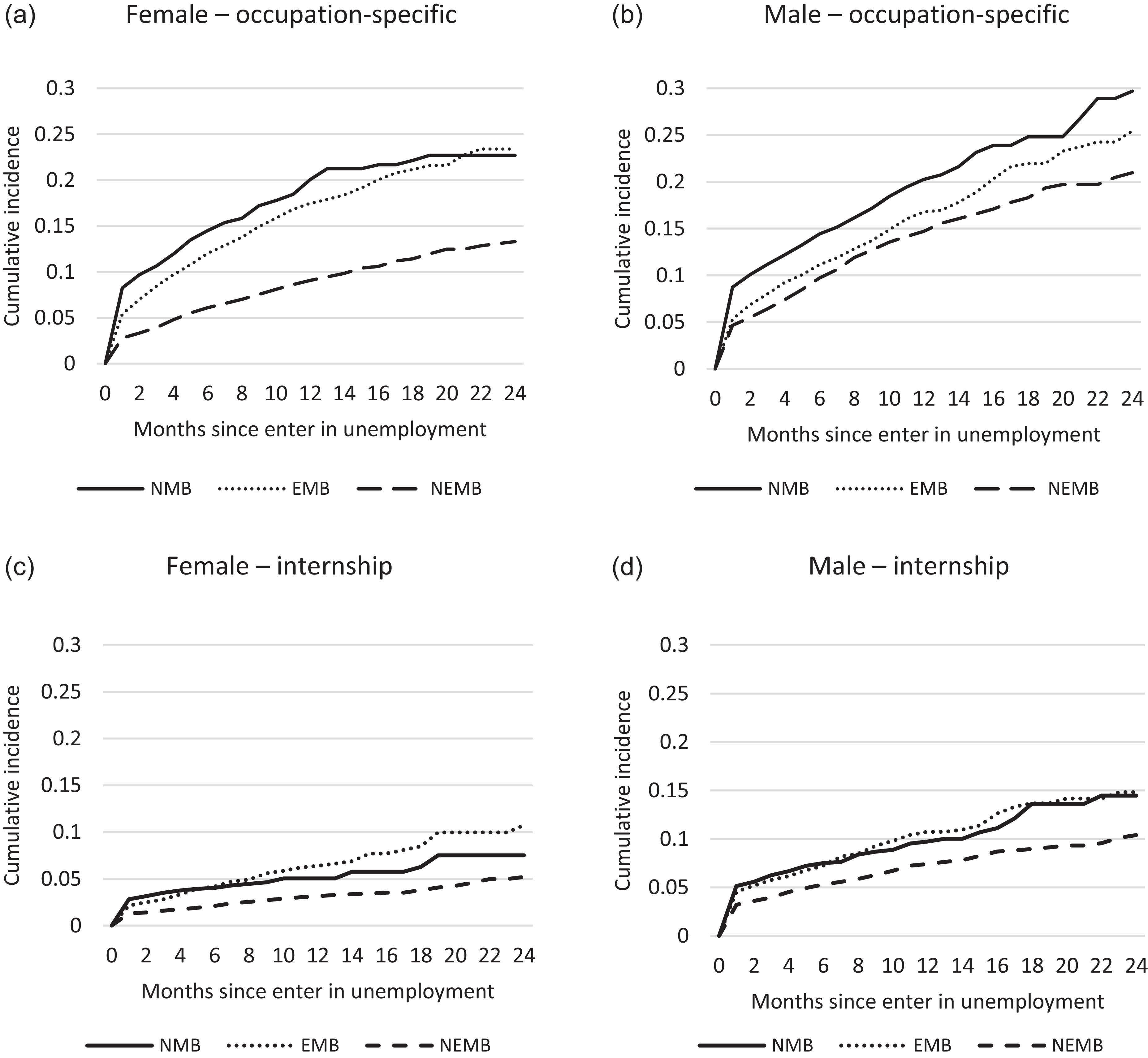
Figure 1 illustrates the cumulative incidence of taking up occupation-specific training (Figure 1a–b) and internships (Figure 1c–d) by duration of unemployment, migrant background, and gender. We find that the non-European origin groups are consistently less likely to take up training programmes compared to the Southern European and particularly in comparison to non-migrant origin groups. Regarding enrolment in occupation-specific training, the gap between the non-European background and the non-migrant background amounts to 5.4 and 4.1 percentage points for women and men, respectively, in the first month of unemployment, and increases further to 11.8 and 9.2 percentage points after one year of unemployment. In the case of internships, the enrolment gaps are relatively constant throughout the unemployment spell around 3.5 and 4.9 percentage points for women and men, respectively. The substantially lower incidence of enrolment among groups with a non-European background contrasts with a more limited difference between the Southern European background and the non-migrant origin groups for occupation-specific training and internships training.
Cumulative incidence of taking up occupation-specific and internship training by migrant background and gender.
Source: MIA Panel, 2005–2016, calculations by authors.
Note: NMB: Non-migrant background, EMB: Southern-European migrant background, NEMB: Non-European migrant background

Multivariate analysis
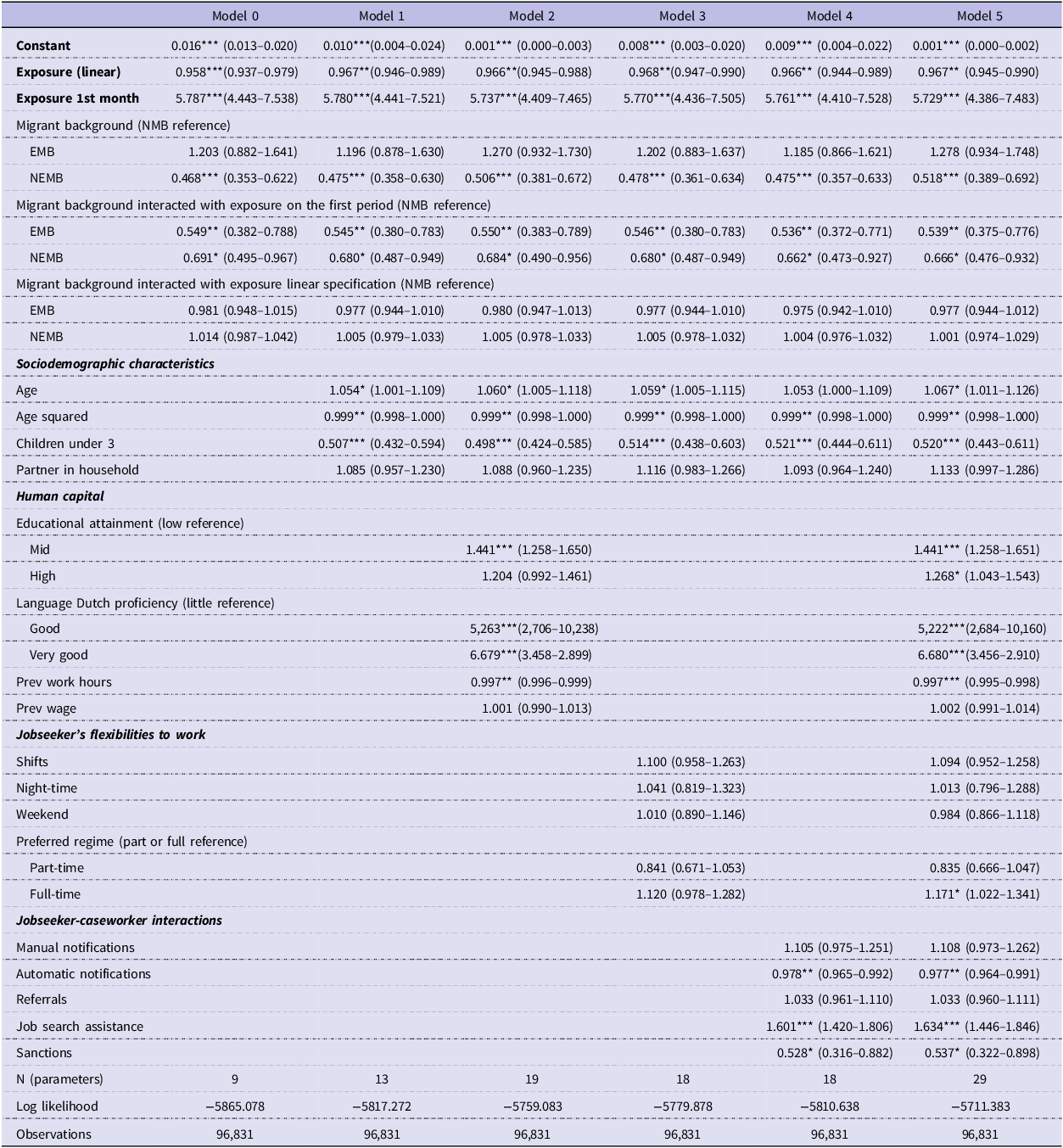
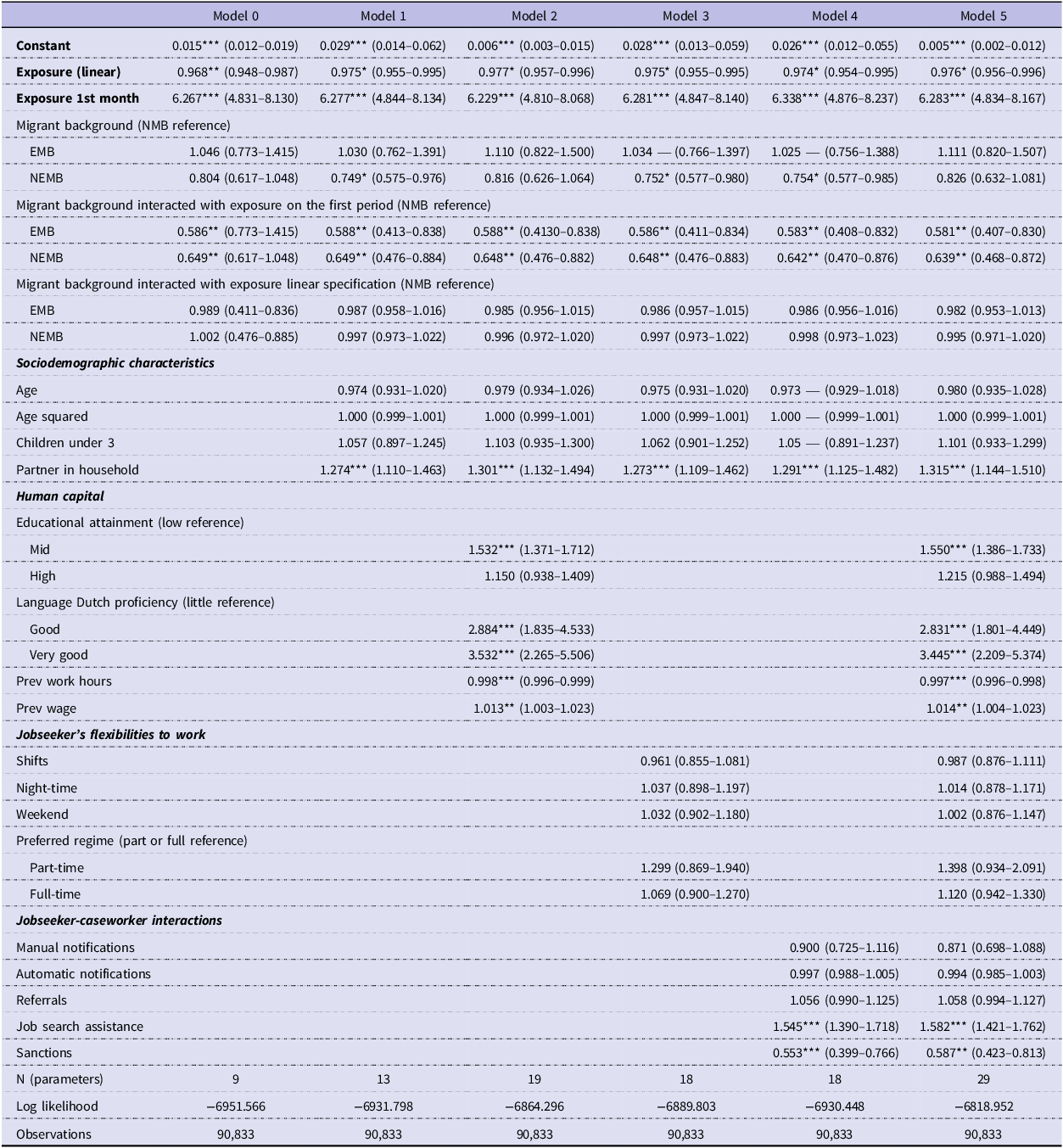
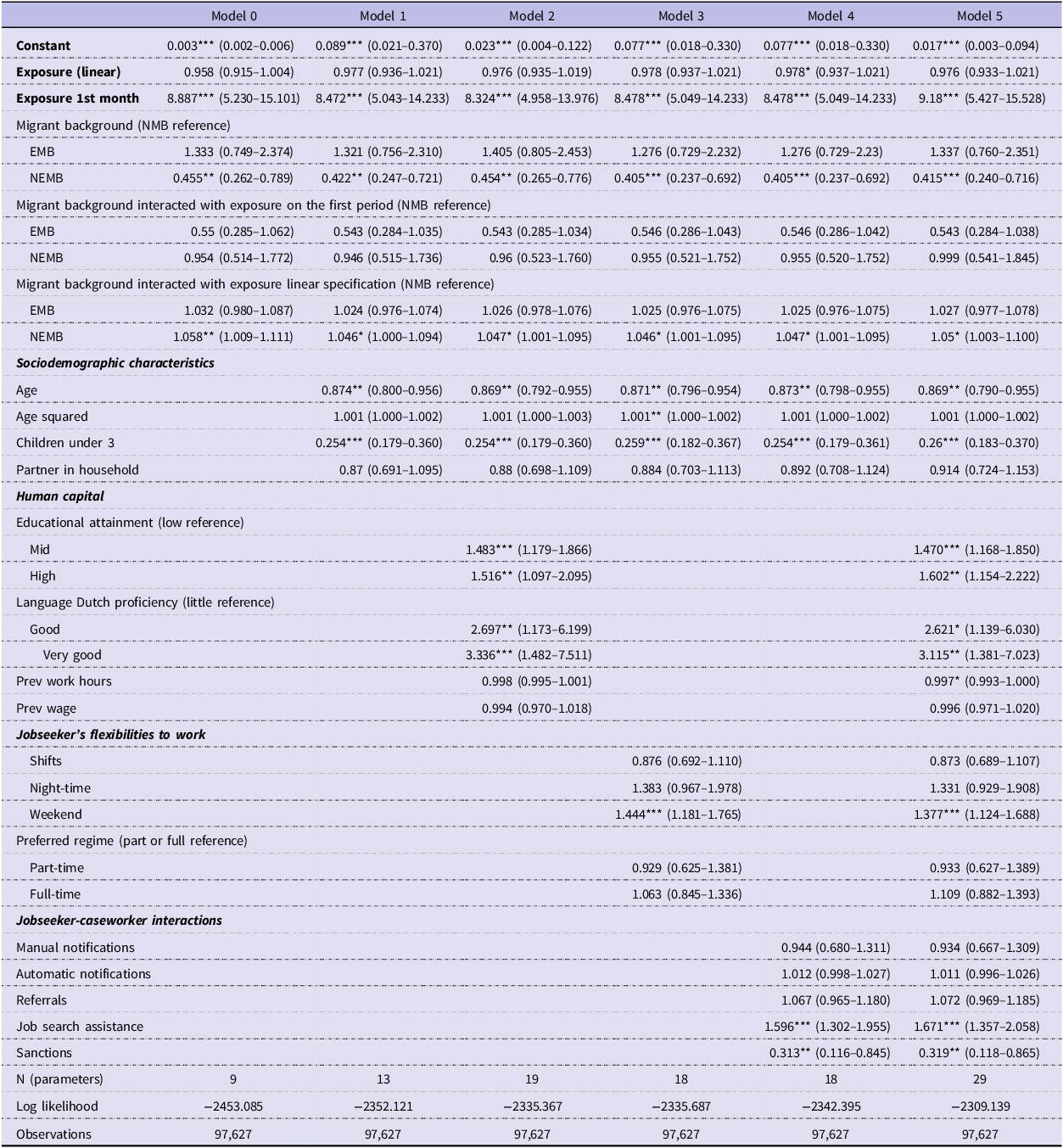
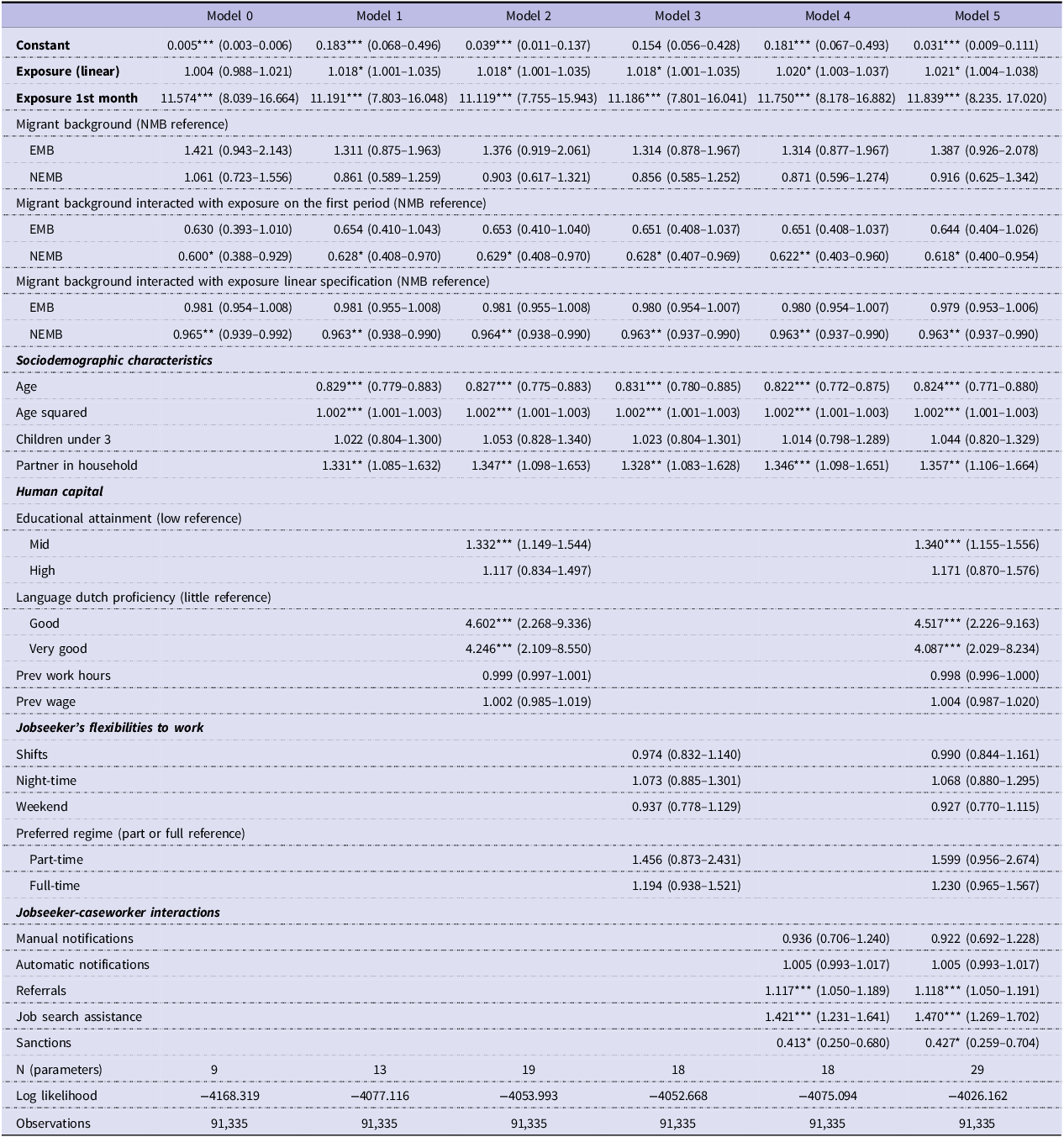
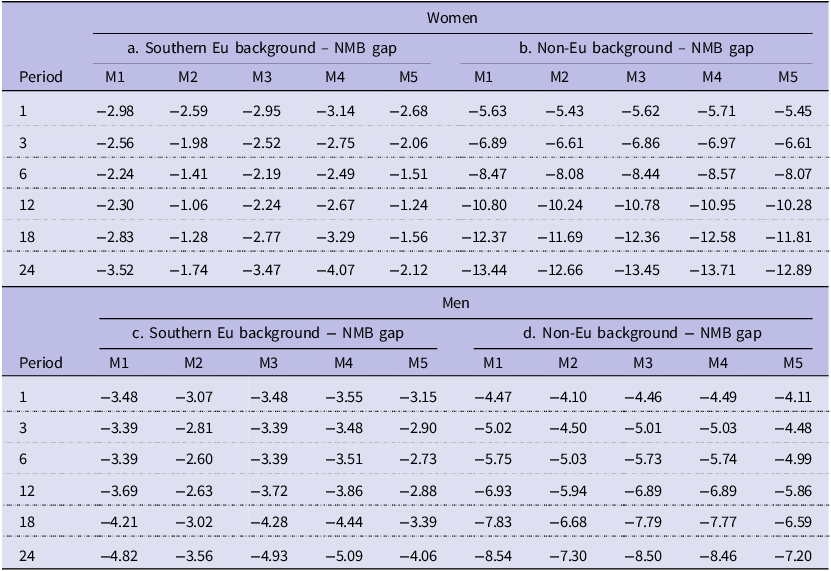
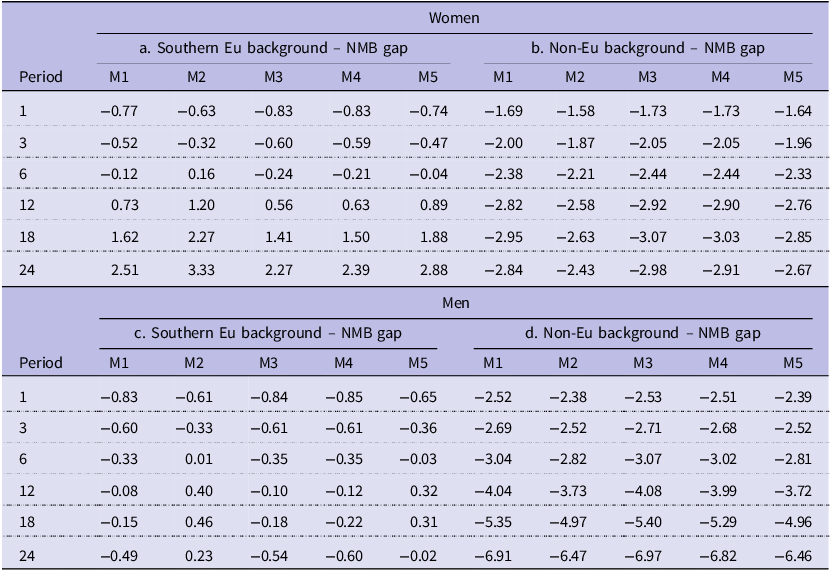
Tables 1, 2, 3, and 4 report exponentiated parameter estimates for explanatory variables in hazard models of occupation-specific training and internships enrolment. In order to assess whether and to what extent differentials can be accounted for by the explanatory variables considered, migrant-native differentials in cumulative incidence for all models are provided in Tables 5 and 6.
Hazard models of women’s enrolment into occupation-specific training (hazard ratios), Flanders (Belgium), 2005–16

Note: The sample is restricted to natives with and without migrant background who had been in unemployment between 2007 and 2016 and who had contact with the Flemish employment office during their unemployment spell(s). NMB: non-migrant background, EMB: Southern European background, NEMB: non-European migrant background, HR: Hazard ratios, significance levels: *p < 0.05; **p < 0.01; ***p < 0.001.
Hazard models of men’s enrolment into occupation-specific training (hazard ratios), Flanders (Belgium), 2005–16

Note: The sample is restricted to natives with and without migrant background who had been in unemployment between 2007 and 2016 and who had contact with the Flemish employment office during their unemployment spell(s). NMB: non-migrant background, EMB: Southern European background, NEMB: non-European migrant background, HR: Hazard ratios, significance levels: *p < 0.05; **p < 0.01; ***p < 0.001.
Hazard models of women’s enrolment into internships (hazard ratios), Flanders (Belgium), 2005–16

Note: The sample is restricted to natives with and without migrant background who had been in unemployment between 2007 and 2016 and who had contact with the Flemish employment office during their unemployment spell(s). NMB: non-migrant background, EMB: Southern European background, NEMB: non-European migrant background, HR: Hazard ratios, significance levels: *p < 0.05; **p < 0.01; ***p < 0.001.
Hazard models of men’s enrolment into internships (hazard ratios), Flanders (Belgium), 2005-2016

Note: The sample is restricted to natives with and without migrant background who had been in unemployment between 2007 and 2016 and who had contact with the Flemish employment office during their unemployment spell(s). NMB: non-migrant background, EMB: Southern European background, NEMB: non-European migrant background, HR: Hazard ratios, significance levels: *p<0,05; **p<0,01; ***p<0,001.
Gap in the cumulative incidence of enrolment into occupation-specific training by duration of unemployment (months) and migrant background (in percentage points)

Note: NMB: non-migrant background, Southern Eu background: Southern European background, Non-Eu background: non-European background.
M1: Model 1 controlling for sociodemographic characteristics, M2: Model 2 adds to model 1 human capital characteristics controls, M3: Model 3 adds to model 1 jobseekers’ aspirations flexibilities controls, M4: Model 4 adds to model 1 jobseeker-caseworker interactions controls, M5: Model 5 is the full model where all the controls are included.
Source: MIA Panel, 2005–2016, calculations by authors.
Gap in the cumulative incidence of enrolment into internships by duration of unemployment (months) and migrant background (in percentage points)

Note: NMB: non-migrant background, Southern Eu background: Southern European background, Non-Eu background: non-European background.
M1: Model 1 controlling for sociodemographic characteristics, M2: Model 2 adds to model 1 human capital characteristics controls, M3: Model 3 adds to model 1 jobseekers’ aspirations flexibilities controls, M4: Model 4 adds to model 1 jobseeker-caseworker interactions controls, M5: Model 5 is the full model where all the controls are included.
Source: MIA Panel, 2005–2016, calculations by authors.
The baseline model (Model 1), which only includes sociodemographic control variables and which will serve as a reference point for further models, yields findings similar to the descriptive results. In subsequent models we explore to what extent each of the potential determinants for enrolment in training explains the gap between natives with and without a migrant background.
Human capital
Likelihood ratio tests indicate that the inclusion of human capital characteristics (Model 2) entails a significant improvement over Model 1 for both types of training and both gendersFootnote 1 . Estimates in Tables 1, 2, 3, and 4 provide evidence for a significant positive effect of educational attainment on enrolment into training. Concerning women’s enrolment of occupation-specific training, for instance (Table 1, Model 2), medium-level and highly educated women, respectively, exhibit 44 per cent ((1.441–1)*100) and 20 per cent higher hazards of entering training compared to the lower educated group. Similarly, there is a strong positive association between Dutch language proficiency and enrolment into training across the board. For instance, jobseekers with good knowledge of Dutch exhibit a considerably higher hazard of starting internships (+170 per cent for women and +360 per cent for men) than those with little knowledge (Tables 3 and 4, respectively, Model 2). With respect to recent work experience, estimates indicate that longer working hours in the previous employment are associated with a reduction of the hazard of enrolment into training. Finally, the relationship between the previous wage and enrolment into training is mostly insignificant.
Despite the significant association between human capital characteristics and enrolment into training, and contrary to our expectations (Hypothesis 1), controlling for human capital characteristics yields only a marginal decrease in the enrolment gap between natives with and without a migration background. Tables 5 and 6 indicate that the cumulative incidence gaps in training enrolment between the non-migrant background and the two migrant background origin groups are only modestly reduced when we include human capital variables into the model.
Jobseekers’ flexibility
We find limited evidence for a significant association between jobseekers’ flexibility and the hazard of enrolment into training. Likelihood ratio tests indicate that the inclusion of indicators of jobseeker’s flexibility (Model 3) only improves the hazard models of enrolment for women, but not for menFootnote 2 . Regarding occupation-specific training, Model 5 in Table 1 shows that regime preference is significantly associated with women’s enrolment into training. Similarly, Model 5 in Table 3 shows that flexibility to work on weekends and at night are significantly associated with women’s enrolment into internships.
Regardless of the association between jobseekers’ flexibility and enrolment, the enrolment gap between jobseekers with a migration background and jobseekers without a migration background remains virtually unchanged when controlling for jobseeker’s flexibility to work, in contrast to our expectations (Hypothesis 2) (Table 5 and 6).
Jobseeker-caseworker interaction
Likelihood ratio tests indicate that the inclusion of jobseeker-caseworker covariates in Model 4 improves the fit compared to Model 1 for both types of training and both gendersFootnote 3 . Results displayed in Tables 1, 2, 3, and 4 show that overall, the relationship between notifications (manual and automatic) and training enrolment is mostly statistically insignificant. Furthermore, we find that jobseekers who are sanctioned are also less likely to enrol in training. For instance, the hazard to enrol in internships is 68.7 per cent and 58.7 per cent lower among sanctioned women and men, respectively (Tables 3 and 4). In contrast, job interview referrals positively associate with men’s enrolment into training. Finally, intensity of job search assistance exhibits a strong positive association with the hazard to enrol in both types of training for both genders. For instance, an increment of one in the intensity of job search assistance increases the hazard of enrolment in occupation-specific training by 60 per cent and 54.5 per cent for women and men, respectively (Tables 1 and 2).
Despite various significant associations between jobseeker-caseworker interaction and enrolment in training, Tables 5 and 6 reveal that the gap between natives with and without a migrant background only changes weakly when controlling for jobseeker-caseworker interaction, contrary to our expectations (Hypothesis 3). More specifically, regarding occupation-specific training, Table 5 (M4 versus M1) shows that in the first two years of unemployment, the gap between the group with Southern European background and the group without a migrant background increased by 0.3 and 0.6 percentage points for women and men, respectively, while the gap between the group with a non-European background and the group without a migrant background expands by 0.3 and 0.1 percentage points for women and men, respectively. In the case of internships, Table 6 (M4 versus M1) shows that the gap of Model 4 does not differ noteworthy from the gap in Model 1 for any of the analysed groups. The increase of the differential enrolment in occupation-specific training for groups with a migrant background is related to referrals and intensity of job search assistance being higher on average in the groups with a migrant background compared to the groups without a migrant background (Table 7 in annexes).
Sensitivity analysis
Three sensitivity checks were performed. First, when adding multiple variables as blocks into the model simultaneously, gradients by migration background may remain stable as a result of counteracting effects of the variables considered. Hence, we also estimated all models including covariates one by one. This approach did not alter our main findings. Second, we included interactions between each covariate and migrant background to study if the effect of the explanatory variables was different by migrant background. The results from these sensitivity analyses did not provide any evidence for differential covariate effects among jobseekers by migrant background. As a result, models without interactions are presented. Third, the human capital and full models were re-estimated only for the population with middle and high levels of education, good and very good Dutch language proficiency, and at least one hour of work in the previous two years to analyse whether the results alter when only including those with presumed larger employability. The results from this analysis confirmed findings presented above.
Discussion and conclusion
Second-generation migrants labour market outcomes are commonly used to analyse host societies’ performance in terms of integration of ethnic minorities (Portes and Zhou, Reference Portes and Zhou1993; Gracia et al., Reference Gracia, Vázquez-Quesada and Van de Werfhorst2016). Segmented assimilation theory (Portes and Zhou, Reference Portes and Zhou1993; Portes et al., Reference Portes, Fernandez-Kelly and Haller2005) assumes differential pathways to integration by origin group, yet factors through which these processes might occur and how policies may foster labour market integration and limit the risk of poverty and social exclusion among individuals with a migrant background remain understudied. As not only characteristics of the groups considered, but also policies may potentially play a major role, this study focuses on active labour market policies, more specifically occupation-specific training and internship programmes.
This study shows that the Belgian labour market not only exhibits large and persistent migrant-native gaps in labour market outcomes (Baert and Cockx, Reference Baert and Cockx2013; Blommaert and Spierings, Reference Blommaert and Spierings2019; Maes et al., Reference Maes, Wood and Neels2019; Neels and Stoop, Reference Neels, Stoop and Lesthaeghe2000), but also migrant-native gaps amongst unemployed jobseekers in terms of enrolment into ALMPs. We find that jobseekers with a migrant background show lower enrolment than jobseekers without a migration background, particularly when considering occupation-specific training. Furthermore, we also find that jobseekers with a Southern European background display enrolment more similar to the non-migrant background population, than those with a non-European background. In addition, in line with the intersectionality theory (Crenshaw, Reference Crenshaw and Maschke2013) we can observe that the gap is larger for women than for men in all origin groups. This may be related to the expected roles from society and/or from households decisions (Lundberg and Pollak, Reference Lundberg and Pollak1996; Eagly, Reference Eagly2013), which in turn shape both individual attitudes toward education and employment as well as caseworkers’ expectations and discretionary decisions regarding deservingness and availability.
From a theoretical perspective, these patterns resonate with frameworks that combine microeconomic rational choice theories, which see individuals weighing the costs and benefits of training participation, with sociological perspectives that emphasise the role of social norms and attitudes. However, these individual considerations are embedded within, and mediated by, broader structural and institutional mechanisms such as caseworker discretion – per street-level bureaucracy theory – which can either reinforce or mitigate inequalities in access to training. Hence, we subsequently studied whether and to what extent previously identified determinants of participation in training and adult education in the general population affect the differential enrolment between natives with and without a migration background (Heckman and Smith, Reference Heckman and Smith2004; Desjardins et al., Reference Desjardins, Milana and Rubenson2006; Van den Broeck et al., Reference Van den Broeck, Vansteenkiste, Lens and De Witte2010; Auer and Fossati, Reference Auer and Fossati2020).
Regarding the role of human capital characteristics, our analyses align with previous research, suggesting that participation in ALMPs potentially excludes the most vulnerable population subgroups, and hence might reproduce inequalities (Cantillon, Reference Cantillon2011; Bonoli and Liechti, Reference Bonoli and Liechti2018). In line with human capital theory, jobseekers with lower education, lower Dutch language proficiency, and lower previous wages are less likely to participate in internships and occupation-specific training, which have been identified as effective pathways to employment (Card et al., Reference Card, Kluve and Weber2017; Wood et al., Reference Wood, Neels and Vujić2024). However, in contrast to our first hypothesis, disparities in human capital characteristics explain a small part of the difference in training participation between natives with a Southern European or non-European background and natives without a migrant background. This suggests that returns to human capital may be unequally distributed across groups, possibly due to structural barriers or differential expectations regarding the labour market, as discussed in segmented assimilation and ethnic penalties literature (Portes and Zhou, Reference Portes and Zhou1993; Heath et al., Reference Heath, Rothon and Kilpi2008). On the other hand, unexpectedly given the intersectionality theory, we find similar behaviour for men and women.
Concerning the jobseeker’s flexibility, no convincing indications are found for an association with training enrolment. As a result, contrary to our second hypothesis, the migrant background enrolment gap remains largely unchanged when controlling for the jobseeker’s flexibilities to work. This may be related to the fact that the higher flexibility to work exhibited by the migrant background origin groups than the non-migrant background ones may be related to the intention to work, and not to uptake training. As explained by Piore (Reference Piore1980) one possible explanation lies in the distinction between flexibility as a signal of employability and flexibility as a strategy for survival.
Concerning jobseeker-caseworker interactions, our findings indicate that jobseekers who receive job search assistance and referrals are also more likely to take up training, in contrast to jobseekers receiving sanctions. These findings potentially suggest that a cooperative attitude on behalf of both jobseekers and caseworkers results in a higher enrolment into training. However, contrary to our expectations and to the assumptions of street-level bureaucracy theory (Lipsky, Reference Lipsky2010), controlling for these interactions does not substantially reduce the migrant-native enrolment gap. A marginal expansion of the gap in occupation-specific training suggests that in contrast to the results from Auer and Fossati (Reference Auer and Fossati2020), the evidence for Flanders hints at a compensation logic, since the caseworkers’ interventions reduce the differential enrolment of occupation-specific training between natives with a Southern-European or non-European background and natives without a migration background. These findings are in accordance with (Bollens and Cockx, Reference Bollens and Cockx2017), who affirm that in Flanders jobseekers who receive referrals are, on average, less employable than their counterparts who do not receive referrals. While the change in enrolment gaps does not show large differences by gender controlling by caseworker interaction, gendered dynamics may still shape how caseworkers assess and engage with jobseekers, particularly regarding perceived availability and care responsibilities (Crenshaw, Reference Crenshaw and Maschke2013; Eagly, Reference Eagly2013).
In conclusion, despite including a wide range of individual-level predictors, and the significant associations between both human capital characteristics and jobseeker-caseworker interactions with enrolment into training, such previously considered determinants for enrolment in training and adult education for the general population – human capital characteristics, jobseeker flexibility, and jobseeker–caseworker interactions – cannot explain the enrolment gap between natives with and without a migration background for men nor for women. Our finding of unexplained gaps in enrolment resonates with similar results in terms of strong migrant-native employment gaps, which remain unexplained even when controlling for characteristics such as human or social capital (Heath et al., Reference Heath, Rothon and Kilpi2008; Maes et al., Reference Maes, Wood and Neels2019). This suggests that other factors may also be relevant to consider with respect to enrolment in occupation-specific training and internships.
Accordingly, further research is required to identify the determinants for training participation for the migrant background population, and more specifically for the non-European background population, in internships training and occupation-specific training, particularly given the precarious labour market position of jobseekers with a non-European background. The enrolment gap between groups with a non-European background and non-migrant background subpopulations in particular remains largely unexplained. In line with the intersectionality theory (Crenshaw, Reference Crenshaw and Maschke2013), this persistent gap is notably more pronounced among women of non-European background, suggesting that gender-specific factors such as caregiving responsibilities and gendered social constraints likely compound barriers to training participation in these groups. Even though this study was unable to fully explain migrant-native gaps in ALMPs uptake based on observed characteristics, our findings are of particular policy interest in the context of non-targeted ALMPs. As ALMPs often do not specifically target groups with a migration background (Rinne, Reference Rinne2012), the identification of large migrant-native gaps in ALMPs uptake is of utmost importance to policy makers in the face of safeguarding equal opportunities. In line with other scholars (Bonoli and Liechti, Reference Bonoli and Liechti2018; Bonoli, Reference Bonoli2020a, Reference Bonoli, Careja, Emmenegger and Giger2020b), we observe that equal provision of resources is masking inequalities in practice. In the Belgian/Flemish context, migrant-native gaps in ALMPs should be considered jointly with empirical findings suggesting accumulating disadvantages for migrants on the labour market. This body of work indicates that more limited labour market opportunities yield a more cumbersome first entry into paid employment (Maes et al., Reference Maes, Wood and Neels2019), which has been related to the transition into parenthood without securing a stable employment position or even as an alternative to career development (Wood et al., Reference Wood, Van den Berg and Neels2017; Wood and Neels, Reference Wood and Neels2017), leading in turn to limited access to subsidised work-family reconciliation policies (Wood, et al., Reference Wood, Kil and Marynissen2018; Marynissen et al., Reference Marynissen, Mussino, Wood and Duvander2019; Biegel et al., Reference Biegel, Wood and Neels2021; Marynissen et al., Reference Marynissen, Wood and Neels2021; Maes et al., Reference Maes, Neels, Biegel and Wood2023; Wood et al., Reference Wood, Marynissen and Van Gasse2023; Wood, Reference Wood2019, Reference Wood2025) and lower subsequent employment (Maes et al., Reference Maes, Wood and Neels2021; Kil et al., Reference Kil, Neels, Wood and De Valk2018; Maes et al., Reference Maes, Wood, Marynissen and Neels2022). These dynamics have been documented to hamper the development of stable careers and particularly jeopardise female labour market trajectories as these limited opportunities and more unfavourable positions compared to male partners also stimulate more traditional gender roles based on male main earners and female main carers (Wood et al., Reference Wood, Kil and Marynissen2018; Wood and Marynissen, Reference Wood and Marynissen2019; Van Gasse et al., Reference Van Gasse, Wood and Verdonck2021; Maes et al., Reference Maes, Wood, Marynissen and Neels2022; Wood et al., Reference Wood, Neels and Maes2023).
In this context, large migrant-native gaps in ALMP uptake can be considered another mechanism that exacerbates differential labour market outcomes across the life course.
Finally, we present four potential fruitful avenues for future research. First, future research should further unpack population heterogeneity by migration background, which was not possible in our data. In doing so, it may be important to adopt an intersectional perspective to capture compounded disadvantage and differential barriers experienced by men and women. Second, future research adopting more detailed covariate measurements would be beneficial, given, for instance, the fact that the sociodemographic characteristics are measured annually in this study, whereas these characteristics are subject to change over time within years. Third, the dataset unfortunately does not provide additional information on caseworkers, which would have allowed to link jobseekers to caseworkers in a (cross-)nested study design allowing to assess the share of variation in enrolment at the caseworker level. Fourth, our data does not account for enrolment into informal work or (anticipated) discrimination on behalf of employers, which both may present important sources of unobserved heterogeneity with respect to ALMPs-enrolment. Furthermore, future research could also explore how gender-based discrimination and informal employment patterns differ by migration background and influence access to formal training programmes.
Supplementary material
The supplementary material for this article can be found at https://doi.org/10.1017/S1474746426101432
Author contributions: CRediT Taxonomy
Tair Kasztan Flechner: Formal analysis, Investigation, Writing - original draft.
Jonas Wood: Conceptualization, Funding acquisition, Methodology, Resources, Supervision, Visualization, Writing - review & editing.
Karel Neels: Funding acquisition, Methodology, Project administration, Supervision, Validation, Writing - review & editing.
Financial support
This research was funded by the Research Foundation Flanders (FWO grant numbers G0AHS24N and G045722N) and the Research Council of the University of Antwerp (BOF: SEP-ERC Wood and BOF – DOCTORAL PROJECT PS ID : 36985).


 Open access

