





1 The Steinhaus lemma and its density analogues
Let G be an abelian group. If A and B are subsets of G, their sumset is $A+B:=\{a+b:a\in A, b\in B\}$
. If
$A+B:=\{a+b:a\in A, b\in B\}$
. If $t\in G$
, write
$t\in G$
, write $A+t$
for the translate
$A+t$
for the translate $\{a+t:a\in A\}$
. We are interested in the structure of
$\{a+t:a\in A\}$
. We are interested in the structure of $A+B$
under various hypotheses saying “A and B are large.”
$A+B$
under various hypotheses saying “A and B are large.”
1.1 The Steinhaus lemma
H. Steinhaus [Reference Steinhaus34, Théorème VII] proved that if $A, B\subseteq \mathbb R$
both have positive Lebesgue measure, then
$A, B\subseteq \mathbb R$
both have positive Lebesgue measure, then $A+B$
contains an open interval. The relevant properties of Lebesgue measure are retained by Haar measure on locally compact abelian (LCA) groups, leading to the following generalization.
$A+B$
contains an open interval. The relevant properties of Lebesgue measure are retained by Haar measure on locally compact abelian (LCA) groups, leading to the following generalization.
Theorem 1.1. Let K be an LCA group with Haar measure $\mu $
. If
$\mu $
. If $\mu (A)>0$
and
$\mu (A)>0$
and $\mu (B)>0$
, then
$\mu (B)>0$
, then $A+B$
contains a nonempty open subset of K.
$A+B$
contains a nonempty open subset of K.
We will prove a special case of Theorem 1.1 in §2. Weil [Reference Weil37, p.50] proves the above for arbitrary locally compact (including nonabelian) groups. See [Reference Stromberg35] for a short proof of the special case where $B=A^{-1}$
.
$B=A^{-1}$
.
Our main results are Theorem 1.5 and Theorem 3.16; these are analogues of Theorem 1.1 where Haar measure is replaced by a finitely additive translation-invariant measure. Such measures are usually discussed in terms of invariant means on the space of bounded functions on the underlying group.
1.2 Means on $\ell ^{\infty }(\Gamma )$

Let $\Gamma $
be a discrete abelian group. We write
$\Gamma $
be a discrete abelian group. We write $\ell ^{\infty }(\Gamma )$
for the Banach space of bounded complex-valued functions on
$\ell ^{\infty }(\Gamma )$
for the Banach space of bounded complex-valued functions on $\Gamma $
, equipped with the supremum norm
$\Gamma $
, equipped with the supremum norm $\|\cdot \|_{\infty }$
. For a function f defined on
$\|\cdot \|_{\infty }$
. For a function f defined on $\Gamma $
and
$\Gamma $
and $\gamma \in \Gamma $
, we write
$\gamma \in \Gamma $
, we write $f_\gamma $
for the translate given by
$f_\gamma $
for the translate given by $f_\gamma (x):=f(x-\gamma )$
. A mean on
$f_\gamma (x):=f(x-\gamma )$
. A mean on $\ell ^\infty (\Gamma )$
is a linear functional
$\ell ^\infty (\Gamma )$
is a linear functional $m:\ell ^\infty (\Gamma )\to \mathbb C$
satisfying
$m:\ell ^\infty (\Gamma )\to \mathbb C$
satisfying $m(1_\Gamma ) = 1$
and
$m(1_\Gamma ) = 1$
and $m(f)\geq 0$
if
$m(f)\geq 0$
if $f(x)\geq 0$
for all
$f(x)\geq 0$
for all $x\in \Gamma $
.
$x\in \Gamma $
.
We write $f\sim _{m} g$
if
$f\sim _{m} g$
if $m(|f-g|)=0$
.
$m(|f-g|)=0$
.
Note that each mean m induces a finitely additive probability measure $m^*$
on the algebra of subsets of
$m^*$
on the algebra of subsets of $\Gamma $
, given by
$\Gamma $
, given by $m^*(A)=m(1_A)$
.
$m^*(A)=m(1_A)$
.
We write $A\subset _m B$
if
$A\subset _m B$
if $m^*(A\setminus B)=0$
, and we write
$m^*(A\setminus B)=0$
, and we write $A\sim _{m} B$
if
$A\sim _{m} B$
if $m^{*}(A\triangle B)=0$
, or equivalently, if
$m^{*}(A\triangle B)=0$
, or equivalently, if $1_{A} \sim _{m} 1_{B}$
.
$1_{A} \sim _{m} 1_{B}$
.
We will abuse notation and write $m(A)$
for
$m(A)$
for $m^{*}(A)$
.
$m^{*}(A)$
.
If a mean m satisfies $m(f_\gamma )=m(f)$
for all
$m(f_\gamma )=m(f)$
for all $f\in \ell ^{\infty }(\Gamma )$
and
$f\in \ell ^{\infty }(\Gamma )$
and $\gamma \in \Gamma $
, we say that m is an invariant mean; invariant means are sometimes called “Banach means” or “Banach mean values” in the literature, cf. [Reference Følner19], [Reference Følner20].
$\gamma \in \Gamma $
, we say that m is an invariant mean; invariant means are sometimes called “Banach means” or “Banach mean values” in the literature, cf. [Reference Følner19], [Reference Følner20].
The set ${\mathcal {M}}(\Gamma )$
of means on
${\mathcal {M}}(\Gamma )$
of means on $\ell ^{\infty }(\Gamma )$
is a weak
$\ell ^{\infty }(\Gamma )$
is a weak $^{*}$
-compact convex subset of
$^{*}$
-compact convex subset of $\ell ^{\infty }(\Gamma )^{*}$
. Translation on
$\ell ^{\infty }(\Gamma )^{*}$
. Translation on $\Gamma $
induces an action
$\Gamma $
induces an action $\tau $
of
$\tau $
of $\Gamma $
on
$\Gamma $
on ${\mathcal {M}}(\Gamma )$
by continuous linear operators:
${\mathcal {M}}(\Gamma )$
by continuous linear operators: $(\tau _{\gamma } m) (f):=m(f_{\gamma })$
. The Markov-Kakutani fixed point theorem [Reference Conway14, p. 151] guarantees that there is at least one mean
$(\tau _{\gamma } m) (f):=m(f_{\gamma })$
. The Markov-Kakutani fixed point theorem [Reference Conway14, p. 151] guarantees that there is at least one mean $m\in {\mathcal {M}}(\Gamma )$
satisfying
$m\in {\mathcal {M}}(\Gamma )$
satisfying $\tau _{\gamma }m=m$
for all
$\tau _{\gamma }m=m$
for all $\gamma \in \Gamma $
. In other words, there is at least one invariant mean on
$\gamma \in \Gamma $
. In other words, there is at least one invariant mean on $\ell ^{\infty }(\Gamma )$
.
$\ell ^{\infty }(\Gamma )$
.
We let ${\mathcal {M}}_{\tau }(\Gamma )$
denote the set of invariant means on
${\mathcal {M}}_{\tau }(\Gamma )$
denote the set of invariant means on $\ell ^\infty (\Gamma )$
. It is straightforward to verify that
$\ell ^\infty (\Gamma )$
. It is straightforward to verify that ${\mathcal {M}}_{\tau }(\Gamma )$
is a weak
${\mathcal {M}}_{\tau }(\Gamma )$
is a weak $^*$
-compact convex subset of
$^*$
-compact convex subset of $\ell ^\infty (\Gamma )^*$
. The Krein-Milman theorem [Reference Conway14, p. 142] then implies that the set
$\ell ^\infty (\Gamma )^*$
. The Krein-Milman theorem [Reference Conway14, p. 142] then implies that the set ${\mathcal {M}}_{\tau }^{ext}(\Gamma )$
of extreme points of
${\mathcal {M}}_{\tau }^{ext}(\Gamma )$
of extreme points of ${\mathcal {M}}_{\tau }(\Gamma )$
is nonempty. We call elements of
${\mathcal {M}}_{\tau }(\Gamma )$
is nonempty. We call elements of ${\mathcal {M}}_{\tau }^{ext}(\Gamma )$
extreme invariant means.
${\mathcal {M}}_{\tau }^{ext}(\Gamma )$
extreme invariant means.
Definition 1.2. Let $A\subseteq \Gamma $
. The upper Banach density of A is
$A\subseteq \Gamma $
. The upper Banach density of A is
 $$\begin{align*}d^*(A):=\sup\{m(A):m \in {\mathcal{M}}_{\tau}(\Gamma)\}.\end{align*}$$
See Lemma 12.1 for conditions equivalent to A having positive upper Banach density.
Observation 1.3. For every $A\subseteq \Gamma $
, there is an extreme invariant mean
$A\subseteq \Gamma $
, there is an extreme invariant mean $\nu $
such that
$\nu $
such that $d^{*}(A)=\nu (1_{A})$
. To see this, note that
$d^{*}(A)=\nu (1_{A})$
. To see this, note that $\lambda \mapsto \lambda (1_{A})$
is a continuous linear functional on
$\lambda \mapsto \lambda (1_{A})$
is a continuous linear functional on $\ell ^{\infty }(\Gamma )^{*}$
and
$\ell ^{\infty }(\Gamma )^{*}$
and ${\mathcal {M}}_{\tau }(\Gamma )$
is a compact convex subset thereof. Proposition 7.9 in [Reference Conway14, p. 144] then implies that the supremum
${\mathcal {M}}_{\tau }(\Gamma )$
is a compact convex subset thereof. Proposition 7.9 in [Reference Conway14, p. 144] then implies that the supremum $\{m(A):m\in {\mathcal {M}}_{\tau }(\Gamma )\}$
is attained by at least one extreme point of
$\{m(A):m\in {\mathcal {M}}_{\tau }(\Gamma )\}$
is attained by at least one extreme point of ${\mathcal {M}}_{\tau }(\Gamma )$
. See Lemma 13.1 below for details.
${\mathcal {M}}_{\tau }(\Gamma )$
. See Lemma 13.1 below for details.
1.3 Characters
We use standard definitions and background presented, for example, in Chapter 4 of [Reference Folland18] or Chapters 1 and 2 of [Reference Rudin33].
Write $\mathcal S^1$
for the group
$\mathcal S^1$
for the group $\{z\in \mathbb C: |z|=1\}$
with the group operation of multiplication and the usual topology.
$\{z\in \mathbb C: |z|=1\}$
with the group operation of multiplication and the usual topology.
Let G be an LCA group. A character of G is a continuous homomorphism $\chi :G\to \mathcal S^{1}$
; the set of all characters of G is denoted
$\chi :G\to \mathcal S^{1}$
; the set of all characters of G is denoted $\widehat {G}$
. The trivial character
$\widehat {G}$
. The trivial character $\chi _{0}$
is constant:
$\chi _{0}$
is constant: $\chi _{0}(\gamma )=1$
for all
$\chi _{0}(\gamma )=1$
for all $\gamma \in \Gamma $
. With the group operation of pointwise multiplication and the topology of uniform convergence on compact subsets,
$\gamma \in \Gamma $
. With the group operation of pointwise multiplication and the topology of uniform convergence on compact subsets, $\widehat {G}$
is an LCA group. When G is compact,
$\widehat {G}$
is an LCA group. When G is compact, $\widehat {G}$
is discrete, and when G is discrete,
$\widehat {G}$
is discrete, and when G is discrete, $\widehat {G}$
is compact. A trigonometric polynomial is a finite linear combination of characters of G. A function
$\widehat {G}$
is compact. A trigonometric polynomial is a finite linear combination of characters of G. A function $f:G\to \mathbb C$
is uniformly almost periodic if it is a uniform limit of trigonometric polynomials.
$f:G\to \mathbb C$
is uniformly almost periodic if it is a uniform limit of trigonometric polynomials.
1.4 Bohr compactification
Let $\Gamma $
be a discrete abelian group. The Bohr compactification of
$\Gamma $
be a discrete abelian group. The Bohr compactification of $\Gamma $
is a compact Hausdorff abelian group
$\Gamma $
is a compact Hausdorff abelian group $b\Gamma $
together with a one-to-one homomorphism
$b\Gamma $
together with a one-to-one homomorphism $\iota :\Gamma \to b\Gamma $
such that
$\iota :\Gamma \to b\Gamma $
such that
-
(i)
$\iota (\Gamma )$
is topologically dense in
$b\Gamma $
; -
(ii) for all
$\chi \in \widehat {\Gamma }$
, there is a character
$\tilde {\chi }\in \widehat {b\Gamma }$
such that
$\tilde {\chi }\circ \iota = \chi $
.


We will identify $\Gamma $
with its image
$\Gamma $
with its image $\iota (\Gamma )$
, and consider
$\iota (\Gamma )$
, and consider $\Gamma $
as a topologically dense subgroup of
$\Gamma $
as a topologically dense subgroup of $b\Gamma $
, so that each
$b\Gamma $
, so that each $\chi \in \widehat {\Gamma }$
is the restriction of a continuous
$\chi \in \widehat {\Gamma }$
is the restriction of a continuous $\tilde {\chi }\in \widehat {b\Gamma }$
:
$\tilde {\chi }\in \widehat {b\Gamma }$
: $\chi = \tilde {\chi }|_\Gamma $
.
$\chi = \tilde {\chi }|_\Gamma $
.
The group $b\Gamma $
may be constructed as the Pontryagin dual of
$b\Gamma $
may be constructed as the Pontryagin dual of $\widehat {\Gamma }_d$
, where
$\widehat {\Gamma }_d$
, where $\widehat {\Gamma }_d$
is the group
$\widehat {\Gamma }_d$
is the group $\widehat {\Gamma }$
with the discrete topology instead of the usual topology. In this construction, the embedding map
$\widehat {\Gamma }$
with the discrete topology instead of the usual topology. In this construction, the embedding map $\iota $
is given by
$\iota $
is given by $\iota (\gamma ):=e_\gamma $
, where
$\iota (\gamma ):=e_\gamma $
, where $e_\gamma (\chi )=\chi (\gamma )$
; see Section 1.8 of [Reference Rudin33] or Section 4.7 of [Reference Folland18] for details.
$e_\gamma (\chi )=\chi (\gamma )$
; see Section 1.8 of [Reference Rudin33] or Section 4.7 of [Reference Folland18] for details.
The following is a special case of [Reference Folland18, Theorem 4.79] for discrete abelian groups.
Theorem 1.4. If f is a bounded function on $\Gamma $
, the following are equivalent:
$\Gamma $
, the following are equivalent:
-
(i) f is the restriction to
$\Gamma $
of a continuous function on
$b\Gamma $
. -
(ii) f is uniformly almost periodic.


We write $\mu _{b\Gamma }$
for Haar probability measure on
$\mu _{b\Gamma }$
for Haar probability measure on $b\Gamma $
.
$b\Gamma $
.
1.5 Main theorem
The next theorem is our main result; it relates sumsets in discrete abelian groups to sumsets in compact abelian groups. In §1.7 we show how it extends the results mentioned in the abstract. Here “ $F_{\sigma }$
” means “countable union of compact sets.” Note that when A and B are
$F_{\sigma }$
” means “countable union of compact sets.” Note that when A and B are $F_{\sigma }$
subsets of
$F_{\sigma }$
subsets of $b\Gamma $
,
$b\Gamma $
, $A+B$
is also
$A+B$
is also $F_{\sigma }$
, implying that
$F_{\sigma }$
, implying that $A+B$
is
$A+B$
is $\mu _{b\Gamma }$
-measurable.
$\mu _{b\Gamma }$
-measurable.
Theorem 1.5. Let $\Gamma $
be a discrete abelian group. Let
$\Gamma $
be a discrete abelian group. Let $\nu $
be an extreme invariant mean on
$\nu $
be an extreme invariant mean on $\ell ^{\infty }(\Gamma )$
, m an invariant mean on
$\ell ^{\infty }(\Gamma )$
, m an invariant mean on $\ell ^{\infty }(\Gamma )$
, and A,
$\ell ^{\infty }(\Gamma )$
, and A, $B\subseteq \Gamma $
. There are
$B\subseteq \Gamma $
. There are $F_{\sigma }$
sets
$F_{\sigma }$
sets $\tilde {A}_{\nu }$
,
$\tilde {A}_{\nu }$
, $\tilde {B}_{m}\subseteq b\Gamma $
such that
$\tilde {B}_{m}\subseteq b\Gamma $
such that $\mu _{b\Gamma }(\tilde {A}_{\nu })\geq \nu (A)$
,
$\mu _{b\Gamma }(\tilde {A}_{\nu })\geq \nu (A)$
, $\mu _{b\Gamma }(\tilde {B}_{m})\geq m(B)$
, and
$\mu _{b\Gamma }(\tilde {B}_{m})\geq m(B)$
, and
 $$ \begin{align} \nu(A+B)\geq \mu_{b\Gamma}(\tilde{A}_{\nu}+\tilde{B}_{m}).\\[-18pt] \nonumber\end{align} $$
Furthermore,
-
(i) if
$V\subseteq b\Gamma $
is compact, then
$$\begin{align*}\mu_{b\Gamma}(\tilde{A}_{\nu}\cap V)\geq \nu(A\cap V) \quad \text{and} \quad \mu_{b\Gamma}(\tilde{B}_{m}\cap V)\geq m(B\cap V);\end{align*}$$
-
(ii) if
$V\subseteq b\Gamma $
is clopen, then
$$\begin{align*}\mu_{b\Gamma}(\tilde{A}_{\nu}\cap V)=0\iff \nu(A\cap V)=0 \quad \text{and} \quad \mu_{b\Gamma}(\tilde{B}_{m}\cap V)=0\iff m(B\cap V)=0;\end{align*}$$
-
(iii) if
$V\subseteq \tilde {A}_{\nu }+\tilde {B}_{m}$
is compact, then
$V\cap \Gamma \subset _{\nu } A+B$
.


We will prove Theorem 1.5 as a special case of Theorem 3.16 below; the latter obtains the same conclusion under a weaker hypothesis on B.
1.6 Large sets
Let $\Gamma $
be an arbitrary discrete abelian group (countable or uncountable). We list some common definitions for large subsets of
$\Gamma $
be an arbitrary discrete abelian group (countable or uncountable). We list some common definitions for large subsets of $\Gamma $
. Equivalent formulations are provided in §12.
$\Gamma $
. Equivalent formulations are provided in §12.
If $\gamma _{0}\in \Gamma $
we say U is a Bohr neighborhood of
$\gamma _{0}\in \Gamma $
we say U is a Bohr neighborhood of $\gamma _{0}$
if there is an open subset
$\gamma _{0}$
if there is an open subset $V\subseteq b\Gamma $
such that
$V\subseteq b\Gamma $
such that $\gamma _{0}\in V$
and
$\gamma _{0}\in V$
and $V\cap \Gamma \subseteq U$
. By Lemma 12.6, U is a Bohr neighborhood of
$V\cap \Gamma \subseteq U$
. By Lemma 12.6, U is a Bohr neighborhood of $\gamma _{0}$
if and only if there is a uniformly almost periodic function
$\gamma _{0}$
if and only if there is a uniformly almost periodic function $\phi :\Gamma \to [0,\infty )$
supported on U such that
$\phi :\Gamma \to [0,\infty )$
supported on U such that $\phi (\gamma _{0})\neq 0$
.
$\phi (\gamma _{0})\neq 0$
.
A set $T\subseteq \Gamma $
is thick if for all finite
$T\subseteq \Gamma $
is thick if for all finite $F\subseteq \Gamma $
, there is a
$F\subseteq \Gamma $
, there is a $t\in \Gamma $
such that
$t\in \Gamma $
such that $F+t\subseteq T$
. By Lemma 12.2, T is thick if and only if there is an invariant mean m on
$F+t\subseteq T$
. By Lemma 12.2, T is thick if and only if there is an invariant mean m on $\ell ^{\infty }(\Gamma )$
such that
$\ell ^{\infty }(\Gamma )$
such that $m(T)=1$
.
$m(T)=1$
.
A set $S\subseteq \Gamma $
is syndetic if there is a finite set
$S\subseteq \Gamma $
is syndetic if there is a finite set $F\subseteq \Gamma $
such that
$F\subseteq \Gamma $
such that $S+F=\Gamma $
. By Lemma 12.3, S is syndetic if and only if S has nonempty intersection with every thick set. Every Bohr neighborhood is syndetic – see §12.3.
$S+F=\Gamma $
. By Lemma 12.3, S is syndetic if and only if S has nonempty intersection with every thick set. Every Bohr neighborhood is syndetic – see §12.3.
We say that $C\subseteq \Gamma $
is piecewise syndetic if there is an
$C\subseteq \Gamma $
is piecewise syndetic if there is an $m\in {\mathcal {M}}_{\tau }(\Gamma )$
and a syndetic set S such that
$m\in {\mathcal {M}}_{\tau }(\Gamma )$
and a syndetic set S such that $S\subset _{m} C$
. Equivalently (Lemma 12.4), C is piecewise syndetic if C contains a set of the form
$S\subset _{m} C$
. Equivalently (Lemma 12.4), C is piecewise syndetic if C contains a set of the form $S\cap T$
, where S is syndetic and T is thick.
$S\cap T$
, where S is syndetic and T is thick.
We say that C is piecewise Bohr if there is an $m\in {\mathcal {M}}_{\tau }(\Gamma )$
and a Bohr neighborhood
$m\in {\mathcal {M}}_{\tau }(\Gamma )$
and a Bohr neighborhood $U\subseteq \Gamma $
such that
$U\subseteq \Gamma $
such that $U\subset _{m}C$
. Equivalently (Lemma 12.7), C is piecewise Bohr if there is a thick set T and a Bohr neighborhood U of some
$U\subset _{m}C$
. Equivalently (Lemma 12.7), C is piecewise Bohr if there is a thick set T and a Bohr neighborhood U of some $\gamma \in \Gamma $
such that
$\gamma \in \Gamma $
such that $T\cap U\subseteq \Gamma $
.
$T\cap U\subseteq \Gamma $
.
Every piecewise Bohr set is piecewise syndetic, but some syndetic sets are not piecewise Bohr; examples are given in [Reference Bergelson, Furstenberg and Weiss4, Theorem 4.3] and in Section 2.5 of [Reference Griesmer22]. In countable abelian groups there are many examples of sets which have positive upper Banach density and are not piecewise syndetic (and therefore not piecewise Bohr); see [Reference Bergelson, Huryn and Raghavan5] for a survey. In §12.4 we construct such examples in $\mathbb R$
and in some other uncountable abelian groups.
$\mathbb R$
and in some other uncountable abelian groups.
1.7 Sumset phenomena
Jin [Reference Jin27] used nonstandard analysis to give a new proof of the Steinhaus lemma in $\mathbb R$
, and to prove a new result about sumsets in
$\mathbb R$
, and to prove a new result about sumsets in $\mathbb Z$
: Corollary 3 of [Reference Jin27] says that if
$\mathbb Z$
: Corollary 3 of [Reference Jin27] says that if $A, B\subseteq \mathbb Z$
both have positive upper Banach density, then
$A, B\subseteq \mathbb Z$
both have positive upper Banach density, then $A+B$
is piecewise syndetic. Under the same hypothesis, Bergelson, Furstenberg, and Weiss improved the conclusion to say that
$A+B$
is piecewise syndetic. Under the same hypothesis, Bergelson, Furstenberg, and Weiss improved the conclusion to say that $A+B$
is piecewise Bohr; this is [Reference Bergelson, Furstenberg and Weiss4, Theorem I]. The latter result was extended to countable amenable groups by Beiglböck, Bergelson, and Fish in [Reference Beiglböck, Bergelson and Fish2], and (with a modified conclusion) to arbitrary countable groups by Björklund and Fish in [Reference Björklund and Fish7] and by Björklund in [Reference Björklund6]. As Corollary 1.6 shows, Theorem 1.5 recovers the abelian cases of these results and extends them to discrete abelian groups of arbitrary cardinality.
$A+B$
is piecewise Bohr; this is [Reference Bergelson, Furstenberg and Weiss4, Theorem I]. The latter result was extended to countable amenable groups by Beiglböck, Bergelson, and Fish in [Reference Beiglböck, Bergelson and Fish2], and (with a modified conclusion) to arbitrary countable groups by Björklund and Fish in [Reference Björklund and Fish7] and by Björklund in [Reference Björklund6]. As Corollary 1.6 shows, Theorem 1.5 recovers the abelian cases of these results and extends them to discrete abelian groups of arbitrary cardinality.
In [Reference Griesmer22, Theorem 1.4] we showed that when $d^{*}(A)>0$
and B satisfies a weaker positive density condition (cf. §3.2 below), we may still conclude that
$d^{*}(A)>0$
and B satisfies a weaker positive density condition (cf. §3.2 below), we may still conclude that $A+B$
is piecewise Bohr. Corollary 4.2 extends this result to arbitrary discrete abelian groups.
$A+B$
is piecewise Bohr. Corollary 4.2 extends this result to arbitrary discrete abelian groups.
Corollary 1.6. If $\Gamma $
is a discrete abelian group and A,
$\Gamma $
is a discrete abelian group and A, $B\subseteq \Gamma $
have positive upper Banach density, then
$B\subseteq \Gamma $
have positive upper Banach density, then $A+B$
is piecewise Bohr (and therefore piecewise syndetic). Furthermore, if
$A+B$
is piecewise Bohr (and therefore piecewise syndetic). Furthermore, if $\nu \in {\mathcal {M}}_{\tau }^{ext}(\Gamma )$
and
$\nu \in {\mathcal {M}}_{\tau }^{ext}(\Gamma )$
and $\nu (A)>0$
, then there is a Bohr neighborhood U such that
$\nu (A)>0$
, then there is a Bohr neighborhood U such that $U\subset _{\nu } A+B$
.
$U\subset _{\nu } A+B$
.
Proof. Assuming A, $B\subseteq \Gamma $
have positive upper Banach density, apply Observation 1.3 to find
$B\subseteq \Gamma $
have positive upper Banach density, apply Observation 1.3 to find $\nu $
,
$\nu $
, $m\in {\mathcal {M}}_{\tau }^{ext}(\Gamma )$
such that
$m\in {\mathcal {M}}_{\tau }^{ext}(\Gamma )$
such that $\nu (A)=d^{*}(A)>0$
and
$\nu (A)=d^{*}(A)>0$
and $m(B)=d^{*}(B)>0$
. Let
$m(B)=d^{*}(B)>0$
. Let $\tilde {A}_{\nu }, \tilde {B}_{m}\subseteq b\Gamma $
be as in Theorem 1.5, so that
$\tilde {A}_{\nu }, \tilde {B}_{m}\subseteq b\Gamma $
be as in Theorem 1.5, so that $\mu _{b\Gamma }(\tilde {A})$
,
$\mu _{b\Gamma }(\tilde {A})$
, $\mu _{b\Gamma }(\tilde {B})>0$
. By Theorem 1.1,
$\mu _{b\Gamma }(\tilde {B})>0$
. By Theorem 1.1, $\tilde {A}_{\nu }+\tilde {B}_{m}$
contains a nonempty open set
$\tilde {A}_{\nu }+\tilde {B}_{m}$
contains a nonempty open set $\tilde {V}$
. Since
$\tilde {V}$
. Since $b\Gamma $
is compact Hausdorff (and therefore regular), there is a compact subset
$b\Gamma $
is compact Hausdorff (and therefore regular), there is a compact subset $\tilde {V}'\subseteq \tilde {V}$
with nonempty interior; cf. [Reference Munkres31, p. 196]. Since
$\tilde {V}'\subseteq \tilde {V}$
with nonempty interior; cf. [Reference Munkres31, p. 196]. Since $\tilde {V}'$
is a compact subset of
$\tilde {V}'$
is a compact subset of $\tilde {A}_{\nu }+\tilde {B}_{m}$
, Theorem 1.5 says that
$\tilde {A}_{\nu }+\tilde {B}_{m}$
, Theorem 1.5 says that $\tilde {V}'\cap \Gamma \subset _{\nu } A+B$
. Since
$\tilde {V}'\cap \Gamma \subset _{\nu } A+B$
. Since $\tilde {V}'$
has nonempty interior,
$\tilde {V}'$
has nonempty interior, $U:=\tilde {V}'\cap \Gamma $
is a Bohr neighborhood satisfying
$U:=\tilde {V}'\cap \Gamma $
is a Bohr neighborhood satisfying $U\subset _{\nu }A+B$
. Thus
$U\subset _{\nu }A+B$
. Thus $A+B$
is piecewise Bohr.
$A+B$
is piecewise Bohr.
Remark 1.7. In Corollary 1.6 the conclusion that $A+B$
is piecewise Bohr cannot be improved: Theorem 4 of [Reference Beiglböck, Bergelson and Fish2] says that if
$A+B$
is piecewise Bohr cannot be improved: Theorem 4 of [Reference Beiglböck, Bergelson and Fish2] says that if $\Gamma $
is a countable abelian group and
$\Gamma $
is a countable abelian group and $C\subseteq \Gamma $
is piecewise Bohr, then there are sets
$C\subseteq \Gamma $
is piecewise Bohr, then there are sets $A, B\subseteq \Gamma $
such that
$A, B\subseteq \Gamma $
such that $d^*(A)>0$
,
$d^*(A)>0$
, $d^*(B)>0$
, and
$d^*(B)>0$
, and $A+B\subseteq C$
.
$A+B\subseteq C$
.


1.8 Følner sequences and Følner nets
Let $\mathbf F:=(F_n)_{n\in \mathbb N}$
be a sequence of finite subsets of
$\mathbf F:=(F_n)_{n\in \mathbb N}$
be a sequence of finite subsets of $\Gamma $
. For
$\Gamma $
. For $A\subseteq \Gamma $
, we write
$A\subseteq \Gamma $
, we write
 $$\begin{align*}\underline{d}_{\mathbf F}(A):= \liminf_{n\to\infty}\frac{|A\cap F_n|}{|F_n|}, \qquad \bar{d}_{\mathbf F}(A):= \limsup_{n\to\infty}\frac{|A\cap F_n|}{|F_n|} \end{align*}$$
for the lower density of A with respect to $\mathbf F$
and upper density of A with respect to
$\mathbf F$
and upper density of A with respect to $\mathbf F$
, respectively. If
$\mathbf F$
, respectively. If $\underline {d}_{\mathbf F}(A)=\bar {d}_{\mathbf F}(A)$
we write
$\underline {d}_{\mathbf F}(A)=\bar {d}_{\mathbf F}(A)$
we write $d_{\mathbf F}(A)$
for the common value, which we call the density of A with respect to
$d_{\mathbf F}(A)$
for the common value, which we call the density of A with respect to $\mathbf F$
.
$\mathbf F$
.
If $\mathbf F:=(F_j)_{j\in I}$
is a net of finite subsets of
$\mathbf F:=(F_j)_{j\in I}$
is a net of finite subsets of $\Gamma $
indexed by a directed set I, we define the lower and upper density of A with respect to
$\Gamma $
indexed by a directed set I, we define the lower and upper density of A with respect to $\mathbf F$
to be
$\mathbf F$
to be $\underline {d}_{\mathbf F}(A):=\liminf _{j\in I} \frac {|A\cap F_j|}{|F_j|}$
, and
$\underline {d}_{\mathbf F}(A):=\liminf _{j\in I} \frac {|A\cap F_j|}{|F_j|}$
, and $\bar {d}_{\mathbf F}(A):=\limsup _{j\in I} \frac {|A\cap F_j|}{|F_j|}$
, respectively. When
$\bar {d}_{\mathbf F}(A):=\limsup _{j\in I} \frac {|A\cap F_j|}{|F_j|}$
, respectively. When $f\in \ell ^{\infty }(\Gamma )$
is real-valued, we write
$f\in \ell ^{\infty }(\Gamma )$
is real-valued, we write
 $$\begin{align*}\underline{\mathbb E}_{\mathbf F}(f):=\liminf_{j\in I} \frac{1}{|F_{j}|}\sum_{\gamma\in F_{j}}f(\gamma) \end{align*}$$
and $\bar {\mathbb E}_{\mathbf F}(f)$
for the corresponding
$\bar {\mathbb E}_{\mathbf F}(f)$
for the corresponding $\limsup $
. When
$\limsup $
. When $\underline {\mathbb E}_{\mathbf F}(f)=\bar {\mathbb E}_{\mathbf F}(f)$
, we write
$\underline {\mathbb E}_{\mathbf F}(f)=\bar {\mathbb E}_{\mathbf F}(f)$
, we write $\mathbb E_{\mathbf F}(f)$
for the common value.
$\mathbb E_{\mathbf F}(f)$
for the common value.
We say that $(F_{n})_{n\in \mathbb N}$
is a Følner sequence if
$(F_{n})_{n\in \mathbb N}$
is a Følner sequence if $\lim _{n\to \infty } \frac {|F_n\triangle (F_n+\gamma )|}{|F_n|}=0$
for all
$\lim _{n\to \infty } \frac {|F_n\triangle (F_n+\gamma )|}{|F_n|}=0$
for all $\gamma \in \Gamma $
. Likewise,
$\gamma \in \Gamma $
. Likewise, $(F_j)_{j\in I}$
is a Følner net if
$(F_j)_{j\in I}$
is a Følner net if $\lim _{j\in I} \frac {|F_j\triangle (F_j+\gamma )|}{|F_j|}=0$
for all
$\lim _{j\in I} \frac {|F_j\triangle (F_j+\gamma )|}{|F_j|}=0$
for all $\gamma \in \Gamma $
.
$\gamma \in \Gamma $
.
It is straightforward to verify that when $\mathbf F$
is Følner sequence or Følner net, we have
$\mathbf F$
is Følner sequence or Følner net, we have
 $$ \begin{align} \underline{d}_{\mathbf F}(A+t)=\underline{d}_{\mathbf F}(A) \quad \text{ and }\quad \bar{d}_{\mathbf F}(A+t)=\bar{d}_{\mathbf F}(A) \text{ for all } A\subseteq \Gamma,\, t\in \Gamma. \end{align} $$
Lemma 1.9. Let $\mathbf F$
be a sequence (or net) of subsets of
$\mathbf F$
be a sequence (or net) of subsets of $\Gamma $
. Then there is a mean m on
$\Gamma $
. Then there is a mean m on $\ell ^\infty (\Gamma )$
satisfying
$\ell ^\infty (\Gamma )$
satisfying
 $$ \begin{align} \underline{\mathbb E}_{\mathbf F}(f)&\leq m(f)\leq \bar{\mathbb E}_{\mathbf F}(f) && \text{for all real valued } f\in \ell^{\infty}(\Gamma), \end{align} $$
 $$ \begin{align} \underline{d}_{\mathbf F}(A)& \leq m(A)\leq \bar{d}_{\mathbf F}(A) && \text{for all } A\subseteq \Gamma. \end{align} $$
If $\mathbf F$
is a Følner sequence or Følner net, there is an
$\mathbf F$
is a Følner sequence or Følner net, there is an $m\in {\mathcal {M}}_{\tau }(\Gamma )$
satisfying (1.3) and (1.4).
$m\in {\mathcal {M}}_{\tau }(\Gamma )$
satisfying (1.3) and (1.4).
Proof. Let $\mathbf F=(F_{j})_{j\in I}$
be a sequence (or net) of finite subsets of
$\mathbf F=(F_{j})_{j\in I}$
be a sequence (or net) of finite subsets of $\Gamma $
. Consider the means
$\Gamma $
. Consider the means $\lambda _{j}\in {\mathcal {M}}(\Gamma )$
,
$\lambda _{j}\in {\mathcal {M}}(\Gamma )$
, $j\in I$
given by
$j\in I$
given by $\lambda _{j}(f):=\frac {1}{|F_{j}|}\sum _{\gamma \in F_{j}}f(\gamma )$
. Let m be any weak
$\lambda _{j}(f):=\frac {1}{|F_{j}|}\sum _{\gamma \in F_{j}}f(\gamma )$
. Let m be any weak $^{*}$
cluster point of
$^{*}$
cluster point of $(\lambda _{j})_{j\in I}$
, so that
$(\lambda _{j})_{j\in I}$
, so that $\liminf _{j}(\lambda _{j}(f))\leq m(f)\leq \limsup _{j}(\lambda _{j}(f))$
for all real-valued
$\liminf _{j}(\lambda _{j}(f))\leq m(f)\leq \limsup _{j}(\lambda _{j}(f))$
for all real-valued $f\in \ell ^{\infty }(\Gamma )$
. This simplifies to (1.3), and (1.4) is the special case where
$f\in \ell ^{\infty }(\Gamma )$
. This simplifies to (1.3), and (1.4) is the special case where $f=1_{A}$
.
$f=1_{A}$
.
When $\mathbf F$
is a Følner sequence or net, it is straightforward to verify that for every
$\mathbf F$
is a Følner sequence or net, it is straightforward to verify that for every $f\in \ell ^{\infty }(\Gamma )$
and
$f\in \ell ^{\infty }(\Gamma )$
and $\gamma \in \Gamma $
, we have
$\gamma \in \Gamma $
, we have $\lim _{j}(\lambda _{j}(f_{\gamma })-\lambda _{j}(f))=0$
. It follows that every weak
$\lim _{j}(\lambda _{j}(f_{\gamma })-\lambda _{j}(f))=0$
. It follows that every weak $^{*}$
cluster point of the net (or sequence)
$^{*}$
cluster point of the net (or sequence) $(\lambda _{j})_{j\in I}$
is an invariant mean.
$(\lambda _{j})_{j\in I}$
is an invariant mean.
Remark 1.10. Somewhat surprisingly, [Reference Hopfensperger26, Theorem 5.9] shows that every invariant mean on every discrete abelian group (and in fact, every discrete group) can be obtained as $\mathbb E_{\mathbf F}$
for some Følner net
$\mathbb E_{\mathbf F}$
for some Følner net $\mathbf F$
. This was previously obtained for the group
$\mathbf F$
. This was previously obtained for the group $\mathbb Z$
in [Reference Hindman and Strauss25]. While this fact is not needed for our results, it may be useful for applications.
$\mathbb Z$
in [Reference Hindman and Strauss25]. While this fact is not needed for our results, it may be useful for applications.
1.9 Invariant means and almost periodicity
It is well known that for every uniformly almost periodic function $\phi $
and any two invariant means m,
$\phi $
and any two invariant means m, $m'$
on
$m'$
on $\ell ^{\infty }(\Gamma )$
,
$\ell ^{\infty }(\Gamma )$
, $m(\phi )=m'(\phi )$
. This is a consequence of the fact that
$m(\phi )=m'(\phi )$
. This is a consequence of the fact that $m(\chi )=0$
for every invariant mean m and every nontrivial
$m(\chi )=0$
for every invariant mean m and every nontrivial $\chi \in \widehat {\Gamma }$
(see Lemma 3.5 below). Linearity of
$\chi \in \widehat {\Gamma }$
(see Lemma 3.5 below). Linearity of $m-m'$
then implies
$m-m'$
then implies $m(\phi )=m'(\phi )$
for every trigonometric polynomial
$m(\phi )=m'(\phi )$
for every trigonometric polynomial $\phi $
, and boundedness of
$\phi $
, and boundedness of $m-m'$
implies
$m-m'$
implies $m(\phi )=m'(\phi )$
every uniform limit of trigonometric polynomials.
$m(\phi )=m'(\phi )$
every uniform limit of trigonometric polynomials.
We use the following consequence in the next example: if $\phi :\mathbb Z\to \mathbb C$
is uniformly almost periodic,
$\phi :\mathbb Z\to \mathbb C$
is uniformly almost periodic, $(F_{n})_{n\in \mathbb N}$
is a Følner sequence for
$(F_{n})_{n\in \mathbb N}$
is a Følner sequence for $\mathbb Z$
, and m is any invariant mean on
$\mathbb Z$
, and m is any invariant mean on $\ell ^{\infty }(\mathbb Z)$
, then
$\ell ^{\infty }(\mathbb Z)$
, then
 $$ \begin{align} \lim_{n\to\infty} \frac{1}{|F_{n}|}\sum_{x\in F_{n}} \phi(x)=m(\phi). \end{align} $$
Example 1.11. There are sets A, $B\subseteq \mathbb Z$
and an invariant mean m on
$B\subseteq \mathbb Z$
and an invariant mean m on $\ell ^{\infty }(\mathbb Z)$
such that
$\ell ^{\infty }(\mathbb Z)$
such that $m(A)>0$
,
$m(A)>0$
, $m(B)>0$
, and for every Bohr neighborhood
$m(B)>0$
, and for every Bohr neighborhood $U\subseteq \mathbb Z$
,
$U\subseteq \mathbb Z$
, $m(U\cap (A+B))<m(U)$
. Consequently, the assertion “
$m(U\cap (A+B))<m(U)$
. Consequently, the assertion “ $U\subset _{m} A+B$
” is false for every Bohr neighborhood
$U\subset _{m} A+B$
” is false for every Bohr neighborhood $U\subseteq \mathbb Z$
.
$U\subseteq \mathbb Z$
.
To construct the example, fix an increasing sequence of even natural numbers $b_{n}$
with
$b_{n}$
with $b_{n+1}/b_{n}\to \infty $
. Let
$b_{n+1}/b_{n}\to \infty $
. Let $F_{n}=\{1,\dots ,b_{n}\}$
and
$F_{n}=\{1,\dots ,b_{n}\}$
and $E_{n}=\{b_{n}/2,\dots , b_{n}\}$
, so that
$E_{n}=\{b_{n}/2,\dots , b_{n}\}$
, so that $F_{n}$
and
$F_{n}$
and $E_{n}$
are Følner sequences. Let m be a weak
$E_{n}$
are Følner sequences. Let m be a weak $^{*}$
limit of
$^{*}$
limit of $m_{n}$
, given by
$m_{n}$
, given by $m_{n}(f)=\frac {1}{|F_{n}|}\sum _{j\in F_{n}}f(j)$
. Let
$m_{n}(f)=\frac {1}{|F_{n}|}\sum _{j\in F_{n}}f(j)$
. Let $A=B=\bigcup _{n=1}^{\infty } E_{n}$
. Then
$A=B=\bigcup _{n=1}^{\infty } E_{n}$
. Then $m(A)=1/2$
, and
$m(A)=1/2$
, and $A+A\sim _{m} A$
.
$A+A\sim _{m} A$
.
Assume, to get a contradiction, that there is a Bohr neighborhood U such that $U\subset _{m} A$
. By Lemma 12.6 (B.3), there is a uniformly almost periodic function
$U\subset _{m} A$
. By Lemma 12.6 (B.3), there is a uniformly almost periodic function $\phi :\mathbb Z\to [0,1]$
with
$\phi :\mathbb Z\to [0,1]$
with $m(\phi )>0$
supported on U. This implies
$m(\phi )>0$
supported on U. This implies $m(\phi 1_{A})=m(\phi )$
. But (1.5) implies
$m(\phi 1_{A})=m(\phi )$
. But (1.5) implies $m(\phi 1_{A})=\lim _{n\to \infty } \frac {1}{|F_{n}|}\sum _{j\in E_{n}} \phi (j)=\lim _{n\to \infty } \frac {|E_{n}|}{|F_{n}|}\frac {1}{|E_{n}|}\sum _{j\in E_{n}}\phi (j)=\frac {1}{2}m(\phi )$
. Thus
$m(\phi 1_{A})=\lim _{n\to \infty } \frac {1}{|F_{n}|}\sum _{j\in E_{n}} \phi (j)=\lim _{n\to \infty } \frac {|E_{n}|}{|F_{n}|}\frac {1}{|E_{n}|}\sum _{j\in E_{n}}\phi (j)=\frac {1}{2}m(\phi )$
. Thus $0<m(\phi )=m(\phi 1_{A})< m(\phi )$
, which is the desired contradiction. Since
$0<m(\phi )=m(\phi 1_{A})< m(\phi )$
, which is the desired contradiction. Since $A\sim _{m} A+A$
, we have shown that no Bohr neighborhood satisfies
$A\sim _{m} A+A$
, we have shown that no Bohr neighborhood satisfies $U\subset _{m} A+A$
.
$U\subset _{m} A+A$
.
1.10 Small sumsets and subgroups
Corollary 1.12 demonstrates the utility of Theorem 1.5: statements about sumsets in compact abelian groups can be transferred to statements about sumsets in discrete abelian groups. In [Reference Griesmer23] we extend this analysis to prove new inverse theorems for sumsets in discrete abelian groups.
Corollary 1.12. Let $\Gamma $
be a discrete abelian group and let
$\Gamma $
be a discrete abelian group and let $\nu \in {\mathcal {M}}_{\tau }^{ext}(\Gamma )$
,
$\nu \in {\mathcal {M}}_{\tau }^{ext}(\Gamma )$
, $\eta \in {\mathcal {M}}_{\tau }(\Gamma )$
, and A,
$\eta \in {\mathcal {M}}_{\tau }(\Gamma )$
, and A, $B\subseteq \Gamma $
. If
$B\subseteq \Gamma $
. If $\nu (A+B)<\nu (A)+\eta (B)$
, then there is a finite index subgroup
$\nu (A+B)<\nu (A)+\eta (B)$
, then there is a finite index subgroup $H\leq \Gamma $
and
$H\leq \Gamma $
and $t\in \Gamma $
such that
$t\in \Gamma $
such that $t+H\subset _{\nu } A+B$
.
$t+H\subset _{\nu } A+B$
.
Proof. Let $\Gamma $
,
$\Gamma $
, $\nu $
,
$\nu $
, $\eta $
, A, and B be as in the hypothesis, and let
$\eta $
, A, and B be as in the hypothesis, and let $\tilde {A} =\tilde {A}_{\nu }$
,
$\tilde {A} =\tilde {A}_{\nu }$
, $ \tilde {B}=\tilde {B}_{\eta }\subseteq b\Gamma $
be the sets provided by Theorem 1.5. We will prove that
$ \tilde {B}=\tilde {B}_{\eta }\subseteq b\Gamma $
be the sets provided by Theorem 1.5. We will prove that $(\tilde {A}+\tilde {B})\cap \Gamma \subset _{\nu } A+B$
and that
$(\tilde {A}+\tilde {B})\cap \Gamma \subset _{\nu } A+B$
and that $(\tilde {A}+\tilde {B})\cap \Gamma $
is a union of cosets of a finite index subgroup of
$(\tilde {A}+\tilde {B})\cap \Gamma $
is a union of cosets of a finite index subgroup of $\Gamma $
. First we claim
$\Gamma $
. First we claim
 $$ \begin{align} \mu_{b\Gamma}(\tilde{A}+\tilde{B})<\mu_{b\Gamma}(\tilde{A})+\mu_{b\Gamma}(\tilde{B}). \end{align} $$
To see this, apply Theorem 1.5 to find
 $$ \begin{align*}\mu_{b\Gamma}(\tilde{A}+\tilde{B})&\leq \nu(A+B) && \\ &< \nu(A)+\eta(B) && \text{by hypothesis} \\ &\leq \mu_{b\Gamma}(\tilde{A})+\mu_{b\Gamma}(\tilde{B}). \end{align*} $$
Because of (1.6), Satz 1 of [Reference Kneser29] provides a compact open (hence finite index) subgroup $\tilde {H}\leq b\Gamma $
satisfying
$\tilde {H}\leq b\Gamma $
satisfying $\tilde {A}+\tilde {B}=\tilde {A}+\tilde {B}+\tilde {H}$
. Thus
$\tilde {A}+\tilde {B}=\tilde {A}+\tilde {B}+\tilde {H}$
. Thus $\tilde {A}+\tilde {B}$
is compact and is a union of cosets of
$\tilde {A}+\tilde {B}$
is compact and is a union of cosets of $\tilde {H}$
. We may take
$\tilde {H}$
. We may take $V=\tilde {A}+\tilde {B}$
in Theorem 1.5 and conclude that
$V=\tilde {A}+\tilde {B}$
in Theorem 1.5 and conclude that $(\tilde {A}+\tilde {B})\cap \Gamma \subset _{\nu } A+B$
. Setting
$(\tilde {A}+\tilde {B})\cap \Gamma \subset _{\nu } A+B$
. Setting $H=\tilde {H}\cap \Gamma $
, Lemma 11.1 says that H has finite index in
$H=\tilde {H}\cap \Gamma $
, Lemma 11.1 says that H has finite index in $\Gamma $
. The same lemma implies
$\Gamma $
. The same lemma implies $(\tilde {A}+\tilde {B})\cap \Gamma $
is a union of cosets of H, so
$(\tilde {A}+\tilde {B})\cap \Gamma $
is a union of cosets of H, so $t+H\subset _{\nu } A+B$
for some
$t+H\subset _{\nu } A+B$
for some $t\in \Gamma $
.
$t\in \Gamma $
.
2 Proof of the Steinhaus lemma
As motivation for our proof of Theorem 1.5 we prove Theorem 2.2 below.
2.1 Fourier coefficients and convolutions
As above we draw from Chapter 4 of [Reference Folland18] and Chapters 1 and 2 of [Reference Rudin33] for background.
Let K be a compact abelian group with Haar probability measure $\mu $
. For
$\mu $
. For $f\in L^{2}(\mu )$
, the Fourier transform
$f\in L^{2}(\mu )$
, the Fourier transform $\hat {f}:\widehat {K}\to \mathbb C$
is defined as
$\hat {f}:\widehat {K}\to \mathbb C$
is defined as $\hat {f}(\chi ):=\int f \overline {\chi } \, d\mu $
; individual values
$\hat {f}(\chi ):=\int f \overline {\chi } \, d\mu $
; individual values $\hat {f}(\chi )$
are called Fourier coefficients of f. The characters form an orthonormal subset of
$\hat {f}(\chi )$
are called Fourier coefficients of f. The characters form an orthonormal subset of $L^2(\mu )$
spanning a dense subspace of
$L^2(\mu )$
spanning a dense subspace of $L^2(\mu )$
. The Fourier transform maps
$L^2(\mu )$
. The Fourier transform maps $L^{2}(\mu )$
onto
$L^{2}(\mu )$
onto $\ell ^{2}(\widehat {K})$
isometrically: when f,
$\ell ^{2}(\widehat {K})$
isometrically: when f, $g\in L^{2}(\mu )$
, we have the Parseval identity
$g\in L^{2}(\mu )$
, we have the Parseval identity
 $$ \begin{align} \sum_{\chi\in\widehat{K}} \hat{f}(\chi)\overline{\hat{g}(\chi)} = \int f\bar{g}\, d\mu. \end{align} $$
Specializing with $g=f$
, we have
$g=f$
, we have
 $$ \begin{align}\sum_{\chi\in \widehat{K}}|\hat{f}(\chi)|^2=\int |f|^2\, d\mu, \end{align} $$
and the Fourier series $\sum _{\chi \in \widehat {K}} \hat {f}(\chi )\chi $
converges to f in the norm topology of
$\sum _{\chi \in \widehat {K}} \hat {f}(\chi )\chi $
converges to f in the norm topology of $L^2(\mu )$
. Here when we say a series
$L^2(\mu )$
. Here when we say a series $\sum _{j\in I} a_j$
converges to a in some topology, we mean convergence in the sense of unordered sums: for every neighborhood O of a, there is a finite set
$\sum _{j\in I} a_j$
converges to a in some topology, we mean convergence in the sense of unordered sums: for every neighborhood O of a, there is a finite set $I_O\subseteq I$
such that
$I_O\subseteq I$
such that $\sum _{j\in J} a_j\in O$
whenever J is a finite set containing
$\sum _{j\in J} a_j\in O$
whenever J is a finite set containing $I_O$
.
$I_O$
.
Definition 2.1. Let $f, g \in L^2(\mu )$
. The convolution
$f, g \in L^2(\mu )$
. The convolution $f*g:K\to \mathbb C$
is defined by
$f*g:K\to \mathbb C$
is defined by
 $$\begin{align*}f*g(x):=\int f(t)g(x-t)\, d\mu(t). \end{align*}$$
We have the standard identity [Reference Rudin33, Theorem 1.2.4 (b)]
 $$ \begin{align} \widehat{f*g}(\chi)=\hat{f}(\chi)\hat{g}(\chi) \qquad \text{for all } \chi\in\widehat{K}. \end{align} $$
The usual proof of (2.3) uses Fubini’s theorem to interchange the order of an iterated integral involving Haar measure $\mu $
on K. In our proof of Theorem 1.5, we will have a finitely additive measure in place of Haar measure, so Fubini’s theorem will not be available. In §5 we explain how using an extreme invariant mean recovers what we need.
$\mu $
on K. In our proof of Theorem 1.5, we will have a finitely additive measure in place of Haar measure, so Fubini’s theorem will not be available. In §5 we explain how using an extreme invariant mean recovers what we need.
2.2 Notation
If $f:D\to \mathbb R$
is a function and
$f:D\to \mathbb R$
is a function and $c\in \mathbb R$
,
$c\in \mathbb R$
, $\{f>c\}$
denotes the level set
$\{f>c\}$
denotes the level set $\{x\in D: f(x)>c\}$
.
$\{x\in D: f(x)>c\}$
.
Theorem 2.2. Let K be a compact abelian group with Haar probability measure $\mu $
and let A,
$\mu $
and let A, $B\subseteq K$
have
$B\subseteq K$
have $\mu (A)>0$
and
$\mu (A)>0$
and $\mu (B)>0$
. Then
$\mu (B)>0$
. Then $A+B$
contains a nonempty open set.
$A+B$
contains a nonempty open set.
To prove Theorem 2.2, let $A, B\subseteq K$
be
$A, B\subseteq K$
be $\mu $
-measurable sets. We average translates of
$\mu $
-measurable sets. We average translates of $1_B$
by elements of A, where “average” is with respect to Haar measure:
$1_B$
by elements of A, where “average” is with respect to Haar measure:
 $$\begin{align*}F(x):=\int 1_{t+B}(x)1_A(t)\, d\mu(t). \end{align*}$$
We see that $1_{t+B}(x)1_{A}(t)>0$
only if
$1_{t+B}(x)1_{A}(t)>0$
only if $t\in A$
and
$t\in A$
and $x\in t+B$
, meaning
$x\in t+B$
, meaning $x\in A+B$
. Thus F is supported on
$x\in A+B$
. Thus F is supported on $A+B$
. Simplifying, we get
$A+B$
. Simplifying, we get $F(x)=\int 1_{A}(t)1_B(x-t)\, d\mu (t)=1_{A}*1_{B}(x)$
. Theorem 2.2 is now a consequence of the following lemma. From it we conclude that
$F(x)=\int 1_{A}(t)1_B(x-t)\, d\mu (t)=1_{A}*1_{B}(x)$
. Theorem 2.2 is now a consequence of the following lemma. From it we conclude that $1_A*1_B$
is continuous and not identically
$1_A*1_B$
is continuous and not identically $0$
; the level set
$0$
; the level set $\{1_{A}*1_{B}>0\}$
will then be the desired open subset of
$\{1_{A}*1_{B}>0\}$
will then be the desired open subset of $A+B$
.
$A+B$
.
Lemma 2.3. If $f, g\in L^{2}(\mu )$
, then
$f, g\in L^{2}(\mu )$
, then $f*g$
is continuous, and
$f*g$
is continuous, and $\int f*g\, d\mu =\int f\, d\mu \int g \, d\mu $
.
$\int f*g\, d\mu =\int f\, d\mu \int g \, d\mu $
.
The proof uses the identity $\int h(-t)\, d\mu (t)=\int h(t)\, d\mu (t)$
, which follows from uniqueness of Haar measure.
$\int h(-t)\, d\mu (t)=\int h(t)\, d\mu (t)$
, which follows from uniqueness of Haar measure.
Proof. Note that when $f,g\in L^2(\mu _K)$
, (2.2) implies
$f,g\in L^2(\mu _K)$
, (2.2) implies $\hat {f},\hat {g}\in \ell ^{2}(\widehat {K})$
. Then (2.3) and Cauchy-Schwarz imply
$\hat {f},\hat {g}\in \ell ^{2}(\widehat {K})$
. Then (2.3) and Cauchy-Schwarz imply $\sum _{\chi \in \widehat {K}}|\widehat {f*g}(\chi )|$
converges. Hence the Fourier series
$\sum _{\chi \in \widehat {K}}|\widehat {f*g}(\chi )|$
converges. Hence the Fourier series $\sum _{\chi \in \widehat {K}} \hat {f}(\chi )\hat {g}(\chi )\chi $
converges uniformly, and its sum is continuous. To prove
$\sum _{\chi \in \widehat {K}} \hat {f}(\chi )\hat {g}(\chi )\chi $
converges uniformly, and its sum is continuous. To prove $f*g$
is continuous, we show that
$f*g$
is continuous, we show that $f*g$
is identically equal to the sum of its Fourier series. This follows from (2.1): writing
$f*g$
is identically equal to the sum of its Fourier series. This follows from (2.1): writing $\tilde {g}_x(t)$
for
$\tilde {g}_x(t)$
for $\overline {g(x-t)}$
, we have
$\overline {g(x-t)}$
, we have
 $$ \begin{align*} \widehat{\tilde{g}_x}(\chi)&= \int \overline{g(x-t)}\overline{\chi(t)}\, d\mu(t)\\ &= \int \overline{g(-t)} \overline{\chi(x+t)}\, d\mu(t) && \text{replacing } t \text{ with } t+x\\ &= \int \overline{g(-t)}\overline{\chi(t)} \overline{\chi(x)}\, d\mu(t) \\ &= \int \overline{g(t)}\overline{\chi(-t)} \, d\mu(t)\, \overline{\chi(x)} && \text{replacing } t \text{ with } -t, \text{ factoring } \overline{\chi(x)}\\ &= \overline{\hat{g}(\chi)} \overline{\chi(x)}, \end{align*} $$
so $\widehat {\tilde {g}_x}(\chi )=\overline {\hat {g}(\chi )} \overline {\chi (x)}$
for all
$\widehat {\tilde {g}_x}(\chi )=\overline {\hat {g}(\chi )} \overline {\chi (x)}$
for all $x\in K$
,
$x\in K$
, $\chi \in \widehat {K}$
. Then
$\chi \in \widehat {K}$
. Then
 $$ \begin{align} f*g(x) = \int f(t) g(x-t)\, d\mu(t) = \int f \overline{\tilde{g}_{x}}\, d\mu = \sum_{\chi\in\widehat{K}} \hat{f}(\chi)\overline{\widehat{\tilde{g}_x}(\chi)}=\sum_{\chi\in\widehat{K}} \hat{f}(\chi)\hat{g}(\chi)\chi(x) \end{align} $$
for all $x\in K$
. The identity
$x\in K$
. The identity $\int f*g\, d\mu = \int f\, d\mu \int g\, d\mu $
is the special case of (2.3) where
$\int f*g\, d\mu = \int f\, d\mu \int g\, d\mu $
is the special case of (2.3) where $\chi $
is the trivial character.
$\chi $
is the trivial character.
3 Fourier analysis with means
In this section we state our second main result, Theorem 3.16. This extends Theorem 1.5 by weakening the hypothesis that m is invariant to assume only that m is an FS-mean, which we define in §3.2. Much of this discussion can be viewed as a special case of the setup in [Reference Björklund and Fish7] and [Reference Björklund6], which deal with nonabelian and even nonamenable groups. The specialization to discrete abelian groups here admits some simplifications.
3.1 The mean ergodic theorem
For a Hilbert space $\mathcal H$
and a unitary operator
$\mathcal H$
and a unitary operator $U:\mathcal H\to \mathcal H$
, we write
$U:\mathcal H\to \mathcal H$
, we write $\mathcal H_{U\text {-inv}}$
for the closed subspace
$\mathcal H_{U\text {-inv}}$
for the closed subspace $\{w\in \mathcal H: Uw=w\}$
and
$\{w\in \mathcal H: Uw=w\}$
and $P_{U\text {-inv}}$
for orthogonal projection onto
$P_{U\text {-inv}}$
for orthogonal projection onto $\mathcal H_{U\text {-inv}}$
. The mean ergodic theorem is often stated as follows.
$\mathcal H_{U\text {-inv}}$
. The mean ergodic theorem is often stated as follows.
Theorem 3.1. Let $U:\mathcal H\to \mathcal H$
be a unitary operator and
$U:\mathcal H\to \mathcal H$
be a unitary operator and $w\in \mathcal H$
. Then
$w\in \mathcal H$
. Then
 $$\begin{align*}\lim_{N\to\infty} \frac{1}{N}\sum_{n=1}^{N} U^{n} w = P_{U\text{-inv}}w\end{align*}$$
in the norm topology of $\mathcal H$
.
$\mathcal H$
.
Weak convergence is often all that is required for applications: we have
 $$\begin{align*}\lim_{N\to\infty} \frac{1}{N}\sum_{n=1}^{N} \langle v,U^{n}w\rangle=\langle v, P_{U\text{-inv}}w\rangle \qquad \text{for all } v, w\in \mathcal H. \end{align*}$$
There are many sequences of integers $(a_{n})_{n\in \mathbb N}$
that can be used in place of
$(a_{n})_{n\in \mathbb N}$
that can be used in place of $a_{n}=n$
while retaining convergence to
$a_{n}=n$
while retaining convergence to $P_{U\text {-inv}}w$
. We say that
$P_{U\text {-inv}}w$
. We say that $(a_{n})_{n\in \mathbb N}$
is an ergodic sequence
Footnote
1
if for every unitary operator on a Hilbert space
$(a_{n})_{n\in \mathbb N}$
is an ergodic sequence
Footnote
1
if for every unitary operator on a Hilbert space $\mathcal H$
and all
$\mathcal H$
and all $v, w\in \mathcal H$
 $$\begin{align*}\lim_{N\to\infty} \frac{1}{N}\sum_{n=1}^{N} \langle v ,U^{a_{n}}w\rangle = \langle v, P_{U\text{-inv}} w\rangle. \end{align*}$$
Many examples of ergodic sequences are known – see §10 for discussion and references.
3.2 Matrix coefficients and FS-means
The mean ergodic theorem remains true when generalized to arbitrary (possibly uncountable) abelian groups, with the minor caveat that in uncountable groups, one must average over Følner nets, rather than sequences. We will need only weak convergence, so we use means instead of averaging over nets of finite subsets of $\Gamma $
.
$\Gamma $
.
Definition 3.2. A unitary action of $\Gamma $
on a Hilbert space
$\Gamma $
on a Hilbert space $\mathcal H$
is an action of
$\mathcal H$
is an action of $\Gamma $
on
$\Gamma $
on $\mathcal H$
by unitary operators
$\mathcal H$
by unitary operators $U_{\gamma }$
,
$U_{\gamma }$
, $\gamma \in \Gamma .$
For
$\gamma \in \Gamma .$
For $v, w\in \mathcal H$
, the matrix coefficient determined by U, v, and w is the function
$v, w\in \mathcal H$
, the matrix coefficient determined by U, v, and w is the function $\phi _{v,w}:\Gamma \to \mathbb C$
,
$\phi _{v,w}:\Gamma \to \mathbb C$
,
 $$\begin{align*}\phi_{v,w}(\gamma):=\langle v, U_{\gamma }w\rangle.\end{align*}$$
We write $\mathcal {H}_{U\text {-inv}}$
for the closed subspace
$\mathcal {H}_{U\text {-inv}}$
for the closed subspace $\{x\in \mathcal H: U_{\gamma } x = x \text { for all } \gamma \in \Gamma \}$
, and write
$\{x\in \mathcal H: U_{\gamma } x = x \text { for all } \gamma \in \Gamma \}$
, and write $P_{U\text {-inv}}w$
for the orthogonal projection of w onto
$P_{U\text {-inv}}w$
for the orthogonal projection of w onto $\mathcal H_{U\text {-inv}}$
.
$\mathcal H_{U\text {-inv}}$
.
The following is a weak ergodic theorem for abelian groups.
Theorem 3.3. Let $\Gamma $
be a discrete abelian group. If
$\Gamma $
be a discrete abelian group. If $m\in {\mathcal {M}}_{\tau }(\Gamma )$
, U is a unitary action of
$m\in {\mathcal {M}}_{\tau }(\Gamma )$
, U is a unitary action of $\Gamma $
on a Hilbert space
$\Gamma $
on a Hilbert space $\mathcal H$
, and
$\mathcal H$
, and $v, w\in \mathcal H$
, then
$v, w\in \mathcal H$
, then
 $$ \begin{align} m(\phi_{v,w})=\langle v, P_{U\text{-inv}} w\rangle. \end{align} $$
Although Theorem 3.3 is classical (and in fact a generalization to arbitrary groups goes back at least to [Reference Godement21]), we give a proof in §9. The conclusion of Theorem 3.3 provides all properties of m required for Theorem 1.5, motivating the following definition.
Definition 3.4. Let $\Gamma $
be a discrete abelian group and let
$\Gamma $
be a discrete abelian group and let $\eta $
be a (not necessarily invariant) mean on
$\eta $
be a (not necessarily invariant) mean on $\ell ^{\infty }(\Gamma )$
. We say that
$\ell ^{\infty }(\Gamma )$
. We say that $\eta $
is an FS-mean if for every unitary action U of
$\eta $
is an FS-mean if for every unitary action U of $\Gamma $
on a Hilbert space
$\Gamma $
on a Hilbert space $\mathcal H$
and all
$\mathcal H$
and all $v,w\in \mathcal H$
, we have
$v,w\in \mathcal H$
, we have $\eta (\phi _{v,w})=\langle v, P_{U\text {-inv}} w\rangle $
.
$\eta (\phi _{v,w})=\langle v, P_{U\text {-inv}} w\rangle $
.
Every invariant mean is an FS-mean, by Theorem 3.3, and FS-means can be thought of as generalizations of ergodic sequences. We write ${\mathcal {M}}^{FS}(\Gamma )$
for the set of
${\mathcal {M}}^{FS}(\Gamma )$
for the set of $FS$
-means on
$FS$
-means on $\Gamma $
. So
$\Gamma $
. So
 $$\begin{align*}{\mathcal{M}}_{\tau}^{ext}(\Gamma)\subseteq {\mathcal{M}}_{\tau}(\Gamma) \subseteq {\mathcal{M}}^{FS}(\Gamma). \end{align*}$$
In countable abelian groups there are many non-invariant FS-means. See §10 for details.
3.3 Eigenspaces
For a unitary action U of $\Gamma $
on a Hilbert space
$\Gamma $
on a Hilbert space $\mathcal H$
and
$\mathcal H$
and $\chi \in \widehat {\Gamma }$
, the
$\chi \in \widehat {\Gamma }$
, the $\chi $
-eigenspace of U is
$\chi $
-eigenspace of U is
 $$\begin{align*}\mathcal H_{\chi}:=\{w\in \mathcal H: U_{\gamma} w=\chi(\gamma) w \text{ for all } \gamma \in \Gamma\}. \end{align*}$$
We write $\mathcal H_{c}$
to denote the smallest closed subspace of
$\mathcal H_{c}$
to denote the smallest closed subspace of $\mathcal H$
containing every eigenspace of
$\mathcal H$
containing every eigenspace of $\mathcal U$
. In other words,
$\mathcal U$
. In other words, $\mathcal H_{c}$
is the closure of the span of
$\mathcal H_{c}$
is the closure of the span of $\bigcup _{\chi \in \widehat {\Gamma }} \mathcal H_{\chi }$
.
$\bigcup _{\chi \in \widehat {\Gamma }} \mathcal H_{\chi }$
.
The next lemma states the properties of FS-means we use in the proof of Theorem 1.5.
Lemma 3.5. Let $\eta $
be a mean on
$\eta $
be a mean on $\ell ^{\infty }(\Gamma )$
. The following are equivalent.
$\ell ^{\infty }(\Gamma )$
. The following are equivalent.
-
(i)
$\eta $
is an
$FS$
-mean. -
(ii) Both of the following hold:
-
(a) For every nontrivial
$\chi \in \widehat {\Gamma }$
,
$\eta (\chi )=0$
. -
(b) For every unitary action U of
$\Gamma $
on a Hilbert space
$\mathcal H$
and all v,
$w\in \mathcal H$
with
$w\perp \mathcal H_{c}$
, we have
$\eta (|\phi _{v,w}|^{2})=0$
.
-


Lemma 3.5 is proved as part of Lemma 9.5 in §9.
Corollary 3.6. If $\eta \in {\mathcal {M}}^{FS}(\Gamma )$
and
$\eta \in {\mathcal {M}}^{FS}(\Gamma )$
and $f\in \ell ^{\infty }(\Gamma )$
, then
$f\in \ell ^{\infty }(\Gamma )$
, then $\sum _{\chi \in \widehat {\Gamma }} |\eta (f\overline {\chi })|^{2}\leq \eta (|f|^{2})$
.
$\sum _{\chi \in \widehat {\Gamma }} |\eta (f\overline {\chi })|^{2}\leq \eta (|f|^{2})$
.
Proof. Let $\eta \in {\mathcal {M}}^{FS}(\Gamma )$
. Note that the map
$\eta \in {\mathcal {M}}^{FS}(\Gamma )$
. Note that the map $\langle \cdot , \cdot \rangle _{\eta }:\ell ^{\infty }(\Gamma )\times \ell ^{\infty }(\Gamma ) \to \mathbb C$
given by
$\langle \cdot , \cdot \rangle _{\eta }:\ell ^{\infty }(\Gamma )\times \ell ^{\infty }(\Gamma ) \to \mathbb C$
given by $\langle f, g \rangle _{\eta }=\eta (f\overline {g})$
is a nonnegative Hermitian form. Lemma 3.5 implies
$\langle f, g \rangle _{\eta }=\eta (f\overline {g})$
is a nonnegative Hermitian form. Lemma 3.5 implies $\eta (\chi \overline {\psi })=0$
whenever
$\eta (\chi \overline {\psi })=0$
whenever $\chi \neq \psi \in \widehat {\Gamma }$
, while
$\chi \neq \psi \in \widehat {\Gamma }$
, while $\eta (\chi \overline {\chi })=\eta (1_{\Gamma })=1$
, so
$\eta (\chi \overline {\chi })=\eta (1_{\Gamma })=1$
, so $\widehat {\Gamma }$
forms an orthonormal set with respect to
$\widehat {\Gamma }$
forms an orthonormal set with respect to $\langle \cdot , \cdot \rangle _{\eta }$
. Bessel’s inequality then implies
$\langle \cdot , \cdot \rangle _{\eta }$
. Bessel’s inequality then implies $\sum _{\chi \in \widehat {\Gamma }} |\langle f,\chi \rangle _{\eta }|^{2}\leq \eta (|f|^{2})$
.
$\sum _{\chi \in \widehat {\Gamma }} |\langle f,\chi \rangle _{\eta }|^{2}\leq \eta (|f|^{2})$
.
Remark 3.7. The “FS” in “FS-mean” refers to the Fourer-Stieltjes algebra $\mathcal B(\Gamma )$
. This is the smallest uniformly closed subalgebra of
$\mathcal B(\Gamma )$
. This is the smallest uniformly closed subalgebra of $\ell ^{\infty }(\Gamma )$
containing every matrix coefficient. It is well known that
$\ell ^{\infty }(\Gamma )$
containing every matrix coefficient. It is well known that $\mathcal B(\Gamma )$
is a translation-invariant subalgebra of
$\mathcal B(\Gamma )$
is a translation-invariant subalgebra of $WAP(\Gamma )$
, the algebra of weakly almost-periodic functions on
$WAP(\Gamma )$
, the algebra of weakly almost-periodic functions on $\Gamma $
. In every group
$\Gamma $
. In every group $\Gamma $
(abelian or otherwise), there is a unique invariant mean
$\Gamma $
(abelian or otherwise), there is a unique invariant mean $m_{W}$
on
$m_{W}$
on $WAP(\Gamma )$
, hence a unique invariant mean
$WAP(\Gamma )$
, hence a unique invariant mean $m_{\mathcal B}$
on
$m_{\mathcal B}$
on $\mathcal B(\Gamma )$
. See Section 14 of [Reference Eberlein15] for a proof in the case where
$\mathcal B(\Gamma )$
. See Section 14 of [Reference Eberlein15] for a proof in the case where $\Gamma $
is abelian; [Reference Burckel13, Corollary 1.26] or [Reference Burckel12, Theorem 1.20] for a proof in the general case. Hence if m is an invariant mean on
$\Gamma $
is abelian; [Reference Burckel13, Corollary 1.26] or [Reference Burckel12, Theorem 1.20] for a proof in the general case. Hence if m is an invariant mean on $\ell ^\infty (\Gamma )$
and
$\ell ^\infty (\Gamma )$
and $\phi $
is a matrix coefficient, then
$\phi $
is a matrix coefficient, then $m(\phi )=m_{\mathcal B}(\phi )$
.
$m(\phi )=m_{\mathcal B}(\phi )$
.
Lemma 3.5 is often derived as a consequence of Wiener’s lemma for Fourier transforms of measures – see [Reference Eberlein16] for such a statement in the generality of our setting. We present essentially this argument in our proof of Lemma 9.5. Lemma 3.5 also follows from Corollary 3.9 of [Reference Badea and Grivaux1], an explicit computation of $m_{\mathcal B}(\phi _{v,w})$
. The same computation is done in Lemma 6.4 and Proposition 6.7 of [Reference Björklund and Fish7]. Although the latter article makes the standing assumption that the acting group is countable, that assumption is not used for these results.
$m_{\mathcal B}(\phi _{v,w})$
. The same computation is done in Lemma 6.4 and Proposition 6.7 of [Reference Björklund and Fish7]. Although the latter article makes the standing assumption that the acting group is countable, that assumption is not used for these results.
Like Theorem 3.3, the natural generalization of Lemma 3.5 to arbitrary (including uncountable and nonamenable) groups goes back to [Reference Godement21].
3.4 Fourier coefficients,
$b\Gamma $
, and the Besicovitch-Radon-Nikodym density

Let $\Gamma $
be a discrete abelian group.
$\Gamma $
be a discrete abelian group.
Definition 3.8. Given $f\in \ell ^\infty (\Gamma )$
and a (not necessarily invariant) mean m on
$f\in \ell ^\infty (\Gamma )$
and a (not necessarily invariant) mean m on $\ell ^\infty (\Gamma )$
, the Fourier coefficients of f with respect to m are
$\ell ^\infty (\Gamma )$
, the Fourier coefficients of f with respect to m are $\hat {f}^m(\chi ):=m(f\overline {\chi })$
, where
$\hat {f}^m(\chi ):=m(f\overline {\chi })$
, where $\chi \in \widehat {\Gamma }$
.
$\chi \in \widehat {\Gamma }$
.
Recall from §1.4 that we identify $\Gamma $
with a topologically dense subgroup of its Bohr compactification
$\Gamma $
with a topologically dense subgroup of its Bohr compactification $b\Gamma $
, and that every character
$b\Gamma $
, and that every character $\chi \in \widehat {\Gamma }$
is the restriction of a unique
$\chi \in \widehat {\Gamma }$
is the restriction of a unique $\tilde {\chi }\in \widehat {b\Gamma }$
.
$\tilde {\chi }\in \widehat {b\Gamma }$
.
Lemma 3.9. Let $\eta $
be an FS-mean on
$\eta $
be an FS-mean on $\ell ^\infty (\Gamma )$
and let
$\ell ^\infty (\Gamma )$
and let $\tilde {\phi }:b\Gamma \to \mathbb C$
be continuous. Then
$\tilde {\phi }:b\Gamma \to \mathbb C$
be continuous. Then $\int \tilde {\phi }\, d\mu _{b\Gamma }=\eta (\tilde {\phi }|_\Gamma )$
.
$\int \tilde {\phi }\, d\mu _{b\Gamma }=\eta (\tilde {\phi }|_\Gamma )$
.
Proof. It suffices to prove the identity when $\tilde {\phi }$
is a trigonometric polynomial, as these form a uniformly dense subset of
$\tilde {\phi }$
is a trigonometric polynomial, as these form a uniformly dense subset of $C(b\Gamma )$
. Writing
$C(b\Gamma )$
. Writing $\tilde {\phi }=\sum _{\chi \in \widehat {\Gamma }} c_\chi \tilde {\chi }$
, this reduces to proving that
$\tilde {\phi }=\sum _{\chi \in \widehat {\Gamma }} c_\chi \tilde {\chi }$
, this reduces to proving that $\eta (\chi )=0$
for all nontrivial
$\eta (\chi )=0$
for all nontrivial $\chi \in \widehat {\Gamma }$
, which follows from Lemma 3.5.
$\chi \in \widehat {\Gamma }$
, which follows from Lemma 3.5.
Lemma 3.10. If $\eta $
is an FS-mean on
$\eta $
is an FS-mean on $\ell ^\infty (\Gamma )$
and
$\ell ^\infty (\Gamma )$
and $f\in \ell ^{\infty }(\Gamma )$
, then
$f\in \ell ^{\infty }(\Gamma )$
, then $\hat {f}^{\eta }\in \ell ^{2}(\widehat {\Gamma })$
, and
$\hat {f}^{\eta }\in \ell ^{2}(\widehat {\Gamma })$
, and
 $$\begin{align*}\tilde{f}^{(\eta)}:=\sum_{\chi\in \widehat{\Gamma}} \hat{f}^\eta(\chi)\tilde{\chi} \end{align*}$$
defines an element of $L^{2}(\mu _{b\Gamma })$
with the following properties:
$L^{2}(\mu _{b\Gamma })$
with the following properties:
-
(i)
$\widehat {\tilde {f}^{(\eta )}}(\tilde {\chi })=\hat {f}^{\eta }(\chi )$
for all
$\chi \in \widehat {\Gamma }$
; -
(ii)
$\int \tilde {\phi }\tilde {f}^{(\eta )}\, d\mu _{b\Gamma } = \eta (\tilde {\phi }|_{\Gamma } f)$
for all
$\tilde {\phi }\in C(b\Gamma )$
; -
(iii)
$\int \tilde {f}^{(\eta )}\, d\mu _{b\Gamma }=\eta (f)$
; -
(iv)
$\|\tilde {f}^{(\eta )}\|_{L^{\infty }(\mu _{b\Gamma })}\leq \|f\|_{\infty }$
. Furthermore, if f is real-valued, then
$\tilde {f}^{(\eta )}$
is real-valued and
$\inf f \leq \tilde {f}^{(\eta )}(x) \leq \sup f$
for
$\mu _{b\Gamma }$
-almost every x.In particular, if
$f:\Gamma \to [0,1]$
, then
$0\leq \tilde {f} \leq 1\ \mu _{b\Gamma }$
-a.e.


We call $\tilde {f}^{(\eta )}$
the Besicovitch-Radon-Nikodym density of f with respect to
$\tilde {f}^{(\eta )}$
the Besicovitch-Radon-Nikodym density of f with respect to $\eta $
; cf. Section 4 of [Reference Björklund and Griesmer9].
$\eta $
; cf. Section 4 of [Reference Björklund and Griesmer9].
Proof. Let $\eta $
and f be as in the hypothesis. By Corollary 3.6, the series
$\eta $
and f be as in the hypothesis. By Corollary 3.6, the series $\sum _{\chi \in \widehat {\Gamma }}|\hat {f}^{\eta }(\chi )|^{2}$
converges, so
$\sum _{\chi \in \widehat {\Gamma }}|\hat {f}^{\eta }(\chi )|^{2}$
converges, so $\tilde {f}^{(\eta )}$
is well-defined in
$\tilde {f}^{(\eta )}$
is well-defined in $L^{2}(\mu _{b\Gamma })$
.
$L^{2}(\mu _{b\Gamma })$
.
Property (i) follows immediately from the definition of $\tilde {f}^{(\eta )}$
. Note that (i) is equivalent to the special case of (ii) where
$\tilde {f}^{(\eta )}$
. Note that (i) is equivalent to the special case of (ii) where $\tilde {\phi }\in \widehat {b\Gamma }$
. The general case of (ii) now follows by linearity and the fact that the set of trigonometric polynomials is uniformly dense in
$\tilde {\phi }\in \widehat {b\Gamma }$
. The general case of (ii) now follows by linearity and the fact that the set of trigonometric polynomials is uniformly dense in $C(b\Gamma )$
. (iii) is the special case of (i) where
$C(b\Gamma )$
. (iii) is the special case of (i) where $\chi \in \widehat {\Gamma }$
is trivial.
$\chi \in \widehat {\Gamma }$
is trivial.
We prove the special case of (iv) where $f:\Gamma \to [0,1]$
; the general case follows by linearity. We first prove that
$f:\Gamma \to [0,1]$
; the general case follows by linearity. We first prove that
 $$ \begin{align} 0\leq \int \tilde{\phi} \tilde{f}^{(\eta)} \, d\mu_{b\Gamma}\leq \|\tilde{\phi}\|_{L^{1}(\mu_{b\Gamma})} \end{align} $$
whenever $\tilde {\phi }\in L^{1}(\mu )$
is real-valued and nonnegative. To see this, note that (3.2) holds for every continuous
$\tilde {\phi }\in L^{1}(\mu )$
is real-valued and nonnegative. To see this, note that (3.2) holds for every continuous $\tilde {\phi }:b\Gamma \to [0,1]$
, since
$\tilde {\phi }:b\Gamma \to [0,1]$
, since
 $$\begin{align*}\int \tilde{\phi} \tilde{f}^{(\eta)} \, d\mu_{b\Gamma}=\eta(\tilde{\phi}|_{\Gamma} f)\leq \eta(\tilde{\phi}|_{\Gamma})=\int \tilde{\phi}\, d\mu_{b\Gamma} = \|\tilde{\phi}\|_{L^{1}(\mu_{b\Gamma})}. \end{align*}$$
The general case of (3.2) follows, as every nonnegative real-valued $\tilde {\phi }\in L^{1}(\mu _{b\Gamma })$
can be approximated in the
$\tilde {\phi }\in L^{1}(\mu _{b\Gamma })$
can be approximated in the $L^{1}$
-norm by continuous functions taking nonnegative values. Thus the map
$L^{1}$
-norm by continuous functions taking nonnegative values. Thus the map $\tilde {\phi }\mapsto \int \tilde {\phi } \tilde {f}^{(\eta )} \mu _{b\Gamma }$
is a linear functional on
$\tilde {\phi }\mapsto \int \tilde {\phi } \tilde {f}^{(\eta )} \mu _{b\Gamma }$
is a linear functional on $L^{1}(\mu _{b\Gamma })$
with norm at most
$L^{1}(\mu _{b\Gamma })$
with norm at most $1$
, mapping nonnegative real-valued
$1$
, mapping nonnegative real-valued $\tilde {\phi }$
to nonnegative real numbers. The usual identification of
$\tilde {\phi }$
to nonnegative real numbers. The usual identification of $L^{\infty }(\mu _{b\Gamma })$
with the dual of
$L^{\infty }(\mu _{b\Gamma })$
with the dual of $L^{1}(\mu _{b\Gamma })$
then implies
$L^{1}(\mu _{b\Gamma })$
then implies $\tilde {f}^{(\eta )}$
is equal,
$\tilde {f}^{(\eta )}$
is equal, $\mu _{b\Gamma }$
-almost everywhere, to a function taking values in
$\mu _{b\Gamma }$
-almost everywhere, to a function taking values in $[0,1]$
.
$[0,1]$
.
Remark 3.11. When $\eta $
is not an FS-mean, one can construct
$\eta $
is not an FS-mean, one can construct $\tilde {f}^{(\eta )}$
as a Radon measure on
$\tilde {f}^{(\eta )}$
as a Radon measure on $b\Gamma $
rather than a function in
$b\Gamma $
rather than a function in $L^\infty (\mu _{b\Gamma })$
. It is unclear what assumptions on
$L^\infty (\mu _{b\Gamma })$
. It is unclear what assumptions on $\eta $
will lead to useful properties of this measure.
$\eta $
will lead to useful properties of this measure.
Lemma 3.12. Let $A\subseteq \Gamma $
, and let
$A\subseteq \Gamma $
, and let $\eta $
be an FS-mean on
$\eta $
be an FS-mean on $\ell ^{\infty }(\Gamma )$
. Let
$\ell ^{\infty }(\Gamma )$
. Let $f=1_{A}$
, and let
$f=1_{A}$
, and let $\tilde {A}_{\eta }$
be any
$\tilde {A}_{\eta }$
be any $\mu _{b\Gamma }$
-measurable subset satisfying
$\mu _{b\Gamma }$
-measurable subset satisfying $\tilde {A}_{\eta } \sim _{\mu _{b\Gamma }} \{\tilde {f}^{(\eta )}>0\}$
.
$\tilde {A}_{\eta } \sim _{\mu _{b\Gamma }} \{\tilde {f}^{(\eta )}>0\}$
.
-
(i) If
$V\subseteq b\Gamma $
is compact, then
$\mu _{b\Gamma }(\tilde {A}_\eta \cap V)\geq \eta (A\cap V)$
. -
(ii) If
$V\subseteq b\Gamma $
is clopen, then
$\eta (A\cap V)=0$
if and only if
$\mu _{b\Gamma }(\tilde {A}_\eta \cap V)=0$
.


Remark 3.13. Since $\tilde {f}^{(\eta )}$
is an element of
$\tilde {f}^{(\eta )}$
is an element of $L^{\infty }(\mu _{b\Gamma })$
, the condition
$L^{\infty }(\mu _{b\Gamma })$
, the condition $\tilde {A}_{\eta }\sim _{\mu _{b\Gamma }} \{\tilde {f}^{(\eta )}>0\}$
means that for every function
$\tilde {A}_{\eta }\sim _{\mu _{b\Gamma }} \{\tilde {f}^{(\eta )}>0\}$
means that for every function $\psi $
belonging to the
$\psi $
belonging to the $L^{\infty }(\mu _{b\Gamma })$
-equivalence class of
$L^{\infty }(\mu _{b\Gamma })$
-equivalence class of $\tilde {f}^{(\eta )}$
, we have
$\tilde {f}^{(\eta )}$
, we have $\mu _{b\Gamma }(\tilde {A}_{\eta }\triangle \{\psi>0\})=0$
.
$\mu _{b\Gamma }(\tilde {A}_{\eta }\triangle \{\psi>0\})=0$
.
Proof. To prove (i), assume $V\subseteq b\Gamma $
is compact. By assumption,
$V\subseteq b\Gamma $
is compact. By assumption, $\tilde {A}_{\eta }\sim _{\mu _{b\Gamma }} \{\tilde {f}^{(\eta )}>0\}$
. Since
$\tilde {A}_{\eta }\sim _{\mu _{b\Gamma }} \{\tilde {f}^{(\eta )}>0\}$
. Since $0\leq \tilde {f}^{(\eta )}\leq 1\ \mu _{b\Gamma }$
-a.e., it suffices to prove that
$0\leq \tilde {f}^{(\eta )}\leq 1\ \mu _{b\Gamma }$
-a.e., it suffices to prove that
 $$ \begin{align} \int 1_{V} \tilde{f}^{(\eta)}\, d\mu_{b\Gamma}\geq \eta(A\cap V). \end{align} $$
Lemma 3.10 says that $\int \tilde {\phi } \tilde {f}^{(\eta )}\, d\mu _{b\Gamma }=\eta (\tilde {\phi }|_{\Gamma } 1_A)$
for every continuous
$\int \tilde {\phi } \tilde {f}^{(\eta )}\, d\mu _{b\Gamma }=\eta (\tilde {\phi }|_{\Gamma } 1_A)$
for every continuous $\tilde {\phi }:b\Gamma \to [0,1]$
. Thus, for every continuous
$\tilde {\phi }:b\Gamma \to [0,1]$
. Thus, for every continuous $\tilde {\phi }:b\Gamma \to [0,1]$
with
$\tilde {\phi }:b\Gamma \to [0,1]$
with $\tilde {\phi }|_{V}\equiv 1$
, we have
$\tilde {\phi }|_{V}\equiv 1$
, we have $\int \tilde {\phi }\, \tilde {f}^{(\eta )}\, d\mu _{b\Gamma }\geq \eta (A\cap V)$
. By outer regularity of Haar measure, this implies (3.3).
$\int \tilde {\phi }\, \tilde {f}^{(\eta )}\, d\mu _{b\Gamma }\geq \eta (A\cap V)$
. By outer regularity of Haar measure, this implies (3.3).
To prove (ii), assume $V\subseteq b\Gamma $
is clopen. Part (i) provides the implication
$V\subseteq b\Gamma $
is clopen. Part (i) provides the implication $\mu _{b\Gamma }(\tilde {A}_\eta \cap V)=0 \implies \eta (A\cap V)=0$
. To prove the reverse implication, assume
$\mu _{b\Gamma }(\tilde {A}_\eta \cap V)=0 \implies \eta (A\cap V)=0$
. To prove the reverse implication, assume $\eta (A\cap V)=0$
. Since V is clopen,
$\eta (A\cap V)=0$
. Since V is clopen, $1_V$
is continuous, so Lemma 3.9 implies
$1_V$
is continuous, so Lemma 3.9 implies $\int 1_V \tilde {f}^{(\eta )}\, d\mu = \eta (1_V|_\Gamma 1_A)=\eta (A\cap V)=0$
. Since
$\int 1_V \tilde {f}^{(\eta )}\, d\mu = \eta (1_V|_\Gamma 1_A)=\eta (A\cap V)=0$
. Since $\tilde {A}_\eta \sim _{\mu _{b\Gamma }} \{\tilde {f}^{(\eta )}>0\}$
, this means
$\tilde {A}_\eta \sim _{\mu _{b\Gamma }} \{\tilde {f}^{(\eta )}>0\}$
, this means $\mu _{b\Gamma }(\tilde {A}_\eta \cap V)=0$
.
$\mu _{b\Gamma }(\tilde {A}_\eta \cap V)=0$
.
Lemma 3.14. Let $\nu \in {\mathcal {M}}_{\tau }^{ext}(\Gamma )$
and
$\nu \in {\mathcal {M}}_{\tau }^{ext}(\Gamma )$
and $\eta \in {\mathcal {M}}^{FS}(\Gamma )$
. Let A,
$\eta \in {\mathcal {M}}^{FS}(\Gamma )$
. Let A, $B\subseteq \Gamma $
, let
$B\subseteq \Gamma $
, let $f=1_A$
,
$f=1_A$
, $g=1_B$
, and let
$g=1_B$
, and let $\tilde {f}^{(\nu )}$
,
$\tilde {f}^{(\nu )}$
, $\tilde {g}^{(\eta )}$
be as in Lemma 3.10. Let
$\tilde {g}^{(\eta )}$
be as in Lemma 3.10. Let $\tilde {h}=\tilde {f}^{(\nu )}*\tilde {g}^{(\eta )}$
and let
$\tilde {h}=\tilde {f}^{(\nu )}*\tilde {g}^{(\eta )}$
and let $h=\tilde {h}|_{\Gamma }$
. Then the series
$h=\tilde {h}|_{\Gamma }$
. Then the series
 $$ \begin{align} \sum_{\chi\in\widehat{\Gamma}} \hat{f}^{\nu}(\chi)\hat{g}^{\eta}(\chi)\chi \end{align} $$
converges uniformly to h, and
-
(i)
$\nu (h1_{A+B})=\nu (h)$
; -
(ii) for all
$\delta>0$
,
$\{h\geq \delta \}\subset _\nu A+B$
; -
(iii) if
$V\subseteq \{\tilde {h}>0\}$
is compact, then
$V\cap \Gamma \subset _{\nu } A+B$
; -
(iv)
$\nu (A+B)\geq \mu _{b\Gamma }(\{\tilde {h}>0\})$
.


The next lemma connects the level set $\{\tilde {h}>0\}$
to a sumset in
$\{\tilde {h}>0\}$
to a sumset in $b\Gamma $
.
$b\Gamma $
.
Lemma 3.15. Let K be a compact abelian group with Haar probability measure $\mu $
, and let
$\mu $
, and let $\tilde {f}$
,
$\tilde {f}$
, $\tilde {g}:K\to [0,1]$
be
$\tilde {g}:K\to [0,1]$
be $\mu $
-measurable functions. Then there are
$\mu $
-measurable functions. Then there are $\mu $
-measurable sets
$\mu $
-measurable sets $\tilde {A}$
,
$\tilde {A}$
, $\tilde {B}\subseteq K$
such that
$\tilde {B}\subseteq K$
such that $\mu (\tilde {A})\geq \mu (\{\tilde {f}>0\})$
,
$\mu (\tilde {A})\geq \mu (\{\tilde {f}>0\})$
, $\mu (\tilde {B})\geq \mu (\{\tilde {g}>0\})$
, while
$\mu (\tilde {B})\geq \mu (\{\tilde {g}>0\})$
, while $\tilde {f}(a)>0$
,
$\tilde {f}(a)>0$
, $\tilde {g}(b)>0$
, and
$\tilde {g}(b)>0$
, and $\tilde {f}*\tilde {g}(a+b)>0$
for all
$\tilde {f}*\tilde {g}(a+b)>0$
for all $a\in \tilde {A}$
,
$a\in \tilde {A}$
, $b\in \tilde {B}$
.
$b\in \tilde {B}$
.
Consequently, $\tilde {A}+\tilde {B}\subseteq \{\tilde {f}*\tilde {g}>0\}$
.
$\tilde {A}+\tilde {B}\subseteq \{\tilde {f}*\tilde {g}>0\}$
.
The next lemma deduces property (ii) in Lemma 3.14 from (i).
Combining Lemmas 3.14 and 3.15 will yield our main result, the promised generalization of Theorem 1.5.
Theorem 3.16. Let $\Gamma $
be a discrete abelian group. Let
$\Gamma $
be a discrete abelian group. Let $\nu \in {\mathcal {M}}_{\tau }^{ext}(\Gamma )$
,
$\nu \in {\mathcal {M}}_{\tau }^{ext}(\Gamma )$
, $\eta \in {\mathcal {M}}^{FS}(\Gamma )$
, and A,
$\eta \in {\mathcal {M}}^{FS}(\Gamma )$
, and A, $B\subseteq \Gamma $
. Then there are
$B\subseteq \Gamma $
. Then there are $F_{\sigma }$
sets
$F_{\sigma }$
sets $\tilde {A}_{\nu }$
,
$\tilde {A}_{\nu }$
, $\tilde {B}_{\eta }\subseteq b\Gamma $
such that
$\tilde {B}_{\eta }\subseteq b\Gamma $
such that $\mu _{b\Gamma }(\tilde {A}_{\nu })\geq \nu (A)$
,
$\mu _{b\Gamma }(\tilde {A}_{\nu })\geq \nu (A)$
, $\mu _{b\Gamma }(\tilde {B}_{\eta })\geq \eta (B)$
, and
$\mu _{b\Gamma }(\tilde {B}_{\eta })\geq \eta (B)$
, and
 $$ \begin{align} \nu(A+B)\geq \mu_{b\Gamma}(\tilde{A}_{\nu}+\tilde{B}_{\eta}). \end{align} $$
Furthermore,
-
(i) if
$V\subseteq b\Gamma $
is compact, then
$$\begin{align*}\mu_{b\Gamma}(\tilde{A}_{\nu}\cap V)\geq \nu(A\cap V) \quad \text{and} \quad \mu_{b\Gamma}(\tilde{B}_{\eta}\cap V)\geq \eta(B\cap V);\end{align*}$$
-
(ii) if
$V\subseteq b\Gamma $
is clopen, then
$$\begin{align*}\mu_{b\Gamma}(\tilde{A}_{\nu}\cap V)=0\iff \nu(A\cap V)=0 \quad \text{and} \quad \mu_{b\Gamma}(\tilde{B}_{\eta}\cap V)=0\iff \eta(B\cap V)=0;\end{align*}$$
-
(iii) if
$V\subseteq \tilde {A}_{\nu }+\tilde {B}_{\eta }$
is compact, then
$V\cap \Gamma \subset _{\nu } A+B$
.


Proof. Let $\Gamma $
,
$\Gamma $
, $\nu $
,
$\nu $
, $\eta $
, A, and B be as in the hypothesis. Let
$\eta $
, A, and B be as in the hypothesis. Let $\tilde {f}^{(\nu )}$
,
$\tilde {f}^{(\nu )}$
, $\tilde {g}^{(\eta )}$
, and
$\tilde {g}^{(\eta )}$
, and $\tilde {h}$
be as in Lemma 3.14. Then
$\tilde {h}$
be as in Lemma 3.14. Then $\tilde {f}^{(\nu )}$
,
$\tilde {f}^{(\nu )}$
, $ \tilde {g}^{(\eta )}:b\Gamma \to [0,1]$
, so Lemma 3.15 provides
$ \tilde {g}^{(\eta )}:b\Gamma \to [0,1]$
, so Lemma 3.15 provides $\mu _{b\Gamma }$
-measurable sets
$\mu _{b\Gamma }$
-measurable sets $\tilde {A}_{\nu }\subseteq \{\tilde {f}^{(\nu )}>0\}$
and
$\tilde {A}_{\nu }\subseteq \{\tilde {f}^{(\nu )}>0\}$
and $\tilde {B}_{\eta }\subseteq \{\tilde {g}^{(\eta )}>0\}$
satisfying
$\tilde {B}_{\eta }\subseteq \{\tilde {g}^{(\eta )}>0\}$
satisfying $\mu _{b\Gamma }(\tilde {A}_{\nu })\geq \mu _{b\Gamma }(\{\tilde {f}^{(\nu )}>0\})$
,
$\mu _{b\Gamma }(\tilde {A}_{\nu })\geq \mu _{b\Gamma }(\{\tilde {f}^{(\nu )}>0\})$
, $\mu _{b\Gamma }(\tilde {B}_{\eta })\geq \mu _{b\Gamma }(\{\tilde {g}^{(\eta )}>0\})$
, and
$\mu _{b\Gamma }(\tilde {B}_{\eta })\geq \mu _{b\Gamma }(\{\tilde {g}^{(\eta )}>0\})$
, and $\tilde {A}_{\nu }+\tilde {B}_{\eta }\subseteq \{\tilde {h}>0\}$
. Inner regularity of Haar measure allows us to replace
$\tilde {A}_{\nu }+\tilde {B}_{\eta }\subseteq \{\tilde {h}>0\}$
. Inner regularity of Haar measure allows us to replace $\tilde {A}_{\nu }$
and
$\tilde {A}_{\nu }$
and $\tilde {B}_{\eta }$
with countable unions of compact sets having the same
$\tilde {B}_{\eta }$
with countable unions of compact sets having the same $\mu _{b\Gamma }$
-measure, so that
$\mu _{b\Gamma }$
-measure, so that $\tilde {A}_{\nu }$
and
$\tilde {A}_{\nu }$
and $\tilde {B}_{\eta }$
are
$\tilde {B}_{\eta }$
are $F_{\sigma }$
sets.
$F_{\sigma }$
sets.
Inequality (3.5) follows from Lemma 3.14 (iv) and the containment $\tilde {A}_{\nu }+\tilde {B}_{\eta }\subseteq \{\tilde {h}>0\}$
. Parts (i) and (ii) follow from Lemma 3.12.
$\tilde {A}_{\nu }+\tilde {B}_{\eta }\subseteq \{\tilde {h}>0\}$
. Parts (i) and (ii) follow from Lemma 3.12.
To prove part (iii), assume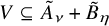 $V\subseteq \tilde {A}_{\nu }+\tilde {B}_{\eta }$
is compact. Then V is a compact subset of
$V\subseteq \tilde {A}_{\nu }+\tilde {B}_{\eta }$
is compact. Then V is a compact subset of $\{\tilde {h}>0\}$
. Continuity of
$\{\tilde {h}>0\}$
. Continuity of $\tilde {h}$
and compactness of V then imply
$\tilde {h}$
and compactness of V then imply $V\subseteq \{\tilde {h}\geq \delta \}$
for some
$V\subseteq \{\tilde {h}\geq \delta \}$
for some $\delta>0$
. Part (iii) of Lemma 3.14 then implies
$\delta>0$
. Part (iii) of Lemma 3.14 then implies $V\cap \Gamma \subset _{\nu } A+B$
.
$V\cap \Gamma \subset _{\nu } A+B$
.
4 Piecewise Bohr structure in
$A+B$

Corollary 4.2 generalizes the results discussed in §1.6 and recovers [Reference Griesmer22, Theorem 1.4]. To prove it, we need the following general fact about translation-invariant measures on groups.
Lemma 4.1. Let G be an abelian group and let m be a translation invariant, finitely additive (or countably additive) probability measure on G such that $m(-A)=m(A)$
for all m-measurable
$m(-A)=m(A)$
for all m-measurable $A\subseteq G$
. If
$A\subseteq G$
. If $m(A) + m(B)>1$
, then
$m(A) + m(B)>1$
, then $A+B=G$
.
$A+B=G$
.
Proof. Let $x\in G$
. Note that
$x\in G$
. Note that $x\in A+B$
if and only if
$x\in A+B$
if and only if $B\cap (x-A)\neq \varnothing $
. Since m is translation invariant and
$B\cap (x-A)\neq \varnothing $
. Since m is translation invariant and $m(-A)=m(A)$
, we have
$m(-A)=m(A)$
, we have $m(B)+m(x-A)>1$
. Hence B cannot be disjoint from
$m(B)+m(x-A)>1$
. Hence B cannot be disjoint from $x-A$
, so
$x-A$
, so $x\in A+B$
.
$x\in A+B$
.
Note that Lemma 4.1 applies to Haar probability measure $\mu $
on a compact abelian group: uniqueness of Haar measure implies
$\mu $
on a compact abelian group: uniqueness of Haar measure implies $\mu (A)=\mu (-A)$
for every
$\mu (A)=\mu (-A)$
for every $\mu $
-measurable set A.
$\mu $
-measurable set A.
Corollary 4.2. Let $\Gamma $
be a discrete abelian group and let A,
$\Gamma $
be a discrete abelian group and let A, $B\subseteq \Gamma $
.
$B\subseteq \Gamma $
.
-
(i) If
$d^*(A)>0$
and
$\eta (B)>0$
for some FS-mean
$\eta $
on
$\ell ^\infty (\Gamma )$
, then
$A+B$
is piecewise Bohr (and therefore piecewise syndetic). Furthermore, if
$\nu \in {\mathcal {M}}_{\tau }^{ext}(\Gamma )$
and
$\nu (A)>0$
, then there is a Bohr neighborhood
$U\subseteq \Gamma $
such that
$U \subseteq _{\nu } A+B$
. -
(ii) If
$\nu $
is an extreme invariant mean on
$\ell ^{\infty }(\Gamma )$
,
$\eta $
is an FS-mean on
$\ell ^\infty (\Gamma )$
, and
$\nu (A)+\eta (B)>1$
, then
$\nu (A+B)=1$
. Consequently
$A+B$
is thick.


Proof. The proof of (i) is identical to the proof of Corollary 1.6, with Theorem 3.16 in place of Theorem 1.5.
To prove (ii), assume $\nu $
,
$\nu $
, $\eta $
, A, and B are as in the hypothesis, and let
$\eta $
, A, and B are as in the hypothesis, and let $\tilde {A}_{\nu }, \tilde {B}_{\eta }\subseteq b\Gamma $
be as in Theorem 3.16. Then
$\tilde {A}_{\nu }, \tilde {B}_{\eta }\subseteq b\Gamma $
be as in Theorem 3.16. Then $\mu _{b\Gamma }(\tilde {A}_{\nu })\geq \nu (A)$
and
$\mu _{b\Gamma }(\tilde {A}_{\nu })\geq \nu (A)$
and $\mu _{b\Gamma }(\tilde {B}_{\eta })\geq \eta (B)$
, so
$\mu _{b\Gamma }(\tilde {B}_{\eta })\geq \eta (B)$
, so $\mu _{b\Gamma }(\tilde {A}_{\nu })+\mu _{b\Gamma }(\tilde {B}_{\eta })> 1$
. Lemma 4.1 implies
$\mu _{b\Gamma }(\tilde {A}_{\nu })+\mu _{b\Gamma }(\tilde {B}_{\eta })> 1$
. Lemma 4.1 implies $\tilde {A}_{\nu }+\tilde {B}_{\eta }=b\Gamma $
, so that
$\tilde {A}_{\nu }+\tilde {B}_{\eta }=b\Gamma $
, so that $\mu _{b\Gamma }(\tilde {A}_{\nu }+\tilde {B}_{\eta })=1$
. Theorem 3.16 then implies
$\mu _{b\Gamma }(\tilde {A}_{\nu }+\tilde {B}_{\eta })=1$
. Theorem 3.16 then implies $\nu (A+B)=1$
. Thickness of
$\nu (A+B)=1$
. Thickness of $A+B$
then follows from (T.5)
$A+B$
then follows from (T.5) $\implies $
(T.1) in Lemma 12.2.
$\implies $
(T.1) in Lemma 12.2.
4.1 Connection to previous work
Lemma 3.14 and Theorem 3.16 improve [Reference Bergelson, Furstenberg and Weiss4, Theorem I], which says that if $A, B\subseteq \mathbb Z$
have positive upper Banach density, then
$A, B\subseteq \mathbb Z$
have positive upper Banach density, then $A+B$
is piecewise Bohr. The improvement is in three aspects:
$A+B$
is piecewise Bohr. The improvement is in three aspects:
-
(i) The containments
$\{h\geq \delta \} \subset _\nu A+B$
and
$(\tilde {A}_{\nu }+\tilde {B}_{\eta })\cap V \subset _{\nu } A+B $
in Lemma 3.14 and Theorem 3.16 say that the piecewise Bohr structure of
$A+B$
can be found where the largeness of A itself is realized; [Reference Bergelson, Furstenberg and Weiss4, Theorem I] does not specify the location of the thick set T where the piecewise Bohr structure of
$A+B$
is realized. -
(ii) The hypothesis on B is weakened from “positive upper Banach density” to
$\eta (B)>0$
for some FS-mean
$\eta $
. -
(iii) Relating
$A+B$
to
$\tilde {A}_{\nu }+\tilde {B}_{\eta }$
allows one to transfer results about sumsets in compact abelian groups directly to discrete abelian groups.


Theorem 3.16 is analogous to a special case of [Reference Björklund and Fish7, Proposition 1.10]. The latter does specify the structure of $A+B$
in terms of a convolution
$A+B$
in terms of a convolution $\tilde {f}*\tilde {g}$
on
$\tilde {f}*\tilde {g}$
on $b\Gamma $
, and the results there apply to general countable groups (not necessarily abelian, or even amenable). Our Theorem 3.16 locates the piecewise Bohr structure of
$b\Gamma $
, and the results there apply to general countable groups (not necessarily abelian, or even amenable). Our Theorem 3.16 locates the piecewise Bohr structure of $A+B$
in terms of
$A+B$
in terms of $\nu $
, whereas [Reference Björklund and Fish7, Proposition 1.10] locates the structure of
$\nu $
, whereas [Reference Björklund and Fish7, Proposition 1.10] locates the structure of $A+B$
in terms of a thick set T whose relation to
$A+B$
in terms of a thick set T whose relation to $\nu $
is unspecified. The proofs in [Reference Björklund and Fish7] rely on detailed analysis of orbits in measure preserving dynamical systems, which our proofs avoid.
$\nu $
is unspecified. The proofs in [Reference Björklund and Fish7] rely on detailed analysis of orbits in measure preserving dynamical systems, which our proofs avoid.
Results in [Reference Björklund and Fish8] do locate structure in $A+B$
in terms of a
$A+B$
in terms of a $\nu \in {\mathcal {M}}_{\tau }^{ext}(\Gamma)$
with
$\nu \in {\mathcal {M}}_{\tau }^{ext}(\Gamma)$
with $\nu (A)>0$
.
$\nu (A)>0$
.
Our results apply to discrete abelian groups of arbitrary cardinality, whereas [Reference Björklund and Fish7] and [Reference Björklund and Fish8] consider only countable discrete groups.
5 Convolution on discrete groups
5.1 Integral notation for means
While means are only finitely additive, we follow [Reference Björklund and Fish7] and [Reference Björklund and Fish8], using integral notation to denote some evaluations of means. So $m(f)$
may be denoted
$m(f)$
may be denoted $\int f(t)\, dm(t)$
.
$\int f(t)\, dm(t)$
.
5.2 Pointwise convolution versus weak convolution
To prove Lemma 3.14, one would naturally set $f=1_A$
,
$f=1_A$
, $g=1_B$
, and define a convolution
$g=1_B$
, and define a convolution $f*_\eta g\in \ell ^\infty (\Gamma )$
by
$f*_\eta g\in \ell ^\infty (\Gamma )$
by $f*_\eta g(x):= \int f(x-t)g(t)\, d\eta (t)$
. One easily verifies that
$f*_\eta g(x):= \int f(x-t)g(t)\, d\eta (t)$
. One easily verifies that $f*_\eta g(x)=0$
unless
$f*_\eta g(x)=0$
unless $x\in A+B$
, so we would like to show that
$x\in A+B$
, so we would like to show that
 $$ \begin{align} f*_{\eta} g \sim_{\nu} \sum_{\chi\in{\widehat{\Gamma}}} {\hat{f}}^{\nu}(\chi) {\hat{g}}^{\eta}(\chi) \chi, \end{align} $$
cf. equation (2.4) above. This is difficult, due the fact that $\nu $
is not countably additive: the inability to exchange the order of integration à la Fubini is an obstruction to computing Fourier coefficients of
$\nu $
is not countably additive: the inability to exchange the order of integration à la Fubini is an obstruction to computing Fourier coefficients of $f*_{\eta } g$
. To circumvent this issue, we use the alternative Definition 5.2, denoted
$f*_{\eta } g$
. To circumvent this issue, we use the alternative Definition 5.2, denoted  . This can be thought of as a weak $L^{2}(\nu )$
limit of averages of translates of f, weighted by g and
$L^{2}(\nu )$
limit of averages of translates of f, weighted by g and $\eta $
. When
$\eta $
. When $\nu $
is only assumed to be invariant, we still cannot prove an identity like (5.1) for
$\nu $
is only assumed to be invariant, we still cannot prove an identity like (5.1) for  , due to examples like Example 1.11. Thanks to Lemma 5.4, the desired identity is available if we assume $\nu \in {\mathcal {M}}_{\tau }^{ext}(\Gamma )$
and
$\nu \in {\mathcal {M}}_{\tau }^{ext}(\Gamma )$
and $\eta \in {\mathcal {M}}^{FS}(\Gamma )$
.
$\eta \in {\mathcal {M}}^{FS}(\Gamma )$
.
5.3 Averaging unitary actions
We generalize the mean ergodic theorem (Theorem 3.1 above) in two ways: (i) instead of averaging over $n\in \{1,\dots ,N\}$
, we average with respect to a mean on
$n\in \{1,\dots ,N\}$
, we average with respect to a mean on $\ell ^\infty (\Gamma )$
, and (ii) we introduce some coefficients
$\ell ^\infty (\Gamma )$
, and (ii) we introduce some coefficients $g(n)$
, so our averages will be generalizations of
$g(n)$
, so our averages will be generalizations of $\frac {1}{N}\sum _{n=1}^N g(n)U^n w$
. We will see that limits of such averages can often be computed in terms of Fourier coefficients and eigenspaces; cf. [Reference Jones, Rosenblatt and Tempelman28].
$\frac {1}{N}\sum _{n=1}^N g(n)U^n w$
. We will see that limits of such averages can often be computed in terms of Fourier coefficients and eigenspaces; cf. [Reference Jones, Rosenblatt and Tempelman28].
Let $\eta $
be any mean on
$\eta $
be any mean on $\ell ^{\infty }(\Gamma )$
and U an action of
$\ell ^{\infty }(\Gamma )$
and U an action of $\Gamma $
by unitary operators
$\Gamma $
by unitary operators $U_t$
on a Hilbert space
$U_t$
on a Hilbert space $\mathcal H$
. For each
$\mathcal H$
. For each $w\in \mathcal H$
and
$w\in \mathcal H$
and $g\in \ell ^{\infty }(\Gamma )$
we define
$g\in \ell ^{\infty }(\Gamma )$
we define
 $$\begin{align*}\int (U_{t} w)g(t)\, d\eta(t)\end{align*}$$
to be the unique $z\in \mathcal H$
satisfying
$z\in \mathcal H$
satisfying $\langle v, z\rangle = \int \langle v, U_t w\rangle \, g(t) d\eta (t)$
for all
$\langle v, z\rangle = \int \langle v, U_t w\rangle \, g(t) d\eta (t)$
for all $v\in \mathcal H$
. The Reisz representation theorem for Hilbert spaces provides this z, as the map
$v\in \mathcal H$
. The Reisz representation theorem for Hilbert spaces provides this z, as the map $v\mapsto \int \langle v, U_t w\rangle \, g(t) d\eta (t)$
is a continuous linear functional on
$v\mapsto \int \langle v, U_t w\rangle \, g(t) d\eta (t)$
is a continuous linear functional on $\mathcal H$
.
$\mathcal H$
.
Recall from §3.3 that for a given $\chi \in \widehat {\Gamma }$
,
$\chi \in \widehat {\Gamma }$
, $\mathcal H_\chi :=\{w\in \mathcal H:U_{\gamma }w= \chi (\gamma )w \text { for all } \gamma \in \Gamma \}$
is the
$\mathcal H_\chi :=\{w\in \mathcal H:U_{\gamma }w= \chi (\gamma )w \text { for all } \gamma \in \Gamma \}$
is the $\chi $
-eigenspace of U. For each
$\chi $
-eigenspace of U. For each $g\in \ell ^{\infty }(\Gamma )$
and each
$g\in \ell ^{\infty }(\Gamma )$
and each $w\in \mathcal H_{\chi }$
, we have
$w\in \mathcal H_{\chi }$
, we have $\int (U_{t} w) g(t)\, d\eta (t)=\int \chi (t)g(t)w \, d\eta (t)$
, so
$\int (U_{t} w) g(t)\, d\eta (t)=\int \chi (t)g(t)w \, d\eta (t)$
, so
 $$ \begin{align}\int (U_{t}w)g(t)\,d\eta(t) = \eta(g\chi)w \qquad \text{ for each } w\in \mathcal H_{\chi}, g\in \ell^{\infty}(\Gamma). \end{align} $$
5.4 Hilbert space associated to a mean
Let m be a mean on $\ell ^{\infty }(\Gamma )$
. As above we write
$\ell ^{\infty }(\Gamma )$
. As above we write $f\sim _m g$
if
$f\sim _m g$
if $m(|f-g|)=0$
.
$m(|f-g|)=0$
.
Consider the Hermitian form $\langle \cdot , \cdot \rangle _m$
on
$\langle \cdot , \cdot \rangle _m$
on $\ell ^\infty (\Gamma )$
given by
$\ell ^\infty (\Gamma )$
given by $\langle f,g\rangle _m:=m(f\overline {g})$
and the associated seminorm
$\langle f,g\rangle _m:=m(f\overline {g})$
and the associated seminorm $\|f\|_{m}:=\langle f,f\rangle _m$
. Observe that
$\|f\|_{m}:=\langle f,f\rangle _m$
. Observe that $\langle \cdot , \cdot \rangle _m$
is not an inner product, as
$\langle \cdot , \cdot \rangle _m$
is not an inner product, as $\|f\|_m$
may be zero for nonzero f. Nevertheless,
$\|f\|_m$
may be zero for nonzero f. Nevertheless, $\langle \cdot , \cdot \rangle _m$
is positive semidefinite and sesquilinear; in particular Cauchy-Schwarz holds:
$\langle \cdot , \cdot \rangle _m$
is positive semidefinite and sesquilinear; in particular Cauchy-Schwarz holds:
 $$ \begin{align} m(f\overline{g})\leq \|f\|_{m}\|g\|_{m}. \end{align} $$
Let $\ell ^{\infty }(\Gamma )/{\sim }_{m}$
denote the quotient
$\ell ^{\infty }(\Gamma )/{\sim }_{m}$
denote the quotient $\ell ^\infty (\Gamma )/\{f:\|f\|_m=0\}$
. We write
$\ell ^\infty (\Gamma )/\{f:\|f\|_m=0\}$
. We write $L^2(m)$
for the metric completion of
$L^2(m)$
for the metric completion of $\ell ^\infty (\Gamma )/{\sim }_{m}$
with respect to the metric
$\ell ^\infty (\Gamma )/{\sim }_{m}$
with respect to the metric $d_m([f],[g]):=\|f-g\|_m$
, where
$d_m([f],[g]):=\|f-g\|_m$
, where $[f]$
and
$[f]$
and $[g]$
denote the respective
$[g]$
denote the respective $\sim _{m}$
equivalence classes of f and g.
$\sim _{m}$
equivalence classes of f and g.
Elements of $L^2(m)$
are represented by Cauchy sequences
$L^2(m)$
are represented by Cauchy sequences $(f_n)_{n\in \mathbb N}$
of elements of
$(f_n)_{n\in \mathbb N}$
of elements of $\ell ^\infty (\Gamma )$
, where “Cauchy” means
$\ell ^\infty (\Gamma )$
, where “Cauchy” means $\lim _{n\to \infty } \sup _{j,k\geq n} \|f_j-f_k\|_m=0$
. When appropriate, we identify
$\lim _{n\to \infty } \sup _{j,k\geq n} \|f_j-f_k\|_m=0$
. When appropriate, we identify $f\in \ell ^{\infty }(\Gamma )$
with the element of
$f\in \ell ^{\infty }(\Gamma )$
with the element of $L^{2}(m)$
determined by the constant Cauchy sequence
$L^{2}(m)$
determined by the constant Cauchy sequence $f_{n}=f$
. In particular, each
$f_{n}=f$
. In particular, each $\chi \in \widehat {\Gamma }$
determines an element of
$\chi \in \widehat {\Gamma }$
determines an element of $L^{2}(m)$
.
$L^{2}(m)$
.
Now $L^{2}(m)$
is a Hilbert space; the inner product of two elements v, w represented by Cauchy sequences
$L^{2}(m)$
is a Hilbert space; the inner product of two elements v, w represented by Cauchy sequences $(f_{n})_{n\in \mathbb N}$
,
$(f_{n})_{n\in \mathbb N}$
, $(g_{n})_{n\in \mathbb N}$
is
$(g_{n})_{n\in \mathbb N}$
is $\langle v,w \rangle _{m}=\lim _{n\to \infty } \langle f_{n},g_{n}\rangle _{m}.$
If $w\in L^{2}(m)$
and
$w\in L^{2}(m)$
and $g\in \ell ^{\infty }(\Gamma )$
, we write
$g\in \ell ^{\infty }(\Gamma )$
, we write $w\sim _{m} g$
to mean that w is represented by the constant Cauchy sequence
$w\sim _{m} g$
to mean that w is represented by the constant Cauchy sequence $g_{n}=g$
.
$g_{n}=g$
.
Lemma 5.1. If $\eta $
is an FS-mean on
$\eta $
is an FS-mean on $\ell ^{\infty }(\Gamma )$
, then
$\ell ^{\infty }(\Gamma )$
, then $\widehat {\Gamma }$
forms an orthonormal subset of
$\widehat {\Gamma }$
forms an orthonormal subset of $L^{2}(\eta )$
.
$L^{2}(\eta )$
.
Proof. This follows from Lemma 3.5.
5.5 Translation action
Now assume m is an invariant mean on $\ell ^{\infty }(\Gamma )$
. For
$\ell ^{\infty }(\Gamma )$
. For $f\in \ell ^\infty (\Gamma )$
, we write
$f\in \ell ^\infty (\Gamma )$
, we write $\gamma \cdot f$
for
$\gamma \cdot f$
for $f_\gamma $
, where
$f_\gamma $
, where $f_\gamma (x)=f(x-\gamma )$
. Since m is invariant, translation preserves the seminorm:
$f_\gamma (x)=f(x-\gamma )$
. Since m is invariant, translation preserves the seminorm: $\|\gamma \cdot f\|_{m}=\|f\|_{m}$
for all
$\|\gamma \cdot f\|_{m}=\|f\|_{m}$
for all $\gamma \in \Gamma $
and
$\gamma \in \Gamma $
and $f\in \ell ^{\infty }(m)$
. Translation on
$f\in \ell ^{\infty }(m)$
. Translation on $\ell ^{\infty }(\Gamma )$
therefore induces an action of
$\ell ^{\infty }(\Gamma )$
therefore induces an action of $\Gamma $
by unitary operators
$\Gamma $
by unitary operators $U_{\gamma }$
on
$U_{\gamma }$
on $L^2(m)$
: if
$L^2(m)$
: if $w\in L^2(m)$
is represented by the Cauchy sequence
$w\in L^2(m)$
is represented by the Cauchy sequence $(f_n)_{n\in \mathbb N}$
, we define
$(f_n)_{n\in \mathbb N}$
, we define $U_\gamma w$
to be the element of
$U_\gamma w$
to be the element of $L^2(m)$
represented by the Cauchy sequence
$L^2(m)$
represented by the Cauchy sequence $(\gamma \cdot f_n)_{n\in \mathbb N}$
. It is routine to check that the element of
$(\gamma \cdot f_n)_{n\in \mathbb N}$
. It is routine to check that the element of $L^{2}(m)$
determined by
$L^{2}(m)$
determined by $(\gamma \cdot f_n)_{n\in \mathbb N}$
depends only on w and not on the specific choice of Cauchy sequence, so
$(\gamma \cdot f_n)_{n\in \mathbb N}$
depends only on w and not on the specific choice of Cauchy sequence, so $U_{\gamma }w$
is well-defined.
$U_{\gamma }w$
is well-defined.
Definition 5.2. Let m be an invariant mean and let $\eta $
be any mean on
$\eta $
be any mean on $\ell ^{\infty }(\Gamma )$
. Let
$\ell ^{\infty }(\Gamma )$
. Let $f,g\in \ell ^\infty (\Gamma )$
, and write U for the translation action of
$f,g\in \ell ^\infty (\Gamma )$
, and write U for the translation action of $\Gamma $
on
$\Gamma $
on $L^{2}(m)$
. We define
$L^{2}(m)$
. We define  (the convolution of f and g with respect to m and $\eta $
) to be the element of
$\eta $
) to be the element of $L^{2}(m)$
given by
$L^{2}(m)$
given by

The “f” on the right-hand side of (5.4) is the element of $L^{2}(m)$
represented by the constant Cauchy sequence
$L^{2}(m)$
represented by the constant Cauchy sequence $f_{n}=f$
, while “g” denotes the actual function g. Thus
$f_{n}=f$
, while “g” denotes the actual function g. Thus  is the unique element of $L^{2}(m)$
satisfying
$L^{2}(m)$
satisfying  for all $\phi \in L^{2}(m)$
.
$\phi \in L^{2}(m)$
.
Lemma 5.3. Let m be an invariant mean on $\ell ^\infty (\Gamma )$
and let
$\ell ^\infty (\Gamma )$
and let $\eta $
be any mean on
$\eta $
be any mean on $\ell ^\infty (\Gamma )$
. If f,
$\ell ^\infty (\Gamma )$
. If f, $g:\Gamma \to [0,1]$
are supported on A and B, respectively, then
$g:\Gamma \to [0,1]$
are supported on A and B, respectively, then  is nonnegative and is supported on $A+B$
. More precisely: if
$A+B$
. More precisely: if $\phi :\Gamma \to [0,1]$
, then
$\phi :\Gamma \to [0,1]$
, then


Proof. Let $f, g, \phi :\Gamma \to [0,1]$
with f supported on A and g supported on B. For all
$f, g, \phi :\Gamma \to [0,1]$
with f supported on A and g supported on B. For all $b\in B$
, we have
$b\in B$
, we have $\langle \phi , U_{b}f\rangle _{m} = \langle \phi 1_{A+B} , U_{b}f\rangle _{m}$
. Since g is supported on B, we get
$\langle \phi , U_{b}f\rangle _{m} = \langle \phi 1_{A+B} , U_{b}f\rangle _{m}$
. Since g is supported on B, we get $\int \langle \phi ,U_t f\rangle _{m}\, g(t) \, d\eta (t)= \int \langle \phi 1_{A+B},U_t f\rangle _{m}\, g(t) \, d\eta (t)$
. This implies (5.6). To prove (5.5), note that
$\int \langle \phi ,U_t f\rangle _{m}\, g(t) \, d\eta (t)= \int \langle \phi 1_{A+B},U_t f\rangle _{m}\, g(t) \, d\eta (t)$
. This implies (5.6). To prove (5.5), note that $\langle \phi , U_{t}f\rangle _{m}\geq 0$
for all t, so
$\langle \phi , U_{t}f\rangle _{m}\geq 0$
for all t, so $\int \langle \phi , U_{t}f\rangle _{m}\, g(t)\, d\eta (t)\geq 0$
.
$\int \langle \phi , U_{t}f\rangle _{m}\, g(t)\, d\eta (t)\geq 0$
.
In light of Equation (5.2), simplifying  in terms of characters requires us to identify the $\chi $
-eigenspace
$\chi $
-eigenspace $\mathcal H_{\chi }$
of the translation action U on
$\mathcal H_{\chi }$
of the translation action U on $L^{2}(m)$
. Clearly we have
$L^{2}(m)$
. Clearly we have $\overline {\chi }\in \mathcal H_{\chi }$
, but in general
$\overline {\chi }\in \mathcal H_{\chi }$
, but in general $\mathcal H_{\chi }$
may be infinite-dimensional. Lemma 5.4 says that for extreme invariant means
$\mathcal H_{\chi }$
may be infinite-dimensional. Lemma 5.4 says that for extreme invariant means $\nu $
, each eigenspace of the translation action on
$\nu $
, each eigenspace of the translation action on $L^{2}(\nu )$
is one-dimensional.
$L^{2}(\nu )$
is one-dimensional.
Lemma 5.4. Let $\nu \in {\mathcal {M}}_{\tau }^{ext}(\Gamma )$
and let U be the translation action of
$\nu \in {\mathcal {M}}_{\tau }^{ext}(\Gamma )$
and let U be the translation action of $\Gamma $
on
$\Gamma $
on $L^{2}(\nu )$
. Then
$L^{2}(\nu )$
. Then
-
(i) the space
$\{w\in L^{2}(\nu ): U_{\gamma } w = w \text { for all } \gamma \in \Gamma \}$
of U-invariant elements is one-dimensional and is spanned by
$1_{\Gamma }$
; -
(ii) for each
$\chi \in \widehat {\Gamma }$
, the
$\chi $
-eigenspace of U is one-dimensional, and is spanned by
$\overline {\chi }$
.


Lemma 5.4 follows from the well-known correspondence between extreme invariant means on $\ell ^{\infty }(\Gamma )$
and Radon probability measures
$\ell ^{\infty }(\Gamma )$
and Radon probability measures $\mu $
on
$\mu $
on $\beta \Gamma $
(
$\beta \Gamma $
( $=$
the Stone-Cech compactification of the discrete group
$=$
the Stone-Cech compactification of the discrete group $\Gamma $
) for which left translation by elements of
$\Gamma $
) for which left translation by elements of $\Gamma $
induces an ergodic measure-preserving action on
$\Gamma $
induces an ergodic measure-preserving action on $(\beta \Gamma ,\mu )$
. We present an elementary proof in §6.
$(\beta \Gamma ,\mu )$
. We present an elementary proof in §6.
Lemma 5.5. Let $\nu \in {\mathcal {M}}_{\tau }^{ext}(\Gamma )$
and
$\nu \in {\mathcal {M}}_{\tau }^{ext}(\Gamma )$
and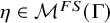 $\eta \in {\mathcal {M}}^{FS}(\Gamma )$
. Let
$\eta \in {\mathcal {M}}^{FS}(\Gamma )$
. Let $f, g\in \ell ^{\infty }(\Gamma )$
. Then the series
$f, g\in \ell ^{\infty }(\Gamma )$
. Then the series $\sum _{\chi \in \widehat {\Gamma }} \hat {f}^\nu (\chi )\hat {g}^\eta (\chi )\chi $
converges uniformly to an element
$\sum _{\chi \in \widehat {\Gamma }} \hat {f}^\nu (\chi )\hat {g}^\eta (\chi )\chi $
converges uniformly to an element $h\in \ell ^{\infty }(\Gamma )$
satisfying
$h\in \ell ^{\infty }(\Gamma )$
satisfying  .
.
5.6 Simplifying convolutions
Let m be an invariant mean on $\ell ^{\infty }(\Gamma )$
and let
$\ell ^{\infty }(\Gamma )$
and let $\eta $
be an arbitrary mean on
$\eta $
be an arbitrary mean on $\ell ^{\infty }(\Gamma )$
. Let U be a unitary action of
$\ell ^{\infty }(\Gamma )$
. Let U be a unitary action of $\Gamma $
on a Hilbert space
$\Gamma $
on a Hilbert space $\mathcal H$
.
$\mathcal H$
.
Recall that $\mathcal H_c$
is the smallest closed subspace of
$\mathcal H_c$
is the smallest closed subspace of $\mathcal H$
containing all the eigenspaces
$\mathcal H$
containing all the eigenspaces $\mathcal H_{\chi }$
. Since each
$\mathcal H_{\chi }$
. Since each $U_\gamma $
is unitary, the eigenspaces are closed and mutually orthogonal, and each
$U_\gamma $
is unitary, the eigenspaces are closed and mutually orthogonal, and each $w\in \mathcal H$
may be expanded uniquely as
$w\in \mathcal H$
may be expanded uniquely as
 $$\begin{align*}w=w_0+\sum_{\chi\in\widehat{\Gamma}} w_\chi,\end{align*}$$
where $w_\chi \in \mathcal H_\chi $
and
$w_\chi \in \mathcal H_\chi $
and $w_0\in \mathcal H_c^\perp $
. With this expansion, equation (5.2) implies
$w_0\in \mathcal H_c^\perp $
. With this expansion, equation (5.2) implies
 $$ \begin{align} \int (U_{t}w) g(t)\, d\eta(t) = \int (U_{t}w_{0}) g(t)\, d\eta(t)+ \sum_{\chi\in\widehat{\Gamma}} \eta(g\chi) w_{\chi}. \end{align} $$
We will simplify $\int (U_{t}w_{0}) g(t)\, d\eta (t)$
under the assumption that
$\int (U_{t}w_{0}) g(t)\, d\eta (t)$
under the assumption that $\eta $
is an FS-mean, and we will simplify
$\eta $
is an FS-mean, and we will simplify $\eta (g\chi )w_{\chi }$
under the assumption that U is the translation action associated to an extreme invariant mean. While these assumptions are independent of one another, our proof of Lemma 5.5 uses both.
$\eta (g\chi )w_{\chi }$
under the assumption that U is the translation action associated to an extreme invariant mean. While these assumptions are independent of one another, our proof of Lemma 5.5 uses both.
Lemma 5.6. If $\eta $
is an FS-mean on
$\eta $
is an FS-mean on $\ell ^{\infty }(\Gamma )$
, U is a unitary action of
$\ell ^{\infty }(\Gamma )$
, U is a unitary action of $\Gamma $
on a Hilbert space
$\Gamma $
on a Hilbert space $\mathcal H$
,
$\mathcal H$
, $g\in L^{\infty }(\Gamma )$
, and
$g\in L^{\infty }(\Gamma )$
, and $w\in \mathcal H_{c}^{\perp }$
, then
$w\in \mathcal H_{c}^{\perp }$
, then $\int (U_{t}w)\, g(t)\, d\eta (t)=0$
.
$\int (U_{t}w)\, g(t)\, d\eta (t)=0$
.
Proof. Let $v\in \mathcal H$
and
$v\in \mathcal H$
and $w\in \mathcal H_{c}^{\perp }$
. Since
$w\in \mathcal H_{c}^{\perp }$
. Since $\eta $
is an FS-mean, Lemma 3.5 (ii) says that
$\eta $
is an FS-mean, Lemma 3.5 (ii) says that $\int |\langle v, U_{t}w\rangle |^{2}\, d\eta (t)=0$
. We apply Cauchy-Schwarz to find
$\int |\langle v, U_{t}w\rangle |^{2}\, d\eta (t)=0$
. We apply Cauchy-Schwarz to find
 $$\begin{align*}\Bigl|\int \langle v,U_{t}w \rangle g(t) \, d\eta(t)\Bigr|^{2} \leq \int |\langle v, U_{t}w\rangle|^{2}\, d\eta(t)\, \eta(|g|^{2}) =0, \end{align*}$$
so $\int \langle v,U_{t}w \rangle g(t) \, d\eta (t)=0$
. Since this holds for all
$\int \langle v,U_{t}w \rangle g(t) \, d\eta (t)=0$
. Since this holds for all $v\in \mathcal H$
, we have
$v\in \mathcal H$
, we have $\int (U_{t}w)\, g(t)\, d\eta (t)=0$
.
$\int (U_{t}w)\, g(t)\, d\eta (t)=0$
.
Proof of Lemma 5.5.
Let $\nu \in {\mathcal {M}}_{\tau }^{ext}(\Gamma )$
and
$\nu \in {\mathcal {M}}_{\tau }^{ext}(\Gamma )$
and $\eta \in {\mathcal {M}}^{FS}(\Gamma )$
. Let U be the translation action on
$\eta \in {\mathcal {M}}^{FS}(\Gamma )$
. Let U be the translation action on $L^{2}(\nu )$
, and let
$L^{2}(\nu )$
, and let $f, g\in \ell ^{\infty }(\Gamma )$
. Specializing equation (5.7) with f in place of w, the left-hand side becomes
$f, g\in \ell ^{\infty }(\Gamma )$
. Specializing equation (5.7) with f in place of w, the left-hand side becomes  , so we have

where $f_{\chi }$
is the orthogonal projection of f onto the
$f_{\chi }$
is the orthogonal projection of f onto the $\chi $
-eigenspace of U, and
$\chi $
-eigenspace of U, and $f_{0}$
is orthogonal to every eigenspace of U in
$f_{0}$
is orthogonal to every eigenspace of U in $L^{2}(\nu )$
. Lemma 5.6 implies
$L^{2}(\nu )$
. Lemma 5.6 implies $\int (U_{t}f_{0}) g(t)\, d\eta (t)=0$
. Part (ii) of Lemma 5.4 implies
$\int (U_{t}f_{0}) g(t)\, d\eta (t)=0$
. Part (ii) of Lemma 5.4 implies $f_{\chi }\sim _{\nu }\langle f,\overline {\chi }\rangle _{\nu }\overline {\chi }$
, which we can write as
$f_{\chi }\sim _{\nu }\langle f,\overline {\chi }\rangle _{\nu }\overline {\chi }$
, which we can write as $f_{\chi }\sim _{\nu }\nu (f\chi )\overline {\chi }$
. The right-hand side of (5.8) then simplifies as
$f_{\chi }\sim _{\nu }\nu (f\chi )\overline {\chi }$
. The right-hand side of (5.8) then simplifies as $\sum _{\chi \in \widehat {\Gamma }} \eta (g\chi )\nu (f\chi )\overline {\chi }$
. Replacing
$\sum _{\chi \in \widehat {\Gamma }} \eta (g\chi )\nu (f\chi )\overline {\chi }$
. Replacing $\chi $
with
$\chi $
with $\overline {\chi }$
and permuting the order of multiplication, we have
$\overline {\chi }$
and permuting the order of multiplication, we have  . By definition, this is equal to $\sum _{\chi \in \widehat {\Gamma }} \hat {f}^\nu (\chi )\hat {g}^\eta (\chi )\chi $
, as desired.
$\sum _{\chi \in \widehat {\Gamma }} \hat {f}^\nu (\chi )\hat {g}^\eta (\chi )\chi $
, as desired.
To prove uniform convergence, first apply Corollary 3.6 to get $\sum _{\chi \in \widehat {\Gamma }}|\eta (g\overline {\chi })|^{2}\leq \eta (|g|^{2})$
, and likewise
$\sum _{\chi \in \widehat {\Gamma }}|\eta (g\overline {\chi })|^{2}\leq \eta (|g|^{2})$
, and likewise $\sum _{\chi \in \widehat {\Gamma }} |\nu (f\overline {\chi })|^{2}\leq \nu (|f|^{2})$
. Cauchy-Schwarz then implies
$\sum _{\chi \in \widehat {\Gamma }} |\nu (f\overline {\chi })|^{2}\leq \nu (|f|^{2})$
. Cauchy-Schwarz then implies $\sum _{\chi \in \widehat {\Gamma }} |\nu (f\overline {\chi })\eta (g\overline {\chi })|$
converges, so
$\sum _{\chi \in \widehat {\Gamma }} |\nu (f\overline {\chi })\eta (g\overline {\chi })|$
converges, so $\sum _{\chi \in \widehat {\Gamma }} \eta (g\overline {\chi })\nu (f\overline {\chi })\chi $
converges uniformly.
$\sum _{\chi \in \widehat {\Gamma }} \eta (g\overline {\chi })\nu (f\overline {\chi })\chi $
converges uniformly.
6 Ergodicity
For this section, fix a discrete abelian group $\Gamma $
and an extreme invariant mean
$\Gamma $
and an extreme invariant mean $\nu $
on
$\nu $
on $\ell ^{\infty }(\Gamma )$
. Let U be the translation action of
$\ell ^{\infty }(\Gamma )$
. Let U be the translation action of $\Gamma $
on
$\Gamma $
on $L^{2}(\nu )$
. We prove Lemma 5.4 at the end of this section.
$L^{2}(\nu )$
. We prove Lemma 5.4 at the end of this section.
Lemma 6.1. If $w\in L^2(\nu )$
is represented by an
$w\in L^2(\nu )$
is represented by an $L^{2}(\nu )$
Cauchy sequence of uniformly bounded functions
$L^{2}(\nu )$
Cauchy sequence of uniformly bounded functions $f_n\in \ell ^\infty (\Gamma )$
and w is U-invariant, then
$f_n\in \ell ^\infty (\Gamma )$
and w is U-invariant, then $w\sim _\nu c1_\Gamma $
, where
$w\sim _\nu c1_\Gamma $
, where $c=\langle w, 1_\Gamma \rangle _\nu $
.
$c=\langle w, 1_\Gamma \rangle _\nu $
.
Proof. The hypothesis states that for some $\alpha>0$
, w belongs to the
$\alpha>0$
, w belongs to the $L^2(\nu )$
-equivalence class of a Cauchy sequence of functions
$L^2(\nu )$
-equivalence class of a Cauchy sequence of functions $f_n:\Gamma \to \mathbb C$
, where
$f_n:\Gamma \to \mathbb C$
, where $|f_n(x)|\leq \alpha $
for all
$|f_n(x)|\leq \alpha $
for all $x\in \Gamma $
, and that
$x\in \Gamma $
, and that $\lim _{n\to \infty }\|f_n-\gamma \cdot f_n\|_{\nu }=0$
for all
$\lim _{n\to \infty }\|f_n-\gamma \cdot f_n\|_{\nu }=0$
for all $\gamma \in \Gamma $
. Splitting
$\gamma \in \Gamma $
. Splitting $f_n$
into real and imaginary parts
$f_n$
into real and imaginary parts $g_{n}$
and
$g_{n}$
and $h_n$
, we see that
$h_n$
, we see that $(g_n)_{n\in \mathbb {N}}$
and
$(g_n)_{n\in \mathbb {N}}$
and $(h_n)_{n\in \mathbb {N}}$
are themselves Cauchy, and represent U-invariant elements of
$(h_n)_{n\in \mathbb {N}}$
are themselves Cauchy, and represent U-invariant elements of $L^2(\nu )$
. It therefore suffices to prove the lemma under the assumption that the
$L^2(\nu )$
. It therefore suffices to prove the lemma under the assumption that the $f_n$
are real-valued. By adding a constant and scaling, we may assume
$f_n$
are real-valued. By adding a constant and scaling, we may assume $f_n:\Gamma \to [0,1]$
.
$f_n:\Gamma \to [0,1]$
.
Let $c=\langle w, 1_\Gamma \rangle _\nu $
, meaning
$c=\langle w, 1_\Gamma \rangle _\nu $
, meaning $c=\lim _{n\to \infty } \nu (f_n)$
. If
$c=\lim _{n\to \infty } \nu (f_n)$
. If $c=0$
, then
$c=0$
, then $\lim _{n\to \infty } \nu (|f_n|)=0$
, meaning
$\lim _{n\to \infty } \nu (|f_n|)=0$
, meaning $w=0$
in
$w=0$
in $L^2(\nu )$
. Likewise, if
$L^2(\nu )$
. Likewise, if $c=1$
, it is easy to verify that
$c=1$
, it is easy to verify that $w\sim _\nu 1_\Gamma $
. So assume
$w\sim _\nu 1_\Gamma $
. So assume $0<c<1$
. Define means
$0<c<1$
. Define means $m_1$
,
$m_1$
, $m_2$
on
$m_2$
on $\ell ^\infty (\Gamma )$
by
$\ell ^\infty (\Gamma )$
by $m_1(g) := \frac {1}{c}\langle g,w\rangle _\nu $
,
$m_1(g) := \frac {1}{c}\langle g,w\rangle _\nu $
, $m_2(g):=\frac {1}{1-c}\langle g, 1_\Gamma -w\rangle _\nu $
. Then
$m_2(g):=\frac {1}{1-c}\langle g, 1_\Gamma -w\rangle _\nu $
. Then $\nu =cm_1+(1-c)m_2$
. Since
$\nu =cm_1+(1-c)m_2$
. Since $w\in \mathcal H_{U\text {-inv}}$
, we get that
$w\in \mathcal H_{U\text {-inv}}$
, we get that $m_{1}$
and
$m_{1}$
and $m_{2}$
are invariant. Since
$m_{2}$
are invariant. Since $\nu $
is extreme, we have
$\nu $
is extreme, we have $m_1=m_2=\nu $
, meaning
$m_1=m_2=\nu $
, meaning $(1-c)\langle g,w\rangle _\nu = c\langle g,1_\Gamma -w\rangle _\nu $
. Simplifying, we get
$(1-c)\langle g,w\rangle _\nu = c\langle g,1_\Gamma -w\rangle _\nu $
. Simplifying, we get $\langle g,w\rangle _\nu = c\langle g,1_\Gamma \rangle _\nu =\langle g, c1_{\Gamma }\rangle _{\nu }$
for every
$\langle g,w\rangle _\nu = c\langle g,1_\Gamma \rangle _\nu =\langle g, c1_{\Gamma }\rangle _{\nu }$
for every $g\in \ell ^\infty (\Gamma )$
. Since
$g\in \ell ^\infty (\Gamma )$
. Since $\ell ^{\infty }(\Gamma )$
forms a dense subspace of
$\ell ^{\infty }(\Gamma )$
forms a dense subspace of $L^{2}(\nu )$
, we see that
$L^{2}(\nu )$
, we see that $\langle v,w\rangle _\nu = \langle v, c1_\Gamma \rangle _\nu $
for all
$\langle v,w\rangle _\nu = \langle v, c1_\Gamma \rangle _\nu $
for all $v\in L^2(\nu )$
. This implies
$v\in L^2(\nu )$
. This implies $w=c1_{\Gamma }$
in
$w=c1_{\Gamma }$
in $L^{2}(\nu )$
.
$L^{2}(\nu )$
.
6.1 Truncations
Let $\alpha>0$
, and define
$\alpha>0$
, and define $\psi _{\alpha }:\mathbb C\to \mathbb C$
by
$\psi _{\alpha }:\mathbb C\to \mathbb C$
by
 $$\begin{align*}\psi_{\alpha}(z) := \begin{cases} z &\text{ if } |z|<\alpha\\ \alpha z/|z| &\text{ if } |z|\geq \alpha \end{cases} \end{align*}$$
Note that $\psi _{\alpha }$
is Lipschitz, with constant 1:
$\psi _{\alpha }$
is Lipschitz, with constant 1: $|\psi _{\alpha }(z)-\psi _{\alpha }(z')|\leq |z-z'|$
for all
$|\psi _{\alpha }(z)-\psi _{\alpha }(z')|\leq |z-z'|$
for all $z, z'\in \mathbb C$
.
$z, z'\in \mathbb C$
.
For a function f with codomain $\mathbb C$
, define the truncation
$\mathbb C$
, define the truncation $f^{(\alpha )}$
by
$f^{(\alpha )}$
by $f^{(\alpha )}:=\psi _{\alpha } \circ f$
. Then
$f^{(\alpha )}:=\psi _{\alpha } \circ f$
. Then $f^{(\alpha )}(x)=f(x)$
when
$f^{(\alpha )}(x)=f(x)$
when $|f(x)|\leq \alpha $
, and
$|f(x)|\leq \alpha $
, and $|f^{(\alpha )}(x)|=\alpha $
when
$|f^{(\alpha )}(x)|=\alpha $
when $|f(x)|\geq \alpha $
.
$|f(x)|\geq \alpha $
.
Lemma 6.2. Let m be a mean on $\ell ^{\infty }(\Gamma )$
, let
$\ell ^{\infty }(\Gamma )$
, let $w\in L^{2}(m)$
, and let
$w\in L^{2}(m)$
, and let $(f_{n})_{n\in \mathbb N}$
be a Cauchy sequence of elements of
$(f_{n})_{n\in \mathbb N}$
be a Cauchy sequence of elements of $\ell ^{\infty }(\Gamma )$
representing w.
$\ell ^{\infty }(\Gamma )$
representing w.
For each $\alpha>0$
,
$\alpha>0$
, $(f_{n}^{(\alpha )})_{n\in \mathbb N}$
is a Cauchy sequence representing an element
$(f_{n}^{(\alpha )})_{n\in \mathbb N}$
is a Cauchy sequence representing an element $w^{(\alpha )}\in L^{2}(m)$
.
$w^{(\alpha )}\in L^{2}(m)$
.
Furthermore $\lim _{\alpha \to \infty } w^{(\alpha )}=w$
in
$\lim _{\alpha \to \infty } w^{(\alpha )}=w$
in $L^{2}(m)$
.
$L^{2}(m)$
.
Proof. Let $\alpha>0$
and
$\alpha>0$
and $f, g\in \ell ^{\infty }(\Gamma )$
. Pointwise we have
$f, g\in \ell ^{\infty }(\Gamma )$
. Pointwise we have $|f^{(\alpha )}-g^{(\alpha )}|= |\psi _{\alpha }(f)-\psi _{\alpha }(g)|\leq |f-g|$
, so
$|f^{(\alpha )}-g^{(\alpha )}|= |\psi _{\alpha }(f)-\psi _{\alpha }(g)|\leq |f-g|$
, so
 $$ \begin{align} \|f^{(\alpha)} -g^{(\alpha)}\|_{m}\leq \|f-g\|_{m}. \end{align} $$
It follows that if $(f_{n})_{n\in \mathbb N}$
is Cauchy, so is
$(f_{n})_{n\in \mathbb N}$
is Cauchy, so is $(f_{n}^{(\alpha )})_{n\in \mathbb N}$
. Thus
$(f_{n}^{(\alpha )})_{n\in \mathbb N}$
. Thus $w^{(\alpha )}$
is well-defined.
$w^{(\alpha )}$
is well-defined.
Now let $(f_{n})_{n\in \mathbb N}$
be a Cauchy sequence of elements of
$(f_{n})_{n\in \mathbb N}$
be a Cauchy sequence of elements of $\ell ^{\infty }(\Gamma )$
representing w. We will prove that
$\ell ^{\infty }(\Gamma )$
representing w. We will prove that $\lim _{\alpha \to \infty }w^{(\alpha )}=w$
. Let
$\lim _{\alpha \to \infty }w^{(\alpha )}=w$
. Let $\varepsilon>0$
.
$\varepsilon>0$
.
Fix $n\in \mathbb N$
such that
$n\in \mathbb N$
such that $\|f_{j}-f_{\ell }\|_{m}<\varepsilon $
for all
$\|f_{j}-f_{\ell }\|_{m}<\varepsilon $
for all $j,\ell \geq n$
. Then for all
$j,\ell \geq n$
. Then for all $\alpha>0$
and all
$\alpha>0$
and all $j, \ell \geq n$
, (6.1) implies
$j, \ell \geq n$
, (6.1) implies $\|f_{j}^{(\alpha )}-f_{\ell }^{(\alpha )}\|_{m}<\varepsilon $
. Choose
$\|f_{j}^{(\alpha )}-f_{\ell }^{(\alpha )}\|_{m}<\varepsilon $
. Choose $\alpha _{0}>0$
so that
$\alpha _{0}>0$
so that $f_{n}^{(\alpha _{0})}=f_{n}$
. For every
$f_{n}^{(\alpha _{0})}=f_{n}$
. For every $\alpha \geq \alpha _{0}$
and all
$\alpha \geq \alpha _{0}$
and all $j,\ell \geq n$
, we have
$j,\ell \geq n$
, we have
 $$\begin{align*}\|f_{j}^{(\alpha)}-f_{\ell}\|_{m}\leq \|f_{j}^{(\alpha)}-f_{n}^{(\alpha)}\|_{m}+\|f_{n}^{(\alpha)}-f_{n}\|_{m}+\|f_{n}-f_{\ell}\|_{m}<2\varepsilon,\end{align*}$$
so $\|w^{(\alpha )}-w\|_{m}<2\varepsilon $
. Since
$\|w^{(\alpha )}-w\|_{m}<2\varepsilon $
. Since $\varepsilon>0$
was arbitrary, this shows that
$\varepsilon>0$
was arbitrary, this shows that $\lim _{\alpha \to \infty } w^{(\alpha )}=w$
.
$\lim _{\alpha \to \infty } w^{(\alpha )}=w$
.
Proof of Lemma 5.4.
To prove part (i), assume $\nu \in {\mathcal {M}}_{\tau }^{ext}(\Gamma )$
and
$\nu \in {\mathcal {M}}_{\tau }^{ext}(\Gamma )$
and $w\in L^2(\nu )$
satisfies
$w\in L^2(\nu )$
satisfies $U_\gamma w = w$
for all
$U_\gamma w = w$
for all $\gamma \in \Gamma $
. Let
$\gamma \in \Gamma $
. Let $(f_n)_{n\in \mathbb N}$
be an
$(f_n)_{n\in \mathbb N}$
be an $L^2(\nu )$
-Cauchy sequence of elements of
$L^2(\nu )$
-Cauchy sequence of elements of $\ell ^\infty (\Gamma )$
representing w. Let
$\ell ^\infty (\Gamma )$
representing w. Let $\alpha>0$
. By Lemma 6.2, we get that
$\alpha>0$
. By Lemma 6.2, we get that $(f_{n}^{(\alpha )})$
is Cauchy, and therefore converges to an element
$(f_{n}^{(\alpha )})$
is Cauchy, and therefore converges to an element $w^{(\alpha )}\in L^{2}(\nu )$
. It is straightforward to verify that
$w^{(\alpha )}\in L^{2}(\nu )$
. It is straightforward to verify that $w^{(\alpha )}$
is U-invariant, assuming w is U-invariant.
$w^{(\alpha )}$
is U-invariant, assuming w is U-invariant.
By Lemma 6.1, $w^{(\alpha )}\sim _\nu c_\alpha 1_\Gamma $
, where
$w^{(\alpha )}\sim _\nu c_\alpha 1_\Gamma $
, where $c_\alpha =\langle w^{(\alpha )}, 1_\Gamma \rangle _\nu $
. Now Lemma 6.2 implies
$c_\alpha =\langle w^{(\alpha )}, 1_\Gamma \rangle _\nu $
. Now Lemma 6.2 implies $w=\lim _{\alpha \to \infty } c_{\alpha } 1_{\Gamma }=c 1_{\Gamma }$
, where
$w=\lim _{\alpha \to \infty } c_{\alpha } 1_{\Gamma }=c 1_{\Gamma }$
, where $c=\lim _{\alpha \to \infty } c_{\alpha }$
. This completes the proof of Part (i).
$c=\lim _{\alpha \to \infty } c_{\alpha }$
. This completes the proof of Part (i).
To prove (ii), let $\chi \in \widehat {\Gamma }$
, and suppose
$\chi \in \widehat {\Gamma }$
, and suppose $w\in L^2(\nu )$
satisfies
$w\in L^2(\nu )$
satisfies $U_\gamma w=\chi (\gamma )w$
for all
$U_\gamma w=\chi (\gamma )w$
for all $\gamma \in \widehat {\Gamma }$
. We will show that w belongs to the subspace of
$\gamma \in \widehat {\Gamma }$
. We will show that w belongs to the subspace of $L^{2}(\nu )$
spanned by
$L^{2}(\nu )$
spanned by $\{\overline {\chi }\}$
. Let
$\{\overline {\chi }\}$
. Let $(f_n)_{n\in \mathbb N}\in \ell ^{\infty }(\Gamma )$
be a Cauchy sequence representing w. Then
$(f_n)_{n\in \mathbb N}\in \ell ^{\infty }(\Gamma )$
be a Cauchy sequence representing w. Then $(\chi f_{n})_{n\in \mathbb N}$
represents an element v of
$(\chi f_{n})_{n\in \mathbb N}$
represents an element v of $L^{2}(\nu )$
. We have
$L^{2}(\nu )$
. We have $U_{\gamma }v=\lim _{n\to \infty } \overline {\chi (\gamma )}\chi U_{\gamma }f_{n}=\lim _{n\to \infty } \overline {\chi (\gamma )}\chi \chi (\gamma )f_{n}=\chi w=v$
for each
$U_{\gamma }v=\lim _{n\to \infty } \overline {\chi (\gamma )}\chi U_{\gamma }f_{n}=\lim _{n\to \infty } \overline {\chi (\gamma )}\chi \chi (\gamma )f_{n}=\chi w=v$
for each $\gamma \in \Gamma $
. Thus v is U-invariant, so part (i) implies
$\gamma \in \Gamma $
. Thus v is U-invariant, so part (i) implies $v=c1_{\Gamma }$
for some
$v=c1_{\Gamma }$
for some $c\in \mathbb C$
. In other words,
$c\in \mathbb C$
. In other words, $\chi f_{n}$
converges to
$\chi f_{n}$
converges to $c1_{\Gamma }$
in
$c1_{\Gamma }$
in $L^{2}(\nu )$
, so
$L^{2}(\nu )$
, so $f_{n}$
converges to
$f_{n}$
converges to $c\overline {\chi }$
in
$c\overline {\chi }$
in $L^{2}(\nu )$
. This shows that
$L^{2}(\nu )$
. This shows that $w\sim _{\nu } c\overline {\chi }$
, as desired.
$w\sim _{\nu } c\overline {\chi }$
, as desired.
7 Proof of Lemma 3.14
Fix a discrete abelian group $\Gamma $
for this section. After the next lemma we prove Lemma 3.14.
$\Gamma $
for this section. After the next lemma we prove Lemma 3.14.
Lemma 7.1. Let m be a mean on $\ell ^{\infty }(\Gamma )$
and
$\ell ^{\infty }(\Gamma )$
and $D\subseteq \Gamma $
. Assume
$D\subseteq \Gamma $
. Assume $h:\Gamma \to [0,1]$
satisfies
$h:\Gamma \to [0,1]$
satisfies $m(h\phi )\geq 0$
for all
$m(h\phi )\geq 0$
for all $\phi :\Gamma \to [0,1]$
, and
$\phi :\Gamma \to [0,1]$
, and $m(h1_{D})=m(h)$
. Then for all
$m(h1_{D})=m(h)$
. Then for all $\delta>0$
,
$\delta>0$
, $\{h\geq \delta \}\subset _{m} D$
.
$\{h\geq \delta \}\subset _{m} D$
.
Proof. Assume m, h, and D are as in the hypothesis. Let $C:=\Gamma \setminus D$
. Assume, to get a contradiction, that
$C:=\Gamma \setminus D$
. Assume, to get a contradiction, that $\delta>0$
and
$\delta>0$
and $\alpha :=m(1_{C\cap \{h\geq \delta \}})>0$
. Then
$\alpha :=m(1_{C\cap \{h\geq \delta \}})>0$
. Then
 $$ \begin{align*} m(h)&= m(h1_{C\cap \{h< \delta\}}) + m(h1_{C\cap \{h\geq \delta\}}) + m(h1_{D})\\ &\geq 0+\delta\alpha+m(h1_{D})\\ &>m(h1_{D}), \end{align*} $$
which contradicts the assumption $m(h)=m(h1_{D})$
.
$m(h)=m(h1_{D})$
.
Recall Definition 3.8: the Fourier coefficients of f with respect to $\eta $
are
$\eta $
are $ \hat {f}^{\eta }(\chi ):=\eta (f\overline {\chi }).$
Recall Lemma 3.14: let $\nu \in {\mathcal {M}}_{\tau }^{ext}(\Gamma )$
,
$\nu \in {\mathcal {M}}_{\tau }^{ext}(\Gamma )$
, $\eta \in {\mathcal {M}}^{FS}(\Gamma )$
, and A,
$\eta \in {\mathcal {M}}^{FS}(\Gamma )$
, and A, $ B\subseteq \Gamma $
. Let
$ B\subseteq \Gamma $
. Let $f=1_A$
,
$f=1_A$
, $g=1_B$
, and let
$g=1_B$
, and let $\tilde {f}^{(\nu )}$
,
$\tilde {f}^{(\nu )}$
, $\tilde {g}^{(\eta )}$
be as in Lemma 3.10. Let
$\tilde {g}^{(\eta )}$
be as in Lemma 3.10. Let $\tilde {h}=\tilde {f}^{(\nu )}*\tilde {g}^{(\eta )}$
and let
$\tilde {h}=\tilde {f}^{(\nu )}*\tilde {g}^{(\eta )}$
and let $h=\tilde {h}|_{\Gamma }$
. Then the series
$h=\tilde {h}|_{\Gamma }$
. Then the series
 $$ \begin{align} \sum_{\chi\in\widehat{\Gamma}} \hat{f}^{\nu}(\chi)\hat{g}^{\eta}(\chi)\chi \end{align} $$
converges uniformly to h, and
-
(i)
$\nu (h1_{A+B})=\nu (h)$
; -
(ii) for all
$\delta>0$
,
$\{h\geq \delta \}\subset _\nu A+B$
; -
(iii) if
$V\subseteq \{\tilde {h}>0\}$
is compact, then
$V\cap \Gamma \subset _{\nu } A+B$
; -
(iv)
$\nu (A+B)\geq \mu _{b\Gamma }(\{\tilde {h}>0\})$
.


Proof of Lemma 3.14.
Fix $A, B\subseteq \Gamma $
, and let
$A, B\subseteq \Gamma $
, and let $f=1_{A}$
,
$f=1_{A}$
, $g=1_{B}$
. Let
$g=1_{B}$
. Let $\tilde {f}=\tilde {f}^{(\nu )}$
,
$\tilde {f}=\tilde {f}^{(\nu )}$
, $\tilde {g}=\tilde {g}^{(\eta )}$
be as in Lemma 3.10.
$\tilde {g}=\tilde {g}^{(\eta )}$
be as in Lemma 3.10.
Expanding $\tilde {h}:=\tilde {f}*\tilde {g}$
as a Fourier series, equation (2.4) implies
$\tilde {h}:=\tilde {f}*\tilde {g}$
as a Fourier series, equation (2.4) implies $\tilde {h}=\sum _{\chi \in \widehat {\Gamma }} \hat {\tilde {f}}(\tilde {\chi })\hat {\tilde {g}}(\tilde {\chi })\tilde {\chi }$
pointwise. Lemma 3.10 allows us to replace the coefficients in the series and we get
$\tilde {h}=\sum _{\chi \in \widehat {\Gamma }} \hat {\tilde {f}}(\tilde {\chi })\hat {\tilde {g}}(\tilde {\chi })\tilde {\chi }$
pointwise. Lemma 3.10 allows us to replace the coefficients in the series and we get $\tilde {h} =\sum _{\chi \in \widehat {\Gamma }} \hat {f}^{\nu }(\chi )\hat {g}^{\eta }(\chi )\tilde {\chi }$
. This series converges uniformly:
$\tilde {h} =\sum _{\chi \in \widehat {\Gamma }} \hat {f}^{\nu }(\chi )\hat {g}^{\eta }(\chi )\tilde {\chi }$
. This series converges uniformly: $\hat {f}^{\nu }$
and
$\hat {f}^{\nu }$
and $\hat {g}^{\eta }$
belong to
$\hat {g}^{\eta }$
belong to $\ell ^{2}(\widehat {\Gamma })$
by Lemma 3.10, so Cauchy-Schwarz implies
$\ell ^{2}(\widehat {\Gamma })$
by Lemma 3.10, so Cauchy-Schwarz implies $\sum _{\chi \in \widehat {\Gamma }} |\hat {f}^{\nu }(\chi )\hat {g}^{\eta }(\chi )|$
converges. Hence
$\sum _{\chi \in \widehat {\Gamma }} |\hat {f}^{\nu }(\chi )\hat {g}^{\eta }(\chi )|$
converges. Hence $h:=\tilde {h}|_{\Gamma }=\sum _{\chi \in \widehat {\Gamma }} \hat {f}^{\nu }(\chi )\hat {g}^{\eta }(\chi )\chi $
, and by Lemma 5.5 we have
$h:=\tilde {h}|_{\Gamma }=\sum _{\chi \in \widehat {\Gamma }} \hat {f}^{\nu }(\chi )\hat {g}^{\eta }(\chi )\chi $
, and by Lemma 5.5 we have  . This and Lemma 5.3 imply Part (i) of Lemma 3.14. Part (ii) follows from Part (i) and Lemma 7.1.
To prove Part (iii), let $V\subseteq \{\tilde {h}>0\}$
be compact. Let
$V\subseteq \{\tilde {h}>0\}$
be compact. Let $\delta =(1/2)\min \{\tilde {h}(x):x\in V\}$
. Then
$\delta =(1/2)\min \{\tilde {h}(x):x\in V\}$
. Then $\delta>0$
, since
$\delta>0$
, since $\tilde {h}$
is continuous, V is compact, and
$\tilde {h}$
is continuous, V is compact, and $V\subseteq \{\tilde {h}>0\}$
. Thus
$V\subseteq \{\tilde {h}>0\}$
. Thus $V\cap \Gamma \subseteq \{h\geq \delta \}$
. The essential containment
$V\cap \Gamma \subseteq \{h\geq \delta \}$
. The essential containment $\{h\geq \delta \}\subset _{\nu } A+B$
from Part (ii) now implies
$\{h\geq \delta \}\subset _{\nu } A+B$
from Part (ii) now implies $V\cap \Gamma \subset _{\nu } A+B$
.
$V\cap \Gamma \subset _{\nu } A+B$
.
To prove Part (iv), let $\varepsilon>0$
. Inner regularity of Haar measure on compact groups provides a compact set
$\varepsilon>0$
. Inner regularity of Haar measure on compact groups provides a compact set $V\subseteq \{\tilde {h}>0\}$
with
$V\subseteq \{\tilde {h}>0\}$
with $\mu _{b\Gamma }(V)>\mu _{b\Gamma }(\{\tilde {h}>0\})-\varepsilon $
. Let
$\mu _{b\Gamma }(V)>\mu _{b\Gamma }(\{\tilde {h}>0\})-\varepsilon $
. Let $V'\subseteq \{\tilde {h}>0\}$
be a compact neighborhood of V, and let
$V'\subseteq \{\tilde {h}>0\}$
be a compact neighborhood of V, and let $\delta =\min \{\tilde {h}(x):x\in V'\}$
, so that
$\delta =\min \{\tilde {h}(x):x\in V'\}$
, so that $\delta>0$
. Let
$\delta>0$
. Let $\tilde {\phi }:b\Gamma \to [0,1]$
be a continuous function supported on
$\tilde {\phi }:b\Gamma \to [0,1]$
be a continuous function supported on $V'$
such that
$V'$
such that $\tilde {\phi }|_{V}=1$
. Let
$\tilde {\phi }|_{V}=1$
. Let $\phi =\tilde {\phi }|_{\Gamma }$
. Then
$\phi =\tilde {\phi }|_{\Gamma }$
. Then
 $$ \begin{align*} \nu(A+B) &\geq \nu(\{h\geq \delta\}) && \text{by part (ii)}\\ &\geq \nu(1_{V'\cap \Gamma}) && \text{since } V'\subseteq \{\tilde{h}\geq\delta\}\\ &\geq \nu(\phi) && \text{since } 1_{V'\cap \Gamma} \geq \phi \\ &=\int \tilde{\phi}\, d\mu_{b\Gamma} && \text{by Lemma (3.9)} \\ &\geq \mu_{b\Gamma}(V) && \text{since } \tilde{\phi} \geq 1_{V} \\&\geq \mu_{b\Gamma}(\{\tilde{h}>0\})-\varepsilon. \end{align*} $$
Letting $\varepsilon \to 0$
, we get
$\varepsilon \to 0$
, we get $\nu (A+B)\geq \mu _{b\Gamma }(\{\tilde {h}>0\})$
.
$\nu (A+B)\geq \mu _{b\Gamma }(\{\tilde {h}>0\})$
.
8 Sumsets in level sets of convolutions, proof of Lemma 3.15
We will derive Lemma 3.15 from the following special case.
Lemma 8.1. Let K be a compact abelian group with Haar probability measure $\mu $
, and let A,
$\mu $
, and let A, $B\subseteq K$
be
$B\subseteq K$
be $\mu $
-measurable. There are
$\mu $
-measurable. There are $\mu $
-measurable sets
$\mu $
-measurable sets $A' \subseteq A$
,
$A' \subseteq A$
, $B'\subseteq B$
such that
$B'\subseteq B$
such that $\mu (A')=\mu (A)$
,
$\mu (A')=\mu (A)$
, $\mu (B')=\mu (B)$
, and
$\mu (B')=\mu (B)$
, and $1_A*1_B(x+y)>0$
for all
$1_A*1_B(x+y)>0$
for all $x\in A'$
,
$x\in A'$
, $y\in B'$
. Consequently,
$y\in B'$
. Consequently, $A'+B'\subseteq \{1_A*1_B>0\}$
.
$A'+B'\subseteq \{1_A*1_B>0\}$
.
Proof. Let $\mathcal U$
be a neighborhood base for
$\mathcal U$
be a neighborhood base for $0_K$
consisting of compact symmetric neighborhoods of
$0_K$
consisting of compact symmetric neighborhoods of $0_K$
, meaning
$0_K$
, meaning $U=-U$
for every
$U=-U$
for every $U\in \mathcal U$
. By Proposition 2.44 of [Reference Folland18, p.58], the collection
$U\in \mathcal U$
. By Proposition 2.44 of [Reference Folland18, p.58], the collection $\{\psi _{U}:U\in \mathcal U\}$
of functions
$\{\psi _{U}:U\in \mathcal U\}$
of functions $\psi _U:=\mu (U)^{-1}1_{U}$
has the following property: for all
$\psi _U:=\mu (U)^{-1}1_{U}$
has the following property: for all $f\in L^2(\mu )$
and all
$f\in L^2(\mu )$
and all $\varepsilon>0$
, there is a neighborhood V of
$\varepsilon>0$
, there is a neighborhood V of $0_K$
such that for all
$0_K$
such that for all $U\in \mathcal U$
with
$U\in \mathcal U$
with $U\subseteq V$
,
$U\subseteq V$
, $\|\psi _{U}* f - f\|<\varepsilon $
, where
$\|\psi _{U}* f - f\|<\varepsilon $
, where $\|\cdot \|$
denotes the
$\|\cdot \|$
denotes the $L^2(\mu )$
norm.
$L^2(\mu )$
norm.
Let $f=1_A$
and
$f=1_A$
and $g=1_B$
. For each n, select
$g=1_B$
. For each n, select $U_{n}\in \mathcal U$
such that
$U_{n}\in \mathcal U$
such that
 $$\begin{align*}\|\psi_{U_{n}}*f-f\|<1/n \qquad \text{ and } \qquad \|\psi_{U_{n}}*g-g\|<1/n.\end{align*}$$
Writing $\psi _{n}$
for
$\psi _{n}$
for $\psi _{U_{n}}$
and passing to a subsequence, we obtain
$\psi _{U_{n}}$
and passing to a subsequence, we obtain
 $$ \begin{align} \lim_{n\to\infty} \psi_{n}*f=f, \quad \lim_{n\to\infty} \psi_{n}*g=g \qquad \mu\text{-almost everywhere.} \end{align} $$
Let
 $$\begin{align*}A':=\{x\in K: \lim_{n\to\infty} \psi_{n}*f(x)=f(x)\}, \quad B':=\{y\in K: \lim_{n\to\infty} \psi_{n}*g(y)=g(y)\}.\end{align*}$$
Let $x\in A'$
and
$x\in A'$
and $y\in B'$
. Note that
$y\in B'$
. Note that $\psi _{n}*f(x)$
simplifies as
$\psi _{n}*f(x)$
simplifies as $\mu (U_n)^{-1} \mu (A\cap (U_n+x))$
, and similarly for
$\mu (U_n)^{-1} \mu (A\cap (U_n+x))$
, and similarly for $\psi _{n}*g(y)$
. So we may choose n such that
$\psi _{n}*g(y)$
. So we may choose n such that $\mu (A\cap (U_n+x))>0.6 \mu (U_n)$
and
$\mu (A\cap (U_n+x))>0.6 \mu (U_n)$
and $\mu (B_n\cap (U_n+y))>0.6 \mu (U_n)$
. Since
$\mu (B_n\cap (U_n+y))>0.6 \mu (U_n)$
. Since $U_{n}=-U_{n}$
and
$U_{n}=-U_{n}$
and $\mu $
is invariant under the map
$\mu $
is invariant under the map $t\mapsto -t$
, we have
$t\mapsto -t$
, we have $\mu (B_{n}\cap (U_{n}+y))=\mu ((B_{n}-y)\cap U_{n})=\mu ((y-B_{n})\cap U_{n})$
. Similarly
$\mu (B_{n}\cap (U_{n}+y))=\mu ((B_{n}-y)\cap U_{n})=\mu ((y-B_{n})\cap U_{n})$
. Similarly $\mu (A\cap (U_{n}+x))=\mu (U_{n}\cap (A-x))$
. This means
$\mu (A\cap (U_{n}+x))=\mu (U_{n}\cap (A-x))$
. This means
 $$ \begin{align} \mu(U_n\cap (A-x))> 0.6\mu(U_n),\quad \mu(U_n\cap (y-B)) > 0.6\mu(U_n). \end{align} $$
Then
 $$ \begin{align*} 1_A*1_B(x+y) &= \mu(A\cap (x+y-B))\\ &= \mu((A-x)\cap (y-B))\\ &\geq \mu(U_n\cap (A-x)\cap (y-B))\\ &\geq 0.2\mu(U_n), && \text{by } ({8.2}) \end{align*} $$
so $1_A*1_B(x+y)>0$
.
$1_A*1_B(x+y)>0$
.
Recall Lemma 3.15: let K be a compact abelian group with Haar probability measure $\mu $
, and let
$\mu $
, and let $\tilde {f}$
,
$\tilde {f}$
, $\tilde {g}:K\to [0,1]$
be
$\tilde {g}:K\to [0,1]$
be $\mu $
-measurable functions. Then there are
$\mu $
-measurable functions. Then there are $\mu $
-measurable sets
$\mu $
-measurable sets $\tilde {A}$
,
$\tilde {A}$
, $\tilde {B}\subseteq K$
such that
$\tilde {B}\subseteq K$
such that $\mu (\tilde {A})\geq \mu (\{\tilde {f}>0\})$
,
$\mu (\tilde {A})\geq \mu (\{\tilde {f}>0\})$
, $\mu (\tilde {B})\geq \mu (\{\tilde {g}>0\})$
, while
$\mu (\tilde {B})\geq \mu (\{\tilde {g}>0\})$
, while $\tilde {f}(a)>0$
,
$\tilde {f}(a)>0$
, $\tilde {g}(b)>0$
, and
$\tilde {g}(b)>0$
, and $\tilde {f}*\tilde {g}(a+b)>0$
for all
$\tilde {f}*\tilde {g}(a+b)>0$
for all $a\in \tilde {A}$
,
$a\in \tilde {A}$
, $b\in \tilde {B}$
.
$b\in \tilde {B}$
.
Consequently, $\{\tilde {f}*\tilde {g}>0\}$
is an open neighborhood of
$\{\tilde {f}*\tilde {g}>0\}$
is an open neighborhood of $\tilde {A}+\tilde {B}$
.
$\tilde {A}+\tilde {B}$
.
Proof of Lemma 3.15.
Let $\tilde {f}, \tilde {g}:K\to [0,1]$
be
$\tilde {f}, \tilde {g}:K\to [0,1]$
be $\mu $
-measurable functions.
$\mu $
-measurable functions.
For each n, let $C_n:=\{\tilde {f}>1/n\}$
,
$C_n:=\{\tilde {f}>1/n\}$
, $D_n:=\{\tilde {g}>1/n\}$
. By Lemma 8.1 choose
$D_n:=\{\tilde {g}>1/n\}$
. By Lemma 8.1 choose $A_n\subseteq C_n$
and
$A_n\subseteq C_n$
and $B_n\subseteq D_n$
so that
$B_n\subseteq D_n$
so that $\mu (A_n)=\mu (C_n)$
,
$\mu (A_n)=\mu (C_n)$
, $\mu (B_n)=\mu (D_n)$
, and
$\mu (B_n)=\mu (D_n)$
, and $1_{C_n}*1_{D_n}(x+y)>0$
for all
$1_{C_n}*1_{D_n}(x+y)>0$
for all $x\in A_n$
,
$x\in A_n$
, $y\in B_n$
.
$y\in B_n$
.
For $n\in \mathbb N$
, let
$n\in \mathbb N$
, let $A_n':= \bigcap _{k=n}^{\infty } A_k$
, and
$A_n':= \bigcap _{k=n}^{\infty } A_k$
, and $B_n':= \bigcap _{k=n}^{\infty } B_k$
so that
$B_n':= \bigcap _{k=n}^{\infty } B_k$
so that $A_n'\subseteq A_n$
,
$A_n'\subseteq A_n$
, $B_n'\subseteq B_n$
for each n, while
$B_n'\subseteq B_n$
for each n, while $A_1'\subseteq A_2' \subseteq \cdots $
and
$A_1'\subseteq A_2' \subseteq \cdots $
and $B_1'\subseteq B_2' \subseteq \cdots $
. Furthermore,
$B_1'\subseteq B_2' \subseteq \cdots $
. Furthermore, $\mu (A_n')=\mu (A_n)$
and
$\mu (A_n')=\mu (A_n)$
and $\mu (B_n')=\mu (B_n)$
for each n.
$\mu (B_n')=\mu (B_n)$
for each n.
Let $\tilde {A}:=\bigcup _{n=1}^\infty A_n'$
,
$\tilde {A}:=\bigcup _{n=1}^\infty A_n'$
, $\tilde {B}:=\bigcup _{n=1}^\infty B_n'$
. Then
$\tilde {B}:=\bigcup _{n=1}^\infty B_n'$
. Then $\tilde {A}\subseteq \{\tilde {f}>0\}$
,
$\tilde {A}\subseteq \{\tilde {f}>0\}$
, $\tilde {B}\subseteq \{\tilde {g}>0\}$
,
$\tilde {B}\subseteq \{\tilde {g}>0\}$
, $\mu (\tilde {A})=\mu \{\tilde {f}>0\}$
, and
$\mu (\tilde {A})=\mu \{\tilde {f}>0\}$
, and $\mu (\tilde {B})=\mu (\{\tilde {g}>0\})$
.
$\mu (\tilde {B})=\mu (\{\tilde {g}>0\})$
.
To prove that $\tilde {A}+\tilde {B}\subseteq \{\tilde {f}*\tilde {g}>0\}$
, let
$\tilde {A}+\tilde {B}\subseteq \{\tilde {f}*\tilde {g}>0\}$
, let $a\in \tilde {A}$
,
$a\in \tilde {A}$
, $b\in \tilde {B}$
. Our definition of
$b\in \tilde {B}$
. Our definition of $C_{n}$
and
$C_{n}$
and $D_{n}$
implies
$D_{n}$
implies $\tilde {f}*\tilde {g}(x)\geq n^{-2}1_{C_{n}}*1_{D_{n}}(x)$
for every
$\tilde {f}*\tilde {g}(x)\geq n^{-2}1_{C_{n}}*1_{D_{n}}(x)$
for every $x\in K$
and all
$x\in K$
and all $n\in \mathbb N$
, so it suffices to prove that
$n\in \mathbb N$
, so it suffices to prove that $1_{C_{n}}*1_{D_{n}}(a+b)>0$
for some
$1_{C_{n}}*1_{D_{n}}(a+b)>0$
for some $n\in \mathbb N$
. To see this, note that there is an
$n\in \mathbb N$
. To see this, note that there is an $n\in \mathbb N$
such that
$n\in \mathbb N$
such that $a\in A_{n}$
and
$a\in A_{n}$
and $b\in B_{n}$
, and this implies
$b\in B_{n}$
, and this implies $1_{C_{n}}*1_{D_{n}}(a+b)>0$
.
$1_{C_{n}}*1_{D_{n}}(a+b)>0$
.
Finally, note that $\tilde {f}*\tilde {g}$
is continuous, by Lemma 2.3, so
$\tilde {f}*\tilde {g}$
is continuous, by Lemma 2.3, so $\{\tilde {f}*\tilde {g}>0\}$
is open.
$\{\tilde {f}*\tilde {g}>0\}$
is open.
9 Continuous measures on
$\widehat {\Gamma }$
and FS-means

In this section we fix a discrete abelian group $\Gamma $
and will prove Theorem 3.3 and Lemma 3.5.
$\Gamma $
and will prove Theorem 3.3 and Lemma 3.5.
9.1 The weak ergodic theorem
Recall Theorem 3.3: if $m\in {\mathcal {M}}_{\tau }(\Gamma )$
, U is a unitary action of
$m\in {\mathcal {M}}_{\tau }(\Gamma )$
, U is a unitary action of $\Gamma $
on a Hilbert space
$\Gamma $
on a Hilbert space $\mathcal H$
,
$\mathcal H$
, $v, w\in \mathcal H$
, and
$v, w\in \mathcal H$
, and $\phi _{v,w}(\gamma )=\langle v, U_{\gamma } w\rangle $
is the corresponding matrix coefficient, then
$\phi _{v,w}(\gamma )=\langle v, U_{\gamma } w\rangle $
is the corresponding matrix coefficient, then $ m(\phi _{v,w})=\langle v, P_{U\text {-inv}} w\rangle .$
Proof of Theorem 3.3.
Writing $w=w_{0}+w_{1}$
, where
$w=w_{0}+w_{1}$
, where $w_{1}=P_{U\text {-inv}}w$
and
$w_{1}=P_{U\text {-inv}}w$
and $w_{0}\perp \mathcal H_{U\text {-inv}}$
, we have
$w_{0}\perp \mathcal H_{U\text {-inv}}$
, we have $\phi _{v,w}=\langle v, w_{1}\rangle +\phi _{v,w_{0}}$
. It suffices to prove that
$\phi _{v,w}=\langle v, w_{1}\rangle +\phi _{v,w_{0}}$
. It suffices to prove that $m(\phi _{v,w_{0}})=0$
. Consider the linear functional
$m(\phi _{v,w_{0}})=0$
. Consider the linear functional $\Lambda :\mathcal H\to \mathbb C$
given by
$\Lambda :\mathcal H\to \mathbb C$
given by
 $$\begin{align*}\Lambda(x) := \int \langle x, U_{\gamma }w_{0}\rangle \, dm(\gamma). \end{align*}$$
By the Reisz representation theorem for Hilbert spaces, there is a unique $z\in \mathcal H$
such that
$z\in \mathcal H$
such that $\Lambda (x)=\langle x,z\rangle $
for all
$\Lambda (x)=\langle x,z\rangle $
for all $x\in \mathcal H$
. We will show that
$x\in \mathcal H$
. We will show that $z=0$
, by showing that
$z=0$
, by showing that $z\in \mathcal H_{U\text {-inv}}$
and
$z\in \mathcal H_{U\text {-inv}}$
and $z\in \mathcal H_{U\text {-inv}}^{\perp }$
. To see that
$z\in \mathcal H_{U\text {-inv}}^{\perp }$
. To see that $z\in \mathcal {H}_{U\text {-inv}}$
, fix
$z\in \mathcal {H}_{U\text {-inv}}$
, fix $x\in \mathcal H$
and let
$x\in \mathcal H$
and let $t \in \Gamma $
. Then
$t \in \Gamma $
. Then
 $$ \begin{align*} \langle x,U_{t} z\rangle &=\langle U_{t}^{-1} x, z\rangle && \text{since } U_{t} \text{ is unitary}\\ &=\int \langle U_{t}^{-1} x, U_{\gamma} w_{0}\rangle\, dm(\gamma)\\ &=\int \langle x, U_{t+\gamma} w_{0}\rangle\, dm(\gamma)\\ &= \int \langle x, U_{\gamma} w_{0}\rangle\, dm(\gamma) && \text{since } m \text{ is invariant}\\ &=\langle x, z\rangle. \end{align*} $$
Since $\langle x,z\rangle = \langle x, U_{t} z\rangle $
for all
$\langle x,z\rangle = \langle x, U_{t} z\rangle $
for all $x\in \mathcal H$
and all
$x\in \mathcal H$
and all $t\in \Gamma $
, we have
$t\in \Gamma $
, we have $U_{t}z=z$
for all
$U_{t}z=z$
for all $t\in \Gamma $
.
$t\in \Gamma $
.
To see that $z\in \mathcal {H}_{U\text {-inv}}^{\perp }$
, let
$z\in \mathcal {H}_{U\text {-inv}}^{\perp }$
, let $x\in \mathcal {H}_{U\text {-inv}}$
. Then
$x\in \mathcal {H}_{U\text {-inv}}$
. Then $\langle x, U_{\gamma } w_{0}\rangle = 0$
for every
$\langle x, U_{\gamma } w_{0}\rangle = 0$
for every $\gamma \in \Gamma $
, so
$\gamma \in \Gamma $
, so $\langle x,z\rangle =\int \langle x, U_{\gamma } w_{0}\rangle \, dm(\gamma )=0$
. This shows that
$\langle x,z\rangle =\int \langle x, U_{\gamma } w_{0}\rangle \, dm(\gamma )=0$
. This shows that $z=0$
, hence
$z=0$
, hence $\Lambda (x)=0$
for all
$\Lambda (x)=0$
for all $x\in \mathcal H$
, meaning
$x\in \mathcal H$
, meaning $m(\phi _{v,w_{0}})=0$
.
$m(\phi _{v,w_{0}})=0$
.
9.2 Multiplication action
Definition 9.1. Let X be a topological space. A Borel measure $\mu $
on X is outer regular if
$\mu $
on X is outer regular if $\mu (E)=\inf \{\mu (U):E\subseteq U, U \text { is open}\}$
for every
$\mu (E)=\inf \{\mu (U):E\subseteq U, U \text { is open}\}$
for every $\mu $
-measurable
$\mu $
-measurable $E\subseteq X$
. It is inner regular if
$E\subseteq X$
. It is inner regular if $\mu (E)=\sup \{\mu (V):V\subseteq E, V\text { is compact}\}$
.
$\mu (E)=\sup \{\mu (V):V\subseteq E, V\text { is compact}\}$
.
A Radon measure on X is a Borel measure that is finite on all compact subsets of X, outer regular on all Borel sets, and inner regular on open sets.
In the setting where $\Gamma $
is a countable abelian group,
$\Gamma $
is a countable abelian group, $\widehat {\Gamma }$
is compact and metrizable, hence every Borel measure on
$\widehat {\Gamma }$
is compact and metrizable, hence every Borel measure on $\widehat {\Gamma }$
is a Radon measure. In general (when
$\widehat {\Gamma }$
is a Radon measure. In general (when $\Gamma $
may be uncountable), we restrict our attention to Radon measures on
$\Gamma $
may be uncountable), we restrict our attention to Radon measures on $\widehat {\Gamma }$
, as they retain the approximation properties we require. See Chapter 7 of [Reference Folland17] for details.
$\widehat {\Gamma }$
, as they retain the approximation properties we require. See Chapter 7 of [Reference Folland17] for details.
The next lemma is one of the building blocks of spectral theory for unitary actions of discrete abelian groups.
Lemma 9.2. Let $\sigma $
be a positive finite Radon measure on
$\sigma $
be a positive finite Radon measure on $\widehat {\Gamma }$
, and let M be the action of
$\widehat {\Gamma }$
, and let M be the action of $\Gamma $
on
$\Gamma $
on $L^{2}(\sigma )$
by unitary operators
$L^{2}(\sigma )$
by unitary operators $M_{\gamma }$
, where
$M_{\gamma }$
, where $(M_{\gamma } f)(\chi ):=\chi (\gamma )f(\chi )$
. For each
$(M_{\gamma } f)(\chi ):=\chi (\gamma )f(\chi )$
. For each $\psi \in \widehat {\Gamma }$
, the
$\psi \in \widehat {\Gamma }$
, the $\psi $
-eigenspace
$\psi $
-eigenspace $L^{2}(\sigma )_{\psi }$
of M is at most one-dimensional, and is nontrivial if and only if
$L^{2}(\sigma )_{\psi }$
of M is at most one-dimensional, and is nontrivial if and only if $\sigma (\{\psi \})>0$
. If
$\sigma (\{\psi \})>0$
. If $\sigma (\{\psi \})>0$
, then
$\sigma (\{\psi \})>0$
, then $L^{2}(\sigma )_{\psi }$
is spanned by
$L^{2}(\sigma )_{\psi }$
is spanned by $1_{\{\psi \}}$
.
$1_{\{\psi \}}$
.
Proof. It suffices to prove that if $\sigma (\{\psi \})>0$
then
$\sigma (\{\psi \})>0$
then $1_{\{\psi \}}$
spans
$1_{\{\psi \}}$
spans $L^{2}(\sigma )_{\psi }$
. So assume
$L^{2}(\sigma )_{\psi }$
. So assume $f\in L^{2}(\sigma )_{\psi }$
, meaning
$f\in L^{2}(\sigma )_{\psi }$
, meaning
 $$ \begin{align}\chi(\gamma)f(\chi)=\psi(\gamma) f(\chi) \qquad \text{for } \sigma\text{-a.e. } \chi\in \widehat{\Gamma}, \text{ and all } \gamma\in \Gamma. \end{align} $$
We will show that f belongs to the span of $\{1_{\{\psi \}}\}$
, by proving the following:
$\{1_{\{\psi \}}\}$
, by proving the following:
 $$ \begin{align} \text{for every neighborhood } U \text{ of } \psi, f(\chi)=0 \text{ for } \sigma\text{-a.e. }\chi\notin U. \end{align} $$
Since $\sigma $
is a Radon measure, we may take a sequence of neighborhoods
$\sigma $
is a Radon measure, we may take a sequence of neighborhoods $U_{n}$
of
$U_{n}$
of $\psi $
with
$\psi $
with $\lim _{n\to \infty }\sigma (U_{n})=\sigma (\{\psi \})$
and conclude from (9.2) that
$\lim _{n\to \infty }\sigma (U_{n})=\sigma (\{\psi \})$
and conclude from (9.2) that $f(\chi )=0$
for
$f(\chi )=0$
for $\sigma $
-almost every
$\sigma $
-almost every $\chi \neq \psi $
.
$\chi \neq \psi $
.
Claim. For every $\phi \in C(\widehat {\Gamma })$
and
$\phi \in C(\widehat {\Gamma })$
and $\sigma $
-almost every
$\sigma $
-almost every $\chi $
, we have
$\chi $
, we have $\phi (\chi )f(\chi )=\phi (\psi )f(\chi )$
.
$\phi (\chi )f(\chi )=\phi (\psi )f(\chi )$
.
Proof of Claim.
Let $\phi \in C(\widehat {\Gamma })$
and
$\phi \in C(\widehat {\Gamma })$
and $\varepsilon>0$
. By Pontryagin duality, there are
$\varepsilon>0$
. By Pontryagin duality, there are $\gamma _{1},\dots , \gamma _{k}\in \Gamma $
and
$\gamma _{1},\dots , \gamma _{k}\in \Gamma $
and $c_{1},\dots ,c_{k}\in \mathbb C$
such that the trigonometric polynomial
$c_{1},\dots ,c_{k}\in \mathbb C$
such that the trigonometric polynomial $p:\widehat {\Gamma }\to \mathbb C$
given by
$p:\widehat {\Gamma }\to \mathbb C$
given by $p(\chi ):=\sum _{j=1}^{k} c_{j}\chi (\gamma _{j})$
satisfies
$p(\chi ):=\sum _{j=1}^{k} c_{j}\chi (\gamma _{j})$
satisfies $\|\phi -p\|_{\infty }<\varepsilon $
. Then
$\|\phi -p\|_{\infty }<\varepsilon $
. Then
 $$\begin{align*}|\phi(\chi)f(\chi)-p(\chi)f(\chi)|\leq \varepsilon|f(\chi)|\end{align*}$$
for all $\chi $
, and (9.1) implies
$\chi $
, and (9.1) implies $p(\chi )f(\chi )=p(\psi ) f(\chi )$
for
$p(\chi )f(\chi )=p(\psi ) f(\chi )$
for $\sigma $
-almost every
$\sigma $
-almost every $\chi $
. Equivalently,
$\chi $
. Equivalently,
 $$ \begin{align} |p(\chi)-p(\psi)||f(\chi)|=0 \qquad \text{for } \sigma\text{-a.e. } \chi. \end{align} $$
Thus
 $$ \begin{align*} |&\phi(\chi)f(\chi)-\phi(\psi)f(\chi)|\\ &=\big|\phi(\chi)-\phi(\psi)\big||f(\chi)|\\ &\leq \big(|\phi(\chi)-p(\chi)|+|p(\chi)-p(\psi)|+|p(\psi)-\phi(\psi)|\big)|f(\chi)|\\ &= \big|\phi(\chi)-p(\chi)\big||f(\chi)|+\big|p(\chi)-p(\psi)\big||f(\chi)|+\big|p(\psi)-\phi(\psi)\big||f(\chi)| \\ &\leq \varepsilon |f(\chi)| + 0 + \varepsilon|f(\chi)| \qquad \text{ for } \sigma\text{-a.e. } \chi && \text{by}\ ({9.3}). \end{align*} $$
Letting $\varepsilon \to 0$
, we get
$\varepsilon \to 0$
, we get $\phi (\chi )f(\chi )=\phi (\psi )f(\chi )$
for
$\phi (\chi )f(\chi )=\phi (\psi )f(\chi )$
for $\sigma $
-almost every
$\sigma $
-almost every $\chi $
.
$\chi $
.
To prove (9.2), let U be a neighborhood of $\psi $
, and let
$\psi $
, and let $\phi :\widehat {\Gamma }\to [0,1]$
be a continuous function with
$\phi :\widehat {\Gamma }\to [0,1]$
be a continuous function with $\phi (\psi )=1$
which vanishes outside U. The claim then implies
$\phi (\psi )=1$
which vanishes outside U. The claim then implies $\phi (\chi )f(\chi )=\phi (\psi )f(\chi )=f(\chi )$
for
$\phi (\chi )f(\chi )=\phi (\psi )f(\chi )=f(\chi )$
for $\sigma $
-almost every
$\sigma $
-almost every $\chi $
, which means
$\chi $
, which means $f(\chi )=0$
for
$f(\chi )=0$
for $\sigma $
-a.e.
$\sigma $
-a.e. $\chi \notin U$
.
$\chi \notin U$
.
9.3 Fourier transforms of measures
For a finite positive Radon measure $\sigma $
on
$\sigma $
on $\widehat {\Gamma }$
, its Fourier transform is
$\widehat {\Gamma }$
, its Fourier transform is $\hat {\sigma }:\Gamma \to \mathbb C$
, given by
$\hat {\sigma }:\Gamma \to \mathbb C$
, given by $\hat {\sigma }(\chi ):=\int \chi (\gamma )\, d\sigma (\chi )$
. The following is the Bochner-Herglotz theorem for this setting, with some additional detail regarding eigenspaces.
$\hat {\sigma }(\chi ):=\int \chi (\gamma )\, d\sigma (\chi )$
. The following is the Bochner-Herglotz theorem for this setting, with some additional detail regarding eigenspaces.
Theorem 9.3. Let U be a unitary action of $\Gamma $
on a Hilbert space
$\Gamma $
on a Hilbert space $\mathcal H$
, let
$\mathcal H$
, let $w\in \mathcal H$
, and let
$w\in \mathcal H$
, and let $\phi _{w,w}:\Gamma \to \mathbb C$
,
$\phi _{w,w}:\Gamma \to \mathbb C$
, $\phi _{w,w}(\gamma ):=\langle w,U_{\gamma } w\rangle $
be the corresponding matrix coefficient. Then there is a finite positive Radon measure
$\phi _{w,w}(\gamma ):=\langle w,U_{\gamma } w\rangle $
be the corresponding matrix coefficient. Then there is a finite positive Radon measure $\sigma $
on
$\sigma $
on $\widehat {\Gamma }$
such that
$\widehat {\Gamma }$
such that
 $$ \begin{align} \phi_{w,w}(\gamma) = \hat{\sigma}(\gamma) \qquad \text{ for all } \gamma \in \Gamma. \end{align} $$
Furthermore, for each $\chi \in \widehat {\Gamma }$
, the
$\chi \in \widehat {\Gamma }$
, the $\chi $
-eigenspace of U is trivial if and only if
$\chi $
-eigenspace of U is trivial if and only if $\sigma (\{\chi \})=0$
.
$\sigma (\{\chi \})=0$
.
Proof. The existence of the positive Radon measure $\sigma $
satisfying (9.4) is given by Theorem 4.19 in [Reference Folland18, p. 103].
$\sigma $
satisfying (9.4) is given by Theorem 4.19 in [Reference Folland18, p. 103].
To prove the second assertion, consider the unitary action M of $\Gamma $
on
$\Gamma $
on $L^{2}(\sigma )$
, given by
$L^{2}(\sigma )$
, given by $(M_{\gamma }f)(\chi )=\chi (\gamma )f(\chi )$
. We exhibit the (well-known) unitary equivalence
$(M_{\gamma }f)(\chi )=\chi (\gamma )f(\chi )$
. We exhibit the (well-known) unitary equivalence $\Phi $
between M and the restriction of U to
$\Phi $
between M and the restriction of U to $\mathcal H^{(w)}$
(
$\mathcal H^{(w)}$
( $=$
the closed subspace spanned by
$=$
the closed subspace spanned by $\{U_{\gamma }w:\gamma \in \Gamma \}$
). For finite linear combinations
$\{U_{\gamma }w:\gamma \in \Gamma \}$
). For finite linear combinations $\sum c_{\gamma }U_{\gamma }w$
, define
$\sum c_{\gamma }U_{\gamma }w$
, define $\Phi (\sum c_{\gamma }U_{\gamma }w):=\sum c_{\gamma }M_{\gamma }1_{\widehat {\Gamma }}$
. It is easy to verify that
$\Phi (\sum c_{\gamma }U_{\gamma }w):=\sum c_{\gamma }M_{\gamma }1_{\widehat {\Gamma }}$
. It is easy to verify that $\Phi $
so defined is a linear isometry from a dense subspace of
$\Phi $
so defined is a linear isometry from a dense subspace of $\mathcal H^{(w)}$
into
$\mathcal H^{(w)}$
into $L^{2}(\sigma )$
, so
$L^{2}(\sigma )$
, so $\Phi $
extends to a linear isometry defined on all of
$\Phi $
extends to a linear isometry defined on all of $\mathcal H^{(w)}$
. By Pontryagin duality, every continuous function f on
$\mathcal H^{(w)}$
. By Pontryagin duality, every continuous function f on $\widehat {\Gamma }$
can be uniformly approximated by a linear combination of functions of the form
$\widehat {\Gamma }$
can be uniformly approximated by a linear combination of functions of the form $\chi \mapsto \chi (\gamma )$
. Since
$\chi \mapsto \chi (\gamma )$
. Since $\sigma $
is a Radon measure, the continuous functions on
$\sigma $
is a Radon measure, the continuous functions on $\widehat {\Gamma }$
form a dense subspace of
$\widehat {\Gamma }$
form a dense subspace of $L^{2}(\sigma )$
(Proposition 7.9 in Ch.7 of [Reference Folland17]). Thus the image of
$L^{2}(\sigma )$
(Proposition 7.9 in Ch.7 of [Reference Folland17]). Thus the image of $\Phi $
is dense in
$\Phi $
is dense in $L^{2}(\sigma )$
. Since
$L^{2}(\sigma )$
. Since $\Phi $
is an isometry, this implies
$\Phi $
is an isometry, this implies $\Phi $
is onto. Thus
$\Phi $
is onto. Thus $\Phi $
is a unitary equivalence between the unitary actions U and M. Fixing
$\Phi $
is a unitary equivalence between the unitary actions U and M. Fixing $\chi \in \widehat {\Gamma }$
, Lemma 9.2 says that the
$\chi \in \widehat {\Gamma }$
, Lemma 9.2 says that the $\chi $
-eigenspace of M is spanned by
$\chi $
-eigenspace of M is spanned by $1_{\{\chi \}}$
, the characteristic function of the singleton
$1_{\{\chi \}}$
, the characteristic function of the singleton $\{\chi \}$
. Thus the
$\{\chi \}$
. Thus the $\chi $
-eigenspace of U restricted to
$\chi $
-eigenspace of U restricted to $\mathcal H^{(w)}$
is nontrivial if and only if
$\mathcal H^{(w)}$
is nontrivial if and only if $\sigma (\{\chi \})>0$
.
$\sigma (\{\chi \})>0$
.
9.4 Polarization identity
Let U be a unitary action of $\Gamma $
on a Hilbert space
$\Gamma $
on a Hilbert space $\mathcal H$
, and let
$\mathcal H$
, and let $v,w \in \mathcal H$
. Setting
$v,w \in \mathcal H$
. Setting $z_1= v+w$
,
$z_1= v+w$
, $z_2=v-w$
,
$z_2=v-w$
, $z_3=v+iw$
, and
$z_3=v+iw$
, and $z_4=v-iw$
, one may verify
$z_4=v-iw$
, one may verify
 $$ \begin{align} 4\langle v, U_\gamma w\rangle = \langle z_1, U_\gamma z_1\rangle - \langle z_2,U_\gamma z_2\rangle + i\langle z_3,U_\gamma z_3\rangle - i\langle z_4,U_\gamma z_4\rangle. \end{align} $$
For the next lemma, recall that if U is a unitary action on a Hilbert space $\mathcal H$
, then
$\mathcal H$
, then $\mathcal H_{c}$
is the closure of the span of the U-eigenspaces
$\mathcal H_{c}$
is the closure of the span of the U-eigenspaces $\mathcal H_{\chi }$
; thus
$\mathcal H_{\chi }$
; thus $w\in \mathcal H_{c}^{\perp }$
is equivalent to w being orthognal to every eigenspace of U.
$w\in \mathcal H_{c}^{\perp }$
is equivalent to w being orthognal to every eigenspace of U.
Lemma 9.4. Let $\eta $
be a mean on
$\eta $
be a mean on $\ell ^{\infty }(\Gamma )$
such that
$\ell ^{\infty }(\Gamma )$
such that $\eta (|\hat {\sigma }|^{2})=0$
for every continuous positive finite Radon measure
$\eta (|\hat {\sigma }|^{2})=0$
for every continuous positive finite Radon measure $\sigma $
on
$\sigma $
on $\widehat {\Gamma }$
. If U is a unitary action of
$\widehat {\Gamma }$
. If U is a unitary action of $\Gamma $
on a Hilbert space
$\Gamma $
on a Hilbert space $\mathcal H$
and
$\mathcal H$
and $w\in \mathcal H_{c}^{\perp }$
, then
$w\in \mathcal H_{c}^{\perp }$
, then $\eta (|\phi _{v,w}|^{2})=0$
for all
$\eta (|\phi _{v,w}|^{2})=0$
for all $v\in \mathcal H$
.
$v\in \mathcal H$
.
Proof. Let U be a unitary action of $\Gamma $
on
$\Gamma $
on $\mathcal H$
, and assume
$\mathcal H$
, and assume $w\in \mathcal H_{c}^{\perp }$
.
$w\in \mathcal H_{c}^{\perp }$
.
Writing $v=v_{0}+v_{1}$
, where
$v=v_{0}+v_{1}$
, where $v_{1}\in \mathcal H_{c}$
, we have
$v_{1}\in \mathcal H_{c}$
, we have $\phi _{v,w}=\phi _{v_{1},w}+\phi _{v_{0},w}$
. Since
$\phi _{v,w}=\phi _{v_{1},w}+\phi _{v_{0},w}$
. Since $\mathcal H_{c}$
and
$\mathcal H_{c}$
and $\mathcal H_{c}^{\perp }$
are mutually orthogonal, closed, and invariant under U, we get that
$\mathcal H_{c}^{\perp }$
are mutually orthogonal, closed, and invariant under U, we get that $\phi _{v_{1},w}=0$
. It therefore suffices to prove the statement under the additional assumption that
$\phi _{v_{1},w}=0$
. It therefore suffices to prove the statement under the additional assumption that $v\in \mathcal H_{c}^{\perp }$
.
$v\in \mathcal H_{c}^{\perp }$
.
The polarization identity allows us to write $|\phi _{v,w}|^{2}$
as a linear combination of functions the form
$|\phi _{v,w}|^{2}$
as a linear combination of functions the form $\gamma \mapsto \langle z_{i}, U\gamma z_{i}\rangle \overline {\langle z_{j}, U\gamma z_{j} \rangle } $
,
$\gamma \mapsto \langle z_{i}, U\gamma z_{i}\rangle \overline {\langle z_{j}, U\gamma z_{j} \rangle } $
, $i,j=1,\dots , 4$
, where each
$i,j=1,\dots , 4$
, where each $z_{i}\in \mathcal H_{c}^{\perp }$
. Since
$z_{i}\in \mathcal H_{c}^{\perp }$
. Since $\mathcal H_{c}^{\perp }$
has no nontrivial eigenspaces, Theorem 9.3 provides a continuous Radon measure
$\mathcal H_{c}^{\perp }$
has no nontrivial eigenspaces, Theorem 9.3 provides a continuous Radon measure $\sigma _{i}$
on
$\sigma _{i}$
on $\widehat {\Gamma }$
such that
$\widehat {\Gamma }$
such that $\langle z_{i}, U_{\gamma } z_{i}\rangle =\hat {\sigma }_{i}(\gamma )$
for each
$\langle z_{i}, U_{\gamma } z_{i}\rangle =\hat {\sigma }_{i}(\gamma )$
for each $\gamma \in \Gamma $
. By hypothesis, we have
$\gamma \in \Gamma $
. By hypothesis, we have $\eta (|\hat {\sigma }_{i}|^{2})=0$
for each i. Applying Cauchy-Schwarz, we have
$\eta (|\hat {\sigma }_{i}|^{2})=0$
for each i. Applying Cauchy-Schwarz, we have $|\eta (\hat {\sigma }_{i}\overline {\hat {\sigma }_{j}})|^{2}\leq \eta (|\hat {\sigma }_{i}|^{2})\eta (|\hat {\sigma }_{j}|^{2})=0$
for each i, j, and we conclude that
$|\eta (\hat {\sigma }_{i}\overline {\hat {\sigma }_{j}})|^{2}\leq \eta (|\hat {\sigma }_{i}|^{2})\eta (|\hat {\sigma }_{j}|^{2})=0$
for each i, j, and we conclude that $\eta (|\phi _{v,w}|^{2})=0$
.
$\eta (|\phi _{v,w}|^{2})=0$
.
9.5 Proof of Lemma 3.5
Lemma 3.5 is (i) $\iff $
(iv) in the following lemma.
$\iff $
(iv) in the following lemma.
Lemma 9.5. Let $\eta $
be a mean on
$\eta $
be a mean on $\ell ^{\infty }(\Gamma )$
. The following are equivalent.
$\ell ^{\infty }(\Gamma )$
. The following are equivalent.
-
(i) For every unitary action U of
$\Gamma $
on a Hilbert space
$\mathcal H$
and all
$v, w\in \mathcal H$
, we have
$\eta (\phi _{v,w})=\langle v, P_{U\text {-inv}} w\rangle $
. -
(ii) For every positive finite Radon measure
$\sigma $
on
$\widehat {\Gamma }$
, we have
$\eta (\hat {\sigma })=\sigma (\{\chi _{0}\})$
, where
$\chi _{0}\in \widehat {\Gamma }$
is the trivial character. -
(iii) Both of the following hold:
-
(a) for every continuous positive finite Radon measure
$\sigma $
on
$\widehat {\Gamma }$
,
$\eta (|\hat {\sigma }|^{2})=0$
-
(b)
$\eta (\chi )=0$
for every nontrivial
$\chi \in \widehat {\Gamma }$
.
-
-
(iv) Both of the following hold:
-
(a) for every action U of
$\Gamma $
by unitary operators on a Hilbert space
$\mathcal H$
, and all
$w\in \mathcal H_{c}^{\perp }$
,
$\eta (|\phi _{v,w}|^{2})=0$
for all
$v\in \mathcal H$
. -
(b)
$\eta (\chi )=0$
for every nontrivial
$\chi \in \widehat {\Gamma }$
.
-


Proof. (i) $\implies $
(ii). Assume (i), and let
$\implies $
(ii). Assume (i), and let $\sigma $
be a positive finite Radon measure on
$\sigma $
be a positive finite Radon measure on $\widehat {\Gamma }$
. Let
$\widehat {\Gamma }$
. Let $v=w=1_{\widehat {\Gamma }}\in L^{2}(\sigma )$
. Let U be the multiplication action on
$v=w=1_{\widehat {\Gamma }}\in L^{2}(\sigma )$
. Let U be the multiplication action on $L^{2}(\sigma )$
given by
$L^{2}(\sigma )$
given by $(U_{\gamma }f)(\chi )=\chi (\gamma )f(\chi )$
. By Lemma 9.2, we have
$(U_{\gamma }f)(\chi )=\chi (\gamma )f(\chi )$
. By Lemma 9.2, we have $P_{U\text {-inv}}w=1_{\{\chi _{0}\}}$
, where
$P_{U\text {-inv}}w=1_{\{\chi _{0}\}}$
, where $\chi _{0}\in \widehat {\Gamma }$
is the trivial character. Under assumption (i) we have
$\chi _{0}\in \widehat {\Gamma }$
is the trivial character. Under assumption (i) we have $\eta (\phi _{w,w})= \langle 1_{\widehat {\Gamma }}, 1_{\{\chi _{0}\}}\rangle _{L^{2}(\sigma )} = \sigma (\{\chi _{0}\})$
.
$\eta (\phi _{w,w})= \langle 1_{\widehat {\Gamma }}, 1_{\{\chi _{0}\}}\rangle _{L^{2}(\sigma )} = \sigma (\{\chi _{0}\})$
.
(ii) $\implies $
(iii). Let
$\implies $
(iii). Let $\sigma $
be a continuous positive finite Radon measure on
$\sigma $
be a continuous positive finite Radon measure on $\widehat {\Gamma }$
. Note that
$\widehat {\Gamma }$
. Note that $|\hat {\sigma }(\gamma )|^{2}=\widehat {\sigma *\sigma }(\gamma )$
, where
$|\hat {\sigma }(\gamma )|^{2}=\widehat {\sigma *\sigma }(\gamma )$
, where $\sigma *\sigma $
is the Radon measure on
$\sigma *\sigma $
is the Radon measure on $\widehat {\Gamma }$
given by
$\widehat {\Gamma }$
given by
 $$\begin{align*}\int f\, d\sigma*\sigma = \int \int f(\chi\overline{\psi})\, d\sigma(\chi)\, d\sigma(\psi).\end{align*}$$
To verify that $\sigma *\sigma (\{\chi _{0}\})=0$
, evaluate
$\sigma *\sigma (\{\chi _{0}\})=0$
, evaluate $\int 1_{\{\chi _{0}\}}\, d \sigma *\sigma = \int \int 1_{\{\chi _{0}\}}(\chi \overline {\psi })\, d\sigma (\chi )\, d\sigma (\psi )$
, as permitted by Theorem 19.10 of [Reference Hewitt and Ross24, p. 267]. Note that the inner integral is always
$\int 1_{\{\chi _{0}\}}\, d \sigma *\sigma = \int \int 1_{\{\chi _{0}\}}(\chi \overline {\psi })\, d\sigma (\chi )\, d\sigma (\psi )$
, as permitted by Theorem 19.10 of [Reference Hewitt and Ross24, p. 267]. Note that the inner integral is always $0$
since
$0$
since $\sigma $
is continuous. Now
$\sigma $
is continuous. Now $\eta (|\hat {\sigma }|^{2})=\eta (\widehat {\sigma *\sigma })=\sigma *\sigma (\{\chi _{0}\})=0$
.
$\eta (|\hat {\sigma }|^{2})=\eta (\widehat {\sigma *\sigma })=\sigma *\sigma (\{\chi _{0}\})=0$
.
To see that $\eta (\chi )=0$
for every nontrivial
$\eta (\chi )=0$
for every nontrivial $\chi \in \widehat {\Gamma }$
, note that
$\chi \in \widehat {\Gamma }$
, note that $\chi =\hat {\sigma }$
, where
$\chi =\hat {\sigma }$
, where $\sigma =\delta _{\chi }$
, the Dirac mass at
$\sigma =\delta _{\chi }$
, the Dirac mass at $\chi $
. When
$\chi $
. When $\chi $
is nontrivial, then
$\chi $
is nontrivial, then $\eta (\chi )=\sigma (\{\chi _{0}\})=\delta _{\chi }(\{\chi _{0}\})=0$
.
$\eta (\chi )=\sigma (\{\chi _{0}\})=\delta _{\chi }(\{\chi _{0}\})=0$
.
(iii) $\implies $
(iv) is immediate from Lemma 9.4.
$\implies $
(iv) is immediate from Lemma 9.4.
To prove (iv) $\implies $
(i), assume (iv), let U be a unitary action of
$\implies $
(i), assume (iv), let U be a unitary action of $\Gamma $
on a Hilbert space
$\Gamma $
on a Hilbert space $\mathcal H$
, and let
$\mathcal H$
, and let $v, w\in \mathcal H$
. Note that
$v, w\in \mathcal H$
. Note that $\mathcal H_{U\text {-inv}} = \mathcal H_{\chi _{0}}\subseteq \mathcal H_{c}$
. Writing
$\mathcal H_{U\text {-inv}} = \mathcal H_{\chi _{0}}\subseteq \mathcal H_{c}$
. Writing $w=w_{0}+w_{1}$
where
$w=w_{0}+w_{1}$
where $w_{0}\in \mathcal H_{c}^{\perp }$
and
$w_{0}\in \mathcal H_{c}^{\perp }$
and $w_{1}\in \mathcal H_{c}$
, we then have
$w_{1}\in \mathcal H_{c}$
, we then have $P_{U\text {-inv}}w_{1}=P_{U\text {-inv}} w$
.
$P_{U\text {-inv}}w_{1}=P_{U\text {-inv}} w$
.
Now $\phi _{v,w}=\phi _{v,w_{0}}+\phi _{v,w_{1}}$
, and assumption (iv) implies
$\phi _{v,w}=\phi _{v,w_{0}}+\phi _{v,w_{1}}$
, and assumption (iv) implies $\eta (\phi _{v,w_{0}})=0$
. To verify that
$\eta (\phi _{v,w_{0}})=0$
. To verify that
 $$ \begin{align} \eta(\phi_{v,w_{1}})=\langle v, P_{U\text{-inv}}w_{1}\rangle \end{align} $$
for all $v\in \mathcal H$
, fix such a v. Expanding
$v\in \mathcal H$
, fix such a v. Expanding $w_{1}$
as a combination of mutually orthogonal eigenvectors
$w_{1}$
as a combination of mutually orthogonal eigenvectors $\sum _{\chi \in \widehat {\Gamma }} c_{\chi }w_{\chi }$
, where
$\sum _{\chi \in \widehat {\Gamma }} c_{\chi }w_{\chi }$
, where $U_{\gamma } w_{\chi }=\chi (\gamma ) w_{\chi }$
for all
$U_{\gamma } w_{\chi }=\chi (\gamma ) w_{\chi }$
for all $\gamma \in \Gamma $
, we have
$\gamma \in \Gamma $
, we have $P_{U\text {-inv}} w_{1}= c_{\chi _{0}}w_{\chi _{0}}$
. It therefore suffices to prove that
$P_{U\text {-inv}} w_{1}= c_{\chi _{0}}w_{\chi _{0}}$
. It therefore suffices to prove that $\int \langle v,U_{\gamma } w_{\chi }\rangle d\eta (\gamma )=0$
for all nontrivial
$\int \langle v,U_{\gamma } w_{\chi }\rangle d\eta (\gamma )=0$
for all nontrivial $\chi $
. This follows from assumption (iv)(b) and the simplification
$\chi $
. This follows from assumption (iv)(b) and the simplification $\int \langle v, U_{\gamma } w_{\chi }\rangle \, d\eta (\gamma ) = \int \overline {\chi }(\gamma )\langle v,w_{\chi }\rangle \, d\eta (\gamma ) = \langle v,w_{\chi }\rangle \int \overline {\chi }(\gamma ) \, d\eta (\gamma )= \langle v,w_{\chi }\rangle \eta (\overline {\chi })=0$
.
$\int \langle v, U_{\gamma } w_{\chi }\rangle \, d\eta (\gamma ) = \int \overline {\chi }(\gamma )\langle v,w_{\chi }\rangle \, d\eta (\gamma ) = \langle v,w_{\chi }\rangle \int \overline {\chi }(\gamma ) \, d\eta (\gamma )= \langle v,w_{\chi }\rangle \eta (\overline {\chi })=0$
.
We now have $\eta (\phi _{v,w})=\eta (\phi _{v,w_{1}})=\langle v,P_{U\text {-inv}} w\rangle $
, as desired.
$\eta (\phi _{v,w})=\eta (\phi _{v,w_{1}})=\langle v,P_{U\text {-inv}} w\rangle $
, as desired.
10 Hartman uniform distribution and FS-means
As mentioned in §3.2, every invariant mean on $\ell ^{\infty }(\Gamma )$
is an FS-mean. Since abelian groups are amenable, we have examples of FS-means in every infinite abelian group. In countable abelian groups there are many interesting examples of non-invariant FS-means. However, the author is presently unaware of interesting examples of non-invariant FS-means in uncountable abelian groups.
$\ell ^{\infty }(\Gamma )$
is an FS-mean. Since abelian groups are amenable, we have examples of FS-means in every infinite abelian group. In countable abelian groups there are many interesting examples of non-invariant FS-means. However, the author is presently unaware of interesting examples of non-invariant FS-means in uncountable abelian groups.
We discuss examples of FS-means in countable abelian groups and ask whether similar examples can be obtained in uncountable groups.
Definition 10.1. Let $\Gamma $
be a discrete abelian group. A sequence
$\Gamma $
be a discrete abelian group. A sequence $(\gamma _{j})_{j\in \mathbb N}$
of elements of
$(\gamma _{j})_{j\in \mathbb N}$
of elements of $\Gamma $
is Hartman uniformly distributed (“Hartman-u.d.”) if for every nontrivial character
$\Gamma $
is Hartman uniformly distributed (“Hartman-u.d.”) if for every nontrivial character $\chi \in \widehat {\Gamma }$
, we have
$\chi \in \widehat {\Gamma }$
, we have $\lim _{n\to \infty }\frac {1}{n}\sum _{j=1}^{n}\chi (\gamma _{j})=0$
. More generally, a sequence of countably additive measures
$\lim _{n\to \infty }\frac {1}{n}\sum _{j=1}^{n}\chi (\gamma _{j})=0$
. More generally, a sequence of countably additive measures $\mu _{n}$
on
$\mu _{n}$
on $\mathcal P(\Gamma )$
is Hartman-u.d. if
$\mathcal P(\Gamma )$
is Hartman-u.d. if $\lim _{n\to \infty } \int \chi \, d\mu _{n}=0$
for every nontrivial character
$\lim _{n\to \infty } \int \chi \, d\mu _{n}=0$
for every nontrivial character $\chi \in \widehat {\Gamma }$
.
$\chi \in \widehat {\Gamma }$
.
Thus $(\gamma _{j})_{j\in \mathbb N}$
is Hartman-u.d. if and only if the sequence of measures
$(\gamma _{j})_{j\in \mathbb N}$
is Hartman-u.d. if and only if the sequence of measures $\mu _{n}:=\frac {1}{n}\sum _{j=1}^{n}\delta _{\gamma _{j}}$
is Hartman-u.d.
$\mu _{n}:=\frac {1}{n}\sum _{j=1}^{n}\delta _{\gamma _{j}}$
is Hartman-u.d.
Specializing to $\mathbb Z$
, we see that a sequence of integers
$\mathbb Z$
, we see that a sequence of integers $a_{j}$
is Hartman-u.d. if and only if
$a_{j}$
is Hartman-u.d. if and only if $\lim _{n\to \infty } \frac {1}{n}\sum _{j=1}^{n} e^{i a_{j}t}=0$
for all
$\lim _{n\to \infty } \frac {1}{n}\sum _{j=1}^{n} e^{i a_{j}t}=0$
for all $t\in (0,2\pi )$
. Examples of Hartman-u.d. sequences include the following. See Section 3 of [Reference Boshernitzan, Kolesnik, Quas and Wierdl11] or [Reference Nair32] for details and more examples.
$t\in (0,2\pi )$
. Examples of Hartman-u.d. sequences include the following. See Section 3 of [Reference Boshernitzan, Kolesnik, Quas and Wierdl11] or [Reference Nair32] for details and more examples.
-
○
$a_{n}=\lfloor n^{5/2}\rfloor $
. -
○ Fix
$c>0$
,
$c\notin \mathbb N$
. Then
$b_{n}=\lfloor n^{c}\rfloor $
is Hartman-u.d. -
○ Let
$p(x)=\alpha _{k}x^{k}+\alpha _{k-1}x^{k-1}+\cdots + \alpha _{1}x_{1}+\alpha _{0}$
be a polynomial with real coefficients. If
$\alpha _{r}/\alpha _{s}$
is irrational for some
$1\leq r<s\leq k$
, Theorem 1 of [Reference Veech36] says that
$c_{n}=\lfloor p(n)\rfloor $
is Hartman-u.d. -
○ An example growing faster than any polynomial is discussed in §1 of [Reference Boshernitzan10]. Let
$1<c<3/2$
. Then
$d_{n}=\lfloor e^{(\log n)^{c}}\rfloor $
is Hartman-u.d.


Remark 10.2. The term “Hartman uniformly distributed” is common, but not quite standard. For example, [Reference Veech36] uses “uniformly distributed,” [Reference Boshernitzan10] uses “homogeneously distributed,” [Reference Griesmer22] uses “ergodic averaging sequence,” and [Reference Bergelson and Ferré Moragues3] uses “ergodic sequence.”
The following well-known lemma will produce FS-means from Hartman-u.d. sequences.
Lemma 10.3. If $\mu _{j}$
is a Hartman-u.d. sequence of measures on
$\mu _{j}$
is a Hartman-u.d. sequence of measures on $\mathcal P(\Gamma )$
and
$\mathcal P(\Gamma )$
and $\sigma $
is a positive finite Radon measure on
$\sigma $
is a positive finite Radon measure on $\widehat {\Gamma }$
, then
$\widehat {\Gamma }$
, then $\lim _{n\to \infty }\int \hat {\sigma }(\gamma )\, d\mu _{n}(\gamma )=\sigma (\{\chi _{0}\})$
.
$\lim _{n\to \infty }\int \hat {\sigma }(\gamma )\, d\mu _{n}(\gamma )=\sigma (\{\chi _{0}\})$
.
Proof. With $\mu _{j}$
and
$\mu _{j}$
and $\sigma $
as in the hypothesis, we have
$\sigma $
as in the hypothesis, we have
 $$ \begin{align} \int \hat{\sigma}(\gamma)\, d\mu_{n}(\gamma) = \int \int \chi(\gamma) \, d\sigma(\chi) \, d\mu_{n}(\gamma)=\int \int \chi(\gamma)\, d\mu_{n}(\gamma) \, d\sigma(\chi), \end{align} $$
where we applied Fubini’s theorem to get the second equality – this is where we use the countable additivity of $\mu _{n}$
. Taking the limit inside the integral in the right-hand side of (10.1), we get
$\mu _{n}$
. Taking the limit inside the integral in the right-hand side of (10.1), we get $\int \chi (\gamma )\, d\mu _{n}(\gamma )=0$
for all
$\int \chi (\gamma )\, d\mu _{n}(\gamma )=0$
for all $\chi $
except
$\chi $
except $\chi _{0}$
. The dominated convergence theorem then implies that the limit in (10.1) simplifies to
$\chi _{0}$
. The dominated convergence theorem then implies that the limit in (10.1) simplifies to $\int 1_{\{\chi _{0}\}}\, d\sigma (\chi )$
, which is nothing but
$\int 1_{\{\chi _{0}\}}\, d\sigma (\chi )$
, which is nothing but $\sigma (\{\chi _{0}\})$
, as desired.
$\sigma (\{\chi _{0}\})$
, as desired.
Thus every Hartman-u.d. sequence of elements of $\Gamma $
produces an FS-mean
$\Gamma $
produces an FS-mean $\eta $
on
$\eta $
on $\ell ^{\infty }(\Gamma )$
: if
$\ell ^{\infty }(\Gamma )$
: if $(a_{n})_{n\in \mathbb N}$
is Hartman-u.d., we apply Lemma 1.9 to get a mean
$(a_{n})_{n\in \mathbb N}$
is Hartman-u.d., we apply Lemma 1.9 to get a mean $\eta $
satisfying
$\eta $
satisfying
 $$\begin{align*}\liminf_{N\to\infty} \frac{1}{N}\sum_{n=1}^{N} f(a_{n})\leq \eta(f)\leq \limsup_{N\to\infty} \frac{1}{N}\sum_{n=1}^{N} f(a_{n})\end{align*}$$
for real-valued $f\in \ell ^{\infty }(\Gamma )$
. In particular, Lemma 10.3 implies
$f\in \ell ^{\infty }(\Gamma )$
. In particular, Lemma 10.3 implies $\eta (\hat {\sigma })=\sigma (\{\chi _{0}\})$
for every positive finite Radon measure on
$\eta (\hat {\sigma })=\sigma (\{\chi _{0}\})$
for every positive finite Radon measure on $\widehat {\Gamma }$
. By Lemma 9.5, we get that
$\widehat {\Gamma }$
. By Lemma 9.5, we get that $\eta $
is an FS-mean.
$\eta $
is an FS-mean.
Since $a_{n}=\lfloor n^{5/2}\rfloor $
is a Hartman-u.d. sequence, this shows that there is an FS-mean
$a_{n}=\lfloor n^{5/2}\rfloor $
is a Hartman-u.d. sequence, this shows that there is an FS-mean $\eta $
on
$\eta $
on $\mathbb Z$
such that
$\mathbb Z$
such that $\eta (\{\lfloor n^{5/2} \rfloor :n\in \mathbb N\})=1$
.
$\eta (\{\lfloor n^{5/2} \rfloor :n\in \mathbb N\})=1$
.
Remark 10.4. Note that when applying the dominated convergence theorem in Lemma 10.3, we require that $(\mu _{n})_{n\in \mathbb N}$
be a sequence, rather than a net. This suggests the following question.
$(\mu _{n})_{n\in \mathbb N}$
be a sequence, rather than a net. This suggests the following question.
Question 10.5. Call a mean $\eta $
on
$\eta $
on $\ell ^{\infty }(\Gamma )$
Hartman-u.d. if
$\ell ^{\infty }(\Gamma )$
Hartman-u.d. if $\eta (\chi )=0$
for every nontrivial
$\eta (\chi )=0$
for every nontrivial $\chi \in \widehat {\Gamma }$
. Is every Hartman-u.d. mean on
$\chi \in \widehat {\Gamma }$
. Is every Hartman-u.d. mean on $\ell ^{\infty }(\Gamma )$
also an FS-mean?
$\ell ^{\infty }(\Gamma )$
also an FS-mean?
11 Finite index subgroups
Lemma 11.1. Let $\Gamma $
be a discrete abelian group and
$\Gamma $
be a discrete abelian group and $b\Gamma $
its Bohr compactification. Let
$b\Gamma $
its Bohr compactification. Let $\tilde {K}\leq b\Gamma $
be a
$\tilde {K}\leq b\Gamma $
be a $\mu _{b\Gamma }$
-measurable finite index subgroup and let
$\mu _{b\Gamma }$
-measurable finite index subgroup and let $K=\tilde {K}\cap \Gamma $
. Then
$K=\tilde {K}\cap \Gamma $
. Then
-
(i) K has finite index in
$\Gamma $
, and
$[\Gamma :K]=[b\Gamma :\tilde {K}]$
. -
(ii) If
$x+\tilde {K}$
is a coset of
$\tilde {K}$
, then
$(x+\tilde {K})\cap \Gamma $
is a coset of K. -
(iii) If
$C\subseteq \Gamma $
, then
$C+K = (C+\tilde {K})\cap \Gamma $
. -
(iv) The map
$\rho : \Gamma /K\to b\Gamma /\tilde {K}$
given by
$\rho (\gamma +K)=\gamma +\tilde {K}$
is a group isomorphism; its inverse is given by
$\rho ^{-1}(x+\tilde {K})=(x+\tilde {K})\cap \Gamma $
. -
(v) If
$C\subseteq b\Gamma $
and
$\eta $
is an FS-mean on
$\ell ^{\infty }(\Gamma )$
, then
$\eta ((C+\tilde {K})\cap \Gamma )=\mu _{b\Gamma }(C+\tilde {K})$
.


Proof. (i) Assuming $\tilde {K}$
is
$\tilde {K}$
is $\mu _{b\Gamma }$
-measurable and has finite index in
$\mu _{b\Gamma }$
-measurable and has finite index in $b\Gamma $
, we get that
$b\Gamma $
, we get that $\mu _{b\Gamma }(\tilde {K})>0$
. Hence Theorem 2.2 implies
$\mu _{b\Gamma }(\tilde {K})>0$
. Hence Theorem 2.2 implies $\tilde {K}-\tilde {K}$
has nonempty interior. Since
$\tilde {K}-\tilde {K}$
has nonempty interior. Since $\tilde {K}$
is a subgroup, we have
$\tilde {K}$
is a subgroup, we have $\tilde {K}=\tilde {K}-\tilde {K}$
, so
$\tilde {K}=\tilde {K}-\tilde {K}$
, so $\tilde {K}$
has nonempty interior. Thus
$\tilde {K}$
has nonempty interior. Thus $\tilde {K}-\tilde {K}$
contains a neighborhood of the identity. Then
$\tilde {K}-\tilde {K}$
contains a neighborhood of the identity. Then $\tilde {K}$
contains a neighborhood of the identity, so
$\tilde {K}$
contains a neighborhood of the identity, so $\tilde {K}$
is open.
$\tilde {K}$
is open.
Let d be the index of $\tilde {K}$
in
$\tilde {K}$
in $b\Gamma $
. Fix coset representatives
$b\Gamma $
. Fix coset representatives $x_{1},\dots ,x_{d}$
of
$x_{1},\dots ,x_{d}$
of $\tilde {K}$
, and choose a neighborhood V of the identity in
$\tilde {K}$
, and choose a neighborhood V of the identity in $b\Gamma $
such that
$b\Gamma $
such that $x_{j}+V\subseteq x_{j}+\tilde {K}$
for each j. Since
$x_{j}+V\subseteq x_{j}+\tilde {K}$
for each j. Since $\Gamma $
is dense in
$\Gamma $
is dense in $b\Gamma $
, we may choose
$b\Gamma $
, we may choose $\gamma _{j}\in (x_{j}+V)\cap \Gamma $
for each j. Then
$\gamma _{j}\in (x_{j}+V)\cap \Gamma $
for each j. Then $\gamma _{j}+\tilde {K}=x_{j}+\tilde {K}$
for each j. We claim that
$\gamma _{j}+\tilde {K}=x_{j}+\tilde {K}$
for each j. We claim that $\Gamma = \bigcup _{j\leq d} \gamma _{j} + K.$
Fix
$\Gamma = \bigcup _{j\leq d} \gamma _{j} + K.$
Fix $\gamma \in \Gamma $
and
$\gamma \in \Gamma $
and $j\leq d$
such that
$j\leq d$
such that $\gamma \in \gamma _{j}+\tilde {K}$
. Then
$\gamma \in \gamma _{j}+\tilde {K}$
. Then $\gamma -\gamma _{j}\in \tilde {K}$
and
$\gamma -\gamma _{j}\in \tilde {K}$
and $\gamma -\gamma _{j}\in \Gamma $
, so
$\gamma -\gamma _{j}\in \Gamma $
, so $\gamma -\gamma _{j}\in K$
. Then
$\gamma -\gamma _{j}\in K$
. Then $\gamma \in \gamma _{j}+K$
. Thus
$\gamma \in \gamma _{j}+K$
. Thus $\Gamma $
is covered by at most d cosets of K. The disjointness of the collection
$\Gamma $
is covered by at most d cosets of K. The disjointness of the collection $\{\gamma _{j}+\tilde {K}:j\leq d\}$
implies that the
$\{\gamma _{j}+\tilde {K}:j\leq d\}$
implies that the $\gamma _{j}+K$
are mutually disjoint, as well, so
$\gamma _{j}+K$
are mutually disjoint, as well, so $[\Gamma :K]=d$
.
$[\Gamma :K]=d$
.
(ii) Let $x\in b\Gamma $
. As in part (i), we may find a
$x\in b\Gamma $
. As in part (i), we may find a $\gamma \in \Gamma $
such that
$\gamma \in \Gamma $
such that $x+\tilde {K}=\gamma +\tilde {K}$
. Then
$x+\tilde {K}=\gamma +\tilde {K}$
. Then $(x+\tilde {K})\cap \Gamma = (\gamma + \tilde {K})\cap \Gamma $
, and we see that
$(x+\tilde {K})\cap \Gamma = (\gamma + \tilde {K})\cap \Gamma $
, and we see that $y\in (\gamma +\tilde {K})\cap \Gamma \iff y-\gamma \in \tilde {K}\cap \Gamma =K$
. So
$y\in (\gamma +\tilde {K})\cap \Gamma \iff y-\gamma \in \tilde {K}\cap \Gamma =K$
. So $y\in \gamma +K \iff y\in (\gamma +\tilde {K})\cap \Gamma $
.
$y\in \gamma +K \iff y\in (\gamma +\tilde {K})\cap \Gamma $
.
(iii) It suffices to prove that if $\gamma \in \Gamma $
, then
$\gamma \in \Gamma $
, then $\gamma +K=(\gamma +\tilde {K})\cap \Gamma $
. The containment
$\gamma +K=(\gamma +\tilde {K})\cap \Gamma $
. The containment $\gamma +K\subseteq (\gamma +\tilde {K})\cap \Gamma $
is clear. To prove the reverse containment, let
$\gamma +K\subseteq (\gamma +\tilde {K})\cap \Gamma $
is clear. To prove the reverse containment, let $y\in (\gamma +\tilde {K})\cap \Gamma $
. Then
$y\in (\gamma +\tilde {K})\cap \Gamma $
. Then $y=\gamma + \tilde {k} \in \Gamma $
, for some
$y=\gamma + \tilde {k} \in \Gamma $
, for some $\tilde {k}\in \tilde {K}$
. So
$\tilde {k}\in \tilde {K}$
. So $\tilde {k} = y-\gamma \in \tilde {K}$
, meaning
$\tilde {k} = y-\gamma \in \tilde {K}$
, meaning $y-\gamma \in K$
. Thus
$y-\gamma \in K$
. Thus $y\in \gamma + K$
.
$y\in \gamma + K$
.
(iv) To see that $\rho (\gamma +K):=\gamma +\tilde {K}$
defines an isomorphism, first note that it defines a homomorphism, since
$\rho (\gamma +K):=\gamma +\tilde {K}$
defines an isomorphism, first note that it defines a homomorphism, since $\rho (\gamma +K)=\gamma +K+\tilde {K}$
, and
$\rho (\gamma +K)=\gamma +K+\tilde {K}$
, and $\tilde {K}$
is a subgroup of
$\tilde {K}$
is a subgroup of $b\Gamma $
containing K. Furthermore
$b\Gamma $
containing K. Furthermore $\rho $
is surjective, since
$\rho $
is surjective, since $\Gamma $
is dense in
$\Gamma $
is dense in $b\Gamma $
and
$b\Gamma $
and $\tilde {K}$
is open. We see that
$\tilde {K}$
is open. We see that $\rho $
is an isomorphism, being a surjective homomorphism between finite groups of the same cardinality. To see that
$\rho $
is an isomorphism, being a surjective homomorphism between finite groups of the same cardinality. To see that $\rho ^{-1}(x+\Gamma )=(x+\tilde {K})\cap \Gamma $
, fix
$\rho ^{-1}(x+\Gamma )=(x+\tilde {K})\cap \Gamma $
, fix $\gamma \in \Gamma $
so that
$\gamma \in \Gamma $
so that $x+\tilde {K}=\gamma +\tilde {K}$
and
$x+\tilde {K}=\gamma +\tilde {K}$
and $(x+\tilde {K})\cap \Gamma = \gamma +K$
(as part (ii) allows). Then
$(x+\tilde {K})\cap \Gamma = \gamma +K$
(as part (ii) allows). Then $\rho (\gamma +K)= \gamma +\tilde {K}= x+\tilde {K}$
.
$\rho (\gamma +K)= \gamma +\tilde {K}= x+\tilde {K}$
.
(v) As seen in part (i), $\tilde {K}$
is open, and therefore clopen. Then
$\tilde {K}$
is open, and therefore clopen. Then $1_{\tilde {K}}$
is continuous, so
$1_{\tilde {K}}$
is continuous, so $\eta (K)=\eta (1_{\tilde {K}}|_{\Gamma })=\int 1_{\tilde {K}}\, d\mu _{b\Gamma }=\mu _{b\Gamma }(\tilde {K})$
, by Lemma 3.9. Likewise
$\eta (K)=\eta (1_{\tilde {K}}|_{\Gamma })=\int 1_{\tilde {K}}\, d\mu _{b\Gamma }=\mu _{b\Gamma }(\tilde {K})$
, by Lemma 3.9. Likewise $\eta (\gamma +K)=\mu _{b\Gamma }(\tilde {K})$
for every
$\eta (\gamma +K)=\mu _{b\Gamma }(\tilde {K})$
for every $\gamma \in \Gamma $
. We then have
$\gamma \in \Gamma $
. We then have $\eta (C+K)=r\cdot \mu _{b\Gamma }(\tilde {K})$
, where r is the number of cosets of K occupied by
$\eta (C+K)=r\cdot \mu _{b\Gamma }(\tilde {K})$
, where r is the number of cosets of K occupied by $C+K$
. So it suffices to verify that the number of cosets of K occupied by
$C+K$
. So it suffices to verify that the number of cosets of K occupied by $(C+\tilde {K})\cap \Gamma $
equals the number of cosets of
$(C+\tilde {K})\cap \Gamma $
equals the number of cosets of $\tilde {K}$
occupied by
$\tilde {K}$
occupied by $C+\tilde {K}$
. Writing
$C+\tilde {K}$
. Writing $C+\tilde {K}$
as a disjoint union
$C+\tilde {K}$
as a disjoint union $(\gamma _{1}+\tilde {K})\cup \dots \cup (\gamma _{r}+\tilde {K})$
, part (iv) implies
$(\gamma _{1}+\tilde {K})\cup \dots \cup (\gamma _{r}+\tilde {K})$
, part (iv) implies $\rho ^{-1}(C+\tilde {K})=(\gamma _{1}+K)\cup \dots \cup (\gamma _{r}+K)$
, as desired.
$\rho ^{-1}(C+\tilde {K})=(\gamma _{1}+K)\cup \dots \cup (\gamma _{r}+K)$
, as desired.
12 Large subsets of abelian groups
Fix a discrete abelian group $\Gamma $
for this section.
$\Gamma $
for this section.
12.1 Thickness and syndeticity
Let $A\subseteq \Gamma $
. We say that A is
$A\subseteq \Gamma $
. We say that A is
-
○ thick if for all finite sets
$F\subseteq \Gamma $
, there is a
$t\in \Gamma $
such that
$F+t\subseteq A$
. -
○ syndetic if there is a finite set
$F\subseteq \Gamma $
such that
$F+A=\Gamma $
. -
○ piecewise syndetic if there is a finite set
$F\subseteq \Gamma $
such that
$F+A$
is thick.


12.2 Finite embeddability
Given $A,B\subseteq \Gamma $
, we write
$A,B\subseteq \Gamma $
, we write $A\prec B$
if for all finite
$A\prec B$
if for all finite $F\subseteq A$
, there is a
$F\subseteq A$
, there is a $t\in \Gamma $
such that
$t\in \Gamma $
such that $F+t\subseteq B$
.
$F+t\subseteq B$
.
Lemma 12.1. Let $A\subseteq \Gamma $
and
$A\subseteq \Gamma $
and $\alpha>0$
. The following are equivalent.
$\alpha>0$
. The following are equivalent.
-
(i) There is an invariant mean m on
$\ell ^\infty (\Gamma )$
such that
$m(1_A)\geq \alpha $
. -
(ii) For all finite
$F\subseteq \Gamma $
, there is a
$t\in \Gamma $
such that
$|(F+t)\cap A|\geq \alpha |F|$
. -
(iii) There is a Følner net
$\boldsymbol {\Phi }$
such that
$d_{\boldsymbol {\Phi }}(A)\geq \alpha $
.


Assuming $\Gamma $
is countable, (iii) is equivalent to the condition that
$\Gamma $
is countable, (iii) is equivalent to the condition that $d_{\mathbf \Phi }(A)\geq \alpha $
for some Følner sequence
$d_{\mathbf \Phi }(A)\geq \alpha $
for some Følner sequence $\boldsymbol {\Phi }$
.
$\boldsymbol {\Phi }$
.
Proof. (i) $\implies $
(ii): let m be an invariant mean with
$\implies $
(ii): let m be an invariant mean with $m(1_A)\geq \alpha $
, and let
$m(1_A)\geq \alpha $
, and let $F\subseteq \Gamma $
be finite. Define
$F\subseteq \Gamma $
be finite. Define $\phi :\Gamma \to \mathbb R$
by
$\phi :\Gamma \to \mathbb R$
by $\phi (t):= |(F+t)\cap A|$
. Then
$\phi (t):= |(F+t)\cap A|$
. Then $\phi $
can be simplified as
$\phi $
can be simplified as $\sum _{\gamma \in \Gamma } 1_{F+t}(\gamma )1_A(\gamma )=\sum _{\gamma \in F} 1_{A-t}(\gamma )=\sum _{\gamma \in F} 1_{A-\gamma }(t)$
. Since m is invariant, we have
$\sum _{\gamma \in \Gamma } 1_{F+t}(\gamma )1_A(\gamma )=\sum _{\gamma \in F} 1_{A-t}(\gamma )=\sum _{\gamma \in F} 1_{A-\gamma }(t)$
. Since m is invariant, we have $m(1_{A-\gamma })=m(1_A)$
for every
$m(1_{A-\gamma })=m(1_A)$
for every $\gamma $
. Thus
$\gamma $
. Thus $m(\phi )=m(1_A)|F|\geq \alpha |F|$
. Then for all
$m(\phi )=m(1_A)|F|\geq \alpha |F|$
. Then for all $\varepsilon>0$
, there is a
$\varepsilon>0$
, there is a $t\in \Gamma $
such that
$t\in \Gamma $
such that $\phi (t)\geq \alpha |F|-\varepsilon $
. Since
$\phi (t)\geq \alpha |F|-\varepsilon $
. Since $\phi $
is integer valued, there must be some t with
$\phi $
is integer valued, there must be some t with $\phi (t)\geq \alpha |F|$
.
$\phi (t)\geq \alpha |F|$
.
(ii) $\implies $
(iii). Assume (ii) holds, and let
$\implies $
(iii). Assume (ii) holds, and let $(\Phi _j)_{j\in I}$
be any Følner net. For each
$(\Phi _j)_{j\in I}$
be any Følner net. For each $j\in I$
, apply (ii) to choose
$j\in I$
, apply (ii) to choose $t_j$
so that
$t_j$
so that $|(\Phi _j+t_j)\cap A|\geq \alpha |\Phi _j|$
. Then
$|(\Phi _j+t_j)\cap A|\geq \alpha |\Phi _j|$
. Then $\boldsymbol {\Phi }'=(\Phi _j+t_j)_{j\in I}$
is a Følner net with
$\boldsymbol {\Phi }'=(\Phi _j+t_j)_{j\in I}$
is a Følner net with $d_{\Phi '}(A)\geq \alpha $
.
$d_{\Phi '}(A)\geq \alpha $
.
To prove (iii) implies (i), assume (iii), and apply Lemma 1.9 to find an invariant mean m on $\ell ^\infty (\Gamma )$
such that
$\ell ^\infty (\Gamma )$
such that $m(1_A)=d_{\boldsymbol {\Phi }}(A)$
.
$m(1_A)=d_{\boldsymbol {\Phi }}(A)$
.
When $\Gamma $
is countable, there are only countably many finite subsets of
$\Gamma $
is countable, there are only countably many finite subsets of $\Gamma $
, so the Følner net in (iii) may be taken to be a sequence.
$\Gamma $
, so the Følner net in (iii) may be taken to be a sequence.
Lemma 12.2. Let $A\subseteq \Gamma $
. The following are equivalent.
$A\subseteq \Gamma $
. The following are equivalent.
-
(T.1) A is thick.
-
(T.2)
$\Gamma \prec A$
. -
(T.3) For all finite
$F\subseteq \Gamma $
,
$\bigcap _{\gamma \in F} (A-\gamma )\neq \varnothing $
. -
(T.4)
$d^*(A)=1$
. -
(T.5)
$m(A)=1$
for some invariant mean m on
$\ell ^\infty (\Gamma )$
. -
(T.6)
$A\cap S\neq \varnothing $
for all syndetic sets
$S\subseteq \Gamma $
.


Proof. (T.1) $\implies $
(T.2) and (T.2)
$\implies $
(T.2) and (T.2) $\implies $
(T.3) are both straightforward.
$\implies $
(T.3) are both straightforward.
To prove (T.3) $\implies $
(T.4), assume (T.3) and let
$\implies $
(T.4), assume (T.3) and let $(\Phi _j)_{j\in I}$
be a Følner net for
$(\Phi _j)_{j\in I}$
be a Følner net for $\Gamma $
. For all
$\Gamma $
. For all $j\in I$
,
$j\in I$
, $\bigcap _{\gamma \in \Phi _j} (A-\gamma )\neq \varnothing $
, so there is a
$\bigcap _{\gamma \in \Phi _j} (A-\gamma )\neq \varnothing $
, so there is a $t_j\in \Gamma $
such that
$t_j\in \Gamma $
such that $t_j+\Phi _j\subseteq A$
. Then
$t_j+\Phi _j\subseteq A$
. Then $\boldsymbol {\Phi }':=(t_j+\Phi _j)_{j\in I}$
is a Følner net such that
$\boldsymbol {\Phi }':=(t_j+\Phi _j)_{j\in I}$
is a Følner net such that $d_{\boldsymbol {\Phi }}(A)=1$
. By Lemma 1.9 there is an invariant mean m such that
$d_{\boldsymbol {\Phi }}(A)=1$
. By Lemma 1.9 there is an invariant mean m such that $m(1_{A})=1$
, so
$m(1_{A})=1$
, so $d^{*}(A)=1$
.
$d^{*}(A)=1$
.
Using Definition 1.2, (T.4) $\implies $
(T.5) follows from the weak
$\implies $
(T.5) follows from the weak $^{*}$
-compactness of
$^{*}$
-compactness of ${\mathcal {M}}_{\tau }(\Gamma )$
and weak
${\mathcal {M}}_{\tau }(\Gamma )$
and weak $^{*}$
continuity of the map
$^{*}$
continuity of the map $m\mapsto m(1_{A})$
.
$m\mapsto m(1_{A})$
.
To prove (T.5) $\implies $
(T.6) let m be an invariant mean with
$\implies $
(T.6) let m be an invariant mean with $m(1_A)=1$
. If S is syndetic then
$m(1_A)=1$
. If S is syndetic then $\bigcup _{\gamma \in F} S+\gamma =\Gamma $
for some finite set F, so
$\bigcup _{\gamma \in F} S+\gamma =\Gamma $
for some finite set F, so $m(S+F)=1$
. Additivity of m then implies
$m(S+F)=1$
. Additivity of m then implies $m(S)\geq 1/|F|$
. Since
$m(S)\geq 1/|F|$
. Since $m(A)=1$
, we have
$m(A)=1$
, we have $m(A\cap S)\geq 1/|F|$
. In particular
$m(A\cap S)\geq 1/|F|$
. In particular $A\cap S$
is nonempty.
$A\cap S$
is nonempty.
To prove (T.6) $\implies $
(T.1), let
$\implies $
(T.1), let $A\subseteq \Gamma $
be such that
$A\subseteq \Gamma $
be such that $A\cap S\neq \varnothing $
for all syndetic sets S. Suppose, to get a contradiction, that A is not thick. Then there is a finite set
$A\cap S\neq \varnothing $
for all syndetic sets S. Suppose, to get a contradiction, that A is not thick. Then there is a finite set $F\subseteq \Gamma $
such that no translate of F is contained in A. In other words,
$F\subseteq \Gamma $
such that no translate of F is contained in A. In other words, $(\gamma +F)\cap A^{c}\neq \varnothing $
for all
$(\gamma +F)\cap A^{c}\neq \varnothing $
for all $\gamma \in \Gamma $
. It follows that for all
$\gamma \in \Gamma $
. It follows that for all $\gamma \in \Gamma $
,
$\gamma \in \Gamma $
, $\gamma \in A^{c}-F$
. This means
$\gamma \in A^{c}-F$
. This means $A^{c}-F=\Gamma $
, so
$A^{c}-F=\Gamma $
, so $A^{c}$
is syndetic. Now
$A^{c}$
is syndetic. Now $A\cap A^{c}=\varnothing $
, contradicting our assumption that
$A\cap A^{c}=\varnothing $
, contradicting our assumption that $A\cap S\neq \varnothing $
for every syndetic set S.
$A\cap S\neq \varnothing $
for every syndetic set S.
Lemma 12.3. Let $S\subseteq \Gamma $
. The following are equivalent.
$S\subseteq \Gamma $
. The following are equivalent.
-
(S.1) S is syndetic.
-
(S.2)
$S\cap T\neq \varnothing $
for all thick sets
$T\subseteq \Gamma $
. -
(S.3)
$\Gamma \setminus S$
is not thick. -
(S.4)
$d^*(\Gamma \setminus S)<1$
.


Proof. The implication (S.1) $\implies $
(S.2) is the statement that every thick set has nonempty intersection with every syndetic set; this was proved in Lemma 12.2.
$\implies $
(S.2) is the statement that every thick set has nonempty intersection with every syndetic set; this was proved in Lemma 12.2.
(S.2) $\implies $
(S.3) is obvious.
$\implies $
(S.3) is obvious.
To prove (S.3) implies (S.4), assume $\Gamma \setminus S$
is not thick. Then Lemma 12.2 implies
$\Gamma \setminus S$
is not thick. Then Lemma 12.2 implies $d^*(\Gamma \setminus S)<1$
.
$d^*(\Gamma \setminus S)<1$
.
To prove (S.4) implies (S.1), we prove the contrapositive. So assume that S is not syndetic, meaning that for all finite $F\subseteq \Gamma $
, we have
$F\subseteq \Gamma $
, we have $\bigcup _{\gamma \in F} S-\gamma \neq \Gamma $
. Writing
$\bigcup _{\gamma \in F} S-\gamma \neq \Gamma $
. Writing $S^{c}$
for
$S^{c}$
for $\Gamma \setminus S$
and applying de Morgan’s law, we get that for all finite
$\Gamma \setminus S$
and applying de Morgan’s law, we get that for all finite $F\subseteq \Gamma $
,
$F\subseteq \Gamma $
, $\bigcap _{\gamma \in F} S^c-\gamma \neq \varnothing $
, meaning
$\bigcap _{\gamma \in F} S^c-\gamma \neq \varnothing $
, meaning $S^c$
is thick. Lemma 12.2 then implies
$S^c$
is thick. Lemma 12.2 then implies $d^*(S^c)=1$
.
$d^*(S^c)=1$
.
Lemma 12.4. Let $C\subseteq \Gamma $
. The following are equivalent.
$C\subseteq \Gamma $
. The following are equivalent.
-
(PWS.1) There is a finite set
$F\subseteq \Gamma $
such that
$F+C$
is thick. -
(PWS.2) There is a thick set
$T\subseteq \Gamma $
and a syndetic set
$S\subseteq \Gamma $
such that
$S\cap T\subseteq C$
. -
(PWS.3) There is an invariant mean m on
$\ell ^{\infty }(\Gamma )$
and a syndetic set
$S\subseteq \Gamma $
such that
$S\subset _{m} C$
.


Proof. (PWS.1) $\implies $
(PWS.2) Assume F is finite and
$\implies $
(PWS.2) Assume F is finite and $F+C$
is thick. Let
$F+C$
is thick. Let $T=C\cup (F+C)$
, so that T is also thick. Let
$T=C\cup (F+C)$
, so that T is also thick. Let $S:= (C\cap T) \cup (\Gamma \setminus T)$
.
$S:= (C\cap T) \cup (\Gamma \setminus T)$
.
We claim that S is syndetic. Let $F'=F\cup \{0\}$
. We will prove that
$F'=F\cup \{0\}$
. We will prove that $F'+S=\Gamma $
. Note that
$F'+S=\Gamma $
. Note that $C\subseteq S$
, so
$C\subseteq S$
, so $T=C\cup (F+C)\subseteq F'+S'$
. Since
$T=C\cup (F+C)\subseteq F'+S'$
. Since $0\in F'$
, we have
$0\in F'$
, we have $0+(\Gamma \setminus T)=\Gamma \setminus T\subseteq F'+S$
, as well. This means
$0+(\Gamma \setminus T)=\Gamma \setminus T\subseteq F'+S$
, as well. This means $\Gamma = T\cup (\Gamma \setminus T)\subseteq F'+S$
. Thus S is syndetic. Clearly
$\Gamma = T\cup (\Gamma \setminus T)\subseteq F'+S$
. Thus S is syndetic. Clearly $S\cap T \subseteq C$
, so (PWS.2) is satisfied.
$S\cap T \subseteq C$
, so (PWS.2) is satisfied.
(PWS.2) $\implies $
(PWS.3) Assuming T is thick, S is syndetic, and
$\implies $
(PWS.3) Assuming T is thick, S is syndetic, and $S\cap T\subseteq C$
, let m be an invariant mean with
$S\cap T\subseteq C$
, let m be an invariant mean with $m(T)=1$
. Then
$m(T)=1$
. Then $S\setminus C\subseteq S \setminus T$
, so
$S\setminus C\subseteq S \setminus T$
, so $m(S\setminus C)\leq m(S\setminus T)\leq m(\Gamma \setminus T)=0$
. This means
$m(S\setminus C)\leq m(S\setminus T)\leq m(\Gamma \setminus T)=0$
. This means $S\subset _{m} C$
.
$S\subset _{m} C$
.
(PWS.3) $\implies $
(PWS.1) Assuming S is syndetic and
$\implies $
(PWS.1) Assuming S is syndetic and $S\subset _{m} C$
, let F be a finite set such that
$S\subset _{m} C$
, let F be a finite set such that $F+S=\Gamma $
. Then
$F+S=\Gamma $
. Then $F+S\subset _{m} F+C$
, so
$F+S\subset _{m} F+C$
, so $\Gamma \subset _{m} F+C$
, meaning
$\Gamma \subset _{m} F+C$
, meaning $m(F+C)=1$
. By Lemma 12.2 (T.5), this means
$m(F+C)=1$
. By Lemma 12.2 (T.5), this means $F+C$
is thick.
$F+C$
is thick.
12.3 Almost periodic functions and Bohr neighborhoods
Let $\mathbb T:=\mathbb R/\mathbb Z$
with the usual topology. For
$\mathbb T:=\mathbb R/\mathbb Z$
with the usual topology. For $x\in \mathbb T$
, let
$x\in \mathbb T$
, let $\tilde {x}\in [0,1)$
be a coset representative of x (i.e.,
$\tilde {x}\in [0,1)$
be a coset representative of x (i.e., $\tilde {x}+\mathbb Z = x$
). Let
$\tilde {x}+\mathbb Z = x$
). Let $\|x\|:=\min \{|\tilde {x}-n|:n\in \mathbb Z\}$
. Then
$\|x\|:=\min \{|\tilde {x}-n|:n\in \mathbb Z\}$
. Then $d_{\mathbb T}(x,y):=\|x-y\|$
is a translation invariant metric on
$d_{\mathbb T}(x,y):=\|x-y\|$
is a translation invariant metric on $\mathbb T$
. For
$\mathbb T$
. For $\mathbf x = (x_1,\dots ,x_d)\in \mathbb T^d$
, let
$\mathbf x = (x_1,\dots ,x_d)\in \mathbb T^d$
, let $\|\mathbf x\|:=\max _{j\leq d} \|x_j\|$
.
$\|\mathbf x\|:=\max _{j\leq d} \|x_j\|$
.
Definition 12.5. Let $d\in \mathbb N$
, let
$d\in \mathbb N$
, let $\rho :\Gamma \to \mathbb T^d$
be a homomorphism, and let
$\rho :\Gamma \to \mathbb T^d$
be a homomorphism, and let $\varepsilon>0$
. The Bohr
$\varepsilon>0$
. The Bohr $_0$
-set determined by these parameters is defined to be
$_0$
-set determined by these parameters is defined to be
 $$\begin{align*}\operatorname{Bohr}(\rho;\varepsilon):=\{\gamma\in \Gamma: \|\rho(\gamma)\|<\varepsilon\}. \end{align*}$$
In other words, $\operatorname {Bohr}(\rho ;\varepsilon )$
is the preimage
$\operatorname {Bohr}(\rho ;\varepsilon )$
is the preimage $\rho ^{-1}(U)$
, where
$\rho ^{-1}(U)$
, where $U:=\{\mathbf x\in \mathbb T^d: \|\mathbf x\|<\varepsilon \}$
. The rank and radius of
$U:=\{\mathbf x\in \mathbb T^d: \|\mathbf x\|<\varepsilon \}$
. The rank and radius of $\operatorname {Bohr}(\rho ;\varepsilon )$
are d and
$\operatorname {Bohr}(\rho ;\varepsilon )$
are d and $\varepsilon $
, respectively.
$\varepsilon $
, respectively.
For a given $\gamma _0\in \Gamma $
, homomorphism
$\gamma _0\in \Gamma $
, homomorphism $\rho :\Gamma \to \mathbb T^d$
, and
$\rho :\Gamma \to \mathbb T^d$
, and $\varepsilon>0$
, the corresponding basic Bohr neighborhood of
$\varepsilon>0$
, the corresponding basic Bohr neighborhood of $\gamma _0$
is
$\gamma _0$
is $\gamma _0 + \operatorname {Bohr}(\rho ;\varepsilon )$
; this is
$\gamma _0 + \operatorname {Bohr}(\rho ;\varepsilon )$
; this is $\rho ^{-1}(U)$
, where
$\rho ^{-1}(U)$
, where $U=\{\mathbf x\in \mathbb T^d:\|\mathbf x-\rho (\gamma _{0})\|<\varepsilon \}$
. We say that U is a Bohr neighborhood of
$U=\{\mathbf x\in \mathbb T^d:\|\mathbf x-\rho (\gamma _{0})\|<\varepsilon \}$
. We say that U is a Bohr neighborhood of $\gamma _{0}$
if U contains
$\gamma _{0}$
if U contains $\gamma _{0}+\operatorname {Bohr}(\rho ;\varepsilon )$
for some homomorphism
$\gamma _{0}+\operatorname {Bohr}(\rho ;\varepsilon )$
for some homomorphism $\rho :\Gamma \to \mathbb T^{d}$
and some
$\rho :\Gamma \to \mathbb T^{d}$
and some $\varepsilon>0$
.
$\varepsilon>0$
.
Since $\mathbb T^d$
is covered by at most
$\mathbb T^d$
is covered by at most $(\lfloor 1/\varepsilon \rfloor +1)^{d}$
translates of the open cube
$(\lfloor 1/\varepsilon \rfloor +1)^{d}$
translates of the open cube $\{\mathbf x:\|\mathbf x\|<\varepsilon \}$
, we see that
$\{\mathbf x:\|\mathbf x\|<\varepsilon \}$
, we see that $\Gamma $
is covered by finitely many translates of
$\Gamma $
is covered by finitely many translates of $\operatorname {Bohr}(\rho ;\varepsilon )$
. Thus
$\operatorname {Bohr}(\rho ;\varepsilon )$
. Thus $m(\operatorname {Bohr}(\rho ;\varepsilon ))>0$
for every invariant mean m. Consequently every Bohr neighborhood is syndetic.
$m(\operatorname {Bohr}(\rho ;\varepsilon ))>0$
for every invariant mean m. Consequently every Bohr neighborhood is syndetic.
Lemma 12.6. Let $A\subseteq \Gamma $
and
$A\subseteq \Gamma $
and $\gamma _{0}\in \Gamma $
. The following conditions are equivalent.
$\gamma _{0}\in \Gamma $
. The following conditions are equivalent.
-
(B.1) A contains a Bohr neighborhood of
$\gamma _{0}$
. -
(B.2) There is a compact abelian group K, a neighborhood U of
$0_K$
, and a homomorphism
$\rho :\Gamma \to K$
such that
$\gamma _{0}+\rho ^{-1}(U)\subseteq A$
. -
(B.3) There is a uniformly almost periodic function
$\phi :\Gamma \to [0,\infty )$
with
$\phi (\gamma _{0})> 0$
and
$m(\phi )>0$
for all
$m\in {\mathcal {M}}_{\tau }(\Gamma )$
, such that
$\{\phi>0\}\subseteq A$
. -
(B.4) There is a neighborhood
$U\subseteq b\Gamma $
of
$0_{b\Gamma }$
such that
$(\gamma _{0}+U)\cap \Gamma \subseteq A$
.


Proof. We prove these equivalences in the special case where $\gamma _{0}=0$
. The general case is easy to obtain by translation.
$\gamma _{0}=0$
. The general case is easy to obtain by translation.
That (B.1) $\implies $
(B.2) follows from the fact that
$\implies $
(B.2) follows from the fact that $\mathbb T^d$
is a compact abelian group.
$\mathbb T^d$
is a compact abelian group.
To prove (B.2) $\implies $
(B.3), let K be a compact abelian group, let
$\implies $
(B.3), let K be a compact abelian group, let $\rho :\Gamma \to K$
be a homomorphism, and let U be a neighborhood of
$\rho :\Gamma \to K$
be a homomorphism, and let U be a neighborhood of $0_K$
in K such that
$0_K$
in K such that $\rho ^{-1}(U)\subseteq A$
. Let
$\rho ^{-1}(U)\subseteq A$
. Let $\tilde {f}:K\to [0,1]$
be a continuous function with
$\tilde {f}:K\to [0,1]$
be a continuous function with $\tilde {f}(0)=1$
and
$\tilde {f}(0)=1$
and $\tilde {f}(x)=0$
for all
$\tilde {f}(x)=0$
for all $x\notin U$
. Since
$x\notin U$
. Since $\tilde {f}$
is continuous, it is a uniform limit of trigonometric polynomials
$\tilde {f}$
is continuous, it is a uniform limit of trigonometric polynomials $q:=\sum _{j=1}^d c_j\psi _j$
, where
$q:=\sum _{j=1}^d c_j\psi _j$
, where $\psi _j\in \widehat {K}$
. Thus
$\psi _j\in \widehat {K}$
. Thus $\phi :=\tilde f\circ \rho $
is a uniform limit of trigonometric polynomials
$\phi :=\tilde f\circ \rho $
is a uniform limit of trigonometric polynomials $q\circ \rho $
, meaning
$q\circ \rho $
, meaning $\phi $
is uniformly almost periodic. To see that
$\phi $
is uniformly almost periodic. To see that $\tilde {f}\circ \rho $
is supported on A, note that if
$\tilde {f}\circ \rho $
is supported on A, note that if $\gamma \notin A$
, then
$\gamma \notin A$
, then $\rho (\gamma )\notin U$
, and
$\rho (\gamma )\notin U$
, and $\tilde {f}(\rho (\gamma ))=0$
whenever
$\tilde {f}(\rho (\gamma ))=0$
whenever $\rho (\gamma )\notin U$
.
$\rho (\gamma )\notin U$
.
Let $m\in {\mathcal {M}}_{\tau }(\Gamma )$
. To see that
$m\in {\mathcal {M}}_{\tau }(\Gamma )$
. To see that $m(\phi )>0$
, first apply Theorem 1.4 to write
$m(\phi )>0$
, first apply Theorem 1.4 to write $\phi =\tilde {\phi }|_{\Gamma }$
, where
$\phi =\tilde {\phi }|_{\Gamma }$
, where $\tilde {\phi }:b\Gamma \to [0,1]$
is continuous and not identically
$\tilde {\phi }:b\Gamma \to [0,1]$
is continuous and not identically $0$
. By Lemma 3.9, we have
$0$
. By Lemma 3.9, we have $m(\phi )=\int \tilde {\phi }\, d\mu _{b\Gamma }>0$
.
$m(\phi )=\int \tilde {\phi }\, d\mu _{b\Gamma }>0$
.
To prove (B.3) $\implies $
(B.1) let
$\implies $
(B.1) let $\phi :\Gamma \to [0,\infty )$
be a real-valued uniformly almost periodic function with
$\phi :\Gamma \to [0,\infty )$
be a real-valued uniformly almost periodic function with $\phi (0)>0$
, and let
$\phi (0)>0$
, and let $\psi :=\sum _{j=1}^d c_j\chi _j$
be a trigonometric polynomial such that
$\psi :=\sum _{j=1}^d c_j\chi _j$
be a trigonometric polynomial such that $\|\phi - \psi \|_\infty <\delta $
, where
$\|\phi - \psi \|_\infty <\delta $
, where $\delta < \frac {1}{2}\phi (0)$
. Write
$\delta < \frac {1}{2}\phi (0)$
. Write $\chi _j(\gamma )$
as
$\chi _j(\gamma )$
as $\exp (2\pi i\rho _j(\gamma ))$
, where
$\exp (2\pi i\rho _j(\gamma ))$
, where $\rho _j:\Gamma \to \mathbb T$
is a homomorphism, and let
$\rho _j:\Gamma \to \mathbb T$
is a homomorphism, and let $\rho :\Gamma \to \mathbb T^d$
be
$\rho :\Gamma \to \mathbb T^d$
be $(\rho _1,\dots ,\rho _d)$
. Choose
$(\rho _1,\dots ,\rho _d)$
. Choose $\varepsilon>0$
so that
$\varepsilon>0$
so that $|\exp (2\pi i t)-1|<\delta (1+\sum _{j=1}^d|c_j|)^{-1}$
whenever
$|\exp (2\pi i t)-1|<\delta (1+\sum _{j=1}^d|c_j|)^{-1}$
whenever $|t|<\varepsilon $
.
$|t|<\varepsilon $
.
Now if $\gamma \in \operatorname {Bohr}(\rho ;\varepsilon )$
we have
$\gamma \in \operatorname {Bohr}(\rho ;\varepsilon )$
we have
 $$\begin{align*}|\psi(\gamma)-\psi(0)|\leq \sum_{j=1}^d |c_j|(\exp(2\pi i\rho_j(\gamma))-1)\leq \delta \bigl(\sum_{j=1}^d |c_j|\bigr)\bigl(1+\sum_{j=1}^{d}|c_j|\bigr)^{-1}<\delta.\end{align*}$$
Thus $|\phi (0)-\phi (\gamma )|\leq |\phi (0)-\psi (0)|+|\psi (0)-\phi (\gamma )|<2\delta $
. Our choice of
$|\phi (0)-\phi (\gamma )|\leq |\phi (0)-\psi (0)|+|\psi (0)-\phi (\gamma )|<2\delta $
. Our choice of $\delta $
then implies
$\delta $
then implies $\phi (\gamma )>0$
. This proves that
$\phi (\gamma )>0$
. This proves that $\operatorname {Bohr}(\rho ,\varepsilon )\subseteq \{\phi>0\}$
.
$\operatorname {Bohr}(\rho ,\varepsilon )\subseteq \{\phi>0\}$
.
(B.3) $\implies $
(B.4). Let
$\implies $
(B.4). Let $\phi :\Gamma \to [0,\infty )$
be uniformly almost periodic with
$\phi :\Gamma \to [0,\infty )$
be uniformly almost periodic with $0<\phi (0)$
, such that
$0<\phi (0)$
, such that $\{\phi>0\}\subseteq A$
. By Theorem 1.4 there is a continuous
$\{\phi>0\}\subseteq A$
. By Theorem 1.4 there is a continuous $\tilde {\phi }:b\Gamma \to \mathbb R$
with
$\tilde {\phi }:b\Gamma \to \mathbb R$
with $\tilde {\phi }|_\Gamma = \phi $
. Then
$\tilde {\phi }|_\Gamma = \phi $
. Then $U:=\{\tilde {\phi }>0\}$
is a neighborhood of
$U:=\{\tilde {\phi }>0\}$
is a neighborhood of $0_{b\Gamma }$
in
$0_{b\Gamma }$
in $b\Gamma $
such that
$b\Gamma $
such that $U\cap \Gamma \subseteq A$
.
$U\cap \Gamma \subseteq A$
.
(B.4) $\implies $
(B.2). Note that (B.4) is the special case of (B.2) where
$\implies $
(B.2). Note that (B.4) is the special case of (B.2) where $K=b\Gamma $
and
$K=b\Gamma $
and $\rho $
is the embedding map.
$\rho $
is the embedding map.
We say that $S\subseteq \Gamma $
is piecewise Bohr if one of the (mutually equivalent) conditions in Lemma 12.7 holds. Using condition (i), we see that since every Bohr neighborhood is syndetic, every piecewise Bohr set is piecewise syndetic.
$S\subseteq \Gamma $
is piecewise Bohr if one of the (mutually equivalent) conditions in Lemma 12.7 holds. Using condition (i), we see that since every Bohr neighborhood is syndetic, every piecewise Bohr set is piecewise syndetic.
Lemma 12.7. Let $A\subseteq \Gamma $
. The following conditions are equivalent.
$A\subseteq \Gamma $
. The following conditions are equivalent.
-
(i) There is a Bohr neighborhood B of some
$\gamma _{0}\in \Gamma $
and a thick set T such that
$B\cap T \subseteq A$
. -
(ii) There is an
$m\in {\mathcal {M}}_{\tau }(\Gamma )$
, a uniformly almost periodic function
$\phi :\Gamma \to [0,\infty )$
, with
$m(\phi )>0$
such that
$\{\phi>0\}\subset _m A$
. -
(iii) There is a Bohr
$_0$
-set B such that
$B\prec A$
. -
(iv) There is a nonempty open
$U\subseteq b\Gamma $
and
$m\in {\mathcal {M}}_{\tau }(\Gamma )$
such that
$U\cap \Gamma \subset _{m} A$
.


Proof. (i) $\implies $
(ii). Assuming (i), there is a Bohr neighborhood B of
$\implies $
(ii). Assuming (i), there is a Bohr neighborhood B of $\gamma _{0}$
and a thick set T such that
$\gamma _{0}$
and a thick set T such that $B\cap T\subseteq A$
. By Lemma 12.6, there is a uniformly almost periodic function
$B\cap T\subseteq A$
. By Lemma 12.6, there is a uniformly almost periodic function $\phi :\Gamma \to [0,\infty )$
with
$\phi :\Gamma \to [0,\infty )$
with $m(\phi )>0$
such that
$m(\phi )>0$
such that $\{\phi>0\}\subseteq B$
.
$\{\phi>0\}\subseteq B$
.
Since T is thick, Lemma 12.2 provides an invariant mean m such that $m(T)=1$
. With this m we have
$m(T)=1$
. With this m we have $\{\phi>0\}\subset _m A$
.
$\{\phi>0\}\subset _m A$
.
(ii) $\implies $
(iii). Let
$\implies $
(iii). Let $\phi :\Gamma \to [0,\infty )$
be uniformly almost periodic with
$\phi :\Gamma \to [0,\infty )$
be uniformly almost periodic with $\sup \phi>0$
and such that
$\sup \phi>0$
and such that $\{\phi>0\}\subset _m A$
. Let
$\{\phi>0\}\subset _m A$
. Let $F\subseteq \{\phi>0\}$
be finite. By Theorem 1.4,
$F\subseteq \{\phi>0\}$
be finite. By Theorem 1.4, $\phi =\tilde {\phi }|_{\Gamma }$
, where
$\phi =\tilde {\phi }|_{\Gamma }$
, where $\tilde {\phi }:b\Gamma \to \mathbb R$
is continuous. Thus there is a neighborhood
$\tilde {\phi }:b\Gamma \to \mathbb R$
is continuous. Thus there is a neighborhood $U\subseteq b\Gamma $
of
$U\subseteq b\Gamma $
of $0_{b\Gamma }$
such that
$0_{b\Gamma }$
such that $U+F\subseteq \{\tilde {\phi }>0\}$
. Letting
$U+F\subseteq \{\tilde {\phi }>0\}$
. Letting $B=U\cap \Gamma $
, we get that B is a Bohr neighborhood of
$B=U\cap \Gamma $
, we get that B is a Bohr neighborhood of $0_{\Gamma }$
with
$0_{\Gamma }$
with $B+F\subseteq \{\phi>0\}$
. We then have
$B+F\subseteq \{\phi>0\}$
. We then have $B\subseteq \bigcap _{\gamma \in F} \{\phi>0\}-\gamma $
. Since
$B\subseteq \bigcap _{\gamma \in F} \{\phi>0\}-\gamma $
. Since $\{\phi>0\}\subset _m A$
, this implies
$\{\phi>0\}\subset _m A$
, this implies $B\subset _m \bigcap _{\gamma \in F} A-\gamma $
. In particular,
$B\subset _m \bigcap _{\gamma \in F} A-\gamma $
. In particular, $\bigcap _{\gamma \in F} A-\gamma $
is nonempty, so A contains a translate of F. Since this holds for every finite
$\bigcap _{\gamma \in F} A-\gamma $
is nonempty, so A contains a translate of F. Since this holds for every finite $F\subseteq B$
, we have
$F\subseteq B$
, we have $B\prec A$
.
$B\prec A$
.
(iii) $\implies $
(i). Fix a homomorphism
$\implies $
(i). Fix a homomorphism $\rho :\Gamma \to \mathbb T^d$
and
$\rho :\Gamma \to \mathbb T^d$
and $\varepsilon>0$
, and consider the corresponding Bohr
$\varepsilon>0$
, and consider the corresponding Bohr $_0$
-set
$_0$
-set $B=\operatorname {Bohr}(\rho ;\varepsilon )$
. Let A be such that
$B=\operatorname {Bohr}(\rho ;\varepsilon )$
. Let A be such that $B\prec A$
. For each finite
$B\prec A$
. For each finite $F\subseteq \Gamma $
, choose
$F\subseteq \Gamma $
, choose $t_F\in \Gamma $
so that
$t_F\in \Gamma $
so that $(F\cap B)+t_F\subseteq A$
. Now
$(F\cap B)+t_F\subseteq A$
. Now $B+t_F=\{\gamma \in \Gamma : \|\rho (\gamma )-\rho (t_F)\|<\varepsilon \}$
. Let
$B+t_F=\{\gamma \in \Gamma : \|\rho (\gamma )-\rho (t_F)\|<\varepsilon \}$
. Let $I:=\{F\subseteq \Gamma : F \text { is finite}\}$
be the directed set of finite subsets of
$I:=\{F\subseteq \Gamma : F \text { is finite}\}$
be the directed set of finite subsets of $\Gamma $
with the usual preorder:
$\Gamma $
with the usual preorder: $F<F'$
if
$F<F'$
if $F\subseteq F'$
. Since
$F\subseteq F'$
. Since $\mathbb T^d$
is compact, there is an
$\mathbb T^d$
is compact, there is an $\alpha \in \mathbb T^d$
and a cofinal collection
$\alpha \in \mathbb T^d$
and a cofinal collection $\mathcal F\subseteq I$
such that
$\mathcal F\subseteq I$
such that $\|\rho (t_F)-\alpha \|<\varepsilon /4$
for every
$\|\rho (t_F)-\alpha \|<\varepsilon /4$
for every $F\in \mathcal F$
. Let
$F\in \mathcal F$
. Let $T=\bigcup _{F\in \mathcal F}F+t_F$
; T is thick since
$T=\bigcup _{F\in \mathcal F}F+t_F$
; T is thick since $\mathcal F$
is cofinal in the partial order of finite subsets of
$\mathcal F$
is cofinal in the partial order of finite subsets of $\Gamma $
. Let
$\Gamma $
. Let $\gamma _0$
be such that
$\gamma _0$
be such that $\|\alpha -\rho (\gamma _0)\|<\varepsilon /4$
. Let
$\|\alpha -\rho (\gamma _0)\|<\varepsilon /4$
. Let $B':=\{\gamma \in \Gamma :\|\rho (\gamma )-\rho (\gamma _0)\|<\varepsilon /2\}$
. We claim that
$B':=\{\gamma \in \Gamma :\|\rho (\gamma )-\rho (\gamma _0)\|<\varepsilon /2\}$
. We claim that $T\cap B'\subseteq A$
. To see this, let
$T\cap B'\subseteq A$
. To see this, let $\gamma \in T\cap B'$
, so that
$\gamma \in T\cap B'$
, so that $\|\rho (\gamma )-\rho (\gamma _0)\|<\varepsilon /2$
and for some
$\|\rho (\gamma )-\rho (\gamma _0)\|<\varepsilon /2$
and for some $F\in \mathcal F$
,
$F\in \mathcal F$
, $\gamma \in F+t_F$
. To prove that
$\gamma \in F+t_F$
. To prove that $\gamma \in A$
, it suffices to show that
$\gamma \in A$
, it suffices to show that $\gamma \in (F\cap B)+t_F$
, meaning
$\gamma \in (F\cap B)+t_F$
, meaning $\gamma -t_F\in F\cap B$
. We have
$\gamma -t_F\in F\cap B$
. We have $\gamma -t_F\in F$
already, we just have to show
$\gamma -t_F\in F$
already, we just have to show $\gamma -t_F\in B$
. To do so, write
$\gamma -t_F\in B$
. To do so, write
 $$\begin{align*}\|\rho(\gamma-t_F)\|=\|\rho(\gamma)-\rho(t_F)\|\leq \|\rho(\gamma)-\rho(\gamma_0)\|+\|\rho(\gamma_0)-\alpha\|+\|\alpha- \rho(t_F)\|<\varepsilon, \end{align*}$$
so $\gamma -t_F\in B$
.
$\gamma -t_F\in B$
.
The equivalence (ii) $\iff $
(iv) follows from the equivalence (B.3)
$\iff $
(iv) follows from the equivalence (B.3) $\iff $
(B.4) in Lemma 12.6.
$\iff $
(B.4) in Lemma 12.6.
12.4 Examples
In Corollary 12.10 and Lemma 12.11 we provide, for certain uncountable abelian groups G, examples of sets having positive upper Banach density which are not piecewise syndetic. Such examples are known already for countable abelian groups and countable amenable groups; see [Reference Bergelson, Huryn and Raghavan5] for a survey.
Remark 12.8. The literature on large subsets of groups contains definitions of “syndetic,” “thick,” etc. for subsets of topological groups, and for non-discrete groups these notions are genuinely different from those defined above. Although we consider subsets of topological groups below, we will only use the terms “syndetic,” “thick,” etc. as defined in §§12.1-12.3 – that is, we consider the underlying group with the discrete topology when we apply these terms.
We first characterize, for compact subsets of compact metrizable groups, the properties of being thick, piecewise syndetic, or having positive upper Banach density. We will use the fact that every such group admits a translation-invariant metric, which is a very special case of Theorem 1.22 in [Reference Montgomery and Zippin30, p. 34].
Lemma 12.9. Let G be a compact metrizable abelian group with Haar probability measure $\mu $
and let
$\mu $
and let $C\subseteq G$
.
$C\subseteq G$
.
-
(i) If C is compact and thick then
$C=G$
. -
(ii) If C is compact and has empty interior, then C is not piecewise syndetic.
-
(iii) If C is
$\mu $
-measurable then
$d^{*}(C)\geq \mu (C)$
.


Proof. To prove (i), fix a translation-invariant metric d generating the topology on G. Let $\varepsilon>0$
, an let
$\varepsilon>0$
, an let $F\subseteq G$
be a finite set which is
$F\subseteq G$
be a finite set which is $\varepsilon $
-dense with respect to d. Since C is thick, C contains a translate of F. Thus C is
$\varepsilon $
-dense with respect to d. Since C is thick, C contains a translate of F. Thus C is $\varepsilon $
-dense in G. Since
$\varepsilon $
-dense in G. Since $\varepsilon>0$
is arbitrary, this implies C is dense in G. Since C is compact, we conclude that
$\varepsilon>0$
is arbitrary, this implies C is dense in G. Since C is compact, we conclude that $C=G$
.
$C=G$
.
We prove (ii) by contradiction. Assume that $C\subseteq G$
is compact, has empty interior, and is piecewise syndetic. By Lemma 12.7, there is a finite set
$C\subseteq G$
is compact, has empty interior, and is piecewise syndetic. By Lemma 12.7, there is a finite set $F\subseteq G$
such that
$F\subseteq G$
such that $C+F$
is thick. Then
$C+F$
is thick. Then $C+F$
is compact, being a union of finitely many compact sets. By Part (i),
$C+F$
is compact, being a union of finitely many compact sets. By Part (i), $C+F=G$
. But this is impossible, as
$C+F=G$
. But this is impossible, as $C+F$
has empty interior, being a union of finitely many sets with empty interior.
$C+F$
has empty interior, being a union of finitely many sets with empty interior.
To prove (iii), let $C\subseteq G$
be
$C\subseteq G$
be $\mu $
-measurable and let
$\mu $
-measurable and let $F\subseteq G$
be finite. Note that
$F\subseteq G$
be finite. Note that
 $$\begin{align*}|(F+t)\cap C|= \sum_{s\in F+t} 1_{C}(s)=\sum_{s\in F} 1_{C}(s+t)=\sum_{s\in F} 1_{C-s}(t).\end{align*}$$
Then $\int |(F+t)\cap C|\, d\mu (t)= \sum _{s\in F} \int 1_{C-s}(t)\, d\mu (t) = \mu (C)|F|$
. Thus there is a
$\int |(F+t)\cap C|\, d\mu (t)= \sum _{s\in F} \int 1_{C-s}(t)\, d\mu (t) = \mu (C)|F|$
. Thus there is a $t\in G$
such that
$t\in G$
such that $|(F+t)\cap C|\geq \mu (C)|F|$
. Since F is an arbitrary finite subset of G, Lemma 12.1 implies
$|(F+t)\cap C|\geq \mu (C)|F|$
. Since F is an arbitrary finite subset of G, Lemma 12.1 implies $d^{*}(C)\geq \mu (C)$
.
$d^{*}(C)\geq \mu (C)$
.
Combining parts (ii) and (iii) of Lemma 12.9 we get the following.
Corollary 12.10. Let G be a compact metrizable abelian group. If $C\subseteq G$
is compact, has empty interior, and
$C\subseteq G$
is compact, has empty interior, and $\mu(C)>0$
, then C has positive upper Banach density and is not piecewise syndetic, and therefore not piecewise Bohr.
$\mu(C)>0$
, then C has positive upper Banach density and is not piecewise syndetic, and therefore not piecewise Bohr.
Since every compact metrizable abelian group G is separable, one can easily construct compact subsets of G with empty interior and positive Haar measure: let $\{g_{n}:n\in \mathbb N\}$
be a countable dense subset of G and for each n let
$\{g_{n}:n\in \mathbb N\}$
be a countable dense subset of G and for each n let $U_{n}\subseteq G$
be an open neighborhood of
$U_{n}\subseteq G$
be an open neighborhood of $g_{n}$
satisfying
$g_{n}$
satisfying $\mu (U_{n})<2^{-(n+1)}$
. Let
$\mu (U_{n})<2^{-(n+1)}$
. Let $C:=G\setminus \bigcup _{n\in \mathbb N} U_{n}$
, so that C is compact, has empty interior, and
$C:=G\setminus \bigcup _{n\in \mathbb N} U_{n}$
, so that C is compact, has empty interior, and $\mu (C)\geq 1/2$
.
$\mu (C)\geq 1/2$
.
Lemma 12.11. There is a subset of $\mathbb R$
which has positive upper Banach density and is not piecewise syndetic.
$\mathbb R$
which has positive upper Banach density and is not piecewise syndetic.
Proof. We write $\mu $
for Lebesgue measure on
$\mu $
for Lebesgue measure on $\mathbb R$
. Let
$\mathbb R$
. Let $C_{0}\subset [0,1)$
be a compact subset with empty interior and
$C_{0}\subset [0,1)$
be a compact subset with empty interior and $\mu (C_{0})>0$
, and let
$\mu (C_{0})>0$
, and let $C=\bigcup _{n\in \mathbb Z} C_{0}+n$
.
$C=\bigcup _{n\in \mathbb Z} C_{0}+n$
.
Assume, to get a contradiction, that C is piecewise syndetic. Then there is a finite set $F\subseteq \mathbb R$
such that
$F\subseteq \mathbb R$
such that $C+F$
is thick. Let
$C+F$
is thick. Let $\phi :\mathbb R\to \mathbb T$
be the quotient map. Then
$\phi :\mathbb R\to \mathbb T$
be the quotient map. Then $\phi (C+F)$
is thick, as well. But
$\phi (C+F)$
is thick, as well. But $\phi (C+F)=\phi (C)+\phi (F)=\phi (C_{0})+\phi (F)$
, which is a union of finitely many translates of
$\phi (C+F)=\phi (C)+\phi (F)=\phi (C_{0})+\phi (F)$
, which is a union of finitely many translates of $\phi (C_{0})$
. Since
$\phi (C_{0})$
. Since $\phi (C_{0})$
has empty interior, Lemma 12.9 implies
$\phi (C_{0})$
has empty interior, Lemma 12.9 implies $\phi (C_{0})+\phi (F)$
is not thick. Thus
$\phi (C_{0})+\phi (F)$
is not thick. Thus $\phi (C+F)$
is not thick, contradicting the earlier assertion.
$\phi (C+F)$
is not thick, contradicting the earlier assertion.
To prove that C has positive upper Banach density, we define an invariant mean m on $\mathbb R$
with
$\mathbb R$
with $m(C)>0$
. For
$m(C)>0$
. For $f\in \ell ^{\infty }(\mu )$
, let
$f\in \ell ^{\infty }(\mu )$
, let $m_{n}(f):=\frac {1}{2n}\int f1_{[-n,n]}\, d\mu $
. Then
$m_{n}(f):=\frac {1}{2n}\int f1_{[-n,n]}\, d\mu $
. Then $m_{n}(1_{C})=\mu (C_{0})$
for each n. For each n, let
$m_{n}(1_{C})=\mu (C_{0})$
for each n. For each n, let $m_{n}'\in \ell ^{\infty }(\mathbb R)^{*}$
be a positive linear functional satisfying
$m_{n}'\in \ell ^{\infty }(\mathbb R)^{*}$
be a positive linear functional satisfying $m_{n}'(f)=m_{n}(f)$
for all
$m_{n}'(f)=m_{n}(f)$
for all $f\in \ell ^{\infty }(\mu )$
; such
$f\in \ell ^{\infty }(\mu )$
; such $m_{n}'$
exists by the Hahn-Banach theorem. Now let m be a weak
$m_{n}'$
exists by the Hahn-Banach theorem. Now let m be a weak $^{*}$
limit of
$^{*}$
limit of $m_{n}'$
, so that
$m_{n}'$
, so that $m(1_{C})=\lim _{n\to \infty } m_{n}'(1_{C})=\mu (C_{0})$
.
$m(1_{C})=\lim _{n\to \infty } m_{n}'(1_{C})=\mu (C_{0})$
.
Thus m is an invariant mean on $\ell ^{\infty }(\mathbb R)$
(meaning the space of all bounded, not necessarily Lebesgue-measurable, functions) with
$\ell ^{\infty }(\mathbb R)$
(meaning the space of all bounded, not necessarily Lebesgue-measurable, functions) with $m(1_{C})>0$
, so C has positive upper Banach density in
$m(1_{C})>0$
, so C has positive upper Banach density in $\mathbb R$
.
$\mathbb R$
.
13 Extreme points and maximizers
Lemma 13.1. Let K be a compact convex subset of a locally convex Hausdorff topological vector space X and let $\lambda \in X^{*}$
be a continuous linear functional with
$\lambda \in X^{*}$
be a continuous linear functional with $\lambda (K)=[a,b]\subseteq \mathbb R$
. Then there is an extreme point
$\lambda (K)=[a,b]\subseteq \mathbb R$
. Then there is an extreme point $k\in K$
such that
$k\in K$
such that $\lambda (k)=b$
.
$\lambda (k)=b$
.
Proof. Continuity of $\lambda $
implies
$\lambda $
implies $K_{b}:=\lambda ^{-1}(\{b\})\cap K$
is compact, and linearity of
$K_{b}:=\lambda ^{-1}(\{b\})\cap K$
is compact, and linearity of $\lambda $
implies
$\lambda $
implies $K_{b}$
is convex. By the Krein-Milman theorem,
$K_{b}$
is convex. By the Krein-Milman theorem, $K_{b}$
has extreme points. Let
$K_{b}$
has extreme points. Let $k\in K_{b}$
be such a point. We will show that k is an extreme point of K. Write
$k\in K_{b}$
be such a point. We will show that k is an extreme point of K. Write $k = cx+(1-c)y$
, where x,
$k = cx+(1-c)y$
, where x, $y\in K$
,
$y\in K$
, $c\in [0,1]$
. We will show that
$c\in [0,1]$
. We will show that $x=y=k$
.
$x=y=k$
.
Now $b=\lambda (k)=c\lambda (x)+(1-c)\lambda (y)$
. This implies
$b=\lambda (k)=c\lambda (x)+(1-c)\lambda (y)$
. This implies $\lambda (x)=b$
and
$\lambda (x)=b$
and $\lambda (y)=b$
, since
$\lambda (y)=b$
, since $\lambda (K)\subseteq [a,b]$
. Thus x,
$\lambda (K)\subseteq [a,b]$
. Thus x, $y\in K_{b}$
, and we conclude that
$y\in K_{b}$
, and we conclude that $x=y=k$
, since k is an extreme point of
$x=y=k$
, since k is an extreme point of $K_{b}$
.
$K_{b}$
.
Acknowledgments
Thanks to Ryan Alweiss for discussions that inspired this article. Gabe Conant and Morenikeji Neri provided comments on earlier drafts. An anonymous referee for Forum of Math, Sigma contributed many corrections.
Competing interests
The author has no competing interests to declare.

 Open access

