





1. Introduction
Second language acquisition (SLA)Footnote 1 research has aimed to identify and account for the factors that influence L2 learners’ production. Some of these are internal to the learner (e.g. proficiency level), while others are external, like the conditions under which linguistic tasks are conducted. Planning time (PT) is one of these task conditions and can be defined as the additional time provided to learners to think about the language to be used and to verbalise it. Studies of PT have explored its influence in learners’ fluency, complexity (syntactic and semantic) and accuracy, evidencing a beneficial effect on both fluency and complexity, while results for accuracy are less conclusive. However, little attention has been paid at the discourse level.
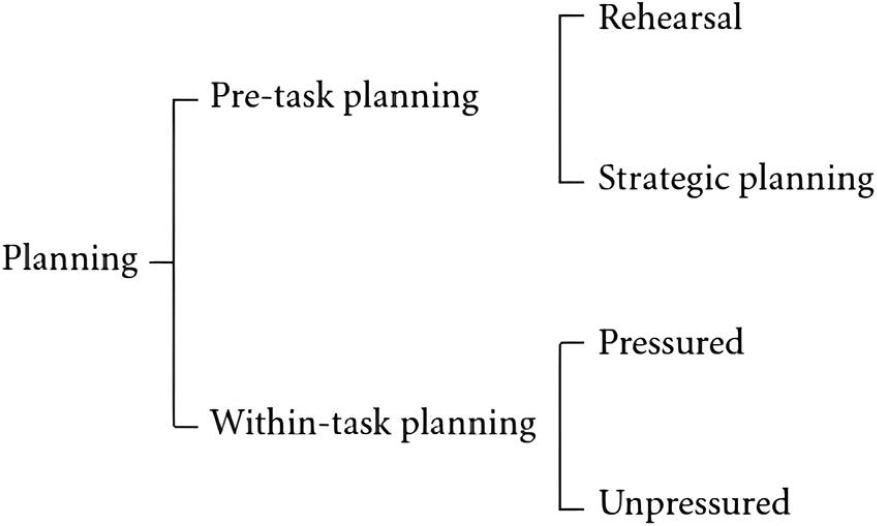
Ellis (Reference Ellis2005a) classified task-based planning types (Figure 1) distinguishing between pre-task and within-task (online planning) depending on whether PT occurs before or during task performance, respectively. Pre-task planning is further divided into rehearsal (i.e. task repetition) and strategic planning, when learners think ahead about the task content and how to verbalise it. This study will focus on pre-task strategic planning.
Types of task-based planning extracted from Ellis (Reference Ellis2005a, p. 4), his figure 1.

Figure 1 Long description
The diagram showing the classification of planning into two main categories: pre-task planning and within-task planning. Pre-task planning is further divided into rehearsal and strategic planning. Within-task planning is divided into pressured and unpressured planning.
Anaphora resolution (AR) is a linguistic phenomenon at the interface between syntax and discourse, that is, syntax-discourse interface, and involves the use of referring expressions (REs) like null pronouns, overt pronouns, and noun phrases (NPs) to establish an association with an entity in prior discourse. For instance, reference to a previous antecedent has been achieved via a null subject (Ø) in (1), the overt pronoun he in (2) and (3), and the NP the woman in (4).
(1) Charlie Chaplini was walking along and Øi found an abandoned childj [English native: EN_WR_23_14_DP]Footnote 2
(2) Charlie Chaplini keeps the childj as hei has formed an emotional connection with itj [English native: EN_WR_20_14_GW]
(3) The womani with the stroller then chases Charliej and so, hej takes the babyk back [English native: EN_WR_22_14_CO]
(4) When hei finds a womanj with a baby stroller, hei leaves the babyk but the womanj becomes angry [English native: EN_WR_20_14_EES]
Previous research has attempted to uncover the factors that constrain RE choices – see Lozano (Reference Lozano and Aronoff2021) for an overview on AR in L2 acquisition. Planning time may modulate AR since it may reduce task demands and facilitate the choice of the most felicitous form in discourse. Pragmatic felicity is achieved when a linguistic form is not only grammatical, but also appropriate in a specific discursive context. In (1), the null pronoun (Ø) is both grammatical (English licenses null subjects in coordination) and pragmatically felicitous, whereas a pronoun (he) or an NP (Charlie Chaplin) would have been grammatical but infelicitous due to redundancy. This will be discussed in more detail in following sections.
This study aims to examine whether PT prior to the performance of a written task may benefit L1 Spanish–L2 English learners’ L2 production of REs in discourse. Planning time has been investigated in relation to L2 fluency, complexity, and accuracy, but its influence at the syntax-discourse interface has not been explored so far. This study will provide new insights into which factors may foster L2 production and whether PT can help overcome task demands, improving L2 performance regarding AR at the syntax-discourse interface.
2. Literature review
2.1. Planning time
2.1.1. Planning time in L2 acquisition
Interest in PT has been spurred by task-based language teaching research (Ellis, Reference Ellis2005a; Ellis et al., Reference Ellis, Skehan, Li, Shintani and Lambert2019; Skehan, Reference Skehan1996, Reference Skehan2002) and cognitive approaches to L2 acquisition and processing (Skehan, Reference Skehan1998; VanPatten, Reference VanPatten1990), as task implementation conditions may influence learners’ attentional capacities, which can in turn determine their L2 performance. Planning time has received extensive attention as a task condition that may improve learners’ production by helping direct their attention to specific linguistic areas.
According to Skehan’s (Reference Skehan1998) Limited Capacity Hypothesis, human attentional resources are limited, so learners cannot equally attend to all language dimensions simultaneously. This aligns with the Interface Hypothesis (Sorace, Reference Sorace2011), which postulates that learners struggle with phenomena at the syntax-discourse interface (e.g. AR) because they find it problematic to simultaneously integrate grammatical and discursive factors in real time. Task cognitive demands modulate how learners invest their attentional resources: as demands increase, more attentional resources are consumed, leaving fewer attention for a focus on form, which negatively affects learners’ production. Based on VanPatten’s (Reference VanPatten1990) claim that attention is unevenly distributed and learners prioritise meaning over form, Skehan (Reference Skehan1996, Reference Skehan2002) proposed exploiting a focus on form by manipulating certain task conditions and reducing cognitive demands. For instance, providing learners with PT to think about their future performance would benefit linguistic form as it may reduce their pressure and promote a more balanced distribution of attentional resources, ensuring increasing focus on form during task performance. Thus, we predict that our learners will choose more felicitous REs when PT is allowed.
A different view is found in Robinson’s (Reference Robinson and Robinson2011) Cognition Hypothesis, which postulates that attentional resources can be expanded depending on the cognitive demands of tasks. Planning time may increase task demands regarding participants’ attentional resources, but may not direct their attention to specific linguistic aspects. Providing PT may foster the availability of attentional resources and facilitate access to already existing knowledge. While decreased complexity, accuracy, and fluency are predicted when no PT is provided, the opposite is expected when PT is allowed.
Considering the above, the interaction between attentional capacities/resources and task cognitive demands is crucial for SLA research as task implementation conditions, like PT, may affect both learners’ production data and research findings.
2.1.2. The effect of planning time on L2 English performance
Research on PT has analysed both oral (Ahangari & Abdi, Reference Ahangari and Abdi2011; Elder & Iwashita, Reference Elder, Iwashita and Ellis2005) and written discourse (Asgarikia, Reference Asgarikia2014; Kabiri, Reference Kabiri2015; Rahimpour & Safarie, Reference Rahimpour and Safarie2011), regarding lexical and syntactic complexity, fluency, and grammatical accuracy. Overall, PT seems to foster more fluent and complex discourse (Asgarikia, Reference Asgarikia2014; Biria & Karimi, Reference Biria and Karimi2015; Ghavamnia et al., Reference Ghavamnia, Tavakoli and Esteki2013), but results for accuracy are inconclusive (Asgarikia, Reference Asgarikia2014; Rostamian et al., Reference Rostamian, Fazilatfar and Jabbari2018). This has been confirmed by two meta-analyses on the effect of pre-task planning time on oral (Johnson & Abdi Tabari, Reference Johnson and Abdi Tabari2022) and written performance (Johnson & Abdi Tabari, Reference Johnson and Abdi Tabari2023) regarding complexity, accuracy, and fluency.
The beneficial influence on L2 fluency has been evidenced by measures like number of syllables/words per minute (Seyyedi et al., Reference Seyyedi, Abdul Malik Mohamed Ismail, Orang and Sharafi Nejad2013) and number of dysfluencies such as reformulations, repetitions, pauses, and so forth (Elder & Iwashita, Reference Elder, Iwashita and Ellis2005; Ghavamnia et al., Reference Ghavamnia, Tavakoli and Esteki2013) using personal and narrative tasks (Asgarikia, Reference Asgarikia2014; Ellis & Yuan, Reference Ellis and Yuan2004), argumentative essays (Biria & Karimi, Reference Biria and Karimi2015), and decision-making tasks (Foster & Skehan, Reference Foster and Skehan1996).
Similarly, PT positively influences L2 complexity; both lexical (Ahangari & Abdi, Reference Ahangari and Abdi2011; Seyyedi et al., Reference Seyyedi, Abdul Malik Mohamed Ismail, Orang and Sharafi Nejad2013) and syntactic (Ghavamnia et al., Reference Ghavamnia, Tavakoli and Esteki2013). For example, Ahangari and Abdi (Reference Ahangari and Abdi2011) examined the effect of pre-task PT on the oral performance of L1 Turkish/Persian–L2 English learners, concluding that planners produced more complex discourse than non-planners. Similarly, Seyyedi et al. (Reference Seyyedi, Abdul Malik Mohamed Ismail, Orang and Sharafi Nejad2013) focused on the written performance of L2 English learners with different L1s (Malay, Chinese, and Indian), evidencing a positive PT effect as planners outperformed non-planners by producing a higher ratio of lexical words (i.e. adjectives, verbs, nouns).
However, PT research on L2 accuracy has provided heterogenous findings, ranging from a positive to a negative effect, or even a lack of it. Evidence of a detrimental effect was found in Asgarikia’s (Reference Asgarikia2014) study on the written performance of L1 Turkish/Persian–L2 English learners, where planners produced significantly more errors than non-planners. Additionally, a lack of effect on L2 accuracy has also been reported. Both Rahimpour and Safarie (Reference Rahimpour and Safarie2011) and Ghavamnia et al. (Reference Ghavamnia, Tavakoli and Esteki2013) focused on written production in L1 Turkish and L1 Persian learners of L2 English, respectively, and concluded that L2 accuracy remained unaffected by pre-task PT. Similar findings were observed for L1 Iranian–L2 English learners’ written performance by Rostamian et al. (Reference Rostamian, Fazilatfar and Jabbari2018).
By contrast, some studies report a positive PT effect on L2 English accuracy. Ellis and Yuan (Reference Ellis and Yuan2004) examined the written performance of L1 Chinese–L2 English learners, evidencing that planners produced more error-free clauses and correct verb forms. Also focusing on written performance, the same beneficial influence was reported by Seyyedi et al. (Reference Seyyedi, Abdul Malik Mohamed Ismail, Orang and Sharafi Nejad2013) for L2 English learners with different L1s, as well as by Kabiri (Reference Kabiri2015) and Abdi Tabari (Reference Abdi Tabari2020), who tested L1 Persian–L2 English learners and found that planners significantly outperformed non-planners.
The inconclusive findings reported on L2 accuracy may be due to the limitations most of these studies present. Firstly, accuracy has been measured via the number of error-free clauses where all morphological, syntactic, and lexical errors are considered so that the least errors of any type a composition presented, the more accurate it was. Secondly, control groups have not been consistently tested, so learners’ data under planning conditions cannot be compared with a baseline condition. These limitations are addressed in this study: (1) an in-depth analysis of a specific syntax-discourse phenomenon is conducted, that is, the use of third person singular subject REs in written discourse, and (2) two control groups are included: an English native group and an L2 non-planning group.
2.2. Anaphora resolution
2.2.1. Anaphora resolution at the syntax-discourse interface
Anaphora resolution has been extensively explored (Chamorro et al., Reference Chamorro, Sorace and Sturt2016; Lozano, Reference Lozano and Aronoff2021; Sorace & Filiaci, Reference Sorace and Filiaci2006) as a fundamental cohesive device at the level of discourse via the linkage between a referring expression, mainly pronouns and NPs, and its antecedent. Although REs in subject position seem to be in free syntactic alternation, that is, the sentential subject may be realised by a variety of REs (see examples (1) to (4)), felicitous REs are constrained by both language-specific grammatical features and pragmatic/discursive factors.
The distinction between null and non-null subject languages determines the pragmatically (in)felicitous distribution of REs in discourse. Null-subject languages like Spanish allow null subjects in a variety of syntactic contexts: in (5) and (6) they are used in coordinate and subordinate sentences, respectively. On the contrary, non-null subject languages like English require an explicit sentential subject, typically overt pronouns or NPs (see examples (2) to (4)). The selection of the most felicitous RE is also constrained by pragmatic/discursive factors like information status, antecedent accessibility, number, gender, distance of potential antecedents, character status, and so on (Ariel, Reference Ariel, Sanders, Schilperoord and Spooren2001; Lozano, Reference Lozano and Alonso-Ramos2016; Martín-Villena & Lozano, Reference Martín-Villena, Lozano, Ryan and Crosthwaite2020; Quesada & Lozano, Reference Quesada and Lozano2020).
(5) Chaplini se apiada del niñoj, Øi guarda la carta en el bolsillo de su chaqueta, y le Øi sonríe [Spanish native: ES_WR_30_14_RSR]
(6) Charles Chaplini está caminando por la calle cuando Øi encuentra un bebéj [Spanish native: ES_WR_21_14_JGG]
The information status of REs, that is, topic-continuity (TC) and topic-shift (TS), seems to be the most relevant factor in AR. An instance of TC is introduced in (7) where the same subject, Chaplin, is maintained over several clauses via the overt pronominal he. In English, TC is typically encoded by overt pronouns, while null pronouns are limited to a specific syntactic configuration: when the same subject is maintained (TC) through coordination (Martín-Villena & Lozano, Reference Martín-Villena, Lozano, Ryan and Crosthwaite2020; Quesada & Lozano, Reference Quesada and Lozano2020). In example (1), the speaker produces a felicitous null pronoun (Ø) because its referent, Charlie Chaplin, is maintained and the subject of a coordinated sentence. In English, coordination is a necessary (Leclercq & Lenart, Reference Leclercq and Lenart2013) but not a sufficient condition for the use of null pronouns as coordination and topic continuity must apply simultaneously (Quesada & Lozano, Reference Quesada and Lozano2020).
(7) Chaplini looks for the baby’sj parentsk […], so hei walks back and forth in search of someonel hei can give the babyj to [English native: EN_WR_21_14_ED]
Topic-shift involves a change of subject in consecutive clauses and English tends to mark these scenarios via overt pronouns and NPs.Footnote 3 In (8) and (9), the pronoun he and the NP Charlie, respectively, have been used for this purpose. Another relevant context is focus new-introduction, which involves the use of an RE to introduce a new character for the first time and is usually marked by a full NP as a police officer in (9) below.
(8) Chaplini is now with the childj in a garret, hej is about 4 or 5 years old [English native: EN_WR_57_15_HW2]
(9) A police officeri sees himj and again Charliej is forced to leave with the babyk [English native: EN_WR_22_14_MO]
Another relevant factor for our results is character status, as the status of a character within a story (main vs. secondary) seems to influence RE choices (Lozano et al., Reference Lozano, Quesada, Papadopoulou and Charatzidis2023; Quesada & Lozano, Reference Quesada and Lozano2020), particularly in TS, because if a narrative presents many characters, multiple changes of topic are required, resulting in more explicit REs.
2.2.2. Anaphora resolution in L2 acquisition
Learners can acquire the morphosyntactic factors that govern L2 RE choices, but pragmatic deficits seem to be pervasive even at advanced states of acquisition (Lozano, Reference Lozano2018; Pladevall Ballester, Reference Pladevall Ballester2013; Prentza, Reference Prentza, Lavidas, Alexiou and Sougari2014). This is accounted for by the Interface Hypothesis (Sorace, Reference Sorace2011), which proposes that although L2 production is cognitively demanding for learners, such cognitive load is higher when they have to simultaneously integrate different linguistic levels, for example, syntax and discourse. Thus, phenomena at the interface between two linguistic levels, for example, AR at the syntax-discourse interface, may not be fully acquired due to the difficulty of simultaneously processing L2 syntactic and discursive constraints. An example of this difficulty to achieve native-like RE management is learners’ tendency to produce more explicit REs than pragmatically required regardless of L1–L2 combinations (Cunnings et al., Reference Cunnings, Fotiadou and Tsimpli2017; Leclercq & Lenart, Reference Leclercq and Lenart2013; Lozano, Reference Lozano and Alonso-Ramos2016; Martín-Villena & Lozano, Reference Martín-Villena, Lozano, Ryan and Crosthwaite2020; Prentza, Reference Prentza, Lavidas, Alexiou and Sougari2014; Quesada & Lozano, Reference Quesada and Lozano2020). Allowing learners to plan their performance is expected to mitigate task demands, reduce their cognitive load, and help them focus on form, mitigating the tendency to redundancy and facilitating the production of the most pragmatically felicitous RE.
Such overexplicitness/redundancy is predicted by the Pragmatic Principles Violation Hypothesis (PPVH) (Lozano, Reference Lozano and Alonso-Ramos2016), which, based on the Gricean Maxims of Quantity and Manner, accounts for deficits in the use of REs. It states that pragmatic violations on AR range from mild to strong: violating the Informativeness/Economy Principle results in redundancy (mild violation), while violating the Manner/Clarity Principle leads to ambiguity (strong violation). Redundancy does not endanger successful communication because the referent can be easily retrieved, but ambiguity may cause a conversational breakdown as the linkage between an RE and its antecedent may be difficult to resolve. Thus, the PPVH predicts learners to be more redundant than ambiguous. Redundancy is illustrated in (10), where the learner uses an overt pronoun she in TC and coordination, rather than a null pronoun, which would be the expected form in English. On the contrary, (11) is ambiguous as the pronoun he could refer to either Chaplin or the policeman.
(10) This womani was in a shop and when shei exits it, shei sees the same babyj and shei gets angry [L2 English learner: ES_WR_B2_18_12_14_PSR]
(11) Chaplini is reparing the window when the policemanj appear again and hei/j understand that theyk have a plan [L2 English learner: ES_WR_B2_19_11_15_MQR2]
In summary, AR is a complex phenomenon since successful L2 use of REs in discourse demands simultaneous integration of syntactic and pragmatic constraints.
2.2.3. The acquisition of anaphora resolution in L2 English
Research on L2 English AR has extensively employed experimental methods (Contemori & Dussias, Reference Contemori and Dussias2016; Cunnings et al., Reference Cunnings, Fotiadou and Tsimpli2017; Prentza, Reference Prentza, Lavidas, Alexiou and Sougari2014), but corpus-based investigations have uncovered factors overlooked in the experimental literature that also modulate RE choices (Leclercq & Lenart, Reference Leclercq and Lenart2013; Quesada & Lozano, Reference Quesada and Lozano2020; Ryan, Reference Ryan2015).
Focusing on the experimental literature, studies show an overacceptance of ungrammatical null subjects by English learners with null-subject L1s, typically explained by L1 transfer (Pladevall Ballester, Reference Pladevall Ballester2013; Prentza, Reference Prentza, Lavidas, Alexiou and Sougari2014) and modulated by proficiency. Pladevall Ballester (Reference Pladevall Ballester2013) reported higher acceptability rates of ungrammatical null subjects for beginner L1 Spanish–L2 English learners than advanced learners. Similarly, Cunnings et al. (Reference Cunnings, Fotiadou and Tsimpli2017) and Contemori and Dussias (Reference Contemori and Dussias2020) explored the interpretation and processing of overt pronouns in proficient L1 Greek and L1 Spanish learners of English, respectively. Both studies show a subject-bias preference in learners and natives, suggesting a lack of L1 transfer at advanced proficiency levels and the fact that processing strategies may be acquirable when discourse complexity is low.
However, deficits do not equally affect all pragmatic contexts, with TC being the most problematic scenario for learners. Deficits in RE choices are more likely to occur in TC than in TS scenarios, as originally shown in Lozano (Reference Lozano, Snape, Leung and Smith2009) and confirmed for L2 Spanish (Lozano, Reference Lozano and Alonso-Ramos2016, Reference Lozano2018; Lozano & Quesada, Reference Lozano and Quesada2023). This has also been reported for L2 English by Prentza (Reference Prentza, Lavidas, Alexiou and Sougari2014), who tested the acquisition of pronominal subjects in L1 Greek–L2 English learners, and by Contemori and Dussias (Reference Contemori and Dussias2016), who explored the production of L1 Spanish–L2 English learners, observing significantly higher selection of infelicitous overt subjects in TC than TS. This problematic nature of TC will be tested in our study.
Overall, the experimental literature on L2 English AR suggests: 1) overacceptance of ungrammatical null subjects, 2) different vulnerability depending on the pragmatic context (topic continuity vs. shift), and 3) L1 transfer of null subjects decreases as proficiency increases. However, these studies show limitations: REs’ information status is sometimes not considered, there is no distinction between animate and inanimate subjects, and analyses tend to mix first, second, and third singular and plural pronominal subjects (Mitkovska & Bužarovska, Reference Mitkovska and Bužarovska2018; Pladevall Ballester, Reference Pladevall Ballester2013; Prentza, Reference Prentza, Lavidas, Alexiou and Sougari2014), but only third person singular REs have been shown to be problematic (Lozano, Reference Lozano, Snape, Leung and Smith2009). These inconsistencies will be accounted for in our analysis.
Turning to corpus-based studies on L2 English AR, these have evidenced learners’ overexplicitness as they tend to use more explicit REs than pragmatically required (Kang, Reference Kang2004; Leclercq & Lenart, Reference Leclercq and Lenart2013; Quesada & Lozano, Reference Quesada and Lozano2020; Ryan, Reference Ryan2015), regardless of L1–L2 combinations (Hendriks, Reference Hendriks and Ramat2003). Quesada and Lozano (Reference Quesada and Lozano2020) tested beginner to advanced L1 Spanish–L2 English learners and found that their sensitivity towards the pragmatic constraints of RE choices increased as proficiency developed, although learners did not achieve native-like attainment even at very advanced levels. Learners significantly differed from natives in TC but not in TS scenarios, evidencing the problematic nature of TC for learners and supporting the PPVH.
In summary, experimental and corpus studies have accounted for the factors that govern RE choices in discourse. English learners seem to be sensitive to L2 constraints, but do not reach native-like AR management since even proficient learners show persistent deficits at the syntax-discourse interface, especially in TC. Thus, the question arises as to whether PT may benefit learners’ sensitivity to these syntax-discourse and pragmatic constraints.
3. Research questions
Based on the previous literature, several research questions (RQs) and hypotheses (Hs) were formulated:
General RQ: Does PT benefit L1 Spanish–L2 English learners’ felicitous use of REs and help them be less overexplicit in discourse?
First, we ensured that the two subgroups of English learners and natives (planners vs. non-planners) were comparable regarding discourse construction, that is, distribution of TC, TS, and focus new-introduction (FNI) will not significantly differ between subgroups. If no differences are found, differences will be attributable to the independent variable (PT). This was tested with data from Task 1 where no PT was provided to any subgroup. Results revealed no significant differences between discourse scenarios (topic continuity, topic shift, focus new-introduction) of REs in either learner or native subgroups. The most frequent discourse scenario in both learners and natives is TC, followed by TS, and, finally, small proportions of FNI.
Subgroups being comparable, PT effects would be observed if, from Task 1 to Task 2, planners behave differently from non-planners, or if there are differences between planners versus non-planners in Task 2. Research Question 1 addresses PT effects regarding the distribution of the REs’ information status (TC, TS, FNI) in discourse. Discourse construction seems to be similar in adults (irrespective of whether they are natives or learners) since learners reuse in the L2 their L1 ability to construct discourse (Lozano & Quesada, Reference Lozano and Quesada2023).
RQ1: Does PT affect the way learners (and natives) construct discourse regarding the distribution of the information status (TC, TS, FNI) of referring expressions?
H1: PT will have no effect since discourse construction is similar in adult speakers irrespective of whether they are natives or learners: neither learners nor natives will show significantly different information-status distributions in discourse from Task 1 to Task 2, irrespective of their subgroup (planners vs. non-planners).
Research Question 2 asks whether PT may influence the overall distribution of referring expressions in discourse, irrespective of their information status. Based on the positive PT effect found in previous studies, PT is expected to counterbalance the tendency towards redundancy by fostering the use of minimal REs.
RQ2: Does PT benefit learners’ (and natives’) overall distribution of REs in discourse? Will planning learners use more minimal forms than non-planning learners?
H2: PT is predicted to benefit learners’ use of REs in discourse, with planners producing more minimal REs (null pronouns) than non-planners.
Although the preceding RQs have not considered the REs’ pragmatic/discourse context, that is, TC and TSFootnote 4 (cf. Section 2.2), RE choices are constrained by the information status of the anaphor: more economical forms tend to mark TC, while NPs seem to be the preferred form to mark TS. Planning time is expected to help learners use more felicitous REs depending on the pragmatic context. If it is beneficial, we should observe differences from Task 1 to Task 2 in planners only. We conducted two analyses: each RE was analysed according to its information-status context (RQ3a), and each information-status context according to its REs (RQ3b).
RQ3a: Does PT benefit learners’ (and natives’) production of each RE (null/overt/NP) according to its information-status context (TC vs. TS)?
RQ3b: Does PT benefit learners’ distribution of the three RE forms (null vs. overt vs. NP) in each discourse context (TC, TS)?
H3: When PT is provided, planners are expected to be pragmatically more felicitous than non-planners. Particularly, in TC contexts, planners will use more null pronouns as these are the most economical and pragmatically felicitous form in TC and coordination, achieving better textual cohesion. Regarding TS contexts, planners will use fuller forms (NPs) than non-planners since NPs have been shown to be the pragmatically preferred form to disambiguate in TS scenarios.
Research Question 3 accounted for TC in general, but the potential beneficial effect of PT should be materialised in a specific context, that is, topic continuity and coordination, as it is the only one where the most economical form (null subject) is pragmatically preferred in English.
RQ4: Does PT affect learners’ (and natives’) production of REs (null/overt/NP) in contexts with TC and coordination, where null pronouns are pragmatically expected?
H4: When PT is provided, planners are expected to be pragmatically more felicitous than non-planners in coordinated TC by producing significantly more null pronouns.
4. Method
4.1. Participants
Sixty-four participants (Table 1) were divided into intermediate L1 Spanish–L2 English learners (N = 46) and a control group of English natives (N = 18). We acknowledge the limitations of having a small sample size for the native group, which reduces statistical power in analyses involving it. Consequently, the native group has not been included in inferential analyses, no direct statistical comparisons are made between the native and learner groups, and no generalisations are made for English natives. This group will solely be used as a benchmark, allowing the reader to better contextualise and interpret learners’ findings.Footnote 5
Participant groups

Table 1 Long description
The table categorizes participants into two main groups: learners and natives, each further divided into non-planning and planning subgroups. Both the learners and natives have equal numbers in their respective planning and non-planning categories, with 23 learners in each subgroup and 9 natives in each subgroup. This structure allows for a balanced comparison between planning and non-planning strategies within both learners and natives. The equal distribution suggests a controlled study design, ensuring that any differences observed are likely due to the planning variable rather than group size disparities.
Learners were selected on the basis of their proficiency level; ranging from B1 to B2 according to the CEFR-based Oxford Quick Placement Test (Oxford University Press, 2003), since pragmatic deficits regarding AR seem to appear at intermediate levels (Hendriks, Reference Hendriks and Ramat2003). Both learners and natives were further divided into two subgroups (planning and non-planning group) depending on the planning condition under which the tasks were conducted. The final design encompassed four participant groups: (1) non-planning learners, (2) planning learners, (3) non-planning natives, and (4) planning natives.
4.2. Elicitation tasks and corpus
Participants did two consecutive film-retelling tasks, henceforth called Task 1 and Task 2, where they watched two videos from a Charlie Chaplin silent film and narrated the plot of each video in writing. The video used for Task 1 is the one employed in the data collection process of the Corpus of English as a Foreign Language (COREFL) (Lozano et al., Reference Lozano, Díaz-Negrillo, Callies, Bongartz and Torregrossa2020), to include the data of this study in the COREFL. The video for Task 2 was chosen based on several criteria: (1) similar length to the first video, (2) same characters, and (3) variety of pragmatic contexts, mainly topic continuity and topic shift. This is relevant as the analysis will examine how these contexts constrain RE choices in discourse.
The COREFL (http://corefl.learnercorpora.com/) is an L2 English corpus designed following the principles for native and learner corpora (Granger, Reference Granger, Lüdeling and Kytö2008; Lozano & Mendikoetxea, Reference Lozano, Mendikoetxea, Díaz-Negrillo, Ballier and Thompson2013; Sinclair, Reference Sinclair and Wynne2005). It contains data from L1 Spanish and L1 German learners of English at all proficiency levels, and three sub-corpora of native Spanish, German, and English.
4.3. Data collection procedure
For learners, a placement test was administered prior to research. All selected participants completed a linguistic profile questionnaire, followed by the two aforementioned tasks. The procedure was as follows. In Task 1, participants watched a video and summarised the plot immediately afterwards. A 10-minute pause was provided upon completion of Task 1, after which they completed Task 2 that also consisted of summarising a video. It is worth mentioning that Task 1 and Task 2 were not counterbalanced. This would have been an ideal design but, given that no differences were observed in the distribution of REs when both tasks are compared without PT (see Section 5.3), we assume the order is not influencing the results.
This procedure was applied to all groups, the planning condition being the only difference. Learners and natives in the non-planning groups did Task 1 and Task 2 without PT, so they could not plan their narratives prior to task performance. On the contrary, participants in the planning groups did Task 1 without PT, but 10-minute planning was provided before Task 2. During PT, they could watch the video several times and take notes, although these were collected before task performance (Ellis & Yuan, Reference Ellis and Yuan2004; Ghavamnia et al., Reference Ghavamnia, Tavakoli and Esteki2013; Rahimpour & Safarie, Reference Rahimpour and Safarie2011). Ten-minute planning is the most frequent PT in previous studies (Abdi Tabari, Reference Abdi Tabari2020; Asgarikia, Reference Asgarikia2014; Rostamian et al., Reference Rostamian, Fazilatfar and Jabbari2018), allowing us to establish reliable comparisons. Table 2 summarises the data collection procedure.
Collection data procedure for each group

Table 2 Long description
The table compares the planning status of learners and natives during two tasks, with a pause between them. Both planning learners and planning natives engage in planning during Task 2, whereas non-planning learners and non-planning natives do not plan in either task. All groups have a consistent 10-minute pause between Task 1 and Task 2. This suggests that planning is selectively applied by certain groups only during the second task, highlighting a potential strategic approach by planning groups. The table does not provide information on the impact of planning on task performance.
4.4. Linguistic data analysis and tagsets
Only third person singular animate REs in subject position in finite clauses were analysed. Previous AR studies have combined REs from first, second, and third persons, although pragmatic deficits are especially manifested in the third person singular, that is, he, she, it (Lozano, Reference Lozano, Snape, Leung and Smith2009). The sample (Table 3) consisted of 128 texts (92 learners; 36 natives) with 55,318 words and 2522 annotated subjects (learners: 1732; natives: 790) when English licenses an alternation of REs, that is, null pronouns, overt pronouns, and NPs. All tagged subjects refer to the characters in the videos.
Corpus details

Table 3 Long description
The table provides details on a corpus divided into two groups: learners and English natives. Learners contribute 92 texts totaling 39,833 words, while English natives contribute 36 texts with 15,485 words. The number of tagged subjects is higher for learners at 1,732 compared to 790 for English natives. Terminal tags also follow this trend, with learners having 10,392 and natives 4,740. Overall, the corpus consists of 128 texts and 55,318 words, indicating learners contribute more significantly in terms of text and word count. This data suggests a larger volume of content and tagging activity from learners compared to English natives.
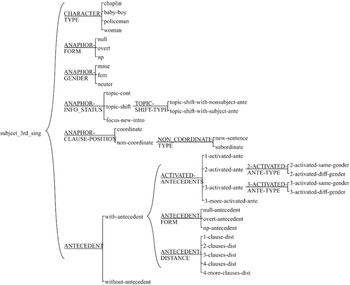
Two tagsets were designed. Based on previous studies (Lozano, Reference Lozano and Alonso-Ramos2016; Quesada & Lozano, Reference Quesada and Lozano2020), a first tagset (Figure 2) was used to annotate each RE for six properties. In the character type system, all REs were tagged for the character they refer to (Chaplin, the baby/boy, the policeman, the woman). Although Task 1 and 2 include the same characters, Chaplin is the only main character in Task 1, while in Task 2 the boy has more prominence (character effects are addressed in Section 5.4). The anaphoric form system reflects each RE form: null pronoun (Ø), overt pronoun (he, she, it), or NP (e.g. Chaplin, a boy, the lady, etc.). The gender system specifies the REs’ grammatical gender (masculine/feminine/neuter) and the information status system, its information status (topic continuity/topic shift/focus new-introduction).
REs tagset.

Figure 2 Long description
The diagram outlines various properties related to anaphors. It includes 'CHARACTER TYPE' with options like chaplin, baby-boy, policeman and woman. 'ANAPHOR FORM' lists null, overt and np. 'ANAPHOR GENDER' includes masc, fem and neuter. 'ANAPHOR INFO STATUS' covers topic-cont, topic-shift and focus-new-intro. 'TOPIC SHIFT TYPE' details topic-shift-with-nonsubject-ante and topic-shift-with-subject-ante. 'ANAPHOR CLAUSE POSITION' is divided into coordinate and non-coordinate, with non-coordinate further split into new-sentence and subordinate. 'ACTIVATED ANTECEDENTS' includes 1-activated-ante, 2-activated-ante and 3-activated-ante, with 2-activated and 3-activated having same-gender and diff-gender subtypes. 'ANTECEDENT' is categorized into with-antecedent and without-antecedent. 'ANTECEDENT FORM' includes null-antecedent, overt-antecedent and np-antecedent. 'ANTECEDENT DISTANCE' lists 1-clause-dist, 2-clauses-dist, 3-clauses-dist and 4-more-clauses-dist.
The clause position system distinguished between coordinate and non-coordinate sentences (new and subordinate sentences) because learners tend to under-use null pronouns in cases of coordination and topic continuity where English allows the use of null subjects (Martín-Villena & Lozano, Reference Martín-Villena, Lozano, Ryan and Crosthwaite2020; Quesada & Lozano, Reference Quesada and Lozano2020). Finally, the antecedent system allowed us to specify if each RE had an antecedent or not (with vs. without antecedent). Within the with-antecedent subsystem, all REs were assigned their number of activated antecedents in the last four clauses, the form of the referent (null, overt or NP antecedent), and the distance between the RE and its antecedent.
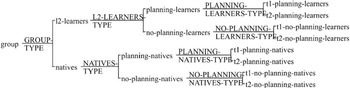
A second tagset (Figure 3) was designed to classify the participants into groups to establish statistical comparisons between them.
Participants tagset.

Figure 3 Long description
A hierarchical diagram categorizes a group into two main types: L2 learners and natives. Each type is further divided into planning and no-planning categories. L2 learners are split into planning-learners and no-planning-learners, with each having subcategories t1 and t2. Similarly, natives are divided into planning-natives and no-planning-natives, each also having t1 and t2 subcategories.
4.5. Analysis
The tagsets were implemented in the software UAM Corpus Tool (O’Donnell, Reference O’Donnell and Bretones2009) (http://www.corpustool.com), where the corresponding tags were manually assigned to each RE in subject position and to each group. The software allows conducting statistical analyses between the (sub)systems of the tagsets, and the statistical contrasts reported are chi-square tests (χ2), as well as their corresponding probability values (p) and their effect sizes (Cohen’s h). The raw frequency outputs generated by the software, as well as the tables with the statistical contrasts, can be found in the Appendix.
5. Results and discussion
5.1. Results for RQ1 (planning time effects on discourse construction)
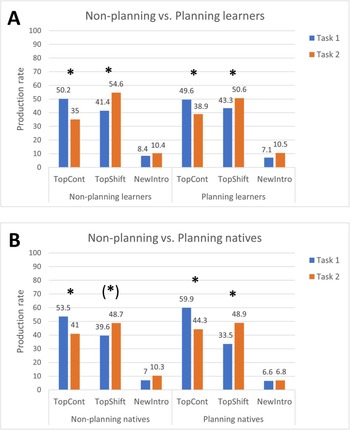
This section will address RQ1: Does planning time affect the way learners (and natives) construct discourse regarding the distribution of the REs’ information status (topic continuity, topic shift, focus new-introduction)? In other words, whether PT influences discourse construction in relation to the distribution of REs’ information status. These pragmatic contexts have been illustrated in previous examples (see (1) and (7) for topic continuity, (8) and (9) for topic shift, and (9) for focus new-introduction). Recall that PT effects should be observable in the transition from Task 1 to Task 2 only in the planning subgroup as they received PT. Figure 4 (and its statistical contrasts in Appendix 3 for learners and Appendix 4 for natives) shows the distribution of the information status of REs in discourse contrasting Task 1 and Task 2 in the planning versus non-planning subgroup (Figure A for learners, Figure B for natives).
Distribution of REs’ info-status in discourse (task 1 vs. task 2): (A) Non-planning vs. Planning learners, (B) Non-planning vs. Planning natives.

Figure 4 Long description
The image A shows a bar graph titled 'Non-planning vs. Planning learners' with production rate on the y-axis and categories 'TopCont', 'TopShift' and 'NewIntro' on the x-axis. For non-planning learners, Task 1 shows 50.2 for 'TopCont', 54.6 for 'TopShift' and 8.4 for 'NewIntro'. Task 2 shows 35 for 'TopCont', 41.4 for 'TopShift' and 10.4 for 'NewIntro'. For planning learners, Task 1 shows 49.6 for 'TopCont', 50.6 for 'TopShift' and 7.1 for 'NewIntro'. Task 2 shows 38.9 for 'TopCont', 43.3 for 'TopShift' and 10.5 for 'NewIntro'. The image B shows a bar graph titled 'Non-planning vs. Planning natives' with production rate on the y-axis and categories 'TopCont', 'TopShift' and 'NewIntro' on the x-axis. For non-planning natives, Task 1 shows 53.5 for 'TopCont', 48.7 for 'TopShift' and 7 for 'NewIntro'. Task 2 shows 41 for 'TopCont', 39.6 for 'TopShift' and 10.3 for 'NewIntro'. For planning natives, Task 1 shows 59.9 for 'TopCont', 48.9 for 'TopShift' and 6.6 for 'NewIntro'. Task 2 shows 44.3 for 'TopCont', 33.5 for 'TopShift' and 6.8 for 'NewIntro'. Asterisks indicate significant differences.
As for learners (Figure 4A, Appendix 3), we observe the same pattern for both planners and non-planners from Task 1 to Task 2. Both subgroups produce significantly more topic continuity in Task 1 than in Task 2 (non-planners: χ2 = 18.14, p < 0.0001, h = 0.309; planners: χ2 = 10.84, p = 0.0010, h = 0.215), but significantly less topic shift in Task 1 than in Task 2 (non-planners: χ2 = 13.56, p = 0.0002, h = 0.266; planners: χ2 = 4.91, p = 0.0267, h = 0.145), whereas FNI remains non-significant across tasks (non-planners: χ2 = 0.90, p = 0.3427, h = 0.068; planners: χ2 = 3.54, p = 0.0599, h = 0.123). Natives (Figure 4B, Appendix 4) show the same pattern found in learners: Task 1 versus Task 2 in topic continuity (non-planners: χ2 = 5.28, p = 0.0215, h = 0.250; planners: χ2 = 10.93, p = 0.0010, h = 0.315); in topic shift (non-planners: χ2 = 2.89, p = 0.0891 [just non sig], h = 0.184; planners: χ2 = 10.94, p = 0.0009, h = 0.315); and in FNI (non-planners: χ2 = 1.20, p = 0.2733, h = 0.118; planners: χ2 = 0.01, p = 0.9312, h = 0.008).
In short, from Task 1 to Task 2, TC significantly decreases but TS significantly increases, both in learners and natives, irrespective of whether they have received PT or not. This indicates that PT cannot account for these differences in topic continuity and in topic shift across tasks. Instead, the differences could have been triggered by the character the boy, who has a more predominant role in Task 2 (where he is a boy and not a baby as in Task 1), so texts in Task 2 will contain more shifts to the boy. Thus, such significant differences may be attributable to a character effect, a point further addressed as a follow-up to RQ3.
5.2. Results for RQ2 (planning-time effects on overall REs)
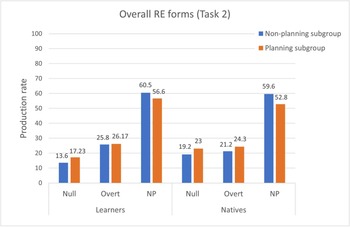
This section will address RQ2: Does PT benefit learners’ (and natives’) overall distribution of referring expressions in discourse? Will planning learners use more minimal forms than non-planning learners? To simplify, we will explore whether PT may influence the overall distribution of REs regardless of their information status. If so, planning learners would use more economical forms (null pronouns) than non-planning learners, as exemplified in (1) earlier. Figure 5 (and its corresponding statistical contrasts in Appendix 5 for learners and Appendix 6 for natives) shows that in Task 2, there are no significant differences for any of the REs between the planning versus non-planning learner groups (null: χ2 = 1.86, p = 0.1729, h = 0.099; overt: χ2 = 0.01, p = 0.9098, h = 0.008; NP: χ2 = 1.22, p = 0.2687, h = 0.080). The same holds for planning versus non-planning natives (null: χ2 = 0.78, p = 0.3769, h = 0.092; overt: χ2 = 0.51, p = 0.4756, h = 0.074; NP: χ2 = 1.78, p = 0.1820, h = 0.138). Thus, our findings suggest that, contrary to our prediction, H2 is disconfirmed. Planning time has no effect on the overall production and distribution of referring expressions in discourse. Otherwise, focusing on the learner subgroups, we would have found differences in Task 2 between learners who received planning time before completing this task and those who did not.
PT in the overall REs’ distribution (task 2): planners vs. non-planners.

Figure 5 Long description
A bar graph titled 'Overall RE forms (Task 2)' compares the production rates of referring expression forms between non-planning and planning subgroups for learners and natives. The x-axis is labeled with categories: Null, Overt and NP for both Learners and Natives. The y-axis represents the production rate, ranging from 0 to 100. For learners, the non-planning subgroup shows rates of 13.6 for Null, 25.8 for Overt and 60.5 for NP. The planning subgroup shows 17.23 for Null, 26.17 for Overt and 56.6 for NP. For natives, the non-planning subgroup shows 19.2 for Null, 23 for Overt and 59.6 for NP. The planning subgroup shows 21.2 for Null, 24.3 for Overt and 52.8 for NP. The graph uses different colors to distinguish between non-planning and planning subgroups.
Additionally, Figure 5 illustrates that both learner groups show the same pattern as both native groups: NPs prevail, followed by far by overt pronouns, which are closely followed by null pronouns. This would suggest that learners’ distribution of referring expressions in discourse seems to be similar to that of natives.
5.3. Results for RQ3a (planning-time effects on REs across discourse contexts)
This section will address RQ3a: Does PT benefit learners’ (and natives’) production of each RE (null/overt/NP) according to its information-status context (TC vs. TS)? In other words, we will investigate whether planning benefits the pragmatic distribution of each individual referring expression across discourse contexts (topic continuity/topic shift).
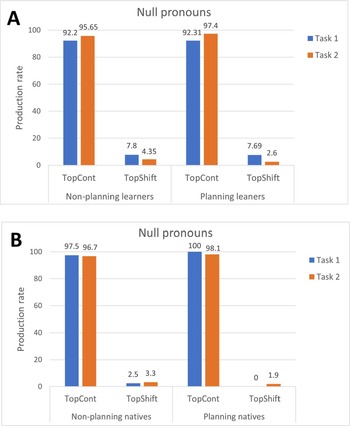
First, regarding null pronouns (Figure 6A learners, Figure 6A natives; cf. their statistical contrasts in Appendices 7 and 8, respectively), they typically mark topic continuity (see example (1) earlier). Both non-planning and planning learners show a similar distribution of null pronouns, which, as expected, predominate in topic continuity (and hardly in topic shift) as null pronouns typically encode topic continuity. There are no significant differences from Task 1 to Task 2 in either subgroup of learners: non-planning learners (χ2 = 0.56, p = 0.4535, h = 0.146); planning learners (χ2 = 2.01 p = 0.1558, h = 0.243). The same holds for both subgroups of English natives: non-planning natives (χ2 = 0.04, p = 0.8359, h = 0.050); planning natives (χ2 = 1.14, p = 0.2857, h = 0.273). These findings reject H3: there is no PT effect on the distribution of null pronouns across discourse contexts, for either learners or natives. Otherwise, we would expect a difference between planning and non-planning subgroups. Note that learners show the same null-pronoun distribution as natives, but they do not fully reach native-like levels as natives’ production is 97% or higher, whereas learners’ is 92% or higher, which is expected since the latter are intermediate learners of English.
PT in null pronouns across discourse contexts (task 1 vs. task 2): (A) Null pronouns in non-planning and planning learners, (B) Null pronouns in non-planning and planning natives.

Figure 6 Long description
The image A shows a bar graph titled 'Null pronouns' with production rates for non-planning and planning learners. The x-axis labels are 'TopCont' and 'TopShift' for both non-planning and planning learners. The y-axis is labeled 'Production rate'. For non-planning learners, 'TopCont' shows 92.2 for Task 1 and 95.65 for Task 2, while 'TopShift' shows 7.8 for Task 1 and 4.35 for Task 2. For planning learners, 'TopCont' shows 92.31 for Task 1 and 97.4 for Task 2, while 'TopShift' shows 7.69 for Task 1 and 2.6 for Task 2. The image B shows a bar graph titled 'Null pronouns' with production rates for non-planning and planning natives. The x-axis labels are 'TopCont' and 'TopShift' for both non-planning and planning natives. The y-axis is labeled 'Production rate'. For non-planning natives, 'TopCont' shows 97.5 for Task 1 and 96.7 for Task 2, while 'TopShift' shows 2.5 for Task 1 and 3.3 for Task 2. For planning natives, 'TopCont' shows 100 for Task 1 and 98.1 for Task 2, while 'TopShift' shows 0 for Task 1 and 1.9 for Task 2.
Second, overt pronouns (Figure 7A for learners, Figure 7B for natives, and their statistical contrasts in Appendices 9 and 10, respectively) typically mark topic continuity when there is no coordination (see example (2)), but also topic shift (see example (8)). An overt pronominal subject is produced by learners around two-thirds of the time to mark TC and one third to mark TS (Figure 7A). There are no significant differences from Task 1 to Task 2 between the two learners’ subgroups: non-planning learners (χ2 = 0.09, p = 0.7630, h = 0.039); planning learners (χ2 = 0.26, p = 0.6071, h = 0.057). Learners show similar proportions to natives, with no significant differences between the two subgroups: non-planning natives (χ2 = 0.09, p = 0.7700, h = 0.060); planning natives (χ2 = 0.47, p = 0.4948, h = 0.114). Similarly to the null-pronoun findings, H3 is disconfirmed for overt pronouns since PT does not play a role in the distribution of overt pronouns across discourse contexts given that planners did not behave differently from non-planners from Task 1 to Task 2.
PT in overt pronouns across discourse contexts (task 1 vs. task 2): (A) Overt pronouns in non-planning and planning learners, (B) Overt pronouns in non-planning and planning natives.

Figure 7 Long description
The image contains two bar graphs labeled A and B, each depicting overt pronoun production rates. Graph A shows data for non-planning and planning learners. For non-planning learners, the production rate for TopCont is 67.3 for Task 1 and 65.5 for Task 2, while TopShift is 32.7 for Task 1 and 34.5 for Task 2. For planning learners, TopCont is 61.9 for Task 1 and 64.7 for Task 2 and TopShift is 38.1 for Task 1 and 35.3 for Task 2. Graph B shows data for non-planning and planning natives. For non-planning natives, TopCont is 60.7 for Task 1 and 63.6 for Task 2 and TopShift is 39.3 for Task 1 and 36.4 for Task 2. For planning natives, TopCont is 59.4 for Task 1 and 64.9 for Task 2 and TopShift is 40.6 for Task 1 and 35.1 for Task 2. The x-axis is labeled with categories TopCont and TopShift and the y-axis is labeled 'Production rate' with values from 0 to 100. Task 1 is represented in blue and Task 2 in orange in both graphs.
Finally, as for NPs (Figure 8A for learners, Figure 8B for natives, and their statistical contrasts in Appendices 11 and 12, respectively), they are the preferred form to mark topic shift (see example (9) earlier). Results show that both learners and natives predominantly produce NPs (80% ∼ 90%) in TS, which confirms the findings from previous corpus studies that NPs (and not overt pronouns) are the privileged RE form to mark a shift in topic. Once again, no significant differences were found from Task 1 to Task 2 between the two learner subgroups: non-planning learners (χ2 = 3.25, p = 0.0716, h = 0.205); planning learners (χ2 = 2.29, p = 0.1299, h = 0.166). The same holds for the native subgroups: non-planning natives (χ2 = 0.07, p = 0.7982, h = 0.046); planning natives (χ2 = 0.31, p = 0.5779, h = 0.104). Planning time has no effect on the distribution of NPs across discourse contexts.
PT in NPs across discourse contexts (task 1 vs. task 2): (A) NPs in non-planning and planning learners, (B) NPs in non-planning and planning natives.

Figure 8 Long description
The image contains two bar graphs labeled A and B. Graph A shows the production rates of NPs for non-planning and planning learners across two tasks. For non-planning learners, the TopCont rates are 17 for Task 1 and 10.1 for Task 2, while TopShift rates are 83 for Task 1 and 89.9 for Task 2. For planning learners, the TopCont rates are 17.4 for Task 1 and 11.6 for Task 2, while TopShift rates are 82.6 for Task 1 and 88.4 for Task 2. Graph B shows the production rates of NPs for non-planning and planning natives. For non-planning natives, the TopCont rates are 20 for Task 1 and 18.2 for Task 2, while TopShift rates are 80 for Task 1 and 81.8 for Task 2. For planning natives, the TopCont rates are 16.7 for Task 1 and 13 for Task 2, while TopShift rates are 83.3 for Task 1 and 87 for Task 2. The x-axis is labeled with categories and groups and the y-axis is labeled 'Production rate' with values from 0 to 100. Task 1 is represented in blue and Task 2 in orange in both graphs.
In short, contrary to our predictions in H3, PT does not affect how referring expressions are pragmatically distributed across discourse contexts as planners do not use pragmatically more felicitous REs than non-planners.
5.4. Results for RQ3b (planning-time effects on discourse contexts across REs)
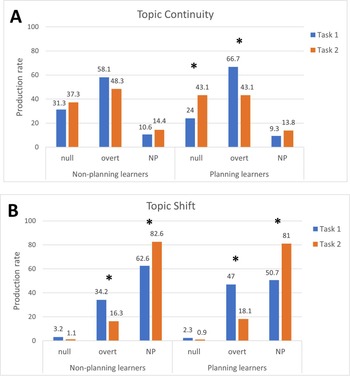
This section will address RQ3b: Does PT benefit learners’ distribution of RE forms (null vs. overt vs. NP) in each discourse context (topic continuity, topic shift)? Here, we will analyse the pragmatic distribution of referring expressions (null/overt pronouns, NPs) in each discourse context: topic continuity (Figure 9A) and topic shift (Figure 9B) (cf. their statistical contrasts in Appendices 13 and 14, respectively).
PT and learners’ REs distribution in TC and in TS (task 1 vs. task 2): (A) Topic continuity in non-planning and planning learners, (B) Topic shift in non-planning and planning learners.

Figure 9 Long description
The image contains two bar graphs labeled A and B. Graph A, titled 'Topic Continuity', shows production rates for non-planning and planning learners. For non-planning learners, Task 1 has null at 31.3, overt at 58.1 and NP at 10.6. Task 2 has null at 37.3, overt at 48.3 and NP at 14.4. For planning learners, Task 1 has null at 24, overt at 66.7 and NP at 9.3. Task 2 has null at 43.1, overt at 43.1 and NP at 13.8. Graph B, titled 'Topic Shift', shows production rates for non-planning and planning learners. For non-planning learners, Task 1 has null at 3.2, overt at 34.2 and NP at 62.6. Task 2 has null at 1.1, overt at 16.3 and NP at 82.6. For planning learners, Task 1 has null at 2.3, overt at 47 and NP at 50.7. Task 2 has null at 0.9, overt at 18.1 and NP at 81. The y-axis is labeled 'Production rate' and ranges from 0 to 100. Task 1 is represented in blue and Task 2 in orange.
First, in topic continuity (Figure 9A, Appendix 13), there are no significant differences between Task 1 and Task 2 for non-planning learners with any of the REs (null: χ2 = 1.26, p = 0.2612, h = 0.127; overt: χ2 = 3.04, p = 0.0814, h = 0.198; NP: χ2 = 1.09, p = 0.2965, h = 0.116). They mainly use overt pronouns, then a considerable proportion of null pronouns (cf. next subsection) and few NPs. By contrast, planners show highly significant differences from Task 1 to Task 2 for null pronouns (χ2 = 17.15, p = < 0.0001, h = 0.409) and overt pronouns (χ2 = 23.07, p < 0.0001, h = 0.478), but non-significant for NPs (χ2 = 2.02, p = 0.1548, h = 0.140). Thus, in topic continuity, planning learners produce significantly more economical forms (null pronouns) and significantly less overt pronouns. The effect sizes are remarkable since a large percentage of the variability can be accounted for by null pronouns (41%) and overt pronouns (49%). This suggests that planners feel more confident to use null pronouns, which leads them to construct their narratives in a more economical and cohesive way. Findings suggest that planning has an effect in the choice of pragmatically more economical REs in topic continuity, thus supporting H3: planners are more sensitive to economy/pragmatic factors than learners who did not receive PT.
Second, in topic shift (Figure 9B, Appendix 14), non-planning and planning learners show similar distribution of REs from Task 1 to Task 2: the proportion of NPs is significantly higher in Task 2, while overt pronouns are significantly higher in Task 1, with null pronouns being non-significantly different. This pattern is observed in both non-planners (null: χ2 = 1.98, p = 0.1595, h = 0.151; overt: χ2 = 15.74, p = 0.0001, h = 0.419; NP: χ2 = 18.69, p = < 0.0001, h = 0.456) and planners (null: χ2 = 1.46, p = 0.2263, h = 0.118; overt: χ2 = 41.96, p = < 0.0001, h = 0.630; NP: χ2 = 45.14 p < 0.0001, h = 0.654). These differences cannot be attributable to a PT effect as they are observed in both planners and non-planners, while H3 predicted PT to affect planners only. Additionally, NPs are preferred over overt pronouns to encode topic shift, which confirms the findings in previous corpus studies.
The significant increase of NPs in Task 2 may be attributed to a potential character effect. In fact, earlier we reported two findings that could not have been attributed to a PT effect but rather to a character effect: (i) in Figure 4A, the production of TS contexts is significantly higher in Task 2 than in Task 1 for planning and non-planning learners (as for natives in Figure 4B), and (ii) in Figure 9B, for TS contexts we observe significantly more NPs in Task 2 than in Task 1 for planning and non-planning learners.
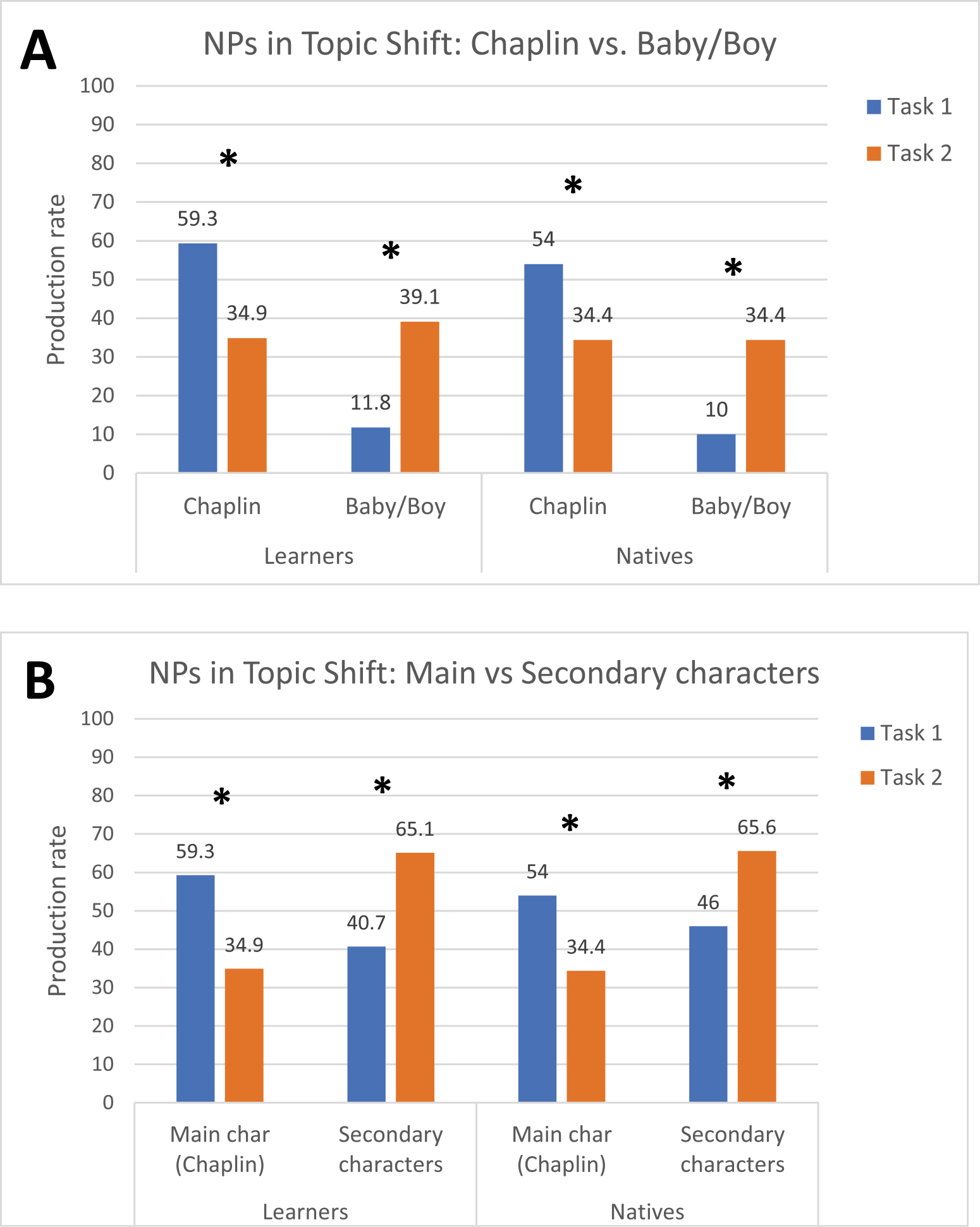
To further explore whether the significant differences in the transition from Task 1 to Task 2 are a character effect rather than a planning effect, we analysed the proportion of NPs from Task 1 to Task 2 in topic shift in two ways. First, we contrasted the main character (Chaplin) versus the baby (Task 1)/the boy (Task 2) (Figure 10A and related statistical contrasts in Appendix 15). We observed a significant decrease of NPs to refer to Chaplin but a significant increase to refer to the boy from Task 1 to Task 2, for learners and natives: learners (Chaplin: χ2 = 34.15, p < 0.0001, h = 0.494; the baby/boy: χ2 = 53.04, p < 0.0001, h = 0.650); natives (Chaplin: χ2 = 6.12, p = 0.0134, h = 0.397; the baby/boy: χ2 = 11.07, p = 0.0009, h = 0.610). This suggests that the boy in Task 2 takes a more leading role over the baby in Task 1 when marking topic shift.
Character effect for NPs in topic shift (task 1 vs. task 2): (A) NPs in topic shift. Chaplin vs. Baby/Boy. (B) NPs in topic shift. Main vs. Secondary characters.

Figure 10 Long description
The image A shows a bar graph titled 'NPs in Topic Shift: Chaplin vs. Baby/Boy'. The x-axis represents categories: Chaplin and Baby/Boy for both Learners and Natives. The y-axis is labeled 'Production rate' ranging from 0 to 100. For Learners, Chaplin has a production rate of 59.3 for Task 1 and 34.9 for Task 2, while Baby/Boy has 11.8 for Task 1 and 39.1 for Task 2. For Natives, Chaplin has 54 for Task 1 and 34.4 for Task 2, while Baby/Boy has 10 for Task 1 and 34.4 for Task 2. Asterisks indicate significant differences. The image B shows a bar graph titled 'NPs in Topic Shift: Main vs Secondary characters'. The x-axis represents categories: Main char (Chaplin) and Secondary characters for both Learners and Natives. The y-axis is labeled 'Production rate' ranging from 0 to 100. For Learners, Main char (Chaplin) has a production rate of 59.3 for Task 1 and 34.9 for Task 2, while Secondary characters have 40.7 for Task 1 and 65.1 for Task 2. For Natives, Main char (Chaplin) has 54 for Task 1 and 34.4 for Task 2, while Secondary characters have 46 for Task 1 and 65.6 for Task 2. Asterisks indicate significant differences.
Second, we contrasted the main character (Chaplin) versus all secondary characters (baby/boy, woman, policeman, old man) (Figure 10B and its statistical contrasts in Appendix 16) and found a more balanced pattern for both learners and natives: from Task 1 to Task 2, NPs significantly decrease to refer to Chaplin, but significantly increase to refer to secondary characters: main character versus secondary characters (learners: χ2 = 34.15, p < 0.0001, h = 0.397; natives: χ2 = 6.12, p = 0.0134, h = 0.397). This indicates that in Task 2 secondary characters take more of a leading role than in Task 1 (which is rather Chaplin-centred), hence the need for a higher proportion of NPs to mark a shift in topic in Task 2.
To summarise, planning time appears to influence learners on topic continuity, not on topic shift. This is in line with previous L2 pragmatic proposals like the PPVH (Lozano, Reference Lozano and Alonso-Ramos2016), which states that AR is more vulnerable in TC than in TS scenarios since learners tend to be more redundant than ambiguous. Our results suggest that planning may mitigate such redundancy, but its effect is limited to TC. Regarding TS, results evidence the possibility of a character effect rather than a planning effect. Planning time cannot explain the findings, as the same pattern is observed in both planners and non-planners alike. The findings for TS are better explained as a result of a character effect.
5.5. Results for RQ4 (PT effect on REs in topic continuity and coordination)
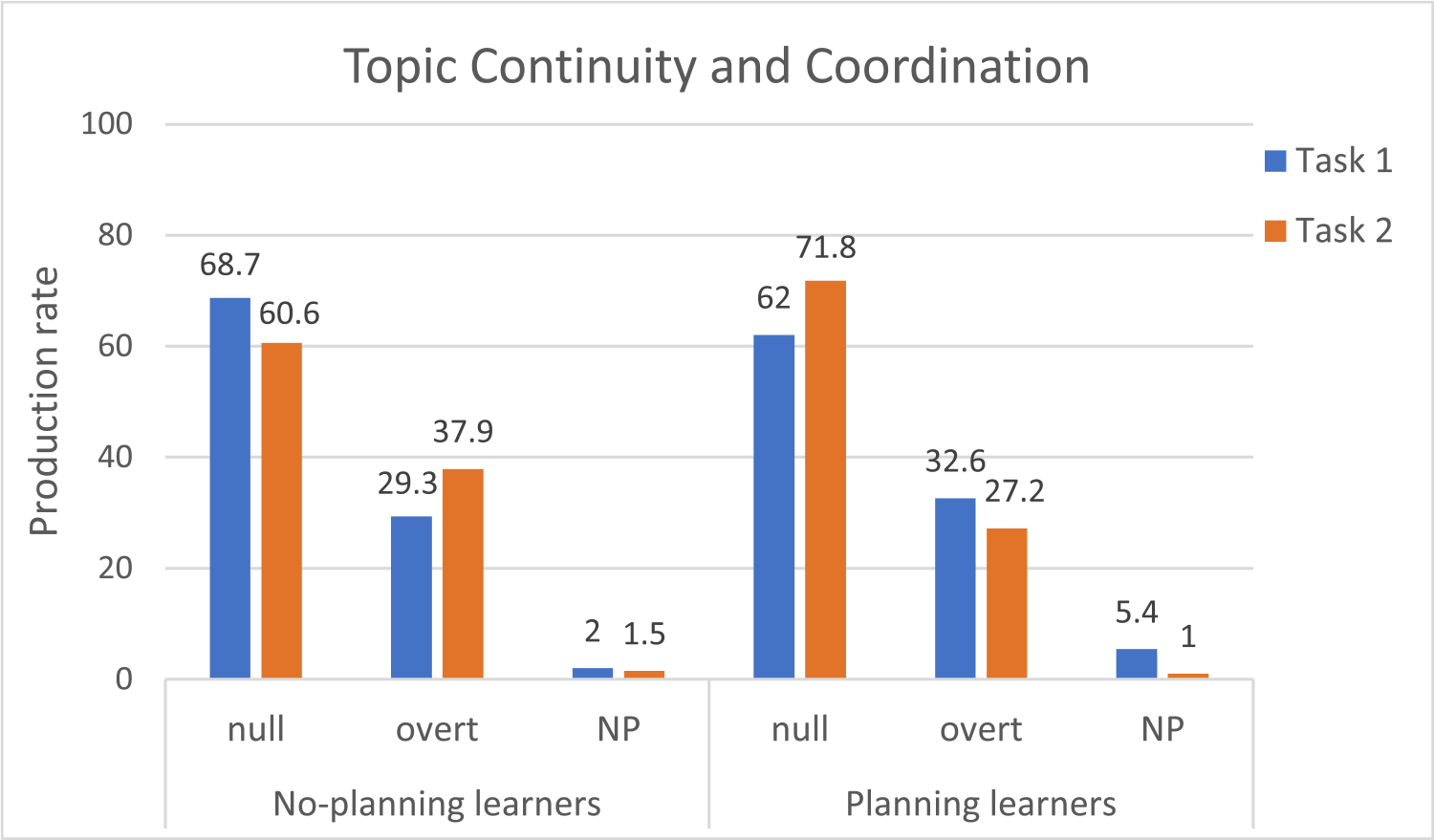
This section will address RQ4: Does PT affect learners’ (and natives’) production of REs (null/overt/NP) in contexts with topic continuity and coordination where null pronouns are pragmatically expected? Recall that in coordinated topic continuity, the preferred form to mark these scenarios by English natives is an economical null pronoun like the one in example (1). Figure 11 (and its statistical contrasts in Appendix 17) shows that from Task 1 to Task 2 there are no significant differences in either learner subgroup: non-planners (null: χ2 = 1.14, p = 0.2849, h = 0.169; overt: χ2 = 1.33, p = 0.2495, h = 0.182; NP: χ2 = 0.06, p = 0.8120, h = 0.038), planners (null: χ2 = 2.15, p = 0.1421, h = 0.2111; overt: χ2 = 0.68, p = 0.4081, h = 0.119; NP: χ2 = 3.25, p = 0.0716 [just non sig], h = 0.273). This indicates that PT has no effect in topic continuity and coordination, against the predictions in H4. Note that null pronouns are the predominant form, with around two-thirds of productions (range: 60% ∼ 72%) and around one third of overt subjects (27% ∼ 38%), suggesting that null pronouns are the privileged form to mark a continuation of topic in coordination (cf. the lower proportions of null pronouns in TC alone, Figure 9A above).
PT and learners’ REs’ distribution in coordinated TC (task 1 vs. task 2).

Figure 11 Long description
A bar graph titled 'Topic Continuity and Coordination' displays production rates for no-planning and planning learners across two tasks. The x-axis categorizes learners into 'No-planning learners' and 'Planning learners', with subcategories 'null', 'overt' and 'NP'. The y-axis represents the production rate. For no-planning learners, Task 1 shows 68.7 for 'null', 29.3 for 'overt' and 2 for 'NP'. Task 2 shows 60.6 for 'null', 37.9 for 'overt' and 1.5 for 'NP'. For planning learners, Task 1 shows 71.8 for 'null', 32.6 for 'overt' and 5.4 for 'NP'. Task 2 shows 62 for 'null', 27.2 for 'overt' and 1 for 'NP'. Task 1 is represented in blue and Task 2 in orange.
The PT significant effect found for null pronouns in topic continuity reported earlier (Figure 9A) disappears when we analyse the locus of those null pronouns (TC and coordination, Figure 11). This can be accounted for by the following fact: learners’ frequency of null pronouns in topic continuity (N = 71 for non-planners and N = 59 for planners, cf. Appendix 13) is basically the same in topic continuity and coordination (N = 68 for non-planners and N = 57 for planners, Appendix 17). So, the significant PT effect reported above for null pronouns in topic continuity is caused by the high number of overt pronouns produced by planners in topic continuity (N = 132 for non-planners vs. N = 164 for planners) when compared to the low and balanced frequencies of overt pronouns in coordinated topic continuity (N = 29 for non-planners and N = 30 for planners). Therefore, such PT effect for topic continuity could be more apparent than real. Future research will need to clarify this.
Finally, if we do an additional between-group comparison in coordinated topic continuity for Task 2 only (non-planning vs. planning learners) (cf. Appendix 18), no significant differences are found between them, which again suggests that PT has no effect in TC and coordination, contrary to the predictions in H4 (null: χ2 = 2.31, p = 0.1282, h = 0.238; overt: χ2 = 2.14, p = 0.1438, h = 0.229; NP: χ2 = 0.10, p = 0.7496, h = 0.049).
6. Conclusion
The present corpus-based study of intermediate L1 Spanish-L2 English learners and English natives explored the effect of planning time (PT) on AR, focusing on the production of subject referring expressions in discourse, by comparing a planning and a non-planning group. Participants in the planning condition, both learners and natives, first completed a control task (Task 1), then had 10-minute planning time to plan what to write in the second task, and immediately afterwards participated in the second task (Task 2). Participants in the non-planning condition, both learners and natives, performed both Task 1 and Task 2 without PT. A study on discourse cohesion by Díaz-Negrillo and Espinola Rosillo (Reference Díaz-Negrillo and Espinola Rosillo2024) proved differences in L2 English learners’ RE choices modulated by mode of production, that is, oral versus written discourse, with learners being more explicit in their spoken than in their written productions. Oral discourse is entirely spontaneous, while written discourse may involve some planning, as learners can think about what to say and revise what they have already written. As differences between oral and written discourse have been observed, it is expected that providing additional PT before a written task will enhance this effect and further reduce redundancy. However, our findings show no effect of PT on the distribution of REs in the written discourse of either learners or natives. When comparing the Task 2 of planners (with PT) to that of non-planners (without PT), no differences are observed. Similarly, participants in the planning condition do not differ in the transition from Task 1 (without PT) to Task 2 (with PT).
Planning time was predicted to facilitate the selection of pragmatically more felicitous REs and to mitigate learners’ redundancy in the L2. This was so based on accounts that propose the limited nature of human attentional resources (Skehan, Reference Skehan1998), and their unbalanced distribution, favouring meaning over linguistic form (VanPatten, Reference VanPatten1990). This aligned with Sorace’s (Reference Sorace2011) claim that L2 learners struggle with phenomena at the interface between two linguistic levels, such as AR at the syntax-discourse interface, due to the difficulty to simultaneously integrate grammatical and discursive factors. Taking this together, and following Skehan’s (Reference Skehan1996, Reference Skehan2002) suggestion to promote a focus on linguistic form by manipulating task conditions and reduce their cognitive demands, providing PT to complete a linguistic task would benefit L2 pragmatic performance at the syntax-discourse interface. Planning time would reduce task cognitive demands and free attentional resources so that learners can direct attention to linguistic form. This would be represented in our study by higher chances to select the most felicitous RE form under planning conditions.
Overall, no PT effect was observed on RE choices, which does not seem to support Robinson’s (Reference Robinson and Robinson2011) Cognition Hypothesis, as reducing task cognitive demands by providing PT does not necessarily result in pragmatically more felicitous discourse. Our findings suggest that insufficient attention was given to linguistic form (VanPatten, Reference VanPatten1990), at least at a discourse level. Although contrary to common sense, the absence of PT effects on the production of subject REs is in line with some studies on L2 grammatical accuracy reviewed earlier (Ghavamnia et al., Reference Ghavamnia, Tavakoli and Esteki2013; Rahimpour & Safarie, Reference Rahimpour and Safarie2011; Rostamian et al., Reference Rostamian, Fazilatfar and Jabbari2018). These studies focused on written performance and report a lack of PT effect on L2 grammatical accuracy. Given that anaphora resolution is constrained by grammatical factors, our results align with such previous findings on the lack of PT effects on grammatical aspects.
Additionally, our results confirm that REs’ information status (topic continuity vs. topic shift) is a key factor modulating RE choices, with more economical forms encoding topic continuity than topic shift in both learners and natives. Learners seem to follow the native tendency especially in topic shift scenarios, while differences, if any, are found in topic continuity. Topic shift contexts led to more expected results (regardless of PT) than topic continuity contexts, evidencing the complex nature of TC for learners and supporting the PPVH, which postulates that learners are hardly ambiguous but frequently redundant.
Our findings have several implications. Regarding pedagogy, common sense would dictate that providing students with time to plan a linguistic task in advance will improve their L2 production. If no planning is allowed, the redundancy observed in learners’ written composition may be attributable to lack of PT. By contrast, if planning time is allowed, we would expect redundancy to be minimised. However, our findings, along with other studies on L2 grammatical accuracy, seem to indicate that this assumption is not so straightforward. Our results suggest that planning may not always translate into more accurate or pragmatically felicitous output. Thus, decisions in the class need to be based on empirical evidence (cf. the principles of instructed second language learning applied to language pedagogy (Ellis, Reference Ellis2005b)), so our findings imply that teachers should take into consideration the (lack of) benefit of the task conditions they implement. Overall, the literature reports clear PT benefits for fluency/complexity but not so for grammatical accuracy/discourse, so it may be a good idea for teachers to provide students with PT if the aim is to promote fluency/complexity.
Additional implications concern future research. First, we conclude that PT has no effect on the distribution of REs in the discourse of intermediate English learners. However, to the best of our knowledge, this is the first study that attempted to explore the relationship between planning time and discourse. Thus, it is necessary to conduct further studies on PT and discourse to explore whether our findings are replicated with other linguistic phenomena. Finally, it would also be necessary to explore how PT is implemented by the students and whether they use this time effectively. In our study, there was no specific guidance/instructions during PT and learners may have focused their attention on overall meaning rather than on linguistic form (RE choices), which might have fostered the lack of PT effect. Future research at the discourse level will need to address whether attention-to-form instructions during PT may have a positive effect on learners’ distribution of RE forms in discourse.
Supplementary material
The supplementary material for this article can be found at https://doi.org/10.1017/S0261444825000011.
Acknowledgements
This study was funded by grant number PID2020-113818GB-I00 from MCIN (Ministerio de Ciencia e Innovación), AEI (Agencia Estatal de Investigación) (DOI: https://doi.org/10.13039/501100011033) to the second author, and supported by a predoctoral FPU contract funded by Ministerio de Ciencia, Innovación y Universidades and a research grant (Beca de Iniciación a la Investigación) by the University of Granada awarded to the first author. Funding for open access charge: Universidad de Granada/CBUA.
Competing interests
The authors declare none.
Elena García-Guerrero, predoctoral researcher at the University of Granada and PhD candidate. Research interests: second language acquisition, bilingualism, and psycholinguistics, with a focus on Spanish-English bilinguals.
Cristóbal Lozano, associate professor in English applied linguistics. Research interests: second language acquisition, bilingualism, learner corpora, and psycholinguistics. He has published internationally on learner corpora and second language acquisition, particularly on L2 English and L2 Spanish. He has been Principal Investigator (PI) of research projects on second language acquisition and learner corpora (ANACOR, ANACOREX).






 Open access

