

Presidents and prime ministers possess vast powers of appointment. These powers can be used to appoint cabinets with an equal number of male and female ministers. Parity cabinets make dramatic statements about gender, representation, and political power. They imply that gender balance—rather than just adding some women—is needed to overcome women's political marginalization. Cabinets with just a few token women are insufficient and undemocratic. Yet appointing women in the same proportions as men challenges a status quo in which men occupy most of the positions of power. Even when leaders possess the formal authority to appoint ministers, forming a parity cabinet means that some existing practices and norms, particularly the norm of male dominance, have been broken. Parity cabinets thus create the possibility of backlash from those who fear reduced opportunities for men to access powerful posts.
The acceptance or resistance of parity cabinets by governing party elites has political consequences. For presidents or prime ministers, resistance to their ministerial appointments can complicate their relationship with their party or coalition partners, making it harder to pursue their legislative agendas or to present a united front against opposition criticism during times of political crisis. For female ministers, resistance to their presence in cabinet can mean greater scrutiny of their performance, leaving them open to criticism that they were appointed because of their sex rather than their abilities or skills. Initial steps toward greater gender equality are always the most visible and heavily scrutinized. For example, the effectiveness of a country's first female leader is often taken as indicative not of her individual ability, but of the ability of all women to succeed in that position. Likewise, the perceived effectiveness of a country's first gender parity cabinet will shape the outcome of future demands for gender parity (in cabinet or other political institutions).
The emergence of parity cabinets is a missed opportunity for scholars of the executive branch to examine more closely the norms and practices surrounding cabinet formation, how they can change, and the consequences of those changes. While the growing number of women appointed to cabinets around the world has generated studies of women's appointment by gender and politics scholars (Claveria Reference Claveria2014; Davis Reference Davis1997; Escobar-Lemmon and Taylor-Robinson Reference Escobar-Lemmon and Taylor-Robinson2009; Jacobs, Scherpereel, and Adams Reference Jacobs, Scherpereel and Adams2013; Krook and O'Brien Reference Krook and O'Brien2012) women's appointments have received little attention from scholars of the executive branch. In this article we ask, under what conditions are changes that bring about gender equality accepted or rejected by the party or parties in power?
We answer this question by comparing two gender parity cabinets: the first appointed in 2004 by Spain's prime minister, José Luis Rodríguez Zapatero, and the second appointed by Chile's president, Michelle Bachelet, in 2006. Both leaders promised to appoint parity cabinets during their electoral campaigns, framing the issue as integral to improving democracy and renovating the political system. Parity was also promoted alongside other representative criteria: youth (in Spain) and “new faces” (in Chile). Yet each leader pursued these goals in a context marked by existing rules, norms, and practices. In Chile, gender parity was resisted by elites in the governing coalition, contributing to cabinet instability and frustration among some of the female ministers who served. In Spain, however, elites in Zapatero's own party supported his equality efforts, even while the opposition party and the conservative media criticized the idea of gender parity as a criterion for cabinet.
Our comparison of Bachelet and Zapatero's cabinets shows that two factors are decisive in shaping the reception of parity cabinets by party and coalition elites. First, origins matter: when parity is supported by previous changes within parties that increased women's inclusion in arenas of power, it is more broadly accepted. Conversely, when gender parity is initiated in a top-down manner by the leader rather than the parties, and challenges existing norms and practices, party elites are more likely to resist and withhold support for ministerial appointments.
Second, the degree of power enjoyed by selectors (president or prime minister) matters. Selectors face less resistance from their party or parties when their own power is uncontested and secure. The selector's power derives from at least two sources. First, institutions, both formal and informal, determine how much uncontested autonomy a leader enjoys when forming a cabinet. In both Chile and Spain, the chief executive alone enjoys the formal, constitutional power to select their ministers. Yet in Chile, this formal autonomy is constrained by a number of informal practices that limit the president's choices. In Spain, there are few such constraints: the prime minister's position as party leader gives her extensive power when assembling a cabinet. Second, the gender of the selector affects the reception of parity as a criterion for cabinet formation. In making this argument, we reaffirm the idea that gender is not synonymous with women. Men are gendered actors, and ideas about masculinity can be a source of power for male leaders (see Duerst-Lahti and Kelly Reference Duerst-Lahti, Kelly, Duerst-Lahti and May Kelly1995). While difficult to untangle from other factors, we argue that in Spain, Zapatero's own gender gave him more political space to promote gender parity. Zapatero appeared progressive when describing himself as a radical feminist. Bachelet's gender, in contrast, meant that her pursuit of gender equality faced greater scrutiny and criticism. She was the country's first female president, and her critics depicted her pursuit of gender equality in cabinet as favoring sex over merit.
Studying the executive branch is difficult given the lack of access to a president's or prime minister's inner circle. We base our analysis on a variety of sources, including media coverage of cabinet formation, shuffles and ministers’ backgrounds and performance, government documents, and interviews with political elites, including former ministers, party officials, and political experts.Footnote 1 The interviews include a sample of men and women who served in the gender parity cabinets in both Spain and Chile.
GENDER AND CABINET RECRUITMENT: FROM INCLUSION TO PARITY
Although cabinets are central to politics and policymaking, we know little about how and why ministers are recruited (Annesley, Beckwith, and Franceschet Reference Annesley, Beckwith and Franceschet2014; Bonvechhi and Scartascini Reference Bonvecchi and Scartascini2011; Dogan Reference Dogan and Dogan1989; Dowding and Dumont Reference Dowding and Dumont2009; Rhodes Reference Rhodes, Rhodes, Binder and Rockman2006, 232). Many studies focus on ministers’ backgrounds to determine the criteria that govern appointment to cabinet, namely, policy expertise and knowledge or political skills and experience. Comparative research finds that some countries are more likely to have cabinets composed of “specialist” ministers appointed for their expertise in a portfolio while elsewhere the route to cabinet is through lengthy parliamentary careers. Other scholars explore patterns of portfolio distribution in coalition governments, asking when and why leaders appoint partisans versus independents and whether portfolio allocation is proportional to the parties making up the coalition (Amorim Neto and Samuels Reference Amorim Neto and Samuels2010; Laver and Shepsle Reference Laver and Shepsle1996). This scholarship gives priority to the party identity of ministers while placing less emphasis on ministers’ other characteristics.
Although party label, policy expertise, and political experience all factor into cabinet formation, other characteristics like region, ethnicity, and gender matter too. Such characteristics are not consistently explored in many studies, even though scholars acknowledge that ministers serve both administrative and representative functions (see Blondel Reference Blondel, Blondel and Thiebault1991). Ministers manage government departments, oversee the implementation of government policies, and participate in discussions of policy and political strategy. But they also serve representative functions, sending cues to particular groups about their place in the government's priorities and policies. When religious, ethnic, or regional cleavages are politically relevant, representational criteria take on added importance. Even where such cleavages are absent, leaders clearly care about the image projected by their cabinet choices. Escobar-Lemmon and Taylor-Robinson (Reference Escobar-Lemmon and Taylor-Robinson2009, 4) write that presidents are often judged on the diversity and inclusiveness of their cabinets and must, therefore, be aware “of the picture—often a literal photo in the press—presented by their cabinet.” Leaders often favor representative criteria when forming cabinets at the start of their term while “giving priority to competence and experience in government administration when shuffling cabinets” (Rodríguez Reference Rodríguez Teruel2011a, 899). It is no surprise, then, that women are more likely to be recruited to cabinet immediately after an election than during midterm cabinet shuffles. Leaders gain the most by making symbolically relevant appointments when the nation's attention is focused on cabinet formation immediately after an election (Davis Reference Davis1997).
Acknowledging the myriad criteria for appointment to cabinet in particular countries does not, however, tell us how the criteria are gendered—that is, how women and men are affected differently by recruitment criteria based on policy expertise, political experience, or diversity (however defined in a particular context). Indeed, determining how leaders decide to staff their cabinets is not well known (Blondel and Thiébault Reference Blondel and Thiebault1988; Dowding and Dumont Reference Dowding and Dumont2009). Dogan (Reference Dogan and Dogan1989, 1) explains that “[r]ules are informal rather than formal. One does not find them in documents but discovers them by talking to politicians willing to unveil these rules to scholars.” The relative absence of legal rules about ministerial recruitment does not mean, however, that cabinet formation is entirely ad hoc. Instead, the appointment of cabinets in any particular country is often governed by informal norms and practices that follow regular patterns, although the patterns may change over time. These norms and practices relate to the type of individuals recruited—that is, the criteria for appointment that restricts recruitment to wide or narrow eligibility pools—and the procedures for cabinet formation—that is, whether appointments and portfolio allocation are decided by the president or prime minister alone or whether consultation or bargaining among the party's (or parties’) leadership is expected.
The fact that the criteria for ministerial appointment and the procedures for assembling cabinets are informal rather than legally defined poses both obstacles and opportunities for women. Informal rules are often detrimental to women precisely because there are no formal authorities to whom demands for gender-friendly change can be addressed. In some cases, informal practices are purposefully hidden for fear that they would not stand up to public scrutiny (Helmke and Levitsky Reference Helmke and Levitsky2004). On the other hand, Waylen (Reference Waylen2014) notes that informal rules and practices may contain greater room for “play”—that is, for individuals to push the boundaries or exploit ambiguities in the norms or practices. This opens up space for political leaders to challenge rules or practices that undermine gender equality.
Given the relative scarcity (to date) of gender parity cabinets, a comparison of Spain and Chile offers a number of analytical advantages for studying the norms and practices surrounding cabinet formation, how they change, and when executives can change norms without encountering resistance in their parties. Chile and Spain share some key properties: both countries underwent relatively recent transitions to democracy—Spain in 1977–1979 and Chile in 1988–1990—emerging with strong, ideologically organized political parties with centralized recruitment practices and chief executives with extensive powers. In addition, both Bachelet and Zapatero were from the political left (both from socialist parties) and led left or center-left governments. Yet the two countries differ in ways that are relevant for cabinet formation: Chile is a presidential democracy and a unitary state while Spain is a parliamentary democracy with a quasi-federal system where the representation of regional identities in national cabinets is increasingly important. While chief executives in both countries have extensive powers, Spain's prime minister is also the party leader, conferring additional power. Finally, even when Spanish prime ministers do not achieve parliamentary majorities, single-party cabinets are nonetheless the norm. In Chile, in contrast, electoral rules make coalition governments the norm. Executive appointments involve a more complex process of consultation between the president and coalition parties.
DOCUMENTING RESISTANCE: NUMBERS, CABINET STABILITY, AND ELITE SUPPORT
José Luis Rodríguez Zapatero became Spain's prime minister in April 2004. When Michelle Bachelet won Chile's presidential election in January 2006, she became the country's first female president. Both leaders challenged existing practices with respect to ministerial recruitment by appointing cabinets with an equal number of men and women. Yet in Chile, in contrast to Spain, gender parity in cabinet was resisted by elites in the governing parties. Below, we discuss the nature of resistance to parity in Chile and its relative absence in Spain. But first we explain that documenting the degree of resistance in the two cases requires more than simply counting the number of women in cabinet throughout each administration.
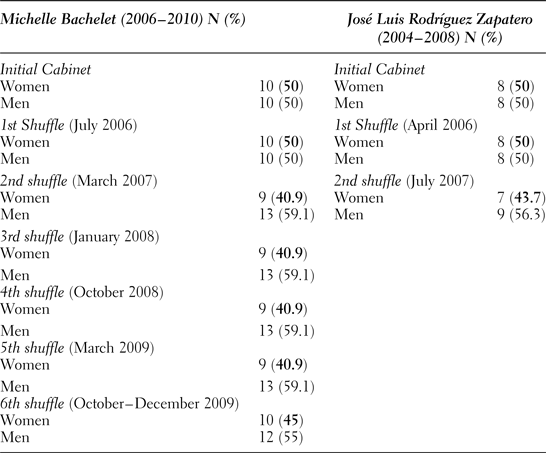
If we were to look only at how long parity lasted and whether the women in cabinet remained in their posts as long as the men, we would find few differences between Spain and Chile. A flexible definition of gender parity (60/40) was maintained for much of the first term of both Bachelet and Zapatero (see Table 1). Of the 16 ministers appointed in Zapatero's cabinet, seven served the full term, and four of them were women. In Chile, just three ministers (of 20) served the full term. Two of them were women, although they held minor portfolios (urban planning and culture).
Duration of parity across term*

Note:
* Includes only those cases where more than one minister was replaced.
Yet, going beyond numbers shows us that the two countries’ experiences with parity cabinets differed in important ways. First, under Bachelet, the women occupying the most powerful positions in cabinet, such as Paulina Veloso as the minister of the presidency and Vivianne Blanot as defense minister, served some of the shortest terms. After shuffling cabinet for a third time, Bachelet spent most of the remainder of her term without a woman in any of the three most powerful positions: minister of the presidency, finance, and interior. In Spain, on the other hand, Zapatero's “right hand” was María Teresa Fernández de la Vega, who occupied the first vice presidency portfolio as well as serving as government spokesperson. Notably, she held the post during Zapatero's whole term (and for most of his second term as well). Second, Bachelet's cabinets were much less stable compared to those of her predecessors. The average length of time without any changes in cabinet was significantly shorter during Bachelet's term (6.8 months), compared to the governments of Eduardo Frei and Ricardo Lagos (12 months) and Patricio Aylwin (24 months) (Dávila Reference Dávila2011, 147).Footnote 2 Bachelet changed her cabinet earlier in her term than did any previous Concertación president. She sacked three ministers just three months after taking office. In contrast, presidents Aylwin and Lagos waited almost two years before shuffling their cabinets, and Frei's first shuffle came six months after taking office (ibid., 217). Zapatero's cabinet, in contrast, was one of the most stable in the postdictatorship period (Real-Dato and Jerez-Mir Reference Real-Dato, Jerez-Mir, Dowding and Dumont2009, 112; see also Rodríguez Reference Rodríguez Teruel2011b).
Third, after being elected to a second term, Zapatero went beyond parity, appointing a cabinet in which women held a majority of posts (nine women and eight men). When Bachelet was elected to a second term in 2014,Footnote 3 she did not appoint a gender parity cabinet, despite having promised to do so during her campaign. Instead, she appointed just 9 women out of 23 ministers (39%), explaining that she ”would have liked that this team be totally equal,” but it was not to be.Footnote 4 Her comment implies that while gender parity was still her personal desire, it was not possible in light of other political demands and the lack of widespread support within her coalition.
Cabinet stability, the terms served by female ministers, and the maintenance of parity only tell part of the story. Capturing the nature of resistance to parity requires a closer look at what was happening in the political parties. Interviews with party leaders, former ministers, and political experts, along with the media record, demonstrate the large degree of resistance to parity within Bachelet's own coalition in Chile and the absence of resistance from Zapatero's copartisans in Spain. Notably, some party elites within the Concertación had criticized the concept of a gender parity cabinet during the campaign, and these criticisms continued after Bachelet took office in 2006. Immediately upon announcing her cabinet, Bachelet faced complaints from party leaders. The president's wish to promote gender equality and political renovation clashed with the parties’ wishes to maintain the tradition whereby ministers are drawn from the party leadership. One party leader, for example, complained that the ministers selected by Bachelet failed to represent “the institutionality of the party” (Garrido Reference Garrido2006).
Bachelet's first few years in office were turbulent, as evidenced by the frequent cabinet changes noted above.Footnote 5 A number of female ministers, along with some of the men who were “new faces,” were criticized for lacking political skill and leadership, particularly in terms of managing relationships within the cabinet, with the parties of the coalition, and the opposition. A study of news coverage conducted by Corporación Humanas (Reference Corporación2010, 48) found that “in the first three years of the government the negative references in relation to the authority of the ministras [female ministers] were higher than positive references.” A former (male) minister, when commenting on Bachelet's initial parity cabinet, explained that “when a political crisis emerged, and you had to have people who could negotiate, who could confront the crisis,” there were simply no women with these profiles. As a result “the guys with experience came back.”Footnote 6
Women ministers reported feeling unsupported by their own parties. In interviews conducted with female ministers and undersecretaries, the Corporación Humanas (Reference Corporación2010, 73) found that women repeatedly noted the lack of support for gender parity policies within the parties. According to one, “we know that [within the parties] there is no support for the theme of gender parity.” Speaking directly to the backlash against gender parity, another said, “I believe that many men still have the fantasy that this [gender parity] is a bad dream, that will end, and that each one will return to his place, and this will once again be a world of men.” Many of Bachelet's women ministers felt that even their own political parties were hostile toward their occupying ministerial positions. As one female minister noted, “[T]he first hits that I received were not from the general public … but were from my party, and were very strong” (PNUD 2010, 276). Asked to comment in December of 2007 about the criticisms of her female ministers, Bachelet responded,
The complaints against [some women ministers] for lacking autonomy are no more than a symbolic resistance against a woman that leads. … In politics, nevertheless, being a woman matters, the parties are sexists, there is resistance when leadership is in the hands of a woman. I have lived this. But it did not stop me (Peña Reference Peña González2007).
No evidence of elite resistance in the PSOE or public concern about the leadership capacities of female ministers emerged in the Spanish case. Women in Zapatero's cabinet interviewed for this study reported respectful treatment by their colleagues and strong party support.Footnote 7 One acknowledged that Zapatero himself fostered such an environment, given his own concerns for ensuring that ministers had access to him personally, and that a climate of respect was fostered in cabinet meetings.Footnote 8 Female ministers did not endure particularly harsh treatment by the media, although there are certainly reports of sexist coverage, particularly in the conservative newspapers. The most important difference in media commentary between Chile and Spain is that the women appointed to Zapatero's cabinet were not undermined by charges that they would be ineffective because they lacked political clout. In contrast to Chile, where few women had served in party leadership roles (PNUD 2010), a former minister in Spain noted that upon winning the party leadership in 2000, Zapatero began incorporating women into the front lines of the party.Footnote 9
In sum, the proportion of women in Bachelet and Zapatero's cabinets throughout both leaders’ first term in office remained close to parity (although somewhat closer in Spain than in Chile). The two cases differ, however, in the degree to which governing party elites supported women's equal presence in government. Bachelet's cabinets were also far less stable than Zapatero's, although cabinet instability was the product of multiple factors, not simply elite resistance to gender parity. The next section explores the reasons for resistance in Chile and its absence in Spain.
EXPLAINING REACTIONS TO PARITY CABINETS: ORIGINS AND EXECUTIVE POWER
Zapatero's parity cabinet faced less resistance than Bachelet's for two main reasons. First, the norm of gender parity preceded Zapatero's emergence as leader of the PSOE and was already institutionalized in party practices like candidate nomination. In Chile, parity was perceived as Bachelet's individual commitment, rather than something that had emerged through initiatives in the parties. Second, the institutional and political context enhanced the power of Zapatero relative to Bachelet. Features of Spain's political system, combined with Zapatero's own route to party leader and prime minister gave him substantial autonomy to select the cabinet ministers he wished. In Chile, despite a “presidentialist” constitution that concentrates power in the executive, well-entrenched informal institutions and practices, along with Bachelet's own (gendered) status as outside of elite party networks, reduced her room for maneuver when selecting ministers.
Origins of Parity
In both countries, norms about gender balance in cabinet emerged in the context of public concern about women's underrepresentation in decision-making arenas. Few women won office in the posttransition parliaments of either country, yet subsequent gains have been much stronger in Spain than in Chile. In 1982, women held just 5% of seats in Spain's Congress of Deputies and less than 5% of seats in the Senate. Yet by 2004, women's parliamentary representation surpassed 35%. In Chile, in contrast, women's representation remains stubbornly low: in the first posttransition election in 1990, only five women (5.8%) were elected to the Chamber of Deputies, and just one woman was elected to the Senate. Women's representation peaked in the Chamber of Deputies in 2006 at 15.8%, and it remains the same today.
The successful lobbying of feminists in Spain's leftist political parties, and the parties’ eventual adoption of gender quotas, explains much of the difference between the two countries. In Spain, feminists in the Socialist party were highly organized and active in lobbying the party's leadership to improve women's representation (Verge Reference Verge2007). As a result of their mobilization, the party adopted gender quotas for internal elections and for party lists in 1988 (Threlfall Reference Threlfall2007; Verge Reference Verge2007).Footnote 10 Initially, the quota was set at 25%, but it gradually increased to 40% by 1997 (Verge Reference Verge2012). In the following years, women's share of candidacies and parliamentary seats increased significantly at all levels: national, regional, and local. By 2007, women held 31% of local offices, 36% of seats in the national parliament, and an average of 42.5% of seats in the 17 regional parliaments (Verge Reference Verge2010, 166–67). When the PSOE won the 2004 general election, women took more than 46% of the party's seats in the lower house. Consequently, Zapatero's appointment of a gender parity cabinet was seen as a natural extension of parity norms already accepted in the PSOE. What is more, women's growing presence in party positions, as well as regional and national parliaments, created a larger supply pool of women with political experience. Many of the female ministers appointed to Zapatero's first cabinet had held elected office at the regional or national level.
In Chile, gender parity in the cabinet emerged from a context in which greater gender equality in politics was desired by many, but had been frustrated in part by the internal coalition politics of the Concertación. Party-level quotas have been adopted by the major parties of the Concertación, but due to the complex negotiations required to compete electorally as a coalition, these quotas were never followed, and all attempts to pass national quota legislation failed to make it out of committee.Footnote 11 As a result, there were fewer women that were considered part of the party elite and who had extensive party and office trajectories in the ministerial supply pool.
When Bachelet emerged as the front-runner in the 2005 presidential election, a central feature of her campaign was a critique of the present limitations of Chile's democracy. She denounced the elite domination of political parties and the limited participation of marginalized groups like women, indigenous groups, the poor, and youth in politics. Within this context, it was significant that Bachelet's candidacy was seen as arising not from a negotiated agreement among her coalition's elite, but from her own popularity among Chileans (Huneeus and López Reference Huneeus, López, Huneeus, Berríos and Gamboa2007; Quiroga Reference Quiroga2008; Ríos Reference Ríos2008; Thomas Reference Thomas2011). Bachelet strategically used her own position as the first serious female candidate and the widespread perception that she was a political outsider to symbolize her broader goals. This strategy was successful in large part because the governing coalition had been in power for 16 years, and, despite general satisfaction with its policies, real concerns had emerged about the exhaustion of the coalition's political vision and the lack of renovation of political leadership in the parties (Franceschet and Thomas Reference Franceschet, Thomas and Murray2010; Sehnbruch and Siavelis Reference Sehnbruch and Siavelis2014; Thomas Reference Thomas2011; Valdés Reference Valdés2010). Bachelet promised to bring “new faces” into the government and provide more political spaces for everyday citizens (Franceschet and Thomas Reference Franceschet, Thomas and Murray2010; Thomas Reference Thomas2011). Yet her commitment to gender equality and generational renovation through executive appointments was not widely shared by party elites within the Concertación. Rather than embracing Bachelet's project of renovation, many party elites criticized what they saw as an attack on their power. A former minister explained: “[S]o what happened, all the men who have historically participated in the Concertación government looked on furiously from the sidelines, indignant because they had lost power and consequently they raised all the flags of criticism before [the government] began its work.”Footnote 12
In Spain, Zapatero's pledge to appoint a gender parity cabinet also emerged during his election campaign in 2004 (Díez 2004). There are some important similarities here with the Chilean case: like Bachelet, Zapatero wanted to send signals to citizens that he would initiate a new and more inclusive style of politics, and he used cabinet appointments to communicate a political project centered around gender and sexual equality, youth engagement, and deepening democracy. Yet unlike Bachelet, Zapatero could count on broader support for the principle of gender equality within his party. Zapatero had become leader of the PSOE in 2000, following a period of internal crisis and crushing electoral defeats for the party in 1996 and 2000. This crisis gave rise to a new leadership, including Zapatero, with few ties to the old generation of party notables (Encarnación Reference Encarnación2009; Field Reference Field2009). Zapatero and his allies seized the opportunity to put the party on a new path and reach out to new political constituencies—like youth, who were largely disengaged from politics. Equality was central to the new political project for the PSOE (Field Reference Field2009). Zapatero explicitly described himself as a feminist (Encarnación Reference Encarnación2009, 118). He also championed equality for gays and lesbians, promising to reform marriage and adoption laws (Calvo Reference Calvo2007). But these equality goals were not just held by Zapatero; they were shared widely in the PSOE and promoted by other key figures. For example, women's representation in regional cabinets governed by Socialists had increased, and Andalusia's regional president, Manuel Cháves, appointed a female majority cabinet (eight women and six men) prior to Zapatero's election.Footnote 13 Interviews with former ministers and political experts indicate that, while the idea of parity in cabinet is closely linked to Zapatero, there was general party support for the principle of gender equality in political appointments. A former minister explained that gender parity “emerged from the party itself, from the resolutions of socialist party congresses. It was pressure from the party toward the [prime minister], not just from the [prime minister].”Footnote 14
Although the most important factor that produced gender parity cabinets in the two countries was the leaders’ own political convictions and strategies, these commitments were shared more broadly among political elites in Spain than in Chile. Gender balance in Zapatero's cabinet could be viewed as the logical extension of a norm that was already being practiced in the PSOE, largely due to successful lobbying by feminists in the party. In contrast, equality norms in political representation remained much weaker in Chile where mechanisms such as gender quotas, although advocated by feminists in the left parties, were resisted by political elites and where women's numbers in elected offices remained much lower.
Executive power: formal, informal, and gendered dimensions
Elite resistance to gender parity in cabinet is also shaped by the degree of power enjoyed by the chief executive. In Chile's presidentialist political system, the president enjoys extensive formal power. The constitution gives the president alone the power to appoint and remove cabinet ministers. In addition to ministers, the president appoints a large number of other key posts, ranging from vice ministers to regional governors. Yet two things limit the formal powers of the president. First, Chile's electoral systemFootnote 15 means that governments are always coalition governments, and not all presidents exercise the same degree of leadership within the coalition. Second, the president's choices of ministers when forming a cabinet are limited by a series of informal norms and practices developed to maintain coalition unity.
Two informal practices to maintain coalition unity have shaped cabinet formation in crucial ways: the cuoteo and party consultation. The cuoteo refers to the practice of sharing executive positions among the parties of the coalition in rough proportion to their share of seats (Altman Reference Altman, Siavelis and Morgenstern2008; Siavelis Reference Siavelis, Helmke and Levitsky2006). Another practice is for the president to solicit recommendations from the parties concerning their wishes for executive posts. With respect to these informal norms, a former minister explains, “Presidents take care to build teams that express the equilibrium in the coalition. Normally, presidents ask the parties for names [of the ministers they would like] but [the president] does not necessarily cling to the names they are given.”Footnote 16
Notably, when Bachelet asked the parties to submit their recommendations, she “asked the parties for lists that included the names of both men and women. She demanded that there be women.”Footnote 17 But in so doing, Bachelet challenged the power of party elites who were accustomed to receiving plum executive appointments. As one former minster noted in explaining the resistance to Bachelet within the Concertación: “The day that you open the alternative of generating new leadership, those who are threatened are those who today have the power … to put in new names is to [break with] your circle of loyalties.”Footnote 18
What is more, it was difficult for Bachelet to combine existing informal norms of cabinet formation (like the cuoteo) with new emphases on gender parity and new faces. Because women were largely absent from the party leadership, many of the most experienced women would not be considered new faces (Siavelis Reference Siavelis2011, 23), while women who represented new faces were probably outside of the inner circles of the political parties. A former minister explained the criticisms in this way: “She broke the tradition, not necessarily of the party … she respected in all ways the political balance, the Concertación was equally represented, this norm was maintained. What happened in this occasion was that those who occupied the positions were not the ones who the traditional elite would have put there and this generated a sensation in the parties that the past agreements had been broken.”Footnote 19
The Spanish prime minister (known as presidente de gobierno, or president of government) also enjoys vast formal powers. The president of government is also party leader, and, as such, wields considerable influence over his or her party: “The president of government is not really a Prime (first) Minister, as he is no longer a primus inter pares but a real President as his official title indicates. The cabinet revolves entirely around him—it is created, lives and dies with him and it acts under his direction and follows his political program” (Bar Reference Bar, Blondel and Müller-Rommel1988, 111). Even though the PSOE has a federalized structure, the central party leadership ultimately controls candidate selection (Van Biezen Reference Van Biezen2003). Although the electoral system is based on proportional representation, the relatively low district magnitude gives it some majoritarian tendencies. Notably, all of the governments since the return of democracy have been composed of single parties, even in the absence of parliamentary majorities.
Although enjoying wide discretion in selecting ministers, leaders from the PSOE must be mindful of two things: regional representation and party representation. Spain is a quasi-federal state, with 17 regions, known as “Autonomous Communities,” each with different powers and relationships to the central government. The need for regional balance in national cabinets derives from the fact that the PSOE itself has a federalized structure, and, according to one interviewee, the prime minister will seek “internal peace in the party” by ensuring that the most important regions, Catalonia, Andalusia, and the Basque Country, are represented in cabinet.Footnote 20 A former minister explained that “there is a very powerful territorial structure and you need to rely on those leaders of regional governments who are the strongest.”Footnote 21 Regional party leaders (called “barons”) are important figures in Spanish politics, especially when the party holds regional office, and control of large budgets may be used to consolidate the party's electoral bases (Gómez and Verge Reference Gómez, Verge, Kopecky, Mair and Spirova2012; Hopkin Reference Hopkin2009).
Interview respondents in Spain spoke of “cuotas de territorialidad” (territorial quotas) and “equlibrios” (equilibria) among regions in much the same way that former ministers and political experts in Chile speak of the need for balance among coalition parties. Yet there is an important difference between the norm of regional representation in Spain and the norm of coalition party representation in Chile: In Spain, regional leaders do not submit their preferences for ministers to the president of government as do party leaders in Chile. According to a former minister (and former regional president), even though “the party leadership in that region would have to feel represented by the [minister appointed from that region], it is the president of government who takes the initiative to consult;” regional leaders do not lobby the president.Footnote 22
Another practice, according to interview subjects, is to ensure that the party leadership is represented in cabinet. A former minister explained that “it is logical that an important part of the [cabinet] normally comes from the party leadership. That is quite common.”Footnote 23 Another former minister said that when forming cabinets, an important criterion is “that the political party in its entirety feels represented by the cabinet.”Footnote 24
Satisfying existing norms of territorial and party leadership representation while also pursuing gender parity was less onerous for Zapatero than the challenge faced by Bachelet. Due to party gender quotas and equality norms, women's presence had grown considerably in parliaments and cabinets at the regional level, thus expanding the supply pool of potential female ministers. Women figured prominently in Zapatero's inner circle. The so-called “Committee of Notables” with whom Zapatero worked most closely during the 2004 general election campaign contained four women (out of 10 individuals), and three of them were appointed to his first cabinet (El País, January 8, 2004). Notably, Zapatero's female appointments were not subject to criticisms about their lack of leadership or authority in part because, for many of them, their influence derived from their close relationship with Zapatero himself. Because Zapatero was party leader and chief executive, closeness to him cemented their position unlike in Chile, where closeness to Bachelet, as president but not undisputed coalition leader, did not.
In addition to formal rules and informal norms and practices, a chief executive's power is influenced by his or her own gender. Bachelet's political decisions, such as promoting gender parity in cabinet, faced added scrutiny because she was Chile's first female president. Unlike her male predecessors, Bachelet had to prove that a woman could be a successful president, and her political decisions were often interpreted through a gendered lens. Within this context, her commitment to a gender parity cabinet was initially met with skepticism. Critics argued both that it would be hard to find an adequate number of qualified women for ministerial appointment and that gender was an illegitimate selection criterion to promote over other criteria, such as political ties or individual merit (Fernández Reference Fernández and de los Ángeles2007, 91–95). The parity cabinet was also a prominent symbol of Bachelet's broader commitments to gender equality, and thus criticisms directed at the cabinet, and female minsters, were also a way to criticize Bachelet's political priorities. Significantly, while Bachelet's predecessor, President Lagos, was lauded for his decision to appoint five women in his 16-member cabinet (Fernández Reference Fernández and de los Ángeles2007, 45–54), Bachelet's more radical commitment was questioned by her coalition during the campaign.
Zapatero was not burdened by such scrutiny because he did not differ from previous prime ministers as significantly as did Bachelet. Although he was younger than previous executives, he was male and, as noted above, exerted considerable power in his party. While his gender parity goals were criticized by the conservative opposition party and the right-wing press, the idea of gender parity enjoyed widespread support within his own party. Zapatero's gender gave him the latitude to proclaim his feminist commitments, and gender equality was seen as rooted in the political principles of the PSOE in ways that Bachelet's choices were not. Bachelet also faced consistent resistance from both the conservative opposition and the Catholic Church, which remains relatively influential in Chile compared to Spain, over her pursuit of women's rights, particularly her efforts to expand access to emergency contraception. In sum, formal and informal sources of power gave Zapatero more space than Bachelet to challenge the existing criteria for cabinet formation and to promote gender parity.
CONCLUSION
Comparing gender parity cabinets in Chile and Spain provides crucial insights into the conditions under which gender parity cabinets are more likely to be accepted or resisted by governing political elites. Our study shows that the acceptance of the initial gender parity cabinet depends on the origins of parity, particularly whether equality norms are shared by governing party elites, and the power of presidents and prime ministers vis-à-vis the elites in their party or coalition. These factors explain why gender parity in cabinet was accepted with less resistance in Spain compared to Chile.
Our analysis also reveals just how much political courage Bachelet showed in her commitment to gender equality. It is clear that without her efforts, a gender parity cabinet would not have emerged in Chile when it did. And, our research leads us to reject an emerging narrative that Bachelet's parity cabinet be considered a political failure. While it is clear that gender parity in appointed office was and continues to be resisted by many political elites, Bachelet opened new political space for a fulsome discussion about the imperative of women's equal incorporation into the political arena, while also providing concrete political opportunities for women and newcomers in her first government.
Identifying how gender and existing norms and practices of cabinet formation affect support or resistance for the two parity cabinets reveals the importance of the informal dimensions of cabinet formation, an underresearched topic in comparative politics. Informal norms and practices are notoriously difficult to study, in large part because they are unwritten, rarely discussed publicly or explicitly, and often taken for granted. These factors mean that informal norms are more visible when they are violated or challenged rather than routinely respected. This is why parity cabinets are such an important phenomenon for study: they represent a moment when existing norms, particularly men's privileged access to executive posts, are threatened with change. As such, appointing parity cabinets creates novel challenges for political leaders who must incorporate new norms into existing institutional frameworks comprised of formal rules and informal practices that often work to maintain the bases of power of the current political elite. Thus, changes in norms of cabinet formation have important political consequences: they potentially challenge how power and influence are distributed within parties.
What general lessons can be derived from the two cases compared here? Parity cabinets have been appointed in numerous countries around the world, including Bolivia, Italy, France, and Sweden. The same factors explored in this paper, namely, the origins of parity and the power of the selector, are sufficiently general that they can be used to assess and explain the consequences of gender-equal cabinets elsewhere. Yet, even if parity cabinets elsewhere are likely to provoke resistance, and even if this resistance produces greater cabinet instability or difficulties for individual female ministers, the effort remains worthwhile. The case of Chile shows that despite elite resistance, Bachelet maintained a “flexible” version of parity throughout her tenure in office, and although her 2014 cabinet falls short of parity, she once again appointed a woman, Ximena Rincón, to one of the top political posts. What is more, the need for women's full inclusion into politics seems to have been accepted, as evidenced by the approval of a quota provision in the electoral reform that passed congress in January 2015.
Our article focuses mainly on the formation of gender parity cabinets and how they are received by political elites. Digging more deeply into the consequences of gender equality in the executive branch would reveal even more starkly the gendered power dynamics in political institutions. For instance, it would be interesting to examine whether female ministers exercise the same degree of policy influence in their departments as their male colleagues, or whether they enjoy the same degree of autonomy in selecting their staff and appointing the fairly large layer of political appointees between the minister and the public administration. Parity cabinets provide an opportunity to answer these types of questions, revealing even more about the relationships among gender, representation, and the exercise of power.