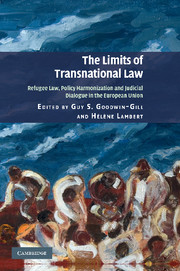
 The Limits of Transnational Law
 Refugee Law, Policy Harmonization and Judicial Dialogue in the European Union
Book contents
- Frontmatter
- Contents
- Notes on contributors and editors
- Acknowledgements
- Abbreviations
- 1 Transnational law, judges and refugees in the European Union
- 2 Where is the reference? On the limited role of transnational dialogue in Belgian refugee law
- 3 Transnational refugee law in the French courts: deliberate or compelled change in judicial attitudes?
- 4 The use of foreign asylum jurisprudence in the German administrative courts
- 5 The solipsistic legal monologue of Italian authorities
- 6 ‘Thou shalt not judge’ … Spanish judicial decision-making in asylum and the role of judges in interpreting the law
- 7 The British judiciary and the search for reciprocal relations with its continental partners
- 8 Speaking across borders: the limits and potential transnational dialogue on refugee law in Ireland
- 9 The absence of foreign law in Danish asylum decisions – quasi-judicial monologue with domestic policy focus?
- 10 Foreign law in Swedish judicial decision-making: playing a limited role in refugee law cases
- 11 The search for the one, true meaning …
- Bibliography
- Index
2 - Where is the reference? On the limited role of transnational dialogue in Belgian refugee law
Published online by Cambridge University Press: 06 July 2010

Book contents
- Frontmatter
- Contents
- Notes on contributors and editors
- Acknowledgements
- Abbreviations
- 1 Transnational law, judges and refugees in the European Union
- 2 Where is the reference? On the limited role of transnational dialogue in Belgian refugee law
- 3 Transnational refugee law in the French courts: deliberate or compelled change in judicial attitudes?
- 4 The use of foreign asylum jurisprudence in the German administrative courts
- 5 The solipsistic legal monologue of Italian authorities
- 6 ‘Thou shalt not judge’ … Spanish judicial decision-making in asylum and the role of judges in interpreting the law
- 7 The British judiciary and the search for reciprocal relations with its continental partners
- 8 Speaking across borders: the limits and potential transnational dialogue on refugee law in Ireland
- 9 The absence of foreign law in Danish asylum decisions – quasi-judicial monologue with domestic policy focus?
- 10 Foreign law in Swedish judicial decision-making: playing a limited role in refugee law cases
- 11 The search for the one, true meaning …
- Bibliography
- Index
Summary
Introduction
Judicial decisions in the Belgian refugee status determination process show a lack of reference to foreign, supranational and international case law. Although judges are applying a refugee definition that originates in an international convention binding upon and applicable in all EU member states (among others), a transnational dialogue between Belgian judges and their counterparts in other countries appears to be missing.
This chapter will first describe the decision-making process in Belgium and its place in the Belgian legal framework. Next the cases and ways in which foreign decisions have played a role in Belgium will be identified. Finally, the possible reasons for this absence of a transnational dialogue will be explored.
The refugee status determination process in Belgium
Migration and asylum law
Migration and asylum law are a part of Belgian public law and are governed by administrative law. The granting of asylum is regulated by the federal Aliens Act. Chapter II of Title II of this Act identifies refugees as one of the special categories of aliens to whom a specific residence procedure and status, differing from the general immigration rules, apply. Whereas in general a right to residence requires prior authorization by the Federal Minister of the Interior (hereafter the minister) or the Federal Immigration Service, asylum claimants automatically obtain residence status upon the recognition of their status as a refugee. With the introduction of subsidiary protection status as of 10 October 2006, the same goes for beneficiaries of that status.
Information
- Type
- Chapter
- Information
- The Limits of Transnational LawRefugee Law, Policy Harmonization and Judicial Dialogue in the European Union, pp. 17 - 34Publisher: Cambridge University PressPrint publication year: 2010
Accessibility standard: Unknown
Why this information is here
This section outlines the accessibility features of this content - including support for screen readers, full keyboard navigation and high-contrast display options. This may not be relevant for you.Accessibility Information
Accessibility compliance for the PDF of this chapter is currently unknown
and may be updated in the future.