


Introduction
Meat from wild vertebrates (often referred to as bushmeat or wild meat) is an important source of protein for rural populations across the tropics (Fa et al., Reference Fa, Juste, Burn and Broad2002; Asprilla-Perea & Díaz-Puente, Reference Asprilla-Perea and Díaz-Puente2019). This continued use has been explained by its accessibility and low cost compared to meat from domesticated animals (Willcox & Nambu, Reference Willcox and Nambu2007; Onadeko et al., Reference Onadeko, Egonmwan and Saliu2011; Kouassi et al., Reference Kouassi, Normand, Kone and Boesch2019). Wild meat is either a source of revenue or is directly consumed by households (Loibooki et al., Reference Loibooki, Hofer, Campbell and East2002; Kouassi et al., Reference Kouassi, Normand, Kone and Boesch2019). Vertebrate taxa used as wild meat include mammals, birds, reptiles and amphibians (Fa et al., Reference Fa, Yuste and Castelo2000, Reference Fa, Seymour, Dupain, Amin, Albrechtsen and Macdonald2006; Gonwouo & Rödel, Reference Gonwouo and Rödel2008; Wright & Priston, Reference Wright and Priston2010; Fominka et al., Reference Fominka, Oliveira, Taboue, Luma, Robinson and Fokam2021). Amphibian consumption occurs in several places in West and Central Africa (Gonwouo & Rödel, Reference Gonwouo and Rödel2008; Mohneke et al., Reference Mohneke, Onadeko and Rödel2009, Reference Mohneke, Onadeko, Hirschfeld and Rödel2010, Reference Mohneke, Rödel and Onadeko2011; Onadeko et al., Reference Onadeko, Egonmwan and Saliu2011; Rödel et al., Reference Rödel, Adum, Aruna, Assemian, Barej, Bell, Heatwole and Rödel2021). Although amphibians play an essential role in ecosystem services (Hocking & Babbitt, Reference Hocking and Babbitt2014), they are threatened by various factors, notably overexploitation (Stuart et al., Reference Stuart, Chanson, Cox, Young, Rodrigues, Fischman and Waller2004). Extensive collection of some highly sought-after species has the potential to contribute to local depletion, threatening population viability (Warkentin et al., Reference Warkentin, Bickford, Moore, Bickford, Sodhi and Bradshaw2009; Mohneke et al., Reference Mohneke, Onadeko, Hirschfeld and Rödel2010). Understanding the factors linked to the collection and consumption of exploited species can help with the development of interventions for reducing negative impacts on populations.
The proportion of threatened species is higher amongst amphibians compared to other groups of terrestrial animals: 24% of amphibian species are threatened globally (c. 2,488 species), compared to 18% of reptiles, 14% of birds and 12% of mammals (IUCN, 2021). Five main factors drive this, often in combination: invasive species, habitat degradation, climate change, infectious diseases and overexploitation. In Central Africa, declines have been mainly observed in mountain species (Hirschfeld et al., Reference Hirschfeld, Blackburn, Doherty-Bone, Gonwouo, Ghose and Rödel2016; Doherty-Bone & Gvoždík, Reference Doherty-Bone and Gvoždík2017; Gvoždík et al., Reference Gvoždík, Nečas, Dolinay, Zimkus, Schmitz and Fokam2020), and the situation for several lowland species remains unclear. The dominant threat to amphibians in West and Central Africa is overexploitation (Stuart et al., Reference Stuart, Chanson, Cox, Young, Rodrigues, Fischman and Waller2004; Gonwouo & Rödel, Reference Gonwouo and Rödel2008; Mohneke et al., Reference Mohneke, Onadeko and Rödel2009, Reference Mohneke, Onadeko, Hirschfeld and Rödel2010). Frogs have been used as food and medicine by Indigenous Peoples across Africa (e.g. Mohneke et al., Reference Mohneke, Onadeko, Hirschfeld and Rödel2010; Onadeko et al., Reference Onadeko, Egonmwan and Saliu2011; Akinyemi & Efenakpo, Reference Akinyemi and Efenakpo2015; Efenakpo et al., Reference Efenakpo, Ayodele and Ijeomah2016). This includes highly sought-after, charismatic and large-bodied species such as the hairy frog Trichobatrachus robustus and night frogs Astylosternus spp. in Cameroon (Gonwouo & Rödel, Reference Gonwouo and Rödel2008). Another iconic exploited species is the Goliath frog Conraua goliath, the largest extant anuran. It is only known from Cameroon and Equatorial Guinea, and is categorized as Endangered on the IUCN Red List because of hunting pressure (Perret, Reference Perret1957; Sabater-Pi, Reference Sabater-Pi1985; IUCN SSC Amphibian Specialist Group, 2019; Gonwouo, Reference Gonwouo, Rödel and Heatwole2021). In Cameroon, this species is categorized as Class A under the national wildlife law, affording it full protection from capture, killing and trade (MINFOF, 2020). Despite this protection, Goliath frogs continue to be hunted, and this is apparent from observations of frogs for sale along major roads, particularly in the Littoral Region of Cameroon (G.C. Tasse Taboue, pers. obs., 2014 to date). Export for international zoos and the pet trade is alleged to occur but has not been quantified (T.M. Doherty-Bone, pers. obs., 2004 to date). There are few quantitative data on the socio-economic factors underlying the collection and use of Goliath frogs across their range, with previous work limited to qualitative descriptions of the consumption of this and other frog species by local people on Mount Manengouba (Gonwouo & Rödel, Reference Gonwouo and Rödel2008). Quantitative data on the socio-economic parameters connected with the hunting of this species are therefore needed to facilitate the development of effective conservation measures.
In this study, we aimed to profile the people involved in the collection and/or consumption of this frog species. We assessed the socio-economic background of the people in communities living alongside Goliath frogs, including those who hunt frogs. This included determining the destination of the frogs hunted and local knowledge of the relevant conservation measures. Additionally, we tracked hunters and their offtake over two hunting seasons.
Study area
We conducted the fieldwork for this study in the Baré Bakem, Nlonako, Manjo, Loum and Njombe-Penja subdivisions of the Littoral Region and in the Nyé’été subdivision of the South Region of Cameroon (Fig. 1). These are predominantly rural areas but with increasing urbanization. Major ethnic groups in these areas include the Sawa, Bassa and Bakoko in the Littoral Region and Fang-Beti in the South Region. Most people in these regions rely on agriculture, small trade and tourism for their livelihoods. The coastal areas receive the greatest amount of rain, up to 3,850 mm annually (Nkiaka & Lovett, Reference Nkiaka and Lovett2019). Biomes comprise a mosaic of humid tropical forests and Atlantic mangrove forests, with the landscape dominated by concessions of agricultural lands used for commercial crops such as banana, palm and rubber. Topography is low lying, especially at the coast, and becomes more varied inland. Elevation across the study sites is 0–451 m. River basins include those of the Kienke, La Lobe, Tyangue, Nyong, Lokoundje, Niete and Sanaga. Protected areas include Campo'o Ma'an National Park, Lake Ossa and Douala-Edéa Wildlife Reserves and the proposed Ebo National Park.
Location of the six administrative subdivisions in Cameroon in which we examined local perceptions and the hunting of the Goliath frog Conraua goliath.

Methods
To investigate local perceptions regarding the Goliath frog, we used a questionnaire survey in Nlonako, Baré Bakem, Loum and Manjo subdivisions. To assess the hunting pressure on Goliath frogs, we recruited seven collaborative hunters in Njombe-Penja, Manjo, Nlonako and Loum subdivisions and monitored them over 2 years, and we observed practices associated with Goliath frog hunting in the Nyé’été subdivision in the South Region. To evaluate the trade and export of the Goliath frog, we consulted the archive of the Cameroonian Ministry of Forestry and Wildlife and the CITES database for records of documented exports of this species.
Questionnaire survey
We conducted structured interviews, with a questionnaire (Supplementary Material 1), with members of the local population, including those who consume wild meat or practice hunting on a temporary or permanent basis. We did not focus specifically on any particular category of person because each villager was a potential Goliath frog hunter and/or consumer. All interviewees were at least 18 years old. We mostly used closed-ended questions in the interviews, in which the respondent had to choose amongst alternative answers. The interviews were mostly in French but, if required, the interview was either in the local language, with the help of an interpreter, or in Pidgin (a dialect of English widely spoken in Cameroon). We designed the questions to provide insights into the socio-demographic profiles of the interviewees and their current knowledge about the Goliath frog, its legal status, any exploitation, trade or export, and the hunting yield and season.
We contacted people via community representatives, and during introductory meetings we invited people to share their perspectives in their own words. We administered 223 questionnaires in 2017, as follows: 20 in Ebone and 13 in Ekomtoloh (Nlonako subdivision), 22 in Ekom and 25 in Soundop (Baré Bakem), two in Loum, 29 in Mabombè and 26 in True-water (Loum), and 44 in Manengoteng, six in Manjo, 11 in Mantem and 25 in Nkongnini (Manjo). To preserve the independence of the data, we interviewed each respondent separately. We presented the respondents with pictures of Goliath frogs and other species known to be consumed in the region such as T. robustus and the Cameroon slippery frog Conraua robusta (Gonwouo & Rödel, Reference Gonwouo and Rödel2008). Questionnaires were anonymized to maintain confidentially. Access to villages was approved by the village chiefs after the presentation of appropriate research permits.
Monitoring of hunters
To examine the number of Goliath frogs harvested, we recruited seven collaborative hunters, in Njombe-Penja, Manjo, Nlonako and Loum, and monitored them during 2017–2018. We recruited the hunters on an ad hoc basis after introductions to the communities via their chiefs, using no specific criteria other than that they were known to hunt Goliath frogs. We visited the hunters once per month during January‒April (the hunting season is November–April) and recorded their catches, both from their recall and from direct observation when we accompanied them on hunting trips.
Trade and export of Goliath frogs
We questioned the seven Goliath frog hunters concerning the fate of their catches (i.e. whether they were consumed locally or sold/exported). We systematically searched the archives of the Cameroonian Ministry of Forestry and Wildlife in Yaoundé for details of any export licenses granted for Goliath frogs. These archives consisted of relevant legal documents produced by the Ministry, with dates, serial numbers and titles assigned to documents during 2008–2017. We verified the reliability of these records by checking them with representatives of the Division of Forest and Protected Areas of the Ministry of Forestry and Wildlife. We also examined the CITES (2022) database to investigate any export of Goliath frogs from Cameroon up to 2021.
Data processing and analysis
The analysis consisted of a descriptive analysis of the socio-demographic profile of the respondents, the knowledge of hunters regarding Goliath frogs and their marketing and export, and the knowledge of the respondents regarding the Goliath and other frogs. We used the Kruskal–Wallis non-parametric test to compare hunting pressure by site and across months, the Mann–Whitney U test to compare hunting pressure by Goliath frog sex, and Cohen's D test to assess the effect size of the difference between the numbers of males versus females captured on each hunting trip. We performed these analyses in R 4.1.1 (R Core Team, 2021).
Results
Characteristics of people living alongside Goliath frogs, and Indigenous knowledge
Of the 223 respondents, 60% were aged 20–40 years, with the majority being male (87%; Table 1). Respondents belonged to 11 ethnic groups, were mainly farmers (67%), and 60% had at least secondary school education (Table 1).
Summary of the socio-demographic profile of the 223 respondents interviewed regarding the Goliath frog Conraua goliath in four administrative divisions of the Littoral Region of Cameroon (Fig. 1).

Most respondents (99%) were familiar with Goliath frogs when provided with images of various species of frogs. Ninety-nine per cent claimed to have previously seen one either alive or dead and 97% reported having seen one alive either in a river or at a market. These encounters with live Goliath frogs occurred by large rivers either during the day (21%), at night (54%) or during both periods (25%). There was a statistical association between the administrative subdivision and when Goliath frogs are observed (χ 2 = 37.5, P < 0.001). When asked about the last time they had observed a Goliath frog, 44% said this was < 2 months previously and 124 (56%) that this was > 2 months previously. There was a significant association between the last time a Goliath frog was observed and the administrative division of the respondent (χ 2 = 23.84, P = 0.038), with the highest number of reported sightings in the previous 2 months in Loum (33), followed by Nlonako (24), Manjo (23) and Baré-Bakem (16; Table 2).
Responses to three questions about Goliath frogs, in four administrative divisions in the Littoral Region of Cameroon.

*Some respondents who said that they knew about Goliath frogs did not answer these questions.
When we asked respondents about the presence of Goliath frogs during the year, 81% said they were most frequently seen during the dry season, 7% that they were seen during the rainy season and 12% that they were seen during both seasons. Most respondents (82%) correctly differentiated the Goliath frog from other frog species, although 18% misidentified it as C. robusta. Knowledge of Goliath frogs and how often they were sighted did not vary between study sites (χ 2 = 6.9756, P = 0.7277). Six local names for Goliath frogs were used by respondents across the subdivisions surveyed: bima, mainly in Nlonako (10 respondents), ebeme in Baré-Bakem (46), ebima in Loum (3) and Nlonako (32), essela in Nlonako (8), makongo in Nlonako (2) and mukongo in Loum (52).
Traditional rites associated with the hunting of Goliath frogs were observed in the Bagyeli community in Nyé’été, South Region, on 26 November 2020. This community believe the Goliath frog is a gift from the gods and hunting it is reserved only for initiated adults. Hunting is exclusively practiced by men in a group of at least three, with groups often comprising 5–7 men. Spears were most frequently used for Goliath frog hunting in this community, with the frogs hunted mainly for domestic consumption. A catch is celebrated loudly by the hunters with songs and the playing of instruments made from tree trunks and sticks. The end of a hunt is marked by a cleansing ceremony involving hunters washing their faces and arms with macerated herbs from a common pot (Plate 1). This is later followed by a ritual in which an elder gently strokes the bodies of the hunters with a branch to exorcise potential bad luck and create new favour within the community. We did not encounter such rituals in the Littoral Region.
Author BCNS taking part in a cleansing rite performed after a Goliath frog Conraua goliath hunt. Photo: the authors.

The majority of respondents (67%, of which only three were hunters) were aware that hunting of the Goliath frog was forbidden by the authorities (Table 3). In total, 80% of respondents were aware that the authorities patrolled the area to prevent the hunting of Goliath frogs. There was a significant association between the administrative divisions and knowledge of the legal status of the Goliath frog (χ 2 = 50.68, P < 0.01) as well as knowledge of the presence of an authority in charge of implementing the law (χ 2 = 31.473, P < 0.01).
Responses to two questions regarding the legal status of Goliath frogs, in four administrative divisions in the Littoral Region of Cameroon.

Goliath frog harvesting practices
Four of the recruited hunters stated they undertook hunting trips 1–5 times per month, whereas three undertook ≥ 10 trips per month. The hunters noted that they avoid hunting during a full moon as their torches are more useful in total darkness, so they can dazzle their potential catch.
Distance travelled per hunt was < 5 km for four of the hunters, whereas the other three claimed to move farther per night to look for the frogs. Five of the hunters claimed they could catch 1–5 Goliath frogs per trip, whereas the other two claimed they could catch > 10 frogs per trip. This resulted in a total estimated harvest of 30 or more frogs per hunter per month. All participants indicated they sought the largest frogs. Hunting was mostly for local consumption and secondly as a source of income. The most commonly used equipment for frog hunting was fishing nets, with four of the hunters reporting their use (Plates 2 & 3); spears and machetes were used by two of the hunters and one used a gun. In Nyé’été, hunters often worked in groups of 3–4, to increase their hunting success. Skills used in frog hunting were reported to be taught by parents to their children.
Author GCTT showing a net used by hunters to collect Goliath frogs. Photo: the authors.

Adult Goliath frog. Photo: the authors.

Hunters considered conditions for hunting Goliath frogs more favourable when river levels are at their lowest (i.e. November–April), although incidental collection occurred throughout the year. During our surveys between February and April, the seven hunters captured a total of 192 Goliath frogs, with the highest number of captures being in March (mean 14.5 ± SD 12.6 per month), 7.5 ± SD 7.2 frogs caught in February and 7.5 ± SD 7.7 caught in April. However, the reported number of Goliath frogs hunted did not differ significantly between months (F = 1.212, P = 0.3). Of the frogs collected by hunters and examined by the authors, the majority were female (mean 13.3 ± SD 10.9 per hunter). There was a large effect size (Cohen's D statistic 0.79, adjusted for sample size) but this was not statistically significant (Kruskal–Wallis χ 2 = 2.5782, P = 0.1). We recorded the highest number of frogs captured in Loum, at 105 (17.5 ± SD 11.5 per hunter), and the lowest number of captures in Manjo, with only two caught there during the study (Fig. 2). However, there were no significant differences in capture rates amongst the sites (Kruskal–Wallis χ 2 = 7.3345, P = 0.06).
The number of Goliath frogs collected by the seven hunters monitored during January‒April in four administrative divisions in the Littoral Region of Cameroon (one hunter in Manjo, and two hunters in each of Njombe-Penja, Loum and Nlonako). The boxplots indicate the median with the lower and upper quartiles, the whiskers are based on 1.5 times the interquartile range and the single dot represents an outlier.

Trade and export of Goliath frogs
When asked whether Goliath frogs were exported or sold locally, 71% of interviewees said they were consumed locally, and 29% said they were exported. Export was said to be mainly to Europe, Asia and the USA. In such cases, respondents mentioned prices of at least XAF 5,000 (USD 10) were offered per individual regardless of the age and sex of the specimen, with larger and/or heavier specimens being more valuable. Price also depended on the time of year, with higher prices during the rainy season, when a single specimen could be worth at least XAF 20,000 (USD 40). It was widely claimed that demand for the export of Goliath frogs was greatest around November. Pricing was claimed to take the state of the specimen into consideration, with the highest prices charged for live animals in good physical condition. Catches were sold at roadsides for XAF 1,500–5,000 (USD 3–10) for specimens of c. 1 kg, often at thoroughfares for travellers such as tollgates and major crossroads (Tables 4 & 5). These animals were said to be eaten by those buying them or sold on either directly or indirectly to restaurants.
Responses to two questions regarding Goliath frog commerce in four administrative divisions in the Littoral Region of Cameroon.

CITES data on the export of Goliath frogs from Cameroon up to 2021.
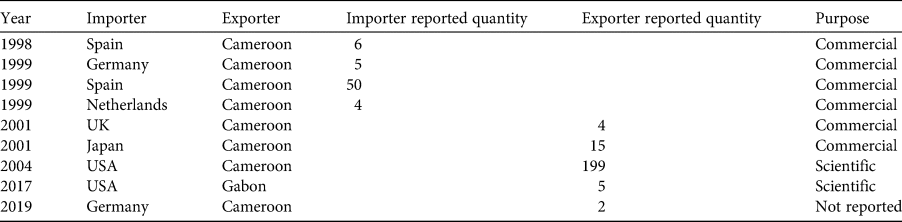
Our assessment of the archives of the Ministry of Forestry and Wildlife revealed no evidence that Goliath frogs had been exported during 2008–2017, whereas the CITES database showed that during 1998–2019 at least 220 individuals were exported from Cameroon and five from Gabon (note, however, that C. goliath has not been recorded in Gabon) to six countries across Europe, America and Asia.
Discussion
This study presents an overview of perceptions and knowledge of Goliath frogs by people living alongside them across their Cameroonian range. The 223 respondents represented major stakeholders including hunters and potential end-consumers. We found that the Goliath frog is a well-known species locally and its consumption is common, as observed elsewhere in its range (Gonwouo & Rödel, Reference Gonwouo and Rödel2008). Consumption was predominately local, although some Goliath frogs are exported to regional urban and international markets. However, we did not find evidence of such activities in government records.
We observed cleansing rites after hunting Goliath frogs in one community in the Nyé’été subdivision. To our knowledge this is the first time such practices have been reported in this region. Previously reported beliefs associated with frogs have related to the curing of ailments such as infertility or of bad luck (Gonwouo & Rödel, Reference Gonwouo and Rödel2008).
The consumption of Goliath frogs seemed to be common amongst the people interviewed, and the majority of the frog meat obtained from hunters was placed with a reseller known locally as byam-sellam in Pidgin. Frog collection and consumption are widely practiced in West Africa (Mohneke et al., Reference Mohneke, Onadeko and Rödel2009, Reference Mohneke, Onadeko, Hirschfeld and Rödel2010, Reference Mohneke, Rödel and Onadeko2011; Akinyemi & Efenakpo, Reference Akinyemi and Efenakpo2015). As with the Goliath frog hunters we interviewed, collection of frogs in other regions seems to be practiced mainly during the dry season when water levels are low in streams and rivers, concentrating frogs such as the crowned bullfrog Hoplobatrachus occipitalis in the few remaining water bodies (Spieler & Linsenmair, Reference Spieler and Linsenmair1997). April coincides with the return of rain in south Cameroon, which increases the number of rivers that can harbour Goliath frogs. This also makes it difficult for hunters to detect and pursue frogs, potentially explaining the observed reduction in frog collection during April. The detectability of Goliath frogs was reported by hunters to be greater during the dry season, creating the perception that Goliath frogs are more abundant in the dry than in the rainy season (Perret, Reference Perret1957). During the rainy season Goliath frogs are more difficult to observe amidst rapids and the flooded vegetation along riverbanks (Gonwouo et al., Reference Gonwouo, Schäfer, Tsekané, Hirschfeld, Tchassem and Rödel2022). The dry season also corresponds to the breeding period of Goliath frogs (Sabater-Pi, Reference Sabater-Pi1985; Schäfer et al., Reference Schäfer, Tsekané, Tchassem, Drakulić, Kameni, Gonwouo and Rödel2019). Conraua goliath exhibits parental care, with adults building nests for their progeny and guarding them during the incubation period (Schäfer et al., Reference Schäfer, Tsekané, Tchassem, Drakulić, Kameni, Gonwouo and Rödel2019). A parent guarding their nest could be at increased risk of being spotted, and this is exploited by hunters to increase catch success.
Although we took precautions to minimize bias, the higher number of male compared to female respondents could limit the representativeness of the perceptions we documented. There may also have been limits to the truthfulness of the responses obtained, as the hunting of Goliath frogs is widely known to be prohibited. Longer-term work within these communities would enable us to build trust, increasing the likelihood of community members sharing accurate information.
The capture rate of Goliath frogs varied across the sites we assessed. The factors driving this variation could be linked to habitat quality, past hunting effort and/or proximity to road networks. Proximity to highways leading to large urban centres, such as Douala, facilitates the selling of frogs at the roadside and at markets. This could produce a financial incentive to hunt Goliath frogs for purposes other than household or local consumption, leading to greater offtake. In Nyé’été in the South Region, poor access to roads resulted in hunters consuming and sharing most of their catch rather than selling it. Catches were biased towards female rather than male frogs. Female Goliath frogs are larger, easier to observe and offer a higher yield of meat, providing a greater return on effort expended. Although there was a difference in the number of female and male frogs collected, this was not statistically significant, but the effect size showed this could have an effect on the population. Further work will need to accompany a greater number of hunters and investigate the sex and sizes of frogs for sale. Frog hunting is a skilled activity, as noted in previous studies of this species (Gonwouo & Rödel, Reference Gonwouo and Rödel2008) and of other taxa (Mohneke et al., Reference Mohneke, Onadeko and Rödel2009, Reference Mohneke, Onadeko, Hirschfeld and Rödel2010). Hunters focus on specific indicators to track frogs, notably the presence of nests, eggs or frogs leaping into water.
Hunting of Goliath frogs is conducted for both consumption and the generation of household income. For trade, live specimens are preferred as they sell for higher prices than dead specimens, which may be decomposing at the point of sale. This makes the use of nets more common than lethal hunting tools such as spears, guns or machetes, as has also been observed previously (Gonwouo & Rödel, Reference Gonwouo and Rödel2008; Schäfer et al., Reference Schäfer, Tsekané, Tchassem, Drakulić, Kameni, Gonwouo and Rödel2019; Gonwouo, Reference Gonwouo, Rödel and Heatwole2021). Hunters confirmed that they target adult Goliath frogs and avoid harvesting juveniles. This is important, as the collection of juveniles has the potential to reduce recruitment.
Although the Goliath frog is legally protected against collection, hunting and consumption in Cameroon (MINFOF, 2020; Gonwouo, Reference Gonwouo, Rödel and Heatwole2021), collection and consumption remain common. This activity provides a source of protein, and access to protein in these communities appears to be dominated by wild meat obtained through hunting. This is the case for several ethnic groups in Central Africa that are believed to rely on wild meat (Wilkie et al., Reference Wilkie, Wieland, Boulet, Le Bel, van Vliet and Cornelis2016), and suggests that conservation of the Goliath frog should consider community reliance on the hunting of this species. Further studies could compare communities' reliance on this species for nutritional well-being in relation to other species hunted for wild meat and livestock production (Gonwouo, Reference Gonwouo, Rödel and Heatwole2021). This would facilitate direct interventions such as the provision of financial incentives and alternative protein sources to communities within the Goliath frog's range. The extent to which communities are attached to their traditions should also be considered and incorporated into any conservation projects.
The Cameroonian authorities have not documented the trade of Goliath frogs. This could be because the trade is probably conducted covertly to avoid legal reprisal, and because Goliath frogs are often exported dead and processed (smoked, air-dried or salted) and mainly as pieces rather than whole specimens, to reduce risk of discovery. It is also possible that the main customers ordering Goliath frogs are those with existing export arrangements, making inspection in transit difficult. The CITES records show Goliath frog exports from Gabon and Cameroon, however, the records from Gabon are probably misidentifications, as Goliath frogs are so far only known to occur in Cameroon and Equatorial Guinea (IUCN SSC Amphibian Specialist Group, 2019).
Globally, amphibian species are subject to both local and regional trade (Mohneke et al., Reference Mohneke, Onadeko, Hirschfeld and Rödel2010; Tapley et al., Reference Tapley, Griffiths and Bride2011; Herrel & van der Meijden, Reference Herrel and van der Meijden2014; Efenakpo et al., Reference Efenakpo, Ayodele and Ijeomah2016). This trade of wild amphibians is often unsustainable because it reduces local populations, compromises animal welfare, spreads diseases/invasive species and poses potential threats to human health (Arena et al., Reference Arena, Steedman and Warwick2012; Pienaar et al., Reference Pienaar, Episcopio-Sturgeon and Steele2022). In West Africa, the high volume of frogs destined for sale has led to concerns regarding the sustainability of such collection (Mohneke et al., Reference Mohneke, Onadeko, Hirschfeld and Rödel2010). Because large, usually female specimens of Goliath frogs are targeted by hunters, extensive collection could cause local population collapses through the removal of fecund individuals. This could also lead to selection pressure for smaller individuals and disrupt breeding. The limited geographical distribution of Goliath frogs means such large offtakes are probably unsustainable.
In summary, our findings indicate that Goliath frogs in Cameroon are subject to substantial hunting pressure, as has previously been hypothesized (Schäfer et al., Reference Schäfer, Tsekané, Tchassem, Drakulić, Kameni, Gonwouo and Rödel2019), and that this species is well known to people living alongside it. Research is required to determine the effects of this hunting on the species’ population dynamics. Hunting of this species has probably been practiced for centuries, and the practice is passed from parents to children. It is mostly practiced using nets and spears, although the use of guns by some is problematic as this could increase hunting efficiency. The greatest hunting pressure appeared to be near routes to trading centres. Export of Goliath frogs was not reported by the national authorities but was detected at the international level. There is a need for Cameroon to document such wildlife trade, as the data is required for assessing the effects of trade on local populations. Although our study provides only preliminary quantitative data, our findings indicate that appropriate conservation strategies for the Goliath frog will be dependent on understanding the nutritional and economic importance of this species.
Acknowledgements
We thank the local populations and authorities and Simon A. Tamungang, Seino Richard Akwanjoh and Biodiversity Conservation for Life for their assistance during fieldwork. The Rufford Foundation provided financial assistance and Idea Wild provided field equipment to GCTT.
Author contributions
Study design: GCTT, BCNS, NLG, TMD-B; fieldwork: GCTT, BCNS, UBKT, AMTF; data analysis: GCTT, BCNS; writing: GCTT, BCNS, JRN, NLG, EBF, TMD-B.
Conflicts of interest
None.
Ethical standards
This study abided by the ethical guidelines of the British Sociological Association and of Oryx. Participation in the interviews was voluntary, and respondents provided signed informed consent (Supplementary Material 1). We did not incentivize the hunting or consumption of Goliath frogs and made this clear to all respondents and hunters. The Cameroon Ministry of Scientific Research and Innovation and the Ministry of Forestry and Wildlife, respectively, authorized this work through research permit No000054/MINRESI/B00/C00/C10/C12 and granted access to their archives through letter No2275/L/MINFOF/SETET/SG/DFAP/SDVEF/SC/BJ.


 Open access

