


Introduction
The Atlantic Forest is a biodiversity hotspot supporting more than 5,000 tree species, of which 45% are endemic (Lima et al., Reference Lima, Souza and de Siqueira2020b). This biogeographical domain once stretched for 1.5 million km along the Brazilian coast but is now reduced to one-third of its original cover and is divided into small, isolated and heavily disturbed patches (Rosa et al., Reference Rosa, Brancalion, Crouzeilles, Tambosi, Piffer and Lenti2021). Most of the remaining Atlantic Forest is secondary forest (Ribeiro et al., Reference Ribeiro, Metzger, Martensen, Ponzoni and Hirota2009), and only 20% is protected (Presidency of the Republic of Brazil, 2000). Given its vulnerability, it is important to restore the fragmented landscape of the Atlantic Forest (Ribeiro et al., Reference Ribeiro, Metzger, Martensen, Ponzoni and Hirota2009) and conserve its biodiversity (Rodrigues et al., Reference Rodrigues, Pilgrim, Lamoreux, Hoffmann and Brooks2006).
The IUCN publishes standardized guidelines for conservation assessments that allow species to be classified according to their risk of extinction and offer relevant information for decision-makers and conservation practitioners (IUCN, 2022). Most Atlantic Forest tree species have not been assessed in the past because a paucity of data has restricted the application of IUCN criteria (Martins et al., Reference Martins, Loyola and Martinelli2017). The first comprehensive assessment of all arborescent Atlantic Forest species indicated that 66% of populations and 84% of endemic tree species are threatened (Lima et al., Reference Lima, Dauby, Gasper, Fernandez, Vibrans and Oliveira2024).
Whilst global conservation assessments are based on the known distribution of specific taxa worldwide, the scale of human impacts on biodiversity (e.g. land-use change) is primarily regional (Pimm et al., Reference Pimm, Ayres, Balmford, Branch, Brandon and Brooks2001). Furthermore, most support for species protection is provided at an institutional, regional or national level. These factors underline the importance of regional conservation assessments and local Red Lists. The current list of threatened tree species for Santa Catarina state, southern Brazil (CONSEMA, 2014), was not based on the IUCN criteria and categories (Elias et al., Reference Elias, Lima and Santos2019) and needs updating. More recent data are available from the FlorestaSC project (Vibrans et al., Reference Vibrans, Sevgnani, Lingner, de Gasper and Sabbagh2010, Reference Vibrans, de Gasper, Moser, Oliveira, Lingner and Sevegnani2020) and other forest surveys (Lima et al., Reference Lima, Mori, Pitta, Melito, Bello and Magnago2015). In addition, the herbaria collections of Santa Catarina have been digitized and integrated into the Global Biodiversity Information Facility database (Gasper et al., Reference Gasper, Stehmann, Roque, Bigio, Sartori and Grittz2020), including data from surveys conducted since the 1950s (Reitz, Reference Reitz1965).
Here we compile a comprehensive dataset of all forest survey and herbaria data for Santa Catarina state, comprising over 200,000 measured trees and 12,000 cleaned herbaria records. We use these data to assess the conservation status and update the Red List of tree species using IUCN guidelines. We also evaluate the advantages of using taxonomically verified herbaria data in species assessments. We followed the current literature on conservation status (Stévart et al., Reference Stévart, Dauby, Lowry, Blach-Overgaard, Droissart and Harris2019; Lima et al., Reference Lima, Dauby, Gasper, Fernandez, Vibrans and Oliveira2024) by quantifying extinction risk using multiple IUCN criteria (IUCN, 2012): the decline in a species’ population size (IUCN criterion A) across a time series of forest cover; the species’ geographical range (criterion B); and small and declining populations (criteria C and D).
Study area
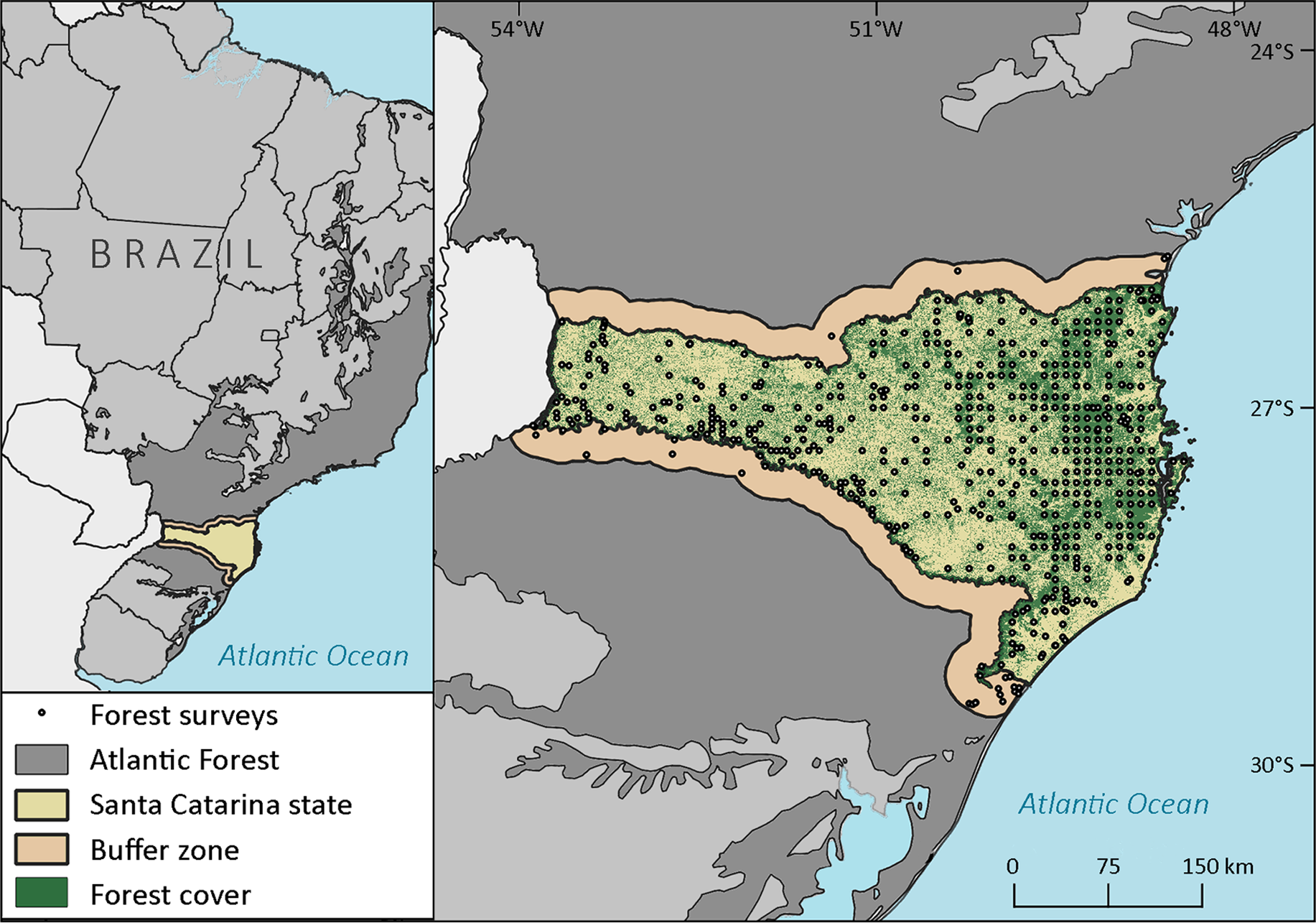
The state of Santa Catarina, southern Brazil, encompasses an area of 95,356 km2, located at 26°–29°S and 48–53°W, with altitudes of 0–1,753 m (Fig. 1). The vegetation types are tropical and subtropical moist broadleaf forests (Alto Paraná forests, Araucaria moist forests and Serra do Mar coastal forests) and mangroves (Restingas; Dinerstein et al., Reference Dinerstein, Olson, Joshi, Vynne, Burgess and Wikramanayake2017). The state has two climate types, classified as humid subtropical with hot summer (Cfa) and humid subtropical with temperate summer (Cfb) under the Köppen system (Alvares et al., Reference Alvares, Stape, Sentelhas, de Moraes Gonçalves and Sparovek2013). Mean annual temperature is 10–22 °C and precipitation is 1,100–2,900 mm (Pandolfo et al., Reference Pandolfo, Braga, da Silva Júnior, Massignan, Pereira and Thomé2002). The tree flora of Santa Catarina state is threatened by human impacts, including illegal selective logging, clear-cutting, fire, understorey mowing, and understorey cattle grazing and trampling (Vibrans et al., Reference Vibrans, de Gasper, Moser, Oliveira, Lingner and Sevegnani2020).
Distribution of forest cover in Santa Catarina state, southern Brazil, and locations of forest surveys in the state and in a 25 km buffer zone along its borders with neighbouring Brazilian states. (Readers of the printed journal are referred to the online article for a colour version of this figure.)

Methods
Trees of Santa Catarina
The definition of a tree varies but often stipulates a free-standing trunk that reaches minimum values of height and/or diameter at breast height. We compiled a list of qualifying tree species based on records of all plants that occur in Santa Catarina taken from the Global Biodiversity Information Facility, cross-referenced with Flora e Funga do Brasil (The Brazil Flora Group et al., Reference Gomes-da-Silva, Filardi, Barbosa, Baumgratz and Bicudo2022) to check for any taxonomical modifications and to establish the growth form for each species. We limited our selection to those species that could occur as a tree, excluding those that only occurred as a shrub in the study area. We checked the preliminary list of 972 tree species and removed any that were erroneously assigned to Santa Catarina by Flora e Funga do Brasil, those that did not occur as a tree in Santa Catarina (Vibrans et al., Reference Vibrans, de Gasper, Moser, Oliveira, Lingner and Sevegnani2020) and species with dubious identification. The final list comprised 577 tree species for Santa Catarina state.
Forest surveys
We obtained forest survey data for Santa Catarina state, and a 25 km buffer along its boundaries with the neighbouring states of Paraná and Rio Grande do Sul (Fig. 1), from the Neotropical Tree Communities database of information for neotropical domains in eastern South America (TreeCo; Lima et al., Reference Lima, Oliveira, Pitta, de Gasper, Vibrans and Chave2020a). We obtained further data from Lima et al. (Reference Lima, Oliveira, Pitta, de Gasper, Vibrans and Chave2020a) including species abundance records, growth form (shrubs, treelets and trees), ecological group (pioneer, early secondary, late secondary and climax), generation length (IUCN, 2022) and mean proportion of mature individuals in the population known to be capable of reproduction (sensu IUCN, 2022). We used Flora e Funga do Brasil (The Brazil Flora Group et al., Reference Gomes-da-Silva, Filardi, Barbosa, Baumgratz and Bicudo2022) to check the species nomenclature in the dataset and to remove cultivated, naturalized and exotic species. The resultant dataset comprised 265 ha of sampled forests, 544 plots, 502 species and 206,207 individually measured trees.
Herbaria data
We applied the workflow and software described by Lima et al. (Reference Lima, Sánchez-Tapia and Mortara2023) to obtain and clean herbaria data. We obtained data from the Global Biodiversity Information Facility (2021) and speciesLink (Canhos et al., Reference Canhos, Almeida, Assad, Cunha Bustamante, Canhos and Chapman2022), then standardized, edited and validated the herbaria collection codes, locality, geographical coordinates and taxon names. We conducted multiple validation steps to ensure data quality, flagging the following issues: outlier occurrences, coordinates not matching the assigned country/state, occurrences in the sea, duplicate records, and erroneous or unreliable species identification. We then removed these invalid records, resulting in a final herbaria dataset comprising 12,318 records of 555 tree species.
Forest cover
We divided the state of Santa Catarina into 5,738 grid cells measuring 5 × 5 km and removed those situated in highland grasslands to avoid overestimating habitat availability for tree species. We overlapped the final grid of 4,359 cells with land-cover maps at 30 m spatial resolution from MapBiomas (Souza et al., Reference Souza, Shimbo, Rosa, Parente, Alencar and Rudorff2020), a highly detailed reconstruction of land-use change in Brazil. We extracted pixels defined by MapBiomas as ‘Forest Formation’ (areas > 0.5 ha with trees reaching a minimum height of 5 m and with the tree canopy varying for different types of forest formation) from each grid cell, summed the number of those pixels and multiplied this value by their area. We divided this product by 10,000 m2 to obtain the forested area in hectares in each grid cell and calculated the area of forest across Santa Catarina state. We repeated this procedure for the years 1985–2019 from the MapBiomas time series.
Mapping tree density
To estimate the population sizes and reductions in numbers of Santa Catarina tree species, we predicted tree density distribution across the state using a regression model informed by the forest survey data. We used 10 variables: monthly minimum temperature, annual mean temperature, temperature seasonality, precipitation, relative humidity (WorldClim, 2022), mean solar radiation, annual potential radiation (McCune & Keon, Reference McCune and Keon2002), declivity (Farr et al., Reference Farr, Rosen, Caro, Crippen, Duren and Hensley2007), an environmental stress factor (Chave et al., Reference Chave, Réjou-Méchain, Búrquez, Chidumayo, Colgan and Delitti2014) and the Human Influence Index (Venter et al., Reference Venter, Sanderson, Magrach, Allan, Beher and Jones2016). We generated 210 models from these variables and selected the best one (best subset selection) using the Bayesian information criterion (Gareth et al., Reference Gareth, Witten, Hastie and Tibshirani2014). We then used the chosen model, which included monthly minimum temperature and temperature seasonality, to predict tree density per ha for each grid cell via universal kriging (Supplementary Material 1, Supplementary Fig. 1, Step 1). We repeated the procedure for the lower and upper values of the 95% CI to account for uncertainty in the estimation.
Species populations and population sizes
We converted the abundance of each species into relative abundance RA i for each forest survey as follows:
 $$R{A_i} = {n_i}/N$$
where n i is the number of individuals of different tree species i, and N is the total number of trees in the survey. Following Steege et al. (Reference Steege, Pitman, Killeen, Laurance, Peres and Guevara2015), we constructed an inverse distance weighting model to predict RA i per species in each grid cell. Next, to estimate the number of individuals per species in each grid cell, we multiplied the predicted relative abundance RA i by tree density (tress per ha, calculated previously) and the grid cell area (25 km2 or 2,500 ha; Supplementary Material 1, Supplementary Fig. 1, Step 2). We then corrected these estimates by overlaying them with forest-cover maps from the MapBiomas time series (1985–2019) and summing the results for all cells (Supplementary Material 1, Supplementary Fig. 1, Step 3). The estimated population size of each tree species accounts for changes in forest cover across time and spatial variation of forest tree density linked to environmental factors.
The IUCN (2022) defines a population as the total number of individuals of a taxon throughout its distribution, including mature and other life stages. However, population size is measured only in terms of the proportion of mature individuals, p. Thus, population size sensu IUCN (2022) only accounts for a fraction of the population, and we calculated it as the product of the species population multiplied by p, the latter obtained from Lima et al. (Reference Lima, Dauby, Gasper, Fernandez, Vibrans and Oliveira2024) and estimated from assumptions regarding the growth form of species, their ecological group and previous studies that assessed p for some tropical trees.
Red List criteria and categories
We assessed the conservation status of each tree species using multiple criteria, based on IUCN guidelines (IUCN, 2022). As in Stévart et al. (Reference Stévart, Dauby, Lowry, Blach-Overgaard, Droissart and Harris2019) and Lima et al. (Reference Lima, Dauby, Gasper, Fernandez, Vibrans and Oliveira2024), our assessment is preliminary as it does not include the revision and justification steps of species-by-species evaluations. However, these assessments provide all of the metrics and analyses necessary for producing final assessments in future evaluations. We based our assessments on the criteria (A) population reduction, (B) geographic range, (C) small and declining populations and (D) very small or restricted populations (IUCN, 2012).
We did not quantify extreme fluctuations in population sizes (criteria B1c, B2c, C2b) because trees are long-lived organisms unlikely to undergo variations in population sizes or distributions ‘widely, rapidly and frequently’ (IUCN, 2022; Lima et al., Reference Lima, Dauby, Gasper, Fernandez, Vibrans and Oliveira2024; Supplementary Material 1). We adapted all criteria evaluations from the workflow established by Lima et al. (Reference Lima, Dauby, Gasper, Fernandez, Vibrans and Oliveira2024); data, scripts and functions are available on GitHub (Lima & Dauby, Reference Lima and Dauby2024). We assessed species only under the following IUCN Red List categories: Least Concern, Near Threatened, Vulnerable, Endangered, Critically Endangered and Data Deficient. If there was sufficient information for a taxon to be assessed under two or more IUCN criteria, and if the assigned threat category varied depending on the criteria used, we assigned the higher category of threat overall (IUCN, 2022). We set 2019 as the assessment year for all species because it was the most recent year with available forest cover data from MapBiomas.
The effects of different criteria on species evaluation
Different criteria can impact species assessments in different ways, so we evaluated the results of our analyses using two datasets: one containing only forest survey data and a second containing forest survey data plus herbaria records. We measured differences in criteria, categories and the Red List Index (Butchart et al., Reference Butchart, Akçakaya, Chanson, Baillie, Collen and Quader2007) between both datasets (forest survey only, and forest survey plus herbaria). The Red List Index can be used to measure changes in categories over time, between regions or between different sets of species. It is calculated as the proportion of species expected to remain extant in the near future in the absence of additional conservation actions (Butchart et al., Reference Butchart, Akçakaya, Chanson, Baillie, Collen and Quader2007). The Index ranges from 0 to 1, where 1 equates to all species classified as Least Concern and 0 equates to all species classified as Extinct.
Regional and local assessments
As a final step, we conducted a species-by-species comparison of threat categories between our local assessments and those from the regional assessments by Lima et al. (Reference Lima, Dauby, Gasper, Fernandez, Vibrans and Oliveira2024), looking for any differences and/or similarities. To do this, we created a chord diagram (Supplementary Fig. 2).
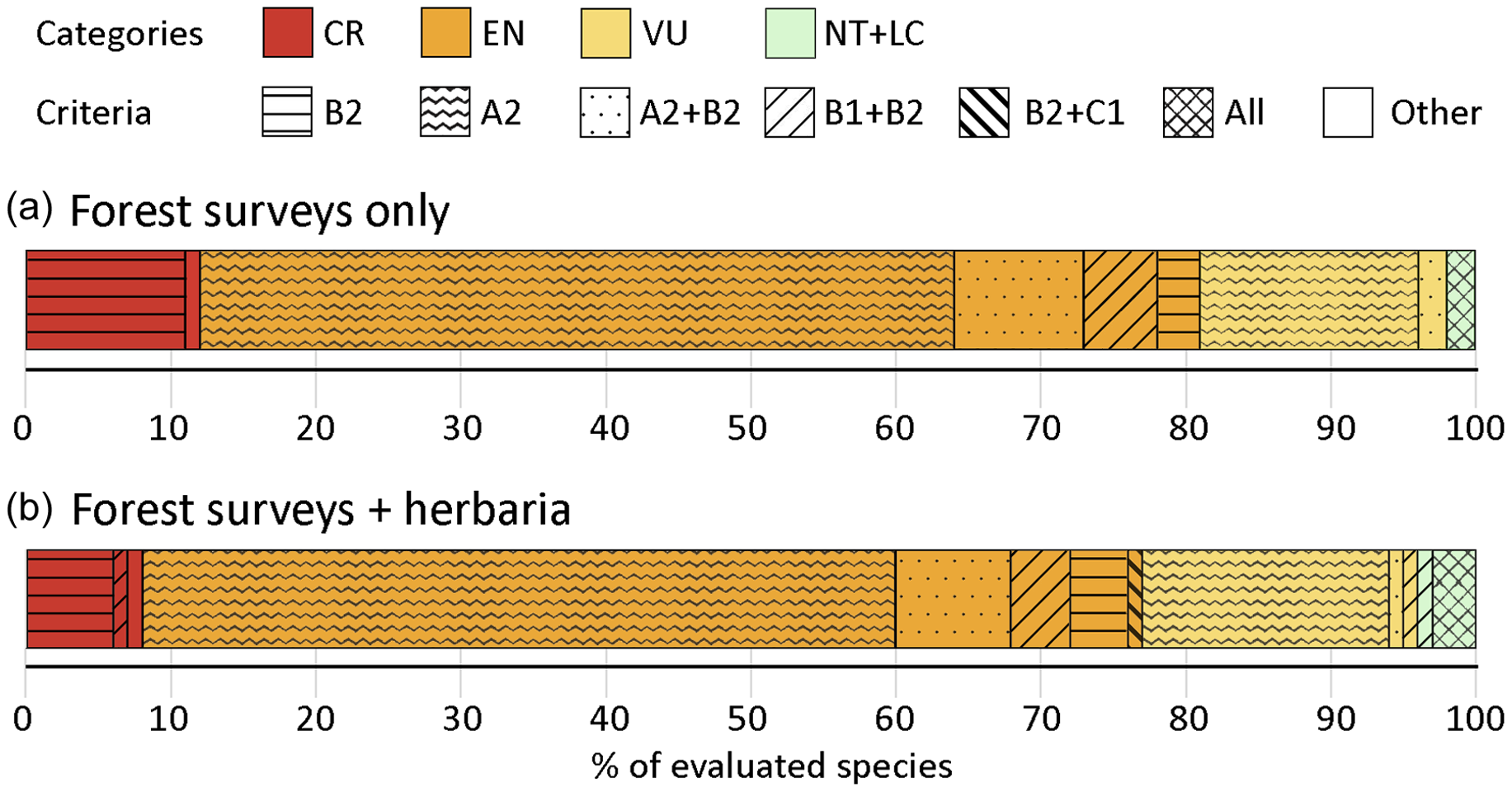
The per cent of tree species in Santa Catarina state, Brazil, classified under each IUCN category (CR, Critically Endangered; EN, Endangered; VU, Vulnerable; NT, Near Threatened; LC, Least Concern), according to different IUCN criteria (IUCN, 2012). The assessments were based on data from (a) forest surveys only and (b) forest surveys plus herbaria data. Only (sub)criteria assigned to at least 1% of all assessed species are shown; combinations of criteria that represented a smaller percentage of all species are shown as ‘other’. The categories Least Concern and Near Threatened were merged as they were assigned to only a small proportion of the evaluated species.

Software and packages
We performed all analyses in R 4.2.1 (R Core Team, 2023). We checked grammar and synonymous terms using the flora package (Carvalho, Reference Carvalho2023), and cleaned herbaria data using plantR (Lima et al., Reference Lima, Sánchez-Tapia and Mortara2023). We handled spatial data using packages raster (Hijmans, Reference Hijmans2023), sp (Pebesma & Bivand, Reference Pebesma and Bivand2005; Bivand et al., Reference Bivand, Pebesma and Gomez-Rubio2013) and rgdal (Bivand et al., Reference Bivand, Keitt and Rowlingson2023). We performed best subset selection in leaps (Miller, Reference Miller2020) and fitted universal kriging and inverse distance weighting using gstat (Pebesma, Reference Pebesma2004; Gräler et al., Reference Gräler, Pebesma and Heuvelink2016). We evaluated all criteria and categories using ConR 2.1 (Dauby & Lima, Reference Dauby and Lima2023) and measured the Red List Index using red (Cardoso, Reference Cardoso2017). We obtained protected area maps using wdpar (Hanson, Reference Hanson2022; UNEP-WCMC & IUCN, 2023a,b).
Results
We evaluated 502 tree species using forest survey data alone (Supplementary Material 2) and considered 494 (98%) to be threatened under at least one IUCN criterion (Fig. 2a, Table 1). The most common threat category was Endangered (70%), followed by Vulnerable (17%) and Critically Endangered (11%). Only eight species were classified as not threatened (Near Threatened and Least Concern). After integrating herbaria data, we were able to evaluate 555 tree species (Supplementary Material 3), but there were minimal changes in the results (Table 1). The Red List Index for Santa Catarina was 0.42 (95% CI: 0.41–0.43) when considering only forest survey data and 0.45 (95% CI: 0.44–0.46) after herbaria data were integrated.
The per cent of tree species in Santa Catarina state, southern Brazil (Fig. 1), assessed as threatened using IUCN criteria A, B, C and D (IUCN, 2012), separately and overall, based on data from forest surveys only and in combination with herbaria data. Median Red List Index values are shown, with 95% CIs.

We found that the Red List category assigned to each species varied depending on the IUCN criteria used in the assessment (Table 1). For both datasets c. 80% of all tree species were assessed as threatened under criterion A2, which corresponds to population declines above 30% in the last three generations (ranging from 30 to 240 years). Overall, almost 70% of species had an estimated population decline of more than 50% in the last three generations. Only 6% of populations were estimated to have declined by less than 30%, which classifies them as not threatened. Only one species (Condalia buxifolia) showed an increase in population size. When considering only the last 25 years, just 22% of all tree species had an estimated population decline of less than 30%.
The main difference between the results from the two datasets (forest surveys only vs forest surveys plus herbaria) related to interpretation of criterion B, geo-graphical range, because the addition of herbaria data affected the distribution parameters of threatened tree species and thus their range (Fig. 2). Criterion B1 (extent of occurrence) was the main criterion for 13% of all conservation assessments and criterion B2 (area of occupancy) was the main criterion for 35% of the assessments based on forest survey data alone. When herbaria data were added, this percentage remained at 13% for criterion B1 and decreased to 30% for criterion B2. At least 20% of all threatened tree species showed a continuing decline in severely fragmented populations.
The IUCN criteria C (small and declining populations) and D (very small or restricted populations) were less relevant to conservation assessments (Fig. 2, Supplementary Materials 2, 3). Only eight species (Euplassa cantareirae, Monteverdia patens, Myrceugenia acutiflora, Myrcia subacuminata, Oreopanax capitatus, Rhamnidium elaeocarpum, Schinus mole, Trichilia silvatica) had population sizes of <10,000 individuals (criterion C threshold for Vulnerable), and only one, C. buxifolia, had a population size of < 1,000 individuals (criterion D threshold for Vulnerable).
We assigned a categorization of Data Deficient to 22 species that were expected to occur as trees in Santa Catarina state but for which the taxonomic delimitation was unclear and the herbarium voucher data were not reliable enough to verify identification (Supplementary Material 4).
Discussion
Species abundance data are essential when estimating population sizes and declines. These data are scarce in Brazil so species assessments often use IUCN criterion B (Martinelli & Moraes, Reference Martinelli and Moraes2013), which is based on geographical range. At most, 35% of Santa Catarina tree species would be categorized as threatened if criterion B was used alone, which is 60% fewer than the proportion reported in this study. The multiple-criteria approach offered a way to look beyond the distributions of species across their geographical range to assess their extinction risk. In a biodiversity hotspot where deforestation has destroyed most of the original habitat (Dean, Reference Dean1997; Joly et al., Reference Joly, Metzger and Tabarelli2014), it is crucial to consider trends in population size reduction (criterion A) to accurately assess the conservation status of tree species or other organisms dependent upon the forest ecosystem. When habitat loss is high, neglecting criterion A could result in an inaccurate IUCN categorization. Our findings suggest that tree species face greater threats at the local level than at the regional level, at least within our study area. A comparison with assessments across the Atlantic Forest (Lima et al., Reference Lima, Dauby, Gasper, Fernandez, Vibrans and Oliveira2024) reported that 461 of the 555 tree species evaluated there (83%) were classified as threatened, which is 15% less than our study’s estimate (98%). Nearly all species classified as Least Concern in the Atlantic Forest domain were considered threatened in Santa Catarina, with some even listed as Critically Endangered (Supplementary Material 1, Supplementary Fig. 2).
Habitat fragmentation
We have shown that populations of at least 20% of all threatened tree species in Santa Catarina state are fragmented. This result was expected based on the severe fragmentation of the Atlantic Forest (Ribeiro et al., Reference Ribeiro, Metzger, Martensen, Ponzoni and Hirota2009), where > 80% of the fragments are smaller than 50 ha, half of the remaining forest area is located close to forest edges, and the distance between fragments is large (Ribeiro et al., Reference Ribeiro, Metzger, Martensen, Ponzoni and Hirota2009). As trees are defined as the main components of a forest, population fragmentation can be considered equivalent to habitat fragmentation (IUCN, 2022). Apart from the short-term impacts (e.g. edge effects), the long-term exposure of forests to habitat fragmentation may restrict gene flow between isolated subpopulations (Couvet, Reference Couvet2002). Dispersal is also hampered by fragmentation, and both recolonization and demographic rescue effects may not be sufficient to stabilize threatened populations, leading to their extinction over time (Tilman et al., Reference Tilman, May, Lehman and Nowak1994).
Caveats regarding the methodology used
We estimated population sizes using abundance data modelled via inverse distance weighting. Different from kriging, inverse distance weighting is a deterministic method. Nevertheless, the method can achieve results like or better than those of kriging (Zarco-Perello & Simões, Reference Zarco-Perello and Simões2017). However, its estimation power depends on assumptions regarding sampling intensity, which can be difficult to attain for rare species (Steege et al., Reference Steege, Pitman, Sabatier, Baraloto, Salomão and Guevara2013). Even in Santa Catarina, where the FlorestaSC project has systematically sampled the whole state (Marques & Grelle, Reference Marques and Grelle2021), the performance of the inverse distance weighting model may be compromised by some species for which there are few records, resulting in wider CIs in population sizes and possibly unreliable estimates.
Some species were expected to occur in the state but were not found in our datasets (Data Deficient species; Supplementary Material 4). Our preliminary list of trees for Santa Catarina comprised 577 species, but data were only available for 555 species. Various factors can explain this lack of data. Firstly, some of these species are rare and were not found in the forest surveys or are known only by the type specimen. Others are subject to taxonomic uncertainty (Hortal et al., Reference Hortal, de Bello, Diniz-Filho and Lewinsohn2015), as species delimitation can be hampered by a paucity of data (e.g. Ocotea species); for example, some individual records were based on written descriptions only, without any collection voucher to allow proper taxonomic verification.
The importance of herbaria data
The inclusion of herbaria data resulted in a more accurate assessment of the conservation status of threatened tree species because it improved our estimates of the extent of occurrence and the area of occupancy (Delves et al., Reference Delves, Albán-Castillo, Cano, Fernández Aviles, Gagnon and Gonzáles2024). Whilst the majority of species were considered threatened under IUCN criterion A2 (population size reduction), for 64 species the inclusion of herbaria data changed the species category from higher to lower risk. The herbaria data contributed additional occurrence points to the assessments, which also increased the extent of occurrence, area of occupancy, number of locations and number of subpopulations. For example, the median extent of occurrence increased from 4,566 to 11,294 km2 for the 64 species and the median area of occupancy increased from 8 km2 (equivalent to four occurrence points in a 2 × 2 km grid) to 36 km2 (equivalent to nine occurrence points in a 2 × 2 km grid). Validation of the herbaria data also high-lighted 53 species that were not recorded in the forest surveys, reinforcing the importance of local collections for species conservation (Delves et al., Reference Delves, Albán-Castillo, Cano, Fernández Aviles, Gagnon and Gonzáles2024).
In tropical regions, where funding can be insecure, forest surveys conducted over extended periods are often hampered by poor working conditions, a lack of basic infrastructure and other practical problems (Nuñez et al., Reference Nuñez, Chiuffo, Pauchard and Zenni2021; Lima et al., Reference Lima, Phillips, Duque, Tello, Davies and de Oliveira2022). Adequate forest survey data are hard to obtain, making it difficult to estimate the parameters related to criterion A (population size reduction). Thus, across the tropics, regional collections are crucial to any assessment of spatial threats to biodiversity conservation (Nualart et al., Reference Nualart, Ibáñez, Soriano and López-Pujol2017; Rocchetti et al., Reference Rocchetti, Armstrong, Abeli, Orsenigo, Jasper and Joly2021). Some examples of this can be seen in the Afrotropical (Schatz, Reference Schatz2002) and Palearctic/Indo-Malay realms (Zhang et al., Reference Zhang, He, Li and Tang2015), where rapid assessments of at-risk taxa were performed using herbaria data.
Conclusion
We evaluated the conservation status of Santa Catarina tree flora based on data from both forest surveys and herbaria using the IUCN criteria A, B, C and D. We demonstrate the importance of using forest surveys to estimate population sizes and assess species under IUCN criterion A (population size reduction) in locations where deforestation has been the main driver of habitat loss in the past. We also highlight how a more accurate Red List assessment can be produced by incorporating herbaria data to complement forest surveys, even when the forest surveys are well distributed within a study region. Whilst we have increased the number of species assessed at the state level, the results we obtained are alarming: almost all tree species in the region are potentially threatened and most of them are already restricted to fragmented remnants such as the Alto Paraná and Araucaria forests. The results reported here can be used to identify important and potential regions for the creation of protected areas and the implementation of forest restoration programmes.
Author contributions
Study conceptualization: RAFdL, ALdG; data curation: RAFdL, ACV, ALdG; design of methodology: GSG, RAFdL, AKF; data analysis: GSG; writing: GSG; revision: AFK, ACV, ALdG; supervision: RAFdL, ALdG.
Acknowledgements
We thank the owners of the forests where data were collected and all field workers and taxonomists involved in the FlorestaSC. GSG thanks Coordenação de Aperfeiçoamento de Pessoal de Nível Superior - Brasil (CAPES) - Código de Financiamento 001. GSG and AKF thank Secretaria de Desenvolvimento Econômico Sustentável do Estado de Santa Catarina (SDE/SC) (2022TR0001389). RAFdL was funded by the European Union’s Horizon 2020 research and innovation programme under Marie Skłodowska-Curie grant agreement no. 795114 and by grant #2013/08722-5, São Paulo Research Foundation (FAPESP). ALdG and ACV were supported by Conselho Nacional de Desenvolvimento Científico e Tecnológico (CNPq) research grants 311303/2020-0 and 305199/2022-6, respectively.
Conflicts of interest
None.
Ethical standards
This research abided by the Oryx guidelines on ethical standards.
Data availability
Data are available from the corresponding author upon reasonable request.



 Open access

