


The cost of nutritious food has implications for child health. Longitudinal studies have linked rising fruit and vegetable prices with increasing BMI in children(Reference Powell and Bao1, Reference Sturm and Datar2). Nutrient-dense foods – including fresh vegetables and fruit – are more costly than less healthful options(Reference Jetter and Cassady3, Reference Drewnowski4), and the disparity in cost is increasing over time(Reference Monsivais, Mclain and Drewnowski5). These economic factors may pose a barrier to purchasing healthful foods for children.
The affordability of healthful foods is an urgent issue for child-care providers, who have been identified as crucial to any initiatives for child nutrition and obesity prevention(Reference Kaphingst and Story6). A recent report from the White House Task Force on Obesity suggested that child-care settings ‘present a tremendous opportunity to prevent obesity’(7). The report recommended that the federal government, with input from health-care providers and other stakeholders, provide clear, actionable guidance to states, care providers and families on how to improve nutrition in child-care settings. Critical to this guidance is a greater understanding of the determinants of diet quality.
With over 3 million pre-school children enrolled, the Child and Adult Care Food Program (CACFP) of the US Department of Agriculture is the largest federal programme supporting nutrition in early child-care settings. CACFP provides monetary reimbursements to participating homes and centres for serving meals and snacks that follow an approved standard. The standard is based on adherence to a five-food-group pattern as well as the selection of foods and beverages that satisfy some nutritional characteristics. In particular, foods and beverages that contain high amounts of added sugar and fat are discouraged. These standards have been shown to provide for better nutrition than foods children bring from home(Reference Sweitzer, Briley and Robert-Gray8, Reference Bruening, Gilbride and Passannante9) but a recent study of CACFP child care homes found that the nutritional quality of foods served to children and food expenditures were higher in homes that received higher federal meal reimbursements(Reference Monsivais, Kirkpatrick and Johnson10).
Studies on the cost of healthful eating have generally found that more nutritious diets are more costly for both adults(Reference Monsivais and Drewnowski11–Reference Andrieu, Darmon and Drewnowski14) and children(Reference Rauber and Vitolo15, Reference Rydén and Hagfors16). The majority of these studies estimated the cost of the diet by linking retail food prices with standard dietary assessment instruments. As a result, such studies essentially provide information on the price of healthful diets and do not necessarily reflect what respondents actually paid for the foods they consumed. Less is known about how individual consumer food expenditures relate to the nutritional quality of foods purchased. The use of coupons and other shopping strategies might help consumers economize while selecting nutritious foods(Reference Wiig and Smith17, Reference Leibtag and Kaufman18). Using detailed expenditure data and food menu records of CACFP child-care providers, the present study tested the hypothesis that higher expenditures on foods are associated with higher nutritional quality of foods served in home child care.
Methods
Study participants
For the present cross-sectional study, a sample of sixty home child-care providers was recruited between July 2008 and September 2009. Eligible providers had to be currently participating in CACFP and reside within King County, Washington State. The present sample size was determined for testing the effects of CACFP policies on nutritional quality of menus(Reference Monsivais, Kirkpatrick and Johnson10), and the analyses described here were conducted as a secondary aim of that project. The names and addresses of providers were furnished by the state agency responsible for CACFP throughout Washington, the Office of the Superintendant of Public Instruction. All procedures were reviewed and approved by the University of Washington Human Subjects Division.
Recruitment and study procedures
Announcements about the research study were initially made in child-care organization newsletters. The study was described as an investigation of food spending and budgeting. Later, invitation letters were mailed to the homes of potential participants. Of 321 invitation letters mailed, ninety-five elicited a response from a potential participant. Of those ninety-five persons interested in participating in the study, seventy-five met the eligibility criteria, and sixty-three completed the study. Three of the providers were subsequently excluded for failing to follow study protocols. In-person surveys were administered to collect data on provider professional and demographic characteristics, including education completed and household income.
Menu analysis
Daily menus were completed by each child-care provider over five consecutive days when the child-care programme was in operation, usually Monday to Friday. Menus were recorded on forms provided by the study staff. These forms provided space and prompts for recording nutritionally relevant characteristics of the foods and beverages served (e.g. low-fat/non-fat, whole-wheat/whole grain) as well as characteristics of the purchased form of the product. For example, a child-care provider served Oven Joy brand white bread, purchased at Safeway in a 22 oz (620 g) loaf. The brand, purchased form and package size of each product were required for computing expenditures on the portions served (see below). All menus were initially analysed for compliance with CACFP meal component requirements using methods described previously(Reference Monsivais, Kirkpatrick and Johnson10). Subsequent analyses were conducted after excluding all beverages on the grounds that CACFP only provides reimbursements for milk or 100 % fruit juice. By contrast, regulations give less specific guidance about food, so care providers have greater discretion in selecting foods that comply with the CACFP food pattern requirements. Milk served with breakfast cereals was not excluded. The exclusion of juice from the present analyses could introduce bias since providers are allowed to substitute juice for whole fruit at some meals. For example, a provider who served juice more than fruit would have menus that appeared to be lower in nutrients, since the juices would not be counted toward the total nutrient content. However, as reported below, juice was served infrequently in this sample and multivariate analyses indicated that serving juice was not significantly linked to food expenditures or nutrient-based measures of menu quality, the key variables in the present study.
All foods and beverages reported were standardized to portions appropriate for children aged 3–5 years, as specified by CACFP. For menu items that did not have recommended serving sizes (e.g. desserts, butter, condiments and syrups), portion sizes were standardized to a one-half MyPyramid serving for desserts and 1 teaspoon for butter, condiments and syrups. Menu items were entered into dietary assessment software (FoodProcessor SQL, version 10·5·0; ESHA Research, Salem, OR, USA). Nutrient composition analyses of menus yielded values for dietary weight (g), energy (kcal/kJ) and fifty-four macro- and micronutrients.
Nutritional quality of menus
Menus were characterized in terms of their percentage of energy from carbohydrates, protein and total fat. The nutritional quality of foods served was defined using two food-based and two nutrient-based indictors. Servings of whole grains and fresh whole vegetables and fruits were the food-based indicators of menu quality, since these foods have been associated with health benefits in cross-sectional and randomized controlled trials(Reference Karanja, Obarzanek and Lin19, Reference Ledikwe, Rolls and Smiciklas-Wright20) and are encouraged as part of a health-promoting diet(Reference Mozaffarian and Ludwig21–24). Whole grains included wholegrain cold breakfast cereals, oatmeal, whole-wheat breads and pastas, and brown rice. Nutrient-based indicators of menu quality were the Mean Adequacy Ratio (MAR)(Reference Maillot, Darmon and Vieux25, Reference Guthrie and Scheer26) and energy density(Reference Monsivais and Drewnowski11, Reference Ledikwe, Blanck and Khan27), which have been used as indicators of diet quality in previous studies. MAR values were calculated for seven nutrients. Six of these were micronutrients of specific concern for child health: Fe(Reference Suskind28–Reference Briley, Jastrow and Vickers30), Mg(24), K(22), Zn(Reference Roberts and Heyman29–Reference Ballew, Kuester and Serdula32), vitamin E(Reference Skinner, Carruth and Houck31–Reference Erinosho, Dixon and Young34) and folate(Reference Skinner, Carruth and Houck31). Total fibre was also included since it has been used in prior measures of diet quality and is consumed in inadequate amounts by children(22, Reference Kranz, Mitchell and Siega-Riz35). Two other nutrients of concern, Ca(22, Reference Roberts and Heyman29, Reference Ballew, Kuester and Serdula32) and vitamin D(22, Reference Suskind28, Reference Skinner, Carruth and Houck31), were excluded from this MAR since milk, a key source of these nutrients, was excluded along with all beverages. The MAR was computed as follows:
![\[--><$$>{\rm{MAR}} = \frac{{\mathop{\sum}\limits_{i = 1}^7 {{\rm{rati}}{{{\rm{o}}}_i}} }}{7}\times 100\eqno\rm<$$><!--\]](https://static.cambridge.org/binary/version/id/urn:cambridge.org:id:binary:20160921032902464-0020:S1368980011002382:S1368980011002382_eqnU1.gif?pub-status=live)
where, for nutrient i,
![\[--><$$> {\rm{rati}}{{{\rm{o}}}_i} = \frac{{{\rm{conten}}{{{\rm{t}}}_i}}}{{{\rm{DR}}{{{\rm{I}}}_i}}} \eqno\rm<$$><!--\]](https://static.cambridge.org/binary/version/id/urn:cambridge.org:id:binary:20160921032902464-0020:S1368980011002382:S1368980011002382_eqnU2.gif?pub-status=live)
and contenti is the content of nutrient i in 4187 kJ (1000 kcal) of menu energy. The daily reference intake for nutrient i (DRIi) is based on the Institute of Medicine's recommendations for each nutrient for children aged 4–8 years(37, 38). The reference intakes were as follows: vitamin E, 7 mg; Fe, 10 mg; Mg, 130 mg; K, 3800 mg; Zn, 5 mg; folate, 200 μg; fibre, 25 g. Menus that perfectly satisfied the recommended levels for these seven nutrients in 4187 kJ (1000 kcal) would have a MAR of 100 %. Energy density was calculated as energy divided by the weight of foods served (kJ/g) following past studies(Reference Monsivais and Drewnowski11, Reference Maillot, Darmon and Vieux25, Reference Ledikwe, Blanck and Khan27).
Food expenditures
Expenditures were computed for each provider's standardized 5 d menu by linking each food served with the providers’ food shopping receipts. For each item appearing on the menus, we used the purchased form, package size and brand of product to identify it in the receipts. On average, the four weeks of receipts provided prices for 80 % of the foods and beverages on the providers’ menus. For missing prices, i.e. foods served but not identified in the provider's own receipts, prices were drawn either from the receipts of other providers (10 %) or from the websites of three retailers that were used by this sample of child-care providers (10 %): Safeway supermarkets, Amazon Fresh (an Internet-only food retailer) and Sam's Wholesale Club. To compute the expenditure associated with each food item, we multiplied the gram weight served (based on the age-appropriate standardized portion) by the ratio of the purchase price over total grams purchased, correcting for edible portion (EP) using a standard reference database(39):
![\[--><$$> {{\$ }_{\rm portion}} = {{\rm g}_{\rm portion}}\times \frac{{{{\$ }_{{\rm as}\ {\rm purchased}}}}}{{{{\rm g}_{\rm purchased}}\times {\rm EP}}} \eqno\rm<$$><!--\]](https://static.cambridge.org/binary/version/id/urn:cambridge.org:id:binary:20160921032902464-0020:S1368980011002382:S1368980011002382_eqnU3.gif?pub-status=live)
For example, the expenditure associated with a  cup portion (54·5 g) of fresh apple that was purchased for $US 1·49/pound (454 g) was 54·5 g × $US 1·49/(454 g × 0·76) = $US 0·141. Expenditures were totalled for each day to compute a daily expenditure and mean daily expenditures were computed across all five days of menus for each provider.
Statistical analysis
Food expenditures, menu energy, energy density and MAR were all normally distributed so parametric statistics were used. Pearson bivariate correlations were estimated to assess the relationship of food expenditure to a number of nutritional characteristics of foods served including energy (kJ/kcal), weight (g), percentage of energy from macronutrients, servings of whole grains, fresh vegetables and fruits, and energy density and MAR. We used multiple linear regression models to examine the relationship between food expenditure and nutritional characteristics of foods served while controlling for covariates. Separate regression models were used for each nutritional characteristic but for all models, the key independent variable was food expenditure ($US/d). Covariates in all models were menu energy and the respondent's age, professional characteristics (years of child-care experience, mean number of children in care), all entered as continuous variables. Models also included educational attainment and household income, indicators of socio-economic status. Education and income were both coded as three-level dummy variables, with the lowest category of each serving as the reference group. Finally, models adjusted for respondents’ CACFP reimbursement tier (low or high), which is associated with both expenditures and the nutritional quality of menus(Reference Monsivais, Kirkpatrick and Johnson10).
Results
Participant characteristics
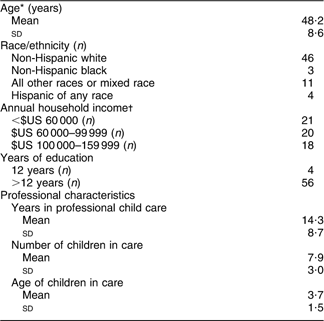
All sixty participating care providers were women, ranging in age from 29 to 64 years with a mean age of 48·2 (sd 8·6) years. Demographic, socio-economic and professional characteristics of the present sample are shown in Table 1. The sample was primarily white, non-Hispanic (46/60) and most had at least some college-level education. Annual household incomes ranged from less than $US 20 000 to between $US 140 000 and $US 159 999, but nearly two-thirds of the sample (38/60) had annual incomes between $US 60 000 and $US 159 999. The present sample had substantial professional experience, averaging 14·3 (sd 8·7) years of experience in professional child care with 11·6 (sd 8·3) years in CACFP. On average, these providers had approximately eight children in care each day and the average age of children was 3·7 (sd 1·5) years.
Characteristics of sixty child-care providers participating in CACFP, King County, WA, USA, 2008–2009
CACFP, Child and Adult Care Food Program.
*Two providers did not report their age.
†One provider did not report income.
Five-day menus
The majority (38/60) of child-care providers in this sample served breakfast, lunch and two snacks each day. Most providers served breakfast (52/60), and all served lunch. None of the providers served evening snacks or supper. Including beverages, menus showed strong adherence to CACFP food pattern guidelines. For all providers, menus were 96·6 (sd 3·8) % consistent with the CACFP food patterns. Juice was served less than once daily, with a mean frequency of 3·0 (sd 0·4) servings weekly. The analyses that follow below exclude juices and milk served as a beverage.
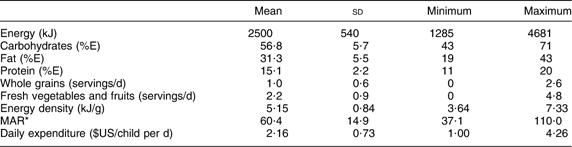
Energy and nutrient composition of the standardized, 5 d menus varied widely. The nutritional characteristics of the menus are shown in Table 2. Energy ranged from 1285 to 4681 kJ (307 to 1118 kcal), with a mean of 2500 kJ (597 kcal). The macronutrient distribution of menus was within the recommended range for children aged 4–18 years(Reference Monsivais, Kirkpatrick and Johnson10) and percentage of energy from fat showed the most variation among providers, ranging from 19 to 43 %. Whole grains were served an average of once daily while whole fruits and vegetables were served just over twice daily, but the range varied widely for both food groups. Energy density and MAR, two indicators of the nutritional quality of foods served, also varied substantially among child care homes. Overall, foods served provided 60·4 % of the daily recommended intakes for the seven nutrients used in computing the MAR.
Characteristics of foods served to children based on 5 d menus in sixty child care homes, King County, WA, USA, 2008–2009
%E, percentage of energy; MAR, mean adequacy ratio.
*MAR based on vitamin E, Ca, Fe, Mg, K, Zn and fibre.
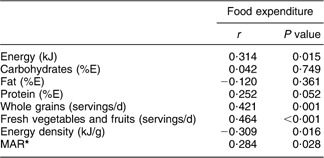
Like the nutritional characteristics of the 5 d menus, average food expenditures varied widely. Expenditures ranged from $US 1·00 to $US 4·26/child per d, with a mean of $US 2·17 (sd 0·74)/child per d. To examine the interrelationship of food expenditures and nutritional characteristics of foods served, bivariate Pearson correlations were estimated (Table 3). The analyses indicated that food expenditures were significantly and positively correlated with total energy, number of portions of whole grains and fresh produce and positively correlated with MAR. However, expenditures were negatively correlated with energy density of foods served.
Pearson correlations (r) of food expenditure ($US/child per d) with nutritional characteristics of menus provided in sixty child care homes, King County, WA, USA, 2008–2009
%E, percentage of energy; MAR, mean adequacy ratio.
*MAR based on vitamin E, Ca, Fe, Mg, K, Zn and fibre.
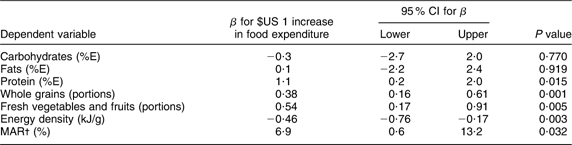
Linear regression models were used to examine the relationship between food expenditures and the nutritional characteristics of menus, while adjusting for energy and other potential confounders. Food expenditures were not associated with the carbohydrate and fat content of foods served (Table 4). However, higher food expenditures were positively associated with the protein content of foods served. Higher food expenditures were also positively associated with indicators of menu quality. For each increase in expenditure by $US 1, the number of portions of whole grains and fresh whole vegetables and fruits increased by 0·38 and 0·54 portions, respectively. The two nutrient-based indicators of overall nutritional quality were significantly associated with food expenditures but in opposite directions. Increasing food expenditure by $US 1/child per d was associated with a 0·46 kJ/g (0·11 kcal/g) reduction in energy density but a 6·9 % increase in nutrient adequacy based on MAR. In regression models for the four indicators of menu quality, food expenditures were the independent variable most strongly related and the only variable that showed a significant association.
Change in menu nutritional characteristics with each $US 1 increase in food spending. Based on separate regression models for each dependent variableFootnote *
% E, percentage of energy; MAR, mean adequacy ratio.
* Regression models adjusted for menu energy, provider's age, household income, educational attainment, years of professional experience, mean number of children in care and CACFP reimbursement rate. Key independent variable for all models: food expenditure ($US 1/child per d). Unstandardized β coefficients represent the change in the dependent variable for each dollar increase in expenditure. Models included all child-care providers (n 60), King County, WA, USA, 2008–2009.
† MAR based on vitamin E, Ca, Fe, Mg, K, Zn and fibre.
Since the menu data and receipts were collected over 14 months, we also examined the possibility that seasonality might have confounded the association between food expenditures and the nutritional quality of menus. Half of all providers (n 30) were surveyed in the summer months (June–August). For autumn, winter and spring, the numbers surveyed were six, nine and fifteen, respectively. Mean daily food expenditures varied somewhat across the four seasons ($US 2·07/d in winter to $US 2·30/d in autumn) but servings of fresh vegetables and fruits did not vary substantially by season, ranging from 2·1 to 2·4 servings/d. Adjusting for seasonality in the regression models did not change the results reported above.
Discussion
The present results indicate that serving more nutritious foods in CACFP child care homes may come at a higher cost. Menus of higher nutritional quality, whether defined in terms of food- or nutrient-based indicators, were associated with higher food expenditures. This association held true even after controlling for socio-economic and other covariates known to be associated with the nutritional quality of foods purchased(Reference Turrell, Hewitt and Patterson40, Reference Kirkpatrick and Tarasuk41) or consumed(Reference Monsivais and Drewnowski11, Reference Darmon and Drewnowski42). In particular, the analyses controlled for reimbursement rate, which our previous analyses showed was associated with higher nutritional quality of foods served(Reference Monsivais, Kirkpatrick and Johnson10).
Diets that are low in energy density and high in nutrients are associated with healthy body weight and more favourable health outcomes(Reference Ledikwe, Rolls and Smiciklas-Wright20, 22). By contrast, diets high in energy density are associated with overweight and weight gain in adults(Reference Mendoza, Drewnowski and Christakis36, Reference Ledikwe, Blanck and Kettel Khan43) and children(Reference Johnson, Mander and Jones44, Reference Mendoza, Drewnowski and Cheadle45). Such evidence is reflected in current nutrition guidance for child health and obesity prevention, which encourages foods that are high in nutrients and low in energy density such as fresh vegetables and fruit, whole grains and low-fat dairy products(46–49). However, parents and child-care providers may require more economic resources to fully implement this guidance.
There is a substantial price differential between energy-dense, nutrient-poor foods and more nutritious alternatives(Reference Drewnowski4) and the disparity has been growing over time(Reference Monsivais, Mclain and Drewnowski5). Observational studies of adults have found that the least costly diets are associated with fewer servings of vegetables and fruits(Reference Murakami, Sasaki and Takahashi13, Reference Rydén and Hagfors16), lower content of vitamins and minerals and higher energy density(Reference Monsivais and Drewnowski11, Reference Murakami, Sasaki and Takahashi13, Reference Andrieu, Darmon and Drewnowski14, Reference Rydén and Hagfors16). A recent study of children's dietary intakes found that higher intakes of vitamins A and C were associated with higher diet cost(Reference Rauber and Vitolo15). When taken together, those observational studies and the results presented here suggest that serving more nutritious foods to children in child care will require higher food spending. Consistent with this notion, the Institute of Medicine's recent recommendations for CACFP estimated that meeting improved nutrition standards in child care would lead to a 31–44 % increase in food costs for child-care providers(48).
Methodological considerations and limitations of the present study
The present study was a cross-sectional descriptive study based on a homogeneous, convenience sample of child-care providers participating in a government-sponsored food programme. The women who agreed to participate in our study may have been more concerned with food prices and/or budgeting than those providers who did not participate. These factors limit our ability to assign causality and generalize to other populations. In addition, our analyses were based on foods that were offered, rather than foods children actually consumed. The reliance on menu records in the present study had intrinsic weaknesses similar to diet records used in traditional dietary assessment. However, menu records in our study were completed in real time by each care provider and were verified for accuracy and completeness, and receipts of foods purchased provided a form of validation of the foods served.
Food expenditures, a key variable studied here, were standardized on a per child/d basis and hence did not reflect the aggregate food expenses faced by child-care providers in the study. However, this analytic step produced a monetary variable that was not confounded by portion sizes or the number and ages of children served, permitting a direct comparison among providers. It is notable that despite this methodological feature, the present findings were consistent with previous studies on the monetary cost and nutritional quality of diets, which estimated the cost of diets from retail prices rather than actual expenditures(Reference Monsivais and Drewnowski11–Reference Rydén and Hagfors16).
One other consideration is the use of the MAR: in effect, a composite index of menu quality that we based on seven nutrients. It is noteworthy that not all seven nutrients were equally dependent on food expenditures. Fibre, Mg and vitamin E were the nutrients most strongly and significantly coupled to expenditures while Fe, folate and Zn did not show a significant association with food spending (data not shown).
Conclusions
Recommendations and policy changes for improving nutrition in child-care settings must recognize that such improvements may involve extra costs. Increasing the number of servings of whole grains and fresh whole produce or improving the nutrient-to-energy ratio of foods served to children would likely require increased food expenditures, which may be a barrier for some populations(7, Reference Beydoun and Wang50). With these constraints in mind, public health nutritionists and policy makers can promote improvements to dietary guidance and nutrition policy that are economically feasible for the target populations. At the same time, child nutrition programmes may require more resources to adequately support improved nutrition standards(Reference Monsivais, Kirkpatrick and Johnson10, 48, 49).
Acknowledgements
The present study was supported by a grant from the Robert Wood Johnson Foundation's Healthy Eating Research Program (RWJF-63046). The authors declare no conflicts of interests in the submission of this manuscript. P.M. collaborated on the conception and design of the study and led the analyses and drafting of the manuscript. D.B.J. collaborated on the conception and design of the study and assisted with the writing and revising of the manuscript. The authors thank Louise Carter, Adam Drewnowski, Jutta Joesch and Matthieu Maillot for their helpful comments on an earlier version of this manuscript. They are also grateful to Shannon Kirkpatrick for coordinating the study.



