




1. Introduction
Ghana and Uganda are home to 73 (e.g. Akan and Ga) and 41 (e.g. Acholi and Luganda) local African languages, respectively (Eberhard et al. Reference Eberhard, Simons and Fennig2025). However, due to colonial histories with the United Kingdom, English is the official language in Ghana and a co-official language (with Swahili) in Uganda, where it serves as the language of law, media, education, commerce and administration (Gut Reference Gut, Filppula, Klemola and Sharma2017, 495; Namyalo et al. Reference Namyalo, Isingoma, Meierkord, Meierkord, Isingoma and Namyalo2016, 20). English is a second language for many speakers in these countries; however, it is a first language (L1) for a teeming population of young people in big cities like Accra and Kampala (Huber Reference Huber, Schneider, Burridge, Kortmann, Mesthrie and Upton2004; Isingoma and Meierkord Reference Isingoma, Meierkord, Meierkord, Isingoma and Namyalo2016). Both varieties are seen to be located at Schneider’s (Reference Schneider2007) nativisation stage (stage 3), which is characterised by lexical expansion and dynamic grammatical features. In both countries, English is taught as a subject at all levels of primary and secondary schools; it is also the medium of instruction in private pre-primary schools, as well as the medium of instruction from higher primary school to university in both countries (Huber Reference Huber, Kortmann and Lunkenheimer2012; Ssentanda Reference Ssentanda, Meierkord, Isingoma and Namyalo2016). The local languages (e.g. Ateso, Akan, Ewe, Luganda, etc.), together with other language acquisition processes and other socio-historical dynamics (Wolf Reference Wolf and Kirkpatrick2021, 217–218), have impacted the use of English in these countries leading to New Englishes such as Ghanaian English (GhE) and Ugandan English (UgE). These New Englishes show variation from other English varieties at the phonological (e.g. Adokorach and Isingoma Reference Adokorach and Isingoma2022; Huber, Reference Huber and Mesthrie2008), lexico-semantic (e.g. Brato Reference Brato, Esimaje, Gut and Antia2019; Isingoma Reference Isingoma, Meierkord, Isingoma and Namyalo2016a), syntactic (e.g. Brato Reference Brato2020; Isingoma Reference Isingoma, Meierkord, Isingoma and Namyalo2016b), and pragmatic (e.g. Anchimbe Reference Anchimbe2018; Meierkord Reference Meierkord2023) levels. This study aims to expand the focus on the pragmatic features of GhE and UgE by exploring commentary pragmatic markers (CPMs) in these two varieties. It has been noted that CPMs contribute to the nativisation of postcolonial English varieties since they reflect the distinct use of expressions that differ from other English varieties (Unuabonah and Gut Reference Unuabonah and Gut2018).
CPMs are syntactically mobile expressions such as frankly and unfortunately, which signal some comment on the message conveyed by a speaker/writer (Fraser Reference Fraser1996). Like other pragmatic markers (PMs), they do not provide propositional meaning but perform interpersonal (e.g. marking emphasis and evaluation) and/or textual (e.g. self-repair and interruption) functions (Brinton Reference Brinton2008; Buysse Reference Buysse2012). Previous studies have explored different types of CPMs in Inner Circle Englishes such as indeed and definitely (Simon–Vandenbergen and Aijmer Reference Simon–Vandenbergen and Aijmer2007; Traugott and Dasher Reference Traugott and Dasher2002), surprisingly, astonishingly, amazingly, sadly, fortunately and unfortunately (Aijmer Reference Aijmer and Romero–Trillo2008), and I think and I believe (Aijmer Reference Aijmer, Aijmer and Rühlemann2015; Kärkkäinen Reference Kärkkäinen, Kaltenböck, Mihatsch and Schneider2010) in British English (BrE) and American English (AmE). These studies show that there is variation in the use of CPMs between the two Inner Circle Englishes. For instance, Kaltenböck (Reference Kaltenböck2007, Reference Kaltenböck2008) shows that epistemic markers such as I think tend to have a backward scope and are more mobile in BrE, while Kärkkäinen (Reference Kärkkäinen, Kaltenböck, Mihatsch and Schneider2010) shows that such markers in AmE have a forward scope and are less mobile in utterances.
Studies that examine CPMs in Outer Circle Englishes have examined groups of CPMs in Nigerian English (NigE) and BrE in different spoken and written text types (Unuabonah and Gut Reference Unuabonah and Gut2018) and different types of CPMs across twenty different Inner and Outer Circle Englishes in online texts, including GhE (Collins Reference Collins2022). The latter two studies confirm that although the group of hearsay markers (a sub-type of CPMs, e.g. I hear and they say) occur more frequently in Outer Circle Englishes than in Inner Circle Englishes, overall, Inner Circle English users employ CPMs more frequently than Outer Circle English users. In particular, Unuabonah and Gut (Reference Unuabonah and Gut2018) attribute these variations to the influence of local languages and cultures on NigE. They show, for instance, that the high frequency of I hear and they say in NigE is due to the transliteration of local hearsay markers such as mo gbo and won ni, respectively, from local Nigerian languages into English. Considering that GhE and UgE are African Englishes (AfEs), just as NigE, it is expected that local Ghanaian and Ugandan languages will influence the use of some of the CPMs in the two varieties, leading to similarities and differences in the use of CPMs in the two varieties. The study also shows that there are similarities and dissimilarities in the use of these CPMS across different text types in NigE and BrE. Thus, it is expected in this study that there will be similarities and variance in the use of CPMs between different GhE and UgE text types. Although Collins (Reference Collins2022) examines GhE alongside 19 other varieties, his study is limited to online texts which do not fully capture the use of these CPMs in different spoken and written text categories such as private conversations, broadcast interviews and business letters; moreover, focus on CPMs in UgE appears to be scarce. All these limit the knowledge and understanding of the use of CPMs in GhE and UgE. To examine pragmatic variation in the use of CPMs in GhE and UgE systematically, this article pursues the following objectives:
(a) to examine the frequency of CPMs in both varieties;
(b) to account for the similarities and differences in the use of these CPMs between both varieties; and
(c) to discuss the use of these CPMs in different text types in both varieties.
By exploring these aspects, this study not only extends research on pragmatic variation in these two varieties but it also contributes to the understanding of nativisation processes in these varieties. To realise its aim, this paper utilises the Ghanaian and Ugandan components of the International Corpus of English (ICE), which contain various spoken and written text types, such as conversations, business transactions, social letters, and news reports.
In the rest of the paper, there is a discussion on CPMs and variational pragmatics, which is the approach from which this study has been carried out, methodology, presentation and discussion of results, and finally the conclusion.
2. Commentary pragmatic markers and variational pragmatics
CPMs belong to the larger group of PMs, which are expressions that connect an utterance to its linguistic and situational context (Buysse Reference Buysse2012) and are sometimes known as discourse particles or discourse connectives (see Aijmer and Simon–Vandenbergen Reference Aijmer, Simon–Vandenbergen, Zienkwoski, Östman and Verschueren2011 for other terminologies). There are different categorisations of PMs and one of such categorisations is found in Fraser (Reference Fraser1996), who groups PMs into CPMs, basic markers (e.g. please), discourse-management markers (e.g. now, well), and discourse markers (e.g. and, but). CPMs cover numerous expressions (see Section 3 for a full list) that have been grouped into different categories. A useful categorisation is provided by Fraser (Reference Fraser1996), who groups CPMs into assessment, evidential, manner-of-speaking, hearsay and emphasis PMs. Assessment markers such as interestingly and sadly signal the evaluation of the message in an utterance, as in (1), while manner-of-speaking markers including bluntly and seriously serve as comments on the mode or style of speaking/writing of an utterance, as in (2). Evidential markers (e.g. basically and perhaps) signal the speaker’s degree of confidence about the truth of the basic message in an utterance, as in (3), while hearsay markers (e.g. it appears and reportedly) comment on the type of source of the speaker’s information expressed in an utterance, as in (4). Emphasis markers (e.g. indeed and definitely) accentuate the force of the basic message in an utterance, as in (5).
(1) Sadly, I was caught up in aloofness. (ICE-GH_W2F-006)
(2) Seriously guys I started thinking about Fundi (ICE-UG_S2A-032)
(3) Basically, her idea is to have a one-stop shop (ICE-GH_W2B-008)
(4) Ocan reportedly claimed the measles and rubella vaccines can kill (ICE-UG_S2B-005)
(5) Definitely they’ll come here and write (ICE-GH_S1A-009)
In this study, we explore CPMs from a variational pragmatic approach, which operates at the intersection between pragmatics and variational linguistics (Schneider Reference Schneider, Haugh, Kádár and Terkourafi2021; Schneider and Barron Reference Schneider and Barron2008). Variational pragmatics addresses the “systematic analysis of the effects of regional and social factors on language in action and interaction” (Schneider and Barron Reference Schneider and Barron2008, 1) as well as the investigation of pragmatic variation in ecological and shared spaces. It captures two levels of pragmatic analysis: language variation and levels of pragmatic analysis. Language variation deals with five macro-social variables: region, ethnicity, social class, gender and age, and their influence on the use of language (Barron Reference Barron, Barron, Gu and Steen2017, 92). The eight levels of pragmatic analysis include the formal (e.g. politeness markers), actional (e.g. speech acts), interactional (e.g. conversational endings), topical (e.g. topic choice), organisational (e.g. interruptions), stylistic (e.g. choice of tone), non-verbal (e.g. posture), and prosodic (e.g. intonation) levels (Schneider and Félix–Brasdefer Reference Schneider, Félix–Brasdefer, Jucker and Hausendorf2022, 642–643). Moreover, it includes other variables such as discourse types (e.g. speech, writing) and social situations (e.g. e-mail, online chat), among others, as significant variables that may affect pragmatic variation (see also Aijmer Reference Aijmer2013). The current research deals with the formal level of pragmatic analysis, which enables a form-to-function mapping of the CPMs in GhE and UgE so as to examine the impact of region on their frequencies and use across different text types. The study utilises the Ghanaian and Ugandan components of ICE, which are comparable databases.
3. Methodology
The data for this study include utterances that capture different types of CPMs retrieved from ICE-GH and ICE-UG, which are corpora that cover approximately one million words each of spoken (∼600,000 words) and written (∼400,000 words) English texts of diverse genres, including private conversations, broadcast talks, press reports and novels. These texts were collected from users who were 18 years and above, and who had been educated up to the secondary school level or beyond in Ghana and Uganda (Huber and Dako Reference Huber and Dako2013; Meierkord and Isingoma Reference Meierkord and Isingoma2022). These make it easier to compare results between not only the two corpora but also with similar corpora that deal with other English varieties. The two corpora were searched with AntConc 3.4.4 (Anthony Reference Anthony2015) for the occurrence of the following 173 CPMs, which include CPMs used in previous studies, including Unuabonah and Gut (Reference Unuabonah and Gut2018). Although this list is not exhaustive, it accounts for most of the markers that are typically used to provide comments on utterances. They comprise:
— 58 assessment markers: amazingly, amusingly, annoyingly, appropriately, artfully, astonishingly, basically, cleverly, conveniently, correctly, cunningly, curiously, delightfully, disappointingly, disturbingly, essentially, expectedly, foolishly, fundamentally, hopefully, ideally, importantly, incredibly, inevitably, ironically, incorrectly, justifiably, justly, luckily, mercifully, naturally, oddly, predictably, prudently, refreshingly, regrettably, rightly, sadly, sensibly, shrewdly, significantly, stupidly, suspiciously, thankfully, tragically, unluckily, unexpectedly, (un)fortunately, (un)happily, (un)reasonably, (un)remarkably, understandably, wisely, wrongly
— 41 manner-of-speaking markers: bluntly, briefly, candidly, confidentially, crudely, fairly, frankly, generally, honestly, ironically, metaphorically, objectively, personally, precisely, roughly, seriously, simply, strictly, truthfully, to speak candidly, roughly speaking, to be honest, in all seriousness, to speak bluntly, to speak candidly, to speak seriously, speaking negatively, speaking (quite) frankly, speaking precisely, bluntly speaking, objectively speaking, roughly speaking, in all candour, in all seriousness, in all fairness, worded plainly, stated simply, off the record, in the strictest confidence and to be quite blunt about it
— 43 evidential markers: assuredly, certainly, clearly, conceivably, decidedly, doubtless, evidently, incontestably, incontrovertibly, indisputably, indubitably, (most/ quite/ very) likely, obviously, patently, perhaps, possibly, presumably, seemingly, supposedly, surely, (un)arguably, undeniably, undoubtedly, unquestionably, I think, I don’t think, I believe, I can’t believe, I thought, I suppose, I guess, I hope, I’m sure, I’m not sure, I imagine, I can’t imagine, I would imagine, I know, I don’t know, I would imagine
— 17 hearsay markers: allegedly, I have heard, I hear, I heard, it appears, it has been claimed, it is claimed, it is reported, it is rumoured, it is said, one hears, purportedly, reportedly, they allege, they say, they said, they tell me
— 14 emphasis markers: by no means, by no stretch of the imagination, definitely, I cannot too often point out that, I emphasise (strongly) that, I insist that, if I ever heard one, indeed, mark my words, on earth, really, to say the least, without exaggeration
A manual search of the retrieved data was then undertaken to eliminate cases in which the items did not function as PMs, as in (6), where they occurred with words or phrases, as in (7), and where they occurred in unclear or incomplete utterances, as in (8):
(6) Yes he said he really loves me (ICE-GH_S1A-016)
(7) Like me personally (ICE-UG_S1A-017)
(8) B: You acquire knowledge but you really in applying
A: Ok maybe literature is one of them (ICE-GH_S1A-096)
The remaining data were then subjected to quantitative and qualitative analysis. The quantitative analysis involved obtaining the raw count of the data and calculating the normalised frequencies based on per million words (pmw) and log-likelihood ratios in order to identify if the differences between the CPMs across both varieties were significant based on the p-values obtained. The qualitative analysis involved examining the linguistic context and clausal positions of prominent CPMs within each category of CPMs.
4. Results
This section presents the overall frequency as well as the frequencies and log-likelihood ratios of the five groups of CPMs in ICE-GH and ICE-UG. The section also displays the frequencies and likelihood ratios of individual CPMs in each category across ICE-GH and ICE-UG. It also presents the use of CPMs across different text categories in the two corpora.
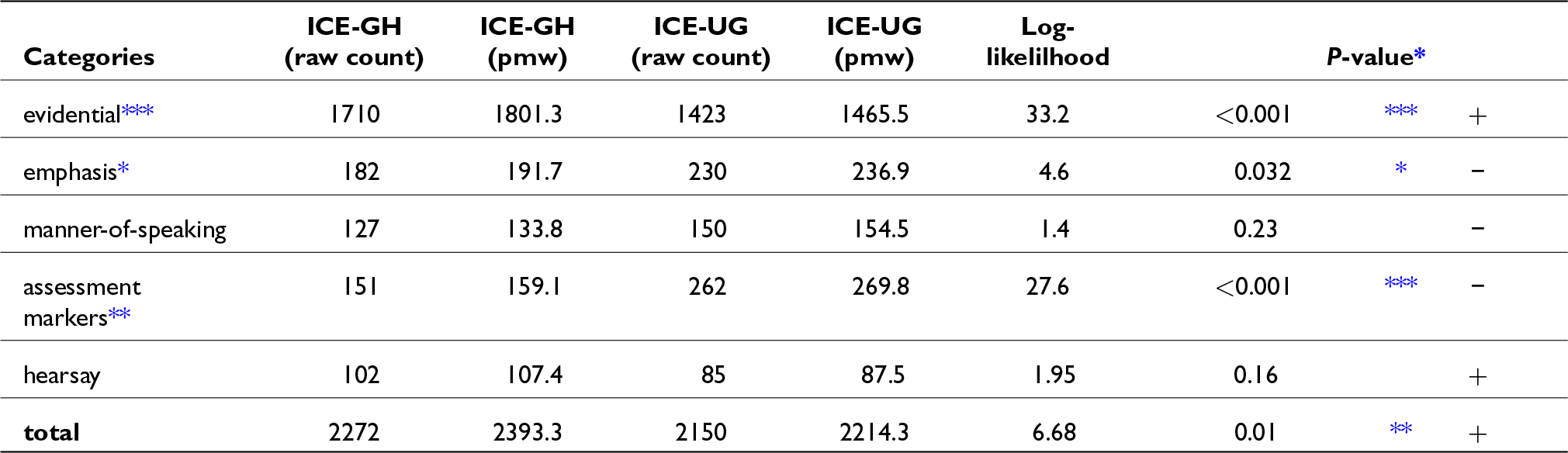
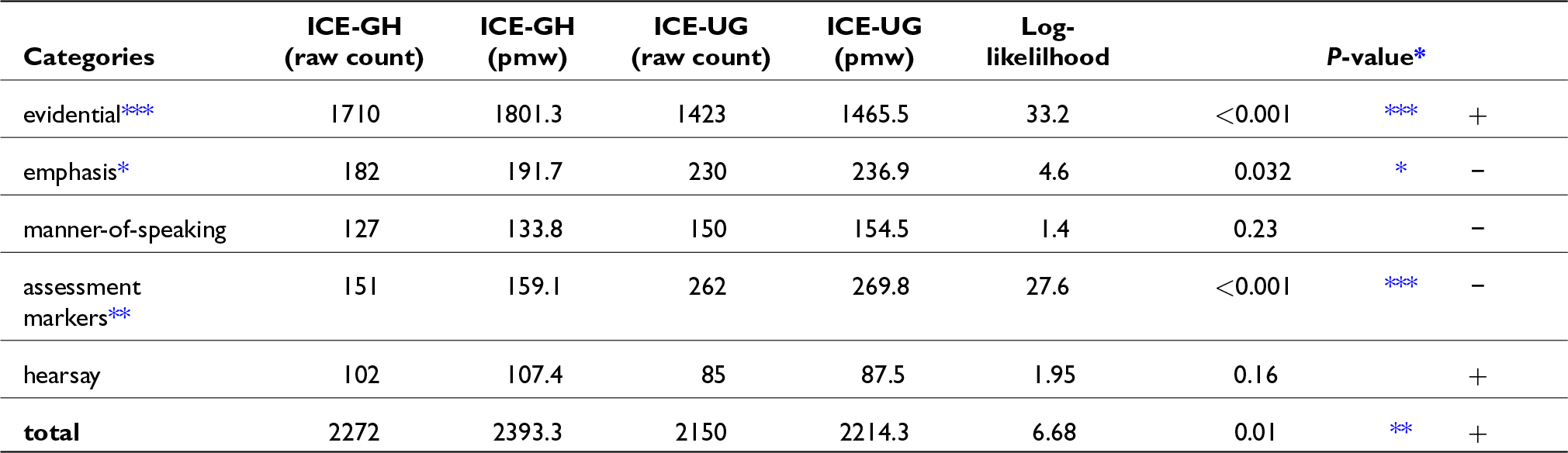
Table 1 shows overall that CPMs occur more significantly in ICE-GH (2385.9pmw) than in ICE-UG (2212.2pmw) with a p-value of 0.012. Table 1 further shows that evidential markers occur significantly more frequently in ICE-GH than in ICE-UG, while emphasis and assessment markers occur significantly more frequently in ICE-UG than in ICE-GH. There are no significant differences in the frequency of manner-of-speaking and hearsay markers. Table 1 indicates that in both ICE-GH and ICE-UG, evidential markers have the highest frequency, followed by emphasis markers. While manner-of-speaking markers are the third most frequent group in ICE-GH, assessment markers are the third most frequent group in ICE-UG. In both corpora, hearsay markers have the least frequency. These results corroborate the findings of previous studies on CPMs (Collins Reference Collins2022; Unuabonah and Gut Reference Unuabonah and Gut2018), which indicate that evidential markers have the highest frequency while hearsay markers have the lowest frequency among CPM categories. Out of the 173 CPMs checked in both corpora, GhE and UgE users employed 63 and 66 CPMs, respectively. Only CPMs that appeared at least in one of the corpora are listed in Tables 2 to 6.
Overall frequency and log-likelihood ratios of CPMs in ICE-GH and ICE-UG
* slightly significant (5%)
** significant (1%)
*** highly significant (< 1%), + (P value indicates a higher frequency of CPMs in ICE-GH over ICE-UG), − (P value indicates a lower frequency of CPMs in ICE-GH than in ICE-UG)
Evidential markers in ICE-GH and ICE-UG
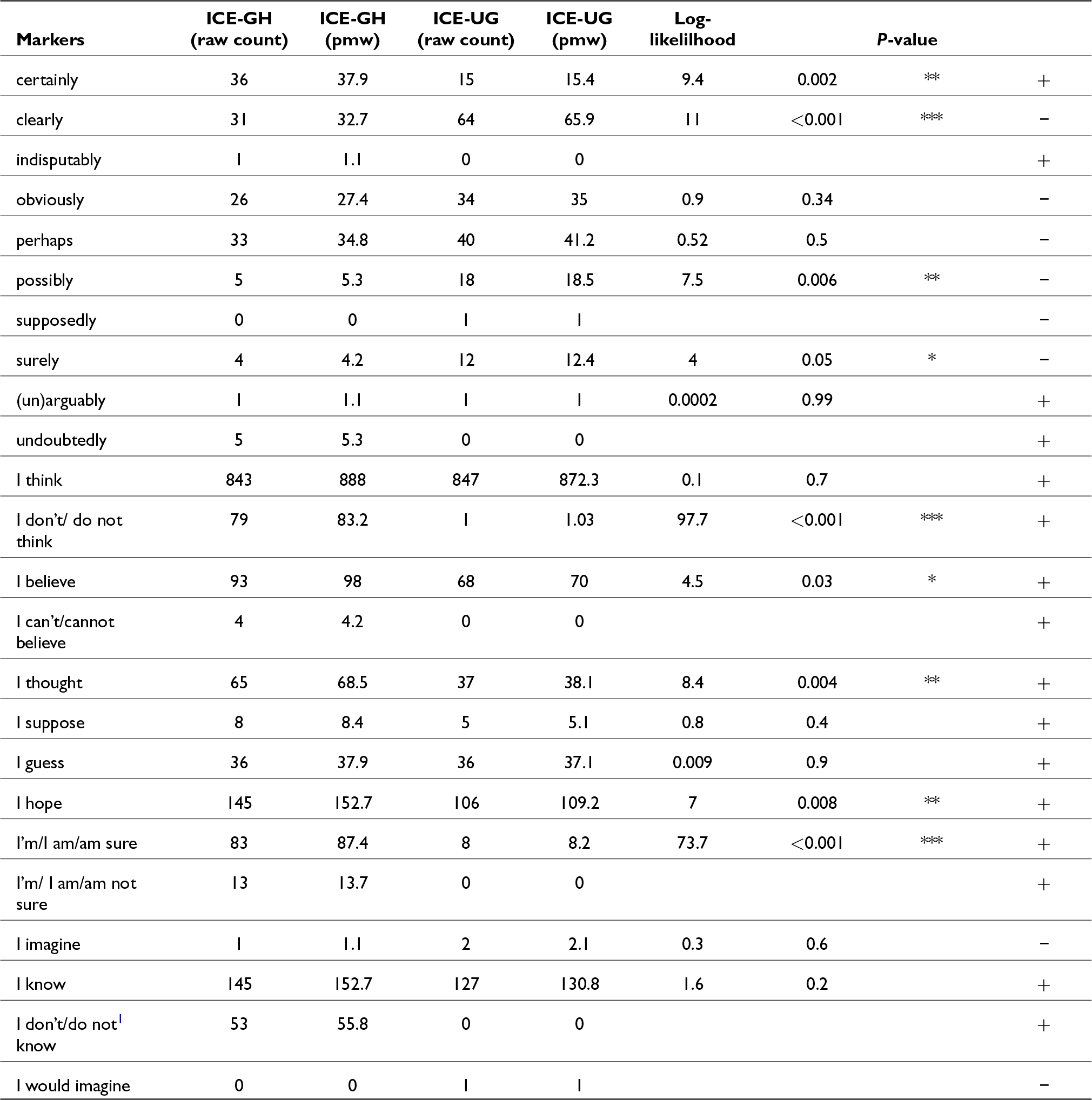
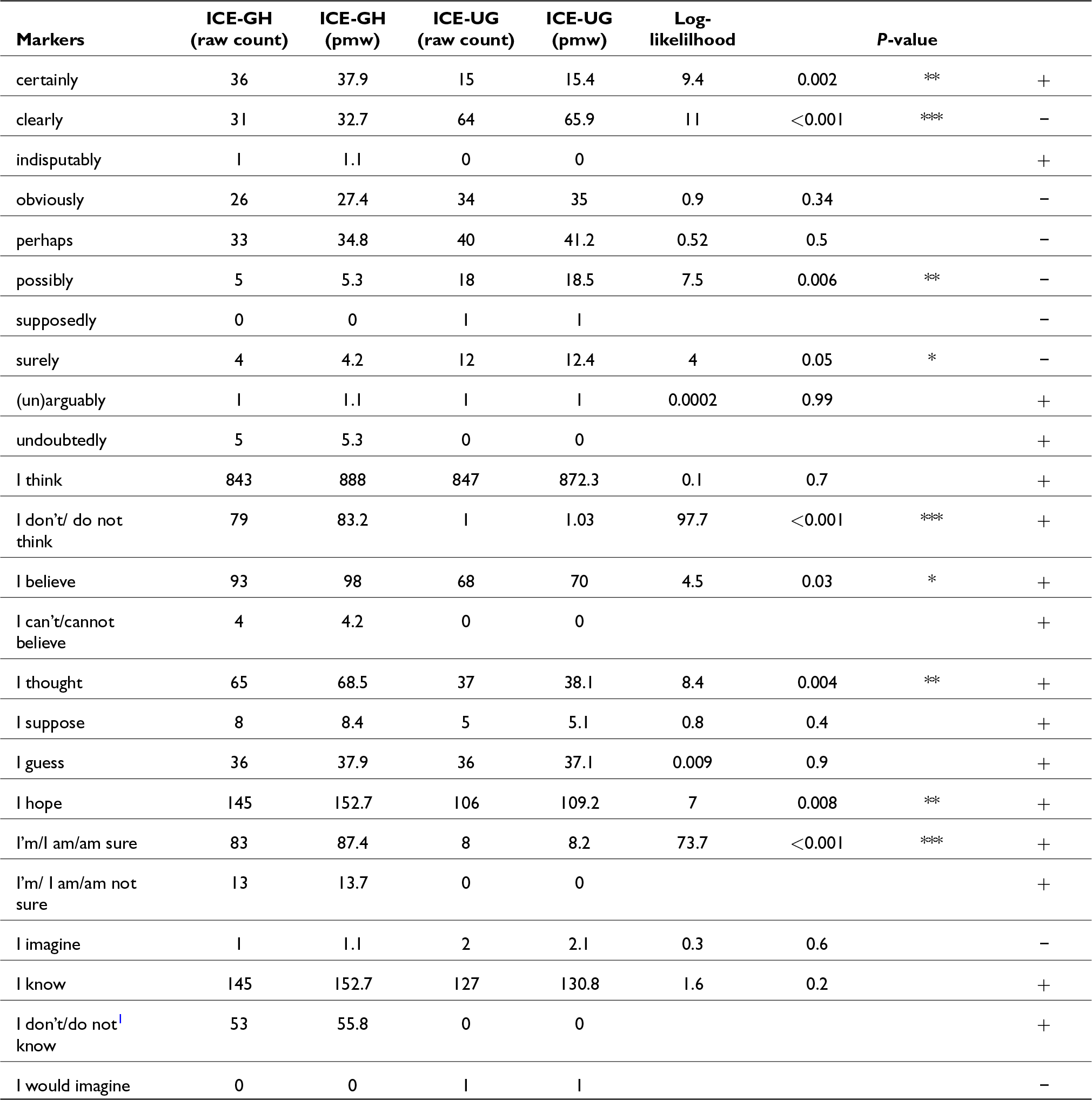
Table 2 displays the frequency and log-likelihood ratios of evidential PMs in ICE-GH and ICE-UG. Out of 43 evidential markers that were checked, GhE users employed 22 while UgE users utilised 18 evidential markers. Table 2 shows that the clausal evidential markers I think, I hope and I know have the highest frequencies in both corpora. What is striking is the absence of clausal evidential markers such as I don’t know and I’m/I am not sure and the very rare appearance of I don’t/ I do not think and I’m/I am not sure in ICE-UG. Moreover, Table 2 shows that certainly, I believe, I thought, I hope, and I’m/I am sure are significantly higher in ICE-GH than in ICE-UG while clearly, possibly and surely are markedly higher in ICE-UG than in ICE-NIG; with the remaining markers, there are no significant differences. Markers such as essentially, fundamentally, indisputably, supposedly, unarguably, I imagine and I would imagine are not used or are very rarely used in both corpora. The qualitative analysis of I don’t think, I don’t know and I’m/I am not sure indicates that these markers signal uncertainty, as in (9), (10) and (11), respectively. These markers are also used to mitigate a face-threatening act or signal what the speakers do not want to do, as in (12), (13) and (14), respectively.
(9) . . . of course they will get an away goal but i don’t think Chelsea will allow them to score them this point (ICE-GH_S1A_033)
(10) I I I don’t know are you are you aware we are playing uh Gha Gha Ghana (ICE-GH_S1A_023)
(11) . . . oh it was so fuuny those tiny Indian children iI think they are Chinese or indian I’m not sure (ICE-GH_S1A_041)
(12) . . . stay at Adenta but I don’t think that I’d like to go there (ICE-GH_S1A_001)
(13) I have made this observation I don’t know it may it it may not be uh uh uhm a good uhm how do I call it (ICE-GH_S1A_006)
(14) . . . and I’m like okay well this is nice but I’m not sure I want to remain in the media (ICE-GH_S1A_097)
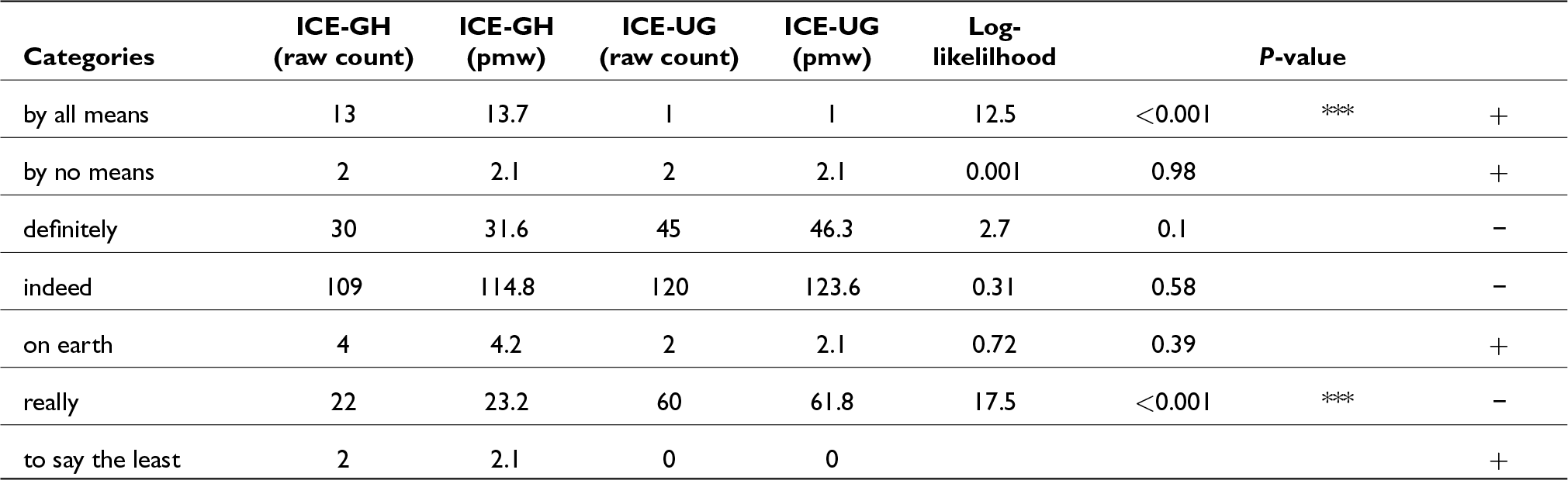
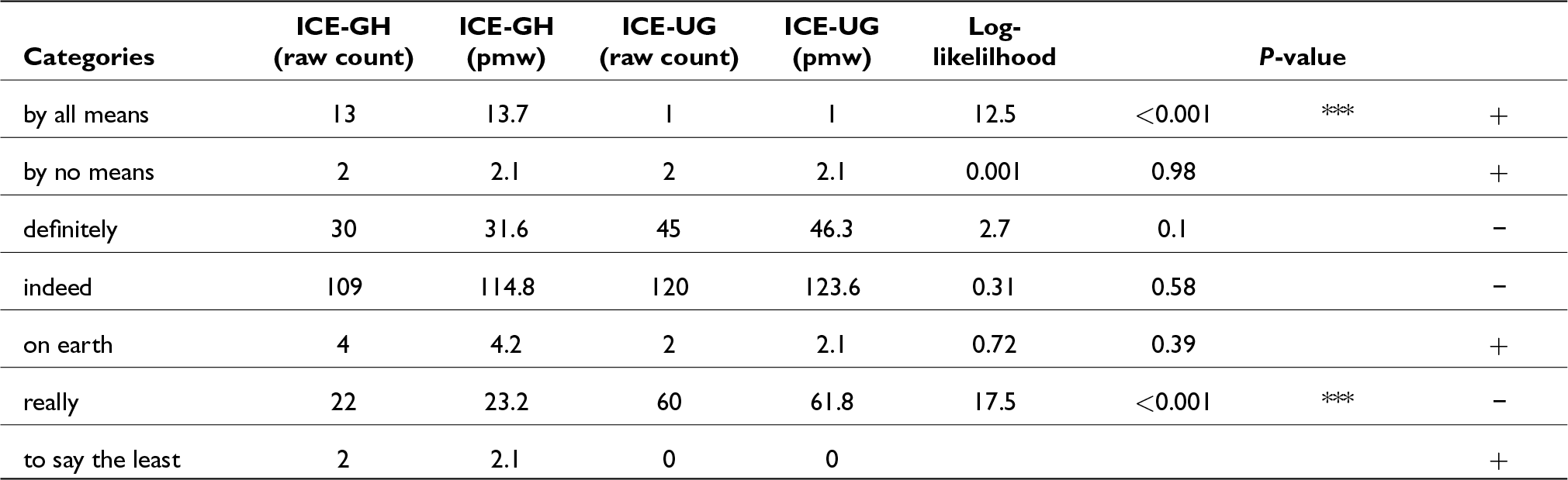
Table 3 shows the frequency and log-likelihood ratios of emphasis PMs in ICE-GH and ICE-UG. Out of 14 emphasis markers that were checked, GhE users utilised 7 while UgE users employed 6 emphasis markers. Table 3 shows that, in both corpora, indeed is the most frequent emphasis PM, followed by definitely and really in ICE-GH, and really and definitely in ICE-UG. All other emphasis markers are rarely used in both corpora. This is somewhat similar to what obtains in ICE-NIG where really is the most frequent emphasis marker, followed by indeed and definitely (Unuabonah and Gut Reference Unuabonah and Gut2018). Table 3 also shows that really is significantly higher in ICE-UG than in ICE-GH while by all means is significantly higher in ICE-GH than in ICE-UG; there are no significant differences in the frequency of the remaining emphasis markers. The preference for by all means in ICE-GH is interesting because it does not occur in ICE-NIG and is rarely used in ICE-GB (Unuabonah and Gut Reference Unuabonah and Gut2018). In ICE-GH, by all means appears both in formal and informal spoken and written texts, as in (15) and (16). It may also appear in clause-initial, clause-medial and clause-final positions, as in (15), (16) and (17), respectively.
(15) By all means study your notes and course material but make time to read widely. (ICE-GH_W2D-11)
Table 3.Emphasis markers in ICE-GH and ICE-UG

(16) . . . he will by all means be brought into the world (ICE-GH_W1A_14)
(17) . . . you are not super human by all means (ICE-GH_S1A_22)
The qualitative analysis of indeed indicates that indeed occurs at clause-initial, clause-medial and clause-final positions, as in (18), (19) and (20), respectively:
(18) Indeed i would walk out of church if this thing is said again today (ICE-GH_S1A_05)
(19) We indeed said that research is a systematic and scientific process (ICE-UG_S1B_16)
(20) You are swift and committed to welfare indeed (ICE-UG_W1B_08)
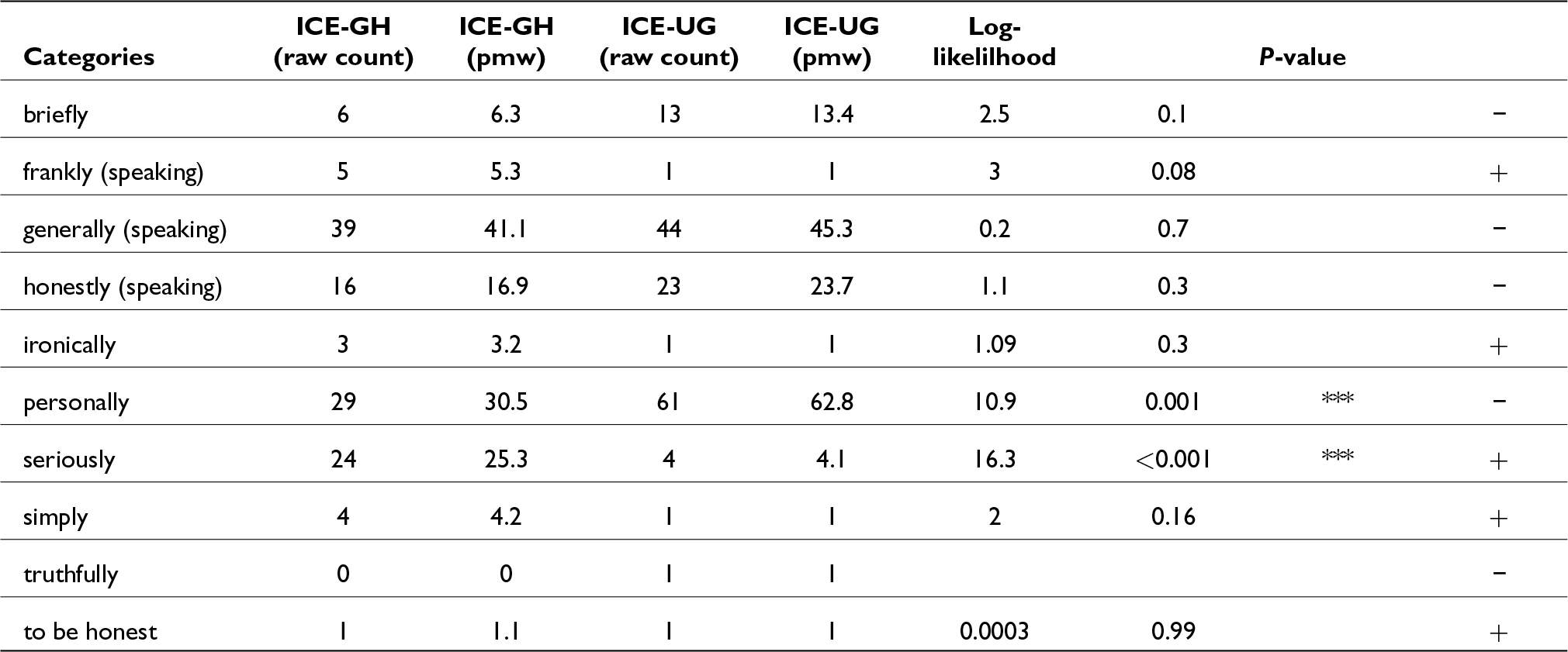
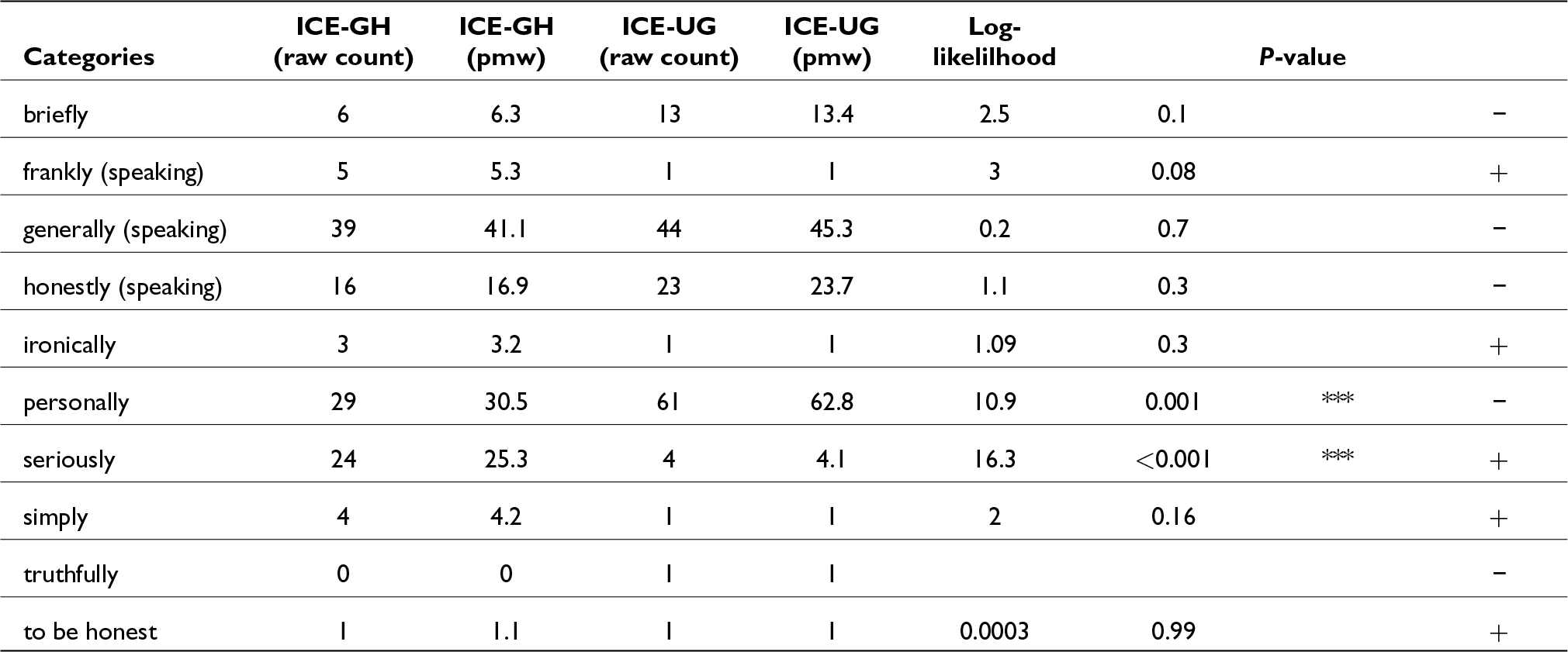
Table 4 shows the frequency and log-likelihood ratios of manner-of-speaking PMs in ICE-GH and ICE-UG. 41 manner-of-speaking markers were checked; however, GhE users utilised 7 while UgE users employed 6 manner-of-speaking markers, as shown in Table 4. Table 4 shows that in ICE-GH, generally (speaking) is the most frequent manner-of-speaking marker followed by personally and seriously and these results slightly differ from ICE-UG, where personally is the most frequent manner-of-speaking marker followed by generally (speaking) and honestly (speaking). Some of these results also hold true for other AfE varieties such as NigE, where the markers generally, honestly and personally are the three most frequent manner-of-speaking markers (Unuabonah and Gut Reference Unuabonah and Gut2018). Table 4 further shows that seriously is significantly higher in ICE-GH than in ICE-UG while personally is significantly higher in ICE-UG than in ICE-GH. This indicates a preference for seriously in GhE, which contrasts with its low frequency in corpora of other varieties such as ICE-NIG and ICE-GB (Unuabonah and Gut Reference Unuabonah and Gut2018). It largely occurs at the clause-initial position but may also appear at the clause-final position, as in (21) and (22), respectively, and only appears in spoken texts, as in (22). Seriously differs from generally, which appears more in written texts (N = 25) than in spoken texts (N =14) in ICE-GH, as in (23) and (24) respectively, while it occurs more in spoken texts (N = 29) than in written texts in ICE-UG (N = 18), as in (25) and (26), respectively.
Manner-of-speaking markers in ICE-GH and ICE-UG
(21) Seriously, you you really are preaching me. (ICE-GH_S1A_84)
(22) But that’s not the case seriously (ICE-GH_S1A_67)
(23) Generally, older people tend to sleep less (ICE-GH_W2B_21)
(24) And the vocabulary generally I think it’s des-Anglo-Saxon (ICE-GH_S1B_08)
(25) Coz generally <,> the prefects are our voice (ICE-UG_S1A_35)
(26) Generally, the prices cut across all these breeds depending on age (ICE-UG_W2B_38)
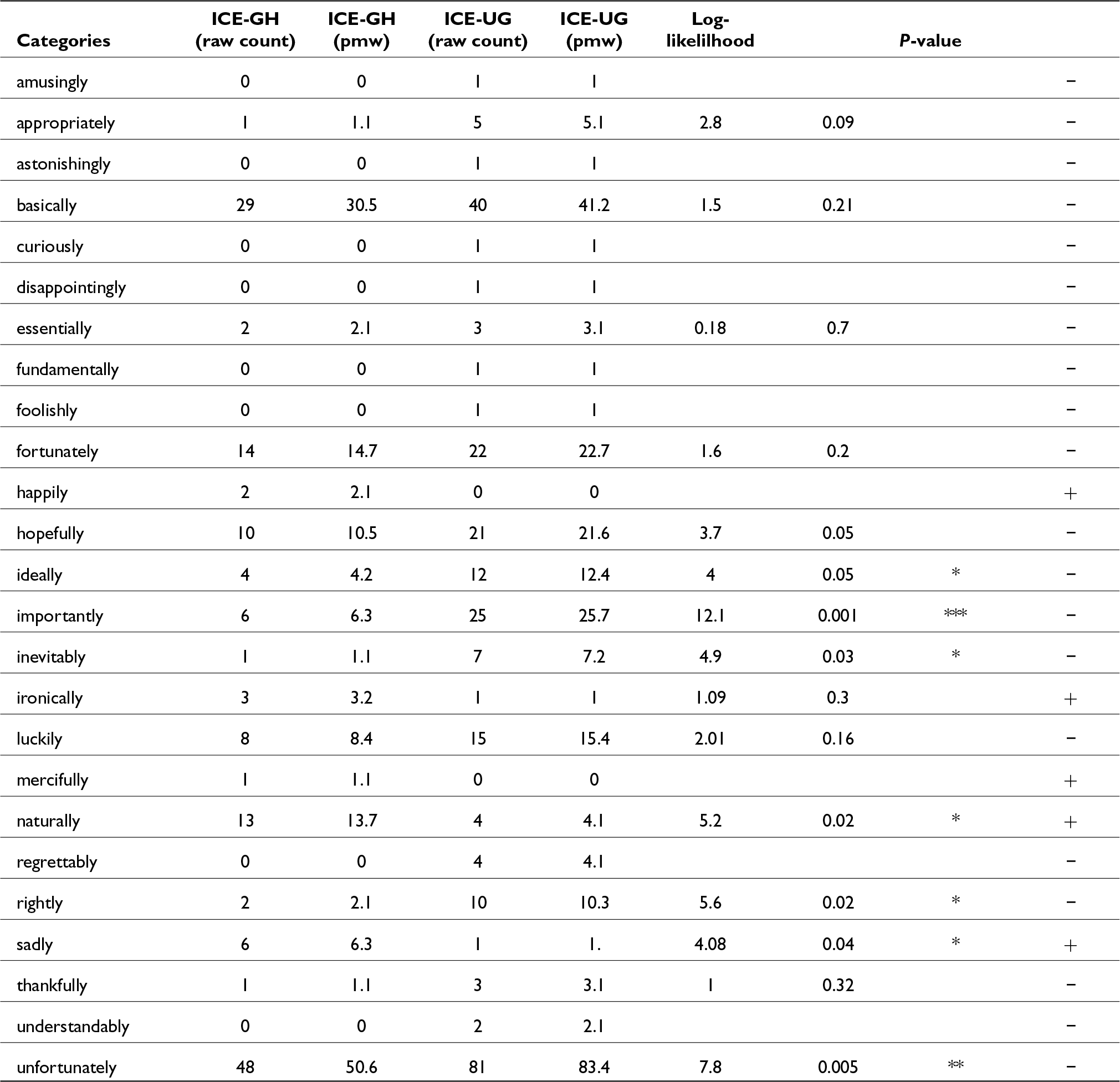
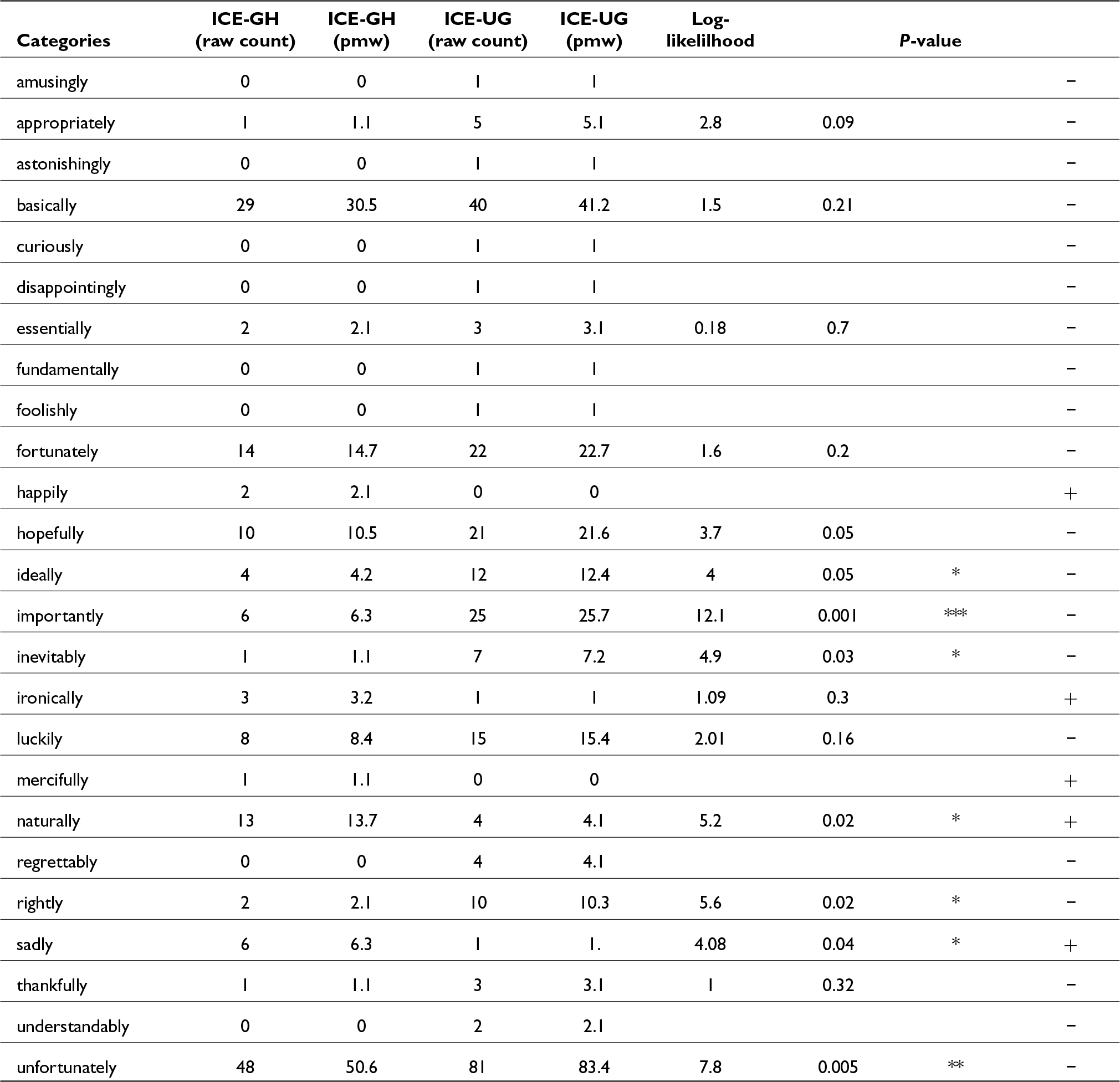
Table 5 displays the frequency and log-likelihood ratios of assessment PMs in ICE-GH and ICE-UG. 58 assessment markers were checked; however, GhE and UgE users utilised only 17 and 23 assessment markers, respectively. Table 5 indicates that unfortunately is the most frequent assessment marker in both corpora, followed by naturally and fortunately in ICE-GH, and importantly and fortunately in ICE-UG. A part of this result is shared with findings for NigE and BrE, where unfortunately is the most frequent assessment marker (Unuabonah and Gut Reference Unuabonah and Gut2018). Table 5 also shows that ideally, importantly, inevitably, rightly and unfortunately are significantly higher in ICE-UG than in ICE-GH while naturally and sadly are significantly higher in ICE-GH than in ICE-UG. There are no significant differences in the rest of the assessment markers. Markers such as amusingly, appropriately, astonishingly, disappointingly, foolishly, mercifully, regrettably, and understandably are not used or rarely used in both corpora.
Assessment markers in ICE-GH and ICE-UG
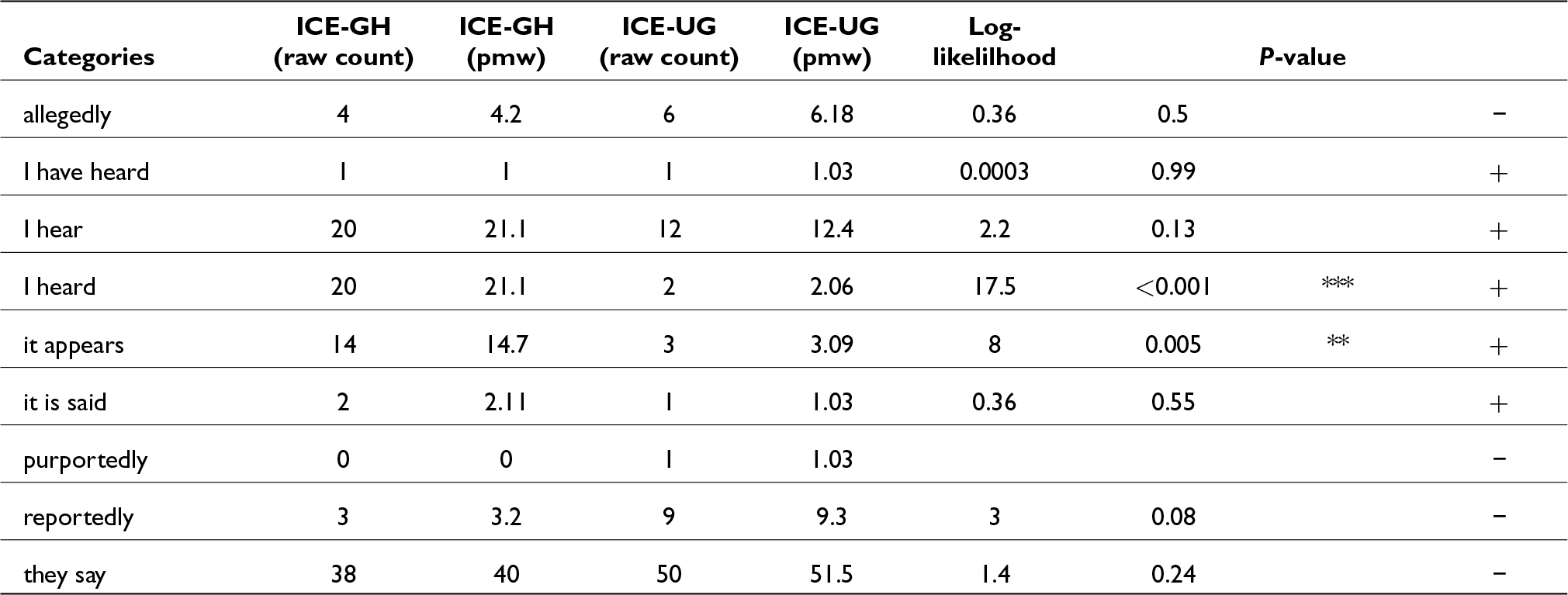
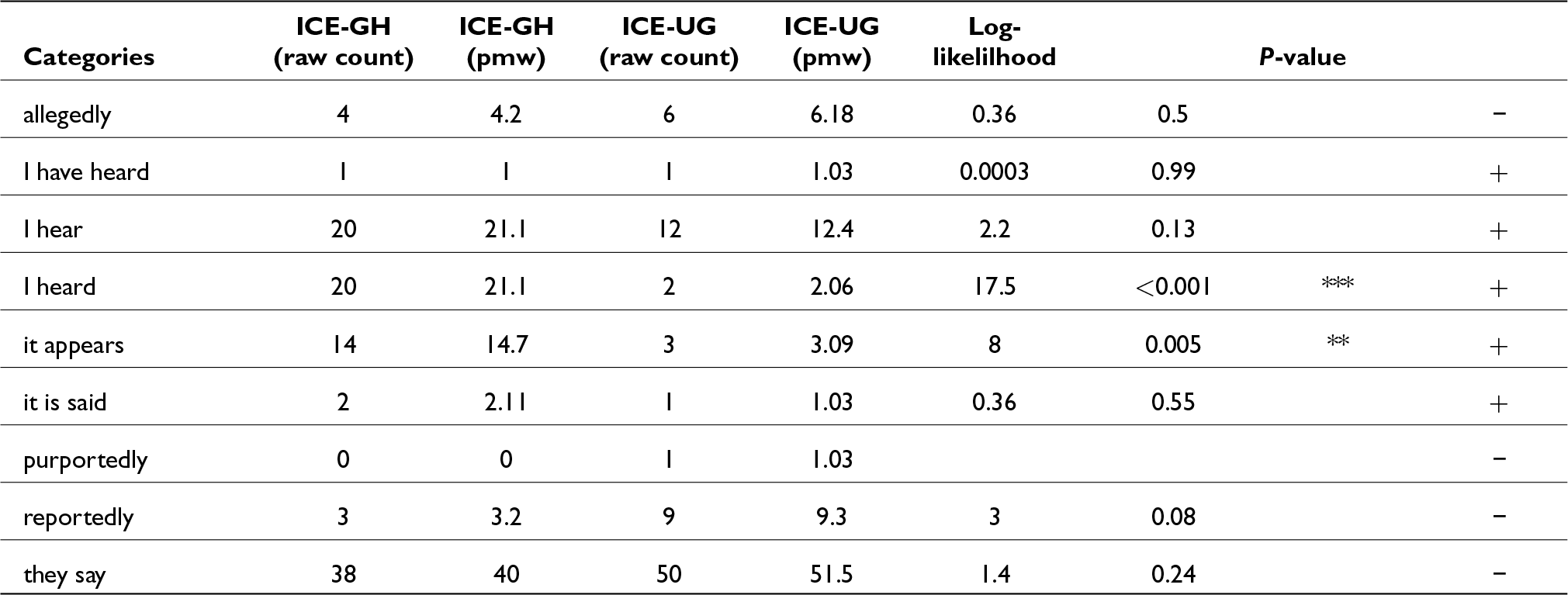
Hearsay markers in ICE-GH and ICE-UG
One thing that is striking about unfortunately in UgE is that it tends to occur more frequently in public dialogues and monologues (N = 38; 46.9%), as in (27), which are formal contexts, and written texts (N=33; 40.7%), as in (28), than in private dialogues (N = 10; 12.3%), as in (29). These findings apply also to ICE-GH, where unfortunately occurs more often in public dialogues and monologues (N = 21; 43.8%) and written texts (N=22; 45.8%) than in private dialogues (N = 5; 10.4%).
(27) and sometimes unfortunately students are in the school or uh they are out the school right (ICE-UG_S1B_020)
(28) but unfortunately, there is limited supply and access to this form of energy. (ICE-UG_W2B_037)
(29) But unfortunately we lost in the final (ICE-UG_S1A-06)
Table 6 displays the frequency and log-likelihood ratios of hearsay markers in ICE-GH and ICE-UG. Out of 17 hearsay markers that were checked, GhE and UgE users utilised only 8 and 9 hearsay markers, respectively. Table 6 indicates that they say is the highest hearsay marker in both corpora, as in (30) and (31), followed by I hear and I heard in ICE-GH and I hear and allegedly in ICE-UG. These findings corroborate results for NigE, where they say and I hear are the two most frequent hearsay markers, which are markers that are not common in Inner Circle Englishes such as BrE (Unuabonah and Gut Reference Unuabonah and Gut2018). As in NigE, the use of they say in GhE and UgE is sometimes tied to the use of proverbs, as in (32). Table 6 also shows that I hear and it appears are significantly higher in ICE-GH than in ICE-UG, while there are no significant differences in the frequency of the remaining hearsay markers between both corpora. Instances of I hear and I heard are indicated in (33) and (34), respectively:
(30) They say he killed a girl he killed his girlfriend (ICE-GH_S1A_003)
(31) They say that babies born by caesarean section can show signs of being angry (ICE-UG_W2B_026)
(32) They say the road to hell is paved with good intentions (ICE-UG_S2B_009)
(33) but I hear <indig> mbu </indig> he is uh <,> involved in the death of Kirumira (ICE-UG_S1A_032)
(34) but I heard I heard there was this new new estate area in Tamale (ICE-GH_S1A_030)
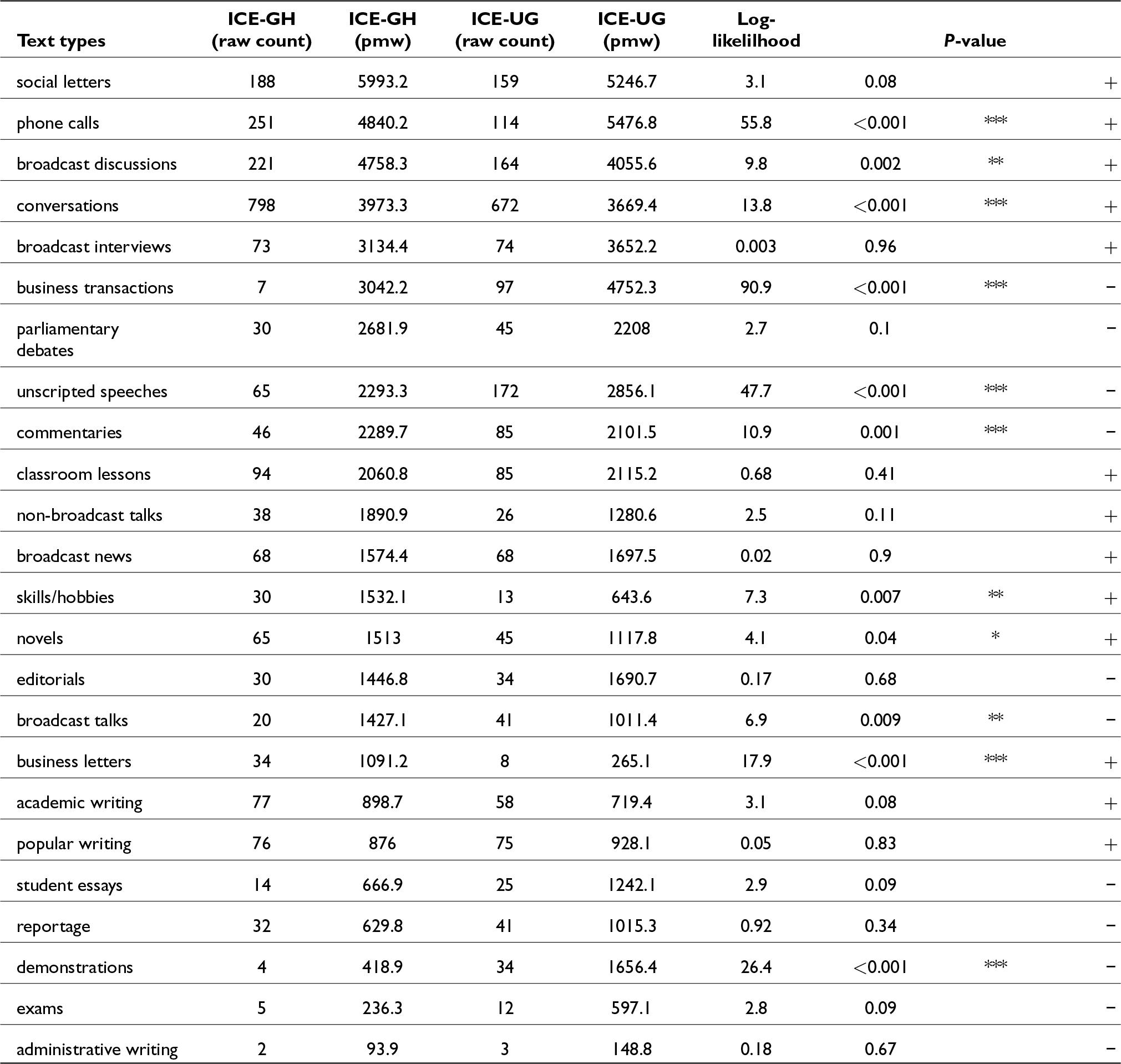
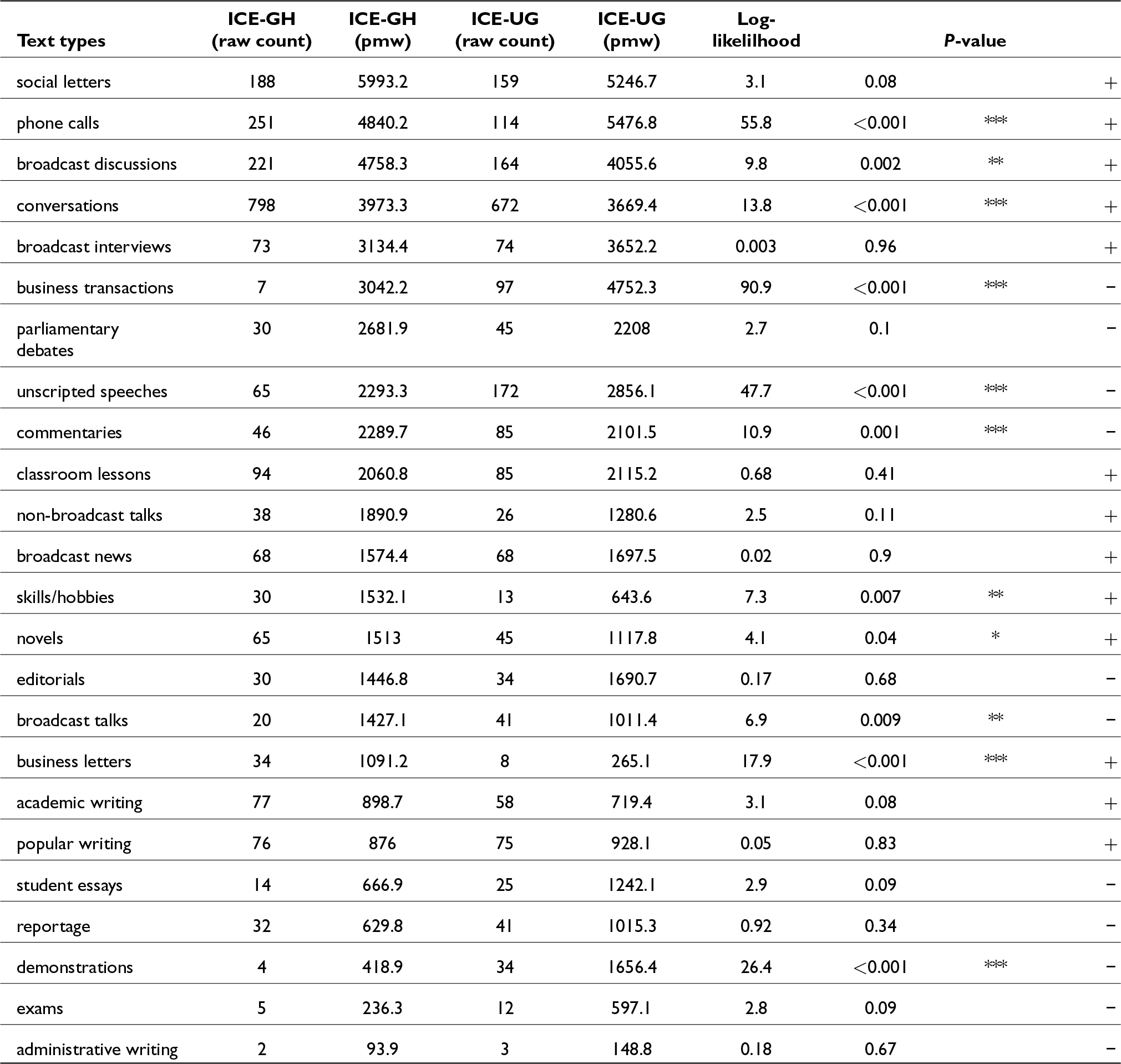
Table 7 displays the frequencies and log-likelihood ratios of CPMs across different text categories in ICE-GH and ICE-UG. Table 7 shows that CPMs occur most frequently in ICE-GH social letters, phone calls and broadcast discussions, which is somewhat related to the findings for ICE-UG, where CPMs appear most frequently in phone calls, social letters and business transactions. The implication is that CPMs often arise in informal writing and private and public dialogues. The table also indicates that CPMs least appear in administrative writing in both corpora. Table 7 further indicates that CPMs occur more significantly in ICE-GH phone calls, broadcast discussions, conversations, skills/hobbies, novels and business letters than in their ICE-UG counterparts, implying that CPMs occur significantly more frequently in ICE-GH dialogues and printed writing than in ICE-UG dialogues and printed writing. On the other hand, CPMs occur significantly more frequently in ICE-UG business transactions, unscripted speeches, commentaries, broadcast talks and demonstrations than in the equivalent ICE-GH text types, indicating that CPMs arise more frequently in ICE-UG monologues than in ICE-GH monologues. In the remaining 13 text types, there are no significant differences in the frequency of CPMs between ICE-GH and ICE-UG.
CPMs across different text types in ICE-GH and ICE-UG
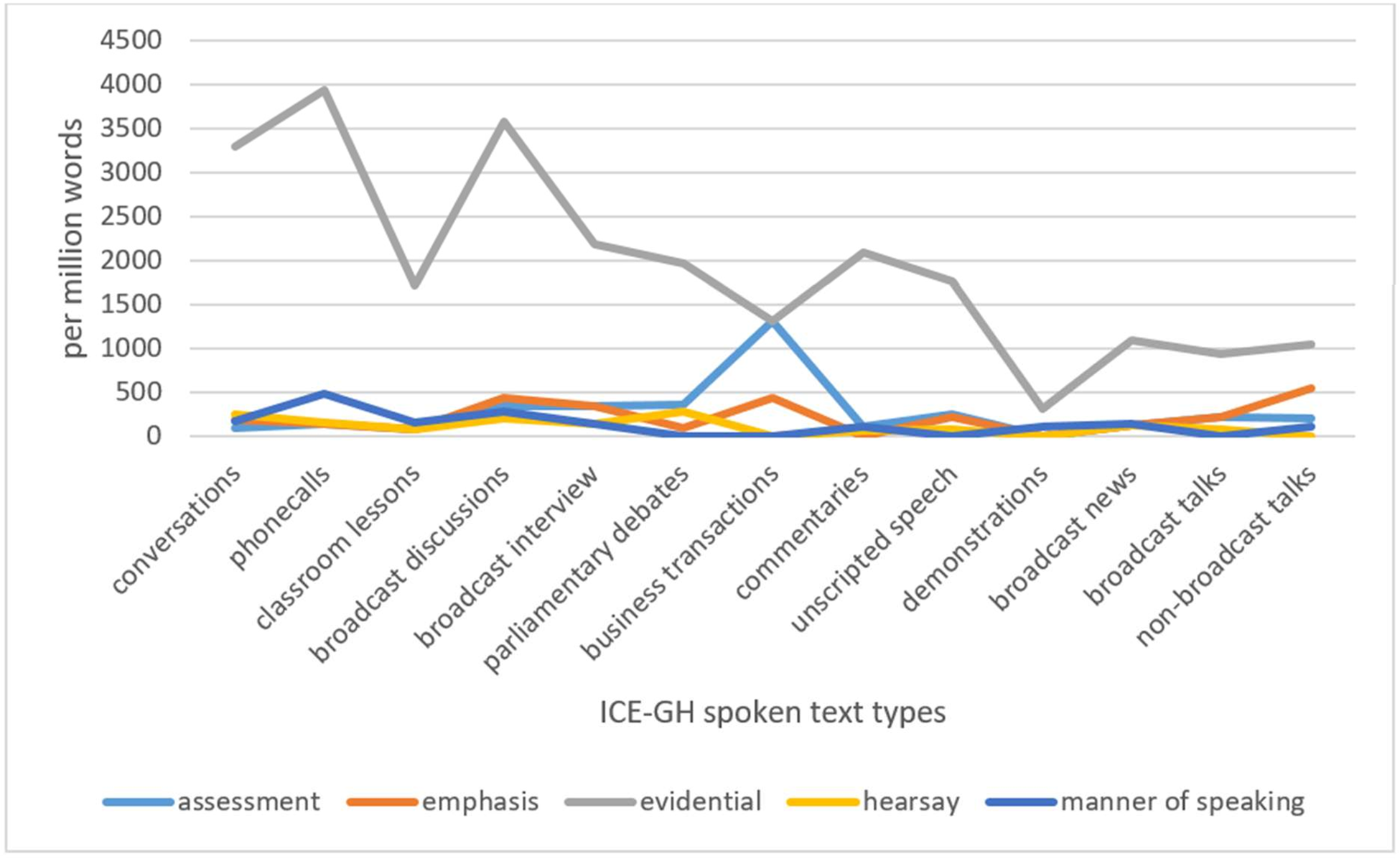
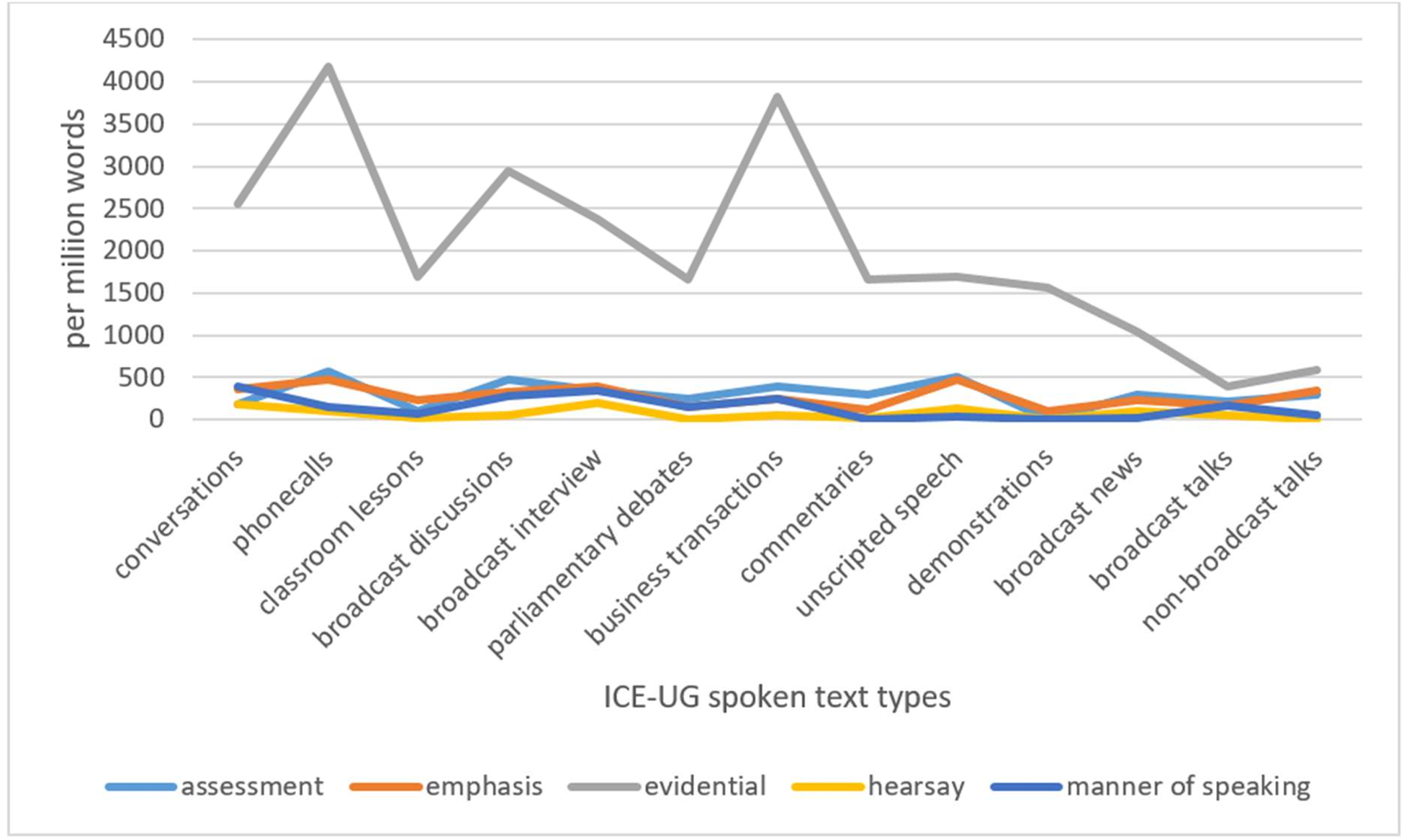
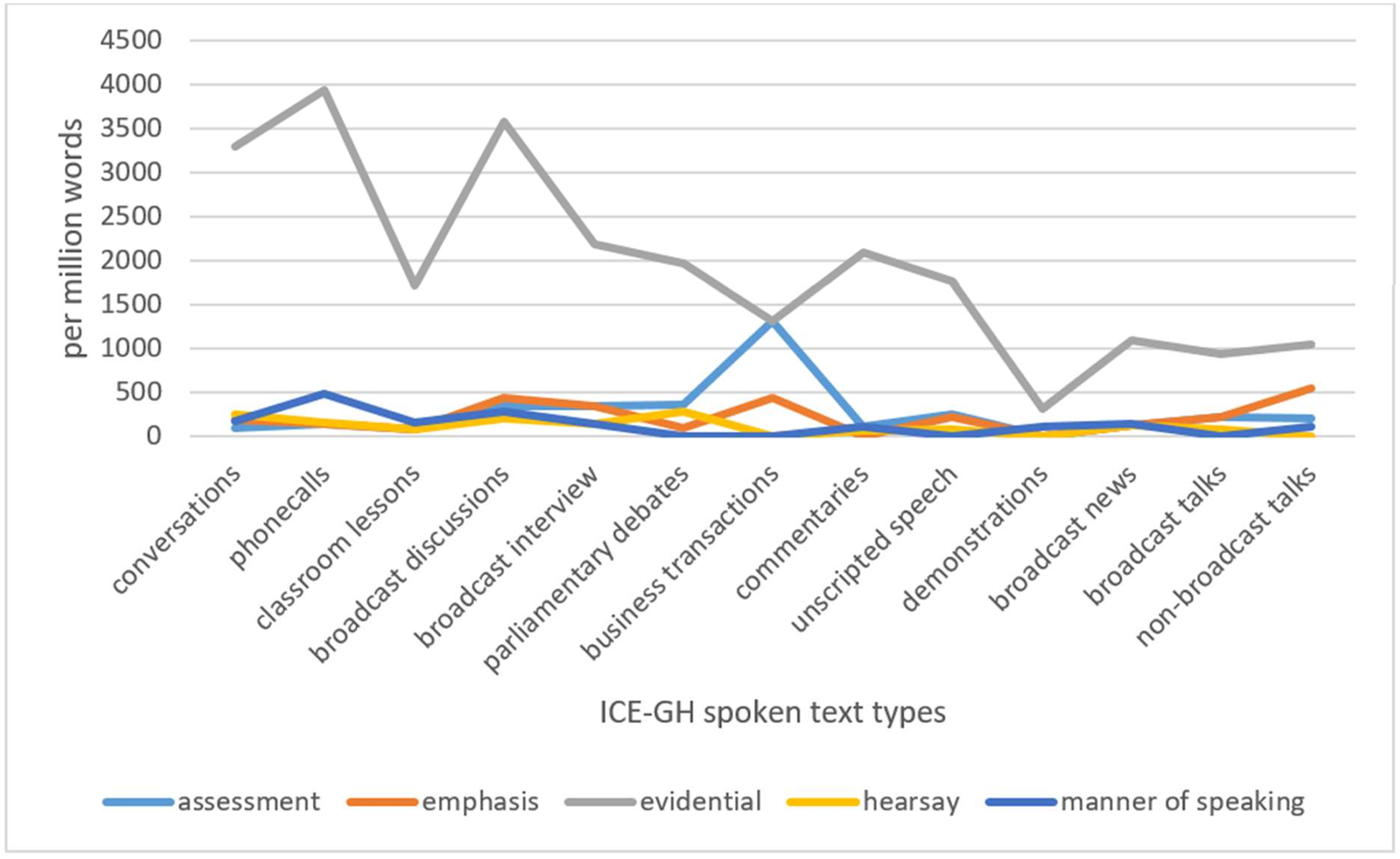
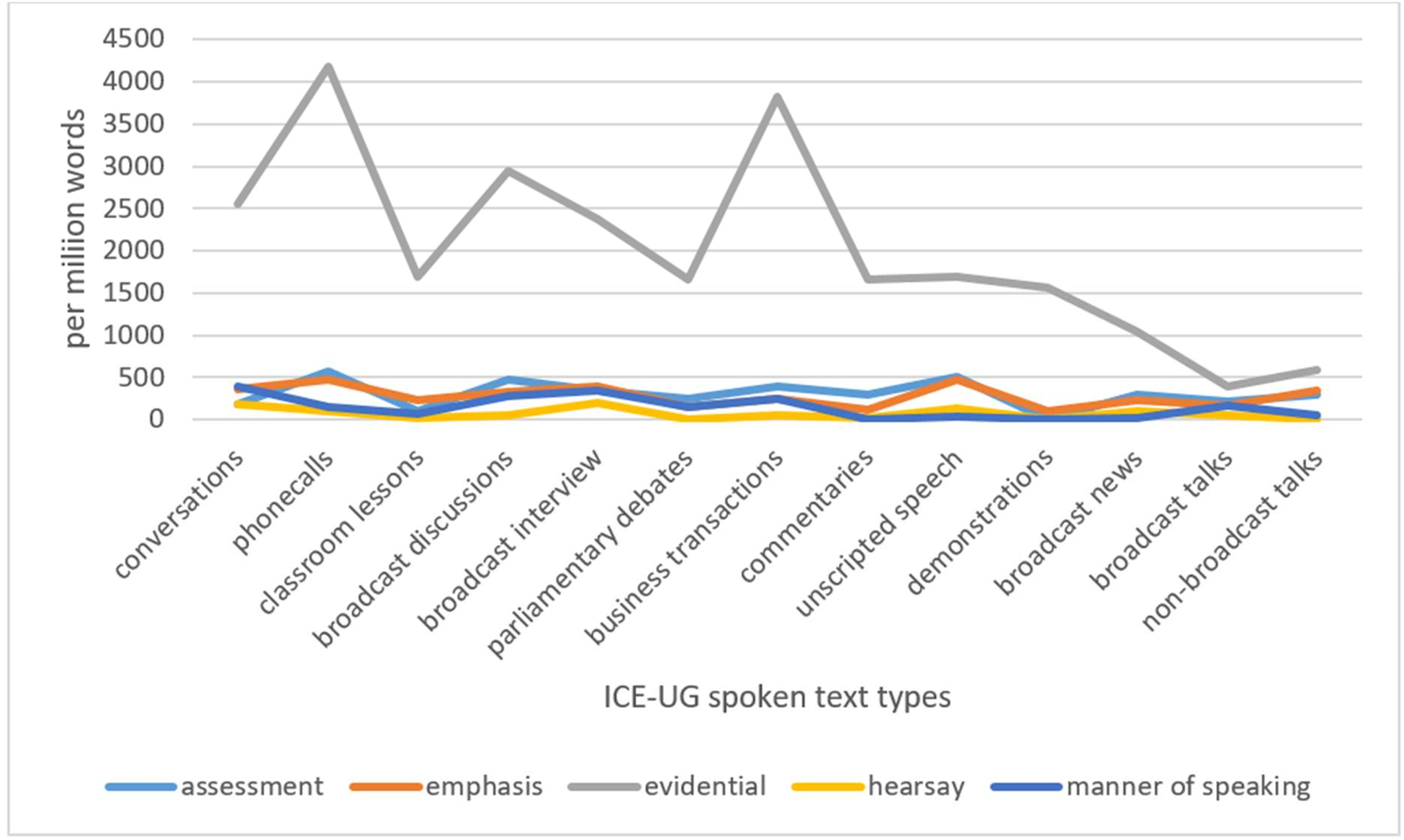
Further analysis was done in order to investigate the frequency of groups of CPMs across the different text categories. Figures 1 and 2 display the results for ICE-GH and ICE-UG spoken text categories, respectively. Figures 1 and 2 show some similarities in the frequency of groups of CPMS between ICE-GH and ICE-UG text categories. Across all the text types, evidential markers have the highest frequencies. A few differences can be found in the high rate of evidential markers in ICE-UG business transactions compared with its fairly low frequency in ICE-GH business transactions, and a high rate of assessment markers in ICE-GH business transactions compared with its low rate in ICE-UG business transactions. There is also a low rate of evidential markers in ICE-GH demonstrations compared with its frequency in ICE-UG demonstrations. The remaining markers occur at fairly close frequencies across both corpora.
Groups of CPMs in ICE-GH spoken text types.
Groups of CPMs in ICE-UG spoken text types.
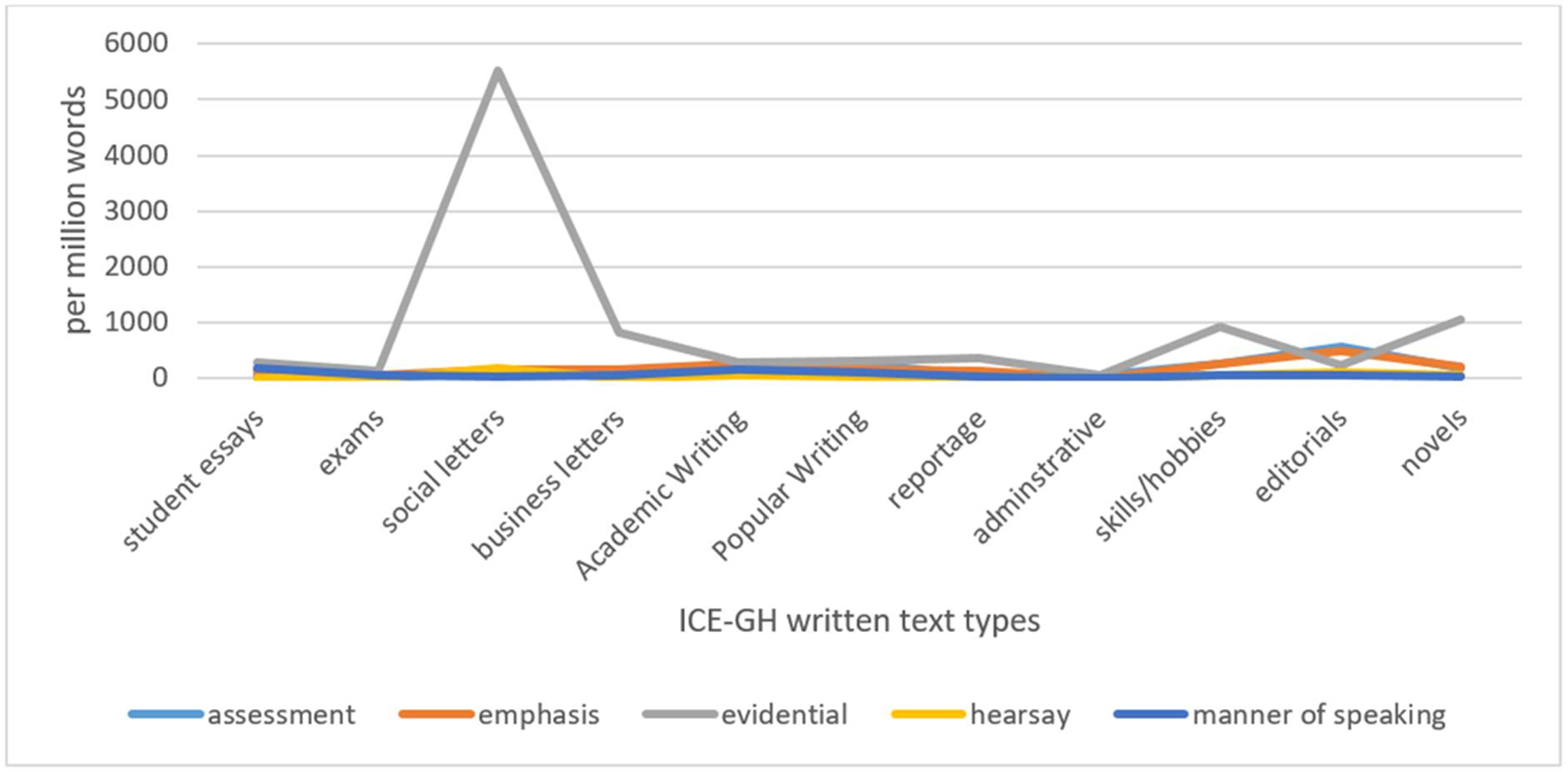
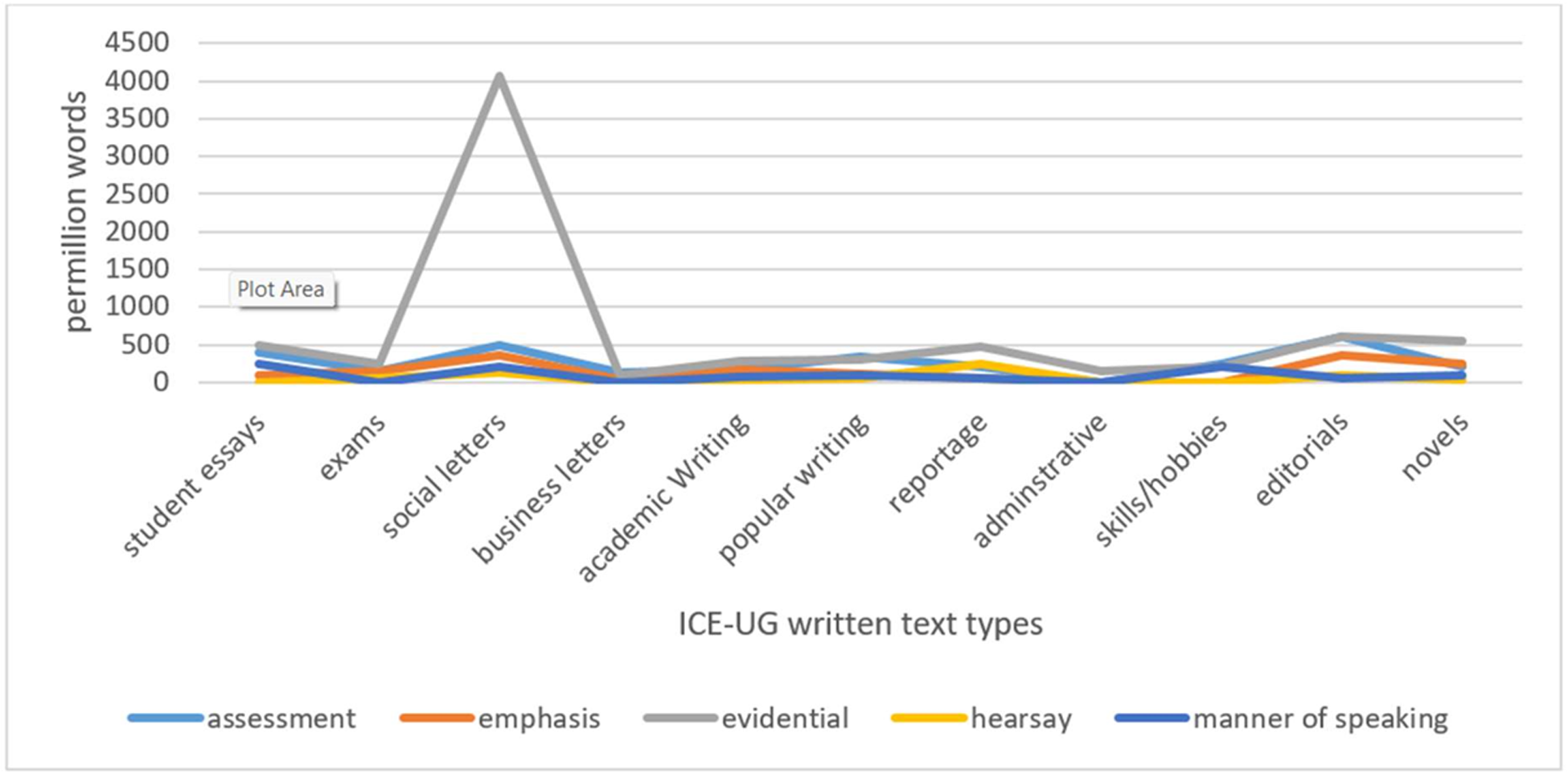
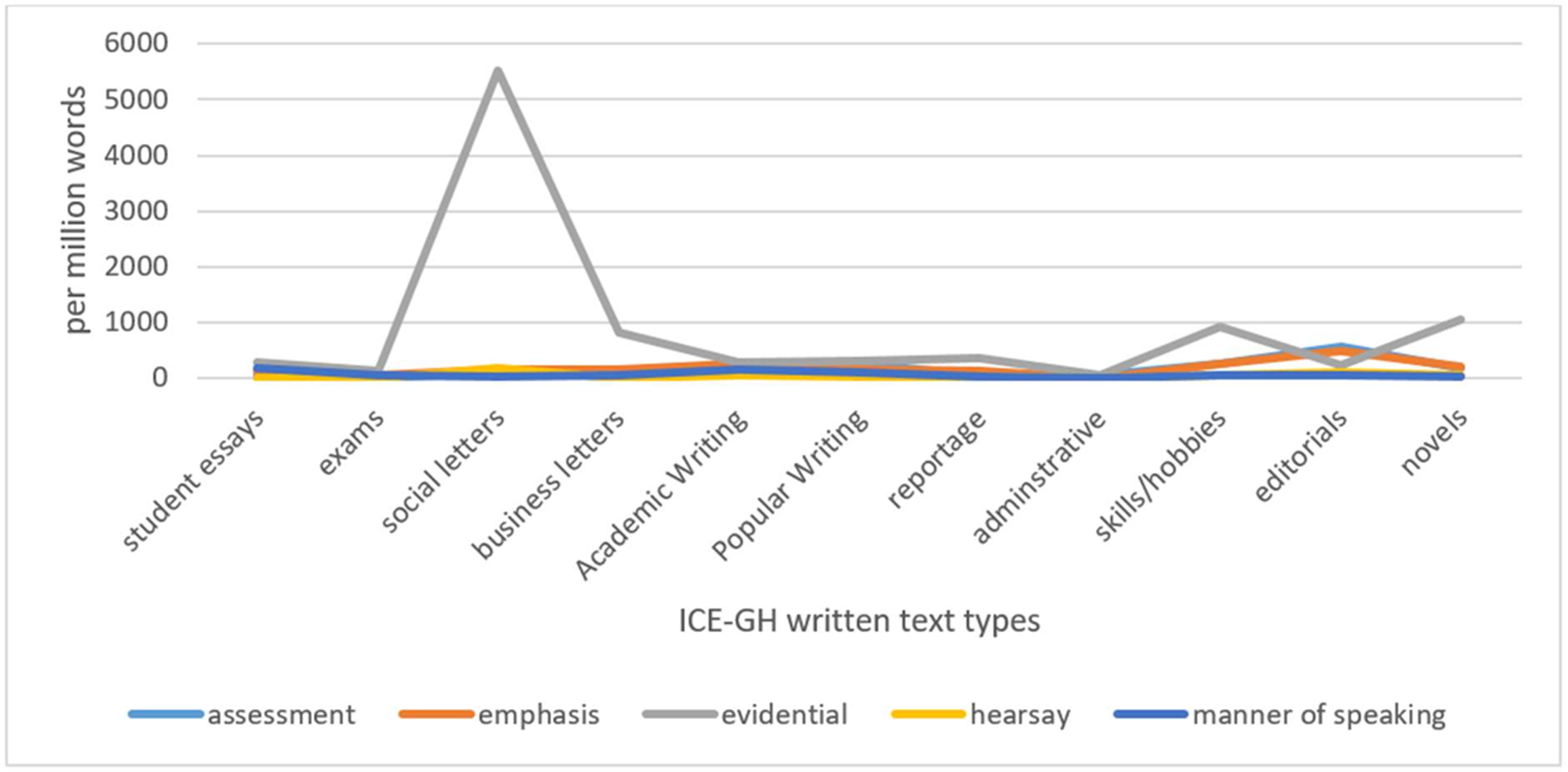
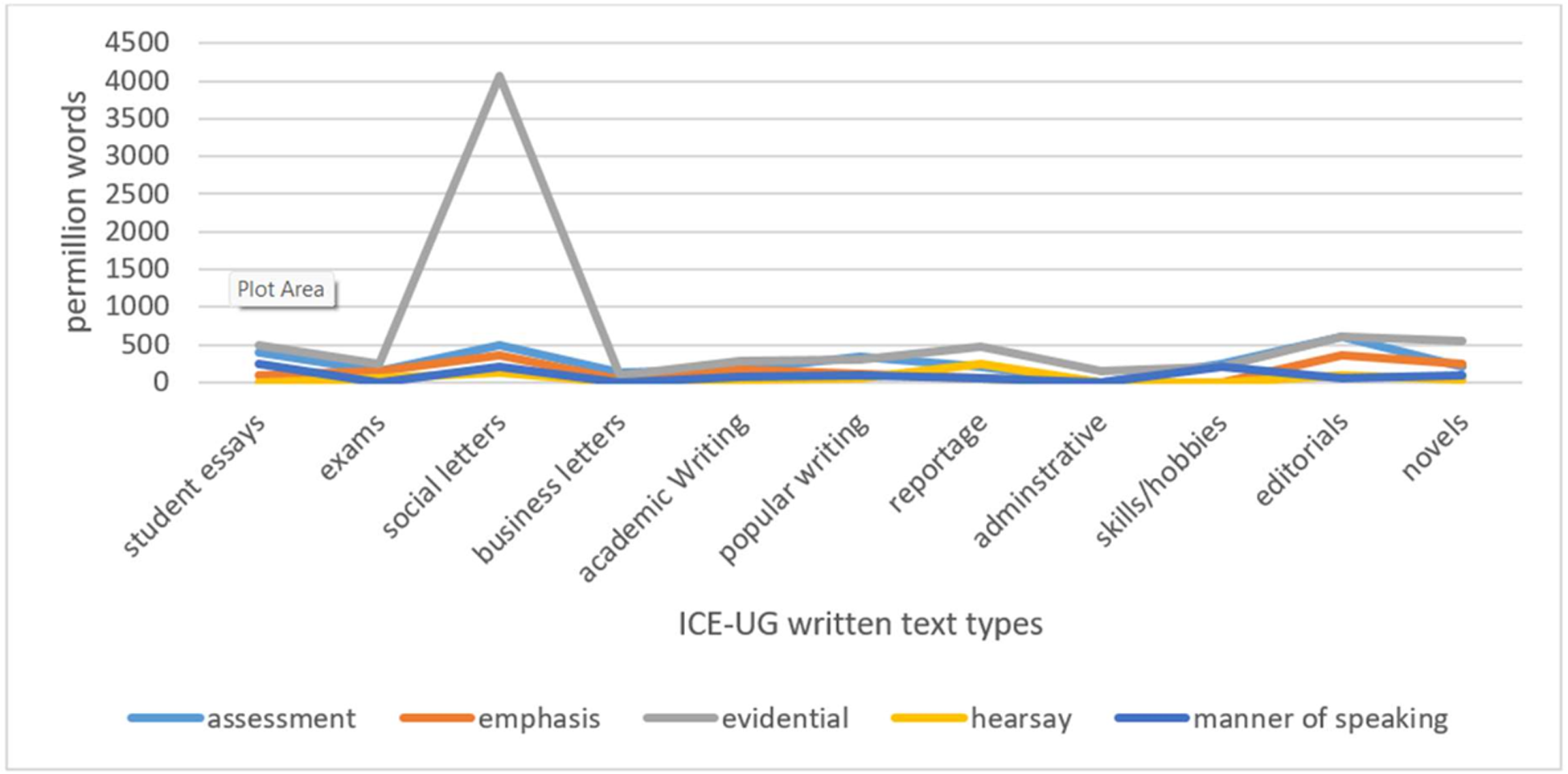
Figures 3 and 4 show the frequencies of groups of CPMs across ICE-GH and ICE-UG text categories. There are similarities in the frequencies of CPMs across ICE-GH and ICE-UG written text categories. In contrast to the frequencies of evidential markers across the different spoken text types, evidential markers have a very high frequency only in ICE-GH and ICE-UG social letters and a fairly high frequency in ICE-GH and ICE-UG novels. Evidential markers also occur fairly frequently in ICE-GH business letters and skills/hobbies while they occur fairly often in ICE-UG editorials. In other text types, there is very little difference in the frequency of the different groups of CPMs across ICE-GH and ICE-UG text categories.
Groups of CPMs in ICE-GH written text types.
Groups of CPMs in ICE-UG written text types.
5. Discussion
This study set out to achieve the following objectives: examine the frequency of CPMs in GhE and UgE, account for the similarities and differences in the use of these CPMs between the two varieties and discuss the use of these CPMs in different text types in both varieties. This section discusses the results in Section 4 and considers their implications for the two varieties and New Englishes in general.
Overall, the higher frequency of CPMs in GhE than in UgE may be linked to the status of English in both countries. Ghanaians have a longer history with English than Ugandans with English; thus, English appears more entrenched in the repertoire of Ghanaians than that of Ugandans. This may have influenced the higher frequency of CPMs in GhE than in UgE as CPMs have been reported to have a higher frequency in BrE than other Outer Circle Englishes (Collins Reference Collins2022; Unuabonah and Gut Reference Unuabonah and Gut2018). In addition, while English shares its lingua franca role with Akan in Ghana, English, Swahili and Luganda all function as lingua francas in Uganda. Thus, the competition with English in Ghana may be less than the competition with English in Uganda, particularly in informal contexts. This can be seen in the case of PMs from diverse PM groups, which occur in UgE (Isingoma Reference Isingoma, Meierkord, Isingoma and Namyalo2016a, 162) compared to GhE where the local PMs that are borrowed are fewer and restricted to emphasis PMs (Unuabonah and Anderson, Reference Unuabonah and Anderson2023).
Notwithstanding the overall higher frequency of CPMs in GhE than in UgE, there are similarities in the frequency of categories of CPMs (e.g. manner-of-speaking and hearsay markers) and frequency of individual CPMs. These similarities may be because these varieties belong to the same region and operate under the influence of local African languages that may share similar linguistic structures and cultural conceptualisations (Callies Reference Callies2017). Moreover, both varieties are at the same stage of nativisation and this might account for similarities in certain language structures, as corroborated in previous studies such as Unuabonah et al. (Reference Unuabonah, Daniel and Fifelola2025), which found similarities in the frequency of the politeness marker sorry between GhE and UgE users. In addition, some of the results of this study are similar to findings from studies on other AfE varieties such as NigE (Unuabonah and Gut Reference Unuabonah and Gut2018). For instance, Unuabonah and Gut (Reference Unuabonah and Gut2018) found 2345 CPMs resulting in 2320.9pmw in ICE-NIG, which is close to the normalised frequency of CPMs in ICE-GH and is significantly higher than CPMs found in ICE-UG. In addition, Ghana and Nigeria share similar colonial histories, with English as the official language in both countries. When compared with studies on other world Englishes (Collins Reference Collins2022; Unuabonah and Gut Reference Unuabonah and Gut2018), these results also confirm that English PMs tend to occur less frequently in Outer Circle Englishes than in Inner Circle Englishes, and this has been largely attributed to the influence of local languages and cultures, as explained later in this section. The results for hearsay markers in GhE and UgE also corroborate the findings that hearsay markers tend to occur more in Outer Circle varieties than in Inner Circle English varieties due to the former’s reliance on hearsay markers (e.g. they say and I hear) that show the influence of local languages (Collins Reference Collins2022; Unuabonah and Gut Reference Unuabonah and Gut2018). Like in NigE, the high frequency of they say and I hear may be tied to their transliteration from local languages such as ɔmo sɛ (they say) and mate sɛ (I hear/heard) in Akan and bwe bagamba (they say) and mpulira (I hear) in Luganda. Isingoma (Reference Isingoma, Meierkord, Isingoma and Namyalo2016a) also reports on the use of local Ugandan markers in UgE, such as the hearsay marker mbu (reportedly), which also appears in ICE-UG.
Apart from the overall higher frequency of CPMs in GhE than in UgE, there are significant differences in individual and groups of CPMs. The lower frequency of assessment markers in GhE markers compared with UgE may indicate that GhE users are less explicit in evaluating or judging people or events. This may also be linked to the lower frequency of the negative assessment marker unfortunately in GhE compared with UgE, which might reflect the influence of local Ghanaian languages and cultures. This situation may also be seen in the avoidance of intensifiers with historically negative meanings, e.g. terribly, frightfully and awfully in AfE varieties such as SAfE and NigE (de Klerk Reference De Klerk2005; Unuabonah et al. Reference Unuabonah, Adebileje and Oladipupo2021). The lower frequency of emphasis markers in GhE than in UgE may also be due to the use of local emphasis markers in GhE such as o as well as koraa/kraa, paa and saa in GhE, which have previously been searched for in ICE-GH (Unuabonah and Anderson Reference Unuabonah and Anderson2023). The lower frequency of evidential markers in UgE than in GhE may be attributed to the absence of evidential markers such as I’m /I am not sure, and I don’t know and the low frequency of others such as I don’t think, I’m/ I am sure and I thought in UgE. This may indicate that UgE speakers are more direct and tend to avoid markers that express uncertainty. Generally, directness is favoured by UgE speakers in order to indicate urgency (private communication with a native speaker). Meierkord (Reference Meierkord, Meierkord, Isingoma and Namyalo2016b) also confirms that Ugandans are more direct when making requests in UgE social letters. These clausal evidential markers are common in GhE and NigE (Unuabonah and Gut Reference Unuabonah and Gut2018) and are typically useful in mitigating utterances. The absence and very low frequencies of these (contracted) evidential markers may have also been caused by the low preference for these markers in BrE (Unuabonah and Gut Reference Unuabonah and Gut2018). Since Ugandans tend to be more exonormative by following more what is taught at school, with BrE as the model (see Isingoma and Meierkord Reference Isingoma and Meierkord2022), speakers tend to avoid the contractions in question since contractions are discouraged in formal writing.
With regard to the use of CPMs across different text categories in both varieties, the findings show that while there are significant differences in the use of CPMs in half of the ICE text categories, the other half does not show any significant difference between GhE and UgE. In text types where there are significant differences, CPMs tend to occur more in GhE dialogues and printed texts than in the UgE counterparts, while they occur more in UgE monologues than in GhE monologues. On the one hand, this attests to similarities between GhE and UgE as evidenced also in previous studies of PMs on both varieties (e.g. Unuabonah et al. Reference Unuabonah, Daniel and Fifelola2025). On the other hand, they highlight differences that are linked to the status of English in both countries, as explained earlier in this section. Thus, it appears that GhE speakers are more adept at using English CPMs in highly interactive contexts, which are sites where CPMs tend to occur very often in other varieties (Unuabonah and Gut Reference Unuabonah and Gut2018). The prominence of CPMs in GhE and UgE social letters and phone calls may be linked to the situational context of these text types where interactants are in non-face-to-face informal interactions. To avoid misunderstanding in a close interpersonal relationship, users appear to use many CPMs, which is similar to the high frequency of CPMs in these two text types in NigE (Unuabonah and Gut Reference Unuabonah and Gut2018), which is also an AfE variety. This is unlike in BrE, where CPMs predominantly appear in public dialogues such as broadcast discussions, broadcast interviews and business transactions (Unuabonah and Gut Reference Unuabonah and Gut2018). This attests to pragmatic nativisation in the use of CPMs in GhE and UgE, as in NigE, and affirms similar cultural linguistic behaviour among AfE users (Unuabonah and Daniel Reference Unuabonah and Daniel2025; Unuabonah et al. Reference Unuabonah, Daniel and Fifelola2025).
6. Conclusion
This study has explored the use and frequency of CPMs in GhE and UgE, and their use across different text categories, using the Ghanaian and Ugandan components of the International Corpus of English. These markers, which are grouped into assessment, emphasis, evidential, hearsay and manner-of-speaking markers are explored from a variational pragmatic approach. Although there are similarities in the use of CPMs between both varieties, particularly when it comes to manner-of-speaking and hearsay markers, GhE users employ an overall higher frequency of CPMs than UgE users. GhE users utilise more CPMs in private and public dialogues and printed writing than UgE users, while the latter employ more CPMs in monologues than their GhE counterparts do. The study confirms the influence of local African languages and cultures on the use of some English CPMs, particularly hearsay markers, thus contributing to the research on nativisation and pragmatic variation in these varieties. The results further corroborate previous findings on the use of CPMs in AfEs. Furthermore, this study has provided a bird’s eye view of the use of CPMs in different GhE and UgE text categories, thus indicating patterns and trends in the use of these markers and providing researchers with some direction on which markers and text types to pay close attention to in future studies. In addition, this study has contributed to the fields of variational pragmatics and world Englishes as it explores varieties that are rarely studied within the fields, considering that variational pragmatics has largely focused on Inner Circle Englishes. Moreover, this paper adds to the research in corpus pragmatics, as it expands the use of corpus tools in contexts that have not received sufficient scholarly attention. Although this study has focused on CPMs in GhE and UgE, other PMs, which belong to other groups of markers, such as discourse-management markers and discourse markers, require investigation in GhE, UgE and other New Englishes. This will expand the research on pragmatic variation in the New Englishes, particularly from a corpus linguistic approach, which has been quite limited for some time now.
Acknowledgement
This study was conducted while the author was on a Senior Fellowship at the College for Social Sciences and Humanities, University Alliance Ruhr, Essen, Germany.
 FOLUKE OLAYINKA UNUABONAH lectures at the Department of English, Redeemer’s University, Ede, Nigeria. Her research areas include (multimodal) discourse analysis and (corpus) pragmatics. Some of her publications can be found in journals such as Discourse & Communication, Discourse & Society, Visual Communication, Multimodal Communication, Metaphor & Symbol, Pragmatics & Society, Text & Talk, Pragmatics, Multilingua, World Englishes, International Journal of Corpus Linguistics, English Text Construction, Lingua, and Intercultural Pragmatics. Email: unuabonahf@run.edu.ng; yinka1011@yahoo.com

 Open access

