




1. Introduction and objectives
Engineers and designers have a critical, determinant role in rethinking existing systems to equitably meet the needs of a growing global population while protecting the environment and ensuring the economic viability of their solutions for the enterprise. Designing sustainable products is a complex task that challenges the team to consider and evaluate different life cycle phases of a system, relating this to the supersystem and its environment. Already in a preliminary design phase, engineers and designers shall be aware of the sustainability-related consequences of their decisions, taking a proactive approach towards them, so as to identify optimal solutions both from a functional and sustainability perspective.
Yet, sustainability requirements are often overshadowed by considerations related to performances, cost, robustness and more (Bertoni, Hallstedt & Isaksson Reference Bertoni, Hallstedt and Isaksson2015; Hallstedt, Bertoni & Isaksson Reference Hallstedt, Bertoni and Isaksson2015). At the same time, design freedom is counterbalanced by ambiguous knowledge of the problem and the solution space (Ullman Reference Ullman2009), which limits designers’ ability to fully consider and prioritise sustainability issues in their decision-making process, preventing them to put their intentions into practice.
Mitigating the latter is mostly a matter of facilitating a process where a number of different disciplines and functions share knowledge with each other (Bertoni et al. Reference Bertoni, Larsson, Ericson, Chirumalla, Larsson, Isaksson and Randall2012) already in the earliest stages of the design process, so as to assess with reasonable confidence and precision what the long-term monetary and sustainability consequences of a solution will be. The early stages of design can be defined as ‘the stages prior to the specification being set’ when designers have not finalised yet any choice regarding the product (Bhamra et al. Reference Bhamra, Evans, McAloone, Simon, Poole and Sweatman1999). Hence, this is the phase of maximum flexibility, which is particularly important in the case of industries subjected to strict standards and regulations, as the aerospace one. Noticeably, in early stage design, any tool can be used depending on the designer’s needs, preferences and background; however, qualitative methods are considered more appropriate than quantitative models (Bertoni Reference Bertoni2019). However, for multidisciplinary design teams, the choice of suitable tools is not trivial.
The application of gamification and serious games techniques in design is of interest to foster such a cross-disciplinary knowledge sharing process and to raise sustainability awareness among design decision-makers from an early stage.
Yet, although these techniques have been observed to work well for educational and training purposes in many technical subjects and sustainability-related topics (Scurati, Ferrise & Bertoni Reference Scurati, Ferrise and Bertoni2020), their role as a decision support tool in the early design stage is less explored. Why and how shall gamification and serious games techniques be used? How are they impacting the work environment? How shall they be integrated with existing design support?
A recent report from Isaksson & Eckert (Reference Isaksson and Eckert2020) touches upon these issues, explaining how the gamification of product development will allow future engineers to embody and test novel conceptual ideas without delay in different scenarios. This new working mode emerges naturally from the commoditisation of modelling and simulation techniques. The latter, by placing the product behaviour at the centre of the design process, is slowly and inevitably switching the focus from ‘simply’ transforming requirements to exploring the desired behaviour of a solution with users and stakeholders along the life cycle.
Although the topic of gamification and serious games is on the hype, literature is scattered when it comes to investigating how these techniques can be used to raise decision-makers’ awareness of the value and cost implications of being (or not being) ‘sustainability compliant’ when designing products and systems. The aim of this paper is then to understand the extent to which gamified design support might foster a collaborative working mode and knowledge sharing behaviour in the cross-functional design team, leading to design decisions that are more conscious of their consequences along the life cycle of a solution, including company profitability and competitiveness, the possible impact of legislative and social systems, environmental protection and risk mitigation.
The research question underlying this work can be then described as the following:
How can serious games increase awareness of the long-term value consequences of sustainability-oriented decision-making in design?
The paper moves from a systematic mapping study that investigates how serious games are applied today across the organisation to support sustainability-oriented decision-making. This mapping is then deepened in the realm of engineering design, to review opportunities and challenges emerging from gamification and serious games initiatives in this domain.
The objective of the paper is to further collect evidence and lessons learned related to the research question by conducting an in-depth case study in the aerospace industry. The study is focused on the development, implementation and verification of a serious game intended to support the early design stage of aeroengine components. While the Initial Impact Model developed in the descriptive study stage points to preferred directions for developing a serious game for early-stage design, the paper later describes case-specific game requirements and features for the realisation of a game prototype in the prescriptive study (PS) phase. The authors then present the main features of such a prototype – describing the main mechanisms used to link the sustainability discussion to the short-term and long-term goals of the enterprise (profitability, brand acknowledgement and knowledge creation) – and elaborate on the lessons learned from academic and industrial verification activities.
The paper is structured as follows. Section 2 describes the overall methodology and stages. Section 3 regards the first stage, illustrating how a first literature mapping was performed and the main research questions and success criteria for the support. Section 4 focuses on the following stage, including the definitions of gamification and serious games categories and their use in education and collaborative decision-making. Section 5 introduces the case study analysis, and Section 6 describes its findings based on interviews with practitioners. Section 7 presents the development of the support tool, a serious board game, including objectives, design requirements and implementation. Section 8 describes the lessons learned from the first testing activities. Section 9 includes a discussion regarding the methodology used and its outcomes, as well as the role of serious games for sustainability value/awareness in design decision-making. Finally, Section 10 provides conclusions and future work.
2. Methodology
Given the intention of studying gamification and serious games techniques as ‘envisaged’ design support – and not of merely developing a serious game for a particular enterprise application – the research effort is framed by the design research methodology (DRM) framework (Blessing & Chakrabarti Reference Blessing and Chakrabarti2009).
The application of DRM in this research is justified both by the complexity of the gamification and serious games phenomenon and by the aim to improve (and do not merely understand) design practices. The objective is not only to model a theory but rather to propose a vision and support (in the form of a serious game) that is likely to change the As-Is into the desired To-Be situation and maintain this. Furthermore, the work did not aim at developing a commercially viable product. DRM differs – sometimes significantly – from established practices for game design, even if some steps are conceptually overlapping. Rather, the scope of the work is to realise ‘intended support’ (Blessing & Chakrabarti Reference Blessing and Chakrabarti2009, p. 34) to such an extent that its core concepts could be demonstrated, evaluating the effects. The work presented in this paper foresees a review-based research clarification (RC), a comprehensive descriptive study I (DS-I) and PS and an initial descriptive study II (DS-II) step (Figure 1).
Application of the design research methodology for the development of gamified design support.
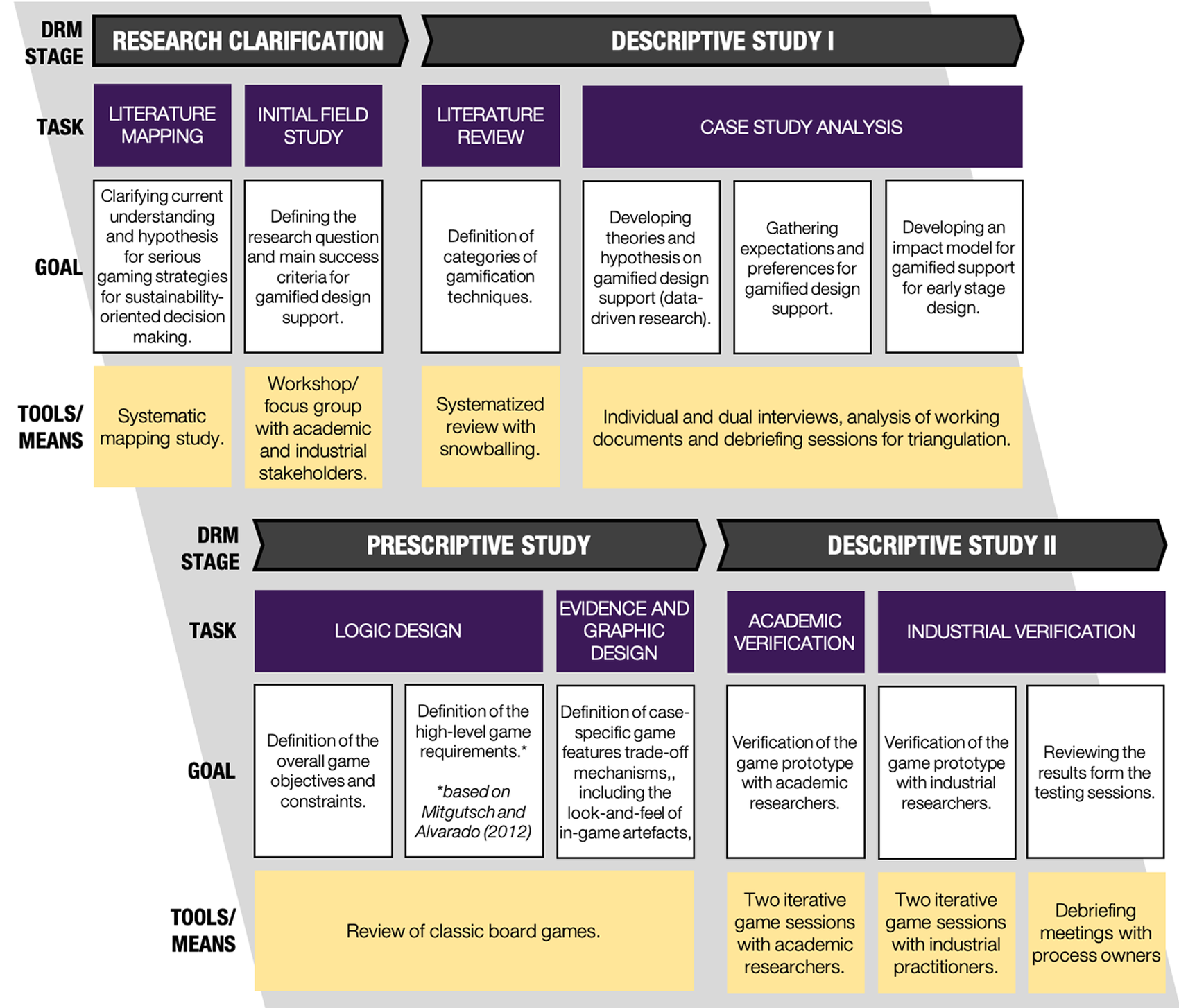
During the RC stage, the authors performed a systematic mapping study to clarify the current understanding and hypothesis for serious gaming strategies for sustainability-oriented decision-making. This study revealed the intersection between gamification and serious games types and fields of applications, industrial and educational domains and sustainability related issues. The interaction with industry practitioners, process owners and practitioners – in different industrial sectors – brought to the iterative definition of the research question and type of research to be conducted.
The DS-I findings originated from dedicated literature reviews and from the in-depth analysis of a single case study conducted in collaboration with a major first-tier supplier of aeroengine components based in Sweden. This represents for the authors a ‘critical case’ (Yin Reference Yin2003, p. 40), mainly because the aviation industry is today at the forefront of the quest for reducing (and reversing) environmental impact, while still answering the increasing demand for mobility required by our economy (Kousoulidou & Lonza Reference Kousoulidou and Lonza2016). The primary mode of data collection was semistructured interviews (which loosely followed the protocol in Table 1), which were triangulated through debriefing activities and the analysis of working documents.
Interview protocol

A total of five respondents were initially sampled for a face-to-face 50-minute interview. The sample covered a variety of roles, including design and cost engineers, risk management and material specialists and sustainability experts. They were located using a snowballing technique (Warren Reference Warren2002): once the initial respondent (fulfilling the theoretical criteria) was identified, they helped to locate others through their social network. The authors had the final word in sample selection, having the care to cover both the ‘meatiest’ cases and the ‘peripheries’ (Miles & Huberman Reference Miles and Huberman1994).
Interviews were transcribed by the authors, then sent to the respondents for validation. Once validated, the transcripts were analysed mainly using descriptive coding (Miles & Huberman Reference Miles and Huberman1994), which is ‘labels’ were used to summarise the basic topic of a passage of qualitative data. As a result, an inventory of topics for indexing and categorising was created, to then construct a narrative summarising the main findings from the interviews (as presented in Section 6). Both during interviews and as an appendix to the transcripts, the authors made use of visual demonstrators of emerging modelling concepts (e.g., sketches, two-dimensional diagrams and/or mind maps) to gather information on the wished characteristics for the game to be prototyped in the PS stage. These demonstrators included possible game structures and elements and were used to discuss their capability to answer the requirements identified during DS-I. The serious game prototype was initially tested in an academic environment during DS-II. Later, this was verified with progressively larger groups of practitioners at the partner company. These groups included both the interview respondents and individuals who were not involved in the data gathering process. These activities were performed in a workshop-style fashion. Initially, the authors presented the study’s objectives to the players while describing the basic game mechanics. Each individual was then asked to play the game in teams for about 1.5 hours. At the end of the game, reflections were gathered from the group, and these results were discussed with the design process owners during weekly online meetings.
3. Clarifying the research at the serious gaming and gamification versus sustainable engineering design intersection
Gamification and serious games are two concepts that refer, respectively, to the use of game elements in non-gaming contexts (Deterding et al. Reference Deterding, Dixon, Khaled and Nacke2011), integrating some game attributes into a system, product or situation, and to the use of full-fledged games for other purposes than mere entertainment, such as education and training (Mitgutsch & Alvarado Reference Mitgutsch and Alvarado2012).
In spite of their differences, these two concepts are often compared and discussed together, since they both stress the opportunity of engaging and persuading users, conveying information, concepts and values. For instance, Johnson et al. refer to both as ‘applied games’ (Johnson et al. Reference Johnson, Horton, Mulcahy and Foth2017, p. 12), describing how they became popular tools for educating people on sustainability-related issues and increasing knowledge and skills for sustainable development. One such example is the Global Goals for Sustainable development game (https://gamethegoals.com/), whose objective is to spread knowledge about sustainability-related issues, motivating a change of behaviour and creating awareness.
Applied games cover a wide range of topics (e.g., resource and energy consumption, building and product design, planning and management and material selection), using different modalities (individual or team playing). While some games are developed for the general public (Huber & Hilty Reference Huber and Hilty2015; Morganti et al. Reference Morganti, Pallavicini, Cadel, Candelieri, Archetti and Mantovani2017), others are designed to educate students (and professionals) with heterogeneous backgrounds, as discussed in the following.
A systematic mapping study (see Scurati et al. Reference Scurati, Ferrise and Bertoni2020) was initially conducted to highlight the extent to which ‘applied games’ are used today in the organisation as a means to raise awareness on sustainability and environmental concerns. The study was conducted on two databases [Web of Science (WoS) and Scopus] through a search query based on title, abstract and keywords. The search featured three lists of keywords, requiring the presence of at least a keyword for each of them. The first list aimed at identifying the publications based on games and gamification techniques (e.g., serious game and gamification), the second included sustainability related terms (e.g., energy and environmental) and the third filtered the papers regarding engineering and industrial contexts (e.g., manufacturing and corporate).
The search query rendered 251 publications on WoS and 443 publications on the Scopus database and returned a total of 65 after a filtering process. The filtering process only included papers presenting case studies related to specific strategic or engineering/production tasks and decisions, excluding ones focused on employees’ civic behaviour or consumers’ choices.
The application of gamification and serious games concepts is found to permeate the strategic, tactical and operational levels of the enterprise, and to address a number of topics related to policy-making, management, manufacturing and design (Figure 2).
Sustainability-oriented serious games in the organisation, per topic (Scurati et al. Reference Scurati, Ferrise and Bertoni2020).
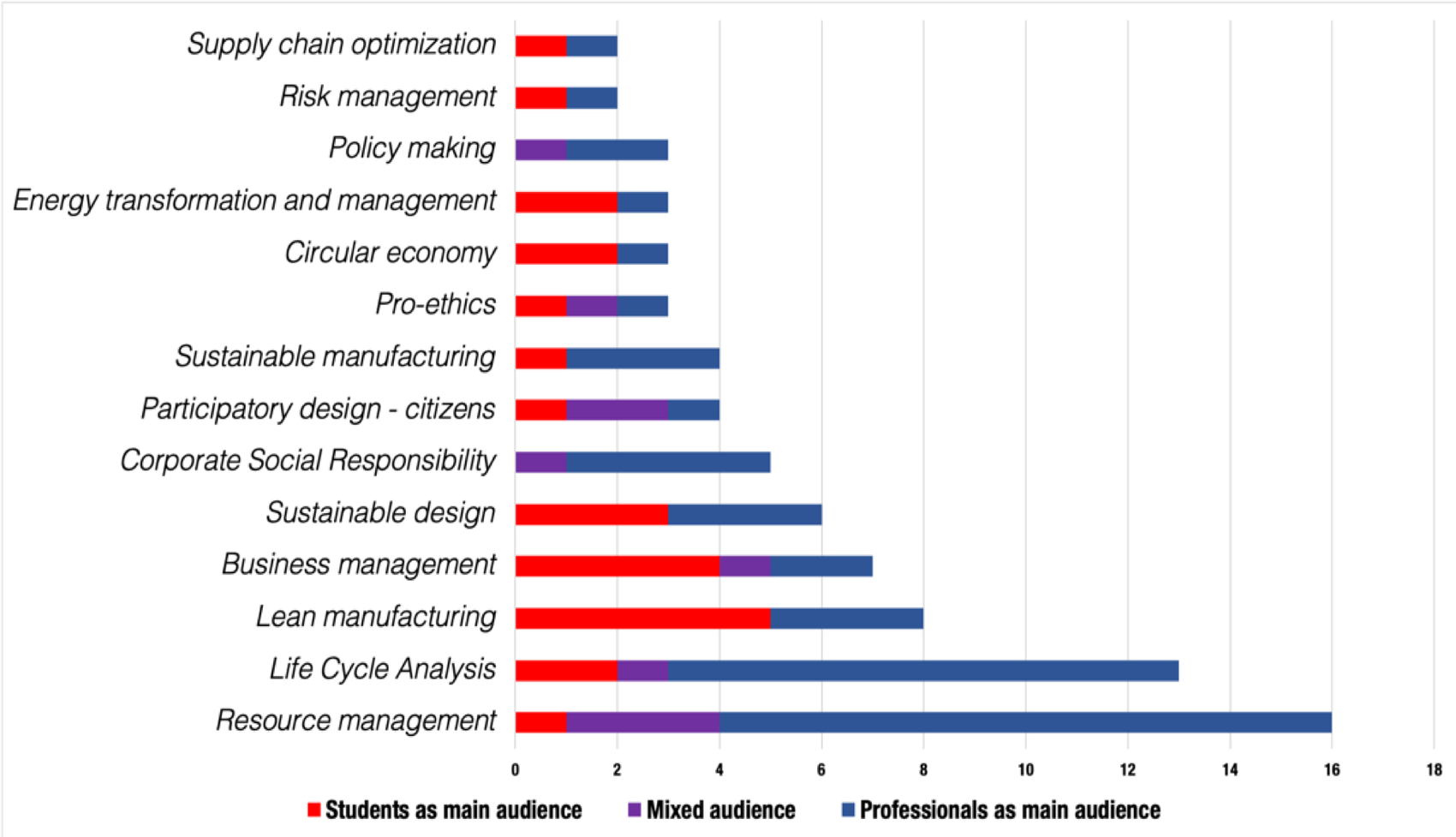
Many contributions target the field of resource management, supply chain optimisation (e.g., van den Berg et al. Reference van den Berg, Voordijk, Adriaanse and Hartmann2017) and lean manufacturing, often addressing the issue of waste management in relation to cost efficiency (e.g., Hirose, Sugiura & Shimomoto Reference Hirose, Sugiura and Shimomoto2004). Several examples of practitioners’ gaming focused on sustainability issues can be found in the business and management domain (e.g., Carreira et al. Reference Carreira, Aguiar, Onça and Monzoni2017). More implementations target the field of policy-making (e.g., Schrier Reference Schrier2015), circular economy (e.g., Whalen & Peck Reference Whalen and Peck2014), energy transformation and management (e.g., Cohen, Niemeyer & Callaway Reference Cohen, Niemeyer and Callaway2016) and sustainable manufacturing (e.g., Stahl et al. Reference Stahl, Cerinšek, Colombo and Taisch2012).
A significant portion of these games finds their roots in the triple bottom line (TBL) framework proposed by Elkington (Reference Elkington1998), to include social and economic dimensions along with the environmental one. These studies emphasise the long-term consequences of unsustainable behaviours in terms of temperature rise, causing climate change and, in turn, showing the consequent adaptation of businesses and practices (e.g., Carreira et al. Reference Carreira, Aguiar, Onça and Monzoni2017). Others describe games aiming to raise awareness of reducing resource exploitation (e.g., Whalen et al. Reference Whalen, Berlin, Ekberg, Barletta and Hammersberg2018), waste production (e.g., Hirose et al. Reference Hirose, Sugiura and Shimomoto2004; van den Berg et al. Reference van den Berg, Voordijk, Adriaanse and Hartmann2017) and energy consumption (e.g., Oppong-Tawiah et al. Reference Oppong-Tawiah, Webster, Staples, Cameron, de Guinea and Hung2020).
The mapping study found that about two-thirds of the analysed contributions describe digital tools, whereas about one-third describe analogue ones. Digital support is beneficial to rapidly simulate various scenarios and get feedback on their outcomes (van Hardeveld et al. Reference van Hardeveld, Driessen, Schot and Wassen2019). Analogue approaches can create more credible training situations in specific industrial contexts, like in the case of instructional factories (see, e.g., De Vin & Jacobsson Reference De Vin and Jacobsson2017). Moreover, some analogue games like board games enable a well-known social situation that stimulates interaction among players. This can be useful when the development of interpersonal skills is required (see, e.g., Koens et al. Reference Koens, Melissen, Mayer and Aall2019).
3.1. Defining the expectations for gamified design support in an early stage
The systematic mapping study was complemented by workshops and focus groups with both academic and industrial stakeholders to define the main research questions to be answered, and the main success criteria for the envisioned early-stage design support. The dialogue with the industrial stakeholders pointed early on to the issue of how applied games, and serious games, in particular, can increase awareness of sustainability-oriented decision-making, mostly with regard to informing engineers and designers of how current decisions will (directly or indirectly) affect the company’s key performance indicators far into the future.
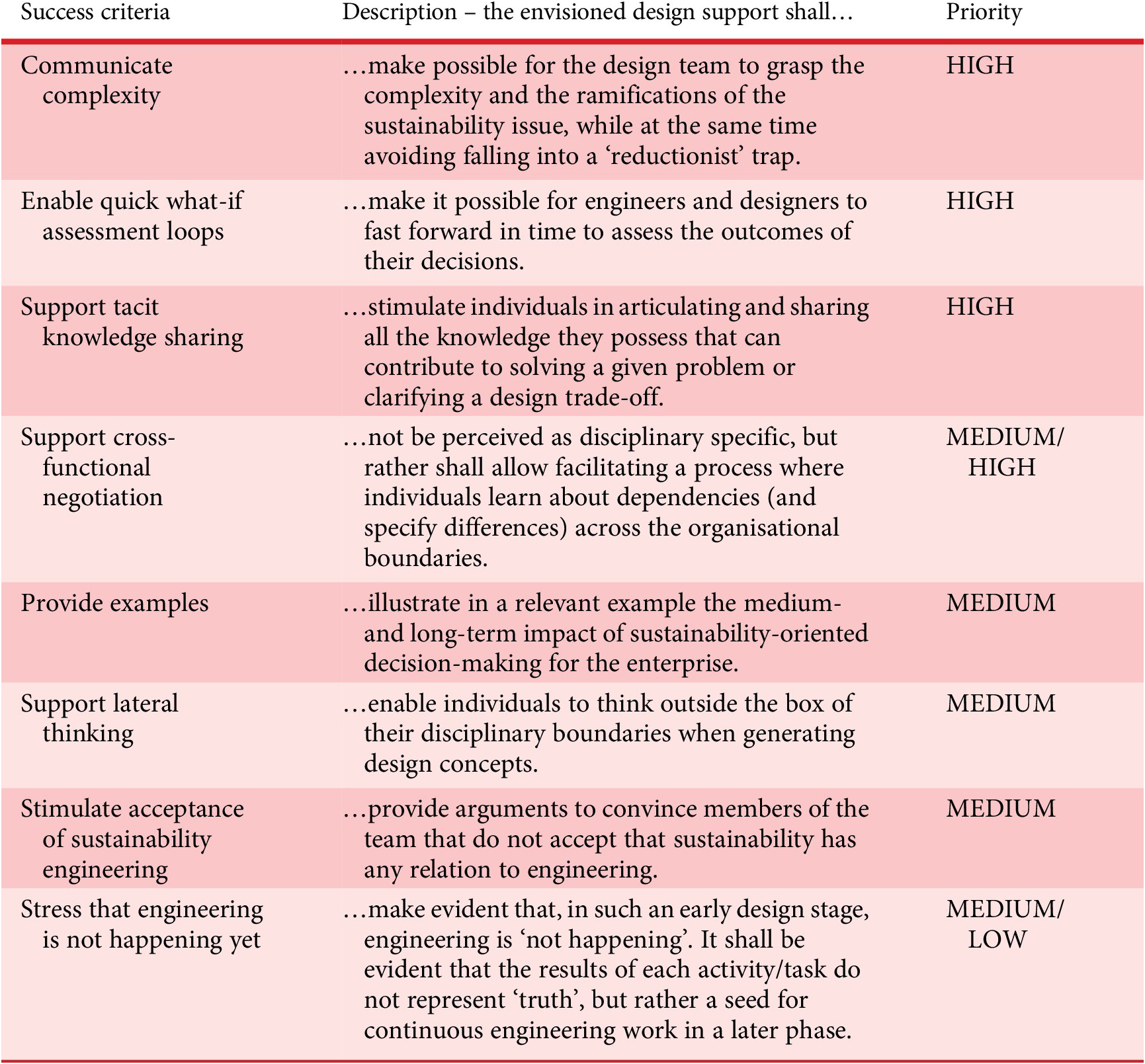
The RC stage further brought to the definition of several success criteria for gamified design support, with different levels of importance and priorities, as summarised in Table 2. A major aspect of interest highlighted in the discussion is how applied games enable participants to grasp complex concepts, and ultimately develop the ability to share knowledge in a cross-functional team setting so as to ideate integrated solutions (versus just ‘products’) outside their ‘disciplinary box’.
Success criteria and their priorities as emerged from the RC study
These inputs brought to the definition of the overall research plan for the study, with the intent to ensure the scientific nature of the study, of bringing a contribution to practice as well as to knowledge, and to ensure a degree of generality and application across products and practice.
4. Literature review: existing gamified support for engineering design
The initial mapping was followed up in the descriptive study stage by a more focused literature review based on the research question presented in Section 1. Five main categories of serious games and gamification techniques are used today to raise awareness in design with regard to sustainability-oriented decision-making. These are simulations, metaphors, gamified learning and practice, role-playing and board games (Table 3).
Applied games: techniques, definitions and examples

Figure 3 shows how these techniques fulfil different functions and differ with regard to their ability to (1) educate engineering designers versus support collaborative decision-making and (2) foster interactions across disciplines and functions.
Visual summary of the literature review findings.

4.1. Serious games and gamification as a means to educate engineering designers
Serious games and gamification have been widely explored in engineering design education, even though with a little emphasis on sustainability-related issues. This is discussed by Paravizo et al. (Reference Paravizo, Chaim, Braatz, Muschard and Rozenfeld2018), who highlights this gap concerning gamified applications to support learning about Industry 4.0. The game design activity itself can be used to enhance the learning experience, as shown by Blokhuis & Szirbik (Reference Blokhuis and Szirbik2017). In particular, the development of games was considered useful to gain a holistic view, which is fundamental in engineering design, and in particular, considering sustainability issues.
Many studies fall into the category of simulations: this term can indicate different approaches, for a variety of target users, including students and professionals. Simulation games can be used to support practical skills and procedural knowledge, allowing students and employees to experience possible situations that may occur in reality or their future career, in a single or multiplayer setting. An example is the simulation proposed by Cohen et al. (Reference Cohen, Niemeyer and Callaway2016) on power systems. Similar interactive applications can improve design engineering processes, supporting analysis and decisions through narratives and a sense of achievement (Louchart et al. Reference Louchart, Lim and Al Sulaiman2009). Practitioners and stakeholders have been found to use simulation to test and evaluate new scenarios, products or strategies. An example is the simulation game proposed by Cardin et al. (Reference Cardin, Yixin, Yue and Haidong2015) to evaluate emergency medical systems’ costs and life cycle performances. An interesting outcome of this study is how simulations games can support flexible thinking in designing systems that need to face uncertainty, a major issue in many sustainability-related problems. In contrast, not many serious games for industrial and professional fields use games based on metaphors, while it is a common approach in other contexts like health and well-being (Lin et al. Reference Lin, Mamykina, Lindtner, Delajoux and Strub2006; Byrne et al. Reference Byrne, Gay, Pollack, Gonzales, Retelny, Lee and Wansink2012) or domestic energy awareness (Tiefenbeck et al. Reference Tiefenbeck, Wörner, Schöb, Fleisch and Staake2019). A possible reason discussed in our previous work (Scurati et al. Reference Scurati, Ferrise and Bertoni2020) is that they are more suitable to create awareness and emotional involvement than for gaining skills. For instance, creating symbolic associations (e.g., the polar ice melting while taking showers shown in the water meter used by Tiefenbeck et al. Reference Tiefenbeck, Wörner, Schöb, Fleisch and Staake2019) can be effective in many cases but may be a risk in specific decision-making contexts, where oversimplification and inexact associations should be avoided.
Gamification differs from serious games as it is the introduction of game elements into usual tasks or situations. Considering industrial and educational contexts, we previously defined this was to modify usual activities as gamified practice and learning. An example is presented by Sharunova et al. (Reference Sharunova, Ead, Robson, Afaq and Mertiny2018), who discuss how an engineering design course can be gamified, including learning contents and evaluation methods. Similarly, Rath et al. (Reference Rath, Birkhofer, Kloberdanz and Hanusch2013) propose role-playing to involve students in a tutorial on sustainable innovation for product design: they are gathered in a ‘project team’ for a fictitious company, while the research associates play the role of the board of management, and the members of a research group engaged in sustainable product development play the role of the consultants. During the course of the game, each team goes through ‘quality gates’ that present to students real-world situations.
While simulations are often more focused on technical approaches and concepts, role-play and board games are effective when social aspects are the main learning outcomes. Considering games that involve social aspects, an example is the role-play-based board game presented by McConville et al. (Reference McConville, Rauch, Helgegren and Kain2017), which deals with water management and sanitation with a focus on sustainability. The game shows how awareness of social implications and stakeholders’ perspectives can be integrated into engineering programs that are still primarily focused on developing technical solutions.
Whalen et al. (Reference Whalen, Berlin, Ekberg, Barletta and Hammersberg2018) present an educational board game that targets material criticality and circular economy. In the game, participants take the role of CEOs of a manufacturing company, facing material scarcity, price volatility and environmental concerns. Verification activities show that the game was found to support awareness on the sustainability matter and foster the development of critical thinking and system thinking skills. In fact, while board games might not be the best option to develop strictly technical skills, they can effectively represent real-world systems, including relationships between different aspects and decisions. Moreover, if based on role-play, they can raise discussion and enhance collaboration and perspective change. However, managing complex representations and dynamics is not trivial. For this reason, as highlighted by Whalen et al. (Reference Whalen, Berlin, Ekberg, Barletta and Hammersberg2018), having a debriefing session after playing the game is critical to increasing and ensuring the understanding of the game.
4.2. Serious games and gamification as a means for co-creation and collaborative decision-making
Serious games and gamification are popular means to foster the development of collaboration skills in educational and professional contexts, particularly when multiple stakeholders, clients or communities are engaged in the design process. For instance, Snijders et al. (Reference Snijders, Dalpiaz, Brinkkemper, Hosseini, Ali and Ozum2015) present a platform to collaboratively set engineering requirements, involving stakeholders through crowdsourcing. In this sense, a game can be a boundary object (in the definition of Star & Griesemer Reference Star and Griesemer1989), supporting collaboration among heterogeneous individuals and groups sharing a similar goal but having a variety of perspectives.
Gamification is used to keep users engaged in defining needs, as they gain points depending on the quantity and quality of their actions, that are evaluated by other users. Similarly, gamification is also proposed by Leclercq, Poncin & Hammedi (Reference Leclercq, Poncin and Hammedi2017) to involve customers in product development processes, through a co-creation platform to propose and vote for new ideas. Co-creating value may be particularly relevant in the case of sustainability strategies, as it is often difficult to understand how clients and partners prioritise sustainability requirements.
Value co-creation is one of the propositions discussed by Shi et al. (Reference Shi, Baines, Baldwin, Ridgway, Petridis, Bigdeli, Uren and Andrews2017) on the use of gamification to improve product-service systems (PSSs) offers and to study evolving consumers’ behaviour in light of different sustainability targets (e.g., aiming at energy saving). Serious games can also be used for similar purposes: Fernandes et al. (Reference Fernandes, Pigosso, McAloone and Rozenfeld2020) propose using a game based on boards, cards and role-play to support value propositions in the design of PSSs, finding them useful to leverage creativity and procedural tasks. Similarly, a card game using role-play is proposed by Beckers & Pape (Reference Beckers and Pape2016) to elicit social engineering security requirements, where players take the role of ‘attackers’.
Games can be used to study decision-making processes and improve them (Cardin et al. Reference Cardin, Yue, Haidong, Ching, Yixin, Sizhe and Boray2013; Vermillion et al. Reference Vermillion, Malak, Smallman and Fields2015, Reference Ullman2017), revealing how players make decisions, motivations behind choices, and how specific game events and interactions with other players affect them.
Many studies show how games impact decision-making through holistic environments, game mechanisms and feedback (Jarke et al. Reference Jarke, Klann and Prinz2009; Kerga et al. Reference Kerga, Rossi, Taisch and Terzi2014). An example of the use of serious games as a research tool to understand decision-making dynamics is discussed by Cardin et al. (Reference Cardin, Yue, Haidong, Ching, Yixin, Sizhe and Boray2013). A further example of how games can support decision-making is provided by Kerga et al. (Reference Kerga, Rossi, Taisch and Terzi2014), who propose using Lego bricks for integrating lean practices.
Yet, some authors pinpoint that games can be detrimental to decision-making as well. Vermillion et al. (Reference Vermillion, Malak, Smallman, Becker, Sferra and Fields2017) highlight that games may introduce more noisy data compared to traditional methods, needing a greater sample size for research purposes. The use of monetary pay-offs was previously discussed (Vermillion et al. Reference Vermillion, Malak, Smallman and Fields2014) as a means to keep the players focused on the results. In fact, there is the risk that they engage in behaviours that they would not have in reality, because they are playing for the sake of the gaming experience. In general, games are used in this context to represent complex systems, dynamics and processes. Therefore, there is often a need for facilitation to understand every rule and mechanism and manage different game components and roles (Fernandes et al. Reference Fernandes, Pigosso, McAloone and Rozenfeld2020) or to help players set constraints and identify shortcomings (Kerga et al. Reference Kerga, Rossi, Taisch and Terzi2014). In fact, the presence of facilitators to ensure and maximise games’ results is also recommended by Riedel & Hauge (Reference Riedel and Hauge2011), which present a state of the art focused on serious games for industrial and business sectors.
Looking at pervasive simulation-based games, they have been observed to be difficult to set up and integrate into a real setting, costly to run and often unsuccessful in engaging the players (Jarke et al. Reference Jarke, Klann and Prinz2009). The recent pandemic has revamped the discussion about differences and similarities between classical analogue games and their digital counterparts. A recent paper from Almås et al. (Reference Almås, Hakvåg, Oliveira and Torvatn2021) highlights how aspects such as nonverbal communication, social proximity and concurrent communication make analogue games superior to their digitised version. The main reason is that the formers are able to leverage certain psychological and pedagogical principles that promote learning through action and interaction. Hence, analogue (board and card) games have been considered to be a more fit-for-purpose solution with regard to the initial research question, mainly considering the target users and desired dynamics and cooperation one wants to stimulate among them. When involving small groups board and card games can be an ideal solution (Beckers & Pape Reference Beckers and Pape2016; Fernandes et al. Reference Fernandes, Pigosso, McAloone and Rozenfeld2020) due to the typical social situation they create.
5. Case study
The complexity of the aviation industry and the need to satisfy air transport demand and sustainability requirements under strict technical standards require intense and challenging collaboration between practitioners, and the development of a comprehensive view of different sets of problems across roles. This makes the aerospace industry an ideal testbed for the development of gamified design support focused on sustainability and value awareness.
For this reason, the research described in this paper was conducted in collaboration with a Swedish design-make supplier to major aeroengine large original equipment manufacturers (OEMs). OEM suppliers and subcontractors are engaged in developing lighter and more efficient solutions to further reduce the environmental impact of aircraft and associated systems during their life cycle, from manufacturing to operation, maintenance and disposal phase (Witik et al. Reference Witik, Gaille, Teuscher, Ringwald, Michaud and Månson2012). These developments must consider both the preservation of the natural environment and its resources, together with the necessity of mitigating negative impacts on the social system (Broman & Robèrt Reference Broman and Robèrt2017).
This collaboration pointed early on to the ‘responsibly sourced minerals’ theme as a promising area of investigation and testing ground for the envisioned design. The resulting case study focused on the issue of raising awareness among design decision-makers about the sustainability-related consequences of using so-called ‘critical materials’, for a given component or subsystem. Materials are defined as critical when containing minerals that are extracted in armed conflict zones (conflict minerals), conditions of exploitation or child labour, or when their extraction exposes humans to potential health damages, causes environmental degradation and contamination or the material availability is scarce (Hallstedt & Isaksson Reference Hallstedt and Isaksson2017).
The empirical data gathering stage was designed then to know more about risks and difficulties in applying sustainability requirements in the aerospace sector, with a focus on the topic of material selection. The interview data highlighted shortcomings in the current tools and processes used (or available for) decision-making during early-stage design, together with needs and tips about possible improvements and preferences for gamified design support. In the prescriptive stage, the case study has provided guidance for the iterative of the game prototype, as well as access to company practitioners during the testing and verification stage.
6. Descriptive study findings
The descriptive study findings are summarised in an Initial Impact Model (see Blessing & Chakrabarti Reference Blessing and Chakrabarti2009, p. 50), representing the desired situation and showing the assumed impact of developing gamified design support for early-stage design. In Figure 4, the nodes represent influencing factors, which are aspects of the desired situation that influence other aspects of this situation. The links between factors show how the factors influence or are desired to influence each other, that is, they represent explicit statements about the existing or desired situation. The combination of ‘+’, ‘−’, ‘?’ and ‘0’ signs at the ends of a link describe how the value of the attribute of the factor at one end relates to the value of the attribute of the factor at the other end. Additionally, the notation [A] indicates that the link between nodes is an assumption, whereas [E] indicates that it is based on the experience of the stakeholders being interviewed during the descriptive study phase (i.e., being derived from the interview transcripts), and [O] means it is based on own investigations (i.e., from the observations and the analysis of the working documents at the case company – as a means to triangulate the interview results).
The Initial Impact Model for the gamified design support, form the DS-1.

The creation of the Initial Impact Model moves from the problem of how to increase long-term profitability and value creation in the enterprise. The empirical investigation (as well as several contributions from the literature) highlights the importance of early-stage design decision-making. Two main factors were deemed of interest with regard to increasing the quality of such decisions: (1) the ability to minimise the influence of uncertainty (Beheshti Reference Beheshti1993) and (2) the level of awareness among decision-makers of how sustainability affects the overall value of a solution (e.g., Hallstedt et al. Reference Hallstedt, Bertoni and Isaksson2015).
Both factors were found to be linked to the ‘learning experience’ issue, as the interview respondents often emphasise the opportunity to ‘learn’ about new solutions in the Stage-Gate process as the main aspect to consider in the development of gamified design support. The quality of such an experience can be raised by the availability of relevant examples (see Boyle Reference Boyle2004), by the ability to perform quick ‘what-if’ assessment loops, and by the level to which ‘complexity’ is communicated and visualised to the decision-makers. With regard to the latter, the interview respondents highlighted the need to depict the complexity of the real-world systems the company interacts with, including the global market, institutions and society in general.
The respondents further pointed out that a major problem for design team members is to understand how their lower-level decisions (i.e., those with a high degree of granularity, typically at the ‘operational’ level) will impact sustainability and value at a system and supersystem level. They highlighted the need for exemplifying how seemingly trivial decisions might trigger serious consequences, and how these might lead even to dramatic events (monetary speaking) that are not usually perceived as decision-making outcomes. In the proposed case study, for instance, the decision of investing in a given alloy might force the company to source material from conflict countries, exposing to the risk of disruption of the supply network due to such conflict, or a sudden rise in the market price of the material.
As discussed by the interview respondents, the main purpose of gamified design support shall also be that of introducing in the design discussion a possibly broad spectrum of more ‘intangible’ sustainability concepts, expanding from the ‘usual suspects’ (e.g., lower fuel consumption and emissions in aerospace), making tacit and hidden phenomena visible. These include those multifaceted aspects of environmental and social sustainability that are often overshadowed by the classical driving criteria in design (quality, time and cost). Governmental incentives, flexibility, responsiveness, networking, risk mitigation and trust relationships with the customers shall be captured, together with cost reductions related to travels, transportation, shipping and other opportunity costs due to shorter lead times. At the same time, the game shall make visible that not being sustainability-complaint might cause customers to fade away due to their increased environmental awareness in supplier selection. Importantly, the game shall also consider aspects related to capability retention and knowledge generation. The latter was discussed with regard to the empowerment of local communities and company employees. In the study’s case, an example is seen with regard to the decision of sourcing materials and components from local suppliers in the region where the company is located (or even in-house) versus from low-cost suppliers in other countries. The latter will trigger short-term cost benefits that may result in the loss of local capabilities in the long term, affecting the company to recruit the right skills from its surroundings.
The ability to fast-forward design decisions to highlight their possible outcomes was one of the aspects pointing towards the development of gamified support. Furthermore, the latter was found to be easier to be manipulated by the team in an early stage, considering the very different disciplined involved in the decision-making task. Yet, it was considered crucial by the respondents to find the right trade-off between simplicity and detail, in a way not to lose too much granularity when dealing with both tangible and intangible aspects of value, while still being able to display the outcomes of several different scenarios.
Noticeably, the ability to raise (2) is also linked to the level to which individuals accept sustainability engineering (Boyle Reference Boyle2004) and to the ability of decomposing sustainability implications to significant decision-making criteria (Isaksson et al. Reference Isaksson, Bertoni, Hallstedt and Lavesson2015). In an early stage, the latter was found to be mostly a matter of supporting cross-functional negotiation and tacit knowledge sharing in the design team. Supporting such a negotiation was, in turn, found to be undermined both by the lack of opportunity for conversational knowledge sharing, in turn, linked to the availability of suitable ‘objects’ from cross-boundary discussion (Subrahmanian et al. Reference Subrahmanian, Monarch, Konda, Granger, Milliken and Westerberg2003).
Tacit knowledge sharing was found to be undermined by the lack of emotional involvement of the design team participants in the cross-functional conversation (see Tiefenbeck et al. Reference Tiefenbeck, Wörner, Schöb, Fleisch and Staake2019) and by minimal knowledge about knowledge owners and sources. For this reason, the game is seen as an opportunity to clarify the rationale guiding the development of a certain component or system, informing how different roles in the company are linked together in collaborative decision-making. The interviewees considered it important to realistically represent the company’s internal practices, constraints and issues. In particular, development situations are dominated by short lead times and highly competitive pressure. The decisions taken in an early stage shall not be easily reverted later on in the process. In the aerospace industry, it is very difficult to change or even upgrade materials, components and subsystems, due to the cost and time needed for testing, verification and certification. Understanding the irreversible cause-and-effect relationships between different decisions was regarded as one of the main aspects of interest in game design.
This branch of the Initial Impact Model shows how increased sustainability awareness is not only a matter of ‘playing the game’ but rather a result of the interactions and dialogues fostered during the game. In this respect, the serious game shall be intended as an opportunity for informal, conversational knowledge sharing for the team. The function of gamified design support becomes that of providing the team with a boundary object (Subrahmanian et al. Reference Subrahmanian, Monarch, Konda, Granger, Milliken and Westerberg2003), supporting knowledge sharing and negotiation across the team. The game’s objective shall be to catalyse the conversation, supporting the different professional roles in the company in converging towards a common decision, even when different points of view and concerns regarding sustainability issues exist.
7. Prescriptive study findings: the ‘Value and Sustainability game for material criticality assessment’
The findings from DS-I brought to the realisation of an initial prototype for the envisioned design support, named ‘Value and Sustainability game for material criticality assessment’ (Figure 5). The function of such a prototype was mainly to collect feedback from the industrial practitioners with regard to the success criteria identified in Table 2, and to stimulate reflections on specific features and trade-off mechanisms able to work as boundary objects to trigger the sustainability-value discussion in design. The choice between the serious games and gamification categories described in Section 4 was guided by the needs and objectives resulting from DS-I findings represented in the impact model. In particular, the authors refer to the need of involving multiple practitioners focusing on various low-level decisions and reflecting on their future outcomes. This integration of several perspectives would make the gamification of each decision-making process complex, possibly requiring the development of different strategies and evaluation methods. The simulation of a simplified product development process was then preferred. Moreover, the need of creating a conversational exchange among participants and represent complex systems and dynamics made the board game an ideal option.
Board design for the ‘Value and Sustainability game for material criticality assessment’.

At this stage, the authors took the decision of prototyping an analogue game to be subsequently digitalised in further iterations. This decision is justified both by time constraints and by the will to emphasise the role of the design support as that of stimulating conversation among different practitioners, and of representing dynamics and interactions of a complex system, including various roles, decisions and elements of uncertainty.
7.1. Game objectives, constraints and high-level requirements
The following case-specific objectives and constraints for the serious game prototype emerged during the PS phase:
(i) Objective #1: foster sustainability-based decision-making. The game prototype shall support decision-making addressing a set of sustainability issues for critical material assessment, integrating environmental and social requirements with technical and economic ones.
(ii) Objective #2: represent the social, economic and legislative space. The game prototype shall represent the real-world scenario within the company acts and the dynamics and interactions with the market, institutions and society, including risks, opportunities and unpredictability.
(iii) Objective #3: representing the technical, strategic and operational space: The game prototype shall describe with sufficient level of detail the company internal practices, including processes and constraints, strategical and operational levels, and shall be able to communicate to the players the urgency of achieving the specified goal and the related time pressure.
(iv) Objective #4: relatability of roles and backgrounds: The game prototype shall present information referring to specific tasks and tools familiar to employees.
(v) Objective #5: stimulating collaboration and knowledge sharing. The game prototype shall support communication and inclusiveness through balanced and understandable contents across roles and subjects.
(vi) Objective #6: linking decisions and long-term effects. The game prototype shall be consequent, showing logically and reliably how decisions taken today are linked to medium and long consequences for the organisation tomorrow.
These objectives were further cascaded down to generic game requirements based on the results of the interview coding activity. Aspects such as, for instance, the total number of players, players per team and more were labelled in the transcripts (using descriptive coding, as presented in Section 2) and further translated into a ‘criterion’ plus an associated ‘value’ when possible. This exercise required the authors to take into consideration a variety of additional elements needed to package and assemble the prototype. This task was supported by the framework proposed by Mitgutsch & Alvarado (Reference Mitgutsch and Alvarado2012), which was used to categorise and describe the requirements in six main areas. In fact, the aim of this step was to relate the main game objectives to the areas to consider in the game design, making sure to cover and link all the fundamental elements. These areas and the relative sets of requirements are collected and described in Table 4. They refer to the six points listed above.
Serious game requirements according to the framework by Mitgutsch & Alvarado (Reference Mitgutsch and Alvarado2012) and answered needs
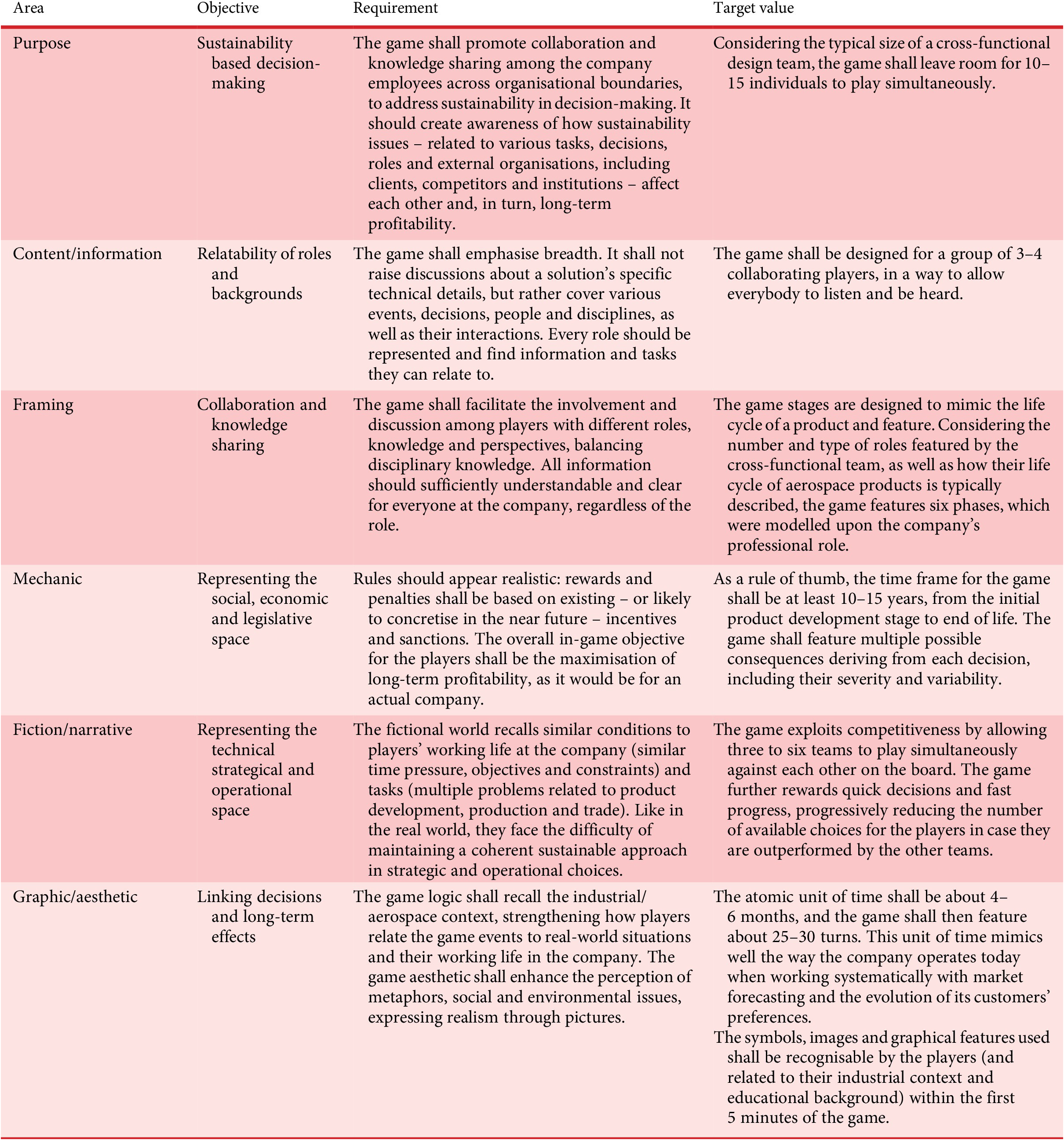
Considering the Initial Impact Model (Figure 4), it is possible to relate the first three requirements in Table 4 to the increased number of opportunities for conversational knowledge sharing and interaction with other disciplines in a task provided by the gamified support. The last three rather contribute to the creation of a simplified model for the scenario simulation and increase the number of scenarios evaluated (through the presentation and interaction of various events, options and opportunities). They also contribute to players’ emotional involvement, through time pressure and highlighting connections with serious effects happening in the company and in the global scenario.
7.2. Game objectives, constraints and high-level requirements
The final game prototype resembles a classic board game that mixes the basic mechanics from traditional games – such as Game of the Goose and Monopoly® – which are often used as an inspiration to design serious games concepts (Whalen & Peck Reference Whalen and Peck2014). In the game, players follow the development, commercialisation and end of life of a new aerospace product, moving through different phases across a board representing the different steps of the product life cycle. Players move across the board (Figure 6) by rolling dice to simulate randomness and to create a dynamic game environment. The game is both collaborative and competitive: each (multidisciplinary) team impersonates an aerospace company and competes against other teams in a closed market. The final goal is to generate more profit than the competitors, making decisions regarding material selection, manufacturing process, market position and more.
Front and back illustration of the cards used in the game. From left to right: Strategy card for phase 1 (Client selection), Strategy card for phase 2 (Product development), Law and regulations event card, Social/political event card, Economic event card and Knowledge card.

Desired game features were defined based on DS-I and the overall game aim and objectives – together with the corresponding generic game requirements – are discussed in Section 5 and listed in Table 4. These features were then implemented through game aspects and elements, as described in Table 5.
Case specific game features and trade-off mechanisms based on objectives in Table 4

In the initial stages of the process, the game proceeds linearly, while during the commercialisation phase of the product players conduct one or more loops depending on the product’s longevity (which, in turn, is determined by its sustainability and functional profile). As in Monopoly, at the end of each of these loops, players collect a reward that represents the profit generated on the market in the time period. Sustainable products mean staying on the market longer, which turns into higher rewards and higher risks through the mechanisms of Unexpected event cards.
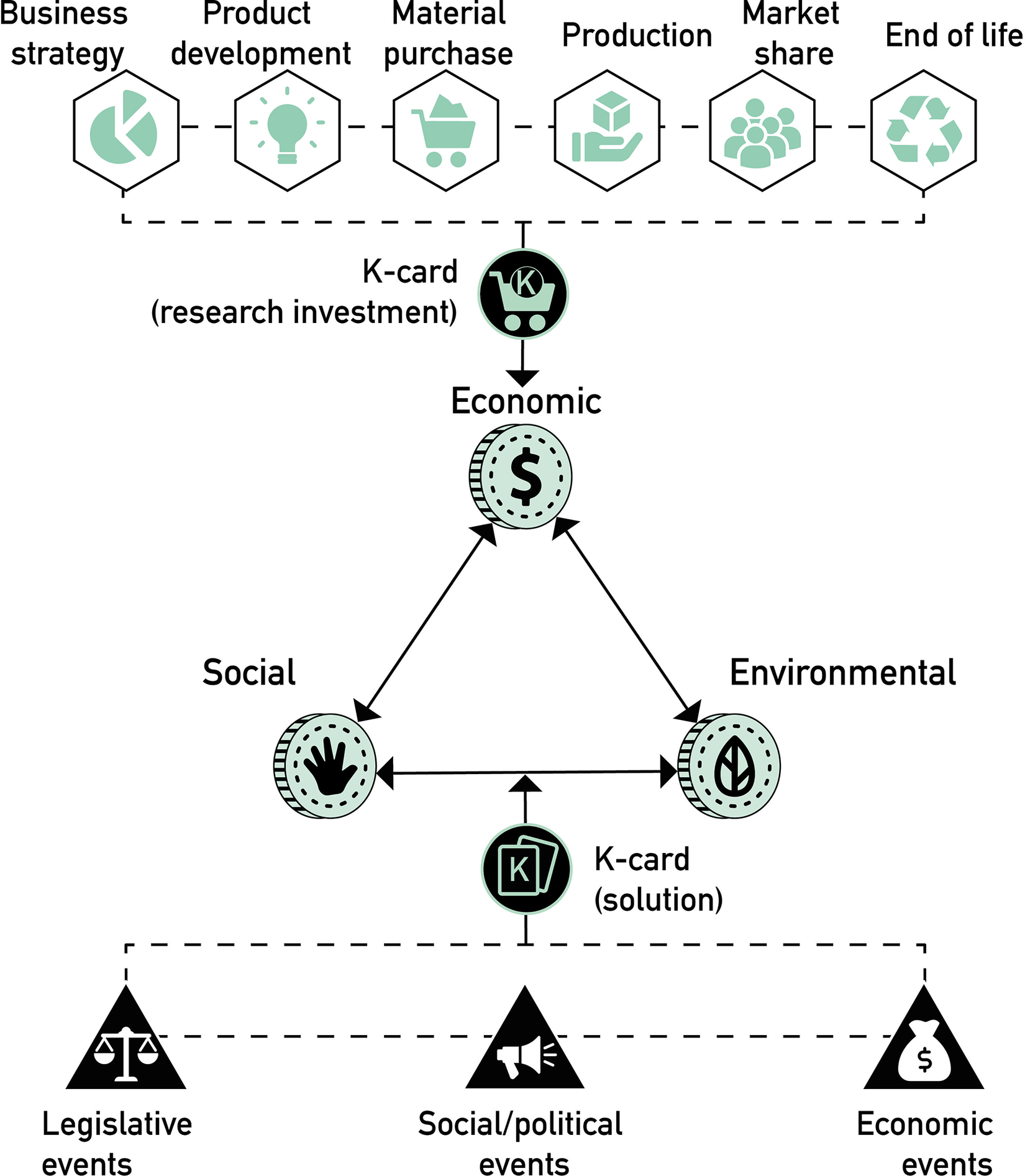
The game creates a bond between economic, environmental and social sustainability values using the ‘coin’ metaphor. The use of coins is typical for many board games and is compliant with the requirement of using well-known visual elements stated in the descriptive study. In fact, while the coin typically serves as a reward, in this case, its purpose is to represent also social and environmental gain and loss, helping players visualise their value.
Economic, social and environmental ‘budgets’ are set at the beginning of the game and are different for each team, depending on the kind of company they choose as a target client. Each following choice will impact (from very minimal to highly significant) the long-term profitability of the teams’ in-game strategy. If a team runs out of environmental and social coins, it will need to replenish its stock by using ‘money coins’ (at an exchange rate of two money coins for one environmental/social coin). The same exchange rate is applied at the end of the game when converting all coins into money to calculate the final score of each team.
The game involves the use of different types of cards. Strategy cards are instrumental for decision-making in each of the six main phases of the game (see an extract of the cards designed for the game in Figure 6).
A second deck of cards (‘Unexpected event cards’) represents emerging risks and opportunities along the product life cycle.
Events can punish or reward a team of players depending on the strategy they have chosen to follow, both looking at specific decisions (is the company making sustainable choices or not?) and at the overall game strategy (is the company coherent in its decision-making?). K-Cards can be purchased by players to mitigate the effect of unexpected events. They can be exchanged with solution cards at each phase: this is handy when the alternatives proposed by the Strategy cards are not desirable – for instance, because the competitors have already selected all the best strategies. An important aspect emerging from the descriptive study is that these cards shall not provide a ‘silver bullet’ to the playing team but shall rather communicate to the participants that knowledge investments might not always result in significant improvements in a given situation. Yet, the ratio of negative versus positive cards is balanced to reinforce the idea that the more investments are made (i.e., more cards are purchased), the higher are the chances to find an effective solution.
Figure 6 illustrates the relationship between the three types of coins in the game and how the decks of cards are intended to impact each player’s economic, environmental and social budget. The game makes it explicit that each decision made by the company on a mainly economic basis also affects the other two dimensions. Similarly, real-world events (modelled in the game by the ‘Event cards’) that are linked to the social and environmental domain might, in turn, be beneficial or detrimental for the profitability of the enterprise. Knowledge cards are further used in the game to mimic how a company can invest in protecting itself from the (negative) economic consequences of such events (Figure 7).
Card–coin relationship in the game.
8. Lessons learned from verification activities
8.1. Testing procedure
Activities in the DS-II have been mainly focused on Application Evaluation (Blessing & Chakrabarti Reference Blessing and Chakrabarti2009, p. 37) verifying that the support can be used for the task for which it is intended, properly addressing the desired factors.
The initial proof of concept of the game was tested in several rounds. During the first iteration, the game was played both by the authors and by a researcher external to the team, to verify the main underlying assumptions related to the dynamics of the game. This activity revealed several opportunities for improvement, which were implemented in the final game prototype. In the second iteration, the game was with a selected group of research fellows, all familiar with sustainability-related concepts as well as with the issue of material criticality in aerospace. This game session, which lasted for about 90 minutes, was moderated by the authors throughout the game. During the discussion following the game, possible critical aspects were identified. Those regarded the overall game presentation, including the use of graphics and text to clarify the descriptions of the game components and the effects of cards. Other suggestions included introducing additional possible Events Cards and the adjustment of events’ consequences (penalties and reward) in a more balanced way. The game board was adjusted to present an adequate number of Unexpected Events, finding a balance between experiencing different ones and game duration. The authors also received fundamental feedback concerning their role as moderators. For instance, participants highlighted the importance of reminding players about the possibility of buying and using K-Cards, as players might not be fully aware of it.
The resulting lessons learned were used to refine the game and plan the testing activity with practitioners at the company’s facilities. Several individuals with different roles (e.g., material, procurement, production, design and costs) were involved in two separate industrial sessions. The first one featured five players divided into two teams and lasted for one and a half hours. The second one involved six players divided into three teams and lasted approximately 1 hour and 45 minutes. The authors acted as game masters during the play, explaining the rules and dispatching the cards/coins, without providing suggestions. The role of game masters was expected to be fundamental: Riedel & Hauge (Reference Riedel and Hauge2011) consider the presence of facilitators one of the key points to maximise serious games’ effectiveness in the industrial sector. Moderators prepared printed rules and game explanations, making sure to cover all the necessary instructions. Moreover, the sessions performed with researchers at the university also served as training before the sessions at the company.
Both sessions were followed by a wrap-up discussion that focused on lessons learned, benefits and improvement areas for the game. This aimed to gather a first evaluation of the gaming experience and assess the game’s ability to represent the value creation opportunity and risks related to sustainability-compliant decisions. The authors played the role of moderators and timekeepers in this session but did not express opinions or comments during the conversation. They introduced some leading questions for the participants to reflect upon, for example, with regard to the complexity of the game, and more.
8.2. Results
The participants provided feedback considering different aspects and objectives, that can be positively related to the success criteria listed in Table 2.
Considering the criteria of communicating complexity, they found the game to be a useful means to capture the aerospace industry’s reality, in particular referring to the realistic challenges represented in the event within the game. One of the players commented:
‘Sometimes, you do not experience this cycle in even one career, and this is good to accelerate your experience. It is valuable to get the entire life cycle, especially for us who are very early in the research & technology development process. We do not think about the life cycle so much, and this makes us think about it more’. In fact, the game was seen as ‘a way to anticipate LCA (Life Cycle Assessment), which comes later in the development process’.
This comment also points out the satisfaction of the criteria of enabling quick what-if assessment loops, allowing early and quick evaluations and understanding of possible impacts. Furthermore, the chance of picking the ‘unexpected event’ cards (e.g., a card that bans a given production process) during the earliest stages of the game was rated positively. Even if such a card did not have any effect on the gameplay in such an early stage, it made participants better understand the game’s dynamics, while raising awareness of the potential long-term consequences of their design choices. This aspect also satisfies the criteria of providing various examples when representing decisions’ impact, covering a range of possible choices and outcomes.
Participants asserted that the idea of the social and environmental coins, transferable into money, was a sound way to highlight the value of sustainability and to quantify it:
‘The system with the coins is very interesting to communicate. The idea of having “transfer” coins has potential. We often speak the language of dollars. Still, it is good to see the trade factor between the values of sustainability’. This can help support the acceptability of sustainability criteria in engineering.
The representation of complexity also presents some critical aspects. For instance, several participants asserted that it was not always easy to understand the different cards’ meaning and impact. However, they acknowledged that complexity, in general, was quite high, but also reasonable: they argued that, if too low, the game would hardly be exhaustive and comprehensive enough, while too much complexity would compromise the whole game experience and effectiveness. Moreover, the game complexity did not prevent players to understand the different phases and decisions to make, as well as their relationship with events. This allowed the satisfaction of the criteria of supporting knowledge sharing and cross-functional negotiation.
However, participants proposed possible strategies to face the game complexity. They highlighted the need for a debriefing session following the game and the importance of having support during the game:
‘The key thing is to have a moderator to lead the game. You need someone to lead the game a lot; you need to become familiar to be able to use it during training sessions for many people. There are many rules, in fact’.
This feedback was expected since it is common for serious games (Riedel & Hauge Reference Riedel and Hauge2011).
However, participants also highlighted the potential of playing the game multiple times, as a means to improve the overall understanding of the game, including rules and mechanisms, as well as to amplify the knowledge gained from a single match. In fact, more playing sessions would allow discovering different combinations and timing of strategies, decisions and events, experimenting with a wide range of possible advantages and consequences. This would lead to a further increase of awareness and comprehension of the game and real-world systems. In this regard, participants also proposed possible rules variations (e.g., forcing teams to take some decisions to see what would happen). Moreover, this would allow them to experience all the events and their associated consequences. Hence, complexity, in this case, has also a positive connotation, since it makes it possible to play several game sessions while continuing learning and keeping the participants engaged. This also highlights the entertaining aspect of the game that can be connected to the learning experience and is indicated by the participants wish to play the game again.
The testing activity further pointed out that potential uses of the game include training sessions, for instance, during periodical meetings in the departments. On similar occasions, employees having different roles meet and discuss sustainability-related issues. Participants found the game a possible tool to start and support discussions during the meetings.
In fact, participants valued the discussions triggered by the game, giving them new perspectives on the sustainability challenges they are facing. In particular, these last suggestions seem to show the willingness to explore a wider variety of possible scenarios opening up to new ways to ideate and develop solutions. This indicates that the game also helped a tendency to think ‘out of the box’, enabling lateral thinking, and supporting the idea that engineering is not happening yet, meaning that decisions are not crystalised but will rather evolve in later phases.
Finally, a possible future development mentioned by participants consists of the design of digital support tools to inform and prepare players for the game sessions in advance and keep the discussion up after the sessions. PC or mobile versions of the game could familiarise employees with the game concept and dynamics, provide a platform for further communication and a means to collect data on users’ attitudes and game outcomes.
9. Discussion
9.1. How can serious games increase sustainability/value awareness in design?
The descriptive study findings (both DS-I and DS-II) show that serious games can increase sustainability/value awareness in design. This emerged from previous literature findings and during the wrap-up discussions following the game sessions. Participants evaluated the game as a means to think, reason and share perspectives about the whole product life cycle considering every sustainability aspect and possible related risks and opportunities. In particular, awareness is supported by (1) promoting the idea that economic and natural capital are tradeable parameters, and, in turn, by (2) catalysing the explicit and implicit knowledge needed to understand the sustainability/value trade-off fully. This view is a defining feature of a ‘weak sustainability’ approach (Gallopín Reference Gallopín2003), a type of sustainability that many consider the current norm among businesses today (Robinson & Boulle Reference Robinson and Boulle2012). The weak approach emerged from the study mainly because of the aerospace sector’s peculiarities, where it is harder, and not always possible, to simultaneously satisfy every sustainability requirement in the best way. Furthermore, a ‘weak’ standpoint was found to raise the credibility of the game among practitioners, as well as to stimulate the discussion about risks and value associated with sustainable design options.
From the perspective of developing ‘design support’, the ability to bring together sustainability and profitability in the same ‘value equation’ was found to be appealing. It opens up an opportunity for ‘optimising’ the system being designed already at an early design stage through value models (see Bertoni Reference Bertoni2017). The use of the coin metaphor to represent the ‘weak sustainability’ trade-off was one of the most appreciated game features during the industrial verification session. The ‘coins’ were observed to work well as a boundary object to facilitate discussion about among different professionals, as a way to make visible interconnections and dynamics that would tend to remain hidden otherwise.
With regard to ‘timing’, Gaziulusoy, Boyle & McDowall (Reference Gaziulusoy, Boyle and McDowall2013) claim that to gain the most out of the gaming activity, a serious game shall be played in separate and distant sessions, allowing time for reflections. When having more sessions and letting the former affect the latter, practitioners have been observed to deepen their discussions on sustainability-related choices, their consequences and future scenarios. Yet, even if a single person can play the game multiple times, time constraints and limited availability of the key stakeholders in the cross-functional team suggest a more condensed setup for the game, featuring only one session (of no more than 90 minutes) followed by one (or more) debriefing session and follow-up discussion. The goal of the task is, in fact, not that of ‘mastering the game’, but rather to inform and raise awareness, showing how short-term operational decisions might generate long-term consequences for the company, its customers and society.
A major question remains with regard to how serious games can support a ‘strong sustainability’ approach. Strong sustainability (see Neumayer Reference Neumayer2003) is acknowledged as the ultimate sustainability level and greatly preferred a priori position (Pelenc & Ballet Reference Pelenc and Ballet2015). A strong position postulates that strategic decisions are made regarding the environment first, then society and finally economy. Even though weak sustainability is found to be effective in raising environmental efficiency (see Gibbs, Longhurst & Braithwaite Reference Gibbs, Longhurst and Braithwaite1998) – reducing the environmental impact of each unit of economic activity – this position is problematic, because it tends to maximise monetary compensations for environmental degradations. While the proposed design decision support (i.e., the serious game) is well anchored on the ‘weak’ standpoint, it brings forward several concepts that are proper of a ‘strong’ position too. For instance, the game does leverage the issue of conserving the irreplaceable ‘stocks’ of critical natural capital for the sake of future generations. At the same, it promotes the idea that certain human actions can entail irreversible consequences. Still, for the reasons highlighted above, it postulates the substitutability of natural capital by other types of capital and does not fully encompass a ‘strong’ approach.
9.2. Reflections on the use of the DRM for the development of gamified support
DRM allowed the authors also to keep the focus on the assessment of the effects of the game during DRM-II. This case prevented the authors from falling into the trap where ‘generic methods’ were developed based on the analysis of a specific problem and evaluated using the same problem.
As a backbone for the entire study, the DRM provided clear guidance on turning the initial research topic into a more structured objective and research question, maintaining scientific rigour, and focusing on the ‘usage’ of the support. All the activities conducted during the DR-I stage – and related to needs and requirement assessment – were particularly critical when designing the serious game. Riedel & Hauge (Reference Riedel and Hauge2011) claimed that serious games are context-related and require proper knowledge of the subject, sector and target players of the application. The first empirical data gathering stage was essential to gain insights that only practitioners working in the company could provide, set game objectives and clarify how to reach them. It is also important to notice that DRM worked well to support the iterations that have characterised the research work. Even though the research process described in the paper seems sequential and linear, several iterations within and across the four phases of the DRM have been necessary, mostly regarding the DS-I and PS.
While DS-I was essential for the game requirements’ definition and development, DS-II provided important lessons learned concerning playing modalities (e.g., number of players/teams and timing) and preparation for game sessions (e.g., time and activities dedicated to presenting and explaining the game rules). Results included aspects related to game and discussion’s moderation: participants described its role as fundamental; hence, its methods would require specific investigation and evaluation. This would contribute to the discussion regarding the use of serious games in industries going beyond the game design, extending to the organisation of game sessions and supporting activities.
10. Conclusions and future work
The paper describes the development of design decision support in the form of a serious game, which is intended to raise sustainability and value awareness in the realm of material criticality. As the main theoretical contribution of the study, the authors indicate the value of applying trade-off factors in the game to balance the economic, environmental and social value of a design. The coin metaphor applied in the game – where environmental and social coins are ‘trade-offs’ by the designers with monetary ones – is seen to stimulate a mindset where the consequences of a sustainable (or unsustainable) decision on the company business and return of investment becomes more practical and real. It is also noticeable how such awareness – on the need to care about environmental and social aspects to maximise monetary returns in a product/system design episode – grows in the players while they proceed along the product life cycle during a game session – and even more, after playing multiple game sessions.
Hence, when looking at serious games as design support, their value is found to reside mainly on fostering a weak sustainability approach during the earliest stages of the design process, promoting the idea that profitability and sustainability are tradeable parameters in design. The game’s main benefit is seen in the opportunity of catalysing the explicit and tacit knowledge needed to fully understand the sustainability/value trade-off, bringing these dimensions together in the same ‘value equation’ to ‘optimise’ the system design through value models. Eventually, the practitioners see the game as a way to anticipate more detailed Life Cycle Analyses that are featured later in the development process.
Another theoretical contribution of this paper is that of showing how serious games supporting sustainability awareness for decision-making in engineering design can be developed using DRM. In particular, it discusses the case study design and implementation, describing how each phase contributed to the game development and assessment. Considering the results, the game prototype received a positive initial evaluation considering the main success criteria set in the RC stage. However, the testing activities also highlighted possible obstacles and critical aspects, providing insights to face the future steps in the game development. These methodological and practical implications can potentially be extended to the development of other serious games, especially considering similar audiences and purposes.
Another aspect of interest, mainly related to the practical contribution of the game, is that of providing a ‘boundary object’ for different disciplines to share their knowledge and perspectives on the meaning of ‘sustainable’ design. In addition, the game is found not only to stimulate ideas generation and the exchange of insights related to this topic but also to lower the barrier for individuals to engage in the discussion. By presenting the participants with a fictional scenario, the game is observed to open up room for everybody in the cross-functional team to speak out and openly express their thoughts and opinions, that otherwise would remain hidden. Acceptability and self-censorship (Lovelace, Shapiro & Weingart Reference Lovelace, Shapiro and Weingart2001) are found to have a deep impact on the way tacit knowledge is captured and shared in cross-functional teams. For this reason, while performing the testing activities at the company, several players suggested that the game could be used during periodical meetings at the company to support discussion about sustainability-related issues. At the same time, external stakeholders could also benefit from the availability of the proposed game, for instance, during periodical cross-organisational workshops focused on sustainability education and early-stage development strategies. More potential uses were proposed, such as the use of the game to train new employees on those sustainability aspects typical of their specific contexts, and their potential long-term effects for the company business. As a general consideration, the game is seen as a way to harness the intelligence of people not ‘officially’ in the team, not ‘supposed’ to have an opinion and not ‘familiar’ with design and development. This can release unexpected synergies and suggest radical, unexpected designs, able to greatly increase the customers’ perceived value.
Future work will deepen the descriptive study results and focus on the development of additional demonstrators (prototypes) for the serious game. These prototypes will address several areas of improvement (e.g., the design of the game elements, card descriptions and instruction) so that new players better understand them. These changes and refinements were identified during gaming and debriefing sessions with participants described in DS-II. Moreover, the impact associated with each decision of event will be reconsidered to ensure that they are balanced in a way that is the closest to reality. In this regard, a possibility is also to refine some game mechanisms. For instance, the exchange rate between environmental/social and economic coins could vary depending on the events (e.g., rumours on the use of conflict minerals could raise the value of social coins).
Future work will also focus on the planning of more testing activities and assessing the serious game efficacy, identifying specific measurement procedures and indicators to evaluate the impact on players’ awareness. Moreover, the game’s impact on the employees and the product development tasks at the company will be assessed as well. Testing the long-term effects is a common practice when the aim is to change human behaviour and attitudes, including interventions using games for sustainable behaviour, to make sure the effects persist (Ro et al. Reference Ro, Brauer, Kuntz, Shukla and Bensch2017; Wemyss et al. Reference Wemyss, Cellina, Lobsiger-Kägi, De Luca and Castri2019). First of all, testing activities will be scaled up and involve a larger number of players, gathering more qualitative data from game activity, as well as performing a quantitative evaluation. An opportunity is to record the gaming session and analyse it using protocol analysis, through an appropriate coding scheme. This is expected to reveal those specific game features that contribute the most in raising awareness of the relationship between value, sustainability and risk for new products, as well as increasing conversations and knowledge sharing among participants. This point improves the game mechanisms and decisions impact discussed above even more important. Future activities will also aim at assessing the efficacy of the game when it comes to triggering new reflections and strategies for sustainable development in the company. Those might be investigated after and between game sessions, to understand how they evolve over time. In particular, this would allow evaluating the game’s effectiveness in the long term and its durability in changing practitioners’ mindsets and attitudes.
Considering future case studies with different organisations and industrial fields, the present work could provide several insights for the development of new games on sustainability, both concerning methodological aspects and game design. The literature mapping in RC and the literature review in DS-I could support future studies. Regarding the developed game, many features should be changed depending on new case studies’ analysis, reflecting mechanisms and peculiarities of the specific industry. However, the game structure could be similar, following a product or service life cycle, modifying events and penalties or rewards mechanisms according to the specific risks and opportunities of the company’s field. Moreover, when targeting sustainability in a TBL perspective, some elements could be maintained (e.g., the three coins metaphor).
Financial support
The research leading to these results has received financial support by the Swedish Knowledge and Competence Development Foundation (Stiftelsen för kunskaps- och kompetensutveckling) through the Model-Driven Development and Decision Support research profile at the Blekinge Institute of Technology.


 Open access

