


Eating more healthfully could help Americans reduce rates of cancer, diabetes, heart disease and other chronic illnesses(Reference Eyre, Kahn and Robertson1). Although Nutrition Facts panels have the potential to help consumers make healthier dietary decisions, and although these panels have now been mandated on food packages in the USA for nearly 20 years(2), there is a dearth of objective data describing whether and how they are used by consumers. A large body of self-report research suggests that many to most consumers read labels some or most of the time (see e.g. reference(Reference Cowburn and Stockley3)), and although there are consistently reported demographic differences in label viewing (i.e. those with higher levels of education and income are more likely to report viewing nutrition labels than those with lower levels), these self-reports have not yet been verified by objectively measuring visual attention of individuals making food purchasing decisions. If researchers and policy makers better understood who uses nutrition labels and how, they could address incompatibilities between consumers and labels and help consumers use nutrition labels more effectively to select healthful foods.
A review of the nutrition label-use literature(Reference Cowburn and Stockley3) reported that most consumers claim to look at nutrition labels often or at least sometimes, that some consumers report their purchasing decisions are impacted by nutrition labels, and that women and individuals with higher levels of education and income are more likely to report looking at labels than men and individuals with less education or income. Another recent review(Reference Grunert and Wills4) reported similar results and identified additional variables related to nutrition label use, including: age (older individuals more interested in labels than younger), presence of children (those with children more interested than those without) and food category (i.e. nutrition information is less likely to be viewed for fresh foods like fruits and vegetables than for processed products ‘with a low degree of transparency’; p. 389). Grunert et al.(Reference Grunert, Wills and Fernandez-Celemin5) recently reported that nutrition information is more likely to be sought by customers looking at products perceived to be healthy (e.g. yoghurt and breakfast cereal) compared with foods perceived to be less healthy (e.g. snacks and desserts).
Most existing research regarding nutrition label use comes from self-report data and has not been verified via precise objective measures. Some objective research has been done in which consumer behaviour is surreptitiously monitored by observers in grocery stores to assess whether labels are viewed naturalistically (e.g. reference (Reference Grunert, Wills and Fernandez-Celemin5)). This methodology successfully assesses whether consumers look at labels in general while preserving ecological validity and not impacting the behaviour under investigation, but it lacks precision to identify which specific label components consumers view. Recently, researchers have begun examining nutrition label use objectively by tracking eye movements of individuals looking at food packages (e.g. references (Reference Jones and Richardson6) and (Reference Visschers, Hess and Siegrist7)). Eye-tracking technology has allowed for precise measurement of time spent viewing specific label components. Identification of label components viewed by consumers making purchasing decisions and rating food healthfulness can inform food packaging and label design to provide consumers desired information they can use to identify healthful foods. This challenge is especially timely given that the US Food and Drug Administration (FDA) ‘soon will propose guidance for the [food] industry regarding nutrition labeling on the front of food packages… [in order to] help consumers choose healthy diets’(8).
Most existing designs of front-of-pack labels list fewer nutrients than are presented on Nutrition Facts panels. Eye tracking research can identify nutrients that are most vital to consumers’ identification of healthy foods, ensuring that, as new reduced-content front-of-pack labels are designed, key nutrients are included. In addition, this methodology can be used to identify label designs that are most user-friendly and understandable. Indeed, eye tracking research has revealed that when participants look at standard nutrition labels, their eye movements are somewhat haphazard(Reference Jones and Richardson6), but become more systematic and productive for rating food healthfulness when labels are made more user-friendly (e.g. by colour-coding the labels according to a traffic light, where low, medium and high levels of key nutrients are labelled in green, amber and red, respectively). However, no eye tracking research has yet been conducted using the standard US Nutrition Facts panel.
The present study utilizes an eye-tracking camera to investigate nutrition label use by American consumers making food purchasing decisions. The primary hypotheses were that, consistent with previous research, there would be significant between-group differences with the following groups viewing labels more than their counterparts: females (v. males), white non-Hispanics (v. ethnic/racial minorities), those with a lower (v. higher) BMI, younger consumers (v. older), those with more (v. less) education, those who were married (v. not married), those with higher (v. lower) incomes and those who had children (v. those who did not have children). In addition, it was hypothesized that, also consistent with prior research, participants would be more likely to view nutrition labels for foods that were nutritionally ambiguous (not clearly healthful or unhealthful), compared with foods that are more commonly perceived to be healthful (like fruits and vegetables) and those commonly perceived to be unhealthful (like ice cream and cookies). Finally, it was hypothesized that participants would view nutrition labels for foods that they then decided to purchase more than foods that they decided not to purchase, based on the theory that an individual making a purchasing decision examines multiple product characteristics and for each characteristic makes a choice whether or not this feature warrants ruling out the purchase. Thus, a product that was not purchased could have been rejected at any one of several decision points, resulting in less viewing time for that product compared with a product that was purchased after withstanding every decision point.
Methods
Setting
The study was conducted at the Epidemiology Clinical Research Center at the University of Minnesota. It was reviewed and approved by the University of Minnesota Institutional Review Board.
Participants
Participants (n 208) were recruited through an advertisement placed in a local magazine, screened over the telephone, and excluded if under 18 years of age or unable to read English words on a computer screen from a distance of 76 cm (30 in). Five participants were unable to complete the eye-tracking portion of the visit because they were wearing hard contact lenses, which are incompatible with the eye tracker, for a final sample size of 203.
During the telephone screening, potential participants were informed that the study would involve having their eye movements monitored while they engaged in a simulated shopping task; for those who were interested, a laboratory visit was scheduled.
Participants came to the laboratory one time, for approximately 1 h, and provided verbal consent to participate in the study. Participants made buy/not-buy purchase decisions for each food by clicking the appropriate button with the computer mouse to indicate their decisions.
Procedures
The online grocery shopping program was created using Experiment Builder software (SR Research, Ottawa, Canada), which is compatible with the EyeLink 1000 eye-tracker. The EyeLink 1000 was positioned below the computer monitor on which participants completed the online grocery shopping task. Before beginning the task, participants were told that they would see sixty-four different foods on the computer and that they should indicate whether they would buy each of the items by clicking on one of three options on the computer screen: ‘would buy’, ‘would not buy’ or ‘not applicable’. Participants were instructed to select ‘not applicable’ only if they had a dietary restriction that prevented them from eating a particular food. They were also instructed to consider each item on its own merits, independent of the other items; in order to facilitate this, participants were not able to go back and see foods they had previously viewed. During the task, a chinrest was used to ensure the highest levels of accuracy (0.25°) and resolution (0.01°) for the eye-tracker.
While shopping, the participants saw sixty-four foods including twenty-two meal items across five categories (i.e. cereal, meat, pizza, soup and yoghurt), sixteen snack items (including chips, crackers, nuts, pretzels and rice cakes), seventeen fruits and vegetables in two categories (canned and frozen) and nine dessert items in two categories (ice cream and cookies). The sixty-four foods were presented in random order. The online shopping computerized interface (see Appendix) was designed such that participants could see all of the information available on the packages of these foods (i.e. price, description of the food, photograph of the food, ingredients and Nutrition Facts panel). The present study examines viewing of the Nutrition Facts panel.
Following the shopping task, participants completed a demographic questionnaire. Participants were provided $US 20 gift cards as compensation.
Measures
Self-reported
Demographic information (sex, race, ethnicity, height, weight, age, education, marital status, income, number of children) was supplied by participants (see Table 1).
Descriptive sample characteristics (n 203)

Sex. Sex was self-reported as male or female. Nutrition label viewing was compared between males and females.
Race and ethnicity. Race was self-reported as one of the following categories: American Indian or Alaska Native; Asian or Asian American; black or African American; Native Hawaiian or other Pacific Islander; white; Other. Participants were also asked about their ethnicity: ‘Do you consider yourself to be Hispanic or Latino/Latina?’ Viewing among white, non-Hispanic participants was compared with viewing among Hispanic and/or non-white participants.
BMI. BMI was calculated using self-reported height and weight. Viewing was compared among participants with BMI considered healthy (i.e. 18·5–25·0 kg/m2), overweight (25·0–29·9 kg/m2) and obese (≥30·0 kg/m2).
Age. Participants reported age in years. Viewing was compared across four groups, created using an approximate quartile split: participants ≤ 30, 31–40, 41–50 and >50 years old.
Education. Participants responded to the following question: ‘What is the highest level of education you completed?’ Answer options were: ‘I did not complete high school’; ‘I completed high school or received a GED (General Educational Development)’; ‘Vocational training beyond high school’; ‘Some college (less than 4 years)’; ‘College/university (4 years)’; ‘Graduate or professional education’. For analyses, the first two groups were combined into a ‘high school or less’ group, and label viewing was then compared among the four remaining groups.
Marital status. Participants reported whether they were: married; never married; not married, living with significant other; separated; divorced; widowed. Label viewing was compared between married and unmarried (i.e. those reporting anything other than ‘married’) participants.
Income. Participants reported which range reflected their annual household income: less than $US 25 000; $US 25 000–50 000; $US 50 001–75 000; $US 75 001–100 000; $US 100 001–125 000; $US 125 001–150 000; more than $US 150 000. For these analyses the three highest income levels were combined, so that the subgroup sizes were approximately equally distributed across five categories; label viewing was compared among these five categories.
Presence of children. Participants reported the number of children they had as a continuous variable. For these analyses, three groups were created and compared: those with no children, those with one child and those with more than one child.
Measured
The Eyelink 1000 eye-tracker was used to precisely measure the time participants spent looking at the pieces of information on each ‘shopping’ screen. For the purposes of the present analyses, the relevant amounts of time were those spent looking at the nutrition label as a whole as well as each of the label's individual constituent parts (i.e. serving size, calories (energy), fat, saturated fat, trans fat, cholesterol, sodium, carbohydrate, fibre, sugar, protein, vitamins, minerals, and percent daily value). Although the Eyelink 1000 records eye position 1000 times per second, at least 50 ms of viewing time are required to actually read a piece of information(Reference Rayner9, Reference Reichle, Rayner and Pollatsek10). Therefore, 50 ms was the minimum amount of viewing required for a nutrition label component to be considered ‘viewed’.
Analyses
To address the question of whether participants with various sociodemographic characteristics view nutrition labels and their constituent parts at comparable levels, ANOVA and t test analyses were conducted comparing participants varying on: sex (male, female); race/ethnicity (white non-Hispanic, other); BMI (<25·0, 25·0–29·9 and ≥30·0 kg/m2); age (≤30, 31–40, 41–50 and >50 years); education (high school or vocational training, <4 years of college, bachelors/4 year college degree and graduate or professional education); marital status (married, unmarried); household income (<$US 25 000, $US 25 000–50 000, $US 50 001–75 000, $US 75 001–100 000 and >$US 100 000); and number of children (0, 1, >1).
In addition to these analyses comparing across sociodemographic subgroups, additional ANOVA and t test analyses were conducted comparing label viewing by purchase status (foods that were purchased v. those that were not purchased), food type (meal foods, snacks, desserts, and fruits and vegetables) and time viewing nutrition label v. other elements presented on the computer screen (i.e. food description, picture, ingredient list and price). Principal components factor analysis using an orthogonal (varimax) rotation was also conducted with viewing variables for all nutrition label components to determine if there were groupings of nutrients that tended to be viewed together. To determine the optimal number of factors, two- to seven-factor solutions were run, and subsequently the rotated component matrices (i.e. the correlations between factors and individual components) were examined to determine which set of factors most meaningfully described distinct groups of nutrients.
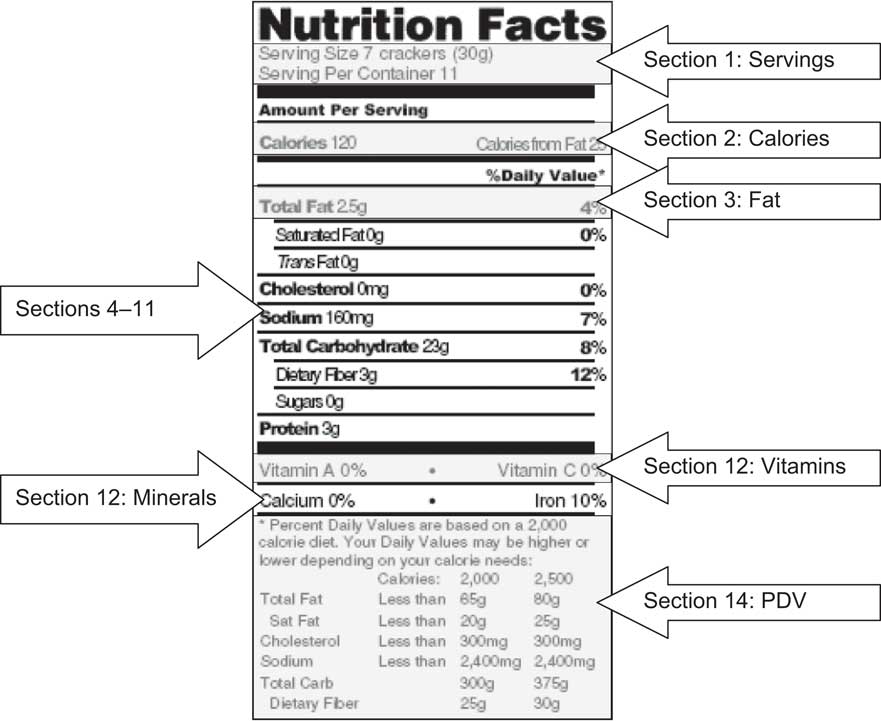
For all analyses, two outcomes were assessed for each individual component on the label (see Fig. 1): percentage of participants viewing the component on the average label and amount of time spent viewing the component on the average label. ANOVA were conducted first to test for omnibus differences among the various categories; for those label components where ANOVA results indicated a significant overall difference between groups, post hoc t tests were conducted, using Bonferroni adjusted P values (0·05/number of comparisons) to determine which groups were significantly different with regard to label viewing.
Nutrition Facts panel highlighting selected sections (PDV, Percent Daily Value)
Power analyses conducted using G*Power 3(Reference Faul, Erdfelder and Lang11) indicated that the ANOVA had low power to detect small effects (ranging from 0·17 to 0·29), but high power (0·82 to 0·94) to detect medium effects and high power (1·00) to detect large effects. Power calculations were similar for t tests: for small effects (0·19 to 0·64); for medium effects (0·60 to 1·00); for large effects (0·92 to 1·00). ANOVA and t test analyses were conducted using the SPSS statistical software package version 17·0 (SPSS Inc., Chicago, IL, USA).
Results
The results of these analyses are presented below for each of the comparisons.
Sex
Participants included 179 women and twenty-four men. The only viewing differences between men and women were: a significantly larger percentage of women (37 %) than men (19 %) looked at sugar content, and women spent significantly more time looking at serving information (147 ms) than did men (78 ms). Additional statistically significant sex differences may have emerged had the sample included more men, who comprised <14 % of the sample.
Race/ethnicity
There were no statistically significant differences in nutrition label viewing between the 178 white non-Hispanic participants and the twenty-five participants of other racial/ethnic groups. As with sex, the small sample size of one of the groups being compared likely limited the ability to detect statistically significant differences.
BMI
Self-reported heights and weights produced the following BMI classifications: ninety participants had healthy BMI (18·5–25·0 kg/m2), fifty-seven were overweight (BMI = 25·0–29·9 kg/m2) and fifty-six were obese (BMI ≥ 30·0 kg/m2). Obese participants were more likely to look at serving size (71 %) and calorie information (82 %) compared with healthy weight participants (50 % and 61 %, respectively).
Age
There were forty-two participants who were ≤30 years old, forty-nine aged 31–40 years, fifty-two aged 41–50 years and fifty-nine who were >50 years old. The percentages of participants in the oldest age group who viewed fat and protein information were higher than those percentages in every other group: significantly higher than the 41–50-year-olds for fat (71 % v. 42 %) and significantly higher than the youngest group (≤30 years) for protein (41 % v. 14 %).
Of the four age groups, participants over 50 years of age spent the most time (235 ms) looking at calorie information; this was significantly more time than the amount spent by participants aged 31–40 years (125 ms). Other between-groups differences in viewing time were not statistically significant.
Educational attainment
There were nineteen participants whose highest level of education completed was high school or vocational training, forty-six who had some college education (<4 years), ninety-one who had a 4 year college degree, and forty-seven who had a graduate or professional education. In general, the group with 4 years of college education did the least viewing of nutrition labels compared with the other three education groups, but the only statistically significant differences were: the college-educated group spent less time (63 ms) looking at sodium content than the group with high school or vocational training; a smaller percentage of the college-educated participants viewed saturated fat (45 %) and trans fat (38 %) compared with those who had <4 years of college education (70 % and 72 %).
Marital status
There were 124 married participants and seventy-nine who were not married. The percentages of unmarried participants viewing saturated fat (46 %) and trans fat (42 %) were significantly lower than the percentages of married participants (60 % and 57 %, respectively).
Household income
There were twenty-seven participants who reported a household income of <$US 25 000, fifty-three who reported $US 25 001–50 000, forty-one who reported $US 50 001–75 000, thirty-two who reported $US 75 001–100 000 and fifty who reported a household income of >$US 100 000. Participants reporting >$US 100 000 spent more time looking at trans fat (117 ms) than did the other groups, but only significantly more time than the group with household income between $US 75 000 and $US 100 000, who spent 60 ms.
Number of children
Thirty-eight participants had one child, seventy-six had more than one child and eighty-nine had no children. Participants with no children spent significantly more time looking at serving size information (162 ms) than did participants with one child (98 ms) and also significantly more time looking at calorie information (216 ms) than participants with more than one child (145 ms).
Type of food
Table 2 presents the mean view times and percentages of participants who viewed each label component for each of four food types (meal items, snack foods, desserts and fruits/vegetables). In general, these results indicated that nutrition label components for meal items received more visual attention than label components for the other types of foods and that labels for fruits and vegetables were the least viewed.
Nutrition label viewing by food category: mean viewing time (ms) and percentage of participants viewing nutrition label components

FV, fruits and vegetables; PDV, Percent Daily Value.
†Meal items: cereal, meat, pizza, soup and yoghurt.
‡Snack items: crackers, chips, nuts, pretzels and rice cakes.
§Fruit/vegetable items: canned and frozen corn, peas, beans, strawberries, blueberries, pears and apple sauce.
∥Dessert items: cookies and ice cream.
¶Pairs underlined are significantly different for viewing time, pairs in italics are significantly different for percentage viewing (P < 0·0083, Bonferroni adjusted).
Screen elements
On average, participants spent 1081 ms viewing nutrition labels, compared with 2076 ms for food description, 963 ms for food pictures, 1069 ms for ingredient lists and 615 ms viewing price information. The average amount of time viewing nutrition labels was significantly greater than time viewing price (P < 0·001), significantly less than the time spent viewing food descriptions (P < 0·001), and not significantly different from time viewing ingredients (P = 0·890) or pictures (P = 0·112).
Purchase status
Comparing viewing between those foods that were purchased and those that were not revealed two consistent differences: participants were less likely to look at nutrition labels on foods they ‘purchased’ compared with those they did not ‘purchase’, but they spent more time looking at the labels of the foods they purchased (see Table 3). These differences were statistically significant for every one of the fifteen nutrition panel components (see Fig. 1).
Nutrition label viewing by food purchase status: mean viewing time for nutrition label components (in ms) and percentage of participants viewing components for at least 50 ms

PDV, Percent Daily Value.
*Significant difference in viewing for purchased v. not-purchased foods (P < 0·05).
†Sample size = 201 because two participants never selected ‘not purchase’.
Finally, principal components factor analysis with a varimax rotation supported a four-component solution (i.e. there were four unique nutrient groups based on participants’ label viewing patterns), such that individuals displaying relatively high viewing of one of these nutrients tended to show relatively high viewing for each of the other nutrients in the same group. One factor, ‘top’, included servings, calories and fat, the three components located nearest the top of the label (see Fig. 1), and explained 17 % of the variance; a second group, ‘upper-middle’, included the next three nutrients nearest the label top (saturated fat, trans fat and cholesterol; 22 % of the variance); a third group, ‘lower-middle’, included the five nutrients located immediately below those included in factor 2 (sodium, carbohydrate, fibre, sugar and protein; 21 % of the variance); and the fourth group, ‘bottom’, included the three components located at the bottom of the label (vitamins, minerals and Percent Daily Value; 13 % of the variance). For additional information regarding nutrition label use as it relates to location of both label and nutrients, see reference (Reference Graham and Jeffery12).
Discussion
Measured use of nutrition labels in the present study is largely consistent with self-reported label use in prior research (i.e. approximately 40–60 % of individuals say they always or often use nutrition information while food shopping(Reference Grunert, Wills and Fernandez-Celemin5)). In the present study, the percentage of participants viewing most label components fell within this 40–60 % range (see Table 2); the percentage of participants looking at calories was slightly higher than this range, but still within the bounds of rates reported in some studies (e.g. references (Reference Guthrie, Fox and Cleveland13) and (Reference Nayga, Lipinski and Savur14)) and the percentages of participants looking at fibre, sugar and protein were only slightly below this range. In the present study, vitamins, minerals and the percent daily value were the least viewed label components; all were substantially below the 40–60 % range.
Consistent with hypotheses, results indicated many significant differences in nutrition label viewing by food category and by consumer purchasing decision; however, contrary to hypotheses and previous research, results indicated few differences in nutrition label viewing between members of different sociodemographic groups (i.e. sex, race/ethnicity, BMI, age, education, marital status, income and number of children). The present study was one of the first to examine sociodemographic characteristics in relation to objectively assessed nutrition label use; that its results did not align with previous self-report data on sociodemographic characteristics of label users suggests that disparities in nutrition label use between various groups might be overestimated by self-report, as previous data reporting these differences were primarily self-reported. However, as mentioned, the small proportions of some demographic groups (e.g. men, racial and ethnic minorities) resulted in low statistical power to detect small effects; thus, additional objective studies of nutrition label use may elucidate these discrepancies. In addition, although the present study compared nutrition label use across many sociodemographic groups, there are additional between-group variables not assessed here (e.g. health consciousness) that would make important contributions to future studies of this kind.
Differences in label viewing based on food type were consistent with those reported previously(Reference Grunert and Wills4, Reference Grunert, Wills and Fernandez-Celemin5); labels for foods generally perceived to be healthier and less processed (i.e. fruits and vegetables) received less visual attention than those perceived to be more processed or ambiguous (e.g. meal items like frozen pizzas and canned soup). Snack food and dessert labels were viewed less than were meal labels; this finding also is consistent with the suggestion in previous research that labels on nutritionally ambiguous foods, like pizza and soup, are more viewed than labels on foods that are seen as more clearly healthy, like fruits and vegetables, or unhealthy, like ice cream, cookies and potato chips. However, previous studies relied on self-reported label use whereas the present study was one of the first to objectively examine differences in label viewing by food type; the consistency between the present findings and previous research indicates that individuals may accurately perceive label viewing in relation to food type.
It should be noted that nutrition labels presented here were clearly visible to the consumer alongside the other pieces of information about the food (i.e. price, product description, ingredients, photo; see Appendix), similar to many online grocery shopping paradigms but different from in-store grocery shopping, where nutrition labels are located on the package side or back and thus not immediately available to a consumer looking only briefly at a package front. This difference may have artificially inflated the percentage of participants viewing labels in the present study compared with the percentage who might do so in a store and represents a likely explanation for why the nutrition information was, on the whole, viewed by a larger percentage of participants herein than in other studies using direct observation. For example, one recent study observing consumer behaviour in a grocery store found that only about one in four shoppers looked at nutrition information when making food purchasing decisions(Reference Grunert, Wills and Fernandez-Celemin5). However, there is no reason to believe that potential inflation due to presentation would differentially impact viewing of individual nutrients (i.e. those nutrients that were most and least viewed by consumers in the present study are likely to be those most and least viewed by consumers making purchasing decisions in grocery stores).
It is, however, also important to understand how consumers use nutrition labels that appear on the front of food packages, as front-of-pack nutrition labels already appear on many food packages in the USA and will soon appear on many more(8). Front-of-pack labels are normative or mandated in many other, especially European, nations and early research on their use suggests that these simplified labels, which typically do not contain all of the information included on the larger nutrition panels, are preferred by consumers(Reference van Kleef, van Trijp and Paeps15), and that package fronts are indeed viewed considerably more (approximately 66 % of the time) than other parts of the package (approximately 12 % of the time) by consumers making food purchasing decisions(Reference Grunert, Wills and Fernandez-Celemin5). Further, preliminary evidence suggests that front-of-pack nutrition labels impact food purchasing, with consumers purchasing healthier foods as indicated by green v. red light labels(Reference Balcombe, Fraser and Di Falco16) and stars indicating healthier choices(Reference Sutherland, Kaley and Fischer17).
Conclusions
The present study represents the first investigation to use eye tracking to objectively measure visual attention to nutrition labels while individuals decided whether to purchase a wide variety of foods. Results indicated that objectively measured label viewing was related to food purchasing decisions but differed from self-reported label viewing. More research with objectively measured nutrition label use is necessary to further explore the high-priority nutrients for consumers and the most user-friendly label designs that inform healthy food selection. In addition, results indicated that nutrition labels on foods with more ambiguous nutrient composition were viewed more than labels on foods with relatively transparent composition or with clear nutrition-related reputations (either healthy or unhealthy), suggesting that consumer expectations contribute substantially to how food labels are viewed. Additional research is warranted into how consumer expectations regarding food healthfulness or nutrient composition relate to nutrition label use and the extent to which these notions reflect accurate healthfulness assessments.
Acknowledgements
This research was supported by the Minnesota Obesity Center (MNOC) and Transdisciplinary Research in Energetics and Cancer (TREC). Both authors declare that they have no conflicts of interest. The authors’ respective contributions to the manuscript are as follows. D.J.G.: conception and design, acquisition of data, analysis and interpretation of data, drafting of manuscript, statistical analysis; R.W.J.: obtaining funding, critical revision of manuscript, supervision. The authors would like to acknowledge MNOC and TREC for funding the research and also Annie Hotop for her contributions to data collection.
Appendix
Sample screen



