




1 Introduction
Let
$(\Omega , \mathcal {F}, \mu , \tau )$
 be a dynamical system, where
$(\Omega , \mathcal {F}, \mu )$
be a dynamical system, where
$(\Omega , \mathcal {F}, \mu )$
 is a probability space and
$\tau \colon \Omega \to \Omega $
is a probability space and
$\tau \colon \Omega \to \Omega $
 is a measure-preserving automorphism. Birkhoff’s pointwise ergodic theorem asserts that for any
$f \in L^1(\Omega , \mathcal {F}, \mu )$
is a measure-preserving automorphism. Birkhoff’s pointwise ergodic theorem asserts that for any
$f \in L^1(\Omega , \mathcal {F}, \mu )$
 , the ergodic averages
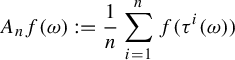
converge almost surely to the integral
$\int f \, d\mu $
 .
.
It is well known that this convergence may fail when
$\mu $
 is only finitely additive (see, for example, [Reference Ramakrishnan35]). However, in [Reference Ramakrishnan35], Ramakrishnan shows that the pointwise ergodic theorem does hold in the finitely additive setting, provided that the sequence of functions
$\{{A_nf}\}$
is only finitely additive (see, for example, [Reference Ramakrishnan35]). However, in [Reference Ramakrishnan35], Ramakrishnan shows that the pointwise ergodic theorem does hold in the finitely additive setting, provided that the sequence of functions
$\{{A_nf}\}$
 satisfies a certain technical regularity condition with respect to
$\mu $
satisfies a certain technical regularity condition with respect to
$\mu $
 (which is automatically satisfied in the
$\sigma $
(which is automatically satisfied in the
$\sigma $
 -additive case), and that

where
$\{{A_i}\}$
 is a sequence of sets in the sub-
$\sigma $
is a sequence of sets in the sub-
$\sigma $
 -algebra of
$\tau $
-algebra of
$\tau $
 -invariant sets, that is,
$\tau ^{-1}(A_i) = A_i$
-invariant sets, that is,
$\tau ^{-1}(A_i) = A_i$
 for all i.
Many other limit theorems in probability theory also fail in the finitely additive setting, such as the strong law of large numbers and the martingale convergence theorem. A substantial body of work, primarily from the 1970s and 1980s, is devoted to recovering classical results of probability theory in the finitely additive context by imposing additional structural or regularity assumptions on the space or the functions involved. In particular, motivated by the insights of Dubins and Savage in their book How to Gamble If You Must [Reference Dubins and Savage10] and by the technical developments of Purves and Sudderth [Reference Purves and Sudderth33], there has been considerable interest [Reference Chen8, Reference Chen9, Reference Karandikar15, Reference Ramakrishnan34] in establishing various limit theorems over products of finitely additive probability spaces that possess suitable continuity properties.
In this paper, we argue that the almost sure convergence in the pointwise ergodic theorem actually does hold for finitely additive probability spaces, provided one adopts the correct notion of almost sure convergence in this setting.
1.1 Motivation of main results
Recall that a sequence of random variables
$\{{X_n}\}$
 on a probability space
$(\Omega , \mathcal {F}, \mu )$
on a probability space
$(\Omega , \mathcal {F}, \mu )$
 converges almost surely if:
-
(A) $\mu (\{\omega \in \Omega : \forall \varepsilon> 0, \exists N\in \mathbb {N}\, \forall i,j \ge N\, (|X_i(\omega ) - X_j(\omega )| \le \varepsilon ) \}) = 1.$


By invoking the continuity of measure (see [Reference Neri and Powell29, Lemma 3.1]), this definition is equivalent to each of the following formulations:
-
(B) ( $\forall \varepsilon{\kern-1pt}>{\kern-1pt} 0, \,(\mu (\{\omega {\kern-1pt}\in{\kern-1pt} \Omega : \exists N \in \mathbb {N}\, \forall i,j \ge N\, (|X_i(\omega ) - X_j(\omega )| \le $
$\varepsilon ) \}) = 1));$
-
(C) ( $\forall \varepsilon , \unicode{x3bb}{\kern-1pt}>{\kern-1pt} 0, \exists N {\kern-1pt}\in{\kern-1pt} \mathbb {N}\, (\mu (\{\omega \in \Omega : \forall i,j \ge N\, (|X_i(\omega ) - X_j(\omega )| $
$\le \varepsilon ) \}) > 1 - \unicode{x3bb} ));$
-
(D) ( $\forall \varepsilon , \unicode{x3bb}> 0, \exists N \in \mathbb {N}\ \forall\ k\in \mathbb {N}$
,
$(\mu (\{\omega \in \Omega : \forall i,j \in [N;N+k]\, (|X_i(\omega ) - X_j(\omega )| \le \varepsilon ) \})> 1 - \unicode{x3bb} )).$






Here, and throughout the rest of this article, we write
$[a;b] := [a,b] \cap \mathbb {Z}$
 .
.
However, these equivalences break down if we assume that
$\mu $
 is only finitely additive. One can readily verify that in this case,

but no other implication holds in general, as explicit counterexamples can be constructed for each of the remaining directions.
We have already noted that the pointwise ergodic theorem does not hold when almost sure convergence is interpreted as property (A). We can strengthen this result by showing that the theorem also fails under property (B) (and, hence, under property (C)).
Example 1.1. Recall that a set
$A \subseteq \mathbb {Z} =: \Omega $
 is said to have asymptotic density if the limit
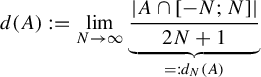
exists. It is straightforward to verify that d defines a finitely additive probability measure on the algebra of all subsets of
$\mathbb {Z}$
 for which the above limit exists. Using a Banach limit, this measure can be extended to a finitely additive probability measure
$\mu $
for which the above limit exists. Using a Banach limit, this measure can be extended to a finitely additive probability measure
$\mu $
 on the entire power set
$\mathcal {P}(\mathbb {Z})$
on the entire power set
$\mathcal {P}(\mathbb {Z})$
 (cf. [Reference Agnew and Morse1]).
Fix such a measure
$\mu $
 . Let
$f := I_A$
. Let
$f := I_A$
 denote the indicator function of a set
$A \subseteq \mathbb {Z}^+$
denote the indicator function of a set
$A \subseteq \mathbb {Z}^+$
 that does not possess an asymptotic density and let
$\tau (\omega ) := \omega + 1$
that does not possess an asymptotic density and let
$\tau (\omega ) := \omega + 1$
 denote the shift map, which can easily be shown to be a measurable, invertible, measure-preserving transformation of
$\mathbb {Z}$
denote the shift map, which can easily be shown to be a measurable, invertible, measure-preserving transformation of
$\mathbb {Z}$
 . Since A does not have an asymptotic density, we can take
$\varepsilon> 0$
. Since A does not have an asymptotic density, we can take
$\varepsilon> 0$
 such that for all N, there exists
$i,j \ge N$
such that for all N, there exists
$i,j \ge N$
 satisfying
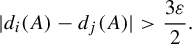
Now, for
$n \in \mathbb {N}$
 and
$\omega \in \mathbb {Z}$
and
$\omega \in \mathbb {Z}$
 with
$n\ge -\omega $
with
$n\ge -\omega $
 , we have
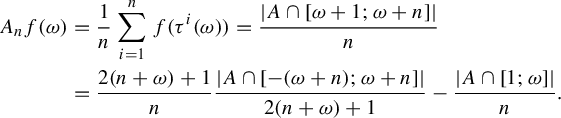
Thus, if
$\omega \le 0$
 , we have

and if
$\omega>0$
 , we have

In both cases, since
$d_k(A) \in [0,1]$
 for all
$k \in \mathbb {N}$
for all
$k \in \mathbb {N}$
 , it follows that

Fix
$\omega \in \mathbb {N}$
 . Suppose there exists
$N \in \mathbb {N}$
. Suppose there exists
$N \in \mathbb {N}$
 such that for all
$i,j \ge N$
such that for all
$i,j \ge N$
 ,
,

If
$i,j \ge \max \{N, (2\omega +1)/\varepsilon \}$
 , the reverse triangle inequality gives

Hence,

which contradicts the way we picked
$\varepsilon $
 .
.
Therefore,

and so property (B) is not satisfied for the sequence
$\{{A_nf}\}$
 .
.
Thus, the only formulation of almost sure convergence we are left with is property (D), which motivates the following definition.
Definition 1.1. Let
$\Omega $
 be a set,
$\mathcal {F}$
be a set,
$\mathcal {F}$
 be an algebra of subsets of
$\Omega $
be an algebra of subsets of
$\Omega $
 , and
$\mu $
, and
$\mu $
 a finitely additive probability measure on
$\mathcal {F}$
a finitely additive probability measure on
$\mathcal {F}$
 . A sequence
$\{{X_n}\}$
. A sequence
$\{{X_n}\}$
 of real valued functions on
$\Omega $
of real valued functions on
$\Omega $
 is said to be finitely almost surely convergent if

and

Remark 1.2. If
$\mathcal {F}$
 is a
$\sigma $
is a
$\sigma $
 -algebra and
$\{{X_n}\}$
-algebra and
$\{{X_n}\}$
 are random variables (which is the setting considered in [Reference Ramakrishnan35] and also the context of Example 1.1), the measurability condition in (1.1) can be omitted. In general, this condition corresponds to the notion of weak Borel measurability introduced in [Reference Neri and Pischke25], which represents the minimal assumption ensuring that the definition remains meaningful when
$\mathcal {F}$
are random variables (which is the setting considered in [Reference Ramakrishnan35] and also the context of Example 1.1), the measurability condition in (1.1) can be omitted. In general, this condition corresponds to the notion of weak Borel measurability introduced in [Reference Neri and Pischke25], which represents the minimal assumption ensuring that the definition remains meaningful when
$\mathcal {F}$
 is merely an algebra.
1.2 Main results
We show that finite almost sure convergence furnishes the appropriate analog of almost sure convergence for extending the pointwise ergodic theorem to finitely additive probability spaces. Our main result is the following theorem.
Theorem 1.3. Let
$(\Omega , \mathcal {F},\mu )$
 be a finitely additive probability space,
$\tau : \Omega \to \Omega $
be a finitely additive probability space,
$\tau : \Omega \to \Omega $
 a measure-preserving automorphism, and
$f \in L^1:=L^1(\Omega , \mathcal {F},\mu )$
a measure-preserving automorphism, and
$f \in L^1:=L^1(\Omega , \mathcal {F},\mu )$
 . If
$\{{A_nf}\}$
. If
$\{{A_nf}\}$
 satisfies

then
$\{{A_nf}\}$
 is finitely almost surely convergent.
The proof of Theorem 1.3 is quite subtle. First, we observe that the quantitative results on the fluctuations of ergodic averages established in [Reference Jones, Kaufman, Rosenblatt and Wierdl12] remain valid in the finitely additive setting. This is achieved by verifying that a suitable version of the Calderón transference principle [Reference Calderón7], which we present in Theorem 3.1, holds for finitely additive spaces. We then combine these results with the insights developed in [Reference Neri and Powell29] on the relationships between various quantitative formulations of almost sure convergence to obtain the desired conclusion.
Furthermore, we obtain several quantitative strengthenings of Theorem 1.3, including a bound on the uniform metastability of the ergodic averages (cf. [Reference Avigad, Gerhardy and Towsner3, Reference Neri and Powell29, Reference Tao and Tao38]).
Theorem 1.4. Let
$(\Omega , \mathcal {F}, \mu )$
 be a finitely additive probability space,
$\tau : \Omega \to \Omega $
be a finitely additive probability space,
$\tau : \Omega \to \Omega $
 a measure-preserving automorphism, and
$f \in L^1(\Omega , \mathcal {F}, \mu )$
a measure-preserving automorphism, and
$f \in L^1(\Omega , \mathcal {F}, \mu )$
 . Suppose that the sequence
$\{{A_n f}\}$
. Suppose that the sequence
$\{{A_n f}\}$
 satisfies

Then,

for some numerical constant c, where

with
$\tilde g^{(i)}$
 denoting the ith iterate of
$\tilde g$
denoting the ith iterate of
$\tilde g$
 .
.
1.3 Connections with mathematical logic and the proof mining program
This work can be seen as a contribution to Kohlenbach’s proof mining program [Reference Kohlenbach16]. Proof mining employs tools from mathematical logic to analyze proofs in mainstream mathematics, yielding significant quantitative and qualitative improvements to known results.
There has been increasing interest in extending the proof mining program to probability theory. Recent developments include results on the Laws of Large Numbers [Reference Neri22, Reference Neri23], studies on the asymptotic behavior of stochastic processes [Reference Neri, Pischke and Powell26, Reference Neri and Powell29], and work on stochastic optimization [Reference Neri, Pischke and Powell27, Reference Neri and Powell30, Reference Pischke and Powell31].
A key feature of analyzing proofs within the framework of proof mining is that one is often forced to strip a proof to its essential structure, which opens the door to generalizations. The results in this paper also benefit from this aspect of proof mining. Studying convergence results in probability theory within this framework, particularly in light of the logical system introduced in [Reference Neri and Pischke25] (see also [Reference Neri, Oliva and Pischke24]), reveals that
$\sigma $
 -additivity is typically used only sparingly in many quantitative analyses. Consequently, many arguments can be lifted to the finitely additive setting. This was already observed in the investigation of quantitative aspects of the ergodic theorem in [Reference Neri and Powell29] and motivated the belief that an appropriate generalization of the pointwise ergodic theorem must exist for finitely additive probability spaces, which we present in this article.
1.4 Organization of the rest of the paper
The structure of the paper is as follows. In §2.1, we recall the theory of integration for finitely additive measures. Section 2.2 reviews the relevant notions and results concerning quantitative formulations of almost sure convergence and their connection to the pointwise ergodic theorem, as presented in [Reference Jones, Kaufman, Rosenblatt and Wierdl12, Reference Neri and Powell29]. The proof of our main results are presented in §3.
2 Preliminary definitions and lemmas
Throughout this section, fix a set
$\Omega $
 , an algebra of subsets
$\mathcal {F}$
, an algebra of subsets
$\mathcal {F}$
 , and a finitely additive probability measure
$\mu $
, and a finitely additive probability measure
$\mu $
 .
.
2.1 Integration on finitely additive spaces
We review the theory of integration on finitely additive probability spaces and recall the properties we need in this paper. Our exposition closely follows the seminal monograph by K. Bhaskara Rao and M. Bhaskara Rao [Reference Bhaskara Rao and Bhaskara Rao5].
The first step is to define the integral of simple functions.
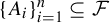
Definition 2.1. A real-valued function f on
$\Omega $
 is said to be simple if there exist sets
$\{A_i\}_{i=1}^n \subseteq \mathcal {F}$
is said to be simple if there exist sets
$\{A_i\}_{i=1}^n \subseteq \mathcal {F}$
 forming a partition of
$\Omega $
forming a partition of
$\Omega $
 and real numbers
$a_i \in \mathbb {R}$
and real numbers
$a_i \in \mathbb {R}$
 such that for all
$\omega \in \Omega $
such that for all
$\omega \in \Omega $
 ,
,
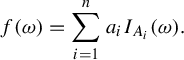
For such a function f, the integral with respect to
$\mu $
 is defined by
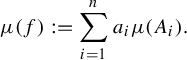
It is straightforward to verify that
$\mu (f)$
 is independent of the particular representation of f. Moreover, linear combinations of simple functions are simple, and the absolute value of a simple function is simple (see [Reference Bhaskara Rao and Bhaskara Rao5, Propositions 4.4.2 and 4.4.4]).
As in the
$\sigma $
 -additive case, a general integrable function
$f : \Omega \to \mathbb {R}$
-additive case, a general integrable function
$f : \Omega \to \mathbb {R}$
 will be defined as the limit of simple functions. In the
$\sigma $
will be defined as the limit of simple functions. In the
$\sigma $
 -additive case, taking this limit to be almost surely or in probability leads to equivalent definitions. In the finitely additive case, we adopt convergence in probability.
Definition 2.2. (Cf. [Reference Bhaskara Rao and Bhaskara Rao5, Definition 4.3.1])
A sequence
$\{f_n\}$
 of real-valued functions on
$\Omega $
of real-valued functions on
$\Omega $
 is said to converge hazily to a function f if

where
$\mu ^*:\mathcal {P}(\Omega ) \to [0,1]$
 denotes the outer measure of
$\mu $
denotes the outer measure of
$\mu $
 , defined by

We can now define the integral for general functions.
Definition 2.3. (Cf. [Reference Bhaskara Rao and Bhaskara Rao5, Definition 4.4.11])
A real-valued function f on
$\Omega $
 is said to be integrable if there exists a sequence
$\{f_n\}$
is said to be integrable if there exists a sequence
$\{f_n\}$
 of simple functions such that
$\{f_n\}$
of simple functions such that
$\{f_n\}$
 converges hazily to f and

Such a sequence
$\{f_n\}$
 is called a determining sequence for f. The integral of f is then defined by

Furthermore, we define

and write
$\lVert {f} \rVert _1$
 for
$\mu (\vert f\vert )$
for
$\mu (\vert f\vert )$
 .
.
The fact that the above definition of the integral is well defined (that is, independent of the choice of determining sequence and finite) follows from [Reference Bhaskara Rao and Bhaskara Rao5, Proposition 4.4.10].
Furthermore, the finitely additive integral satisfies the expected fundamental structural properties (cf. [Reference Bhaskara Rao and Bhaskara Rao5, Proposition 4.4.13]). In particular, linear combinations of integrable functions are themselves integrable, the integral defines a linear operator on the space of integrable functions, and it is monotone: if
$f,g$
 are integrable and
$f(\omega ) \le g(\omega )$
are integrable and
$f(\omega ) \le g(\omega )$
 for all
$\omega \in \Omega $
for all
$\omega \in \Omega $
 , then
$\mu (f) \le \mu (g)$
, then
$\mu (f) \le \mu (g)$
 .
.
The final result we require concerning integration on finitely additive probability spaces involves the composition of integrable functions with measure-preserving automorphisms. Specifically, we consider an invertible map
$\tau \colon \Omega \to \Omega $
 satisfying
$\tau ^{-1}(A) \in \mathcal {F}$
satisfying
$\tau ^{-1}(A) \in \mathcal {F}$
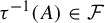 and
$\mu (\tau ^{-1}(A)) = \mu (A)$
and
$\mu (\tau ^{-1}(A)) = \mu (A)$
 for all
$A \in \mathcal {F}$
for all
$A \in \mathcal {F}$
 .
.
Proposition 2.1. If
$f : \Omega \to \mathbb {R}$
 is integrable and
$\tau : \Omega \to \Omega $
is integrable and
$\tau : \Omega \to \Omega $
 a measure-preserving automorphism, then the function
$\tilde {f} : \Omega \to \mathbb {R}$
a measure-preserving automorphism, then the function
$\tilde {f} : \Omega \to \mathbb {R}$
 defined by

is integrable and
$\mu (\tilde{f}) = \mu (f)$
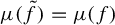 .
.
Proof. The result is immediate if f is simple. Let
$\{{f_n}\}$
 be a determining sequence for f and define
$\{{\tilde{f_n}}\}$
be a determining sequence for f and define
$\{{\tilde{f_n}}\}$
 by
by

Since
$\{{f_n}\}$
 and
$\{{\tilde{f_n}}\}$
and
$\{{\tilde{f_n}}\}$
 are sequences of simple functions, and
$\tau $
are sequences of simple functions, and
$\tau $
 is measure preserving, we have

and, hence, if
$\{{\tilde{f_n}}\}$
 is a determining sequence for
$\tilde{f}$
is a determining sequence for
$\tilde{f}$
 , we have

Thus, it remains to show that
$\{{\tilde{f_n}}\}$
 is indeed a determining sequence for
$\tilde{f}$
is indeed a determining sequence for
$\tilde{f}$
 .
.
We first note the following.
Claim. If
$\tau $
 is a measure-preserving automorphism, then for every
$E \subseteq \Omega $
is a measure-preserving automorphism, then for every
$E \subseteq \Omega $
 ,
,

Proof of claim.
For any
$B \in \mathcal {F}$
 with
$E \subseteq B$
with
$E \subseteq B$
 , we have
$\tau ^{-1}(E) \subseteq \tau ^{-1}(B)$
, we have
$\tau ^{-1}(E) \subseteq \tau ^{-1}(B)$
 and
$\mu (\tau ^{-1}(B)) = \mu (B)$
and
$\mu (\tau ^{-1}(B)) = \mu (B)$
 . Taking the infimum over all such B yields

The reverse inequality follows by applying the same argument to
$\tau ^{-1}$
 .
.
Now, for all
$\varepsilon> 0$
 and
$n \in \mathbb {N}$
and
$n \in \mathbb {N}$
 ,
,

Thus, since
$\{{f_n}\}$
 converges hazily to f, it follows that
$\{{\tilde{f_n}}\}$
converges hazily to f, it follows that
$\{{\tilde{f_n}}\}$
 converges hazily to
$\tilde{f}$
converges hazily to
$\tilde{f}$
 .
.
Finally, for all
$n,m \in \mathbb {N}$
 ,
,

and, hence,

This shows that
$\{{\tilde{f_n}}\}$
 is indeed a determining sequence for
$\tilde{f}$
is indeed a determining sequence for
$\tilde{f}$
 , completing the proof.
2.2 Quantitative notions of stochastic convergence
Quantitative aspects of the pointwise ergodic theorem have been studied extensively in the
$\sigma $
 -additive setting. As we shall see in the following section, many of these quantitative results carry over to the finitely additive setting since one can establish a version of the Calderón transference principle [Reference Calderón7] for finitely additive spaces. In this section, we review the relevant quantitative notions of almost sure convergence that are pertinent to our work.
The most natural quantitative interpretation of the convergence of a sequence of real numbers
$\{{x_n}\}$
 is known as a rate of convergence, which is a function
$\phi :(0,1) \to \mathbb {R}^+$
is known as a rate of convergence, which is a function
$\phi :(0,1) \to \mathbb {R}^+$
 satisfying

There are many convergence results in analysis where one cannot obtain a uniform rate of convergence for the sequences satisfying the premises of these results; a notable example is the monotone convergence theorem, where no uniform rate of convergence exists for all monotone sequences in
$[0,1]$
 , since such sequences can converge arbitrarily slowly. This remains true even for the class of computable sequences of rational numbers [Reference Specker36].
In situations where a uniform rate of convergence cannot be obtained, one can often obtain uniform bounds on an equivalent reformulation, known as metastable convergence:

It is easy to see that (2.1) is equivalent to the convergence of
$\{{x_n}\}$
 . Indeed, if
$\{{x_n}\}$
. Indeed, if
$\{{x_n}\}$
 does not converge, then there exists some
$\varepsilon>0$
does not converge, then there exists some
$\varepsilon>0$
 such that

so we can take a function
$g:\mathbb {N}\to \mathbb {N}$
 bounding
$i,j$
bounding
$i,j$
 depending on n, that is,

which contradicts (2.1). The converse implication is immediate.
A rate of metastability is a functional
$\Phi $
 bounding n in (2.1), that is,

Remark 2.2. One can easily verify that if
$\{{x_n}\} \subseteq [0,1]$
 is monotone, then

is a rate of metastability for
$\{{x_n}\}$
 , where
$\tilde g(n) := n + g(n)$
, where
$\tilde g(n) := n + g(n)$
 and
$\tilde g^{(i)}$
and
$\tilde g^{(i)}$
 denotes the ith iteration of
$\tilde g$
denotes the ith iteration of
$\tilde g$
 .
.
Remark 2.3. The term metastability originates from Tao [Reference Tao and Tao38], where he discussed metastable versions of the monotone convergence principle and other ‘infinitary’ statements. From the perspective of logic, metastability (2.1) corresponds to the Herbrand normal form of convergence, and a rate of metastability provides a solution to the so-called ‘no-counterexample interpretation’ of the convergence statement [Reference Kreisel20, Reference Kreisel21]. Furthermore, there are theorems from mathematical logic guaranteeing the extractibility of uniform rates of metastability for large classes of proofs. Such uniformity was required in the proof of the convergence of the ergodic averages given in [Reference Tao39], where a uniform quantitative version of the dominated convergence theorem was required. Indeed, extractions of rates of metastability by proof-theoretic methods are common results in proof mining (e.g. [Reference Kohlenbach and Leuştean17, Reference Kohlenbach and Sipoş18, Reference Neri and Powell28, Reference Powell32]). Furthermore, as we shall see later, metastability is intimately related to the notion of fluctuations of sequences, a concept that has attracted considerable attention in ergodic theory and probability theory (see, for example, [Reference Avigad and Rute4, Reference Kachurovskii13, Reference Kalikow and Weiss14]).
In the stochastic setting, the analog of a rate of convergence is a function
$\phi : (0,1) \times (0,1) \to \mathbb {R}^+$
 satisfying

where
$\{{X_n}\}$
 is a sequence of real-valued functions on
$\Omega $
is a sequence of real-valued functions on
$\Omega $
 satisfying

Such a function is sometimes called a rate of almost sure convergence. In [Reference Avigad, Gerhardy and Towsner3, Theorem 5.1], it is demonstrated that no computable such rate can exist for the convergence of the (
$\sigma $
 -additive) pointwise ergodic theorem. Motivated by the deterministic case, the notion of uniform metastable convergence (there is also a notion of pointwise metastable convergence, cf. Remark 3.5) was introduced in [Reference Avigad, Gerhardy and Towsner3].
Definition 2.4. Let
$\{{X_n}\}$
 be a sequence of real-valued functions on
$\Omega $
be a sequence of real-valued functions on
$\Omega $
 satisfying

We say that
$\{{X_n}\}$
 is uniformly metastable if

Remark 2.4. In [Reference Avigad, Dean and Rute2], uniform metastability was introduced under the name of
$\unicode{x3bb} $
 -uniform
$\varepsilon $
-uniform
$\varepsilon $
 -metastable convergence and given in a slightly different form. The formulation we present here is from [Reference Neri and Powell29] (see [Reference Neri and Powell29, discussion after Definition 4.10]).
As in the deterministic case, uniform metastability is equivalent to finite almost sure convergence.
Proposition 2.5. Let
$\{{X_n}\}$
 be a sequence of real-valued functions on
$\Omega $
be a sequence of real-valued functions on
$\Omega $
 . Then,
$\{{X_n}\}$
. Then,
$\{{X_n}\}$
 is uniformly metastable if and only if it is finitely almost surely convergent.
Proof. Suppose first that
$\{X_n\}$
 is finitely almost surely convergent. Then, for every
$\varepsilon , \unicode{x3bb}> 0$
is finitely almost surely convergent. Then, for every
$\varepsilon , \unicode{x3bb}> 0$
 , there exists
$N \in \mathbb {N}$
, there exists
$N \in \mathbb {N}$
 such that

Let
$g \colon \mathbb {N} \to \mathbb {N}$
 be arbitrary. Taking
$k = g(N)$
be arbitrary. Taking
$k = g(N)$
 in the above yields

which shows that
$\{{X_n}\}$
 is uniformly metastable.
Conversely, suppose
$\{{X_n}\}$
 is not finitely almost surely convergent. Then, there exist
$\varepsilon , \unicode{x3bb}> 0$
is not finitely almost surely convergent. Then, there exist
$\varepsilon , \unicode{x3bb}> 0$
 such that for all
$N \in \mathbb {N}$
such that for all
$N \in \mathbb {N}$
 , there exists
$k \in \mathbb {N}$
, there exists
$k \in \mathbb {N}$
 with
with

Define
$g(N)$
 to be the least such k. Then, for this choice of g, we have, for all
$N\in \mathbb {N}$
to be the least such k. Then, for this choice of g, we have, for all
$N\in \mathbb {N}$
 ,
,

which shows that
$\{{X_n}\}$
 fails to be uniformly metastable.
To prove Theorem 1.3, we shall demonstrate that the ergodic averages are uniformly metastable. Furthermore, we shall obtain a quantitative strengthening of this result through the construction of explicit so-called rates of uniform metastability.
Definition 2.5. Let
$\{{X_n}\}$
 be a sequence of real-valued functions on
$\Omega $
be a sequence of real-valued functions on
$\Omega $
 satisfying

A functional
$\Phi : (0,1)\times (0,1)\times \mathbb {N}^{\mathbb {N}} \to \mathbb {R}^+$
 is called a rate of uniform metastability for
$\{{X_n}\}$
is called a rate of uniform metastability for
$\{{X_n}\}$
 if
if

In [Reference Avigad, Gerhardy and Towsner3], rates of uniform metastability were computed for the pointwise ergodic theorem for
$L_2$
 functions, with the treatment of the full theorem later given by the author and Powell in [Reference Neri and Powell29]. Moreover, in [Reference Neri and Powell29], a stronger quantitative result is established by introducing the concept of uniform learnability.
Definition 2.6. Let
$\{{X_n}\}$
 be a sequence of real-valued functions on
$\Omega $
be a sequence of real-valued functions on
$\Omega $
 satisfying

A function
$\phi :(0,1)\times (0,1)\to \mathbb {R}^+$
 is called a learnable rate of uniform convergence if, for any
$\varepsilon , \unicode{x3bb} \in (0,1)$
is called a learnable rate of uniform convergence if, for any
$\varepsilon , \unicode{x3bb} \in (0,1)$
 , and sequences
$a_0<b_0 \le a_1<b_1 \le \cdots $
, and sequences
$a_0<b_0 \le a_1<b_1 \le \cdots $
 , there exists
$n \le \phi (\unicode{x3bb} ,\varepsilon )$
, there exists
$n \le \phi (\unicode{x3bb} ,\varepsilon )$
 such that

It turns out that a learnable rate of uniform convergence corresponds to a rate of metastability of a particularly nice form.
Proposition 2.6. (Cf. [Reference Neri and Powell29])
Let
$\{{X_n}\}$
 be a sequence of real-valued functions on
$\Omega $
be a sequence of real-valued functions on
$\Omega $
 satisfying

Then,

is a rate of uniform metastability for
$\{{X_n}\}$
 if and only if
$\lceil \phi (\unicode{x3bb} ,\varepsilon ) \rceil $
if and only if
$\lceil \phi (\unicode{x3bb} ,\varepsilon ) \rceil $
 is a learnable rate of uniform convergence.
This result is stated in the context of
$\sigma $
 -additive spaces, immediately following [Reference Neri and Powell29, Definition 4.15], as an easy consequence of an abstract result given in [Reference Neri and Powell29, Lemma 3.5]. The finitely additive case follows similarly as a direct consequence of the same lemma.
We prove a quantitatively stronger result than that stated in Theorem 1.3 by computing a learnable rate of uniform convergence for the ergodic averages. Theorem 1.3 will then follow from Propositions 2.5 and 2.6.
To compute a learnable rate of uniform convergence for the pointwise ergodic theorem, we require a result from [Reference Jones, Kaufman, Rosenblatt and Wierdl12] concerning the fluctuations of ergodic averages on
$\sigma $
 -additive probability spaces. First, we introduce the notion of the number of
$\varepsilon $
-additive probability spaces. First, we introduce the notion of the number of
$\varepsilon $
 -fluctuations of a sequence of real numbers.
Definition 2.7. Let
$\{{x_n}\}$
 be a sequence of real numbers. We define
$J_{{N},{\varepsilon }}\{{x_n}\}$
be a sequence of real numbers. We define
$J_{{N},{\varepsilon }}\{{x_n}\}$
 to be the number of
$\varepsilon $
to be the number of
$\varepsilon $
 -fluctuations that occur in the initial segment
$\{x_0,\ldots ,x_{N-1}\}$
-fluctuations that occur in the initial segment
$\{x_0,\ldots ,x_{N-1}\}$
 , that is, the maximal
$k \in \mathbb {N}$
, that is, the maximal
$k \in \mathbb {N}$
 such that there exist indices

with

We write

for the total number of
$\varepsilon $
 -fluctuations that occur in
$\{{x_n}\}$
-fluctuations that occur in
$\{{x_n}\}$
 . Note that
$J_{{\varepsilon }}\{{x_n}\}$
. Note that
$J_{{\varepsilon }}\{{x_n}\}$
 could be infinite.
Remark 2.7. It is clear that
$\{{x_n}\}$
 converges if and only if

In [Reference Jones, Kaufman, Rosenblatt and Wierdl12], Jones et al obtained the following quantitative strengthening of the pointwise ergodic theorem.
Theorem 2.8. Let
$(\Omega , \mathcal {F},\mu )$
 be a
$\sigma $
be a
$\sigma $
 -additive probability space and let
$\tau :\Omega \to \Omega $
-additive probability space and let
$\tau :\Omega \to \Omega $
 be a measure-preserving automorphism. For any
$f \in L_1$
be a measure-preserving automorphism. For any
$f \in L_1$
 and
$k, \varepsilon> 0$
and
$k, \varepsilon> 0$
 , we have
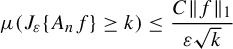
for some numerical constant C.
This result was originally conjectured by Ivanov [Reference Kachurovskii13], who, using entirely different methods, was only able to show

where C is a constant depending only on
$\lVert {f} \rVert _1/\varepsilon $
 (in [Reference Neri and Powell29], the authors were unaware of the bound of Jones, Kaufman, Rosenblatt, and Wierdl, and by improving the methods of Ivanov, they were able to give an improvement to his bound, which was still weaker than that in Reference Jones, Kaufman, Rosenblatt and Wierdl12]).
By establishing a version of the Calderón transference principle [Reference Calderón7] for finitely additive spaces, we shall show that a version of Theorem 2.8 also holds in the finitely additive setting.
It is clear from Theorem 2.8 that the ergodic averages satisfy

and thus converge almost surely. However, as in the case of convergence, bounded fluctuations can have different, non-equivalent formulations in the finitely additive setting. If
$\mathcal {F}$
 is a
$\sigma $
is a
$\sigma $
 -algebra and
$\{{X_n}\}$
-algebra and
$\{{X_n}\}$
 is a sequence of random variables on
$\Omega $
is a sequence of random variables on
$\Omega $
 (so that for all k and
$\varepsilon $
(so that for all k and
$\varepsilon $
 ,
$J_{{k},{\varepsilon }}\{{X_n}\}$
,
$J_{{k},{\varepsilon }}\{{X_n}\}$
 is itself a random variable), we have the following formulations of having finitely many fluctuations almost surely:
-
(J1) $\mu (\{\omega \in \Omega : \forall \varepsilon> 0,\, \exists N \in \mathbb {N}, \forall k\in \mathbb {N}\, J_{{k},{\varepsilon }}\{{X_n}\}(\omega )< $
$ N\}) = 1;$
-
(J2) $(\forall \varepsilon> 0,\ (\mu (\{\omega \in \Omega : \exists N\in \mathbb {N} \,\forall k \in \mathbb {N}\, (J_{{k},{\varepsilon }}\{{X_n}\}(\omega ) < N)\}) = 1));$
-
(J3) $(\forall \varepsilon , \unicode{x3bb}> 0,\ \exists N\in \mathbb {N}\, (\mu (\{\omega \in \Omega : \forall k\in \mathbb {N}\, (J_{{k},{\varepsilon }}\{{X_n}\}(\omega ) < N)\})> 1 - \unicode{x3bb} );$
-
(J4) $(\forall \varepsilon , \unicode{x3bb}> 0,\ \exists N\in \mathbb {N}\ \forall k\in \mathbb {N}\, (\mu (\{\omega \in \Omega : J_{{k},{\varepsilon }}\{{X_n}\}(\omega ) < N\})> 1 - \unicode{x3bb} ).$





As in the case of convergence, we have

Furthermore, it is clear that

where formulation (B) is the almost sure convergence given by

Therefore, Example 1.1 demonstrates that the pointwise ergodic theorem cannot satisfy formulation (J2) in the finitely additive setting and thus cannot satisfy formulation (J3). However, Theorem 2.8 implies formulation (J3), so it cannot hold in the finitely additive setting. We shall show that formulation (J4) of Theorem 2.8 does hold via the Calderón transference principle [Reference Calderón7] for finitely additive spaces.
Theorem 1.3 will follow from our formulation (J4) of Theorem 2.8 by establishing a quantitative connection between bounds on the fluctuations and learnable rates of uniform convergence. We first introduce the notion of a modulus of finite fluctuations, as in [Reference Neri and Powell29], which quantitatively captures formulation (J4).
Definition 2.8. Let
$\{{X_n}\}$
 be a sequence of real-valued functions on
$\Omega $
be a sequence of real-valued functions on
$\Omega $
 satisfying

A function
$\phi :(0,1)\times (0,1)\to \mathbb {R}^+$
 is a modulus of finite fluctuations for
$\{{X_n}\}$
is a modulus of finite fluctuations for
$\{{X_n}\}$
 if
if

Remark 2.9. This definition is well posed because, if

then

In [Reference Neri and Powell29], the author and Powell examined how quantitative notions of almost sure convergence, including those introduced here, relate to one another. For example, from a learnable rate of uniform convergence, one can obtain a rate of uniform metastability. Furthermore, the authors abstracted away from almost sure convergence and instead focused on general logical formulas of the same quantifier complexity, yielding more general quantitative results.
At the time of writing [Reference Neri and Powell29], the quantitative relationship between moduli of finite fluctuations and learnable rates of uniform convergence in the
$\sigma $
 -additive setting was left as an open problem. Recently, Powell communicated to the author a partial solution to this problem by constructing a learnable rate of uniform convergence from a modulus of finite fluctuations. Powell’s construction also lifts naturally to the finitely additive setting. Namely, one has the following result.
Proposition 2.10. Let
$\{{X_n}\}$
 be a sequence of real-valued functions on
$\Omega $
be a sequence of real-valued functions on
$\Omega $
 satisfying

Suppose
$\{{X_n}\}$
 has a modulus of finite fluctuations
$\phi $
has a modulus of finite fluctuations
$\phi $
 . Then,
$\{{X_n}\}$
. Then,
$\{{X_n}\}$
 has a learnable rate of uniform convergence given by
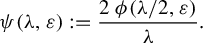
Proof. Fix
$\unicode{x3bb} , \varepsilon \in (0,1]$
 and consider sequences
$a_0 < b_0 \le a_1 < b_1 \le \cdots $
and consider sequences
$a_0 < b_0 \le a_1 < b_1 \le \cdots $
 . For
$k \in \mathbb {N}$
. For
$k \in \mathbb {N}$
 , define the event

By the definition of the modulus of finite fluctuations,
$\mu (B_k) \le \unicode{x3bb} /2$
 for all
$k \in \mathbb {N}$
for all
$k \in \mathbb {N}$
 . For
$a,b \in \mathbb {N}$
. For
$a,b \in \mathbb {N}$
 , set
, set

Suppose, for a contradiction, that for all
$n \le \psi (\unicode{x3bb} ,\varepsilon )$
 , we have
$\mu (C(a_n,b_n))> \unicode{x3bb} $
, we have
$\mu (C(a_n,b_n))> \unicode{x3bb} $
 . Then, for all
$n \le \psi (\unicode{x3bb} ,\varepsilon )$
. Then, for all
$n \le \psi (\unicode{x3bb} ,\varepsilon )$
 ,
,

where we set
$k := b_{\phi (\unicode{x3bb} /2,\varepsilon )} + 1$
 .
.
Now, observe that

and, thus,

which is a contradiction. Here, the last inequality follows from the monotonicity of the integral.
Remark 2.11. The optimality of this construction follows from [Reference Neri and Powell29, Example 4.18]. The converse relationship (constructing a modulus of finite fluctuations from a learnable rate of uniform convergence) is currently an open problem.
3 Proof of main results
The proof of the main result follows by establishing a variation of the Calderón transference principle [Reference Calderón7] for finitely additive spaces.
We adopt the same setup for transference as in [Reference Kosz19]. Suppose that for each
$N \in \mathbb {N}$
 , we have mappings
$\mathcal {O}_N:\mathbb {R}^N \to \mathbb {R}^+$
, we have mappings
$\mathcal {O}_N:\mathbb {R}^N \to \mathbb {R}^+$
 and
$C:\mathbb {R}^+ \to \mathbb {R}^+$
and
$C:\mathbb {R}^+ \to \mathbb {R}^+$
 such that, for any
$K \in \mathbb {N}$
such that, for any
$K \in \mathbb {N}$
 ,
$f:[1,2K] \to \mathbb {R}$
,
$f:[1,2K] \to \mathbb {R}$
 , and
$a>0$
, and
$a>0$
 , we have

where

Our goal is to obtain such an inequality for an arbitrary finitely additive dynamical system.
Theorem 3.1. Let
$(\Omega , \mathcal {F}, \mu )$
 be a finitely additive probability space,
$\tau : \Omega \to \Omega $
be a finitely additive probability space,
$\tau : \Omega \to \Omega $
 a measure-preserving automorphism, and
$f \in L^1(\Omega , \mathcal {F}, \mu )$
a measure-preserving automorphism, and
$f \in L^1(\Omega , \mathcal {F}, \mu )$
 . If the averages
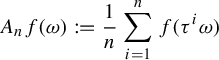
satisfy

then for all
$a>0$
 and
$K \in \mathbb {N}$
and
$K \in \mathbb {N}$
 ,
,

Proof. Fix
$a>0$
 and
$K \in \mathbb {N}$
and
$K \in \mathbb {N}$
 . For each
$\omega \in \Omega $
. For each
$\omega \in \Omega $
 , define
$f_\omega : [1,2K] \to \mathbb {R}$
, define
$f_\omega : [1,2K] \to \mathbb {R}$
 by
by

Then, for
$k,n \in [1,K]$
 ,
,

For
$k \in [1,K]$
 , define

By
$(\star )$
 ,
$E_0 \in \mathcal {F}$
,
$E_0 \in \mathcal {F}$
 . Moreover,
$\mu (E_k) = \mu (E_0)$
. Moreover,
$\mu (E_k) = \mu (E_0)$
 for all
$k \in [1,K]$
for all
$k \in [1,K]$
 since
$\tau $
since
$\tau $
 is measure preserving and invertible, and
$E_k = (\tau ^k)^{-1}(E_0)$
is measure preserving and invertible, and
$E_k = (\tau ^k)^{-1}(E_0)$
 . Hence,

For each
$\omega \in \Omega $
 ,
,
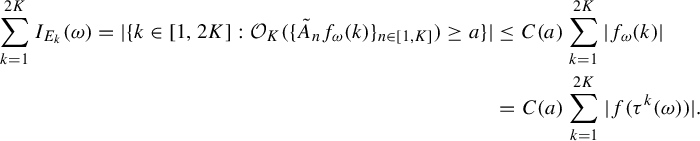
By the monotonicity of the integral, we conclude

and the result follows.
We can now establish a version of Theorem 2.8 in the finitely additive setting.
Theorem 3.2. There exists a constant C such that for any finitely additive probability space
$(\Omega , \mathcal {F}, \mu )$
 , measure-preserving automorphism
$\tau : \Omega \to \Omega $
, measure-preserving automorphism
$\tau : \Omega \to \Omega $
 , and
$f \in L^1(\Omega , \mathcal {F}, \mu )$
, and
$f \in L^1(\Omega , \mathcal {F}, \mu )$
 , if
, if

then for all
$a, \varepsilon> 0$
 and
$K \in \mathbb {N}$
and
$K \in \mathbb {N}$
 ,
,

Proof. Define
$\mathcal {O}_K(\{{x_n}\}) := \varepsilon \sqrt {J_{{K},{\varepsilon }}\{{x_n}\}}$
 . Condition
$(\star )$
. Condition
$(\star )$
 is satisfied since the set in question is a finite union of finite intersections of sets of the form
$\{\omega \in \Omega : |A_i f(\omega ) - A_j f(\omega )| \le \varepsilon \}$
is satisfied since the set in question is a finite union of finite intersections of sets of the form
$\{\omega \in \Omega : |A_i f(\omega ) - A_j f(\omega )| \le \varepsilon \}$
 .
.
Applying Theorem 2.8 to the discrete space
$([1,2K], \mathcal {P}([1,2K]), \mu _K)$
 with
$\mu _K(A) := |A|/2K$
with
$\mu _K(A) := |A|/2K$
 and
$\tau _K(\omega ) = \omega + 1 \bmod 2K$
and
$\tau _K(\omega ) = \omega + 1 \bmod 2K$
 gives condition
$(\dagger )$
gives condition
$(\dagger )$
 . The result then follows by Theorem 3.1.
Remark 3.3. As is the case for the Calderón transference principle in the
$\sigma $
 -additive setting, our Theorem 3.1 allows us to extend several weak-type
$(1,1)$
-additive setting, our Theorem 3.1 allows us to extend several weak-type
$(1,1)$
 inequalities on the ergodic averages (in the context of further measureability assumptions in the case where
$\mathcal {F}$
inequalities on the ergodic averages (in the context of further measureability assumptions in the case where
$\mathcal {F}$
 is only assumed to be an algebra). This includes: finitely additive analogs of the maximal ergodic theorem, upcrossing inequalities (see, for example, [Reference Bishop6, Reference Ivanov11]), and inequalities on the variation and oscillation seminorms (see, for example, [Reference Jones, Kaufman, Rosenblatt and Wierdl12]) to the finitely additive setting.
Proof of Theorems 1.3 and 1.4.
Theorem 3.2 implies that
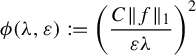
is a modulus of finite fluctuations (cf. Definition 2.8) for the sequence
$\{{A_n f}\}$
 . Moreover, by Proposition 2.10, we obtain that
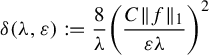
constitutes a learnable rate of uniform convergence (cf. Definition 2.6) for
$\{{A_n f}\}$
 . Consequently, Proposition 2.6 yields that

serves as a rate of uniform metastability (cf. Definition 2.5) for
$\{{A_n f}\}$
 . This yields Theorem 1.4. Theorem 1.3 then follows from Proposition 2.5.
Remark 3.4. In [Reference Neri and Powell29, Theorem 7.9], the asymptotically sharper bound
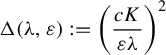
is established as a learnable rate of uniform convergence for
$\{{A_n f}\}$
 in the
$\sigma $
in the
$\sigma $
 -additive setting, where
$c> 0$
-additive setting, where
$c> 0$
 is a universal constant and
$K := \max \{1, \|f\|_1\}$
is a universal constant and
$K := \max \{1, \|f\|_1\}$
 .
.
The methods employed in [Reference Neri and Powell29] crucially rely on countable additivity and therefore do not extend directly to the finitely additive framework. Determining whether comparably sharp learnable rates of uniform convergence can be obtained for the finitely additive version of the pointwise ergodic theorem remains an open problem, which we leave for future investigation.
Remark 3.5. There is an alternative way to obtain Theorem 1.3 without appealing to Proposition 2.10. From a modulus of finite fluctuations, one can derive what is known as a rate of pointwise metastability convergence (cf. [Reference Neri and Powell29, Theorem 4.16]), that is, a functional
$\Phi $
 satisfying

The notion of pointwise metastable convergence was introduced in [Reference Avigad, Dean and Rute2], where the motivation was to develop a quantitative version of Tao’s metastable dominated convergence theorem (cf. [Reference Tao39, Theorem A.2]). Tao’s theorem shows that one can obtain rates of metastability for the convergence of the integrals in the dominated convergence theorem, which depend only on a slightly stronger variant of a rate of pointwise metastability for the random variables appearing in its premise.
The authors of [Reference Avigad, Dean and Rute2] observed that if one has a rate of uniform metastability for the random variables in the premise of the dominated convergence theorem, then one can easily obtain a rate of metastability for the corresponding integrals. Their main result (cf. [Reference Avigad, Dean and Rute2, Theorem 3.1]) explicitly constructs a rate of uniform metastability from a rate of pointwise metastability (which they term a quantitative version of Egorov’s theorem) and uses this quantitative result to strengthen Tao’s metastable dominated convergence theorem. However, the construction given in [Reference Avigad, Dean and Rute2] is highly complex and involves a form of recursion on trees known as bar recursion (introduced in [Reference Spector and Dekker37]). As a consequence, the resulting bounds exhibit an enormous blow-up in complexity. For example, as shown in [Reference Avigad, Dean and Rute2, p. 11], even comparatively simple input rates of pointwise metastability can yield tower-exponential bounds.
It was shown in [Reference Neri and Pischke25] that the results of [Reference Avigad, Dean and Rute2] also hold in finitely additive probability spaces. Thus, one may use the modulus of finite fluctuations obtained in Theorem 3.2 to derive a rate of pointwise metastability, and then appeal to the finitely additive adaptation of [Reference Avigad, Dean and Rute2] given in [Reference Neri and Pischke25] to obtain Theorem 1.3, albeit at the cost of very weak quantitative bounds on the resulting rate of uniform metastability.
Acknowledgements
We would like to express our gratitude to Nathan Creighton, John Griesmer, Pedro Pinto, Nicholas Pischke, and Thomas Powell for their valuable comments and stimulating discussions during the preparation of this work. We are especially indebted to Thomas Powell for communicating his construction, from which Proposition 2.10 was obtained by a straightforward modification.

 Open access

