




1. Introduction
English language teaching in schools and universities has different goals dependent on the specificity of local contexts. Such goals are in turn affected by global scenarios characterized by volatility, unpredictability, complexity, and ambiguity (Van Berkel & Manickam, Reference Van Berkel and Manickam2020). Furthermore, English can no longer be associated with a unique and fixed standard code as it sits amid local varieties, other languages, multimodal semiotic means and resources for expression and communication, fluid spatial and temporal repertoires, and other elements comprising emotions, sensations, bodily and performative features, movement, and more (Harvey et al., Reference Harvey, Tordzro and Bradley2022). It is therefore not straightforward what the focus of English language teaching, or the teaching of any language, in fact, should involve.
Baker (Reference Baker, Ishikawa, McBride and Suzuki2025) suggests that his updated model of transcultural awareness (TCA) can be a valuable pedagogical tool as it brings together intercultural, transcultural, and English as Lingua Franca (EFL) perspectives for the teaching and learning of languages. One advantage is the attention to processes and procedures in intercultural and transcultural communication rather than the identification of competences. Turning away from competences is useful for a critical understanding of the complexity and fluidity of ELF communication, which involves sensitivity to power issues and hegemonic discourses in language education.
Vis-à-vis this backdrop, this article offers an application of Baker’s (Reference Baker, Ishikawa, McBride and Suzuki2025) latest TCA model located in a language teacher education setting in Latin America. The study provides empirical support for the TCA model from an underrepresented region and underscores its pedagogical and methodological potential.
2. Conceptual framework and literature review
Intercultural communication is a bourgeoning field. As global scenarios are increasingly volatile, unpredictable, complex, and ambiguous (Van Berkel & Manickam, Reference Van Berkel and Manickam2020), precariousness (Papastephanou et al., Reference Papastephanou, Zembylas, Bostad, Oral, Drousioti, Kouppanou, Strand, Wain, Peters and Tesar2022) is multifaceted and is manifested as poverty, hunger, armed conflict, human rights abuse, climate catastrophes, illiteracy, and more. What is a viable pedagogical response against this backdrop? Efforts at local levels (e.g. communities) have been complemented with strategic actions by associations dedicated to fostering literacy, democracy, human rights, and social justice, supported by supranational organizations and institutions (UNESCO, Organization of American States, Council of Europe, etc.). Despite these efforts, living together in difference and engaging in loving and ethical relations with others, human and non-human – the foundation of intercultural communication – is currently a utopia.
Language education can make a contribution: it can cultivate in students ethical ways of relating to others (human and non-human) and a renewed sense of life, the self, and being – stepping stones for the building of democratic, peaceful, just, and sustainable societies (Biesta, Reference Biesta2024; Porto, Reference Porto2025a). Different initiatives within intercultural communication and intercultural language education have focused upon social justice language education (Banegas & Sanchez, Reference Banegas and Sanchez2024; Diaz Maggioli, Reference Diaz Maggioli2022; Okan, Reference Okan and Papa2019; Ortaçtepe Hart, Reference Ortaçtepe Hart2023), human rights education (Bruner & Porto, Reference Bruner and Porto2024; Osler & Starkey, Reference Osler, Starkey and Porto2022), peace education (Mercer & Gregersen, Reference Mercer and Gregersen2023; Olivero, Reference Olivero2017; Oxford et al., Reference Oxford, Gregersen, Harrison and Olivero2021), and sustainability in language teaching (Goulah & Katunich, Reference Goulah and Katunich2020; Porto, Reference Porto2025b; Romhild et al., Reference Romhild, Marxl, Matz and Siepmann2023), among others. Furthermore, several models exist (Arasaratnam-Smith, Reference Arasaratnam-Smith, Deardorff and Smith2017), intended to aid policy, curricular developments, pedagogy, and research, such as the Model of Intercultural Awareness (Baker, Reference Baker2011, Reference Baker2015), the Model of Intercultural Communicative Competence (Byram, Reference Byram1997, Reference Byram2021), and the Reference Framework of Competences for Democratic Culture (Barrett, Reference Barrett2020), among others. These models highlight different dimensions of knowledge, skills, attitudes, and values needed to foster democratic engagement and intercultural dialogue.
Here the focus is on Baker’s (Reference Baker2012a, Reference Baker2015) concept and model of intercultural awareness (ICA), recently revised and renamed as transcultural awareness (TCA) (Baker, Reference Baker, Ishikawa, McBride and Suzuki2025), designed for lingua franca contexts, which I use as a theoretical and analytical foundation. Language awareness refers to ‘explicit knowledge about language and conscious perception and sensitivity in language learning, language teaching and language use’ (Garrett & James, Reference Garrett, James and Byram2000: 330). Cultural awareness is considered to be multidimensional, dynamic and variable, modified through experience, and affected by fluid communicative practices as English is used as a global lingua franca in diverse situations (Baker, Reference Baker2012a). The relationship between language and culture is not simplified, on the contrary; it is understood in its complexity (Boye & Byram, Reference Boye, Byram, Garrett and Cots2017), taking into account ‘the multi-voiced “diglossic” nature of culture, which contains conflicting and contradictory views’ (Baker, Reference Baker2012a: 65). Drawing on Byram’s (Reference Byram2021) intercultural communicative competence and Kramsch’s (Reference Kramsch2021) symbolic competence, Baker (Reference Baker, Ishikawa, McBride and Suzuki2025) highlights characterizations of intercultural communication as fluid, dynamic, emergent, and highly variable according to specific sociocultural contexts. It is acknowledged that language learners, including ELF users, need not only knowledge and awareness of various kinds but also the skills of negotiation, adaptation, and flexibility (Baker, Reference Baker2022a, Reference Baker2022b; Vettorel, Reference Vettorel2019), complemented by attitudes such as openness and curiosity.
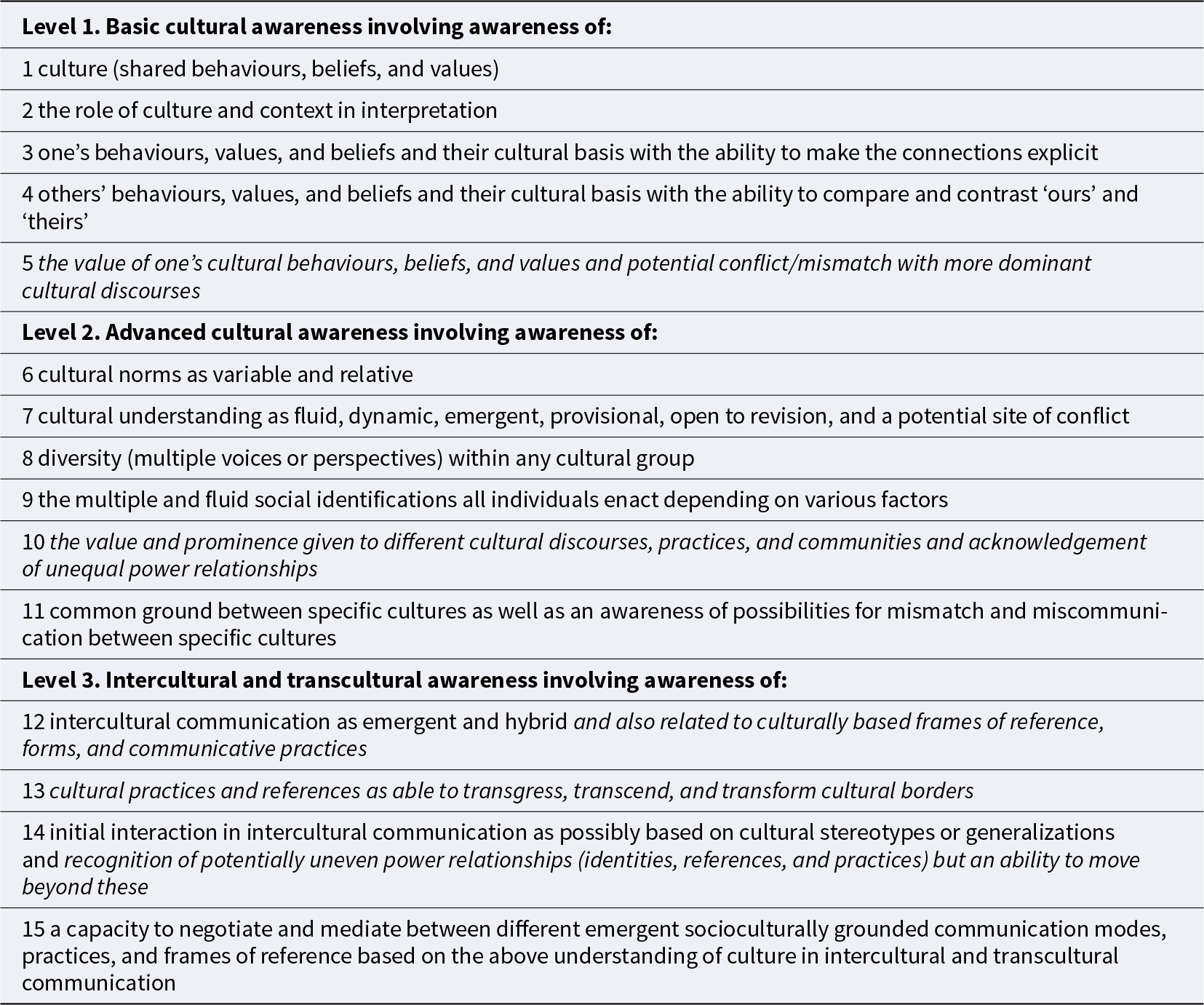
Baker (Reference Baker2012a) defines intercultural awareness (ICA) as ‘a conscious understanding of the role culturally based forms, practices, and frames of understanding can have in intercultural communication, and an ability to put these conceptions into practice in a flexible and context specific manner’ (p. 66) (emphasis added). The word ‘conscious’ suggests that the critical dimension is acknowledged and the revised model (Baker, Reference Baker, Ishikawa, McBride and Suzuki2025) includes this critical element more explicitly. Table 1 presents the updated model, arranged in 15 components (the original model had 12) divided in three levels. Levels 1 and 2 are respectively named as ‘basic’ and ‘advanced’ cultural awareness and level 3 is called ‘intercultural and transcultural awareness’. Although the visual display seems to indicate that levels and components are fixed and have a predetermined progression, Baker (Reference Baker, Ishikawa, McBride and Suzuki2025) acknowledges that the model is a simplification and that people do not necessarily move univocally in the direction reflected in it. The components ‘delineate the knowledge, skills, and attitudes that a user of English as a global lingua franca needs to be able to successfully communicate in these complex settings’ (Baker, Reference Baker2012a: 67), although they ‘should not be read as a set of prescriptive features for intercultural communication’ (Baker, Reference Baker, Jenkins, Baker and Dewey2018: 33). The italicized components are new to the updated model and intended to reflect power issues and hegemonic discourses that may affect transcultural communication.
Model of transcultural awareness (adapted from Baker, Reference Baker, Ishikawa, McBride and Suzuki2025)
Several empirical studies in language education have explicitly used Baker’s original ICA framework (Baker, Reference Baker2012a, Reference Baker2015) as their theoretical foundation and analytical tool. For instance, Bai et al. (Reference Bai, Hu and Zhou2024) found that students developed their intercultural awareness through a reading and writing curriculum in a university in China. Likewise, Yu and Van Maele (Reference Yu and Van Maele2018) found that participants in an English reading course at a Chinese university developed basic intercultural awareness but did not reach level 3.
Al-Hasnawi (Reference Al-Hasnawi2022) investigated ICA in an eight-week Facebook-based debate between university learners of English in Iraq and peers in the US, showing positive development. Chen and Tsai-Hung (Reference Chen2023) report on a General English course at a Taiwanese university designed to teach intercultural communication in ELF using teacher-made materials, which was found to be effective. In an Indonesian university, Kusumaningputri and Widodo (Reference Kusumaningputri and Widodo2018) investigated ICA development through digital photographs and intercultural tasks. Their findings are indicative of level 3 as students enhanced their critical awareness of the sociocultural realities in the photographs. In an Indonesian secondary school context, Putri (Reference Putri2024) found that teachers who deployed high levels of intercultural awareness used intercultural pedagogies that in turn fostered students’ intercultural awareness and communication. Also in Indonesia, Mulyani et al. (Reference Mulyani, Widodo, Simbuka, Balisar Panjaitan and Lestariyana2024) investigated whether the tasks in an English language textbook for secondary schools promoted intercultural awareness. Findings show that most tasks included only basic awareness (level 1) with little evidence of level 3 and no evidence of level 2.
In Vietnam, Nguyen (Reference Nguyen2023) investigated the influence of student teachers’ intercultural awareness in their English teaching practice and found inconsistencies and contradictions between classroom performance and participants’ perceptions of the use of English and its teaching and learning. In an Iranian context, Abdzadeh and Baker (Reference Abdzadeh and Baker2020) developed a course to increase teenage language learners’ intercultural awareness. Findings indicate that systematic ICA instruction in a predominantly monolingual and culturally restricted context had a positive effect as students reached levels 1 and 2. Also in Iran, Edalati Kian (Reference Edalati Kian2018) investigated the intercultural awareness of Iranian learners of English as a foreign language and found disparate levels of awareness – a basis for the author to suggest that local policies and practices of English teaching need serious revision.
Several studies have been undertaken in Thailand. Rajprasit (Reference Rajprasit2020) examined the effects of asynchronous online discussion at tertiary level on ICA development and showed that participants reflected critically upon culturally related issues. Pattaraworathum’s (Reference Pattaraworathum2021) investigation of English teachers’ culture teaching practices indicates that they deployed basic cultural awareness. In turn, Baker (Reference Baker and Council2012b) found a modest positive engagement with intercultural content mainly at levels 1 and 2 in a short self-guided e-course. Level 3 was not observed. Similar difficulties with level 3 were observed by Baker (Reference Baker2016) and Humphreys and Baker (Reference Humphreys and Baker2021) who investigated international students’ intercultural preparation in Japan in study-abroad programmes. Participants stayed at levels 1 and 2.
There are few studies set in the European context. For instance, Souza da Silva (Reference Souza da Silva2021) investigated the intersection between the ICA model and pragmatics in naturally occurring conversations in London in multilingual faith-based communities. Her findings indicate that some pragmatic strategies fulfilled specific functions in the displays of the ICA levels. In a TESOL Master’s programme in a UK university, Delogu and Greenier (Reference Delogu and Greenier2025) used Baker’s model to investigate practitioners’ cultural conceptualizations and their attitudes towards implementing transcultural ELT materials in the future and towards the portrayal of culture and intercultural communication in a commercial textbook. Findings show that participants appreciated intercultural approaches but considered that transcultural awareness was complex and difficult to implement. In turn, Köylü and Borràs (Reference Köylü and Borràs2024) investigated Spanish and Turkish student-sojourners’ intercultural awareness development in longitudinal perspective, a few years after a study abroad experience in non-anglophone countries where English was used as a lingua franca (Austria, Belgium, Denmark, Germany, Poland, Portugal). Participants developed their intercultural awareness during the study abroad, and the positive effects were sustained three to five years after the stay.
This brief literature review shows that empirical studies are located in China, Iran, Iraq, Thailand, Indonesia, Taiwan, Vietnam, Japan, and the UK. Overall, the influence of Baker’s original ICA model on educational programmes and interventions as well as to gather student reflections and experiences related to intercultural awareness development is significant, predominantly in the Asian-Pacific region, with a smaller number of studies in Europe. In these regions, the model has been validated as a pedagogical guide and a theoretical and analytical framework in research and practice. To my knowledge, there is little or no research in Latin America. This gap in the literature motivates this study. Furthermore, the fact that evidence of ICA development remains mainly at levels 1 and 2 of the model deserves further investigation. It is not clear why development is limited to the lower levels of basic and advanced cultural awareness without indications of the development of intercultural and transcultural awareness. I hypothesized that one reason might be methodological: research instruments are generally interviews, surveys, questionnaires, written assignments and reflections, and classroom observations. Conversational data in a classroom context are not available (cf. Souza da Silva, Reference Souza da Silva2021 in a naturally occurring context) – let alone artistic and civic engagement data. In addition, there is of course no empirical evidence yet of the revised TCA model (Baker, Reference Baker, Ishikawa, McBride and Suzuki2025). It is therefore important to investigate how the different levels of intercultural and transcultural awareness operate in different contexts and regions with the goal of obtaining a comprehensive picture of TCA development that takes into account complex, dynamic, and fluid understandings of the language-culture nexus in transcultural communication and language education (Baker & Ishikawa, Reference Baker and Ishikawa2021; Baker et al., Reference Baker, Ishikawa and Jenkins2024). These gaps motivate the present study and the research question is: how does transcultural awareness (TCA) develop among teacher candidates in an Argentinian teacher education programme?
3. Methodology
3.1. Context, participants, and project description
This study is retrospective as I was curious to apply Baker’s new model to a project focused on English as a Lingua Franca (ELF) that included conversational, artistic, and civic engagement data. I therefore re-examined an online transnational project implemented in 2013 between 100 second-year undergraduate students, Spanish speakers, future teachers of English, at a national public university in Argentina, and 75 Italian second-year bachelor’s level degree students of English at a university in Italy. They were 18 to 22 years old with a B2/C1 level of English and their participation in the project was voluntary. I was the course teacher and the researcher.
The project lasted seven months, addressed the theme of mural art and graffiti, and had linguistic and intercultural aims, for example, appreciate linguistic diversity in English, Spanish, and Italian; engage in intercultural dialogue with others using English as lingua franca; and analyse images, texts, and practices critically. It also had citizenship aims such as: express viewpoints respectfully; develop values such as empathy and solidarity; and engage in civic participation locally and beyond.
There were three steps:
a) Introductory and awareness raising stage: students researched about mural art and graffiti in their own language classes without interacting online yet. They strolled around their cities in Argentina (La Plata) and Italy (Padua) to photograph existing murals and graffiti in their towns and they created a corpus of street art in each city. They uploaded their photographs to a wiki and using a-synchronic communication tools (chat in the wiki and email), they shared their impressions about that corpus.
b) Online intercultural dialogue stage: students met in Skype weekly in mixed nationality groups and discussed the social, cultural, and historical meanings of their corpus using ELF. They arrived at a shared and critical understanding of those forms of expression, analysing whether they were art forms or vandalism. They also designed a collaborative mural or graffiti intended to represent their positioning on the debate art or vandalism using tools like Mural.ly.
c) Citizenship stage: in small groups students planned and implemented a civic action in their local communities. Due to restrictions, only the Argentinian students participated in this stage. Their civic actions, planned and implemented without teacher involvement, were: teaching a lesson on mural art and graffiti in a shelter home for poor women; drawing reverse graffiti in a local square (an environmentally friendly way of creating temporary images on walls or other surfaces by removing dirt from a surface); publishing an article in the university newspaper; and creating a mural in one of their homes.
3.2. Data collection and analysis
The data collected in this project are in general radically different from the data in the reviewed studies above (cf. Kusumaningputri & Widodo, Reference Kusumaningputri and Widodo2018, who used digital photographs). It comprised face-to-face synchronous communication (conversational data in recorded Skype conversations), artistic artefacts (collaborative murals and graffiti, accompanied by a reflection log describing the artwork), and civic action artefacts (newspaper articles, leaflets, photos, reverse graffiti, murals, sticker art, and written reports of civic actions). The Argentinian students also completed the Autobiography of Intercultural Encounters (AIE) (Council of Europe, 2022) – a resource with guided questions and prompts intended to help users observe, describe, analyse, interpret, and evaluate an intercultural encounter. Students signed informed consent forms and the universities provided the ethical frameworks.
I conducted a qualitative retrospective and a priori analysis using Baker’s (Reference Baker, Ishikawa, McBride and Suzuki2025) revised model of transcultural awareness (Table 1) (Cohen et al., Reference Cohen, Manion and Morrison2018; Saldaña, Reference Saldaña2021). There was an initial holistic stage in which I examined and re-examined all data types to obtain a global perspective. During this process, I made informal handwritten annotations and comments using the model as foundation, registered salient aspects, and compiled my initial impressions in a chart. Then I proceeded to trace evidence of the 15 components of transcultural awareness (TCA) in all data types. I also looked for emerging themes related to each component, unique perspectives not anticipated by it, and commonalities or unifying threads. Throughout the process I wrote descriptive, narrative, and interpretive vignettes and I selected multiple examples from all data types to document the analysis and illustrate findings.
Following these procedures, my original plan was to assign a particular component and level in the model to each data type by each participant. Although Baker (Reference Baker, Ishikawa, McBride and Suzuki2025) himself acknowledges that levels and components are not fixed and that there is no pre-determined progression, their labelling as ‘basic’, ‘advanced’, and ‘intercultural and transcultural awareness’ indicates that some kind of hierarchy and progression is indeed assumed and can, in fact, be expected. However, during the data analysis phase, it was impossible to allocate discrete components and levels to any data type as a whole or participant in particular. What the analysis showed is that participants moved backwards and forwards fluidly among the components of each level, and across levels, not only among the written tasks and artistic artefacts they produced, but also at different points within the same task/artefact. This fluidity was also observed in spoken interaction in the Skype conversations in mixed nationality groups. This means that TCA in ELF communication in this setting could not be described as a set of discrete components or levels. By contrast, this awareness was dynamic, fluid, procedural (it was highly dependent on various aspects and emerging conditions), and was consequently complex. Participants deployed flexible and idiosyncratic trajectories towards TCA, showing indicators of all components and levels in their ELF communication in this setting.
Methodologically then, this impossibility to assign components and levels discretely led me to adjust my analytical procedures. I decided to identify components and levels not per task (research instrument) or individual (participant), as originally planned, but emergently as they occurred, for instance at paragraph, sentence, and/or phrase level within each data type, covering the full data set. This procedure meant that it would be impossible to present findings per component, level, or participant. Therefore, I arranged findings around a theme I called ‘intercultural and transcultural awareness development in action’. It includes findings arising from: a) teacher candidates’ work in project tasks through face-to-face online communication; b) face-to-face informal and off-task conversations during the Skype meetings; c) written reflection in the Autobiography of Intercultural Encounters; and d) civic action artefacts. Data extracts appear verbatim and I highlight the evidence for my arguments in the data extracts used as illustration. Single inverted commas indicate that those words belong to the participants.
4. Findings
4.1. Intercultural and transcultural awareness development in action
a) Teacher candidates’ work in project tasks through face-to-face online communication: A collaborative mural
Following task instructions, one mixed nationality group designed a collaborative mural to portray the group’s positioning on the debate art or vandalism. It consisted in the juxtaposition of colourful images they considered to be representative of each country. They prioritized nationality as their main framework of orientation although the instructions did not set any predetermined orientation. The mural cannot be reproduced here for copyright reasons as there are images from the internet. The central part of the mural is occupied by two flags, Argentinian and Italian. Also centrally located, there is a big shape of a face, with its skull wide open, from which one can see the brain popping up, accompanied by the caption ‘Always keep it OPEN’ (emphasis in capitals belongs to students). Twelve arrows depart from the skull and end in different images intended to represent each country. On the Argentinian side, the images show Maradona, Borges, and tango; on the Italian side, the Roman Coliseum, Venice, and pizza.
These choices reflect basic cultural awareness in Baker’s model (level 1) involving cultural representations, evidence of component 1. Students discussed these choices and said they were intended to make ‘a good link between Italy and Argentina’ (extract from Skype conversation). One Argentinian student expressed that the aim was to ‘represent[s] us Argentineans’ and ‘represent[s] both countries’ cultures’. They thus mobilized components 3 and 4 by discussing the representativeness of different options for each country, in other words, ‘our’ and ‘their’ cultural representativeness.
We tried to reflect what represents us Argentineans all over the world (…) we made a graffiti that represents both countries’ cultures (reflection log).
Extract 1 shows students’ choices of cultural representations (in italics) (‘Argentinian flags’, ‘Maradona’, ‘Patagonia’).
Extract 1
ITAL1: Yes, we actually talked about some backgrounds images for pictures, to put two flags, both the Italian and Argentinian flags, and two landscapes, a photo of Maradona, a soccer player from Argentina, who actually played in Napoli in Italy, so I guess it’s a good link between Italy and Argentina.
(…)
ARG1: Do you put Maradona in the middle of the flag?
(…)
ITAL1: Yes, the two flags, the Patagonia and the other is the sunset in the mountain, Italy. And we use both as a background for the mural.
Even though cultural representations of this kind are superficial and stereotypical (Baker 2012, Reference Baker2015, Reference Baker, Ishikawa, McBride and Suzuki2025), it was hard for students to come to an agreement. The discussion to come to an agreement is evidence of components 3 (one’s cultural basis) and 4 (others’ cultural basis), with a capacity for reflection upon the binary ‘us-them’. For instance, discussing their choice of landscape for each country (Extract 2), students considered including prototypical animals (sheep, goats, dogs) (component 1), associated a particular animal with a country or region within it (‘Patagonian sheep’), and discussed whether a particular breed of dog was Italian or not (‘we also have the Italian Matador’, ‘are you sure it’s only an Italian dog?’) (component 2, the role culture and context meaning-making).
Extract 2
ITAL2: There, I just put an images of sheeps.
ARG2: It’s ok.
ARG1: I think it’s cute.
ARG2: It’s a Patagonian sheep, I think.
ITAL2: We also have some races of goats, here in Italy we also have the Italian Matador.
ITAL1: Yes, it’s a race of dog.
ITAL2: I put the image on the mural.
ITAL1: Are you sure it’s only an Italian dog?
ITAL2: Yes, I’m sure.
Teacher candidates reflected on the possibility of including the Pope because he is an ‘Argentinean and living in Rome’. Extract 3 shows they considered his representativeness as both Argentinian and Italian (components 1 through 4) but were concerned about whether the religious content could be perceived as ‘offensive’ by some Italians. This is an indication of component 5 as participants were considering potential conflicts (‘but’, ‘serious doubts’, ‘offensive’) within a dominant religious discourse in Italy (‘how much religion means’) (in bold).
Extract 3
ARG2: I was suggesting the Pope, being that the Pope is Argentinean and living in Rome, specially knowing how much religion means to Italians, but I had serious doubts that those who are not religious would find it offensive.
They finally decided the Pope would have general appeal so it would be a better selection than the dog (Extract 4). The discussion of the value and prominence given to the religious discourse in both countries is also indicative of component 10 in level 2. In their view, the Pope erased any power issues (‘proud’, ‘offensive’); consequently, they discarded the problem of causing offense (‘I don’t think’) (in bold). The phrase ‘goes beyond religious beliefs’ (underlined) indicates the group was discussing the choice of the Pope as a challenge to national boundaries of membership and this is indicative of components 14 (the role of generalizations) and 13 (cultural practices and references as able to transgress, transcend, and transform cultural borders) in level 3.
Extract 4
ITAL1: Choosing the Pope goes beyond religious beliefs. so I think we can put the Pope. I don’t think the dog goes with the mural.
ITAL2: Yes, you are right.
ITAL1: I don’t think it completely represents Italy.
ITAL2: Ok, you are right.
ARG2: So what do you guys think about the Pope?
ITAL1: Yes, I think it’s a good idea.
ARG2: Also the fact that we are Argentinean or at least most of us are proud of the fact that the pope is Argentinean, and I don’t think people in Italy would find it offensive since 90% of the citizens in Italy are religious.
As teacher candidates discussed these possibilities, they were in fact addressing the role of culture and context in interpretation, for instance, the suitability of adding the Pope and the dog, or not. This is component 2 in level 1. At the same time, Extract 4 offers evidence of components 3 and 4, that is, attention to one’s behaviours, values, and beliefs and their cultural basis (component 3, ‘most of us are proud of the fact that the pope is Argentinean’), and attention to others’ behaviours, values, and beliefs and their cultural basis (component 4, ‘90% of the citizens in Italy are religious’).
The conversation continues as teacher candidates discussed each of the cultural representations they wished to include in their mural. No choice was simple. For instance, the cultural associations brought about by tango were not clear-cut for them. Extract 5 shows components 6, 7, and 8 in level 2 indicating advanced cultural awareness (in italics). The fact that two group members were not familiar with tango and that a third member confused the instruments used to play it (guitars, drums, piano) illustrates the variability and relativity of cultural products, representations, and norms (component 6), their characterization as fluid, dynamic, and emergent (component 7) as well as the diversity that characterizes any cultural group (component 8). This variability, relativity, fluidity, and diversity was signalled linguistically (indicated in bold) through the use of denials (‘no, I’m not’, ‘I don’t think’), clarification requests (‘what is it for?’), confirmation requests (‘right?’), tentativeness (‘it can be used’), and an offer to research further (‘let me find’).
Extract 5
ARG2: … are you at all familiar with Tango? I think it’s a very common genre of music in Italy as well as in Argentina.
ITAL1: No, I’m not.
ITAL2: I’m also not very familiar with it.
ARG2: Oh, I thought you were.
(…)
ARG1: I just pasted a picture of guitars and drums, it was used to make music in folklore and tango.
ARG2: I don’t think drums are used in tango.
ARG1: Let me find the main instrument used for tango.
(…)
ARG2: On the side there are images of a piano, what is it for?
ITAL1: It can be used as an instrument in tango, right?
After this long conversation, the group concluded that both cultural groups have ‘many things in common’ (Extract 6), illustrating component 11 in level 2, that is, shared worlds, common ground, and convergence after considering possible mismatches.
Extract 6
ARG2: I think it’s easy to find things in common between Italian and Argentinian cultures.
ITAL1: Yes, there are many things in common.
They became conscious of the fact that the development of transcultural awareness was a long process that evolved during the implementation of the whole project, an indication of component 15 in level 3.
The message we intended to transmit was constructed along the duration of the project (…) The meaning attributed to the mural was built between the members of this group by sharing and discussing the different perspectives each of us had (reflection log).
Teacher candidates were aware of the complexity and procedural nature of intercultural and transcultural understanding (component 15) and this was evidenced in their motivation to contact cultural informants on one occasion. For instance, discussing their corpus of murals in each country, one group of Italian students contacted the association that supported the creation of the mural they had photographed in Padua (Extract 7). This is evidence of components 2 (the role of culture and context in interpretation), 6 (cultural norms as variable and relative), and 7 (cultural understanding is fluid, dynamic, and emergent) (evidence in italics).
Extract 7
ARG3: Where is it [the mural]? Is it in Padua?
ITAL3: Yeah. It was a dull wall because it was all grey and nobody cared about it. And all these artists came here and they planned to do something amazing with the support of an association. An association which promotes the meeting with the artists and some kind of shows with the artists. We talked with the president of this association last week and also with the artists that participated at the mural.
(…)
ARG4: So you talked to the graffiti artist and this association you were talking about in class? You talked to them?
ITAL3: Yes.
ITAL4: Yes.
ARG4: Oh. That’s awesome.
They compared and contrasted their contexts, backgrounds, behaviours, values, and beliefs (components 3 and 4) in relation to street art in their cities, La Plata and Padua (Extract 8) (‘very different styles’, ‘it’s more like open’, ‘they are more about …’).
Extract 8
ITAL3: I think that there are very different styles from Italian, in Padua. Graffiti in Padua. Graffiti in La Plata.
ARG4: Maybe …
ITAL3: I think, I’m not sure in La Plata they can be called like wild style. It’s more like open and in Padua are more like … I don’t know …
ARG4: Elaborated.
ARG3: And here in Argentina they are more about political issues.
Despite these differences, they concluded that ‘graffiti is a worldwide language’, another challenge to national boundaries of membership as the Pope (component 14, level 3), indicating their awareness of shared worlds, common ground, and convergence in communication (component 11, level 2), in this case through art.
… although we did notice that graffiti in Padova is a little bit different from the one here in La Plata, we could understand it and appreciate them anyway. So we concluded stating that graffiti is a worldwide language (reflection log).
b) Face-to-face off-project interaction with international peers
The fluidity and flexibility in teacher candidates’ trajectories towards transcultural awareness was also observed when they engaged in informal and off-task conversation during the Skype meetings. For instance, the same group of students compared and contrasted means of transport in both cities (‘Buenos Aires is the only city that has undergrounds’, ‘We don’t have undergrounds here in Padua’ – Skype conversation), an indication of components 1 through 4. The conversation then turned to names and languages as characteristic of particular backgrounds and as markers of identity (Extract 9), illustrating component 9 (multiple and fluid social identifications). The topic was triggered by the teacher’s name in Italy and its associations with particular geographical backgrounds and languages from the students’ points of view.
Extract 9
ITAL5: I think she’s not Italian even if she has this name and surname which, I don’t know, are very Italian.
ARG5: It’s not. It’s like … enm … a name from South America.
ITAL6: It’s a very common name in Italy.
ITAL5: Yeah, it’s very common. She told us she didn’t know Spanish so we supposed she wasn’t, she isn’t from South America or Spain so we don’t know.
Then they discussed their own names and the associations each one brought in terms of origins (Extract 10). They also attempted translating their names into Italian or Spanish accordingly. They ended up talking about ancestors, again evidence of component 9.
Extract 10
ITAL5: And what about your surname? Because it’s, you know, if you read it in Italian [it] is [surname], which is really Italian as a surname.
ARG6: It is Italian.
ITAL5: Yeah! Really?
ARG6: My grandfather was Italian.
ITAL6: Oh.
ITAL5: Really! So, yeah I guess it was because it’s so Italian. So, do you have some relatives here in Italy?
The conversation continued and teacher candidates addressed a variety of themes related to their own cultures (components 1 and 2), comparing and contrasting them (components 3, 4, 6), for instance, socioeconomic contexts in each country, currency, university systems, private and public education, fashion, love relationships, stereotypes like ‘Latin lover’, male and female roles, and the family, among others. In so doing, they relied on stereotypes and generalizations, for example, in connection with the characteristics of men in both countries. Linguistic evidence of such stereotyping and generalizing (component 14) is highlighted in bold in Extract 11: plural nouns (‘Italians’, ‘guys in Italy’, ‘Italian boys … they are all …’), general noun phrases (‘people in towns’), and predictions (‘they’ll say’). At the same time, however, they were aware of the role of cultural stereotypes and generalizations (component 14) (underlined), for instance through comments like ‘which is a stereotype’, and also wondered about them in the first place (‘is it true?’ repeated three times). Consequently, the extract also offers evidence of components 6 (cultural norms are variable and relative) and 8 (diversity within any cultural group), for instance, through the use of tentativeness, hesitation, hedging, and modality (also underlined) (‘Em, well. I don’t know’, ‘it depends’, ‘maybe’).
Extract 11
[After discussing what Argentinian men are like]
ARG6: How about Italians? Are they good?
ARG5: Is it true they care so much because of their appearance?
ITAL5: Sorry.
ARG5: Is it true that guys in Italy they really care about their image, personal image? I mean …
ITAL6: It’s true. I think it’s true.
ARG5: Because of the clothes, because the hairstyle.
ARG6: The hairstyle?
ARG5: The hairstyle and we know that you have, you know, Gucci perfumes, you know, Dolce and Gabbanna trademark, is it true?
ITAL6: Em, well. I don’t know.
ITAL5: I think it’s the sense …
ITAL5: Oh, I mean, in my opinion it depends, there are two things that can, we can say, I mean, em people who lives in towns in big towns, uh, maybe they are more passionate about their clothes, about their image
(…)
ITAL6: My personal opinion if you want to know about Italian boys it is that they are all mamas’ boy, don’t know if you understand.
ARG5: What is that? I don’t know what is that.
ITAL6: Em, they’re not Latin lovers, they’re very linked and connected to their mother, so for example if you cook something for them, which is a stereotype, they’ll say ‘oh my mom do it better than you’, then you cook better than her.
Then, in Extract 12, participants discussed male and female roles in society (‘a second mommy who cares for them’), particularly sexism and male chauvinism (in italics) (‘a macho thing’, ‘macho-men’, ‘machismo’), and analysed cultural stereotypes and generalizations (component 14) (underlined) by drawing attention to the influence of personal perspectives (‘it depends of you’, ‘it depends on the people’) and the family (‘maybe it depends in the way they have been raised’). Linguistically, this is again shown through the use of tentativeness, hesitation, hedging, and modality (‘I just can say that’, ‘maybe’, ‘I mean em because, you know’, ‘but I don’t know’, ‘maybe it depends’) (in bold). The discussion illustrates the components related to relationships of power in the model, for instance, component 10 (analysis of cultural beliefs and practices such as cooking, cleaning, and caring and an acknowledgement of unequal power relationships in society) and component 14 (the recognition of uneven power relationships, in this case gender roles in society) (‘has the power’, ‘have control’). In addition, in acknowledging such power issues, participants engaged with those roles emergently, mediating perspectives, evidence of component 15 in level 3, signalled by expressions of tentativeness (‘it depends’ and ‘maybe’ – repeated three times each).
Extract 12
ARG5: There’s a macho thing in the society . I don’t know the word for ‘machismo’ in English?
ARG6: How do you say something related to males?
ARG5: Do you know the word machismo in Spanish?
ITAL5: I mean it’s something related to the fact of being male?
ARG6: Yes.
ITAL5: Yeah, well, I don’t know how to say it in English, I mean, maybe …
ITAL6: Do you mean something like macho?
ARG5: Yeah.
ITAL5: Macho-men? Something like this, they’re not …
ARG5: It’s like the Godfather movie.
ITAL5: Ok, someone who has the power and wants to have control of the people? Is this?
ARG6: Yes …
ARG5: So they want a second mommy, let’s say.
ITAL5: They don’t want a girlfriend, they want a second mommy who cares for them.
ITAL5: Oh, yes!
(…)
ITAL5: … I just can say that yeah, maybe there are a lot of men who wants to his girlfriend to be like her mother, like his mother, I think it’s true. I mean em because, you know, here in Italy our mother is a very present figure in the family so … but I don’t know maybe it depends on you, I don’t know, it depends on the people.
ARG6: Maybe it depends in the way they have been raised, yeah maybe some boys are raised to be a ‘macho’ and have the woman cook and clean for them.
ITAL5: Yeah.
ARG6: And maybe others are not.
When the conversation turned to the family (Extract 13), at one moment two Argentinian students disclosed a very special social identification (component 9) (in italics), the death of a sister, engaging the Italian students emotionally (‘oh, oh’). The discovery of this common but profound and unique life experience contributed to the development of a sense of bonding among the group (in bold) (‘I completely understand you’), an instantiation of component 11 (shared worlds, common ground, and convergence).
Extract 13
ARG6: … and well, my older sister ehm she’s dead but em. It’s ok, it’s ok I don’t have a sister, that’s why I said uh, this is awkward ha ha like it’s ok.
ITAL5: Yeah.
ARG5: You know, I understand you, because, you know, I’ve mentioned only my brother, but the thing is we were we are three brothers, my sister died seven years ago, but, you know, in a way she’s with you. I know what you mean you try like, like you bring her, back uh … in your memory.
All: Yeah.
ITAL5: Oh, oh.
ARG6: We can’t deny them.
ARG5: Yeah.
ITAL5: Of course.
ARG5: I completely understand you, yeah.
Participants gave a lot of importance to feelings and saw art as a means of channelling discomforting feelings (‘crudeness’, ‘unbearable’) such as these.
We wanted to share what people can do with art, how they can represent their feelings, points of view and, as we showed in the mural, ‘without art the crudeness of reality would make the world unbearable’ (reflection log).
Importantly, this sense of bonding (component 11, shared worlds) was also fostered by their participation in the project and the creation of their collaborative mural.
We feel that the mural is an expression of the friendship and cooperation that we experienced during this project (…) We summarize the feeling using the words ‘this project brought us together’. We are far away, but we felt really close to each other (reflection log).
c) Written reflection in the Autobiography of Intercultural Encounters
The intercultural encounter with the Italian peers using ELF was novel for the Argentinian students: ‘for all of us it was an unusual experience because we are not used to interact with people from other countries’ (St1). Initially, they expressed feeling ‘frightened’, ‘worried’, ‘fearful’, ‘nervous’, ‘anxious’, ‘shy’, ‘insecure’, ‘embarrassed’, and ‘weird’ – all frequent responses in initial contact with otherness. However, as time passed by, these reactions changed. Teacher candidates felt ‘comfortable’, ‘excited’, ‘very enthusiastic and eager’, and ‘joyful’: ‘it felt like we were talking with some old friends’.
There was a lot of reflection indicating component 12 (transcultural communication as emergent and hybrid) and 15 (the importance of negotiation and mediation). Teacher candidates reflected on the need to adjust speech in specific ways. First, there was the need to be deliberately clear oneself, and ask for clarification when necessary, for instance, speaking slowly, using repetition, explanation, paraphrase, and switching languages.
… one has to speak slowly … (St1)
… they found it much easier to speak in their mother tongue (St5)
I had to repeat again and again … (St5)
Sometimes I found myself trying to explain something and being obliged to paraphrase it, to express my ideas in several ways, because the others could not understand me. (St5)
Second, pronunciation was significant in both directions, that is, understanding others and making oneself understood, with awareness of perceived speech varieties and accents.
I did not pay attention to my pronunciation at first, but then I had to because none of us were English native speakers so we had to do our best to understand each other well (…) I noticed their accent while speaking in English. (St1)
… one of our Italian peers (…) she was from Poland (…) she just had a different accent or dialect and it wasn’t easy to understand her. (St4)
Third, politeness was a recurrent strategy too.
I did my best to be friendly and nice. (St4)
I tried always to be polite, to respect the other’s point of view. (St6)
These strategies – asking questions, speaking slowly and clearly, being polite, paraphrasing – reveal teacher candidates’ skills of negotiation, adaptation, and mediation, which they complemented with attitudes of curiosity and openness.
I tried to be open to, interested in and curious about the Italian and Polish cultures. (St6)
It is important to be open-minded and to be ready to learn from the others. (St5)
Furthermore, these strategies and attitudes were supported by values such as cooperation, mutual support, consensus, and solidarity.
I learnt to express myself in many different ways so as to cooperate with my mates. (St5)
Our conversations were full of atmosphere. (St5)
We were trying to keep the wheels of the conversation turning on smoothly. (St6)
These skills, attitudes, and values characterize components 12 and 15.
Overall, the autobiographies indicate that teacher candidates reached level 3 as they showed deep understandings of the processes involved in intercultural and transcultural communication. For example:
I believe that interculturality requires (…) not to assume that your own values, beliefs, and behaviours are the only possible and naturally correct ones (…) It is a matter of respect for otherness. (St6)
[The intercultural experience] helps you to become aware of your own preconceptions, stereotypes, and prejudices (…) to develop the ability to interpret and explain the perspectives and practices of your culture and the other cultures as well (…) It helps you to grow in the communication field. (St5)
d) Civic action outcomes
Participants also developed their TCA by engaging in civic action and designing their civic artefacts. Most teacher candidates addressed the importance of meaning negotiation and cooperation in transcultural communication (component 15 in level 3) enacted through art. For instance, one group created a leaflet juxtaposing their understandings of art in this way (Fig. 1A), manifested in their written report of the civic action, and printed and distributed their leaflet in the university premises and in their city (Fig. 1B).
Art is the most genuine means of communication between people. It represents a universal language through which the different cultures of the world come into contact, reciprocally enriching one from another in a constant negotiation of meaning (written report of civic action).
Art as a universal language that transcends borders in a constant negotiation of meaning (components 13 and 15).

As a universal language, art was for participants a means of transcending and transforming cultural borders (component 13) (‘does not impose limitations’). For example, using the stencil technique another group drew a mural on a wall in one street in their neighbourhood. It consisted of a bridge and phrases in English and Spanish to convey the idea that ‘art is universal’ and a ‘puente cultural’ [‘cultural bridge’] (Fig. 2A). Another group drew a mural in a local NGO with a similar goal and named it ‘Graffito’. In their report they emphasized the power of art, languages, the soul, and the heart to bring people together despite cultural differences (Fig. 2B). The significance of emotions and affect for this group (‘the soul’, ‘the heart’, ‘el alma’) is to be noted (in bold).
What we wanted to transmit to the community with our ‘Graffito’ is that it does not matter how different we are, from where we are or the language we talk, what it is important is that art, for instance graffiti, can be shared and enjoyed by anyone because art does not impose limitations.
Our ‘Graffito’ has different globes and inside each globe the word ‘hello’ is written in different languages but that does not mean that language limits us, we must greet people with our hearts, with our souls, without thinking how different we are. (…) We need to know how to greet others with our souls: ‘Saludemos con el alma’ [Let’s say hello with our souls].
Components 13 and 15 through artistic expression and affect.
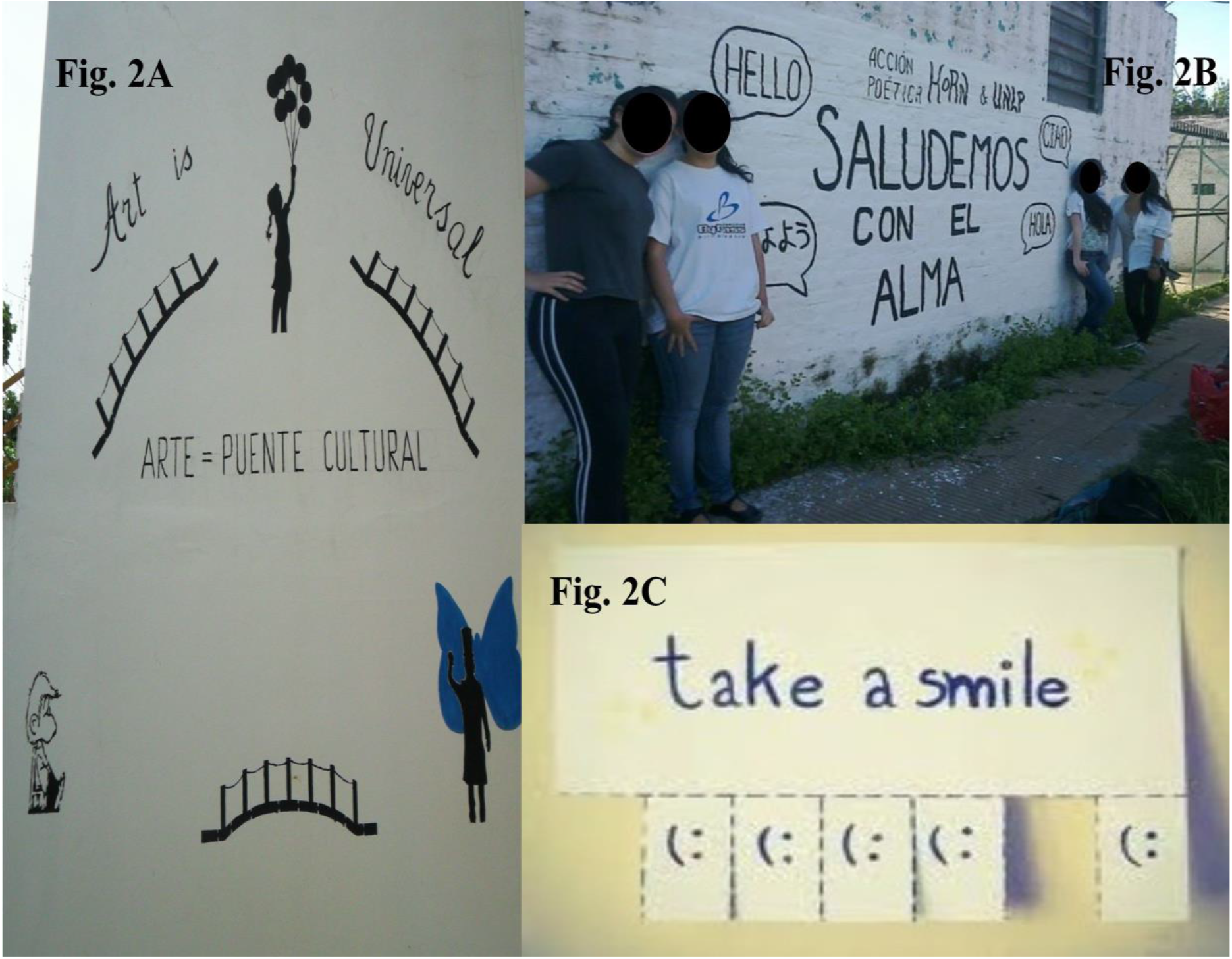
Yet another group also emphasized emotions and affect in transcultural communication. They used a graffiti technique called sticker art, which involves publicly displaying an image or message with stickers that passers-by can take in order to promote a political agenda, raise awareness of a certain social issue, or critique social reality. They wished to highlight a positive attitude needed in transcultural communication, namely smiling, based on an ancient meditation technique called ‘the inner smile’ to reinforce the healing and bonding power of smiles across cultural borders (Fig. 2C).
5. Discussion
Although ELF research has flourished in Latin America in the last decade, covering countries like Argentina, Brazil, Chile, Colombia, Ecuador, Mexico, and Venezuela, the influence of Baker’s original model in the region is minimal (see Gimenez et al., Reference Gimenez, Haus and Nô Dos Santos2025; Morán-Panero et al., Reference Morán-Panero, Martínez-Sánchez and Ronzón-Montiel2024). This study contributes to recent ELF literature (Ishikawa et al., Reference Ishikawa, McBride and Suzuki2025; Jenkins et al., Reference Jenkins, Baker and Dewey2018) by adding empirical support to the updated TCA model drawn from ELF communication in this Argentinian context. Moreover, the reviewed studies that used the original model as theoretical, analytical, and/or pedagogical foundation found evidence almost exclusively of levels 1 and 2, with few exceptions such as Kusumaningputri and Widodo (Reference Kusumaningputri and Widodo2018), who observed level 3. This study provides strong evidence for the pedagogical potential of the model to disclose intercultural and transcultural awareness at level 3 of development.
Baker (Reference Baker2022a, Reference Baker, Ishikawa, McBride and Suzuki2025) explains why ICA evolved at such lower levels in these empirical studies, for example, short duration of the courses taught, limiting socio-political context (Iran), little language proficiency of participants, and specificity of programmes (such as study-abroad). In this study, by contrast, the project lasted seven months, participants were advanced English speakers at B2/C1 level, and the general language course in which the project was undertaken was designed as intercultural citizenship (Byram et al., Reference Byram, Golubeva, Hui and Wagner2017), that is, it was concerned with teacher candidates’ growth not only in linguistic and intercultural terms but also from a civic perspective. The links between intercultural/global citizenship and ICA/TCA have been explored by Baker (Baker, Reference Baker, Jenkins, Baker and Dewey2018; Baker & Fang, Reference Baker and Fang2022; Fang & Baker, Reference Fang and Baker2018), who acknowledges that while intercultural citizenship is a broader concept than ICA, ICA can in fact be viewed as part of intercultural citizenship (Baker, Reference Baker2022a).
Importantly too, this study gathered data from face-to-face synchronous communication (conversational data), artistic artefacts (collaborative murals), and civic action artefacts (murals, leaflets, sticker art), while most studies have used interviews, surveys, questionnaires, written assignments and reflections, and classroom observations. Some exceptions are Kusumaningputri and Widodo (Reference Kusumaningputri and Widodo2018) who used digital photographs; Vettorel (Reference Vettorel2019) who used ELF interactions taken from the VOICE corpus; and Souza da Silva (Reference Souza da Silva2021) who collected conversational data, though in a naturally occurring context rather than in a classroom setting as in the present study. Although one limitation of this retrospective study is that it was not purposefully designed to investigate TCA, it nonetheless seems that face-to-face online communication and artistic and civic expression facilitated TCA development at level 3 in this context. This finding merits further investigation both as a potential methodological and pedagogical contribution concerning the empirical use of the TCA model. Furthermore, even though the linguistic and pragmatic strategies that students deployed here are examples of negotiation, adaptation, and mediation in TCA, this study suggests together with Souza da Silva (Reference Souza da Silva2021) and Vettorel (Reference Vettorel2019) that the interplay between communication and pragmatic strategies and the ICA/TCA model deserves further investigation as it affects how cultural understandings in ELF talk are negotiated.
The main conclusion is that TCA development in this setting could not be identified with a set of discrete components or levels. The reason is the impossibility to match a participant or entire data type to a single component or level in Baker’s (Reference Baker, Ishikawa, McBride and Suzuki2025) updated model, at least in this specific context. All teacher candidates moved backwards and forwards fluidly along the components of each level and across levels from the beginning to the end of the project. TCA was highly dependent on various aspects and emerging conditions such as purposes at hand, project tasks, and personal backgrounds, experiences, preferences, emotions, and interests. Echoing Baker (Reference Baker, Jenkins, Baker and Dewey2018, Reference Baker2022a, Reference Baker2022b, Reference Baker, Ishikawa, McBride and Suzuki2025), this indicates that TCA development here was dynamic, fluid, procedural, and complex, although the overall trajectory was not one of necessarily progressing through the model: all components were displayed simultaneously in this study. Importantly too, this study shows evidence of the new components (5, 10, and 14) concerned with power issues in the updated model. Furthermore, teacher candidates also mobilized attitudes (curiosity, openness), strategies (asking questions, speaking slowly and clearly, being polite, paraphrasing), and skills (negotiation, adaptation, flexibility, mediation) within a framework of values involving cooperation, mutual support, consensus, and solidarity. This is evidence of component 13, new to the revised model, which suggests teacher candidates were able to engage deeply with cultural practices, transcending and transforming cultural borders. The Pope as a bonding transnational figure beyond borders is an example.
While findings from one study in isolation are of course not sufficient to make any strong claims in any direction, this article identifies several areas that would contribute to further develop the model. Firstly, although Baker (Reference Baker, Jenkins, Baker and Dewey2018: 33) warns that ‘a critical approach to intercultural communication entails an understanding that there can be no one set of communicative practices, intercultural or otherwise, that are more effective or successful than any other in all situations’, it would nonetheless be important to avoid or overcome the implied expectation of pre-determined progression and hierarchy, evidenced in the labelling and numbering of the three levels as ‘basic’ (1), ‘advanced’ (2), and ‘intercultural and transcultural awareness’ (3). Secondly, the use of the revised model in classroom contexts and real intercultural encounters involving ELF communication is in need of empirical exploration across regions and settings. For instance, it would be useful to know whether some kinds of awareness are more or less helpful in particular settings. Thirdly, emotions and affect in TCA development, particularly discomforting emotions, do not have a place in the model but this study shows they play a role. For instance, traumatic familiar experiences such as losing a sister were significant for the development of a sense of bonding among one group of students, leading in turn to TCA. Fourthly, in alignment with Ishikawa (Reference Ishikawa2022), this study has shown the powerful contribution of multimodality, the arts, and creative expression in TCA development but they do not feature in the model and might deserve consideration. Finally, there is the question of whether there could or should be a place for civic engagement in the model. In this study it was pivotal for TCA development at level 3.
This article also raises implications for language education and ELF communication in terms of classroom practice, teacher education, policy, and research, particularly regarding the assumptions, definitions, and expectations associated with TCA (Baker, Reference Baker, Ishikawa, McBride and Suzuki2025). The understandings that are endorsed for specific purposes and in particular local settings will affect the kind of policies, curricula, programs, pedagogies, practices, and research made possible accordingly. In this respect, the potential of conceptualizations of language education as intercultural citizenship (as in this study) to enable transcultural awareness using Baker’s updated model, both pedagogically and methodologically, deserves further investigation. The multilingual, multicultural, and multimodal characteristics of intercultural citizenship seem to be highly significant for TCA development, particularly concerning students’ non-essentialist dispositions toward cultural perspectives, their awareness of linguistic and cultural diversity, and their readiness for intercultural dialogue and civic engagement.
6. Conclusion
This is the first empirical study drawing on Baker’s (Reference Baker, Ishikawa, McBride and Suzuki2025) updated ELF-informed model of intercultural and transcultural awareness as theoretical and analytical framework. The model was used to identify and characterize the features of teacher candidates’ TCA development in the context of a teacher education language course in an Argentinian university. This Argentinian setting is unique in portraying the Latin American region as available studies are located mainly in the Asian-Pacific area and less frequently in Europe. The data illustrate complex intercultural interactions and the development of TCA in this setting, thus situating Baker’s new model as an inspiring foundation of an intercultural teaching approach. At the same time, the study illustrates both the limitations of the model as applied to the data set collected here and the alternative approach to data analysis employed. However, the fact that the study is retrospective, and not specifically designed to investigate TCA, is a limitation.
The article identifies potential areas for further development of the model. First, it seems that the achievement of higher levels of TCA is affected by certain conditions such as course duration, students’ language proficiency, and type of programme. These conditions merit further investigation across regions and contexts. Second, the interplay between intercultural/global citizenship and ICA/TCA is not straightforward and pragmatic strategies seem to play a role. This interplay can become a line of further research as it affects understanding and negotiation in ELF communication. Third, the lack of progression across levels in the model illustrates the fluidity of TCA in this setting. Thus, the progression that the model assumes or expects (revealed in the labelling ‘basic’, ‘advanced’, ‘intercultural and transcultural awareness’) might need to be revisited. In addition, this fluidity was permeated by strategies, skills, attitudes, and emotions. The characterization of these dimensions for specific contexts would broaden our understanding of TCA, particularly emotions, as they have no place in the current model. Fourth, this study provides empirical support for the new components in the model related to power issues but this support needs to be stronger as one study in isolation is not sufficient. Finally, multimodality, the arts, creative expression, and civic engagement in TCA development do not presently have a place in the model but were significant in this study, particularly for achieving level 3. Overall, the study makes a case for possible extensions and different applications of the TCA model.
Acknowledgements
I am very grateful to Gloria Josefina Ronzón-Montiel, Maritza Maribel Martínez-Sánchez, and Sonia Morán Panero for their valuable feedback and insights on earlier drafts. I am also indebted to Will Baker who kindly shared his new 2025 model with me and contributed related empirical studies.
Melina Porto is a researcher at the National Research Council (CONICET) and Full Professor at Universidad Nacional de La Plata in Argentina. She was Honorary Research Fellow at the University of East Anglia during 2019 to 2024. Her research interests include intercultural language education, intercultural citizenship, pedagogies of discomfort, social justice and ethics, among others. Her latest book is From critical literacy to critical pedagogy in ELT: Using teacher-made materials in difficult contexts (Foreword by Osler and Starkey; Afterwords by Crookes, Janks and Luke) (2022).



 Open access

