


Highlights
-
Dysbiosis of compositional and functional gut microbiota (GM) was identified in FSHD patients along with distinct profiles of faecal and circulating FFAs.
-
Faecal and circulating SCFAs correlated with methylation levels of disease-related genetic regions in FSHD patients but not in controls.
-
Modulation of GM and SCFAs can be promising for FSHD.
Introduction
Facioscapulohumeral muscular dystrophy (FSHD) is a progressive neuromuscular disease characterised by muscle wasting. The facial, shoulder and scapular muscles are the first to be affected, resulting in disturbances to eye and lip movements and the formation of a scapula alata. As the disease progresses, other muscle groups become involved, further impairing mobility and function.Reference Tawil1 There is a remarkable degree of clinical heterogeneity among patients, which cannot be attributed solely to the genetic mutation.Reference Ghasemi, Emerson and Hayward2
The genetic structure of FSHD pathology is defined in two subclasses. The primary genetic mechanism underlying FSHD is the shortening corresponding to less than 11 repetitions of the D4Z4 repeat on chromosome 4.Reference Wijmenga, Sandkuijl and Moerer3 The second fundamental mechanism is the hypomethylation: a reduction in methylation levels of the D4Z4 repeat sequence.Reference Lemmers, Tawil and Petek4
Recent studies have demonstrated that the degree of hypomethylation in patients with FSHD may be a key underlying factor contributing to the clinical heterogeneity.Reference Overveld Van, Lemmers and Sandkuijl5 The severity of the disease increases as the degree of hypomethylation increases.Reference Gaillard, Roche and Dion6 The most significantly hypomethylated region within the D4Z4 repeat sequence, which is associated with clinical severity, was found to be the regions known as DR1 and 5P located in the proximal part of the repeats.Reference Gaillard, Roche and Dion6,Reference Hartweck, Anderson and Lemmers7
The genetic factors that influence the methylation status of this proximal region have been identified. Contraction of the repeat leads to hypomethylation. In addition, reduced function of the SMCHD1, DNMT3B and LRIF1 proteins causes further hypomethylation in the proximal part of the D4Z4 repeats.Reference Lemmers, Tawil and Petek4,Reference Boogaard Van Den, Lemmers and Balog8,Reference Hamanaka, Šikrová and Mitsuhashi9 However, there have been no studies to date that have looked at non-genetic individual factors that affect the proximal part of the D4Z4 repeats. In our latest research study, we obtained novel data on the correlation between hormones and proximal D4Z4 methylation status,Reference Hangul, Ozcan, Darbas, Uysal, Koc and Karauzum10 based on the observed differences in disease severity between males and females.
New data suggest that alterations in the gut microbiome might be associated with dystrophy.Reference Liu, Cheung and Li11,Reference Gizard, Fernandez and De Vadder12 An mdx mouse model has revealed evidence of gut dysbiosis and decreased circulating levels of short-chain fatty acids (SCFAs) in Duchenne muscular dystrophy.Reference Kalkan, Pagano and Paris13 Another study supporting the dystrophy–gut interaction was conducted on human samples in myotonic dystrophy type 1 (MD1), demonstrating that DM1 status correlated with changes in gut microbiota (GM).Reference Mahdavi, Prévost and Balthazar14
Despite the growing evidence, there is currently a lack of human research on the relationship between GM and FSHD. In the present study, we characterised (i) the composition of the GM and (ii) the fatty acid (FAs) profile in faeces and in serum samples of FSHD patients and healthy controls (HC). In addition, (iii) proximal D4Z4 methylation status and (iv) disease severity were identified. By comparing with HC, we investigated for the first time the association of GM and FAs with the clinical severity and proximal D4Z4 methylation status in FSHD patients.
Materials and methods
Patients
In this study, we recruited FSHD patients and gender- and age-matched healthy volunteers as HC. For each patient, data collection and routine clinical assessments were performed in accordance with international guidelines.Reference Tawil, Kissel, Heatwole, Pandya, Gronseth and Benatar15 FSHD patients were grouped as mild and severe using the Lamperti scaleReference Lamperti, Fabbri and Vercelli16 to evaluate clinical severity in neurological examination.
Patients who were diagnosed with FSHD1 were enrolled in the study. HC matched to FSHD patients for sex, age and body mass index (BMI) were included in the study. Individuals who had used antibiotics, pre- or probiotics, immunosuppressants or non-steroidal anti-inflammatory drugs in the two months preceding enrolment; were pregnant, breastfeeding or menstruating; or had a diagnosis of some gastrointestinal diseases were excluded from the study. Blood sampling was performed immediately after the stool sample collection. Peripheral blood samples were collected in evacuated plastic tubes (Vacutainer, Becton Dickinson), centrifuged at 1500 r.p.m. for 10 minutes and stored in aliquots at -20°C until further analyses. Stool samples, obtained for the compositional and functional analysis of the GM, were immediately frozen at -80°C.
The study protocol received approval from the Local Ethics Committee, adhered to the principles of the Declaration of Helsinki, and written informed consent was obtained from all participants.
Faecal microbiota characterisation
The genomic DNA was extracted from frozen (-80°C) stool samples using the QIAamp Fast DNA Stool Mini Kit (Qiagen, Hilden, Germany), following the manufacturer’s instructions. The quality and quantity of extracted DNA were assessed with both NanoDrop ND-1000 (Thermo Fisher Scientific, Waltham, USA) and Qubit Fluorometer (Thermo Fisher Scientific, Waltham, USA), and then it was stored at -20°C. Subsequently, amplicon libraries of the V2-V9 16S rRNA hypervariable regions were prepared. The size and concentration of the final sequencing library, formed by pooling the barcoded amplicons in equimolar concentrations, were determined using the Bioanalyzer High Sensitivity Chip (Agilent Technologies, Santa Clara, CA, USA). Finally, sequencing was performed on the Ion Torrent system (Life Technologies, Carlsbad, CA, USA).
The resulting raw data in FASTQ files were processed following the software pipeline MICCA (MICrobial Community Analysis).Reference Albanese, Fontana, Filippo De, Cavalieri and Donati17 Demultiplexed sequence reads were processed using QIIME2 2022.11. DADA2 was used for trimming low-quality nucleotides from reads (---p-trunc-len 250) and for performing paired-end filtering, merging and removing chimaeras. Host sequences were identified by aligning the possible amplicon sequence variants (ASV) to GRCh38 (human reference genome) and deleted using Bowtie2 2.4.4. The remaining reads were imported into QIIME2, and taxonomic assignment was performed through the Scikit-learn multinomial Bayes classifier re-trained on the Silva database (release 138–99).
To minimise the presence of contaminants, every ASV with an average relative abundance between the genera less than the cutoff of 0.005% was removed.Reference Bokulich, Subramanian and Faith18 Additionally, every sequence unassigned at the domain taxonomic level or associated with chloroplasts or mitochondria according to SILVA has been discarded.Reference Lusk19
Faecal and circulating short-, medium- and long-chain fatty acid evaluation by GC-MS analysis
The qualitative and quantitative evaluation of faecal SCFAs, medium-chain fatty acids (MCFAs) and long-chain fatty acids (LCFAs) was performed using an Agilent gas chromatography-mass spectrometry (GC-MS) system composed of a 5971 single quadrupole mass spectrometer, 5890 gas chromatograph and 7673 autosampler, through our previously described method.Reference Niccolai, Baldi and Ricci20
Briefly, just before the analysis, stool samples were thawed and added with a 0.25 mM sodium bicarbonate solution (1:1 w/v) in a 1.5 mL centrifuge tube. The obtained suspensions were sonicated for 5 minutes and centrifuged at 5.000 r.p.m. for 10 minutes, and the supernatants were collected. The SCFAs, MCFAs and LCFAs were finally extracted as follows: an aliquot of 100 µL of sample solution (corresponding to 0.1 mg of stool sample) was added to 50 µL of an internal standards mixture, 1 mL of tert-butyl methyl ether and 50 µL of HCl 6 M + 0.5 M NaCl solution in a 1.5 mL centrifuge tube. Subsequently, each tube was shaken in a vortex apparatus for 2 minutes and centrifuged at 10.000 r.p.m. for 5 minutes, and lastly, the solvent layer was transferred to an autosampler vial and processed three times.
Free fatty acids (FFAs), namely, circulating SCFAs, MCFAs and LCFAs, were analysed with a similar GC-MS method.Reference Bartolucci, Pallecchi and Menicatti21,Reference Baldi, Menicatti and Nannini22
Just before the analysis, each sample was thawed, and the FFAs were extracted as follows: 200 μl of the serum sample was added to 10 μl of the internal standards mixture, 100 μl of tert–butyl methyl ether and 20 μl of 6 M HCl + 0.5 M NaCl solution in a 0.5 mL centrifuge tube. Next, each tube was vortexed for 2 minutes and centrifuged at 10,000 r.p.m. for 5 minutes, and finally, the solvent layer was transferred to a vial with a microvolume insert and analysed.
D4Z4 repeat 5’ DNA methylation analysis
DNA isolation from blood samples was performed using the QIAamp DNA Blood Mini kit (Qiagen, Hilden, Germany). Bisulphite conversion was carried out using the DNA Methylation-Gold kit (Zymo Research, Orange, CA, USA). The forward primer sequence was GGGGAGGAAGGTAGGGAGGAAAAG, and the reverse primer sequence was AAAATCTTAAATATACCAAACCCTCTCTCC. Purified and standardised PCR pools were prepared using the NexteraXT sample preparation kit (Illumina, San Diego, CA, USA), and the next generation sequencing (NGS) was performed on the Illumina MiSeq platform.
To determine the methylation percentage, the reads were aligned to the bisulphite-converted sequence. The points of methylation (C points of the CpG sites) changed to N instead of C; as a next step, the C and T readings obtained at methylation points were determined. The percentage of methylation was calculated for each point by multiplying the C/(C + T) ratio by 100.
Statistical analysis
The statistical analyses of bacterial communities were conducted in R (version 4.2.2) using the following packages: phyloseq 1.42.0, vegan 2.6–4, DEseq2 1.38.3, ggplot2 3.2.4, ggpubr 0.6.0 and other packages satisfying their dependencies.
Saturation analysis was performed using the rarecurve function, and samples that did not satisfy the saturation threshold were discarded. The observed richness and Shannon indices were used to perform alpha diversity analyses. The Pielou’s evenness index was calculated using the formula E = S/log (R), where S is the Shannon index and R is the observed ASV richness in the sample. Differences in all indices between grouped samples were tested using the Wilcoxon signed-rank test, and p-values less than 0.05 were considered statistically significant. To test the significance between sample clusters observed following principal coordinate analysis (PCoA), permutational analysis of variance (PERMANOVA) with 9999 permutations was applied to beta diversity distance matrices using Hellinger distance on Hellinger-transformed genus abundances. Hellinger distances were selected to minimise the dominance effect of highly abundant taxa, providing a more balanced representation of community composition. At different taxonomic ranks, the differential abundances (DA) were computed through the DESeq2 algorithm on raw count data. DAs with an associated p-value (adjusted through the Benjamini–Hochberg method) less than 0.05 were considered significant. Additionally, DAs with a grand mean count < 100 have been discarded to avoid noisy results. Spearman correlations were performed in R, and p-adjusted values less than 0.05 were considered significant. GraphPad Prism (v.8) was used for statistical analysis of faecal and circulating SCFA, MCFA and LCFA abundances between FSHD patients and HC; differences were assessed using the Mann–Whitney test, and p-values less than 0.05 were considered statistically significant.
Sample size was calculated for comparison of the difference in proportions between two groups, assuming alpha level 0.05 and power 0.80.Reference Ferdous, Jiang and Dinu23 Effect size (difference of proportions) was accepted as 0.20. The originally calculated number was 31 for each group, and 35 patients were reached during the study; however due to the exclusion of some samples for technical reasons, we could obtain results for 28 subjects for each group. Post-study power analysis shows that the power of this study is approximately 0.75.
Results
Demographics of enrolled patients
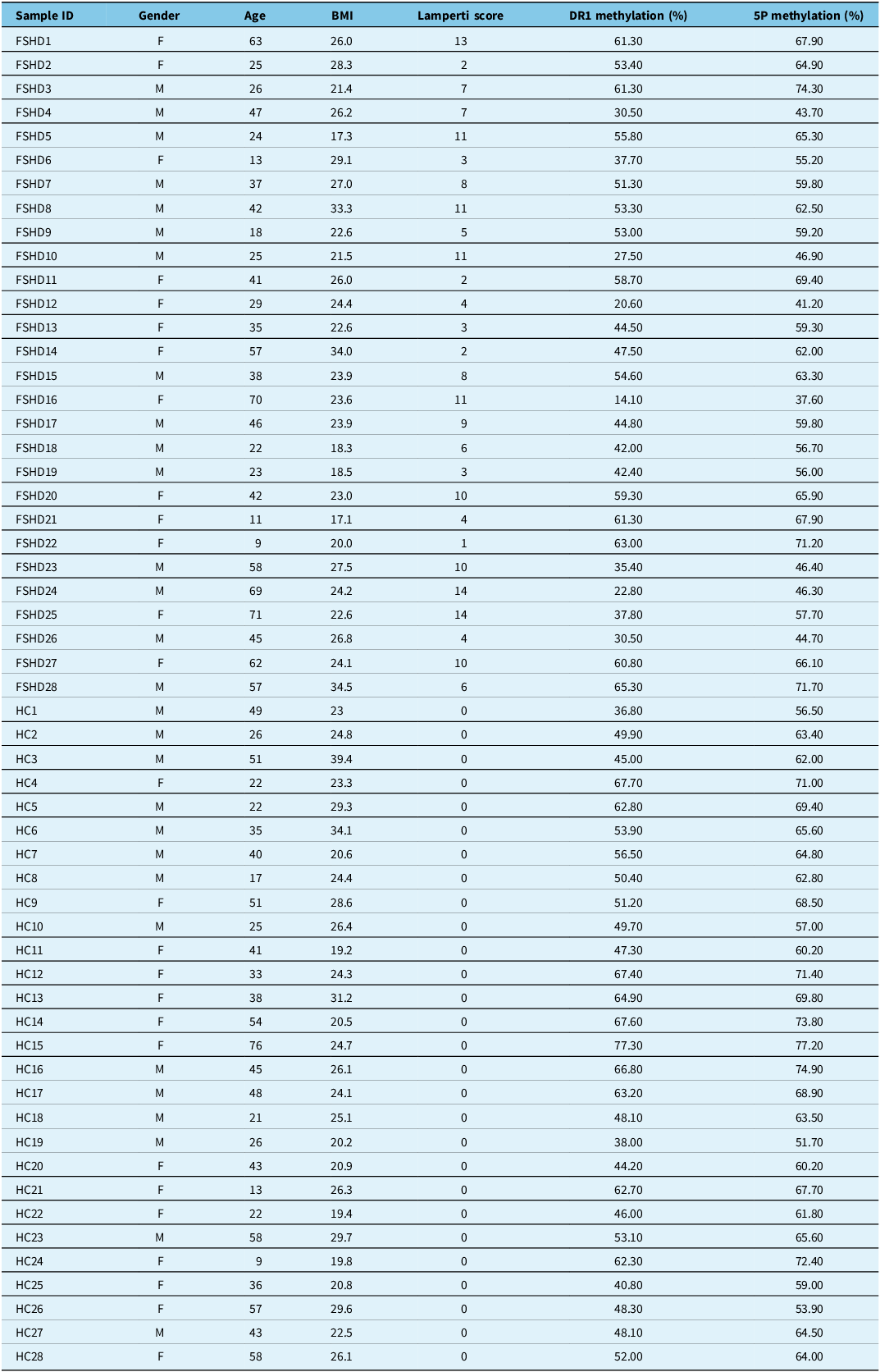
Demographic and clinical features of FSHD patients and HC are reported in Table 1. We recruited 28 FSHD patients (13F:15M, mean age: 39.4 ±18.6 years) and 28 gender- and age-matched HC (14F:14M, mean age: 37.8 ±16.1 years). Additionally, FSHD patients reported a mean BMI of 24.6 ± 4.6 kg/m2, while HC showed a mean BMI of 24.9 ± 4.5 kg/m2. Regarding clinical severity score, 13 patients were mildly affected (Lamperti scores 1–7), while 15 patients were more severely affected (Lamperti scores 8–15). Concerning methylation, FSHD patients, compared to HC, showed reduced methylation rates in DR1 (46.63% vs 53.29%) and 5P (58.68% vs 65.05%) subregions.
Clinical and demographical features of enrolled FSHD patients and healthy subjects

FSHD = facioscapulohumeral muscular dystrophy; HC = healthy control.
FSHD patients showed significant hypomethylation of DR1 and 5P subregions
First of all, we assessed the methylation profile of DR1 and 5P regions located in the proximal part of the D4Z4 repeat unit and detected significant hypomethylation in both DR1 (p = 0.045) (Figure 1A) and 5P (p = 0.021) (Figure 1B) subregions in FSHD patients compared to HC.
Bar plots displaying the methylation percentage of DR1 (A) and 5P (B) regions of both FSHD patients and HC. FSHD = facioscapulohumeral muscular dystrophy; HC = healthy control.

FSHD patients showed different gut microbiota composition
We initially evaluated whether patients with FSHD have differences in GM structure compared to HC. Rarefaction curves for observed ASVs showed adequate sampling for all faecal specimens, except for four samples from FSHD patients (specifically 11, 17, 20, 22), which were excluded from further analysis (Figure S1).
As depicted in Figure 2A, FSHD patients showed a reduced alpha diversity in GM compared to HC (observed ASV richness, p = 2.2e-7; Shannon index, p = 2.4e-6). Additionally, the PCoA computed using the Hellinger distance on transformed genus abundances highlighted a separation among stool samples from FSHD patients and HC (PERMANOVA, p < 0.0472) (Figure 2B).
Box plots showing faecal alpha diversity indices (observed amplicon sequence variant, Shannon index, Pielou’s evenness) between FSHD patients and HC (A). PCoA conducted with the Hellinger distance on transformed genus abundances of stool samples among FSHD patients and HC (B). Boxplot displaying the results of differential abundance analysis between FSHD patients and HC. All results have a p-adjusted < 0.05 (C). FSHD = facioscapulohumeral muscular dystrophy; HC = healthy control; PCoA = principal coordinates analysis.

As reported in Figure S2, the taxonomic analysis revealed distinct relative abundances in both the top five phyla and genera within faecal samples collected from FSHD patients and HC. In detail, the top five phyla in healthy subjects’ stool samples were Actinobacteriota, Bacteroidota, Cyanobacteria, Firmicutes and Proteobacteria (Figure S2A), while the top five genera were Alistipes, Bacteroides, Prevotella, Roseburia and UCG-002 (Figure S2B).
On the contrary, the top five phyla found in stool samples of FSHD patients were Bacteroidota, Cyanobacteria, Firmicutes, Fusobacteriota and Proteobacteria (Figure S2C), whereas the five most represented genera were Bacteroides, an uncultured bacterium belonging to the Enterobacteriaceae family, an uncultured bacterium belonging to the Lachnospiraceae family, Prevotella and the Rikenellaceae_RC9 gut group (Figure S2D).
In particular, several taxa were observed to exhibit differential abundance in faecal samples from FSHD patients and HC (Figure 2C, Table S1). Specifically, members of the orders Enterobacterales and Veillonellales-Selenomonadales, as well as the families Selenomonadaceae, Sutterellaceae and Veillonellaceae, were detected to be more abundant in patients with FSHD. Conversely, reduced abundances of members belonging to the Bacilli class, Erysipelotrichales order, Bacteroidaceae and Oscillospiraceae families and Alistipes, Butyricimonas, NK4A214_group, UCG-002, UCG-003 and UCG-005 genera were detected in patients with FSHD.
Different faecal SCFAs, MCFAs and LCFAs profiles among FSHD patients and HC
By a GC-MS approach, we assessed abundances of microbial-derived SCFAs (acetic, propionic, butyric, isobutyric, 2-methylbutyric, valeric and isovaleric acids), MCFAs (hexanoic, isohexanoic, heptanoic, octanoic, nonanoic, decanoic, dodecanoic, phenylacetic and phenylpropionic acids) and LCFAs (tetradecanoic, hexadecanoic and octadecanoic acids) in stool samples from both HC and FSHD patients. In order to address potential variations resulting from the total amount of each metabolite, the comparisons were performed on the percentage compositions of the acids (Table S2).
As depicted in Figure 3, FSHD patients showed reduced abundances of isobutyric, 2-methylbutyric, isovaleric and phenylacetic acids but higher levels of propionic and nonanoic acids.
Boxplot reporting statistically significant differences in faecal short-chain fatty acids and medium-chain fatty acids between healthy control and facioscapulohumeral muscular dystrophy (FSHD) patients. Analyses were assessed using the Mann–Whitney test, and p-values less than 0.05 were considered statistically significant. The asterisks (*) represent p-values, *p < 0.05, **p < 0.01, ***p < 0.001.

Different circulating FFA profile between FSHD patients and HC
Finally, we assessed the circulating levels of SCFAs, MCFAs and LCFAs of both HC and FSHD patients (Table S3). As depicted in Figure 4, FSHD patients showed an increased total amount of SCFAs but a reduced total abundance of MCFAs. More in detail, we documented increased levels of acetic, propionic, butyric, isobutyric, isohexanoic, isovaleric, 2-methylbutyric, valeric and hexanoic acids in FSHD patients compared to HC.
Boxplot reporting the statistically significant circulating acids between healthy control and FSHD patients. Analyses were assessed using the Mann–Whitney test, and p-values less than 0.05 were considered statistically significant. The asterisks (*) represent p-values, *p < 0.05, **p < 0.01, ***p < 0.001. SCFAs = short-chain fatty acids; MCFAs = medium-chain fatty acids; FSHD = facioscapulohumeral muscular dystrophy.

Patient stratification and comparison according to disease severity
To evaluate whether patients with different disease involvement showed distinct compositional and functional GM signatures, we grouped FSHD patients as mild (Lamperti scores 1–7) or severe disease (Lamperti scores 8–15) and performed a comparison between these groups. We observed a similar intestinal microbiota structure (Figure S3A, B) between groups but an increase in bacteria belonging to the Pasteurellaceae family was noted in FSHD patients with severe symptoms (log2FC = 5.094: p adj = 0.037) (Figure S3C). Regarding the GM functional evaluation, although no differences in faecal SCFA, MCFA and LCFA abundances were documented among groups (Table S4), FSHD patients with severe disease exhibited increased circulating levels of both acetic and hexanoic acids compared to patients with mild symptoms (Table S5).
Association between GM features and methylation pattern revealed a correlation in FSHD patients
Since the role of SCFAs in triggering DNA methylation and thus regulating target genes’ expression has been hypothesised, we performed Spearman correlations between GM profile and methylation percentage of DR1 and 5P regions of both FSHD patients and HC. Specifically, as reported in Figure 5B, higher faecal levels of isobutyric, 2-methylbutyric, valeric, isovaleric, hexanoic, phenylacetic, hexadecanoic and octadecanoic acids were correlated with decreased methylation levels of DR1 and 5P regions in FSHD patients. Moreover, a positive association was found between lower levels of faecal isobutyric, 2-methylbutyric, isovaleric and phenylacetic acids and the reduced abundance of Butyricimonas spp. Conversely, in healthy subjects, a positive association was observed between increased abundance of Erysipelotrichales members and acetic acid levels. In addition, a negative correlation was found between Erysipelotrichales abundance and increased levels of hexanoic, heptanoic, octanoic and octadecanoic acids. Furthermore, regarding circulating FFAs, FSHD patients showed a positive correlation between isobutyric acid and Erysipelotrichales members but a negative association between methylation profile and serum abundances of acetic, propionic, butyric, valeric, 2-ethylhexanoic, decanoic and tetradecanoic acids (Figure 5A). Regarding disease severity, as depicted in Figure 6B, strong associations between hypomethylation of DR1 and 5P regions and faecal levels of isobutyric, valeric, heptanoic and phenylacetic acids were reported in FSHD patients.
Heatmap of Spearman correlations between statistically significant faecal taxa and methylation levels of DR1 and 5P regions and circulating (A) and faecal (B) fatty acids of FSHD patients and HC. Red shades indicate positive correlations, whereas blue shades indicate negative correlations; the intensity of colours represents the degree of association. The asterisks (*) represent p-values, *p < 0.05, **p < 0.01, ***p < 0.001. FSHD = facioscapulohumeral muscular dystrophy; HC = healthy control.

Heatmap of Spearman correlations between statistically significant faecal taxa and methylation levels of DR1 and 5P regions and circulating (A) and faecal (B) fatty acids of facioscapulohumeral muscular dystrophy patients with mild or severe disease. Red shades indicate positive correlations, whereas blue shades indicate negative correlations; the intensity of colours represents the degree of association. The asterisks (*) represent p-values, *p < 0.05, **p < 0.01, ***p < 0.001.

Furthermore, with respect to patients with severe FSHD, ones with mild symptoms showed a negative correlation between methylation profile and circulating levels of butyric, valeric and decanoic acids (Figure 6A).
Discussion
To date, the pathophysiology of the FSHD has not been fully elucidated, and no effective drugs in treating the disease or slowing its progression are available.Reference Hangül, Karaüzüm and Akkol24 There is a distinct variation in clinical involvement and disease severity.Reference Ghasemi, Emerson and Hayward2 Studies investigating the relationship between epigenetic mechanisms and clinical severity of the disease revealed that hypomethylation occurring in the DR1 and 5P regions located in the proximal area of the D4Z4 repeat sequences is associated with clinical severity.Reference Overveld Van, Lemmers and Sandkuijl5,Reference Gaillard, Roche and Dion6 There is not enough data on the individual factors causing hypomethylation in the DR1 and 5P regions. Recent evidence has suggested the existence of a gut–muscle crosstalk and documented the implication of microbial-derived SCFAs in host epigenetic regulatory mechanisms.Reference Shon, Han and Song25
The objective of this study was to examine the role of the microbiota in FSHD, based on the dystrophy–gut microbiota connection that has been demonstrated in recent years. In line with this objective, we investigated for the first time (i) the changes in the GM and FA metabolites in FSHD and (ii) the relationship between microbiota and fatty acid metabolites with hypomethylation in the DR1 and 5P regions.
The results of the methylation analysis revealed that the DR1 and 5P regions, located in the proximal region of the D4Z4 repeat, exhibited a notable reduction in methylation levels in individuals with FSHD when compared to HC. This result is compatible with the previous literature data related to DR1 and 5P regions.Reference Gaillard, Roche and Dion6,Reference Hartweck, Anderson and Lemmers7,Reference Roche, Dion and Broucqsault26
Subsequently, we characterised the GM composition and found that FSHD patients exhibited a significant decrease in alpha diversity indices compared to HC. A similar reduction was revealed in a dystrophin-deficient mdx mouse model,Reference Jollet, Mariadassou and Rué27 whereas no significant differences were found among patients with myotonic dystrophy type 1 and healthy individuals.Reference Mahdavi, Prévost and Balthazar14 The PCoA revealed significant dissimilarity in the GM structure between FSHD patients and HC, which is similar to recent studies on dystrophy.Reference Kalkan, Pagano and Paris13,Reference Mahdavi, Prévost and Balthazar14,Reference Jollet, Mariadassou and Rué27 In contrast, a comparison of FSHD patients with mild and severe did not reveal any significant divergence in either alpha or beta diversity indices. In conclusion, the significant differences in alpha and beta diversity indices between FSHD patients and HC confirmed the presence of dysbiotic GM in FSHD patients.
A detailed differential abundance analysis revealed that, compared to HC, FSHD patients showed increased levels of members belonging to the Enterobacterales and Veillonellales-Selenomonadales orders and the Selenomonadaceae, Sutterellaceae and Veillonellaceae families. These bacteria are known to play a relevant role in gut dysbiosis and are notably associated with inflammatory bowel disease pathogenesis and progression.Reference Baldelli, Scaldaferri, Putignani and Chierico Del28,Reference Chung, Chang and Liao29
In contrast, the abundance of several SCFA-producing bacteria, namely, Alistipes spp., Butyricimonas spp., UCG-002 spp., UCG-003 spp. and UCG-005 spp., was markedly reduced in FSHD patients compared to HC. Furthermore, it is noteworthy that an increase in members of the Pasteurellaceae family was observed in patients with severe FSHD compared to those with milder symptoms. Pasteurellaceae species are commensal organisms that are capable of producing pore-forming RTX (repeats in toxin) toxins.Reference Linhartová, Bumba and Mašn30 These toxins exhibit cytotoxic and haemolytic activities across a range of cell types.Reference Linhartová, Bumba and Mašn30 Microbial metabolites systemically impact host physiology, and Pasteurellaceae species might be contributing to the loss of skeletal muscle cells. This hypothesis merits further investigation.
Recent studies have demonstrated that gut bacterial metabolites can exert a significant influence on a range of metabolic pathways, not only within the intestine but also by entering the systemic circulation. Among these metabolites, the most notable association with skeletal muscle functionality has been observed particularly in relation to SCFAs. The administration of SCFAs to germ-free mice resulted in an enhancement of muscle strength, when compared to the untreated control group.Reference Chew, Lim and Lim31 This observation provides evidence that SCFAs may act as a pivotal mediator between the GM and muscle function. Another supporting data was the reduction in bacteria capable of producing SCFAs in patients with age-related sarcopenia and cirrhosis-related sarcopenia.Reference Yamamoto, Ishizu and Honda32
Given the central role in the gut–muscle axis, faecal and circulating levels of SCFAs were examined in both FSHD patients and healthy subjects. We found a significant decrease in faecal SCFAs, along with their circulating increase in FSHD patients compared to HCs. The decrease of faecal SCFAs and the increase of circulating SCFAs in the FSHD group support the presence of leaky gut. Moreover, patients with dystrophy may also experience a reduction in intestinal transit time due to a decrease in physical activity. This, in turn, might result in an increase in the time taken for SCFAs to be absorbed, as well as a decrease in faecal SCFA levels. Different SCFAs might exhibit distinct partitioning between local usage and systemic distribution.
A wide range of clinical variation in FSHD patients has been documented, but these differences cannot be fully explained by genetic factors.Reference Ghasemi, Emerson and Hayward2,Reference Gaillard, Roche and Dion6,Reference Tawil, Kissel, Heatwole, Pandya, Gronseth and Benatar15 Among the SCFAs, plasma butyric acid levels were markedly increased in FSHD patients. Increased butyric acid levels could be a key finding, because butyric acid was shown to be a potent histone deacetylase (HDAC) inhibitor.Reference Xiong, Guo and Gan33 This finding might have a relation to FSHD pathophysiology. The DUX4 gene, situated within the repeat sequences, encodes the DUX4 protein, which plays a pivotal role in the disease.Reference Lemmers, Vliet Van Der and Klooster34 An independent study has demonstrated that HDAC inhibition resulted in elevated DUX4 expression in FSHD myocytes.Reference Haynes, Bomsztyk and Miller35 Given that butyric acid is an HDAC inhibitor, the high levels of butyric acid that we have identified in FSHD patients may have an influence on DUX4 expression. We think that this hypothesis merits further investigation.
Regarding MCFAs and LCFAs, mainly derived from dairy products, their elevated circulating levels, although decreased in faecal samples, could be a consequence of the increased intestinal permeability that usually accompanied a GM dysbiosis. This same pattern was also observed in severe FSHD patients, confirming the hypothesis of altered gut barrier function and systemic dissemination of gut-derived metabolites.Reference Chae, Lee, Kim and Park36 Therefore, revealing epigenetic modifications and their interaction with individual–environmental factors may provide important clues. Specifically, our investigation focused on the FAs’ profile and its potential association with DNA methylation in the DR1 and 5P regions, which are known to be hypomethylated in FSHD.Reference Gaillard, Roche and Dion6,Reference Roche, Dion and Broucqsault26
Remarkably, we found that healthy subjects exhibited no correlation between fatty acids and methylation in the DR1 and 5P regions, while FSHD patients showed significant correlations between methylation levels of these regions and both faecal and circulating FFAs. This suggests that the altered GM and its metabolites, particularly SCFAs, may influence the epigenetic landscapeReference Stein and Riber37 in FSHD patients, potentially contributing to the disease’s variability and severity.
In FSHD patients, significantly reduced levels of faecal isobutyric, isovaleric and 2-methylbutyric acids correlated with the decreased methylation pattern. Since these acids are involved in immunity regulation, our findings support growing evidence documenting widespread activation of the immune system in FSHD patients.Reference Iodice, Ugga, Aruta, Iovino and Ruggiero38,Reference Frisullo, Frusciante and Nociti39
Likewise, circulating FFAs showed a disease-specific pattern but, strikingly, with an inverse pattern of association with methylation compared to faecal acids. In particular, we documented a strong association between proximal D4Z4 hypomethylation and increased levels of circulating acetic, propionic, butyric and valeric acids in FSHD patients. As aforementioned, these FFAs are known as remarkable HDAC inhibitors,Reference Xiong, Guo and Gan33,Reference Stein and Riber37 and DUX4 expression increases with HDAC inhibition.Reference Haynes, Bomsztyk and Miller35 Therefore, significant correlation between circulating FFAs and hypomethylation suggests a role for SCFAs in HDAC inhibition in the muscle tissue of FSHD patients by promoting DUX4 expression through hypomethylation. Strengthening our findings, no association was found in healthy subjects.
Regarding bacterial species, we reported an association between the decrease of Butyricimonas spp. and the lower faecal abundances of 2-methylbutyric, isobutyric and isovaleric acids in FSHD patients. Butyricimonas species are known to be crucial for maintaining commensal homeostasis between the GM and the host, producing SCFAs that, as well known, have beneficial effects on host energy metabolism.Reference Lee, An and Kim40 In FSHD patients, a reduction in Erysipelotrichales members correlated positively with increased circulating levels of isobutyric acid. This is noteworthy because isobutyric acid is an activator of the AKT signalling pathway. Interestingly, inhibitors of the PI3K/Akt/mTOR pathway have been shown to suppress DUX4 expression at the transcript level, which is significant given that DUX4 expression is a key factor in FSHD pathology.Reference Lek, Zhang and Woodman41
To conclude, we documented for the first time the compositional and functional intestinal dysbiosis in FSHD patients. A strong association between D4Z4 proximal hypomethylation and microbial-derived SCFAs was identified. These findings suggest that the modulation of GM could be a promising strategy for innovative interventions in FSHD management.
Limitations of the study
In our study, we have shown for the first time the status of the microbiota and its metabolites in FSHD disease. During sampling, all conditions accepted as standard in microbiota studies, such as diet, sampling conditions and selection of controls, were followed. However, the microbiota is known to be highly variable and influenced by many factors. It is not possible to standardise all parameters in clinical studies; therefore, the results obtained need to be verified by subsequent in vivo studies.
The relationship between microbiota and skeletal muscle is supported by several findings in the literature; however, studies of microbiota in dystrophy are limited in number. To prove whether SCFAs have a role in the molecular pathogenesis of FSHD, further in vitro molecular research is needed.
In our patient group, there were cases with significant lower extremity involvement but no upper extremity involvement; therefore, Lamperti scoring, which provides the most efficient measurement in our study group, was used rather than other clinical measurement methods. Lamperti scoring provides discrete numerical data. Inclusion of methods providing continuous quantitative data as three-dimensional assessment methods may capture more data in correlation analysis.
In this study, we focused on the 5P and DR1 regions located in the D4Z4 repeat sequences in DNA, based on the data we previously found to be significant. In subsequent studies, the inclusion of methylation levels in the mid and distal regions of the repeat sequences in the examination may provide more comprehensive data on the association between microbiota and epigenetic infrastructure. Although our study found a significant correlation between hypomethylation and microbiota metabolites, further studies at the molecular and functional level are needed to draw a definitive conclusion.
Supplementary material
The supplementary material for this article can be found at https://doi.org/10.1017/cjn.2025.10388.
Data availability
The data presented in this study are deposited in the NCBI Gene Expression Omnibus (GEO) repository, accession number GSE271601.
Acknowledgements
Author Simone BALDI was supported by Fondazione Umberto Veronesi. Thanks to Haldun DOGAN for his support in methylation analysis.
Author contributions
Concept and design, CH, OKO, SB, DC, KHG, SBK, AA; methodology, CH, OKO, SB, DC, OT, TP, SB, MP, FK, CD, HU, KHG, FO, GB, SBK, AA; software, CH, OKO, SB, SB, MP, KHG, FO, GB; validation, CH, OKO, SB, DC, OT, TP, SB, MP, FK, CD, HU, KHG, FO, GB, SBK, AA; formal analysis, CH, OKO, SB, DC, SB, MP, FK, CD, HU, KHG, FO, GB; investigation, CH, OKO, SB, DC, OT, TP, SB, MP, FK, CD, HU, KHG, FO, GB, SBK, AA; resources, CH, DC, FO, GB, AA; data curation, CH, OKO, SB, DC, OT, TP, SB, MP, FK, CD, HU, KHG, FO, GB, SBK, AA; writing–original draft preparation, CH, OKO, SB, DC, OT, TP, SB, MP, FK, CD, HU, KHG, FO, GB, SBK, AA; writing–review and editing, CH, OKO, SB, DC, OT, TP, SB, MP, FK, CD, HU, KHG, FO, GB, SBK, AA; visualisation, CH, OKO, SB, DC, OT, TP, SB, MP, FK, CD, HU, KHG, FO, GB, SBK, AA; supervision, CH, GB, AA; project administration, CH, DC, GB, AA; funding acquisition, CH, GB, AA. All authors have read and agreed to the published version of the manuscript.
Funding statement
This research was funded by the National Scientific Council (TÜBİTAK 219S921).
Competing interests
The authors declare no conflict of interest.


 Open access


Target article
Gut Microbiota and Short-Chain Fatty Acid Profiles in Facioscapulohumeral Dystrophy: Associations with Epigenetic Alterations
Related commentaries (1)
Reviewer Comment on Hangul et al. “Gut Microbiota and Short-Chain Fatty Acid Profiles in Facioscapulohumeral Dystrophy: Associations with Epigenetic Alterations”