


Numerous studies have demonstrated that larger portion size results in increased energy intake(Reference Diliberti, Bordi and Conklin1–Reference Wansink and Park5). This may, over time, lead to weight gain and obesity. Portion size that is larger than optimal is therefore considered to be an important contributor to overeating and subsequent weight gain(Reference Herman, Fitzgerald and Polivy6). The incentive to overeat is also associated with a strong drive for ‘value for money’ and, consequently, large portions remain appealing to some consumers despite potential health outcomes(Reference Vermeer, Steenhuis and Seidell7).
Portion size information has many components. In order to use portion size to control intake, consumers need to be aware of the energy density of the foods they are eating and how ‘large’ these servings are relative to their daily intake. The cognitive processes to achieve this require that individuals are readily able to locate appropriate nutritional information, understand their daily energy requirements, and integrate this information in a way that allows them to manage their intake for the remainder of the day. Previous research supports the suggestion that most people are unable to accomplish these processes(Reference Young and Nestle8–Reference Krukowski, Harvey-Berino and Kolodinsky10).
Choosing foods that meet serving size recommendations has proven a challenge for nutrition students(Reference Young and Nestle8). In another study, 75 % of doctors and nurses were unable to estimate the energy content of food dishes to the closest 250 kcal(Reference Ashley, Davidson and Wilkins9) (1 kcal = 4·184 kJ). Krukowski et al.(Reference Krukowski, Harvey-Berino and Kolodinsky10) asked college students and community members to indicate the number of calories they should consume in a day. Using a ‘liberal definition’, the authors considered any value between 1500 and 2500 correct. Only 67 % of people were able to identify their energy requirements. Combined, these studies indicate that consumers may not possess the skills they require to interpret portion size and use this to moderate consumption.
Nutrition involvement and/or knowledge may be associated with consumers’ ability to interpret and utilise nutrition information. Dieters, who need to be aware of energy content in order to monitor their intake and to meet their dietary restrictions, appear to be more accurate in calorie estimation tasks(Reference Carels, Konrad and Harper11) as well as being frequent users of nutrition labels(Reference Neuhouser, Kristal and Patterson12). In a study in the UK, members of the public estimated the number of calories in twelve different food items(Reference Speakman, Walker and Walker13). The estimations made by consumers were close to the actual amounts, when averaged, but highly variable. The authors pooled the absolute error in energy estimation for the food items to create a proxy measure of energy knowledge. They reported that the people with lower BMI had better energy knowledge (were more accurate in their estimations) compared with obese people. However, this was found only in people adjudged as of lower socio-economic status. Other research has suggested that demographic characteristics including gender, socio-economic status, employment status and education levels are associated with general nutrition knowledge(Reference Hendrie, Cox and Coveney14–Reference Parmenter, Waller and Wardle16). In another study(Reference Chandon and Wansink17) participants were asked to estimate the amount of energy they had consumed in the fast-food meal they had just eaten as they exited the restaurant. Fast-food consumers with high involvement in nutrition chose smaller meals and were more accurate at estimating the calorie content of the items they had consumed.
There is some indication that engagement with nutrition or nutrition knowledge may be associated with the ability to interpret nutrition information and even food choice. There is also evidence suggesting that consumers struggle to utilise nutrition information. The aims of the present study were to: (i) assess Australian consumers’ perception of portion size of fast-food items and their ability to estimate energy content; and (ii) evaluate any association between demographic characteristics, knowledge of energy content in fast-food items and the amount of fast-food consumed. Fast foods were the target of the current study because data were obtained from a survey of fast-food consumers, but this focus was also considered advantageous due to consistent portion sizes and the use of fast foods in other portion size studies(Reference Chandon and Wansink17).
Method
Participants and procedure
Perception of portion size was measured as part of a general fast-food survey. This survey asked participants to recall and enter the items consumed at their most recent visit to McDonalds, Hungry Jacks (aka Burger King), KFC, Red Rooster or Domino's Pizza. Recall of the fast-food items eaten was followed by thirty-eight questions about the context of consumption, fast-food behaviours (including frequency of consumption), participant demographics (sex, age, highest level of education, self-reported height and weight, annual household income, postcode, occupation, marital status, country born) and portion size (discussed below). In order to complete the fast-food survey, participants needed to be Australian, over the age of 15 years and have consumed fast food from McDonald's, Hungry Jack's, KFC, Domino's Pizza or Red Rooster in the six months prior to the survey. As an incentive, participants were offered the chance to be entered into the draw to win a double pass to the cinema.
Two methods were used to recruit participants to complete the fast-food survey: a computer station placed in a display for a week at an annual agricultural fair in Adelaide, South Australia and an independent website (www.fastfoodstudy.com.au) which was publicised using local mass media and press releases that directed any fast-food consumers from the age of 16 years upwards to visit the website and complete the survey. At the fair, people walking past were asked if they had 15 min to do a fast-food survey. Within the display, educational staff delivered interactive science activities that occupied children and allowed parents to do the survey with minimal interruption. In both cases, participants responded to the questions and submitted their responses through the computer. The independent website received 419 responses and 116 people completed the survey at the fair. After data screening, 8·6 % of the initial sample was deleted due to missing, incomplete or extreme responses.
Although there were some demographic differences between the two samples recruited on education, household income and employment status, there were no systematic differences in the responses to the portion size items. Therefore results from both cohorts were combined. In the light of documented gender differences in the perception of foods(Reference Oakes and Slotterback18, Reference Oakes and Slotterback19), the final sample was split by participant sex (168 males, 324 females).
Portion size measures
The portion size tasks included in the fast-food survey required participants to estimate portion size in terms of two metrics: prospective satiety associated with item consumption and energy (kJ). Five fast-food items and two standard meals were rated. The fast-food items represented ‘typical’ burger (i.e. McDonald's Big Mac: alone, with medium fries and in a medium meal), chicken (quarter of a chicken and chips) and pizza (four slices of a Hawaiian pizza) meals. The descriptions of the two standard meals used common Australian food items so they were easily recognisable to participants. Each meal was designed to represent either a ‘large’ meal (T-bone steak with vegetables and sauce) or a ‘light’ meal (ham sandwich with mayonnaise).
The authors developed the prospective satiety measure to assess how much food each of the meals described represented. Participants were asked to rate the seven meals using a Likert-type scale from 1 (‘not enough food’) to 7 (‘too much food’).
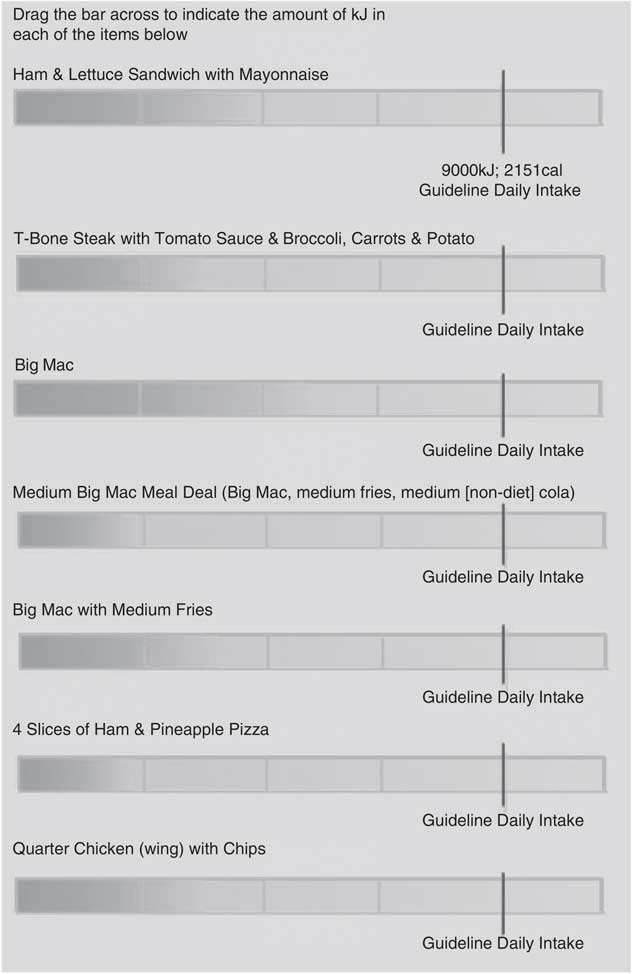
Rather than being asked to estimate an exact value for energy content, as has been done in previous studies(Reference Krukowski, Harvey-Berino and Kolodinsky10, Reference Carels, Konrad and Harper11, Reference Speakman, Walker and Walker13, Reference Chandon and Wansink17), participants in the current study entered their energy estimations using a Guideline Daily Amount (GDA) format which consisted of a visual scale showing a 9000 kJ GDA. This scale had 48 points; the minimum value that could be indicated was 225 kJ and the maximum was 10 800 kJ (120 % of the daily intake; Fig. 1). Prior to the energy estimation task, participants were told that a ‘normal’ meal could be conceived of as roughly a third of the daily energy intake. The GDA format was used because it has been rated as valuable and useful in the interpretation of nutrition information by UK consumers(Reference Sadler20) and GDA are currently used by big manufacturers (including Kellogg's and McDonalds) for front-of-pack labelling in Australia.
Screenshot of the kJ estimation task completed by participants
In order to obtain a benchmark of the difficulty of the task, a small sample of dietitians also completed the energy estimation task and provided feedback on its difficulty using a set of six categorical items: 1 = impossible, 2 = very difficult, 3 = difficult, 4 = reasonable, 5 = easy, 6 = very easy. Nine registered and/or practising dietitians completed the questions. All of the dietitians categorised the task as varying in difficulty between reasonable and very easy to complete. When judging difficulty for the general population, two dietitians described the energy estimation task as reasonable difficulty and the remainder considered the task to be difficult to very difficult.
Data analysis
The energy content of the fast-food items that participants consumed (recalled during the general fast-food survey) was calculated using manufacturer's nutritional information. For the calculation of accuracy in the energy estimation task, the actual kJ content of fast-food items listed in the energy estimation task was gathered from company websites of McDonald's(21), Red Rooster(22) and Domino's Pizza(23) in mid-2006. These brands were used to represent energy content as they are among the most popular quick-service restaurants in Australia(Reference Brindal, Mohr and Wilson24). Energy information for the standard meals was calculated in FoodWorks 2006 software (Xyris Software (Australia) Pty Ltd, Highgate Hill, Australia) using ‘standard’ serving sizes.
After reporting their height and weight, participants could indicate if they were confident in the values they had provided. A total of 17·3 % of the final sample were not confident in their height and/or weight and were excluded from the calculation of BMI. The subset of participants who were not confident in their BMI values were more likely to be unmarried, unemployed, younger and of lower income than the confident group. Finally, relative socio-economic disadvantage was calculated using the participant's postcode(25, 26). Eight responses did not include a valid postcode and were treated as missing.
All resulting data were analysed using the SPSS statistical software package version 16 (SPSS Inc., Chicago, IL, USA) using t tests, multivariate analysis of covariance (MANCOVA) and multiple regression.
Results
The final sample had a high proportion of female respondents and people in the highest income category (Table 1). There were significant gender differences for age (t(490) = 4·29, P < 0·001), monthly fast-food patronage (t(490) = 3·99, P < 0·001), relative socio-economic disadvantage (t(482) = −2·55, P = 0·01), BMI (t(405) = 3·64, P < 0·001), level of education (χ 2 = 15.20, P = 0·004) and employment status of respondents (χ 2 = 29·64, P < 0·001).
Demographic characteristics of the males (n 168) and females (n 324) in the sample

*BMI was calculated only for people confident in self-reported heights and weights (145 males, 262 females).
†Participant's residential postcode was used to calculate the Index of Socioeconomic Disadvantage (IRSD). This index gives an indication of socio-economic disadvantage according to postal zones throughout Australia. Scores range from 200 to 1200 with lower scores indicating more socio-economic disadvantage(25).
Prospective estimation of satiety
MANCOVA controlling for age, relative socio-economic disadvantage, level of education, income, being full-time employed or married revealed that, in comparison to females, males rated the items as significantly less satiating (F(7,470) = 9·29, P < 0·001). The effect of gender remained significant after the inclusion of BMI in the subsample who were confident in their heights and weights (F(7,386) = 9·37, P < 0·001), suggesting that ratings differed according to participant gender and not other demographic differences between males and females.
Both sexes ranked the amount of food for each item roughly in accordance with its weight. The exception was the Medium Big Mac Meal, which weighed slightly less than the pizza and chicken meals, but was rated as providing the second most food – most likely because of the addition of a beverage (Table 2).
RatingsFootnote * of prospective satiety in the fast-food and standard food meals for males and females
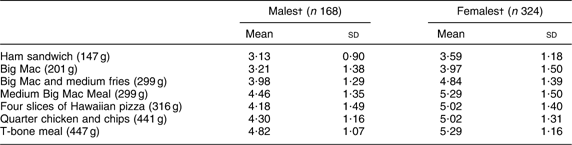
* Each food was rated from 1 = not enough food to 7 = too much food.
† There were significant sex differences for the ratings of all items (P < 0·001).
Males did not perceive the Big Mac to provide any more food than the ham sandwich (t(167) = −0·54, P = 0·59), while females did (t(323) = −5·11, P < 0·001). Males rated the T-bone meal as more food than all of the fast-food meals described. Females saw the T-bone meal as more food than the fast-food items with the exception of the Medium Big Mac Meal (Table 3).
Comparison of ratings of prospective satiety for the large standard meal relative to the fast-food meals
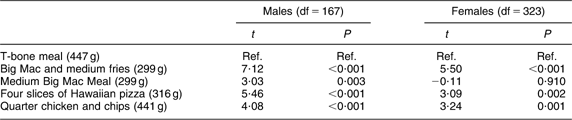
Ref., reference.
Energy estimation
For the energy estimation task, MANCOVA revealed gender differences when controlling for other demographic variables (F(7,470) = 1·45, P < 0·001) and when BMI was included (F(7,386) = 3·86, P < 0·001).
The estimations that the dietitians gave were within 10 % of the actual values. On average, males and females in the lay sample estimated large values for all food items (both fast-food and standard items). All participants estimated that the Big Mac Meal contributed a high portion of the daily amount, with females and males indicating that the meal accounted for over 90 % and 80 % of the GDA, respectively (Table 4). Energy content of items was more frequently overestimated than underestimated by both males and females in the lay sample.
Estimated kilojoules (kJ) of food items (Actual) and this value as a percentage of the Guideline Daily Amount (%GDA) with estimations for dietitians, males and females
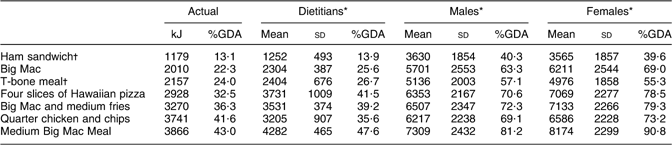
*All values were significantly different between the population samples (both males and females) and the dietitians at the P < 0·001 level.
†As estimated by FoodWorks 2006 software (Xyris Software (Australia) Pty Ltd, Highgate Hill, Australia).
The absolute error in energy estimation was calculated by subtracting the actual kJ content from that estimated by the participants. Absolute error was used due to the small number of underestimations and to focus analyses on the magnitude of error in energy estimation. Average absolute errors made by males and females were three to ten times the magnitude of those made by dietitians (Table 5).
Average error (in kJ) and the percentage of the sample underestimating the kJ content of the food items rated in the energy estimation task (%under) for dietitians, males and female sample
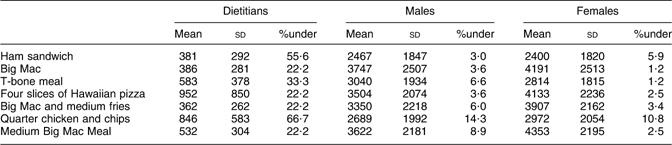
The average absolute error in estimation (herein referred to as ‘energy error’) for the fast-food items (females: mean 3911 (sd 1998) kJ; males: mean 3382 (sd 1957) kJ) was significantly larger than the average energy error for the standard food items (females: mean 2607 (sd 1623) kJ; males: mean 2754 (sd 1652) kJ) across sexes (both P < 0·001). In the dietitian sample, there was no significant difference (P = 0·249) in the error for fast-food items (mean 616 (sd 263) kJ) compared with the energy error for the standard food items (mean 482 (sd 286) kJ). However, this result was likely due to lack of statistical power, given Cohen's d for the comparison between the dietitians’ ratings approximated 0·5, indicating that the mean difference corresponded to a medium effect size(Reference Cohen27).
Relationship between energy error, demographics and behaviour
The associations between participant demographics, energy error for fast-food items (as calculated above) and the average energy consumed from fast foods at the previous fast-food eating occasion (recalled in the fast-food survey) were determined by multiple linear regressions. In the first regression, demographic characteristics (participant age, working full-time, household income, level of education, relative socio-economic disadvantage and frequency of fast-food consumption) were entered as predictors for energy error for the fast-food items (calculated from the energy estimation task). In the second regression, energy error and the participant demographics were used as predictors for the amount of fast-food eaten (in kJ) at the participants’ previous visit to a fast-food restaurant. According to the requirement of twenty participants per predictor for regression(Reference Tabachnick and Fidell28), the model including seven predictors was adequately powered to detect effects in both the male and female samples considered.
None of the demographic characteristics were significant predictors of energy error, and overall the models were not significant for males or females. The model predicting energy intake from fast-food items in males also failed to reach significance but was significant in females (F(7,310) = 2·67, P = 0·01). The model explained 3·5 % of the total variance (based on adjusted R 2), with energy error as the single significant predictor of energy intake. The β value for energy error was 0·16, indicating that greater error in energy estimation was associated with slightly greater energy intake from fast-food items. The unstandardised value indicated that each 1000 kJ increment in energy error was associated with a 127 (se 45) kJ increase in intake.
Given the potential importance of BMI in predicting general nutrition knowledge(Reference Speakman, Walker and Walker13), the models predicting energy error were re-run, including BMI, for the subset of people who indicated confidence in their weights and heights (145 males, 262 females). Despite the inclusion of BMI, the models predicting energy error were not significant in both males and females.
Discussion
The study presented in the current paper aimed to explore consumers’ perceptions of the portion size of fast-food and standard meals as well as assessing the relationship between error in energy estimation and actual intake of fast foods. When asked to indicate prospective satiety of multiple meals, most consumers thought that the food items described provided an adequate volume of food. Fast-food meals were rated as containing a smaller volume of food than the standard large meal, with the exception of women's ratings of the Big Mac. In contrast, when estimating the energy content of the meal, many consumers indicated that food items contained enough energy to account for a large portion of the GDA. Generally, consumers’ errors in energy estimation were large and none of the demographic characteristics considered predicted the magnitude of this error. In women there was some evidence that the degree to which they incorrectly estimated the energy content of the fast-food items could predict the amount of fast food they consumed at their last eating occasion.
The lay samples indicated that fast foods provided high amounts of energy. This was evident in their rating of the Medium Big Mac Meal. Men and women rated the amount of energy in this meal almost equivalent to the entire GDA. Admittedly, not all burger meals are the same. The equivalent burger meal from Hungry Jacks accounts for approximately 25 % more energy than the Big Mac meal from McDonalds(Reference Brindal, Mohr and Wilson24), but this still only represents just over half of the 9000 kJ GDA used. If consumers believe that a fast-food meal accounts for almost a whole day's energy requirements, it would be useful to investigate how they would, and actually do, cope with this perceived excessive intake. Consumers may attempt to counterbalance this intake with restricted food intake throughout the day. However, the perception of excessiveness could also result in increased consumption throughout the day if dietary disinhibition occurs(Reference Herman and Polivy29).
It was interesting that the energy estimations were more often overestimations than underestimations, as this contradicts previous research(Reference Chandon and Wansink17). The health halo effect describes the tendency to underestimate the energy content of food claimed to be healthy, such as Subway(Reference Wansink and Chandon30). The standard food items were overestimated along with the fast-food items. Yet errors in energy estimation for fast-food meals were larger than those for the standard meals, suggesting that perhaps the perceived ‘unhealthiness’ of these items increased the errors made. However, here the average energy content of the fast-food items was greater than that of the standard food items, meaning that the greater error may also be a function of different meal sizes(Reference Chandon and Wansink17).
Nestle(Reference Nestle31) discusses a ‘virtual absence of intuitive understanding that larger portions contribute more calories’ (p. 40). As items were added to the Big Mac, both males and females increased their energy estimations suggesting some understanding that more food (and even drink) can provide more energy. Obviously energy estimation was further complicated by energy density of fast-food items in the current study. Here, the T-bone meal represented the greatest volume of food and yet only an intermediate amount of energy. It appeared that consumers had some understanding of this since, on average, the steak meal was rated as having less energy than all of the fast-food items. It is unclear whether the perception that fast food has more energy than standard meals is related to the perception of fast foods as unhealthy or an actual understanding of energy density. Data indicating that 75 % of an Australian sample was unaware that fat is energy dense(Reference Hendrie, Cox and Coveney14) suggest that the latter is unlikely.
Despite some adjustment for portion size, consumers made gross errors in energy estimation. If the pooled error in estimation is treated as a proxy measure for energy awareness or knowledge(Reference Speakman, Walker and Walker13), the magnitude of error in the current sample indicates that they had poor awareness of the energy content of food items. Although this may also reflect the complexity of the task for consumers (predicted by the dietitian sample who indicated it would be difficult for the general population), estimating the impact of a meal on a day's energy requirements is no more challenging than the processes involved in interpreting and using the details displayed on nutrition information panels in Australia. If nutrition information remains in its current format, consumers need further education or strategies to interpret and utilise energy information and balance energy intake.
The results for the female sample suggested that accuracy at estimating energy content may be related to behaviour. Women who were better at the energy estimation task (i.e. had a lower absolute energy estimation error) also consumed less energy at their previous fast-food consumption occasion, which suggests that a better understanding of energy content may be associated with intake. Error in estimation predicted intake more strongly than other demographic factors, such as age, but accounted for only a small amount of the total variance for the amount of fast food consumed.
The ability to estimate energy may be associated with behaviour in women and not men because of a high involvement in health and dieting. Certainly, this would be consistent with results from a large-scale multi-country study in which women were reported to be more likely to be dieting than men(Reference Wardle, Haase and Steptoe32) and Australian census data which reveal that there are almost 3·5 times more women majoring in a health field than men(33). Gender differences in concern about food require more research especially if they have the potential to moderate effects on dietary behaviour.
Public education about the energy content of food in relation to daily requirements may improve consumers’ ability to interpret and utilise this information. General nutrition knowledge has been associated with dietary behaviours such as lower consumption of foods away from home(Reference Beydoun, Powell and Wang34). There is evidence that calorie counting is a skill that can be taught(Reference Martin, Anton and York-Crowe35). Indeed, estimating the energy content of foods is a skill that many dieters adapt and put in practice. Increasing involvement with nutrition together with self-efficacy may also be a promising way of increasing the effect of nutrition knowledge on behaviour(Reference Rimal36). An alternative (and potentially cost-effective) approach to education is the provision of intelligent multimedia tools that utilise ‘just-in-time’ prompting strategies and self-monitoring programmes(Reference Atienza, King and Oliveira37, Reference Tsai, Lee and Raab38). Yet another solution may be to implement policies that change the way that nutrition information is communicated, which may also enable individuals to monitor and moderate their energy intake more effectively.
The above approach has been recently adopted in the USA where calorie information will be required to be displayed at the point of purchase in food establishments(Reference Bernstein39). The efficacy of a labelling and informational approach for energy moderation is supported by some(Reference Cranage, Conklin and Lambert40, Reference Gerend41) but not all studies(Reference Krukowski, Harvey-Berino and Kolodinsky10, Reference Harnack, French and Oakes42, Reference Yamamoto, Yamamoto and Yamamoto43). In the specific case of fast food, less than 5 % of consumers reported seeing nutrition information in fast-food restaurants in New York City (where labelling has been compulsory since 2007) but, when they did, they consumed fewer calories(Reference Bassett, Dumanovsky and Huang44). Therefore, making energy content information prominent for fast-food items may positively alter behaviour in a limited number of cases. However, the possibility that consumers’ drive for value for money may also undermine this tactic needs consideration, with companies already advertising items with calories per dollar(Reference Gimein45). Future studies are needed to clarify the efficacy of providing energy contents at a population level and to determine if environmental cues can increase awareness of dietary energy and/or alter behaviour.
The current findings are subject to methodological limitations. It is possible that the survey attracted certain types of people such as those with higher involvement with food and nutrition. The sample was slightly homogeneous lacking a strong representation of men or people of low socio-economic status. This may have may have limited the ability to replicate previous findings of an association between energy knowledge and BMI(Reference Speakman, Walker and Walker13). The presentation of the tasks could also be improved in the future. Previous studies have asked participants to rate expected satiety by presenting photographs which could be incorporated into a new version of the task, particularly when assessing non-standardised meals (i.e. chicken and chips)(Reference de Graaf, Stafleu and Staal46).
The present study has provided unique data on the way in which Australian consumers perceive the size of fast-food items. Improved understanding of dietary energy is required if consumers are to balance their energy intake with their requirements. If future portion size interventions are to be successful, more data on the perception of portion size and consumer knowledge are needed to determine the most effective strategies for behaviour change.
Acknowledgements
The study was funded by a Linkage Grant from the Australian Research Council. The industry partners in this grant are the South Australian Health Department and McDonald's Australia. Neither industry partner had a role in the designing, analysing or interpreting the study or in the drafting, review or approval of the manuscript. G.W. is a member of the McDonald's Global Advisory Council on Balanced, Active Lifestyles, on which he provides advice about nutrition and contributes to their balanced active lifestyles policy and programme. There were no further conflicts of interest. E.B. conceived the study and conducted the research and analysis for the study, which formed part of her PhD thesis. C.W., P.M. and G.W. provided academic supervision and support for the work. E.B. prepared the manuscript. All authors contributed to, read and approved the final manuscript.



