




Introduction and objectives
The development of human socioecological niches comprises ecological, economic and institutional factors operating at various spatial and organisational scales (Descheemaeker et al. Reference Descheemaeker2019). World highlands and their surroundings offer unique constraints and opportunities for the spatial allocation of human activities (Rademaker et al. Reference Rademaker2014), particularly when multiple economic strategies coexist.
Our study area comprises the longitudinal valleys of Uspallata, Calingasta and Iglesia (Mendoza and San Juan Provinces, Argentina), making up a biogeographic corridor flanked by the towering mountain ranges of Precordillera (east) and the Andes (west), with striking topographical and ecological variation (29°–32°S; Figures 1 & 2; see video in the online supplementary material (OSM)). During the last approximately 3000 years, the southern Andes were characterised by a diverse array of socioecological niches variously combining hunting, gathering, horticulture, intensive agriculture, and camelid pastoralism, setting the stage for multiple forms of landscape use and social interaction (Gambier Reference Gambier2000; Durán et al. Reference Durán2018).
Study area, samples for bioavailable strontium and studied sites (credit: G. Lucero).

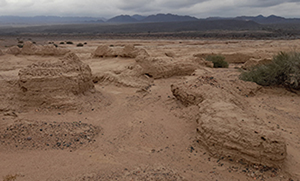
Study area: a) Precordillera in Uspallata; b) Uspallata Valley; c) Iglesia Valley; d) Angualasto site; e) Calingasta Valley (credit: R. Barberena).

The project, Diversity in Socioecological Niches in the Andes (DISENIA), seeks to study the spatio-temporal diversity of human strategies of niche construction in the vertical worlds of the southern Andes. Our approach combines ‘dietary’ (13C/12C, 15N/14N) and ‘spatial’ (87Sr/86Sr) isotope systems. While the former allow reconstruction of the economic dimension of niche, strontium reveals the geographic signatures associated with hunting, gathering and agropastoral activities, the configuration of human territories, and migration. In combination with studies of human palaeoecology, landscape change and settlement patterns, we seek to understand the evolution of socioecological niches across the agropastoral transition—a period of increased diversity. This can then be compared with similar trajectories worldwide (Boivin et al. Reference Boivin2016).
The southern Andean valleys: landscape and bioarchaeology
These longitudinal valleys are placed near the southern frontier of the expansion of agropastoral economies between 29° and 32°S (Figure 2) and have a remarkable bioarchaeological record, with cemeteries spanning the last 3000 years. Our research began by building a trans-Andean isoscape of bioavailable strontium and producing the first results for human remains from Uspallata, identifying locals and migrants—at Potrero Las Colonias—possibly coming from regions to the north (Barberena et al. Reference Barberena2020, Reference Barberena2021).
As a case study illustrating our methodological strategy, we discuss the sites Túmulo I and Túmulo II (1890–1900m asl), displaying local 87Sr/86Sr signatures, as a tool to explore the diversity of isotopic niches within the valleys. This is compared with migrants from Potrero Las Colonias (1850m asl). These sites lie within 5km of each other in the Uspallata Valley bottom and were excavated in the 1930s by Carlos Rusconi (Figure 3). Túmulo II is a multiple burial containing 10 individuals dated to c. AD 700–1000. Túmulo I contains 28 individuals dated between AD 1020 and 1190, and Potrero Las Colonias has an MNI (minimum number of individuals) of 119 and is dated between AD 1290 and 1420 (Rusconi Reference Rusconi1961; Da Peña Aldao et al. Reference Da Peña Aldao, Novellino and Frigolé2016; Barberena et al. Reference Barberena2020).
Burials in Uspallata: a) reconstruction of sites Túmulo I and II; b) plan view of Túmulo II (Rusconi Reference Rusconi1961: 363 & 387).

An isotopic approach to human organisational variation in a land of hunters, herders and farmers
Four bone samples from Túmulo I and fourteen bone and teeth samples from Túmulo II overlap with the local bioavailable strontium range and are identified as locals. While both sites are within the local 87Sr/86Sr range, they do not overlap, since Túmulo I (0.70937±0.0001) shows more radiogenic values than Túmulo II (0.7089±0.0002) (Figure 4).
87Sr/86Sr values for rodents, locals (Túmulo I, II) and migrants (Potrero Las Colonias) (credit: R. Barberena).

These sites also differ in δ13Capatite—a proxy of total diet. Túmulo I presents an average C4 input of 29 per cent and Túmulo II of 55 per cent. Bayesian modelling of the isotopic niches of δ13Capatite and 87Sr/86Sr produced with Stable Isotope Bayesian Ellipses (SIBER; Jackson et al. Reference Jackson, Inger, Parnell and Bearhop2011) shows wide spacing between the ellipses for Túmulo I, II and the migrants (Figure 5).
Isotopic space and niche of Túmulo I (n = 4), II (n = 8) and Potrero Las Colonias (n = 7) (credit: A. Tessone).

By applying our isoscape, we reconstruct different catchment areas for the resources consumed, since the individuals from Túmulo I utilised more often the highlands of Precordillera to the east of Uspallata, while those from Túmulo II are largely allocated to the valley bottom (Figure 6). Building on this, we suggest that Túmulo I and II represent different—and possibly coexisting—niches and strategies of landscape use within the valleys during AD 700–1200. While these groups were mobile, their daily ranges would not have included regions beyond the valleys/Precordillera scale. The individuals from Túmulo I occupied a niche biased towards a highland-C3 ecosystem (e.g. guanacos, seeds from wild plants such as Prosopis), while also yielding 87Sr/86Sr values closer to Precordillera. In turn, Túmulo II occupies a niche situated in the valley bottom with a higher C4 input—likely derived from both maize and wild C4 plants. Since the highlands would be covered by snow during winter (Figure 1b), we suggest that these differences are partly produced by different strategies of seasonal mobility. The highland-C3 niche would have implied significant vertical mobility, with prolonged summer occupations of the highlands reaching approximately 3000m asl, whether for hunting, camelid herding, or combinations thereof (Durán et al. Reference Durán2018). In comparison, the valley bottom-C3/C4 niche would have implied more restricted vertical mobility, with longer stays in the lowlands, compatible with more intensive maize farming (Figure 6). Finally, while the geographic source of the non-local individuals from Potrero Las Colonias is still unknown (Barberena et al. Reference Barberena2020), their emphasis on C4 farming and homogeneous 87Sr/86Sr values suggests reduced mobility in comparison with the locals from Túmulo I and II.
Ranges of mobility for locals (Túmulo I and II), as reconstructed from the isoscape (credit: G. Lucero).

Future research
This preliminary study illustrates the potential of a multi-isotope approach to study socioecological niches in the southern Andean corridor valleys. This research framework will be developed by: (a) expanding the regional isotope ecology; and (b) characterising the spatial and altitudinal allocation of hunting, herding and farming activities by isotopically analysing camelid and plant remains. In addition, we will (c) study the dietary and geographic stability of human life histories at the level of individuals, groups and communities, assessing the patterns of permanent or long-term migration as a dimension of kinship organisation and social interaction. We aim at understanding the socioecological processes producing niche diversity during the agropastoral transition in the vertical worlds of the southern Andes.
Acknowledgements
We thank Claudia Herrera (Guaytamari) and Graciela Coz (Llahue Xumec), representatives of the Huarpe communities of Uspallata; Guillermo Campos (Museo de Ciencias Naturales y Antropológicas J.C. Moyano); and Horacio Chiavazza (Director of Museums and Cultural Heritage, Mendoza). Ignacio Erdozain filmed the drone video included as online supplementary material. We acknowledge the insightful input from the two anonymous reviewers.
Funding statement
This research is funded by the National Geographic Society (grant no. NGS-92679R-22), the Wenner-Gren Foundation (grant no. 2368532037), the Universidad Nacional de Cuyo (M042-T1) and the CONICET (Argentina).
Supplementary materials
To view supplementary material for this article, please visit https://doi.org/10.15184/aqy.2023.47.


 Open access

