


The use of marine protected areas to safeguard high-seas habitats of marine vertebrates (Hyrenbach et al., Reference Hyrenbach, Forney and Dayton2000) has been largely unrealized, despite the mandates of multilateral agreements such as the United Nations Convention on the Law of the Sea, the Convention on Biological Diversity, and the Convention on Migratory Species. Marine vertebrates therefore remain at risk from fisheries when occupying the pelagic realm (Hall et al., Reference Hall, Alverson and Metuzals2000; Lewison et al., Reference Lewison, Freeman and Crowder2004; Carranza et al., Reference Carranza, Domingo and Estrades2006). In contrast, coastal marine protected areas may be more successful in protecting species of conservation concern as surveillance and enforcement become tractable. Marine protected areas could provide an important management tool for migratory species such as the leatherback turtle Dermochelys coriacea that occupy neritic habitats for breeding.
Leatherback turtles have the widest spatial distribution of all marine turtles (Plotkin, Reference Plotkin, Lutz, Musick and Wyneken2003), moving through pelagic habitats whilst undertaking foraging migrations for gelatinous prey (James et al., Reference James, Myers and Ottensmeyer2005; Witt et al., Reference Witt, Broderick, Johns, Martin, Penrose, Hoogmoed and Godley2007). Reproductively active adults converge on natal tropical and subtropical coastal habitats to breed and nest (Miller, Reference Miller, Lutz and Musick1997). Leatherback turtles nesting in Gabon (Fig. 1a) form a globally important sub-population (Fretey, Reference Fretey1984; Formia et al., Reference Formia, Tiwari, Fretey and Billes2003; Sounguet et al., Reference Sounguet, Mbina and Formia2004). Three centres of nesting occur on the Gabonese coast (Fig. 1a) at Pongara, Gamba and Mayumba National Park (Sounguet et al., Reference Sounguet, Mbina and Formia2004; Verhage et al., Reference Verhage, Moundjim and Livingstone2006). Given the reproductive patterns of this species (James et al., Reference James, Myers and Ottensmeyer2005) it is likely that the coastal waters of Gabon host substantial numbers of leatherback turtles during the breeding and nesting season (September to March).
(a) Main centres of leatherback turtle nesting in Gabon (filled circles) including Mayumba National Park. I, Equatorial Guinea territorial sea and exclusive economic zone; II, Sao Tome & Principe economic zone; III, Gabon territorial sea, contiguous zone and exclusive economic zone; IV, Congo territorial sea. Hatched zone represents disputed region. Dashed rectangle depicts spatial extent of Figs 1b-d. Inset map shows the location of the main figure in Africa. (b) Habitat utilization by tracked turtles using a single daily position taken at midday, for each turtle, from their respective interpolated tracks. Vertical inset legend indicates the number of occupation events observed per cell. Dotted black lines are bathymetric contours. (c) & (d) Argos-derived tracks of turtles A-D and turtles E-G respectively (Table 1). Dotted black lines are bathymetric contours. Solid black arrows highlight dominant offshore ocean currents derived from absolute dynamic topography satellite altimetry data.

A c. 900 km2 marine protected area was established at Mayumba (Fig. 1b) in 2002 as part of a larger effort to protect habitats and species across Gabon. The park is a fisheries exclusion zone encompassing a 15 km band of neritic habitat and a 1 km band of adjacent land stretching northwards for 60 km from Gabon's southern border with the Republic of Congo and its Conkouati-Douli National Park (Fig. 1b). Mayumba National Park was designated to protect leatherback and olive ridley turtles Lepidochelys olivacea, and humpback whales Megaptera novaeangliae.
Leatherback turtles are reported to disperse widely from focal nesting points (Eckert et al., Reference Eckert, Eckert, Adams and Tucker1989; Eckert, Reference Eckert2006; Fossette et al., Reference Fossette, Corbel, Gaspar, Maho and Georges2007); this behaviour most likely increases the possibility of interaction with industrial fisheries in Gabonese coastal waters. We therefore deployed Platform Terminal Transmitters (PTTs, two models: Kiwisat 101, Sirtrack, Havelock North, New Zealand, n = 4; Satellite Relayed Data Logger, SRDL, Sea Mammmal Research Unit, St Andrews, UK, n = 3) communicating with Service Argos (CLS, 2007) to record the at-sea distribution of seven leatherback turtles (Table 1) nesting at Mayumba National Park. PTTs were attached to leatherback turtles using either harnesses (n = 5) modified from designs of Eckert & Eckert (Reference Eckert and Eckert1986) and Hays et al. (Reference Hays, Houghton, Isaacs, Kin, Lloyds and Lovell2004) or using a modified direct carapacial attachment (n = 2) procedure (Lutcavage et al., Reference Lutcavage, Rhodin, Sadove and Conroy1999).
Morphometrics, inter-nesting durations and movement metrics of seven leatherback turtles satellite-tracked from Mayumba National Park. There are two sets of records for Turtles D and F as they were each tracked for two inter-nesting periods.

1 Straight-line distance
2 PTT attached using a harness
3 Post-nesting movements recorded by satellite telemetry
4 Nesting visually observed by third party (no location coordinates available)
5 Nesting location derived from Argos location estimates with error classes A and B that provide no error estimate
6 PTT failed at sea on day 8 of the inter-nesting period
7 PTT removed after nesting
8 Turtle entered in territorial waters of the Republic of Congo
9 SRDL haul-out timer recorded periods of dryness (>10 and <45 minutes) in days prior to nesting that likely represent unsuccessful nesting attempts
10 PTT attached using a direct carapace attachment
Movements of tracked individuals were reconstructed from Argos location estimates assigned error classes 3, 2, 1, 0 and A using the Satellite Tracking and Analysis Tool (Coyne & Godley, Reference Coyne and Godley2005). Classes 3 to 0 have decreasing location accuracy from <150 m to >1,000 m; class A has no location error estimate (Hays et al., Reference Hays, Åkesson, Godley, Luschi and Santidrian2001). To remove inaccurate location estimates each movement track was independently filtered using the minimum redundant distance and distance, angle and rate filters of the Douglas Argos-Filter algorithm. Argos location estimates with error classes 2 and 3 were always retained. Geographical locations of PTT attachment sites were recorded using a global positioning system.
We derived the locations of subsequent nesting events from Argos location estimates using two criteria: (1) directed movement towards land and (2) an increase in location error class that commonly occurs with nesting. These criteria were required to occur no earlier than 8-9 days after PTT attachment or following a previous nesting event. This duration typifies the minimum re-nesting interval of leatherback turtles (Miller, Reference Miller, Lutz and Musick1997). For the three turtles fitted with SRDLs haul-out information (periods of non-submergence >10 minutes) were also used to discriminate Argos locations representing nesting events. Prior to analysis all movement tracks were resampled at 1-hour intervals assuming straight-line movement between location estimates.
During their inter-nesting periods (mean 10 ± SD 1 day, range 8-13), leatherback turtles ranged widely moving a mean minimum straight-line distance of 249 ± SD 101 km. This pattern of movement is consistent with studies of inter-nesting leatherback turtles in the North Atlantic (Eckert et al., Reference Eckert, Eckert, Adams and Tucker1989; Keinath & Musick, Reference Keinath and Musick1993; Godley et al., Reference Godley, Blumenthal, Broderick, Coyne, Godfrey, Hawkes and Witt2008). Satellite-tracked leatherback turtles occupied 7,670 km2 of neritic habitat (Fig. 2; estimated using the α-hull technique where α = 7, Burgman & Fox, Reference Burgman and Fox2003), and remained exclusively on the continental shelf (coastline to 200 m depth contour). Turtles B, D and E moved into the waters of the Conkouati-Douli National Park within Congolese Territorial Waters (Fig. 2) for a mean 46 ± SD 13% of their respective tracking durations.
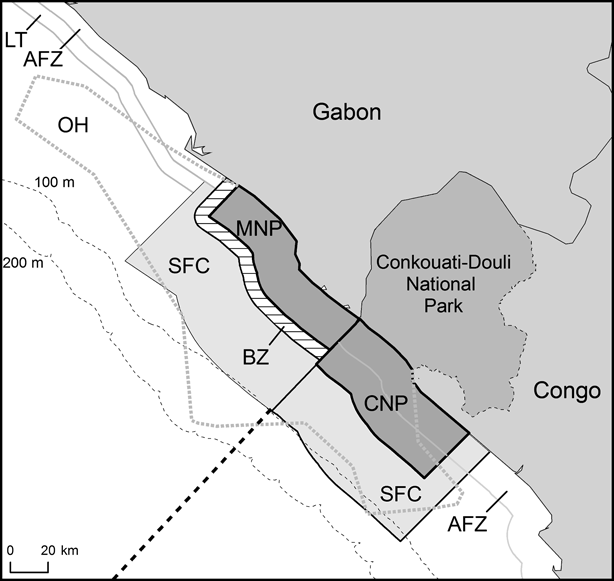
Existing and recommended spatial zoning on the continental shelf of Gabon and the Republic of Congo. No fishing is permissible inside Mayumba National Park (MNP). We recommend that Mayumba National Park's existing buffer zone (BZ) act as a year-round exclusion zone to industrial trawlers and as a seasonal closed zone for artisanal fishing between September and March. At present industrial trawlers cannot operate in the existing Artisanal Fishery Zones (AFZ). In Gabon the AFZ is from the coastline to 3 nautical miles, in the Congo it is to 6 nautical miles. Artisanal fishing is permissible inside Conkouati-Douli National Park (CNP) up to 6 nautical miles from the coast but only to villages within the Park. In Gabon industrial fishing is permissible by licensed trawlers 3-6 nautical miles from the shore (LT). Our recommended seasonal fisheries closure (SFC) zone for industrial trawl fisheries would operate between September and March. Habitat occupied (OH) by satellite-tracked leatherback turtles (A-G) is also shown.
Leatherback turtles spent a mean of 62 ± SD 26% of tracking time outside Mayumba National Park; in these habitats they remain at risk of incidental capture by both licenced and unlicenced industrial trawl fisheries (Billes et al., Reference Billes, Fretey, Mourndembe and Seminoff2003; Sounguet et al., in press). The most frequented region of the inter-nesting habitat occurred within and on the periphery of Mayumba National Park (Fig. 1b). The pattern of distribution probably highlights a shuttling movement made by females to and from the nesting beach every c. 10 days. The mean time to depart the National Park following nesting was 1 ± SD 0.7 days; most protection is therefore conferred by the National Park in the hours prior to, during and following nesting.
The spatial extent of the National Park encompassed 9% of habitat utilized by tracked individuals (Fig. 2). This disparity between available protected habitat and that which would offer enhanced protection (e.g. 50 or 75% of inter-nesting habitat) illustrates the difficulties in demarcating coastal marine protected areas. Restricting access to coastal waters rich in resources such as fisheries and oil poses problems for governments that are required to balance economic growth with the need to protect species of conservation concern.
Mayumba National Park is nested within several existing marine zones (Fig. 2) but historically little capacity has existed to monitor and enforce them. In previous years adult leatherback turtles have been washed ashore dead on the beaches of the National Park and at Gamba, 160 km to the north, coincidentally observed with fisheries violations (Verhage et al., Reference Verhage, Moundjim and Livingstone2006; Parnell et al., Reference Parnell, Verhage, Deem, Leeuwe, Nishihara, Moukoula and Gibudi2007). Rates of strandings are unlikely to represent the extent of deleterious interactions occurring at sea, particularly as prevailing currents (Fig. 1c,d) may wash severely injured or dead leatherback turtles away from the coast. Limited satellite tracking suggests that these areas are likely to be densely occupied by leatherback turtles during the breeding and nesting season (Fig. 1b).
Mean nest site fidelity varied appreciably (mean distance between nests = 13.1 ± SD 10.6 km, range 1.2-28.3) and nesting activity was not restricted to the National Park; turtle E was observed in the Conkouati-Douli National Park c. 30 km south of the PTT attachment site. Monitoring of nesting undertaken at Mayumba National Park and at the Gamba rookery shows that some exchange of individuals occurs annually (Verhage et al., Reference Verhage, Moundjim and Livingstone2006), demonstrating that the wide ranging movement of inter-nesting leatherback turtles are matched in geographic scale by changes in nest site selection. This plasticity highlights the additional challenges of limiting illegal egg harvest and the complexities of ensuring consistent protection across geopolitical zones both on land and at sea.
The Memorandum of Understanding (MoU) for West African turtles introduced by the Convention on Migratory Species encourages signatories, such as Gabon and the Republic of Congo, to protect marine turtles by mitigating potential risks. An important step towards the MoU would be the implementation of marine spatial planning with a goal to select regions requiring protection for leatherback turtles. This process may be informed by the use of distribution data recorded by satellite telemetry.
Practically, enhanced protection may be achieved through the use of fisheries zoning (see Fig. 2 for a recommended spatial plan) that instigates a seasonal fisheries closure during October-March in habitats surrounding Mayumba and the marine region of Conkouati-Douli National Park (c. 1,260 km2). This would offer an additional c. 4,100 km2 of protection. The recent commissioning of a fishing vessel monitoring system and the proposed introduction of turtle excluder devices in Gabon may also make a substantial contribution to mitigating fisheries risk. Taking an integrative approach would however require bilateral agreements to ensure consistent and uniform fisheries surveillance between both countries. Despite these obstacles, such an approach, especially when operated in tandem with appropriate control of pelagic fisheries, is likely to yield beneficial results for leatherback turtle population growth and overall ecosystem health.
Acknowledgements
This work was funded partly by the ShellShock Campaign of the European Association of Zoos and Aquaria and the Large Pelagics Research Center at the University of New Hampshire through National Oceanographic and Atmospheric Agency award NA04NMF4550391. MJW is supported by a Natural Environment Research Council PhD studentship (NER/S/A/2004/12980) at the University of Exeter (Cornwall campus). BJG and ACB receive funding from the European Social Fund and NERC. We thank M. Lutcavage and A. Myers for their technical assistance with direct carapace attachment of PTTs. We are especially grateful to the turtle technicians of ASF working at Mayumba National Park and to WCS-Gabon (Libreville) for providing logistical support. We thank A. Sanders, E. Hymas, F. Hymas, B. Willems and M. Markovina for field-site assistance. We thank L. Hawkes, M. Tiwari, M. Taylor, A. McGowan and two anonymous reviewers for their comments on earlier versions of this manuscript. Ocean current data presented in Fig. 1b were derived from altimeter products produced by Ssalto/Duacs and distributed by Aviso, with support from CNES.
Biographical sketches
Matthew Witt's research centres on the use of spatial ecology to aid an understanding of marine vertebrate distribution and foraging ecology. Annette Broderick and Brendan Godley coordinate the Marine Turtle Research Group at a range of sites around the world including Ascension Island, Northern Cyprus and the UK Overseas Territories. Michael Coyne coordinates the work of seaturtle.org. Angela Formia works extensively on marine turtle conservation genetics in West Africa and coordinates the Marine Turtle Partnership in Gabon. Solange Ngouessono is the Director of Mayumba National Park, and Richard Parnell directs the Wildlife Conservation Society's project in Mayumba. Guy-Phillipe Sounguet directs the activities of Aventures Sans Frontières, a NGO concerned with habitat and species protection in Gabon.



