


Introduction
The Antillean manatee Trichechus manatus manatus is one of the most threatened aquatic mammal species across its range in eastern North, Central and South America. In Mexico, it occurs along the coasts of the Gulf of Mexico and the eastern Yucatan Peninsula (Colmenero-Rolón & Hoz, Reference Colmenero-Rolón and Hoz Zavala1986; Morales-Vela & Olivera-Gómez, Reference Morales Vela and Olivera Gómez1997) as two genetically distinct populations (Nourisson et al., Reference Nourisson, Morales-Vela, Padilla-Saldívar, Tucker, Clark and Olivera-Gómez2011). An estimated 1,000–1,500 manatees inhabit Mexican waters (Castelblanco-Martínez et al., Reference Castelblanco-Martínez, Nourisson, Quintana-Rizzo, Padilla-Saldívar and Schmitter-Soto2012).
Threats to manatees include poaching, entanglement in fishing nets and habitat loss caused by intensive coastal development (Morales-Vela & Olivera-Gómez, Reference Morales Vela and Olivera Gómez1997; Ortega-Ortiz et al., Reference Ortega-Ortiz, Delgado-Estrella, Ortega-Argueta, Withers, Nipper;, Caso, Pisanty and Ezcurra2004). To address these threats, priority conservation strategies are being directed towards effective management for recovery (Quintana-Rizzo & Reynolds, Reference Quintana-Rizzo and Reynolds III2010; SEMARNAT/CONANP, Reference Olivera Gómez, Ortega-Argueta, Morales Vela and Colmenero Rolón2010). One of the management strategies is the rescue of injured or stranded manatees and their transfer to rehabilitation facilities. Although captive breeding of threatened species is a widespread conservation strategy (IUCN, 1998), it is not always feasible or justifiable as a management priority (Hunter et al., Reference Hunter, White, Henschel, Frank, Burton and Loveridge2013). Decision-making in conservation needs to take into account complex social considerations and is subject to human emotivity (Ainsworth et al., Reference Ainsworth, Aslin, Weston and Garnett2016), which can lead to erroneous or late decisions with unintended or unforeseen management outcomes (Wilson et al., Reference Wilson, Carwardine and Possingham2009; Brook et al., Reference Brook, Dudley, Mahood, Polet, Williams and Duckworth2014). In the management of threatened species, attention can be diverted to unnecessary or lower priority actions, with costly consequences in terms of funding and achievement of recovery goals (Pérez et al., Reference Pérez, Anadón, Díaz, Nicola, Tella and Giménez2012). Here we document a controversy surrounding the captive management and breeding of manatees in Mexico, examining whether captive breeding is a priority for manatee conservation. We describe the evolution of this controversy over 2 decades (1997–2017) and analyse the consequences of the decisions made and the implications for manatee conservation, and, to address these issues, propose an integrated management strategy that involves aspects of both in situ and ex situ conservation. Although this analysis was carried out in the context of Mexico, it is relevant and applicable to the management of this species across the wider Caribbean region.
Conservation benefits of manatee management in captivity
Manatees can be injured or orphaned as a result of anthropogenic or natural events and become dependent on rescue and rehabilitation in appropriate facilities. Partnerships of government authorities with state and private zoos play an important role by providing the necessary veterinary care, husbandry and research opportunities. Such partnerships have been established successfully in the USA (including Puerto Rico), Brazil and Venezuela, where manatees have been held in captivity (Adimey et al., Reference Adimey, Mignucci-Giannoni, Auil-Gomez, Da Silva, Alvite, Morales-Vela, Hines, Reynolds, Aragones, Mignucci-Giannoni and Marmontel2012; Normande et al., Reference Normande, Luna, Malhado, Borges, iana Junior, Attademo and Ladle2015; Boede & Mujica-Jorquera, Reference Boede and Mujica-Jorquera2016). Manatees are difficult to study in the wild and therefore the knowledge and expertise gained through management of captive individuals is of great value. Manatees in captivity have also generated greater public awareness and support for their conservation (Adimey et al., Reference Adimey, Mignucci-Giannoni, Auil-Gomez, Da Silva, Alvite, Morales-Vela, Hines, Reynolds, Aragones, Mignucci-Giannoni and Marmontel2012).
Manatee rescue and rehabilitation has a long history, particularly in the USA (Adimey et al., Reference Adimey, Mignucci-Giannoni, Auil-Gomez, Da Silva, Alvite, Morales-Vela, Hines, Reynolds, Aragones, Mignucci-Giannoni and Marmontel2012, Reference Adimey, Ross, Hall, Reid, Barlas, Diagne and Bonde2016) and Brazil (Normande et al., Reference Normande, Luna, Malhado, Borges, iana Junior, Attademo and Ladle2015). Rehabilitation programmes involve the provision of veterinary care, rearing of orphaned animals and the subsequent release of viable individuals into suitable wild habitat (Miller, Reference Miller2000). The release of individuals into an existing population is referred to as reinforcement or restocking (IUCN, 1998). Several protocols for manatee rehabilitation have been developed by major conservation programmes in the Caribbean region (Lima et al., Reference Lima, Alvite and Vergara-Parente2007; Adimey et al., Reference Adimey, Mignucci-Giannoni, Auil-Gomez, Da Silva, Alvite, Morales-Vela, Hines, Reynolds, Aragones, Mignucci-Giannoni and Marmontel2012).
Manatees can adapt to captivity within a matter of weeks (Bonde et al., Reference Bonde, Keith, Ward, Reid, Pitchford and Deutsch2003) but contact with humans can alter their behaviour and reaction to natural hazards; the animals become docile and attached to humans. Manatees that are maintained for long periods or were born in captivity also lack the instinct to avoid risks such as boats and gillnets, two major causes of manatee mortality. Docile manatees are unlikely to survive in the wild because they lack the ability to exploit habitats where they can find food and shelter, and face the difficulty of integrating into existing populations (Bonde et al., Reference Bonde, Keith, Ward, Reid, Pitchford and Deutsch2003). Experience in Florida suggests that manatees held in captivity for less than 2 years face fewer challenges after release than those held for longer periods (Bonde et al., Reference Bonde, Keith, Ward, Reid, Pitchford and Deutsch2003; Adimey et al., Reference Adimey, Ross, Hall, Reid, Barlas, Diagne and Bonde2016).
Captive breeding as a recovery strategy for threatened species
Captive breeding is a widely used conservation strategy for species with diminished populations in the wild. Captive animals represent a demographic and genetic reservoir that can be used for restocking (IUCN, 1998), but captive breeding is not always feasible. Experience from the USA (including Puerto Rico) and Brazil has shown that breeding manatees in captivity (Corkeron, Reference Corkeron, Perrin, Wursig and Thewissen2002) presents biological and financial challenges (Adimey et al., Reference Adimey, Mignucci-Giannoni, Auil-Gomez, Da Silva, Alvite, Morales-Vela, Hines, Reynolds, Aragones, Mignucci-Giannoni and Marmontel2012). Manatees have a relatively low reproduction rate: they reach sexual maturity after 5 years, have a gestation period of 11–13 months, give birth to a single calf and the average interval between births is 2.5 years (Marmontel et al., Reference Marmontel, Odell, Reynolds and Hemlett1992). The high cost of maintaining manatees in captivity, up to USD 16,700 annually per individual (R. Sánchez-Ockruky, Dolphin Discovery, Mexico, pers. comm.), makes it difficult to secure the necessary financial resources, especially in developing countries such as Mexico. Long-term recovery based on captive breeding programmes is therefore unviable (Bossart, Reference Bossart1999); it can only be an interim solution that can be expected to remain relatively expensive (Snyder et al., Reference Snyder, Derrickson, Beissinger, Wiley, Smith, Toone and Miller1997). In the USA (including Puerto Rico), Belize and Brazil manatees have been kept in captivity only long enough to rehabilitate them, and have been released as soon as possible, thus minimizing costs and avoiding habituation to people (Lima et al., Reference Lima, Alvite and Vergara-Parente2007; Adimey et al., Reference Adimey, Mignucci-Giannoni, Auil-Gomez, Da Silva, Alvite, Morales-Vela, Hines, Reynolds, Aragones, Mignucci-Giannoni and Marmontel2012).
1997–2007: manatee management controversy
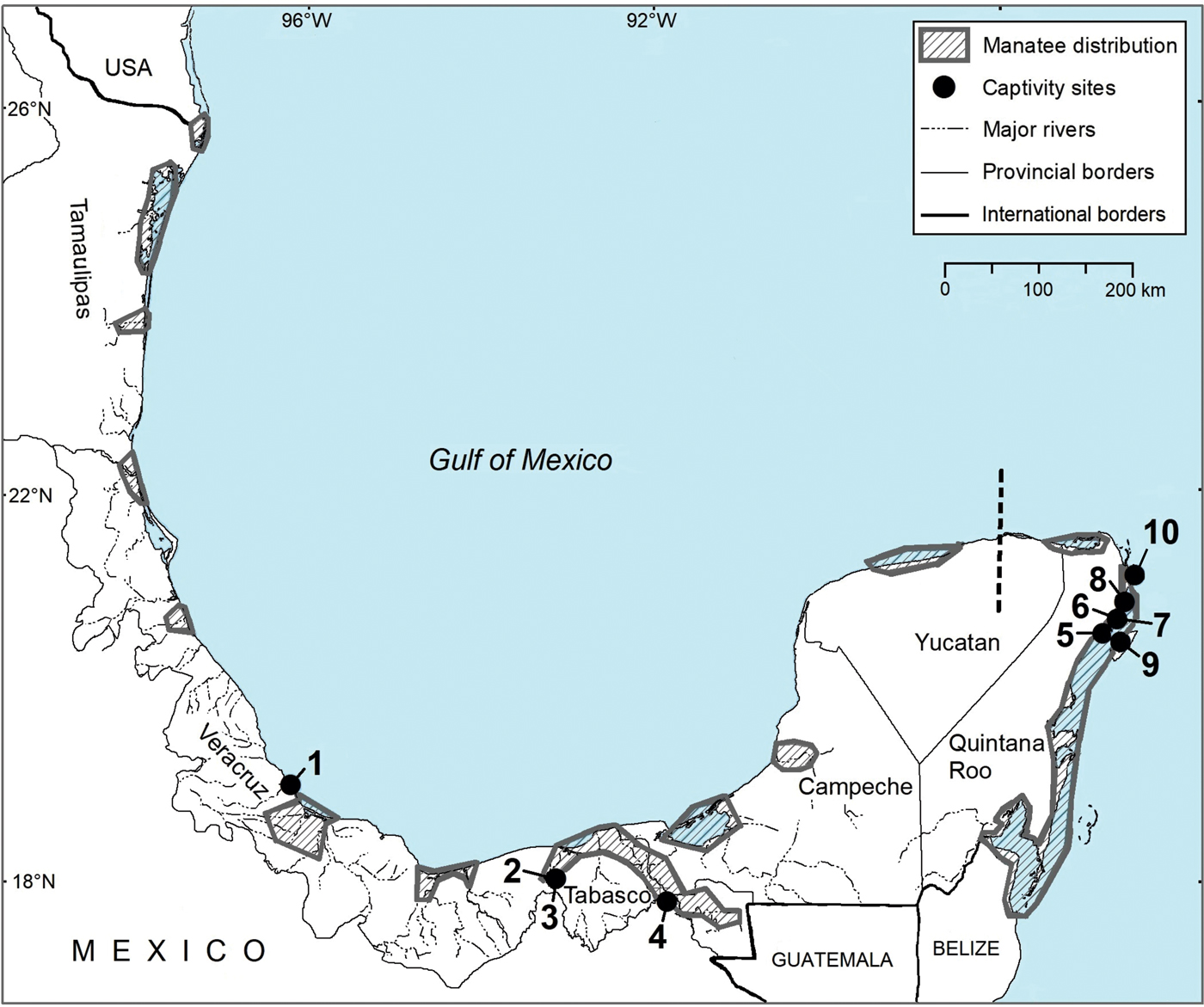
Capture of manatees is prohibited in Mexico, with the exception of capture for rescue or research purposes by accredited institutions. In 1997 a programme of the Ministry of the Environment and Natural Resources began, with a focus on the recovery of threatened species. This included the creation of technical advisory committees: autonomous multi-stakeholder bodies that aimed to advise management decisions, and comprised government officials, scientists, representatives of the private sector (parks and zoos), non-governmental organizations and community groups. During this first decade, the manatee advisory committee worked as a recovery team, coordinating and implementing management actions such as manatee rescues and research. An intensive national campaign was launched to raise awareness and encourage community involvement in manatee conservation in the entire distribution range, with members of the manatee recovery team conducting informal educational talks and distributing promotional materials such as t-shirts and pamphlets. This resulted in an increase in the number of reported manatee incidents (e.g. entanglement in fishing nets). Because there is no federal governmental facility for manatee rehabilitation, the rescued manatees were immediately transferred to state and private zoos with suitable facilities, trained personnel and accredited management programmes. With more manatees being rescued every year and ongoing captive breeding, the number of individuals in captivity increased from < 10 animals in four facilities to 40 in 10 facilities (Table 1; Fig. 1). Of the current captive manatee population in Mexico, at least 37.5% (n = 15) are captive-born.
Manatee distribution areas and captivity sites (Table 1) in Mexico, as of December 2017 based on information obtained in our own research and including information from SEMARNAT/CONANP (Reference Olivera Gómez, Ortega-Argueta, Morales Vela and Colmenero Rolón2010). Shaded areas indicate where direct (sightings of live manatees, bones or carcasses) and indirect (manatee presence reported in interviews; evidence of feeding areas) records of wild manatees have been obtained during 1997–2017. Facilities with manatees in captivity: (1) Veracruz Aquarium; (2) Yumka; (3) University of Tabasco; (4) Aluxes Ecopark, Palenque; (5) Xel-ha; (6) Dolphin Discovery Puerto Aventuras; (7) Dolphin Discovery Puerto Aventuras Dreams; (8) Experiencias Xcaret; (9) Dolphin Discovery Isla Cozumel and (10) Dolphin Discovery Isla Mujeres. The dashed line on the Yucatan Peninsula indicates the geographical border between the two genetic clusters: the Gulf of Mexico and the Caribbean Sea (Nourisson et al., Reference Nourisson, Morales-Vela, Padilla-Saldívar, Tucker, Clark and Olivera-Gómez2011).
Captivity facilities and captive manatees in Mexico (see Fig. 1 for locations), detailing manatee ID, gender, age class, date of birth, date of admission and origin of individuals as of December 2017, based on information obtained in our own research and including information from SEMARNAT/CONANP (Reference Olivera Gómez, Ortega-Argueta, Morales Vela and Colmenero Rolón2010). During our research of official documents (obtained through the National Institute for Transparency, Access to Information and Personal Data Protection), we observed inconsistencies and variations in the documentation of the number of facilities and captive manatees. We validated official information through consultation with personnel from the relevant facilities but some numbers may not be up-to-date because of subsequent manatee rescues, translocations between parks, births and mortality.
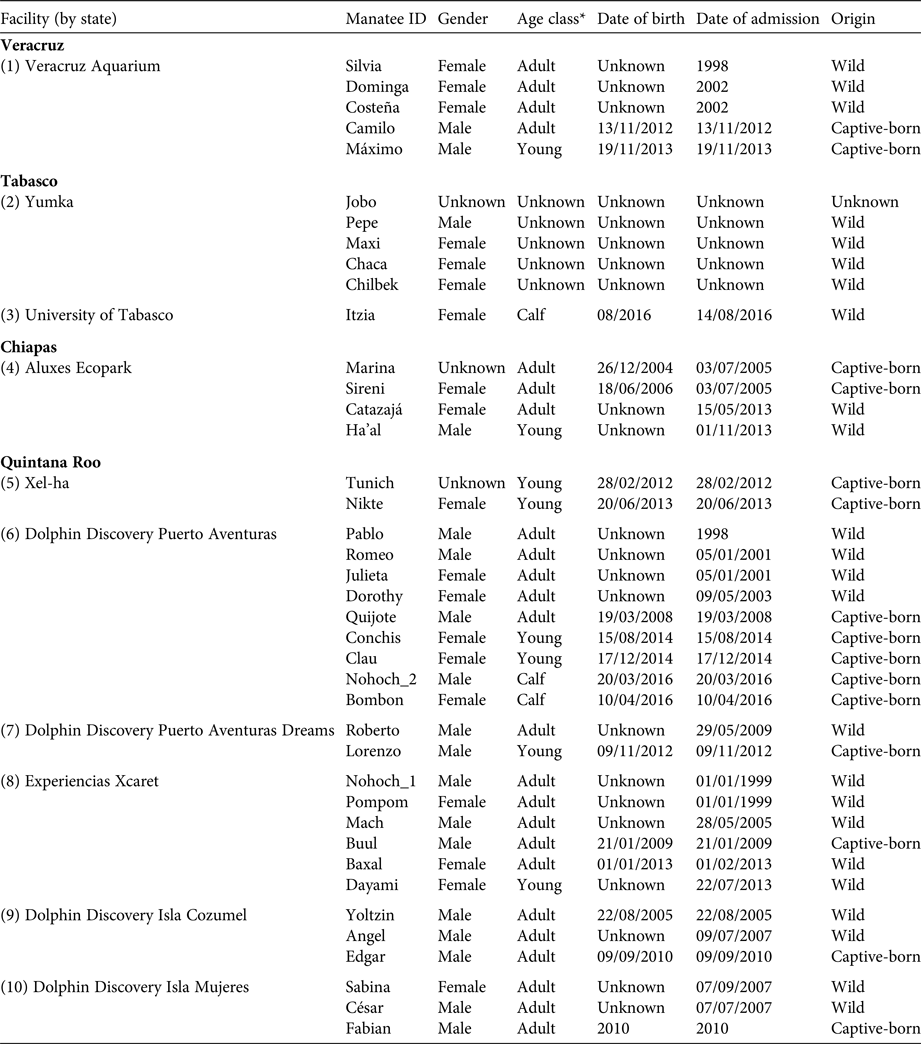
* Age classes were defined according to calf dependency and age of sexual maturity, estimated by Hartman (Reference Hartman1979) for Trichechus manatus, as follows: calf (<2 years old), young (2–5 years old) and adult (>5 years old).
The collaboration of parks and zoos, as rehabilitation centres, with government authorities was of great significance, as they participated in all rescues on a voluntary basis and covered most of the maintenance and rehabilitation costs of the manatees in captivity. It was seen as beneficial for all parties because government authorities gained financial and technical support for manatee rehabilitation and the parks and zoos obtained manatees for exhibition.
However, the management programmes of the accredited facilities did not include agreed objectives regarding the post-rehabilitation release of manatees, and there were also gaps in the relevant legislation, such as the protocols for marine mammal rehabilitation and release (NOM-135-SEMARNAT-2004). Authorities typically had to respond to reported incidents urgently and authorized all rescues and transportation to care facilities. The increase in the number of captive manatees and the lack of official protocols for rehabilitation and release prompted discussions within the advisory committee on how government authorities should proceed to manage the rescued animals once they became independent, healthy and ready for release. Captive breeding is not a necessary conservation strategy for the species according to international management plans (Quintana-Rizzo & Reynolds, Reference Quintana-Rizzo and Reynolds III2010), but some of the advisory committee justified the breeding of manatees as an opportunity for gaining expertise and conducting research and education activities. Others on the committee argued for the preparation of a management strategy with clear criteria for assessing rehabilitation and release attempts. At this point, no decision was made regarding planning for either the immediate or future management needs of the species. In this situation of undefined government management strategy, lack of leadership, and polarized views on rehabilitation objectives, all captive manatees were treated according to the care practices of each individual facility and were mostly domesticated, with no consideration of the international protocols for reintroduction to the wild and restocking of existing populations.
2007–2017: weakening manatee conservation
In 2007 all advisory committees were dissolved following administrative changes. The authorizations of manatee rescues and transfers by the Ministry of the Environment and Natural Resources no longer depended on discussions with the advisory committee. Several changes occurred that had negative consequences for the conservation of manatees.
Firstly, the lack of consideration given to the genetic structure of the population in management decisions is of concern. Despite the fact that two manatee populations have been identified (Fig. 1; Nourisson et al., Reference Nourisson, Morales-Vela, Padilla-Saldívar, Tucker, Clark and Olivera-Gómez2011), several manatees from the Gulf of Mexico were transferred to facilities on the Yucatan Peninsula, with no intention of release. A second concern is the lack of effort dedicated to the preparation of manatees for post-rehabilitation release. To date, only three animals have been released, with mixed results. In 1999, a manatee was rescued in Belize, transported to and rehabilitated in a private park in Mexico and released back into the wild in Belize after two years, where it apparently survived (Sánchez Okrucky, Reference Sánchez Okrucky2009). The second manatee was rescued in 2003 in Chetumal Bay, and kept in semi-captivity for 7 years. This individual became attached to humans and attempts to release it failed several times (Mercadillo-Elguero et al., Reference Mercadillo-Elguero, Castelblanco-Martínez and Padilla-Saldívar2014). However, in 2015 this manatee began to explore larger areas, travelling distances of up to 145 km along the coastline (Morales-Vela Reference Morales-Vela2017). The third manatee was a rescued orphan kept in the Alvarado Lagoon, reared by locals for 3 years and released with no monitoring (B. Cortina, pers. comm.). To our knowledge, no further releases are currently planned. A third cause for concern is the ongoing growth of the captive population of manatees, with little consideration given to the impact of inbreeding in some facilities. The number of manatees has also reached the maximum capacity of some facilities, which undermines their potential to receive and care for manatees in need of rescue.
Another major concern is the lack of government financial resources for manatee rehabilitation. Private parks, zoos and conservation groups are of paramount importance in sustaining rehabilitation activities, but they are using their limited resources to keep manatees in captivity for long periods. Investment in activities such as habitat protection and restoration could be of greater benefit for the long-term conservation of the species. The parks and zoos have a genuine interest in caring for the animals, but by pursuing their own objectives they have lost sight of the full extent of manatee recovery issues and have failed to adopt optimal release strategies that would be more beneficial to the population. These strategies are presented in the Manatee Recovery Programme of Mexico (SEMARNAT/CONANP, Reference Olivera Gómez, Ortega-Argueta, Morales Vela and Colmenero Rolón2010).
In 2011 technical protocols to guide manatee rehabilitation and release were developed by members of the former advisory committee (Morales-Vela et al., Reference Morales-Vela, Castelblanco-Martínez and Olivera-Gomez2012). Nevertheless, most manatees have been maintained in captivity for a decade or more, benefitting the parks’ objectives. Although parks, zoos, community groups and academic institutions can potentially provide capacity and expertise for the development and implementation of a restocking management strategy, there is no longer the debate among former advisory committee members and government authorities that could make this a reality.
The benefits of keeping manatees in captivity were explicitly discussed within the advisory committee. These include the rescue and survival of the affected animals, the experience and expertise acquired by park and zoo personnel, the establishment of adequate equipment and holding facilities, the knowledge gained from research and the creation of educational and awareness programmes that have reached a wider public audience. However, the costs and potential negative outcomes of these management choices were not explicitly debated in the decision-making groups of the advisory committee and authorities.
The costs and consequences (including ecological and strategic) of not releasing manatees back into the wild are difficult to gauge. In the context of Mexico, with a population of 1,000–1,500 manatees, removal of 40 animals may not be significant. However, in the context of other countries in the region, such as Honduras and Trinidad and Tobago with populations of < 100 individuals (Quintana-Rizzo & Reynolds, Reference Quintana-Rizzo and Reynolds III2010), the removal of 40 manatees from the wild population would be significant for persistence of a population. Despite this uncertainty, government authorities have failed to take adequate measures to prevent more manatees from being domesticated in captivity.
Management decisions should be made while there is an opportunity to act (Martin et al., Reference Martin, Nally, Burbidge, Arnall, Garnett and Hayward2012). In the present case, an unforeseen cost was the loss of momentum. As a partnership group, the advisory committee played an important role, not only through provision of technical advice and planning support, but also by undertaking multiple conservation initiatives and implementing the manatee recovery programme. Most of the management strategies and actions required the collaboration and coordination of all committee stakeholders (SEMARNAT/CONANP, Reference Olivera Gómez, Ortega-Argueta, Morales Vela and Colmenero Rolón2010). The establishment of technical committees and partnerships with relevant stakeholders can support limited government capacity to address the complexity of recovery plans, as demonstrated in Belize (Auil, Reference Auil1998) and the USA (Abellera et al., Reference Abellera, Calleson, Deutsch, deWit, Duncan and Edwards2007). For the manatee in Mexico this multidisciplinary capacity was lost when the advisory committee was dissolved. The development of a post-rehabilitation release strategy was not only postponed, but abandoned. As a consequence, the Ministry of the Environment and Natural Resources and the manatee management programme lost accountability and their ability to implement recovery. With no explicit debate of the actions (or inaction) and their consequences, decision-makers could not estimate how a given choice might contribute to meeting important management objectives.
A way forward for manatee management in Mexico
The national capacity to develop an integrated management strategy is potentially adequate. Addressing the issues identified here requires political will, rather than technical and monetary capacities. The Ministry of the Environment and Natural Resources could work strategically, adopting a precautionary approach, on four aspects of management:
(1) Although parks and zoos have been successful in breeding manatees in captivity in Mexico, captive breeding without a clear restocking plan does not benefit the wild population and should therefore not be a priority. The optimal strategy for manatee recovery is to enhance the natural reproduction of wild populations. Protection of manatee habitat should ensure that there is suitable shelter, foraging and reproductive grounds, with adequate connectivity.
(2) Transfer of wild manatees to rehabilitation centres should be carried out with the final objectives of rehabilitation and restocking. We do not advocate against parks and zoos; we recognize that the expertise and facilities they offer are paramount for achieving the manatee recovery programme objectives. However, their role should be strengthened through adaptation of their management plans and protocols according to the recovery objectives and the creation of quarantine and pre-release facilities. International monitoring protocols exist to assess post-release adaptation success. These recommend using subcutaneous microchip tags and telemetry equipment for monitoring manatee survival, behaviour and acclimation to the wild and, ultimately, the reproductive contribution of released individuals to the wild population (Adimey et al., Reference Adimey, Ross, Hall, Reid, Barlas, Diagne and Bonde2016). This would allow assessment of the effectiveness of rehabilitation strategies in the long-term. Manatees judged as unsuitable for return to the wild could still be used for exhibition, research and educational purposes, which would help cover the financial costs of rehabilitation programmes.
(3) Pre-release preparation and release sites could be established in the two regions that correspond to genetically identified populations. In the Gulf of Mexico, the Alvarado lagoon system, the Pantanos de Centla Biosphere Reserve and the Terminos Lagoon Protection Area offer optimal conditions. On the eastern Yucatan Peninsula, along the coast of Quintana Roo State, several natural lagoons could easily be adapted as release sites. It has been suggested that the genetic profile of the individual should be considered when selecting the release region (Luna et al., Reference Luna, Bonde, Attademo, Saunders, Meigs-Friend, Passavante and Hunter2012), to avoid inbreeding and outbreeding depression and genetic swamping (Frankham et al., Reference Frankham, Ballou and Briscoe2010). A national studbook is required for the genetic records of individuals.
(4) The manatee advisory committee should be restored, to support government authorities in the development of an integrated management strategy. Government and scientists must work together closely and establish an interactive feedback loop in which authorities inform scientists about the information required for decision-making, and scientists conduct research to provide this information. The committee could coordinate manatee release activities and post-release monitoring, as well as maintain the information repositories. Multi-stakeholder partnerships are key to the success of rehabilitation and release programmes (Adimey et al., Reference Adimey, Ross, Hall, Reid, Barlas, Diagne and Bonde2016). Leadership and coordination of the Ministry of the Environment and Natural Resources are also necessary, to secure federal funding and access other financial sources to cover the cost of the recovery programme in the long term and to strengthen cooperation with neighbouring countries, particularly Belize and the USA.
These four aspects of management for the Antillean manatee are necessary and complementary. In the absence of such management, conservation efforts in Mexico will have limited effects on the recovery of the manatee at either national or regional levels. We documented this case to help avoid repetition of decision-making without thorough consideration of all consequences—positive and negative—of any proposed actions in the future of manatee conservation in Mexico.
Acknowledgements
We thank R. Sánchez-Ockruky, L. D. Olivera-Gómez and D. Jiménez for providing information on manatees in captivity, and L. C. Colmenero-Rolon, E. Barba-Macías and two anonymous reviewers, who provided constructive comments. K. MacMillan translated and revised the English text. R. Ramos produced the map.
Author contributions
AOA conceived the central idea, prepared the proposed management strategy, and carried out the institutional and management analyses. DNCM provided information on manatee management in captivity within international and national contexts, and documented the regional experiences of post-rehabilitation releases.
Biographical sketches
Alejandro Ortega-Argueta researches threatened species recovery and wildlife management. He is particularly interested in the social dimensions of management systems, including policy, planning, governance and evaluation. He is the former Secretary of the Manatee Advisory Committee in Mexico and was commissioned to prepare the Manatee Recovery Plan of Mexico. Delma Nataly Castelblanco-Martínez is a conservation biologist studying aquatic vertebrates in Latin America. Her work focuses on conservation issues, population dynamics, behaviour and ecology of aquatic mammals, particularly manatees. She is a member of the IUCN Sirenian Specialist Group and is currently conducting a long-term megafauna monitoring project in the Caribbean.



