




1 Introduction
The program of proof-theoretic semantics seeks to characterize the meanings of logical operators in terms of characteristic rules of inference. The idea of proof-theoretic semantics is that these rules qualify as valid, not because they respect the meanings of the terms that appear in them, but because the rules directly specify those terms’ meanings. From this point of view, one would not argue that a rule is sound with respect to an independent notion of validity (e.g., truth-preservation); instead one might motivate a concept of truth in a structure by observing its adequacy to the theory of meaning provided by proofs.
This way of thinking can be traced back to a lecture David Hilbert gave in Göttingen in 1920 in which the “questions of completeness” and “of the relationship between the formalism and its semantics” that had figured prominently in his earlier research “receded into the background.” In this lecture, Hilbert observed that “inference rules can” instead “be understood as the logical symbols’ definitions” [Reference Ewald and Sieg2, p. 298]. But the locus classicus of proof-theoretic semantics is the 1935 dissertation of the Göttingen student (who would later serve as Hilbert’s assistant), Gerhard Gentzen. In that work, Gentzen introduced a type of formal system called a natural deduction calculus in which to each operator there corresponds a pair of rule schemata: one for its “introduction” and one for its “elimination.” In a remark that has become something of a creed for proof-theoretic semantics, Gentzen explained that “the introductions represent …the ‘definitions’ of the symbols concerned, and the eliminations are no more, in the final analysis, than the consequences of these definitions” [Reference Gentzen6, II sec. 5.13].
Gentzen’s remark raises two question whose answers can help clarify the proof-theoretic semantics program. The first question is, In what sense are natural deduction’s elimination rules “consequences” of their corresponding introduction rules? The second question is, What, if anything, explains the asymmetry between introduction and elimination rules, so that the former (but not the latter) “represent” the definitions of which the latter (but not the former) are consequences? The questions are related. I argue that the correct answer to the first question dissociates meaning from any preference between introduction and elimination rules. Once one appreciates how introduction and elimination rules define logical operators through their joint adequacy to a universal construction, it becomes clear that uniform, asymmetric approaches often generate more cumbersome, higher-order rules where a symmetric treatment admits simpler ones. On the surface, such higher-order rules appear to be more general, or inferentially stronger, than the lower-level alternatives, but I show (§5) that when a rule expressing a universal property is universalized a second time, against an operator’s natural polarity, the resulting higher-order rule is interderivable with the far simpler, lower-order, polarity-respecting rule. I then show that the same “collapse” phenomenon arises more generally. As the identity predicate illustrates (§6), higher-order rules are sometimes the first place where a universal construction is explicitly formulated. In such cases, the collapse reveals that simpler rules determine the same universal construction, even though that construction is not evident at the lower level.
2 Universal constructions
An illustrative example of an Intro/Elim pair of rules is the following pair of inference figures that Gentzen claimed provide the meaning of the logical disjunction (
$\vee $
 ) symbol:
![A all over A or B and B all over A or B (or-Intro), and A or B, [A] over C, [B] over C all over C.](https://static.cambridge.org/binary/version/id/urn:cambridge.org:id:binary:20260720143941348-0971:S1755020326101208:S1755020326101208_inline2.png?pub-status=live) (
$\vee $
(
$\vee $
 -Elim). Obviously, if one means by the “consequences” of a rule “all the rules that can be derived from it,” neither of these rules is a consequence of the other. So what did Gentzen mean when he said that the “eliminations are no more …than the consequences of” the definitions that “the introductions represent”? Later in his dissertation, he explained that elimination rules are “unique functions” of introduction rules because of how they represent the operator’s definition [Reference Gentzen6, II sec. 5.13]. Infinitely many different rules can be derived from a given rule, but the sense in which elimination rules follow from their corresponding introduction rules is not like that. They are functionally determined.
Gentzen claimed that making the functional relationship between introduction and elimination rules explicit would require a more precise formulation than he was able to offer. I disagree. What Gentzen lacked was not precision but the right descriptive framework. That framework was developed about a decade after Gentzen’s work by Pierre Samuel, who described it in a 1948 paper [Reference Samuel12]. This is the notion of a universal construction. It equips one to see immediately the relationship that all of Gentzen’s Intro/Elim rule pairs exhibit.Footnote 1
Let us introduce universal constructions with Gentzen’s rules for
$\vee $
 . Rewritten in turnstile notation, the
$\vee $
. Rewritten in turnstile notation, the
$\vee $
 -Intro inferences are

Now, one could understand these inferences as just specifying a property that sentences of the form
$\text {A}\vee \text {B}$
 have: They follow from A and from B. But one could instead understand these inferences as saying that the meaning of
$\vee $
have: They follow from A and from B. But one could instead understand these inferences as saying that the meaning of
$\vee $
 is that sentences of the form
$\text {A}\vee \text {B}$
is that sentences of the form
$\text {A}\vee \text {B}$
 follow from A and B. Such sentences don’t just have the specified property, they are fully characterized by that property. One way of making that idea precise is to say that any other sentence that can legitimately fill in the blanks in
$\text {A}\vdash$
follow from A and B. Such sentences don’t just have the specified property, they are fully characterized by that property. One way of making that idea precise is to say that any other sentence that can legitimately fill in the blanks in
$\text {A}\vdash$
 _________ and
$\text {B}\vdash$
_________ and
$\text {B}\vdash$
 _____, any sentence, that is, that stands in the definitional relationships of
$\text {A}\vee \text {B}$
_____, any sentence, that is, that stands in the definitional relationships of
$\text {A}\vee \text {B}$
 , must further be inferable from
$\text {A}\vee \text {B}$
, must further be inferable from
$\text {A}\vee \text {B}$
 . This is expressed with the following inference:

But notice that this last inference is just Gentzen’s
$\vee $
 -Elim rule.
This derivation of
$\vee $
 -Elim from
$\vee $
-Elim from
$\vee $
 -Intro exemplifies the general idea of a universal construction as follows: To define an operator, first identify the property that fully characterizes that operator, the expression of the relationships that sentences containing that operator stand in just by virtue of its meaning. Then write down the claim that any other sentence standing in those same relationships does so only because of how it is in turn related to the sentences containing the operator being defined. Returning to our example, many sentences have the same property that disjunctions have, but disjunctions have that property universally—those other sentences have the property only because of how they are related to the disjunction.
This is what Gentzen meant when he said that the elimination rules of natural deduction are consequences of the definitions that the introduction rules represent.
$\vee $
 -Elim does not follow from
$\vee $
-Elim does not follow from
$\vee $
 -Intro, but if the
$\vee $
-Intro, but if the
$\vee $
 -Intro inferences are understood as the definition of
$\vee $
-Intro inferences are understood as the definition of
$\vee $
 , then
$\vee $
, then
$\vee $
 -Elim does follow from that understanding: It is the claim that
$\vee $
-Elim does follow from that understanding: It is the claim that
$\vee $
 not only has the property expressed by the
$\vee $
not only has the property expressed by the
$\vee $
 -Intro rule but in fact has that property universally.
One can verify easily that each of the Intro/Elim pairs Gentzen presented in his dissertation (for
$\wedge $
 ,
$\neg $
,
$\neg $
 ,
$\supset $
,
$\supset $
 ,
$\forall $
,
$\forall $
 ,
$\exists $
,
$\exists $
 ,
$\bot $
,
$\bot $
 ) provides a universal construction in the way just described. This suggests that the way
$\vee $
) provides a universal construction in the way just described. This suggests that the way
$\vee $
 -Elim is a “unique function” of
$\vee $
-Elim is a “unique function” of
$\vee $
 -Intro was perfectly precise already in 1934.Footnote
2
-Intro was perfectly precise already in 1934.Footnote
2
3 Polarity
Consider, as a contrasting case to
$\vee $
 , Gentzen’s elimination rule for
$\supset $
, Gentzen’s elimination rule for
$\supset $
 :
:
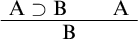 . Many people share the view that this inference rule (“
modus ponens
”) is not just one among many patterns of valid inference involving the conditional. They think that it is definitional of the conditional
$\text {A}\supset \text {B}$
. Many people share the view that this inference rule (“
modus ponens
”) is not just one among many patterns of valid inference involving the conditional. They think that it is definitional of the conditional
$\text {A}\supset \text {B}$
 that it licenses the inference from
$\text {A}$
that it licenses the inference from
$\text {A}$
 to
$\text {B}$
to
$\text {B}$
 . But if the availability of this inference is the very definition of
$\text {A}\supset \text {B}$
. But if the availability of this inference is the very definition of
$\text {A}\supset \text {B}$
 , then in fact any sentence that, together with
$\text {A}$
, then in fact any sentence that, together with
$\text {A}$
 , allows the inference to
$\text {B}$
, allows the inference to
$\text {B}$
 expresses something equivalent to or (inferentially) stronger than
$\text {A}\supset \text {B}$
expresses something equivalent to or (inferentially) stronger than
$\text {A}\supset \text {B}$
 . This is the universalization pattern again. Modus ponens:

expresses a property that the
$\supset $
 operator has. But we want to say more, namely that having this property is definitional of the
$\supset $
operator has. But we want to say more, namely that having this property is definitional of the
$\supset $
 operator—that any other sentence that can legitimately fill in the blank in _________,
$\text {A}\vdash\text {B}$
operator—that any other sentence that can legitimately fill in the blank in _________,
$\text {A}\vdash\text {B}$
 , that is, any sentence that stands in the same inferential relationships as
$\text {A}\supset \text {B}$
, that is, any sentence that stands in the same inferential relationships as
$\text {A}\supset \text {B}$
 , must be such that
$\text {A}\supset \text {B}$
, must be such that
$\text {A}\supset \text {B}$
 is inferable from it. This is what the following inference expresses:

And this last inference is just Gentzen’s
$\supset $
 -Intro rule.
Gentzen’s universal constructions of
$\vee $
 and
$\supset $
and
$\supset $
 differ in their order of construction. With
$\vee $
differ in their order of construction. With
$\vee $
 , we identified the introduction rule as expressing the operator’s defining property and then universalized it to discover the correct formulation of the corresponding elimination rule. This rule expressed the fact any other sentence with
$\vee $
, we identified the introduction rule as expressing the operator’s defining property and then universalized it to discover the correct formulation of the corresponding elimination rule. This rule expressed the fact any other sentence with
$\vee $
 ’s defining property can be inferred from
$\text {A}\vee \text {B}$
’s defining property can be inferred from
$\text {A}\vee \text {B}$
 . Following Bergman [Reference Bergman1, p. 71], we will call such a construction left-universal, as
$\text {A}\vee \text {B}$
. Following Bergman [Reference Bergman1, p. 71], we will call such a construction left-universal, as
$\text {A}\vee \text {B}$
 stands “to the left” of any sentence that shares its defining property.
With
$\supset $
 , the procedure was reversed. The elimination rule expresses the defining property. Universalizing it leads to the discovery of the correct formulation of the introduction rule which expresses the fact that
$\text {A}\supset \text {B}$
, the procedure was reversed. The elimination rule expresses the defining property. Universalizing it leads to the discovery of the correct formulation of the introduction rule which expresses the fact that
$\text {A}\supset \text {B}$
 can be inferred from any other sentence with
$\supset $
can be inferred from any other sentence with
$\supset $
 ’s defining property. Standing “to the right” of every such sentence, the
$\supset $
’s defining property. Standing “to the right” of every such sentence, the
$\supset $
 operator is here given a right-universal construction.
It will be clear in what follows that many operators admit both left- and right-universal constructions. Under very general conditions, however, it will be shown that these constructions are strongly equivalent, in the sense that their defining inferences are interderivable. By an operator’s natural polarity I mean the polarity of its lowest-order universal construction. Higher-order presentations of the opposite polarity may be available, but when they arise through further universalization they collapse to the lower-order construction and are in that sense unnatural for the operator. For brevity, an operator will sometimes be called left- or right-universal according to its natural polarity, i.e., according to the polarity of its lowest-order universal construction.
If the sense in which one rule is meant to be a consequence of another is captured by universality, then it seems to be wrong to say that the “introductions” always “represent …the ‘definitions’ of the symbols concerned, and the eliminations are no more, in the final analysis, than the consequences of these definitions.” Which rule represents the definition, and which rule is a consequence of that definition, depends on the operator’s natural polarity. For left-universal operators, the elimination rule is functionally determined by the introduction rule as the statement that the operator is the “strongest” among objects with the property that the introduction rule expresses. But constructions like that of
$\supset $
 reverse the dependence. The elimination rules of right-universal operators express their defining properties. Their introduction rules express the fact that the operators are the “weakest” among objects with those properties and are, in that sense, consequences of the definitions that the elimination rules express.
4 Uniform treatments
On our analysis, an operator’s definition is identified, neither with an introduction rule nor with an elimination rule, but with a universal construction. One observes which rule expresses the fact that the operator has the defining property and which rule expresses the fact that it is unique among objects that do. Neither rule defines anything on its own, but their joint adequacy to the universal construction means that they define the operator together. Which rule (introduction or elimination) fills which role depends on the construction’s polarity.
Few advocates of proof-theoretic semantics have been so flexible about how inference rules define logical operators. The predominant trend is to identify either introduction rules or elimination rules themselves as an operator’s definition and to do so uniformly, so that it is either always introduction rules or always elimination rules that provide meaning. One consequence of this trend is that the idea of a universal construction does not typically figure into the exposition. Another consequence is that the reasoning involved in demonstrating the “harmony” between introduction and elimination rules is often overly complicated by the fact that one is reasoning against an operator’s natural polarity.
An illustrative example is the treatment by Koslow in [Reference Koslow8]. Koslow’s account actually comes closer to the idea of a universal construction than what one typically finds, which makes it especially suitable as a contrast to our own analysis. But it still exhibits uniformity, prioritizing elimination rules as defining. According to Koslow’s “way of the weakest,” the role of an introduction rule is always to characterize an operator, regardless of its natural polarity, as the weakest object with the property expressed by its elimination rule.
Consider how a left-universal operator, such as
$\vee $
 , appears in this framework. One begins with its elimination rule, which we have already identified as

But now, ignoring the fact that we already know what the
$\vee $
 -Intro rule is as well as the fact that
$\vee $
-Intro rule is as well as the fact that
$\vee $
 -Elim, as just written, is rather explicitly a statement about
$\text {A}\vee \text {B}$
-Elim, as just written, is rather explicitly a statement about
$\text {A}\vee \text {B}$
 being the strongest sentence satisfying the property expressed by
$\vee $
being the strongest sentence satisfying the property expressed by
$\vee $
 -Intro, suppose one just reads
$\vee $
-Intro, suppose one just reads
$\vee $
 -Elim as expressing a property and wants to “derive” a corresponding introduction rule that characterizes
$\text {A}\vee \text {B}$
-Elim as expressing a property and wants to “derive” a corresponding introduction rule that characterizes
$\text {A}\vee \text {B}$
 as the weakest claim with this property. The result isFootnote
3
as the weakest claim with this property. The result isFootnote
3

What is the relationship between this rule and Gentzen’s
$\vee $
 -Intro? Intuitively, it is stronger than Gentzen’s rule. If one lets D := A, it implies that
$\text {if [ for all }\text {C}, \text {if } \text {A}\vdash\text {C} \text { and } \text {B}\vdash\text {C}, \text {then } \text {A}\vdash\text {C ]}, \text {then } \text {A}\vdash\text {A}\vee \text {B}$
-Intro? Intuitively, it is stronger than Gentzen’s rule. If one lets D := A, it implies that
$\text {if [ for all }\text {C}, \text {if } \text {A}\vdash\text {C} \text { and } \text {B}\vdash\text {C}, \text {then } \text {A}\vdash\text {C ]}, \text {then } \text {A}\vdash\text {A}\vee \text {B}$
 . But the antecedent of this conditional is trivially true, so the consequent
$\text {A}\vdash\text {A}\vee \text {B}$
. But the antecedent of this conditional is trivially true, so the consequent
$\text {A}\vdash\text {A}\vee \text {B}$
 follows. Similarly, it implies
$\text {B}\vdash\text {A}\vee \text {B}$
follows. Similarly, it implies
$\text {B}\vdash\text {A}\vee \text {B}$
 (just let D := B). Thus Koslow’s rule (
$\vee $
(just let D := B). Thus Koslow’s rule (
$\vee $
 -Intro
$\! \star $
-Intro
$\! \star $
 ) entails Gentzen’s rule (
$\vee $
) entails Gentzen’s rule (
$\vee $
 -Intro). But it also seems to license other potential “introductions” of
$\text {A}\vee \text {B}$
-Intro). But it also seems to license other potential “introductions” of
$\text {A}\vee \text {B}$
 —one only needs to find other, nontrivial, sentences D from which C follows whenever it follows from both A and B.
More common than treatments like Koslow’s, in which elimination rules are prioritized, are accounts that follow Gentzen’s language more literally, treating introduction rules as definitions and elimination rules as their “consequences.” This is the approach taken by Schroeder-Heister in [Reference Schroeder-Heister13], which has become canonical in developments of proof-theoretic semantics. Such accounts, predictably, lead to convolution in the case of right-universal constructions analogous to what was observed above in Koslow’s treatment of disjunction. Because the role of universality in relating elimination rules to introduction rules is not explicit in Schroeder-Heister’s formulations, I will first present this approach in our notation. The relationship between our notation and Schroeder-Heister’s will be made clear at the end of §5.
Suppose we want to discover the elimination rule that says that
$\supset $
 is the strongest object with the property expressed by Gentzen’s
$\supset $
is the strongest object with the property expressed by Gentzen’s
$\supset $
 -Intro rule:

Universalizing this rule in the familiar way, contrary to the operator’s natural polarity, results in:

But notice that although one would expect Gentzen’s
$\supset $
 -Elim rule (modus ponens) to be a trivial instance of this rule, it isn’t. The relationship between the two rules is not immediately clear.
To understand what is going on, consider again Gentzen’s rules for
$\vee $
 . As we are accustomed to writing the rule-template for
$\vee $
. As we are accustomed to writing the rule-template for
$\vee $
 -Elim,
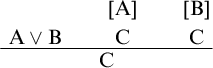 , there is in fact an ambiguity, if not an outright error, in the formulation. This is because the most literal way to read the rule suggests that the
$\vee $
, there is in fact an ambiguity, if not an outright error, in the formulation. This is because the most literal way to read the rule suggests that the
$\vee $
 -Elim inference is only allowed when
$\text {A}\vee \text {B}$
-Elim inference is only allowed when
$\text {A}\vee \text {B}$
 is a theorem and C follows from both A and B without any additional assumptions. We are habituated against this literal reading because practice with natural deduction makes us aware that
$\vee $
is a theorem and C follows from both A and B without any additional assumptions. We are habituated against this literal reading because practice with natural deduction makes us aware that
$\vee $
 -Elim inferences are permissible in arbitrary contexts. To make this awareness explicit, one might better formulate the rule template as follows:
![Natural deduction rule for disjunction elimination. C and A or B and (C and [A] all over D) and (C and [B] all over D) all over D.](https://static.cambridge.org/binary/version/id/urn:cambridge.org:id:binary:20260720143941348-0971:S1755020326101208:S1755020326101208_inline82.png?pub-status=live) . The inelegance of this presentation speaks in favor of habituation to the intended understanding of Gentzen’s formulation, but it is instructive because it reveals something about the universalization scheme. In turnstile notation, the explicit-context formulation of
$\vee $
. The inelegance of this presentation speaks in favor of habituation to the intended understanding of Gentzen’s formulation, but it is instructive because it reveals something about the universalization scheme. In turnstile notation, the explicit-context formulation of
$\vee $
 -Elim reads as follows:

The uniqueness of
$\text {A}\vee \text {B}$
 is not just that it is the strongest among sentences that follow from both A and B; among sentences D that follow from both A and B in the context of an arbitrary context C,
$\text {A}\vee \text {B}$
is not just that it is the strongest among sentences that follow from both A and B; among sentences D that follow from both A and B in the context of an arbitrary context C,
$\text {A}\vee \text {B}$
 is the strongest in the sense that D can be inferred from
$\text {A}\vee \text {B}$
is the strongest in the sense that D can be inferred from
$\text {A}\vee \text {B}$
 in that same context. The explicit expression of this reveals that the quantification in the universal construction is over sequents rather than mere formulas.
The role of contexts in the universalization scheme is a point of theoretical interest that can be harmlessly suppressed in the case of
$\vee $
 . But its consequences in the case of
$\supset $
. But its consequences in the case of
$\supset $
 are dramatic. The explicit-context formulation of the universalization of Gentzen’s
$\supset $
are dramatic. The explicit-context formulation of the universalization of Gentzen’s
$\supset $
 -Intro rule (working still against the operator’s natural polarity) is

And one can now readily identify Gentzen’s
$\supset $
 -Elim rule as an instance of this more general rule. Letting D := A and E := B, the rule’s antecedent (
$\text {for all }\text {C}, \text {if } \text {C}, \text {A} \vdash\text {B}, \text {then } \text {C}, \text {A}\vdash\text {B}$
-Elim rule as an instance of this more general rule. Letting D := A and E := B, the rule’s antecedent (
$\text {for all }\text {C}, \text {if } \text {C}, \text {A} \vdash\text {B}, \text {then } \text {C}, \text {A}\vdash\text {B}$
 ) is trivially true, so that its conclusion
$\text {A}\supset \text {B}, \text {A}\vdash\text {B}$
) is trivially true, so that its conclusion
$\text {A}\supset \text {B}, \text {A}\vdash\text {B}$
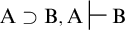 follows.
By making contexts explicit, the pattern emerges. If
$\text {R}_1$
 is a rule and
$\text {R}_2$
is a rule and
$\text {R}_2$
 is its universalization, then
$\text {R}_3$
is its universalization, then
$\text {R}_3$
 —the higher-order universalization of
$\text {R}_2$
—the higher-order universalization of
$\text {R}_2$
 —has
$\text {R}_1$
—has
$\text {R}_1$
 as a trivial instance but appears at first glance to be more general. In the case of
$\supset $
as a trivial instance but appears at first glance to be more general. In the case of
$\supset $
 , the rule
$\supset $
, the rule
$\supset $
 -Elim
$\! \star $
-Elim
$\! \star $
 seems to license other potential “eliminations” of
$\text {A}\supset \text {B}$
seems to license other potential “eliminations” of
$\text {A}\supset \text {B}$
 : If there are sequents
$\text {D}\vdash\text {E}$
: If there are sequents
$\text {D}\vdash\text {E}$
 other than
$\text {A}\vdash\text {B}$
other than
$\text {A}\vdash\text {B}$
 such that
$\text {C}, \text {D}\vdash\text {E}$
such that
$\text {C}, \text {D}\vdash\text {E}$
 , then
$\text {A}\supset \text {B}, \text {D}\vdash\text {E}$
, then
$\text {A}\supset \text {B}, \text {D}\vdash\text {E}$
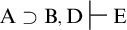 as well. Do such sequents exist?
5 Collapse
We pointed out that the rules
$\vee $
 -Intro
$\! \star $
-Intro
$\! \star $
 and
$\supset $
and
$\supset $
 -Elim
$\! \star $
-Elim
$\! \star $
 appear at first glance to be more general than
$\vee $
appear at first glance to be more general than
$\vee $
 -Intro and
$\supset $
-Intro and
$\supset $
 -Elim. Remarkably, they aren’t stronger at all.
To see how
$\vee $
 -Intro
$\! \star $
-Intro
$\! \star $
 follows from
$\vee $
follows from
$\vee $
 -Intro, assume the latter rule and also
$\vee $
-Intro, assume the latter rule and also
$\vee $
 -Intro
$\! \star $
-Intro
$\! \star $
 ’s antecedent:
$\text {for all }\text {C}, \text {if } \text {A}\vdash\text {C} \text { and } \text {B}\vdash\text {C}, \text {then } \text {D}\vdash\text {C}$
’s antecedent:
$\text {for all }\text {C}, \text {if } \text {A}\vdash\text {C} \text { and } \text {B}\vdash\text {C}, \text {then } \text {D}\vdash\text {C}$
 . Now let C :=
$\text {A}\vee \text {B}$
. Now let C :=
$\text {A}\vee \text {B}$
 . This yields:
$\text {if } \text {A}\vdash\text {A}\vee \text {B} \text { and } \text {B}\vdash\text {A}\vee \text {B}, \text {then } \text {D}\vdash\text {A}\vee \text {B}$
. This yields:
$\text {if } \text {A}\vdash\text {A}\vee \text {B} \text { and } \text {B}\vdash\text {A}\vee \text {B}, \text {then } \text {D}\vdash\text {A}\vee \text {B}$
 . But the antecedent of this conditional is just
$\vee $
. But the antecedent of this conditional is just
$\vee $
 -Intro. Thus its consequent
$\text {D}\vdash\text {A}\vee \text {B}$
-Intro. Thus its consequent
$\text {D}\vdash\text {A}\vee \text {B}$
 follows. But this is also the consequent of
$\vee $
follows. But this is also the consequent of
$\vee $
 -Intro
$\! \star $
-Intro
$\! \star $
 itself!
$\supset $
 -Elim
$\! \star $
-Elim
$\! \star $
 follows similarly from
$\supset $
follows similarly from
$\supset $
 -Elim: Assume the latter rule and also
$\supset $
-Elim: Assume the latter rule and also
$\supset $
 -Elim
$\! \star $
-Elim
$\! \star $
 ’s antecedent (
$\text {for all }\text {C}, \text {if } \text {C}, \text {A} \vdash\text {B}, \text {then } \text {C}, \text {D}\vdash\text {E}$
’s antecedent (
$\text {for all }\text {C}, \text {if } \text {C}, \text {A} \vdash\text {B}, \text {then } \text {C}, \text {D}\vdash\text {E}$
 ). Now let C :=
$\text {A}\supset \text {B}$
). Now let C :=
$\text {A}\supset \text {B}$
 . This yields:
$\text {if } \text {A}\supset \text {B}, \text {A}\vdash\text {B} \text { then } \text {A}\supset \text {B}, \text {D}\vdash\text {E}$
. This yields:
$\text {if } \text {A}\supset \text {B}, \text {A}\vdash\text {B} \text { then } \text {A}\supset \text {B}, \text {D}\vdash\text {E}$
 . The antecedent of this conditional is just
$\supset $
. The antecedent of this conditional is just
$\supset $
 -Elim, so its consequent
$\text {A}\supset \text {B}, \text {D}\vdash\text {E}$
-Elim, so its consequent
$\text {A}\supset \text {B}, \text {D}\vdash\text {E}$
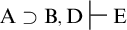 follows. And this is
$\supset $
follows. And this is
$\supset $
 -Elim
$\! \star $
-Elim
$\! \star $
 ’s consequent as well!
Thus we have seen that
$\vee $
 -Intro
$\! \star $
-Intro
$\! \star $
 and
$\vee $
and
$\vee $
 -Intro, despite appearances, mutually imply one another, as do
$\supset $
-Intro, despite appearances, mutually imply one another, as do
$\supset $
 -Elim
$\! \star $
-Elim
$\! \star $
 and
$\supset $
and
$\supset $
 -Elim. Let us be clear about what sort of consequence this is. Unlike, for example,
$\vee $
-Elim. Let us be clear about what sort of consequence this is. Unlike, for example,
$\vee $
 -Elim, which Gentzen says is a consequence of the definition that
$\vee $
-Elim, which Gentzen says is a consequence of the definition that
$\vee $
 -Intro represents—a concept we have analyzed in terms of
$\vee $
-Intro represents—a concept we have analyzed in terms of
$\vee $
 -Elim and
$\vee $
-Elim and
$\vee $
 -Intro jointly determining a universal construction—
$\vee $
-Intro jointly determining a universal construction—
$\vee $
 -Intro is literally a consequence of
$\vee $
-Intro is literally a consequence of
$\vee $
 -Intro
$\! \star $
-Intro
$\! \star $
 in the sense that it instantiates it. Similarly,
$\vee $
in the sense that it instantiates it. Similarly,
$\vee $
 -Intro
$\! \star $
-Intro
$\! \star $
 is a consequence of
$\vee $
is a consequence of
$\vee $
 -Intro in the sense that any derivation using
$\vee $
-Intro in the sense that any derivation using
$\vee $
 -Intro
$\! \star $
-Intro
$\! \star $
 can be converted to one that uses
$\vee $
can be converted to one that uses
$\vee $
 -Intro instead. These two rules, as well as
$\supset $
-Intro instead. These two rules, as well as
$\supset $
 -Elim
$\! \star $
-Elim
$\! \star $
 and
$\supset $
and
$\supset $
 -Elim, are interderivable.
The phenomenon exhibited by these two examples generalizes. It shouldn’t be surprising that Gentzen’s rules for conjunction,
$\wedge $
 -Elim and
$\wedge $
-Elim and
$\wedge $
 -Intro, and the result of universalizing
$\wedge $
-Intro, and the result of universalizing
$\wedge $
 -Intro against the conjunction’s natural polarity,
$\wedge $
-Intro against the conjunction’s natural polarity,
$\wedge $
 -Elim
$\! \star $
-Elim
$\! \star $
 , exhibit the same behavior.
$\wedge $
, exhibit the same behavior.
$\wedge $
 -Elim and
$\wedge $
-Elim and
$\wedge $
 -Elim
$\! \star $
-Elim
$\! \star $
 are interderivable. Also unsurprising is the interderivability of
$\neg $
are interderivable. Also unsurprising is the interderivability of
$\neg $
 -Elim and
$\neg $
-Elim and
$\neg $
 -Elim
$\!\! \star $
-Elim
$\!\! \star $
 . The duality between
$\wedge $
. The duality between
$\wedge $
 and
$\vee $
and
$\vee $
 and the well-known relationship between the rules for
$\supset $
and the well-known relationship between the rules for
$\supset $
 and
$\neg $
and
$\neg $
 suggest that these examples will be similar to the ones verified above.
For a more interesting example, consider the multiplicative disjunction. Franks ([Reference Franks3]) observed that Gentzen’s rules for
$\vee $
 define the additive disjunction from which one can distinguish a multiplicative disjunction, here denoted
$\unicode{x214B} $
define the additive disjunction from which one can distinguish a multiplicative disjunction, here denoted
$\unicode{x214B} $
 . Whereas
$\vee $
. Whereas
$\vee $
 is a left-universal operator,
$\unicode{x214B} $
is a left-universal operator,
$\unicode{x214B} $
 is right-universal. Its introduction and elimination rules are


Universalizing
$\unicode{x214B} $
 -Intro against the operator’s natural polarity (and remembering to be explicit about contexts) results in the higher-order rule:

The interderivability of
$\unicode{x214B} $
 -Elim and
$\unicode{x214B} $
-Elim and
$\unicode{x214B} $
 -Elim
$\!\! \star $
-Elim
$\!\! \star $
 follows a now familiar pattern. To show that
$\unicode{x214B} $
follows a now familiar pattern. To show that
$\unicode{x214B} $
 -Elim is derivable from
$\unicode{x214B} $
-Elim is derivable from
$\unicode{x214B} $
 -Elim
$\!\! \star $
-Elim
$\!\! \star $
 , first instantiate
$\unicode{x214B} $
, first instantiate
$\unicode{x214B} $
 -Elim
$\! \star $
-Elim
$\! \star $
 with D :=
$\neg $
with D :=
$\neg $
 A and E := B. As the antecedent instance is trivially true, the consequent
$\text {A}\unicode{x214B} \text {B}, \neg \text {A} \vdash\text {B}$
A and E := B. As the antecedent instance is trivially true, the consequent
$\text {A}\unicode{x214B} \text {B}, \neg \text {A} \vdash\text {B}$
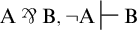 is as well. The instance with D :=
$\neg $
is as well. The instance with D :=
$\neg $
 B and E := A similarly yields
$\text {A}\unicode{x214B} \text {B}, \neg \text {B} \vdash\text {A}$
B and E := A similarly yields
$\text {A}\unicode{x214B} \text {B}, \neg \text {B} \vdash\text {A}$
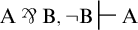 . To show that
$\unicode{x214B} $
. To show that
$\unicode{x214B} $
 -Elim
$\! \star $
-Elim
$\! \star $
 is derivable from
$\unicode{x214B} $
is derivable from
$\unicode{x214B} $
 -Elim, assume
$\unicode{x214B} $
-Elim, assume
$\unicode{x214B} $
 -Elim and instantiate the antecedent of
$\unicode{x214B} $
-Elim and instantiate the antecedent of
$\unicode{x214B} $
 -Elim
$\! \star $
-Elim
$\! \star $
 with C :=
$\text {A}\unicode{x214B} \text {B}$
with C :=
$\text {A}\unicode{x214B} \text {B}$
 . This gives: if
$\text {A}\unicode{x214B} \text {B}, \neg \text {A} \vdash\text {B}, \text {and }\text {A}\unicode{x214B} \text {B}, \neg \text {B} \vdash\text {A}, \text {then }\text {A}\unicode{x214B} \text {B}, \text {D} \vdash\text {E}$
. This gives: if
$\text {A}\unicode{x214B} \text {B}, \neg \text {A} \vdash\text {B}, \text {and }\text {A}\unicode{x214B} \text {B}, \neg \text {B} \vdash\text {A}, \text {then }\text {A}\unicode{x214B} \text {B}, \text {D} \vdash\text {E}$
 . The antecedent of this conditional is just
$\unicode{x214B} $
. The antecedent of this conditional is just
$\unicode{x214B} $
 -Elim, so its consequent, which is also the consequent of
$\unicode{x214B} $
-Elim, so its consequent, which is also the consequent of
$\unicode{x214B} $
 -Elim
$\! \star $
-Elim
$\! \star $
 , is true.
The pattern exhibited by these examples is no accident. Whenever a rule
$\text {R}_1$
 specifies an operator’s defining property, and
$\text {R}_2$
specifies an operator’s defining property, and
$\text {R}_2$
 is the universalization of
$\text {R}_1$
is the universalization of
$\text {R}_1$
 expressing that this property uniquely characterizes the operator, then the high-order universalization
$\text {R}_3$
expressing that this property uniquely characterizes the operator, then the high-order universalization
$\text {R}_3$
 of
$\text {R}_2$
of
$\text {R}_2$
 has
$\text {R}_1$
has
$\text {R}_1$
 as a trivial instance. Moreover, although it appears to be more general,
$\text {R}_3$
as a trivial instance. Moreover, although it appears to be more general,
$\text {R}_3$
 is in turn derivable from
$\text {R}_1$
is in turn derivable from
$\text {R}_1$
 . The higher-order rule produced by ignoring the operator’s natural polarity always collapses back to the original defining rule.
We are now positioned to verify this general fact schematically. Assume a right-universal operator
$\mathcal {O}$
 with a single defining property (
$\mathcal {O}$
with a single defining property (
$\mathcal {O}$
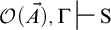
 -Elim rule):
$\mathcal {O}(\vec {A}), \Gamma \vdash\text {S}$
-Elim rule):
$\mathcal {O}(\vec {A}), \Gamma \vdash\text {S}$
 .Footnote
4
The rule
$\mathcal {O}$
.Footnote
4
The rule
$\mathcal {O}$
 -Intro, which says that
$\mathcal {O}(\vec {A})$
-Intro, which says that
$\mathcal {O}(\vec {A})$
 is unique among sentences that satisfy its defining property, is formed by universalizing over contexts:
$\forall \Delta (\Delta, \Gamma \vdash\text {S}\Rightarrow \Delta \vdash\mathcal {O}(\vec {A}))$
is unique among sentences that satisfy its defining property, is formed by universalizing over contexts:
$\forall \Delta (\Delta, \Gamma \vdash\text {S}\Rightarrow \Delta \vdash\mathcal {O}(\vec {A}))$
 . When this last rule is universalized, against
$\mathcal {O}$
. When this last rule is universalized, against
$\mathcal {O}$
 ’s natural polarity, the result is (
$\mathcal {O}$
’s natural polarity, the result is (
$\mathcal {O}$
 -Elim
$\! \star $
-Elim
$\! \star $
 ):
$\forall [\Pi \vdash\text {T}] (\forall \Delta (\Delta , \Gamma \vdash\text {S}\Rightarrow \Delta , \Pi \vdash\text {T})\Rightarrow \mathcal {O}(\vec {A}), \Pi \vdash\text {T})$
):
$\forall [\Pi \vdash\text {T}] (\forall \Delta (\Delta , \Gamma \vdash\text {S}\Rightarrow \Delta , \Pi \vdash\text {T})\Rightarrow \mathcal {O}(\vec {A}), \Pi \vdash\text {T})$
 . One can see why
$\mathcal {O}$
. One can see why
$\mathcal {O}$
 -Elim is derivable from
$\mathcal {O}$
-Elim is derivable from
$\mathcal {O}$
 -Elim
$\! \star $
-Elim
$\! \star $
 : Substituting
$\Pi := \Gamma $
: Substituting
$\Pi := \Gamma $
 and
$\text {T} := \text {S}$
and
$\text {T} := \text {S}$
 trivializes
$\mathcal {O}$
trivializes
$\mathcal {O}$
 -Elim
$\! \star $
-Elim
$\! \star $
 ’s antecedent and instantiates its consequent as
$\mathcal {O}$
’s antecedent and instantiates its consequent as
$\mathcal {O}$
 -Elim. And one can see why
$\mathcal {O}$
-Elim. And one can see why
$\mathcal {O}$
 -Elim
$\! \star $
-Elim
$\! \star $
 is derivable from
$\mathcal {O}$
is derivable from
$\mathcal {O}$
 -Elim: Assuming the antecedent of
$\mathcal {O}$
-Elim: Assuming the antecedent of
$\mathcal {O}$
 -Elim
$\! \star $
-Elim
$\! \star $
 and substituting
$\Delta := \mathcal {O}(\vec {A})$
and substituting
$\Delta := \mathcal {O}(\vec {A})$
 results in an instance whose own antecedent is just
$\mathcal {O}$
results in an instance whose own antecedent is just
$\mathcal {O}$
 -Elim and whose consequent is identical to
$\mathcal {O}$
-Elim and whose consequent is identical to
$\mathcal {O}$
 -Elim
$\! \star $
-Elim
$\! \star $
 ’s.
’s.
In [Reference Schroeder-Heister13], higher-order inference rules arise from the principle that an expression governed by a logical operator
$\mathcal {O}$
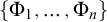
 should express the “common content” of the “rules associated with” that operator, where the common content of those rules is the set of all inference rules (or sentences) derivable from them. For an expression to express the common content of rules
$\{\Phi _1, \ldots , \Phi _n\}$
should express the “common content” of the “rules associated with” that operator, where the common content of those rules is the set of all inference rules (or sentences) derivable from them. For an expression to express the common content of rules
$\{\Phi _1, \ldots , \Phi _n\}$
 is for an inference rule to be derivable from that expression if, and only if, the same rule is derivable from each
$\Phi _i$
is for an inference rule to be derivable from that expression if, and only if, the same rule is derivable from each
$\Phi _i$
 . Because any expression is derivable from itself, the only if direction guarantees that the expression follows from each
$\Phi _i$
. Because any expression is derivable from itself, the only if direction guarantees that the expression follows from each
$\Phi _i$
 . The if direction guarantees that any sentence will follow from an expression given that it follows from each
$\Phi $
. The if direction guarantees that any sentence will follow from an expression given that it follows from each
$\Phi $
 . This determines the following “basic rule schemata” associated with a logical operator:

One readily sees that these schemata provide a general framework for left-universal constructions. The operator is defined as the thing that governs expressions that have the property of following from each
$\Phi _i$
 . The introduction rules express the part about the expressions having the property. The elimination rules express the part about them being “the things” that do, in the sense that anything else with this property does so by virtue of being inferable from them.
It is easy to see that Gentzen’s
$\vee $
 -Intro and
$\vee $
-Intro and
$\vee $
 -Elim rules instantiate these schemata exactly. This is what one expects. As we observed earlier, those inferences characterize
$\vee $
-Elim rules instantiate these schemata exactly. This is what one expects. As we observed earlier, those inferences characterize
$\vee $
 as left-universal. None of the rule pairs for
$\wedge $
as left-universal. None of the rule pairs for
$\wedge $
 ,
$\supset $
,
$\supset $
 , or
$\unicode{x214B} $
, or
$\unicode{x214B} $
 fully instantiate the schemata, though. Although the introduction rule for each connective is of the right form in each case, the elimination rule never is.
In the case of conjunction, because the “rules” from which
$\text {A}\wedge \text {B}$
 are canonically inferred are just the sentences A and B, Schroeder-Heister’s schemata provide
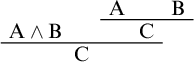 as the elimination rule. Schroeder-Heister remarked that this rule “obviously” has “the same strength” as Gentzen’s
$\wedge $
as the elimination rule. Schroeder-Heister remarked that this rule “obviously” has “the same strength” as Gentzen’s
$\wedge $
 -Elim rules, taken together. How obvious that is might be a matter of opinion; von Plato [Reference von Plato10, p. 544] provided a proof. The suggested elimination rule for the conditional, by contrast, resists any straightforward presentation in natural deduction. Schroeder-Heister rendered it as follows:

Here the minor premise of the inference of C from
$\text {A}\supset \text {B}$
 is the fact that C follows from the fact that B can be derived from A. As Schroeder-Heister stressed, the rule
 itself is a discharged assumption in this inference—a feature inexpressible in Gentzen’s calculus. This is precisely the higher-order rule
$\supset $
itself is a discharged assumption in this inference—a feature inexpressible in Gentzen’s calculus. This is precisely the higher-order rule
$\supset $
 -Elim
$\! \star $
-Elim
$\! \star $
 , obtained above by treating
$\supset $
, obtained above by treating
$\supset $
 as if it were a left-universal operator and universalizing
$\supset $
as if it were a left-universal operator and universalizing
$\supset $
 -Intro a second time, ignoring the fact that
$\supset $
-Intro a second time, ignoring the fact that
$\supset $
 -Intro is itself already a universalization of the connective’s defining property. In the turnstile notation, discharged assumptions pose no special difficulty, be they individual sentences or claims of derivability.
As for the relationship between this rule and the elimination rule for
$\supset $
 Gentzen offered (
modus ponens
), Schroeder-Heister no longer claimed that anything is obvious. The proof he provided for their interderivability is nontrivial, twice invoking the admissibility of a higher-order cut metarule, and determined by the details of the specific inference rules for the conditional.
Gentzen offered (
modus ponens
), Schroeder-Heister no longer claimed that anything is obvious. The proof he provided for their interderivability is nontrivial, twice invoking the admissibility of a higher-order cut metarule, and determined by the details of the specific inference rules for the conditional.
The collapse result not only unifies these observations but explains them. Instead of one higher-order rule being “obviously” of the “same strength” as its lower-order counterpart and another requiring a specialized proof of equivalence, both interderivabilities are seen to be instances of a single structural phenomenon. Collapse is the inevitable consequence of a higher-order rule arising as a (further) universalization of a rule that is itself a universalization of some defining property.
The collapse phenomenon does not show asymmetric treatments to be without value. On the contrary, among the applications of Schroeder-Heister’s prioritization of introduction rules, one finds von Plato’s conception of “general elimination rules” in [Reference von Plato10]. There von Plato showed that treating logical operators uniformly, as Schroeder-Heister suggested, allows one to specify a perspicuous translation between natural deduction and sequent calculi as well as far-simpler normalization algorithms. To achieve this, von Plato had to modify the rules from [Reference Schroeder-Heister13] so that they can be formulated directly in a propositional natural deduction template. Specifically,
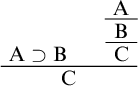 is replaced by
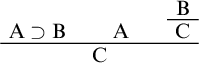 . The connection to the universal construction is obfuscated, but uniform left-polarization is preserved—a feature that Pelletier and Hazen [Reference Pelletier and Hazen9, sec. 5.4] suggest provided the perspective leading to von Plato and Siders’s [Reference von Plato and Siders11] discovery of normalization of classical propositional logic.
What the collapse phenomenon does show is that asymmetry provides no special insight into meaning. The structural relationships between rules in pairs like
$\langle \vee $
 -Elim,
$\vee $
-Elim,
$\vee $
 -Intro
$\! \star \rangle $
-Intro
$\! \star \rangle $
 and
$\langle \supset $
and
$\langle \supset $
 -Intro,
$\supset $
-Intro,
$\supset $
 -Elim
$\! \star \rangle $
-Elim
$\! \star \rangle $
 by virtue of which they relationally specify a connective’s meaning are present already in pairs like
$\langle \vee $
by virtue of which they relationally specify a connective’s meaning are present already in pairs like
$\langle \vee $
 -Intro,
$\vee $
-Intro,
$\vee $
 -Elim
$\rangle $
-Elim
$\rangle $
 and
$\langle \supset $
and
$\langle \supset $
 -Elim,
$\supset $
-Elim,
$\supset $
 -Intro
$\rangle $
-Intro
$\rangle $
 .
.
Higher-order rules like Koslow’s
$\vee $
 -Intro
$\! \star $
-Intro
$\! \star $
 and Schroeder-Heister’s
$\supset $
and Schroeder-Heister’s
$\supset $
 -Elim
$\! \star $
-Elim
$\! \star $
 are unwieldy and not obviously suited for implementation in natural deduction. Worse, they give the strong impression that non-trivial contexts—e.g., in the case of
$\vee $
are unwieldy and not obviously suited for implementation in natural deduction. Worse, they give the strong impression that non-trivial contexts—e.g., in the case of
$\vee $
 -Intro
$\! \star $
-Intro
$\! \star $
 contexts including neither A nor B—could suffice for the introduction of the disjunction
$\text {A}\vee \text {B}$
contexts including neither A nor B—could suffice for the introduction of the disjunction
$\text {A}\vee \text {B}$
 . We now know that this impression is an illusion. Rules like
$\vee $
. We now know that this impression is an illusion. Rules like
$\vee $
 -Intro
$\! \star $
-Intro
$\! \star $
 and
$\supset $
and
$\supset $
 -Elim
$\! \star $
-Elim
$\! \star $
 , simply by virtue of being the double universalization of Gentzen’s
$\vee $
, simply by virtue of being the double universalization of Gentzen’s
$\vee $
 -Intro and
$\supset $
-Intro and
$\supset $
 -Elim rules, can figure in no derivation that cannot be transformed into one featuring
$\vee $
-Elim rules, can figure in no derivation that cannot be transformed into one featuring
$\vee $
 -Intro or
$\supset $
-Intro or
$\supset $
 -Elim instead.
6 The identity predicate
The collapse of higher-order rules resembles the familiar fact from category theory that adjoints determine one another uniquely: The rule in the
$\text {R}_2$
 position has the form of a residuation or adjoint situation, and the higher-order rule (
$\text {R}_3$
position has the form of a residuation or adjoint situation, and the higher-order rule (
$\text {R}_3$
 ) obtained by universalizing it against an operator’s natural polarity is isomorphic with the rule (
$\text {R}_1$
) obtained by universalizing it against an operator’s natural polarity is isomorphic with the rule (
$\text {R}_1$
 ) that
$\text {R}_2$
) that
$\text {R}_2$
 is a universalization of. But in two ways the collapse phenomenon we have documented improves on this abstract formulation.
First, we have shown that under certain conditions, the uniqueness can be confirmed locally without any appeal to isomorphism. Isomorphism could obtain without the equivalence of inference patterns being expressed within a logical system. In that case one might say that it just so happens that the only way to introduce
$\text {A}\vee \text {B}$
 or to eliminate
$\text {A}\supset \text {B}$
or to eliminate
$\text {A}\supset \text {B}$
 with rules like
$\vee $
with rules like
$\vee $
 -Intro
$\! \star $
-Intro
$\! \star $
 and
$\supset $
and
$\supset $
 -Elim
$\! \star $
-Elim
$\! \star $
 is in the contexts already provided by Gentzen’s
$\vee $
is in the contexts already provided by Gentzen’s
$\vee $
 -Intro and
$\supset $
-Intro and
$\supset $
 -Elim rules. However, the interderivability of
$\text {R}_3$
-Elim rules. However, the interderivability of
$\text {R}_3$
 with
$\text {R}_1$
with
$\text {R}_1$
 makes the abstract equivalence concrete. The apparent generality of the rules generated by universalizing against an operator’s natural polarity can be explained away by the logical derivation apparatus itself.
By emphasizing this aspect of collapse, I do not mean to disparage the asymmetric, uniform approaches to proof-theoretic semantics so much as to show that Gentzen’s analysis of definition via universal constructions is resilient in the face of variation. If one universalizes a rule against the natural polarity of the operator one seeks to define, the resulting rule might be cumbersome. Nevertheless it will be correct, and the fact that the same universal construction admits a simpler, polarity-reversing formulation can be verified internally, by deriving the higher-order rule from the lower-level one and conversely. This only reinforces the idea that what matter for meaning in proof-theoretic semantics are universal constructions, not the particular forms of their presentation.
A second advantage of the concrete verification of collapse is its greater generality. A higher-order rule (
$\text {R}_3$
 ) generated by universalizing
$\text {R}_2$
) generated by universalizing
$\text {R}_2$
 may collapse even when its lower-level equivalent
$\text {R}$
may collapse even when its lower-level equivalent
$\text {R}$
 does not evidently stand in a defining relationship with
$\text {R}_2$
does not evidently stand in a defining relationship with
$\text {R}_2$
 . When this happens, the collapse itself provides evidence that R is definitional: Its joint adequacy with
$\text {R}_2$
. When this happens, the collapse itself provides evidence that R is definitional: Its joint adequacy with
$\text {R}_2$
 to a universal property is only visible through its interderivability with
$\text {R}_3$
to a universal property is only visible through its interderivability with
$\text {R}_3$
 .
.
The identity predicate provides a vivid example of this generality. Typical natural deduction presentations of the first-order theory of identity feature rules corresponding to Leibniz’s “indiscernibility of identicals” law and the reflexivity property:

One might, as many authors have,Footnote 5 question whether these rules warrant inclusion in natural deduction calculi. Neither rule evidently describes what it means for the property expressed by the other rule to hold universally or definitionally, as we expect of the Intro/Elim rules associated with logical operators.
Consider, however, what happens when one tries to correct this apparent inadequacy. LL can be rewritten in turnstile notation as

To say that this rule is not only valid but definitional of the
$=$
 relation is to say that any other sentence that can legitimately fill in the blank in “_________,
$\text {P}(\text {a})\vdash\text {P}(\text {b})$
relation is to say that any other sentence that can legitimately fill in the blank in “_________,
$\text {P}(\text {a})\vdash\text {P}(\text {b})$
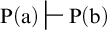 for all predicates P,” any sentence, that is, that stands in the same inferential relationships as
$\text {a}=\text {b}$
for all predicates P,” any sentence, that is, that stands in the same inferential relationships as
$\text {a}=\text {b}$
 , must be such that
$\text {a}=\text {b}$
, must be such that
$\text {a}=\text {b}$
 is inferable from it. Thus defining
$=$
is inferable from it. Thus defining
$=$
 with LL determines that
$\text {a}=\text {b}$
with LL determines that
$\text {a}=\text {b}$
 can be inferred in any other context that similarly licenses the inference, for every P, from
$\text {P}(\text {a})$
can be inferred in any other context that similarly licenses the inference, for every P, from
$\text {P}(\text {a})$
 to
$\text {P}(\text {b})$
to
$\text {P}(\text {b})$
 . This is expressed by the following rule:

These two rules, LL (
$=$
 -Elim) and its universalization (
$=$
-Elim) and its universalization (
$=$
 -Intro), thus depict
$=$
-Intro), thus depict
$=$
 as a right-universal construction. The latter rule is distinctively higher-order, though, in so far as it quantifies over the parameter predicate variable P featured in LL itself. And as we have come to expect, it suggests the availability of “introductions” of identity statements other than trivial examples such as
$\text {a}=\text {a}$
as a right-universal construction. The latter rule is distinctively higher-order, though, in so far as it quantifies over the parameter predicate variable P featured in LL itself. And as we have come to expect, it suggests the availability of “introductions” of identity statements other than trivial examples such as
$\text {a}=\text {a}$
 .
.
In [Reference Klev7], Klev cited the rule’s higher-order nature as reason to doubt that it can shed any light on the meaning of identity not available in a more standard explicit definition in full second-order logic (p. 874). I disagree. In light of Franks’s [Reference Franks5] proof that
$=$
 -Intro is interderivable with the lower-order rule Ref, one can say that
$=$
-Intro is interderivable with the lower-order rule Ref, one can say that
$=$
 -Intro shows how the patently first-order inference rules Ref and LL are, despite first appearances, jointly adequate to a universal construction.
The proof can be recast in the pattern of the collapse result. (
$=$
 -Intro
$\Rightarrow $
-Intro
$\Rightarrow $
 Ref): Let b := a. The resulting antecedent of
$=$
Ref): Let b := a. The resulting antecedent of
$=$
 -Intro (
$\Gamma , \text {P}(\text {a})\vdash\text {P}(\text {a}), \text {for all P}$
-Intro (
$\Gamma , \text {P}(\text {a})\vdash\text {P}(\text {a}), \text {for all P}$
 ) is trivially true. Thus its consequent, (
$\Gamma \vdash\text {a}=\text {a}$
) is trivially true. Thus its consequent, (
$\Gamma \vdash\text {a}=\text {a}$
 ) follows, i.e., Ref is true. (Ref
$\Rightarrow =$
) follows, i.e., Ref is true. (Ref
$\Rightarrow =$
 -Intro): Assume
$\Gamma , \text {P}(\text {a})\vdash\text {P}(\text {b})$
-Intro): Assume
$\Gamma , \text {P}(\text {a})\vdash\text {P}(\text {b})$
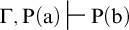 for all P. Instantiate with
$\text {P}(x)$
for all P. Instantiate with
$\text {P}(x)$
 :=
$\text {a}=x$
:=
$\text {a}=x$
 to get
$\Gamma , \text {a}=\text {a}\vdash\text {a}=\text {b}$
to get
$\Gamma , \text {a}=\text {a}\vdash\text {a}=\text {b}$
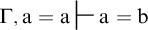 . By Ref, this sequent reduces to
$\Gamma \vdash\text {a}=\text {b}$
. By Ref, this sequent reduces to
$\Gamma \vdash\text {a}=\text {b}$
 , which also happens to be the consequent of
$=$
, which also happens to be the consequent of
$=$
 -Intro.
To reemphasize the main idea: The rules Ref,
$=$
 -Elim, and
$=$
-Elim, and
$=$
 -Intro do not follow the
$\text {R}_1$
-Intro do not follow the
$\text {R}_1$
 ,
$\text {R}_2$
,
$\text {R}_2$
 ,
$\text {R}_3$
,
$\text {R}_3$
 pattern from §5.
$=$
pattern from §5.
$=$
 -Intro is the universalization of
$=$
-Intro is the universalization of
$=$
 -Elim, but
$=$
-Elim, but
$=$
 -Elim is not, in turn, the universalization of Ref. Joint adequacy to a universal construction only materializes at the higher level. The collapse of
$=$
-Elim is not, in turn, the universalization of Ref. Joint adequacy to a universal construction only materializes at the higher level. The collapse of
$=$
 -Intro to Ref, rather than indicating a simpler route to the same universal construction, instead projects that construction onto the pair
$\langle $
-Intro to Ref, rather than indicating a simpler route to the same universal construction, instead projects that construction onto the pair
$\langle $
 Ref,
$=$
Ref,
$=$
 -Elim
$\rangle $
-Elim
$\rangle $
 , where it would otherwise not be evident. The identity predicate demonstrates that the collapse phenomenon is not restricted to cases where the defining rule and its universalization stand in the neat hierarchy described in §5. In such cases higher-order rules are the first place where the universal property is explicitly formulated. The collapse therefore underscores, not the redundancy, but the value of the higher-level rule: It is what reveals that the lower-level rule determines the same universal construction, thereby explaining why it works.
7 Conclusion
The theory of meaning developed in Göttingen in the 1920s and 1930s is given full expression through the notion of a universal construction. Not only do all the Intro/Elim pairs presented in Gentzen’s natural deduction calculi describe universal constructions of the operators they govern, but once the scheme is properly understood, it is possible to present analogous constructions of operators that Gentzen did not treat directly. Examples considered here are the multiplicative disjunction and the binary predicate symbol for identity, and there are others.
Part of the craft of studying meaning in the way Gentzen prescribed is to appreciate that logical operators are best defined relationally according to their natural polarity. Operators like
$\supset $
 ,
$\wedge $
,
$\wedge $
 ,
$\neg $
,
$\neg $
 ,
$\forall $
,
$\forall $
 ,
$\unicode{x214B} $
,
$\unicode{x214B} $
 , and
$=$
, and
$=$
 are right-universal, so that their defining properties are naturally expressed by elimination rules. Their introduction rules, in turn, express the fact that these properties are defining. Operators like
$\vee $
are right-universal, so that their defining properties are naturally expressed by elimination rules. Their introduction rules, in turn, express the fact that these properties are defining. Operators like
$\vee $
 and
$\exists $
and
$\exists $
 are left-universal. For another example, see [Reference Franks5], where it is observed that the natural number predicate admits a left-universal characterization as well. For such connectives, the role of introduction and elimination rules is reversed. Regardless of its polarity, though, one must not read Gentzen too casually, as suggesting that an operator’s elimination rule is a consequence of its introduction rule, or vice-versa. The one rule does not follow from the other, but it does, in a precise sense, follow from the definition that the other rule represents. That sense is what the universal construction concept makes explicit.
The proof-theoretic semantics program has at times been encumbered by looking past the concept of universality in an attempt to identify either introduction or elimination rules always as defining. Ignoring in this way the operators’ polarities can lead to cumbersome rules, typically of higher-order, that complicate analyses. We have shown, however, that the higher-order rules arrived at in this way are always interderivable with the more perspicuous, lower-level rules that respect the operators’ natural polarities. Key to the interderivability proof is the formulation of universality in terms of arbitrary contexts, or general sequents. On the one hand, this result speaks in favor of symmetric developments of proof-theoretic semantics. More tellingly, though, it highlights the primacy of a universal construction—rather than the details of any particular presentation—as the original site of meaning.
Further analysis reveals that the collapse phenomenon has more to do with an inference rule’s order than with whether it originated through universalizing against an operator’s natural polarity. The presentation of
$=$
 as a right-universal operator is an illustrative example: The introduction rule that figures in that presentation is higher-order despite the fact that there is no simpler, polarity-reversing representation of the construction in natural deduction. Collapse attains all the same, revealing that familiar textbook rules LL and Ref are, despite lacking any markings as such, fully adequate to the same universal construction.
Acknowledgments
Comments from two anonymous referees were helpful in clarifying some of the ideas in this paper and in drawing connections to related work.
Funding
This research was not funded by any grant awarding agency.


 Open access

