

In October 2012 the Danish Socialist People's Party chose Annette Vilhelmsen as its leader. With her ascension to power, women simultaneously headed all three of Denmark's governing parties for the first time. Though an exclusively female-led coalition government remains exceptional, in developed democracies the number of female prime ministers and party leaders has grown in recent years. Since 2000, women have governed in Denmark, Germany, Finland, Iceland, New Zealand, and Australia and have commanded coalition partner parties in Austria, Ireland, and Sweden. Just as there are now more female leaders, governments are also nominating more women to cabinets than ever before. Women recently held half of all ministerial posts in Finland, Iceland, Sweden, and Spain. Female ministers are also serving in high-prestige portfolios from which they were traditionally excluded, including finance and foreign affairs.
As women's presence in executive office grows, interest in both women's ascension to leadership positions (Jalalzai Reference Jalalzai2013; Murray Reference Murray2010; O'Neill and Stewart Reference O'Neill and Stewart2009; Wiliarty Reference Wiliarty2008) and nomination to cabinets (Bego Reference Bego2014; Claveria Reference Claveria2014; Davis Reference Davis1997; Escobar-Lemmon and Taylor-Robinson Reference Escobar-Lemmon and Taylor-Robinson2005; Reynolds Reference Reynolds1999) has also increased. At the same time, female leaders and ministers have largely been studied in isolation from one another, and little is known about the relationship between the two. This is a surprising oversight because party leaders play a central role in cabinet appointments and because of the conflicting expectations generated by prior research. While some scholars posit that female leaders increase women's access to top political posts (Davis Reference Davis1997; Jacob, Scherpereel, and Adams Reference Jacob, Scherpereel and Adams2014), others find no support for this claim (Krook and O'Brien Reference Krook and O'Brien2012) or show that it is wholly attributable to self-appointments (Barnes and O'Brien Reference Barnes and O'Brien2015).
We provide the first empirical analysis of female leaders’ effects on both the proportion of ministerial posts held by women and women's nomination to high-prestige portfolios. After examining the literature on women's cabinet appointments, we develop two competing sets of hypotheses linking female leaders and ministers in advanced parliamentary and semipresidential democracies. Our letting-down-the-ladder hypotheses posit that female prime ministers and coalition party leaders—particularly in left governments—are associated with women's increased appointment to cabinets and their ascension to high-prestige ministerial posts. In contrast, our shutting-the-door hypotheses suggest that the presence of female leaders—especially in nonleft governments—will result in the nomination of fewer women to (high-prestige) portfolios.
We test our competing hypotheses using data on female prime ministers, party leaders, and cabinet members in 15 countries beginning in 1980. Our multilevel models with country-level random effects demonstrate that the presence of either a female prime minister or a female-led coalition party is associated with fewer female-held portfolios, particularly as compared to exclusively male-led left governments. Female leaders are also no more likely than their male counterparts to appoint women to high-prestige posts. In our discussion of these results, we posit that this is likely a consequence of the opportunities and constraints facing male and female leaders in parliamentary and semipresidential regimes. These findings thus offer an important contribution to the growing literature on women in executive politics and lay the groundwork for future research exploring the knock-on effects of women's ascension to leadership posts. Indeed, they highlight the need for additional qualitative and quantitative work assessing the motivations and incentives of male and female leaders across different political systems.
TRENDS IN WOMEN'S ACCESS TO MINISTERIAL POSTS
Women have traditionally held few ministerial positions and have been relegated to low-prestige portfolios with “feminine” characteristics (Davis Reference Davis1997; Escobar-Lemmon and Taylor-Robinson Reference Escobar-Lemmon and Taylor-Robinson2009; Reynolds Reference Reynolds1999; Studlar and Moncrief Reference Studlar and Moncrief1999). Their nomination to cabinets—and appointment to high-prestige posts—thus has major pragmatic and symbolic implications. Women's inclusion in government grants them policy-making authority that they were previously denied (Laver and Shepsle Reference Laver and Shepsle1994), and the presence of female cabinet members is a key determinant of women's substantive representation (Atchison and Downs Reference Atchison and Downs2009). Beyond these important policy implications, the nomination of female ministers is an important indicator of gender equality in politics (Krook and O'Brien Reference Krook and O'Brien2012). Women's continued exclusion from these posts indicates that men's grip on power remains firm, while their inclusion in cabinets signifies broader changes to women's status.
Though the appointment of female ministers is important for ensuring women's access to political power, there is also growing recognition that women's portfolio assignments can either reinforce or displace traditional gendered patterns of exclusion (Borelli Reference Borrelli2002). Cabinet assignments are not created equal, and different portfolios vary with respect to their influence within the cabinet, the amount of media attention they garner, and the degree to which they provide a pathway to higher office (Krook and O'Brien Reference Krook and O'Brien2012). Historically, the ministries allocated to women were rarely part of the most important “inner cabinet” (Davis Reference Davis1997). While these portfolios often deal with areas that are central to the welfare state and of particular importance to female citizens (Trimble and Tremblay Reference Trimble and Tremblay2012), women's cabinet posts were often rendered “unimportant” by the criteria of political clout (Krook and O'Brien Reference Krook and O'Brien2012). The appointment of women to high-prestige portfolios thus represents a highly visible break from traditional patterns of women's marginalization in the executive branch (Bego Reference Bego2014; Escobar-Lemmon and Taylor-Robinson Reference Escobar-Lemmon and Taylor-Robinson2005).
As scholars and practitioners alike have come to recognize the importance of female ministers, a growing body of literature examines women's nomination to cabinets and appointment to high-prestige posts. Krook and O'Brien (Reference Krook and O'Brien2012) identify three overarching hypotheses explaining patterns in women's presence in (high-prestige and masculine) portfolios: institutional arrangements, women's inclusion among political elites, and broader norms of gender equality. Their work finds strong support for the first two claims, but only limited evidence in favor of the third. Other studies confirm the importance of components of all three hypotheses. Institutional arrangements including the form of government (Bego Reference Bego2014), specialist cabinet recruitment patterns (Bauer and Okpotor Reference Bauer and Okpotor2013; Claveria Reference Claveria2014; Davis Reference Davis1997; Siaroff Reference Siaroff2000), the ideological commitments of governing parties (Claveria Reference Claveria2014; Escobar-Lemmon and Taylor-Robinson Reference Escobar-Lemmon and Taylor-Robinson2005; Moon and Fountain Reference Moon and Fountain1997), and a history of competitive elections (Reynolds Reference Reynolds1999) are each positively correlated with women's appointment to cabinets. Left governments and democratic states are also more likely to nominate women to high-prestige portfolios (Escobar-Lemmon and Taylor-Robinson Reference Escobar-Lemmon and Taylor-Robinson2005; Jacob, Scherpereel, and Adams Reference Jacob, Scherpereel and Adams2014; Studlar and Moncrief Reference Studlar and Moncrief1999). Beyond these institutional factors, women's inclusion in cabinets is shaped by strategic considerations—including partisan competition (Escobar-Lemmon and Taylor-Robinson Reference Escobar-Lemmon and Taylor-Robinson2005) and patronage-based alliances (Arriola and Johnson Reference Arriola and Johnson2014)—as well as societal-level features related to gender equality. These include economic development (Bego Reference Bego2014), religious traditions (Reynolds Reference Reynolds1999), and a demonstrated commitment to women's inclusion (Jacob, Scherpereel, and Adams Reference Jacob, Scherpereel and Adams2014; Reynolds Reference Reynolds1999).
Across these studies, one of the most consistent findings is that women's involvement in cabinets is highly correlated with women's access to political office more broadly. Women's presence in both the legislature (Claveria Reference Claveria2014; Escobar-Lemmon and Taylor-Robinson Reference Escobar-Lemmon and Taylor-Robinson2005; Reynolds Reference Reynolds1999; Siaroff Reference Siaroff2000) and the governing parties’ parliamentary delegations (Studlar and Moncrief Reference Studlar and Moncrief1997) are each associated with the proportion of ministerial portfolios held by women, as is the use of gender quotas by the largest governing party (Claveria Reference Claveria2014). The number of female legislators similarly predicts women's ascension to high-prestige posts (Studlar and Moncrief Reference Studlar and Moncrief1999; Escobar-Lemmon and Taylor-Robinson Reference Escobar-Lemmon and Taylor-Robinson2005). Women's presence in legislative assemblies clearly affects the supply of, and demand for, female cabinet ministers.
FEMALE LEADERS AND WOMEN'S ACCESS TO MINISTERIAL POSTS
A growing literature highlights the multitude of institutional and cultural factors affecting women's selection as cabinet ministers. Though this research offers important insights into women's executive branch appointments, it has also largely overlooked a key actor influencing cabinet composition: the party leader. In particular, no study to date systematically evaluates female party leaders’ effects on women's ministerial appointments. This scarcity of research reflects men's traditional dominance as party leaders and heads of governments. Until very recently, there were simply too few female prime ministers and coalition party leaders to allow for a broad-based assessment of their influence on cabinets. As the number of female leaders grows, however, it is essential to examine the gendered links between different executive branch posts.
Across political systems, leaders play an important role in determining cabinet composition. In pure presidential systems, the president appoints and dismisses whomever she wishes to her cabinet. In the parliamentary and semipresidential systems studied here, the leader of each party in government also plays a key role in assigning ministerial appointments within his or her party (Dowding and Dumont Reference Dowding, Dumont, Dowding and Dumont2009). Though no two countries or parties are exactly alike—with some delegating a great deal of authority to leaders and others giving more power to the party executive or parliamentary delegation (Andeweg Reference Andeweg, Hart and Rhodes2014)—the leader is generally one of the most important and influential politicians within her party (Cross and Blais Reference Cross and Blais2012; Pilet and Cross Reference Pilet and Cross2014).
Given the importance of the leadership post, there is reason to believe that the presence of female prime ministers and coalition party leaders affects women's ministerial nominations. At the same time, the direction of this influence is unknown. On the one hand, there is a large body of work linking women's descriptive representation across political arenas, and existing studies posit that female heads of government are positively associated with women's cabinet appointments (Davis Reference Davis1997; Jacob, Scherpereel, and Adams Reference Jacob, Scherpereel and Adams2014). This suggests a letting-down-the-ladder effect, whereby the presence of female prime ministers and party leaders results in women's appointment to (high-prestige) cabinet posts. On the other hand, others find no link between female leaders and women's cabinet appointments (Krook and O'Brien Reference Krook and O'Brien2012) or argue that the “impact of female prime ministers and presidents [on women's appointment to cabinet] remains idiosyncratic” (Sykes Reference Sykes, Hart and Rhodes2014, 698). The opportunities and constraints facing female leaders may in some cases encourage these women to “shut the door behind them,” and women's presence in these posts may result in fewer female cabinet appointees. In the following subsections, we develop these two competing sets of hypotheses explaining female leaders’ effects on women's cabinet appointments.
Letting Down the Ladder: Female Leaders Promoting Women's Access to Cabinets
The presence of a female governing party leader may improve women's access to (high-prestige) cabinet portfolios. These leaders may select—or advocate on behalf of—women for these posts, and their presence may alter parties’ beliefs concerning women's suitability for office. Across many organizations, female leaders are more likely to promote women than their male counterparts. Studies of corporate behavior, for example, find that companies with more women in top management also have a greater proportion of women in lower managerial positions (Kalev, Dobbin, and Kelly Reference Kalev, Dobbin and Kelly2006). These patterns from the business world are paralleled in the recruitment of candidates for elected office. Just as female partners at large law firms are more likely than men to hire female associates (Gorman Reference Gorman2005), female local party leaders are more apt to recruit female candidates than their male peers (Crowder-Meyer Reference Crowder-Meyer2013; Niven Reference Niven1998).
Research linking women's descriptive representation across political posts supports the expectation that female party leaders are likely to promote women's inclusion in politics. Parties with greater numbers of female internal officeholders, for example, are more likely to adopt quota policies for women (Kittilson Reference Kittilson2006), and women in leadership posts are more likely than their male counterparts to support measures to advance women in politics (Tremblay and Pelletier Reference Tremblay and Pelletier2001). Women's presence on parties’ national executive committees also leads to women's increased representation in parties’ parliamentary delegations (Kittilson Reference Kittilson2006), and female local party presidents are more likely to select female candidates for office (Cheng and Tavits Reference Cheng and Tavits2011). Together, these studies suggest that in parties where leaders dictate cabinet composition, women prime ministers and coalition party leaders may let down the ladder to other female politicians. Even when the party leader plays a more limited formal role in ministerial selection, she may use her significant influence within her organization to advocate on behalf of her fellow female politicians.Footnote 1
In addition to selecting more female ministers, female party leaders may also be associated with women's appointment to high-prestige posts. Bias against outgroup members may lead male party leaders to overlook women for these positions. Niven (Reference Niven1998) argues, for example, that male gatekeepers evaluate men's unique strengths and weaknesses but lump women together and assign female aspirants conventionally feminine traits. This suggests that female leaders may be more apt to evaluate individual women's competency for high-prestige ministries while their male peers only consider whether or not women are generally well suited for these portfolios.
Beyond these direct effects, the presence of female leaders likely indirectly enhances parties’ demand for—or at least acceptance of—female cabinet appointees. Female leaders have been shown to improve citizens’ beliefs about women's capacity to govern (Beaman et al. Reference Beaman, Chattopadhyay, Dulfo, Pande and Topalova2009). The presence of a female prime minister or coalition party leader may thus make citizens more accepting of women in cabinets and lead them to view women's exclusion from power negatively. Female leaders who usher their parties into government may similarly change party elites’ attitudes concerning female cabinet appointees, particularly in high-prestige positions. Indeed, a woman's very presence in this post indicates that women have cracked the highest glass ceiling within the party and suggests that its members are amenable to women taking on more—and more prestigious—cabinet positions.
Finally, female leaders may not only influence the selection of female cabinet ministers within their own organizations; their presence may also have spillover effects for other governing parties. Women's initial ascension to prime ministerial and presidential posts appears to shatter the glass ceiling and allows other women to hold these positions (Jalalzai Reference Jalalzai2013; Jalalzai and Krook Reference Jalalzai and Krook2010). As well as shifting the broader norms and expectations about women's suitability for executive office, women's cabinet appointments may also be subject to contagion effects. Within advanced parliamentary democracies, parties’ propensity to select female candidates is influenced by party competition, with larger parties promoting women in response to smaller parties’ efforts on this front (Matland and Studlar Reference Matland and Studlar1996). Linking “contagion effects” to cabinet appointments, Davis (Reference Davis1997) shows that a party's willingness to nominate women to government depends as much (if not more) on the number of female parliamentarians from outside the party as it does on the proportion of women within the party's parliamentary delegation. The presence of a female party leader may likewise incentivize other coalition members to select more women as ministers—or place women in high-prestige portfolios—in an effort to appear female-friendly and progressive.
Female politicians’ propensity to promote women in politics, combined with their effects on parties’ attitudes toward female ministerial appointees, suggests that female leaders may increase women's access to (high-prestige) cabinet posts. This leads to the first set of hypotheses:
H1a:
The presence of a female leader results in more women in cabinets.
H1b:
The presence of a female leader promotes women's appointment to high-prestige portfolios.
Though female leaders may on average be more likely to appoint female ministers—and to select women for high-prestige posts—these gendered effects may not hold across all cabinets. The link between female leaders and the selection of candidates and elected officials is context-dependent (Kunovich and Paxton Reference Kunovich and Paxton2005), and party gatekeepers’ sex is sometimes secondary to partisanship and feminist identification in predicting the recruitment of female candidates (Tremblay and Pelletier Reference Tremblay and Pelletier2001). There is similarly reason to expect that the link between female leaders and ministers may vary across governments. In particular, the association between female party leaders and women's access to power may be strongest in ideologically left-leaning governments (i.e., cabinets led by socialist or social democratic parties).
Left parties have long traditions of publicly embracing gender-egalitarian ideologies (Duverger Reference Duverger1955) and historic ties with progressive women's movements (Beckwith Reference Beckwith2000). The link between left parties and women's descriptive representation has also been well documented. Within legislatures, these parties tend to be more open to promoting women to prominent political positions (Lovenduski and Randall Reference Lovenduski and Randall1993). Left-party governments are similarly more apt to appoint female cabinet ministers (Escobar-Lemmon and Taylor-Robinson Reference Escobar-Lemmon and Taylor-Robinson2005; Moon and Fountain Reference Moon and Fountain1997; Reynolds Reference Reynolds1999) and to elevate these women to high-prestige and nonfeminine portfolios (Studlar and Moncrief Reference Studlar and Moncrief1999). Just as left parties have traditionally been more receptive to women's descriptive representation, women in these parties are more likely than other politicians to have progressive attitudes on gender equality policies (Lovenduski and Norris 2003) and to self-identify as feminists (Tremblay and Pelletier Reference Tremblay and Pelletier2000). Large left parties have also proved more responsive to contagion effects than their nonleft counterparts (Matland and Studlar Reference Matland and Studlar1996).
Left parties’ traditional support of women's descriptive representation and commitment to gender equality—coupled with their greater propensity to respond to smaller parties’ promotion of female candidates—together suggests that the relationship between female party leaders and women's access to cabinets may be more likely to emerge in left governments. Indeed, the female leaders who are best known for actively recruiting women to cabinet positions, including Michelle Bachelet of Chile and Jóhanna Sigurðardóttir in Iceland, are from left parties. These intraparty dynamics offer a second set of letting-down-the-ladder hypotheses:
H2a:
In left-party governments, the presence of a female party leader results in more women in cabinets.
H2b:
In left-party governments, the presence of a female party leader promotes women's appointment to high-prestige portfolios.
Shutting the Door: Female Leaders Constraining Women's Access to Cabinets
While some female heads of government promote women to their cabinets, others fail to do so (Bauer and Tremblay Reference Bauer and Tremblay2011; Jalalzai and Krook Reference Jalalzai and Krook2010). Similarly, though women's presence in top management positions is sometimes correlated with the promotion of female employees, in other cases women who succeed in male-dominated settings fail to promote junior women (Staines, Tavris, and Jayaratne Reference Staines, Tavris and Jayaratne1974). In contrast to the letting-down-the-ladder hypotheses, the incentives and constraints facing male and female leaders—coupled with parties’ responses to women in leadership—may in fact yield the opposite outcome. The shutting-the-door hypotheses suggest that the presence of a female governing party leader may actually limit women's access to (high-prestige) cabinet portfolios.
Leadership is both sexed and gendered, with the archetypal leader being “male in appearance and gender,” as well as “masculine in character traits” (Sjoberg Reference Sjoberg, Hart and Rhodes2014, 73). This is especially true in executive politics, which has historically been conceived of as the most masculine branch of government (Duerst-Lahti Reference Duerst-Lahti, Borrelli and Martin1997; Jalalzai Reference Jalalzai2013). Even in the modern era, Sykes (Reference Sykes, Hart and Rhodes2014) argues that executive leadership is often characterized by at least some “measure of masculine attributes” (696), and female leaders find themselves wielding power in “gender-specific environment[s] molded by ‘masculinist’ norms and expectations” (691). Women's appointment to leadership posts may make them more cognizant of their gender and force them to “learn competence in masculine behaviours and practices, while being constantly reminded of their feminine status” (Pini Reference Pini2005, 79). Female executives are thus required to develop strategies that demonstrate their strength, determination, and decisiveness (Sykes Reference Sykes, Hart and Rhodes2014). Presenting a more masculine image, in turn, allows women to adhere to the “undeclared male rules of the game” (Shvedova Reference Shvedova2002, 44–45).
Given the environments in which they operate, it is not surprising that female leaders often choose not to adhere to conventional gender stereotypes when making decisions (Sjoberg Reference Sjoberg, Hart and Rhodes2014). In established democracies, for example, female chief executive and defense ministers increase defense spending and conflict behavior (Koch and Fulton Reference Koch and Fulton2011), and female foreign ministers decrease foreign aid spending (Lu and Breuning Reference Lu and Breuning2014). For a female party leader, cabinet appointments can likewise be used to signal adherence to masculine norms. Championing men for these posts can be a useful strategy for downplaying the leader's sex, while appointing many female ministers—or placing women in high-prestige posts—may actually draw greater attention to her “femaleness.”
Beyond the need to present a masculine image, as compared to their male counterparts, female leaders may reap fewer benefits from—and perceive greater costs to—nominating female ministers. Even in seemingly identical situations, men and women are faced with different norms and expectations (Crawford Reference Crawford1995). Male leaders can use women's ministerial appointments to satisfy the demands of women within their party and signal progressive and female-friendly ideals to voters. Female leaders using similar strategies, on the other hand, may be accused of “favoritism” and pursuing “identity politics.”
Though shutting-the-door effects are broadly applicable, female leaders may be especially disinclined to appoint women to (high-prestige) cabinet posts in parliamentary and semipresidential democracies. In these political systems, the cabinet's continued survival depends on the approval of a legislative majority. Party leaders and their ministers must enjoy the continued confidence of the assembly in order to retain their posts. Within their parties, moreover, leaders must constantly manage prospective challengers who threaten to unseat them from power (Bynander and ’t Hart Reference Bynander and Hart2007). Selecting a cabinet in these systems thus requires balancing different personalities, ambitions, and policy aims in order to satisfy powerful individuals and factions within the party, cultivate the support of the selectorate, and temper the ambitions of potential opponents (Dowding and Dumont Reference Dowding, Dumont, Dowding and Dumont2009). When men are the principal powerbrokers within political parties, this can result in male-dominated cabinets. The need to appease male copartisans may be especially acute for female leaders, who have shorter tenures in these posts (O’Neill and Steward Reference O'Neill and Stewart2009) and are especially likely to leave office when their parties are losing vote share (O’Brien Reference O'Brien2015).
Female leaders may not only feel less able to promote women; the existence of a female-led party may also release parties from any sense of obligation to do so. Female party leaders can serve as “tokens,” acting as representatives for, or symbols of, women (Kanter Reference Kanter1977). Their presence may allow parties in government to feel as if women's demands for access to power have been met. Indeed, it is more difficult for women to argue that they are systematically excluded from government posts when a woman holds one of the most important political positions in the country. The presence of a female leader thus provides cover for women's systematic exclusion from both the cabinet and traditionally high-prestige posts.
As compared to their male counterparts, female leaders may encounter greater costs (and fewer benefits) when advocating for women's appointment to cabinets. Their presence may also reduce the pressure for governing parties to advance women's descriptive representation in the executive branch. Together, this suggests that female prime ministers and coalition party leaders may be associated with a decrease in the number of women in (high-prestige) cabinet portfolios. Our third set of hypotheses posit:
H3a:
The presence of a female party leader results in fewer women in cabinets.
H3b:
The presence of a female party leader inhibits women's appointment to high-prestige portfolios.
Though many female leaders face constraints in appointing women to their cabinets, these impediments may be more strongly felt by women in nonleft governments (here, cabinets not led by socialists or social democrats). The desire of conservative and Christian democratic parties to maintain the “status quo” and defer to social conventions (Willets Reference Willets1992), combined with a historic alignment with religious organizations (Betz Reference Betz1994), encourages these parties to promote traditional gender roles (Lovenduski and Randall Reference Lovenduski and Randall1993). Liberal parties’ commitment to individualism and “merit” can likewise lead them to eschew formal measures that promote gender equality (Dahlerup Reference Dahlerup2007). Nonleft parties in advanced parliamentary democracies have thus historically lagged behind their left counterparts with respect to women's representation. Nonleft governments, for example, have traditionally been less likely to appoint female cabinet ministers and less willing to assign women to high-prestige portfolios.
Among women from nonleft parties, support for efforts to increase women's descriptive representation is also mixed. While in some cases these women have been supportive of efforts to increase women's presence in elected office (Childs and Webb Reference Childs and Webb2012), in others they have been critical of “identity politics,” arguing that female voters are not concerned with the sex of their representatives (Schreiber Reference Schreiber2008). Some nonleft female leaders may thus feel less personally or ideologically compelled to select female cabinet ministers.
Even if women from nonleft parties would like to let down the ladder, it can be difficult for them to make claims related to gender equality. Jiménez (Reference Jiménez2009) finds reluctance among some right women to work on gender topics due to the perception that a “defense of women's problems is damaging” (257). Women in nonleft parties may prefer to sideline “women's issues” and appoint men to their cabinets, lest they be perceived as challenging the gendered status quo. Consistent with this argument, Celis and Ezreel (Reference Celis and Erzeel2015) find that across 10 European countries male representatives in right parties are more likely than their female counterparts to speak on behalf of women.
The absence of an ideological commitment to advancing women's representation, combined with the potentially high costs of doing so, may discourage women in nonleft parties from promoting female cabinet ministers. This leads to our final set of hypotheses:
H4a:
In nonleft governments, the presence of a female party leader results in fewer women in cabinets.
H4b:
In nonleft governments, the presence of a female party leader inhibits women's appointment to high-prestige portfolios.
TESTING THE LINK BETWEEN FEMALE LEADERS AND CABINET MEMBERS
In order to test our competing letting-down-the-ladder and shutting-the-door hypotheses, we draw on an original dataset of 206 cabinet-level observations nested in 15 states beginning in 1980. The countries—Australia, Austria, Canada, Denmark, Finland, Germany, Greece, Iceland, Ireland, the Netherlands, New Zealand, Portugal, Spain, Sweden, and the United Kingdom—were selected because they encompass the set of advanced parliamentary and semipresidential democracies with stable party systems in which the party leader can be clearly identified and serves in government. Here, democracies are identified using the ParlGov (Döring and Manow Reference Döring and Manow2012) and Polity datasets (Marshall and Jaggers Reference Marshall and Jaggers2014), parliamentary and semipresidential systems are selected based on information provided by Cheibub, Gandhi and Vreeland (Reference Cheibub, Gandhi and Vreeland2010), and advanced industrial states are defined by OECD membership (see appendix for a discussion of case selection).
Though our theoretical framework is broadly applicable, it is especially important to test our hypotheses in advanced parliamentary and semipresidential democracies. Ministers in these systems formulate policy, dictate which bills are introduced to the legislature, and have access to significant perks and patronage. Women's inclusion in these posts is thus especially important. Beyond the significance of the cabinet, these states have also historically served as a model for the rest of the world with respect to women's representation. Political parties in these countries have been at the forefront of efforts to bolster women's presence in politics, and the first parity cabinets emerged from these governments. When judged by the United Nations Development Programme's gender inequality index, these states are also among the most gender equal in the world, and their citizens are largely supportive of women's equality (Inglehart and Norris Reference Inglehart and Norris2003). If shutting-the-door effects emerge even in the “easy” case of advanced parliamentary democracies, biases against women may also remain entrenched elsewhere.
Beyond these theoretical justifications, there are also empirical reasons to study this set of countries. These states provide sufficient variation in women's presence in executive office to test our hypotheses while at the same time allowing us to hold constant a broader set of political, socioeconomic, and cultural variables. Focusing on these countries thus allows us to minimize variation on a number of societal-level intervening factors while still making more generalizable claims. Finally, we begin our analysis in 1980, as before 1979 there were no female-led governing parties in our dataset.
Measuring and Modeling Women's Appointment to Cabinets and Access to High-Prestige Posts
To establish whether female party leaders let down the ladder or shut the door behind them, we consider two measures of women's access to cabinets. First, we examine the percentage of female cabinet ministers. Second, we analyze women's appointment to high-prestige posts from which they have historically been excluded (Krook and O'Brien Reference Krook and O'Brien2012).Footnote 2 To do so, we determine whether a woman held the finance, foreign affairs, interior/home affairs,Footnote 3or defense ministries during each government. Though the meaning and significance assigned to individual portfolios varies over time and space (Bauer and Tremblay Reference Bauer and Tremblay2011), these four posts are consistently identified as high-prestige appointments in existing studies of women in cabinets (Escobar-Lemmon and Taylor-Robinson Reference Escobar-Lemmon and Taylor-Robinson2005, Reference Escobar-Lemmon and Taylor-Robinson2009; Krook and O'Brien Reference Krook and O'Brien2012; Reynolds Reference Reynolds1999). The foreign affairs, interior, and finance posts are also generally viewed as the most important ministries in Western European cabinets (Druckman and Warwick Reference Druckman and Warwick2005).Footnote 4 Historical evidence further supports the argument that these positions represent important appointments from which women have traditionally been excluded. Among the countries studied, the first female foreign affairs minister was not selected until 1976 (Sweden's Karin Söder). Similarly, the first women to serve as finance and defense ministers were New Zealand's Ruth Richardson and Canada's Kim Campbell, appointed in 1990 and 1993, respectively.
While our sample of cabinets is taken from the ParlGov database (Döring and Manow Reference Döring and Manow2012), we constructed the measures of both the proportion of women in cabinets and women's access to high-prestige posts, relying primarily on the Keesing's World News Archive. As a governing party's leader typically holds a ministerial portfolio, we remove both male and female party leaders from the counts of male and female ministers.Footnote 5 Excluding leaders from our dependent variables allows us to determine whether women in these posts are likely to promote other women to cabinets. Additionally, we exclude the cases in which a female leader takes a high-prestige post for herself, as this does not reflect her (un)willingness to appoint other women to these portfolios.
Finally, the empirical analyses assess both women's presence in cabinets and access to high-prestige posts using logistic regression models with country-level random effects. These varying-intercept random effects account for the covariance between cabinets within a given country and capture baseline differences in their propensities to select female ministers and/or appoint them to high-prestige portfolios.
Measuring the Presence of Female Leaders
Female leaders may promote or inhibit women's access to cabinets. To test the hypotheses about female leaders alone (H 1 and H 3), we drew on an original dataset of party leaders to create two measures. We focus first on female prime ministers. Across the governments in our study, there are 18 female-headed cabinets. These include the governments of Julia Gillard in Australia, Kim Campbell in Canada, Helle Thorning-Schmidt in Denmark, Anneli Jäätteenmäki and Mari Kiviniemi in Finland, Angela Merkel in Germany, Jóhanna Sigurðardóttir in Iceland, Jenny Shipley and Helen Clark in New Zealand, and Margaret Thatcher in the United Kingdom. We then broaden our analysis to distinguish between governments with any female-led party and those comprised exclusively of male-led organizations. There are 32 cabinets in which at least one (major or minor) party was female-led, and four in which women headed two of these parties. In the exceptional case described above—the Danish coalition government formed in 2012—women led all three governing parties. In total, 37 cabinets (18% of all observations) contain at least one female-led party.
The second and fourth sets of hypotheses (H 2 and H 4) address not just the party leader's sex, but also the differing incentives faced by leaders from left and nonleft parties. To capture this relationship, we include an interaction effect between government ideology and presence of a female leader. As a measure of ideology, we use the prime minister's party family as reported by the ParlGov database. We distinguish left governments—cabinets in which the prime minister is from a socialist or social democratic party—from nonleft governments in which she is from a conservative, Christian democratic, liberal, or agrarian party. In total, we have four cabinet types: 15 female-led left cabinets; 22 female-led nonleft cabinets; 65 male-only left cabinets; and 104 male-only nonleft cabinets.
Controlling for Alternative Explanations
Beyond the main predictors, we control for factors that may otherwise bias the results. Over time parties may become more likely to appoint women to executive office. We thus include three time period dummy variables. The models also have a covariate capturing the percentage of seats held by women in parliament, as increasing the number of female legislators can alter both the supply of—and demand for—female leaders and women in cabinets. Existing research likewise suggests that female ministers are more common in specialist than generalist systems, so we account for specialist systems using data from Siaroff (Reference Siaroff2000). Similarly, we control for the number of parties in government, as female leaders are more likely to be present in coalitions, and these governments face distinct incentives as compared to those that do not share cabinet posts (Krook and O'Brien Reference Krook and O'Brien2012). Since federal systems have been shown to positively affect women's descriptive representation (Stockemer and Tremblay Reference Stockemer and Tremblay2015), we also capture the degree of federalism in the country using data from the Comparative Political Data Set I (1960–2012).
RESULTS
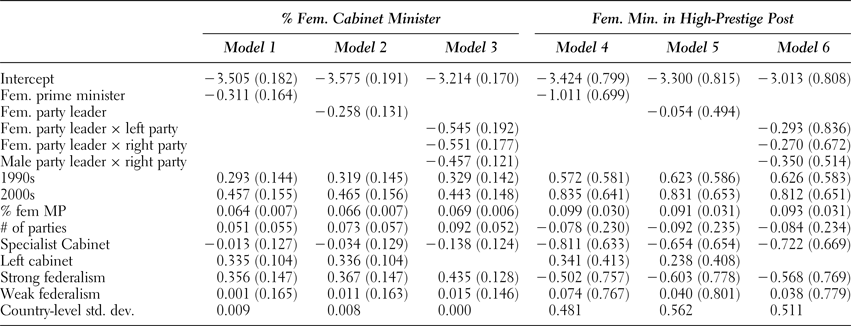
Table 1 presents the findings from six logistic regression analyses, each examining the relationship between female leaders and ministers across 15 parliamentary and semipresidential democracies. Taken together, a clear picture emerges from these results: female leaders do not let down the ladder to other women, and in some cases shut the door behind them. Female prime ministers and minor party leaders have fewer women in their cabinets than their male counterparts, and women are no more likely to hold high-prestige posts in female-led governments.
Random effects logit models of women in cabinets (standard errors in parentheses)

Notes: The outcome variable in Models 1, 2, and 3 is the percentage of ministerial portfolios held by women. The outcome variable in Models 4, 5, and 6 is a dichotomous measure of women's appointment to at least one of the four high-prestige posts. Number of observations: 206 cabinets; number of groups: 15 countries.
Female Party Leaders and Women's Presence in Cabinets
There is tremendous variation in women's representation across cabinets. Some governments, particularly in the early period, included no women. Among the cabinets formed in the 1980s, for example, there were 14 all-male governments. By the 1990s, a norm of including at least one female minister had been established. The last all-male government in these countries was the 1990 cabinet formed by British Conservative John Major. Even after the establishment of an inclusion norm, however, women's representation still varies greatly. On one end of the spectrum are governments like that formed by Antonis Samaras in Greece in 2012. His cabinet had only one female minister, Olga Kefalogianni, holding the tourism portfolio. On the other are governments like the Finnish center-right/green coalition government formed in 2007. Led by Matti Vanhanen, 12 of the 20 total ministerial posts were held by women. After removing the (three male and one female) party leaders in the cabinet, 11 of the 16 available positions (69%) were allocated to women.
Looking across the three logistic regression models of women's presence in cabinets shown in Table 1, the link between female party leaders and women's portfolio allocation becomes clear. In each case the presence of a female leader is significantly and negatively associated with women's nomination to office. Lending support to the shutting-the-door hypothesis (H 3a), Model 1 finds that female prime ministers are less likely to include women in their cabinets. While the predicted proportion of posts held by female appointees is 17% with a male head of government, it drops to 13% with a woman in this post.Footnote 6 This result holds when also considering coalition party leaders (Model 2). In this case, the predicted percentage of seats decreases from 17% in exclusively male-led cabinets to 14% in governments with at least one female-led party.
To test the claim that women in left governments are more likely to let down the ladder (H 2a)—and that those in nonleft cabinets may shut the door (H 4a)—Model 3 includes an interaction effect between government ideology and the presence of a female leader. The results suggest that ideology interacts with leaders’ sex to shape cabinet appointments, but not as predicted. Rather than women on the left letting down the ladder, male-dominated left governments are significantly more likely to allocate portfolios to female ministers than any other cabinet type. The predicted proportion of female cabinet appointees is 22% in male-only left governments. This figure drops to 14% in male-only nonleft governments and 15% and 14%, respectively, in left and nonleft governments with at least one female leader. There are no significant differences between exclusively male nonleft cabinets and either female left or nonleft governments, but all three nominate significantly fewer women as ministers than male-dominated left executives.
These results from our cross-national analyses are not only consistent with the shutting-the-door hypothesis (H 3a), but also with the behavior of male and female party leaders across advanced parliamentary democracies. Both popular and scholarly works frequently point to Margaret Thatcher as the quintessential example of a woman shutting the door behind her. During her 11 years as British prime minister, Thatcher selected only one woman for her cabinet. Janet Young was the leader of the House of Lords from 1981 to 1983, lasting for only two years in her position before being relegated to a junior ministerial post. While by far the most frequently cited example of this phenomenon, Thatcher is not alone in her decision to appoint a nearly all-male cabinet. In the two years she governed New Zealand, Jenny Shipley's cabinets had only one female minister.
Just as there are examples of governments with female-led parties appointing fewer women to cabinets, there are also cases that illustrate the propensity of left male leaders to allocate portfolios to women. Indeed, the notion of a “parity cabinet” has its roots in Swedish Social Democratic Prime Minister Ingvar Carlsson's 1994 government, in which half of all members were women. Other male prime ministers have followed Carlsson's example, including Spain's José Zapatero. After the 2008 election, the socialist leader appointed nine women and eight men to his government.
Female Party Leaders and Women's Appointment to High-Prestige Posts
Of the four high-prestige positions, women in advanced parliamentary democracies have the greatest access to interior or home affairs portfolios (40 cabinets), followed by foreign affairs ministries (22 cabinets). They remain almost wholly excluded from defense (10 cabinets) and finance (8 cabinets) posts. Though the majority of governments fail to appoint female ministers to any of these positions (146 cabinets, or 71% of observations), women have arguably made major inroads in these traditionally male-dominated appointments. Over one-fifth of cabinets (44 in total) include women in at least one high-prestige post. Another 8% (16 cabinets) have appointed women to two or more of these portfolios. The vast majority of these appointments, moreover, have occurred since 2000.
While women's presence in high-prestige posts has increased dramatically in the past 15 years, this growth cannot be attributed to female leaders letting down the ladder. To the contrary, as shown in Table 1, female leaders are no more likely than their male counterparts to appoint women to these portfolios. Indeed, there are no circumstances in which women's presence in leadership consistently facilitates female ministers’ access to high-prestige positions. Neither female prime ministers in particular (Model 4), nor the presence of a female leader more broadly (Model 5), is associated with women's access to these ministries. Even in left governments (Model 6), the presence of a female leader is not correlated with women's nomination to these posts. Additional analyses further suggest that female leaders are neither more likely to first appoint women to high-prestige portfolios, nor to include women in these positions after the glass ceiling has already been shattered (see Models A19–A26 in the appendix).Footnote 7
These results are once again consistent with the experiences of female cabinet appointees across advanced industrialized democracies. Women are excluded from all conventionally high-prestige posts in the majority of cabinets with female prime ministers or coalition party leaders. This trend, moreover, is not limited to nonleft parties. Just as Margaret Thatcher did not select women for these positions, Social Democratic Danish Prime Minister Helle Thorning-Schmidt's cabinet did not include female ministers in these portfolios. Nonetheless, there are five instances (out of 18 cases) in which female prime ministers appoint women to high-prestige posts. The most “woman-friendly” female-headed cabinet was the second government of Jóhanna Sigurðardóttir, in which women held two of these portfolios. These female ministers did not serve contemporaneously, however, and Oddný Harðardóttir only became finance minister during Sigurðardóttir's final 18 months in office.
As with female-led governments, a majority of male-dominated cabinets also fail to appoint women to high-prestige ministries. Yet, across the cases studied there are 55 examples (of 188 cabinets) of male prime ministers allocating at least one of these portfolios to women. An additional 14 male-led governments nominated female ministers to two of these posts. These include both governments with socialist and social democratic prime ministers—such as those of Alfred Gusenbauer and Werner Faymann in Austria and Göran Persson in Sweden—and right-leaning cabinets, like those led by José Manuel Barroso in Portugal and Brian Mulroney in Canada. In the highest-profile case of a male prime minister appointing women to traditionally high-prestige positions, Zapatero's parity cabinet included Elena Salgado as Minister of Economy and Finance, Trinidad Jiménez as Minister of Foreign Affairs and Cooperation, and Carme Chacón as Minister of Defence. Chacón's appointment in particular garnered a great deal of attention, as she was seven months pregnant when she assumed the post. The dissonance between her ultrafeminine appearance and high-prestige, “masculine” appointment led to worldwide media coverage of her nomination.
DISCUSSION
The presence of a female prime minister—or even a female-led coalition party—is associated with fewer women in cabinets, particularly as compared to exclusively male-led left governments. Female-led cabinets, moreover, are no more likely to appoint women to high-prestige posts than male-dominated governments. While these results are initially counterintuitive in light of the large body of work suggesting that female politicians will promote other women, they are consistent with recent political developments across advanced parliamentary democracies. Female prime ministers in these states have not made high-profile commitments to parity cabinets. Rather, it is male leaders on the left who are making these pledges, including, most recently, Italy's Matteo Renzi. These men have been roundly praised for their inclusive governments and are often heralded as being progressive and female-friendly leaders. Conversely, their male counterparts who have excluded women—like David Cameron in the UK and Tony Abbott in Australia—were criticized for failing to select greater numbers of female ministers.
Though male leaders can reap significant benefits from appointing women to their cabinets—and encounter some costs for failing to do so—it is not clear that female leaders face similar incentives. In the parliamentary and semipresidential systems studied here, party leaders always run the risk of being removed from their post (and thus their position in cabinet). Female leaders may feel especially susceptible to male challengers, and therefore cultivate loyalty by appointing these men to government posts. As the face of their party, moreover, these women need to be especially conscientious of how their actions will be portrayed in the media and perceived by voters. Appointing too many female ministers—or placing them in high-prestige posts—may be interpreted not as progressive, but rather as favoritism or identity politics. Indeed, while leaders like Zapatero, Renzi, and France's François Hollande were commended for their parity cabinets, when Acting Party Leader Harriet Harman pushed for parity in the British Labour Party's shadow cabinet, she received much less praise. Clearly, seemingly identical actions are likely to be perceived differently depending on the sex of the leader. Due to the constraints placed on women in these posts, in some cases it may be easier for male politicians to shift norms about women's inclusion in high-level politics. Given the limits inherent in statistical analyses based on observational data, future work should explore the motivations underlying the cabinet appointments of both male and female leaders.
While the presence of a female leader does not necessarily promote women's access to cabinets in parliamentary and semipresidential democracies, female heads of government may behave differently in pure presidential regimes. In presidential systems, the executive is neither drawn from, nor accountable to, the legislature. This separation of survival—as well as the president's position as formateur, independent control over cabinet appointments, personal mandate, term limits, and greater individual authority to implement her goals—together create different preferences and prerogatives vis-à-vis ministerial appointments (Amorim Neto and Samuels Reference Amorim Neto and Samuels2010; Weller Reference Weller, Hart and Rhodes2014). Presidents, for example, are both more likely than prime ministers to select nonpartisan ministers (Amorim Neto and Samuels Reference Amorim Neto and Samuels2010) and also less likely to allocate cabinet portfolios proportionally (Amorim Neto Reference Amorim Neto2006).
As presidents are often (though not always) less constrained than their parliamentary counterparts, there is reason to suspect that leaders’ sex has different effects across regime types (Reyes-Housholder Reference Reyes-Housholder2013).Footnote 8 Anecdotal evidence suggests that female presidents (particularly from left parties) may be especially willing to nominate female ministers. Brazil's Dilma Rousseff, Costa Rica's Laura Chinchilla, and Michelle Bachelet of Chile each appointed record-breaking numbers of women to their cabinets. In Liberia, Ellen Johnson Sirleaf went as far as to publically state, “If I had my way, I would have had an all-woman cabinet.” At the same time, even in presidential systems, not all female leaders champion women. Argentina's Cristina Fernández de Kirchner maintained the gender status quo, and South Korea's Park Geun-hye nominated fewer women to her cabinet than her male predecessor. Building on our findings, future work should assess when female presidents have the incentives and capacity to let down the ladder to female cabinet appointees, and when they shut the door behind them.
CONCLUSIONS
Rather than letting down the ladder and bringing women into their cabinets, female leaders in advanced parliamentary democracies sometimes shut the door behind them. Looking across 206 cabinets in 15 countries from 1980 to the present, we show that the presence of either a female prime minister or a female-led coalition party is associated with fewer female ministers, particularly as compared to exclusively male-led left governments. Cabinets with female prime ministers or coalition party leaders, moreover, are no more likely to appoint women to high-prestige posts than their male-dominated counterparts.
These findings have important consequences for the study of both women in the executive and women's representation more broadly. At the most basic level, we highlight an important (and largely overlooked) factor explaining women's access to ministerial portfolios. As the number of female leaders increases over time, research on cabinets will need to account for their role in advancing or hindering women's nomination to these posts. Our results further illustrate that we cannot assume that women's presence in one political arena will uniformly lead to women's inclusion elsewhere. To the contrary, different forms of descriptive representation are sometimes in tension with one another. We thus need careful theorizing about when and why women's increased presence in one area is likely to promote, or inhibit, women's access to other positions.
The growing number of female leaders also demands a new body of scholarship examining how women and men behave once in office. Building on our findings, researchers should consider whether female leaders’ pathways to power influence their propensity to advance women's descriptive and substantive representation. In addition to comparing presidents and prime ministers, more scholarship is needed to understand the effects of intraparty leadership selection mechanisms. Female leaders chosen by the parliamentary party may behave differently than those elected by the party membership more broadly. Likewise, future work should consider the interaction between the expectations placed on leaders because of their sex and the gendered nature of the position itself. A growing body of evidence suggests that the post of head of government can be more or less masculine in different times and places (Jalalzai Reference Jalalzai2011; Sykes Reference Sykes, Strangio, Hart and Walter2013). Comparing women in highly masculine posts to both men and women in less masculine environments would provide significant insights into leaders’ behavior. This new body of research will demand both quantitative medium- and large-N studies and careful qualitative assessments of individual leaders’ aims and motivations.
Finally, though we find some support for the shutting-the-door hypotheses, our results do not imply that gender equality advocates should eschew female prospective leaders in favor of their male counterparts. Female party leaders have been linked to a number of other outcomes that are beneficial for women, including the selection of greater numbers of female candidates (Cheng and Tavits Reference Cheng and Tavits2011) and positive shifts in societal attitudes toward gender equality more broadly (Beaman et al. Reference Beaman, Duflo, Pande and Topalova2012). Even in the absence of these knock-on effects, women's ascension to these positions serves as an important marker of gender equality. Indeed, we will not have reached parity in politics until women are as likely as men to be selected for these posts. Rather than promoting the selection of male leaders, our findings demonstrate the need for a shift in the norms concerning women's representation in executive politics. Parity cabinets must become the standard, such that all leaders (irrespective of their sex) are expected to appoint equal numbers of men and women. Until that time, scholars and activists alike must be cognizant of the unique challenges facing—and distinct opportunities available to—female leaders.