

Part I. The field of word-formation
1 The scope of word-formation
Cross-linguistic comparisons are thus difficult since the same category (e.g. diminutive) may be inflectional in one language but derivational in another. We cannot assume that, if a category is treated as an inflection in one language, it will be inflectional in the next language we encounter. To complicate matters further, within the same language the same affix may have both inflectional and derivational uses.
This chapter outlines the scope of word-formation as it came to be understood in recent decades and shows how, rather than being clearly defined, the boundaries between derivation on the one hand, and inflection and syntax on the other, are fuzzy, and also that the same morphological category may be derivational in one language and inflectional in another. Therefore, the examined relation of word-formation to inflection and syntax should be perceived as a cline with prototypical and less prototypical cases, especially if the scope of study is cross-linguistic. It is the prototypical, i.e. productive word-formation processes and rules that are the focus of our cross-linguistic study of word-formation.
Section 1.1 discusses the relation between inflection and derivation (1.1.1). The problems connected with the delimitation of the scope of word-formation (1.1.2) are illustrated by means of three different linguistic phenomena (1.1.3), in particular, evaluative morphology (1.1.3.1), aspect/Aktionsart (1.1.3.2) and plurality (1.1.3.3).
1.1 Inflection vs derivation
1.1.1 General
The reflection of the opening motto is shared by many morphologists. It seems particularly relevant for this book, because it shows one of the major problems of research into universals and typological classification of languages from the perspective of word-formation or derivational morphology: the limits of the field under study. The difficulty inherent in the issue of the limits of word-formation across languages is aptly expressed by Laca (Reference Laca, Haspelmath, König, Oesterreicher and Raible2001: 1215):
It is somewhat of an irony that the best known universal generalizations concerning derivation, Greenberg’s Universals 28 (‘If both the derivation and the inflection follow the root, or they both precede the root, the derivation is always between the root and the inflection’) and 29 (‘If a language has inflection, it always has derivation’) (Greenberg Reference Greenberg and Greenberg1963: 90), hinge upon the distinction between derivation and inflection, since this distinction has proven particularly elusive.
Thus, while one feels the need to distinguish between inflectional and derivational morphology in order to identify the scope of research, it is generally recognized that the borderline is rather blurred and, more important, that it may not coincide across languages.
Cross-linguistic data offer a wealth of examples illustrating this situation. One of them is the so-called D-element in Na-Dene languages (C. Thompson Reference Thompson1996). The D-element stands for prefixes, also called classifiers even if, as explained by Thompson, they do not actually classify anything. Thompson (Reference Thompson1996: 353) maintains that they are to a large extent ‘derivational and not always meaningful in modern Athapaskan languages’. In some languages, such as Hupa, a Na-Dene language spoken in North America, the D-element is mostly derivational, while in others, such as Koyukon, another Na-Dene language, it is more inflectional and productive. Even in Koyukon, however, it is clearly derivational in some cases (Thompson, pers. comm.). This account in itself is sufficient to suggest an ambiguous status of the D-element, which is mostly used in the formation of ‘reflexives, reciprocals, agentless passives, anticausatives, antipassives, incorporation of body parts into the verb, erratives (with suppressed agency), impersonal subjects, and intransitive antitelic and iterative verbs’ (Thompson Reference Thompson1996: 353).
Passivization in Udihe by the suffix -u (Nikolaeva and Tolskaya Reference Nikolaeva and Tolskaya2001: 287, 307ff.) is another example. Passive is commonly treated as an inflectional category, but in Udihe it is formed by derivation from a restricted class of transitive verbs:
(1)
(2)
Another example is negation by circumfixation in Wichí within a regular inflectional paradigm (Nercesian, pers. comm.). Negation in Wichí is bound to modality and evidentiality. There are two possibilities:
(a) the coding of an event or a state in the negative form is the result of inferential evidence, i.e. the knowledge of the event is obtained by inference from certain evidences, and
(b) experiential evidence, i.e. the knowledge of the event is obtained by direct experience and it is therefore more certain than that obtained by inference.
Negative inferential is an amalgamated form that conflates negation, inferential evidentiality and person. The entire paradigm is nam. . .a for the first person, ka. . .a for the second person and ni. . .a for the third person. The negative form ha. . .hi (experiential evidentiality) is the same for all three grammatical persons:
(4)
- Wichí
ha-’i-lofwen-hi
neg.exp-3sbj-be.fast-neg.exp
‘It is not fast’
Gender in Slovak, where one and the same category can be both derivational and inflectional, is another example. In Slovak, the inflectional category of the gender of nouns is purely formal. This means that each noun belongs to one of the twelve basic formal paradigms (four paradigms per gender – masculine, feminine and neuter) and is declined for seven cases of singular and seven cases of plural depending on its membership in the formal gender paradigm. On the other hand, gender in the derivational system is determined by a derivational suffix:
(5)
(6)
The last example cited here for the difficulty in separating inflectional and derivational morphology concerns a number of suffixes in Kwakw’ala which have a highly specialized meaning. Boas (Reference Boas, Boas Yampolsky and Harris1947: 225–6) maintains that the demarcations between the suffixes which merely complete the stem without adding any material concept to it, the suffixes indicating the syntactic function, and the suffixes which add new material concepts
are somewhat arbitrary because they are fundamentally based on the structure of European languages. To us the concept of time is a functional element modifying the stem and not adding a new material concept; for there is no verbal expression that does not imply time, as permanent existence, present, past or future. In Kwakiutl such time concepts are treated like other material concepts.
This is illustrated in the following examples (Boas Reference Boas, Boas Yampolsky and Harris1947: 240–1):
(7)
(8)
Affixes with a highly specialized meaning can also be found in Japanese, where Kageyama (Reference Kageyama1982: 226) remarks that ‘it is sometimes difficult to determine whether these are really prefixes or bound morphemes for compounding’. In general, this kind of meaning is a feature of polysynthetic languages where these affixes ‘are used to express meanings that in most languages would be expressed through free lexical or grammatical morphemes in syntactic phrases’ (Hall Reference Hall, Booij, Lehmann and Mugdan2000: 538). Be that as it may, the fact is that they present features which are not in line with the general understanding of affixes.
While in most languages the inflection vs derivation ambiguities are restricted to individual cases or categories, as in the former examples, in others it is the whole morphological system that seems to be ambiguous in terms of the distinction in question. This has been claimed of Ket and the other Yeniseian languages (Werner Reference Werner1998: 133) to the extent that, rather than separate processes, inflection and derivation are in these languages a single process of forming new lexical units (Belimov Reference Belimov1991: 25). Thus, Werner (Reference Werner1998: 135) mentions verbs in Ket which have complete inflectional paradigms but lack any infinitive as a basic citation form. As he shows, infixation of determinative, temporal and aspectual affixes may give rise to verb forms which might be considered to be new lexical units lacking any infinitive form:
(9)
(10)
(11)
- Ket
2du? ɛs’-k-u-vij
the smoke comes
‘The smoke turns upwards’
(12)
- Ket
2du? ɛs’-k-u-l’-bij
the smoke came
‘The smoke turned upwards’
Some existing infinitives are not present in the corresponding verb paradigms. This can be illustrated by the paradigm of the Ket verb qΛr’eη/qΛr’eηbet‘give’ (Werner Reference Werner1998: 134). The following examples express the momentaneous Aktionsart in the left-hand column and the iterative Aktionsart in the right-hand column:
(13) Ket
Werner (Reference Werner1998: 138) also draws attention to the questionable status (i.e. inflectional vs derivational) of verbal incorporation complexes in Yeniseian languages and speaks of a ‘word-formation/form-formation’ process, because in a number of cases the two processes are interspersed to a considerable degree. A change of root or determinative morpheme in a particular position of a verb form may distinguish various grammatical forms:
(14)
Overall, as remarked by Haspelmath (Reference Haspelmath1996: 47), the distinction inflection/derivation ‘is not absolute but allows for gradience and fuzzy boundaries . . . we are dealing with a continuum from clear inflection to clear derivation with ambiguous cases in between’. This has also been borne out by Plank’s (Reference Plank and Asher1994) analysis of twenty-eight criteria applied to six morphological categories in English. Plank maintains that the third person singular in English is most inflectional of all, more than plural. At the other end, there are the categories of diminutiveness in nouns and state–position of adjectives or adverbs, which are more derivational than the category of process–result of nouns, and this, in turn, is more derivational than the category of inchoative–causative. Neither of the polar (most typical) categories is absolutely inflectional or derivational but each of the six categories examined is dominated by inflectional or derivational features.
This observation can be geared towards the general principles of cognitive linguistics drawing our attention to prototypical cases, also expressed in Dressler’s (Reference Dressler, Doleschal and Thornton2000: 7) proposal to distinguish between prototypical inflection and prototypical derivation. In the context of cross-linguistic research, the following conclusion by Dressler (Reference Dressler, Doleschal and Thornton2000: 7) is even more important:
Degree of marginality may differ cross-linguistically . . . Discrete boundaries between subcomponents or submodules are easier to draw within single languages than on a universal basis, but boundaries within one language often do not correspond to boundaries within another language.
1.1.2 The scope of word-formation
In 1962 and 1997, Dokulil defined the scope of word-formation by means of onomasiological categories (1997: 187):3
The phenomenon to be named is, first, classed with a certain conceptual group possessing its categorical expression in the given language, and then, within the limits of this group, it is determined by a certain mark . . . The conceptual group enters the onomasiological structure of the concept as a determined component (the onomasiological base), the mark enters it as a determining component (the onomasiological mark).
This delimitation of the scope of word-formation is a cognitive counterpart to the Marchandean, more formally grounded concept of the word-formation syntagma based on the determinant–determinatum structure. In this structure, both the determinant and the determinatum must be full linguistic signs (Marchand Reference Marchand1960). The determinatum can stand for the whole syntagma in all positions (the determinant cannot) and is thus the basic part of the word-formation syntagma about which a statement is made by the determinant: ‘in the logical relation “species-genus”, only the word denoting the genus can become the determinant’ (Marchand Reference Marchand and Kastovsky1974: 304).
Word-formation processes that meet this double condition include affixation, compounding, reduplication, conversion (if accounted for as zero-derivation),4back-formation (if synchronically analyzed as zero-derivation) and (noun) incorporation. This list of word-formation processes should be completed with root-and-pattern, stem vowel modification, consonant alternation, circumfixation, derivation processes combining two affixes (prefixes, suffixes and infixes), combinations of affixation and vowel alternation and also blending. Clipping and acronymization are not considered word-formation processes here on the grounds that they do not meet the fundamental conditions of word-formation, i.e. that their primary function is not the naming of new objects of extra-linguistic reality.
However, from the formal point of view, the above delimitation of the scope of word-formation does not contribute much to the distinction between inflection and derivation, because formal techniques like affixation, root-and-pattern, reduplication and stem modification, among others, are used for both inflection and derivation.
A number of linguists after Dokulil and Marchand have proposed criteria for the distinction between inflection and derivation in various theoretical frameworks. Unfortunately, none of these criteria can be considered a hard-and-fast rule guaranteeing a cross-linguistically clear-cut distinction. The literature shows that the classification of categories based on the disjunctive, either–or, principle finds limitations in this and other branches of linguistics.
The split morphology view has both advocates (e.g. Perlmutter Reference Perlmutter, Hammond and Noonan1988; Anderson Reference Anderson1992) and opponents (e.g. Halle Reference Halle1973; Williams Reference Williams1981; Lieber Reference Lieber1981, Reference Lieber1992; Kiparsky Reference Kiparsky and Yang1982a, Reference Kiparsky, van der Hulst and Smith1982b; Guerssel Reference Guerssel1983; Mohanan Reference Mohanan1986; Booij Reference Booij1994, Reference Booij1995; van Marle Reference van Marle1995).5The former believe that the distinction between inflection and derivation is robust enough as a tendency and that counter-examples are exceptional and can be easily explained (e.g. Baker Reference Baker, Everaert, Evers, Huybregts and Trommelen1988; Laca Reference Laca, Haspelmath, König, Oesterreicher and Raible2001: 1215). The latter prefer to view inflection and derivation as a continuum (e.g. Bybee Reference Bybee1985; Dressler Reference Dressler1989; Booij Reference Booij1994; Haspelmath Reference Haspelmath1996). The cognitive approach to linguistics has also unambiguously manifested that the categories of linguistic disciplines are based on the fuzziness principle (cf. Aarts, Denison, Keizer and Popova Reference Aarts, Denison, Keizer and Popova2004) and that, therefore, inflection and derivation belong in a cline rather than in a dichotomy (Katamba Reference Katamba1993: 217).
In between the ends of the inflection/derivation gradient, ambiguous cases can be found which challenge the classical view of split morphology, such as the quasi-inflectional affixes. These affixes display typical features of inflectional affixes, are fully productive and do not express obligatory morphological categories but, unlike prototypical inflectional morphemes, they do not constitute a paradigm. These types of units can be found, e.g. in Totonac (Beck Reference Beck2004), where they can express a number of semantic nuances like distribution, manner or direction of motion, repetition, simultaneity, etc.
It may be claimed that, given the absence of unambiguous formal and semantic criteria, the functional difference between inflectional and derivational morphology is crucial for their separation. Such a difference manifests itself as an opposition between two morphologies whose main fields of operation, the field of semiotics and the field of communication, are different but complementary. Word-formation (derivational morphology) is the field whose function is inherently semiotic. Its rules are used for giving names to entities of extra-linguistic reality, ranging over the conceptual categories of substance, action, quality and circumstance. Through the semiotic function, word-formation enters into contact with extra-linguistic reality.6 Inflectional morphology does not have such a direct relation to the language user or to extra-linguistic reality. Inflectional rules apply automatically, without any creative involvement of language users. The conditions for their operation are pre-determined in the semiotic act of coining new complex words. Functionally, inflectional morphology is mainly a resource that enables the language user to express relations between units in sentences in the communication process. The naming function of word-formation is thus complemented with the relational function of inflectional morphology.
This apparently unambiguous functional difference is, however, hard to observe in all cases of inflection and/or derivation. By way of an example of how fuzzy the field can be, let us point out that inflection may sometimes have a naming function, such as the word-forming function of inflectional paradigms in conversion (transflexion) in Slavic languages (cf. Smirnickij Reference Smirnickij1953, Reference Smirnickij1954; Dokulil Reference Dokulil and Isačenko1968, Reference Dokulil1982; Furdík Reference Furdík2004), as in (15) and (16):
(15)
(16)
Also, the delimitation of a new object is not so obvious as might be expected. Thus, we may ask whether the quantity-based categories of language are new objects of naming: while simple plural, as in English boy vs boy-s or its Slovak equivalents chlapec vs chlapc-i, seems to keep a word within the limits of an originally named object, it may be shown that, cross-linguistically, there are multiple and diverse manifestations of plurality which go beyond the limits of a single word. Similarly, are augmentatives and diminutives new objects, new linguistic signs, or extensions of the meanings of the existing objects?7 Different answers can be given according to opposite evidence and arguments. The following section examines three borderline cases related to the supercategory of quantity in order to illustrate the difficulty inherent in the inflection vs derivation distinction from a cross-linguistic perspective.
1.1.3 Ambiguities in the supercategory of quantity
1.1.3.1 Evaluative morphology
This chapter opens with a quotation from Katamba’s (1993: 212) discussion of the sometimes inflectional and sometimes derivational nature of diminutives. Katamba notes that, in many African languages, augmentatives and diminutives are marked by affixes that are at the heart of the inflectional system. Thus, in Luganda the prefixes ka-/bu may function as unmarked inflectional singular/plural markers as in ka-solya ‘roof’ vs bu-solya ‘roofs’, but also as derivational diminutive prefixes as in mu-kazi ‘woman’ vs ka-kazi ‘little woman’ and ba-kazi ‘women’ vs bu-kazi ‘little women’. Similarly, bi- and ki- are unmarked inflectional singular/plural markers in ki-sero ‘basket’ vs bi-sero ‘baskets’, but derivational augmentative prefixes in ki-kazi ‘large woman’ and bi-kazi ‘large women’ (Katamba Reference Katamba1993: 211).
As a confirmation of Katamba, Anderson (Reference Anderson1992: 80ff.), in reference to diminutive affixes in Fula, a Niger-Congo language spoken in Africa, argues that, while diminutive formation is derivational in many languages, diminutives in Fula are integrated into the paradigmatic system as the marking of number, and that this paradigmatic system takes part in the syntactic relation of agreement, which is a major inflectional feature.
By contrast, Brown and Dryer (unpublished manuscript) give evidence that the category of diminutiveness in Walman, a language of the Torricelli family spoken in Australia-New Guinea, is inflectional. Similarly, Contini-Morava (pers. com.) shows that diminutives in Swahili are formed by replacing the noun class prefix with ki- (Class 7) and vi- (plural, Class 8), as in (17), and augmentatives are formed by replacing the noun class prefix with zero (Class 5) and ma- (plural, Class 6), as in (18):
(17)
(18)
Halfway between these two positions, Scalise (Reference Scalise1984) describes evaluative morphology as a third level of morphology different from both inflectional and derivational morphology. Based on examples from Italian, Scalise shows that evaluative suffixes:
(a) violate the Unitary Output Hypothesis,
(b) are transparent with regard to the lexical category (the category is always that of the base) and to the syntactic features,
(c) may be attached to more than one lexical category,
(d) change the semantics of the base,
(e) allow repeated application, and
(f) are always peripheral with regard to genuine derivational suffixes and internal with regard to inflectional morphemes.
However, Scalise’s claims are not universal. Thus, diminutive suffixes may change the lexical category of the base in Slovak: the masculine gender of medveď ‘bear’ changes to neuter in one of its diminutive forms, medvieďa, and the feminine gender of žena ‘woman’ changes to neuter in the diminutive žieňa. Similar cases abound. While the language-specific nature of Scalise’s account of evaluative morphology was demonstrated by Stump (Reference Stump1993), augmentatives and diminutives are intriguing for their relation to inflection and derivation (cf. Dressler Reference Dressler, Hickey and Puppel1997: 1403, 1406).
1.1.3.2 Aspect/Aktionsart
Aspect/Aktionsart is further evidence of the vague borderline between inflection and derivation, and has been discussed in the literature accordingly (Spencer Reference Spencer, Orgun and Sells2004: 1–2):
there are numerous cases in which we wish to say that a semantic predicate is added to a word without changing the word class, for example, Aktionsart markers. These cases are notoriously difficult to classify as inflection or derivation and I argue that they represent the final type of category mixing, asyntactic derivation.
The problem concerning the nature of aspect/Aktionsart has a terminological, a semantic and a formal side. Terminologically, there does not seem to be a unified use of the term aspect. In the English-written literature there is usually no distinction between aspect and Aktionsart. It is only recently that this distinction came to be drawn, in particular, between more or less grammatical aspect (covering notions like perfectivity) and more or less lexical (which presumably implies derivational) Aktionsart (covering various aspects of action, such as iterativity, durativity, inchoativity, habituality, telicity, etc.). According to Dressler (Reference Dressler1968: 40), this distinction dates back to Agrell (Reference Agrell1908).
Boogaart (Reference Boogaart, Booij, Lehmann and Mugdan2000: 1166) distinguishes between lexical aspect and grammatical aspect, thus reflecting the difference between Aktionsart as a lexical–derivational property of verbs and aspect per se expressed grammatically. Boogaart (Reference Boogaart, Booij, Lehmann and Mugdan2000: 1167) points out problems with this distinction, like the fact that Aktionsart is in many languages expressed by grammatical means. A case in point is Jaqaru. Hardman (Reference Hardman2000: 59) reports that the iterative suffix -q“a ‘is considered a part of the inflectional system because its use is obligatory, because it does not enter into lexicalizations (its meaning is always predictable) and morphologically it forms an integral part of the marking within the person/tense system’. However, the fact that the suffix in question is integrated in the stem seems to argue against its treatment as an inflectional suffix.
But the crux of the matter here is, again, semantic: What actually is a new word, i.e. when can we speak about a new word? Boogaart (Reference Boogaart, Booij, Lehmann and Mugdan2000: 1167) tackles the issue in the discussion of the perfective verb in Slavic languages, which are reputedly true aspectual languages: ‘the distinction is obligatory and it is independent of tense. However, it is a matter of some debate to what extent the perfectivizing prefixes of Russian in fact derive perfective verbs with a different lexical content, i.e. with a different Aktionsart.’ As grammatical markers usually develop from lexical units, it is not always possible to classify aspectual forms as belonging either to the lexicon or to the grammar. Dressler (Reference Dressler1968: 49) maintains that a number of Aktionsarten feature close semantic affinity to aspect and they usually incline to either perfective or imperfective aspect. Specifically, Dressler notes that this interconnection of aspect and Aktionsart is so strong in Slavic languages that ‘most of the Aktionsarten are exclusively bound to a single aspect’.8
Table 2.1 shows the extensive possibilities of prefixation in German, Latin and Slovak. Many of these prefixes combine the aspect-related and the Aktionsart-related effects. Thus, when the prefix pre- is attached to the imperfective Slovak verb písať ‘write’, its meaning acquires a perfective nuance and, at the same time, changes into ‘rewrite’. The Slovak verb niesť ‘carry’ is imperfective but, when the prefix pri- is attached, it becomes perfective and its meaning changes to ‘bring’ and, when the prefix za- is attached, the same base takes on the (perfective) meaning ‘take it to (somebody)/(somewhere)’. This type of modification is extremely common in Slavic languages and turns imperfective into perfective verbs, usually altering the original meaning of the base and, thereby, producing new words.
An even more problematic side of the category of aspect/Aktionsart is habituality and iterativity. These are further subcategories of the supercategory of quantity and it is disputable whether affixation of this type keeps the verb within the original framework of the base or whether it produces a new verb.
Various positions can be found in the literature in this respect: Anderson (Reference Anderson and Shopen1985: 7–8) describes features of aspect in Russian in terms of derivation rather than of inflection and Hardman (Reference Hardman2000: 59) points out the ambiguous nature of the category of iterativity in Jaqaru. Štasni (pers. comm.) treats the Serbian-Croatian verb do-pis-iva-ti ‘add (in writing)’, where -iva expresses iterativity, as a case of derivation, and so do Horecký and Ološtiak (pers. comm.) with regard to its Slovak counterpart dopisovať.9 Similarly, Fortescue (Reference Fortescue1984) considers the West Greenlandic aspectual affix -sar of repetition as a derivational one and Nikolaeva and Tolskaya (Reference Nikolaeva and Tolskaya2001: 308–9) also view deverbal aspectual affixes in Udihe as derivational.
Other examples of derivation expressed by aspectual markers are the momentaneous (semelfactive) aspect in Ket and other Yeniseian languages, which may refer to a single, unrepeated action, and the iterative aspect which refers to an ongoing action. According to Werner (Reference Werner1998: 146), the two aspects10may differ from each other by referring to either one or several objects. With verbs of motion, the aspectual forms also refer to the length of action. Finally, in Malayalam, the first constituent of verb + verb compounds always takes the form of an adverbial participle. Asher and Kumari (Reference Asher and Kumari1997: 401) make explicit mention of the borderline nature of this structure, as in (19):
(19) Malayalam
The above can be interpreted as evidence that at least those subcategories of Aktionsart which fall under the supercategory of quantity are, by analogy to plurality, more derivation-like than other subcategories of aspect and Aktionsart, because they contribute to the lexical meaning of the motivating words in one or the other way. This is also in line with Kiefer’s (1999) view of Aktionsart as ‘the meaning of a morphologically complex verb introduced by morphological means which adds a semantic feature to the meaning of the base verb’.11
1.1.3.3 Plurality
Arguments have been raised in the literature concerning the derivational status of what has traditionally been considered an integral part of the inflectional system of language, as is number (cf., among others, Plank Reference Plank and Asher1994: 1672; van Marle Reference van Marle1995: 74). Beard (Reference Beard1982) lists several similarities between pluralization and derivational processes:
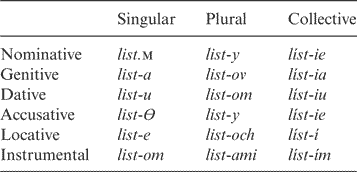
(a) formal and semantic irregularities (e.g. English deer, salmon, etc., and English skies, heavens, etc., respectively). Similarly, Russian gender distinction of singular paradigms is lost in the plural and Slovak collective nouns derived from a singular noun yield neuter gender from the masculine and, as the new noun behaves as a singular, a new inflectional paradigm,12
(b) lexical constraints, as numerous nouns cannot be pluralized or cannot take the singular form,
(c) preservation of number markings even where inflection completely disappears in the historical development of a language (e.g. in Bulgarian, English and Hindi), and
(d) use of borrowings and agreement with lexical gender rather than with inflectional case in the relative pronoun of inflectional languages like Russian.
Similarly, Kießling (pers. comm.) assumes that plural formation in Datooga and other Southern Nilotic languages is derivational because it belongs to a larger number reference system in nouns where plural and singulative are just two categories: many nouns show a tripartite distinction of the basic form with collective or generic reference, a singular reference form (singulative) and a multiple reference form (plural). All three forms could be morphologically derived, but the capacity to derive two or three forms and the selection of plural and singulative markers largely depends on the lexical root and is not predictable by phonological or morphological criteria. Therefore, plurals and singulatives should be viewed as part of the lexicon and, thus, of word-formation.
The derivational pole of the category of plurality may also be illustrated by the so-called pluractional verbs in Hausa as discussed by Newman (Reference Newman2000: 423–9). Pluractional verbs in Hausa indicate the plurality of action and are derived productively from corresponding non-pluractional verb stems by reduplication. Their meaning can concern a multiple, iterative, frequentative, distributive or extensive action. (20a) and (20b) are two of Newman’s examples, both based on preposing reduplication:
(20) Hausa
a. tun~tùnā
red~tunàa
pl/ite~remind
‘remind many or often’
b. hàhhaifàa
red~hàifā
pl/ite~give.birth
‘give birth many times or to many children’
A similar point can be made of Kwakw’ala, where plurality is a derivational category. According to Boas (Reference Boas, Boas Yampolsky and Harris1947: 246), this category may express repetition (21a), several subjects (21b) or simultaneous action (21c) in different parts of a unit:
(21) Kwakw’ala
a. mede´lxu~mede´lqwela
‘It is boiling repeatedly’
b. me-ɛ~mEdE´lqwela
‘Many are boiling’
c. maɛe´~mdElqwEla
‘It is boiling in all of its parts’
The three different plural formations in Kwakw’ala resemble the plural system in Hausa. According to Anderson (Reference Anderson and Shopen1985: 30), the derivational status of at least the temporal, aspectual and plural groups is indicated by their being ‘optional, and present only where necessary for emphasis or disambiguation; and . . . equally applicable to words of any syntactic function or word class’.
While these facts argue for a case of pluractional markers as derivational in nature, this is not so in every language. A case in point is Karitiâna, an Arikem language spoken in South America. Sánchez-Mendes and Müller (Reference Sánchez-Mendes, Müller and Deal2007) provide conclusive evidence that pluractionality excludes all singular, atomic events from the denotation of their verbs and thus behaves like the plural affix for nouns: its basic meaning is ‘more than one event’. Consequently, pluractionality in Karitiâna cannot, among other things, express distributive meaning (the distributive meaning postulates the distribution of singular events, which are, however, not in the denotation of pluractional predicates). This point has been raised in reference to another language, Ket, where an inflectional suffix with plural meaning becomes a derivational one. Werner (Reference Werner1998: 41ff.) shows that the derivational suffix -η goes back to the plural suffix -η. (22) and (23) are examples of the acquired derivational status of -η:
(22)
(23)
In many cases the lexicalized plural forms are collective nouns which have developed a secondary plural form, such as those in (24):
(24)
However, as noted by Werner (Reference Werner1998: 46), the derivational status of the original plural suffixes -η and -s’in may be called into question, because they are preceded by a plural suffix:
(25)
Werner refers to a similar observation by Bloomfield about German, where the plural of the diminutive Kindchen ‘small child’ is formed from the plural form of the non-diminutive base, i.e. Kinder yielding Kinderchen. As noted by Bloomfield (Reference Bloomfield1933: 226), ‘if a language contained too many cases of this sort, we should simply say that it did not distinguish such morphologic layers as are denoted by the terms “inflection” and “word-formation”.’
A different piece of evidence is the participation of derivational affixes in inflectional paradigms, as in Breton (Stump Reference Stump, Štekauer and Lieber2005: 61–4), where the highly productive suffix -enn attaches to collectives. The resulting word is in the singular:
(26)
This suffix can derive countable nouns from mass nouns and also be attached to a count noun or an adjective to produce a semantically related noun. All the derivations are of a feminine gender regardless of the properties of the base. The ability to change word-class and to determine the gender of the resulting formation and also other facts (e.g. -enn can be followed by another derivational suffix) suggest a derivational status for -enn, whereas the fact that the choice of the form (singulative or collective) is determined by the syntactic context13 suggests inflectional status of -enn, because selection of inflectional forms for the sake of grammatical agreement is a typically inflectional property.
A final argument for the derivational nature of various aspects of plurality is its additional semantic content beyond the basic meaning of plural ‘more than one’. When simple plural, as in prototypical inflectional paradigms, is compared with various meanings of plurality, a substantial difference between plural and plurality follows from the inclusion in the latter of additional semantic information represented by categories like collectivity, discontinuity, distribution, iterativity, quantitativeness, simultaneity, totality, etc.14The word-formation meaning of plurality thus follows from the additional semantic content added to the simple concept of ‘more than one item or action’ by the various plurality categories, as shown in Table 1.1:


Additional examples can be found in several other languages. Campbell (Reference Campbell1985: 46) states that some plural forms in Pipil take the suffix -wan when they are possessed. The suffix -wan expresses inalienable possession, usually with kinship terms or other closely related terms:
(37)
- Pipil
-manuh-wan
‘brothers’
Cowan (Reference Cowan1969: 108) characterizes the Tzotzil suffix -an with the meaning ‘multiple action of the same kind’ as a derivational suffix:
(39)
- Tzotzil
mĭl-an
kill.it-pl
‘do a lot of killing to them’
Finally, Rubino (Reference Rubino and Haspelmath2005a: 115) points out that in Luiseño, a Uto-Aztecan language spoken in North America, different variants of reduplication can denote various plural actions: lawi means ‘make a hole’ while law-lawi means ‘make two holes, make a hole twice’ and lawa-láwi ‘make many holes, more than two’.
The evidence and the arguments cited above do not conclude for or against the derivational nature of the traditionally inflectional category of number. However, they suggest that there seem to be enough grounds to separate, in cross-linguistic characterizations, the category of plural as an inflectional category from the conceptually/semantically more complex category of plurality, and that the latter of these would fall within the scope of word-formation.
1.1.4 Summary
This chapter is not intended to analyze all of the criteria proposed for the distinction between inflection and derivation in the literature, but the cases discussed here may illustrate the overall situation in the field. Extensive discussion on this issue can be found, among others, in Scalise (Reference Scalise1988), Dressler (Reference Dressler1989), Plank (Reference Plank and Asher1994), van Marle (Reference van Marle1995), Haspelmath (Reference Haspelmath1996), Booij (Reference Booij and Brown2006) and Aikhenwald (2007). These and other works give support to the assumption that the majority of the inflection vs derivation criteria are based on the principle of a continuum with typical cases of inflection at one end, typical cases of derivation at the other and numerous intermediate cases which show features of both inflection and derivation.
1 I.e. ‘It is slow’.
2 More examples of the fuzzy limit between inflection and derivation in Yeniseian languages, including incorporation complexes, causatives, aspectual forms, etc., can be found in Werner (Reference Werner1998: 137ff.).
3 Onomasiological categories are here understood as the ‘types of [the] inner structuring of the concept, in view of its expression in the given language’ (Dokulil Reference Dokulil, Panevová and Skoumalová1997: 187).
4 Cf. Štekauer (Reference Štekauer1996, Reference Štekauer, Štekauer and Lieber2005) for an onomasiological account of conversion as conceptual recategorization.
5 Van Marle (Reference van Marle1995) argues against the strict division of inflection and derivation based on examples of Dutch which, in his view, demonstrate that derivational forms may develop inflection-like properties, while inflectional forms may display derivation-like properties. Therefore, van Marle speaks of the ‘interwoven’ character of inflectional and derivational properties: ‘derivation and inflection bear upon two distinct aspects of words: their lexical-semantic dimension and their syntax-oriented dimension. Typical of word structure seems to be, then, that these two dimensions are often entangled . . . Evidently, this means that both dimensions of the word – i.e. the lexical semantic and the syntax-oriented – constitute a unity which is much closer than is often assumed’ (Reference van Marle1995: 78–9).
6 As noted elsewhere (Štekauer Reference Štekauer, Štekauer and Lieber2005), word-formation is a part of an important semiotic triad: (i) object (of an extra-linguistic reality) to be named, (ii) language user (as a coiner of a new linguistic sign, i.e. new naming unit), and (iii) linguistic sign itself as a new candidate for membership in the system of language (langue).
7 This question does not apply to unambiguous cases of changed denotation, like those given by Kryk-Kastovsky (Reference Kastovsky and Mugglestone2000), e.g. (Viennese) German Krüg-erl Bier ([pint-dim]) ‘pint of beer’, Italian libretto ([book-dim]) ‘opera libretto’ and Polish łyż-ecz-ka ([spoon-dim]) ‘teaspoon’.
8 Translation by Pavol Štekauer.
9 Both Serbian-Croatian -iva and Slovak -ov derive an imperfective, iterative/durative verb from a perfective verb.
10 From what is said above, we would rather speak of Aktionsart in these cases.
11 Kiefer, F. 1999. ‘Aktionsart-formation’, paper presented at the MMM2 conference, 10–12 September 1999, Lija, Malta.
12 These features confirm the existence of a new word. This is accompanied by stem vowel alternation, as in Slovak list ‘leaf’:
13 Thus, the syntactic context that determines the selection between the singulative noun sivienn ‘strawberry’ and the collective sivi ‘strawberries’ likewise determines the selection between the singular noun potr ‘boy’ and the plural form potred ‘boys’ (Stump Reference Stump, Štekauer and Lieber2005: 63).
14 Finer semantic distinctions are also possible: within the category of iterativity, E. Gruzdeva (2007. ‘Distributive plurality in Nivkh’, paper presented at the Workshop on Nominal and Verbal Plurality, 9–10 November, 2007, Paris) shows that in Nivkh, a language of the Nivkh family spoken in Eurasia, it is possible to distinguish between the so-called multiplicative plurality expressing repeated situations performed at the same period of time by identical participants, as in the first example below, and iterative plurality itself in which repeated situations are performed at different periods of time by identical participants, as in the second example below:
15 We opt for this term in accordance with Dressler (Reference Dressler1968: 63), who defines discontinuativeas a function denoting a rare repetition of an action, with the emphasis on the pauses between individual repetitions. Dressler (Reference Dressler1968) provides a subtle classification of various shades of the category of plurality.
16 With two participants.
17 With more than two participants.
18 The extreme case being absence of plurality.
19 From tanaw-ec ‘make peace’.
20 The hyphen at the beginning indicates that the noun is used with a possessive pronominal prefix, e.g. nu-mu:n-wan ‘my brothers-in-law’.
2 Word-formation vs syntax
[N]one of the possible criteria give a reliable distinction between two types of construction. The implication is that any distinction drawn on the basis of just one of these criteria is simply a random division of noun + noun constructions, not a strongly motivated borderline between syntax and the lexicon.
If we wish to delineate the scope of word-formation we are, among other things, expected to identify its basic unit, i.e. the linguistic sign resulting from a process of word-formation. This is important in terms of the separation between word-formation and syntactic structures, but it is particularly relevant with respect to word-formation processes combining free morphemes. These include compounding, noun incorporation, reduplication (partial reduplication being an exception) and blending. With the exception of the last, these processes usually rank among the major word-formation processes, which means that they are fairly widespread cross-linguistically and, in individual languages, they are usually among the most productive word-formation processes. These word-formation processes also coincide with what is labelled as natural word-formation processes in Natural Morphology, i.e they are based on the principle of constructional iconicity.
This chapter reviews the main pitfalls in the effort to draw a borderline between word-formation and syntax, i.e. the concept of wordhood (2.1), and the status of compounds (2.2). Section 2.3 is devoted to the process of (noun) incorporation and is taken as an illustrative example of a linguistic phenomenon for whose lexical (word-formation) nature there are arguments in favour and against.
2.1 Different notions of word
It is not easy to identify what language users intuitively have in mind when we talk about words. This can be seen in the discussion of this issue by Di Sciullo and Williams (Reference Di Sciullo and Williams1987) and also in Dixon and Aikhenvald (Reference Dixon and Aikhenvald2002). Several theoretical distinctions have been introduced to clarify the issue, like the separation of different words, i.e. words from the orthographical, phonological, lexical, morphological, grammatical and syntactic points of view.
This distinction does not solve the problem of word-formation and the units identified as words on the basis of one of these criteria need not necessarily coincide with what are words according to another (Julien Reference Julien and Brown2006: 617–18). This can be illustrated with Jaqaru, in which it is convenient to distinguish between morphological words, i.e. plain roots and roots with verbal and/or nominal suffixes (including thematic morphemes, (1) and (2), and syntactic words, which also contain ‘suffixes which tie them into the sentence structure’, (3) and (4); Hardman Reference Hardman2000: 8):
(1)
- Jaqaru
qumpishi
‘girdle, support worn inside the Tupe belt (wak’a)’
(2)
- Jaqaru
quqimi
‘dried ear of corn stored with the leaves’
(3)
- Jaqaru
qumpshi-wa
‘It is a girdle support’
(4)
- Jaqaru
quqmi-wa
‘It is a dried corn ear’
A number of replacement terms for word have been made available in the literature, such as lexical unit (Cruse Reference Cruse1986), listeme (Di Sciullo and Williams Reference Di Sciullo and Williams1987: 3) or naming unit (Štekauer Reference Štekauer1998, drawing on Mathesius Reference Mathesius1975). Each of these and others which are not mentioned here, have far-reaching theoretical implications. Thus, the listeme is defined as a unit listed in the lexicon, i.e. stored in the mental lexicon of a language user. Importantly, Di Sciullo and Williams (Reference Di Sciullo and Williams1987) explicitly emphasize the difference between listedness (listing a unit in the lexicon) and wordhood: not only words, but also morphemes, idioms, phrases and even sentences like English How do you do? are listed, because they do not have any internal structure to predict their semantic or grammatical behaviour and, therefore, must be memorized and stored in the lexicon. The lexicon is thus presented as a set of irregularities: ‘a collection of the lawless’ (Di Sciullo and Williams Reference Di Sciullo and Williams1987: 4). Yet, a great number of complex words are not listed, specifically those based on regular and productive word-formation rules. In other terms, it is not the word but the particular word-formation rule that is stored.
Listedness raises the issue of whether the various forms of words, the word-forms which are produced for categories like case, number, gender, person, tense and a number of other categories in inflectional languages are stored in the lexicon. It could be argued that they are stored and that, therefore, they should be considered listemes and, consequently, words. However, it can also be said that, as with productively coined words, a paradigm is identified with a word stored in the lexicon and the individual forms are generated for the purpose of syntax. It may even be the case that different inflected forms are dealt with differently. Julien (Reference Julien and Brown2006: 618) gives an example from Northern Saami, a Uralic language spoken in Eurasia: while it may be assumed that beana ‘dog.nom’ and beatnaga ‘dog.acc’ are both listed, the listedness of beatnagiidisctguin ‘with their (own) dogs’ is questionable.
Listedness is also difficult to apply to idioms: while they are semantically idiosyncratic and therefore should be listed (by the criteria given by Di Sciullo and Williams Reference Di Sciullo and Williams1987), they are also analyzable and therefore should not be listed (by the criteria given by Lieber Reference Lieber1981). The confusion is aggravated by the scalar nature of the compound vs idiom relationship, where compounds and idioms form a continuum of different degrees of transparency/opacity (cf. Kavka Reference Kavka2003, Reference Kavka, Lieber and Štekauer2009; Fernández-Domínguez Reference Fernández-Domínguez2009: 68). This discussion thus leads to the question of whether compounds should be listed or not and, if so, which compounds should be, which should not be and why.
Since, however, the linguistic signs which fall within the scope of word-formation are of a highly diverse nature, both cross-linguistically and not infrequently within one and the same language, linguists came to be rather uncertain as to what actually is a word and what is not. The following examples from several languages of a number of language families show that what is a word in one language can correspond to a sentence in another, in this case in English:
(5)
- Clallam
nə-sxwčɬ-ɬqčšɬšá?
my-cau-adv-affect-fifty
‘Fifty of them got me’
(6)
- Georgian
გა-მ-ა-კეთ-ებ-ინ-ებ-დ-ე-ს-ო
ga-m-a-k’et-eb-in-eb-d-e-s-o
preverb-v-io1.sg-version-do-thm-cau-ipf-sbj-s3.sg-quo
‘[If/when] s/he would make me do it, s/he says/said’
(7)
- Ket
da-u-g-d-o-v-il-tang
3f.sbj-3n.tr.obj-abl-across-thm-ins.app-pst-drag
‘She dragged it (using a conveyance)’
(8)
- Nelemwa
u-paare-a-r-I na
way.of-tell-det-it-of-me
(lit. ‘way of telling of it of me’)
‘[It’s] my way of telling it’
(9)
- Totonac
na-kin-ka:-ta-la’h-x’a:-te:lha-ni-ya:-n-tunká
fut-1obj-pl.obj-3pl.sbj-dst-husk.corn-amb-ben-ipf-2obj-very
‘They will go around husking lots of corn for us’
- Zulu
be-si-nga-sa-zu-m-biz-a
pst-we-neg-still-fut-him/her-call-v
‘We were no longer going to call him/her’
Fortescue (Reference Fortescue1980: 260) demonstrates for West Greenlandic that the sentence words of (5) to (10)1 should be viewed as real polysynthetic words rather than as strings of analytic words (cf. in this respect Anderson Reference Anderson and Shopen1985: 32–3, in reference to the polysynthetic language Kwakw’ala). Thus, the status of some sequences can be other than words or sentences by falling between the two in some ways. Schiffman (Reference Schiffman1996) notes that Tamil can combine nouns with verbs and make compound verbs, i.e. verbs that are equivalent to a verb in another language. The nominal part of this compound is not marked for case, though it may in fact be the semantic object of the verbal action.
The notion of compound makes the point at issue even more difficult to handle. Specifically, the separation of compounds from phrases has been described as ‘one of the more vexed problems in morphological theory, particularly in languages which are relatively poor in agreement morphology’ (Spencer Reference Spencer, Booij, Lehmann and Mugdan2000: 315; cf. also Giegerich Reference Giegerich2004, Reference Giegerich2009 on English; Booij Reference Booij2009 on Greek and Dutch; Schäfer Reference Schäfer2009 on Mandarin Chinese; van Goethem Reference van Goethem2009 on Romance and Germanic languages). This is the result not only of the vagueness of the notions under discussion and of the different theoretical positions that can be taken with respect to them, but also of the fact that a number of compounds develop from phrases.
The concept word is thus a fuzzy notion covering a range of various referents. In addition, the issue of wordhood is further obscured by the status of some bound elements which semantically behave as free morphemes and therefore remind us of Beard’s (Reference Beard1981) forty-four cognitive categories which can be potentially expressed by both inflection and derivation. From this it follows that there is a large number of elements which have identical cognitive bases and unequal status in terms of wordhood. Malkiel (Reference Malkiel and Greenberg1978: 127) gives examples of this well-known Indo-European phenomenon from German and Latin, but this is also common in Slavic languages as seen in Table 2.1.


Similar cases exist beyond the Indo-European linguistic area too. As noted by Dixit (pers. comm.), attachment of postpositions or adverbs to the stem is the crucial process of word-formation in Marathi. It is applicable to nouns, pronouns, adjectives, postpositions, adverbs and verbs, and produces adverbs, adjectives and conjunctions. Laca (Reference Laca, Haspelmath, König, Oesterreicher and Raible2001: 1219) also mentions formatives that have freely occurring particles but do not qualify automatically as lexemes:
(a) adpositional or adverbial particles that play a role both in phrase and in lexeme formation, mostly as prefixes, e.g. German gegen ‘against’, gegen mich ‘against me’ vs Gegenteil ‘opposite’ or vor ‘before, in front of’, vor ihm ‘before him’ vs vorkommen ‘happen’,
(b) lexemes belonging to major lexical categories that are being grammaticalized as derivational affixes by a well documented diachronic process in which derivational patterns emerge from series of compounds (or of set phrases that have been subject to univerbation). Thus, the status of German frei ‘free’, voll ‘full’ and arm ‘poor’, in risikofrei ‘free from risk’, angstvoll ‘fearful’ and gefühlsarm ‘showing little feeling, insensitive’ is doubtful. In such cases, affixal status only becomes certain when the corresponding lexeme disappears (as in the case of German -heit; cf. also English suffixes developed from lexemes) or when a clear semantic and/or formal split intervenes that disrupts the etymological connection (English full vs reduced and unstressed -ful, Spanish mente ‘mind’ vs the adverbial suffix -mente).
As in other issues, a continuum is assumed to exist between affixes (bound units) and words (free units), with different sorts of units between them, like various types of clitics (Zwicky Reference Zwicky1977). Thus, in describing Chalcatongo Mixtec, an Oto-Manguean language spoken in North America, Macaulay (Reference Macaulay1996: 14) refers to the category of phrasal affixes (i.e. affixes attached to phrases) and maintains that they are affix-like in terms of dependence and word-like in terms of placement.
2.2 The status of compounds
A number of criteria have been proposed in the literature for the identification of compounds. These criteria may have to be applied differently in different languages, as Plank (Reference Plank and Asher1994: 1672) proposed for the opposition inflection vs derivation, or each language may have additional criteria bound to its specific system: besides the difficulty inherent in the concept of compounding, the cross-linguistic study of compounding is further complicated by the fact that some languages may accept as compounds units which would not be accepted as such in other languages,2 or by the fact that they just do not exist in all languages (L. Bauer Reference Bauer and Brown2006: 721–2).3 A similar picture is obtained for noun incorporation, where opposing views and varied cross-linguistic evidence make it difficult to go beyond a rather general description.
Leaving aside the sentence-like words illustrated in (5) to (10), one of the central problems of word-formation is the position of compounds and their relation to syntactic phrases. The special position of compounds may be seen from their treatment or, rather, lack of any treatment, in early lexicalist works. Neither Halle (Reference Halle1973), in the first programmatic paper on generative word-formation, nor Aronoff in his breakthrough monograph of generative word-formation (1976), deal with compounds. Halle speaks of two types of word-formation rules, those combining stems and affixes, and those combining words and affixes. Aronoff’s word-formation rule is a phonological operation on the base which consists in attaching an affix.
In the transformationalist tradition, compounds are generated from kernel sentences and are treated as syntactic structures (Lees Reference Lees1960, Reference Lees, Bierwisch and Heidolph1970; Marchand Reference Marchand1965a, Reference Marchand1965b; Kastovsky Reference Kastovsky1969; Li 1971;4 Levi Reference Levi1978; Roeper and Siegel Reference Roeper and Siegel1978).
Compounds are assigned a special status by, among others, Strauss (Reference Strauss1982) and Anderson (Reference Anderson1992), who identify three components of morphology (inflection, derivation and compounding), and also by Jackendoff (Reference Jackendoff, Lieber and Štekauer2009: 113) in his conception of protolanguage as cognitive scaffolding on which modern language is built:
relics of earlier stages of the language capacity remain as pockets within modern language. These relics would have only rudimentary grammatical structure, and such grammatical structure as there is would not do much to shape semantic interpretation. Rather, we would expect semantic interpretation to be highly dependent on the pragmatics of the words being combined and on the contextual specifics of use. I suggest that compounding fills the bill completely.
No matter which of the numerous positions we adhere to, it is necessary to admit the diversity of views reflecting the diversity of the phenomenon of compounding, a word-formation process that is far from homogeneous. A case in point is Tzotzil, in which compounding admits four different types of stems (Cowan Reference Cowan1969: 89ff.):
(a) root (i.e. one morpheme),
(b) radical (root + one or more derivational affixes),
(c) compound itself, and
(d) compound radical (compound + one or more derivational affixes).
This gives rise to a number of combinations which are summarized in Table 2.2.
Table 2.2. Some combinations of the internal structure of compounds in Tzotzil

A number of references can be found in the literature on the identification of compounds (Marchand Reference Marchand1969; Adams Reference Adams1973, Reference Adams2001; L. Bauer Reference Bauer2001; Donalies Reference Donalies2004). One of the most recent ones, Lieber and Štekauer (Reference Štekauer2009), discusses various aspects of compoundhood (wordhood) and maps the state of the art in the field from the perspective of various theoretical approaches as well as by describing the process of compounding in various languages of the world. In the following we confine ourselves to the illustration of the word-formation/syntax problem by discussing the status of noun incorporation.
2.3 Compounding and noun incorporation
Like compounding, noun incorporation appears as one of the most problematic areas at the word-formation/syntax interface. Noun incorporation is here understood as a verb-forming process whereby a nominal stem is fused with a verbal stem to yield a larger, derived verbal stem. In noun incorporation, the incorporated noun functions as an argument (usually object) of the predicative verb. This is a definition of prototypical cases of noun incorporation, but this definition is not an all-encompassing one.5 Sadock (Reference Sadock and Brown2006: 585) shows that the scope of the concept of incorporation varies considerably, ranging from the original, narrowly defined noun incorporation up to any juxtaposition of two functional or lexical categories (Baker Reference Baker, Everaert, Evers, Huybregts and Trommelen1988).
Thus, while incorporation usually makes use of full words, there are also cases in which incorporation is based on an affix, like nominal stems fused with an affix. Recognizing an affix-based incorporation can be, according to de Reuse (Reference de Reuse1994: 200), traced back to Kroeber (Reference Kroeber and Heger1910). In West Greenlandic there are many bound verbal suffixes, such as -qar ‘have’, -si ‘get’, -lisaar ‘wear’, -tur ‘eat/drink’, -liur ‘make’ and -ssaaliqi ‘lack’ (Fortescue Reference Fortescue1984: 82):
(21)
(22)
Fortescue (Reference Fortescue1984: 84) wonders ‘whether “incorporation” is the best term to use here, since all verbalizing affixes like qar are bound forms, never stems’. In fact, as argued by Malouf (Reference Malouf, Webelhuth, Kathol and Koenig1999), while the resulting denominal verb has the full syntactic and morphological distribution of any verb in West Greenlandic and retains some of the properties of the incorporated nominal, it has little in common with noun incorporation constructions in languages like Mohawk, an Iroquoian language spoken in North America, or in Southern Tiwa, a Kiowa-Tanoan language also spoken in North America.
This case is not unique: Mithun (Reference Mithun1984: 885) reports on languages that ‘contain affixes which function much like I[ncorporated]N[oun]’s, often highly productively. Others contain affixes which function much like incorporating V[erb]’s, again often very productively.’ Similarly, Gerdts (Reference Gerdts, Spencer and Zwicky1998: 94–7) refers to the abundance of the so-called lexical suffixes in Salishan, Wakashan and other northwestern Amerindian languages which carry a nominal meaning denoting body parts, environmental concepts, cultural items and human terms.6 These suffixes undergo the same kind of incorporation as nouns and establish the same kind of relations as stem-based noun incorporation. In Gerdts’ view, ‘lexical suffixes can be regarded as incorporated nouns that have lost their status as free-standing nominals’ (Reference Gerdts, Spencer and Zwicky1998: 97).
A different case is offered by noun-stripping-based incorporation in Lakhota,7 in which a noun is followed by an adjectival modifier:
(23)
The usual objection is that a noun cannot be considered stripped if followed by an adjectival modifier. De Reuse argues, however, that the noun and the adjective are not a phrase. Instead they form a syntactic compound with its characteristic stress (i.e. main stress on the second syllable of the first constituent and secondary stress on the second syllable of the second constituent).
Mithun (Reference Mithun1984: 847) points out that ‘noun incorporation is perhaps the most nearly syntactic of all morphological processes’ and Katamba (Reference Katamba1993: 287) adds that it ‘obscures the boundary between syntax and morphology’. This is clear in borderline cases like the following from Udihe, where the bond between the verb b’a- ‘get’ and the incorporated noun in accusative is rather loose (Nikolaeva and Tolskaya Reference Nikolaeva and Tolskaya2001: 326ff.), and the latter may be modified by an adjective (24) and may even be separated from the governing verb (25) (Nikolaeva and Tolskaya Reference Nikolaeva and Tolskaya2001: 327):
(24)
(25)
In principle, there are two major positions on the status of (noun) incorporation: the syntactic position, which explains noun incorporation by a movement operation in syntax, and the lexical/word-formation position. In Leza’s (Reference Leza, Haspelmath, König, Oesterreicher and Raible2001: 714) view, neither the proponents of a syntactic approach nor those of a morphological (i.e. lexical) approach have argued unambiguously and compellingly in favour of their respective positions.
The syntactic approach to noun incorporation goes back to Mardirussian (Reference Mardirussian, Grossman, San and Vance1975) but was primarily developed by Sadock (Reference Sadock1980, Reference Sadock1985, Reference Sadock1986) and Baker (1983, Reference Baker1985, Reference Baker, Everaert, Evers, Huybregts and Trommelen1988).9 The argument is that noun incorporation is basically a syntactic process. In Katamba’s (Reference Katamba1993: 283) words it is ‘a productive syntactic rule that builds a special type of compound verb’. Baker makes use of his Mirror Principle to suggest that the processes employed in generating a complex form by noun incorporation mirror the syntactic processes. In his view, noun incorporation is based on the movement of a word from its position in a noun phrase of a sentence to a position inside a verb. Thus, Kageyama (Reference Kageyama1982: 243) treats noun incorporation like Japanese 腰掛ける (kosi-kakeru) ‘sit down’ (lit. ‘put one’s buttocks’),手間取る (tema-doru) ‘take time’, 物言う (mono-yuu) ‘say (something)’, etc. as nominalization compounds ‘derived from their paraphrasing sentential constructions’ by movement transformation. Baker argues in favour of a syntactic nature of noun incorporation by assuming that:
(a) incorporation can leave behind the non-head portions of the noun phrase,
(b) a copy may be left behind,
(c) only objects and subjects of intransitives can be incorporated, this being a syntactic specification, and
(d) incorporated nouns may introduce new discourse referents
(cf. Di Sciullo and Williams Reference Di Sciullo and Williams1987).
Syntactic arguments were called into question by Mithun (Reference Mithun1984), Di Sciullo and Williams (Reference Di Sciullo and Williams1987: 63–9) and Spencer (Reference Spencer1995, Reference Spencer, Booij, Lehmann and Mugdan2000). Mithun (Reference Mithun1984, Reference Mithun1986), Rosen (Reference Rosen1989), Anderson (Reference Anderson1992: 267–9) and Gerdts (Reference Gerdts, Spencer and Zwicky1998) propose a lexical approach instead, and treat noun incorporation as a lexical process, specifically as a special case of compounding. Thus, Gerdts (Reference Gerdts, Spencer and Zwicky1998: 84) defines noun incorporation as ‘the compounding of a noun stem and a verb (or adjective) to yield a complex form that serves as the predicate of a clause’.10
The proponents of the lexical/word-formation approach to noun incorporation agree on its general compounding principle, but the details and foci of their respective treatments of noun incorporation differ. Thus, Mithun (Reference Mithun1984) distinguishes four noun incorporation types primarily on the basis of various (discourse) functions and Rosen (Reference Rosen1989) classifies noun incorporations according to their syntactic features as two groups:
(a) those which preserve the argument structure of the incorporating verb intact (‘classifier N[oun] I[ncorporation]’),11 and
(b) those in which one argument of the verb is satisfied with the complex verb which results in turning a transitive verb into an intransitive one (‘compound N[oun] I[ncorporation]’).
Noun incorporation is, in the vast majority of cases, connected with incorporating a single noun. Yet, a rare case of two incorporated nouns, mostly combined with locative and instrumental prefixes, can be found in Lakhota. One such example, whose structure is [N+[Loc+[N+[Loc+[Loc+V]]]]], is given in de Reuse (Reference de Reuse1994: 216):
(26)
- Lakhota
xta?ómakhiyokpazA
evening-loc-earth-loc-loc-be.dark
‘grow dusk’
De Reuse (Reference de Reuse1994: 202) also shows that, in addition to an incorporated noun stem, Lakhota stative verbs can incorporate a pronominal prefix too. Thus, the stative verb chóla ‘be missing’ in (27) below has two arguments after noun incorporation: the stative pronominal prefix ma- ‘first person’ and the incorporated noun sí ‘foot’:
The inclusion or not of noun incorporation in the field of word-formation is just one example of how relevant theoretical frameworks can prove in typological research. It also illustrates that, in some cases, theory-independent approaches in typological research are just not possible.
Another point concerns the internal relations in word-formation itself. If we admit that noun incorporation is a word-formation process, we are then probably expected to decide on such borderline cases as represented by this phenomenon in English. It has long been assumed by the majority of morphologists that examples like English to chain-smoke, to sleep-walk, etc. are back-formations from the corresponding verbal compounds. The arguments are based mainly on the diachronic data indicating that the longer forms appeared historically before the shorter ones.
Not only does this sort of argument not seem to be sufficiently reliable to justify the claim concerning the nature of a word-formation process, but it may also be argued that the original process of back-formation in English gave rise to numerous analogical formations which did not rely on longer counterparts any more. The growing number of such formations12 may have triggered a synchronically productive process of noun incorporation. This account is favoured in Kiparsky’s approach (Reference Kiparsky and Yang1982a), which explains the generation of this class of expressions as compounding, based on the rule [Y Z]X (where X stands for a verb). An even stronger claim in this line was made by Kastovsky (Reference Kastovsky, Kastovsky and Szwedek1986: 419), when he predicted the gradual development of a productive process of noun incorporation. Kastovsky (Reference Kastovsky, Lieber and Štekauer2009: 338) recently strengthened this claim by arguing that ‘this type has become rather popular in Modern English as a result of the re-interpretation of denominal back-formations’. The position presented here, as in the opening lines of this section, is in accordance with E. Sapir (Reference Sapir1921), who also treats this kind of complex words as cases of noun incorporation: noun incorporation is thus viewed as compounding, i.e. a process controlled by word-formation rules (cf. Štekauer Reference Štekauer1998 and Reference Štekauer, Štekauer and Lieber2005).
2.4 Summary
Compounding and noun incorporation lie at the interface of word-formation and syntax and show that similar problems to the ones discussed in chapter 1 on the limit between inflection and derivation can be found between word-formation and syntax. In this respect, word-formation is no exception to the general fuzzy nature of linguistics. Partly for this reason, derivation, like inflection, is best described in terms of prototypical characteristics or, maybe, it can be described only in terms of prototypes. Unlike what happens in inflection and derivation, where the separation is presented as a gradient both by the literature (among others, Bybee Reference Bybee1985: 5; Plank Reference Plank and Asher1994: 1672) and by a review of language systems, the separation between compounding or noun incorporation and syntactic structures is much more difficult to express even in a gradient.
The implications for word-formation typology and universals are that decisions concerning the selection of the categories considered to be word-formation may be called into question. The range of ambiguous categories is relatively large. What seems therefore necessary is to focus on the prototypical and most productive instances of the individual word-formation processes. With such an approach (cf. also Booij Reference Booij and Brown2006: 654), there may still be a substantial space of uniqueness pertaining to both formal and semantic characteristics of the individual word-formation processes and categories and, first and foremost, to their respective functions.
1 As noted by Fortescue (Reference Fortescue1980: 261), ‘at least a dozen affixal morphemes can be found in single verb forms, and sometimes up to four of the same category . . . can be encountered successively’.
2 L. Bauer cites Glinert (Reference Glinert1989), who labels as compounds those units that an English-focused morphologist would identify as blends. Other examples cited by Bauer are French chemin de fer ‘way of iron’, i.e. ‘railway’, and pomme de terre ‘apple of earth’, i.e. ‘potato’.
3 Compounding has been reported here not to exist in Dangaléat, in Diola-Fogny, in Karao and in West Greenlandic, and the data for Kwakw’ala (Boas Reference Boas, Boas Yampolsky and Harris1947) indicate that compounding does not exist in this language as a productive word-formation process either.
4 Li, C. 1971. ‘Semantics and structure of compounds in Chinese’. PhD thesis, University of California, Berkeley, CA.
5 According to Sadock (Reference Sadock and Brown2006: 585), ‘it was in this sense that the word Einverleibung was originally used in describing facts of “Mexican” (Nahuatl) by von Humboldt, who contrasted a sentence with an independent verb and object: ni-c-qua in nacatl “I-it-eat the meat” with the incorporated form ni-naca-qua “I-meat-eat”’.
6 Examples from Kwakw’ala follow (Boas Reference Boas, Boas Yampolsky and Harris1947: 238–40):
7 According to Gerdts (Reference Gerdts, Spencer and Zwicky1998: 93–4), noun stripping (deletion of usual case markings or determiners of the noun phrase) differs from incorporation on the ground that the juxtaposed constituents preserve their phonological features, such as stress. On the other hand, ‘like incorporation, noun stripping is almost always limited to objects and to subjects of inactive verbs. Prototypical stripped nouns are indeterminate and inanimate’ (Gerdts Reference Gerdts, Spencer and Zwicky1998: 94).
8 Even so, certain features separate these instances of noun incorporation from syntactic structures: ‘The object in them does not passivize, does not control depictives and does not relativize, unlike a regular direct object . . . Unlike other objects, these compounds cannot be coordinated without repeating the verb . . . These properties suggest that we are here dealing with an object characterized by a certain degree of incorporation, and that the compound expressions . . . [in (24) and (25)] are transitional in character, being somewhere between a syntactic phrase and a lexical element’ (Nikolaeva and Tolskaya Reference Nikolaeva and Tolskaya2001: 327–8).
9 Baker, M. 1983. ‘Noun incorporation in Iroquoian’. Manuscript. Cambridge, MA: MIT.
10 Gerdts (Reference Gerdts, Spencer and Zwicky1998: 88), however, acknowledges the unique nature of this type of compounding because ‘in noun incorporation . . . the stem that results from the compounding of a noun stem and a verb serves a dual role in the clause: it is both the verb and one of the arguments of a verb’.
11 The term classifier reflects the fact that the incorporated noun classifies the object noun. In other words, the incorporated noun must be more general than the object NP. Therefore, as exemplified by Rosen (Reference Rosen1989: 297), while ‘I animal-bought a dog’ is acceptable, ‘I dog-bought an animal’ is not.
12 Cf., among others, Szymanek (Reference Szymanek, Štekauer and Lieber2005: 434), who maintains that this pattern ‘has been marked by considerable growth over recent years’.


