


14.1 Introduction
Over the last two decades, a sizable body of research has documented the importance of the early childhood years as a critical foundation not only for successful transition to school, but for literacy success in elementary school and beyond (for a review, see Reference Morrison, Bachman and ConnorMorrison, Bachman, & Connor, 2005). Further, a complex set of factors in the child, family, school, and larger sociocultural context, independently and in interaction, shape the growth of early literacy skills over that crucial time period. Recently, attention has focused on a set of skills called self-regulation (also executive function or effortful control), that has been shown to uniquely impact children’s literacy development and academic growth across the school years, as well as their success in adult life (Reference Moffitt, Arseneault and BelskyMoffitt et al., 2011). With emphasis on the context of the United States (see also Kieffer & Vuković, Chapter 2 in this volume), this chapter focuses on four central questions about self-regulation, a skill set essential to learning. First, how have scientists conceptualized self-regulation? As will be seen, there are multiple perspectives on the labeling of the term as well as on its measurement. Second, what are the extent and nature of individual differences in self-regulation during the transition to school? Third, what is the unique impact of self-regulation on early literacy and later academic achievement? Finally, can self-regulation be modified by appropriate environmental stimulation, especially in the school environment?
14.2 Conceptualizations of Self-Regulation
Self-regulation refers to the ability to modulate one’s thoughts, emotions, and social behavior in the service of achieving goals or otherwise acting appropriately. On a theoretical level, self-regulation has been conceptualized as a complex skill set, composed of three fundamental components: attention control/flexibility, working memory, and response inhibition. Understandably, this coordinated skill has been the object of much attention from scientists across a broad range of disciplines. Developmental scientists have focused on growth of executive functioning from infancy to early adulthood (Reference Welsh, Kalverboer and GramsbergenWelsh, 2001). Executive functioning (EF) has been conceptualized as the cognitive underpinning of the more overtly observable manifestations of behavioral, emotional, and social regulation. Along with education researchers, they have sought to understand the interplay between maturational and environmental factors that shape development of executive skills and the role of variability in children’s self-control, which emerges even before children start school, and the impact of this interplay on, for instance, American children’s poor academic achievement (Reference Duckworth and SeligmanDuckworth & Seligman, 2006; Reference Matthews, Ponitz and MorrisonMatthews, Ponitz, & Morrison, 2009). From a different perspective, neuroscientists studying cognitive-control processes have noted distinct differences between brain areas subserving basic cognitive functions (attention, memory) and those involved in integrating and coordinating attentional and memory skills. More recently they have also explored differences in the neural bases of these skills in children as compared to adults (Reference Welsh, Friedman, Spieker, McCartney, Phillips, McCartney and PhillipsWelsh, Friedman, & Spieker, 2006). In addition, cognitive scientists have been analyzing the underlying components of executive functioning (attentional control/flexibility, working memory, response inhibition, planning) to ascertain their structure and function (Reference Zelazo, Craik and BoothZelazo, Craik, & Booth, 2004).
In addition to disciplinary differences, a global perspective uncovers insights into self-regulation that are sometimes country- and culture-specific. For example, in a study of five-year-old children in England, Estonia, and the United States, gender differences in each EF subdomain – inhibition, mental flexibility, and working memory – were only present in Estonian children, with girls outperforming boys (OECD, 2020). Differences in the emergence and development of self-regulation between American and British children compared to Chinese and Korean children are also present, noted in a series of studies that we outline later in the chapter. Scholars have examined the extent to which parenting practices, shaped by culturally shared values around childrearing, might contribute to how children self-regulate as well as to the goals that individuals possess with respect to self-regulation (see Reference Jaramillo, Rendon, Munoz, Weis and TrommsdorffJaramillo et al., 2017, for a review). Although the present chapter focuses on the American context, we acknowledge the importance of attending to contextual factors outside the United States in the study of self-regulation.
Until recently, each discipline has been working in relative isolation from the others, with the consequence that definitions and measurement of self-regulation vary widely. The dominant labels are executive function (from neurophysiological and cognitive researchers), self-regulation (from educational and developmental scientists), cognitive control (from neuroscientists), and effortful control (from early childhood researchers). Likewise, the methods of measurement range from highly constrained tasks with simple responses (needed for neurophysiological and cognitive studies), to more child-friendly tasks that mimic real-world behaviors (Simon Says tasks), to more global assessments from parent and teacher rating scales. The proliferation of constructs and tasks has created a kind of “conceptual clutter” and “measurement mayhem” as these disciplines begin to integrate their efforts (Reference Morrison, Grammer, Griffin, McCardle and FreundMorrison & Grammer, 2016). At present, it is not clear whether these varying terms refer to distinctly different underlying skills or simply reflect the same construct. Likewise, little is known about how the various measures of self-regulation relate to each other or to real-world behaviors (Reference Morrison, Grammer, Griffin, McCardle and FreundMorrison & Grammer, 2016). In this chapter, we adopt a broad definition that we introduced earlier in this section: Self-regulation refers to the ability to modulate one’s thoughts, emotions, and behavior in the service of achieving goals or otherwise acting appropriately.
14.3 Early Variability in Self-Regulation
As for many skills important for academic success, variability in children’s self-regulation emerges early and can remain stable throughout the school years and beyond without explicit intervention (Reference Morrison, Ponitz, McClelland, Calkins and BellMorrison, Ponitz, & McClelland, 2010). Researchers have consistently found that children from families with higher socioeconomic status (SES) outperform lower-SES children on multiple measures of EF (i.e., Reference Hackman and FarahHackman & Farah, 2009; Reference Noble, Norman and FarahNoble, Norman, & Farah, 2005). For example, a study of American kindergartners found that middle-SES children outperformed low-SES children on inhibition and cognitive-flexibility tasks, and further, that SES accounted for 15 percent of the variance of the composite EF score (Reference Noble, Norman and FarahNoble et al., 2005). Additionally, a study by Reference Matthews, Ponitz and MorrisonMatthews et al. (2009) demonstrated wide individual variability even within a sample of middle-SES children. In that study, children were tested at the beginning of kindergarten on two measures: a direct assessment of their response inhibition and a teacher report of their overall self-regulation in the classroom. The direct assessment utilized the Head-Toes-Knees-Shoulders (HTKS) task, in which children, after following a researcher’s example of touching their head, toes, and so on, on command, are then instructed to do the opposite, for example, touch their toes when told to touch their head. The Child Behavior Rating Scale (Reference Bronson, Tivnan and SeppanenBronson, Tivnan, & Seppanen, 1995) was given to teachers, one subscale of which was utilized as a measure of self-regulation (example item: this child can complete a task that requires multiple steps). The frequency distribution on the HTKS task mirrored those on the rating scale. Results from teacher ratings are depicted in Figure 14.1. Substantial variability in children’s self-regulation ratings at the beginning of the kindergarten year emerged across teachers. Girls were rated higher than boys and look more similar to each other. Strikingly, teachers also rated as lowest in self-regulation a small but notable cluster of boys at the bottom of the distribution.
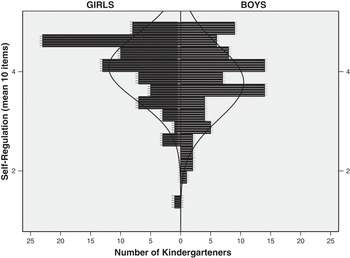
Figure 14.1 Frequency distribution of teacher ratings of self-regulation for males and females at the beginning of the kindergarten year
The pattern of results from this study and others (see Reference Morrison, Ponitz, McClelland, Calkins and BellMorrison et al., 2010 for a review) corroborate recent findings that meaningful variation in important cognitive skills, including self-regulation, emerge early in development. Further, gender differences in self-regulation favoring girls are evident in early childhood in the United States and may have long-term implications for later development. In that regard, it is noteworthy that a major underlying reason for the gender gap may reside with a group of particularly low-performing boys. Keep in mind that the children in this study all came from middle-SES backgrounds in the United States; including more disadvantaged children would arguably have increased the proportion of low-performing boys. Finally, the close agreement between the direct measure and teacher ratings not only reinforces the overall patterns found but reveals that teacher ratings of self-regulation can accurately mirror direct assessment in a predominantly white middle-class US sample.
Interestingly, gender differences in self-regulation commonly found in American children have not consistently emerged in recent studies of young children in East Asia (Reference Wanless, McClelland and LanWanless et al., 2013; Reference WeixlerWeixler, 2012). Wanless et al. found no gender difference in behavioral regulation in young Chinese and Korean children (ages three to six), despite finding a sizeable female advantage among American children. Similarly, Weixler found a substantial female advantage in both attention and working memory in American kindergarteners, but a gender gap was only present in working memory in Chinese children.
Furthermore, young children in China and South Korea are well ahead of typical American and British children in the development of self-regulation skills (Reference Oh and LewisOh & Lewis, 2008; Reference Sabbagh, Xu, Carlson, Moses and LeeSabbagh et al., 2006; Reference WeixlerWeixler, 2012; Reference Yang, Yang and LustYang, Yang, & Lust, 2011). Across multiple domains of self-regulation, Chinese and Korean children outscore their counterparts in the United States and Britain by as much as half to three quarters of a standard deviation. These gaps pervade all socioeconomic levels, and findings from one study indicate that high-SES children in the United States, whose parents typically have graduate degrees and high-status occupations, score similarly to low- and lower-middle-SES Chinese children, whose parents, on average, have a high-school education or less (Reference WeixlerWeixler, 2012). Though little evidence exists to identify the origins of Chinese and Korean children’s early advantage in self-regulation relative to American children, some findings point to cultural differences that include social and family structures, as well as environmental influences, particularly early education, in facilitating the more advanced development of self-regulation in young children in these countries (Reference Tobin, Hsueh and KarasawaTobin, Hsueh, & Karasawa, 2009; Reference WeixlerWeixler, 2012).
14.4 Self-Regulation and Academic Achievement
Beyond discovery of early variability in self-regulation, accumulating evidence has demonstrated that differences in self-regulation uniquely predict children’s emergent literacy skills (Reference Blair and RazzaBlair & Razza, 2007) as well as their academic achievement across elementary school (Reference McClelland, Acock and MorrisonMcClelland, Acock, & Morrison, 2006; see Reference Morrison, Ponitz, McClelland, Calkins and BellMorrison et al., 2010 for a review). Some, but not all, studies have shown that self-regulation predicts performance on math tasks more strongly than on reading tasks. This difference may stem, in part, from the fact that elementary math tasks, especially word problems, engage all three self-regulatory skills to a greater degree than beginning reading tasks, which focus primarily on single-word decoding. The sweep of self-regulation is not limited to academic domains or to childhood. A study by Reference Moffitt, Arseneault and BelskyMoffitt et al. (2011) found that individual differences in self-control in early childhood predicted patterns of health, wealth, and criminality in adults decades later. Clearly, growth of self-regulation across the lifespan exerts a broad influence on many domains that underlie life success.
For that reason, in part, scientists have been interested in the degree to which self-regulation can be modified. Until recently, conventional wisdom viewed self-regulation as primarily under maturational control. Schools themselves seem to have adopted this view implicitly, because there has been little effort to explicitly teach self-regulation skills in the classroom as part of the school curriculum. This is changing gradually, as schools recognize the potential power of self-regulation in enhancing children’s life chances inside and outside the classroom.
Does schooling have a direct effect on growth of self-regulation? Clearly self-regulation improves as children progress through school, and spurts in self-regulation can be seen from preschool to early elementary school. But these changes could all be driven by maturation. We tried to address the causal connection between experiences in school and growth of self-regulation using a natural experiment (Reference Morrison, Bachman and ConnorMorrison et al., 2005; Reference Morrison, Kim, Connor and GrammerMorrison et al., 2019). Each year school districts admit students to kindergarten based on a birthdate cutoff that varies widely across localities. The regression discontinuity design (RDD), a quasi-experimental technique, allows us to conduct a natural experiment in which children’s experience in school varies as a function of when their birthday falls relative to the school entry cutoff date. Children born prior to the cutoff date are permitted to enter kindergarten, while those born after the date must wait until the following year. Using RDD, it is possible to generate relatively unbiased estimates of the unique effect of schooling without the need for randomization (e.g., Reference Imbens and LemieuxImbens & Lemieux, 2008; Reference Jacob, Zhu, Somers and BloomJacob, Zhu, Somers, & Bloom, 2012; Reference Thistlethwaite and CampbellThistlethwaite & Campbell, 1960). A variant of RDD, called the school cutoff method, selects children who cluster very closely around the school cutoff date (by one or two months); we can then effectively equate children on age and compare their growth, using a pre-post design. Differences in growth rates over the school year can be legitimately attributed to schooling-related experiences, though the exact nature of the experience responsible for the differences needs to be separately determined.
Across a number of studies, evidence has accumulated that schooling does in fact have a significant impact on a variety of cognitive, language, and academic skills over the school transition period, generally viewed as three years of age to third grade (Reference Morrison, Bachman and ConnorMorrison et al., 2005; see Reference Morrison, Kim, Connor and GrammerMorrison et al., 2019, for a review). Further, research has documented that the extent and timing of the schooling effect varies across different skills (Reference Christian, Morrison, Frazier and MassettiChristian et al., 2000). For example, school cutoff studies have revealed that single-word decoding is influenced both during kindergarten and first grade, but phonemic awareness is uniquely enhanced by schooling experiences much more strongly in first grade. In contrast, the impact of schooling experiences on vocabulary remains mixed, with some studies showing schooling effects on receptive vocabulary (e.g., Reference Weiland and YoshikawaWeiland & Yoshikawa, 2013; Reference Wong, Cook, Barnett and JungWong et al., 2008) but no schooling effects on expressive vocabulary (e.g., Reference Christian, Morrison, Frazier and MassettiChristian et al., 2000; Reference Kim and MorrisonKim & Morrison, 2018; Reference Skibbe, Connor, Morrison and JewkesSkibbe et al., 2011).
In an effort to examine schooling effects on growth of self-regulation skills, Reference Burrage, Ponitz and ShahBurrage et al. (2008) employed the school cutoff method to compare groups of younger kindergarten children and older pre-kindergarten children on two self-regulation skills: working memory (from the Woodcock Johnson-III [WJ-III] battery; Reference Woodcock, McGrew and MatherWoodcock, McGrew, & Mather, 2001) and response inhibition (HTKS). They also included a measure of word decoding from the WJ-III as a manipulation check. The groups did not differ on maternal education. The results for word decoding revealed that kindergarten children outperformed pre-K children at beginning-of-year testing, revealing a schooling effect during the pre-K year. In addition, a separate effect of the kindergarten year was revealed in a significant group difference favoring kindergarten children at the end of the academic year. The outcomes for working memory demonstrated a strong schooling effect during the pre-K year (beginning-of-year comparison), and while there was not an independent schooling effect during the kindergarten year, the kindergarten children maintained their advantage on the end-of-year posttest. Interestingly, the findings for response inhibition were quite different. Here, there is a marginally significant effect of schooling during the pre-K year, but no evidence of a schooling effect in kindergarten and, in reality, minimal evidence of growth in response inhibition over the two-year period.
Taken together, results for self-regulation mirror those for other skills studied. In these data, schooling experiences do produce significant, unique growth in working memory skills in preschool, but not response inhibition (though other studies find effects for both working memory and response inhibition, as well as attention flexibility, i.e., Reference Weiland and YoshikawaWeiland & Yoshikawa, 2013). While the reasons for the different patterns remain to be studied, some evidence points to the potential role of classroom experiences. Specifically, Reference Cameron, Connor and MorrisonCameron, Connor, and Morrison (2005), using direct classroom observations in first grade, examined teacher’s use of orienting and organizing language in directing children’s actions. This variable, labeled, “orient-organize,” consisted of instructions to the children about what would be happening in the next half-hour, day, or week, and what the children needed to do to prepare. The coding scheme describes “orient-organize” as follows: “the teacher explains to students how they should organize their classwork time (for example, the teacher describes each activity available for ‘activity time’ or explains that students should work on journaling first, then math, and then free reading); teacher focuses students’ attention on the next activity; etc.” (Reference Cameron, Connor and MorrisonCameron, Connor, & Morrison, 2005). They found that the more time teachers spent in orient-organize instructions, the less time children took to transition between activities. Further, teachers who spent more time in orient-organize instructions in the first half of the school year had children who spent more time managing their own activities in the second half of the year. Reference Connor, Ponitz and PhillipsConnor et al. (2010) found that classroom management that included clear expectations for self-regulated learning led to greater gains in self-regulation for students with initially weaker skills.
We have examined research that demonstrates that EF skills can predict academic outcomes. Before we leave this section, it is important to acknowledge that academic skills and psychological processes may be bidirectionally related to each other. The theory of mutualism argues that the development of skills in one domain can influence the development of skills in another domain (Reference Van der Maas, Dolan and Grasmanvan der Maas et al., 2006). In the domain of academic achievement, research has revealed that cognitive abilities and academic skills predict each other in development, and that direct academic instruction can improve reasoning skills (Reference Peng and KievitPeng & Kievit, 2020). Empirical research has demonstrated bidirectional links between EF skills and math ability (e.g., Reference Clements, Sarama and GermerothClements, Sarama, & Germeroth, 2016) and science ability (Reference Kim, Bousselot and AhmedKim, Bousselot, & Ahmed, 2021). Clearly, additional work is needed to elucidate the nature of the bidirectional links between self-regulation and academic achievement.
14.5 Broadening the Scope: Neurobiological Perspective
Recent investigations have explored individual differences in neurobiological indicators of self-regulation and academic achievement. This exploration into the neural underpinnings of achievement and behavior allows us to better understand the nature and development of self-regulation in young children. Notably, it is possible that development of self-regulation can be observed in the brain before it is manifested in observable behavior, with implications for understanding and training self-regulation (see also Rigatti et al., Chapter 12 in this volume).
Research using the event-related potential (ERP) technique has identified two brain components associated with cognitive processes that occur when individuals make mistakes on inhibitory control tasks. Because self-regulation is especially required in precisely those challenging situations in which controlling one’s responses and shifting attention is necessary for optimal performance, error-related ERP components can provide important insights into the nature and development of self-regulation.
The error-related negativity (ERN) is observed as a negative-going deflection in frontal brain locations immediately after an individual makes a mistake on a speeded target discrimination task (see Reference Gehring, Liu, Orr, Carp, Luck and KappenmanGehring et al., 2012, for a review). The ERN is thought to reflect conflict monitoring, a component of cognitive-control processes which overlap substantially with self-regulation. The error positivity (Pe) is observed as a slower positive deflection in parietal brain locations between 200 and 500 milliseconds after a mistake. In contrast to the ERN, the Pe is thought to reflect the conscious awareness of the mistake or perhaps response conflict (Reference Overbeek, Nieuwenhuis and RidderinkhofOverbeek, Nieuwenhuis, & Ridderinkhof, 2005), and has been associated with behavioral changes in task performance associated with committing an error.
We know that individual differences in ERPs are related to meaningful variation in academic achievement in school-aged children and college students, and that a larger ERN and Pe indicate better capacities to engage cognitive-control mechanisms which promote better achievement on academic tasks (Reference Hillman, Pontifex and MotlHillman et al., 2012; Reference Hirsh and InzlichtHirsh & Inzlicht, 2010). When looking specifically during the transition to school period, findings from a recent investigation indicate that individual differences in early academic outcomes – particularly for reading – are related to the Pe but not to the ERN, and that this relation is positive and nonlinear in nature (Reference Kim, Grammer and MarulisKim et al., 2016). Other work has also linked ERPs with behavior and motivation (e.g., Reference Kim, Marulis, Grammer, Morrison and GehringKim et al., 2017; Reference Lamm, Zelazo and LewisLamm, Zelazo, & Lewis, 2006; Reference Moser, Schroder, Heeter, Moran and LeeMoser et al., 2011). It is worth noting that the majority of these investigations have shown links with the Pe and children’s school-related skills. This suggests that it is the conscious awareness of having made a mistake that may be more highly related to achievement and motivation. Moreover, these studies indicate that the relation between academics and ERPs depends on development and may be domain-specific, further highlighting the important heterogeneity of effects that is uncovered when brain and behavior are studied in tandem.
Less attention has been focused on whether environmental influences – such as schooling – can influence the magnitude of these ERP components. While research has amply demonstrated contextual influences on behavior and brain development, schooling effects on specific neural indices associated with cognitive control and academic achievement would indicate that the neural correlates of self-regulation might potentially be malleable as a function of school and classroom experiences, thereby transforming the way researchers understand, define, and measure self-regulation. As already mentioned, one potential mechanism might be the nature of teacher instructions to students, such as “orient-organize.” Other factors, such as global classroom climate, disciplinary practices, or incentive systems could be potential mechanisms of this effect and should be tested in future research.
Although it is not possible to randomly assign children to enter or not enter school, there are a number of ways to causally examine the role that schooling plays in children’s development, such as RDD and the school cutoff method (Reference Morrison, Kim, Connor and GrammerMorrison, Kim, Connor, & Grammer, 2019). As mentioned previously, both methods leverage the kindergarten entrance age mandated in each country context; by using the birthdate cutoff date, one can compare outcomes for children who are similar in age, but vary in the extent of their experiences in school. Put another way, depending on when they are born, children either enter school or not within a given year. Thus, it is possible to compare the performance of children who were able to go to school versus those who did not, controlling for age.
This comparison is most clear in the children born just before and just after the cutoff: they are virtually identical in age but differ by one year of schooling. As is portrayed in the top panel of Figure 14.2, for the development of some skills such as receptive vocabulary, children’s performance depends on age but not schooling experience. Thus, children on either side of the cutoff date (in this case December 1st) look similar in skill level. In contrast, as is demonstrated in the lower panel, for some skills, including alphabet recognition and word decoding (Reference Christian, Morrison, Frazier and MassettiChristian et al., 2000; Reference Morrison, Griffith, Frazier, Sameroff and HaithMorrison, Griffith, & Frazier, 1996), there are discrepancies in the performance of children who have birthdays on either side of the cutoff. When a schooling effect is observed, a gap in performance between children who are oldest relative to youngest for their grade can be seen.
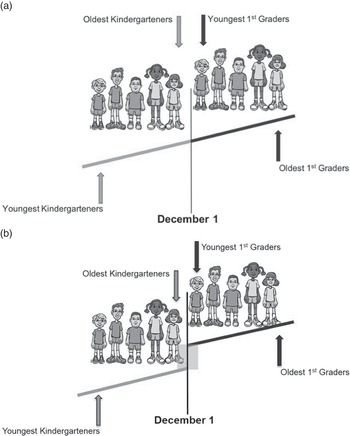
Figure 14.2 In the top panel, there is a linear effect of age, but not schooling. This is typically seen for measures of vocabulary, which appear to be more sensitive to biological maturation compared to schooling. In the bottom panel, there is a linear effect of age as well as a unique effect of schooling. This is shown by the positive slopes for each grade (i.e., an age effect) as well as a jump, or discontinuity, at the cutoff for first-grade children. That is, there is a unique impact of first-grade schooling on the outcome of interest, over and above the effects of age
Rather than assuming that children born within the two-month window are identical, a key assumption of the school cutoff technique, RDD can estimate linear or nonlinear regressions for groups who make versus miss the cutoff date for school entry within a prespecified window around the cutoff date (also called a bandwidth). Conditional on the two groups being equivalent on key demographic characteristics, a schooling effect is inferred if the regression lines “jump” at the cutoff date, indicating that the effects for the group who made the cutoff are attributable to schooling experiences and not to some other factor.
In our recent work examining brain and behavioral correlates of children’s EF development, we have found preliminary evidence that schooling can explain unique variance in individual differences in ERPs associated with self-regulation. Indeed, using RDD to examine behavioral and ERP data collected from 550 children in kindergarten and first grade, we find an impact of school experience on the differences between the amplitude of the ERN on error and correct trials elicited on a child-friendly go/no-go task. Specifically, experience in the first grade is associated with a 1.11 standard deviation increase in the ERN amplitude related to an additional year in the classroom. Similarly, when considering changes in Pe scores as a function of experience in first grade, we observe a 1.4 standard deviation change in Pe amplitude that is attributable to experience in Grade 1 relative to kindergarten (Reference Grammer, Gehring and MorrisonGrammer, Gehring, & Morrison, 2018).
Although the effects of experience in school can be seen on ERP correlates of children’s self-regulation, consistent with other work (Reference Brod, Bunge and ShingBrod, Bunge, & Shing, 2017), in our data we do not observe a commensurate impact of schooling on behavioral indices of these same skills including accuracy and reaction time. Put another way, the impact of school on children’s self-regulation cannot be seen when examining children’s behavior alone. This finding has potentially important implications on our general understanding of the impact that experience in school can have on children’s regulation. Self-regulation is particularly challenging to measure across the transition into school for a number of reasons, including tasks that are sensitive to age (i.e., floor and ceiling effects), whether the task taps into discrete dimensions of self-regulation or a global construct, where the task is administered (laboratory vs. school vs. home settings), and even whether the task is administered individually or in group settings (the latter potentially being more ecologically valid as a measure of self-regulation in typical learning environments) (Reference Ahmed, Grammer and MorrisonAhmed, Grammer, & Morrison, 2021). Challenges associated with behavioral measurement may be masking some of the impact in these skills that can be attributed to experiences children have in the classroom. Variations in the association between brain and behavioral measures of self-regulation, particularly in early childhood (Reference Grammer, Carrasco, Gehring and MorrisonGrammer et al., 2014; Reference Grammer, Gehring and MorrisonGrammer et al., 2018), suggest that these two different levels of measurement provide unique information regarding these skills. Thus, by assessing regulation at the behavioral and neurobiological levels, it may be possible to better understand the mechanisms by which experience in school impacts the development of these important skills.
Taken together, these findings related to the neural correlates of self-regulation indicate the substantial heterogeneity that exists in our understanding of self-regulation and related constructs in early childhood. Given the difficulties that the field has experienced with reliably measuring these constructs, it is not surprising that we find added complexity when we also consider the neurobiological correlates of early self-regulation and academic achievement. The field is ripe for further exploration by melding different levels of analysis as researchers seek to better understand the nature and development of self-regulation during the transition to school, with the potential to inform innovative approaches to training and promoting these important skills at an early age.
14.6 Conclusions and Discussion
Like many other skills underlying success in school and later life, individual differences in self-regulation emerge early in development before children enter formal schooling. Mounting evidence documents the strong unique effect of self-regulation on success in school and in later life in the United States and other parts of the world. Of particular interest is a subset of males who comprise the lower end of the distribution of self-regulation skills and who may be at risk for poor developmental outcomes. Despite these strong associations, self-regulation has been shown to be malleable during early development, raising the hope that appropriately timed interventions could improve the self-regulation skills of children at increased risk for poor academic and psychological outcomes. In fact, a host of promising interventions are currently being developed and evaluated. The success of these interventions will spawn new research on how self-regulation develops and when and how it can be modified to help children grow (see Reference Diamond and LeeDiamond & Lee, 2011).
While research bridging brain and behavior has revealed new insights regarding the impact of schooling on development at multiple levels of analysis, whether and how this knowledge can inform actual instructional practices remains an important question that should be addressed from an interdisciplinary lens. One important area of future research is to identify the classroom-level mechanisms that promote growth in self-regulation skills. Evidence using school cutoff and RDD have demonstrated that schooling has causal impacts on literacy and behavioral skill development, but what it is about schooling that leads to these effects has yet to be determined. Moreover, as we have alluded to, these classroom-level mechanisms may well vary depending on the cultural context in which learning takes place. For example, what are the values, goals, and expectations around learning and achievement that are shared by a given culture, and how do these cultural specifics shape how self-regulation is taught and trained in home and school settings? And which factors appear to be shared across cultures and countries? Demonstrating mere cause–effect relations between schooling and development, while critical, presents only an incomplete picture. In-depth studies are needed to uncover what actually happens in school and classroom environments that promotes growth in literacy and behavioral skills during childhood.


