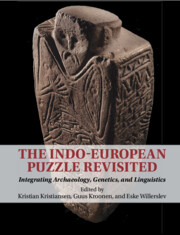


From May 2 to 5, 2018, the editors of this volume hosted an international, interdisciplinary conference at Gothenburg University under the name “When Archaeology Meets Linguistics and Genetics.” Thanks to a generous grant from Riksbankens Jubileumsfond in 2016, the three organizers had already become involved in multiple interdisciplinary research projects on European prehistory. It was our ambition also to bring together other scholars from the aforementioned fields, in particular those working to solve some of the central questions related to the puzzle of Indo-European origins. With this vision in mind, we invited some of the most active scholars from archaeology, linguistics, and genetics to come to Gothenburg, and to present the state of the art of their fields.
To make this a constructive interdisciplinary encounter, we decided to organize the conference around a number of themes, each with a contribution from archaeology, linguistics, and archaeogenetics, when possible. These are (1) early Indo-European and the origin of pastoralism, (2) migratory processes and linguistic dispersals between Yamnaya and the Corded Ware, (3) the cultural and linguistic significance of Bell Beakers along the Atlantic fringe, (4) the Bronze Age chariot and wool horizons, and (5) kinship systems, marriage, fosterage, free and unfree. It turned out to be a rewarding approach, we believe, even if some results were unexpected, surprising, or straight-out problematic. After all, it is only by identifying new problems that new explanations can be explored, and in the interdisciplinary arena of Indo-European studies, such identifications often only happen by combining all of the available data sets.
Now, we can present this volume as a lasting result of our ambition to unite scholars from our highly divergent but increasingly interdependent fields. We would like to express our deepest gratitude to all the participants for joining our meeting in Gothenburg, for presenting their ideas, and for participating in the discussions, and last but not least for reevaluating their results in the light of their experiences at the conference.
We further thank the authors for contributing one or sometimes even two papers, each of which can be considered pioneering studies in their corresponding areas of research. While we cannot claim to have solved all the problems concerning the dispersal of the Indo-European languages, we are confident that the papers presented in this book take important new steps toward understanding what lies at the heart of the formation of the Eurasian linguistic landscape, i.e., the Indo-European dispersal. Although the puzzle of the Indo-European origins is over a century old, there has hardly ever been a more fascinating time to study it. By addressing all the old and the new problems that this topic presents, fresh insights can be gained not only on this key question in European prehistory, but also on how to make new inroads into the development of interdisciplinary tools for addressing other such major questions concerned with our shared human past.
Finally, we thank Kristen de Joseph for her efforts in copy-editing all the contributions and Richard Potter for helping us prepare the manuscript for publication.
