

Between 3000 and 2500 BCE, populations derived genetically from individuals assigned to the Yamnaya archaeological culture migrated out of their steppe homeland eastward to the Altai Mountains and westward into the Hungarian Plain and southeastern Europe, an east–west range of 5,000 km across the heart of the Eurasian continent (Allentoft et al. Reference Allentoft, Sikora, Sjögren, Rasmussen, Rasmussen, Stenderup, Damgaard, Schroeder, Ahlström, Vinner, Malaspinas, Margaryan, Higham, Chivall, Lynnerup, Harvig, Baron, Della Casa, Dąbrowski, Duffy, Ebel, Epimakhov, Frei, Furmanek, Gralak, Gromov, Gronkiewicz, Grupe, Hajdu, Jarysz, Khartanovich, Khokhlov, Kiss, Kolář, Kriiska, Lasak, Longhi, McGlynn, Merkevicius, Merkyte, Metspalu, Mkrtchyan, Moiseyev, Paja, Pálfi, Pokutta, Pospieszny, Price, Saag, Sablin, Shishlina, Smrčka, Soenov, Szeverényi, Tóth, Trifanova, Varul, Vicze, Yepiskoposyan, Zhitenev, Orlando, Sicheritz-Pontén, Brunak, Nielsen, Kristiansen and Willerslev2015; Narasimhan et al. 2019). In Europe, their descendants created the Corded Ware and Bell Beaker horizons (Haak et al. Reference Haak, Lazaridis, Patterson, Rohland, Mallick, Llamas, Brandt, Nordenfelt, Harney, Stewardson, Fu, Mittnik, Bánffy, Economou, Francken, Friederich, Pena, Hallgren, Khartanovich, Khokhlov, Kunst, Kuznetsov, Meller, Mochalov, Moiseyev, Nicklisch, Pichler, Risch, Guerra, Roth, Szécsényi-Nagy, Wahl, Meyer, Krause, Brown, Anthony, Cooper, Alt and Reich2015; Frînculeasa et al. Reference Frînculeasa, Preda and Heyd2015; Olalde et al. Reference Olalde, Brace, Allentoft, Armit, Kristiansen, Rohland, Mallick, Booth, Szécsényi-Nagy, Mittnik, Altena, Lipson, Lazaridis, Patterson, Broomandkhoshbacht, Diekmann, Faltyskova, Fernandes, Ferry, Harney, de Knijff, Michel, Oppenheimer, Stewardson, Barclay, Alt, Avilés Fernández, Bánffy, Bernabò-Brea, Billoin, Blasco, Bonsall, Bonsall, Allen, Büster, Carver, Castells Navarro, Craig, Cook, Cunliffe, Denaire, Dinwiddy, Dodwell, Ernée, Evans, Kuchařík, Farré, Fokkens, Fowler, Gazenbeek, Garrido Pena, Haber-Uriarte, Haduch, Hey, Jowett, Knowles, Massy, Pfrengle, Lefranc, Lemercier, Lefebvre, Lomba Maurandi, Majó, McKinley, McSweeney, Gusztáv, Modi, Kulcsár, Kiss, Czene, Patay, Endrődi, Köhler, Hajdu, Luís Cardoso, Liesau, Pearson, Włodarczak, Price, Prieto, Rey, Ríos, Risch, Rojo Guerra, Schmitt, Serralongue, Silva, Smrčka, Vergnaud, Zilhão, Caramelli, Higham, Heyd, Sheridan, Sjögren, Thomas, Stockhammer, Pinhasi, Krause, Haak, Barnes, Lalueza-Fox and Reich2018), establishing a large part of the genetic ancestry in modern Europeans and probably their linguistic ancestry in the Indo-European language family as well (Anthony Reference Anthony2007; Reich Reference Reich2018). The Yamnaya archaeological culture (or “cultural-historical community,” in Soviet archaeological jargon) has consequently become a focus of wide interest. One debated subject that is perhaps most relevant for understanding the outbreak of long-distance migrations is the nature of the Yamnaya pastoral economy – were they nomads? This essay addresses Yamnaya nomadism as an innovation that opened the Eurasian steppes to productive human exploitation. It does not consider nomadic pastoralism in other parts of the world. Because the Yamnaya culture is little known or understood by Western archaeologists, I begin with an overview of Yamnaya chronology and variability.
2.1 Yamnaya Chronology and Variability
The Yamnaya or Pit GraveFootnote 1 culture was first defined by V. A. Gorodtsov (Reference Gorodtsov1907). His excavations in kurgans around Kharkhov in the northern steppes of Ukraine established the stratigraphic sequence of three grave types (pit grave, catacomb grave, and timber grave) that still frame the Bronze Age in the Pontic–Caspian steppes. The Pit Grave (or Yamnaya) culture defined the Early Bronze Age (EBA); catacomb graves represented the Middle Bronze Age (MBA); and the Timber Grave (or Srubnaya) culture represented the Late Bronze Age (LBA). EBA pit graves were in simple roofed pits under kurgans, MBA catacomb graves were (usually) in a niche or catacomb dug into one wall of the pit, and LBA timber graves (often) were in pits roofed with wooden logs (or, in the treeless steppe, with bundles of Phragmities reeds mistaken for logs after decay). Both the chronological period assigned to Yamnaya and its absolute dates have shifted over the decades, but Gorodtsov’s divisions of the steppe Bronze Age remain as a chronological framework.
By the 1950s, the paucity of metals in Yamnaya graves contrasted with the wealth of bronze weapons and tools in the emerging Bronze Age cultures of Europe, the Aegean, and even in Catacomb culture graves in the steppes. Two English-language syntheses of Soviet research of the 1950s and 1960s (Gimbutas Reference Gimbutas1956: 89–92; Sulimirski Reference Sulimirski1970: 127–136) described Yamnaya as Late Neolithic. The perception that Yamnaya was poor in metal persisted long after it was disproved. Hansen’s (Reference Hansen and Starnini2013: Fig. 9.6) distribution map of copper and bronze daggers in EBA western Eurasia showed many daggers in Maikop contexts and many more in southeast Europe, but none in Yamnaya contexts in the Pontic–Caspian steppes. Meanwhile, in the Cyrillic literature, one regional survey of tanged metal daggers in Yamnaya graves counted fourteen examples in the Volga–Ural steppes (Morgunova Reference Morgunova2014); another counted twenty in the lower Dnieper steppes (Ryndina and Degtyareva Reference Ryndina and Degtyareva2018: 322). Accumulating metal artifacts from Yamnaya graves like these, combined with radiocarbon dates and typological links with the late Maikop culture (Korenevskii Reference Korenevskii and Pryakhin1980; Nechitailo Reference Nechitailo1991), prompted the gradual reassignment of the Yamnaya culture to the EBA by about 1990, returning to Gorodtsov’s periodization (Anthony Reference Anthony, Heyd, Kulcsár and Preda-Bălănică2021 describes these shifts in more detail). However, as with any shifting debate, the return was incomplete: Some archaeologists retain the Eneolithic label for the earliest phase of Yamnaya (Rassamakin Reference Rassamakin, Heyd, Kulcsár and Szeverényi2013) while most now regard the beginning of early Yamnaya as the start of the EBA (Telegin et al. Reference Telegin, Pustalov and Kovalyukh2003; Shishlina Reference Shishlina2008; Morgunova Reference Morgunova2014).
In the North Caucasus Mountains, bordering the steppes to the south, the EBA begins with the mid-fourth-millennium BCE appearance of the Maikop culture and its impressive arsenical bronze metallurgy, the central culture of Chernykh’s Circumpontic Metallurgical Province (Chernykh Reference Secoy1992: 67–83), in which Yamnaya was included. Maikop was the extreme northwestern frontier of sites displaying material and technological links with the “Uruk expansion” trade network of the West Asian EBA/Late Chalcolithic (Kohl Reference Kohl2007; Kohl and Trifonov Reference Kohl, Trifonov and Renfrew2014). Korenevskii (Reference Korenevskii2016, Reference Korenevskii, Kashuba, Reinhold and Piotrovskii2020) has argued that Mesopotamian/Iranian symbols such as the goat on the tree of life (a cosmological symbol with deep roots in Mesopotamia/Iran) and paired bull-and-lion images (icons of Mesopotamian/Iranian kingship, displayed in a region without lions) found in the monumental kurgan graves of the Maikop elite indicate that Mesopotamian socio-religious ideologies were introduced to the North Caucasus piedmont and perhaps to the steppes by Maikop warrior-chiefs; their elevation was linked with those ideologies as well as with the gold, silver, carnelian, and turquoise ornaments and bronze weapons they displayed. According to Wang et al. (Reference Wang, Reinhold, Kalmykov, Wissgott, Brandt, Jeong, Cheronet, Ferry, Harney, Keating, Mallick, Rohland, Stewardson, Kantorovich, Maslov, Petrenko, Erlikh, Atabiev, Magomedov, Kohl, Alt, Pichler, Gerling, Meller, Vardanyan, Yeganyan, Rezepkin, Mariaschk, Berezina, Gresky, Fuchs, Knipper, Schiffels, Balanovska, Balanovsky, Mathieson, Higham, Berezin, Buzhilova, Trifonov, Pinhasi, Belinskij, Reich, Hansen, Krause and Haak2019), the Maikop elite and ordinary people were genetically alike: local descendants of the Neolithic population that had migrated into the North Caucasus from Georgia about 4800 to 4700 BCE and remained connected genetically to Southern Caucasus/East Anatolian populations. Early Maikop material culture (ceramics, lithics, clay andirons) was deposited in two stratified Eneolithic settlements in the steppes of the lower Don River (Konstantinovka and Razdorskoe level VI), mixed with the late Sredni Stog material culture of the main occupation, probably in the mid-fourth millennium BCE. These sites testify to the occasional visits of early Maikop expeditions (in wagons?) as far north as the lower Don – without the luxury goods that distinguished Maikop chiefs. Maikop technologies, perhaps including wheeled vehicles (Reinhold et al. Reference Reinhold, Gresky, Berezina, Kantorovich, Knipper, Maslov, Petrenko, Alt, Belinsky, Stockhammer and Maran2017), were then copied and diffused across the steppes, and these innovations were fundamental parts of the Yamnaya revolution. However, Maikop and Yamnaya mates were rarely exchanged, as these two populations, so deeply entangled in other ways, seemed to remain genetically largely apart (Wang et al. Reference Wang, Reinhold, Kalmykov, Wissgott, Brandt, Jeong, Cheronet, Ferry, Harney, Keating, Mallick, Rohland, Stewardson, Kantorovich, Maslov, Petrenko, Erlikh, Atabiev, Magomedov, Kohl, Alt, Pichler, Gerling, Meller, Vardanyan, Yeganyan, Rezepkin, Mariaschk, Berezina, Gresky, Fuchs, Knipper, Schiffels, Balanovska, Balanovsky, Mathieson, Higham, Berezin, Buzhilova, Trifonov, Pinhasi, Belinskij, Reich, Hansen, Krause and Haak2019).
Early Maikop, around 3700 to 3300 BCE, was pre-Yamnaya, but late Maikop, including the weapon-rich graves at Nalchik (Belinsky et al. Reference Belinskii, Hansen, Reinhold, Tonussi and Rova2017) and Klady (Wang et al. Reference Wang, Reinhold, Kalmykov, Wissgott, Brandt, Jeong, Cheronet, Ferry, Harney, Keating, Mallick, Rohland, Stewardson, Kantorovich, Maslov, Petrenko, Erlikh, Atabiev, Magomedov, Kohl, Alt, Pichler, Gerling, Meller, Vardanyan, Yeganyan, Rezepkin, Mariaschk, Berezina, Gresky, Fuchs, Knipper, Schiffels, Balanovska, Balanovsky, Mathieson, Higham, Berezin, Buzhilova, Trifonov, Pinhasi, Belinskij, Reich, Hansen, Krause and Haak2019), was contemporary with early Yamnaya, about 3300 to 3000 BCE. Yamnaya metalsmiths copied late Maikop bivalve-mold casting methods, their preference for arsenical bronze, and their weapon types, including cast-tanged daggers, flat axes with expanding blade edges, and single-bladed sleeved shaft-hole axes – new types that partly define the EBA in the steppes (Korenevskii Reference Korenevskii and Pryakhin1980; Nechitailo Reference Nechitailo1991; Morgunova Reference Morgunova2014; Ryndina and Degtyareva Reference Ryndina and Degtyareva2018; Klochko Reference Klochko2019). Metallurgical links to Maikop explain why Yamnaya is assigned to the EBA, and why the EBA begins in the steppes more than a millennium before the EBA in central and western Europe: The Bronze Age chronology of the Pontic–Caspian steppes was linked to the Bronze Age chronology of southwestern Asia (Anthony Reference Anthony, Heyd, Kulcsár and Preda-Bălănică2021), not to Europe. Consequently, Yamnaya migrants might begin their journey in the EBA, but as they moved west, they entered regions where their graves are assigned to the Late Eneolithic (in the Carpathian Basin) or the Late Neolithic (north of the Carpathians), a problem well reviewed by Heyd (Reference Heyd, Heyd, Kulcsár and Szeverényi2013).
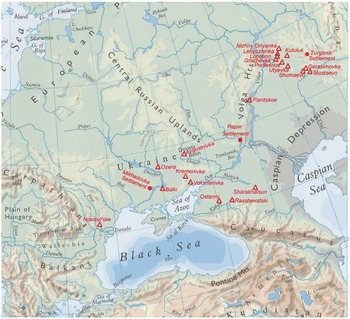
I recently discussed the radiocarbon chronology of the early phase of the Yamnaya culture with the goal of defending a reasonable date for the beginning of Yamnaya (Anthony Reference Anthony, Heyd, Kulcsár and Preda-Bălănică2021). At least fifty radiocarbon dates on bones, teeth, or wood that are not contradicted by a second date on the same feature, from contexts assigned by the reporting archaeologist to the Yamnaya culture, fall into the ≥ 4350 BP (3000 cal BCE and older) category (Table 2.1). Seven of these early dates derive from three early Yamnaya settlements (Repin, Mikhailovka level II, and Generalka 2, phase 1) and forty-three early Yamnaya dates derive from human graves in twenty-seven kurgan cemeteries distributed from the east Carpathian piedmont to the Ural River steppes (Fig. 2.1). The calibrated averaged midpoint for these earliest Yamnaya settlements and cemeteries is between 3203 and 3107 BCE (Table 2.1). Early Yamnaya material culture and its associated kurgan cemeteries began as early as 3300 BCE, spreading rapidly across most of the Pontic–Caspian steppes in 3200 to 3100 BCE, and finally, in its late phase, beginning in 3000 BCE, saturated all the regions of the steppes as Yamnaya nomads penetrated into neighboring regions.
Table 2.1. Radiocarbon dates of 4350 BP or older from three early Yamnaya settlements and twenty-seven graves: Sites with Repin-style ceramics are in italics.

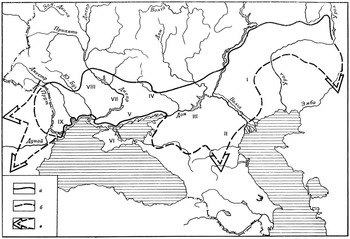
Figure 2.1. The nine regional groups (I–IX) of the Yamnaya culture defined by N. I. Merpert (Reference Merpert1974). In his legend, a = a documented border of a culture region; b = a supposed border of a region; and c = the direction of invasion of other culture areas. He argued that the oldest Yamnaya phases were found in groups I, II, and III, the lower Volga, and the lower Don.
Early Yamnaya material culture, as known primarily from graves, included wheeled vehicles, tanged daggers, sleeved axes cast in bivalve molds, and silver or copper hair rings, all of which might have been copied from late Maikop models. There were also triangular flint projectile points with a concave base (dominant form, with several minor types), canine-tooth pendants, stone end-pestles, bone pins (several types), and a diverse range of late-fourth-millennium ceramics. Kurgan graves with elements of this package – classically with the dead in the “Yamnaya position” (supine with raised knees), but occasionally contracted on the side, and strewn with red ochre – began to appear across the Pontic–Caspian steppes about 3300 to 3200 BCE. The average Yamnaya grave was poor in material wealth, but the average Yamnaya kurgan was a large mound often made of turfs, 30 to 40 m in diameter, and it usually covered a single (occasionally double) central grave that contained an adult male in 70 to 80 percent of cases (the percentage of males varied regionally but was the majority everywhere).
Yamnaya material culture was not homogeneous regionally or chronologically. N. I. Merpert, director of the Russian Institute of Archaeology in Moscow, published the foundational synthesis of the Yamnaya culture (Merpert Reference Merpert1974, Reference Merpert1977). He divided Yamnaya into nine regional groups distinguished by variations in grave rituals, pottery, and funerary artifacts (Fig. 2.2). The variant in the lower Volga steppes (I) typified at Berezhnovka II represented his oldest Yamnaya phase, and later regional variants represented expansion to the west and south. His Berezhnovka II “early Yamnaya” graves have since been shown by radiocarbon dates to be Eneolithic, contemporary with Khvalynsk, a millennium before Yamnaya. Merpert’s intuition, before Khvalynsk was discovered, that they were typologically archaic was correct, but his date estimate was late. His chronology was based partly on stratified kurgans in the lower Volga steppes, such as Berezhnovka (Mallory Reference Mallory1977; Merpert Reference Merpert1977), and partly on two Yamnaya settlement sites, Mikhailovka in Ukraine and Repin in Russia (Anthony Reference Anthony, Heyd, Kulcsár and Preda-Bălănică2021).
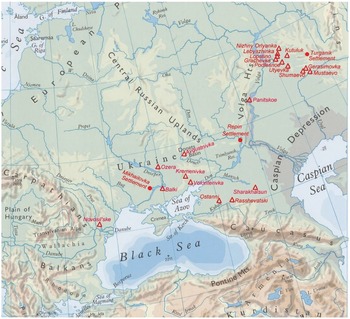
Figure 2.2. Early Yamnaya sites with radiocarbon dates ≥ 4350 BP. Circles: settlements, triangles: cemeteries. Non-Yamnaya sites of the same age are marked with a star. The concentration near Samara on the Volga reflects increased funding for dates from the Samara Valley Project, the Reich ancient DNA lab, and the Russian Academy of Sciences.
Mikhailovka, a unique settlement overlooking a probable ford across the lower Dnieper River, had three stratified phases in about 2 m of cultural deposits: stratum I (about 1,000 m2) was designated Late Eneolithic (ca. 3600–3300 BCE); II (about 1,500 m2) was early Yamnaya (3300–3000 BCE), the only Eneolithic settlement in the Pontic–Caspian steppes to expand in size in early Yamnaya; and III (about 15,000 m2 within fortification walls, not all occupied) was late Yamnaya (ca. 3000–2600 BCE). Merpert (Reference Merpert1974: 116–117) regarded Mikhailovka II as the initial expansion into the Dnieper steppes of early Yamnaya pastoralists from his proposed homeland on the lower Volga. The site report (Lagodovskaya et al. Reference Lagodovskaya, Shaposhnikova and Makarevich1959, Reference Lagodovskaya, Shaposhnikova and Makarevich1962) agreed that Mikhailovka II was the earliest Yamnaya chronological phase in the North Pontic steppes, a conclusion maintained forty years later in an updated site monograph (Korobkova and Shaposhnikova Reference Korobkova and Shaposhnikova2005) and supported by radiocarbon dates (Table 2.1; Anthony Reference Anthony, Heyd, Kulcsár and Preda-Bălănică2021). The Mikhailovka II ceramic assemblage contained shell-tempered, cord-impressed, flat-based pots that show continuity with local Eneolithic Sredni Stog/Mikhailovka I pottery, as well as egg-shaped vessels that would become more typical of Yamnaya, and finally thick-bodied vessels of the Repin type, about 10 percent of all vessels, not found in I or III (Kotova and Spitsyna Reference Kotova and Spitsyna2003).
The Repin style establishes a cultural-chronological link between the monotype Repin site (Kuznetsov Reference Kuznetsov2013) on the lower Don (where the direct ancestors of modern domesticated horses were identified; see below) and Mikhailovka II, supported by radiocarbon dates from both sites of 3300/3400 to 3000/3100 BCE (Table 2.1; Anthony Reference Anthony, Heyd, Kulcsár and Preda-Bălănică2021). Most Yamnaya graves and the largest Yamnaya settlements do not date to this early Repin phase, but to late Yamnaya, after 3100 to 3000 BCE. Mikhailovka III enclosed a space ten times larger than Mikhailovka II, with stone fortification walls preserved to a height of 2.5 m in the 1950s. Similarly, the Yamnaya settlement at Generalka, 100 km north of Mikhailovka, was almost entirely late Yamnaya (typologically like Mikhailovka III) with one small early Yamnaya feature (Tuboltsev and Radchenko Reference Tuboltsev and Radchenko2018; Kaiser et al. Reference Kaiser, Tuboltsev, Benecke, Evershed, Hochmuth, Mileto and Riesenberg2020). Late Yamnaya settlement components were thicker and larger in area than the few dated early Yamnaya settlements. The late Yamnaya period witnessed the rapid growth and expansion of people and sites that were culturally and/or genetically Yamnaya.
Individuals assigned to the Yamnaya culture by diverse archaeologists in the Pontic–Caspian steppes exhibit an unexpectedly narrow range of genetic variation (Wang et al. Reference Wang, Reinhold, Kalmykov, Wissgott, Brandt, Jeong, Cheronet, Ferry, Harney, Keating, Mallick, Rohland, Stewardson, Kantorovich, Maslov, Petrenko, Erlikh, Atabiev, Magomedov, Kohl, Alt, Pichler, Gerling, Meller, Vardanyan, Yeganyan, Rezepkin, Mariaschk, Berezina, Gresky, Fuchs, Knipper, Schiffels, Balanovska, Balanovsky, Mathieson, Higham, Berezin, Buzhilova, Trifonov, Pinhasi, Belinskij, Reich, Hansen, Krause and Haak2019), indicating that they shared ancestry in a small founding population. From a genetic perspective, the Yamnaya culture looks like a clan or sodality defined by shared paternal descent from a small set of male ancestors. How this homogeneous Yamnaya ancestry became established has not been adequately explained, but it contrasts with the variety shown in Yamnaya metals. Arsenical bronzes are more frequent in the North Pontic steppes (Klochko Reference Klochko2019), perhaps influenced by Maikop, versus “pure” copper tools and weapons in the Volga–Ural steppes, near the Yamnaya copper mines at Kargaly (Morgunova Reference Morgunova2014: 305). Ceramics were even more variable, exhibiting continuity with preceding regional Eneolithic traditions: Khvalynsk on the Volga (Dremov and Yudin Reference Dremov and Yudin1992), Repin on the Don, Mikhailovka I on the Dnieper, and Budzhak (Ivanova Reference Ivanova2013) in the Danube steppes. For Ivanova (Reference Ivanova2006; Ivanova et al. Reference Ivanova, Nikitin and Kiusak2018), the absence of a shared ceramic type meant that Yamnaya was not a proper archaeological culture (or cultural-historical community), but rather was an ideology or religion shared between distinct regional groups. Yamnaya was homogeneous in its genetic ancestry and funeral rituals but heterogeneous in its craft traditions in metal and ceramics, possibly suggesting that potters and metalworkers were local and genetically distinct from those buried under Yamnaya kurgans.
This summary establishes a brief foundation for understanding the Yamnaya economy. Important conclusions are that Yamnaya began in the late fourth millennium BCE almost everywhere in the Pontic–Caspian steppes at approximately the same time, an apparent rapid spread; the Maikop culture had a strong influence on early Yamnaya metals and weapon types and perhaps on politico-religious ideology, but the two communities remained genetically apart; Yamnaya kurgan graves contain a remarkably narrow range of human genetic variation, implying a small founding population that expanded rapidly; the largest and most numerous Yamnaya sites and the majority of radiocarbon dates come from the late phase, 3100/3000 to 2700/2600 BCE, implying significant growth in the Yamnaya population in its late phase, when it spread beyond the steppes; and Yamnaya homogeneity in genetics and funeral rituals contrasts with regional variability in ceramics and metals, perhaps suggesting that those buried under Yamnaya kurgans were an elite separate from local craftworkers.
But were they nomads? Recent specialist studies have made great progress in documenting the pastoral economy of the Yamnaya population.
2.2 Debates about Yamnaya Pastoralism
Nomadic pastoralism is the most mobile form of pastoralism, practiced in the Eurasian steppes by the Scythians, Huns, and Mongols, among many others. The people buried in Yamnaya graves are described in the Cyrillic literature as ‘stockbreeders’ (skotovody), or pastoralists. But they were not the first people in the steppes to keep domesticated animals, so just how Yamnaya stockbreeding was different from Eneolithic stockbreeding is one debated question; the role of agriculture is another. Until recently, a respected body of theory insisted that nomadic pastoralism could not have existed in the Bronze Age, because the conditions necessary for its evolution were not yet present (Shnirelman Reference Shnirelman1980, Reference Shnirelman1992; Kuzmina Reference Kuzmina and Mair2008: 214–215; Khazanov Reference Khazanov1994: 72–75). Häusler (Reference Häusler2003) stated that Yamnaya nomads were a myth, and Spengler et al. (Reference Spengler, Ventresca Miller, Schmaus, Motuzaite-Matuzeviciute, Miller, Wilkin, Taylor, Li, Roberts and Boivin2021) extended that doubt even to the Iron Age nomads of Central Asia, who were described as dependent on agriculture. Kaiser (Reference Kaiser2010) claimed that cattle were the focus of Yamnaya pastoralism (but see below), noting that cattle are unsuitable for long-range nomads. Manzura (Reference Manzura2005) argued that Yamnaya cattle were introduced by neighboring Cucuteni-Tripol’ye farmers, whose colonization of the steppes created the Yamnaya population and economy. Rassamakin (Reference Rassamakin, Marsha Levine, Rassamakin and Tatarintseva1999: 154) concluded that Yamnaya “… should not be described as nomadic, and even a semi-nomadic form of economy can only be proposed with reservations.”
Other equally expert authorities described the Yamnaya economy as the earliest form of nomadic pastoralism in the Eurasian steppes, explicitly comparing it to the nomadic pastoralism of Iron Age and Medieval nomads (Gimbutas Reference Gimbutas, Cardona, Hoenigswald and Senn1970, Reference Gimbutas1977; Merpert Reference Merpert1974; Shilov Reference Shilov1975, Reference Shilov and Maksimov1985; Dergachev Reference Dergachev2007; Morgunova Reference Morgunova2014: 276–293), but perhaps with shorter, more localized migration routes (Anthony Reference Anthony2007: 321–322; Shishlina Reference Shishlina2008: 230–236). This debate about Yamnaya mobility complicates how we understand the pancontinental migrations that began about 3100 to 3000 BCE. If Yamnaya pastoralism was semisedentary, then the mobility associated with Yamnaya pastoralism was not so different from Eneolithic pastoralism, and Yamnaya migrations could not be even partly explained by the evolution of a new, higher-mobility way of life in the steppes.
If, however, the Yamnaya economy represented the first invention of nomadic pastoralism in the Eurasian steppes, then it was a revolutionary innovation. By specializing in the meat and milk of a few domesticated animals that converted grass into food, clothing, shelter, and transport, the first steppe nomads greatly simplified their diet and opened the steppe grasslands to human exploitation. The wild, unexploited steppe plateaus between the river valleys became named pastures. The annual migrations that define nomadic life required emerging pastoralists to develop social and political institutions that defined rights to claim and use new pastures, rights to move across pastures claimed by others, the maintenance of family and clan cohesion between mobile groups, the maintenance of political power among mobile constituents, and a variety of technical skills such as horse management (trickier than with modern horses; see below) and wagon repair. Once matured, this organization and its supporting skills and institutions could have facilitated other kinds of long-distance mobility, including migrations to new territories. But what could have caused people to embrace a new and extreme form of residential mobility?
Most of those who do support the nomadic interpretation of Yamnaya pastoralism attribute the innovation of nomadism to climate change, which created more arid conditions in the steppes in the late fourth millennium BCE (Merpert Reference Merpert1974; Shilov Reference Shilov1975; Gimbutas Reference Gimbutas1977). While there is some palynological evidence for increased aridity coinciding with pre-Yamnaya and early Yamnaya (Pashkevich Reference Pashkevich, Pan’kov and Voznesens’ka1992, Reference Pashkevich, Levine, Renfrew and Boyle2003; Zakh et al. Reference Zakh, Ryabogina and Chlachula2010), it was not a catastrophic change. In any case, nomadism was not an automatic response to increasing aridity, particularly among Eneolithic riverine steppe societies with complex diets including some domesticated cattle and sheep, hunted equids, deer and beaver, and abundant fish and shellfish (faunal lists in Dergachev Reference Dergachev2007: 447–448; Anthony and Brown Reference Anthony and Brown2011; Vybornov et al. Reference Vybornov, Kulkova, Kosintsev, Platonov, Platonova, Philippsen and Nesterova2018, Reference Vybornov, Kosintsev, Kulkova, Doga and Platonov2019).
I instead stress the introduction of wagon transport after about 3500 BCE, combined with horseback riding. Since Herodotus’ account of the Scythians c. 450 BCE, the mobility of Eurasian steppe nomads has been described as based on two types of transport: horseback riding for rapid travel, herd control, and warfare, combined with ox-drawn wagons for the transport of heavy residential needs like tents, water, fuel, and food. The introduction of wagons (four wheels) and carts (two wheels) to the Pontic–Caspian steppes is well dated to about 3400/3300 BCE by parts of wagons and carts buried under hundreds of Yamnaya and Catacomb culture kurgans (Fansa and Burmeister Reference Fansa and Burmeister2004; Burmeister Reference Burmeister, Stockhammer and Maran2017). The oldest wheel in the steppes is currently from Sharakhalsun 2 in the North Caucasus steppes, dated 3336 to 3105 BCE (4500±40 BP/GIN-12401) (Reinhold et al. Reference Reinhold, Gresky, Berezina, Kantorovich, Knipper, Maslov, Petrenko, Alt, Belinsky, Stockhammer and Maran2017). Wagons diffused across the steppes with the early Yamnaya expansion. Childe (Reference Childe1958: 137) and Piggott (Reference Piggott1983: 241) have emphasized the status associated with the first vehicles rather than the changes in economy they made possible. Like them, Burmeister (Reference Burmeister, Stockhammer and Maran2017:71) has argued that the adoption of wheeled vehicles was unrelated to transport, citing the mechanical inefficiency of early wagons (but see Rosenstock et al. Reference Rosenstock, Masson, Zich, Müller, Hinz and Wunderlich2019). Sherratt (Reference Sherratt1983, Reference Sherratt, Pétrequin, Arbogast, Pétrequin, van Willigen and Bailly2006) included wheeled vehicles in his secondary products revolution as part of a traction complex, including plows, that shifted his analysis toward the role of wagons in agriculture. But Bakker et al. (Reference Bakker, Kruk, Lanting and Milisauskas1999) and recently Reinhold et al. (Reference Reinhold, Gresky, Berezina, Kantorovich, Knipper, Maslov, Petrenko, Alt, Belinsky, Stockhammer and Maran2017) have accepted early wagons as revolutionary new functional tools that had profound economic effects, including involving humans in the breeding and maintenance of pairs of oxen for traction. In the words of Reinhold et al. (Reference Reinhold, Gresky, Berezina, Kantorovich, Knipper, Maslov, Petrenko, Alt, Belinsky, Stockhammer and Maran2017: 91), “The practical assets of the new vehicles are still the most plausible argument for the implementation of wheeled transport in steppe societies.”
A mounted herder in Mongolia can manage three times more sheep than a pedestrian herder (Khazanov 1984: 32), so riding made it possible to triple herd sizes without increased labor. But horseback riding is difficult to identify in the archaeological record; therefore, riding is the more debated aspect of the riding-and-driving combination that seems to have been a necessary precursor of nomadic pastoralism in the Eurasian steppes (Shilov Reference Shilov1975, Reference Shilov and Maksimov1985; Shishlina Reference Shishlina2008). New evidence has changed the debate about horse domestication and riding.
2.3 New Evidence: Horseback Riding, DNA, and Wheels
Horse domestication was inferred at Botai in northern Kazakhstan, 3500 to 3100 BCE, based on many indicators (Outram et al. Reference Outram, Stear, Bendrey, Olsen, Kasparov, Zaibert, Thorpe and Evershed2009). Bit wear on horse lower premolar (P2) teeth was the most direct indicator of horseback riding (Brown and Anthony Reference Brown and Anthony1998; Anthony, Brown and George Reference Anthony, Brown, George, Olsen, Grant, Choyke and Bartosiewicz2006; Outram et al. Reference Outram, Stear, Bendrey, Olsen, Kasparov, Zaibert, Thorpe and Evershed2009; Anthony and Brown Reference Anthony and Brown2011). A recent criticism (Taylor & Barrón‑Ortiz Reference Taylor and Isabelle Barrón‑Ortiz2021) of the evidence for bit wear at Botai focused on one kind of dental pathology (a vertical scar on the prow of the P2) but ignored the second kind found at Botai (a beveled facet measuring at least 3 mm on the occlusal surface of the mesial or paraconid cusp of the P2). The latter, the mesial occlusal wear facet, was the first bit-related dental pathology recognized in ancient horses (Clutton-Brock Reference Clutton-Brock1974) and is most studied, both by equine veterinarians (Clayton and Lee Reference Clayton and Lee1984; Cook Reference Cook2011) and archaeologists (Azzaroli Reference Azzaroli1980; Brown and Anthony Reference Brown and Anthony1998; Bendrey Reference Bendrey2007; Outram et al. Reference Outram, Stear, Bendrey, Olsen, Kasparov, Zaibert, Thorpe and Evershed2009; Anthony and Brown Reference Anthony and Brown2011). At Botai, of nineteen P2 teeth suitable for study, five had significant (3 mm or greater) mesial occlusal wear facets, not observed among the 105 wild and never-bitted adult horse P2 teeth measured from Pleistocene, ancient, and modern contexts, excluding teeth aged 3≤ years and ≥20 years to avoid confusion with natural irregularities (Anthony, Brown, and George Reference Anthony, Brown, George, Olsen, Grant, Choyke and Bartosiewicz2006). Mesial occlusal facets like those on the five Botai P2 teeth were produced experimentally in horses ridden for 150 hours with rope bits (Brown and Anthony Reference Brown and Anthony1998; Anthony, Brown, and George Reference Anthony, Brown, George, Olsen, Grant, Choyke and Bartosiewicz2006); the agent of wear was dirt trapped under the rope (see Sanson et al. Reference Sanson, Kerr and Gross2007 for exogenous grit in dental microwear). Other evidence for horse management at Botai included horse manure dumped in pits (waste management), putative corrals, and horse-milk residue in pots (Outram et al. Reference Outram, Stear, Bendrey, Olsen, Kasparov, Zaibert, Thorpe and Evershed2009), the latter a certain indicator of domestication.
A millennium before Botai, at the Khvalynsk cemetery and related sites in the Volga steppes dated 4500 to 4000 BCE, Eneolithic riverine fisher-hunter-herders who already had domesticated cattle and sheep-goats, unlike Botai, began to behave differently toward horses in three new ways (Anthony and Brown Reference Anthony and Brown2011: 140–143; Anthony et al. Reference Anthony, Khokhlov, Agapov, Agapov, Schulting, Olalde and Reich2022). At Khvalynsk, horse bones were included in human graves with cattle and sheep-goats in funerary sacrifices limited to these three mammals, excluding obviously wild mammals such as deer; also, horses were arranged in head-and-hoof deposits above the human graves at Eneolithic S’yezzhee, like the domesticated cattle and sheep head-and-hoof deposits at contemporary Khvalynsk; and new horse images were produced and included in Eneolithic graves, including stone maces shaped like horse heads (Dergachev Reference Dergachev2007; Anthony et al. Reference Anthony, Khokhlov, Agapov, Agapov, Schulting, Olalde and Reich2022). These new behaviors associated horses symbolically with humans, cattle, and sheep after 4500 BCE, the earliest signal that horses were moving away from the wild pole and toward the domesticated pole on the wild-domesticated continuum in the middle Volga steppes.
Tables 2.2 and 2.3 show that horse bones, usually just a phalange or carpal, appeared also in Yamnaya graves. But at the Tsa-Tsa cemetery in the Caspian steppes (Shilov Reference Shilov and Maksimov1985: 99–102), the central grave 5 in kurgan 1 contained an adult male with a copper tanged dagger, two small clay pots of early Catacomb types, and the skulls of forty horses. A single horse skull was placed in central grave 12 under kurgan 7, attributed to the Yamnaya culture. Horse-focused rituals like those conducted at Tsa-Tsa were not common in Yamnaya/Catacomb funerals, but their presence in human death rituals supports the idea that Yamnaya horses played important roles in life.
Table 2.2. Data on sacrificed animals found in Bronze Age graves located in the steppes between the lower Volga, the lower Don, and the North Caucasus. Multiple species can be present in one grave.
| Culture name | Graves examined | Graves w/ fauna graves/% | With wild fauna graves/% | Sheep-goat graves/% | Cattle graves/% | Horse graves/% | Dog graves/% |
|---|---|---|---|---|---|---|---|
| YamnayaEBA | 263 | 40/15.2% | 6/2.3% | 26/65% | 6/15% | 3/7.5% | 2/5% |
| PoltavkaMBA | 176 | 48/27.3% | 4/2.3% | 37/77.1% | 6/12.5% | 2/4.6% | 1/2.1% |
| Pre-Caucasus/CatacombMBA | 604 | 152/25.3% | 8/1.3% | 106/70% | 21/13.9% | 11/7.2% | 1/0.6% |
| SrubnayaLBA | 1053 | 238/22.6% | 7/0.7% | 128/53.8% | 60/25.2% | 27/11.3% | 1/0.8% |
| Bronze Age total/average | 2096 | 22.6% | 1.7% | 66.5% | 16.7% | 7.7% | 2.1% |
Table 2.3. Data on sacrificed animals found in EBA and MBA graves located in the Samara and Orenburg steppes between the south Urals and the Volga.
| Culture name | Graves examined | Graves with fauna graves/% | Sheep-goat present | Cattle | Horse | Other fauna or unidentified |
|---|---|---|---|---|---|---|
Yamnaya & Poltavka EBA & MBA | 164 | 16/10.0% | 15/94% | 4/25% | 4/25% | 2/13.5% |
A recent groundbreaking study of ancient horse DNA (Librado et al. Reference Librado, Khan, Fages, Kuslyi, Suchan, Tonasso-Calvière, Schiavinato, Alioglu, Fromentier, Perdereau, Aury, Gaunitz, Chauvey, Seguin-Orlando, Der Sarkissian, Southon, Shapiro, Alquraishi, Alfarhan, Al-Rasheid, Seregely, Klassen, Iversen, Bignon-Lau, Bodu, Olive, Castel, Alvarez, Germonpré, Wilczyński, Rannamäe, Saarma, Lōugas, Kyselý, Peške, Balasescu, Gerber, Kulcsár, Gál, Bendrey, Allentoft, Shephard, Tomadini, Grouard, Pitulko, Brem, Wallner, Keller, Kitagawa, Bessudnov, Taylor, Bayarsaikhan, Erdenebaatar, Kubatbeek, Mijiddorj, Boldgiv, Tsagaan, Pruvost, Olsen, Makarewicz, Valenzuela Lamas, Albizuri, Espinet, Garrido, Kotova, Pryor, Crabtree, Zhumatayev, Kuznetsova, Lordkipanize, Marzullo, Prato, Bagnasco, Clavel, Lepetz, Davoudi, Mashkour, Stockhammer, Krause, Haak, Morales, Benecke, Hofreiter, Ludwig, Graphodatsky, Kiryushin, Baryshnikov, Petrova, Sablin, Tishkin, Ananyevskaya, Logvin, Logvin, Kalieva, Kukushkin, Merz, Merz, Sakenov, Shevnina, Varfolomeyev, Zaibert, Arbuckle, Reinhold, Hansen, Roslyakova, Kosintsev, Kuznetsov, Anthony, Kroonen, Kristiansen, Wincker, Outram and Orlando2021) demonstrated that domesticated horses like those we have today (the lineage named DOM2) first appeared in fully modern genetic form about 2200 to 2100 BCE in the Don–Volga steppes, and that 95 percent of their ancestry was from earlier Don–Volga steppe horses, including a Yamnaya horse at Repin dated 3262 to 2917 BCE (Table 2.1) and a Yamnaya horse at Turganik dated 2889 to 2636 BCE. The horses of Botai and related sites in Kazakhstan (DOM1) were the ancestors of today’s Przewalski horses and contributed little to DOM2 (Gaunitz et al. Reference Gaunitz, Fages, Hanghøj, Albrechtsen, Khan, Schubert, Seguin-Orlando, Owens, Felkel, Bignon-Lau, de Barros Damgaard, Mittnik, Mohaseb, Davoudi, Alquraishi, Alfarhan, Al-Rasheid, Crubézy, Benecke, Olsen, Brown, Anthony, Massy, Pitulko, Kasparov, Brem, Hofreiter, Mukhtarova, Baimukhanov, Lõugas, Onar, Stockhammer, Krause, Boldgiv, Undrakhbold, Erdenebaatar, Lepetz, Mashkour, Ludwig, Wallner, Merz, Merz, Zaibert, Willerslev, Librado, Outram and Orlando2018). The DOM2 horses sacrificed in Sintashta chariot graves had mutations connected with a calmer mood that probably made them more tolerant of the violent sounds and motions of warfare than were Yamnaya horses, important in animals whose natural defenses included a quick startle-and-run reflex. DOM2 also had mutations affecting their lumbar vertebrae that probably made them more tolerant of long bouts of riding. DOM2 horses were so desirable that they rapidly replaced older equid genetic variants across Eurasia (including Europe) by about 1500 BCE, during the early era of chariot warfare.
Librado et al. (Reference Librado, Khan, Fages, Kuslyi, Suchan, Tonasso-Calvière, Schiavinato, Alioglu, Fromentier, Perdereau, Aury, Gaunitz, Chauvey, Seguin-Orlando, Der Sarkissian, Southon, Shapiro, Alquraishi, Alfarhan, Al-Rasheid, Seregely, Klassen, Iversen, Bignon-Lau, Bodu, Olive, Castel, Alvarez, Germonpré, Wilczyński, Rannamäe, Saarma, Lōugas, Kyselý, Peške, Balasescu, Gerber, Kulcsár, Gál, Bendrey, Allentoft, Shephard, Tomadini, Grouard, Pitulko, Brem, Wallner, Keller, Kitagawa, Bessudnov, Taylor, Bayarsaikhan, Erdenebaatar, Kubatbeek, Mijiddorj, Boldgiv, Tsagaan, Pruvost, Olsen, Makarewicz, Valenzuela Lamas, Albizuri, Espinet, Garrido, Kotova, Pryor, Crabtree, Zhumatayev, Kuznetsova, Lordkipanize, Marzullo, Prato, Bagnasco, Clavel, Lepetz, Davoudi, Mashkour, Stockhammer, Krause, Haak, Morales, Benecke, Hofreiter, Ludwig, Graphodatsky, Kiryushin, Baryshnikov, Petrova, Sablin, Tishkin, Ananyevskaya, Logvin, Logvin, Kalieva, Kukushkin, Merz, Merz, Sakenov, Shevnina, Varfolomeyev, Zaibert, Arbuckle, Reinhold, Hansen, Roslyakova, Kosintsev, Kuznetsov, Anthony, Kroonen, Kristiansen, Wincker, Outram and Orlando2021) found that the genetic admixture in the Repin horse (named C-PONT for Caspian–Pontic) was much closer to DOM2 than to NEO-CAS (for Neolithic Caspian) wild horses dated 5500 BCE, before domesticated animals appeared in the Don-Volga steppes. NEO-CAS was ancestral to C-PONT, and C-PONT to DOM2. Horses contemporary with Khvalynsk in the late fifth millennium BCE, at Oroshaemoe in the lower Volga steppes and Semenovka I in Ukraine, showed intermediate ancestry (not given a separate acronym) between the sixth-millennium BCE wild steppe horses (NEO-CAS) and fourth-millennium Yamnaya steppe horses (C-PONT), forming a genetic continuum that documents a series of changes between wild horses (NEO-CAS) and those of Khvalynsk, Yamnaya (C-PONT), and Sintashta (DOM2).
Ancient DNA tells us when and where the fully modern DOM2 pattern of genetic ancestry first evolved among horses, but not when horse management began. No gene informs us if an equid was ridden or milked. The symbolic changes in the human treatment of horses seen archaeologically at Khvalynsk, S’yezzhe, and other Volga Eneolithic sites dated 4500 to 4000 BCE (Anthony and Brown Reference Anthony and Brown2011: 140–143; Anthony et al. Reference Anthony, Khokhlov, Agapov, Agapov, Schulting, Olalde and Reich2022) signal the earliest shift in human attitudes toward horses within the pre-DOM2 population. The evidence from Botai follows in the mid-fourth millennium BCE with the DOM1 population. Osteologically, a Yamnaya individual from kurgan 1, grave 3 near Strejnicu, Romania had “rider’s syndrome,” a suite of skeletal pathologies consistent with riding, dated to 2822 to 2663 cal BCE, the first osteological evidence of a Yamnaya rider (Trautmann et al. Reference Trautmann, Frînculeasa, Preda-Bălănică, Petruneac, Focşǎneanu, Alexandrov, Atanassova, Włodarczak, Włodarczak, Podsiadło, Dani, Évinger, Bereczki, Hajdu, Băjenaru, Ioniță, Măgureanu, Măgureanu, Popescu, Sârbu, Vasile, Anthony and Heyd2021). Dairy peptides preserved in Yamnaya dental calculus from two individuals on the lower Don at the Krivyanskii IX kurgan cemetery (see below) show that they had Equus peptides in their teeth, the earliest peptide evidence for horse milking (Wilkin et al. Reference Wilkin, Ventresca Miller, Fernandes, Spengler, Taylor, Brown, Reich, Kennett, Culleton, Kunz, Fortes, Kitova, Kuznetsov, Epimakhov, Outram, Kitov, Khokhlov, Anthony and Boivin2021). And from zoology, larger horses attributed to steppe origins began to appear in central Europe during the early Yamnaya era (Kyselý & Peške Reference Kyselý and Peške2016), although if they were C-PONT horses, they were later replaced by local European horses (Librado et al. Reference Librado, Khan, Fages, Kuslyi, Suchan, Tonasso-Calvière, Schiavinato, Alioglu, Fromentier, Perdereau, Aury, Gaunitz, Chauvey, Seguin-Orlando, Der Sarkissian, Southon, Shapiro, Alquraishi, Alfarhan, Al-Rasheid, Seregely, Klassen, Iversen, Bignon-Lau, Bodu, Olive, Castel, Alvarez, Germonpré, Wilczyński, Rannamäe, Saarma, Lōugas, Kyselý, Peške, Balasescu, Gerber, Kulcsár, Gál, Bendrey, Allentoft, Shephard, Tomadini, Grouard, Pitulko, Brem, Wallner, Keller, Kitagawa, Bessudnov, Taylor, Bayarsaikhan, Erdenebaatar, Kubatbeek, Mijiddorj, Boldgiv, Tsagaan, Pruvost, Olsen, Makarewicz, Valenzuela Lamas, Albizuri, Espinet, Garrido, Kotova, Pryor, Crabtree, Zhumatayev, Kuznetsova, Lordkipanize, Marzullo, Prato, Bagnasco, Clavel, Lepetz, Davoudi, Mashkour, Stockhammer, Krause, Haak, Morales, Benecke, Hofreiter, Ludwig, Graphodatsky, Kiryushin, Baryshnikov, Petrova, Sablin, Tishkin, Ananyevskaya, Logvin, Logvin, Kalieva, Kukushkin, Merz, Merz, Sakenov, Shevnina, Varfolomeyev, Zaibert, Arbuckle, Reinhold, Hansen, Roslyakova, Kosintsev, Kuznetsov, Anthony, Kroonen, Kristiansen, Wincker, Outram and Orlando2021).
Yamnaya people rode horses, milked horses, sacrificed horses in graves, and selected horses for 95 percent of the genetic traits that would later define DOM2. But Yamnaya horses probably had less endurance as mounts than DOM2 and were more “skittish.” In quiet activities such as travel or herding, Yamnaya horseback riding could have been an effective aid for light transport and the management of large herds, but Yamnaya riders might have dismounted to advance toward a predator or an aggressive human.
Horseback riding tripled the efficiency of herding, but by itself did not solve the problem of moving the herder’s residence. The larger herds of cattle and sheep made manageable by horseback riding must be fed, and since fodder was not used among most Eurasian steppe pastoralists (Khazanov Reference Khazanov1994: 72–74), a larger herd needed to move frequently to renew its pasture. Maintaining larger herds required increased residential mobility among the herders.
That problem was solved, and a new way of life made possible, when wheeled vehicles were invented in the middle of the fourth millennium BCE (Bakker et al. Reference Bakker, Kruk, Lanting and Milisauskas1999; Fansa and Burmeister 2002; Burmeister Reference Burmeister, Stockhammer and Maran2017; Reinhold et al. Reference Reinhold, Gresky, Berezina, Kantorovich, Knipper, Maslov, Petrenko, Alt, Belinsky, Stockhammer and Maran2017). They diffused across the Pontic–Caspian steppes beginning about 3400 to 3300 BCE, according to current radiocarbon dates (see Table 2.1 wagon graves). Wooden wheels and other vehicle parts were included in Yamnaya graves distributed geographically across the Yamnaya range, from Shumaevo in the Orenburg steppes, at the northeastern frontier of the Yamnaya culture area (Morgunova and Khokhlova Reference Morgunova and Khokhlova2013); to the Budzhak steppes near the Danube delta, at the southwestern frontier of the Yamnaya area (Ivanova and Tsimidanov Reference Ivanova and Tsimidanov1993). The North Caucasus steppes, the southeastern Yamnaya frontier, had the largest concentration of wagon graves, with more than 300 known and the oldest radiocarbon dates (Gei Reference Gei2000: 128; Reinhold et al. Reference Reinhold, Gresky, Berezina, Kantorovich, Knipper, Maslov, Petrenko, Alt, Belinsky, Stockhammer and Maran2017). This might be where wheels were introduced to the steppes.
When people who rode horses to herd cattle and sheep began to construct large wooden machines that rolled on solid wooden wheels, capable of carrying 1 to 2 tons of cargo (Rosenstock et al. Reference Rosenstock, Masson, Zich, Müller, Hinz and Wunderlich2019: 1104), wagons became the first mobile homes. Oxen trained to pull weight became a valuable new human commodity (Sherratt Reference Sherratt, Pétrequin, Arbogast, Pétrequin, van Willigen and Bailly2006; Reinhold et al. 2018; Bogaard, Fochesato, and Bowles Reference Bogaard, Fochesato and Bowles2019). Permanent homes in the river valleys were abandoned, an event described below that partly defines the Yamnaya culture. The combination of slow, bulk transport in wagons and light, rapid transport on horseback made possible a new economy that combined extreme residential mobility with the production of a storable, movable economic surplus counted primarily in animals. The herders’ diet was simplified to concentrate on meat and milk proteins from grazing animals. Surplus animals could be used for political purposes – feasts, gift-giving, public sacrifices, and the extension of loans.
In a cross-cultural study of nomadic pastoralists, Mulder et al. (Reference Mulder, Fazzio, Irons, McElreath, Bowles, Bell, Hertz and Hazzah2010) found that inherited differences in herd wealth tended to create relatively durable wealthy clans among nomads worldwide, so a degree of social inequality can be expected in any pastoral economy. Yamnaya kurgan graves and grave gifts do seem to indicate a persistent but weakly differentiated hierarchy consisting of very few richly equipped and many poorly equipped graves, consistent with this expectation (Merpert Reference Merpert1974; Dovchenko and Rychkov Reference Dovchenko and Rychkov1988). In addition to material wealth such as animal stock, weapons, and equipment, Mulder et al. (Reference Mulder, Fazzio, Irons, McElreath, Bowles, Bell, Hertz and Hazzah2010) found that differences in relational wealth – reputation, and social agreements providing access to extra labor – also were important in maintaining political inequality among nomads. Two aspects of reputation were the most important for nomadic chiefs generally: generosity, proven by hosting feasts and gifting animals; and being a reliable military ally, proven by successful military actions. Feasting and weaponry are two aspects of Yamnaya archaeology that might receive more attention from this perspective – if the Yamnaya pastoral economy can be described as nomadic.
I argue here that the Yamnaya pastoral economy in the Don–Volga–Ural steppes was the first and oldest form of nomadic pastoralism in the Eurasian steppes, in agreement with Shilov (Reference Shilov1975, Reference Shilov and Maksimov1985), Merpert (Reference Merpert1974), and Shishlina (Reference Shishlina2008). However, some archaeologists reject the term “nomadic pastoralism” for any Bronze Age steppe economy, and archaeologists have presented contrasting views of the Yamnaya economy in the Pontic–Caspian steppes. Below, I criticize dependency theory, present data from the Samara Valley Project on Yamnaya dietary isotopes and dental pathologies, review faunal evidence from three late-fourth-millennium settlements and from Yamnaya graves, and review new evidence of dairy peptides, including Equus milk, in the dental calculus of Yamnaya individuals.
2.4 Dependency Theory and the Evolution of Nomadic Pastoralism
Owen Lattimore captured the essence of nomadic dependency in a maxim usually rendered as “the only pure nomad is a poor nomad,” although his exact words (Lattimore Reference Lattimore1988 [1940]: 73–75) were “it is the poor nomad who is the pure nomad.” Anatoly Khazanov’s groundbreaking Nomads and the Outside World codified the dependency theory later expanded and elaborated by Barfield (Reference Barfield1989). Pastoralism pursued as the sole source of subsistence was regarded as so unreliable in northern Eurasia that survival on that basis alone was a struggle. Nomadic pastoralism, the most mobile and specialized form of pastoralism, was interpreted as a complex parasitic economy that outsourced agriculture (and many other needs, such as metal-working) to China, Persia, and Greece in the form of trade or tribute, upon which the nomadic economy depended. Nomadic confederacies rose and fell with their hosts. They could not have evolved before the state-level societies that were uniquely able to produce the surpluses that nomads consumed.
An external source of cultivated grain was necessary, it was thought, because extreme winters recurred in the northern Eurasian steppes at intervals of five to ten years, causing the catastrophic deaths of many range animals (Khazanov 1984: 70–75). Steppe pastoralists must have a storable food or face recurring winter famines. In historic times, that food was bread. Prominent Russian and Ukrainian archaeologists cited Khazanov to argue that “true” nomadic pastoralism could not have evolved before the Iron Age, when states and their agricultural surpluses first appeared on the edges of the steppes (Shnirelman Reference Shnirelman1980, Reference Shnirelman1992; Bunyatyan Reference Bunyatyan, Levine, Renfrew and Boyle2003: 269; Koryakova and Epimakhov Reference Koryakova and Epimakhov2007: 210; reviewed in Anthony Reference Anthony, Anthony, Brown, Khokhlov, Kuznetsov and Mochalov2016). Spengler et al. (Reference Spengler, Ventresca Miller, Schmaus, Motuzaite-Matuzeviciute, Miller, Wilkin, Taylor, Li, Roberts and Boivin2021) criticized the word “nomad” as both too vague (underdefined) and too binary (overdefined), suggesting that “nomads” differed from other pastoral producers only in their degree of dependence on agriculture.
Archaeological discoveries in Central Asia seemed to support dependency theory by verifying that Iron Age and Medieval Eurasian steppe nomads ate and cultivated grain. Extensive dental caries indicating starchy cereal consumption was found in the teeth of nomadic Huns and Sarmatians in the Altai (Murphy Reference Murphy2003). Domesticated cereal remains were found at Iron Age and Medieval Golden Horde nomadic sites (Nedashkovskii Reference Nedashkovskii2010; Motuzaite-Matuzeviciute et al. Reference Motuzaite-Matuzeviciute, Telizhenko and Jones2012). Iron Age agricultural settlements were excavated on the edges of the steppes (Chang Reference Chang2018). Bronze Age agropastoralist sites with stone-built houses in the Tien Shan had wheat and millet by 2500 BCE (Frachetti 2012: 15; Doumani et al. Reference Doumani, Frachetti, Beardmore, Schmaus, Spengler and Mar’yashev2015). Steppe nomads living free from agriculture seemed to have been at best an aspirational ideal.
In the 1990s, several archaeological projects examined the role of agriculture in Bronze Age steppe economies in the Pontic–Caspian steppes, using systematic flotation and palynology (Chernykh Reference Chernykh2004; Lebedeva Reference Lebedeva2005; Diaz del Rio 2006; Anthony et al. Reference Anthony, Anthony, Brown, Khokhlov, Kuznetsov and Mochalov2016). Two of these projects focused on Srubnaya sites of the early second millennium BCE, the LBA in the steppes, when EBA/MBA mobile pastoralists settled down and began to live in permanent homes that are rich sources of archaeological data. One question was why pastoral settlements appeared across the Eurasian steppes, Srubnaya to Andronovo, around 2000 to 1800 BCE, after more than a millennium of higher mobility. Was it because this was when they adopted agriculture?
The Samara Valley Project (Anthony et al. Reference Anthony, Anthony, Brown, Khokhlov, Kuznetsov and Mochalov2016) employed systematic flotation, palynology, and phytolith analyses to examine the role of agriculture at Krasnosamarskoe, a permanently occupied (all four seasons) LBA settlement of the Srubnaya culture, and two seasonal Srubnaya herding camps dated 1900 to 1700 BCE. We found no trace of agriculture. But we did find hundreds of charred seeds of Chenopodium, Polygynum, and Amaranthus, all nutritious wild seed species. Similar systematic flotation and extensive palynological sampling had the same negative result at the Srubnaya copper mining settlement at Gorny, but again, large numbers of charred Chenopodium seeds were recovered (Diaz del Rio et al. Reference Diaz del Río, García, López Sáez, Martina Navarette, Rodrígues Alcalde, Rovira-Llorens, Vicent García, de Zavala Morencos, Peterson, Popova and Smith2006). Systematic soil sampling and flotation conducted at two fortified settlements of the late MBA/early LBA Sintashta culture (2100–1800 BCE), east of the Urals, at Kammenyi Ambar and Stepnoe, recovered only wild seeds (including Chenopodium) (Rühl, Herbig, and Stobbe Reference Rühl, Herbig and Stobbe2015; Hanks et al. Reference Hanks, Miller, Judda, Epimakhovd, Razhevf and Privat2018). Lebedeva (Reference Lebedeva2005) conducted more limited soil coring at twelve Srubnaya settlements east of the Don River and analyzed her samples using flotation, finding no seeds of cultivated grain. Together, twelve LBA Srubnaya settlements and two MBA/LBA Sintashta settlements east of the Don River were analyzed with flotation and yielded no domesticated seeds. A few Srubnaya settlements west of the Don did have some agricultural seeds (Lebedeva Reference Lebedeva2005), showing the persistence, from the Yamnaya era, of economic differences east and west of the Don (see below). Surprisingly, settled LBA pastoralists in the Volga–Ural steppes yielded no trace of agricultural foods, while the nomads of the Iron Age were bread-eaters.
The viability of agriculture-free pastoralism in the Volga–Ural steppes is proven by the absence of cultivated grain in Srubnaya and Sintashta settlements. Hundreds of Srubnaya settlements with intact cultural strata are known in the Pontic–Caspian steppes, but they probably do not indicate a sudden increase in the LBA population, nor the introduction of agriculture. Rather, LBA settlements appeared because steppe nomads reduced their mobility, increasing their archaeological visibility, in reaction to a well-documented climatic shift to colder and drier winters in the late third millennium BCE, the 4.2 ka event, which eventually induced steppe herders to settle permanently near their most critical diminishing resource – rapidly shrinking Phragmites marshes – vital for domesticated animals’ winter fodder (Anthony Reference Anthony2007: 389–91; Anthony et al. Reference Anthony, Anthony, Brown, Khokhlov, Kuznetsov and Mochalov2016). No new foods were introduced. Even the Srubnaya copper mine at Gorny thrived without agriculture through the mid-second millennium BCE (Diaz del Rio et al. Reference Diaz del Río, García, López Sáez, Martina Navarette, Rodrígues Alcalde, Rovira-Llorens, Vicent García, de Zavala Morencos, Peterson, Popova and Smith2006).
Dependency theory is therefore misleading for this region and period. Pastoralists in the Volga–Ural steppes did not need external sources of cultivated grain to succeed, thrive, and even conduct industrial-scale copper mining. Cultivated wheat and millet were choices, not necessities, and were widely consumed only in the Iron Age after agriculture was adopted in most of the ecological environments fringing the steppes, including the lower piedmont of the Tien Shan (Chang Reference Chang2018) and the northern forest zone (Koryakova and Epimakhov Reference Koryakova and Epimakhov2007). During the early Yamnaya period, both environments were occupied by hunter-gatherers, as were the Kazakh steppes – the Botai people’s only domesticates were horses and dogs. Yamnaya nomadic pastoralism was different from Iron Age nomadic pastoralism partly because agriculture remained absent in the Volga–Ural steppes as late as the LBA. Yamnaya pastoralists might have acquired cultivated grain from Tripol’ye C2 and late Maikop farmers on the western and southern frontiers of the Pontic–Caspian steppes, but these tribal societies did not have centralized storage for grain distribution or sufficient surpluses to maintain the Yamnaya diet.
2.5 The Abandonment of Eneolithic Settlements
Those who insist that Yamnaya pastoralists were semisedentary and limited to local territories must explain why the Yamnaya and Srubnaya settlement patterns were so different. No Yamnaya occupation site with an intact cultural layer has yet been found east of the Don River (Shilov Reference Shilov1975; Shishlina Reference Shishlina2008: 230; Morgunova Reference Morgunova2014: 26). All the excavated Yamnaya sites in the Volga–Caspian–Ural steppes (regions I, II, and III in Fig. 2.1) are kurgan cemeteries. Occasional scatters of flint tools and Yamnaya pottery sherds are reported in wind-deflated sites in the Caspian Depression (Merpert Reference Merpert1974: 100–101), attributed to Yamnaya herders’ camps. Moreover, the Samara Valley Project used shovel testing to discover subsurface MBA (Poltavka culture in this region) sherd scatters, invisible on the ground surface, that had artifact densities of one small ceramic sherd per 4 to 8 m2 (Anthony et al. Reference Anthony, Anthony, Brown, Khokhlov, Kuznetsov and Mochalov2016 and Fig. 2.3: 15–18), with no cultural level. One subsurface sherd per 2x2 m to 2x4 m unit is not recognizable as a site using normal archaeological methods. We found these ephemeral MBA sites only because the same favorable locations were later reused by semisedentary Srubnaya pastoralists who left much denser artifact deposits, among which we occasionally encountered an MBA sherd (but no Yamnaya sherds!). The dominance of temporary camps with vanishingly low artifact densities for at least one thousand years over this huge region implies a continuously mobile, nomadic mode of residence.
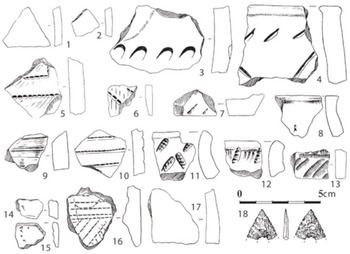
Figure 2.3. Seasonal herding camp artifacts from Peschanyi Dol 1, Samara Valley Project; 1–13, semisedentary LBA Srubnaya culture; 15–18, nomadic MBA Poltavka culture
East of the Don River, Morgunova (Reference Morgunova2015: Fig. 2) and Shishlina (Reference Shishlina2008: Fig. 107) mapped eighty Neolithic and Eneolithic riverine settlements, none with a Yamnaya cultural level. Radiocarbon dates were from the late seventh to the mid-fourth millennia BCE. Radiocarbon dates on animal bones (excluding dates on organic crusts from pottery, which are centuries older) show that from about 4900 to 4700 BCE, riverine fisher-hunters began to keep some domesticated sheep and cattle (Vybornov et al. Reference Vybornov, Kulkova, Kosintsev, Platonov, Platonova, Philippsen and Nesterova2018, Reference Vybornov, Kosintsev, Kulkova, Doga and Platonov2019). Their settlements contain stratified cultural levels in favorable locations and were riverine, near timber, deer, water, marshes, and fish. They were functionally varied, including some specialized camps in the arid Caspian steppes with more than 80 percent wild saiga antelope or steppe onager bones, and more diversified occupations in the middle Volga steppes (like Orashaemoe, with horses intermediate between NEO-CAS and C-PONT) containing the bones of red deer (Cervus elaphus) and elk (Alces alces), horses in a prominent dietary role, and fish, in addition to cattle, goats, and sheep (Morgunova Reference Morgunova2015; Vybornov et al. Reference Vybornov, Kulkova, Kosintsev, Platonov, Platonova, Philippsen and Nesterova2018, Reference Vybornov, Kosintsev, Kulkova, Doga and Platonov2019). The role of domesticated animals seems to have increased gradually during the fifth millennium BCE. All these Eneolithic settlement sites were abandoned after 3300 BCE.
West of the Don River, a handful of Eneolithic settlements have produced Yamnaya cultural levels, and two settlements, Mikhailovka and Repin, had dense artifact deposition including published fauna. Only Mikhailovka II and III and a late Yamnaya ritual site at Generalka on an island in the Dnieper Rapids (Kaiser et al. Reference Kaiser, Tuboltsev, Benecke, Evershed, Hochmuth, Mileto and Riesenberg2020; Tuboltsev and Radchenko Reference Tuboltsev and Radchenko2018) had pits, postholes, house floors, and other built facilities. The other investigated Yamnaya settlements in the Dnieper and lower Don valleys, including Repin, Razdors’ke, Liventsovka, and a few others, lacked pits, postholes, or house floors. The absence of constructed facilities at most of the ten or so known Yamnaya settlements in the western part of the Yamnaya range suggests a reduction in settlement permanence and in anticipated length of stay (Kent and Vierich Reference Kent, Vierich and Kent1989; Kelly, Poyer, and Tucker Reference Kelly, Poyer and Tucker2005), compared with the Eneolithic occupations at the same places; but it also indicates some continuity between Eneolithic and Yamnaya settlement patterns. The western Yamnaya pastoral economy was tethered to a few habitual camps and one central settlement (Mikhailovka) in a landscape where more than 95 percent of Yamnaya sites were kurgan cemeteries. The eastern Yamnaya settlement pattern, east of the Don, lacked even these few occupation sites and seems to have been more mobile.
The abandonment of almost all riverine Eneolithic settlements across the Pontic–Caspian steppes after 3300 BCE is a hallmark of the beginning of the Yamnaya period. But it does not appear in most lists of Yamnaya traits. Both Morgunova and Rassamakin defined the Yamnaya culture typologically, by ceramic and grave types. If we define the beginning of the Yamnaya phenomenon by its economy and settlement pattern rather than by typology, then the abandonment of riverine settlements was a major defining trait. Morgunova (Reference Morgunova2014: 277) suggested that it was time to reexamine the analyses of V. P. Shilov (Reference Shilov1975, Reference Shilov and Maksimov1985), whose theories about Yamnaya nomadism were submerged by Khazanov’s dependency theory.
2.6 Yamnaya Nomadic Pastoralism: Sheep, Isotopes, and Dairy Peptides
V. P. Shilov’s interpretation of the Yamnaya economy in the Don–Volga–Caspian steppes (regions I, II, and III in Fig. 2.2) included seven observations (by my count – he did not number them) indicating that Yamnaya pastoralists were nomadic (Shilov Reference Shilov1975, Reference Shilov and Maksimov1985). These were briefly reviewed and largely dismissed by Kaiser (Reference Kaiser2010: 23). They have not been described in English. In my view, they remain mostly valid today.
Shilov’s seven arguments in favor of Yamnaya nomadism were: 1) the appearance of wagons and horse bones in Yamnaya graves indicated the presence of the kinds of transportation methods required by nomads (this states an important technological precondition for pastoral nomadism); 2) the soils and rainfall in much of the Don–Volga–Caspian steppe region were not suitable for rainfall agriculture; 3) no carbonized grain (and, we can now add, no caries from regularly eating grain) was found in hundreds of excavated Yamnaya graves; 4) the most frequently found sacrificed animals in Yamnaya graves were (in Russian terminology) “small horned cattle,” or sheep-goats, which are associated with more mobile pastoral economies – not “large horned cattle,” which need more water and are associated with more sedentary pastoral economies; 5) Yamnaya settlements were completely absent in the region, but dozens of large Yamnaya kurgan cemeteries appeared; 6) the kurgan type of funerary monument, visible from afar in a flat landscape, was typical of nomads, not settled farmers (this was the essentialist typological thinking of the 1960s, but many kurgans have since been shown (Borisova et al. Reference Borisova, Krivosheev, Mimokhod and El’tsov2019) to have been built from stacked squares of turf – literally pastures for the dead – which does suggest a pastoral economy); and 7) a few large Yamnaya kurgan cemeteries (Tsa-Tsa, Balkhin Khutor) appeared 30 to 90 km away from the major river valleys, and were the first major monuments in the arid steppe plateaus between the river valleys. This indicated a new economic exploitation of interior steppe grassland environments, suggestive of a nomadic economy.
Shilov’s third and fourth points – the absence of cultivated grain and the dominance of sheep and goats over cattle – were about how to define and characterize the eastern Yamnaya diet. Today we can examine the Yamnaya diet through the stable isotopes of 15N and 13C in Yamnaya skeletons, dental pathologies, animal bones from settlements, animals sacrificed in graves, and dairy peptides in dental calculus.
2.6.1 Dietary Stable Isotopes
During the Samara Valley Project, Schulting and Richards (Reference Schulting, Richards, Anthony, Brown, Khokhlov, Kuznetsov and Mochalov2016) examined dietary stable isotopes in fifty-eight individuals chosen to represent a time series from the Eneolithic through the LBA, distributed across the Volga–Ural steppes around Samara, Saratov, and Orenburg (northern region I in Fig. 2.2). The sample included fourteen Eneolithic individuals from two cemeteries and nine Yamnaya individuals from six cemeteries (Fig. 2.4).
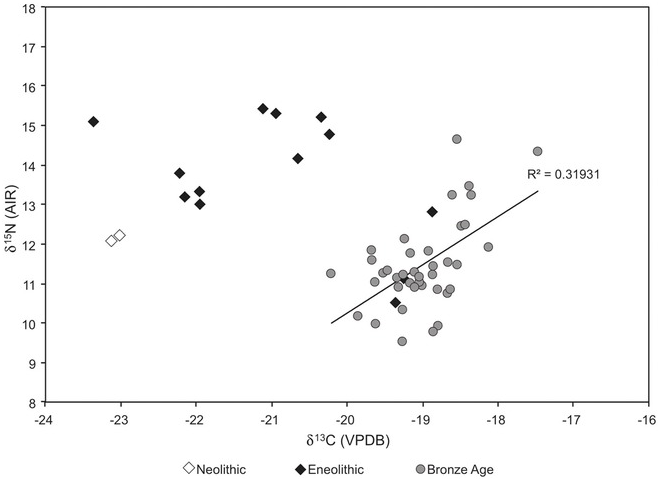
Figure 2.4. Bivariate plot of Eneolithic and Bronze Age stable dietary isotopes from humans in the middle Volga steppes. From Schulting and Richards Reference Schulting, Richards, Anthony, Brown, Khokhlov, Kuznetsov and Mochalov2016: Figure 7.2 Subsequent radiocarbon dating of these samples showed that the two anomalous “Eneolithic” individuals were actually dated to the Yamnaya period
The clearest change through time was a marked difference between the Eneolithic and Yamnaya diets. The Eneolithic diet was distinguished by δ13C values that were significantly more negative (Eneolithic –20.1 vs Yamnaya –19.1) than in Yamnaya (Mann-Whitney U test, Z = 4.43, p = 0.000); and also by δ15N values (Eneolithic, c. 13.7‰; Yamnaya, c. 11.2‰) that were significantly higher (Z = 3.73, p =0.000) (Schulting and Richards Reference Schulting, Richards, Anthony, Brown, Khokhlov, Kuznetsov and Mochalov2016: 130, Table 7.2). This combination of relatively depleted δ13C values and elevated δ15N values can be attributed to an Eneolithic protein diet based largely on freshwater fish and forest game. The Yamnaya diet showed an isotopic shift from C3 resources derived from forests and rivers to a mixture of C3 and C4 resources typical of steppe-pastured grazing animals. In the North Caucasus, Knipper et al. (Reference Knipper, Reinhold, Gresky, Berezina, Gerling, Pichler, Buzhilova, Kantorovich, Maslov, Petrenko, Lyakhov, Kalmykov, Belinskiy, Hansen and Alt2020) found a similar contrast between C3 agricultural diets in the Eneolithic at Progress-2 and C3 and C4 in Yamnaya and later Bronze Age diets, as did Shishlina et al. (Reference Shishlina, Zazovskaya, van der Plicht, Hedges, Sevastyanov and Chichagova2009).
Yamnaya δ15N remained higher than many prehistoric populations because high aridity raises the δ15N in steppe plants. Bronze Age steppe ovicaprids showed a positive correlation between δ13C and δ15N values and also exhibited more elevated δ15N values than cattle, and the Bronze Age Volga steppe human population showed the same two trends. The human isotopic results could be explained (Schulting and Richards Reference Schulting, Richards, Anthony, Brown, Khokhlov, Kuznetsov and Mochalov2016: 143) “if it is assumed that sheep milk and meat contributed the majority of the protein in Bronze Age human diets.”
The shift from riverine to grassland resources, seen isotopically, was accompanied by the widespread abandonment of riverine Eneolithic residential sites (Shilov #5) and by the initial appearance of kurgan cemeteries in the inter-valley steppe plateaus (Shilov #7). This is what would be expected in a shift from a mixed riverine economy to grassland nomadic pastoralism.
2.6.2 Dental Pathologies
During the Samara Valley Project, Murphy and Khokhlov (Reference Murphy, Khokhlov and Anthony2016: 169–171) examined 2,976 teeth from populations in the Volga–Ural steppes, Eneolithic, EBA, MBA, and LBA. Murphy recorded no caries in 256 teeth from 16 examined Yamnaya individuals and a continuing absence of caries in 1984 teeth from 175 MBA and LBA individuals. The absence of dental caries showed continuity between the Yamnaya (EBA) and Srubnaya (LBA) diets. All the Bronze Age pastoralists from the middle Volga steppes had teeth like hunter-gatherers, while Iron Age nomads from the Altai Mountains had extensive caries (Murphy Reference Murphy2003; Murphy and Khokhlov Reference Murphy, Khokhlov and Anthony2016: 169–171). The absence of caries (and by implication cultivated grain) in the teeth of Yamnaya pastoralists in the Volga steppes again distinguishes Yamnaya from Medieval nomadic pastoralism.
2.6.3 Faunal Evidence from Mikhailovka, Repin, and Usatovo
Two early Yamnaya settlements in the steppes have reported fauna: Mikhailovka II on the lower Dnieper and Repin on the lower Don. As described above, both had similar Repin-style pottery and radiocarbon dates (Table 2.1) and have traditionally been regarded as type sites for the early Yamnaya period, 3300 to 3000 BCE. Usatovo, a non-Yamnaya site, was another important settlement located near modern Odessa on the northwest coast of the Black Sea during the late fourth millennium BCE. Usatovo was not a Yamnaya culture site, but it had kurgan graves for its elite, and had a steppe-zone pastoral economy during the early Yamnaya period.
Eneolithic Mikhailovka I, dated 3600 to 3400 BCE, produced 1166 identifiable animal bone fragments, more than 95 percent from domesticated animals. Of the domesticated animals, 65 percent of the bones were from sheep-goats, 19 percent cattle, 10 percent horses, and less than 2 percent pigs (Tsalkin Reference Tsalkin1970: Table 51). Sheep-goats dominated the Mikhailovka I herds.
Mikhailovka II (early Yamnaya) and III (late Yamnaya mixed with early Catacomb) unfortunately were combined when the zoological remains were analyzed. Mikhailovka II–III together produced an unprecedented 51,151 animal bones, 44 times (!) more than the quantity recovered from Eneolithic Mikhailovka I (Shevchenko Reference Shevchenko1957; Tsalkin Reference Tsalkin1970: Table 51). This is more animal bones by an order of magnitude than any other Yamnaya site, and five times more than Usatovo (10,925). Cattle constituted 60 percent of domesticated animal bones and 45 percent of individuals MNI, followed by sheep-goats (30% bones/34% MNI) and horses (10% bones/18% MNI) (Tsalkin Reference Tsalkin1970; Shilov Reference Shilov and Maksimov1985; Dergachev Reference Dergachev2007: 447). Wild hemiones (Equus hemionus) accounted for less than 1 percent of bones, but they were still hunted occasionally. Horse fats were detected on 37 percent of the ceramic sherds from Mikhailovka II analyzed for lipid residues (Mileto et al. Reference Mileto, Kaiser, Rassamakin and Evershed2018: 6), so horses might have been more important contributors to the diet than the bones suggest.
The dominance of cattle in the animal bones from Mikhailovka II–III could represent feasting activities, given the uniquely large quantity of cattle bones at this site. The difference in cattle between the piece count (60% of bone fragments) and the minimum number of individuals (45% of individuals) suggests that the cattle bones were more fragmented than other animals, thus dominating the piece count, consistent with intense butchering for cattle. The 30,538 cattle bone fragments from Mikhailovka II–III represented at least 1623 (MNI) consumed cattle (Tsalkin Reference Tsalkin1970: Table 51). If we assume a small adult body weight of 400 kg per cow or bull, with about 40 percent of that representing “retail” meat cuts, 1,623 cattle would produce 260,000 kg (!) of beef for a settlement that never had more than eight Yamnaya domestic structures. This quantity of beef suggests that guests from outside the settlement were feasted there.
At Repin, horses were counted as 55 percent of bones by V. Shilov (originally reported as 80% by Bibikova), cattle 18 percent, and sheep-goats only 9 percent, with the remainder (wild?) pigs and red deer (Shilov Reference Shilov and Maksimov1985: 29). A small reexcavation in 1989 obtained 142 additional animal bones and Repin-style pottery. Of 100 bones identifiable to species, 80 percent were horse (as in the original report by Bibikova), 8 percent were cattle, and 12 percent were sheep-goat (Kuznetsov Reference Kuznetsov2013: 13). Horses were by far the species consumed most frequently at Repin, with cattle and sheep-goat a distant second or third. Some horse bones from Repin passed DNA screening and proved to be the direct ancestors of DOM2 horses (Librado et al. Reference Librado, Khan, Fages, Kuslyi, Suchan, Tonasso-Calvière, Schiavinato, Alioglu, Fromentier, Perdereau, Aury, Gaunitz, Chauvey, Seguin-Orlando, Der Sarkissian, Southon, Shapiro, Alquraishi, Alfarhan, Al-Rasheid, Seregely, Klassen, Iversen, Bignon-Lau, Bodu, Olive, Castel, Alvarez, Germonpré, Wilczyński, Rannamäe, Saarma, Lōugas, Kyselý, Peške, Balasescu, Gerber, Kulcsár, Gál, Bendrey, Allentoft, Shephard, Tomadini, Grouard, Pitulko, Brem, Wallner, Keller, Kitagawa, Bessudnov, Taylor, Bayarsaikhan, Erdenebaatar, Kubatbeek, Mijiddorj, Boldgiv, Tsagaan, Pruvost, Olsen, Makarewicz, Valenzuela Lamas, Albizuri, Espinet, Garrido, Kotova, Pryor, Crabtree, Zhumatayev, Kuznetsova, Lordkipanize, Marzullo, Prato, Bagnasco, Clavel, Lepetz, Davoudi, Mashkour, Stockhammer, Krause, Haak, Morales, Benecke, Hofreiter, Ludwig, Graphodatsky, Kiryushin, Baryshnikov, Petrova, Sablin, Tishkin, Ananyevskaya, Logvin, Logvin, Kalieva, Kukushkin, Merz, Merz, Sakenov, Shevnina, Varfolomeyev, Zaibert, Arbuckle, Reinhold, Hansen, Roslyakova, Kosintsev, Kuznetsov, Anthony, Kroonen, Kristiansen, Wincker, Outram and Orlando2021). Repin was the last major settlement in the steppes to continue the equid-focused diet of Dereivka, Varfolomievka, and other Eneolithic sites (Anthony Reference Anthony2007: 174–186; Shishlina Reference Shishlina2008: 222–230; Anthony and Brown Reference Anthony and Brown2011; Morgunova Reference Morgunova2014). But even at Mikhailovka II, horse fats occurred on 37 percent of ceramic sherds analyzed.
The Usatovo settlement of 3 to 4 ha. was on the crest of a hill overlooking a bay on the northwest shore of the Black Sea, a marine-oriented site (Anthony Reference Anthony2007: 349–359). Usatovo was a coalescent culture, with cord-impressed coarse wares like late Cernavoda I in the steppes and painted Tripol’ye C2 fine pottery probably made in agricultural towns in the middle and upper Dniester valley. Coalescence between steppe and agricultural cultures, possibly in a patron–client relationship, also is suggested by two rich kurgan cemeteries near the settlement each of which was accompanied by a cemetery of poorer flat graves, without kurgans, similar to Tripol’ye C2 flat graves. The central graves under the kurgans contained riveted copper daggers with cast midribs, silver spiral temple ornaments, faience beads (the oldest in the steppes), and coral beads (Gorgonarium) from the Aegean Sea. Production and export of salt might explain its wealth (Ivanova Reference Ivanova2010). Radiocarbon dates cluster between 3300 and 3000 BCE (Anthony Reference Anthony2007: Table 14.1), contemporary with Mikhailovka II, Repin, and late Maikop. The fauna recovered from Usatovo amounted to 10,925 identified bones from 892 individual animals (MNI). The dominant species was sheep-goat (62% of bones, 49% MNI), followed by cattle (24% of bones, 29% MNI), horses (13% of bones, 18% MNI), and pigs (0.5% of bones, 3% MNI) (Tsalkin Reference Tsalkin1970: Table 48). Horse images were incised on Usatovo pots.
Western archaeologists (Kohl Reference Kohl2007: 78, 162–164; Frachetti Reference Frachetti2008, Reference Frachetti2011; Kaiser Reference Kaiser2010; Bendrey Reference Bendrey2011) have asserted that cattle were the numerically dominant domesticated animal in the western Eurasian steppes during the Bronze Age. Kaiser (Reference Kaiser2010) compiled faunal data that showed a shift, she asserted, from sheep-goat in the Eneolithic to cattle as the dominant herd species in EBA Yamnaya herds. She excluded from her EBA analysis the horse-dominant Repin site and assigned the ovicaprid-dominant Usatovo site to the Eneolithic, although both are shown by radiocarbon dates to have been contemporary with Mikhailovka II. Also excluded were the Caspian steppes south of the Volga, where Kaiser accepted the likelihood that Yamnaya herds probably had more sheep-goat than cattle for ecological reasons (Kaiser Reference Kaiser2010: 31). The hypothesis that Yamnaya specialized in cattle leaned heavily on Mikhailovka II–III, a unique site. Other settlements with cattle-dominant fauna included the late Yamnaya (equivalent to Mikhailovkla III) ritual site at Generalka on an island in the Dnieper (Kaiser et al. Reference Kaiser, Tuboltsev, Benecke, Evershed, Hochmuth, Mileto and Riesenberg2020) or were Catacomb culture sites in the forest steppe, not relevant for steppe Yamnaya.
Steppe herd compositions varied from region to region during the EBA, according to the published faunas from three EBA settlements in the North Pontic steppes west of the Don River. Horse meat continued to play a prominent dietary role at Repin. Cattle seem to have been used as feasting animals at the unique residential center at Mikhailovka II–III and were dominant in the smaller faunal sample at the ritual site at Generalka. The sheep-dominant herds of the Usatovo culture, like the stable isotopes from Yamnaya skeletons in the middle Volga steppes, suggest a diet dominated by sheep-goat meat and dairy products. Yamnaya graves are much more numerous than settlements, and are distributed over the entire Yamnaya geographic range, unlike settlements. The animals sacrificed in graves therefore provide a wider window onto the animals herded by Yamnaya pastoralists.
2.6.4 Faunal Evidence from Graves
Shilov (Reference Shilov and Maksimov1985) collected data on animal sacrifices in Yamnaya graves in the lower Don–lower Volga–Caucasus steppes (regions II, III, and the southern part of I in Fig. 2.2) and found that sheep-goat was the most frequent taxon sacrificed (Table 2.2). In 263 excavated Yamnaya graves from kurgans in this region, he found animal sacrifices in 40 graves, about 15% of the Yamnaya graves examined. Sheep-goat bones appeared in 65% of these graves, cattle in 15%, and horse bones in 7.5% (Table 2.2). Sheep-goat were in 70–77% of MBA graves with animal sacrifices, about the same as in EBA graves.
In the middle Volga–Ural steppes, the northeastern Yamnaya region (northern region I in Fig. 2.2), Morgunova compiled similar data from 164 excavated Yamnaya graves from 153 kurgans (Table 2.3). She came to the same conclusion as Shilov: graves with animal sacrifices were a distinct minority (10% of Yamnaya graves here), but in the graves with fauna, sheep-goats were by far the dominant taxon (appearing in 94% of the graves with fauna). Sheep-goats also were dominant in early Yamnaya graves in the Kuban steppes north of Maikop (Gei Reference Gei2000: 128). Sheep-goats generally were the most frequent animals sacrificed in Yamnaya graves. A human diet dominated by sheep-goat proteins also explains the stable isotopes in Yamnaya individuals in the middle Volga steppes around Samara (Schulting and Richards Reference Schulting, Richards, Anthony, Brown, Khokhlov, Kuznetsov and Mochalov2016: 143), so the sheep-goat parts placed in Yamnaya graves might represent symbolic meals for the dead.
2.6.5 Peptides from Dairy
Wilkin et al. (Reference Wilkin, Ventresca Miller, Fernandes, Spengler, Taylor, Brown, Reich, Kennett, Culleton, Kunz, Fortes, Kitova, Kuznetsov, Epimakhov, Outram, Kitov, Khokhlov, Anthony and Boivin2021) analyzed dairy peptides contained in dental calculus from eleven Eneolithic individuals with well-preserved proteomics from five cemeteries in the Volga steppes dated 4600 to 4000 BCE. Ten of the eleven contained no evidence for dairy consumption. One individual from the Khvalynsk cemetery (Khvalynsk II grave 1), dated 4500 to 4300 BCE, exhibited one bovine peptide (alpha-S1-casein), but lacked the most frequently recovered bovine peptide (beta-lactoglobulin [BLG]), so dairy consumption in this individual cannot be confirmed. Wilkin et al. also examined dental calculus in Yamnaya, Poltavka, and Sintashta individuals of the EBA, MBA, and MBA/LBA transition, 3300 to 1700 BCE. For the EBA individuals assigned to the Yamnaya culture, dairy peptides were recovered from fifteen of the sixteen individuals analyzed, a reversal of the Eneolithic pattern. All fifteen individuals with positive dairy results contained multiple peptide spectral matches to ruminant dairy proteins and some individuals also contained alpha S1-casein and alpha S2-caseins. Ovis, Capra, and Bos attributions were all made, with many individuals’ calculus containing dairy peptides from multiple species. The Yamnaya people regularly consumed dairy products, probably in hard (cheese) or fermented (yogurt) forms, given the prevalence of lactose intolerance among them. This gives strong support to the hypothesis of a significant change in diet from the Eneolithic to the EBA. In an earlier study, Shishlina (Reference Shishlina2008: 232) examined human dental calculus from Yamnaya and Catacomb kurgan graves in the Kalmyk steppes south of the lower Volga dated 2800 to 2000 BCE, and found no cultivated seeds, cereal pollen, or cereal phytoliths in dental calculus.
Significantly, Equus milk peptides from the protein BLG I were identified in two Yamnaya individuals from Krivyanskiy IX. One of the Yamnaya individuals with Equus milk peptides in his dental calculus (kurgan 4, grave 21A) was dated 3345 to 3096 BCE (95%) (4495±25 BP, PSUAMS-7979), and the other (kurgan 2, grave 2) was dated 2881 to 2633 (95%) (4165±25 BP, PSUAMS-7978). This is the earliest Equus milk product in human dental calculus.
2.6.6 Stature
Yamnaya people in the Volga steppes were on average taller (male femoral length 466–480 mm, mean 472.1) and more robust than their Eneolithic ancestors (male femoral length 434–482 mm, mean 461.4), suggesting that the new diet led to taller, stronger people (Khokhlov Reference Khokhlov and Agapov2010: 456, 476; Murphy and Khokhlov Reference Murphy, Khokhlov and Anthony2016: 162). They were also taller than European farmers in southeastern Europe (Mathieson et al. Reference Mathieson, Lazaridis, Rohland, Mallick, Patterson, Roodenberg, Harney, Stewardson, Fernandes, Novak, Sirak, Gamba, Jones, Llamas, Dryomov, Pickrell, Luís Arsuaga, Bermúdez de Castro, Carbonell, Gerritsen, Khokhlov, Kuznetsov, Lozano, Meller, Mochalov, Moiseyev, Rojo Guerra, Roodenberg, Vergès, Krause, Cooper, Alt, Brown, Anthony, Lalueza-Fox, Haak, Pinhasi and Reich2015: 502). The newly simplified diet seems to have been successful nutritionally.
2.7 Conclusion: The First Pastoral Nomads in the Steppes
The Eneolithic fisher-hunter-herders of the Volga steppes kept domesticated cattle and sheep-goats (and horses of uncertain status) and sacrificed them in human graves, but they apparently did not consume milk products. In contrast, dairy foods were ubiquitous in EBA Yamnaya dental calculus, clear evidence of a significant dietary change also indicated in dietary stable isotopes. The incidence of caries was like that found among hunter-gatherers, so starchy cereals were not a major part of the Yamnaya diet. The animals sacrificed in graves across the Yamnaya world were primarily sheep-goats, not cattle, and settlements of the early Yamnaya era (3300–3000 BCE) exhibited a variety of faunal compositions, each one probably more indicative of the site’s function than of the Yamnaya diet in general. Mikhailovka was a special and central place, interpreted here as a kind of caravanserai where nomadic groups crossing the Dnieper paused to feast on beef and gather information. Other than Mikhailovka and a few additional settlements west of the Don, most Eneolithic riverine settlements were abandoned, replaced by kurgan cemeteries, some of which were the first large human monuments in the steppe plateaus between the river valleys. Wagons and carts were so important that they were included in hundreds of Yamnaya and Catacomb graves. Yamnaya people rode and milked horses, and Yamnaya horses from Repin and Turganik were among a small set of samples that contributed 95% of the ancestry of DOM2 horses. Together these observations support Shilov’s argument that Yamnaya people were the first nomadic pastoralists in the Eurasian steppes.
The Yamnaya economic-ritual community enjoyed a decisive advantage because it was the first to fully commit to mobile herding using ox-drawn wagons and horse-mounted herders. Those who adopted the new economy were the first human groups to exploit the vast reserves of bioenergy stored in the Eurasian grasslands, converting that bioenergy into a simplified human diet focused on meat and milk proteins. This revolutionary economic adaptation spread across the steppes with a genetically homogeneous group of closely related people, perhaps an innovative elite, whose shared funeral ritual was accompanied by a shared set of religious beliefs and myths, as Ivanova (Reference Ivanova2006) suggested, expressed in a language that was probably late Proto-Indo-European. Comparative Indo-European mythology preserves traces of these beliefs (West 2007).
The new, productive nomadic pastoral economy opened a large, unexploited ecological zone to human exploitation, and at the same time the military advantages of mobility pushed and pulled the settled riverine population toward nomadic life. This process created a set of nomadic groups who became increasingly distinct from neighboring sedentary farming communities in southeastern Europe and the North Caucasus. The later Yamnaya migrations out of the Pontic–Caspian steppes and across 5000 km of Eurasia were facilitated by the development and maturation of the first pastoral nomadic economy in the steppes.
3.1 Introduction
The Yamnaya culture of the Lower Don is a Bronze Age culture dated between 2900 and 2600 cal BC. Its population inhabited the Eurasian desert steppe belt, where their main subsistence activity was pastoralism. The Yamnaya population developed a distinctive economic model based on new principles of pasture rotation, landscape use, and individual mobility. The focus of this study is the analysis of the specific landscapes and geographical features of one of the Eurasian Steppe regions located between the Lower Don and Lower Volga regions, i.e. the Sal-Manych Ridge (Fig. 3.1); it includes the settlement pattern and economic model that the mobile Yamnaya pastoralists developed to adapt to this region, the resources of the steppes they exploited and the system of seasonal migration reflected in the mobility of individual Yamnaya groups.

Figure 3.1. Pilot area of the research: a – Eurasian steppe belt, b Yamnaya culture, c Sal-Manych Ridge.
This research is based on recent studies of the archaeological contexts of Yamnaya graves and kurgans in the pilot region, the reconstruction of their settlement pattern, modeling of the productivity of local pastures located near the Yamnaya sites, and the isotope study of collagen from human and animal bones (identification of δ15N and δ13C values), as well as variations in Sr isotopes.
3.2 Chronology and Archaeological Background of the Yamnaya Culture
Based on the available 14C data (Shishlina Reference Shishlina2008; Shishlina et al. Reference Shishlina, van der Plicht and Zazovskaya2011) (Table 3.1), the period of the Lower Don Yamnaya culture has been established to be between 2900 and 2600 cal BC.
Table 3.1. 14C data on the Lower Don Yamnaya; total probability (in parentheses) with estimated OxCal 4.3.
| Unmodeled Sum calibrated age | Modeled Sum (within Phase) calibrated age | Modeled Sum (within Phase) (No Humans) calibrated age |
|---|---|---|
| 2902–2582 BC (68%) 3010–2290 BC (95.4%) | 2910–2430 BC (95.4%) 2900–2449 BC (68%) | 2856–2700 BC (68%) 2904–2601 BC (95.4%) |
The Yamnaya population buried its dead in kurgans, Bronze Age architectural structures that consist of a segment-shaped mound and a round or an oval ditch (Fig. 3.2a). Sometimes the upper part of the mound is flattened. The average diameter of primary kurgans is approximately 12 to 18 m, and their height is 0.65 to 1.10 m. Other structural details include stone mounds, stone walls, and stone rings (Fig. 3.2b. Many secondary graves were added to the primary Yamnaya kurgans (up to six or seven graves). Ritual areas with flint items, clay sherds, and bones of wild and domesticated animals are typical features of the Yamnaya kurgans.


Figure 3.2. The Sal-Manych Ridge, Temrta IV burial ground: a Yamnaya culture kurgan, b stone ring around grave 9, c grave 9.
The main grave construction is a simple rectangular pit, usually built for one deceased person; ledged pits are found only rarely. The pit was usually roofed. The burial normally contained many items: e.g., plant mats placed along the bottom, the walls, and the roof of the pit; details of wooden constructions; pillows stuffed with steppe plants; and wooden wagon walls or dwelling doors that were sometimes used as the pit roofing. A typical pose for the deceased is a contracted supine posture with extended arms (Fig. 3.2c); in some graves, the bodies are fully extended, prone or supine. The predominant orientation of the deceased in both primary and secondary graves is toward the east, though other orientations have been observed as well. Collective graves are only rarely recorded. The use of ochre is a characteristic feature of all local groups: ochre was used to sprinkle the skull, legs, hands, and funerary offerings, as well as the bottom of the pit; sometimes a piece of ochre was placed inside the grave as well.
The funerary assemblage usually contained lightly fired clay vessels tempered with chamotte, sand, and shell: e.g., egg-shaped, round-bottomed pots (Fig. 3.3 b), bowls, and amphorae (Fig. 3.3 a). Sets of hammer-headed bone pins and other amulets are very common (Fig. 3.3 c–d). Some of the graves contain round temple rings of metal and bone (Fig. 3.3 e), and sheep talus bones (Fig. 3.3 f). The Yamnaya graves are not rich in tools or weapons. The funerary assemblages sometimes include pestles and grinding stones, as well as bronze knives (Fig. 3.3 gh), usually placed under the head of the adult person. In several rare cases, the graves have yielded sets consisting of a bronze knife and an awl, and more rarely an axe.

Figure 3.3. Yamnaya culture funerary goods: a, b clay vessels, Mu-Sharet 4, kurgan 1, grave 5; c hammer-headed bone pin, Zunda-Tolga 6, kurgan 2, grave 1; d hammer-headed bone pin, Chograisky V, kurgan 6, grave 4; e bone temple ring, Peschany IV, kurgan 13, grave 5; f sheep talus bones, Peschany IV, kurgan 13, grave 6; g bronze knife, Balka Chikalda; h bronze knife, Mandjikiny II, kurgan 11, grave 3.
Our study of more than 500 Yamnaya graves uncovered in both the Kalmyk Steppe and in the pilot region clearly reveals common features, such as the rectangular shape of the pits and their decoration, the position of the body and its orientation, and the use of ochre, as well as specific local differences in tradition. For example, stone rings around the graves are typical of the Middle Yergueni Hills and the Sal-Manych Ridge. These differences are important to note because, in our view, they suggest that this rather broad region between the Lower Volga and the Don was exploited by small family groups, each practicing its own funerary rite.
In our research, we have used this hypothesis as a basic assumption to establish the settlement pattern of the Yamnaya population in the pilot region and to discuss its mobility.
3.3 The Settlement Pattern
To gain a better understanding of this settlement pattern, we examined a number of dry steppe river valleys (Russian balkas) with temporary or seasonal flows. These studies revealed numerous traces of the open steppe’s occupation by prehistoric mobile pastoral groups in the pilot region (Shishlina et al. Reference Shishlina2018b). Traces of Chalcolithic Yamnaya and Catacomb seasonal campsites were discovered in the middle reaches of meandering dry valleys with streams and well-defined terraces. We assume that almost all watershed plateaus and small steppe river valleys of the Sal-Manych Ridge were occupied and fully exploited by the Yamnaya population. Yamnaya clay sherds, a bronze knife (Fig. 3.3 g), and horse, sheep, and cattle bones were found at some campsites (Fig. 3.4). The presence of only small campsites and lack of large permanent settlements is therefore consistent with the assumption, mentioned earlier in the text, that during the Yamnaya period, small groups rather than large populations exploited the region in question. The economic potential of such groups not only allowed them to sustain themselves, but also to develop a special form of pastoral economy, as will be described further below.

Figure 3.4. The Sal-Manych Ridge. Location of Bronze Age seasonal campsites.
New geomorphological, isotope, and pasture productivity data offer insight into the link between the Yamnaya economic model and their system of short- and long-term migrations.
3.4 Optimization of the Economic Strategy
The Sal-Manych Ridge is characterized by severe climatic conditions: low temperatures in winter and high temperatures in summer; high wind speeds, especially in the cold period; and low precipitation, hence low productivity of ecosystems (Narodetskaya Reference Narodetskaya1974). Life in a hot, dry climate forced prehistoric populations to develop rather sophisticated adaptation mechanisms for the harsh conditions. The pastoral economic strategy developed by the Yamnaya groups was stipulated by the specific features of pasture use in these desert areas, such as low forage yield, the seasonal nature of vegetation, and the difficulty or impossibility of procuring forage during the non-grazing period (Masanov Reference Masanov and Shishlina2000). The optimization of the seasonal economic cycle depended on the availability of winter pastures for animals. In order to optimize the herding economy, the population introduced pasture rotation. The height of snow cover, snow density, and presence of ice bands and crust in the snow, as well as the frequency of thaws, precipitation, and fog, are all factors that determine the quality of pastures in winter. When the snowfall is loose, goats and sheep cannot graze in snow cover of more than 25 to 30 cm; when the snow is dense, grazing is not possible at a snow height of 5 to 10 cm (Narodetskaya Reference Narodetskaya1974). Snowfalls, blizzards, and the ice coverage of the land were taken into account when selecting winter pastures. The area of such pastures was determined by the distance that sheep could roam per day in winter. Animals would graze on winter pastures by roaming along a radius of 4–5 km, first away from the winter campsites, and then back toward the camps (Masanov Reference Masanov1995). Given the low forage yield of pastures in winter, herders were forced to move from one grazing area to another. In summer, successful grazing depended on the availability and accessibility of water sources. The duration of stays at campsites around the main watering places, as well as migrations away from the campsite into the open steppes, depended on the forage yield of summer pastures (Zhitetsky Reference Zhitetsky1893; Masanov Reference Masanov1995; Smirnov Reference Smirnov1999). When forage resources were depleted, people moved to other areas, and did not come back until the vegetation cover of the grasslands fully recovered. If a certain exploited ecological niche provided enough grass for the animals, most people would stay at the campsite longer, because the animals could graze outside the campsite during the day before being led back for the night.
The above-described model was probably the most viable for this region, with its harsh weather and sometimes scarce grassland resources. The region’s use was reflected in the mobility of population groups that depended on the productivity of the grasslands, which also influenced the settlement pattern of the population that inhabited the pilot region. In order to obtain new information in support of our hypothesis, we conducted a number of studies.
3.5 Productivity of the Yamnaya Grasslands
The Sal-Manych Ridge, which encircles the Kuma-Manych Depression on the Kalmyk Steppe, extends to the Lower Don region in the north and merges with the Yergueni Hills in the east. This area is characterized by the presence of various small steppe river valleys with temporary flows (balkas), floodplain terraces, and larger river valleys. The small river valleys of the Manych River water system differ from the small river valleys that discharge waters into the Sal River. In contrast to the latter, the small river valleys of the Manych are deeply incised and have steep slopes. They are characterized by their sharp differentiation of geological formation conditions; that is why they are noted for their greater variety of valley structures. Small steppe river valleys with temporary flow are suitable for use as winter pastures, because the snow on their southern slopes does not form a continuous cover, or it melts quickly. For this reason, sheep and goats can graze in bad weather conditions when the high snow cover does not allow animals to graze in other landscape niches. At the same time, the vegetation growing on the steep, shadowy slopes with exposure to the north is not scorched in summer and persists even during the severe droughts of April and June. The area of these slopes can be used as winter and summer pastures (Fig. 3.5a).


Figure 3.5. The Sal-Manych Ridge. Balka Volochaika: a – contemporary pastures; b – model of the seasonal productivity of the local pastures.
The small river valleys of the Sal River system are usually less incised, and their slopes are gentler; these valleys have low relief and are used as pastures throughout the year, though no special grazing patterns have been identified here.
Nowadays, both smaller and larger river valleys have dikes; they do not have continuous flow. However, there are several natural springs in the small river valleys of the Kuma-Manych Depression. These are linked to the deep erosive dissection and tectonic differentiation of this area; that is why it is easy to tap groundwater reservoirs, and water is discharged easily into valley beds.
The method of determining Yamnaya pasture productivity is based on research into the productivity of contemporary pastures. Several pilot areas on the Sal-Manych Ridge have been used as references.
A comparative analysis of the forage yield of contemporary pastures in the Volochaika steppe river valley (Fig. 3.5b), near the Manych River, offered the opportunity to identify the seasonal forage yield of contemporary grasslands. This highlighted the objectively high forage value of these pastures, namely due to the native fescue-feather grass community growing on the gentle slope of the valley and the sedge and gramineous plant community growing in the lower floodplain, especially amid the gramineous plant regrowth of the spring period. It also underscored the generally low values and more noticeable contrast in seasonal values estimated for the forage yield of the Bolshaya Elista pastures (the Sal River basin).
We believe that the pastures located in the small river valleys of the steppe were seasonally exploited by the Yamnaya population, which moved from one pasture to another depending on pasture productivity. Isotope data provide additional evidence for this hypothesis.
3.6 Yamnaya Culture Isotope Data
The isotope data obtained for the Sal-Manych Yamnaya humans and animals confirm a high level of mobility among individual groups and flocks. Stable isotopes (δ15N and δ13C) reveal differences in the components of individual human diets and animal fodder intake (Shishlina et al. 2012; 2014; Reference Shishlina, Sevastyanov and Kuznetsova2018a).
The isotopic composition of the Yamnaya pasture-fed animals demonstrates that they primarily grazed on typical local C3 pastures, though some isotopic variations have been identified (Shishlina et al. Reference Shishlina, Sevastyanov and Kuznetsova2018a). The isotope study of sheep bones yielded several outliers, which means that some sheep or flocks of sheep grazed on pastures with stressed vegetation in more arid environments. The valleys of the East Manych and the Dzhurak-Sal – a tributary of the Sal River where many Yamnaya kurgans have been discovered, and where there are thickets of tall cane – meet the requirements for winter pastures, and these river valleys were most likely exploited in winter as well. The isotope composition of the cane used as contemporary winter feed is characterized by a high level of δ15N values; the consumption of such plants could produce high nitrogen values in archaeological animal bones.
The sample of archaeological plants collected from the Yamnaya graves includes both typical С3 and С3-arid plants; the latter are characterized by high δ15N values. Therefore, high values of δ15N in the isotope composition of the Yamnaya animals can be attributed to high values in their fodder, due to both the aridity of the pastures as well as the specific isotope composition of winter fodder (Shishlina et al. Reference Shishlina, Sevastyanov and Kuznetsova2018a). The variety of isotope composition in both archaeological plants and animal bones demonstrates that the exploited pastures were located in different ecological and geochemical environments, i.e., that herders moved across vast areas.
The isotope composition of individuals from the local Yamnaya steppe community also demonstrates large variations in δ15N and δ13C values compared to Yamnaya humans from other areas (Shishlina et al. 2012). These variations were caused by human diet, multicomponents of which originated from different places. Mobility caused people to consume various food components with different isotope values. The human diet was based on C3 vegetation, sometimes with high δ15N values (~13–15‰), and the meat and dairy of domesticated animals, but could also include aquatic components. Such food resources were probably also located in different geochemical environments.
We also studied variations in the strontium isotopes 87Sr/86Sr in human teeth, which can be used as an additional argument in support of population movements (Bentley et al. Reference Bentley, Price and Stephan2004; Eckardt et al. Reference Eckardt2009) across the studied region of the Sal-Manych Ridge.
The variation in the strontium isotopes in the tooth enamel of individuals from Yamnaya burial grounds such as Peschany V, Ulan-4, and Sukhaya Termista II is from 0.7090 to 0.7091. This correlates with the isotopic variations in the reference samples from the Dzhurak-Sal basin, the western slopes of the Middle Yergueni Hills, and the Don River basin from the middle reaches of the river, near the town of Volgodonsk, to the Lower Don valley (Shishlina and Larionova Reference Shishlina, Larionova and Belinsky2013). The variation in the strontium isotopes in the teeth of individuals from the Yamnaya burial grounds in the Southern Yergueni Hills and the Sarpa Plain, such as Mandjikiny and Kanukovo, is 0.7090. This also correlates with isotopic variations from the local reference samples of animal bones.
Generally speaking, the region with strontium isotopic variations from 0.7090 to 0.7091 encompasses several local steppe areas in the south of the Russian Plain. The likely place of birth of the local Yamnaya individuals examined is a geographical steppe area extending from the middle to the lower reaches of the Don River; it also includes the contiguous steppe areas of the western part of Kalmyk steppes.
However, there are some individual outliers in the strontium isotope variation of the tooth enamel: for example, that of the individual from Temrta IV, kurgan 16, grave 9 (87Sr/86Sr: 0.7094). These variations most likely mean that the buried male who is the outlier was a nonlocal, born in a geographical area to the south (Shishlina and Larionova Reference Shishlina, Larionova and Belinsky2013; Shishlina et al. Reference Shishlina2016) but buried far from his birthplace. These outliers are not numerous.
Therefore, we may infer from this isotope data that almost all of the analyzed Yamnaya individuals inhabited the steppe and exploited only the steppe environment. The isotopic data also demonstrate that the migrations of the people and the animals took place only within the steppe, though in different ecological niches.
3.7 Pastoralism and Mobility of Yamnaya Pastoralism in the Arid System: Discussion
The landscape analysis of the contemporary grassland resource base reveals the potential for optimal organization of the seasonal economic cycle within the exploited steppe area. The resources within the steppe grazing systems are characterized by low forage yield, the seasonal nature of the vegetation, and the difficulty or impossibility of forage conservation and livestock stall-feeding (Narodetskaya Reference Narodetskaya1974; Masanov 1999; Smirnov Reference Smirnov1999). From the very start of exploiting steppe pastures, these factors made people move from place to place quite frequently, though their flock of domesticated animals was small.
It should be also noted that, basically, the composition of plant communities from the pilot region, i.e. the Sal-Manych Ridge, is suitable for grazing domesticated pasture-fed animals with low tolerance for water restrictions. Though the pasture yield perhaps varied depending on annual climatic fluctuations, the landscape resource base across seasons was not conducive to long-term stays.
This explains why the mobile economic cycle of the local Yamnaya pastoral economy evolved, and why the people involved in seasonal migrations within the exploited steppe landscape developed a mobile lifestyle. The place and the trajectory of the routes were determined by many reasons, e.g., economic, social, natural, and landscape-based; essentially, the principle of pasture rotation formed the basis of the new subsistence system and seasonal migrations.
The pastures thus began to be used throughout the year. The knowledge of pasture forage yield in the exploited pasture systems and the adaptive skills of domesticated animals stimulated the development of an expanded system of short- and long-distance routes, i.e., a special type of husbandry practice. As wagons appeared on the steppe, successful short-term moves were made possible by using bulls as pack animals, as evidenced by grave offerings. Interestingly, the examination of Yamnaya skeletons from the studied area reveals that the pastoralists walked a lot when they moved from place to place and suffered from osteochondrosis (S. Borutskaya and A. Khokhlov, personal communication).
The seasonality of this economy is consistent with the system of seasonal use of small steppe river valley pastures in the south of the Russian Plain as typical of the Kalmyks, the traditional nomads who roamed the Eurasian Steppe in the seventeenth to nineteenth centuries. As described by the mid-nineteenth-century missionary Parmen Smirnov, the small steppe river slopes and lowlands between the hillocks (hills) were the only grasslands that were humid and had vegetation in summer (Smirnov Reference Smirnov1999). An average nomadic group with a herd of 50 to 100 horses, 70 to 100 cows, and a flock of up to 100 sheep would graze down a summer pasture in two to three weeks. Nomadic groups were able to return to the old pastures only after the rain, when grasslands recovered (ibid., 84, 90–91).
3.8 Conclusion
The economic model of the Yamnaya core groups encompassed various activities, such as raising domesticated animals, fishing, gathering, and the production of ceramic, tools, and implements, as well as weapons. Most likely, their economic success led to the formation of small mobile pastoral groups whose aim was to search for and exploit grasslands beyond the nearby areas. Basically, this was a new economic model based on the principle of pasture rotation, with short-term seasonal migrations resulting in a substantial increase in the exploited resource base, helping some groups in the mobile population to streamline their economic and production cycle and adapt to the severe conditions that prevailed in the desert steppe ecological niches in the south of the Russian Plain. Both the settlement pattern reconstructed for the pilot region, i.e., small seasonal campsites, as well as the isotope data provide additional testimony of the local pastoral groups’ short-distance migrations across the exploited area.
Since the so-called “Ancient DNA Revolution” of the past decade, which has yielded many new insights into the genetic prehistory of Europe and large parts of Asia, it can no longer be doubted that the Indo-European languages spoken in Europe and Central and South Asia were brought there from the late fourth millennium BCE onward by population groups from the Pontic–Caspian steppes who had belonged to the archaeologically defined Yamnaya culture.Footnote 1 We may therefore assume that the population groups bearing the Yamnaya culture can practically be equated with the speakers of Proto-Indo-European, the reconstructed ancestor of the Indo-European languages of Europe and Asia, and that the spread of the Indo-European language family is a direct consequence of these migrations of Yamnaya individuals into Europe and Asia.
Moreover, the last few decades have seen the growing consensus, within Indo-European linguistics, that the Anatolian branch of the Indo-European language family occupies a special position: most scholars nowadays seem to accept the idea that the first split in the Indo‑European language family was between Anatolian and the other, non-Anatolian branches (including Tocharian), which at that point still formed a single language community that, for some time after, continued to undergo common innovations not shared by Anatolian.Footnote 2 In the following, I will use the term Proto-Indo-Anatolian (PIA) for the language stage preceding the “Anatolian split,” and the term “Classical Proto-Indo-European” (CPIE, sometimes also called “Core Proto-Indo-European,” “Nuclear Proto-Indo-European,” vel sim.) for the mother language of all the other, non-Anatolian, Indo-European branches; cf. Figure 4.1.Footnote 3

Figure 4.1. The family tree of Indo-European according to the Indo-Anatolian Hypothesis.
As the first split of Classical Proto-Indo-European can be equated with the large Yamnaya migrations of the latter half of the fourth millennium BCE, the Anatolian split should be dated before that period. However, no consensus has yet been reached on the amount of time that must have passed between the Anatolian split and the breakup of Classical Proto-Indo-European.
It is the aim of the present chapter to shed light, from a comparative linguist’s point of view, on the possible dating of the Anatolian split, as well as the possible route along which the Anatolian languages were brought to Anatolia (the “Anatolian trek”).
4.1 Dating the “Anatolian Split”
Before we embark on discussing the possible date of the Anatolian split, it is important to mention the fact that comparative linguistics does not provide a tool with which prehistoric language stages can be dated with exact precision in an absolute way: all dating is, in principle, relative. However, there are some arguments we can rely on to make educated guesses about the absolute dating of reconstructed languages. The most important of these is the number of linguistic innovations one must postulate between a reconstructed pre-stage and its daughter language: the higher the number of these innovations, the further back in time the reconstructed stage must have been spoken. Note, however, that – since it is known that in some situations, languages change more rapidly than in others – the correlation between the number of reconstructed innovations and the length of the period in which these innovations have taken place is certainly not a constant. Nevertheless, on the basis of a broad comparison with the linguistic histories of, e.g., the Romance languages and the Indic languages (the mother languages of which are attested and can be historically dated), it should be possible to give relatively precise estimates for the dating of linguistic pre-stages based on the number and nature of the linguistic innovations that have taken place between these pre-stages and one or more daughter languages.
4.1.1 Dating Proto-Anatolian
Ten known languages are commonly regarded to belong to the Anatolian branch: Hittite,Footnote 4 Palaic,Footnote 5 Cuneiform Luwian,Footnote 6 Hieroglyphic Luwian,Footnote 7 Lydian,Footnote 8 Carian,Footnote 9 Lycian,Footnote 10 Milyan,Footnote 11 Sidetic,Footnote 12 and Pisidian.Footnote 13 Already in the very first documents written in ancient Anatolia (Old Assyrian clay tablets from the twentieth century BCE), we find references to Anatolian (Hittite) personal names, whereas the youngest attestations of an Anatolian language date to the second century CE (Pisidian grave inscriptions). It is commonly assumed that in the course of the first millennium CE, the entire Anatolian branch went extinct. In order to date the Proto-Anatolian mother language from which all these languages stem, we have to investigate the linguistic differentiation between them.
As noted above, the oldest attestations of an Anatolian languageFootnote 14 are Hittite personal names attested in Old Assyrian documents, as discovered in Kültepe (ancient Kaniš/Nēša) and other sites and which date to ca. 1935 to 1715 BCE.Footnote 15 In Kloekhorst Reference Kloekhorst2019, it is argued that these Hittite personal names, though unmistakably Hittite, display a distinct dialect when compared to the Hittite language as known from the later texts from Boğazköy (ancient Ḫattuša), which date to ca. 1650 to 1180 BCE. Moreover, this “Kanišite” Hittite dialect cannot be the ancestor of Ḫattuša Hittite, which means that the two varieties must linguistically be regarded as sisters, stemming from an earlier stage that may be called Proto-Hittite. Since the difference between the two Hittite dialects is small, not much time is needed to account for the diversification between the two, and it therefore seems safe to date Proto-Hittite to no more than a handful of generations before the earliest attestation of Kanišite Hittite, i.e., to ca. 2100 BCE.
The so-called Luwic languages (Cuneiform Luwian, Hieroglyphic Luwian, Lycian, and possibly Carian, Sidetic, and Pisidian)Footnote 16 form a distinct subbranch within Anatolian.Footnote 17 The two oldest attested languages within this group, Cuneiform Luwian (whose oldest texts date from the sixteenth century BC) and Hieroglyphic Luwian (attested from ca. 1400 BCE onward), are closely related dialects, and their common ancestor, Proto-Luwian, need not be much older than a handful of generations before the earliest Cuneiform Luwian attestations. It may thus be dated to the eighteenth or nineteenth century BCE. The third major Luwic language, Lycian, though attested considerably later (fifth to fourth century BCE), is, on the one hand, evidently closely related to the Luwian languages, but, on the other, also clearly distinct from them (especially with regard to the vowel system and certain morphological innovations).Footnote 18 Moreover, it is clear that Lycian cannot descend directly from Proto-Luwian. We therefore need to postulate a pre-stage of Proto-Luwian and Lycian, which we term Proto-Luwic. On the basis of the relatively small, but nevertheless clear linguistic distance between Lycian and the Luwian languages, we may assume that this stage preceded Proto-Luwian by a couple of centuries, and it therefore seems safe to assume that Proto-Luwic dates to the twenty-first to twentieth century BCE.
The status of the two remaining Anatolian languages, Palaic and Lydian, is somewhat debated,Footnote 19 though good arguments exist for assuming that they are more closely related to the Luwic branch, with Palaic sharing more common innovations with Proto-Luwic than Lydian does.Footnote 20 This means that we may view Palaic as a sister of Proto-Luwic, both deriving from an ancestor that can be called Proto-Luwo-Palaic. Lydian may thus be viewed as a sister of this latter language, both going back to a Proto-Luwo-Lydian ancestor language. However, since our knowledge of Palaic and Lydian is rudimentary, it is difficult to know the exact shapes of these ancestor languages. This also makes it difficult to give secure estimates of the lengths of the time gaps between Proto-Luwic, Proto-Luwo-Palaic, and Proto-Luwo-Lydian, respectively, although it seems reasonable to assign several centuries to each of them. With Proto-Luwic probably dating to the twenty-first to twentieth century BCE, it seems plausible to date Proto-Luwo-Palaic to some point between the twenty-sixth and twenty-third century BCE, and Proto-Luwo-Lydian maximally to the twenty-ninth, minimally to the twenty-sixth century BCE.
Proto-Anatolian can now be defined as the ancestor language of, on the one hand, Proto-Luwo-Lydian (the ancestor of Lydian, Palaic, and the Luwic languages) and, on the other, Proto-Hittite. With Proto-Luwo-Lydian dating to the twenty-ninth to twenty-sixth century BCE, Proto-Anatolian must be dated before that time. This also applies when we compare the two language stages of the Anatolian branch whose shapes we can reconstruct relatively securely, namely Proto-Hittite and Proto-Luwic (which, as we saw above, seem to have been roughly contemporaneous, ca. 2100 BCE and the twentieth to twenty-first century BCE, respectively). If we look at the linguistic differences between these two languages, which is an indication of the distance from their pre-stage, we see that these differences are relatively sizable.Footnote 21 Proto-Luwic in particular seems to have undergone quite a number of phonological and morphological innovations vis-à-vis the reconstructable Proto-Anatolian stage: Čop’s law, with later morphological restorations; the assibilation of the fortis palatovelar; the weakening of the lenis velars; the reduction of the vowel system; the massive spread of the so-called i-mutation paradigm; the grammaticalization of the genitival adjective; the reshaping of some nominal endings; etc. But Proto-Hittite too has undergone its share of linguistic innovations: the weakening of unaccented vowels; the assibilation of dental stop + *i̯; the almost complete elimination of paradigmatic alternations between fortis and lenis stops; the reshaping of some verbal endings; the transfer of many mi-verbs to the ḫi-conjugation; the spread of the n-stem in the word for ‘earth’; etc. Not only the number of different innovations, especially of the Luwic subbranch, is telling, but also their nature. For instance, the massive spread of the i-mutation paradigm in Luwic is an innovationFootnote 22 that must have taken at least several generations, perhaps centuries. On the basis of the linguistic distance between Proto-Hittite and Proto-Luwic, I assume that the time gap between the two may have been approximately a millennium. This would mean that Proto-Anatolian should be dated to sometime around the thirty-first to thirtieth century BCE. This is in line with the observation that Proto-Anatolian must predate the Proto-Luwo-Lydian stage, which can be dated to the twenty-ninth to twenty-sixth century BCE. Moreover, it would mean that the first dissolution of Proto-Anatolian was not too far removed in time from the breakup of Classical Proto-Indo-European (from 3400 BCE onwards; cf. § 4.1.2.1), which would fit the Indo-Anatolian hypothesis.
All in all, we may schematize the phylogenetic composition of the Anatolian branch as presented in Figure 4.2.

Figure 4.2. The phylogenetic composition of the Anatolian branch (gray blocks represent the period of attestation of that specific language stage).
4.1.2 Dating Proto-Indo-Anatolian
From a comparative linguistic point of view, there are two approaches to evaluating the possibilities for the date of Proto-Indo-Anatolian: (1) assessing the possible length of the time gap between Proto-Indo-Anatolian and Classical Proto-Indo-European; and (2) assessing the possible length of the time gap between Proto-Indo-Anatolian and Proto-Anatolian.
In both cases, this assessment depends on making an inventory of all the innovations that have taken place between Proto-Indo-Anatolian and the respective daughter stage. This is a difficult task, however, since no consensus currently exists as to how Proto-Indo-Anatolian should be reconstructed. As a consequence, at present there is no commonly held view on the nature and number of innovations that distinguish Classical Proto-Indo-European and Proto-Anatolian, respectively, from their Proto-Indo-Anatolian mother language. The two paragraphs that follow therefore inevitably depend on my personal view of what the shape of Proto-Indo-Anatolian may have been, and which innovations may have taken place in the prehistories of Classical Proto-Indo-European and Proto-Anatolian.
4.1.2.1 The Gap between Proto-Indo-Anatolian and Classical Proto-Indo-European
As mentioned in the introduction of this chapter, the recent revolution in tracking prehistoric migrations on the basis of ancient DNA has erased all doubt that the speakers of Classical Proto-Indo-European can be equated with the bearers of the Yamnaya culture of the Early Bronze Age Pontic–Caspian steppes. The last phase of Classical Proto-Indo-European may be dated to the period directly prior to the migrations of the Yamnaya people to the east, into Central Asia, causing the rise of the Afanasievo culture (commencing ca. 3300 BCE),Footnote 23 which is generally seen as the ultimate ancestor of the Tocharian languages. The start of this migration, which we may term the “Tocharian split” and which constitutes the first breakup of Classical Proto-Indo-European,Footnote 24 may thus be dated a bit earlier than 3300 BCE, i.e. ca. 3400 BCE.
Recently, Tijmen Pronk and I have gathered a total of twenty-three examples that we regard as “good candidates” for possible linguistic innovations that have taken place between Proto-Indo-Anatolian and Classical Proto-Indo-European (Kloekhorst & Pronk Reference Kloekhorst, Pronk, Kloekhorst and Pronk2019: 3–4). This list includes eight cases of semantic innovation (e.g. PIA *mer- ‘to disappear’ > CPIE ‘to die’),Footnote 25 ten morphological innovations (e.g. PIA *h1eḱu- > CPIE *h1eḱu-o- ‘horse’),Footnote 26 three sound changes (e.g. PIA *h2 = *[qː] > CPIE *[ħ] or *[ʕ]),Footnote 27 and two syntactic innovations (e.g. the marking of neuter agents).Footnote 28 Besides these twenty-three cases, we list another eleven examples that we regard as “promising, though perhaps less forceful” than the other ones, or as “requiring additional investigation before it can be decided whether we are genuinely dealing with an innovation of the ‘classical’ Indo‑European languages” (ibid.: 4–5). Though it is possible that not every innovation on this list will ultimately be accepted by all specialists in the field, it seems unlikely that they will all be refuted. Moreover, some of the good candidates concern significant structural innovations (e.g. the rise of the feminine gender, including the creation of its morphological marking), which must have taken substantial time to develop. In Kloekhorst & Pronk Reference Kloekhorst, Pronk, Kloekhorst and Pronk2019, we have therefore concluded that the time gap between Proto-Indo-Anatolian and Classical Proto-Indo-European (including Tocharian) may have been in the range of 800 to 1000 years. With the dating of Classical Proto-Indo-European to the period directly preceding the start of the “Tocharian split,” i.e. ca. 3400 BCE, we would arrive at a date of ca. 4400 to 4200 BCE for the “Anatolian split,” which means that the last stage of Proto-Indo-Anatolian must have been spoken before this date.
4.1.2.2 The Gap between Proto-Indo-Anatolian and Proto-Anatolian
In the period between Proto-Indo-Anatolian and Proto-Anatolian, linguistic innovations have taken place as well, but here, too, the same problem arises: there is no consensus on the exact shape of Proto-Indo-Anatolian; thus there is no generally accepted view on the nature and number of innovations that must have taken place in the period between these two stages.
Nevertheless, there are certain innovations in Proto-Anatolian that most scholars would agree on, namely with regard to the phonological system (the development of three consonantal series into two;Footnote 29 the “collapse” of the laryngeal system: the phonologization of coloring, partial merger of *h2 and *h3, and development of *VHC > V̄C;Footnote 30 the creation of a new labialized laryngeal *Hw;Footnote 31 and lenition rulesFootnote 32) and especially the morphological system (a major reshuffling of the verbal system, including the loss of the optative and subjunctive categories, the loss of the present-aorist distinction, and probably the transformation of the perfect into the ḫi-conjugation,Footnote 33 but also the creation of sentence-initial particle chains).Footnote 34 The changes in the verbal system in particular seem to be innovations that would have needed considerable time to take place. We may therefore assume that the time gap between Proto-Indo-Anatolian and Proto-Anatolian may have been at least 1000 years, or perhaps even 1200 years.
If our dating of the last stage of Proto-Anatolian to around the thirty-first to thirtieth century BCE is correct, we would arrive at a date of around the forty-third to fortieth century BCE for Proto-Indo-Anatolian.
4.1.2.3 Combining the Two Approaches
We see that both approaches yield a comparable result: if we take Classical Proto-Indo-European as our point of departure, we arrive at ca. 4400 to 4200 BCE for Proto-Indo-Anatolian, and if we take Proto-Anatolian as our starting point, we arrive at ca. the forty-third to fortieth century BCE. The two approaches overlap in the period 4300 to 4200 BCE, with a margin ranging from ca. 4400 BCE to the fortieth century BCE. In the remainder of the chapter, I will therefore use 4300 to 4200 BCE as a shorthand for the date of the “Anatolian split,” but we must bear in mind that the first dissolution of Proto-Indo-Anatolian could have taken place a bit earlier (up to ca. 4400 BCE) or a bit later (until ca. the fortieth century BCE).
4.2 Locating Proto-Indo-Anatolian
The question of where Proto-Indo-Anatolian must have been located ties in with two issues: (1) the Indo-European “homeland” question; and (2) the possible genetic relationships of Proto-Indo-Anatolian with one or more other languages or language families.
4.2.1 The Indo-European “Homeland” Question: Analyzing the Anatolian Lexicon
For decades, linguists and archaeologists have engaged in discussion as to where the Indo-European mother language was spoken, focusing on two scenarios: the steppe hypothesis, which states that the Indo-European languages originated in the Pontic–Caspian steppes and was spread throughout Europe and Asia by nomadic pastoralists in the late fourth millennium BCE,Footnote 35 and the Anatolian hypothesis, which assumes that the Indo-European mother language was spoken around 8000 to 7000 BCE in Anatolia by the first farmers, who, by gradually colonizing Europe and Asia, not only spread agriculture, but also their language.Footnote 36 Nowadays, since studies in ancient DNA have shown that in the latter part of the fourth millennium BCE, massive migrations must have taken place from the Pontic–Caspian steppes into the areas of Europe and Asia where later Indo-European languages are spoken,Footnote 37 no one can seriously uphold the Anatolian hypothesis for Classical Proto-Indo-European anymore.
However, since Proto-Indo-Anatolian must be dated substantially earlier than Classical Proto-Indo-European (cf. Section 4.1), one could theoretically argue that the Anatolian homeland hypothesis still applies to Proto-Indo-Anatolian. One would then have to assume that this protolanguage originated in Anatolia, and that after the “Anatolian split,” the Anatolian branch in fact remained where it was, and that the other branch, which was to develop into Classical Proto-Indo-European, ended up in the Pontic–Caspian steppes in some way or another, from which it spread further into Europe and Asia. If this is true, Proto-Anatolian would be indigenous to Anatolia.
From a linguistic point of view, this hypothesis can be tested by analyzing the Anatolian lexicon. Unfortunately, we do not have enough lexical material for all the Anatolian languages at our disposal, so we cannot make such an analysis for the entire branch. Nevertheless, it is possible to perform such an investigation for Hittite and, as we will see, the results are robust enough to assume that we can apply them to the Anatolian branch as a whole.
We can approach the Hittite lexicon from two angles: (1) by assessing the semantics of its borrowed lexicon; and (2) by assessing the semantics of its inherited lexicon.
4.2.1.1 The Borrowed Lexicon of Hittite
The Hittite lexicon, as attested in the texts known to us, consists of some 1900 word stems whose meanings are clear (although the exact meaning of some of these words is less certain than others). With the use of the methods of comparative linguistics, it is possible to distinguish between two types of lexemes: (1) words that have a good Indo-European etymology, and can therefore be regarded as inherited words (i.e., they must already have been part of the pre-Hittite lexicon from the Proto-Indo-Anatolian stage onward); and (2) words that do not have a good etymology, and are therefore very likely borrowings (i.e. words that entered the Hittite lexicon through contact with other languages in the period between Anatolian splitting off from the Proto-Indo-Anatolian language stage and the period from which the Hittite texts stem).
In my etymological database of the entire Hittite lexicon (compiled in preparation for Kloekhorst Reference Kloekhorst2008a), some 890 words (i.e., ca. 46% of the lexicon) are classified as “non-Indo-European,” and can therefore be regarded as borrowings. These words fall into the following semantic categories:
1. Animals / pertaining to animals (63 words)
2. Body parts / medical (67 words)
3. Buildings / parts of buildings (44 words)
4. Celestial phenomena (4 words)
5. Cultic terms (115 words)
6. Foodstuffs (89 words)
7. Functionaries / professions (75 words)
8. Furniture (14 words)
9. Garments / clothing / wool (48 words)
10. Gems / materials (35 words)
11. Plants (80 words)
12. Royalty / rulership (18 words)
13. Tools / instruments (45 words)
14. Topographical features (34 words)
15. Vessels (58 words)
16. Other (101 words)
Several of these categories are interesting. Take, for instance, category 3 (buildings/parts of buildings): apart from the word per / parn- ‘house’, which may be of Indo-European origin, all other Hittite words for buildings are borrowings (arkiu-, ḫištā-, kāškāštipa-, māk(kiz)zii̯a-, etc.). The same goes for words concerning royalty and rulership: although the Hittite words ḫaššu- ‘king’ and ḫaššuššara- ‘queen’ are built from Indo-European elements, all other words dealing with royalty are borrowings: the title of the king and queen (labarna-Footnote 38 and tawannanna-), the terms for ‘crown prince’ (tuḫkanti-),Footnote 39 ‘throne’ (ḫalmašuitt-), and ‘palace’ (ḫalentiu-), etc. The number of borrowings denoting vessels (‘cup’, ‘bowl’, ‘basket’, etc.) is impressive, and this also goes for the number of borrowings denoting cultic items and concepts.
In other words, almost all the Hittite terms referring to the “high culture” of the city-states characteristic of Middle/Late Chalcolithic and Early Bronze Age Anatolia are borrowings. This situation is not consistent with a scenario in which Proto-Anatolian (and therefore Hittite) was indigenous to Anatolia: in such a case, we would expect the Hittites to have indigenous words for all aspects of the high culture of Anatolia (and to find some of these words in the other Indo-European languages as well). On the contrary, this situation implies that the speakers of Proto-Anatolian/pre-Hittite were immigrants into Anatolia, having taken over the high cultures of population groups who spoke a language or languages different from theirs, and extensively borrowing words for all kinds of items and concepts that were new to them.
We can therefore safely reject the Anatolian hypothesis for the Proto-Indo-Anatolian stage. From a linguistic point of view, there can be no question that Proto-Indo-Anatolian was spoken outside of Anatolia. In view of its being the ancestor of Classical Proto-Indo-European, which was spoken in the Pontic–Caspian steppes, it seems best to assume that Proto-Indo-Anatolian was spoken somewhere near that region as well.
4.2.1.2 The Inherited Lexicon of Hittite
In order to pinpoint a more precise location for the Proto-Indo-Anatolian homeland, we have to look at the inherited lexicon of Hittite.Footnote 40 The inherited lexemes of Hittite, i.e., words that have good cognates in the other Indo-European languages, must have been passed down all the way from Proto-Indo-Anatolian, and can therefore be regarded as representatives of the Proto-Indo-Anatolian lexicon. Using the concept of linguistic palaeontology,Footnote 41 we can assume that the words used by the speakers of Proto-Indo-Anatolian represented concepts that were known to them. Since the Proto-Indo-Anatolian lexicon contains words for e.g. ‘horse’ (PIA *h1eḱu-), ‘cow’ (PIA *gweh3u-), ‘sheep’ (PIA *h3eui-), ‘yoke’ (PIA *ieug-), ‘honey’ (PIA *melit-), and ‘to pasture’ (PIA *ues‑), which point to a pastoralist lifestyle, we may assume that the speakers of Proto-Indo-Anatolian were living in the steppes, just as their descendants, the speakers of Classical Proto-Indo-European, did. It should be noted that since the word for ‘wheel’ cannot be reconstructed for Proto-Indo-Anatolian (the Hittite word for ‘wheel’, ḫurki-, does not match the word for ‘wheel’ in the other Indo-European languages, which was *kwekwlo-), the Proto-Indo-Anatolians may not have known the wheel. This is consistent with the dating of Proto-Indo-Anatolian before ca. 4300 to 4200 BCE, a period that predates the invention of the wheel by more than half a millennium.Footnote 42
4.2.2 The Indo-Uralic Hypothesis
In order to pinpoint more precisely where in the steppes Proto-Indo-Anatolian may have been spoken, it may be fruitful to look further back in time to see whether we can identify one or more languages or language families that could have been relatives of Proto-Indo-Anatolian.
Throughout history, there have been many attempts to connect the Indo-European language family with other language families (see Kloekhorst and Pronk Reference Kloekhorst, Pronk, Kloekhorst and Pronk2019: 9 for a selective overview), most of which are regarded with skepticism by Indo-Europeanists. One comparison stands out, however: namely, the one connecting Indo-European with Uralic.Footnote 43 The similarities between these two language families are mostly found in morphology (Kortlandt Reference Kortlandt, Blokland and Hasselblatt2002 lists no fewer than twenty-seven morphemes of Indo‑European and Uralic that are phonetically so similar to each other that he regards them as “definitely Indo‑Uralic”), but there are also some matches both lexically and structurally.Footnote 44
If this connection between Indo-European and Uralic, the so-called “Indo-Uralic hypothesis,” is valid (and I regard this as highly likely), it would mean that Proto-Indo-Anatolian and Proto-Uralic would both stem from a common ancestor, Proto-Indo-Uralic. With Proto-Uralic being spoken somewhere near the Urals,Footnote 45 and Proto-Indo-Anatolian being the ancestor of Classical Proto-Indo-European, which was spoken in the Pontic–Caspian steppes, it stands to reason that Proto-Indo-Anatolian should be located in an intermediate region, i.e., the northeastern part of the Pontic–Caspian steppes, near the Ural Mountains.
4.3 Mapping the “Anatolian Trek”
In order to map, in time and space, the route by which the Anatolian branch may have been transferred from its presumed Proto-Indo-Anatolian homeland (northeast of the Pontic–Caspian steppes before 4300 to 4200 BCE) to the location where it is eventually attested (Anatolia, from ca. 2000 BCE onward) – which we may term the “Anatolian trek” – we have to answer two questions: (1) when did the Anatolian branch enter into Anatolia, and (2) via which point of entry did it do so?
4.3.1 The Date of Entry into Anatolia
The question of when the Anatolian branch was introduced into Anatolia ties in with the issue of whether Proto-Anatolian diverged inside Anatolia or rather outside of it. On linguistic grounds, this is not easy to answer with certainty at the moment. If we assume that Proto-Anatolian diverged outside of Anatolia, it would imply multiple, separate introductions of Anatolian-speaking population groups into Anatolia – for instance, speakers of (a pre-stage of) Proto-Hittite and those of (a pre-stage of) Proto-Luwo-Lydian. These immigrations would thus have taken place in the period after the first breakup of Proto-Anatolian (ca. the thirty-first to thirtieth century BCE) and the last stage of Proto-Luwo-Lydian (ca. the twenty-ninth to twenty-sixth century BCE).Footnote 46 However, simply because all known Anatolian languages were spoken in Anatolia, it is to my mind more economical to assume that the Anatolian languages arrived in Anatolia as a single group, which would mean that we are dealing with a single introduction, namely that of speakers of (a pre-stage of) Proto-Anatolian. This event should thus be dated before or to the thirty-first to thirtieth century BCE.
From a historical linguistic perspective, the “Anatolian trek” should thus have started around 4300 to 4200 BCE and would have transferred pre-Proto-Anatolian from the Proto-Indo-Anatolian homeland (the northeast of the Pontic–Caspian steppes) to Anatolia, where it was introduced at some time before the thirty-first to thirtieth century BCE.
4.3.2 The Point of Entry into Anatolia
There are, in theory, two routes leading from the Pontic–Caspian steppe region into Anatolia: one through the Balkan Peninsula, and one through the Caucasus.Footnote 47 From a linguistic point of view, it seems more probable that the Anatolian branch arrived in Anatolia from the west, i.e., via the Balkan route, than from the east, i.e., via the Caucasus route. This statement is based on the following four arguments.
4.3.2.1 The Western Location of the Anatolian Languages
In Figure 4.3, a reconstruction of the linguistic landscape of Anatolia at the beginning of the second millennium BCE is presented.

Figure 4.3. Reconstruction of the linguistic landscape of Anatolia at the beginning of the second millennium BCE. Names in small caps are Anatolian (Indo-European) languages; names in italics are non-Indo-European languages. The gray arrows indicate language spread in historic times (that of Luwian to southeast Anatolia and northern Syria and of Hittite into central Anatolia).
This map is based partly on information from contemporary sources,Footnote 48 as well as from later sources (both from the second and first millennium BCE). Some of the locations assigned to (pre-stages of) languages are based on a back projection of the later geolinguistic situation,Footnote 49 sometimes involving relatively complicated argumentation,Footnote 50 but the overall picture of the linguistic landscape of western, central, and southeastern Anatolia seems reasonably clear. Only for northeastern Anatolia do we have insufficient data to say anything about its linguistic make-up in this period.
It is striking that the Anatolian languages are found in west and south-central Anatolia, whereas the mid-central and eastern parts of Anatolia are occupied by non-Indo-European languages (Hattic, Hurrian), which to their south side are bordered by members of the Semitic family (Amorite, Babylonian, and Assyrian), which is non-Indo-European as well. This distribution, in which the Anatolian languages clearly cluster in the west whereas the rest of Anatolia is inhabited by non-Indo-European speaking groups, is best explained by assuming that the speakers of (pre-)Proto-Anatolian entered Anatolia from the west, via the Bosporus and/or Dardanelles. If they had entered Anatolia from the east, via the Caucasus, we would expect to find some traces of Anatolian languages from there all the way to western Anatolia. One could argue that since we do not have any solid evidence for the linguistic make-up of northeast Anatolia in this period, it cannot be excluded that some unknown Anatolian languages were spoken in this region. These would then form a trail from the Caucasus to the Anatolian language of the west; however, there is simply no evidence for such languages. Even from later sources (from the first millennium BCE and the first centuries CE), which do offer information on the linguistic landscape of northeast Anatolia in these periods, I know of no evidence that could be interpreted as pointing to an earlier presence, in this region, of languages that might have belonged to the Anatolian branch.Footnote 51
4.3.2.2 The Kızıl Irmak River as a Linguistic Border
One of the clear landmarks of central Anatolia is the Kızıl Irmak river, which after rising in the eastern part of central Anatolia first runs westward, then veers off to the north, after which it runs back eastward in a northern direction before eventually flowing into the Black Sea (see Figure 4.3 for the Kızıl Irmak’s typical bend). Moreover, the Kızıl Irmak is wide enough to form an obstacle when traveling through Anatolia: through time, it often even functioned as a boundary between regions and states.Footnote 52 At the beginning of the second millennium BCE, the area encompassed by the Kızıl Irmak bend, which was then called Ḫatti-land (the region centered around the city of Ḫattuša), was in essence Hattic-speaking.Footnote 53 Although Ḫattuša later became the capital of the Hittite kingdom, and the land of Ḫatti is traditionally seen as the Hittite heartland, it was in fact not until Anitta, king of Kaniš / Nēša, conquered Ḫattuša around 1730 BCE and Ḫattuša was later chosen as the capital of the Hittite royal family (ca. 1650 BCE) that speakers of Hittite may have settled in this region in large numbers. The presence of speakers of Hattic, a non-Indo-European language, within the Kızıl Irmak’s bend contrasts with the presence of Anatolian (Indo-European) languages on the other side of the river: Palaic on its northwest side, Luwian on its southwest side, and Hittite on its south side. This distribution of Anatolian languages on all sides of the Kızıl Irmak’s bend, while a non-Indo-European language was spoken inside the bend, strongly suggests that the speakers of these Anatolian languages came from the west, but that their migration was initially blocked by the Kızıl Irmak river, which they were not able to cross in large enough numbers to settle on its east side. Only later on, in historical times, were speakers of Hittite able to successfully cross the upper, southern course of the river with enough troops that they could eventually conquer the region inside the bend.
I therefore view the fact that the Kızıl Irmak seems to function as a linguistic border between Anatolian Indo-European languages, on the one hand, and a non-Indo-European one on the other as an argument in favor of assuming that the speakers of (pre-)Proto-Anatolian entered Anatolia from the west, i.e. via the Balkan route.
Within the scenario in which the Anatolian branch entered Anatolia from the east, i.e. via the Caucasus route, it is difficult to see how the distribution of languages on both sides of the Kızıl Irmak river could be explained in a natural way. We would then have to assume that in their move to the west, (the speakers of) (pre-)Proto-Anatolian did not enter the area to the north of the Kızıl Irmak, but instead took a route to its south, after which the Anatolian languages spread all over western Anatolia. But it is unclear why this would have been the case: what would have stopped these languages from spreading into the area north of the Kızıl Irmak river? Within the Caucasus scenario, I do not see any good explanation for this fact, whereas within the Balkan scenario, the initial absence of Anatolian languages inside the Kızıl Irmak bend can be linked to the shape of this river’s course in a very natural way.
4.3.2.3 The “Drift” of the Anatolian Languages in Historic Times
Within the historical period, some Anatolian language spread into territories where they were not spoken previously. In Section 4.3.2.1, we saw that at the beginning of the second millennium BCE, Hittite was confined to the area south of the Kızıl Irmak River, but was able to spread to the north, into Ḫatti-land, in the eighteenth and seventeenth centuries BCE. Likewise, Luwian, which, at the beginning of the second millennium BCE, seems to have been at home in western Anatolia, is first attested in Kizzuwatna (present-day Adana province) (Luwian Kizzuwatnean ritual texts from the sixteenth century BCE), then spread to the Hittite heartland (influence on Hittite from ca. 1400 BCE onwards), and later moved eastward (all the way to the northern course of the Euphrates) and southward (into northern Syria) into areas where Semitic languages were originally spoken. It remained the dominant language there until the seventh century BCE.
This clear eastward drift of Luwian is particularly consistent with the Balkan scenario: we may thus see this movement to the east during the second and first millennium BCE as a mere continuation of the eastward movement that caused the initial entry of the Anatolian branch from the Balkan Peninsula into west Anatolia at the beginning of the third millennium BCE (cf. Figure 4.4).

Figure 4.4. The route of the spread of (pre-stages of) Luwian within the Balkan scenario.
Within the Caucasus scenario, we would have to assume that Proto-Anatolian first underwent a spread to the west, meanwhile diverging into different daughter languages, some of which ended up all the way in western Anatolia, and that, not much later on, one of these daughter languages, Luwian, started moving back all the way east again (cf. Figure 4.5). Although this may not be impossible, the scenario clearly seems less economical than the Balkan scenario.

Figure 4.5. The route of the spread of (pre-stages of) Luwian within the Caucasus scenario.
4.3.2.4 Parallels from Later Times
The linguistic history of Anatolian is a rich one: throughout the past millennia, many different population groups have been able to settle in Anatolia from somewhere else, bringing their languages with them. Even nowadays, the modern state of Turkey is home to a dozen different languages. Some of these languages entered Anatolian through migrations from the west, via the Balkans. This is generally assumed to have been the case for Phrygian (entering Anatolia at the end of the second millennium BCE)Footnote 54 and Galatian (a Celtic language, entering in the third century BCE),Footnote 55 and likely applies to Armenian as well (entering together with Phrygian at the end of the second millennium BCE?).Footnote 56
These cases therefore can serve as parallels to the arrival of the Anatolian languages in Anatolia, supporting the Balkan scenario.
Many other languages spoken in Anatolia in the past and present have come from the east, but in each case, these came either from the Levant or Mesopotamia (Phoenician, Aramaic, Arabic) or via the Iranian plateau (Mittanni-Indic, Kurdish, Zazaki, Turkish). It is true that there are some languages spoken in present-day Turkey that come from the Caucasus (Adygh, Laz), but these languages do not come from beyond the Caucasus, and therefore they cannot be used as parallels for a scenario in which the Anatolian languages spread from the steppes into Anatolia through the Caucasus.
It appears that there is no well-established parallel to the Caucasus scenario for the arrival of the Anatolian languages into Anatolia, whereas the Balkan scenario does have some clear parallels.
4.4 Conclusions on the Basis of Comparative Linguistic Arguments
Taking the identification of the speakers of Classical Proto-Indo-European with the bearers of the Yamnaya culture as an attractive working hypothesis, we arrive at the following reconstruction of the “Anatolian trek.” First, the Anatolian branch must derive from Proto-Indo-Anatolian, which is the stage from which Classical Proto-Indo-European also derives. On the basis of the linguistic differences between Proto-Anatolian (which first diverged around 3100 to 3000 BCE) and Classical Proto-Indo-European (which first diverged around 3400 BCE, the time of the “Tocharian split”), it is estimated that Proto-Indo-Anatolian first diverged around 4300 to 4200 BCE. Because of its likely genetic relationship with Uralic, it must have been located to the northeast of the Yamnaya homeland. Moreover, since the Proto-Indo-Anatolian lexicon reflects a pastoralist lifestyle, the Proto-Indo-Anatolian homeland must have been in the steppes as well, probably the steppes near the Ural mountains. This is the location where, around 4300 to 4200 BCE, the “Anatolian trek” must have commenced.
On the basis of linguistic analyses of the Anatolian branch, it is likely that the Anatolian languages arrived in Anatolia before or around the thirty-first to thirtieth century BCE. On the basis of the geographical location of the Anatolian languages within Anatolia, their distribution along the Kızıl Irmak river, and their “drift” in historical times, taking into account historical parallels, it seems best to assume that their point of entry into Anatolia was the west, through the Bosporus and/or the Dardanelles. A hypothetical point of entry from the east, through the Caucasus, is very hard to reconcile with all these arguments.
With the northeast of the Pontic–Caspian steppes as the point of departure of the “Anatolian trek,” and the west of Anatolia as its point of entry into Anatolia, the most economical assumption is that the intermediate route went through the Pontic–Caspian steppes and the east of the Balkan Peninsula, respectively. We can thus reconstruct the “Anatolian trek” as schematized in Figure 4.6. Note that this reconstruction is solely based on comparative linguistic arguments.

Figure 4.6. Schematic route of the “Anatolian trek.”
The dispersal of the Anatolian languages within Anatolia may be envisaged as indicated in Figure 4.7.

Figure 4.7. The dispersal of the Anatolian branch: 1. Proto-Anatolian (ca. 3100 BCE); 2a. Proto-Hittite (location around 2100 BCE, with northward drift in 18th and 17th c. BCE as a dashed line); 2b. Proto-Luwo-Lydian (ca. 2900–2600 BCE); 3. Pre-Lydian (location in 2nd. mill. BCE, with later drift into Classical Lydia after 1200 BCE as a dashed line); 4. Palaic (attested 16th c.); 5. Proto-Luwic (ca. 2200 BCE); 6. Proto-Luwian (ca. 19th c. BCE, with later eastward drift during the 2nd mill. BCE as dashed lines); 7. Proto-Caro-Lycian (ca. 1500 BCE?, with later drifts into Classical Caria and Lycia as dashed lines).
4.5 Mapping the “Anatolian Trek” onto Evidence from Archaeology
It goes beyond the scope of this chapter to discuss the entire archaeological side of the “Anatolian trek” question. It should be noted, however, that the reconstruction of the “Anatolian trek” as presented here – which, it must be stressed, is arrived at purely on the basis of comparative linguistic arguments – more or less fully coincides with Anthony’s archaeological scenario for the spread of the Anatolian branch (Anthony Reference Anthony2007, Reference Anthony2013). My postulation of the Proto-Indo-Anatolian homeland in the northeastern part of the Pontic–Caspian steppes, near the Urals, before ca. 4300 to 4200 BCE would point to the Khvalynsk culture (4450–4350 BCE)Footnote 57 in the middle Volga region. My reconstruction of the first part of the “Anatolian trek,” namely as commencing around 4300 to 4200 BCE and heading toward the Balkans, fits Anthony’s description of how steppe herders spread into the lower Danube valley around 4200 to 4000 BCE, and “either caused or took advantage of the collapse of Old Europe” (2007: 133). According to Anthony (Reference Anthony2007: 251), these herders, who formed the Suvorovo-Novodanilovka complex (ca. 4200–3900 BCE), “represent the chiefly elite within the Sredni Stog culture,” which is situated in the middle Dnieper–lower Don area, i.e., in the western part of the Pontic–Caspian steppes. On the basis of Figure 4.8 (adapted from Dergačev Reference Dergačev2007: 147), which depicts the spread of the stone horse-head maces that are one of the key attributes of the steppe herders who formed the Suvorovo-Novodanilovka complex (Anthony Reference Anthony2007: 234–235), it is likely that their origins go back to the Khvalynsk culture of the northeastern part of the Pontic–Caspian steppes.

Figure 4.8. The spread of the stone horse-head maces in the Middle Eneolithic, (adapted from Dergačev Reference Dergačev2007: 147). Ecoregions: I) southern border of forest-steppe; II) southern border of steppe; III) border of semidesert. Cultures: 1) burial complexes and settlements of Khvalynsk (1A – Middle Don; 1B – Northern Caspian; 1C – Western Caspian); 2) Burial complexes and remains of the Suvorovo-Novodanilovka type (2A – Eastern; 2B – Western); 3) Pre-Maikop; 4) Sredni Stog; 5) Cucuteni–Trypillia; 6) Bolgrad–Alden’ – Gumelniţa–Karanovo VI; 7) Krivodol–Sălcuţa.
We may therefore view this graph as a possible route map of the initial part of the “Anatolian trek.”
The final part of the “Anatolian trek,” i.e., the arrival of the Anatolian branch into Anatolia through the Bosporus and/or the Dardanelles, sometime before or around 3100 to 3000 BCE, is more difficult to trace archaeologically. A major factor in this is, as Bachhuber (Reference Bachhuber, Mouton, Rutherford and Yakubovich2013: 279) observes, that archaeologists of Bronze Age Anatolia have for decades “struggled with [the concept of] large-scale population movements,” and are hesitant to interpret changes in material culture as a signal of population spread. A notable exception is James Mellaart, who, in a series of articles, argued for interpreting archaeological facts as signaling the incoming of speakers of Indo-European into Anatolia from the west in the third millennium BCE.Footnote 58 However, cf. also Yakar Reference Yakar1981, who discusses archaeological data from sites like Demircihöyük (founded ca. 3000 BCE; ca. 30 km northwest of Eskişehir), which shows that, at the beginning of the third millennium BCE, there was “contact between the Danube, the Balkans, and Anatolia” (1981: 96). His conclusions – that “[t]he unmistakable southeast European traits in the EBI cultures [ca. 3000–2700 BCE, AK] of the western, central and north-central regions point to the presence in Anatolia of displaced elements from the Balkans and Danube” (1981: 106) – would be consistent with the scenario of the arrival of the Anatolian branch into Anatolia as advocated in Section 4.3.2. However, a full assessment of such archaeological arguments is something I will have to leave to the specialists.
4.6 Mapping the “Anatolian Trek” onto Evidence from Palaeogenomics
In the case of the palaeogenomic literature regarding the “Anatolian trek” question, it is likewise the case that full coverage goes beyond the scope of the present paper. Nevertheless, some observations are in order.
When it comes to the initial part of the “Anatolian trek” as proposed here, i.e. as proceeding from the northeastern part of the Pontic–Caspian steppes to the Balkans from ca. 4300 to 4200 BCE onward, it is interesting that Mathieson et al. (Reference Mathieson2018), in their paper on the genomic history of southeastern Europe, state that they have found steppe ancestry in two individuals from the Copper Age Balkans, namely one from Varna (northeast Bulgaria, on the Black Sea coast), ANI163, dated to 4711–4550 BCE, and one from Smyadovo (some 100 km west of Varna), I2181, dated to 4550–4450 BCE. Interestingly, according to the figure showing the ADMIXTURE analyses of the samples they used in their study (2018: 207), steppe ancestry is also found in a third Copper Age sample from the Balkans, ANI152 (albeit clearly less than in the other two), which belongs to the individual found in Varna grave 43, who “was buried with more gold than is known from all other Neolithic and Copper Age burials, combined” (ibid.: 197).
At first sight, the presence of steppe ancestry in these three individuals from the Balkans dating to ca. 4700 to 4450 BCE may be viewed as too early to fit my reconstruction of the “Anatolian trek” above, which commenced with the “Anatolian split” ca. 4300 to 4200 BCE. However, it must be taken into account that a linguistic split is the final outcome of a longer process of separation of a population group from their home region, which usually includes an initial number of migrants who can operate as scouts, and a period of some early groups that may have moved back and forth (including return migration); cf. Anthony Reference Anthony1990: 902–905. During this initial period, when there was still relatively frequent contact between the migrants and their home region, their language would still share the innovations of the language of the home region. Only when the group of migrant speakers is large enough that a majority of speakers no longer has direct contact with speakers from the home region, or when such contact has been lost altogether, and linguistic innovations are no longer shared, can we speak of a real linguistic split. The steppe ancestry of the three Balkan individuals dating to ca. 4700–4450 BCE may therefore be seen as marking the initial phase of population movements from the Proto-Indo-Anatolian home region into the Balkans, which did not result in a full linguistic split (the “Anatolian split”) until several generations later. The fact that one of these individuals was found in the richest burial known from this period is consistent with Anthony’s reconstruction that these migrants formed a chiefly elite.
With regard to the final part of the “Anatolian trek” I have proposed, i.e., proceeding from the Balkans into Anatolia, where the Anatolian branch must have arrived around 3100 to 3000 BCE, Mathieson et al. (Reference Mathieson2018: 201) note that “although [they] find sporadic steppe-related ancestry in Balkan Copper and Bronze Age individuals, this ancestry is rare until the late Bronze Age,” and they therefore state that there is “no evidence” that the Anatolian branch “was spread into Asia Minor by the movements of steppe people through the Balkan Peninsula during the Copper Age at around 4000 BC.” Indeed, apart from the three samples mentioned, none of the other Copper Age samples analyzed by Mathieson et al. (dating 4700 to 3500 BCE) show steppe ancestry: only in samples dating to the Bronze Age (from 3200 BCE onward) do we see some steppe ancestry, but these samples are too late to be part of the “Anatolian trek” as proposed above. I therefore agree with Mathieson et al. that their data show that the spread of the Anatolian languages through the Balkans cannot have been the result of a massive migration. However, since the archaeological and palaeogenomic traces of the individuals who moved from the steppes into the Balkans indicate that they formed a wealthy upper class, to my mind it cannot be excluded that their language was taken over as an elite language, in accordance with the “elite dominance model” of language spread.Footnote 59 In such a situation, it was not necessary for the speakers of this language to have been present in large numbers and thus to have had a great impact on the genetic profile of the population group that eventually took over their language. Moreover, with the Suvorovo-Novodanilovka complex lasting until ca. 3900 BCE (see Section 4.5), we still have a period of some 800 years (ca. thirty-two generations) to bridge before the entry of this language into Anatolia may have taken place. This seems time enough for an initially relatively small influx of steppe genes to eventually be fully diluted away from the later population group’s genetic profile. I therefore agree with Mathieson et al. (Reference Mathieson2018: 201) that “it remains possible that Indo-European languages were spread through southeastern Europe into Anatolia without large-scale population movement or admixture.”
This point is important to take into account when assessing ancient DNA samples from Anatolia. In a recent paper by Damgaard et al. (Reference Damgaard2018), genetic samples of twelve ancient humans from central Anatolia have been analyzed, “including 5 individuals from presumed Hittite-speaking settlements.” They report that these samples “do not genetically distinguish Hittite and other Bronze Age Anatolians from an earlier Copper Age sample,” and thus seem to show “Anatolian/Early European farmer ancestry, but not steppe ancestry.” This is interpreted as a demonstration that “the Anatolian IE language branch, including Hittite, did not derive from a substantial steppe migration into Anatolia.”
First, we need to discuss the five samples that Damgaard et al. describe as coming “from presumed Hittite-speaking settlements.” From the supplementary materials to this article, we learn that these samples were taken from the Kaman-Kalehöyük site (Kırşehir province, in the southwestern part of the Kızıl Irmak basin). Three of these (MA2205, MA2206, MA2208–2209) stem from stratum IIIc, “Middle Bronze Age (‘Assyrian Colony Period’) (~2000–1750 BCE).” As we have seen in Section 3.2.1, at the beginning of the second millennium BCE, the area within the Kızıl Irmak bend, where Kaman-Kalehöyük is situated, was probably home to speakers of Hattic, a non-Indo-European language. It may not have been until the time of Anitta, king of Nēša (reign ca. 1740–1725 BCE), that the first larger groups of Hittite speakers entered this area. Moreover, the establishment of a Hittite-speaking court at Ḫattuša took place only a century after the “Assyrian Colony Period” had ended, namely around 1650 BCE. The three individuals from Kaman-Kalehöyük stratum IIIc were therefore probably not speakers of an Anatolian language, and it is even dubious whether they could have been in (genetic) contact with people who were: the Kızıl Irmak River might not only have been a geographic obstacle that for a long time prevented language spread but might have blocked gene flows as well during this period. The other two samples from Kaman-Kalehöyük (MA2200–2201, MA2203–2204) stem from stratum IIIb, “Middle to Late Bronze Age (‘Old Hittite period’) (~1750–1500 BCE).” These individuals could thus indeed stem from the period in which Hittite was first introduced to the region inside the Kızıl Irmak bend and established as the elite language there. This depends, however, on whether these individuals stem from the earlier or latter part of this period. All in all, it may be clear that these five samples do not need to belong to speakers of an Anatolian language, and I think we should therefore be careful in using them to assess the palaeogenomic side of the “Anatolian trek.”
The same goes for the three samples analyzed by Damgaard et al. (Reference Damgaard2018) that stem from outside the Kızıl Irmak bend, namely those from the site of Ovaören (Nevşehir province, 20 km south of the Kızıl Irmak river). These samples (MA2210, MA2212, MA2213) are taken from individuals dating to the Early Bronze Age II, which Damgaard et al. date to “~2200 BCE” (Reference Damgaard2018: 2). However, Yakar (Reference Yakar, Steadman and McMahon2011: 68), for example, dates the Early Bronze Age II in Anatolia to 2600 to 2500 BCE. With the presumed dating of the arrival of the Anatolian languages into Anatolia around 3100 BCE (cf. Section 4.1.1), we may wonder whether they would have been able to fully disperse into the central part of Anatolia already by 2500 BCE. It seems quite possible to me that the arrival of the Anatolian languages into the Ovaören area postdates the period from which the three sampled Early Bronze Age individuals stem. If so, these samples would likewise be irrelevant for assessing the palaeogenomic side of the Anatolian trek.
What appears more relevant, however, are three samples analyzed by Lazaridis et al. (Reference Laziridis2017) that stem from the West Anatolian site of Göndürlü Höyük (Harmanören, ca. 150 km north of Antalya) and date to 2558 to 2295 BCE (I2495), 2836 to 2472 BCE (I2499), and 2500 to 1800 BCE (I2683), respectively (suppl. information, p. 24–25). The individuals from whom these samples are taken did live in a place and time where we may assume that speakers of one or more Anatolian languages were present. According to Lazaridis et al., these individuals genetically seem to be “a mixture of Neolithic Anatolians, Caucasus hunter-gatherers, and Levantine Neolithic” (suppl. information, p. 40), and thus show no steppe ancestry.Footnote 60 They therefore conclude that if the speakers of (pre-)Proto-Anatolian did come from the steppes, a “massive dilution of their steppe ancestry in the ensuing two millennia would be needed to account for its disappearance in the Bronze Age Anatolian sample” (suppl. information, p. 49). This is consistent with the rarity of steppe ancestry in the Copper Age samples from the Balkans (until 3500 BCE) as reported by Mathieson et al. Reference Mathieson2018, and which was interpreted above as showcasing that the small influx of steppe genes onto the Balkans during the latter part of the fifth millennium BCE was, during the fourth millennium BCE, diluted away from the genetic profile of this population group, even though the language of these steppe herders, who formed an upper class in this area in the fifth millennium BCE, had been taken over as an elite language. We may thus assume that when the Anatolian languages spread into Anatolia at the end of the fourth millennium BCE, this was probably the result of a movement of speakers who no longer contained any traceable steppe ancestry.
Nevertheless, the absence of steppe ancestry in Anatolian Bronze Age samples has led some scholars to consider the possibility that the Anatolian branch was not originally spoken by a steppe population at all. Instead, the presence of Caucasian Hunter Gatherer (CHG) ancestry in these samples has led Damgaard et al. (Reference Damgaard2018: 8), for instance, to state that this would fit a “scenario in which the introduction of the Anatolian IE languages into Anatolia was coupled with the CHG-derived admixture before 3700 BCE.” In the same vein, Kristiansen et al. (Reference Kristiansen2018: 3) suggest that, possibly, “multiple groups moved into Anatolia from the Caucasus during the late fourth and third millennium BCE, including groups of […] early IE Anatolian speakers.”Footnote 61 Both Damgaard et al. and Kristiansen et al. do not make explicit, however, what their view on the location of the Proto-Indo-Anatolian homeland is, and how this relates to the Classical Proto-Indo-European homeland in the steppes. More explicit in this regard are Wang et al. (Reference Wang2019), who suggest the possibility of a Proto-Indo-Anatolian homeland “south of the Caucasus” (2019: 10). The spread of the Anatolian languages into Anatolia would thus be genetically traceable by the spread of CHG ancestry into Anatolia. According to Wang et al., not only Anatolian could have this South Caucasian origin; they regard it “[g]eographically conceivable” that Armenian, Greek, and possibly even Indo-Iranian also derive from this homeland. The Indo-European language(s) that must have been spoken by the bearers of the Yamnaya culture on the Pontic–Caspian steppes, and which spread from there into Europe and Central Asia, would thus have arrived in the steppes as a result of population movements that are traceable as a “subtle gene-flow” of CHG ancestry from south to north through the Caucasus (ibid.). From a linguistic point of view, this scenario runs into insurmountable problems. First, it does not account for the fact that the reconstructed Proto-Indo-Anatolian lexicon points to a pastoralist lifestyle by its speakers, which means that they must have lived in a steppe region. Secondly, it does not account for the linguistic connection of Proto-Indo-Anatolian with the Uralic language family, which was spoken to the northeast of the Pontic–Caspian steppes. Third, it does not account for all the indications that the Anatolian branch entered Anatolia from the west, namely: (a) the geographic clustering of the Anatolian languages in the west of Anatolia; (b) the distribution of the Anatolian languages surrounding the course of the Kızıl Irmak river on its west bank, whereas on its east bank, a non-Indo-European language is spoken; (c) the historical eastward drift of the Anatolian languages; and (d) the parallels from history. Moreover, the scenario of Wang et al. fully ignores the fact that in the Caucasus, three distinct, non-Indo-European language families are spoken – Kartvelian, Northeast Caucasian, and Northwest Caucasian – which are unrelated to any other known language family,Footnote 62 and for which there is no indication whatsoever that they were not present in the Caucasus for at least several millennia. It is disappointing, therefore, that Wang et al. (Reference Wang2019) present a scenario involving prehistoric language spread through the Caucasus mountain range without even mentioning these indigenous Caucasian language families.Footnote 63
4.7 Conclusions
We can conclude that from a comparative linguistic point of view, the Indo-European Anatolian language branch ended up in Anatolia in the following way. The Anatolian branch derives from a Proto-Indo-Anatolian ancestor language that was spoken in the northeastern part of the Pontic–Caspian steppes in the fifth millennium BCE, probably by bearers of the Khvalynsk culture. Sometime around ca. 4300 to 4200 BCE, a group of speakers of Proto-Indo-Anatolian lost contact with the language community in the Proto-Indo-Anatolian homeland because they had moved away to different regions (the “Anatolian split”). From that moment onward, the language of these speakers underwent specific innovations that, in the end, transformed it into Proto-Anatolian. During this period, this language spread to new regions (the “Anatolian trek”), first from the steppes into the Balkan Peninsula, after which it entered Anatolia from the west, through the Bosporus and/or the Dardanelles, before or in the thirty-first to thirtieth century BCE. The initial part of this “trek,” from the steppes to the Balkans, is traceable in data from both archaeology and palaeogenomics. We find evidence for steppe herders, coming from the Khvalynsk area in the latter part of the fifth millennium BCE, who form a “chiefly elite” within the Suvorovo-Novodanilovka complex in the Balkans (ca. 4200 to 3900 BCE). Genetically, the three Copper Age individuals from the Balkan with steppe ancestry (dating to ca. 4700 to 4450 BCE) may be viewed as representing the very first waves of Proto-Indo-Anatolian-speaking people in this area before all contact with the PIA home region had been lost. However, the final part of this “trek,” from the Balkans into Anatolia, cannot be traced in data from these fields thus far. In the case of archaeology, this may be due to the fact that for decades, archaeologists of Copper Age and Bronze Age Anatolia have been hesitant to interpret changes in material culture as signaling population movements, a situation that will hopefully change in the years to come. In the case of palaeogenomics, the absence of any steppe ancestry in the DNA of Bronze Age Anatolian samples may be explained by the possibility that pre-Proto-Anatolian entered the Balkans as a language of relatively few steppe immigrants who nevertheless formed an elite in Balkan society. If, during the last quarter of the fifth millennium BCE, their language was taken over by the local population (according to the “elite dominance model” of language spread), it is possible that in the millennium that followed, this language lived on, while the genetic profile of these steppe individuals was diluted away. When, later on, (pre-)Proto-Anatolian moved on and entered Anatolia, it would have been brought there by speakers whose genetic ancestry no longer contained any traceable steppe component. This scenario may be confirmed in the future when a more fine-grained picture of the palaeogenomic interactions between the Balkans and Anatolia is achieved by analyzing further samples from chronologically more multi-layered sites from these regions.
Due to the absence of steppe ancestry in Bronze Age Anatolian aDNA in some recent palaeogenomic papers, an alternative scenario for explaining the presence of the Anatolian languages in Anatolia has been suggested – namely one that sees the Anatolian branch as coming from the Caucasus, either because the “Anatolian trek” would have gone through the Caucasus, or because the Proto-Indo-Anatolian homeland would have been located in or near the Caucasus. This scenario must be rejected, however: it is at present difficult to see how it could be reconciled with the evidence from comparative linguistics.