

In the introduction, I explained that political changes come in three different levels: first, as policy changes within the constitutional equilibrium; second, as constitutional amendments moving outside the constitutional equilibrium but within the constitutional amendments rules; and third, as constitutional replacements where the whole constitution is judged inadequate and is replaced by a new one. Each of these steps is more difficult than the previous one and occurs only when the previous one is considered insufficient or inadequate.
Many analyses have dealt with the first level of changes (i.e., policy) within the constitutional equilibrium, taking the constitution of a country for granted (Shepsle and Weingast Reference Shepsle and Weingast1987, Krehbiel Reference Krehbiel1998, Strøm et al. Reference Strøm, Müller and Bergman2003, Thomson et al. Reference Thomson, Stokman, Achen and König2006, Eldes et al. Reference Eldes, Fong and Lowande2024). This book moves to the second level and addresses the movements outside the constitutional equilibria, which take place within the rules specified by the amendment rules of the constitution itself. These amendment rules specify veto players (that is, actors whose agreement is necessary for a change of the constitutional status quo) who are different from the legislative ones. They may require different (more stringent) majorities or involve more actors. Often, the people of a country have understood that the current rules as specified by their constitution are not helpful in addressing some particular problems, so a more difficult modification of the constitution itself is in order. This is why we will be studying the constitutional amendment rules and the outcomes that they produce – that is, the constitutional changes that they enable.
This chapter is presented in four sections. In Section 2.1, I define the basic concept for the analysis, the constitutional core, and explain why I use this concept and how I can understand constitutional change on the basis of it by using the simplest example of a one-dimensional space. Section 2.2 calculates the core in a more complicated two-dimensional space and covers all the different provisions of existing constitutions. Section 2.3 deals with one particular set of rules, which is the use of constitutions for the final approval of a constitutional text. There, the concept of the constitutional core is not useful for reasons that I will explain, so we will instead use another way to understand the institutional provisions. Finally, Section 2.4 will use all the theoretical analyses of the previous sections as well as a series of simplifications in order to create an indicator of constitutional rigidity. This indicator will be simple and rigid in order to be applicable in the comparative statistical analyses presented in this book.
2.1 The Core in a Single Dimension and the Use of It in the Analysis of Constitutional Change
The definition of a “core” that I will use here is different from the one in the law literature, which considers a “core” as being only the constitutional provisions that are not allowed to be modified at all (Albert Reference Albert2015d). I will instead adopt the definition of the rational choice literature, which is that the core of the constitution is the set of provisions that cannot be amended given the prevailing rules and the preferences of the actors involved. The reader should notice that I use a combination of the constitutional rules and the preferences of the political actors to define “core.” For example, if a constitution requires a two-thirds majority of parliament for an amendment and such a majority is impossible to achieve, then, under the current circumstances, we find ourselves within the core. Under different circumstances (such as if the parties were less polarized or if the institutional requirements were less stringent), it would be possible to modify the constitution (so we would be outside the core). Similarly, consider a scenario with a constitution that requires a simple majority and three political parties, none of which has the majority. When they cannot agree, then, again, the core of the constitution has been achieved despite the fact that if coalitions were possible the constitution would have otherwise been amended. On the other hand, if a party has a qualified majority (like the PRI had in Mexico before 1994), any point not preferred by this party is outside the core and the constitution can be modified at will.
This concept of “core” is part of cooperative game theory. The fundamental assumption of this branch of game theory is the enforceability of agreements. Because agreements are assumed to be enforceable, anything permitted by the institutions will be undertaken in order to achieve the agreed outcome. It does not matter what the preferences of the actors were before the agreement (they may have negotiated a necessary convergence), and it does not matter what the specific strategies are that lead to the outcome. Therefore, this theory provides an outline of the feasible solutions, but not a prediction about which one will prevail.Footnote 1
Let us calculate the core in the simple case of a one-dimensional policy space. Assume that we have seven legislators with preferences 1 to 7 as depicted in Figure 2.1. Let us assume that this legislature is requested to modify the constitution under two different sets of amendment rules: first by a qualified majority of five-sevenths and second by six-sevenths. We can calculate the qualified-majority cores of this legislature as follows. First, if the required majority is five-sevenths, the constitutional core lies in the interval between Point 3 and Point 5 in Figure 2.1. Indeed, a status quo provision that lies between Player 3 and Player 5 cannot be altered with a three-fifths majority. For any point inside this interval, a blocking minority will always prevent movement away from it. If one considers Point 3, for example, it cannot be moved to the left because 3, 4, 5, 6, and 7 will object; similarly, it cannot be moved to the right because 1, 2, and 3 will object. If the constitution requires a six-sevenths majority for revision instead of five-sevenths, the core grows, now ranging from Point 2 to Point 6. In this case, moving to the right of Point 2 or to the left of Point 6 will raise objections from 2 out of the 7 members, so the required six-sevenths majority would not be reached. As one might expect, increasing the size of the required supermajority renders it more difficult to revise a constitution. Indeed, under the six-sevenths case, a larger number of provisions become unalterable in this seven-person legislature.

Figure 2.1 Five-sevenths and six-sevenths cores in one dimension
Let us now modify the preferences of the actors while preserving the amendment rules. This will likely happen when a country tries to revise its constitution. Figure 2.2 replicates the five-sevenths and six-sevenths core arguments under two different preferences of the seven legislators. The “old” preferences are represented by the gray numbers 1 to 7, and the “new” preferences are represented by the black numbers 1’ to 7’. Note that the political change that occurred in this country was a shift to the “right” of monumental proportions, where three of the seven actors (5, 6, and 7) have changed their opinions so much that their positions did not exist in the political spectrum of the past, while two of them (1 and 2) have kept their preferences unchanged. Given such a policy change, it is reasonable to assume that the political system would want to modify the constitution accordingly. The concept of the core identified before will help us understand the magnitude of constitutional change.
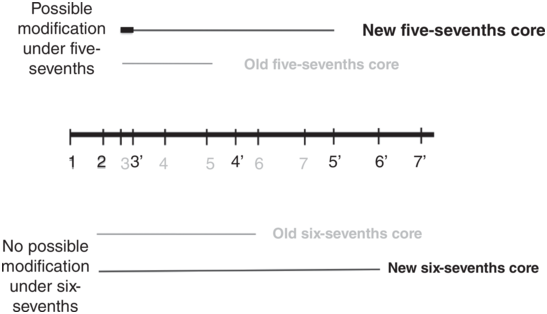
Figure 2.2 Change of core in one dimension under five-sevenths and six-sevenths majority
In this simplified one-dimensional representation, the old five-sevenths constitutional core would be indicated by the gray line at the top of the picture, while the new five-sevenths constitutional core would be indicated by the black line. The feasible difference between the two lines, corresponding to the possible constitutional change, would be the tiny segment in red. This is the only possible constitutional change. If the constitution happened to be located anywhere in the 3–3’ segment of the line, it would be modified to go to 3’. Otherwise, it will remain unmodified. The reason for this is that for a five-sevenths majority the outcome is to be within the new core; consequently, the approval of Player 3 (now 3’) is necessary.
Let us now look at the bottom of the figure, which assumes a six-sevenths qualified majority for modification of the constitution (that is, it addresses the issue of a six-sevenths constitutional core). Now, constitutional change is impossible because Legislator 2 has to approve it and they have not changed their opinion.
In both cases, the part of the constitution that can be modified is the difference between the new and the old core – that is, anything that happens to be in the old core and is not in the new one. This difference is very small in the case of amendment rules requiring five-sevenths and is non-existent in the case of amendment rules needing a six-sevenths majority. This makes it clear why different amendment rules have very different outcomes. Consequently, the Burgess (Reference Burgess1890) argument, which states that amendment rules are the most important part of the constitution (and is an argument shared by many researchers, as we saw in the Introduction), is not an idiosyncratic statement based on his preferences but a belief based on the way institutions work.
The astute reader will understand that the larger the core of the constitution (I remind them, this depends not only on amendment rules but also on the actors’ preferences), the less frequent and/or significant amendments will become. A more accurate argument, though, is that a large constitutional core is incompatible with significant amendments. However, one should be uneasy about the simplicity of the one-dimensional space I used to make my analysis. A very reasonable objection is that constitutions are much more complicated objects. However, the advantage of theory is that it allows one to see the consequences of bare-bones arguments and then complicate them. We will now move to a two-dimensional space of constitutional cores.
2.2 Two-Dimensional Cores Generated by Complicated Amendment Rules
Let us assume that we have a single congress with seven legislators (for reasons of simplicity) that requires a two-thirds majority to amend the constitution, as in Figure 2.3. If we assume that each one of these seven legislators has their own preferences (depicted by the location of Points 1 to 7) and that each one of them prefers outcomes that are closer to their preference over outcomes that are further away, then we can calculate the qualified majority core of this “legislature” as follows. Given that the constitution specifies a two-thirds majority for successful amendments, it requires that five of the seven members vote in favor of revisions in order for them to pass. Figure 2.3a presents a five-sevenths core by drawing a line between two players such that there are two points to one side of the line and five points either on the line or to the opposite side of the line (as with lines C1C4, C2C5, C3C6, etc.). The core, for example, cannot be north of line C2C6 because five group members (C2, C3, C4, C5, C6) will replace such a point by its projection on the line itself (which they prefer). Similarly, the core cannot be south of line C2C5 because five members (C1, C2, C5, C6, C7) will pull this point down on line C2C5. Once all such possible lines are drawn, the core is formed at the intersection of all the preferences of five points (Figure 2.3a). A similar process is followed to generate the six-sevenths core depicted in Figure 2.3b. Here, lines are drawn to exclude just one point instead of two. The resulting intersection is larger than in the five-sevenths case, indicating a larger core. Here again, under the six-sevenths arrangement, one should expect less constitutional revision over time. Figure 2.3c indicates that the five-sevenths core is included in the six-sevenths core.
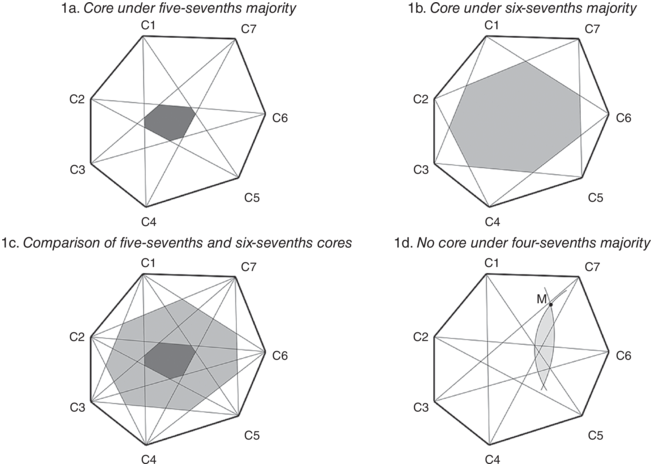
Figure 2.3 Core of a unicameral legislature under qualified majorities and lack of core under simple majority
What is more interesting, however, is that if the required majority is a simple majority or less, the core ceases to exist. Indeed, if we draw a median line that has a simple (not qualified) majority on one side of it, it will also have a simple majority on the other side: The line C2C6 in Figure 2.3d, for example, is such a median line since it has four points either on it or on one side of it (C1, C2, C6, C7) and five points (C2, C3, C4, C5, C6) either on it or on the other side of it. Consequently, the line has a majority on both sides of the line, leading to the situation that any point in this two-dimensional space can be defeated by a simple majority – or, in other words, that the core is empty. Let us now consider Point M north of the line C2C6. We show that this point cannot be within the core if the decision-making rule is a simple majority – that is, that it can be defeated by a simple majority. If we draw the circles C2M and C6M, any point in their intersection defeats M by a simple majority. Indeed, any point north of the line C2C6 is preferred over M by points C1, C2, C6, and C7, and any point south of the line is preferred by points C2, C3, C4, C5, and C6. Consequently, Point M can always be defeated by a simple majority. By moving Point M to different locations, we can prove that there cannot be any point that is undefeated, and, therefore, the simple majority core is empty. This condition will be even more true if the required majority is smaller than a simple majority (such as 40 or 45 percent). I could make the same argument with respect to any other median line, and I could complicate the picture by creating what is called the win-set of Point M – a flowerlike pattern that identifies all the points that can defeat Point M by a simple majority of the members of congress C1C7. I will present a simpler picture in Section 2.3.
Let us now assume that we have a bicameral congress (like one-third of the countries in the world) that requires specifically a two-thirds majority in both chambers in order to amend the constitution (this is the requirement in the US and Mexico). Figure 2.4a replicates the argument presented above in each one of the thirteen-member chambers by excluding five members and creating different majorities with eight out of thirteen members. Figure 2.4b connects the two separate cores and creates the bicameral two-thirds core of the legislature. In this case, the constitutional core expands significantly. Indeed, if we connect the core of one chamber with the core of the other, the whole composite area becomes the constitutional core of the country. Any point inside this area cannot be defeated by a concurrent two-thirds majority because it can be moved neither up or down (at least five members of one chamber would object) nor left or right (the whole upper or lower chamber would object).
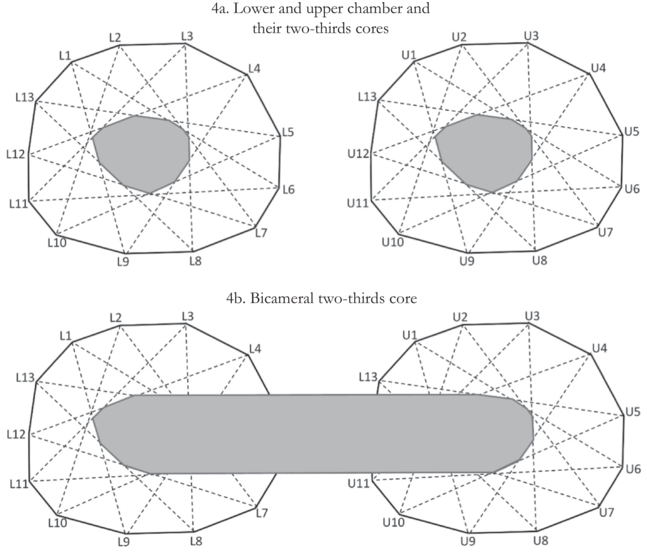
Figure 2.4 Constitutional core of a bicameral legislature
The major additional point that Figure 2.4 makes over Figure 2.3 is that the conjunction of two different bodies significantly expands the core of a constitution. Further, the argument is not restricted to two bodies. Figure 2.5 adds to the bicameral legislature an additional body that is required to agree by simple majority (this is the case for the Mexican constitution that requires two-thirds majorities of both chambers and a majority of the states).

Now, with three different bodies, the core of the constitution expands even further. Any point inside the shaded area cannot be defeated on the basis of the existing rules because at least one of the conditions will be missing.
There is one more complication in the amendment rules of some countries. What happens if the constitution adds alternate methods of revision rather than adding constraints? Figure 2.6 presents such a situation. Consider that in addition to a three-fourths majority required for approval by a bicameral legislature, represented by chambers A1A2A3 and B1B2B3, the constitution requires either approval by a referendum, represented by Player P, or by an elected president of the republic, represented by Player Q. Based on the previous analysis, the bicameral core would be the whole area A1A2A3B3B2B1. The additional requirement of a referendum would expand the core to the area A1A2A3PB2B1, while the alternative route of asking for the approval of the president of the republic would generate the core A1A2A3QB2B1. However, the dotted areas in the picture are not parts of the constitutional core of the country. The points in the dotted areas can be modified by one of the two permissible mechanisms – either the referendum or the president. The constitutional core will be the intersection of the two possible cores, represented by the shaded area in Figure 2.6.
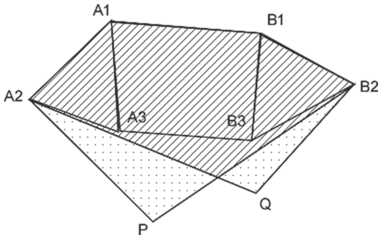
Figure 2.6 Core with alternative constitutional provisions
Figures 2.5 and 2.6 demonstrate the logic of constitutional revisions. Their extent depends not only on the institutional provisions but also on the positions of the actors involved. For example, in Figure 2.5 the constitutional cores of the two chambers could be smaller or overlap, leading to a reduction of the size of the constitutional core. On the other hand, they could be larger and further away from each other, leading to an expansion of the core. Similarly, in Figure 2.6, one of the two procedures could become easier than the other. For example, if Q is inside the triangle PA2B2, then the approval of Q will be easier than that of P, and P will become irrelevant (all other players would prefer the approval of Q instead of P).
There are two rules that will produce stable effects on constitutional cores. The first is that adding constraints will never reduce a constitutional core, although it may not affect it, depending on the positions of the actors. The second is that adding alternatives will never expand the constitutional core, although, again, depending on the position of the actors, it may result in no change. I will use these two rules extensively in the calculation of constitutional cores for the sample of countries in this analysis. I will discuss the issue of dependence on actors’ preference on the core in the conclusions of this chapter.
Finally, another result of my analysis of the constitutional core as a condition for constitutional amendments is that the small size of the core is a necessary but not sufficient condition for constitutional amendments. Here are the reasons why.
Figure 2.7 presents two different constitutional cores, one large and one small (which is a subset of the large core). This configuration occurs when one removes restrictions from the amendment rule – for instance, when moving from a three-fourths to a three-fifths majority, or if only one chamber of a bicameral legislature is required to approve some constitutional revisions (as in the case of Austria). This configuration presents three different potential positions of the status quo. In the first case, the status quo SQ is located inside the small core (that is, inside both cores), and, therefore, no constitutional revision is possible. In the second case, the status quo SQ’ is located outside the small core but inside the large core, so constitutional revisions are possible if the core is small, but impossible if the core is large. In the third case, the status quo SQ" is located outside both cores, and, while constitutional revisions are possible, the set of possible revisions is larger than in the case with the small constitutional core. All of these statements are true regardless of the position of the status quo in each one of the three areas.

There are several conclusions from this analysis. First, regarding the frequency of amendments, the larger the core, the fewer constitutional amendments are possible (e.g., SQ’ can be modified with a small core, but not with a large one).
Second, the importance of the potential amendments is correlated with the size of the core. In Figure 2.7, SQ" has a large distance from the small core (but not from the large one). Consequently, a large constitutional revision is possible if the core is small. Figure 2.7 also demonstrates that this change is not possible with a large core.
Third, the arguments above produce necessary but not sufficient conditions for constitutional amendments. Constitutional amendments are impossible when the status quo is inside the core, but they are just possible (though not necessary) in cases where the status quo is outside the core. This has implications for the variance of the relationship between the size of the core (constitutional rigidity) and the frequency of amendments: Lower constitutional rigidity will present higher variance because more constitutional amendments become possible (but, again, not necessary). Consequently, my analysis predicts that constitutional rigidity will have a double impact on the frequency of amendments: Higher rigidity will produce both a lower frequency of amendments and a lower variance of amendments.Footnote 2
2.3 Referendums as Agents of Constitutional Modification (and Replacement)
In Chapter 1, we saw that referendums are used by either individual (in France, the president) or collective (in Ireland, the government) agents for confirmation of their constitutional amendment proposals. More frequently, particularly in Latin American countries, they are used as the final institution of approval of a change of the whole constitution. This is a subject that we do not fully address in this book, but we do slightly touch on it in Chapter 4 because in Chile the failure of a process of constitutional amendment led to a process of constitutional replacement (which was also a double failure).
Referendums may or may not have some participation requirements for the validity of results, but the decision is made by simple majority rule. In Section 2.2, we saw that simple majority rule decisions do not have a core. Consequently, the fundamental concept of this chapter (the constitutional core) cannot be of any further use.Footnote 3 We will use another concept instead: the win-set of the status quo – that is, the set of points that can defeat the status quo by majority rule. The core is actually a derivative of this concept, since it can be defined as the set of points for which the win-set of the status quo is empty. In addition, the core is a more partial concept (sometimes it exists, sometimes it does not), while the win-set of the status quo is a universal concept (it rarely does not exist). The outcome of these definitions is twofold: first, analyses on the basis of the core are simpler (there is no reference to the status quo; this is why I used it as much as possible); second, analyses on the basis of the core and analyses on the basis of the win-set are consistent with each other because when the core shrinks the win-set of the status quo expands, and when the core is empty the win-set of the status quo expands even more. In other words, both concepts are related to constitutional rigidity in inverse ways.
Let me revisit the fundamental conclusions of Sections 2.1 and 2.2 on the basis of the win-set concept and, consequently, generalize them (in case there is no core).
Proposition 1: For any SQ, an additional constitutional amendment constraint does not increase the win-set of the SQ.
The reason for Proposition 1 is that any constraint will be either operational, in which case it will exclude some outcomes and decrease the win-set of the SQ, or not, in which case it will leave it unchanged.
Proposition 2: For any SQ, an alternative constitutional amendment procedure does not decrease the win-set of the SQ.
The reason for Proposition 2 is that any alternative procedure will be either easier, in which case it increases the win-set of the SQ, or more difficult, in which case it leaves it the same.
Proposition 3: A large win-set of the SQ is a necessary but not sufficient condition for significant constitutional amendments.
The reason for Proposition 3 is that a large win-set of the SQ provides the possibility of significant amendments but does not guarantee them.
I will now describe the win-set of the status quo of a single actor and then expand it in the case of a referendum. Figure 2.8 presents an individual Y and the status quo in a two-dimensional policy space. This actor would prefer any point that is closer to their preferences over the status quo, so Policies 1, 2, and 3 but not Point A would replace the status quo. Another way of describing the situation is that Points 1, 2, and 3 are inside the win-set of the status quo, but Point A is not. The conclusion from this discussion is that what belongs in the win-set of the status quo depends on the position of Y and the position of the status quo (or either of them along with their distance).

Figure 2.8 Outcomes of a referendum
Now let us consider a collective actor like a whole population and the status quo. In order to calculate the win-set of the status quo, we should draw as many circles as the members of the population (most likely in the millions), consider the intersection of these circles, and select a point in any of the possible intersections of a majority of these circles. This appears to be a daunting enterprise. However, appearances are deceiving. Ferejohn et al. (Reference Ferejohn, McKelvey and Packell1984) have proven that the situation in a referendum is not very different from the one described in Figure 2.8. The win-set of the status quo of a collective player can be included inside a circle and includes another circle, both with the same center. The larger the population, the more these two circles approximate each other in size (Tsebelis Reference Tsebelis2002: Ch. 5), and, consequently, the analysis of the outcomes of a referendum can be done in Figure 2.9.Footnote 4 The win-set of the status quo will be located again inside the circle YSQ, and any point inside this circle would defeat SQ while any point outside would be defeated by SQ.
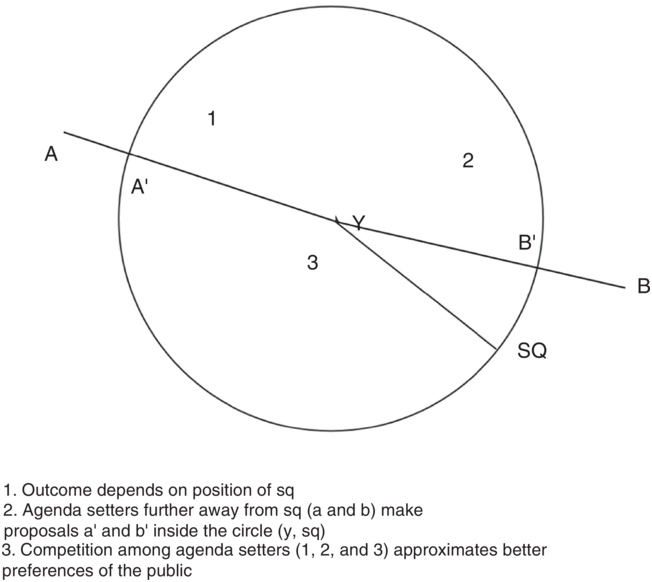
Figure 2.9 Referendum outcomes as a function of agenda setter
Let us use this picture to help our analysis of constitutional amendments. As we said, there is an additional actor (individual or collective) who proposes the amendments to the population. If this actor is inside the circle YSQ (such as Points 1, 2, or 3), they can propose their own preferences, which will be adopted. If they are outside the circle YSQ (such as A or B), their proposals will be rejected, unless they select a point inside the circle. So, rational actors would select the points A’ or B’.
One additional point (although it does not address, to my knowledge, constitutional revisions) is that if we do not have a single agenda setter but several that compete with each other, such as several proposals presented to the people as is the case with popular initiatives, then these agenda setters will make proposals approaching closer to the ideal point Y of the population in the hope that they will attract more votes and win.
The fact that there is no core in a referendum and, therefore, constitutional change is easier to make happen is the reason for the frequent use of referendum procedures for adopting constitutional amendments – or even for replacing whole constitutions, as we will see in the next chapter. There are even situations where agenda setters deviate from the constitution and try to enshrine their preferences through a ratification by referendum – a process against which the Venice Commission guards:
The Commission also wishes to stress that recourse to a referendum should not be used by the executive in order to circumvent parliamentary amendment procedures. The danger and potential temptation is that while constitutional amendment in parliament in most countries requires a qualified majority, it is usually enough with simple majority in a referendum. Thus, for a government lacking the necessary qualified majority in parliament, it might be tempting instead to put the issue directly to the electorate. On several occasions the Venice Commission has emphasized the danger that this may have the effect of circumventing the correct constitutional amendment procedures. It has insisted on the fact that it is expedient in a democratic system upholding the separation of powers that the legislature should always retain power to review the executive’s legislative output and to decide on the extent of its powers in that respect.
2.4 Computing Constitutional Rigidity
It is now time to use all these analyses to produce a means to consistently assess the constitutional rigidity of different countries. Sections 2.1 and 2.2 calculated the core of a constitution as a function of the actors required to agree and the majorities required for valid decisions in each one of them. Section 2.3 analyzed the case when one of them is a referendum, when all the other relevant actors will be the agenda setters and they have to produce a constitutional solution acceptable to the majority of voters (that is, a solution within the win-set of the SQ of the population). This method is based on the interaction between the institutions specified in the amendment provisions of the constitution and the preferences of the relevant actors. However, the preferences depend on the subject matter of the constitutional review and cannot be assessed a priori and in comparative perspective. Instead, I use the arguments to construct a simplified index based only on the amendment provisions. I will return to this issue in the conclusions of this chapter.
Now, I will calculate the index by summing the approval thresholds of different elected institutions. This combines the veto players who are required by the founders of the constitution with the qualified majorities included to protect it. For all countries, the formula includes the threshold that must be reached for approval in any popularly elected body that must approve a constitutional amendment (any constitutional veto player). If applicable, this formula includes the executive (in presidential systems), the legislative, the people (referendums), and regional governments. For example, if a legislative body must pass an amendment by a simple majority, 0.5 is added to the formula. If an intervening election is required between two rounds of majority approval, 0.5 + 0.5 is added. For example, in Greece, two votes are required by two successive parliaments (with an intervening election). One of the two majorities is three-fifths, and the other is a simple majority. As a result, the basic score for constitutional rigidity in Greece is (3 / 5 + 0.5) = 1.10 (see Appendix II).
For my analysis, I focus on the constitutions of countries included in the Constitute Project in effect in 2013 (www.constituteproject.org/). I restrict my analysis to only “democratic” countries, which I will operationalize as countries ranking five or above in the POLITY2 Index.Footnote 5
Some constitutions provide alternate paths to revision. When there are several alternative procedures, I measure only the one that is first presented in the constitution. This first path is the one that the founders intended to be the primary process. We will look at such procedures in Chapter 4, where we will study amendments in Italy and Chile in detail. If there are subsequent alternative methods,Footnote 6 my index (which is calculated a priori) will include them with a small reduction of rigidity as calculated by the first method. Finally, if there are different procedures for explicitly enumerated articles of the constitution, they will be ignored (as different amendment procedures would generate different indexes in many countries). That would mean that analyses that deal with specific subjects which have different amendment rules, such as budget amendments or human rights, should calculate new constitutional rigidity indexes on the basis of these rules.
2.4.1 Measure of Bicameral Legislatures
I will now turn to the second chamber of a bicameral legislature. A second chamber can have a majority independent from the lower chamber. Most of the time, the founders of a constitution designate the legislature as a required veto player in addition to specifying the required majority for approval. If the legislature is composed of two chambers, they are usually both designated as veto players.Footnote 7 I use the Euclidean distance between the two chambers as a measure of their disparity: if one legislature is composed of parties with proportions  , while in the second legislature the same parties have percentages
  , the compositional distance between the two chambers is
  , which increases as a function of the difference in the percentage that each party wins in each chamber. If the two chambers have identical composition, which is what Lijphart (Reference Lijphart2012: 99) calls “congruent,” then this indicator counts them as a single unicameral legislature. According to this index, as the difference in the composition of the two chambers increases, constitutional revisions become significantly more difficult.Footnote 8 This calculation of the difference in the composition was done at the end of 2013. My choice implies that this difference approximates the average difference over the whole period of democratic rule in a country, which would have been a more accurate measure. One example for how this measure of bicameral legislatures is applied can be found in Germany. In this country, both chambers of a bicameral legislature have to agree on a constitutional revision with a two-thirds majority. The Euclidian distance of the two chambers is 0.281. Consequently, I calculate the constitutional rigidity in the German Federal Republic as 2 / 3 × 1.281 = 0.854 (actually, in Appendix II I add 0.01 and report 0.864 for reasons that will become clear later in this chapter). My approach does not address the question of whether the political majorities in both chambers are the same or not, which is an issue that would be complicated to calculate comparatively but would have significant effects in single-country studies.
2.4.2 The Epsilon Rule
To account for any modifications of the rules that make constitutional amendments more or less difficult than specified in the fundamental method, I add or subtract an epsilon (i.e., a small number – in this case, 0.01). This is done for any provision that would increase or decrease rigidity. Examples of such modifications – and, therefore, an addition or subtraction of an epsilon – may include a provision outlining the percentage of members required for a quorum, a requirement that a revision be passed twice, or a delay from one passage to the next. If an alternative procedure is specified, I will subtract an epsilon (see Appendix II).
This method ensures that every single rule that addresses constitutional revisions is incorporated into my measure, including any compositional differences between the two legislative chambers. What is missing, though, is the actual ideological distance of the different parties or other institutional veto players.Footnote 9
While these rules are applied in a consistent way, they are not the only ones possible. For example, under the current assumptions, it makes no difference for the constitutional rigidity of a country if the parliament votes by simple majority for the amendments followed by a referendum or if there is a new election and the new parliament approves the amended provisions, provided simple majorities are required in parliament and the referendum. Some might object to this simplification. The voters may have different preferences than a subsequent parliament, and it is not obvious which one of them is closer to the positions of the initial parliament. However, the constitutional rigidity index calculation would be 0.5 + 0.5 = 1 in both cases. Similarly, it makes no difference in the index if a double passage by the same parliament is required or if there is a quorum requirement. Both cases result in adding an epsilon to the indicator. For more clarification, the reader can refer to Greece and Germany in Appendix II. For Greece, an epsilon is added because of two votes required in the first reading, and an epsilon is subtracted because of the two alternative procedures. This leaves the index unchanged at 1.10. For Germany, I add an epsilon to represent the requirement of two-thirds of the total number of members of the chambers (and not of the members present); the final result for Germany is 0.864. These choices are the simple application of the rules outlined earlier.Footnote 10
I only consider the constitutions in effect in 2013 and the constitutional history of countries only when they are democratic. If a country falls below five in the POLITY2 index, the corresponding years are eliminated. Given that I use the rate of amendment years over the total democratic years, the elimination of a year may affect the numerator of my variable (which is the number of amendment years) but will certainly affect the denominator (which is the total number of democratic years).Footnote 11 These restrictions leave a sample with a wide range of both constitutional rigidity and constitutional amendment frequency. The range of the constitutional rigidity scale extends from 0.5 to 1.85, with a standard deviation of 0.29. These numbers roughly correspond to one to three different veto players with simple or qualified majorities. An intuitive way of understanding this measure is to say that a change of two standard deviations is roughly equivalent to adding a referendum or the approval of a popularly elected president as a requirement for the validity of a constitutional amendment. With respect to amendment frequency, the range is from zero (no amendments in any democratic year) to one (amendments passed in every democratic year). The average constitutional rigidity in the sample is 0.89, and the average amendment frequency is 0.25 amendments per year (that is, one amendment every four years). The empirical analysis in Chapter 6 will demonstrate the empirical relevance of this chapter.
I will call the index generated in this book the veto players rigidity index because the analysis presented in this chapter is based on the theory of veto players (Tsebelis Reference Tsebelis2002).
Conclusions
There is one significant difference between the theoretical approach in Sections 2.1, 2.2, and 2.3 of this chapter as well as the empirical indicator I generated in Section 2.4. In the theoretical analysis, I rely on both the preferences of the actors and the amendment rules of the constitution for the calculation of the core or the win-set of the status quo. In the calculation of the index, I rely only on the amendment rules. This is a significant and unfortunate modification that I would have preferred to avoid. Therefore, I must explain why I could not do so.
The arguments in the first three sections depend on the relevant positions of the actors. For example, the core of the constitution will be significantly reduced if the preferences of the actors approach each other. However, these preferences will change over time. Such changes could occur because of political conditions (a shift in coalitions, polarization because of upcoming elections, etc.) or changes in the opinion of the voters. Similarly, the position of the status quo will change over time. The obvious reason for this would be a legislative change, but I want to underline one additional, less obvious reason for change. Consider legislation on social security or unemployment – the same legislation can have completely different effects several years later when different generations come to retirement age or when there are different economic conditions. Such exogenous changes to the status quo may require not only policy changes but even constitutional ones. I do not know how to take into account such changes in a comparative analysis. Some researchers approximate it by the number of parties (Negretto Reference Negretto2012). However, as I will show in Chapter 5, the case of Mexico where multiple parties sign agreements and behave as a single party does not support the approach in comparative perspective. Others that attempt to incorporate preferences at the comparative level have not been successful in my judgment, as I will demonstrate in Chapter 3.
In my analysis, a very promising step forward could be made by operationalizing the concept of polarization. Highly polarized countries would have larger cores and smaller win-sets of the SQ than more consensual ones. Consequently, amending the constitution should be easier in such countries. I do not know of any indicator of cross-national polarization. However, even if such an indicator existed, it should be differentiated across policy dimensions. For example, differentiation along the environmental policy dimensions today should be significantly lower than twenty years ago, and constitutional changes on environmental issues (such as including constitutional provisions about environmental assessment of policy measures) should be easier. The fact that such a comparative analysis is not possible today does not mean we should not assess the effects of amendment rules at all. As the reader will verify, I make such an assessment of the institutions as a necessary but not sufficient condition for change and leave it open for any additional variables that we will be able to convincingly generate in the future.


 Open access