

Research on judicial independence (JI) has flourished since the pathbreaking article of Cooter and Ginsburg (Reference Cooter and Ginsburg1996) on judicial discretion. Cooter and Ginsburg (Reference Cooter and Ginsburg1996) argue that because judges have more discretion to shift policy when they are unafraid of being overruled, their discretion increases “when the probability decreases of legislative repeal of their decisions” (295), which they measure (among other factors) as the number of vetoes legislation has to clear.Footnote 1
Today, a voluminous literature seeks to understand what exactly constitutes JI, identify how to measure it, and determine both its causes and its effects on other phenomena of interest. JI is thought to be essential to constraining state power and making agreements credible (North and Weingast Reference North and Weingast1989), and it leads to efficient investment, growth, and development (Barro Reference Barro1997, Acemoglu et al. Reference Acemoglu, Johnson and Robinson2001, Feld and Voigt Reference Feld and Voigt2003), respect for human rights (Powell and Staton Reference Powell and Staton2009), and democratic consolidation (North et al. Reference North, Summerhill, Weingast, Bueno de Mesquita and Root2000).
Starting with Feld and Voigt (Reference Feld and Voigt2003), much of the literature distinguishes between de jure and de facto JI. De jure JI is generally defined as the independence guaranteed to judiciaries in formal legal documents (e.g., the constitution), whereas de facto JI is the amount of independence the judiciary enjoys in practice. The former is typically measured in terms of the presence or absence of a set of procedural factors (length of tenure, methods of appointment and removal, formal declaration of independence of the judiciary, etc.) (Keith Reference Keith2002, Feld and Voigt Reference Feld and Voigt2003, La Porta et al. Reference La Porta, Lopez-de-Silanes, Pop-Eleches and Shleifer2004), while the latter is measured by expert assessments (Howard and Carey Reference Howard and Carey2004).Footnote 2
Findings from this line of research indicate a weak relationship between the de facto and de jure JI: Researchers have shown that de facto JI, rather than de jure JI, is correlated with growth (Feld and Voigt Reference Feld and Voigt2003, Voigt et al. Reference Voigt, Gutmann and Feld2015), that de jure JI is weakly positively correlated with de facto JI (Hayo and Voigt Reference Hayo and Voigt2007, Reference Hayo and Voigt2019), that most components of de jure JI are uncorrelated with de facto JI (Melton and Ginsburg Reference Melton and Ginsburg2014), and that de jure JI is weakly negatively correlated with de facto JI (Ríos-Figueroa and Staton Reference Ríos-Figueroa and Staton2014, Metelska-Szaniawska and Lewkowicz Reference Metelska-Szaniawska and Lewkowicz2021).
This set of findings implies that formal rules are ineffective at guaranteeing judicial independence. However, as Ríos-Figueroa and Staton (Reference Ríos-Figueroa and Staton2014) argue, the theoretical motivation for why a specific rule should or should not contribute to judicial independence and the mechanisms by which it does so remains underdeveloped; therefore, researchers should be cautious in uncritically using indexes of rules as a measure for de jure JI. I concur with this assessment and take it one step further. To measure the relationship between formal institutional rules and the behaviors they condition, we need three things: a specific formal rule, a specific behavioral outcome, and a theorized mechanism by which the rule conditions the outcome.
To this end, instead of trying to establish a relationship between additive indexes of de jure provisions and de facto outcomes, I provide here a theoretical account of how a specific de jure feature of constitutions – the constitutional amendment rule – affects a specific de facto behavioral outcome: the capacity of a judiciary to strike down government legislation. I argue that as constitutions become more difficult to amend, high courts gain more discretion in their ability to strike down legislation without fearing a government override. By theoretically motivating the relationship between constitutional rigidity and judicial strikes, I can outline the conditions under which we will actually observe judicial strikes in terms of two theoretical quantities: the discretion afforded to judges by the constitution and the preferences of the judiciary over policy outcomes. When judges have a high level of discretion and their preferences over policy are not aligned with the government, they have considerable ability to strike down government legislation. In other words, they are independent of the government, with the amount of independence increasing in both the level of discretion and the distance between judicial and government preferences. Conversely, when the judiciary has no discretion or is perfectly aligned with the government preference-wise, they will not be independent of the government, and, consequently, we will not observe independent behavior.
A parsimonious measure of JI directly follows from the definition of JI as being the frequency with which the judiciary alters or invalidates the policy of the sitting government, given the opportunity to do so. An example will clarify this definition: If the US Supreme Court decides to invalidate Obamacare while President Obama is in office, it will count as a demonstration of judicial independence, while if it makes this decision when President Trump is in office, it will not count as such.Footnote 3
Using a measure of judicial discretion based on the constitutional rigidity index from Chapter 6, I estimate the effect of judicial discretion on JI. Because judicial preferences are unmeasurable except in rare cases, I deliberately exclude them from the analysis.Footnote 4 On the basis of the theorized relationship between preferences, discretion, and independence, I expect there to be a positive heteroskedastic relationship between judicial discretion and observable judicial independence such that at low levels of discretion, judicial independence is uniformly low, but at high levels of discretion, judicial independence varies between high or low depending on the judges’ preferences. In addition, to control for the necessary condition for judicial independence that the decisions of the judiciary must be respected and enforced, I restrict my analysis to countries that are democratic (operationalized as countries that score over five on the POLITY2 index) on the basis that in democracies the decisions of the judiciary are likely to be respected.Footnote 5
I test my theoretical expectation using data from the Comparative Law Project to calculate the rate of judicial strikes of government legislation and the constitutional rigidity index from Chapter 6 as a measure of judicial discretion over constitutional matters and show that the data support the hypothesized relationship between JI and discretion: As discretion increases, so too does the rate at which government legislation is struck down by the judiciary as well as its variance. I close with a discussion of directions for future research into JI. This chapter includes an appendix with the data used in the empirical analysis.
8.1 Literature Review
Judicial independence is often considered important for any well-functioning political system,Footnote 6 but the effect of JI on outcomes such as economic growth, democratic stability, and respect for human rights has been mixed. While an extensive literature from political economy has shown the positive relationship between institutional quality and economic growth (Acemoglu et al. Reference Acemoglu, Johnson and Robinson2002, Reference Acemoglu, Johnson and Robinson2005) and between property rights and economic growth (Acemoglu and Johnson Reference Acemoglu and Johnson2005), there has been comparatively little research into the effect of JI on economic growth. Moreover, the research that does exist comes to contradictory conclusions: Glaeser et al. (Reference Glaeser, La Porta, Lopez-de-Silanes and Shleifer2004) show that JI is uncorrelated with growth, whereas La Porta et al. (Reference La Porta, Lopez-de-Silanes, Pop-Eleches and Shleifer2004) show that JI is positively associated with economic and political rights. In a series of papers, Feld and Voigt claim that de facto JI, defined as the amount of independence that the judiciary enjoys in practice, is associated with economic growth but that de jure JI, defined as the amount of independence that is formally guaranteed to the judiciary in written legal texts, is uncorrelated with growth (Feld and Voigt Reference Feld and Voigt2003, Voigt et al. Reference Voigt, Gutmann and Feld2015). However, Dove (Reference Dove2015, Reference Dove2016) shows that across the US states, JI is positively correlated with both entrepreneurship and economic freedom (using the procedure that judges are appointed by – a measure that would be considered to be de jure JI in the Feld and Voigt typology).
With respect to the relationship between JI and political rights, Howard and Carey (Reference Howard and Carey2004) show that “judicial independence is an important, if not absolutely necessary, condition for the development of political and civil liberties” (290). Keith et al. (Reference Keith, Tate and Poe2009) show that some indicators of JI (including the finality of court decisions and the absence of exceptional courts) are correlated with a reduction in state human rights abuse, but other indicators (such as guaranteed term lengths, fiscal autonomy for judges, and judicial review) are not so correlated. Keith (Reference Keith2011) also shows that de facto JI is associated with respect for human rights.
The relationship between de jure and de facto JI is unclear: Hayo and Voigt (Reference Hayo and Voigt2007) show that de jure JI is the most important predictor of de facto JI, Ríos-Figueroa and Staton (Reference Ríos-Figueroa and Staton2014) show that de jure JI is negatively correlated with de facto JI, Helmke and Rosenbluth (Reference Helmke and Rosenbluth2009) show that de jure JI is uncorrelated with de facto JI, Keith (Reference Keith2011) shows that de jure JI is correlated with de facto JI, and Melton and Ginsburg (Reference Melton and Ginsburg2014) show that only some combinations of de jure JI factors are predictive of de facto JI. More recently, Gutman and Voigt (Reference Gutmann and Voigt2018, Reference Gutmann and Voigt2020) show that while de jure and de facto JI are completely uncorrelated at the world level, they are negatively correlated when restricting the sample to only democratic countries and positively correlated when restricting to only nondemocracies. Metelska-Szaniawska and Lewkowicz (Reference Metelska-Szaniawska and Lewkowicz2021) analyze JI in post-Soviet countries and find no relationship between de jure and de facto JI. The absence of a clear, observed relationship between de jure and de facto JI has led some scholars to investigate why such a gap exists in the first place. Voigt (Reference Voigt2021) argues that the de jure–de facto gap is understudied and undertheorized and proposes a research program to investigate the determinants of the gap. Metelska-Szaniawska (Reference Metelska-Szaniawska and Lewkowicz2021) takes up Voigt’s research program and shows that in post-Soviet constitutions, longer and more complicated constitutions are associated with larger de jure–de facto gaps.
There are reasons to be skeptical of these findings. First, there is no single agreed-upon definition of JI (Ríos-Figueroa and Staton Reference Ríos-Figueroa and Staton2014, Staton Reference Staton, Howard and Randazzo2018). Second, since there is no way to observe JI directly, researchers must use proxies for which the relationship with JI is not always clear. As a result, there is inconsistency both within and across measures as to what constitutes an indicator of JI and whether a given indicator is associated with a higher or lower level of JI. The de jure–de facto split exacerbates this problem: It is frequently unclear whether measures are, in fact, proxying only de facto JI (as opposed to both de facto and de jure JI). I discuss each of these problems in the following sections.
8.1.1 Definition of JI
When analyzing JI, researchers must decide whether to define JI in terms of the autonomy that judges have from other branches of government and/or in terms of the ability of the judiciary to influence policy outcomes (that is, have their decisions implemented). Most scholars define JI strictly in terms of autonomy (e.g., Cox Reference Cox1996, Kornhauser Reference Kornhauser, Burbank and Friedman2002, Howard and Carey Reference Howard and Carey2004, La Porta et al. Reference La Porta, Lopez-de-Silanes, Pop-Eleches and Shleifer2004, Ríos-Figueroa Reference Ríos-Figueroa2007, Helmke and Rosenbluth Reference Helmke and Rosenbluth2009, Keith et al. Reference Keith, Tate and Poe2009, Gibler and Randazzo Reference Gibler and Randazzo2011)Footnote 7 or as a combination of both autonomy and influence (Ferejohn and Kramer Reference Ferejohn and Kramer2002, Feld and Voigt Reference Feld and Voigt2003). I will follow the general rule and focus on autonomy. Given that I restrict my empirical analysis to democratic countries, the implementation of judicial decisions can, in principle, be assumed.
8.1.2 Inconsistency within and across Measures of JI
A researcher’s measure of JI can be problematic if it lacks internal consistency, which occurs when the chosen proxies do not match the definition of JI. Glaeser et al. (Reference Glaeser, La Porta, Lopez-de-Silanes and Shleifer2004) and La Porta et al. (Reference La Porta, Lopez-de-Silanes, Pop-Eleches and Shleifer2004), for example, define JI as the ability of judges to enforce laws without interference (an autonomy-based measure) but measure JI in terms of whether judicial decisions are a source of law.
Internal consistency can also be a problem when researchers use measures of other related concepts as a proxy for judicial independence. For example, researchers such as Dove (Reference Dove2016) cite Barro (Reference Barro1997) as providing evidence that JI leads to economic growth, but Barro shows the effect of the central bank rather than judicial independence on growth. Similarly, Linzer and Staton (Reference Linzer and Staton2015) include the Contract Intensive Money (CIM) score from Clague et al. (Reference Clague, Keefer, Knack and Olson1999) in their composite measure of JI despite the CIM score reflecting the proportion of money in a given polity that is held in banking institutions.
This can also lead to inconsistency across measures since researchers are not all measuring the same concept. For example, Hayo and Voigt (Reference Hayo and Voigt2010) measure whether a constitution has an explicit statement of judicial independence, while Melton and Ginsburg (Reference Melton and Ginsburg2014) are skeptical as to whether this will have an effect. Hayo and Voigt (Reference Hayo and Voigt2007) argue that judges who only serve one term are more independent, while Ríos-Figueroa and Staton (Reference Ríos-Figueroa and Staton2014) argue that it is only important that the judge’s term is longer than those who elected or appointed them. Melton and Ginsburg (Reference Melton and Ginsburg2014) argue that judges with lifetime terms are more independent. Other concepts such as the number of judges, selection procedure, removal procedure, salary insulation, changes to rules, and dependence on other branches are less debated but vary in terms of whether they are included in the measure altogether (Melton and Ginsburg Reference Melton and Ginsburg2014).
As a result, independent measures of JI may be uncorrelated even when trying to capture the same dimension of independence. For example, Haggard et al. (Reference Haggard, MacIntyre and Tiede2008) show that the correlation between the La Porta et al. (Reference La Porta, Lopez-de-Silanes, Pop-Eleches and Shleifer2004) measure of JI and the measure used by the Word Economic Forum is only 0.15, even though both measures are attempting to capture the autonomy dimension of judicial independence.
8.1.3 Unclear Distinction between De Jure and De Facto JI
Both problems are also exacerbated by the strategies researchers use to distinguish between de jure and de facto JI. Tables 8.1 and 8.2 summarize existing measures of de facto and de jure JI in the literature, respectively, and Table 8.3 breaks down which indicators of de jure JI are used by each indicator. Starting with Feld and Voigt (Reference Feld and Voigt2003), many researchers consider the two to be separate concepts, with de jure JI referring to the amount of JI guaranteed in legal texts and de facto JI to the amount of JI that exists in practice.
Table 8.1 Measures of de facto judicial independence
| Source | Description |
|---|---|
| Howard and Carey (Reference Howard and Carey2004) | An ordinal measure of judicial autonomy with the levels fully independent, partially independent, or dependent based on US state department country reports |
| Henisz (Reference Henisz2000) | A binary measure that uses the Political Executive Constraints measure and the Political Risk Service’s Law and Order measure to get at the extent to which the judiciary is a constraint on the government |
| Cingranelli and Richards (Reference Cingranelli and Richards2008) | An ordinal measure of judicial independence from none, partial, to full using state department country reports |
| Linzer and Staton (Reference Linzer and Staton2015) | A continuous measure bounded by 0 and 1 measuring eight different components of de facto judicial independence using US state department human rights country reports as well as expert surveys |
| Feld and Voigt (Reference Feld and Voigt2003) | A continuous measure bounded by 0 and 1 with eight different components of de facto judicial independence from expert surveys (note how much harder it is to get expert surveys on de facto as opposed to de jure judicial independence) |
| Hayo and Voigt (Reference Hayo and Voigt2007) | A continuous measure bounded between 0 and 1 with eight different components of de facto judicial independence collected with an expert survey |
Table 8.2 Measures of de jure judicial independence
| Source | Description |
|---|---|
| Hayo and Voigt (Reference Hayo and Voigt2007) | A continuous measure from 0 to 1 that includes twelve different variables collected from an expert survey |
| Hayo and Voigt (Reference Hayo and Voigt2010) | A selection of twenty-one variables from the Comparative Constitutions Project that they think are relevant in explaining judicial independence |
| Melton and Ginsburg (Reference Melton and Ginsburg2014) | A measure of each aspect of judicial independence using data from the Comparative Constitutions Project (described in Table 8.4) on a 0 to 1 scale |
| Feld and Voigt (Reference Feld and Voigt2003) | A continuous measure between 0 and 1 from twelve different indicators (twelve different variables described in Table 8.3) from expert surveys |
Table 8.3 Components of de jure judicial independence
| Description | Source(s) |
|---|---|
| Explicit statement of judicial independence | Hayo and Voigt (Reference Hayo and Voigt2010) |
| Measure of judicial tenure (one term) | Hayo and Voigt (Reference Hayo and Voigt2007) |
| Measure of judicial tenure (term longer than those that elected them) | Ríos-Figueroa (Reference Ríos-Figueroa, Helmke and Ríos-Figueroa2011) |
| Measure of judicial tenure (lifetime term) | Melton and Ginsburg (Reference Melton and Ginsburg2014), Feld and Voigt (Reference Feld and Voigt2003) |
| Number of judges | Hayo and Voigt (Reference Hayo and Voigt2007) |
| Selection procedures | Melton and Ginsburg (Reference Melton and Ginsburg2014), Feld and Voigt (Reference Feld and Voigt2003), Hayo and Voigt (Reference Hayo and Voigt2010) |
| Removal procedures (cannot be removed or limited removal procedures) | Melton and Ginsburg (Reference Melton and Ginsburg2014), Hayo and Voigt (Reference Hayo and Voigt2007, Reference Hayo and Voigt2010) |
| Salary insulation (as well as access to other resources) | Melton and Ginsburg (Reference Melton and Ginsburg2014), Hayo and Voigt (Reference Hayo and Voigt2007), Feld and Voigt (Reference Feld and Voigt2003), Hayo and Voigt (Reference Hayo and Voigt2010) |
| Changes to rules (or lack thereof) | Hayo and Voigt (Reference Hayo and Voigt2007), Feld and Voigt (Reference Feld and Voigt2003) |
| Dependence on other branches | Hayo and Voigt (Reference Hayo and Voigt2007) |
| Ability to initiate proceedings | Feld and Voigt (Reference Feld and Voigt2003) |
| Publish decisions | Feld and Voigt (Reference Feld and Voigt2003), Hayo and Voigt (Reference Hayo and Voigt2010) |
Despite the intent to distinguish between legally guaranteed and actually occurring independence, every measure of de facto JI mixes elements from both de jure and de facto JI. Measures based on expert surveys (e.g., Feld and Voigt Reference Feld and Voigt2003, Howard and Carey Reference Howard and Carey2004, Cingranelli and Richards Reference Cingranelli and Richards2008) cannot ensure that the surveyed experts separate the influence of institutional guarantees in their assessment of the independence of a country’s judiciary, and measures using procedural checklists include structural factors that should be associated more closely with the de jure concept.Footnote 8
It is also not clear what the de jure concept is measuring. Most measures amount to aggregating a checklist of rules and procedures (e.g., Feld and Voigt Reference Feld and Voigt2003, Hayo and Voigt Reference Hayo and Voigt2014). But, as Ríos-Figueroa and Staton (Reference Ríos-Figueroa and Staton2014) argue, whether researchers recognize it or not, by using the de jure concept they are implicitly trying to capture the incentives that the written guarantees of independence provide the actors, rather than simply the semantic content of the written guarantees of JI. It is not clear a priori which rules should be included in a given measure of de jure JI, and, as a result, different measures of de jure JI (Feld and Voigt Reference Feld and Voigt2003, La Porta et al. Reference La Porta, Lopez-de-Silanes, Pop-Eleches and Shleifer2004, Keith et al. Reference Keith, Tate and Poe2009) are only weakly correlated with one another.
8.1.4 Composite Measures as a Corrective?
Recognizing the multiplicity of different measures of JI and the uneven coverage of these measures across both countries and time, some scholars have created composite measures of JI. Hayo and Voigt (Reference Hayo and Voigt2014, Reference Hayo and Voigt2016) generate a time-series cross-sectional measure of de jure JI for 100 countries between 1950 and 2005 using factor analysis to extract the shared information from a variety of structural indicators of JI; Linzer and Staton (Reference Linzer and Staton2015) use a Bayesian Item-Response model to create a composite measure of de facto JI from 1948 to 2012 across over 200 countries by pooling information from a variety of existing de jure and de facto measures of JI (Feld and Voigt Reference Feld and Voigt2003, Howard and Carey Reference Howard and Carey2004, Cingranelli and Richards Reference Cingranelli and Richards2008, Keith et al. Reference Keith, Tate and Poe2009, economic and investment indexes from Clague et al. Reference Clague, Keefer, Knack and Olson1999, the Global Competitiveness Report, the International Country Risk Guide, the XCONST index from Polity IV).
It is unclear how to interpret Linzer and Staton’s composite measure or what to do when other researchers use the Linzer and Staton measure of de facto JI to test the relationship between de jure and de facto JI given that the latent variable modeled by Linzer and Staton contains information from both de jure and de facto measures (Hayo and Voigt Reference Hayo and Voigt2019).
8.1.5 Implications for Existing Findings
In sum, we should be skeptical of the validity of existing measures of JI and be cautious in accepting the lack of cohesive empirical findings from the literature at face value. Recall a central confusion from the literature: Feld and Voigt (Reference Feld and Voigt2003) and Hayo and Voigt (Reference Hayo and Voigt2007, Reference Hayo and Voigt2016, Reference Hayo and Voigt2019) claim that de facto and not de jure JI is correlated with economic growth, but that there is a weak correlation between de facto and de jure JI, whereas Howard and Carey (Reference Howard and Carey2004) claim that de facto JI is correlated with political rights. La Porta et al. (Reference La Porta, Lopez-de-Silanes, Pop-Eleches and Shleifer2004) and Keith et al. (Reference Keith, Tate and Poe2009) claim that a de jure measure of JI is correlated with political and economic freedom and respect for human rights, respectively, and Melton and Ginsburg (Reference Melton and Ginsburg2014) argue that certain combinations of indicators of de jure JI are correlated with de facto JI.
The inconsistency of these results is unsurprising, considering that the de jure measures from each of these projects are very weakly correlated (Ríos-Figueroa and Staton Reference Ríos-Figueroa and Staton2014). Regarding Howard and Carey’s (Reference Howard and Carey2004) measure of de facto JI, based on US state department reports, their coding criteria mix de jure and de facto concepts. Feld and Voigt’s (Reference Feld and Voigt2003) de facto measure mixes in de jure concepts, and Melton and Ginsburg (Reference Melton and Ginsburg2014) and Hayo and Voigt (Reference Hayo and Voigt2019) use the composite measure of de jure and de facto indicators from Linzer and Staton (Reference Linzer and Staton2015).
Where do we go from here? In their review of measures of judicial independence, Ríos-Figueroa and Staton (Reference Ríos-Figueroa and Staton2014) argue,
It is not yet clear that we have identified well the rules (or sets of rules) that produce the incentives we hope to measure. The perennial question on whether and how institutions impact behavior, that is, the relationship between de jure and de facto judicial independence, requires thinking carefully about two sets of issues: the conditions under which tend to work effectively and the incentives set by specific institutions, such as the appointment, removal, or constitutional review powers of judges. The length of judicial tenure as established in the constitution is a good measure if one wants to study the relationship between de jure and the actual length of tenure. But it is far less clear whether life tenure in the constitution produces “independent judicial behavior,” even if the actual tenure is also long. The latter question requires a conceptual clarification of what amounts to independent judicial behavior; for instance, what we have identified as autonomy or influence and a theoretical model of how a long tenure incentivizes such behavior.
Similarly, Melton and Ginsburg (Reference Cheibub, Elkins and Ginsburg2014) argue that the relationship between individual components of de jure JI (such as selection procedure, judicial salary, judicial tenure, etc.) and de facto independence should be considered separately and theoretically justified.
I concur that theory is needed to map the relationship between specific rules and judicial independence and that our instinct with respect to the measurement of rules should be to disaggregate rather than aggregate. In addition, in order to properly measure the effects of specific rules (rather than aggregated indices), we first need to theorize about how the presence or absence of a rule affects specific judicial behaviors instead of aggregated indices of de facto JI based primarily on expert surveys.
To this end, in the next section, I return to the concept of judicial discretion and use it to motivate a theory of JI as the interaction between judicial discretion and the preferences of the judiciary.
8.2 Judicial Discretion, Preferences, and Independence
In this section, I follow Cooter and Ginsburg (Reference Cooter and Ginsburg1996) (see also Tsebelis Reference Tsebelis1995, Reference Tsebelis2002) who determine judicial discretion to be a function of the rigidity of legislative outcomes and argue that judicial control over constitutional outcomes is proportional to constitutional rigidity. Then, I offer a theory concerning the conditions under which we should observe independent behavior in terms of constitutional discretion and judicial preferences: when judicial preferences diverge from the government’s and when discretion is high, the capacity for judges to behave independently will be high. However, since judicial preferences are nearly always unmeasurable, I predict that the relationship between behavioral indicators of judicial independence (such as the striking down of government legislation) and discretion will be heteroskedastic and positive due to the fact that judges may or may not rule against government policy when judicial discretion is high, and judges’ preferences are unaligned with those of the government but will (almost) never rule against government policy when discretion is low. I also justify the measures I choose: for judicial independence, the proportion of a sitting government’s legislation that the judiciary strikes down from the CompLaw dataset, and for discretion, the constitutional rigidity index from Tsebelis (Reference Tsebelis2022).
8.2.1 Constitutional Discretion Is Proportional to Constitutional Rigidity
Cooter and Ginsburg (Reference Cooter and Ginsburg1996) argue that judicial discretion, defined as the extent to which the judiciary can use statutory interpretation,Footnote 9 increases as legislative override of judicial decisions becomes more difficult. Their logic is straightforward: when judges’ preferences over policy diverge from those of the government, judges may wish to move policy closer to their ideal point by way of statutory interpretation. However, because the legislative veto players can, in most cases, come together to override the judiciary, the ability of the judiciary to interpret laws will be limited when the executive and legislative branches are aligned. Conversely, when the legislative veto players conflict, the judiciary may interpret laws to the extent that at least one of the legislative vetoes prefers the interpreted policy to the original.Footnote 10
A generalization of the Cooter and Ginsburg argument is that as the number of veto players increases, so too does the discretion of the judiciary. Let us assume that a political system has three veto players (e.g., three parties in a coalition government or three political institutions in a presidential system).Footnote 11 Figure 8.1 presents the ideal points (preferences) in a two-dimensional space. Assume that the horizontal axis represents the left-right continuum and that the vertical axis represents the environment. If each of these actors prefers points closer to their own preference over points further away, then they cannot change any policy located inside Triangle 123. Indeed, for any point inside this triangle, any movement of the status quo to the north will be objected to by Veto Player 3; any movement to the south will be objected to by Veto Player 1, and any movement to the east or west will be objected to by either 2 or 3. Therefore, a legislative change from point L1 to L2 is impossible because it will be objected to by Players 1 and 2, who will find the final outcome further away from their preferences. Similarly, a change from L2 to L1 will find Veto Player 3 objecting.Footnote 12

Figure 8.1 Legislative core: the court can make any statutory interpretation inside it
This analysis can be used in order to explain judicial discretion since any decision inside the triangle cannot be overruled by the political system. If the judiciary in the corresponding country prefers L1 or L2, it can interpret the law accordingly without any fear of being overruled. In addition, the courts could modify their opinion (a delicate stare decisis case) from L1 to L2 without any interference from the political system. However, if it prefers points J or K, it will have to select points J’ and K’ in order to avoid a legislative decision overruling its interpretation. So, if the statutory interpretations are within the political core (Triangle 123), no reaction by the political system is possible. Therefore, the size of the legislative core is an appropriate proxy for the discretion of the judiciary with respect to regular legislation.
What would happen if the basis of the judicial decision is the constitution (constitutional interpretation) and not any particular law (statutory interpretation)? Then, instead of the legislative core of the political system, we would have to base the analysis on the constitutional core. In most countries, it is more difficult to modify the constitution than the legislative status quo.Footnote 13
Figure 8.2 gives a visual representation of this situation. I have added one more veto player than what was in Figure 8.1. The quadrilateral 1234 represents the constitutional core (the Veto Player 4 is also required for a constitutional revision). As a result, changes to the constitution inside Quadrilateral 1234 are impossible, and any constitutional interpretation inside this area becomes possible. The reader can verify from Figure 8.2 that while a judicial decision J would be overruled (no matter whether it was on statutory or constitutional grounds), a decision K would be overruled on statutory grounds but would be valid on constitutional grounds. So, in our hypothetical example, if the court had based its decision on the constitution, a legislative overrule would have been irrelevant, and a constitutional amendment would have been impossible. So, the larger the difference between the constitutional and the judicial core (the shaded area in Figure 8.2), the more empowered the judges are to make constitutional interpretations (as opposed to statutory ones).
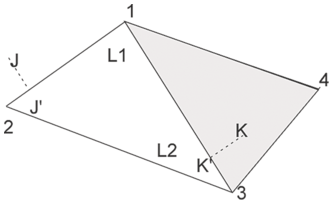
Figure 8.2 Constitutional core larger than legislative core: any constitutional interpretation within the constitutional core stands
Assuming the constitutional and supreme courts do not want to be overruled, they will exercise discretion proportionally to the size of the constitutional core. It follows that when considering discretion with respect to constitutional matters, it is appropriate to use the size of the constitutional core as a measure of constitutional discretion. For ordinary courts (or, more accurately, for statutory interpretations of any court), the determinant factor will be legislative overrule (i.e., the size of the legislative core of a country), while for constitutional decisions, the decisive factor will be the size of the constitutional core.
8.2.2 The Importance of Jurisdiction
The literature often focuses on higher courts, so there is relatively no work on lower courts (Burbank and Friedman Reference Burbank, Friedman, Burbank and Friedman2002). This is because it is argued that the incentive structures of lower courts are different. Local courts may be independent of local governments, but they may also be highly reliant on senior judges (in particular for promotions) (Ramseyer and Rasmusen Reference Ramseyer and Rasmusen2003). Lower court judges want to be promoted, whereas supreme court or constitutional court judges do not, which means that lower court judges will be more beholden to superior judges (Salzberger and Fenn Reference Salzberger and Fenn1999). In addition, it is thought that lower courts are more constrained than the supreme court (Burbank and Friedman Reference Burbank, Friedman, Burbank and Friedman2002).
There are generally two different models for constitutional courts, generalized into the “American” and “European” Systems (Jacob et al. Reference Jacob, Blankenburg, Kritzer, Provine and Sanders1996). On the one hand, these models are different because they have different appointment mechanisms and different terms. For certain European courts, the appointment of judges is seen as nonpolitical – the process, usually through a constitutional tribunal, is often criticized for being too secret, unlike that of the appointment of Supreme Court justices in the US (Ferreres Comella Reference Ferreres Comella2009). We will test this expectation in Section 8.4. Unlike many ordinary judges, constitutional court judges often have term lengths and limits. This is because while the rulings of ordinary judges can be overruled by higher judges, constitutional judges are the final and only say in the matter (Ferreres Comella Reference Ferreres Comella2009). There are conflicting expectations about constitutional courts in the literature. Epstein et al. (Reference Epstein, Knight and Shvetsova2001) compare the characteristics of constitutional and supreme courts. They summarize the literature as follows:
Some argue that [constitutional courts] are relatively unconstrained actors (e.g., Blankenburg 1996; Provine 1996; Stone 1994, 1995; Utter & Lundsgaard 1994), able to have “last licks” on matters that receive their attention. Others suggest that, even though these courts issue decisions that are final and formally binding, they are hardly untethered; they are instead constrained actors, those who must be attentive to preferences and likely actions of other relevant players in their systems of government, as well as to the institutional context in which they work, if they wish to issue efficacious decisions – decisions that the other players will respect and with which they will comply (e.g., Smithey 1999; Vanberg 1999).
Table 8.4 presents a list of countries with constitutional courts (which will be included as a dummy variable in my empirical analysis).
Table 8.4 Countries with constitutional courts
The main difference between constitutional and ordinary courts is that constitutional courts provide the final say in constitutional matters (Finck Reference Finck1997). At their most basic level, “constitutional courts have the power of judicial review and invalidation of unconstitutional statutes and statutory provisions” (Garlicki Reference Garlicki2007: 67). In most cases, constitutional courts are added later on after the judicial system of a country is well established.
The distinction between constitutional and supreme courts started with Kelsen arguing the differences between the European and American models. Within systems that have a constitutional court, only “a single court (usually called a ‘constitutional court’) can exercise judicial review; other courts are typically barred from so doing” (Epstein et al. Reference Epstein, Knight and Shvetsova2001: 121). Because of this, constitutional courts are thought of as more centralized or concentrated and specialized (for example, in Germany), whereas supreme courts are seen as more decentralized or diffuse and general (Finck Reference Finck1997, Horowitz Reference Horowitz2006). This means that in systems with only an ordinary court, it can rule on whether an act is unconstitutional, but it can only do this “a posteriori,” or after an act has occurred (Epstein et al. Reference Epstein, Knight and Shvetsova2001). Here, centralized means a clear delineation in terms of how a case will reach a constitutional court. Ordinary courts deal with all legislation – if a country has a constitutional court and an ordinary court, the ordinary court will decide whether it is a constitutional matter. In practice, there is much more overlap between the constitutional court and the highest ordinary court (in some cases, a supreme court), which means that there can and will be tensions between the two (Garlicki Reference Garlicki2007). For instance, in Germany, where the constitutional court has a vast amount of power, there are no clear and understood boundaries of the court’s jurisdictions in practice (Garlicki Reference Garlicki2007).
8.2.3 Judicial Preferences
To distinguish between cases where a court genuinely aligns with the government from those where the court aligns with the government under pressure, the positions of the executive, the legislature, the judiciary, and others must also be known (Cameron Reference Cameron, Burbank and Friedman2002). This approach can place a court into one of four categories. The first three, enumerated by Vanberg (Reference Vanberg2001), are (1) a friendly court where it shares the same preferences for the policy as the legislature, (2) a submissive court where it agrees that the policy is unconstitutional but will only do so when it knows that the legislature will abide by the court’s decision, and (3) an assertive court where it will vote that a policy is unconstitutional regardless of the legislature’s actions. Another possibility is (4) an authoritative court, which would force the executive to respect its preferences.
However, these distinctions require knowing the positions of the court in order to distinguish between a friendly, a submissive, an assertive, and an authoritative court. Therefore, in cases where the preferences of government actors are, in fact, measurable, it is possible to infer the positions of the judiciary from the rules governing judicial appointments and the positions of those who appoint. For instance, in countries where judges are appointed by legislators, the position of the legislatures can be a reliable proxy for the position of the judges. This is the case for a country like France where the “Conseil Constitutionnel members – being political appointees – are actually incapable of independent action and behave … necessarily as partisans and not as judges” (Stone Sweet Reference Stone Sweet2007: 73). Based on this, either the constitutional court legislates in the same manner as the parliament or it does not legislate at all, given that it is a product of appointees from the parliament (Stone Sweet Reference Stone Sweet2007). This is similar to the case of the US, where, although not a constitutional court, the decisions of the Supreme Court can be predicted based on the position of the median justice in the majority coalition (Carrubba et al. 2012). This is because, in both cases, the nomination process of the judiciary is fairly transparent, making it known who appointed the judge, which makes the appointee a suitable proxy for the position of the judge. The nomination and appointment mechanisms can range from just a single actor, such as the head of state, to multiple actors, such as the head of state, one or multiple chambers of the legislature, and even approval from the judiciary. How many actors – as well as which actors – there are will determine how visible the process is as well as how applicable a proxy method of appointment may be.
8.2.4 JI as the Conjunction of Constitutional Rigidity and Judicial Preferences
When we can measure both the preferences of the government and the judiciary, we should expect the relationship between judicial preferences, discretion, and independence to be conditional: High discretion will be a necessary but not sufficient condition for JI. Indeed, if a court has no discretion, it will not be independent, but if it has high discretion, it still may not be independent. If the justices are appointed by a political actor, the appointees are likely to have identical preferences with their principal, and the court will not be considered independent.
However, since the preferences of members of the judiciary are unknown, we should expect that the relationship between the two variables will be heteroskedastic (just like the relationship between constitutional rigidity and amendment frequency; see Chapter 6).
Figure 8.3 makes this point visually. High constitutional rigidity generates high judicial discretion; however, this high discretion may or may not be used by the judiciary and, consequently, under these conditions judicial independence may be high or low. On the other hand, low constitutional rigidity leads necessarily to low judicial independence.
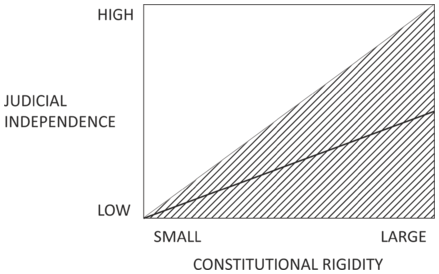
Figure 8.3 Low constitutional rigidity is a necessary condition for low judicial independence
8.2.5 Constitutional Strikes as a Measure of JI
Figure 8.4 presents an abstraction of the set of outcomes that the majority of the constitutional court (from now on, the judiciary) prefers over the status quo (not presented in the figure). I call this set the win-set of the status quo, or W(SQ), which is the intersection of the majority of preferences and restrictions different judges impose on a piece of legislation to consider it compatible with the constitution. These preferences may include elements of political judgment (Gabel et al. Reference Gabel, Carrubba, Helmke, Martin, Staton and Ward2024),Footnote 14 or they may include absolute principles (like respect for human life), proportionality between such principles (human rights and freedom of expression),Footnote 15 or any other rule of textual interpretation one considers to be in play. The shaded area presents the intersection of the majority of such judicial preferences and constraints. In this simplified game, if the government makes a decision outside of W(SQ), it will be overruled by the judiciary on constitutional grounds. Therefore, under the conditions described above, the government will make a decision inside W(SQ). This model produces no judiciary strikes because they are anticipated by the government, and the proposed solutions are not objectionable by the judiciary. The only way that there would be judiciary overrule of government actions is if the government has a dominant strategy to provoke the judiciary and be overruled by it (or at least not care about it). Such a situation could happen if the government is involved in a Nested Game (Tsebelis Reference Tsebelis1991) where it cares about the payoffs provided in another arena (e.g., electoral) and not about the survival of its own legislation. An example of this would be a conservative government legislating against abortion rights in order to appeal to its supporters regardless of the fact that it will be overruled by the judiciary. Although such cases are possible, they cannot be the predominant explanation of disagreement between governments and the judiciary at a comparative level. In fact, they require the introduction of an additional actor (the public) and a special interaction between the government and this actor to determine (and explain) the actions of the government.
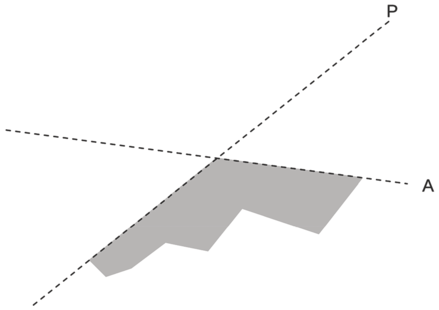
Figure 8.4 The win-set of the status quo subject to constraints on judicial decision-making
Figure 8.5 replicates the previous story with one difference that increases the realism of the model: What if the government does not have exact knowledge of W(SQ)? The lighter gray shaded area indicates the government’s uncertainty over the judiciary’s win-set of the status quo. Uncertainty stems from the fact that the government may not know the exact constitutional consequences of a particular policy decision and/or the preferences of the judiciary (just like researchers). As a result, these zones of uncertainty may be very wide indeed. In this scenario, the government may make a decision G in the zone of uncertainty that it intends to be approved by the judiciary but is instead struck down. What is the inference if we observe the judiciary striking down a government decision? First, we are in Figure 8.5 instead of Figure 8.4 (that is, the government is operating under incomplete information), and second, the judiciary has preferences different than the government and has affirmed these preferences. What is the inference if we observe no disagreement? There are several possibilities: first, it could be that the government was able to anticipate the preferences of the judiciary and made a proposal acceptable to it; second, it is possible that the judiciary does not have any significant differences from the government; and third, it may be that the judiciary is afraid to contradict the government. In other words, in the first case, the judiciary prevails; in the third, the government; and in the second, there is an identity of preferences. As a result, in the case of judicial approval, we can make no inference.
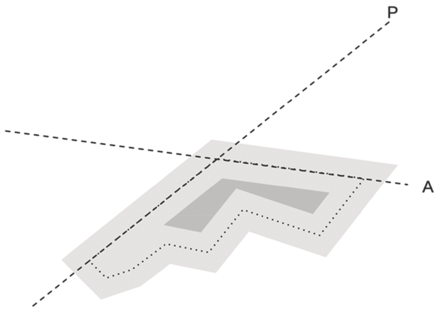
Figure 8.5 The win-set of the status quo subject to constraints on judicial decision-making, with uncertainty
However, a lack of any disapproval of existing law should be counted as a disagreement between the government and the judiciary. We should identify the cases where the judiciary makes decisions conflicting with the decisions of the current government. Constitutionally overruling old laws is not an indication of JI, but it could be an indication that the laws have become obsolete or, even more perversely, that constitutional courts strike down old laws or provisions to suit the preferences of the current executive.Footnote 16 Therefore, I operationalize the JI variable as the percentage of cases that a constitutional court strikes down the decisions of the current government as unconstitutional over the total number of cases that the court votes them either up or down.
In sum, when the judiciary is not independent of the government, we will not see strikes against the sitting government’s legislation; when the judiciary is independent of the government, we may or may not see strikes, depending on whether the preferences of the judiciary and the government align.
Some researchers have used the frequency of court overrule as a measure of judicial independence, although this is only the case for individual countries and is not always in terms of overruling against the sitting government. Their findings align with my expectation of a positive relationship between the size of the constitutional core and JI. For example, Santoni and Zucchini (Reference Santoni and Zucchini2004) examine the Italian Constitutional Court from 1956 to 1992 and show that the frequency of disputes over the constitutionality of laws is increasing with the size of the constitutional core (defined as the number of parties needed to agree on a constitutional revision), though they do not restrict their analysis to only conflicts over legislation from a sitting government.Footnote 17 Similarly, Ríos-Figueroa (Reference Ríos-Figueroa2007) analyzes all judicial decisions by the Mexican Supreme Court from 1994 to 2002 and shows that the judiciary is more likely to strike down legislation from the PRI when the fragmentation of the political system is high. Sánchez et al. (Reference Sánchez, Magaloni, Magar, Helmke and Ríos-Figueroa2011) include all Mexican Supreme Court rulings until 2007 and show that after the PRI lost the presidency in 2000 (and the political system became more fragmented), the Mexican Supreme Court became more likely to strike down laws of the sitting government via constitutional review.Footnote 18
In order to replicate these analyses at the cross-national level, we need the indicator of constitutional rigidity developed in Chapter 6 along with decisions of constitutional courts in different countries rejecting laws from the government in power. The expectation is a heteroskedastic relationship between judicial discretion and the number of judicial decisions on the unconstitutionality of current government laws.
8.3 Looking Comparatively: The CompLaw Database
Creating a comparative dataset on courts is difficult for many reasons. First, comparability is very difficult. Each country conducts judicial reviews differently, making it difficult to compare one case to the next clearly. Second, it is difficult due to the large number of cases that pass through a judicial system each year, many of which are only accessible in a country’s archives. Third, these two previous reasons are highly correlated with economic development and level of democracy, meaning that it is even harder to compare less-developed countries with more-developed countries. In addition to having information about cases, ideally there would also be information on the positions of the judges. While in some cases this is easier to measure, such as in the US or France, in most cases it is nearly impossible to measure the positions of judges. This is due to different appointment processes as well as the level of transparency of the courts.
The Comparative Law (CompLaw) Database (Carrubba et al. Reference Carrubba, Friedman, Martin and Vanberg2015, Gabel et al. Reference Gabel, Carrubba, Helmke, Martin, Staton and Ward2024) addresses some of these problems by creating a comprehensive dataset that comparatively looks at constitutional cases around the world. It covers forty-five countries while coding at least 200 of the cases heard in each country in 2003. While this is by no means encompassing every case or every country, it is the first large-scale dataset of its kind providing comparative insights into multiple different systems of judicial review. Although it cannot evaluate the positions of the judges, it can provide data on how they decided on constitutional cases. CompLaw, like most existing data sources, only analyzes the highest court in a country with constitutional review, even when there are multiple high courts in a country. For data availability reasons, they also only include decisions that are published online. It does not include all cases – for example, if a country had fewer than 200 cases in 2003, then all 200 or fewer cases were coded, but if there were more than 200 cases in 2003, then they used a random sample to code at least 200 cases per country. Within each of the cases, the state, which can either be the state government or the federal government, has to be an active participant. Here, a case could be about a statute, an executive order, enforcement action, an administrative act, or a decree.
Within this dataset, there are many variables of interest. First, there is the admission date, which is when the case was admitted for review by the court. There is also the decision date, which is when the court decided the result. The policy date is when the policy was adopted by the government. Lastly in terms of dates, there is the date of the precipitating event, which is the date when the infraction occurred that gave rise to the case. In addition to these dates, there is the variable, which is extremely relevant to whether the court exercised constitutional review in its decision – this is coded as a dummy variable. Finally, they code how the court responded to the case – this is a categorical variable with four levels: 0, which is deemed constitutional; 1, which is deemed unconstitutional; 2, which is discussed but dismissed for procedural reasons; and 3, which is not discussed and dismissed for procedural reasons. For the purposes of this chapter, I am only interested in the first two levels: those that were deemed constitutional and those that were deemed unconstitutional.
I used the CompLaw Database to understand the relationship between the number of times a country’s constitutional court rules a case as unconstitutional against the government and my measure of constitutional rigidity. While the existing data have each policy as the unit of analysis, I am interested in the country as the unit of analysis. I limited the countries to democratic ones (those that have a POLITY2 score of five or above). As described in the Introduction, I am only interested in cases where the court invalidates legislation of the current government.Footnote 19 To do this, I ensure that the government in office during the policy year is the same as the government in office during the decision date. For parliamentary governments, if there was an election it is considered a new government even if it has the same party composition. For presidential systems, I consider only the president as the government.
After cleaning the data, there is a sample of thirty countries with a POLITY2 score of five or above.Footnote 20 In order to aggregate the data to the country level, I calculate the percentage of strikes. The percentage of strikes is defined by the number of cases that the constitutional court rules as unconstitutional over the total number of cases that were deemed either constitutional (0) or unconstitutional (1). This is a better proxy of judicial independence because it only measures how often a court rules against its corresponding government, which is my definition of judicial independence. This variable ranges from 0 with countries like Israel and India to 1 with countries like Italy, Canada, and Romania, where every case in 2003 was declared unconstitutional.
8.4 Method and Results
Using the CompLaw data, I test two hypotheses: (1) that the mean rate of judicial vetoes is increasing in constitutional rigidity and (2) that the variance of the rate of judicial vetoes is increasing in constitutional rigidity. To test both hypotheses, I fit a multiplicative heteroskedastic linear model of the form

where  is the rate of judicial strikes in country i,
  is the level of constitutional rigidity,
  represents the correlation between constitutional rigidity and judicial strikes,
  is a dummy variable indicating whether country i has a constitutional court,
  represents the correlation between a constitutional court and the rate of strikes,
  represents the set of unknown parameters in the variance function,
  is the variance in the rate of judicial strikes for country i, and
  is the error term for country i.Footnote 21 The idea is that this model tests two different predictions simultaneously: on the one hand, the average rate of judicial strikes, and on the other, its variance as functions of constitutional rigidity (as well as other unobserved factors).Footnote 22
Figure 8.6 shows the relationship between the percentage of strikes and constitutional rigidity for countries with a POLITY2 score of five or above. It is a positive relationship, meaning that the higher the constitutional rigidity, the higher the expected strike percentage. In addition, Figure 8.6 shows that the 95 percent prediction interval, presented by the shaded area in the figure and dependent on the variance of the distribution, slightly expands when constitutional rigidity moves from 0.5 to 1.5. In other words, the relationship between constitutional rigidity and JI is positive and (slightly) heteroskedastic, as hypothesized.

Figure 8.6 The effect of constitutional rigidity on court strikes
Table 8.5 presents the numerical results of this calculation, including a dummy variable for the existence of a constitutional court (from Table 8.4). It shows that constitutional rigidity has a positive effect (both substantively and statistically significant) on the percentage of strikes (judicial independence).Footnote 23 On the other hand, the heteroskedasticity of the relationship, while positive as expected, is not statistically significant.Footnote 24 I attribute this lack of significance to the small number of countries and hope that, in the future, more data will become available (particularly time series of court decisions). Table 8.6 is similar to Table 6.2 in Chapter 6, indicating the added value from the basic model (constant and existence of constitutional court) to the mean only model (where a constitutional rigidity variable is introduced) and to the heteroskedastic model (where the variance of constitutional rigidity is added). The final p-value is 0.076, which corroborates our analysis on the basis of Table 8.5.
Table 8.5 Effect of constitutional rigidity on percentage of strikes (sample: POLITY2 ≥ 5)
| Base model | Mean-only model | Het. regression | |
|---|---|---|---|
| n | 30 | 30 | 30 |
| Dependent variable: percentage of judicial strikes | |||
| (Intercept) | 0.412 *** | –0.027 | –0.082 |
| (0.105) | (0.243) | (0.213) | |
| Constitutional court | 0.057 | 0.119 | 0.161 |
| (0.128) | (0.126) | (0.119) | |
| Veto players constitutional rigidity | 0.433 | 0.462 * | |
| (0.218) | (0.223) | ||
| Dependent variable: the log-squared residuals of the OLS regression of the percentage of judicial strikes on veto players constitutional rigidity and constitutional court | |||
| (Intercept) | –3.072 *** | –3.319 * | |
| (0.299) | (1.43) | ||
| Veto players constitutional rigidity | 1.649 | ||
| (1.491) | |||
*** p < 0.001; ** p < 0.01; * p < 0.05.
Table 8.6 Comparison of three models of effects of constitutional rigidity (base, mean only, and heteroskedastic) on judicial strikes for POLITY2 ≥ 5 threshold (likelihood ratio tests, n = 30)
| Models | Chi-square | p(> Chi-square) |
|---|---|---|
| Base vs. mean only | 4.0822 | 0.04334 |
| Mean only vs. heteroskedastic | 1.0827 | 0.29809 |
| Base vs. heteroskedastic | 5.1649 | 0.07559 |
In order to test the robustness of my results, I also applied Dul’s method to test whether constitutional rigidity was a necessary condition for judicial strikes (Dul Reference Dul2016, Reference Dul2024). The test resulted in a p-value of 0.002 for the CE-FDH ceiling line (Dul et al. Reference Dul, Van der Laan and Kuik2020), corroborating my hypothesis.
Conclusions
While JI has been frequently discussed in the literature, the underlying theory is not clear, and the empirical findings are not consistent. Starting from criticisms in the existing literature, I presented an alternative that is based on three different principles.
First, I gave a theoretical justification of my variables: I argued that the institutional basis of the analysis should be judicial discretion as determined by the constitutional rigidity of a country. Countries with high constitutional rigidity have high judicial discretion because the judges are not afraid that they will be overruled. In addition, I argued that assessing the independence of a branch famous for its opinions and decisions without explicitly modeling its preferences lacks a theoretical foundation. One can assess independence only when judges decide according to their preferences.Footnote 25 Consequently, knowing the preferences and beliefs of the judiciary is necessary to assess its independence. I therefore defined judicial independence as the interaction between judicial discretion and judicial preferences.
Second, instead of using an expert assessment of JI, I considered the percentage of times that the judiciary overrules the decisions of the other branches of government (over the number of cases that it either concurs or overrules). A decision to overrule cannot be considered anything but an indication of independence, while a decision to concur may have many motivations: it could be a sincere agreement of the judiciary, it could be deference because the appropriate decisionmaker is another branch, it could be fear of retaliation from the other branches, or it could be that the other branches anticipated the judicial decision and did not want to confront the judiciary. From the lack of manifest disagreement between the judiciary and other powers, no inference on judicial independence can be made. It is possible that expert assessments of JI include evaluations of agreements between the judiciary and other powers. For example, they can inflate the JI used in this chapter if they consider the lack of disagreement as an indication of deference, or they could deflate it if they consider it as an indication of timidity. However, there would be no way to make an intersubjectively testable assessment of these judgments.
Third, given the fact that one of my independent variables (judicial preferences) is unknown in the overwhelming majority of cases, I argued that the variance of my estimators would be affected. Consequently, I used the appropriate statistical technique: heteroskedastic regression, which explicitly models the heteroskedastic relationship between discretion and independence. This expectation was motivated by the theoretical analysis surrounding Figures 8.1 and 8.2 and was corroborated by the empirical tests in Figure 8.6 and Table 8.5. I want to point out that Brown (Reference Brown2022: ch. 4) evaluating the number of cases that state supreme courts strike government legislation in the US comes to similar conclusions while including the distance of the court from the legislature. Indeed, he finds a negative effect of the number of amendments (which in Chapter 6 I demonstrated is negatively correlated with constitutional rigidity) and a positive effect of ideological distance between the legislature and judiciary.
This chapter uses only one institutional variable (constitutional rigidity) as the basis for judicial independence. This choice does not mean that, in my opinion, other variables such as the identity of the person who appoints a judge cannot or should not be considered as a factor that affects JI, but it means that theoretical models of the effects of these variables should first be presented, and then we would and should be able to include them in the analysis.
I expect that the issue of data availability will be resolved and we will then be able to rely on time series of data in more countries than the thirty-one covered above. In addition, future research may use the indicator of JI calculated above to test the implications of JI on growth, human rights, and other variables, as discussed in the literature.


 Open access