

In the previous chapter, we did what all institutional political science literature does by tracing the constitutional amendment decisions in order to understand the constitutional amendment properties (that is, the content of successful amendments). However, we did not deal with the distribution of preferences of the different actors. In the conclusion of Chapter 2, we made it clear that if these preferences were located close to each other, more frequent and more significant constitutional amendments would be possible, but we did not establish a theory about when preferences would be less polarized.
In this chapter, we will now look at the literature and discuss the argument that some principles of preference organization affect the constitutional amendments as well as or even instead of the amendment rules included in the constitutions. Indeed, a series of authors have identified constitutional “cultures” – that is, “shared attitudes about the desirability of amendment,” as Ginsburg and Melton (Reference Ginsburg and Melton2015: 699) define it.
Culture is a very general concept referring to the way of life, behaviors, beliefs, values, and symbols of a group of people. Students of comparative politics have used cultural differences to explain observed variation across political units for over a century (or even further if one considers Aristotle, Plato, or Thomas Aquinas). One might call Weber’s analysis of the Protestant Ethic and the rise of capitalism in Europe the birth of cultural theory in political science. His understanding of culture was the coherence of clusters of attitudes and values in the population, determined by the relative size of the Protestant population. Systematic empirical analyses of the phenomenon took off in the 1960s with Almond and Verba’s The Civic Culture and were reintroduced by Inglehart’s Culture Shift and Putnam’s Making Democracy Work in the 1990s. The methods for measuring civic engagement, civic community, or civic virtue vary: Almond and Verba along with Inglehart survey citizens in different countries, while Putnam compiles an extensive data set that goes beyond the individual level concerning a wide variety of social, economic, and political attributes of each region in Italy. They are united in aiming to explain outcomes on the macro level, focusing on democracy (Almond and Verba), economic performance and democratic stability (Inglehart), and regional government performance (Putnam et al. Reference Putnam, Leonardi and Nonetti1993).
Concerning political culture in the US, Elazar (Reference Elazar1984) in American Federalism uses an inductive approach to classify the culture of the forty-eight mainland US states. His theory of moralistic, individualistic, and traditionalistic subcultures was used to develop measures of culture (Sharkansky, for example, recoded his data to construct a numerical estimate of each state’s position) and linked to other concepts such as female representation in state legislatures (Hill Reference Hill1981), utilization of corporal punishment in public schools (Vandenbosch Reference Vandenbosch1991), and personality traits (Mondak and Canache Reference Mondak and Canache2014). Taking up Putnam’s ideas, Rice and Sumberg (Reference Rice and Sumberg1997) developed civic culture estimates for the US states and demonstrated the relationship between their measure and Elazar’s. A more recent conceptual development stems from Oliver and Wood (Reference Oliver and Wood2014), who study the support of conspiracy theories as part of American political culture.
Turning to legal and, more specifically, constitutional cultures, Gardbaum (Reference Gardbaum2018) argues that a legal culture, which includes “(1) the status of judges, (2) their historical degree of independence, and (3) cultural adherence to rule of law norms within a system” (22), may enhance or detract from the ability of courts to increase their own powers beyond those originally bestowed. He does not measure culture quantitatively; however, the theoretical insights are valuable, as are Dixon and Landau’s (Reference Dixon and Landau2018) in their proposal of a third model of constitutionalism besides the short, abstract, and rigid model and the lengthy, detailed, and flexible one. They highlight that realizing the goals of constitutionalism, such as stability and the realization of the objectives enshrined in the constitution, may be influenced by the citizens’ identification with their constitutional text as it makes “replacement less likely; popular buy-in of existing constitutions will increase resistance to attempts to scrap the existing constitutional text” (Dixon and Landau Reference Dixon and Landau2018: 467). Further, it will also increase “support for those objectives and thus [place] pressure on politicians to achieve them” (Dixon and Landau Reference Dixon and Landau2018: 468).
In this chapter, I will not speak about culture in general or constitutional culture in an abstract sense. I will focus on studies that are using “constitutional culture” in order to explain the frequency of constitutional amendments – that is, which are using “constitutional culture” as their explanatory variable and are using the frequency of amendments as the variable to be explained. I will show that different authors understand and use this concept of constitutional culture in three distinct ways, which I will discuss sequentially as (1) “culture” as a random element, (2) “culture” as a systematically omitted variable, and (3) “culture” as an independent variable.
3.1 “Culture” as a Random Element
Richard Albert has produced an extensive body of writings on constitutional amendment rules (e.g., Albert Reference Albert2010, Reference Albert2015a, Reference Albert2015b, Reference Albert2015c, Reference Albert and Koltay2018, Albert et al. Reference Albert, Nakashidze and Olcay2018) which culminate in a very important book, Constitutional Amendments: Making, Breaking, and Changing Constitutions (Albert Reference Albert2019). He argues the following:
Rankings of comparative amendment difficulty [what this book did in Chapter 2] have a fatal flaw: they either ignore or fail to account for sources of amendment ease or difficulty. These non-textual sources include uncodified changes to formal amendment rules, popular veneration for the constitution, temporal variability in amendment difficulty, and prevailing cultures of amendment. I moreover define and illustrate three different cultures of amendment—each of which has the effect of either exacerbating or assuaging amendment difficulty: amendment culture as an accelerator of change, as a redirector of change, and as an incapacitator of change. I ultimately arrive at two conclusions: first, that studies of amendment difficulty are doomed to failure; and second, that in any case they may not be worth the effort.
One may infer from this quote, which in essence is replicated multiple times throughout the book, that Albert is neglecting the significance of the written text. However, Albert extensively argues in favor of “writtenness”:
Modern constitutionalism has given us good reason to celebrate the written tradition in which the rules of formal amendment are anchored. Writtenness is deeply interconnected with the rule of law and indeed serves its democratic values, namely predictability, transparency, and publicity. The written tradition gives political actors and the people notice about the rules to which they will be held, it allows the governed to hold their governors to account, and it creates a textual referent for challengers to contest the conduct of incumbents. The uses of writtenness moreover extend well beyond these proceduralist functions: it also holds promise for cultivating a culture of public-oriented citizens who come to know, understand, and respect the codified constitution and the moral commitments it entrenches.
In this respect, he is repeating the arguments of authors like Aristotle (in Rhetoric), Locke (in Two Treaties on Government), and Montesquieu (in The Spirit of Laws), to mention only a few (see also my discussion in the Introduction).
However, Albert’s argument is that the articles that specify the rules of constitutional amendment are only part of the story and that the constitutional culture, which facilitates or obstructs the facility of amendments as specified by the text, is so complex that it makes the assessment of amendment difficulty on the basis of the text doubtful, to say the least. In his approach, “Amendment culture can accelerate, redirect, or incapacitate formal amendment in a given jurisdiction” (Albert Reference Albert2019: 111; emphasis mine). The result is that, “If only this thin and quite unsatisfactory measurement of amendment difficulty is possible, we confront again the question we continue to encounter: Why measure amendment difficulty at all? It is far from clear that this question has a good answer” (Albert Reference Albert2019: 172).
According to Albert, the situation provides layers of complication:
For decades, codified rules of formal amendment have been modified in circumvention of those very rules and sometimes in direct violation of them. In other words, codified amendment rules have been altered without a corresponding codification. One implication of this trend involves text-based studies of formal amendment difficulty: How can we measure comparative amendment difficulty with any reliability if formal amendment occurs according to rules unseen in the codified text? This is a further quite devastating reason to doubt rankings of amendment difficulty that focus exclusively on a narrow textual analysis of the codified rules of change.
I do not want to contradict Albert’s arguments – particularly his thorough analysis of the Canadian Constitution. What I will argue, however, is that his analysis is on the relative significance of written and unwritten rules in each individual constitution. Further, for a given individual constitution, the better we understand the unwritten rules, the better we will understand the constitutional revision process. But, as Albert says, these unwritten rules sometimes increase and other times decrease the ease of amendment. If we knew the conditions under which a “culture” or “norm” would operate one way or the other, we should include it in our analysis. Such a rule is not provided, however, and neither do we know whether different researchers would identify the same norms across constitutions or whether they would classify them in the facilitating category or the opposite group. From a comparative perspective, we have to classify all these “cultural” factors as a random error, while the written text provides the systematic basis for the analysis.
My argument is that the written text of the amendment provisions is the systematic component of the analysis and the nonwritten text is the random error of my analysis. I may also agree that this random component may be very significant at times (Albert’s analysis of the Canadian constitutional text and amendments is a very good example of this). However, when we compare constitutions, we have to base our judgment on the systematic elements and leave the error term aside.
Let me provide the statistical argument which draws conclusions from a set of constitutions rather than just from one. In Table 3.1, I present a computer simulation of constitutional rigidity measures, with formal being measured by the written rules and actual being measured considering both formal and informal rules. The formal rules have an average of five units and a standard deviation of two, while the random element (informal rules) has an average of zero units and a much more significant standard deviation of five. The reason I am making this choice is to replicate Albert’s argument that informal rules may contribute more than the formal ones to the final outcome. Table 3.1 presents the comparison between formal rigidity and actual rigidity when we include 1, 5, 10, or 100 countries. The reader can verify that this difference between formal and actual practically disappears when we take the average of 100 countries.
Table 3.1 Difference between actual and formal rigidity: As n increases, the error term (difference) approaches zero
| Number of countries | ||||
|---|---|---|---|---|
| 1 | 5 | 10 | 100 | |
| Actual rigidity (mean) | 3.9 | 4.31 | 3.5 | 4.82 |
| Formal rigidity (mean) | 5.36 | 5.19 | 5.5 | 4.79 |
| Error (mean) | –1.46 | –0.89 | –2 | 0.03 |
Note: The formal rigidity variable is drawn from a normal distribution with a mean of five and a standard deviation of two. The error is also distributed normally with a mean of zero and a standard deviation of five. The actual rigidity is constructed as the sum of the estimated rigidity and error.
However, the reader may object to this as we are not going to measure an average country. Instead, we are going to measure the effect of constitutional rigidity (measured textually as in Chapter 2) on another variable: the frequency of amendments. This is the subject of Table 3.2, which is a precursor of what will come later in this book: we will use the approximation of constitutional rigidity generated in Chapter 2 to estimate the frequency of constitutional amendments in different countries (Chapter 6).
Table 3.2 Effect of formal rigidity on another variable (constitutional amendments): As n increases, the coefficient approximates the true value
| Constitutional amendments | True value | |||
|---|---|---|---|---|
| n | 5 | 10 | 100 | |
| (Intercept) | 3.395 | 5.760 | 0.707 | |
| (3.117) | (2.990) | (1.378) | ||
| Formal rigidity | –1.385 | –1.553 Footnote * | –0.616 Footnote * | –0.6 |
| (0.575) | (0.505) | (0.254) | ||
| R2 | 0.659 | 0.542 | 0.057 | |
* p < 0.05.
Note: The formal rigidity variable is drawn from a normal distribution with a mean of five and a variance of two. The error is also distributed normally with a mean of zero and a variance of five. The constitutional amendments variable is constructed as the sum of the estimated rigidity multiplied by a coefficient with the value –0.6 and the error.
Here, we give a summary of the statistical argument that will follow. We create a frequency of amendments variable that is as follows: (Amendment frequency) = –0.6 × (real rigidity) when, as before, (real rigidity) = (formal rigidity) + (error term).
Table 3.2 is slightly more complicated than Table 3.1 in the sense that it will help us assess the relationship between two variables. Formal rigidity is again constructed to have an average of five and a standard deviation of two, while the error term is constructed to have an average of zero and a standard deviation of five (just like in the previous example). The reader can verify that if we are fortunate to have 100 countries in our sample, the actual estimated coefficient will differ very little from the real one.
In conclusion, as long as “culture” is not systematic but can be assimilated as a random error, it can be ignored in a comparative approach, and the results of the analysis will not be affected. It seems to me that there is a way to systematize Albert’s analysis. On the basis of his arguments, there should be a difference in the analysis of specific constitutional articles before and after the nonwritten modifications. One can compare the textual analysis of these articles before and after and assess whether the changes were strengthening or weakening the restrictive nature of the articles and, as a result, identify the systematic nature of these nontextual amendments. If one identifies specific indicators reflecting more and less restrictive effects, then we would be able to assess systematic forces at the cross-national level and include Albert’s understanding of “culture” in the analysis. However, is there any other way to include “culture” as a systematic force? We will now turn to this question.
3.2 “Culture” as a Systematic Omission
A different analysis of constitutional “culture” is provided by Ginsburg and Melton (Reference Ginsburg and Melton2015) in their very influential article: “Does the Constitutional Amendment Rule Matter at All? Amendment Cultures and the Challenges of Measuring Amendment Difficulty.” Ginsburg and Melton’s analysis begins with the fact that many attempts to measure constitutional rigidity did not find a very strong relationship with constitutional amendment frequency. They propose “an alternative theory of amendment difficulty,” stating, “We articulate the idea of an amendment culture which we argue is implicit in many accounts of constitutionalism more generally” (Ginsburg and Melton Reference Ginsburg and Melton2015: 215, 687). Their indicator is presented as an “alternative to institutional factors that constrain amendment” (Ginsburg and Melton Reference Ginsburg and Melton2015: 691). Looking at the literature, they have not been able to identify a cross-national measure of amendment culture, so they generate their own, using the amendment rate of the previous constitution as “amendment culture.” Their argument is that if the amendment rate does not depend on the institutions, then high amendment rates in the previous constitution would be due to a permissive amendment culture and low rates would be due to a restrictive culture. The persistence of this amendment culture would lead to high or low amendment rates for the current constitution as well.
Ginsburg and Melton proceed to an empirical test of their argument, and they regress the number of years an amendment was performed in different countries on their institutional factors (amendment threshold, number of proposers, number of approvers, multiple sessions required, judicial review, political constraints, ln of length in words, scope, age of constitution) as well as on their “amendment culture,” defined as the frequency of amendments in the previous constitution. Their result is that most of the institutional variables lack significance and sometimes even have the wrong sign, while the only significant variable is “amendment culture.”Footnote 1 Some of their results are that “large vote thresholds are positively correlated with the amendment rate, suggesting that higher vote thresholds actually yield higher amendment rates. Similarly, requiring votes in multiple parliamentary sessions is associated with higher amendment rates. The only procedural variable with the correct sign is the one indicating the number of approving actors… In short, amendment culture is more important than institutional constraints in explaining amendment practices” (Ginsburg and Melton Reference Ginsburg and Melton2015: 711).
Ginsburg and Melton created an acquis communautaire (or “acquired by the community”) among students of constitutional law. Contiades and Fotiadou (Reference Contiades and Fotiadou2016) consider this finding to be a correction to Ginsburg and Melton’s previous analyses. They argue, “By articulating this indicator of amendment culture, [Ginsburg and Melton] remedy the flaws of their earlier work and allegedly add a new parameter to constitutional scholarship” (Contiades and Fotiadou Reference Contiades and Fotiadou2016: 198). Bucur and Rasch (Reference Bucur, Rasch, Congleton, Grofman and Voigt2019) summarize the literature as follows: “A growing body of literature challenges the purely institutional understanding of constitutional change. Probably the best example of this position is the ‘amendment culture’ argument put forward by Ginsburg and Melton (Reference Ginsburg and Melton2015), according to which norms and habits are better predictors of constitutional change than the choice of amendment rules” (171).
Marshfield (Reference Marshfield2018: 80) argues that we should abandon institutional measures, and Versteeg and Zackin (Reference Versteeg and Zackin2016: 661) echo this sentiment. Marshfield (Reference Marshfield2018) writes, “A better measure of constitutional flexibility is a constitution’s actual amendment rate because this presumably captures both the formal barriers to amendment contained in the amendment rules as well as cultural attitudes regarding formal amendment” (80). Versteeg and Zackin (Reference Versteeg and Zackin2016) agree, saying, “The measure [of constitutional entrenchment] does not rely on formal amendment rules because these rules are mediated so dramatically by political norms (Ginsburg and Melton Reference Ginsburg and Melton2015, Klug Reference Klug, Tushnet, Graber and Levinson2015)” (661). Hayo and Voigt (Reference Hayo and Voigt2016) would have liked to use constitutional rigidity to calculate judicial independence but avoided it because of the Ginsburg and Melton analysis: “Ideally, we would include a variable controlling for the formal difficulty of amending constitutions. Although some attempts to measure this difficulty have been undertaken, none of them have been completely successful. Ginsburg and Melton (Reference Ginsburg and Melton2015) even propose abandoning all such attempts and looking at what they call ‘amendment cultures’ instead” (6). Given the impact of the Ginsburg and Melton analysis, we have to consider it very seriously indeed. I have three critical remarks: the first is theoretical, the second empirical, and the third statistical.
The theoretical objection stems from two sources: the first is epistemological, and the second logical. The epistemological objection originates from Lakatos’ (Reference Lakatos1978) “The Methodology of Scientific Research Programs,” where he argues that each scientific research program includes a positive (what the researchers should be doing) and a negative (what they should never do) heuristic. The negative heuristic cannot be abandoned any time that an empirical test does not corroborate the theory because, in reality, an empirical test points out an inconsistency among many assumptions, and it is for the researcher to identify which one of them that was produced is causing the problem. In Lakatos’ (Reference Lakatos1978) terms (and notation): “It is not that we propose a theory and Nature may shout NO; rather, we propose a maze of theories, and Nature may shout INCONSISTENT” (45). In the case of constitutional amendments, the “maze” of theories involves the assumption that all amendments are of the same significance, that cultural variables matter and can be approximated by the frequency of amendments in the previous constitution, that linear regression is the appropriate methodology for the analysis, and so on. All these assumptions are part of the Ginsburg and Melton analysis, and we will discuss (dispute) them in detail later in this chapter. The “negative heuristic” for an institutional research program is the significance of institutions, and it cannot be disputed as long as we stay within this research program. If all other assumptions cannot be disputed, then the research program will have run its course.Footnote 2
The logical objection comes from equilibrium analysis. Ginsburg and Melton are using the decision-making procedure of the previous constitution in order to understand what is happening under the current one. Why would it be relevant? Why would the decisions to amend today’s constitution depend on the frequency of amendments of the past? Instead of tracing the actual decisions, Ginsburg and Melton use an inertia factor, claiming that it is more important than the current problems or the current conditions. This analysis would require a serious explanatory argument, which is missing, but, in my opinion, it would be untenable. However, I understand that many readers would not give rationality arguments the same weight as I would, so I will not stop my criticism here.
The empirical objection is the following. For the amendment rules to be irrelevant and for the amendment culture instead to be significant, amendment frequency must remain the same despite amendment rules changing. If amendment rules remain the same, then the argument is not only invalid but could instead be an argument in favor of institutionalism. So, if constitutional replacement is not accompanied by a change of amendment rules, then the argument is in favor of an institutional, not cultural, explanation. This is exactly the case. I examined the previous constitutions of the countries I include in my sample (which are the democratic countries in 2013, excluding the ones without a previous constitution like the US; see Chapter 2) and divided them into two groups: the ones that changed their constitution while remaining democratic, and the ones that moved from a dictatorship to a democracy. One would expect that the constitutional changes would be more significant in the second category. This expectation is correct, but the amendment rules of the different constitutions changed very little. As Figure 3.1 indicates, in democracies there are very few changes in the index of constitutional rigidity as calculated in the previous chapter, but, in most cases, the difference is zero, indicating that the actual amendment institutions remain identical from one constitution to the next.

Figure 3.2 provides a bird’s-eye view of the situation: In democracies, the overwhelming majority of countries changed their constitution without modifying the amendment rules, but this is not true of transitions from dictatorships to democracies (although, still, the majority of countries concerned do not modify constitutional rigidity). The conclusion is that a significant majority of the countries I checkedFootnote 3 did not modify their constitutional rigidity despite constitutional change. Ginsburg and Melton deal with many more constitutions since they examine the history of all countries, not just the more recent past, and they do not restrict their study to democracies. However, my analysis indicates that the high significance of the “amendment culture” coefficients in the Ginsburg and Melton regressions is more likely to be the effect of the same institutions, not the same culture.
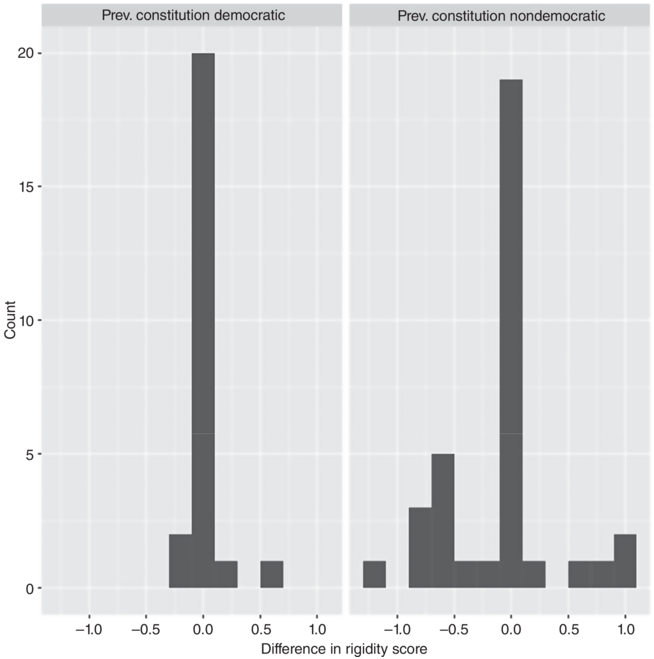
Figure 3.2 Summary of the number of countries that changed their constitution and the difference in rigidity scores
Last but not least is the statistical argument. Let us forget the previous two arguments – that is, that the current institutions do not matter (theoretical argument) and that the reason that the frequency of amendments remains the same is because the amendment rules are the same (empirical argument) – and now look at the statistical validity of the procedure where the lagged dependent variable is included in the regressors. As Achen (Reference Achen2000) argues, “When one or more lagged values of the dependent variable are added ‘as a control’ … in many instances the autoregressive terms are strongly significant, and the fit improves sharply, but the original sensible substantive effects of other variables disappear. This pattern frequently occurs even when the lagged variables have no plausible causal interpretation” (1).Footnote 4 This result (as Achen demonstrates) occurs because, if there is a time trend, the inclusion of the lagged dependent variable picks the time trend up not only from the omitted variables but also from the included ones.
Ginsburg and Melton (Reference Ginsburg and Melton2015) do not have a whole time series analysis –just one step. However, (as argued in Section 3.2) the amendment rules of the current constitution will be dependent on the ones of the previous constitution, particularly if these rules are finely defined like what Ginsburg and Melton have done (who state that amendment threshold, number of proposers, number of approvers, multiple sessions required, and judicial review are all independent variables).Footnote 5 It is this serial dependence that is picked up by the amendment frequency of the previous constitution as well as other omitted variables (such as economic development, ethnic divisions, etc.).
I simulated a model like the one Ginsburg and Melton present in Table 4 of their article in Table 3.3. I created a dependent variable y, which was a function of a series of dummy variables A, B, and C (expressing different components of rigidity like a vote by one chamber, a referendum, etc.), an omitted variable O, and the lagged dependent variable. This equation is as follows:

Then, I estimated the (known by construction) coefficients. The results are presented in Table 3.3. They all confirm Achen’s expectations. Actually, most of the institutional dummies lack significance or even have the wrong coefficient, and the only significant variable is the lagged dependent one, which is overestimated compared to its real value. So, Achen’s expectations are confirmed, and the results of Ginsburg and Melton’s Table 4 are replicated. The arguments of “amendment culture” as an inertial approach are not valid theoretically (out of equilibrium), empirically (what appears to be inertia is determined by the same institutions), or statistically (the method of approach leads to biased conclusions).
Table 3.3 Estimation of coefficient of “culture” as a lagged dependent variable: When institutional data are serially correlated, including a lagged dependent variable will inflate its estimated effect and lead to misestimation of other variables including the wrong sign
| Amendment frequency | True value | |||
|---|---|---|---|---|
| n | 10 | 50 | 100 | |
| (Intercept) | –2.159 | –0.255 | 0.602 | 1 |
| (1.767) | (2.442) | (1.249) | ||
| Institutional dummy A | 4.071 * | –2.455 * | –0.584 | 0.1 |
| (1.314) | (0.979) | (0.511) | ||
| Institutional dummy B | 5.191 | 0.831 | 0.102 | 0.8 |
| (2.210) | (0.996) | (0.799) | ||
| Institutional dummy C | –5.358 * | 0.961 | –0.013 | 0.3 |
| (1.571) | (2.490) | (0.944) | ||
| Omitted variable | 0.4 | |||
| Lag DV | 0.775 *** | 0.993 *** | 0.975 *** | 0.8 |
| (0.101) | (0.064) | (0.041) | ||
| R2 | 0.948 | 0.871 | 0.882 | |
*** p < 0.001; * p < 0.05.
Note: Institutional dummies A, B, and C are drawn from Bernoulli distributions with probabilities 0.5, 0.8, and 0.9, respectively. Additionally, O is drawn from a normal distribution with a mean of two and a standard deviation of five. The error is also normally distributed with a mean of zero and a standard deviation of one. All independent variables are serially correlated by a factor of 0.3. The dependent variable is constructed as 
Let us now move to the third kind of “cultural” approach.
3.3 Culture as an Independent Variable
The methodology of this third kind of cultural approach is the appropriate one: instead of adding a random variable or the lagged dependent variable, researchers identify a new independent variable of “cultural” nature and include it in the analysis. They argue that the frequency of amendments does not depend exclusively on institutions but also on the preferences of the involved actors. In addition, they proceed one step further, and instead of arguing (as I did in Chapter 2) that we cannot make any prediction about the preferences of these actors, they claim that some particular cultural variables characterize in a significant way the population of each country, and, as a result, the whole country will adopt institutions in agreement with these characteristics, or at least as frequently as these characteristics impose.
There is one important weak point of this argument. The conceptual distance between any variation of “culture” and the frequency of constitutional amendments is very big, and, consequently, a series of empirical arguments will be necessary to lead from one to the other. Each step in this road will be an argument to be corroborated by empirical evidence, and the more steps that are necessary will result in a less reliable final conclusion. This is the essential objection that I will raise at the end of this section, urging for convincing and empirically relevant arguments.
To my knowledge, there are two analyses that deal with constitutional amendments as the dependent variable.
The first approach is “what constitutes a constitutional culture” (Tarabar and Young Reference Tarabar and Young2021), which uses the cultural indexes from Hofstede (Reference Hofstede2001) and Hofstede et al. (Reference Hofstede, Hofstede and Minkov2010) to estimate amendment frequencies. These indexes, which are based on surveys, identify six broad cultural attitudes, four of which are used to assess amendment frequency: individualism, power distance, uncertainty avoidance, and long-term orientation. Out of these four characteristics, two turn out to be of (statistical) significance: individualism and uncertainty avoidance. In addition, when used along with the lagged amendment rate introduced by Ginsburg and Melton (Reference Ginsburg and Melton2015), they eliminate its statistical significance.Footnote 6
The argument for why these cultural features will be associated with amendment rates is as follows: “In a more individualistic society, people emphasize their own particular interests over general ones… In the constitutional context, this can lead people to view amendments as desirable whenever they serve their particular interests. By not insisting on a generality norm, individualistic societies may have higher amendment rates, all else equal” (Ginsburg and Milton Reference Ginsburg and Melton2015: 2). They go on to say, “Uncertainty avoidance measures extent to which people are comfortable in unstructured versus controlled and predictable environments. Individuals with high uncertainty avoidance may favour the predictability of governance under an entrenched constitution; as such, they perceive amendments to be generally undesirable” (Ginsburg and Milton Reference Ginsburg and Melton2015).
My objection to the argument that individualism and/or uncertainty avoidance would have a determinant impact on constitutional amendment frequency is that they should first have an impact on other more direct variables. For example, in my mind, the most direct effect of individualism would be on taxes: Individualists would not like to pay money to the government because their own money would be used by the government to promote its own preferences and even give subsidies to people other than the ones paying the taxes. Therefore, individualism should lead to lower tax rates in the corresponding countries. Similarly, uncertainty avoidance would have a much more direct impact on the desirability of income fluctuations than on constitutional amendments. Further, if one would raise the objection that people cannot shape these policies according to their preferences, I would answer that this argument applies even more to constitutions than policies. Table 3.4 demonstrates that these cultural variables have either the opposite than expected effect or no effect on these more directly relevant policies.
Table 3.4 Association of indicators of culture from Tarabar and Young (Reference Tarabar and Young2021) with economic outcomes (based on IMF data) are not as expected
| (1) Individual income tax revenue in percent of GDP in democracies | (2) Volatility of GDP in democracies | |
|---|---|---|
| n | 28 | 28 |
| (Intercept) | 0.272 | –0.380 Footnote *** |
| (0.178) | (0.080) | |
| Individualism | 0.637 Footnote *** | |
| (0.157) | ||
| Uncertainty avoidance | 0.017 | |
| (0.080) | ||
| R2 | 0.388 | 0.002 |
| Adj. R2 | 0.365 | –0.037 |
*** p < 0.001.
Individualism is significantly positively associated with taxes, while we expected the sign to be negative. Uncertainty avoidance is not significantly associated with the volatility of GDP (measured for the period of 1980–2014 as the mean of the absolute values of the annual change of GDP in one year subtracted from the annual change of GDP in the following year).
I do not know what the reason is for these discrepancies, but they are sufficient to take us back to the drawing board. However, researchers raise more significant, sustained, and systematic objections, saying that “the validity of the VSM 2013 [the dataset used by Tarabar and Young] is in doubt, and the internal consistency of the VSM 2013 scales was overall poor” (Gerlach and Eriksson Reference Gerlach and Eriksson2021). To go back to Lakatos’ terminology, it looks like the VSM is the prime suspect for “inconsistency.”
The second approach deals with a concept relevant to culture: social capital and its relation to constitutional amendment rates (Blake et al. Reference Blake, Cozza, Armstrong and Friesen2023). The argument is that social capital will be positively correlated with the frequency of amendments, and it is made in two steps: first, in a comparative way, including the amendment rules of different countries and finding that social capital matters at a 90 percent level (along with constitutional rigidity); and second, in a time series way, finding that in each country periods of higher social capital lead to higher frequency of amendment.
I consider the second part of the argument a very productive application of cultural or social capital arguments because, by definition, it controls for institutions and looks at how social capital and behaviors covary. Here, I will focus on the first part of the argument because I want to compare their argument and findings with what will follow in this book, and the time series effects cannot be addressed with my approach. I do not disagree with the methodology of the approach; if one believes that social capital affects constitutional amendments, this is the way to investigate the argument empirically. But why would one entertain this belief? Here is Blake et al.’s explanation:
While social capital does not directly measure amendment attitudes, trust and activism may be factors that shape a constitutional culture. Scholars have found that social capital affects policy innovation (Putnam et al. Reference Putnam, Leonardi and Nonetti1993: 82–120, Putnam Reference Putnam2001: 346–347), and we extend this insight to constitutional innovation. Constitutional rules impose transaction costs (Buchanan and Tullock Reference Buchanan and Tullock1965), and, in general, social capital reduces transaction costs (Fukuyama Reference Fukuyama1995). Thus, we predict that amendments will be adopted more frequently in polities with higher levels of social capital or at times within a polity’s history when social capital is comparatively higher.
This quote is the whole argument they provide and includes two branches, but, as I said, I focus only on the first which is relevant to my analysis.Footnote 7
The reference to Putnam comes from Bowling Alone (Putnam Reference Putnam2001) and is elevated to the status of universal truth, which supports generalizations. The original quote is much more modest and involves an operational mechanism which includes governments: “Preliminary studies suggest that states high in social capital sustain governments that are more effective and innovative” (Putnam Reference Putnam2001: 361).Footnote 8 In the Blake et al. (Reference Blake, Cozza, Armstrong and Friesen2023) article, social capital affects policy innovation directly. We will see in Appendix 3.A that different meanings of social capital will support different constitutional amendment results.
The second part of the argument (the “extension”) makes use of what Sartori (Reference Sartori1970) calls the “concept stretching” strategy by introducing the claim that constitutional innovations (which is implicitly equivalent to constitutional amendments)Footnote 9 are an extension of policy innovations. I take issue with this claim because the element of surprise, originality, or unexpectedness implied in the term “innovation” does not exist in constitutional amendments. As I argued in the Introduction, constitutional amendments are Level 2 amendments – that is, they occur when legislation or judicial interpretations (strategies within the constitutional equilibrium) cannot achieve the desired outcomes. In this case, the only possible path is a constitutional amendment (Level 2 changes or modifications outside the constitutional equilibrium, as I explain in Table I.2). Constitutional amendments are institutional changes that are very well studied and discussed in order to achieve the necessary majorities (specified by the constitutional amendment rules). As I argued in Chapter 1 (Sections 1.2 and 1.3), some of them were submitted several times and failed before they could be adopted, others remained on the back burner for years before they were introduced precisely for fear of rejection, and others even required a change of the amendment rules precisely because the existing rules made them impossible to be adopted. Consequently, the claim of “innovation” when applied to constitutional amendments is an unfounded one.
It is well known that a causal chain is as strong as its weakest link, so the first part of the argument, being the mixture of a concept stretching and a false argument, is not supported. In my mind, this is sufficient not to test the empirical expectation. However, if we go ahead and observe the existing correlations, the ones reported in the first part of Blake et al.’s (Reference Blake, Cozza, Armstrong and Friesen2023) article are not sufficient (even the authors report that they are at the level of 90 percent one-sided). In addition, the variables used do not eliminate the constitutional rigidity arguments despite the verbal arguments that “group membership, civic activism, and political trust can offset the effect of amendment rules” (Blake et al. Reference Blake, Cozza, Armstrong and Friesen2023: 1). This statement is not only not corroborated in the article but is not even tested.Footnote 10
In Figure 3.3, I demonstrate the variety of social capital or cultural indicators included in the datasets used in the Blake et al. (Reference Blake, Cozza, Armstrong and Friesen2023) article (the WVS and V-Dem).Footnote 11 It is to be expected that, among all these indicators, some could be of high correlation with the frequency of constitutional amendments (or any other variable for that matter). It turns out that the highest correlation with the frequency of constitutional amendments is provided by one of the components of “civic activism” (signatures to petitions), which lifts the correlation between “civic activism” and frequency of amendments to high levels – higher than any of the other variables among these two datasets either included in the Blake et al. (Reference Blake, Cozza, Armstrong and Friesen2023) article (like “trust”Footnote 12 and “groups”) or excluded from it. In addition, as Figure 3.3 demonstrates had group membership, mass mobilizations, or trade union participation been included (instead of signatures to petitions) as an indicator of social capital the argument would have to be a negative relation with constitutional amendments. The interested reader can find in Appendix 3.A the set of countries that provided the data.
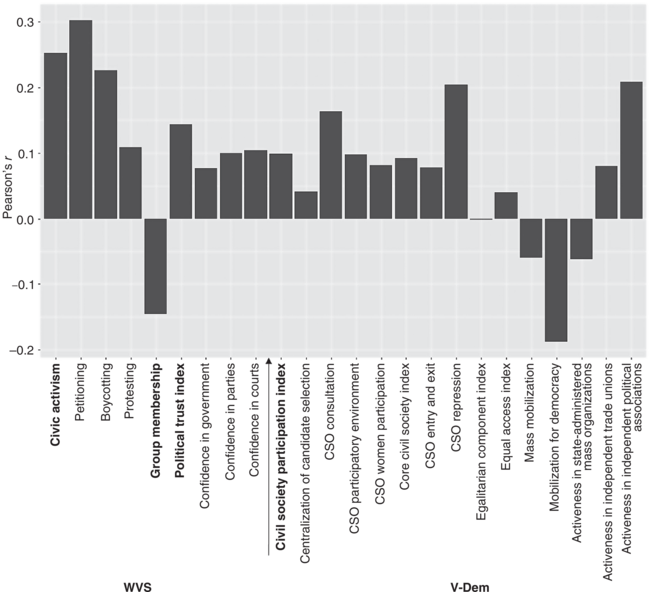
Figure 3.3 Correlations between amendment frequencies and the World Values Survey (WVS) and V-Dem Variables
The question that remains in my mind after reading Blake et al.’s (Reference Blake, Cozza, Armstrong and Friesen2023) article is this: Even if the argument that constitutional amendments are some form of innovation was not false, how would that argument explain how signatures of petitions would increase the frequency of constitutional amendments? Again, the finding, if it was (inappropriately) taken for granted, should lead us back to the drawing board.
Conclusions
In this chapter, I described three different ways that culture has been used in assessing the impact of constitutional amendment rules on the frequency of constitutional amendments. The first was as a random variable, the second was as a constant (lagged dependent variable), and the third was as an independent variable. Out of these three ways, only the last one is methodologically tenable, but, as I showed, there are few existing studies and they are not persuasive at the theoretical level.
The two articles connecting culture or human capital with constitutional amendments are based on correlations alone without presenting any reasons why the particular indicators (ranging from individualism to civic activism, passing through uncertainty avoidance, groups, trust, and civil society participation, and omitting countless others as indicated in Appendix 3.A) should be selected (that is, why they should be expected to affect the frequency of constitutional amendments). However, if we want to understand how and why the world works the way it does, we need to combine logical arguments indicating the relationship among variables with statistical ones used to evaluate whether our logical expectations (theories) were corroborated. It cannot happen with statistical analysis alone. A strong correlation is, in the best of cases, the identification of an interesting puzzle, not an answer.
As I argued at the end of Chapter 2, this book does not offer any way of assessing the distribution of preferences of the actors involved. Cultural theories make the implicit argument that there is a uniform force operating in societies that will affect outcomes in a similar way (much like individualism will affect constitutional amendments). I have argued that there are two reasons that undermine such claims. The first is the dimensionality of the underlying space: It may be that the expectation is correct in some dimensions but not in others. This would undermine the uniformity of results. The second is the role of institutions. It may be that institutions interfere and disallow the adoption of outcomes preferred by majorities, even in democracies (constitutional rigidity is clearly one of them). In other words, there is no direct effect of public opinion, attitudes, or culture on political outcomes or events, and certainly not on constitutional ones. They may or may not work – the example of the conflict between legislature and courts in Israel or the conflict between the values and policies indicated in Table 3.4 indicate cases of discrepancies.Footnote 13 Further, in the Appendix of Chapter 6, the reader can verify that when the human capital variables of Blake et al. (Reference Blake, Cozza, Armstrong and Friesen2023) are introduced along with constitutional rigidity, they almost always lose their significance.
These arguments are antagonistic to theories of culture at the empirical level. Even more, though, at the theoretical level, I have serious doubts about whether we will be able to offer a theory of preferences where we will be able to understand how the tastes of different individuals evolve and what they depend on. All these reasons do not imply that we should give up and not try to formulate rules of thumb about what kind of preferences will affect what kind of outcomes. In this chapter, I argue that we will need many more efforts in this direction.
Of all the different ways of understanding the effect of “culture” on the frequency of constitutional amendments presented in this chapter, I think the most fruitful would be the first if we are able to systematize the permissive and restrictive processes over constitutional rules. This would be a monumental task since it would involve written texts (other than the constitution).
In the remainder of this book, I will be focusing on constitutional amendment rules alone in a comparative way (which, as I have argued, are the necessary conditions). When theories of culture are sufficiently developed in a comparative way, they will be “graftable” to the constitutional analysis I provide.


 Open access