

The credit for developing the earliest device for recording sound goes to the Frenchman Édouard-Léon Scott de Martinville (1817–1879). His device, the phonautograph, patented in France in 1857, worked on the basis of converting sound waves into mechanical modulations which were traced onto paper blackened with soot to render the tracings easily visible. De Martinville's concern was to study the acoustics of sound waves and not to reverse the process and reproduce sound from the patterns his device generated. This step was left to Thomas Edison (1847–1931), the great American inventor, who in 1877 developed his phonograph (later known as a gramophone), a device for mechanically recording an acoustic signal onto a physical medium. The principle working of this device consisted of amplifying the acoustic signal through a megaphone-like horn at the narrow end of which was attached a stylus which etched onto a wax cylinder a pattern which corresponded to the modulating acoustic input. The wax cylinder could then be used to play back the signal by using a stylus and horn to reverse the process. The mechanical modulation of the stylus moving through the patterning on the wax cylinder converted these movements into an acoustic signal via a diaphragm which was then released through the horn of the device.

Figure 23.1 An early cylindrical phonograph from around 1900.
Wax cylinders could be reused for a recording by smoothing the surface so that it could accept new patterning during a later recording session. In early recording work for dialectological purposes, wax cylinders were frequently reprocessed after a fieldworker took notes from a recording. This meant, of course, that many audio recordings did not survive.Footnote 1
The next development in recording technology was the gramophone record in which recorded sound was stored on a flat disc of shellac, later of polyvinyl chloride, simply called ‘vinyl’. This development is mainly associated with the German-American Emile Berliner (1851–1929) who founded several companies for the commercial production and sale of records.
Linguistic material was, however, collected on very early gramophone records. In Germany in the 1930s, a large-scale project was begun which collected samples of all the dialects of the then Third Empire stretching from the Rheinland in the west to Prussia in the east. This project, with the name Lautdenkmal reichsdeutscher Dialekte ‘Audio monument of imperial German dialects’ was infected by the Nazi ideology of the time, and in fact the completed set of some 300 gramophone records with a player in a specially designed wooden cabinet was presented to Adolf Hitler on his forty-eighth birthday on 20 April 1937. The politically unacceptable thinking behind the project, especially of one of its main members, Hermann Neef (1904–1950), led to its neglect for many years. There have been a number of attempts to use the material for objective dialect analysis in the past two decades, and many recordings have since been digitised (see the information at www.lautdenkmal.de).

Figure 23.2 A portable mechanical gramophone player from the 1930s.
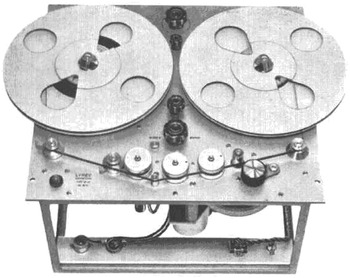
A different principle is where an analogue audio signal is recorded on a wire by moving it across a recording head which induces magnetic patterns in the wire. These patterns reflect the modulations of the audio signal and so the wire functions as a storage medium for sound. Although the principle of magnetic recording had been laid down in the 1870s and 1880s by the American engineer Oberlin Smith (1840–1926) and the Danish engineer Valdemar Poulsen (1869–1942), it was not until 1928 that the Austro-German engineer Fritz Pfleumer (1881–1945) produced the first magnetic tape recorder. This used a long plastic (originally paper) band on which a coating of magnetisable material (ferric oxide) had been added and stored on a reel.
In the context of the present volume, the most important early data source from England are the sound recordings made for the Survey of English Dialects. The fieldworkers of this project collected material over an eleven-year period from 1950 to 1961. The informants were generally non-mobile, older, rural males (so-called NORMs) who represented their dialect area best in the opinion of the survey's manager Harold Orton (1898–1975) of the University of Leeds. With advances in recording technology, several of the dialect locations were revisited, and some of the original informants (or comparable individuals) were recorded. This continued until 1974 and resulted in a collection of gramophone records and audio tapes, some 287 of which are available on the website of the British Library as audio clips which can be listened to online (see http://sounds.bl.uk/accents-and-dialects/survey-of-english-dialects).
The breakthrough which led to modern recording technology was the development of digital recording where an acoustic signal (or video signal for filming devices) is translated into a digital signal consisting of sequences of binary data with only two values, 0 and 1, or below and above a certain threshold which is then interpreted as 0 and 1 by the digital recording device. This device can then recreate the analogue signal by converting the digital data and outputting it via a loudspeaker (or computer display for a visual representation of the sound pattern).
The mechanics of digital encoding had been developed in the nineteenth century and was used in early telegraphy, telecommunications and the transmission of Morse code. The principle of the latter system consisted of alternating sequences of clicks, tones or lights consisting of two types, a long and a short signal. The system was indeed binary, but it did not capture sound but used an encoding system which could be understood by a receiver who knew how the code worked. The digitisation of sound came with pulse-code modulation, which sampled the audio signals so many times a second and converted each sample to a digital value using a certain bit depth, the larger the latter, the better the quality of the digitised audio signal. A patent for this system was taken out by the English scientist Alec Reeves (1902–1971), and after World War II the first digital recorders were developed. During the 1970s, commercial digital recorders became available, and in 1979 the digital optical storage disc, or simply CD (for Compact Disc) was developed, and since then digital recording and storage has become the commonplace of audio recording.
For speech recording, the great advantage of digital recording is the high quality and the freedom from background noise caused by earlier recording devices. Noise picked up with the speech signal can often be successfully filtered out with digital devices, usually by processing the recording with appropriate software afterwards. Digital recordings can furthermore be displayed and edited as spectrograms or in wave form. The compact size of digital recorders makes them very suitable for linguistic fieldwork.

As the 2000s progressed, CDs became less favoured as storage media and small removable hard disks, USB flash drives and solid state drives appeared as alternative storage forms for digital data, as they all have the advantage of allowing easy deletion and (re-)storing of data.
The encapsulation of sound data in digital form led to the development of processing software to allow not only the basic editing of primary data, but also the spectral and formant analysis of such data. The premier software tool at the moment is Praat, developed by Paul Boersma and David Weenink at the University of Amsterdam (see Boersma and Weenink Reference Boersma and Weenink2016 and the website www.praat.org/; the current version is 6.0.21 [September 2016]). This software has been used in the processing of audio data in nearly every chapter in the current volume. The availability of such software has enabled the whole research field of sociophonetics (Johnson Reference Johnson2008; Thomas Reference Thomas2011; Di Paolo and Yaeger-Dror, eds. Reference Di Paolo and Yaeger-Dror2011; Celata and Calamai, eds. Reference Celata and Calamai2014) in which phonetic data is subjected to detailed analysis within a sociolinguistic framework. The numerical data gained from such software as Praat is often taken as input to a statistical package which is capable of graphically representing the input data. Most commonly used here are statistical packages generated with R, an open source, higher level programming language developed by an international team (see the website https://www.r-project.org/) who are part of the R Project for Statistical Computing. The combination of digital sound data, audio processing software and statistical computing software has established itself as a standard set of tools for sociophonetic work in the 2010s and will likely remain so for the future, with further developments in technology and software adding more processing power and possibilities and so allowing linguists to refine the types of acoustic analysis which will be possible in years to come.
