

7.1 Introduction
Tyneside English (TE) – nicknamed ‘Geordie’ – is spoken in the conurbation around Newcastle upon Tyne, in the north-east of England. Newcastle (population c. 280,000) is the largest city in the region, and as an economic and cultural centre of gravity its influence is unrivalled in the north-east. Besides Newcastle, the conurbation includes Gateshead, a large town (population c. 200,000) on the south side of the River Tyne, and other smaller communities that extend eastward as far as the North Sea coast. Nearby towns in (historical) County Durham (e.g. Washington, Chester-le-Street) and in southern Northumberland (e.g. Ponteland, Cramlington) are sometimes also included.
For space reasons we cannot discuss the history of Tyneside and its local vernacular in detail here. Beal (Reference Beal, Milroy and Milroy1993, Reference Beal, Kortmann and Upton2008a, Reference Beal, Kortmann and Upton2008b), Watt (Reference Watt1998, Reference Watt2002) and Beal et al. (Reference Beal, Burbano-Elizondo and Llamas2012) offer more extensive treatments of the subject. We will, however, briefly consider relevant aspects of the variety before looking more closely at the oldest extant recordings of Tyneside English that we can identify.
7.2 Tyneside English
Tyneside is almost as far removed from London and the linguistically influential south-east as it is possible to be within England. Tyneside's relative isolation even from other large urban centres in northern England is often argued to have favoured the retention of archaic pronunciations. Prominent among these is uvular [ʁ],Footnote 1 which has long excited comment. As far back as the 1720s, a Reverend Jones remarked upon the unusual ‘burred’ /r/ in Northumbrian English (Wales Reference Wales2006: 100–101), while Daniel Defoe, who travelled to Newcastle and Northumberland at around the same time as Jones, also devoted journal space to a discussion of the burr. Defoe, who described it as a ‘hollow Jarring in the Throat’ and an ‘Imperfection’ of speech, noted that Tynesiders seemed proud of the burr as a badge of the ‘Antiquity of their Blood’ (1724–1727 [1778]: 257–258). At the end of the nineteenth century, the burr was still sufficiently frequent that Ellis, who described it as ‘the characteristic of [Northumberland] speech … though quite inessential to the dialect’ and ‘really a defect of articulation which tends to become epidemic’ (1889: 641), allotted it a special section in his On Early English Pronunciation (see further Påhlsson Reference Påhlsson1972; Howell Reference Howell1987).
Claims of the uniqueness, exceptional antiquity and immutability of Newcastle and Northumbrian dialects are repeated so often in popular discourse about variation in British English that they have practically become truisms. For example,
Today the only part of England where the original Anglo-Saxon language has survived to any great extent is of course the North East. Here the old language survives in a number of varieties, the most notable of which are Northumbrian and Geordie. It is from the ancient Germanic and Scandinavian language of the Angles that the unique local dialects of Northumberland and Durham primarily owe their origins.
There is undoubtedly a strong sense of regional identity in the north-east of England, and this might also help to account for the survival of traditional pronunciations (for examples, see Section 7.4 below). We noted earlier that Newcastle is relatively remote from other large English cities, but we should not forget that there are two significant conurbations, Edinburgh and Glasgow, to the north of it. Wales (Reference Wales2006) argues that the ‘austrocentrism’ of British culture often leads observers to neglect the fact that as a linguistic barrier the Scottish border is far from impermeable (Watt et al. Reference Watt, Llamas, Johnson and Lawson2014). Indeed, according to Beal (Reference Beal, Milroy and Milroy1993),
[t]he strongest influence on the dialects of Tyneside and Northumberland is undoubtedly from Lowland Scots, but this can hardly be called an outside influence given the common origin of these dialects; it must rather be said that the continuing close relationship between Scots and Northumbrians has served to maintain and reinforce the linguistic similarities between their dialects.
See also Mess (Reference Mess1928: 34), and cf. Ellis's lament about Sunderland speech, which ‘can hardly be said to be a dialect on account of the mixed population and influence of Scotch’ (Ellis Reference Ellis1889: 640).
Social and economic changes across the north-east have also been held accountable for increasing ‘dilution’ of the traditional dialects, and for the ability of dialect speakers even in rural areas to code-switch between their local vernaculars and more standard-like forms of English. Wright (Reference Wright1898: v), looking ahead to the twentieth century, is pessimistic about the fate of ‘pure dialect speech’, blaming the greater availability of education and ‘modern facilities for intercommunication’ (Wright Reference Wright1905: vii). Ellis observes that two Newcastle coal miners he interviewed ‘spoke very well’, and when asked if they talked that way while working in the pit they told him that to do so would invite scorn from workmates, but that they were allowed to speak ‘properly’ at union meetings (Ellis Reference Ellis1889: 650). Orton (Reference Orton1929, Reference Orton1930, Reference Orton1933) also notes that traditional Northumbrian and County Durham dialects were moving closer to Standard English, and that in the fullness of time standard forms were likely to supplant indigenous ones.
Viereck (Reference Viereck1966) echoes Orton's views in his discussion of the speech of a group of working-class Gateshead men born as early as the 1880s. He ascribed changes in traditional TE to the combined influences of Standard English, immigration from other British regions, television and radio, and the greater availability of state education. At the turn of the twenty-first century, Griffiths (Reference Griffiths1999: 44–45) added ‘official contempt’ for regional vernaculars to the list of factors – ‘industrial decline, education [and] technological shifts’ – that, like Viereck, he thought responsible for the erosion of traditional dialect.
Contemporary treatments (e.g. Beal et al. Reference Beal, Burbano-Elizondo and Llamas2012) tend to express more nuanced perspectives on the ways in which the dialect is changing in response to a variety of intrinsic and extrinsic forces, but with respect to its phonology the overall picture is still one of convergence on a more standard-like pattern. It would not be controversial to say that the traditional features of TE that set it apart from other varieties in northern England are ever more infrequently heard.
With a view to examining whether such features are present in the oldest available recordings of TE, and to what degree they occur if they are present, we turn now to consider the materials we have analysed with these aims in mind.
7.3 The Recordings
The north-east of England is relatively well served in terms of the availability of early recordings of its dialects. The corpus collected from thirty-five locations across northern England between 1928 and 1939 by Harold Orton, a native of County Durham, contains samples from speakers who ranged in age from their twenties to their sixties at the time of recording (Rydland Reference Rydland1998: 12–13). In principle, this gives us the opportunity of hearing the speech of people who were born almost 150 years ago. Similarly, the fieldwork carried out for the Survey of English Dialects (Orton Reference Orton1962; Orton and Halliday Reference Orton and Halliday1962) included interviews with sometimes quite elderly men and women. Many were in their seventies during the first phase of fieldwork in the early 1950s; one man from Washington, then in County Durham, was born as early as 1876. The oldest residents of Newcastle and Gateshead who participated in the Tyneside Linguistic Survey (TLS; Pellowe Reference Pellowe and Viereck1976; Pellowe et al. Reference Pellowe, Nixon, Strang and McNeany1972) were born in the 1890s. Later in this chapter we will make use of SED and TLS data, but these are not the focus of our analysis.
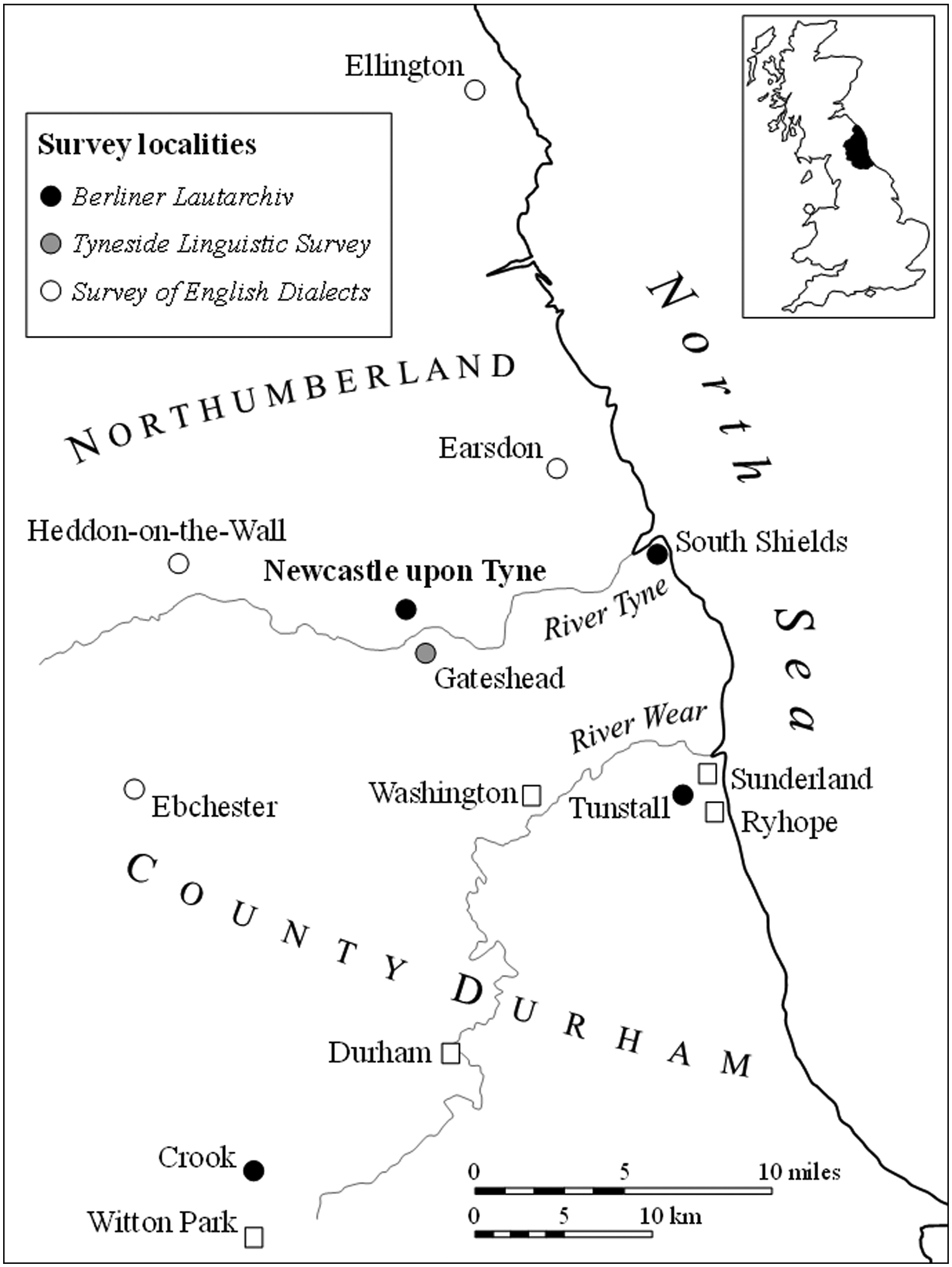
Because the date that the recording was made is our criterion for selection, rather than the birth years of subjects, the oldest available recordings of TE appear to be those made in February 1916 by or for Wilhelm Doegen and Alois Brandl (see Robinson, this volume). They recorded the speech of two British prisoners-of-war (POWs) being held in camps near Berlin. The prisoners in question were Arthur Roper, a 22-year-old professional soldier born in Durham but raised in Newcastle, and William Dixon, a 24-year-old former machinist/shipbuilder from South Shields, then in County Durham (Map 7.1). The samples of their speech, and other recordings like them, are housed in the Berliner Lautarchiv (henceforth BLA) at Humboldt University, but since 2008 the British Library has also held digital copies available for download from their website. Doegen, Brandl and their colleagues, supported by the Royal Prussian Phonographic Commission, collected nearly 2,700 recordings in German POW camps between 1915 and 1918 (Mahrenholz Reference Mahrenholz, Dendooven and Chielens2008). Among this wealth of recorded speech and song there is regrettably little material from north-eastern England; besides the Roper and Dixon samples there are only two other recordings of speakers from the north-east (Table 7.1).
| Origin | County (pre-1974) | Speaker name | Birth year | Recording year | Age | Place of recording |
|---|---|---|---|---|---|---|
| Newcastle (born in Durham) | Northumberland | Arthur Roper | 1894 | 1916 | 22 | Wittenberg, Germany |
| South Shields | Co. Durham | William Dixon | 1892 | 1916 | 24 | Dyrotz, Germany |
| Tunstall | Co. Durham | Arthur Clark | 1882 | 1917 | 35 | Güstrow, Germany |
| Witton Park (born in Crook) | Co. Durham | Richard Blacket | 1895 | 1917 | 22 | Güstrow, Germany |
These are also of young men from County Durham, but the locations recorded as their places of origin, Tunstall and Crook, are not in Tyneside itself (Map 7.1). Tunstall, then a rural village, has since been absorbed into Sunderland, a city about 11 miles (18 km) east of Newcastle and comparable to it in size. The interactive map on the British Library website inaccurately suggests that this particular Tunstall – there are several in England – is in the far south-west of County Durham; the locality marked on their map is actually Bowes. The Tunstall speaker had in 1910 moved to the neighbouring village of Ryhope, now also part of the Sunderland conurbation, and had lived there for four years until the outbreak of war. Crook is a small town about 20 miles south-west of Newcastle, but note that the Crook speaker lived between the ages of eight and twenty in nearby Witton Park, and is labelled as coming from the latter place by Borgis (Reference Borgis, Müller and Borgis1936: 14).
Borgis's treatise on language use in County Durham and Northumberland is very valuable in the current context, as it reproduces Brandl's notes about the four BLA speakers, and provides Borgis's own narrow (quasi-IPA) phonetic transcripts of each recording alongside a list of ways in which his transcription choices differ from Brandl's. There then follows a dense and lengthy exposition of individual consonant and vowel features. We cannot hope here to replicate Borgis's accomplishment in this respect, so will not attempt to focus on more than a subset of the features present in the recordings.
For unknown reasons, the four BLA samples cannot be located on the British Library website by searching for recordings by county. Puzzlingly, neither Durham nor Northumberland are listed among the counties represented in the archive. Recordings must instead be searched for by keyword (locality, county or speaker's name). One (Arthur Roper) is also available on the British Library's Voices of the UK CD, though, as per the BLA website, Roper is said to come from Durham rather than Newcastle. At the time he was recorded, Roper had lived for most of his life in Newcastle – he was taken there from Durham by his parents when he was about six and remained there until he joined the army and moved to London at the age of twenty – so understandably is described by Borgis (Reference Borgis, Müller and Borgis1936: 3), following Brandl's notes, as a speaker of Newcastle dialect. We can legitimately classify Roper, then, as a speaker of late nineteenth-century TE, and will treat him as such in the present chapter.
Though only Roper and Dixon are TE speakers in the strictest sense, we include the recordings of Clark and Blacket for the purposes of comparison, and because of the scarcity and brevity of relevant samples of this age. There are of course differences between all four recordings, but we judge them to be sufficiently similar that treating them together is justified.
The BLA recordings are all short (3–5 minutes), being readings of a passage less than 600 words in length. The text (the Parable of the Prodigal Son; Luke 15.11–32) is reproduced at the end of this chapter (see Stuart-Smith, this volume, for an analysis of the same text). Although the British Library website notes that this particular story was used for other surveys, e.g. the Linguistic Survey of India (Grierson Reference Grierson1927), the wording of Doegen and Brandl's text differs somewhat from the standard versions available today (e.g. www.biblegateway.com). There is also variation in the wording of the passage between the four speakers. It is unclear whether these are just the result of misreadings, or alternative wordings chosen by the speakers (e.g. the South Shields speaker says shoon (= shoes) rather than boots, and the Tunstall speaker reads man as chap, sons as lads, nothing as nowt, and friends as chums, among other changes). It is possible, of course, that Doegen and Brandl modified the wording over the two years in which they made the recordings of our four POWs. It is also likely that they instructed the speakers to read ‘broadly’ as though talking to a relative or friend from home. There are points at which the word that is presumably the one shown on the page is read but then immediately re-read as its dialect equivalent (e.g. go is first read as such but then replaced by gan by the Newcastle and Crook speakers, and the Newcastle speaker starts to read home but opts instead for yem). Doegen and Brandl may have stipulated that speakers attempt a ‘broad’ reading not just to elicit traditional forms of special interest, but also because the elevated, archaic language of the text might well have prompted the readers to adopt a more standard, ‘learned’ pronunciation of the sort they would probably have heard in church or school. It is unclear whether the Tunstall speaker's substitution of thou/thee for you, thy for your, and thine for yours was a choice of his own – these forms were present in the speech of County Durham in the nineteenth century (Pietsch Reference Pietsch, Kortmann, Herrmann, Pietsch and Wagner2005), and they would certainly be in keeping with the ‘biblical’ language used throughout the text – or a faithful rendition of the words on the page (the other BLA speakers consistently use you, your and yours in the same places). Otherwise, there are few examples of non-standard grammar evident in the recordings, but this is to be expected under the circumstances. Exceptions are the Tunstall speaker's use of invariant come and run instead of standard came and ran, and the apparent omission by the Crook speaker of the definite article in what is presumably into the country (though the other speakers have (in)to a far country here, so what the standard equivalent would be is uncertain). Three things about the recordings are striking at first hearing. One is the surprisingly good technical quality of most of them (the exception is that for William Dixon, which suffers from high levels of non-speech noise). Doegen was the inventor of the ‘Lautapparat’ recording device, which cut grooves into wax discs as the talker spoke into a large sound-gathering horn. The originals were then copied onto shellac discs by means of a copper ‘matrix’ (Mahrenholz Reference Mahrenholz, Dendooven and Chielens2008). The Lautapparat could record only a few minutes of speech onto one disc, which accounts for the short length of the reading passage. While the sound quality in even the best of the four recordings is crackly, hissy and occasionally distorted or muffled, for all four it is sufficiently good that acoustic measurements are feasible, but inevitably less reliable than those derived from recordings made with modern equipment, and they are based on only small numbers of observations owing to the brevity of the samples.
Another striking feature of the recordings is the fluency of the readings. According to Borgis (Reference Borgis, Müller and Borgis1936) and the accompanying notes on the British Library website, all four speakers had had a school education before joining the army, but all were in occupations (farm labourer, soldier, machinist, miner) that at the time would not have demanded a high level of literacy. Indeed, Brandl's notes specify that Arthur Roper (Newcastle) could not read and write (Borgis Reference Borgis, Müller and Borgis1936: 3), but this is difficult to square with the competence of his recitation, even if he was being prompted. The latter is a possibility: it might account for the voice that can be heard in the background uttering what sounds like the line of the passage Roper is about to recite. Nonetheless, we have the strong impression that even if Roper was unable to read the parable on cue, he had rehearsed it carefully beforehand. Similarly, there are indications that Blacket is being prompted by another speaker. This may have been Brandl, whose notes specify that he was in the room when Blacket was recorded (Borgis Reference Borgis, Müller and Borgis1936: 4).
In any case, although literacy rates in the United Kingdom exceeded 90 per cent at the turn of the twentieth century (Vincent Reference Vincent1993), that would hardly guarantee a high level of skill at reading Bible passages written in a style redolent of early seventeenth-century English. It may be that the readers were specifically chosen by Doegen and Brandl, or their representatives, from among the body of prisoners in their respective camps on the basis of their ability at reading aloud, and they might have been permitted to practise reading the passage several times before being recorded. Indeed, it may also be the case that in spite of the often appalling conditions in which the POWs were kept (Hinz Reference Hinz2006; Oltmer Reference Oltmer2006), they may in general have had more frequent opportunities than the average working man to practise reading aloud, through reading to fellow prisoners to communicate news from home or simply as a way of passing the time (van Emden Reference van Emden2009). It is perhaps doing a disservice to the BLA speakers to set out with the assumption that they would have had difficulty reading a text aloud, but under the circumstances it does not seem unreasonable to be surprised by the facility with which they did so.
Thirdly, one gets the impression that the speech in the samples is actually quite modern sounding. As suggested above, it is possible, perhaps even probable, that the speakers erred on the side of relatively standard pronunciations while reciting the text, at least to the extent that they could style shift in any consistent way. In 1916–1917, having one's voice recorded would have been extraordinary in a way that is difficult to imagine today. Recording equipment would be unfamiliar to practically everyone alive at the time, and the fact that the reading task was being administered by academics – whose English was likely to have been spoken in accents modelled on Received Pronunciation – could well have led to strong observer's paradox effects (Labov Reference Labov1972). One speaker (Blacket) adopts a rather shrill, ‘shouted’ style, perhaps in response to an instruction to talk loudly and clearly into the recording device. In short, we are almost certainly not hearing samples of the speech of these interns that is fully representative of their home language. But even if no such style-shifting was taking place when the speakers were recorded, one must consider the circumstances in which the prisoners were being held: the other English speakers in the POW camps were from all over the British Empire, and alongside these were prisoners from non-anglophone countries (e.g. Russia, Romania, Italy) who were almost certainly unable to speak any English at all (Hinz Reference Hinz2006; Mahrenholz Reference Mahrenholz, Dendooven and Chielens2008). If the BLA speakers had enlisted in 1914, they would have already been mixing with speakers of other varieties of English for two or three years before their incarceration. It seems almost inconceivable that some degree of accent levelling did not occur among these speakers before and during their internment (for relevant discussion of the effects of language contact, see entries in Hickey Reference Hickey2010). Whether the convergence would have been towards a Received Pronunciation-like model or something quite different is hard to say. But since Received Pronunciation was at the time the British English accent most closely linked with clarity and suitability for communication across geographical and social divides (a reason it was favoured by the British military for use among the officer classes), it would at any rate have been available to the BLA speakers as a model of pronunciation that they could orient to when communicating with fellow prisoners, and perhaps also their captors.
In the following sections we describe some of the key features to be heard in the BLA recordings. We draw a particular focus on the vowels of the face, goat and nurse lexical sets (Wells Reference Wells1982) by way of illustrating the value of recordings of this antiquity when looking for evidence of the progress of sound changes that appear to have taken place over the intervening period. face and goat are among the most variable vowels in spoken English, a point which is amply illustrated by the accents of the north-east of England (Watt Reference Watt2000; Haddican et al. Reference Haddican, Foulkes, Hughes and Richards2013). In the case of nurse, it has been asserted quite frequently in the literature on traditional forms of TE, e.g. O'Connor (Reference O'Connor1947), Viereck (Reference Viereck1965, Reference Viereck1966, Reference Viereck1968), Wells (Reference Wells1982), Hughes et al. (Reference Hughes, Trudgill and Watt2012), that nurse was once fully merged with north such that, for example, shirt and short were homophonous. If the merger was indeed complete, it appears to have been ‘undone’ in the interim, in that for most speakers of contemporary TE pairs like shirt and short are now distinct. Using measurements of the frequencies of the lowest two formants in tokens of relevant vowels, we examine variability in the face and goat vowels and assess the degree to which these, the oldest known recordings of TE, corroborate the reports of a nurse∼north merger. The BLA data are supplemented with figures drawn from the TLS and SED corpora.
Firstly, however, we discuss some of the more notable segmental features to be heard in the BLA recordings, to give a flavour of the diversity of forms across the four samples and the ways in which these north-eastern varieties differ from forms of British English that might be more familiar to readers.
7.4 Features
The four speakers are denoted as follows: Ne = Newcastle; SSh = South Shields; Tu = Tunstall; Cr = Crook. The transcriptions below were made independently of those by Borgis and Brandl in Borgis (Reference Borgis, Müller and Borgis1936), and differences between our versions and theirs are of course to be expected. Some may be the consequence of poor sound quality, particularly in the recording of the SSh speaker.
7.4.1 Consonants
/p t k/
These are fairly similar to contemporary pronunciations, in that they are moderately aspirated in initial positions, but are frequently realised with the local variants [ʔp ʔt ʔk] where they occur between sonorants, as in Tu yet a, pity (Docherty and Foulkes Reference Docherty, Foulkes, Hardcastle and Mackenzie Beck2005). In several cases intervocalic /t/ is voiced (e.g. Ne fatted, got him; SSh but even, what he, part of;;) or tapped (Ne but as). Some examples of voiced intervocalic /t/ (e.g. Tu got him, SSh put a) are verging on [ɹ], i.e. they may be instances of t-to-r (Wells Reference Wells1982: 370). Borgis (Reference Borgis, Müller and Borgis1936: 8) in fact has [r] (sic) for /t/ in put a and got him for Ne, SSh and Tu. The realisation of /t/ as the glottal stop [ʔ] does not occur to any extent in the BLA samples. It seems to us more likely that the infrequency of [ʔ] is indicative of the retention of the traditional TE [t] pronunciation than it is the outcome of an effort by the speakers to bring their readings more into line with the standard pronunciation.
The Tu speaker spirantises /k/ to [x] in e.g. working. Borgis notes an affricated pronunciation for the Ne speaker in kill. There are, unsurprisingly, no signs of the pre-aspirated variants reported for modern Tyneside English (Docherty and Foulkes Reference Docherty, Foulkes, Foulkes and Docherty1999).
All four speakers’ accents are fairly consistently non-rhotic, but not categorically so, e.g., Ne together, father; Tu work; Cr your hired (NB: the /h/ is not dropped). Sporadic rhoticity is not unexpected (e.g. Beal Reference Beal, Eaton, Fischer, Koopman and van der Leek1985: 43). Borgis indicates considerably more rhoticity than we can hear in the samples, but does not indicate subtypes of /r/ other than to indicate the uvular /r/, which he denotes as <r>; for other variants of /r/ he uses [r] throughout.
Where realised, /r/ is generally [ɹ], but the uvular /r/ noted earlier is quite frequent (Ne great, arose, ran, bring, angry, together, father (see above); SSh country, great; Cr country, there, very). The alveolar tap [ɾ] is not uncommon (Ne very, friends; Tu everything, very, merry). The tap also occurs intervocalically across word boundaries (e.g. Tu father has, here I) but in linking /r/ contexts of this kind the /r/ may also be [ɹ] (Cr for him). As in contemporary TE, /r/ liaison may be avoided altogether through the use of [ʔ] (Tu share of; Cr are always). Intrusive /r/ does not occur in the context saw him for any speaker (e.g. Tu [sɑːm]), but Borgis has the unexpected [twaːr sonz] two sons for the Cr speaker.
Most surprising are the two or three occasions on which /r/ sounds labiodental ([ʋ]; SSh friends, and possibly also SSh and Tu brother; note that in each case there is a preceding labial consonant). Given the poor sound quality of the SSh recording, we cannot identify the pronunciation with complete certainty, however.
The majority of /l/ tokens are clear (i.e. palatalised), but can on occasion be ‘darker’ (more velarised) than expected, e.g. Ne meals. Word-final /l/ may be elided in certain historically /l/-final words, e.g. Ne all.
[ŋ] and [n] are both present, the latter occurring in suffixes, as in, e.g., belongings, working. Hunger has [ŋ] only, not [ŋɡ], for all four speakers (though on one occasion the Cr speaker has [ŋɡ] in hunger; he also has [ŋ] rather than [ŋɡ] in youngest and angry). The [ŋɡ] sequence is used by SSh in nothing himself (Borgis has [ŋk] here, and in everything, bring and also for, e.g., Cr young).
/h/-dropping is not consistent across the samples. Contemporary TE is said to be the only urban accent of England in which /h/ is regularly pronounced (Wells Reference Wells1982: 374), although it may be absent from unstressed /h/-initial pronouns and auxiliary verbs, as in, e.g., Ne begrudged him. Among the other speakers, /h/-dropping is more frequent and affects /h/-initial content words, e.g. SSh hired; Tu husks; Cr heaven, house, he had (but [h]usks).
Although [h] is the expected form, [j] rather than [h] occurs at the beginning of two instances of heaven for the Ne speaker.
There is no sign of any fronting to /f v/ of either of these consonants – this is infrequent even in contemporary TE – but the Cr speaker uses a tap in father [ˈfaɾa]. For the same speaker Borgis gives [d] in father and together, but [dđ] (IPA [d̪;ð]) in there, that, and found (i.e. the /d/ is affricated). He also has [tϸ] (IPA [tè]) for one of the Cr speaker's productions of with. The final consonant of with is dropped by the Ne and Tu speakers in with me.
/v/
The final /v/ is dropped by the Ne speaker in give, gave, have. Borgis transcribes a [v] at the end of to in to his (IPA [tɪv ɪs]) by the Tu speaker, and has both [tɪv] and [tuv] in to his for the Ne speaker. This is presumably an outcome of the same process that gives rise to [dɪv] for do in con-temporary TE.
/j/
An expected form of done in TE is [djon] (or similar; see, e.g., Jones Reference Jones1911) but this is only heard in the Tu speaker's sample. He has [djʊn] for done (twice), and both he and the Ne speaker have the now archaic [bjʊts] boots and [sjʊn] soon.
7.4.2 Vowels
A narrow closing diphthong [ɪi] and often a wider one [ei] occur in open syllables, e.g. Tu me, but also in checked ones, e.g. Ne feet, Cr sleep. In north-eastern English varieties the mapping between the vowel system and the lexicon often deviates markedly from that of Received Pronunciation and other reference accents, a point well illustrated by the membership of the fleece set. For example, Ne's dying is [diːɪn], who is [wɪi] and no is [niː]; SSh has [dɪi] do and Tu [dɪid] dead.
Generally [ɪ], but the vowel is often raised to [i], e.g. Tu kissed, things; Cr this, killed.
The vowel is typically [ɛ], but many RP dress-class words take other values in the BLA data, e.g. Ne [ˈmɒʁi] merry, [ˈnɪvə] never, [fɾiːnz] friends; Cr [ˈmɒni] many (cf. Scots), [ˈmʌʁi] merry.
The quality may be appreciably closer than in contemporary TE; for several speakers it is [æ], e.g. in man, had, glad, last, dancing. Elsewhere it is mostly [a], but Cr gathered has [ɛ], as does Cr's bath item afterwards, and Tu's after and gathered take [e̞ː]. Words of the bath set almost all pattern with trap items, but – as in modern TE – an exception is master, which for all four speakers has [ɑː] or [aː] (cf. Borgis [aː(ə)]) rather than [a] (Beal et al. Reference Beal, Burbano-Elizondo and Llamas2012: 36). As in Scots, belong(ing)s, long(er), etc. often have [a] rather than [ɒ].
In contemporary TE, start tends to be fully back, somewhat raised and often slightly rounded, but in the BLA samples it can be very front (SSh [aː], Tu [æ̝ː]; Borgis has [ɛə] for the latter, and indicates a postvocalic /r/ that we do not hear).
The short [a] in the first syllable of father has already been noted. It may on occasion be closer: [æ̝] (Cr) and even [ɪ] (SSh) are recorded in this word.
Words such as what and want, which take [ɒ] in RP, generally have [a] in the varieties represented by the BLA speakers (e.g. Ne, SSh want, Tu what), though the standard-like [ɒ] is also attested (cf. thought, below).
Words containing pre-lateral vowels, e.g. all, often have [aː]. Ne has this vowel in called and always. Cr's saw is [sɑː].
As elsewhere in northern England, the split between these two classes did not take place. All words in this set take /ʊ/, but the actual quality used is quite variable. Even in the 1870s Ellis had remarked upon a fudged ‘new sound … [that] adumbrates (œ)’ which he had heard in Newcastle and considered a ‘bad imitation’ of a more standard form (1889: 638). We may assume the target would have been [ʌ] (Ellis's [Ǝ]). Ellis claims that the use of [ʌ] in Sunderland could be attributed to Scottish influence. Interestingly, the SSh and Cr speakers produce son(s) with [ʌ] on one occasion apiece, while the Ne and Cr speakers generally have [ʊ] and [ɒ] respectively (Borgis gives [o] and [ɔ]). Food [fʊd] is apparently a foot/strut item for these speakers, as are found [fʊnd] and boots [bjʊts].
In line with its ‘partner’ vowel fleece, goose is diphthongal in open syllables and often also in checked ones (e.g. Cr shoes), but the majority form we had anticipated was a close, back and strongly rounded [uː]. Unfortunately, there are very few examples of goose items in the text with which to illustrate this; food, as noted above, patterns with foot/strut. The vowel of soon is as fronted as [y] for the Tu speaker (perhaps an interaction with the preceding yod; Borgis gives [iu]). There is a neutralisation of vowel quality between goose and mouth as a consequence of the failure of mouth to break and fall to a back upgliding diphthong in the far north of England and in Scotland. Forms such as toon ‘town’ and aboot ‘about’ are one of the principal stereotypes of TE, in fact; see further mouth, below.
There is some evidence in the BLA data of the context-conditioned alternation between a diphthong with a closer and fronter onset ([ɛi]) and one with a more open and central onset ([ai]); see Milroy (Reference Milroy1995). The first variant is expected where price precedes a voiceless consonant, as in sight or price, while the second occurs elsewhere (side, prize, pry, etc.). However, the BLA material is not altogether clear with respect to the alternation. Cr has a monophthongal [aː] in swineherd (cf. Ne's [ai]) but [ai] in time (Ne has [æi]). SSh has [ɛi] and [ai] in time, and his dying is [daɪn].
Contrary to our expectations, mouth-monophthonging was not especially common in the four samples. The majority forms were back upgliding diphthongs of the [aʊ] type, with first elements anywhere along a continuum between [a] and [ə], and glides at [ʊ], [o] or [u(ː)]. More monophthongal productions included Ne [ʌuːt] out; SSh [huː] how, [hʉs] house (cf. Scots), [su̞ːnd] sound; Tu [fuənd] found.
As in contemporary TE, happy is a short tense close front [i] (Ne, SSh worthy, merry; Tu many, pity; Cr very, etc.).
It was noted above in connection with the pronunciation of father that letter can be very open and peripheral, e.g. Ne [ˈfaða] father; SSh [ˈhʊŋɐ] hunger. This is not invariably the case, however: [ə] is the most common form across the four recordings (e.g. Ne together, never).
7.4.3 face, goat and nurse
We turn finally to look in more detail at the face, goat and nurse vowels, which have been shown to vary in complex ways in late twentieth-century TE (Watt Reference Watt2000, Reference Watt2002; Maguire Reference Maguire2008).
7.4.3.1 face and goat
face and goat are in some sense ‘partner’ vowels, in that the ways in which they vary in terms of their phonetic exponency and the distribution of these variants across the TE-speaking population seem to work in parallel (it should be noted that the tendency of these two vowels to shift in concert with one another is attested in numerous other varieties, including London Cockney English and, to a lesser extent, RP). In this variety, both have long close-mid monophthongal realisations ([eː] and [oː]). There is some variation in vowel height, but they are seldom as open as the [ɛː] and [ɔː] realisations found on Teesside and Yorkshire to the south, though make and take may have short open-mid or open vowels (e.g. [mak]) in Tyneside. [eː] and [oː] are today the majority variants. The traditional face and goat forms are ingliding or ‘centring’ diphthongs, which start close and peripheral and transition to schwa ([ɪə] and [ʊə], or forms approximating these values). These forms are now rather uncommon in the speech of young Tynesiders. They are also less common among women and middle-class speakers. Each vowel also has an upgliding form resembling those in RP: [eɪ oʊ]. These are believed to be relatively new to the variety; older sources do not cite them. Perhaps predictably, they are preferred by women and middle-class speakers. Lastly, goat features an ‘extra’ variant for which there is no analogy in face. This is the fronted variant [ɵː], which is very close qualitatively to the long central variant of the nurse vowel [ɜː]. It is this variant that eye-dialect spellings such as turtle (for total) are seeking to capture (e.g. Beal Reference Beal2000). The antiquity of the [ɵː] is uncertain, but it may relate to the archaic [ɸː] found in parts of Northumberland (Rydland Reference Rydland1998).
The BLA recordings contain examples of the peripheral monophthongs [eː] and [oː], but the ingliding diphthongs [ɪə] and [ʊə] are the most common forms of face and goat (compare, e.g., the Ne and SSh speakers’ pronunciations of place and go, which are Ne [pl̥ɪəs], [ɡʊə] and [pl̥eːs], [ɡoː] respectively). [a] in make and take is attested. [eɪ oʊ] are absent, as is [ɵː]. This does not mean that the closing diphthongs and the fronted variant were never heard in the vicinity; Jones (Reference Jones1911: 184) has [o(ː)u] in a Newcastle male speaker's pronunciations of coals, so and though, and there are indications that the BLA Tu speaker favours a slightly centralised monophthongal goat vowel [öː]. Thirty years later, O'Connor (Reference O'Connor1947: 8) would record the (short) fronted [ɵ] form in so, and [ɵə] in both, in Newcastle, so it is possible that goat fronting was already underway when the BLA recordings were made.
Figure 7.1 is a plot of the means of the first and second formants of face and goat, normalised following Watt and Fabricius Reference Watt and Fabricius2002, for each of the four BLA speakers. The grand means for all four speakers’ corner vowels (fleece, goose and trap) are included to give an indication of the height and frontness of face and goat, and the arrows indicate the averaged trajectories between the nuclei and the glides of the two vowels, the formants of which were measured at the approximate 25 per cent and 75 per cent duration points for each vowel. It will be noticed for face that the nucleus tends to be front and moderately close, with a normalised F2 close to that of fleece, though for the SSh speaker the face nucleus is relatively open. All four speakers’ face vowels are diphthongal, being characterised by a centralising or opening offglide at [ə̟ ∼ ɛ̈]. The Tu speaker has the narrowest diphthong, but the nucleus-glide trajectory is comparable in direction to that of the Ne and Cr speakers. The goat vowel shows some similarities to face in respect of the tendencies noted above, but for the Cr speaker the nucleus of goat appears to be fairly open, such that it is a centring and upgliding diphthong rather than a downgliding one.

Figure 7.1 F1/F2 plot of averaged trajectories of the face and goat vowels for the four BLA speakers. The corner vowels fleece, goose and trap are the grand means for all four speakers. The Hz values have been normalised using the modified Watt-Fabricius method in NORM (Thomas and Kendall Reference Thomas and Kendall2007).
The trajectories of the face and goat vowels plotted in Figure 7.1 differ quite markedly from those shown for comparison in Figure 7.2. The latter are the by-speaker averages of a set of female TLS speakers from Gateshead. Although these women were recorded more than half a century later than the BLA speakers, they were born between 1891 and about 1900 and so can be considered their contemporaries. It is important to remember that the recordings from which the data in Figures 7.1 and 7.2 were drawn were made under very different circumstances: the TLS speakers were talking spontaneously rather than reading aloud, and a relatively modern magnetic tape recorder was used rather than Doegen's primitive device, for example. However, the formant plot clearly confirms the auditory impression that these female talkers favour monophthongal variants more than the BLA men do. This pattern is replicated in TE data collected in the early 1990s (Watt Reference Watt2000), more strongly among the older working-class speakers who were born shortly before World War II than among the young and middle-class speakers in that sample. On the assumption that the qualities of the face and goat vowels in the speech of the four TLS speakers were in the 1970s still much as they were when these women were young, it appears that the preference for the diphthongal [ɪə ʊə] variants among men, and the monophthongal [eː oː] variants among women, is a long-standing and quite stable feature of TE.

Figure 7.2 F1/F2 plot of averaged trajectories of the face and goat vowels for four TLS speakers (four elderly women from Gateshead, Co. Durham). The corner vowels fleece, goose and trap are the grand means for all four speakers. The Hz values have been normalised using the modified Watt-Fabricius method in NORM (Thomas and Kendall Reference Thomas and Kendall2007).
7.4.3.2 nurse
As noted earlier, it has been claimed that TE nurse has undergone merger at some point in the past with north (and by implication force and thought, which like north have /ɔː/; for simplicity, we hereafter refer to these three sets collectively as north). Retraction and rounding of nurse to [ɔː] from a value close to [ɜː] has been put down to the regressive coarticulatory influence of a following uvular [ʁ], i.e. the Northumbrian burr (Wells Reference Wells1982: 370), which, following derhoticisation of most of the accents in north-east England, has been lost in non-prevocalic coda positions. The most rigorous critique of these claims is to be found in Maguire (Reference Maguire2008), who exhaustively sifts the evidence that has been put forward in support of a full-scale nurse∼north merger in Tyneside, Northumberland and parts of County Durham. Homophony of nurse and north items is indicated or discussed in some of the earliest scholarly treatments of the accents and dialects of the north-east of England, notably by Ellis (Reference Ellis1889). Maguire (Reference Maguire2008: 94) credits Ellis with the earliest reliable phonetic attestation of nurse∼north homophony, but points to various non-technical sources (rhymes in dialect poetry and songs, deliberate or accidental misspellings in other forms of writing, renderings of place-names, and so forth) that would suggest that it may have been present in TE as early as the latter half of the eighteenth century.
However, as Watt (Reference Watt1998) and Maguire (Reference Maguire2008) point out, nurse and north items are for many modern TE speakers every bit as distinct as they are in other British accents, so if there ever was a full merger it has subsequently been ‘undone’ again. This poses a potential problem: according to what Labov calls ‘Garde's Principle’ (Garde Reference Garde1961, cited in Labov Reference Labov1994: 602), mergers cannot be reversed ‘by linguistic means’. Accepting that this axiom – ‘once a merger, always a merger’ – is literally inviolable forces us to conclude that the merger can never have been complete in the first place. Such a conclusion would be supported by the fact that hypercorrection (the pronunciation of short as [ʃɸːt], for example) does not appear to occur (Wells Reference Wells1982: 375); had the lexical sets in question coalesced fully, one would not expect speakers to be able to apply phonetic alternations to words from one of the original input lexical sets but not to those from the other. It is possible that varieties in which the two vowel classes were distinct (e.g. RP) served as a model such that TE speakers were provided with direct evidence concerning the original lexical set membership of individual nurse and north words, though it can be assumed that a contact-based explanation of this sort would not in Garde's view qualify as ‘linguistic means’.
Although the number of nurse items in the BLA recordings is small, it is worth analysing them more closely to see whether they cast any light on the nurse∼north merger in late nineteenth-century TE. It should be noted that the geographical extent of the merger specified by Maguire (Reference Maguire2008: 99) would exclude Crook and possibly also Tunstall; Newcastle and South Shields are well within its limits, however.
Figure 7.3 shows vowel plots (in raw Hz) for each of the four BLA speakers, with the individual nurse-class words that occur in the reading passage picked out by unfilled triangles. Note that some nurse tokens are not represented for certain speakers because of difficulties in extracting formant values. The grey squares indicate the F1 and F2 values for the few north-class words that are found in the passage (before and two instances of saw). The ranges of values on the axes in each plot have been kept consistent for the purposes of comparison across speakers. Ellipses have been drawn around two subsets of nurse items, based upon (a) the tendency of Middle English /ɛr/ items (<e(a)r> words like servants, etc.) to develop an open reflex (given as [ɑː] by Maguire Reference Maguire2008: 110) and (b) the items in <or> – work, worthy, etc. – that have converged on /ɔː/ (Maguire Reference Maguire2008: 111). In some informal dialect sources, <e(a)r> forms are indeed often spelled in a way that reflects the relative openness of the vowel (e.g. German as ‘Jarmin’ or learn as ‘larn’; e.g. Todd Reference Todd1987).

Figure 7.3 F1/F2 plots (in Hz) of the vowels of nurse and north items produced by the four BLA speakers. Means for each speaker's corner vowels fleece, goose and trap are included for comparison. Ellipses are drawn around the <or> and <e(a)r> subsets of nurse and around north items.
In spite of the obvious differences between each of the four speakers with respect to the positions of the nurse and north tokens, and bearing in mind the difficulty of extracting reliable formant values from the BLA materials, it is noticeable that the <er> words do indeed seem to be more open than the <or> tokens, and in the cases of the Ne and Tu speakers are fairly well separated from them. In one <e(a)r> case (heard) the Tu speaker produces a vowel with a markedly front quality; Borgis transcribes the word as [heːd], corroborating our own transcription precisely, and reflecting the vowel's position on Tu's formant plot in Figure 7.3. It is probably to be expected that the formant values for the worthy set are mostly quite low, owing to perseverative coarticulation with the preceding /w/, though the Cr speaker seems to have a central rather than a back vowel in both <or> and <e(a)r> words, so retraction and raising of the vowel in <or> items is not inevitable.
On the basis of limited observations it is rather difficult to say whether there is qualitative overlap between nurse and north for these speakers, but for the SSh and Tu speakers it is certainly not implausible to suppose that, given a larger sample, one might find that vowels of the two sets would be hard to distinguish on the basis of their F1 and F2 values alone. For the Cr speaker, the three north items are further back than even the mean of goose, which places them where one would expect on the basis of the older descriptions of TE given by Ellis and others. For the Ne speaker, north seems very open, but two of the three tokens in question are the word saw, the vowel of which may take a quality close to [ɐː] (cf. the Tu speaker's productions).
The scarcity of nurse and north items makes it difficult to argue definitively in favour of a nurse∼north merger, although the auditory qualities of the nurse <or>-word vowels (work, etc.) are often at or close to [ɔː] (it is possible, on the other hand, that this latter tendency represents the retention of a historical pattern rather than the outcome of a more recent merger). Regardless, given that both older and contemporary published descriptions describe the north vowel in TE as [ɔː], it would presumably mean that for adult male speakers its F1 and F2 values were in the region of 400–600 Hz and 700–1000 Hz respectively. This is indeed exactly what we see in the left panel in Figure 7.4, which shows raw F1/F2 data for nurse and north in the SED recordings of four older male speakers from Northumberland and Co. Durham. There is clear overlap of the two clouds of points, suggesting that the vowels are not distinct from one another. There are too few nurse tokens in the SED figures (N = 15) to establish whether there is any correlation between subclass (<e(a)r>, <or>, etc.) and the relative height and fronting of individual tokens. However, if we compare the SED speakers’ productions with those for four TLS speakers (all elderly Gateshead women), we can see that there is much greater separation of the nurse and north vowels than is the case for the SED men. There is also a tendency for the fronter nurse tokens to be <ir>- or <e(a)r>-class words (e.g. circle, girl, first, thirty, heard), while tokens which overlap with north in respect of the range of F2 values are almost all <or> and <ur> items (e.g. work, world, church) (see further Maguire Reference Maguire2008: 235–243).

Figure 7.4 F1/F2 plots (in Hz) of the vowels of nurse and north items produced by (left) four SED speakers (older males from Earsdon, Ebchester, Ellington and Heddon-on-the-Wall) and (right) four TLS speakers (older females from Gateshead, as per Figure 7.1). Grand per-group means for the corner vowels fleece, goose and trap are included for comparison. Ellipses are drawn around nurse and north items.
On the basis of these strands of evidence, we therefore have principled grounds for thinking that in late nineteenth-century TE the vowel of <or> items like work, worthy, etc. was indistinguishable, or only marginally distinguishable, from that of north-class words, but that the vowel of <e(a)r> or <ir> words like servants, heard, girl, etc. was either more open or more fronted – or both – than the vowels found in other nurse-class words. Given that in contemporary TE the nurse vowel can still be realised anywhere along a continuum from [ɔː] through [ɜː] to [ɛː] or [ɸː], it appears that the situation has changed rather little with respect to this variable. The [ɔː] variant is now rare, however, with central and front realisations accounting for the great majority of nurse pronunciations in Tyneside, and indeed the north-east more widely; nurse in accents of Teesside, the third major conurbation in north-east England after Tyneside and Wearside, is generally as front as [ɛː], for instance. In line with Maguire (Reference Maguire2008), we conclude from this analysis that to talk of there having been a nurse∼north merger in TE would be a misleading oversimplification.
7.5 Conclusion
While there are obvious limitations to the data analysed here, it has been possible to form an impression from the BLA recordings of what the phonology and phonetics of TE were like in the late nineteenth and early twentieth centuries, and to gain from them some intriguing indications of the sociolinguistic patterns that obtained in the variety around that time. For a subset of the vowel variables examined, the SED and TLS data provide useful support by demonstrating how the production patterns of men and women born at around the same time as Doegen and Brandl's POWs can be used as a baseline against which to compare the BLA data. The distributions of vowel tokens on the F1∼F2 plane reveal a good deal about the relative stability of vowel targets within and across speakers, and within their lexical and phonemic classes. They also allow us to corroborate some of the observations of TE that were made by phoneticians and dialectologists around the time the BLA speakers were recorded. At the time of writing almost eighty years have elapsed since Borgis performed his detailed auditory analysis of the BLA recordings, and in the centenary year of the collection of these earliest TE recordings it seems fitting it seems fitting to return to the samples to glean new insights into the properties of these voices from the past.
Acknowledgments
We are grateful to Warren Maguire for useful discussion of some of the issues raised in this chapter, and for pointing us towards Borgis's monograph. We also thank Joan Beal, Kerry Bossons, Karen Corrigan, Natalie Fecher, Rachel Gill, Tyler Kendall, Paul Kerswill, Carmen Llamas, Katy McGahan, Adam Mearns, Dave Parsons, Jonnie Robinson, Simon Rooks and Eivind Torgersen for their advice and assistance, as well as Raymond Hickey for feedback on several points in the chapter.


