

8 The Tupian expansion
This chapter explores the expansion of the Tupian languages and culture across greater Amazonia to better understand the mechanisms and processes of cultural and linguistic contact and change. Tupian languages are or were spoken among indigenous groups in Lowland South America from the Brazilian Atlantic coast through Paraguay to the eastern Andean slopes of Peru. The investigation uses Geographic Information Systems (GIS) to map the spatial distribution of cultural and linguistic features associated with Tupí-speaking groups in order to plot the historical expansions of the Tupian languages and to characterize the sociocultural and linguistic context and consequences of these events, particularly relating to internal and external contact situations. Research is directed toward multidisciplinary integration of linguistic data with cultural data derived from anthropology, archaeology, ethnohistory, and geography in order to reach a multifaceted understanding of the history of contact and exchange involving Tupí-speaking groups. The chapter breaks new ground in combining traditional studies of material culture with linguistic data through the use of GIS, as well as in mapping and investigating the spatial distribution of linguistic features and their relationship to cultural attributes.
1 Introduction
Attempts to reconstruct the expansion of the major linguistic families have a long and proud history in the research of the tropical lowlands of South America. Schmidt (Reference Schmidt1917) described the expansion of Arawakan, while Nordenskiöld (Reference Nordenskiöld1918–38) dealt with both Arawakan and Tupian, along with other ethnolinguistic groups. Lathrap (Reference Lathrap1970) described the expansion of Panoan, Arawakan, and Tupian, and his followers Brochado (Reference Brochado1984) and Oliver (Reference Oliver1989) concerned themselves with Tupian and Arawakan, respectively. Meggers (e.g. Reference Meggers1971) tried to explain the expansion of the major linguistic families in the region as a consequence of population movements triggered by climate fluctuations, and Meggers and Evans (Reference Meggers, Evans and Jennings1978) proposed an origin of the Tupian family east of the Madeira River (a hypothesis already advocated by Métraux (Reference Métraux1928) and Rodrigues (Reference Rodrigues1964); see below). Noelli (Reference Noelli1998, Reference Noelli, Silverman and Isbell2008) and Urban (Reference Urban1996) also devoted studies to the Tupian expansion, while Heckenberger (Reference Heckenberger, Hill and Santos-Granero2002) addressed the Arawakan dispersal. More recently, Neves (Reference Neves, Hornborg and Hill2011) has attempted to correlate ceramic styles with Arawakan and Tupian languages from an archaeological perspective; Walker and Ribeiro (Reference Walker and Ribeiro2011) have modeled the linguistic history of Arawakan, and Eriksen and Danielsen (this volume) have studied the Arawakan dispersal from a transdisciplinary perspective.
There have been several advances in various academic disciplines relevant to our understanding of linguistic expansions in pre-Columbian Amazonia during the last two decades. One decisive theoretical advance in this field of research comes from the work of Hornborg (Reference Hornborg2005) and Hornborg and Hill (Reference Hornborg and Hill2011), who stress the importance of understanding the development of ethnic identities through the process of ethnogenesis (i.e. the development and continuous renegotiation of ethnic identities through sociocultural interaction) in order to decipher processes of cultural and linguistic exchange among indigenous groups. Another important factor includes the use of large-scale computerized databases of spatially distributed cultural and linguistic data (Geographic Information Systems, or GIS), which promotes multidisciplinary comparative studies of the interplay between cultural and linguistic variables through time (Eriksen Reference Eriksen2011). And finally, the field of linguistics has seen a veritable boom both in good quality documentation of South American languages and in the use of computational tools and large-scale databases to probe the internal relationships of Amazonian language families as well as the areal diffusion of lexical and structural features between different linguistic groupings (Muysken and O’Connor, this volume).
2 The Tupian language family and its branches
In order to contextualize the current investigation, we start with a basic and non-exhaustive orientation to what has been accomplished in previous Tupian studies. The Tupian family is one of the largest and most widely distributed language families in lowland South America, with languages still spoken in a large geographic area that covers a great part of Brazil as well as adjacent areas in Paraguay, Argentina, French Guiana, Bolivia, and Peru (Map 8.1). It has long been recognized, based on the time depth of regional Tupian diversity, that the vast expansion of the Tupian family stems from a single point of origin (Métraux Reference Métraux1928; Rodrigues Reference Rodrigues1964; Noelli Reference Noelli, Silverman and Isbell2008), located east of the Madeira-Guaporé basin, in the Brazilian state of Rondônia. From this point of origin, the family has expanded into ten branches: Tuparí, Arikém, Puruborá, Ramarama, Mondé, Juruna, Mundurukú, Tupí-Guaraní, Awetí, and Mawé (Figure 8.1) over a time span of roughly 4–5,000 years (cf. estimates by Rodrigues Reference Rodrigues1964 and other researchers). These ten branches encompass about 40–45 languages, not counting the differences among dialects spoken by distinct ethnic groups (Moore et al. Reference Moore, Galucio and Gabas2008).

Map 8.1 The location of Tupí-speaking groups at the time of European contact
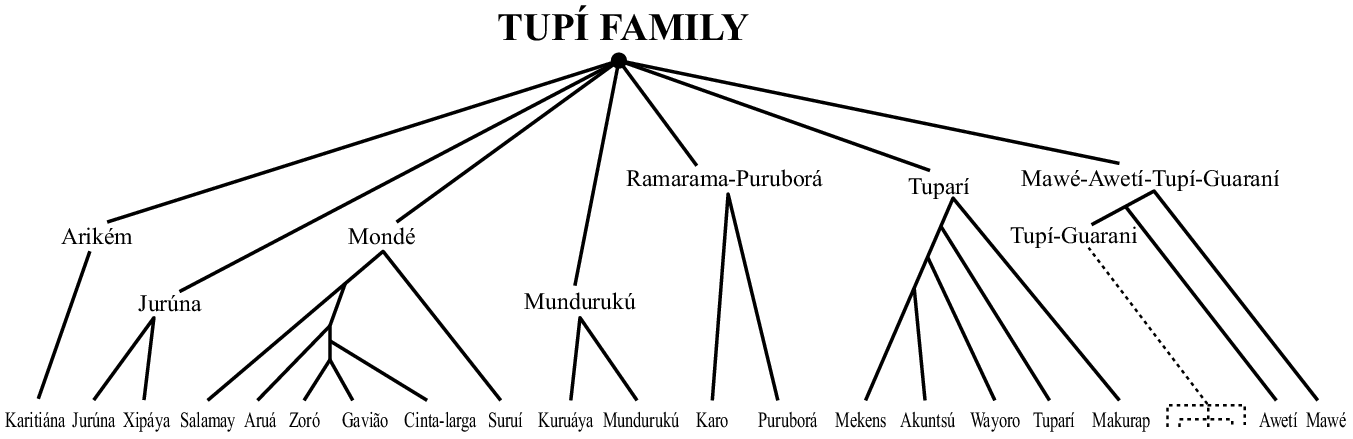
Figure 8.1 The branches of the Tupian language family1
The genetic relationship and internal classification of the Tupian family shown schematically in Figure 8.1 incorporates recent historical-comparative studies concerning internal classification and proposals of intermediary stages in the evolution from Proto-Tupí to the current languages, including the results of lexical and grammatical comparison and reconstruction for the different branches of the Tupian family (Rodrigues Reference Rodrigues1984, Reference Rodrigues, Klein and Stark1985; Gabas Jr. Reference Gabas, van der Voort and van de Kerke2000; Galucio and Gabas Jr. Reference Galucio and Gabas2002; Moore Reference Moore2005; Drude Reference Drude, Dietrich and Symeonidis2006; Picanço Reference Picanço, Gildea and Galucio2010; Galucio and Nogueira Reference Galucio and Fernanda Nogueira2012).
The close relationship between Awetí, Mawé, and the Tupí-Guaraní languages has long been recognized (Rodrigues Reference Rodrigues1964, Reference Rodrigues1984, Reference Rodrigues, Klein and Stark1985; Rodrigues and Dietrich Reference Rodrigues and Dietrich1997), and it is by now well established that these languages constitute a large branch inside Tupí, the Mawé-Awetí-Tupí-Guaraní branch (Drude Reference Drude, Dietrich and Symeonidis2006; Correa da Silva Reference Correa da Silva2011; Drude and Meira to appear), termed the Mawetí-Guaraní branch by the latter two authors. This branch represents the major branch of the family, in number of languages and in territorial extension.
Given the enormous diversity within the family in terms of territorial expansion, it is clear that the different Tupian groups have been shaped by distinct and individual historical experiences. An attempt to reconstruct the internal diversification and expansion of Tupian languages must therefore take these experiences into account, aided by a multidisciplinary approach that seeks to understand not only the genealogic relationship and contact history of the languages from a linguistic point of view, but also the particular historical experiences of the groups by mapping the sociocultural features associated with them.
3 Lexical and structural distances between Tupian languages
The genealogical classification of the Tupian family is presented in Figure 8.1, which shows the distinct levels of relationships between the languages and their evolutionary paths from the ancestor language, Proto-Tupí. In this section, we present another view of Tupian language relations, based on distance matrices of shared features. We analyzed the data compiled for this study using quantitative techniques to visualize patterns of relationship in terms of lexical and structural similarity, without presuming an explicit genealogical history. We then compare assessments of similarity presented in network representations (Figures 8.2 and 8.3) to the internal relationships and genealogy of the Tupian family (Figure 8.1).
3.1 Linguistic distance based on lexical similarity analysis
Galucio and colleagues (to appear) present the results of a lexicostatistical and phylogenetic study based on the analysis of the Swadesh list of 100 diagnostic words considered to be most stable over time (Swadesh Reference Swadesh1955) for all the nineteen Tupian languages outside the Tupí-Guaraní family and for four Tupí-Guaraní languages (Guaraní, Parintintim, Tapirapé, and Urubu-Kaapor). Their study shows the degree of distance across Tupian languages, confirms the two more recently established branches of Ramarama-Puruborá and Mawé-Awetí-Tupí-Guaraní, and also supports the internal structure of each branch of the family based on historical-comparative methods. In the case of Tuparí and Mondé, the two most diversified branches outside Tupí-Guaraní, the phylogenetic similarity tree agrees exactly with the independent internal classification of these branches (Moore Reference Moore2005; Galucio and Nogueira Reference Galucio and Fernanda Nogueira2012). We took their study and extended it to include a more complete set of languages from the Tupí-Guaraní branch. Using the NeighborNet algorithm implemented in Splits-Tree4 (Huson and Bryant Reference Huson and Bryant2006), we generated an unrooted network expressing a distance measure among the Tupian languages on the basis of lexical similarity in the basic vocabulary for thirty-one Tupí-Guaraní languages and dialectal varieties and the nineteen languages from the other Tupian branches already established by Galucio et al. (to appear). The distances between the languages based on the percentage of shared lexical items are shown in the NeighborNet representation in Figure 8.2.2
The analysis is not intended to show the historical development of these languages but rather the degree of distance between them, based on lexical similarity that may also reflect the result of horizontal transfer. It is nonetheless remarkable that the major clusters of languages that surface from the distance measure shown in the graphic are comparable to the proposed path of historical development for the Tupian languages, on the basis of the comparative method (cf. Figure 8.1). The NeighborNet representation places Awetí as the closest language to the Tupí-Guaraní cluster, followed by Mawé, and together forming the Mawetí-Guaraní larger cluster, which is consistent with the proposed path of evolution in the history of these languages (Drude Reference Drude, Dietrich and Symeonidis2006; Correa da Silva Reference Correa da Silva2011; Drude and Meira, to appear). The six other lexical clusters (Juruna, Arikém, Ramarama-Puruborá, Mondé, Tuparí, and Mundurukú) and their sub-splits correspond exactly to the more recent genealogic classification of these languages, as clearly seen in the Tuparí and Mondé branches (Moore Reference Moore2005; Galucio and Nogueira Reference Galucio and Fernanda Nogueira2012).
The linguistic cohesiveness of the Tupí-Guaraní branch is also prominent in the network representation. Horizontal transfers due to contact and borrowing may be responsible for a great number of the synchronic resemblances in the Tupí-Guaraní lexicon, not all of them due to retention from a common ancestor language. Nonetheless, as expected from the known history of these languages, the thirty-one Tupí-Guaraní languages are closer to each other than to any other language in the Tupian family.
However, the splits inside the Tupí-Guaraní cluster do not correspond exactly to classifications of the Tupí-Guaraní branch based on phonological criteria (Mello Reference Mello2000; Rodrigues and Cabral Reference Rodrigues, Cabral, Cabral and Rodrigues2002) or on a combination of lexical, phonological and grammatical criteria (Dietrich Reference Dietrich1990). There is an overall absence of well-delimited lexical clusters inside the Tupí-Guaraní group in Figure 8.2. Among the few specific clusters that surface from the quantitative lexical comparison are the Kawahib languages (Parintintim, Tenharim, Amondawa, and Uru-eu-uau-uau) that are classified as dialectal variants (Sampaio Reference Sampaio1997); the Yuki-Sirionó cluster of two closely related Tupian Bolivian languages; the Wayampi-Emérillon cluster of languages spoken in the same geographic area in French Guiana; the Língua Geral Amazônica3-Urubu-Kaapor grouping, for which there have been claims of mutual influence through contact; and a Guaraní cluster that includes most of the languages in Rodrigues and Cabral's subgroup I of Tupí-Guaraní (2002) but also includes Guarayo, spoken in Bolivia. The Cocama-Cocamilla language4 appears close to Xeta. The Cocama lexicon, including the core vocabulary, is primarily Tupian (Cabral Reference Cabral1995), but it also shows lexical traits of Arawakan, Panoan, and Quechuan origin, in addition to Portuguese and Spanish (Muysken Reference Muysken, Campbell and Grondona2012b).5

Figure 8.2 NeighborNet representation of lexical distances among Tupian languages
3.2 Linguistic distance based on structural similarity analysis
For the structural analysis, we designed a preliminary questionnaire of twenty prominent typological features, divided between phonology, morphology and syntax.6 Due to the availability of data, our structural sample is smaller than the lexical sample. It consists of thirty languages, including eighteen from the Tupí-Guaraní branch and twelve from the other nine branches of the family. The features were coded on the basis of published material, complemented with direct verification with specialists working on particular languages. The current location of the analyzed languages is shown in Map 8.2. Only two features are identical for all the languages in the sample. All Tupian languages have the order possessor-possessed in the possessive phrase, and all have noun-postposition order in the noun phrase, which is consistent with the general head-marking characteristic of the family. With the exception of Cocama-Cocamilla, which has a causative suffix -ta, all other languages have a causative prefix of the form mV- (<Proto-Tupí *mõ-). The phonological features show few splits throughout the family. The vowel inventories go from four (Língua Geral Amazônica) to seven vowels (Karo, Puruborá and Tenetehara-Tembé), with most of the languages showing five or six vowels. With respect to suprasegmental phenomena, languages of two branches (Mondé and Mundurukú) have contrastive tone, three languages (Juruna, Karitiana, and Karo) have pitch-accent systems, and the remaining languages, including Xipaya, the sister language of Juruna, have stress-only systems (cf. also Storto and Demolin Reference Storto, Demolin, Campbell and Grondona2012).

Map 8.2 Current location of the languages in our structural sample
Preliminary results of the structural analysis can be visualized in the network representation in Figure 8.3. The discrepancies between the lexical and grammatical analyses are remarkable. The only languages that seem to cluster in both analyses are Kaiowa with Mbyá-Guaraní, and Karo with Puruborá, although there is little evidence for the latter in the grammatical outcome, probably due to the gaps in the Puruborá data.7 The other lexical clusters that correspond to the known genealogy of the Tupian languages are not found in the structural analysis. The lexical major split opposing a large Mawé-Awetí-Guaraní branch on one side to all the other branches (cf. Figure 8.2) is not present in the structural analysis, either. A split in terms of Eastern and Western languages (Rodrigues Reference Rodrigues, Cabral and Rodrigues2007) that opposes the language branches spoken in the Rondônian region (Arikém, Ramarama-Puruborá, Tuparí, and Mondé) to the branches spoken outside that region (Mawetí-Guaraní, Juruna, and Mundurukú) does not surface in either the lexical or the grammatical analysis.

Figure 8.3 NeighborNet representation of structural distances among Tupian languages
The output of the structural distance measure does not compare favorably with known genealogical relations. The closely related Juruna branch members Juruna and Xipaya are adjacent in the lexical measure but do not cluster together in the structural analysis. On the other hand, languages that belong to distant genealogical branches such as Makurap (Tuparí) and Asuriní do Tocantins (Tupí-Guaraní) or Mekens (Tuparí) and Yuki (Tupí-Guaraní) show high measures of grammatical similarity. Cocama-Cocamilla and Língua Geral Amazônica constitute another unorthodox cluster in Figure 8.3, sharing fourteen of the twenty analyzed features, including SVO as the basic order of clausal constituents. As the most prominent expansion varieties of Tupian, these two languages played an important role in the contact scenario (see Section 5).
4 Cultural characteristics of the Tupí-speaking groups
When investigating a language family as widespread as Tupian, great caution must be used in assigning general cultural characteristics to such a large number of groups located in such diverse ecological zones within the lowlands of tropical South America. Let us therefore first point out that we do not propose that all Tupí-speaking groups share a single set of cultural features. What we do propose, however, is that several socio-cultural characteristics, material as well as non-material, with great potential to influence language dispersal, have very interesting distributional patterns within the family and therefore deserve closer investigation. Recent research by Walker et al. (Reference Walker, Wichmann, Mailund and Atkisson2012) applied quantitative methods to analyze the distribution of cultural features within the Tupian family in order to reconstruct its homeland and the rates of cultural change within it. However, the research by Walker and colleagues does not investigate cultural features that are typical of Tupí-speaking societies, but rather features that are common among Tupian groups (and, not incidentally, just as common among members of many other lowland South American language families). The present investigation seeks instead to isolate cultural features that are more exclusively Tupian, allowing us to identify Tupian versus non-Tupian characteristics in contact situations. The latter method is particularly useful when researching prehistoric contact scenarios, where the primary sources of evidence are the remains of material culture (see below).
Since the publication of Eduardo Viveiros de Castro's (Reference Viveiros de Castro1992) From the enemy's point of view, the so-called “bellicose ethos” identified by the author has become a powerful cultural characterization of Tupí-speaking groups across Amazonia. The expression stems from the observation that the Tupí-speaking groups studied displayed a strong predatory cosmology, where social prestige and status is gained by violent performances such as warfare, enslavement, and anthropophagy. Anthropophagy was a widespread and well-integrated cultural feature of many Tupí-speaking societies at the time of contact (Gareis Reference Gareis2002: 248; Fausto Reference Fausto, Fausto and Heckenberger2007: 83; Santos-Granero Reference Santos-Granero, Hornborg and Hill2011: 343). Many of the violent encounters between Europeans and Tupí-speaking groups in the 1500s bear witness to the presence of these practices among Tupians of the Atlantic Coastline. It is then tempting, of course, to assign the predatory cosmology of the Tupí-speaking groups encountered by early Europeans to the whole language family, but such a generalization must nevertheless be corroborated by careful study of a large and representative number of communities, in order to confirm such a hypothesis. Let us therefore for a moment return to Map 8.1, where the spatial distribution of the Tupian branches at the time of contact is depicted.
Early Europeans who set foot in South America along the Atlantic coastline and later along the lower Amazon River would have come into contact primarily with speakers of the Tupí-Guaraní branch, and secondarily with speakers of the Mundurukú, Mawé, and Juruna branches. These branches are also of great interest for our reconstruction of the expansion of the family. These four branches are responsible for the majority of the territorial expansion of the Tupian languages,8 and they are, therefore, the most salient ones in terms of indigenous contact scenarios. Fortunately, the ethnographical information available for the members of these four branches is relatively rich.
In an intriguing study of Amazonian captive identities,9 Santos-Granero (Reference Santos-Granero2009: 5) investigates the “native regimes of capture and servitude,” providing extensive detail on the cultural characteristics of the Chiriguano (Tupí-Guaraní branch). Warfare and the taking of captives were central elements in Chiriguano society, and these also played an important role in the contact scenario between these Tupians and their Arawakan neighbors. In the Gran Chaco, the neighboring Arawakan-speaking Chané were repeatedly raided for captives, who were sometimes left alive and integrated into Chiriguano society and sometimes executed as part of anthropophagous rituals (p. 75).
According to Santos-Granero (p. 78), the Chiriguano kept more captives alive than did the Tupinambá (of the Tupí-Guaraní branch), who also had a great reputation as warriors and anthropophages. Furthermore, both the Chiriguano and Tupinambá had war clubs (Métraux Reference Métraux and Steward1948a: 95; Santos-Granero Reference Santos-Granero2009: 77), a weapon used exclusively during warfare. The Mundurukú (Mundurukú branch) also had war clubs and were involved in military conflicts (Horton Reference Horton and Steward1948: 271f., 276; Balée Reference Balée and Ferguson1984: 257). Like the Chiriguano, the Mundurukú were also known captive-takers (Horton Reference Horton and Steward1948: 278), a practice shared with the Mawé of the Mawé branch (Nimuendajú Reference Nimuendajú and Steward1948b: 251). The Juruna and Xipaya, members of the fourth Tupian linguistic branch that expanded far from Rondônia, were also known as cannibals and were documented as very hostile by the early Europeans (Nimuendajú Reference Nimuendajú and Steward1948a: 218, 235). The Xipaya also carried war clubs (Nimuendajú Reference Nimuendajú and Steward1948a: 232). In addition to taking captives, making war trophies out of enemy heads was another common practice of these Tupians, as documented in the Juruna, Mawé, Kuruaya, and Mundurukú groups (Nimuendajú Reference Nimuendajú and Steward1948a: 236, Reference Nimuendajú and Steward1948b: 251; Santos-Granero Reference Santos-Granero2009: 104, Figure 38).
Thus the ethnolinguistic groups of the four branches responsible for the major territorial expansion of the Tupian family share a certain set of features with respect to their strong emphasis on warfare and the taking of captives. This pattern of violent sociocultural interaction with neighboring groups had very particular consequences in terms of the cultural and linguistic exchange between the combatant societies. Judging from the unequal power relations that often arose between captives and captors, one may get the impression that cultural and linguistic exchange was unidirectional in contact situations, with elements flowing in the direction from the powerful to the powerless only. However, many examples involving the four non-Rondônian branches of the family indicate that contact scenarios were more complex and interesting.
Several ethnographical examples from Tupí-speaking societies provide a picture of communities particularly keen to integrate new cultural elements into their repertoires. Although the Arawak-speaking Chané were Chiriguano-ized by their powerful Tupí-speaking neighbors, there was also a substantial Arawakan cultural element flowing in the opposite direction (Santos-Granero Reference Santos-Granero2009: 33, 186). In terms of agricultural skills, the Chané were much better equipped than the Chiriguano, which led to the abandonment of traditional Chiriguano subsistence strategies in favor of obtaining food produced by subjugated Chané groups (Santos-Granero Reference Santos-Granero2009: 80f., 136). Furthermore, as noted by Iris Gareis (Reference Gareis2002: 264) in a study of the cultural encounters between Tupí-speaking groups of the Brazilian Atlantic Coast and the first Europeans to settle there, the Tupians quickly integrated the Europeans and their artifacts into their own cultural sphere through the establishment of exchange relations with the French and the Portuguese.
Another intriguing example of the Tupian tendency to adopt cultural elements from others is given in Gow's (Reference Gow, Fausto and Heckenberger2007) study of the Tupí-Guaraní-speaking Cocama communities of the Peruvian Amazon, who adopt the surnames of groups with high social ranking, e.g. Brazilians, in order to escape their status as “indigenous,” commonly seen as low-status citizens. The dynamic and flexible nature of Tupian exchange relations vis à vis other groups helps us understand the dispersal of the non-Rondônian branches of the language family: arenas of linguistic exchange were created which fostered integration and assimilation scenarios among groups and individuals and facilitated the borrowing of cultural and linguistic features. This interaction style is a key criterion in researching the nature of linguistic contacts involving the Tupí-Guaraní branch.
5 The nature and timing of the Tupian language expansions
Of the ten traditional Tupian branches, a single one, Tupí-Guaraní (with approximately twenty-two languages and about forty dialectal variants), is responsible for the major part of the territory conquered by the family (Map 8.1). Some of this spread was accomplished during European colonization. Métraux (Reference Métraux and Steward1948a: 98–99) reports two great Tupinambá migrations: one from the coast of Brazil to Chachapoyas in Peru (1540–1549), and a second one involving a different Tupinambá group from the coast of Brazil through the Amazon and Madeira rivers up to Bolivia and then back to the mouth of the Madeira, where they settled on the Tupinambarana island. Similarly, Old Guaraní was attested from the end of the seventeenth century until about the middle of the eighteenth century, when reference to the language basically disappears. The language surfaced again around the mid-nineteenth century to become the starting point of modern Guaraní. By then the Guaraní language had already diverged into at least three major branches: Chiriguano, Guaraní, and Mbya-Guaraní, spoken in Bolivia, Paraguay, and Brazil, respectively (Schleicher Reference Schleicher1998: 3). This scenario of Tupian expansion is also linked to the development of línguas francas that surfaced in the context of the Portuguese and Spanish colonization. The best known cases are Guaraní, Língua Geral Paulista, and Língua Geral Amazônica. The first is now a national language of Paraguay. Língua Geral Paulista is extinct, and Língua Geral Amazônica is still spoken by various ethnic groups in the northwest Amazon (Map 8.2).
During the first two centuries of Portuguese colonization, Tupinambá was largely spoken along the coast of Brazil and subsequently spread into the provinces of Maranhão and Grão-Pará in Amazonia.10 The language evolved in contacts during the earlier colonial period between Tupinambá, Portuguese, mestizos, and speakers of other indigenous languages, and it was used for daily, official, and religious communication. By the mid-eighteenth century, there was already an identifiable variety distinct from Tupinambá that later came to be called Língua Geral Amazônica (Rodrigues Reference Rodrigues1986; Moore et al. Reference Moore, Facundes and Pires1993). Official prestige for the language shifted drastically during the centuries, from being the institutionalized official language of the Maranhão and Grão-Pará provinces during the seventeenth century to being prohibited in the mid-eighteenth century, due to the promotion of Portuguese. The nineteenth century saw at the same time a gradual decline of language usage along with a gradual adoption of the language by new groups, first as a second language of Arawakan and other ethnic groups, later as a first language in the upper Rio Negro (Brazil), where it is now spoken by thousands of people mostly in Brazil but also in Venezuela (Cruz Reference Cruz2011). An important factor in the history of Língua Geral Amazônica is its continuous transmission over the centuries (Cabral Reference Cabral2011; Moore Reference Moore and Mufweneforthcoming). It has been modified over time as it adapted to new settings, but its transmission was never interrupted. In the first centuries, the main mechanism of change seems to have been substratum influence during the acquisition of Língua Geral Amazônica by speakers of diverse languages, resulting in grammatical changes rather than lexical and grammatical borrowing (Moore et al. Reference Moore, Facundes and Pires1993). Increasing bilingualism, the dislocation of speaker populations, and the mixing of native groups led to increasing levels of Portuguese lexical and grammatical borrowing, observed in the twentieth century (Moore Reference Moore and Mufweneforthcoming: 180).
Another Tupí-Guaraní language that played a central role in the expansion of the family through horizontal transfer (contact and borrowing) is Cocama-Cocamilla. Cocama has been claimed (Cabral Reference Cabral1995) to be the result of incomplete shift in a process of rapid creolization, starting in the fifteenth century, when a group of Tupí-speakers (possibly Tupinambá) migrated from the Atlantic coast inland to the upper Amazon and came into close contact with speakers of one or more other languages, possibly of Arawakan origin. Cabral argues that due to the mixed origin of Cocama and its history of intense language contact, reflected in lexical and grammatical idiosyncrasies, it cannot be assigned Tupian or any other genealogical affiliation (Cabral Reference Cabral2011: 20). However, the genealogical affiliation of Cocama as Tupian has also been defended (Michael Reference Michael2010; Vallejos-Yopán Reference Vallejos-Yopán2010). Despite traces of non-Tupian contributions in its grammar, regular patterns of grammatical change can be identified in Cocama that support an early development from a Proto-Tupí-Guaranían origin with gradual changes over the centuries (Vallejos-Yopán Reference Vallejos-Yopán2010: 753–758). The role of Arawakan, Panoan, Quechuan, Portuguese, Spanish, and other non-identified languages as suppliers of lexical and grammatical items for Cocama-Cocamilla highlights the complex contact scenario found in the Amazon region since pre-Columbian times. The effect of an earlier Quechua-based pidgin in the upper Amazon (Crevels and Muysken Reference Crevels, Muysken, Noll and Symeonidis2005b) might be reflected in the high number of Quechua words in Cocama, including plant and animal names, verbs, adverbials, numerals, and a special Quechua perfective morpheme used in verbs of Spanish origin (Muysken Reference Muysken, Campbell and Grondona2012b: 249f.).
There may also have been horizontal transfers from Arawakan (and other languages) to Tupian groups through second language acquisition, as with the Chiriguano who subjugated Arawakan populations. As the powerful Arawakan regional exchange system that had expanded across Amazonia between 900 BCE and 1000 CE declined (Hornborg Reference Hornborg2005; Eriksen Reference Eriksen2011; Eriksen and Danielsen, this volume), there were both Tupian and Cariban expansions in the period between 1000 and 1500 CE (Eriksen Reference Eriksen2011). Tupí-speakers competed with the Caribs for Arawakan trade routes, and the headwaters of the Amazon River were part of early Tupian routes.
Other Tupian groups who left Rondônia include speakers of the Mundurukú, Mawé, and Juruna branches, who expanded their territories, and speakers of the single-language branch Awetí, who are concentrated today in a small geographic area in the Upper Xingú Indigenous Park. In the second half of the eighteenth century, the Mundurukú appeared in the colonial records as inhabitants of the Maué river, a tributary of the Amazon.11 They expanded their territory through warfare and came to completely dominate the region between the Madeira and Tapajós rivers by the beginning of the nineteenth century. Sateré-Mawé-speakers have inhabited the region of the Tapajós and Madeira rivers for more than 300 years. The first reference to their presence there dates back to 1639 (Carvajal, de Rojas and de Acuña Reference Carvajal, de Rojas and de Acuña1941, cited in Franceschini Reference Franceschini1999), and their split from a Proto-Mawetí-Guaraní language is certainly much earlier than the Tupinambá migration that left the coast around 1530 and arrived at the Tapajós-Madeira region around 1590 (Métraux Reference Métraux1928). The internal classification of the Mawetí-Guaraní super-branch shows an Awetí-Tupí-Guaraní branch opposed to Mawé (cf. Figure 8.1). This internal classification implies that the Mawé were the first to separate from the ancestral group, which later split into the ancestors of the Awetí and the ancestors of another group that later became the diverse Tupí-Guaraní branch (Rodrigues and Dietrich Reference Rodrigues and Dietrich1997; Drude and Meira, to appear).
The remaining five Tupian branches are still located within Rondônia and its adjacent areas, and there are no indications that they have ever expanded outside of this region.
5.1 The material culture of the Tupian expansion
Most attempts to reconstruct the Tupian expansions have relied heavily on pottery as a marker of the pre-Columbian spread of Tupian languages (see e.g. Lathrap Reference Lathrap1970; Brochado Reference Brochado1984; Noelli Reference Noelli, Silverman and Isbell2008; Neves Reference Neves, Hornborg and Hill2011). Lathrap (Reference Lathrap1970) argued that the dispersal of the Arawakan and Tupian families took place from roughly the same point of origin in central Amazonia. He suggested that Arawak-speaking groups were associated with Barrancoid pottery (also known as Incised Rim), while the Tupian groups could be traced through the presence of ceramics associated with the Amazonian Polychrome Tradition.
The Barrancoid tradition originated in the Orinoco Valley around 900 BCE (Cruxent and Rouse Reference Cruxent and Rouse1958, Reference Cruxent and Rouse1959; Sanoja Reference Sanoja1979; Sanoja and Vargas Reference Sanoja and Vargas1983; Barse Reference Barse1989; Oliver Reference Oliver1989; Roosevelt Reference Roosevelt1997; Boomert Reference Boomert2000; Gassón Reference Gassón2002), expanded into the central Amazon by 400 BCE (Heckenberger et al. Reference Heckenberger, Petersen and Neves1999; Rebellato et al. Reference Rebellato, Woods, Neves, Woods, Teixeira, Lehmann, Steiner, WinklerPrins and Rebellato2009), and progressed further into the upper Amazon (Evans and Meggers Reference Evans and Meggers1968: 17, 81; Lathrap Reference Lathrap1970: 109; Brochado and Lathrap Reference Brochado and Lathrap1982: 12) and southern Amazonia (Lathrap Reference Lathrap1970: 159; Heckenberger Reference Heckenberger2005: 56; Saunaluoma Reference Saunaluoma2010: 94) during the centuries around 1 CE (see Eriksen Reference Eriksen2011 for an inclusive account of the Barrancoid expansion). The timing and expansion of the Barrancoid tradition correlates strongly with the Arawakan linguistic dispersal, supporting their association (Eriksen and Danielsen, this volume).
The historical record on a correlation between Tupian languages and Amazonian Polychrome pottery is less straightforward. The association between this pottery style and Tupian groups originated because the first Europeans who entered Amazonia found polychrome pottery among several indigenous groups of the Tupí-Guaraní branch, including the Omagua, Cocama, and Cocamilla of the upper Amazon (Salazar Reference Salazar, Silverman and Isbell2008: 264), the Tupinambá of the Atlantic coastline south of the mouth of the Amazon (Brochado Reference Brochado1984: 283–297), and the southern Tupí-Guaraní groups from the Sao Paulo area to the Andean foothills of Bolivia, among whom a variant of the Polychrome tradition with corrugated decoration was widespread (Howard Reference Howard1947; Métraux Reference Métraux and Steward1948b: 411). The earliest confirmed datings12 of the tradition are from the Marajoara phase of Marajó Island at the mouth of the Amazon (Meggers and Evans Reference Meggers and Evans1957; Roosevelt Reference Roosevelt1991; Schaan Reference Schaan, Silverman and Isbell2008), from around 300 CE (Brochado and Lathrap Reference Brochado and Lathrap1982: 51), but dates closer to 750 CE are more frequent (Boomert Reference Boomert, Delpuech and Hofman2004: 259).
Around 500 CE, polychrome decoration also began to develop in the central Amazon, alongside ceramics of the Barrancoid tradition and later of the Paredão phase (700–1200 CE). These are two ceramic styles associated with Arawak-speaking groups (Neves Reference Neves, Hornborg and Hill2011: 48), who by that time were integrated into a vast regional exchange system encompassing large parts of the northern South American lowlands (Hornborg Reference Hornborg2005; Eriksen Reference Eriksen2011; Neves Reference Neves, Hornborg and Hill2011: 41). Arawak-speaking groups dominated sociocultural exchange in Amazonia during this period, demonstrating status through different but interrelated ceramic styles. The complex historical record of Amazonian Polychrome pottery illustrates the multifaceted character of its association with potentially multiple ethnolinguistic groups.
The Arawakan expansion began in the Orinoco area around 900 BCE (Eriksen Reference Eriksen2011) and continued along the Amazon River, via the Madeira onto the Llanos de Moxos, and further into the upper Xingu between 500 and 1 BCE. The vast Arawakan linguistic and cultural dispersal was integrated through a regional exchange system that circumscribed the Tupian family in Rondônia on all sides but the east, so when the Tupian family slowly started to expand, it was indeed eastward (cf. Noelli Reference Noelli, Silverman and Isbell2008).
5.2 The chronology of the Tupian expansion
Early proposals (cf. Martius Reference Martius1867) postulated a relatively recent date for the onset of Tupian linguistic diversification and expansion, placing it shortly before the arrival of Europeans. Rodrigues’ (Reference Rodrigues1964) estimated chronology situated the origin of Proto-Tupí in the Madeira-Guaporé region around 3000 BCE and the beginning of Tupí-Guaraní expansions east and south between 500 and 1 BCE. In a more recent review based on archaeological data, Noelli (Reference Noelli, Silverman and Isbell2008) assesses available dates for what he calls the Tupí-Guaraní ceramic tradition and concludes that this tradition may have started expanding at least around 2,000 years ago.
It is important to consider that, despite the great territorial extension of Tupí-Guaraní speaking groups (see Map 8.1), the languages reveal a high degree of uniformity. The rate of shared cognates among the Tupí-Guaraní languages is around 70 percent or higher, and they also share many other phonological and morphosyntactic features that distinguish them from other Tupian languages. While the beginning of the diversification process that gave rise to the current languages is placed some 2,500 to 2,000 years ago, linguistic comparative studies indicate more recent subgroupings within the family. Thus, a rapid rate of displacement is necessary to account for both the great spatial distribution of the Tupí-Guaraní groups and their great linguistic similarity.
The complex Tupí-Guaraní migration process that began in prehistoric times (Métraux Reference Métraux1928) was probably accelerated and intensified by the European occupation. At the time of the initial Tupian expansions (specifically the Tupí-Guaraní branch), Arawakan-speaking groups dominated the cultural and linguistic exchange in large parts of Amazonia. The Arawak-speaking communities were river-oriented, settling close to major transportation routes that formed the basis of their exchange system, while the Tupí-speaking groups preferred the headwaters of the rivers, not the riverbeds (Migliazza Reference Migliazza and Prance1982; Urban Reference Urban1996). The Amazon River seems to have been particularly important in this sense, serving as a major artery connecting the Arawak-speaking Aruã at the mouth of the Amazon with the Manao at the juncture of the Negro, Madeira, and Amazon Rivers. The connection continued into the upper tributaries, where groups such as the Chamicuro were still located at the time of European contact. Given the dominance of Arawakan culture and languages in Amazonia at around 500 CE, it is highly likely that the early polychrome ceramics found along the main river, far up the Rio Negro and into the Aruã territory on Marajó Island, dating from precisely this period, were associated with the Arawakan cultural complex. This claim will be further elaborated on below.
In this light, the latter period of the Amazonian Polychrome tradition carries a totally different story. Its early history was very much a product of the Arawakan exchange system that had produced a complex culture, centered around ancestry and inherited rank as the basis for social hierarchies and political power (Santos-Granero Reference Santos-Granero, Hill and Santos-Granero2002: 42ff.), displayed through complex ritual ceremonies, and accompanied by elaborate expressions of material culture such as intricate musical instruments (Izikowitz Reference Izikowitz1935; Hill Reference Hill, Hornborg and Hill2011), dancing masks (Santos-Granero Reference Santos-Granero, Hornborg and Hill2011: 344), and beautifully decorated ceramic artifacts. In contrast, the late history of this ceramic style contains an abrupt shift of cultural context related to the expansion of Tupí-speaking groups. The polychrome ceramic associated with Tupian occupation, sometimes labeled the Tupí-Guaraní tradition, covered a large geographic area from the Ji-Paraná and Aripuanã rivers in Rondônia to the Xingu and Tocantins rivers in Mato Grosso and Tocantins (Cruz Reference Cruz2008).
As noted by archaeologists, the circular villages of the Arawak-speaking communities established along the Amazon River and its major tributaries during the Barrancoid period came to a sudden end around 900 CE. A period of warfare resulted in the replacement of the circular and palisaded Arawakan villages with linear, un-palisaded villages similar to those noted by the early European travelers (Rebellato et al. Reference Rebellato, Woods, Neves, Woods, Teixeira, Lehmann, Steiner, WinklerPrins and Rebellato2009: 22, 29; see also Roosevelt Reference Roosevelt, Descola and Taylor1993; Porro Reference Porro and Roosevelt1994; Hemming Reference Hemming2004 [1978]). The change in architectural style likely signals the violent expansion of the speakers of the Tupí-Guaraní branch, enacting an early version of the predatory cosmology described earlier. The outcome of this period of social conflict and warfare was not only a change in village layout (Rebellato et al. Reference Rebellato, Woods, Neves, Woods, Teixeira, Lehmann, Steiner, WinklerPrins and Rebellato2009: 22) (and most likely also language use), but also a stronger representation of the Amazonian Polychrome tradition along the main river and an elaboration of the painted decoration of the vessels.13
The timing of the expansion of Tupian languages and polychrome pottery south of the Amazon River indicates that these ceramics are another example of the Tupian process, discussed above, of absorbing external cultural elements into their own repertoire to strengthen ethnic identity vis à vis other groups. As noted above, the Barrancoid (400 BCE–900 CE) and Paredão (700–1200 CE) occupations in the central Amazon area have been associated with an Arawak-controlled regional exchange system (Eriksen Reference Eriksen2011; Neves Reference Neves, Hornborg and Hill2011: 41, 45, 48f.). The period of warfare that led to the replacement of villages and pottery styles also brought Guarita phase ceramics of the Amazonian Polychrome tradition (Neves et al. Reference Neves, Petersen, Bartone, Heckenberger, Glaser and Woods2004: 133; Rebellato et al. Reference Rebellato, Woods, Neves, Woods, Teixeira, Lehmann, Steiner, WinklerPrins and Rebellato2009: 22, 27). However, Guarita phase pottery was not a truly intrusive ware in the region. It had already started to develop out of Barrancoid material in the area around 500–600 CE (Lathrap Reference Lathrap1970: 155–157; Brochado Reference Brochado1984: 317; Petersen et al. Reference Petersen, Neves and Bartone2004: 9), but it did not gain an important position until the period of social upheaval around 900. The territory of the Guarita phase increased between 900 and 1550, not only in territories known to have been controlled by Tupí-speaking groups at the time of contact, but also along the Rio Negro14 – in an area known to have been a stronghold of the Manao, one of the most powerful Arawak-speaking groups of Amazonia, and their neighbors, the Arauakí (Eriksen Reference Eriksen2011: 112, Figure 4.3.1).
Indeed, the Manao were powerful enough to substantially eradicate all speculations of a Tupi-controlled lower Rio Negro during late prehistory, but the picture from ceramic evidence is more complicated. Although the pottery of the historical Manao shows influence from the polychrome tradition (Myers 1999: 36f.), the main affiliation of their ceramics is to the Arauquinoid/Incised Punctuated tradition, a ceramic style originating around the Guiana Highlands and most commonly associated with Cariban language speakers15(Neves Reference Neves, Hornborg and Hill2011: 47). Furthermore, the Manao traded gold to the Tupí-speaking Curuzirari of the Amazon River, who in turn manufactured polychrome pottery that was circulated to neighboring groups (Eriksen Reference Eriksen2011: 205). Thus, in gold we find another high-status cultural element that was exchanged between Arawakan and Tupian groups of the area, suggesting further language contact between these groups, even as connections multiply between pottery styles and a variety of speaker groups.
Vessel shapes and functions of the Guarita phase attest to two different wares: a variety that was elaborately decorated with polychrome painting, probably used in ceremonies, and a simple variety, with little or no decoration, probably manufactured for everyday use (Petersen et al. Reference Petersen, Neves, Heckenberger, McEwan, Barreto and Neves2001: 97). Considering the relatively complex inter-ethnic relationships of the central Amazon during late prehistory, it is likely that some groups used Guarita ceramics as their everyday-ware, while high-status pottery was traded among all influential groups as a sign of social status and ethnic affiliation.
Therefore, the suggested chronology is one in which polychrome pottery was initially manufactured by Arawakans 500–900 CE, alongside Barrancoid and Paredão phase ceramics. In the subsequent period, polychrome ceramics were transformed into more elaborately decorated high-status ware that from 900 to 1200 was acquired by Tupí-speakers as part of the shifting power relations between Arawakans and Tupians in Amazonia. Finally, between 1200 and 1550 the high-prestige polychrome pottery was circulated among the different ethnolinguistic groups of the central Amazon, an area now in the hands of Tupians, as a marker of political and religious power and social status that was also communicated by Tupian language use.
Downriver in the lower Amazon, cultural exchange and dynamics of ethnogenesis between Tupí- and Arawak-speakers began a little earlier, around 700–800 CE, with evidence of the pottery later known as the Tupinambá phase of the Amazonian Polychrome tradition found south of Marajó Island (Brochado Reference Brochado1984: 342). Brochado (Reference Brochado1984: 313) notes that Tupian polychrome pottery of eastern Brazil, the Guaraní and Tupinambá ceramic phases, originated in the Guarita sub-tradition. Many of the stylistic elements in Guarita and Marajoara thereafter remained in the Tupinambá phase, but Brochado (Reference Brochado1984: 369) is careful to point out that Marajoara dates at least 500 years before Tupinambá, eliminating all speculations on a reverse cultural exchange between these two groups. Guaraní ceramics, the southernmost distributed branch of the Tupian polychrome pottery, lost some decorative elements in the split from Guarita (Noelli Reference Noelli, Silverman and Isbell2008: 661), and there was a certain amount of stylistic exchange with local complexes in southern Brazil, particularly a Kaingang style (manufactured by a Macro-Jê-speaking community) (Brochado Reference Brochado1984: 378).
The so-called Tupí-Guaraní pincer movement, a process that resulted in the circling of the Brazilian Highlands and the meeting of Tupinambá- and Guaraní-speaking groups in the area of the present-day Sao Paulo, took place between 500 and 1000 CE (Brochado Reference Brochado1984: 383). After this, a period of constant warfare between the two groups ensued (Brochado Reference Brochado1984: 386). Unlike most Arawak-speaking groups of Amazonia (cf. Santos-Granero Reference Santos-Granero, Hill and Santos-Granero2002), the Tupian groups do show signs of endo-warfare: at times, they seem to have considered their closest linguistic relatives their worst enemies. Despite frequent hostilities, trade and exchange between the two Tupian groups were maintained, leading to ceramic interaction and facilitating a certain degree of homogenization between their respective ceramic phases (although vessel shapes were sometimes adapted to local conditions) (Brochado Reference Brochado1984: 387f., 394).
As for the sociocultural relationship between Tupí-Guaraní-speakers and non-Tupian groups, several observations point to a scenario in which there was actually less warfare than usually assumed for the expansion of Tupí-Guaraní (cf. Viveiros de Castro Reference Viveiros de Castro1992). According to Noelli (Reference Noelli, Silverman and Isbell2008: 664), there was a gradual expansion of Tupian groups into others’ territories, which would explain the ceramic acculturation noted above. Brochado (Reference Brochado1984: 402) and Santos-Granero (Reference Santos-Granero2009: 33) note that the Tupinization of outside groups was an important way of incorporating new populations into the group, thus also spreading Tupian languages. This fits well with the observation made earlier that Tupí-Guaraní-speaking groups were generally very skilled in incorporating new cultural elements into their own repertoire and often engaged in processes of ethnogenesis with neighboring indigenous groups and later with Europeans. As noted, the Tupí-speaking Chiriguano had an unequal power relation with the Arawak-speaking Chané (Santos-Granero Reference Santos-Granero2009: 186), but there were nevertheless many cultural traits flowing from the Chané to the Chiriguano.
Linking this observation back to the discussion of polychrome pottery and its possible correlation with Tupians, the occurrence of this ceramic tradition in the Peruvian Amazon was initially closely associated with the Cocama, who established themselves together with the polychrome pottery in the region between 1200 and 1400 (Evans and Meggers Reference Evans and Meggers1968; Lathrap Reference Lathrap1970; Myers Reference Myers, Glaser and Woods2004; Salazar Reference Salazar, Silverman and Isbell2008: 264). The pottery was then transformed from an intrinsic part of the Tupian Cocama, Cocamilla, and Omagua identity into an ethnic marker of the Pano-speaking Shipibo and Conibo who co-existed with the Cocama in the Jesuit missions in colonial times (Lathrap Reference Lathrap1970: 184; Myers Reference Myers1976; Brochado Reference Brochado1984: 304; DeBoer and Raymond Reference DeBoer and Scott Raymond1987: 128f.; DeBoer Reference DeBoer, Conkey and Hastorf1990: 87, 103). Thus, tourists walking the streets of Pucallpa and Iquitos in eastern Peru are addressed in Spanish and offered “traditional” Panoan shirts16 and pottery with polychrome decoration. This is perhaps the ultimate example of the tendency for powerful cultural markers to transform themselves and take on new functions through sociocultural exchange and ethnogenetic processes – always involving language as a crucial component of contact.
6 Conclusion
This study has illustrated that out of the ten branches of the Tupian family, five (Juruna, Mundurukú, Mawé, Awetí, and Tupí-Guaraní) are largely responsible for the territorial expansion, and that one of them (Tupí-Guaraní) has expanded over large parts of South America. Linguistic analysis has shown that three out of five expanding branches (Mawé, Awetí, and Tupí-Guaraní) are closely related, forming a sub-branch of their own labeled Mawetí-Guaraní (cf. Map 8.1 and Figure 8.1). While earlier research emphasized warfare as a central mechanism of expansion for these five branches, this study has shown that although warfare was a central component of many of the expanding Tupí-speaking communities (as it was for many non-Tupí Amazonians, as well), much of the territorial expansion was the result of a gradual process in which Tupians absorbed cultural elements gradually from neighboring groups in order to strengthen themselves and their culture. This process ultimately led to the Tupinization of neighboring communities through contact scenarios dominated by Tupians, which in turn led to the adoption of Tupian languages by non-Tupí-speaking groups.
However, the process was far from unidirectional, as can be seen from the constant updates and adjustments that Tupian cultures underwent through contact with neighboring societies. In this respect, the most expansive branches of Tupian are characterized by hybrid cultures (and sometimes also languages, such as Cocama-Cocamilla), constantly renegotiated through ethnogenetic processes (cf. Hornborg Reference Hornborg2005) when in contact with other indigenous Amazonians, the colonial powers, or the current nation states.
The results of linguistic analysis of lexical material showed that patterns of synchronic similarity are consistent with genealogic classifications that incorporate an estimate of history. However the analysis of typological material showed considerably different results. Patterns of similarity were neither consistent with the known genealogy of the family nor with contact situations suggested by non-linguistic findings. The same mismatch of results has been reported for the Arawakan family (Carling et al. Reference Carling, Eriksen, Holmer and van de Weijerforthcoming), and it is an indication that lexical and typological components of languages are subjected to different historical developments in contact situations. As is well known in historical linguistics, this is due in part to varying degrees of feature borrowability. Basic vocabulary is traditionally considered to be more stable and less prone to replacement, an outcome reflecting the results of the linguistic analysis in Section 3. For example the Tupí-Guaraní languages have around 70 percent shared cognates on the basic vocabulary, while the structural data are much less homogeneous, confirming that lexicon, especially basic vocabulary, is better preserved in contact situations. The high rates of cognacy and, to a lesser extent, of structural similarity found among Tupí-Guaraní languages point to a relatively recent and rapid movement of Tupí-Guaraní speaking groups. They expanded to a vast territorial area but retained a substantial level of linguistic uniformity, even in contact situations where there was a tendency for cultural assimilation.
This conclusion fits well with the archaeological data, which propose a gradual replacement of the Arawak-dominated political control of greater Amazonia by Tupians from about 700–800 to 1200 CE. This process undoubtedly involved diverse aspects of interaction including warfare, cultural exchange, ecological practice, and linguistic evolution that ultimately led to the distribution of Tupian languages depicted in Map 8.1. Finally, the development of lingua francas such as Guaraní, Língua Geral Paulista, and Língua Geral Amazônica, in the contact scenario of early colonization, is a prime example of these processes within the Tupí-Guaraní branch.
Parts of the studies reported on here were carried out under the Tupí Comparative Project, a collaborative project ongoing at the Museu Goeldi/Brazil, since 1998, in cooperation with various Tupian specialists. We thank Pieter Muysken for making his personal notes on Língua Geral Amazônica and Cocama-Cocamilla available to us.
1 The Tupí-Guaraní branch has several languages and sub-branches, represented by the dotted lines, which are not shown in the diagram.
2 Analysis relative to the non-Tupí-Guaraní languages draws directly from Galucio et al. (to appear).
4 Also known as Kokama. In this volume the spelling Cocama-Cocamilla is adopted, following Peruvian usage.
5 The question of Cocama's genetic affiliation is discussed in Section 5.
6 Coded features are: vowel inventory, vowel length, tonal contrast, relational prefix, noun classifiers, positional demonstratives, valence change morphemes, order inside possessive phrases, order of adpositions and nouns, basic word order, subject-verb and object-verb preferred order, alignment systems, verbal argument marking, case markers, and subordination strategies (relative, complement, and adverbial clauses).
7 In a NeighborNet representation the amount of evidence within the data supporting each split is indicated by the length of the lines. Gaps in the data may account for the high number of unresolved or weakly supported clusters in the graph.
8 The Awetí branch, represented by the single Awetí language in the Upper Xingu area, also represents a major territorial expansion from the heartland in Rondônia, but it offers a limited amount of information relevant to the present study due to its minimal territorial extension for the short period we have good data. However, its close linguistic relationship to Mawé and Tupí-Guaraní (see above) points to a scenario where this group was once part of the expansion by the Mawetí-Guaraní branch.
9 The study also extends into the Caribbean, but is mainly focused on the tropical lowlands of South America.
10 Corresponding to the current Brazilian states of Pará and Maranhão.
11 Roteiro da viagem da cidade do Para até as ultimas colônias do sertão da Provincia (1768), by Jose Monteiro de Noronha (cited in Picanço Reference Picanço2005)
12 Eurico Miller (Reference Miller1992) has unearthed polychrome pottery claimed to date around 800 BCE along the upper Madeira River (interestingly, an area very close to the proposed homeland of the Tupian family and many of its sub-branches). If confirmed, such early dates would force archaeologists to alter the chronology and internal development of the Amazonian Polychrome tradition.
13 Among the Guaraní in southern Brazil, decorative elements in the polychrome pottery seem to have been lost instead (Noelli Reference Noelli, Silverman and Isbell2008: 661). See further discussion below.
14 Along the Rio Negro, polychrome Guarita-like ceramics were still being manufactured by Arawakans into the 1800s (Boomert Reference Boomert, Delpuech and Hofman2004: 261), and Neves (Reference Neves, McEwan, Barreto and Neves2001: 274f.) has confirmed the link between contemporary Arawakan pottery and the Amazonian Polychrome tradition along the same river.
15 It is known from historical sources that the Manao traded with the Caribs of the Guiana Highlands (Edmundson Reference Edmundson1904: 16).
16 The Panoan bark shirt (cushma) was initially an Andean trait transferred to the lowland groups through the ancient exchange systems of the eastern Andean slopes (Bodley, Reference Bodley, Francis, Kense and Duke1981: 54f.), but many textiles are nowadays, as elsewhere in the world, being imported from Southeast Asia.


