

5 The Andean foothills and adjacent Amazonian fringe
This chapter on the distribution of Andean and Amazonian features in the upper Amazon area shows that the transition from the Andean to the Amazonian area is gradual and complex. This is consistent with the intricate history of contact between the different ethnic groups of the area, and it presents a strong argument for connecting the research traditions associated with these areas. Morphosyntactic influence generally seems to represent older contact situations than phonological influence.
1 Introduction
South America is generally regarded as linguistically unusually diverse, especially in terms of genealogical units (including the exceptionally high number of isolates), but also in terms of the range of possibilities one finds in grammatical constructions. Nevertheless, regional traits of varying extensions that cross family boundaries have also been observed by several authors. Some of these characteristics are shared widely by South American languages in general, and some are restricted to particular areas of varying size.
Two macro-areas within South America have received recurring attention from scholars in terms of shared grammatical features: the Amazon basin and the Andes (see also Birchall, this volume). The middle Andes, ranging from northern Ecuador to central Chile and Argentina, has been described as “a self-contained area that proved resistant to linguistic influences from the outside” (Adelaar Reference Adelaar, Campbell and Grondona2012b: 586). Contact between the different languages that are and were spoken along the Andean mountain range, especially those spoken in the inter-Andean valleys and along the coast on the western slopes, left its imprint on the languages in the form of a number of shared traits (see e.g. Büttner Reference Büttner1983; Torero Reference Torero2002; Adelaar Reference Adelaar, Campbell and Grondona2012b). The Amazon basin is more diffuse typologically than the middle Andes, but several scholars have observed shared traits across language families over large territories (e.g. Derbyshire and Pullum Reference Derbyshire, Derbyshire and Pullum1986; Derbyshire Reference Derbyshire1987; Derbyshire and Payne Reference Derbyshire, Payne and Payne1990; Payne, D. Reference Payne and Payne1990; Dixon and Aikhenvald Reference Dixon and Aikhenvald1999).
In spite of the relative self-containedness of the Andean cultural region, and perhaps also in spite of the fact that Andean and Amazonian studies seem to form separate worlds, it is obvious that the transition from the Amazon basin into the Andes is not an abrupt one, they shade off into each other. Moreover, there is archaeological and ethnohistorical evidence that there used to be much more contact between the highlands and upper Amazon area until quite recently, continuing into the post-Columbian era (Taylor Reference Taylor, Salomon and Schwartz1999).
In this chapter, I take a closer look at the area where the Amazon basin and the Andes meet, an area that I will term the foothill-fringe (FF) area, covering the eastern slopes of the Andes and the westernmost fringe of the Amazon basin. It is an explorative chapter in the sense that it does not aim to test specific hypotheses about this area (there is, for instance, no underlying claim that the foothill-fringe forms a linguistic area), but rather tries to take stock of the distribution of linguistic features of the FF languages, especially those that have been claimed to be important areal characteristics of the Amazonian and Andean areas. There were certainly close historical connections of many of the FF languages with the Andean cultures (see e.g. Adelaar Reference Adelaar, Campbell and Grondona2012b), as well as with Amazonian cultures like Arawakan and Tupian, also longer-distance riverine connections (Taylor Reference Taylor, Salomon and Schwartz1999). In fact, a good many FF languages are classified as Arawakan or Tupian.
The chapter is structured as follows. In Section 2, I first define what I mean by the FF area, and I introduce the languages that represent the area in this paper. Section 3 is devoted to a discussion of “Amazonian” and “Andean” linguistic features, as they have been proposed in the literature. Section 4 describes the approach taken to measuring distances between the languages of the sample, as well as the results. In the last section (5) I come to a conclusion.
2 The foothill-fringe area
The eastern slopes, or the foothills, of the Andean mountain range and the western fringe of the Amazon basin are among the genealogically most diverse areas of the continent. The region is home to many isolates and small language families, as well as representatives of larger families that have extended into this transition zone. Defining this area is not an easy task, because it is essentially an area between two other zones. Therefore we will first direct our attention to the zones that border the FF area.
To the west, a number of successive Andean civilizations have occupied varying parts of the Andean mountains. The last of these indigenous civilizations, the Inca civilization, had its greatest extension as recently as the late fifteenth to early sixteenth century, when its influence stretched along the mountain range all the way from northern Ecuador/southern Colombia to central Chile (see Van de Kerke and Muysken, this volume). This relatively recent expansion has left a firm linguistic mark on the Andean landscape, not only in terms of the spread of the Quechuan languages and the extensive mutual interference with Aymaran languages, but also in terms of shallower contact with languages spoken on the outskirts of the empire, in Chile and Ecuador.
To the east of the FF area, two major expansive movements took place over the last millennia: that of the Arawakan culture (see Eriksen and Danielsen, this volume) and later that of the Tupí-Guaranian culture (see Eriksen and Galucio, this volume). These expansions were mostly by river and promoted the spread of Arawakan and Tupí-Guaranian languages. Different opinions exist about the homeland of these cultures, but it is clear that both expanded (among other directions) east towards the Andes.
Map 5.1 shows the maximum expansion of Quechuan and Aymaran languages in the Andes, as well as the probable maximum extensions of Tupian, Arawakan, and Panoan languages. Given that the different groups expanded at different times (see below), the map should not be regarded as representing the distribution of languages at any given time in history.

Roughly speaking, the FF region as understood in this chapter comprises the strip of land between the Andes and the Amazon, delimited by the river systems that flow together into the Amazon River, resulting in a geographic range from northern Ecuador to southern Bolivia. This territory can be divided into three major sub-areas on the basis of the river systems: a northern system defined by the Napo and upper Marañon Rivers that join together (with the Ucayali) into the Amazon River near Iquitos, a central system where two major rivers (the Huallaga and the Ucayali) flow into a general south–north direction across Peru, joining the Marañon in northern Peru, and finally a southern system (Madre de Dios-Beni-Mamoré) covering southern Peru and Bolivia.
The position of the FF languages in the midst of a number of cultural-linguistic expansions raises the question of how speaker communities have dealt with these expansions and, more particularly, what imprint, if any, this cultural interaction has made on the languages that they speak. Reviewing all languages of this area is at this point beyond our reach, since data are scanty, and the time span for the current chapter was not long enough. Therefore I confine myself to reviewing a representative sample of the languages listed in Table 5.1 (the number refers to the number on Map 5.2).
Table 5.1 The languages in the sample and their sources


Map 5.2 The languages in the sample and their geographic distribution
3 Andean versus Amazonian features
A number of different authors have proposed “areal” or “regional” features both for an Amazonian and for an Andean area. The proposals of these authors are not always easy to compare, since there is no clear consensus with respect to the precise extensions of the areas. This is the case especially for the Amazonian area. Some authors look at a limited number of language families that cover a broad territory (see e.g. Payne, D. Reference Payne and Payne1990); others look at a sample of languages spoken in different parts of Amazonia (Derbyshire and Pullum Reference Derbyshire, Derbyshire and Pullum1986), and yet others look at the entire Amazon basin that contains a multitude of families and which may also contain smaller linguistic areas (see e.g. Dixon and Aikhenvald Reference Dixon and Aikhenvald1999). This sometimes makes it hard to compare results, as they can be incompatible. In the discussion of the features, I will indicate the problematic points and the way I treat these problems. First, however, I briefly introduce the sources for the features in Table 5.2.
Table 5.2 Areal studies of the Amazon and Andean regions used in this study

In what follows I will discuss proposals made by these authors for widely shared features in the Amazon and Andes with respect to phonology, morphology, syntax, and lexicon. I favor those characteristics that contrast the Andean area with the Amazonian area. Moreover, I favor those characteristics that pertain to languages and language families that are or were spoken in the FF zone between northern Ecuador and southern Bolivia.
3.1 Phonology and morphophonology
Dixon and Aikhenvald (Reference Dixon and Aikhenvald1999) list the following phonological features, which are explicitly marked as being absent or having different values in the Andean area.
1. one liquid phoneme, frequently a flap
2. affricates outnumber fricatives
3. presence of a high, unrounded central vowel
4. presence of mid vowels
Andean languages, according to Dixon and Aikhenvald, typically have more than one liquid phoneme and a preference for fricatives over affricates in terms of numbers of phonemes. The high unrounded central vowel is mentioned by Torero (Reference Torero2002) as an Andean characteristic with limited extension, as it occurs in Mapudungun (central Chile) and the extinct northern Peruvian coastal language Mochica. He furthermore mentions that it is possibly reconstructable for Puquina, also extinct, which was spoken around Lake Titicaca at the present-day Bolivian–Peruvian border. It should be borne in mind that the range of the Andean area that Torero talked about has a wider extension than the area talked about in this chapter, as Torero's Andean area extended all the way down to the southern cone and included also the formerly spoken coastal languages. Since Mapudungun and Mochica fall outside the part of the Andes immediately adjacent to the foothill-fringe area, and because the high mid vowel is present in members of the most dominant western Amazonian families (Arawakan, Tupí-Guaranian, and Panoan), I take it up in the list of Amazonian features for this chapter. With respect to the mid vowels /e/ and /o/, there are also a number of Andean languages that have mid vowels as phonemes (see Torero Reference Torero2002: 524; Adelaar Reference Adelaar, Lubotsky, Schaeken and Wiedenhof2008a: 26), but the two most dominant language families of the Andes, Quechuan and Aymaran, have three-vowel systems containing only high and low vowels. Nevertheless, this feature should be considered with care, since Adelaar (Reference Adelaar, Lubotsky, Schaeken and Wiedenhof2008a) reports that some variants of Quechuan and Aymaran have developed phonemic mid vowels, possibly due to Spanish and Portuguese influence. Vowel nasalization is decidedly Amazonian, and does not occur in Andean languages.
Payne (Reference Payne, Dixon and Aikhenvald2001) adds a sixth morphophonological feature to the Amazonian list, nasal spreading, noting that the Tupí-Guaranian, Tucanoan, Jê, Panoan, and Makú families all show some form of this characteristic.
6. nasal spread
Moving on to the Andean literature, Torero (Reference Torero2002) distinguishes between a number of levels of feature diffusion (general – wide extension – limited extension – restricted). In the questionnaire I consider the first two groups, plus a subset of the features with limited extension, to the extent that they are found in languages or language families that cover major parts of the Andes along the foothill region as it is considered here. These, however, will be used with some caution, and especially to shed more light on subareas within the general region.1
General and widely extended
1. presence of a palatalized nasal
2. frequently closed syllables
3. velar–uvular opposition for voiceless stops
4. presence of retroflex affricate
Limited extension
5. glottalization of stops (some Quechuan, Aymaran, Uru-Chipaya)
6. aspiration of stops (some Quechuan, Aymaran, Uru-Chipaya)
7. three-vowel system (Quechuan, Aymaran)
The palatal nasal, the velar–uvular distinction, and the retroflex affricate are mentioned as traits that distinguish the Andes from the Amazonian area (Torero Reference Torero2002: 523–524). Glottalization and aspiration of obstruents in Quechuan languages is limited to those languages that are situated in southern Peru and Bolivia. This is very probably an Aymaran substrate feature (see e.g. discussion in Büttner Reference Büttner1983 and Adelaar Reference Adelaar, Campbell and Grondona2012b). The three-vowel system consisting of phonemes /u/, /i/, and /a/ is also in particular a feature of Quechuan and Aymaran languages (although perhaps not historically – Adelaar Reference Adelaar, Campbell and Grondona2012b), and is rare in Amazonia.
Andean feature 2 requires a few extra remarks, first of all because it is not an entirely straightforward feature with respect to the Andean area, and second because it must be translated into a question to which an answer can be given in terms of discrete categories. Adelaar (Reference Adelaar, Campbell and Grondona2012b: 601–602) mentions that neither proto-Quechua nor proto-Aymara allowed complex codas in underlying form, but since Aymaran morphophonology contains complex deletion rules of phonetic material, surface forms can contain highly complex consonant clusters. Moreover, Adelaar mentions that proto-Aymara may have been more restrictive in terms of the kinds of elements allowed in the coda, although modern Aymaran languages seem to have acquired greater coda tolerance, possibly as a result of contact with Quechuan languages (see Cerrón-Palomino Reference Cerrón-Palomino2008: 47). In addition, many Amazonian languages do allow a few consonants in the coda (usually nasals or fricatives), but tend to have more severe restrictions on what can be present in the coda. Therefore, rather than looking at abstract syllable structure, I analyze the issue of closed syllables as the degree to which restrictions are placed on segments in the coda of a syllable – not counting phonologically deviating words like ideophones, interjections, etc. and looking at underlying syllable structure.2 The answer to this question can be based on the percentage of phoneme consonants that can occur in coda position, ranging from 0 to 100, divided into three groups: A: 0–30, B: 31–60, C: 61–100. More Andean-type syllable structures will fall into categories B and C, with Amazonian-types in category A.
Since Andean characteristic 7 inherently contrasts with Amazonian characteristics 3 and 4, they can be collapsed. This leaves a total of twelve contrastive Andean and Amazonian phonological features for analysis: ten general features plus two which are more restricted (Table 5.3).
Table 5.3 The phonological features

3.2 Morphosyntax
Both Andean and Amazonian languages are by-and-large characterized by having verbs with a highly synthetic, agglutinating morphological structure. Although this is a salient feature, it is not contrastive. Nevertheless, a number of contrasting features can still be listed on the basis of the proposals by the different scholars.
The status of argument cross-referencing on the verb is unclear, since where Derbyshire and Pullum (Reference Derbyshire, Derbyshire and Pullum1986) claim that the tendency for Amazonian languages is to have a set of pronominal affixes for both subject and object participants, Dixon and Aikhenvald (Reference Dixon and Aikhenvald1999) claim that it is typically Amazonian to cross-reference only one core argument on the verb (which may differ according to context). Andean languages often cross-reference both subjects and objects on the verb, so this is potentially a contrastive feature. However, the three families with a large western Amazonian presence (Arawakan, Tupí-Guaranian, Panoan) differ with respect to this parameter. Whereas Arawakan languages usually have cross-reference markers on the verb for both subject and object, Tupí-Guaranian languages conform to Dixon and Aikhenvald's prototypical Amazonian situation in that they mark one core argument on the verb, and Panoan languages, finally, have “no, incipient, or little developed argument marking in the main verb or auxiliary” (Valenzuela Reference Valenzuela, Gildea and Queixalós2010: 68).
What is striking, however, is the number of Amazonian languages that have pronominal prefixes (see Payne, D. Reference Payne and Payne1990: 221). This may be part of a more general difference between Amazonian and Andean languages, in that large-scale Andean languages like Quechuan and Aymaran are exclusively suffixing, whereas in Amazonian languages, prefixing is more common and is present in almost all languages to different degrees (see e.g. Payne, D. Reference Payne and Payne1990; Dixon and Aikhenvald Reference Dixon and Aikhenvald1999: 9; Torero Reference Torero2002: 526).
Another opposing feature to do with person markers is the fact that isomorphism between possessors and one of the core arguments is common in Amazonia (Dixon and Aikhenvald Reference Dixon and Aikhenvald1999), and rather rare in the Andes. In Torero's data, this is limited to foothill languages Cholón and Cunza. The isomorphism feature can be extended to languages that do not have bound person markers by taking into account isomorphism on the basis of form parameters such as case marking or special forms of pronouns. I am more wary of basing isomorphism solely on positional encoding, since the possible variation is too limited. Therefore, languages that treat possessive and argument pronouns as the same only in terms of their position with respect to their head are counted as “non-applicable.”
In addition to verbal cross-referencing, many Andean languages employ rich case systems (Torero Reference Torero2002: 527), including core case markers, whereas Amazonian languages tend to have elaborate applicative systems (Payne, D. Reference Payne and Payne1990), and a rather small set of peripheral case markers (Dixon and Aikhenvald Reference Dixon and Aikhenvald1999: 8). This characteristic is hard to quantify, since it is difficult to tell what is a rich system and what is a restricted system. Iggesen (Reference Iggesen, Dryer and Haspelmath2012) classifies languages into nine categories. I will distinguish three categories in a less refined way: (A) small set of case markers or no case marking (0–4), (B) medium set of case markers (5–6), and (C) large set of case markers (>6), where the typical Amazonian profile is “small set of case markers” and the typical Andean profile “large set of case markers.” Aymaran and Quechuan languages moreover have accusative case markers. Core case markers are un-Amazonian, with the exception of Panoan languages, which often have an ergative marker.
Finally, an often mentioned trait of Amazonian languages is their tendency to have ergative alignment, or alignment systems with clear and substantial ergative elements (e.g. Derbyshire Reference Derbyshire1987). Although the range of the systems encountered in Amazonia is rather great and involves various types of split systems, fully accusative systems appear to be very rare in Amazonia (Dixon and Aikhenvald Reference Dixon and Aikhenvald1999: 8), so this feature can be contrasted with the Andean languages, such as Quechuan and Aymaran languages, as well as Barbacoan languages, Cunza, and Huarpe, which have accusative systems (Torero Reference Torero2002: 529). Encoding strategies I consider are constituent order, verbal cross-referencing, and case marking. For a language to be coded as accusative, at least one of these three must follow an accusative pattern, and the others cannot give a contrastive signal. I particularly look at NPs in simple clauses, and do not count as accusative any system that has a major alignment split (e.g. based on definiteness, semantic role, etc.).
In the nominal realm, possessive constructions can be contrasted. The typical Amazonian structure involves a head-marked construction, making use of bound person markers (see e.g. Dixon and Aikhenvald Reference Dixon and Aikhenvald1999: 8). The Andean type often involves dependent marking, sometimes in combination with head marking (Quechuan, Aymaran – see Torero Reference Torero2002; Adelaar Reference Adelaar, Campbell and Grondona2012b), sometimes not (Mochica, Huarpe, Barbacoan – Torero Reference Torero2002: 528). Puquina and Mapudungun both have Amazonian-type possessive structures in that they mark possessive relations on the head by means of person prefixes. Nevertheless, it is reasonable to contrast this feature in terms of Andean versus Amazonian in that the former tend to have dependent-marking strategies, and the latter not.
Another salient Amazonian feature is the presence of a noun class or gender system of some sort. Noun class systems are also encountered in some of the languages that Torero counts as being part of the Andean area (Mochica and Cholón), but as mentioned Mochica is a coastal language (on the west side of the Andes) and Cholón is considered here to be part of the FF area.
In terms of negation, Andean languages display several different strategies: a preposed particle, a suffix, or a combination of those. Torero (Reference Torero2002: 528–529) mentions that the first two strategies are also common in Amazonian languages, especially suffixal negation. So this feature is not contrastive enough to take up in the questionnaire.
Apart from the aforementioned subject and object cross-referencing and negation marking, a number of further traits are encountered to different degrees both in the Andean and the Amazonian area, and are therefore not contrastive: evidentiality, nominalized subordinate clauses, switch reference, phrase- or sentence-final particles or enclitics, inclusive–exclusive distinction, alienability, incorporation, and lack of passive. The above considerations leave us with a further seven contrastive morphosyntactic characteristics (Table 5.4).
Table 5.4 The morphosyntactic features

3.3 Constituent order
Especially Derbyshire and Pullum (Reference Derbyshire, Derbyshire and Pullum1986) and Derbyshire (Reference Derbyshire1987) give close attention to issues of constituent order. Among the Amazonian constituent order traits, they include O before S (Derbyshire and Pullum Reference Derbyshire, Derbyshire and Pullum1986) or O-initial (Derbyshire Reference Derbyshire1987) constituent order in the sentence and the combination of NA, Pr-Pd orders and postpositions. Torero (Reference Torero2002), on the other hand, mentions SOV clause order as an Andean trait with limited but still wide extension (Quechuan, Aymaran, Chipaya, and also true for Barbacoan languages – see Curnow and Liddicoat Reference Curnow and Liddicoat1998: 387), and AN and Pr-Pd orders as widely shared features. This results in two contrastive features (Table 5.5).
Table 5.5 The constituent order features

I have chosen the formulation of feature 20 as noted in Table 5.5 because asking for SOV order would have been too restrictive on the Andean-like languages, and asking for O-initial, too restrictive for Amazonian languages (in the sense that “no” as an answer would encompass many more logical possibilities). I will give more detailed information on word order below.
3.4 Lexicon
A final domain for which proposals have been made on the basis of which we can contrast an Amazonian profile with an Andean profile is the lexicon. One salient feature for Andean languages is a decimal counting system, shared by many of the languages and language families: Quechuan, Aymaran,3Puquina, Mochica, Cholón, Uru-Chipaya, Cunza, Huarpe, and Mapuche. Although we cannot contrast this trait as such with the Amazonian type of numeral systems, Dixon and Aikhenvald (Reference Dixon and Aikhenvald1999: 9) mention that there is generally only a small class of numerals in Amazonian languages. This means that we can set up an Andean–Amazonian contrast on the basis of elaboration of the numeral system, where a stable numeral system that goes to at least 10 (and that does not contain Spanish or Portuguese loans) is typically Andean, whereas smaller systems are typically Amazonian.
A final lexical characteristic of Amazonian languages is mentioned by Payne (Reference Payne, Dixon and Aikhenvald2001): the presence of an elaborate class of ideophones. Ideophones can be defined as “marked words that depict sensory imagery” (Dingemanse Reference Dingemanse2011: 25), i.e. they are words that typically show deviating characteristics, especially in their phonology and phonetics but often also in their morphological and/or syntactic behavior, that depict a situation in such a way that it evokes a perceptual sensation or perceptual knowledge. This goes well beyond the arguably universal onomatopoeia, as ideophones can depict at higher levels of abstraction, often involving perceptual modalities other than hearing, such as vision, taste, smell, touch, etc.
Table 5.6 completes the list of twenty-three contrastive features.
Table 5.6 The lexicon features

In the comparisons that are discussed in the next sections, I score the features for each of the thirty-two languages in the sample if the available data allow for it. By regarding the Andean profile and the Amazonian profile as “language” profiles, on a par with the profiles of the FF languages, I can calibrate the distance of an FF language to the Andean and Amazonian type.
4 Results and discussion
4.1 Linguistic distance
Figure 5.1 represents the distance between languages by taking into account all of the twenty-three features discussed above, without any differences in weight for the features. The Andean and Amazonian profiles (which are maximally contrastive) are treated as if they were languages; they are boxed in the network. The distances between the languages are visualized in a Neighbor-Net network (Bryant and Moulton Reference Bryant and Moulton2004), a distance-based method that shows splits between languages, but also signals that go against proposed splits in the form of reticulation or ‘webbing’.
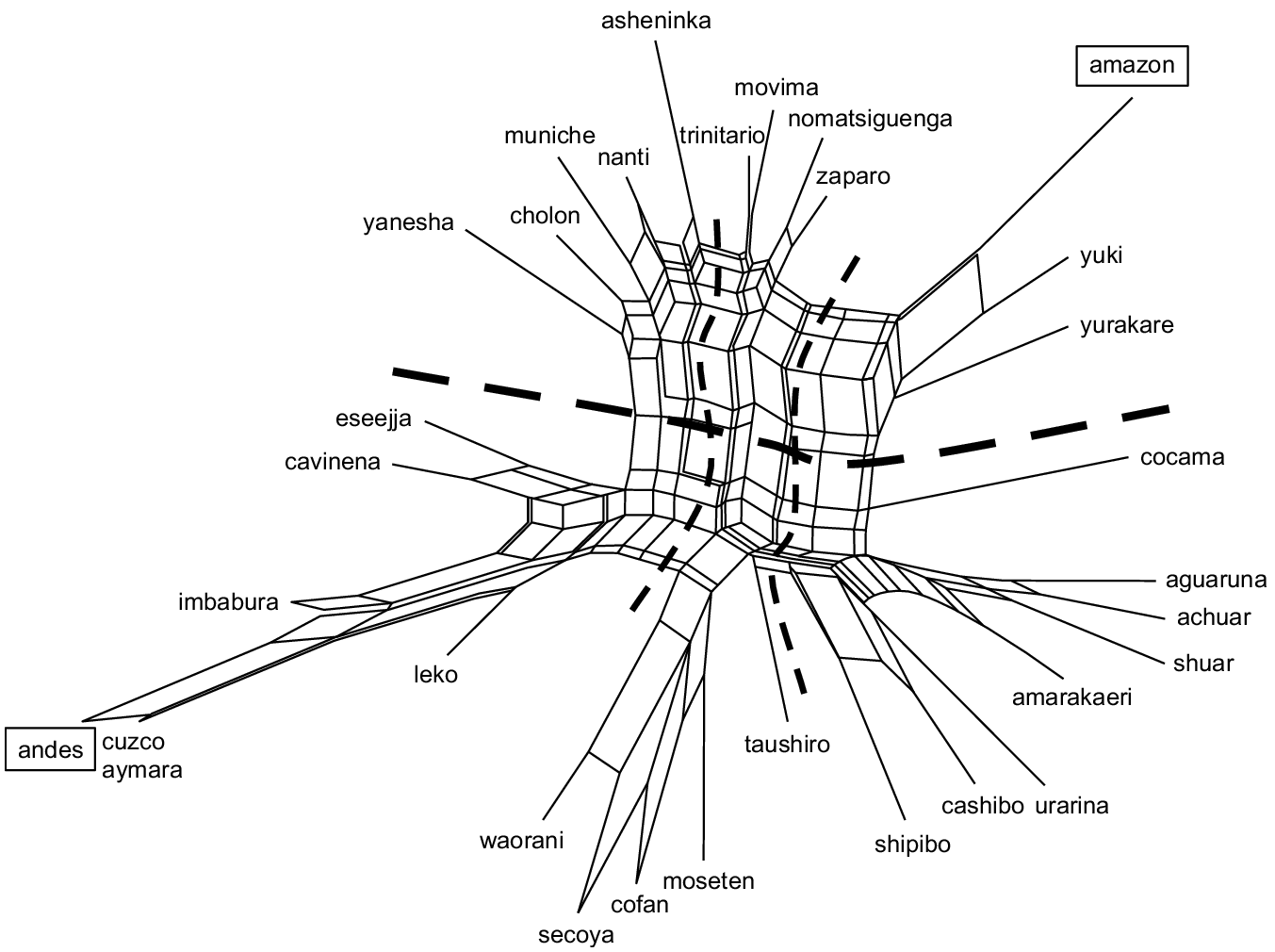
Figure 5.1 NeighborNet representation of the distances between the languages of the sample
A first major split we can observe is indicated by the vertical thick dotted line in Figure 5.1. The group of languages above the dotted line contains all the Arawakan languages as well as a few others, like Cholón, Muniche, Movima, and Záparo, and towards the right the isolate Yurakaré and Tupí-Guaranian language Yuki. The group below the dotted line contains the Quechuan, Tacanan, Panoan, and Jivaroan languages, as well as Aymara (Aymaran), Secoya (Tucanoan), Amarakaeri (Harakmbet), Cocama (Tupí-Guaranian) and the (semi-)isolates Leko, Waorani, Cofán, Mosetén Taushiro, and Urarina. For ease of reference, I will refer to the group above the dotted line as “Amazonian” and to the group below the dotted line as “Andean.”
If we contrast these two blocks, the binary features that contribute most to the contrast between them are (ordered according to contrast, the highest contrast first):
1. presence of core case markers (0% of the ‘Amazonian’ group versus 89% of the ‘Andean’ languages);
2. isomorphism of possessor and core verbal argument (91% Amazonian, 32% Andean);
3. dependent marking for possession (9% Amazonian, 68% Andean);
4. the presence or absence of an elaborate case marking system (64% of Amazonian languages have a small case marker inventory vs. 5% of the Andean group, and 18% of the Amazonian group and 84% of the Andean group have an elaborate case marking system);4
5. the presence of gender/classifier systems (73% Amazonian, 16% Andean);
Both groups of languages show moreover a secondary contrast between languages to the left of the graph and languages to the right. This contrast is much less clear and seems more reminiscent of a continuum, or perhaps a tripartite distinction, and is indicated by the two thin vertical lines. If we take the most contrastive languages on the left–right axis, we can again distinguish an “Andean” group on the left, consisting of Arawakan languages Ashéninka, Nanti, and Yanesha’, and Cholón (Hibito-Cholón) and the isolate Muniche, as well as the Quechuan languages Imbabura and Cuzco Quechua, the Tacanan languages Cavineña and Ese Ejja, Aymara, and the isolate Leko. To the right of the graph we can distinguish an “Amazonian” group consisting of Yurakaré (isolate), Tupí-Guaranian languages Yuki and Cocama, the three Jivaroan languages Aguaruna, Achuar, and Shuar, Panoan Shipibo and Cashibo, isolate Urarina, and Amarakaeri (Harakmbet).
For this axis the most contrastive features are the following:
1. basic adjective-noun order (73% of Andean, 0% of Amazonian);
2. phonemic central high vowel (18% Andean, 90% Amazonian);
3. the presence of more than one liquid phoneme (82% Andean, 10% Amazonian);
4. nasal spread (0% Andean, 70% Amazonian);
6. phonemic palatal nasal (100% Andean, 40% Amazonian).
While the rather clear top-to-bottom split is dominated by morphosyntactic features, the more diffuse left-to-right split seems to be particularly based on phonological features (except for the first). This may at least in part reflect the fact that the phonological features seem to be more sensitive to diffusion through contact, probably through the incorporation of loanwords. If we split the phonological features from the morphosyntactic features,5 we can observe that the distributions of Arawakan and to a lesser extent Quechuan languages (together with Aymara) are rather diffuse in the network based on the phonological features (Figure 5.2), and much closer together in the network based on morphosyntactic features (Figure 5.3). In Figure 5.3, all the Arawakan languages in the sample are in the left “tail” of the figure (with Movima and Muniche). The two Quechuan languages and Aymara are identical with respect to the morphosyntactic features, and converge completely on the Andean profile. In Figure 5.2 on the other hand, the Arawakan languages are spread all over the network, while Quechuan languages and Aymara are still rather close to each other, if not so close as in Figure 5.3.

Figure 5.2 NeighborNet of distances between languages of the sample (phonological features only)

Another interesting difference that can be observed is the fact that Panoan (Cashibo, Shipibo) and Tacanan (Cavineña, Ese Ejja) languages, which are often regarded as being related in a deep sense (see e.g. Key Reference Key1968; Girard Reference Girard1971), are rather close together in the morphosyntactic representation, compared to the phonological feature representation. On the whole, then, the morphosyntactic picture makes the impression of representing a more conservative, genealogical picture than the phonological one. This can possibly be connected to borrowing of linguistic forms (especially lexicon), thus introducing new phonemes to the recipient language. Since grammar is generally assumed to be more resistant to borrowing than the lexicon, we might hypothesize that Figure 5.2 may be read as indicating patterns of (shallow) language contact, whereas Figure 5.3 may be reflecting either genealogical links or deep/intense contact.
In terms of features, the same major contributing factors that were identified for the top–bottom divide in Figure 5.1 are responsible for the main divide in Figure 5.3, which contrasts the same two groups of languages. The main contributing features of Figure 5.2 are nasal spread (79% for the Amazonian side, 0% for the Andean side), the presence of more than one liquid phoneme (5% for the Amazonian side, 79% for the Andean side), and the presence of a phonemic palatal nasal (32% for the Amazonian side, 100% for the Andean side).
4.2 Correlations with geographic factors
This chapter focuses on linguistic issues in the discussion on the foothill-fringe area. I will here touch on some possible geographic correlates, but it is clear that more in-depth research is necessary to give more detailed and definite answers to these matters.
The Andean side of the divide in Figure 5.2 suggests contact between Andean (Quechuan and Aymaran) languages and some of the languages spoken close to the Andes in northern Bolivia (Leko, Cavineña) and Peru (Nanti, Ashéninka, Cholón). From there towards the right of the graph the situation becomes more diffuse. There are a few probable contact pairs (Cofán and Secoya, perhaps Urarina with the Panoan languages – although there is quite a lot of reticulation, including the biggest divide in the graph), but there are more surprising positions: Záparo, Mosetén, and Amarakaeri, whose closest neighbors in the network are not their closest neighbors geographically. On the whole, then, the phonological graph seems to represent a rather specific Andean profile with some possible points of contact-induced change, and a much more diffuse Amazonian zone, where languages may share some traits but not others. The most widespread features in the Amazonian group are the presence of mid vowels (also quite common on the Andean side of Figure 5.2) and nasal spread (both 79 percent).
One clear exception to the pattern that phonology is less stable than morphosyntax is the fact that the Jivaroan languages are distributed much more diffusely in the morphosyntactic picture than in the phonological one. There is no straightforward explanation for this apparent anomaly. A suggestion towards an explanation may come on the one hand from the long-term and complex relations between Jivaroan groups and highland groups,6 and on the other hand because the Jivaroan groups “show a particularly strong ethnic consciousness” (Adelaar with Muysken Reference Adelaar, Adelaar and Muysken2004: 432). The first factor may contribute to the result that Achuar is found rather close to the Andean profile, and the latter may account for the fact that the Jivaroan languages pattern so closely phonologically, perhaps due to an ethnic consciousness that includes a resistance to lexical (conscious) borrowing.
Figure 5.3 shows a relatively homogeneous “Amazonian” group, containing all Arawakan languages, but also the isolates Movima and Muniche and, at more distance, Cholón and Záparo. The Movima case may be explained by (deep) contact of Movima with Trinitario/Ignaciano and also Baure. Other cases, such as the puzzling position in the midst of the Arawakan languages in the network of Muniche, Záparo, and Cholón, may require less straightforward explanations.7
Given the particular position of the languages in the sample, between two major geographical (and perhaps cultural) zones, a natural question to ask is whether we can find any correlations8 between the linguistic patterns and geographic variables. A first, simple question would be whether there is any correlation between linguistic distance and geographic distance.9 It seems that there is no such correlation, as can be observed in Figure 5.4, which shows geographic distance on the x-axis and linguistic distance on the y-axis. This confirms the observations made (i) that there are a few languages oddly placed in the graph, and (ii) that genealogical signals can be strong without necessarily coinciding with geographic proximity.

Figure 5.4 Correlation between linguistic distance and geographic distance
Two other geographic factors that seem intuitively important are elevation and river systems, as they are of consequence to how people travel, and perhaps they limit the range of contacts between peoples. Figure 5.5 shows the correlation between geographic elevation and linguistic distance. It should be read as follows: the greater the difference in elevation between a language pair, the greater the linguistic difference between these languages. In very general terms, this can be interpreted as identifying the Andean mountains as a barrier for contact, although the correlation is not very strong (r = 0.37).

Figure 5.5 Correlation between geographic elevation and linguistic distance
The idea that differences in elevations are barriers for contact is corroborated by the graph indicated in Figure 5.6, which is the correlation between elevation and proximity to the Andean profile. The x-axis indicates the height of the location where the languages are spoken, and the y-axis indicates distance from the Andean profile. As a general tendency, the higher a language is spoken, the more it conforms to the Andean profile.

Figure 5.6 Correlation between elevation and proximity to the Andean profile
A final geographic factor that I want to take into consideration is the river system. Rivers in South America form pathways along which people move around, are in contact with each other, and thus possibly influence each other. The foothill-fringe area as presented here can be said to consist of three major river systems:
1. The northern basin, delimited in the north by the lower Napo and Aguarico Rivers and in the south by the lower Ucayali and Marañon Rivers, encompassing eastern Ecuador and northern Peru.
2. The drainage basin of the upper Ucayali and Huallaga Rivers, covering north-central to southern Peru.
3. The basin defined by the Madre de Dios and Mamoré Rivers, covering Bolivia and a small part of southern Peru.
The languages in the sample can be classified according to the river system they belong to (see above), and the average distance between their linguistic profiles can be compared to the average of the entire sample. However, it seems that the river systems do not have any impact on the average linguistic distance, as is shown in Table 5.7.
Table 5.7 The average linguistic distance per river system

One proviso that we should make with this result is that the genealogical diversity is greater in the Napo/Aguarico (ten families) and Madre de Dios/Mamoré basins (nine families) than in the Ucayali/Marañon basin (four families). This means that perhaps the picture should be adjusted somewhat and there might be a (relative) contact effect after all in the northern and southern basins. However, this is difficult to take into the equation, and must, moreover, await more detailed research.
5 Conclusion
When reviewed in terms of areal linguistic features that are considered to be of importance for the Andean and the Amazonian areas, the FF languages conform neither to the Amazonian profile, nor to the Andean profile. Instead, they form a mixed group, which fits well with their position between these two areas, and reflects their complex past of multilateral contacts. The results of the study do clearly show that the FF area, which is mostly associated with the Amazon in traditional terms, does not conform to the Amazonian prototype. On the basis of the results of this preliminary study, we can tentatively draw a few further conclusions (pending more research that incorporates results from ethno-historical and archaeological studies).
In terms of genealogical patterns we cannot say very much on the basis of this sample, which would need to be expanded to allow for more firmly supported conclusions. Nevertheless, with this proviso in mind, some patterns can still be recognized and perhaps serve as hypotheses for future studies. The Quechuan languages (Cuzco and Imbabura) do end up relatively close to each other in all networks, but Aymara is generally closer to Cuzco Quechua than Imbabura. This is in line with the conclusions drawn in Van de Kerke and Muysken (this volume) about Ecuadorian variants of Quechua being substantially different due to contact effects. The Tacanan and Panoan languages show rather strong signals, and even end up together when only morphosyntactic features are considered, possibly reflecting an even older connection. Arawakan and Jivaroan languages show ambiguous signals (see below).
Apart from the Andean sphere (including Tacanan and Leko), and a recurring northern group of Cofán, Warao and Secoya, there are no obvious major areal patterns in the data. There may be some further more local areal patterns (Movima and Trinitario, Yurakaré and Yuki, Urarina with the Panoan languages). Closer scrutiny may reveal more of these local patterns.
In general terms, morphosyntactic features seem to represent more stable structural traits than the phonological features, which is possibly attributable to the fact that lexical borrowing, more likely to occur than structural borrowing, can influence phoneme systems. The phonological picture is more diffuse than the morphosyntactic one, which shows a clear – Arawakan-dominated – Amazonian group and a (somewhat more diffuse) Andean group. One of the hypotheses that could be tested further is that the patterns reflect two time layers: an older layer of languages with the longest presence in the area and the longest history of contact with the Andean civilizations, and a group of languages and language families that have moved into the area from Amazonia proper, dominated by the Arawakan profile, and which have undergone less long-term Andean influence. The Jivaroan languages form a notable exception to this pattern, which is possibly due to factors of a more ethno-cultural nature. This issue clearly requires more in-depth research.
Apart from linguistic and cultural-historical considerations, I have reviewed some geographic factors that may be of influence. There is no correlation between geographic and linguistic distance as such, but there is a correlation between difference in elevation between language pairs and their linguistic distance, suggesting that elevation differences form a natural barrier against contact. This is corroborated by the fact that there is a correlation between the elevation of a language and the degree of conformation to the Andean profile. Belonging to the same broad river system seems to be less influential when it comes to predicting linguistic distance, although future research may reveal that there is some impact in the northern and southern river systems, or that smaller river systems may give more meaningful results.
This paper was partly prepared at the Radboud University Nijmegen, supported by NWO grant 275–89–006, which is gratefully acknowledged. I thank the editors for useful comments on earlier drafts of this paper, and Françoise Rose, Lev Michael, and Marine Vuillermet for generously providing unpublished material and/or personal comments on specific data points. I furthermore thank Harald Hammarström for his invaluable help with the statistics. Remaining errors are mine.
1 This particularly means those traits found in at least two of the following languages/language families in Torero's list: Aymaran, Quechuan, Puquina, Uru-Chipaya, Cunza. Traits limited to coastal languages like Mochica and Sechura and/or to southern cone languages/families Mapudungún, Huarpe, and Cunza are not taken into consideration, since they are or were not spoken in areas adjacent to the foothill-fringe.
2 It would actually be preferable to also look at surface codas, since that is the signal that may be transferred from one language to the other, but lack of systematic data prevents this.
3 Aymaran has in fact historically a five-term system, but this is supplemented with Quechua loans (Cerrón-Palomino 2000, Van de Kerke Reference Kerke, Crevels and Muysken2009, Adelaar Reference Adelaar, Campbell and Grondona2012b).
4 In the latter interpretation (i.e. the presence or absence of an elaborate case marking system), this feature is the second-highest contributing factor.
5 The constituent order features are included in the morphosyntactic features; the lexicon features have not been considered in either of these networks.
6 Adelaar with Muysken (Reference Adelaar, Adelaar and Muysken2004: 432) suggest that the Jivaroan territory may even have extended into the Andean highlands.
8 I thank Harald Hammarström for the calculations as well as providing me with the data points on geographic position and elevation of the languages in question.
9 I have taken a crude approach here, distances being represented as the crow flies, and the languages being considered points rather than polygons on the map.


