

7 The Arawakan matrix
This chapter investigates the cultural and linguistic characteristics of the ethnolinguistic groups in the Arawakan language family, particularly relating to situations of contact and exchange within and outside the family. In 1492, Arawakan languages were distributed from the Greater Antilles in the north to the Gran Chaco area in the south, and from the Amazon River mouth in the east, to the eastern Andean slopes in the west. The Arawakan languages expanded successfully across the South American continental land mass during pre-Columbian times as part of a powerful cultural complex characterized by intensive contact and exchange with neighboring groups: the Arawakan matrix, which this chapter aims to investigate and map. Geographic Information Systems (GIS) and various phylogenetic methods are used to explore the spatial and temporal distribution of cultural and linguistic features of Arawakan-speaking people, to gain a more complete picture of their expansion. The chapter also adds to our current theoretical knowledge about the sociocultural mechanisms of the Arawakan diaspora and the spatial distribution of particular linguistic features characteristic of the Arawakan language family.
1 Introduction
The study of the expansion of Arawakan languages across prehistoric Amazonia has much to gain from the integration of linguistic (Danielsen) and archaeological (Eriksen) perspectives. Previous studies of the Arawakan language family have revealed that its members possess not only highly characteristic lexical and structural features (see Payne Reference Payne, Derbyshire and Pullum1991; Aikhenvald Reference Aikhenvald, Dixon and Aikhenvald1999a; Danielsen et al. Reference Danielsen2011) but also a set of cultural features clearly distinguishing them from their indigenous Amazonian neighbors (cf. Hill and Santos-Granero Reference Hill, Hill and Granero2002; Eriksen Reference Eriksen2011). In order to understand the means and timing of the Arawakan expansion, it is therefore necessary to integrate findings from ethnography, archaeology, and linguistics.
Investigating the timing of the expansion of the Arawakan language family in Amazonia is more difficult than mapping the expansion of archaeological cultures and associated language families in e.g. the Pacific, where the Austronesian languages and the material culture of the speaking communities can be nicely plotted from island to island as the communities migrated across the Pacific, carrying with them material culture as well as language (Gray and Jordan Reference Gray and Jordan2000). In contrast, the lexical, structural, and cultural features of the Arawakan family had to be navigated through a cultural landscape already fully populated by such features belonging to other ethnolinguistic entities, making constant negotiations and renegotiations between the speakers an unavoidable component of the Arawakan expansion.
Strikingly, the geographic distance between Arawakan languages only predicts 7 percent of the typological distance between them (the so-called “isolation by distance” measure), indicating that there were contacts between members of the family until fairly recently. The time depth of the ultimate diversification cannot be very great (Danielsen et al. Reference Danielsen2011: 183f). This means that the Arawakan languages expanded relatively late in the prehistoric sequence, i.e. during a period when Amazonia had long since experienced advanced ceramic manufacture, intensive crop cultivation, and hierarchical social organization (see below).
The title of this chapter, the Arawakan matrix, refers to the set of cultural features – material as well as non-material – identified in multidisciplinary investigations of Arawak-speaking societies as the set that “constitutes simultaneously the background, framework, and source of information that informs the sociocultural practices of the members of a given language family” (Santos-Granero Reference Santos-Granero, Hill and Santos-Granero2002: 42). The term was first coined by Santos-Granero (Reference Santos-Granero, Hill and Santos-Granero2002: 42ff.) to refer to a set of five key Arawakan non-material cultural features in societies across Amazonia (Map 7.1):
(1) suppression of endo-warfare,
(2) a tendency to establish sociopolitical alliances with linguistically related groups,
(3) a focus on descent and consanguinity as the basis of social life,
(4) the use of ancestry and inherited rank as the foundation for political leadership, and
(5) an elaborate set of ritual ceremonies that characterizes personal, social, as well as political life.
By conducting a large-scale GIS-mapping of pre-Columbian material culture across Amazonia, Eriksen (Reference Eriksen2011: 9) was able to add four additional points, linked to material culture, to the list:
(6) various types of high-intensity landscape management strategies as the basis of subsistence (cf. Hill Reference Hill, Hornborg and Hill2011),
(7) a tendency to situate their communities in the local and regional landscapes through the use of such techniques as “topographic writing,” ceremonial earthworks, extensive systems of place-naming, or rock art (cf. Santos-Granero Reference Santos-Granero1998),
(8) an elaborate set of rituals including a repertoire of sacred musical instruments and extensive sequences of chanting, often performed as part of place-naming rituals (cf. Hill Reference Hill2007),
(9) a proclivity to establish settlements along major rivers and to establish trade and other social relations through river transportation (cf. Hornborg Reference Hornborg2005).
The current investigation seeks to map the timing of the expansion of these nine features, alongside a similar mapping of the linguistic features of Arawakan languages, thus seeking a detailed, multidisciplinary understanding of the Arawakan expansion. A linguistic database of Arawakan features was created by Danielsen using complex linguistic questionnaires.
Our central theoretical assumption is that the best way to explain the interplay between non-material culture (points 1–5 above), material culture (points 6–9 above), and language features is to view these all as part of one single phenomenon: the ethnic identity of Arawak-speaking communities. Ethnic identities and ethnicity in indigenous Amazonia have recently been explored as an important interdisciplinary field of research (Hornborg and Hill Reference Hornborg and Hill2011). This involves the formation and renegotiation of Amazonian ethnic identities – the concept of ethnogenesis – (Hill Reference Hill and Hill1996; Hornborg Reference Hornborg2005; Hornborg and Eriksen Reference Eriksen2011), and results in a new understanding of the multitude of ethnic identities in Amazonia and their role in situations of contact and exchange between indigenous groups. Here, the concept of ethnogenesis is used as a tool to understand the process of spreading of components of the Arawakan matrix to new groups through sociocultural, material, and linguistic exchange, thereby integrating other Amazonian groups into the Arawakan identity, a process inevitably leading to the incorporation of new cultural and linguistic elements among Arawak-speaking communities, and ultimately to a renegotiation of the Arawakan cultural and linguistic identity by small, constant changes and updates of the cultural matrix.
2 The ecology of the Arawakan expansion
2.1 The Amazonian pioneers
Since the first voyage of Christopher Columbus and his followers, South American landscapes, and particularly the Amazon region, have been thought of as the ultimate example of pristine wilderness, encompassing a unique example of rich biodiversity with little human disturbance. Informed by research in anthropology, archaeology, historical ecology, and soil science since the 1980s, the scientific community has slowly adjusted this image towards a view encompassing substantial human influence in the species composition of the world's largest area of tropical rainforest. Since the discovery of Balée (Reference Balée, Descola and Taylor1993: 231) that up to 12 percent of the Amazonian ecosystem is of anthropogenic origin, scholars have noted that much of the “pristineness” of Amazonian forest is actually an effect of the demographic collapse of the indigenous populations following in the wake of the European colonization. Furthermore, archaeological investigations reveal large-scale earthworks, subsistence systems, and settlements, confirming the hypothesis that the sparsely populated Amazonia of the historical period is a relatively recent anomaly when contrasted to the socio-economic development of the region during the last 3,000 years.
Human subsistence strategies in Amazonia have for at least 9,000 years involved domesticated crops (Piperno and Pearsall Reference Piperno and Pearsall1998: 4; Oliver Reference Oliver, Silverman and Isbell2008: 208). When small bands of hunter-gatherers at that time began the domestication of bitter manioc (Manihot esculenta crantz), it marked the starting point of a landscape modification process that was to continue until the demographic collapse following the European colonization some 8,500 years later.
By 7000 BP1 the indigenous societies along the lower Amazon and the present Brazilian Atlantic coastline were producing ceramic vessels and shell middens, forming the earliest centers of pottery production in the New World. Along the middle and lower Amazon, the archaeological sites of Dona Stella, Pedra Pintada, and Taperinha show initial signs of horticultural activities between 8000 and 7000 BP (Roosevelt et al. Reference Roosevelt, Lima da Costa, Machado, Michab, Mercier, Valladas, Feathers, Barnett, da Silveira, Henderson, Silva, Chernoff, Reese, Holman, Toth and Schick1996; Piperno and Pearsall Reference Piperno and Pearsall1998: 4; Petersen et al. Reference Petersen, Neves and Bartone2004), and at Taperinha forest clearing is indicated by 7000 BP, and clearly documented at Lake Geral, a site located in the same region dated to 5760 BP (Bush et al. Reference Bush, Miller, de Oliveira and Colinvaux2000). These early signs of food production and accomplished material culture soon spread through a regional exchange system operating along the coastline between the mouth of the Amazon and Orinoco Rivers (Eriksen Reference Eriksen2011: 127f). Along the coastline of present-day Colombia, Venezuela, and Guyana, the location of a number of shell mounds with a characteristic lithic assemblage labeled the Ortoiroid series, sharing similarities with the above-mentioned sites of the Amazon river region, indicates the establishment of a wide-reaching exchange system already at this point in time (Boomert Reference Boomert2000: 74).
Sometime between 6500 and 5250 BP, the art of ceramic manufacture was exchanged between the lower Amazon and the Guyana coastline, an event marked by the establishment of the Late Alaka phase of the latter area (Evans and Meggers Reference Evans and Meggers1960; Roosevelt Reference Roosevelt1997: 360; Plew Reference Plew2005: 13). These two areas continued to share similarities when the Mina phase (5500–4000 BP), another archaeological complex producing crude ceramics and shell mounds, was established along the lower Amazon and at the coastline south of the river mouth (Simões and Araujo-Costa Reference Simões and de Araujo-Costa1978; Roosevelt Reference Roosevelt1997). Without losing ourselves in details of the early indigenous material culture, subsistence strategies, and exchange systems of northern South America, it is safe to say that much of the early accomplishments of these socio-economic categories took place through the sharing of important achievements between different groups separated by rather large geographic distances, a mechanism in itself indicative of the character of the future to come.
2.2 The birth of the Arawakan matrix
The complexity of pottery production grew steadily along the Guyana coastline and the Orinoco River, a process leading to the establishment of technologically more complex and stylistically elaborated wares in the form of the Saladoid2 and Barrancoid3 series along the Orinoco River by around 3000 BP. By that time, agriculture also was substantially intensified in the same region. Along the Orinoco, the Saladoid and Barrancoid producing societies developed a technology for soil fertilization based on the addition of ash, charcoal, and domestic waste to the soil, with increased microbial activity and improved fertility as the result (Oliver Reference Oliver, Silverman and Isbell2008: 211; see also Arroyo-Kalin et al. Reference Arroyo-Kalin, Neves, Woods, Woods, Teixeira, Lehmann, Steiner, Winkler Prins and Rebellato2009 for technical specifications). This process created sustainable conditions for high-intensity food production, and the black, fertile soils (also known as terras pretas or Amazonian Dark Earths [ADE]) spread widely across Amazonia between 900 BCE and 1500 CE (Lehmann et al. Reference Lehmann, Kern, Glaser and Woods2003; Glaser and Woods Reference Glaser and Woods2004; Woods et al. Reference Woods, Teixeira, Lehmann, Steiner, WinklerPrins and Rebellato2009). Apart from the addition of charcoal and ashes to the agricultural lands, burnt tree bark (Licania sp.) was also being added to the ceramics as a potent tempering material for increased solidity of the vessels. West of the Orinoco River, on the seasonally sedimentary soils of the flooded savannas of the Llanos, proper drainage of the soils was a bigger challenge than lack of available nutrients. In this area agricultural intensification took place through the construction of elevated cultivation surfaces, so-called raised fields or camellones, improving agricultural conditions by elevating parts of the otherwise flat landscape for the improvement of soil conditions, drainage, water management, and nutrient production in order to stimulate agricultural productivity (Denevan Reference Denevan1970; Darch Reference Darch1983; Erickson Reference Erickson, Balée and Erickson2006: 251).
The refinements of agricultural technologies and pottery production were not isolated technological advancements, but, as we will argue below, part of a cultural package that was just beginning its march across Amazonia. Interestingly, the cohesive links of this cultural package were not the technological advancements or the surplus production (even though they were both intrinsic parts of it) but language, and more particularly languages of the Arawakan language family. At the time of European contact4 at least sixty Arawakan languages were spoken from the Greater Antilles in the north to northern Argentina in the south, and from the mouth of the Amazon in the east to the eastern Andean slopes in the west (Grimes 2009 lists fifty-nine documented Arawakan languages, not including several extinct ones) (Map 7.1). Arawak-speakers across South America and the Caribbean are united by two main factors: (1) the genealogical relationship of their languages, i.e. their descent from a common proto-language, and (2) a shared set of cultural features, i.e. both material and non-material attributes.
By 1500 CE the Arawak-speaking groups inhabited numerous seasonally flooded environments of the South American tropical lowlands with raised field agriculture or similar technologies, including the Llanos of Venezuela and Colombia (Spencer and Redmond Reference Spencer and Redmond1992), the Llanos de Moxos of Bolivia (Erickson Reference Erickson, Balée and Erickson2006), Marajó Island at the mouth of the Amazon (Schaan Reference Schaan, Silverman and Isbell2008), and the Guyana Littoral (Versteeg Reference Versteeg, Silverman and Isbell2008). They were also known as the moderators of an elaborate set of ritual ceremonies with the use of sacred musical instruments and chanting as essential ingredients (Izikowitz Reference Izikowitz1935; Hill Reference Hill and Santos-Granero2009). Apart from this, Arawak-speakers such as the Taino of the Greater Antilles, the Lokono of the Guyana Littoral, the Manao of the central Amazon, the Achagua and Caquetío of the Llanos, and the Moxo of the Llanos de Moxos (just to name a few) were well-known traders carrying out exchange between various ethnolinguistic groups (Eriksen Reference Eriksen2011: 275).
2.3 The timing of the geographic expansion of the Arawakan matrix
The main ingredients of the Arawakan cultural package were first being brought together in the Orinoco region around 900 BCE. By that time, we find high-intensity landscape management systems in the form of raised fields and terras pretas for agricultural production and causeways for transportation, water management, and possibly also including ritual functions. Also present were ceramic artifacts rich in painted and plastic decoration, that is to say features indicative of a rich ceremonial life similar to that documented from Arawak-speaking communities of the historical period (Santos-Granero Reference Santos-Granero1998; Heckenberger 2008; Hill Reference Hill, Hornborg and Hill2011). Interestingly, the rich ceremonial life of the Arawak-speakers of the historical period was essentially constructed around two themes: (1) the presence of elaborate techniques for physically and ritually domesticating their surrounding landscapes, and (2) the use of fire in processes of landscape domestication and during other types of ritual ceremonies.
As described above, by-products of fire such as charcoal and ashes were an essential part of the subsistence strategies and ceramic manufacture of the Orinoco Region already by 900 BCE. The elaborately decorated ceramics of the Saladoid and Barrancoid series act as indicators of the elaborate ceremonial life of the Orinoco communities, and, interestingly, the rich ethnographic record of Arawak-speaking communities across Amazonia shows that the use of tobacco smoke by Arawakan shamans is considered an essential aspect of ritual ceremonies, including healing processes. Thus, an image of a cultural package capable of transforming the landscape into a high-productive resource, while at the same time providing a powerful ceremonial life for its members, now arises through the archaeological, anthropological, geological, and historical records.
The combination of high-intensity landscape management strategies and a rich ceremonial life would prove to be highly successful during the centuries to follow. By 400 BCE the first evidence of terra preta farming appears in the central Amazon, and shortly thereafter the first earthworks of the Llanos de Moxos represents the initial signs of landscape modification in this region. Judging by the great differences in terms of ecology between the habitats colonized by the subsistence strategies of this emergent regional system, there was a great deal of adaptation available within the communities involved in this process. In much of the central and lower Amazon, large surfaces of fresh sediments rich in available nutrients annually drained from the Andes, forming great conditions for high-productive agriculture, were available. These so-called várzeas eliminated the need for raised fields or terras pretas in many areas of central Amazonia and, interestingly, Versteeg (Reference Versteeg, Silverman and Isbell2008: 305) notes how the raised fields can be compared to artificial várzeas that are subjected to controlled inundation, bringing nutrient-rich sediments to the elevated surfaces during parts of the year.
By 200 BCE Barrancoid pottery and terra preta farming were present along the Ucayali River in the Peruvian Amazon (Lathrap Reference Lathrap1970: 117; Eden et al. Reference Eden, Bray, Herrera and McEwan1984: 126), and at around 100 BCE archaeological dates of the huge earthwork complex of Acre, northwest of the Llanos de Moxos, begin to cluster (Saunaluoma Reference Saunaluoma2010: 106). The geometrical earthworks of Acre, also known as geoglyphs, are perhaps the most visually stunning example of the ceremonial aspects of earth-moving that had been crystallizing across Amazonia from about 900 BCE. The Acre geoglyphs so far discovered consist of more than 200 (an estimated 10 percent of the total number [Mann Reference Mann2000]) geometrical figures carved out of the soil by ditches and walls extending up to 3 meters deep and 11 meters wide. The size of the earthworks measures up to 300 meters across and their frequency is up to 5 geoglyphs per km2 (Hornborg et al. Reference Hornborg, Eriksen and Bogadóttir2013).
The cultural associations of these earthworks are so far unknown, but the presence of pottery related to the Barrancoid series (Saunaluoma Reference Saunaluoma2010: 94), their dating, and the engineering skills and focus on soil moving among the Arawak-speaking communities on the nearby savannah of the Llanos de Moxos makes an association with the Arawakan cultural complex highly plausible. As for the functions of the geoglyphs, little is known, but suggestions that they were used for fortification purposes have been made. Although this may be true for the circular structures, particularly those dated to the late pre-Columbian period when military conflicts were expanding across the lowlands (see below), it is unlikely that the communities erected up to five elaborately constructed geometrical structures with low ditches with little or no defensive capabilities per square kilometer because they feared an external threat in the form of spears, arrows, or war clubs. On the contrary, the fortified villages of the Arawakan cultural complex documented from the late pre-Columbian periods are semi-circular structures, located on high ground, adapted to the local topography and surrounded by palisades (Rebellato et al. Reference Rebellato, Woods, Neves, Woods, Teixeira, Lehmann, Steiner, WinklerPrins and Rebellato2009).
Interestingly, new research in the upper Xingú area, another region of Amazonia populated with – and culturally dominated by – Arawak-speakers, is finding support for the notion that Arawak-speakers sometimes devoted themselves to strictly ceremonial domestication of their landscapes. During the late pre-Columbian period, the upper Xingú area had developed integrated patterns of centers organized in multi-ethnic, or “galactic,” clusters populated by up to 2,500, and perhaps as many as 5,000 inhabitants (Heckenberger Reference Heckenberger, Balée and Erickson2006: 330; Reference Heckenberger, Silverman and Isbell2008: 955). These multiethnic confederations, referred to as an early form of urbanism by Heckenberger et al. (Reference Heckenberger, Silverman and Isbell2008), were integrated by wide road-like causeways resembling the elevated causeways of the Llanos de Moxos, which facilitated cultural, linguistic, and material exchange within and between regions. The landscapes were domesticated by the creation of circular villages with a central plaza and radial road networks with perfectly straight passages connecting a multitude of such population centers to each other in a regional system.
In Arawak-speaking areas where earthworks and other landscape-altering techniques were less prevalent, other strategies of landscape domestication were employed. The Yanesha’, an Arawak-speaking group of the eastern Andean slopes in present-day Peru, apply an intricate system of “topographic writing” in order to maintain an intimate relationship to their landscape (Santos-Granero Reference Santos-Granero1998). Topographic writing is the concept Santos-Granero uses to describe how individual place names (topograms) are connected to extensive systems (topographs) and reiterated, for instance through chanting in ritual ceremonies in order to strengthen the ties to the local and regional landscape (p. 128). Such ritual place-naming is also well documented from the northwest Amazon Arawakan people (Vidal Reference Vidal2000, Reference Vidal, Hill and Santos-Granero2002; Hill and Chaumeil Reference Hill, Hornborg and Hill2011; Wright Reference Wright, Hill and Chaumeil2011) and from Arawakan groups in southern Amazonia such as the Paresi (Schmidt Reference Schmidt1917: 21f). Santos-Granero (Reference Santos-Granero1998: 132, 139) refers to the landscape domesticating process of topographic writing among the Yanesha’ as a form of proto-writing, also present among other Amazonian groups such as the Paéz (to which it likely diffused through contact with nearby Arawak-speaking communities), a linguistic isolate between the Marañon and Napo Rivers, and the Arawak-speaking Kurripako (Wakuénai) of the northwest Amazon (Hill Reference Hill and Hill1996: 153f; Reference Hill, Hill and Granero2002: 235f; Reference Hill and Santos-Granero2009: 250).
Returning to the archaeological material, by 300 CE a new ceramic style, labeled the Amazonian Polychrome tradition, had developed out of Barrancoid material along the middle and lower Amazon (Hilbert Reference Hilbert1968; Lathrap Reference Lathrap1970: 156f; Eden et al. Reference Eden, Bray, Herrera and McEwan1984: 137; Myers Reference Myers, Glaser and Woods2004: 79; Petersen et al. Reference Petersen, Neves and Bartone2004: 9; Eriksen Reference Eriksen2011: 181). At the time of European contact, the Arawak-speakers of Marajó Island at the mouth of the Amazon, the Aruã, were still manufacturing an undecorated variant of the Marajoara phase (one of the most elaborate phases of the Amazonian Polychrome tradition)5 labeled the Aruã phase, when they were encountered by the Europeans (Brochado and Lathrap 1982: 53).
Once again, the significance of burning is reflected in the anthropomorphic burial urns typical of the Amazon Polychrome tradition, an inventory indicating secondary urn burials in which the cremation of the corpse and the storing of the ashes in the urn were central components. In many instances, even the pottery itself included ashes in the form of caraipé temper utilized in the Ipavu phase in the upper Xingú (Heckenberger Reference Heckenberger1996: 136f), the Guarita phase in the middle Amazon (Petersen et al. Reference Petersen, Heckenberger, Neves, Alofs and Dijkhoff2003: 252), the Mazagão phase in Maracá (Meggers and Evans Reference Meggers and Evans1957: 596), the Koriabo phase of the Guyanas (Boomert Reference Boomert, Delpuech and Hofman2004: 259), and, together with crushed sherds, in Marajoara (Brochado and Lathrap Reference Brochado and Lathrap1982: 50). The burial urns, also well known among the northwest Amazon Arawakan people and those in the Llanos de Moxos − the Moxo and the Baure − (Mann Reference Mann2000; Métraux 1948c) and Arawakan groups in the Bolivian Chiquitanía, like the Paunaka (Métraux Reference Métraux and Steward1948b), were often stored in caves that could be visited and inspected (Chaumeil Reference Chaumeil, Fausto and Heckenberger2007: 250ff), indicating close ties to the ancestors, and the importance of maintaining a strong relationship to deceased relatives, shamans, and political leaders – a custom typical of the Arawak-speaking communities of the historical period. Another way of maintaining a close link to the ancestors was through ritual consumption of their remains, as illustrated by the Arawak-speaking Guayupe and Sae, who cremated their ancestors and drank their ashes mixed with beer (Kirchhoff Reference Kirchhoff and Steward1948: 387f.).
The process of burning was also a central aspect of other Arawak-moderated rituals performed in their sphere of influence. At religious ceremonies performed in the northwest and southwest Amazon and in the upper Xingú area, tobacco smoke is a central element in healing-ceremonies conducted by the Arawakan shamans, who blow the tobacco smoke on the patient's body in order to eliminate the patient's symptom (Hill Reference Hill and Santos-Granero2009: 249, 259; Hill and Chaumeil Reference Hill, Hornborg and Hill2011). The blowing of tobacco smoke on patients has also been reported of the Bolivian Arawakan groups of the Paunaka in shamanic ceremonies (Danielsen, own observation) and it is also the way the shaman gets in contact with the spirits of the deceased among the Baure (Riedel Reference Riedel2012). According to Goldman (Reference Goldman and Steward1948: 789), smoke was also blown during funerals, reflecting the association between this custom and the importance of deceased ancestors.
Via the historical and contemporary ethnographical sources, we find another interesting connection between, on the one hand, shamanistic blowing of smoke, and, on the other, the ritual wind instrument also utilized by Arawakan shamans during religious ceremonies. Among contemporary Arawak-speaking communities of the northwest Amazon, the upper Purús River (the Apurinã) and the upper Xingú area, ritual wind instruments play a central role in annual ceremonies and during rites de passages.
Apart from the apparent association to shamanic blowing, the sacred flutes of the Arawakan people also had a striking connection to landscape and fire worth exploring further. According to the legends of the Arawak-speakers of the northwest Amazon, the earth was created from the remains of a mythological hero, Kúwai, after his body had been destroyed in a fire. Besides being the ancestor from whose body the world of humans was created, Kúwai also provided material for the ritual wind instruments used in religious ceremonies. The Yuruparí flutes are artifacts directly derived from the bones of the mythological hero and thus representatives of the ancestors (Steverlynck Reference Steverlynck2008: 580). In the words of Robin Wright (Reference Wright, Hill and Chaumeil2011):
After his [Kúwai's] sacrificial death in an enormous conflagration, from the ashes of his body emerged the sickness-giving spirit Iupinai but also a giant tree from which the sacred flutes were made, and it is with these flutes that traditionally the men initiated boys and girls in the major rituals held at the beginning of the rainy season.
Overall, the sacred wind instruments of the Arawakan people were one of their most central characteristics. Sacred flutes have been known to occur among a number of Arawak-speaking groups of the northwest Amazon, including the Achagua, Baniwa, Bare, Cabiyarí,6Kurripako, Maipure, Yucuna,7 Pasé,8Resígaro, and Yumana, and they also occur among neighboring non-Arawak-speaking groups who maintain close sociocultural contact with the Arawakan groups (Chaumeil Reference Chaumeil, Fausto and Heckenberger2007; Wright Reference Wright, Hill and Chaumeil2011). Chaumeil (Reference Chaumeil1997, cited in Steverlynck Reference Steverlynck2008: 579) points to the connection between the sacred flutes complex of the northwest Amazon and the use of ceremonial trumpets by Taino shamans of the Greater Antilles.

Map 7.1 The reconstructed geographical dispersal of the Arawakan and Tupian language families at the time of European contact. For complete references, see Eriksen Reference Eriksen2011: 12
Chaumeil (Reference Chaumeil, Fausto and Heckenberger2007: 265) notes how Arawak-speaking groups dominate the sacred flutes complex throughout Amazonia, and Wright (Reference Wright, Hill and Chaumeil2011) identifies the sacred flutes as an important element in the expansion of Arawakan languages. Arawak-speaking groups located outside of the northwest Amazon who also use sacred flutes include the Apurinã of the Purús River; the Baure and Moxo in the Llanos de Moxos; the Paresi further west; and the Mehinaku in the upper Xingú. Other groups belonging to the same complex include some Tupian-speaking groups such as Cocama and Omagua, Mundurukú, Tupinambá, and Kamayurá. In the upper Xingú, the complex also spread to the Carib-speaking Kalapalo and Bakairí, who were “Arawakanized” by their Mehinaku, Kustenau, Yawalapití, and Waurá neighbors (Chaumeil Reference Chaumeil, Fausto and Heckenberger2007: 266).
During female initiation rites among the Arawak-speaking Kurripako (Wakuénai) in the northwest Amazon, the sacred flutes are used during up to six hours long ceremonies of chanting during which an enormous series of place names along the rivers of northern South America are reiterated (Hill Reference Hill and Hill1996: 153f; Reference Hill, Hill and Granero2002: 235f; Reference Hill and Santos-Granero2009: 250). These place names represent nodes in an exchange system once dominated by Arawak-speakers, but they are also part of a geographic network with strong mythological connotations. This exchange network, known as the Kúwai route (borrowing its name from the creator), represents both a trade network constructed on the basis of physical travels over centuries, but also a collection of mythological places where Arawakan shamans head on their transcendental journeys during séances. Thus, the sacred flutes, the Kúwai routes, and the relationship to the ancestors and the mythological past form a trinity of inseparable components that collectively contributed to a strengthened identity and sociopolitical status of the Arawak-speaking communities.
Like many indigenous cultures around the world, for Arawak-speaking communities the physical and religious aspects of the landscape form a whole. The landscape functions as a single meaningful unit, steadily present in the life and minds of its inhabitants. However, the Arawakan domestication of the landscape was not only meaningful to the Arawakan people themselves but also part of a vast socio-religious and economic exchange system that affected the lives of all inhabitants of northern South America between 1000 BCE and 1000 CE. Together with intensive agriculture, an effective exchange system, and an advanced sociocultural and religious concept based on social hierarchies and ancestor worship, Arawakan languages (which formed intrinsic parts of these three concepts) expanded across an enormous geographic territory on mainland South American and in the Caribbean. The diversity and the power of the Arawakan groups led to the complete or partial adoption of the Arawakan cultural matrix and associated languages by many indigenous groups between 1000 BCE and 1000 CE. At the time of the European arrival Arawakan languages were widely spoken and northern South America showed extensive domesticated landscapes (Map 7.1).
Arawakan culture also came to influence the Andean region substantially, as indicated by the presence of a large number of lowland products brought to the highlands via the Arawak-controlled trade routes (Eriksen Reference Eriksen2011: 164). Along the trade routes of the eastern Andean slopes, an ethnolinguistic group known as the Kallawaya transported lowland products with pharmaceutical or hallucinogenic characteristics to the Andean cultures (Rowe Reference Rowe and Steward1946: 239; Wassén Reference Wassén1972: 63; Lathrap Reference Lathrap1973: 180f; Taylor Reference Taylor, Salomon and Schwartz1999: 199; Eriksen Reference Eriksen2011: 78). The Kallawaya tongue was a mixed language based on the Arawakan language Puquina, the isolated Chipaya language, and Quechua (Gordon Reference Gordon2005, Hannss p.c.). Puquina was a high-status language spoken among the Inca elite (Torero Reference Torero2002; Dudley Reference Dudley and Alexiades2009: 146). Along the eastern Andean slopes in present-day Peru, a number of Arawakan languages are still spoken, and advanced systems for ritual domestication of the landscape have been documented among the Yanesha’ of that region (Santos-Granero Reference Santos-Granero1998) (Map 7.1). These groups bear testimony to the incredible ability of the Arawakan matrix to maintain its relevance for its users during the sociocultural changes on-going for centuries.
2.4 The expansion of the Arawakan family from a linguistic perspective
As noted, the Arawakan language family has expanded over a very large area of South America, more than other language families (Map 7.1). A suggested Arawakan language classification is presented in Table 7.1, mainly based on geographic proximity, but also on grammatical features, summarized from Aikhenvald (Reference Aikhenvald, Dixon and Aikhenvald1999a), Walker and Ribeiro (Reference Walker and Ribeiro2011), and Danielsen and Terhart (forthcoming).9
Table 7.1 The Arawakan language family
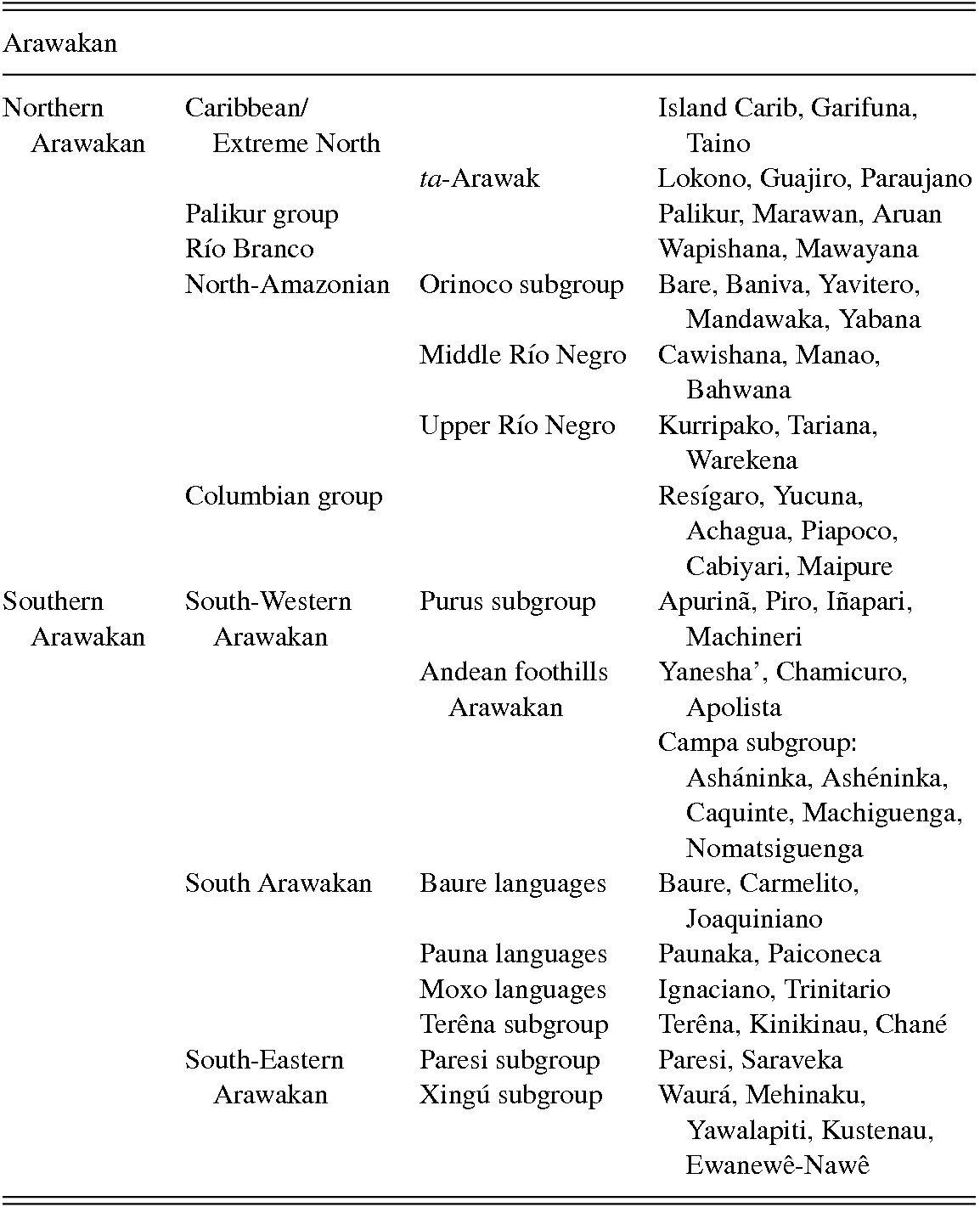
The internal classification of Arawakan languages is difficult to establish (see Facundes Reference Facundes, Hill and Santos-Granero2002), and some reasons for this are discussed in 2.6. This section focuses more on the character of the Arawakan linguistic family as such. Instead of taking the lexicon as the basis of comparison, which was done in other studies (Payne Reference Payne, Derbyshire and Pullum1991, Walker and Ribeiro Reference Walker and Ribeiro2011), we take grammatical features as our point of departure here and compare our findings to those of lexical comparisons. The similarities of the Arawakan languages in some key linguistic features suggest that the expansion happened rather quickly (see Danielsen et al. Reference Danielsen2011). The personal paradigm, e.g., is similar in many respects in most Arawakan languages, formally as well as functionally (see Payne, David L. Reference Payne1987), and it has often served as the first characteristic for assigning the genealogical relationship to a language (Gilij Reference Gilij1780–84). The proto-system of person marking was presumably a “Latin-type” paradigm (see Cysouw Reference Cysouw2003: 107): 1sg, 2sg, 1pl, 2pl, 3sg with a gender distinction (masculine/non-feminine and feminine), and 3pl (also applied as a general pl suffix). Person markers are employed to mark the possessor on nouns (prefix), subject on verbs (SA, prefix), object(s) on verbs (suffixes), and the subject on stative or non-verbal predicates (SO, suffix).10 In addition, free pronouns are derived from these bound personal forms, as well as certain adpositions marked for person. This general grammatical system can be claimed for all Arawakan languages, and the differences lie mainly in the specific lexemes that make use of a certain kind of marking, such as which nouns are actually part of the category inalienably possessed (with person marking), and which verbs belong to the (active) set with SA marking or the (stative) set with SO marking. There may also be striking differences in the SAP (speech act participants, i.e. first and second person reference) marking system versus the 3rd person in some languages, and the SAP forms tend to be more stable. Here also certain functions only hold for sub-clusters of the language family, such as gender marking or derivation of adjectives or nouns by means of the same personal forms (suffixes) for 3rd person. If we model the Arawakan language family as a NeighborNet splitsgraph only with respect to the person marking system (forms and functions), we get a rather plausible picture of the geographic distribution of the languages and possible migration routes (Figure 7.1).

Figure 7.1 The distribution of the personal paradigms in Arawakan languages11
The star-like splitsgraph in Figure 7.1 shows no clear northern versus southern branching of the language family with respect to the features examined, contrary to what Table 7.1 suggests. There is a tendency that Northern Arawakan and Southern Arawakan languages group together and a few sub-clusters can be observed. The same is true for the lexicon, as analyzed in Walker and Ribeiro (Reference Walker and Ribeiro2011: 2563). This means that there are some shared Arawakan features almost equally distributed: the personal paradigms to some extent and some of the conservative lexicon. The reason for this presumably goes back to the Arawakan exchange network that functioned for a long time. If the languages had spread like Tupian, we would presumably be able to see certain clear expansion groups, which is not really the case (compare Figure 8.1 in Chapter 8 on the Tupian expansion). However, some groups and subgroups within the language family can be found clustering in the graph in Figure 7.1: Some Northern Arawakan languages cluster, like Lokono with Island Carib, Garifuna, and Paraujano, but also with Resígaro in this graph. While Bare and Tariana appear closely related, Piapoco and Achagua have been separated according to their person marking systems. So, there is some confusion and a geographically unclear picture of northern and central Amazonian Arawakan languages. A similar observation was made about the lexical relations (Walker and Ribeiro Reference Walker and Ribeiro2011: 2563). The Purus group and Campa Arawakan cluster nicely, and Bolivian Arawakan languages, the Baure, Moxo, Pauna languages, more or less as well. The less Arawakan character of Apolista, Yanesha’, and Chamicuro, presumably due to the Andean influence these languages have undergone, is reflected in their relatively isolated positions in the splitsgraph. This may be a sign of an earlier migration into the region than the other Arawakan languages of the Andean foothills. The complicated position of Resígaro within the Arawakan language family has been discussed in the literature before (Payne Reference Payne1985). Its odd position among the Northern Arawakan languages in the graph − and also in Figure 7.2 − is probably just a sign of a connection at some point in history; this may have been in times when the Arawakan web stretched from the Caribbean to the Andes. The Taino language, excluded from the analysis in Figure 7.1 due to the lack of sufficient data, has also lately been described as being on the one hand closely related to Northern Arawakan languages, such as Island Carib, Lokono, Guajiro, Piapoco, and Achagua (cf. Granberry and Vescelius Reference Granberry and Vescelius2004: 56). On the other hand, it also seems to have certain characteristics found in South-Western Arawakan languages, in particular the Campa group, namely certain nominal (classifying) root formatives (cf. Granberry and Vescelius Reference Granberry and Vescelius2004: 94). Is this another hint at traces of the times of the interaction over such distances? The Northern Arawakan language Palikur appears right among the Southern Arawakan languages, from which it is geographically far away. However, being a Brazilian Arawakan language, Palikur seems to display some connection to other eastern and southeastern (Brazilian) Arawakan languages. The latter have not been claimed to form any particular subgroup, but in Walker and Ribeiro (Reference Walker and Ribeiro2011: 2563), these languages are included under the name “Central Brazil,” since they cluster in their lexical analysis. In Table 7.1, we call this assumable group South-Eastern Arawakan. The Arawakan languages of the Xingú group (Paresi, Saraveka, Waurá) and possibly those of the Terêna subgroup (Terêna, Kinikinau, Mehinaku) may well be a loose intermediate group with characteristics similar to their northern and northwestern neighbors as well as to their southern genealogical neighbors. The findings in Granberry and Vescelius (Reference Granberry and Vescelius2004: 55 ff.) also seem to point in this direction, and Walker and Ribeiro (Reference Walker and Ribeiro2011) demarcate Palikur (and Marawan) as a subgroup named “Northeast.” This, however, remains to be further substantiated.

Figure 7.2 Minimum spanning network of the Arawakan language family (also taken from the NeighborNet algorithm, Huson and Bryant Reference Huson and Bryant2006)12
To get a better picture of the possible expansion of Arawakan languages, the same feature matrix as used for the NeighborNet splitsgraph in Figure 7.1 can be reduced to a Minimum Spanning Tree (MST), as given in Figure 7.2.
The graph in Figure 7.2 provides us with possible routes of the dispersal of the respective Arawakan languages. Even though this is only one interpretation of the given data as a dispersal route, this scenario has plausibility.13 The position of Island Carib and Garifuna shows an excursion of the Arawak-speaking people into the Caribbean Sea, probably at an early stage and starting off from Maipure and Palikur. Another expansion of Arawakan could have led to the northern coast with Lokono at its end. As already mentioned above for Figure 7.1, Resígaro may be a remnant of the Arawakan expansion towards the Andes and a sign that there was still regular exchange at that time between the east (Resígaro) and the west (Lokono and others) of Amazonia through Arawakan peoples.14 In the south, we may conclude that the Moxo languages Trinitario and Ignaciano came into the area through Baure. There is some evidence for the fact that Baure came into the region earlier due to its relatively conservative character. It is here also suggested that Apolista and Yanesha’ are part of one migration route, starting off with Chamicuro, which is the most northern member of this loose group of Andean-influenced Arawakan languages.
2.5 The fragmentation of the Arawakan matrix
By approximately 800 CE, the Arawakan languages and the associated cultural complex, here labeled the Arawakan matrix, had reached their maximal territorial extent. By that time, Arawakan languages from the Greater Antilles to northern Argentina and from the Atlantic to the Andes were united by a large and complex regional exchange system. The Arawak-speaking communities had by that time accumulated considerable land-based capital in the form of agricultural earthworks, aquacultural facilities, and infrastructure that was attractive to other indigenous Amazonian groups.15 Since the early centuries of the first millennium CE, another major ethnolinguistic formation came to the fore in the Tupian language family, which had begun expanding out of its point of origin in the Brazilian state of Rondônia (Rodrigues Reference Rodrigues1964). Up until then, the geographic distribution of the Tupian family had remained very restricted, despite early internal branching (Eriksen and Galucio, this volume).
The geographic expansion of the Tupian languages took place very differently from the spread of the Arawakan languages. While the Arawakan languages were part of a complex exchange system with strong mythological and ceremonial underpinnings, the Tupian language family was part of an expansionistic military culture. Where the Arawakan societies prioritized ancestry and descent as the bases for political power, the Tupians based their social hierarchies on feats on the battlefield (Eriksen and Galucio, this volume).
Particularly among the communities of the Tupí-Guarani branch, the groups developed an effective ability to absorb cultural traits and technological elements from neighboring groups in order to strengthen their own social status, military power, and agricultural production (Eriksen and Galucio, this volume). Due to these abilities of the Tupian cultures, it was inevitable that the encounter between groups speaking Tupian and Arawakan languages along the shores of the middle and lower Amazon around 700 to 800 CE would lead to extended periods of conflict (Map 7.1). Military aggression was in evidence from the start and the remains in the archaeological record bear witness of burned villages, destroyed palisades, and ultimately a change in village layout from the circular villages of the Arawakan communities to the linear settlements of the Tupí-speakers documented from the historical period (Heckenberger Reference Heckenberger2005: 56; Rebellato et al. Reference Rebellato, Woods, Neves, Woods, Teixeira, Lehmann, Steiner, WinklerPrins and Rebellato2009: 22, 29). The military conflict between Tupí- and Arawak-speaking communities along the main river ultimately led to Tupian control of a large section of the Amazon River from the mouth of the Amazon to the tributaries in eastern Peru by 1200 CE (Map 7.1).
In addition to this, other Tupí-Guarani languages had expanded along the Atlantic coastline, circumscribing the Macro-Jê speakers and restricting their distribution to the Brazilian highlands. The three other expanding branches of the Tupian language family, Mundurukú, Mawé-Sateré, and Yuruna expanded in the area immediately south of the middle and lower Amazon River, contributing to a strong dominance of Tupian languages in southern Amazonia during the late pre-Columbian period (Eriksen Reference Eriksen2011). Overall, the expansion of the Tupian family replaced the Arawakan dominance in many areas of Amazonia and led to the fragmentation of the previously pan-Amazonian character of the Arawakan regional exchange system (Map 7.1).
However, the sociocultural processes through which Tupian languages replaced Arawakan were sometimes more complex than the predatory ethos of the Tupí-speaking groups would lead us to believe. According to several linguists (Cabral Reference Cabral1995; Jensen Reference Jensen, Dixon and Aikhenvald1999: 129; Adelaar with Muysken Reference Adelaar, Adelaar and Muysken2004: 432), the structures of the Tupí-Guarani languages (Omagua, Cocama, and Cocamilla) of the upper Amazon indicate that they represent a language shift16 from some non-Tupian language(s) to Tupinambá. This indicates that a new cultural pattern, including both language and material culture, was adopted in the region about 1200 CE. Included in this cultural package was polychrome pottery, locally developed into the Napo and Caimito phases. Epps (Reference Epps2009: 599) has suggested that Cocama and Omagua represent two different language shifts from Arawakan languages to Nheengatú, the Tupinambá-based lingua franca still spoken in the northwest Amazon.
As a result of the Tupian expansion at the expense of the Arawakan languages, a change in land use also followed. While the Arawakan communities had been heavily sedentary, relying on their earthworks, terras pretas, and aqua-cultural facilities for long-term subsistence, the military apparatus of the Tupian groups acted as an incentive for more mobile subsistence strategies. Many ethnolinguistic groups of the Tupí-Guarani, Mundurukú, Mawé-Sateré, and Yuruna branches launched annual war expeditions up the major rivers and tributaries. These expeditions, some of which were documented by the early Europeans of the continent, lasted for months and required access to easily transportable food resources. As a result of this, the Tupian groups along the main river came to rely heavily on short-ripening maize-varieties that were grown on the annually flooded várzea areas. The Arawakan groups also produced a considerable food surplus, e.g. beer made from maize and manioc, to be consumed during religious ceremonies. Thus, the Tupians could rely on their ability to steal food during their war expeditions and their dominance over tributary populations for part of their subsistence (Santos-Granero Reference Santos-Granero2009).17
It would take another millennium before Amazonia once again experienced an alteration of the landscape similar to the one that took place during the Arawakan expansion from roughly 1000 BCE until 1000 CE. Between 1000 and 1500 CE, the region suffered conflicts and warfare, and the most important socio-economic progress took place in the Andes. During this period, the landscape alteration processes were less intensive than during the first millennium CE. As a consequence of the demographical collapse among the indigenous populations that followed in the wake of the European colonization (an event that eradicated perhaps 90 percent of the population in Amazonia), the anthropogenic environments of Amazonia underwent a reforestation process that in most areas resulted in an advance of the tropical rainforest at the expense of previously maintained grounds. The image of the reforested Amazonia (a process that was completed in most areas of the lowlands before any Europeans entered) has contributed strongly to the image of Amazonia as an ecosystem with little human historical influence.
2.6 The fragmentation of the Arawakan language family from a linguistic perspective
A subdivision into Northern versus Southern Arawakan is not as straightforward as suggested in Aikhenvald Reference Aikhenvald, Dixon and Aikhenvald1999a (Danielsen et al. Reference Danielsen2011, cf. also Walker and Ribeiro Reference Walker and Ribeiro2011: 2563). This is supported by the fact that no major branches can be shown for the language family (cf. Figure 7.1). As we have shown in Section 2.4, Arawakan languages are much alike, at least with respect to selected linguistic features such as the personal paradigms and the lexicon. This then results in the star-like splitsgraph in Figure 7.1. Some other features are in tendency more Southern Arawakan, such as the morphological complexity of the verb and applicative marking types on verbs.18 Taking all linguistic features into consideration, however, the picture is much more blurred. The splitsgraph in Figure 7.1 demonstrates that there are not many major splits between groups of languages of the Arawakan family, and the distances between them are relatively even, and much more balanced than a main subdivision into Northern versus Southern Arawakan would suggest. This tells us something about the nature of the Arawakan expansion: Firstly, the Arawakan matrix must have remained intact for quite some time, so that linguistic features could still be exchanged (and spread throughout Amazonia to other languages). This explains why general Amazonian features (see Derbyshire and Pullum Reference Derbyshire, Derbyshire and Pullum1986: 19; Dixon and Aikhenvald Reference Dixon and Aikhenvald1999: 8–9) mostly reflect Arawakan features, and why it is almost impossible to find an Arawakan feature that is not also Amazonian or vice versa. Secondly, the expansion of Arawakan was neither unidirectional, nor did it happen in one stroke. Walker and Ribeiro (Reference Walker and Ribeiro2011: 2566) have suggested a more southern point of departure of the Arawakan expansion − western Amazonia, in the area of the Apurinã − than others have come up with before (the Caribbean coast in Aikhenvald Reference Aikhenvald, Dixon and Aikhenvald1999a: 75; the Upper Amazon referring to Lathrap Reference Lathrap1970 and Oliver Reference Oliver1989 in Aikhenvald Reference Aikhenvald, Dixon and Aikhenvald1999a: 75). Usually, we take the area of most linguistic diversity within the language family as the probable homeland, as in the case of Tupian. However, the diversity must represent the source of divergence within the family. In the case of Arawakan, diversity may mean local linguistic interaction with other unrelated languages and is not directly related to the different migrations of Arawakan languages. The area of the northern Amazon and the Caribbean coast are both examples of intensive language contact, in particular between Arawakan languages and languages of other stocks. Therefore, linguistic diversity alone may not be always taken as the key evidence for a homeland. Later language contact is probably the reason why an analysis of general linguistic features of Arawakan languages gives us the picture it does in Figure 7.3 (see Danielsen et al. Reference Danielsen2011).

Figure 7.3 Structural analysis of thirty-one Arawakan languages19
In Figure 7.3, which is again a star without any major branching, we see that general linguistic features are shared by some subgroups within Arawakan − indicated by the dotted lines − but a great number of the languages appear to be simply mixed in the graph. This fact is the main reason why it has been complicated till now to come up with a decent internal classification of the language family. In contrast to Figures 7.1 and 7.2, Resígaro now occurs more closely to the languages that are also geographically closest, such as Tariana, and not to the Caribbean Arawakan language Lokono. Thus, local contact effects are stronger than possible historical genealogical relations that may be restored from the personal paradigm. Examples of languages that underwent language contact with genetically unrelated languages and are therefore grammatically quite different from other Arawakan languages are the following:
Garifuna (see Escure Reference Escure, Escure and Schwegler2004): Arawakan with Cariban (and European languages); Garifuna is a language of Arawakan origin (Island Carib) with substantial interaction of Cariban (at the time during colonization) and English- and French-lexifier pidgins and Creoles at the time during and after colonization)
Tariana: Arawakan with Tucanoan (AikhenvaldReference Aikhenvald, Dixon and Aikhenvald1999b, Reference Aikhenvald, Aikhenvald and Dixon2001, Reference Aikhenvald2002); Aikhenvald has done a detailed study of language diffusion in the Vaupés area, and these strong effects of language contact hold for all the languages in this region, not only Arawakan.
Resígaro: Arawakan with Bora (SeifartReference Seifart2011); Resígaro has in particular changed its nominal morphology and underwent great grammatical changes under the influence of the Bora language; the lexicon and the verbal morphology remained more Arawakan.
Yanesha’ (WiseReference Wise1976) and other Andean foothill Arawakan languages (see Table 7.1): Arawakan with Quechua; Yanesha’, Chamicuro, and Apolista were influenced by Quechua, and they are therefore grammatically distinct from other Arawakan languages in the same area, like e.g. the Campan Arawakan languages.
Paunaka: Arawakan with Bésiro (Macro-Jê) from the Chiquitanía (Danielsen and Terhart forthc.); the Paunaka language shows regional grammatical constructions in the morphology of borrowed verbs that are typical for the Chiquitanía, and Paunaka has also had lexical influence from Bésiro more recently.
Moxo: Arawakan with possibly Bésiro (Macro-Jê) or already extinct language(s) of the area; the Moxo languages only show a particular non-Arawakan pattern in the personal paradigm form for 3rd person with speaker gender distinction (see Danielsen Reference Danielsen2011, Rose, p.c.) that is not Arawakan.
The long list of reported cases of language contact of Arawakan languages with other languages demonstrates why it is difficult to base an internal classification on the same features for all languages. While some Arawakan languages have been influenced in their nominal morphology, others have changed their verbal morphology, and again others the personal paradigms or the lexicon, the results of the fragmentation of the Arawakan matrix after their wide expansion. A more detailed comparative analysis is needed of the grammatical features of the languages that Arawakan languages came into contact with before a more comprehensive analysis of the fragmentation process can be carried out.
3 Conclusion
In this chapter we have sketched the birth, expansion, and fragmentation of the Arawakan matrix, one of the most important cultural systems of prehistoric South America. It is characterized by a surprisingly robust uniformity in its earlier stages, but then in its aftermath, it underwent complex interactions with neighboring systems. The expansion of the Arawakan matrix was characterized by a network of contact and exchange manifested in a regional exchange system that spread the material culture and languages of the matrix to neighboring groups, but also absorbed linguistic and cultural traits – thereby contributing to constant renegotiations and renewal of the system.
The linguistic analysis shows that the regional exchange system of the Arawak-speaking communities must have been intact until late prehistory. This is evident from the distribution of linguistic features typical of the Arawakan family among most of the languages of the family. Many features typical of the Arawakan family are also characteristic of Amazonian languages in general. This is most likely the result of the fact that the Arawakan languages, through the cultural matrix which they were part of and the exchange system which they spread through, came into contact with a very large number of Amazonian languages belonging to other genealogical groupings. The process of contact and exchange between Arawakan and non-Arawakan languages resulted in a diffusion of features between these two. Another archaeological claim (apart from the existence of the regional exchange system) sustained by the linguistic analysis is the tendency of the Arawakan matrix to expand in a multidirectional and irregular fashion (Figures 7.2 and 7.3). According to the archaeological analysis, the Arawakan matrix constantly renegotiated its character through contact with new groups, and new items were added to the matrix as it expanded along the major rivers of the great basin. The regional exchange system facilitated recursive feedback of new features, thereby contributing to the fluent and dynamic character of the matrix, a feature probably contributing to the longevity of the system.
As a result of the dynamic character of the Arawakan matrix, Figure 7.3, which depicts diversity of linguistic features within the Arawakan family, could just as well be used as an illustration of possible routes of contact and exchange of material culture or as the routes of mythological travels of the Arawakan shamans (both phenomena would have contributed to the linguistic exchange). Thus the expansion of Arawakan languages was a complex process where language, material culture, and non-material culture formed an inseparable entity and where all components were crucial for the successful expansion and renewal of the system. It also shows that in order to decipher such a process, a broad, multidisciplinary scientific approach is called for, matching the many different aspects of the system.
Finally, the composition of the language groupings and the distribution of individual linguistic features among Amazonian languages is the result of long-term processes of contact and exchange, in which material culture, social organization, customs and traditions, and language have interacted to form complex sociolinguistic structures that require multidisciplinary research to unravel.
The Arawakan linguistic database was created partly with support from and in interaction with the LinC (Languages in Contact) project at the Radboud University Nijmegen.
1 “Before present,” i.e. years before 1950 according to international standards for the calibration of C14-dates derived from the radiocarbon method.
2 The Saladero phase dates to approximately 1300 BCE, i.e. 3000 BP (Roosevelt Reference Roosevelt1997; Boomert Reference Boomert2000).
3 The Barrancas and Isla Barrancas phases date to approximately 900 BCE, i.e. 2800 BP (the discrepancy of the BP-dates in footnotes 2 and 3 is due to the non-linear correspondence between BCE/CE and BP in the C14 calibration curves. This phenomenon is in itself an effect of uneven amounts of solar radiation hitting the earth during different time periods (Cruxent and Rouse Reference Cruxent and Rouse1958, Reference Cruxent and Rouse1959; Sanoja Reference Sanoja1979; Sanoja and Vargas Reference Sanoja and Vargas1983; Barse Reference Barse1989; Oliver Reference Oliver1989; Roosevelt Reference Roosevelt1997; Boomert Reference Boomert2000; Gassón Reference Gassón2002).
4 The Arawak-speaking Taino of the Greater Antilles was actually the first indigenous group encountered by Columbus on his first voyage (Rouse Reference Rouse1993).
5 Brochado and Lathrap (1982: 51) at one point describe Marajoara as “one of the most complex art styles of the world.”
6 Cabiyarí (Cauyari, Cabuyarí, Acaroa) is classified as a dialect of Tariana (Landar Reference Landar and Sebeok1977: 454).
7 Yucuna is also known as Matapí (Matapí-Tapuya) (Lewis Reference Lewis2009).
8 Métraux (Reference Métraux and Steward1948c: 708) writes that the “Pasé were considered the most advanced Indians of the middle Amazon.”
9 Aikhenvald (Reference Aikhenvald, Dixon and Aikhenvald1999a) is the basis for all subdivisions in Northern Arawakan. Danielsen and Terhart (forthcoming) specifies the Southern Arawakan group, which is less classified in Aikhenvald (Reference Aikhenvald, Dixon and Aikhenvald1999a), according to the former lack of information. Some more subgrouping could be done on the basis of the findings in Walker and Ribeiro (Reference Walker and Ribeiro2011), which are supported by the analyses in the present chapter. The Purus subgroup has been claimed by Facundes (Reference Facundes, Hill and Santos-Granero2002) under the name A-P-I; the name Purus is used in Walker and Ribeiro and on Ethnologue (Lewis Reference Lewis2009).
10 These are generally concepts expressed by adjectives in other languages.
11 In this graph, Southern Arawakan languages are marked by bold grey script, Northern by black bold italics. The grey broken lines encircle the members of possible subgroups, as given in Table 7.1.
12 In this graph, the size of the circles indicates relative frequency of shared features of the present study. The grey shades of the circles refer to Southern Arawakan.
13 Cf. Salipante and Hall Reference Salipante and Hall2011 for criticism on the interpretation of these graphs.
14 Unfortunately, we do not have enough data for the inclusion of the Chané Arawakan language into the analysis of personal paradigms. It would indeed be interesting to see where this old and already extinct Arawakan language that reached the north of Argentina would be in the graph. Chané had been replaced by a Tupian language during the early days of the European colonization.
15 For an extended discussion on the relationship between the Arawak-created land-based capital and the socio-economic and cultural development of the region, see Hornborg et al. (Reference Hornborg, Eriksen and Bogadóttir2013).
16 The occurrence of multilingualism and language shifts has been documented in various parts of Amazonia (Schmidt Reference Schmidt1917; Sorensen Reference Sorensen1967; Jackson Reference Jackson1983; Campbell Reference Campbell1997; Aikhenvald Reference Aikhenvald2002, Reference Aikhenvald2003b). For other examples of language contact situations resulting in language shifts, see e.g. Thomason and Kaufman (Reference Thomason and Kaufman1988); Sasse (Reference Sasse and Brenzinger1992).
17 For an extended discussion on indigenous slavery and predation in Amazonia, see Santos-Granero (Reference Santos-Granero2009).
18 Taking only features related to the marking of semantic roles on either the verb or not, we do get some Northern versus Southern branching (Danielsen, unpublished).
19 The feature list consists of the Constenla (1991) questionnaire and additional distinctive features selected by Danielsen; for more details see Danielsen et al. (Reference Danielsen2011). Excluded from the analysis for the combined feature set were Apolista, Enawenê-Nawê, Mehinaku, Saraveka, and Taino because of incomplete data.


