

Introduction
To date, I have only twice in my life tried to write a book-length manuscript, and this third attempt is undertaken at a time, and in a discipline, in which journal papers are more highly valued, careerwise, than books. Why would I now write a book? I am close to retirement, so I do not need it for my career. I have published a substantial number of papers, which is certainly easier than writing a book. But I have the urge, no doubt because of my age, to start bringing the various strands of my thinking together. I am, in many ways, writing this book for myself – using the occasion to rethink ideas, to combine themes, and show the relationship between some parts of my academic thinking. But I also would like to give back, to share that effort with the many people who have contributed to these ideas, and, if they are of interest to them, with others.
To lay the groundwork for this endeavor, I will begin this chapter with a (very short) summary of some of the stretches and turning points in what has become a true slalom of a career, spanning four countries in which I resided for a decade or more, and many others in which I had the privilege of doing fieldwork, experiencing the hospitality and collaboration of many colleagues, and sharing ideas and experiences with many more.
Trained in the Netherlands as a cultural and environmental pre-historian and archaeologist, and as a medieval European historian, I began my active career with a stint of excavations in the Euphrates Valley in Syria, as part of the Tabqa dam project (1972–1974). One purpose of the project there was to get a sense of the long-term development of human–environment dynamic relations, and another to study the evolution of pottery making from a technological perspective. I did my PhD thesis on that last topic, and will come back to that later in these pages (Chapters 12 and 13).
But the dominant experience in Syria for me was living in a Beduin village for about fifteen months, among people who had at that point never been visited by Europeans and had only very rarely had contact with urban Syrians. What an eye-opener!
We lived among people of a different culture, creed, and religion, saw how they managed to make a living based on agriculture and animal husbandry in a very dry area, using a hoe to till the soil, yet undergoing a technological transition due to the availability of cars, water pumps, and various other accoutrements of western material culture. All of us were, I think, changed by that experience for the rest of our lives. We shared in the ups and downs of village life – marital troubles, illnesses and how they were treated in the absence of western medicines, neighborhood conflicts, weeks of rain so that everything we owned was permanently wet, the arrival of the first pairs of sunglasses and portable radios bought with money earned on our excavations, etc.
During breaks in the excavation schedule, and after the excavations, I was able to travel relatively widely in the (then still peaceful) Near East, visiting many sites and urban contexts, in Syria, Jordan, and Lebanon. I deeply appreciated the cosmopolitan culture of the area, as well as the amazing landscapes and antiquities (e.g., Palmyra, Petra, Wadi Ram), and everywhere found friendly, open people, such as in one of the Palestinian refugee camps near Amman.
This book is not about that wonderful period of my life, but I think it is through that experience that my interest in the topic of this book was raised: the long-term evolution of how people dealt with their natural environment. When university politics made it difficult for me to continue in the Near East, I was asked to participate in an archaeological project in the Netherlands, which turned out (you never know in archaeology!) to enable us to develop a vision of the emergence of the Western Netherlands from the sea – that unique part of the country that lies below sea level and was literally wrested from the sea over a period of some 2,000 years. Again, the theme was the evolution of the ways people dealt with their environment. One of the results of that work is Chapter 10.
After moving from the University of Amsterdam to Cambridge University in 1985, I was invited by French colleagues at the CNRS to participate in a third regional man–land focused project, this time in the Massif des Maures in southern France. In 1990 that area was ravaged by a huge wildfire that destroyed all vegetation over a wide area around our principal excavation site. Fortunately, that happened on a Friday – the day that I had given our students and fellow archaeologists a day off, following the Near Eastern tradition, with the result that nobody was hurt even though I still have metal tools in my study that melted while the fire passed over our site. Suddenly, we saw the landscape as it had been before many years of garrigue growth had covered it, and we were able to walk everywhere and identify many remains of human activity. We changed the strategy of our project and developed an intensive survey campaign that localized human impact on the landscape going back to pre-Roman times, and we were able to reconstruct yet another instance of human–environment evolution over a couple of thousand years.
But in the midst of that project, my career was definitively sent on a different trajectory – by what was in those days a very large grant from the European Commission’s Research Directorate – to study modern human–environment relationships in all the countries of the northern Mediterranean rim, under the umbrella of “Desertification in Europe.”1 The funding enabled me to bring a team together of some sixty-five scientists covering every conceivable discipline from theoretical physics and complex systems through mathematics, the natural, earth and geographic sciences to the social sciences, including history, rural sociology, and archaeology. And importantly, I was given the freedom to choose scientists from all over Europe without any institutional constraint so that I was able to assemble a team of people I liked to work with. It was a unique opportunity for me to get a third university education, this time completely transdisciplinary. In various forms the core of the team stayed together for a decade (1991–2000), so that we had ample time to learn from each other and develop a group identity to replace the disciplinary identities of the individuals concerned. Quickly, our research focus moved from desertification to environmental degradation and from studying principally the environment to studying the people in their environments, and ultimately how they made decisions about their environment. I will refer in certain places in this book to that project, the ARCHAEOMEDES project, so I will be short here. We investigated areas in Greece (2), in Dalmatia (1), in Italy (1), in France (several, depending on how you counted them), in Spain (3), and in Portugal (1). In some areas, the research spanned 12,500 years, in others a few decades. The areas varied from a couple of hundred to more than 10,000 square kilometers, as did the intensity of the research with them. An important innovation was that much of our thinking was based on a complex adaptive systems (CAS) approach. Though I did not realize that fully at the time, in that sense the ARCHAEOMEDES project was far ahead of its time. And again, that laid the foundation for a very important aspect of this book.
In the mid-1990s I moved from the United Kingdom to France for personal reasons and decided that, while retaining the long-term perspective that is also at the core of this book, I would focus on its impact on contemporary people and their environments. I relinquished my responsibilities in various archaeological activities that I had maintained thus far, and became, in essence, a sustainability scientist avant la lettre.
In 1999–2000, somewhat tired of project management, I was offered a year’s sabbatical at the Santa Fe Institute and Arizona State University, which – again – ended up being a life-changer. It reconnected me with North American colleagues in archaeology, some of whom I had known since the mid-1970s, but the post also gave me the opportunity to gain deeper insights into CAS, and in particular to further develop my CAS thinking in the social sciences, grounded in the ARCHAEOMEDES experience.
In that process, I reconnected with two very early interests, one in the evolution of technology (as embodied in ceramic technology) on which I had done my thesis in the 1970s, and the other in the role of information processing in human evolution that began in the early 1980s, and I combined them. The ceramic interest was due to my early love of pottery making, in high school, and working together for my thesis with Jan Kalsbeek, a professional potter who instilled in me the potter’s way of looking at archaeological potsherds. It taught me a lot about the contrast between creative thinking and scientific thinking and led to ethnographic fieldwork on pottery making in the Near East and the Philippines in the 1980s. But above all, it gave me a completely novel ‘inside’ perspective on techniques and technologies and their coevolution. In the very early 1990s, at the invitation of colleagues at the National Autonomous University of Mexico, my interests in this topic found their culmination in ethnographic fieldwork on innovation in pottery making in Michoacán with my wife Anick Coudart and Dick Papousek.
Stimulated by the SFI experience, I combined this interest with my early foray into the role of information processing as a major driver of societal evolution, and this led a couple of years later, again funded by the European Commission but now through its Information Technology Directorate, to the “Information Society as a Complex System” (ISCOM, 2003–2007) project, which aimed in particular at the relationship between innovation and urban dynamics, an interest that I have actively pursued until this day, and which has contributed a lot to the thinking that I will elaborate in this book. It is this project, which I initiated while at the Santa Fe Institute and conceived and codirected with David Lane, Denise Pumain, and Geoffrey West, that a few years later gave birth to the “allometric scaling” approach to urban systems codeveloped at the Santa Fe Institute and Arizona State University (Bettencourt et al. Reference Bettencourt, Lobo, Helbing, Kühnert and West2007), as well as to a series of projects dealing with the dynamics of invention and innovation.2 One of the results of the project is the approach to the coevolution of cognition, societal organization and environment that is reflected in Chapter 8 in this book, and which was first published in a volume that gave birth to yet another lively project: IHOPE (Costanza et al. Reference Costanza, Leemans, Boumans, Gaddis, Costanza, Graumlich and Steffen2007) as well as in the ISCOM book (Lane et al. 2009a).3
But in 2003–2004 I moved to Arizona State University (ASU), attracted by its president’s very innovative vision about universities as well as by the very collegial atmosphere I had experienced in its anthropology department in 2000. I accepted the directorship of that department, with the charge to develop it into a transdisciplinary school, for which the name “School of Human Evolution and Social Change” was chosen. A few years later, in 2010, that was followed by the deanship of the School of Sustainability that ASU created in 2005, and a little later by the directorship of ASU’s Complex Adaptive Systems Initiative. Much of this last decade, therefore, I devoted with much pleasure to institution building in the very exciting and rewarding atmosphere of ASU. I published a number of papers on aspects of my thinking about the long-term coevolution of societies and their environments, but this left me too little time to undertake writing a book like this. So here we are.
Stepping Stones
While writing the chapters that follow, I was often reminded of Deng Xiao-Ping’s famous dictum when he wanted to change the course of Chinese history: “Cross the river by feeling for stones.” For much of my life, I have wondered and marveled at where I was going. Here and there, reading in very different corners of the intellectual world, discussing with many friends in different places, I have found things that appealed to me because “they fitted.” But what did they fit? I was often not aware of the pattern in which they might fit, but followed a kind of hunch that “this was interesting.” It is only with the benefit of hindsight, over the last ten years or so, that I began to see a pattern. Each of the following chapters is thus a kind of stone in the river that allowed me make another step in crossing my stream both literally (to a comfortable senior citizenship) and intellectually (from study of ancient techniques and societies, to a preoccupation with the impact of information technology on our modern societies).
I am emphasizing this for a number of reasons. First, because the book is not a tightly knit piece of work that holds together, examining a specific set of issues from every possible angle, profoundly digesting a complete literature. Instead, it resembles a network of stepping stones, in themselves coherent and that deal with different, loosely connected issues. To link them into the kind of direction where I found myself going I have made some large, only feebly documented jumps, in particular when discussing the impact the ICT revolution might have on our future.
Second, the domain that I propose to explore is not clearly defined, and there is no coherent community in existence to reconnoiter it. I have thus used my intuition as a compass to point in a new direction for sustainability research, rather than design a map in order to answer specific questions. It is too early for that. The interactive dynamic between the domain of research and the community interested in it has not had sufficient time to mature.
Third, the reader is reminded that the book represents about forty years of intellectual and physical wandering. Hence, some of the stepping stones are much older than others. That is particularly reflected in the literatures on which my arguments are built. I have not tried to update those references, as this is beyond my reading capacity. Moreover, as a historian designing an approach that is fundamentally processual, historical, and focused on the emergence of novelty, I feel a certain pride in showing the reader how I traveled, which stones I stepped on and how they relate, rather than – like Thucydides – hide that process by overlaying it with multiple rewrites. After all, I cannot – and cannot be expected to – master the many very different topics that I have touched on. The stones, therefore, are very different in nature and quality. Many topics I refer to have been the subject of decades, if not centuries, of discussion and I have therefore had to rely on relatively general summaries to include them in the discussion.
As Anick observed, the result is that I have done not much more than open a window and describe, in vague terms, the vista that one sees when looking out through that window. I can only hope that there are people out there who feel challenged by that vista. If there are none, my consolation is that writing this book has been a very satisfying voyage of personal discovery. I do not believe in convincing people – people convince themselves.
The Book: What It Is and What It Is Not
So, what is this book about, and what is it not about? To whom am I addressing myself? What is the core message? To introduce that first question, I will begin with an anecdote. One that occurred in the very first days of the ARCHAEOMEDES project. We were in northern Greece, in Epirus, close to the Albanian border, initiating our research on environmental degradation as was part of our brief for that project. The anthropologist of our team, Sarah Green,4 who was born and raised in Greece, started walking around the landscape in an attempt to find out what people considered degradation. After a couple of weeks, in despair, she took a local family into their own backyard where there was a very large hole of (I seem to recall) 20 meters across and about a meter deep, caused by underground solifluction. She pointed to that hole and asked “Is that not degradation?” The family shook their heads and said something to the effect of “No – we have had that hole in the ground forever, and we live with (and around) it.” So, asked Sarah, “What is degradation?” They laughed a bit, pointed to a nearby mountain called Kasidiares (which means “the bald one” in Greek) and said: “The fact that the bald one is growing hair.” What they meant was that for them, degradation was the fact that there were now trees growing on a mountain that had always been bald before!
That idea certainly relativized our concept of environmental degradation – here people considered the growing of trees to be degradation. How was that possible? This apparent contradiction initiated a highly interesting strand in our research, which led us ultimately to accept that environmental degradation as a concept is culturally defined and directly related to the experience of the inhabitants/observers. In this precise case, we drilled down quite deep and became convinced that the growing of the trees, for the Epirotes of the region, symbolized the fact that their experience of their own society’s evolution since World War II was essentially negative. That determined in many ways the direction this book takes.
Sustainability is a word that has many different meanings, uses, (mis-) interpretations, emotions, and rationales associated with it. At a later stage, I will discuss how one might define “sustainability,” its content, its temporal dimension, its relations with other concepts currently used in the domain explored in this book. This book is about a particular vision of sustainability, climate change, and a whole range of related phenomena as primarily social and societal rather than environmental.5 Indeed, it has been recognized for some time in our community that we are dealing with socioenvironmental dynamics, and I subscribe to that. The Resilience Alliance, Elinor Ostrom and many others have cogently argued for that. But I want to go a step further, and argue that the second order socioenvironmental dynamics (the ways the socioenvironmental dynamics have changed over long timeframes) are essentially driven by societies and the societal dynamics within them. After all, humans do not only define what they consider their environments, but they also define what they consider to be environmental challenges (essentially challenges to the environment as they see it). And finally, societies devise what they consider solutions to these challenges. Those solutions, as I will argue in Chapter 10, have unintended consequences, and these in turn cause challenges and ask for solutions.
This position – that societies define their environments, environmental challenges, and potential solutions depending on their culture – goes to some extent against the prevailing conclusion in the western world that nature and culture are two opposites. That conclusion therefore needs consideration. A more detailed examination of the concepts “nature” and “culture,” for example by examining how the contrast between “natural history” and (social or cultural) “history” emerged in the eighteenth and nineteenth centuries makes very clear that nature and natural history are in effect cultural constructs. Nature as we know it has been defined within the western cultural tradition as distinct from culture. It is therefore not surprising that when we look around at other cultures, whether in Amazonia, in Japan, in India, or in traditional China, the relationship between human societies and their environments has been viewed very differently.
To summarize, sustainability is a social and societal issue, rather than an environmental one. It involves all the different fields and dynamics of our human behavior in societies: politics and governance, institutions, the economy, our collective perceptions and decisions, our social interactions, etc. It is not just about the emission of CO2 and other greenhouse gases, however much these may impact on our climate. I will argue in this book that those emissions are only one aspect of a much more fundamental threat to the continuity of our current ways of living on Earth. What I call “the crisis of unintended consequences” is hitting our way of life in many other ways, some of which (regional water shortages, food security, global societal instability) may well become dramatic before climate change or sea level rise do.
One core message of this book is that one can only begin to deal with these issues if one stops defining them as a potential crisis that needs to be avoided. Though fear has over the last thirty years alerted people to an emerging challenge, it does not, in the long term, mobilize societies to change – hope on the other hand does. The fact that our societies are waking up to the fact that they may be getting close to a tipping point in their relationships with their environments also offers an amazing occasion to think through and to implement a very different way forward, which some have called green growth – a way to reduce poverty by deliberately aiming for a very different kind of economy and lifestyle, based on partial dematerialization of our value systems. After all, if you want to get out of the hole you have dug for yourself, the first thing to do is to stop digging!
One must remember that many societies, at different times in history and in different places, have been faced with the kind of tipping point that we currently see emerging on the horizon. Sustainability has always been a challenge. And in many such instances, there is no substantive evidence to argue that such a tipping point was directly related to climate change. Indeed, one could justifiably argue that focusing on such emissions is a form of escapism – an escape from meeting the underlying issues head-on.
It is one of the other important tenets of this book that thinking about the future must be developed into a coherent approach, moving from a science that explains the present by studying the past toward an approach that uses the study of the past to learn about the present, and aims to use that knowledge to improve our perspective on the future, even though we may at present not quite see what that approach would look like. I will elaborate on that in Chapter 6, developing some tentative pathways to do so.
Yet another emphasis in this book is on the role played by the organization of information processing and its evolution throughout human history. This focus finds its origin in the fact that for the first time in the history of our species we are faced with a major transition in that domain, from human to electronic information processing. In my opinion, it is not coincidental that that transition occurs in parallel with the approaching sustainability tipping point. Moreover, the information and communication technology (ICT) revolution that embodies this transition will profoundly influence what the future will look like, and how people may be able to deal with the challenges facing us.6 Treatment of the massive data on the environment and sustainability at large that is available today as part of the “Big Data” revolution is helping us to better understand the processes involved, both in the environment and in society, but the ICT revolution has many other consequences for society that have generally not been taken into account in this context, and I will devote substantive attention to them.
To whom am I addressing myself? I am trying to get my core message across to as wide an audience as possible. That potential audience concerns scientists in all disciplines as well as the wider educated public. Part of the message is directly aimed at science and scientists, as it is my opinion that the last two and a half or three centuries of scientific activity have contributed to the challenge that we are facing. Much of the science until recently has been reductionist – gaining clarity about phenomena by reducing the size and scope of what was being studied, as well as reducing the number of dimensions taken into account. Moreover, it has focused on explaining the present by relating it to the past, and as a result has not really dealt with the need to scientifically look toward the future to anticipate future challenges. But some sciences have evolved in the last thirty or forty years, and I see considerable need and opportunity to further develop the sciences of complex systems – which focus on emergence of novelty rather than explaining origins – to help us develop new approaches to deal with the challenges at hand.
But more needs to be done by the scientific community – over the past forty years it has slowly but surely, in many ways unconsciously, lost some of the trust that allowed scientists in earlier decades to help society find solutions to emerging challenges. Another main message of this book is that science has in my opinion promised too much in some domains, while in others it has implemented solutions with unintended, and negatively perceived, consequences. But above all, science has progressively lost the independence it had when it was mostly practiced by amateurs, as was the case in the seventeenth to nineteenth centuries. On the one hand, it has become encapsulated by business as a way to innovate and make money while on the other it has been used by governments everywhere – and at all levels – to justify decisions that society was not always ready to take. If science is to help us again to change course, that trust needs to be regained. But it remains to be seen how scientists will make their community evolve and how this community and the scientific process will be restructured, improving transparency and independence as well as diversity and transdisciplinarity.
Although both the above messages are directed at the scientific community, they are also directed at all those people who actually impact on scientific institutions, practices, and directions, as well as all those who are active in ways that are influenced by science and scientists. Hence, I am aiming this book at a wider audience than the scientific community alone. I will not try to argue my position in contrast to existing scientific positions, thus engaging in a series of narrow debates. Instead, I think my cause is best served by a 30,000 feet perspective that is written in a language that can be understood by anyone with an education. This will therefore not be a scientific monograph that reviews existing theories and documents additions or changes. It will follow an out-of-the-box approach, outlining its principal theses in bold traits, illustrated with examples.
The book is organized in three parts. The first, comprising Chapters 1–7, presents my perspective on a scientific context within which one can profitably view sustainability issues. The second part, Chapters 8–14, describe from the perspective of information processing the way in which I think we have come to the present sustainability challenge. The third part, Chapters 15–21 discusses various aspects of the way I think we might, as scientists, contribute to smoothing the transition from the present to the future, taking into account the simultaneous acceleration of environmental challenges, the challenges of the ICT revolution, and those of the fundamental global socioeconomic and political system.
Background
In the early years of the current century, Will Steffen and colleagues (Reference Steffen, Sanderson, Tyson, Jäger, Matson, Moore, Oldfield, Richardson, Schellnhuber, Turner and Wasson2004, Reference Steffen, Sanderson and Tyson2005) published a couple of illustrations that summarized our understanding of global change in a very effective way, showing how, since 1750, changes in the Earth system had accelerated very rapidly. To do so, he combined in two figures measured changes in environmental and societal parameters, ranging from CO2 and NO2 emissions, loss of biodiversity, and increases in Earth surface temperature to the number of people worldwide, gross domestic product (GDP), and water use (see Figure 2.1). These figures were reproduced in many publications and became extremely well known and popular at a time when the scientific world was principally looking at global change in the context of different scientific disciplines.

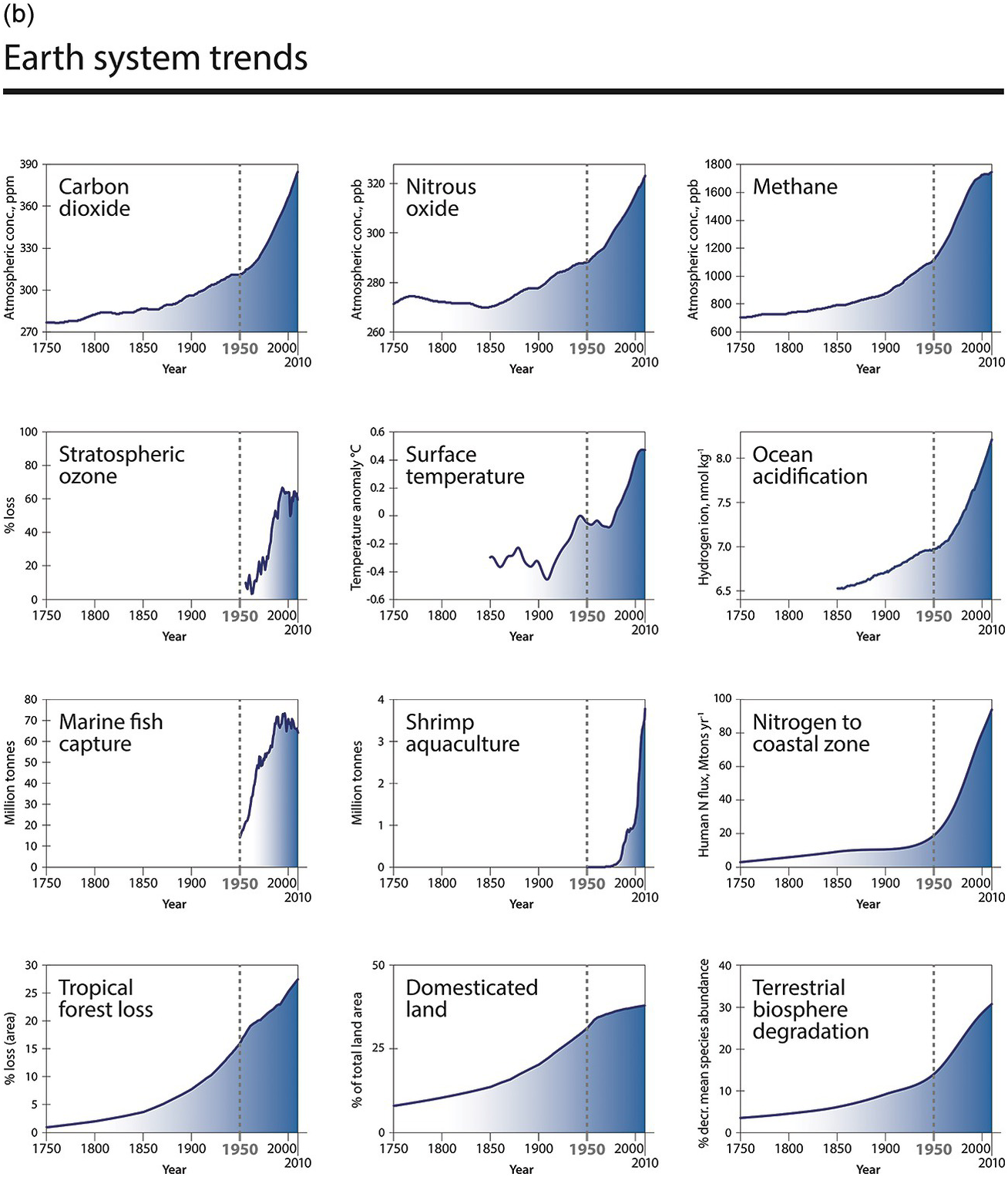
Figure 2.1a,b The rapid acceleration of change over the last 2½ centuries viewed through the eyes of many dimensions, both natural and societal.
A few years later, in a paper in Nature that has also been frequently cited, in a team led by Johan Rockström of the Stockholm Resilience Center (Rockström et al. Reference Rockström, Steffen, Schellnhuber, van der Leeuw, Liverman, Hansen, Lenton, Sörlin, Fabry, Noone, Lambin, Corell, Costanza, Scheffer, Folke, Svedin, Hughes, Rodthe and Crutzen2009a), we made for the first time a strong case for the fact that our worldwide management of the environment was exceeding what was called the “safe operating space” of the Earth’s environmental dynamics. Much of the debate that followed focused on the question whether it was possible to a priori set global limits to such a space, or even whether such an approach was conceptually sound. Another part of the debate questioned the boundaries themselves. But relatively little attention was paid to an important message: the fact that if human activities pushed the Earth system dynamics beyond certain limits in more than one dimension (e.g. CO2 emissions, biodiversity loss, ocean acidification, etc.), the system as a whole could easily move into completely unpredictable, (near-) chaotic behavior, rapidly undermining the environmental bases of our various societies.
The paper, and a subsequent one headed again by Will Steffen (2015), thus not only drew attention to the fact that our Earth system was undergoing rapidly accelerating change in many environmental as well as societal dimensions, but that there might come a point where these many changes would themselves generate second-order changes (that is, changes in the nature of the dynamics themselves, dynamics which during most of the Holocene have remained within narrow boundaries) that could rapidly and unpredictably transform the natural as well as the societal sphere in which human groups have functioned for centuries. By implication, these papers argued for a transdisciplinary approach that involved the atmospheric sciences, chemistry, oceanography, geology, biology, and other disciplines. But they did not include the social sciences in equal measure.
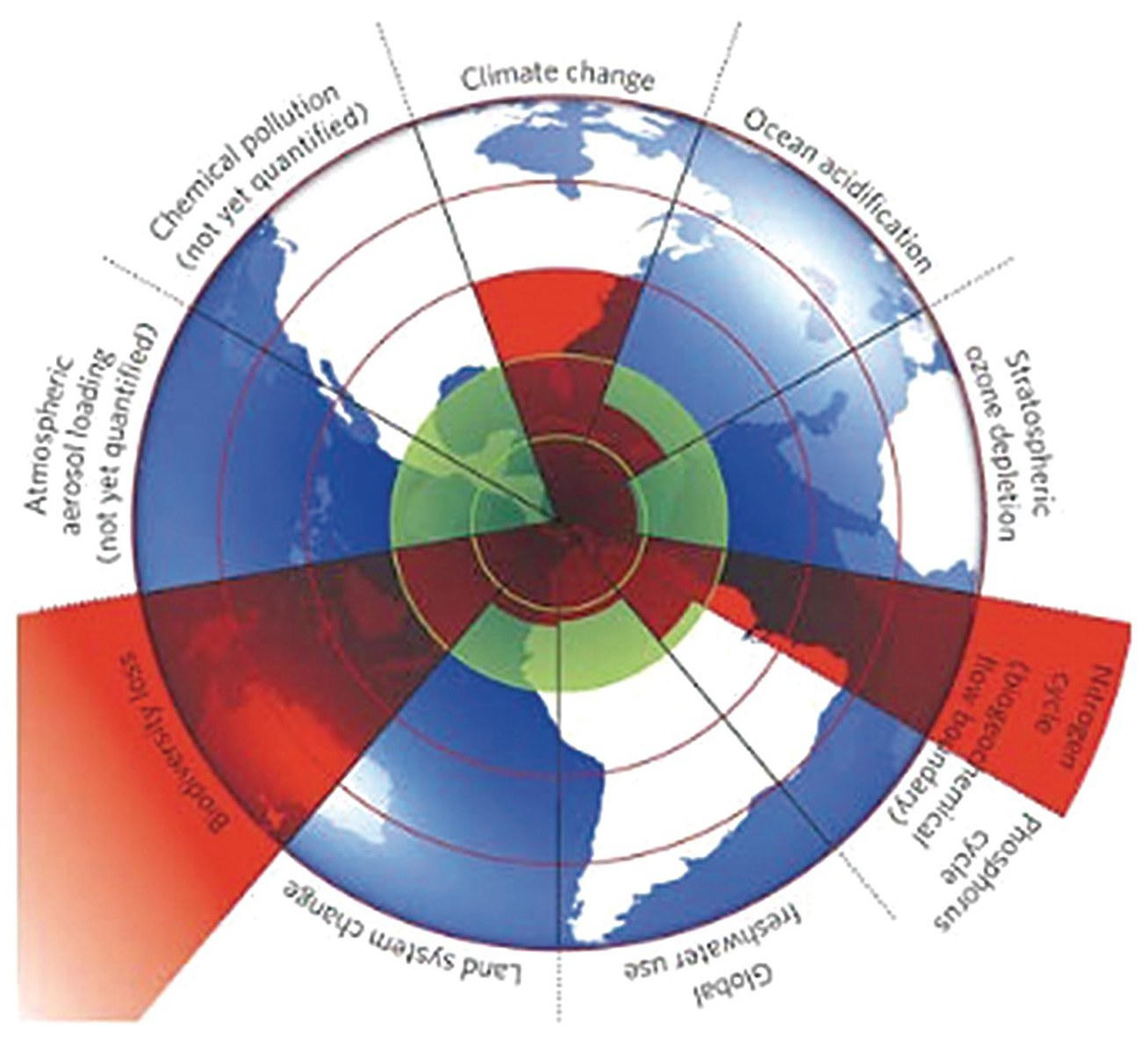
Figure 2.2 The Earth system is close to exceeding its “safe operating space.”
This intellectual shift occurred in parallel to an organizational shift in the global scientific community’s institutional context. In the 1980s and 1990s, a number of Global Environmental Change communities had been created and funded that grouped certain disciplines together: the World Climate Research Program (1980; climate sciences, meteorology), the International Geosphere-Biosphere Program (1986; Earth sciences, life sciences), the International Human Dimensions of Global Environmental Change Program (1990; social sciences), DIVERSITAS (1991; biodiversity-related disciplines such as ecology), etc.
An important aspect of this situation was that this movement involved the upstream part of the Earth science community alone, while in other scientific fields (physics, chemistry, biology, etc.) there usually are large “intermediate” scientific communities dealing with “applied sciences” before the scientifically acquired knowledge can be adopted for technological, industrial, agricultural, medical, and other applications. This shortcut created a wide disconnect between the Earth science and sustainability communities on the one hand and the general public as well as all people involved in doing things (engineers, politicians, professional organizations, etc.) on the other. In the latter sphere, because knowledge is immediately related to “needed actions” and their consequences, scientific knowledge is mainly approached as emotion (how many images have we not seen of polar bears deriving on melting icebergs?), rather than rationally with reference to the means to act. Action is all too often caricatured as being in the hands of a business community that is only interested in short-term profit.
In 2006, at a meeting in Beijing, a new organization was created, the Earth System Science Partnership, which was conceived as an organization to start building the links between these different communities. This proved difficult, and was quickly abandoned as an effort, to be replaced by a complete reorganization of the whole Global Environmental Change community into a single organization, called Future Earth. This was initiated in 2012 and is nearing its cruising altitude and speed as I write. As part of that transition, an explicit focus on learning for the future, transdisciplinarity, co-design and the development of applications is included in Future Earth’s vision, but in practice the organization is still very much driven by the academic community and its longer-standing approaches.
Both intellectually and organizationally, the first decade of the twenty-first century thus saw a clear move toward investigating global change in an integrated, transdisciplinary manner. It seems to reflect a fundamental conceptual change that began a couple of decades earlier, in the 1980s, which changed our conception of the relationship between people and their environment, as summarized in Table 2.1.
Table 2.1 Shifts in the conceptualization of society's relationship to nature
The last few decades have seen a shift in our understanding of the relationship between societies and their environments. Up to the 1980s humans were predominantly seen as (reactively) adapting to nature. Under the impact of the environmentalist movement, the late 1980s and 1990s saw the emergence of the opposite perspective: humans as proactive, with (mostly negative) consequences for the environment. That led to the emergence of sustainability as an ideal. In the late 1990s and 2000s a more balanced perspective emerged, which views the relationship between societies and their environments as interactive. The core concept shifted again, this time to resilience – the capacity to respond to change without losing continuity or identity.
But in many relevant scientific communities, this shift is not yet complete. In the climate, Earth and life sciences in particular, the role of societies is acknowledged, but many in these disciplines still see that role as defined by, and often ancillary to, the role of atmospheric dynamics, geological or geomorphological processes, ecosystems, etc. Thus, when practitioners of those disciplines formulate questions that they hope can be answered by social scientists, they (understandably) do so in ways that derive from their discipline of origin.
A central theme of this book is the fact that our so-called environmental challenges are in fact societal ones, involving all aspects of our societies, including governance, economics, culture, technology, institutions, environment, resources, etc. I use this term throughout the book to distinguish the dynamics involved from purely social ones. At the most fundamental level the distinction between society and nature is a societal one. As I will explain in Chapter 3, the concept “nature” emerges in its current position as a counterpart to “culture” in the eighteenth and nineteenth centuries in western Europe in an attempt to define natural history (biology) by contrasting it with history (the history of societies and human individuals) (van der Leeuw 1998).
The questions asked by the natural and life sciences often do not hit the sweet spot among social scientists, and do not trigger the kind of research effort that, fundamentally, they merit in view of the urgency of dealing with the socioenvironmental issues involved. It is often as if there is a glass wall between the disciplines involved: they see each other, but they cannot touch. I will discuss the historical reasons for this in Chapter 3.
What concerns me here is rather to present a first outline of the task of reaching out across that barrier, to achieve the kind of intellectual fusion that is necessary to deal with the issues concerned. As a starting point, I think we have to acknowledge that most of the kinds of scientific challenges that the social sciences deal with are very different from those tackled by the natural, life and Earth sciences. One way this difference has been formulated is by Cristelli et al. (Reference Cristelli, Batty and Pietronero2012), who show an image of one of the US astronauts on the moon, alongside an image of a huge traffic jam in London and ask “Why can we reach the moon but not the airport?”
The answer is that these are two very different kinds of problems. Reaching the moon is not easy, but at least the goal is well defined, and the number of dimensions involved is limited and knowable, so that the challenges to be met and the dynamics affecting them can be isolated, the overall challenge disaggregated into subsets and solutions found for these subsets. Once such solutions have been found, one can then bring the subset solutions together to meet the overall challenge. Many of the problems in the natural, earth, and engineering sciences are of this nature. Once they have been solved, they will not recur as problems. They are considered “tame” in comparison with “wicked” problems.
In their image, the way to the airport is blocked by a traffic jam. Traffic jams are examples of such wicked problems, problems that cannot be solved definitively. The number of dimensions involved is so large that it is unknowable, and the challenges can therefore not be disaggregated. Such problems are characterized by indeterminacy in problem formulation – the precise formulation of a wicked problem as a problem with unique and determinate conditions to be satisfied is virtually impossible – and by the fact that there is no definite and rigorous ultimate solution with definitive results. Such problems can at best be suppressed, managed, or solved over and over again (Rittel and Webber Reference Rittel and Webber1973). Most challenges involving society are of this kind – if only because the behavior of so many individuals is involved. Other examples of such wicked problems are the “Not In My Back Yard” (NIMBY) problem, the recurrence of financial crises, and terrorism.
Such differences in the nature of the issues investigated, as well as the (related) differences in disciplinary history, research goals, paradigms, methods, and training have led to (groups of) disciplines that collect their data under the impact of different epistemologies, using different methods and techniques, and set different standards for the validation of research results. Hence the data and information collected and used by these disciplines cannot be treated in the same manner, and that constitutes another fundamental barrier to developing an integrated perspective on socioenvironmental dynamics. This is aggravated by the fact that many scientists in both the disciplines related to the Earth sciences and the social sciences and humanities disciplines, as well as politicians, business (wo)men, journalists, and others are only partly aware of the fundamental epistemological and conceptual differences behind their disciplines, which in many instances leads to confusion, and therefore to ambiguity concerning the nature and value of the data collected.
One reason for this semi-awareness is the nature of our education systems, which are so strongly discipline-based and discipline-focused that they develop their own communities of practitioner-experts, their own education curricula, their own specialist languages, their own funding sources, and above all their own criteria for admission into a particular field of study. These different fields of study focus on particular issues, questions, methods, and techniques, and relegate to other communities of scholars and scientists the task of answering questions that they themselves cannot. In this process of – for want of a better term – educational and social alignment, many academic – disciplinary – communities have increasingly closed themselves off from scientists and scholars in other disciplines because it became increasingly difficult for those who had not followed the anointed cursus honorum of a discipline to achieve the full depth of understanding of its expert practitioners. As a result, the scientific worldview that was once the pride of the Enlightenment has fractured into many disciplinary academic ones, and that state of affairs has been cast into administrative structures in (almost) all universities and research organizations. But it should be pointed out that this is not the case, or at least not to the same extent, among the applied science-, technology-, engineering- and related communities that have to an important extent been industry or business -driven.
Once a sufficient number of scholars and scientists became aware of this issue, they initiated a swing in the opposite direction, emphasizing consecutively “multi-,” “inter-,” “trans-” and most recently “un-” disciplinarity. That battle-cry is now resounding everywhere, but in practice, for reasons to be discussed later, it is personally and institutionally still very difficult to achieve the kind of intellectual fusion that is needed to deal with complex questions such as sustainability. I would like this book to contribute a vision of the challenges facing us that enables an improved intellectual fusion between the disciplines involved by providing the necessary scaffolding structure.
In order to do so, I have adopted a starting point that is very different from most of those involved in the sustainability debate. Rather than view our current socioenvironmental dilemma from the perspective of the natural and Earth sciences as is done, for example, by the Intergovernmental Panel on Climate Change (IPCC) I will do so from a societal perspective, in keeping with the thesis expressed in Chapter 1, that the second order drivers that are increasingly pushing the socioenvironmental dynamics of our Earth system to transgress the boundaries of our “safe operating space” are essentially societal, not environmental.
The argument for that is quite simple. Everything humans observe and do passes through the filter of their cognition. That filter defines all the categories humans simultaneously observe and create. Hence, both “nature” and “culture” are in effect cultural categories, defined by humans who have adopted different perspectives on the world around them. Environment is another such culturally defined category. Humans define what they consider their cultural and natural environments. They also define what they consider the challenges they observe in these environments, and finally they determine what they consider to be the “solutions” for such challenges. Other cultures than our own, western one define their environments differently. In some instances they do not in any way distinguish the cultural or social sphere from the natural and environmental one (as in the case of the Achuar, see Descola Reference Descola1994), while in other cases they acknowledge a difference between these spheres but conceive the relationship between them in ways very different from our own, as for example in Japan (Berque Reference Berque1986). But even when a group does not distinguish between “culture” and “nature,” that in itself is a sociocultural choice. It is thus not only appropriate but essential that we view socioenvironmental dynamics as being societally driven. This will be of fundamental importance in the sustainability debate in the current century, in which major societal changes are likely to occur.
The choice to try to develop an integrative (transdisciplinary) perspective on socioenvironmental dynamics from the societal point of view brings a novel, daunting challenge: to introduce a perspective on societal dynamics that engages natural, life, Earth, economic, and social scientists, so that they can all contribute to its development. Moreover, that approach should not only be able to provide proximate explanations for observed phenomena, but also ultimate explanations for both the first- and the second-order socioenvironmental dynamics we observe in all three so-called pillars of sustainability: society, economy, and environment.
To find a starting point, I have argued as follows: if we consider for a moment human beings as “just another unique species” (the title of Foley’s 1987 book), I think we can agree that, like all other living beings, humans process energy, matter, and information. They use energy and matter to physically live and survive – to feed themselves, to grow, and to reproduce. Some of that energy is processed in the form of raw energy – heat from sunshine, for example, which is transformed into vitamins and absorbed to help maintain the necessary body temperature. The remainder of the energy needed to maintain body temperature, as well as the energy expended in movement and other muscular activity is processed in the form of matter – food. Other forms of matter, and this distinguishes humans from many other animals, are processed to provide protection, tools, shelter, and the like. In all these cases, the processing involves the transformation of the information content of the matter, either through digestion (increase of entropy) or creation of functional objects (decrease of entropy).
Humans, like all other animals, therefore also process information. But what is specific about human beings is that they not only learn (and learn how to learn, see Bateson Reference Bateson1972), but they can (and do) organize (Lane et al. 2009b). In organizing, they add information to matter and energy when they transform either or both for a specific human purpose. They organize their thoughts, their needs, their actions, their tools, and they also organize themselves – into communities and societies. In doing the latter, they put to use a particular aspect of information – the fact that it is not subject to the law of conservation. Energy and matter, because they are subject to this law, cannot be shared, but information can be, and is, shared. A society functions as such because its members communicate and share ideas, expectations, ways of doing things, knowledge about certain resources, etc. It is the sharing of information that holds a society together and constitutes its culture. The fact that information is processed both individually and (in later human prehistory) collectively is responsible for the fact that each culture has its language, its customs, its technology, and material culture, its myths and legends, its art, etc. All of these are shared and communicated ways of doing things.
One could in effect say that each and every individual and society processes energy and matter, but what distinguishes individuals and societies is the form that such processing takes, and that in turn is dependent on the information processing of both the group and the individuals that are its members. André Leroi-Gourhan was as far as I know the first to point in this direction in the mid-1940s in his Technique et Langage (Technique and Language), part of a magnificent set of two volumes on many of the contextual dimensions that impact on techniques and technology, including long-term history, materials, cognition, economy, and tradition.
Taking the above argument as the starting point of my search for a perspective on societal dynamics that can engage scientists on both sides of the social–natural sciences divide, I have looked at a number of aspects of human dynamics from the information-processing perspective, and will introduce these explorations in later chapters (Chapters 8 ff.) of this book.
Six Fundamental Points
In order to give the reader a synthetic preview of some of the main points that have shaped my perspective on sustainability issues and that underpin much of this book I want to present six major points in a nutshell.1 The reader will see them recur as part of the weft of the book.
The first of these, that we are facing a societal rather than an environmental crisis has already been referred to: societies define what they consider their environment, what they consider its problems, and what they see as the potential remedies for the latter. Or, as Luhmann (Reference Luhmann1989) emphasized, society does not communicate with its environment, it communicates within itself about the environment, and such communication is self-referential in each culture. We cannot escape the fact that our societies are responsible for the environmental phenomena that cause us to worry, and only by changing our collective behavior can we do something fundamental about these worries.
A first step in that process is to understand the societal dynamics behind the environmental crisis, including the role of science itself – its overpromising, its unintended consequences and their negative effects, as well as its numerous positive contributions to many aspects of human life and society. We need to ask, for example, what is the role of science in the fact that there is such a protest against Genetically Modified Organisms (GMO’s) in Europe and there was much less on nuclear issues? This also touches on the role of scientific communication – which five or ten years ago was not on the agenda.
The second point I emphasize is the importance of looking at dynamic systems over the long term, sometimes up to several millennia. This allows me to discern aspects of systems dynamics that are not usually included in shorter-term visions:
Slow changes that do impact on the environment and society, but are barely discernible at secular timescales;
A wider range of system states than the ones that the system has encountered over the last few centuries;
Second order changes (“changes in the way change proceeds”) that reveal important dynamics that often play out very slowly.
Moreover, looking only at the last two centuries or so, we observe a socio-natural system that has already been heavily impacted by anthropogenic dynamics. It is like looking at a very ill patient without knowing what a healthy person looks like. Taking a long-term perspective enables one to distinguish the natural dynamics better from the anthropogenic ones.
My third point is that we have to look at the limitations of human cognition. Human cognition, whether individual or collective, is limited to a relatively small number of the dimensions of processes occurring in nature. Our actions, which are thus based on partial – and biased – perceptions of the dynamics going on around us, affect our environments more profoundly than we can possibly know. At the 2016 Royal Colloquium in Stockholm Taleb (Reference Taleb, Kessler and Karlquist2017) has called this “the curse of dimensionality.” Over time, the net effect of continued learning about, and intervention in, the environment is that the more we think we know, the less we know because we have wrought changes in the environment that far exceed our knowledge. This results in unanticipated, unintended consequences of our actions. Moreover, whereas we “do something about” known frequent risks, these actions engender unknown risks that accumulate over time so that the risk spectrum shifts over the long term toward a dominance of unknown, long-term risks.
This second-order dynamic is reinforced by the fact that our thinking is underdetermined by current observations (Atlan Reference Allen and Hoekstra1992) and thus over-determined by known reactions to prior events Hence, our thinking is path-dependent and difficult to change. The actions we conceive and implement fall within a range determined in the past, and they are therefore very often not optimal to deal with the changed circumstances.
Due to the shift in risk spectrum and the introduction of unknown longer-term unintended consequences, over time the latter accumulate to the point that a society may no longer know how to deal with all of them simultaneously. This is in my opinion what triggers a crisis or (in more scientific terms) a tipping point, a temporary incapacity of a society to do the information processing required to keep it in tune with the changes it has caused. It follows that we must look closely at these unintended consequences of all our individual and collective decisions and actions.
My fourth point, following directly from this argument, is that we have to also invert the way we look at stability and change, by assuming that change is permanent and humans try and create stability, so that we should be explaining stability rather than change. This is a very fundamental move away from our core Aristotelian scientific perspective toward the perspective of Heraclitus of Ephesus. It implies among other things that we should start to design for change, rather than for stability, such as is timidly being proposed by the protagonists of the circular economy. Another implication is that wherever possible we should follow the precautionary principle, making “do not harm” the core of our interactions with our environment.
The fifth point is that the current emphasis in the sustainability community on “innovating our way out of trouble” ignores that 250 years of randomly exploding innovation in every domain is what got us into trouble with the environment, as has wonderfully been illustrated by Klimek and AtKisson’s Parachuting cats into Borneo (Reference Klimek and AtKisson2016). To have any chance of dealing with our present global predicament, we must ultimately find ways to focus innovation in positive, helpful directions. But currently we do not even know scientifically how invention works, and we only partly understand how the introduction of inventions in society works (Lane et al., Reference Lane, Maxfield, Arthur, Durlauf and Lane1997, Reference Lane and Maxfield2005). We need urgently to understand this better, in order to focus our innovative capacity on sustainability issues.
My sixth point is to ask why do we forever push against the environment, trying to transform it, at least in our western societies? Our relationship with the environment can be seen from two points of view – that of the society and that of the environment, which I am here referring to as environment (the natural state surrounding society) and milieu (society in the center of nature) respectively. Those perceptions interact, according to an interesting perspective on category formation (Tversky & Gati Reference Tverski, Gati, Rosch and Lloyd1978; van der Leeuw Reference van der Leeuw, Fiches and van der Leeuw1990), in which the direction of comparison between a subject and a referent with which it is compared determines whether the comparison emphasizes similarities or differences. Thus, when in the milieu perspective humanity (subject) is compared to nature (referent), the cohesion and strength of nature and the confusion and handicaps of humanity are emphasized, whereas in the environment perspective, when nature is the subject and humanity the referent, the opposite happens. This leads to the opposition illustrated in Table 2.2.
Table 2.2 Different perspectives on the relationship between humanity and the environment
If we then look at how these two perspectives interact, one sees that taking them together, they exaggerate the unknown dangers of the environment, and downplay the dangers of human intervention in it, explaining in my opinion the opposition between society and environment and the continued intervention of the former in the latter.
This raises an interesting question: where does one focus first – on the context or on the subject, on the ideal or on the reality? What does one consider the subject, and what is seen as the referent?
In this context, there are two interesting differences between a western and an eastern (Daoist) perspective (Sim & Vasbinder, in press). Firstly, in the latter one seems to focus first on the context, and then on the subject, whereas in the West it seems to be the other way around. If that is indeed the case – and I am not at all a specialist in these matters – that would imply that in the Daoist approach the similarities between society and the environment are emphasized, whereas the differences are emphasized in our western approach.
Could it be that this difference is also related to the fact that in our western approach, at least since the Enlightenment, one projects an ideal and strives to get as close to that ideal as possible whereas in a Daoist approach, on the other hand, one tries to act in the best way possible given the context of the moment, rather than strive toward an ideal?
Introduction
Now let me start outlining my argument in earnest, beginning with a 30,000 ft historical perspective that illuminates some of the intellectual reasons for the current dilemma and places them in the context of wider societal and intellectual changes over the last few centuries, and particularly the last century or so. This historical perspective may seem at first sight to be a diversion, and not necessarily an easy one to read for others than historians of science, but it is fundamental to understand the origins of many aspects of the current western perspective on sustainability that is the main topic of the book.
Beginning with the transition from the early medieval “vitalist” to the dual Renaissance perspective, I will here show how over the last six centuries a perspective linked to what was originally a human cultural category, “nature,” has come to dominate our scientific world view to the point that we are now investigating human functioning (for example of the brain) as a “natural” phenomenon, and have to an important extent lost sight of human behavior as something intrinsically human. That process has also permeated much of our western thinking beyond the realms of science, scholarship, and academia, and anchors our perspective on climate and environmental change.
In doing so, I have focused on the traditional, academic sciences as that is the domain in which I work and to which I hope this book may contribute. As already mentioned in Chapter 2, over and beyond these sciences, there is a wide range of applied sciences where much of what I am arguing here is already current practice, in the sense that their role is to relate “pure” science to the practicalities of everyday life, and that they combine the input of many disciplines.
The last sixty to a hundred years have seen very important and rapid advances in many scientific disciplines. In the natural sciences, we have seen increases in our knowledge about subatomic particles by means of larger and larger accelerators, but also the development of nuclear energy. Astronomy and planetary science have rapidly advanced thanks to the construction of large numbers of (radio-) telescopes and satellites, in the process giving us Geographical Positioning Systems. The discoveries of the double helix and the subsequent mapping of genetic structures have transformed biology, medicine, and our ideas about biological evolution. In materials science, the discovery of unprecedented properties of silicon, and more recently graphene and the nanomaterials, has opened up huge new areas of research. All these discoveries, and many more, have together completely changed our lives, changing what we eat (agro-industry; packaged and frozen foods; the hamburger), how we move around and how far we can go (the jet airplane), what we do in our spare time (the television, computer games); who we consider our friends (Facebook, Twitter) and so forth. But no scientific discoveries have transformed society as much as those that have led to the computer, informatics, the Internet, and – in general – the information sciences.
In the process, science itself has changed. What began in the 1700s as a voluntary, unregulated, and individual inquiry into natural phenomena practiced by the upper middle classes and nobility, funded by their own resources, has developed over the last two and a half centuries into a worldwide community of millions of scientists who are subject to stringent rules (peer review; university administrative structures; promotion and tenure proceedings), and are paid by governments and industries on the premisse [sic!] that their activities will lead to inventions and discoveries that improve our lives, satisfy our curiosities, and keep our economies humming. In particular, after the discovery of many novel tools during World War II (e.g., radar, nuclear energy, jet engines), for some thirty years (1950–1980) the general population’s respect for scientists was at its zenith. Scientists (natural scientists in particular) were counted upon to perform miracles, guide governments, provide industry with the tools to be ever more performing, and invent more and more ways to make life more comfortable and less wearing. But somewhere in the 1980s and 1990s that trust in science began to wane, and an increasing proportion of the population in western countries became more critical of science.
That shift in the perception of the role of science is of direct relevance to us, and to the topic of this book, because the sustainability challenges facing us now will require an all-out scientific effort to find and to apply solutions, and for that effort to succeed scientists need to regain the trust of society at large. Hence, I want to use this chapter to delve a little deeper into the history of the sciences, laying bare some of the dynamics that have shaped the successes, the directions, and the challenges of contemporary scientific research. In doing so, I will of course not introduce novel ideas, but juxtapose ideas from historians of science in a way that suits my main purpose: to put into perspective the ways in which our scientific approaches have been shaped by, and have come to shape, our world, and to point to some of the reasons why a fundamentally different approach is needed.
The Great Wall of Dualism
Let us first consider the word “nature.” Natura is the Latin equivalent of the classical Greek word φυσισ which we encounter in the words physics, physiology, physician, and many other words in the European languages.1 Lewis (Reference Lewis1964) argues that already in classical Greek the word conveys an ambiguity, as it can mean “that which is real” (as opposed to fictional) and thus “the way things should be” (in accordance with nature), as well as “nonhuman,” relating to the world of nonhuman beings. The ambiguity clearly expresses the difficulties in locating human beings on the Greek mental map of earthly phenomena. Human beings must under certain conditions be considered part of nature, while in other circumstances it is preferable to exclude them from nature. The duality is also an essential step in the objectification of nature as it allows one to think of nature as subject to its own dynamics, its own laws, its own behavior, distinct from those that govern the dealings of people. Such objectification is a conditio sine qua non for any attempt to reduce perceived natural risks, indeed for the description of any presumed interaction between people and that what surrounds them.
In two very interesting books, which I summarize here much as I did in my ARCHAEOMEDES publication (1998b), Evernden (Reference Evernden1992) describes some of the transformations this conception underwent, beginning in the early Middle Ages. At that time, a single “vitalist” worldview pertained to all aspects of the world, whether mineral, vegetal, animal, or human. All these realms were seen as inhabited by living beings of different kinds which had close links between them and with the realm of the divine and supernatural. In effect, all that is happening in these realms is seen as an expression of a divine configuration and, in this respect, there was no difference between human beings and any other aspect of nature.
The Renaissance, following on the heels of the major plague epidemics of the fourteenth century (which in some urban locations reduced population numbers by 50% or more), is the next major step. Historians and art historians have long linked the Βlack Death and the Renaissance in their interpretations (e.g., Gombrich Reference Gombrich1961, Reference Gombrich1971; Hay Reference Hay1966), focusing for example on the contrast between the danse macabre and the subsequent explosion in the arts, but also on the introduction of the concept of the individual (as manifest in the first full-face portrait painting, of King Richard II of England), the emergence of the signature as a means of identification in commerce (see Cassirer Reference Cassirer1972), and the first attempts to measure time with mechanical clocks. Evernden cites the groundbreaking work of Jonas (Reference Jonas1982) in according fundamental importance to this period in which a shift occurs from a cyclical perspective in which life and death are both part of a never-ending cycle, to a linear one in which death is the rule, life the anomaly. This opened the door to the notion of an inanimate universe, nature as lifeless “behaving matter,” a notion that has grown ever since in a movement that is closely related to the emergence of mechanistic physics (the so-called Newtonian paradigm) and the emerging separation between science and religion.
It is Evernden’s contention that this growth was made possible by what he calls “the great wall of dualism” (Reference Evernden1992, 90), which protected our conception of humanity from the lifelessness of the inanimate world by maintaining that (nonhuman) nature was subject to fundamentally different laws than were human beings, so that one could concern oneself with the study of the former without attacking the human sense of identity, and thus to reposition human beings with respect to their nonhuman surroundings.
Thus, in the centuries following the Renaissance, Copernicus could introduce the idea that humans are not living on the central body of the universe, but on one among a series of more or less identical planets turning around the sun. Human life thus became an epiphenomenon, a mere anomaly on one planet out of (eventually, centuries later) millions assumed to exist in the universe.
Of direct importance for us here is the push for objectivity in the study of nature, linked to the idea that because human beings are outside the natural realm, their observations and actions on nature would essentially distort its dynamics and our perception of them. As expressed by Shapin and Shaffer: “the solidity and permanence of matters of fact reside in the absence of human agency in their coming to be” (Reference Shapin and Shaffer1985, 17–18). Evidently, this had consequences for the period’s conception of knowledge, which shifted from one in which knowing is achieved through identification with the object of study to one in which knowledge is in the mind, independent of the object, and achieved through the critical observation and study of that object.
Evernden illustrates, by means of examples from Italian and Dutch painting, how the first stage of this slow change occurred differently in different parts of Europe (Reference Evernden1992, 78–79). The stereotyping of Italian landscape painting seems to indicate that, here, nature is assumed to be a coherent system, whereas in Dutch landscape painting the attention for detail and realism seems to indicate that nature is made up of details which project oneself on the retina. It is as if in the Italian case the depiction of nature derives as it were top down, from a particular overall conception, whereas in the northern European examples, nature is depicted bottom up, as an ensemble of observed details. In a similar line of argument, Alpers suggests (Reference Alpers1983, xxv) that Dutch society was oriented toward the visual and material, Italian society toward the verbal and conceptual. However that may be, it is clear that from this period onwards there emerges a contrast between developments in northwestern and in southern Europe. Its most eminent manifestation is the growth of empiricism (ultimately followed by the Industrial Revolution) in Britain and Holland, in opposition to the Cartesian rationalist position that dominated in France and Italy.
It is of importance to our further discussions to emphasize that from this moment on we also observe a growing separation between the natural sciences and the humanities that is the inevitable corollary of the separation between humanity and nature. Humanity is a sphere in which values, thought, spirituality and novelty dominate the scene – contrasting with the mechanics which are thought to dominate in the natural sphere. Until recently, most educational institutions in continental Europe and the Anglo-Saxon world have seen it as their task to educate students in both spheres, but it is my impression that that goal is now in many institutions suffering under the increased pressure on students to reduce study time, and focus on their future employment.
Rationalism and Empiricism
The next stage in the development of our western intellectual tradition that shaped our present scientific capabilities and challenges is the transition to the eighteenth century, and in particular the emergence of the intellectual movement usually referred to as the Enlightenment, in which the above differences between Rationalism and Empiricism solidified. It is crucial because it shaped the scientific articulation between theory and observation. That articulation between the realm of ideas and that of observations led to two very different approaches to science that persist, mutatis mutandis, to this day. The difference is best summarized by contrasting the approach of Descartes in France with that of Bacon in Britain.
Descartes’ famous dictum “Cogito ergo sum” (“I think therefore I am”) reflects a movement in which the importance of thought and reason is emphasized over that of experience. Cogitation leads one to adopt a conception of one’s surroundings, a construct into which experiences can be fitted. If at first sight these experiences do not fit, one has to look at them in different ways until they may confirm, and maybe nuance, the conception one has adopted. Cassirer gives the example of another rationalist, Leonardo da Vinci, for whom “a dualism between the abstract and the concrete, between ‘reason’ and ‘experience’ can no longer exist” (Cassirer Reference Cassirer1972, 154). Both these cases lead to an approach that makes experiences fit a conception. At the cognitive nexus between humans and the world “out there,” what humans perceive is determined by their worldview rather than by the phenomena they observe. This worldview is primarily the result of reflection and cogitation rather than observation.
In Britain and Holland, on the other hand, there seems to be an aversion to attempts to generalize, to build a reasoned worldview. Such a system is deemed to remain hidden from the senses, reasoned and therefore interfering with the direct observation of nature. Hence, Bacon’s view predominates, that to resolve nature into abstractions is less relevant than to dissect it into parts. In arguing that reason has to conform to experience, and that experience deals with the manifest details of nature, the empiricists set about building another worldview by deliberately crumbling the existing one into oblivion. We will come back to that theme when discussing the emergence of our intellectual and scientific disciplines.
It is essential to underline that this empiricist disaggregation prepared the way for a slow shift, as northern Europe flourished economically and scientifically over the next couple of centuries, in which “century by century, item after item is transferred from the object’s side of the account to the subject’s” (Lewis Reference Lewis1964, 214–215). It is as if in the development of the natural sciences an inevitable initial phase of separation between subject (ourselves, people, societies) and object (nature), is followed by an increasing “objectification” of the study of people and societies, so that in the end, we ourselves as humans have become part of the natural sphere of inquiry. It is in this context that the social sciences emerge in the nineteenth and twentieth centuries, and that at present cognition and thought have become subjects of scientific study and explanation in terms of synapses, chemical communication in the human brain, etc. Resulting in the fact that “now […] the subject himself is discounted as merely subjective; we only think that we think” (Lewis Reference Lewis1964, 214–215). Blanckaert (Reference Blanckaert, Ducros, Ducros and Joulian1998) calls this “the naturalization of Man.” Via the “detour” of dualism, we thus see a slow return to a monistic worldview, exchanging the monistic vitalist philosophy of the European early Middle Ages for a materialistic monism in which, nowadays, atoms, molecules, hormones, and genes prevail.
This has created a fundamental paradox in our worldview. In the words of Evernden: “We have in effect been consumed by our own creation [e.g., nature], absorbed into our contrasting category. We created an abstraction so powerful that it could even contain – or deny – ourselves. At first, nature was ours, our domesticated category of regulated otherness. Now we are nature’s, one kind of object among all the others, awaiting final explanation (Reference Evernden1992, 92–93).”
The Royal Society and the Academies
In 1660 the Royal Society was founded in London. Its creation was followed by other academies, such as the French Académie Royale des Sciences founded in 1666, the Swedish Royal Academy of Sciences founded in 1739, and the Hollandse Maatschappij van Wetenschappen founded in 1752 in the Netherlands. These institutions were created by and for scientists, sometimes with funding from private sources, and they selected their members by cooptation based on (informal) peer review. A number of these scientists, not all of course, were socially part of the classes of society (the modernity-oriented aristocracy and the bourgeoisie) that became deeply involved in developing the economy through the applied sciences.
As time progressed, in so far as they were “science” academies – there also emerged, later, academies of art and letters, for example – these contributed substantially to a stricter definition of what was considered (empiricist) science, and in particular to the idea that every step in an argument should be proven or demonstrated to be considered scientific. What this means in different fields of science, and between different intellectual tendencies, is highly variable. But one thing is certain: one cannot “prove” things by invoking the future. Hence, to this day science places a very heavy emphasis on explaining by invoking dynamics that lead to observed phenomena, in effect relating the past and the present without referring to the future. But the sciences and the humanities do this in very different ways.
Newtonian physics (the dominant paradigm until the beginning of the last century) built from empirical observation a worldview in which phenomena could be isolated from one another, and in which processes occurring at the most fundamental scales were considered reversible (e.g., state changes such as between vapor, water, and ice), cyclical (e.g., celestial mechanics), or repeatable (most chemical reactions, if they were not reversible). It is a worldview that is essentially aimed at “dead,” ahistorical phenomena – those whose nature does not fundamentally and irreversibly change during their existence, and who therefore do not have any (long-term) history.
In the humanities, on the other hand, invoking history seems to have been the dominant form of explanatory reasoning, at least since the Renaissance (Girard Reference Girard1990). In historical interpretation, irreversible time was a dominant strand. As a formal discipline (i.e., as a domain isolated from everyday life) History emerged when invoking irreversible time as explanation was challenged by the emergence of the natural sciences in the eighteenth and nineteenth centuries. On the one hand, it is firmly anchored in empiricist thought (cf. the famous words: “interpretations may change, but the facts remain” attributed to the historian von Ranke). But on the other hand, it developed, notably under the impact of Dilthey (1833–1911), into an approach that differed from British empiricism in its epistemological and ontological assumptions.
Dilthey (Reference Dilthey, Makkreel and Rodi1883) acknowledged that the kind of positivist universalism that was current in the natural sciences could not be applied to the humanities. According to his school, the central goal of history (and later of the humanities more in general) is understanding rather than the knowledge that is the central goal of the natural sciences. To gain such understanding, Dilthey proposed the “hermeneutic circle,” the recurring movement between the implicit and the explicit, the particular and the whole, the core and the context, the manifestations of human thinking and the thinking itself. Adopting this position enabled the hermeneuticists to (re-) position people in their historical, geographical, cultural, and social context, and by doing so relate individual, often short-term, actions to longer-term trends. In emphasizing, finally, that gaining understanding has to proceed from the study of the manifestations of human actions to the understanding of their significance, it introduces a particular kind of empiricism that is adapted to the study of people and societies.
The Emergence of the Life Sciences and Ecology
The life sciences emerged in the nineteenth and twentieth centuries as a novel area of scientific endeavor, and one that emphasized long-term irreversibility. They were part of a cluster of disciplines that sprang up between the humanities and the natural sciences at a time when the latter two could no longer easily communicate with each other, once the cohabitation of dualism had been replaced by the battle that accompanied the separation of the two spheres. The disciplines concerned cover a continuum between geology, which is essentially mechanistic in its basic attitude to long-term time (similar causes have similar effects, causality does not irreversibly change) via paleontology, evolutionary biology, and archaeology (in all three, long-term irreversible change is acknowledged, but short-term irreversible change is deemed invisible, incremental or irrelevant) to ethology and anthropology (short-term non-recurrence is accepted; the longer term not really considered).
The “new” disciplines delimited a deliberately ambiguous middle ground, a fuzzy no man’s land, either because they dealt with phenomena which do fundamentally and irreversibly change qualitatively during the period of observation (geology, paleontology, botany, zoology), or because they concerned another apparent contradiction, that between the behavior of natural beings (ethology) and the nature of (human) behavior (anthropology). Such phenomena did not fit the mechanistic approach of the “core” natural sciences because these excluded the study of qualitative change, but neither did they fit the traditional historical approach, which focused almost exclusively on the human (non-recurrent) aspects of behavior.
How did this come about, and what were its effects? Jonas argues that as soon as the natural sciences are, in seventeenth-century northwestern Europe, sufficiently mature “to emerge from the shelter of deism” (Reference Jonas1982, 39), the explanation of the observed functioning of physical systems in terms of general principles gives way to the reconstruction of the possible generation of such systems’ antecedent states, and ultimately from some assumed primordial state of matter. And
the point in modern physics is that the answer to both these questions (i.e., functioning and genesis of the system) must employ the same principles. […] The only qualitative difference admitted between origins in general and their late consequences (if the former are to be more self-explaining than the latter and thus suitable as a relative starting-point for explanation) is that the origins must, in the absence of an intelligent design at the beginning of things, represent a simpler state of matter such as can plausibly be assumed on random conditions.
When the mechanistic Newtonian approach, which was dominant at the time, was extended to living beings the sheer perfection of the construction and functioning of most living beings made it difficult to envisage their simpler and cruder precursors. The odds against a mere chance production of such perfect beings “would seem no less overwhelming than those against the famous monkeys’ randomly hammering out world literature” (Jonas Reference Jonas1982, 42). And moreover, these near-perfect beings continually died and were recreated! It would thus have been easier to explain them as the result of some (divine) design, but such a theory was incompatible with empiricist thought. The two centuries of delay between Kant and Laplace’s explanation of the origins of the solar system and Darwin’s idea of the origins of living species are indicative of the extent to which the study of living beings was caught between the two prongs of a dualistic worldview. “The very concept of dévelopement [sic] was opposed to that of mechanics and still implied some version or other of classical ontology” (Jonas Reference Jonas1982, 42).
The struggle to free the practitioners of the life sciences from traditional ideas is evident when one looks at the emergence of what was then called Natural History as a process in which two emerging disciplines, [societal or human] History and Natural History offset themselves against each other in the eighteenth and nineteenth centuries (for more detail see van der Leeuw Reference van der Leeuw, Ducros, Ducros and Joulian1998a). They both had to grapple with similar issues, such as the relationship between universal principles and individual manifestations, the challenge of dealing with the long term from the same perspective as was used for shorter-term dynamics, the relationship between subject and object, etc.
The contrast between the Lamarckian and the Darwinian models of the origins of life allows us a glimpse of what was necessary to resolve the problem. Lamarck’s explanation of the living world remained thoroughly natural in the sense that he saw reproduction as the identical re-creation of individual generations of complex beings according to a grand design. But at the same time, he introduced a historical element in his point of view by arguing that, though the design remained the same, it had sufficient flexibility to allow changes whenever ‘the environment’ imposed different conditions. There lingered doubt about whether such changes could be passed on to later generations. Historical explanation over the timespan of a generation was admissible, but not (yet) beyond. First representatives were still called for, and remained unexplained.
The post-Darwinian model, on the other hand, avoids the difficulties around the improbability of chance origins by arguing that the first representatives could have been much simpler than the present ones. Distinguishing ontogenetic from phylogenetic evolution allows biologists to explain the past and the present of living species in different ways. The essential role of a central, mechanistic, theory unifying the explanation of past and present is henceforth played by the mechanism accounting for evolution (i.e., variation and natural selection), introduced at the meta-level of the long-term existence of species, rather than at that of the individual and/or the single generation. And last but not least from our perspective, the theory of evolution introduced the idea that heredity is linked to change, rather than to immutability (Jonas Reference Jonas1982, 44). This broke the iron grip of reversibility and/or replicability of explanation, and heralded the reintroduction of historical (rather than evolutionary) explanation in the realm of nature. In this, it was inextricably tied to both geology and prehistoric archaeology – other children of the nineteenth century, which helped push back the age of the world and everything in and on it (e.g., Schnapp Reference Schnapp1993).
In the context of this book, it is also important to look at the early concept of environment which is invoked by Lamarck, and which Darwin reconfigured as the conditions of natural selection. Haeckel developed what he called the new science of ecology which he described as “the science of the relationships of the organism with its environment, including all conditions of existence in the widest sense” (Reference Haeckel1866, 286). Whereas Darwin included mankind in his “web of life,” Haeckel did not. He defined environment in much the same way as nature was defined a millennium or two earlier – as “nonorganism” (ibid., 286). Such negative formulations, of course, do not define anything but they are nevertheless revealing. In this case, there is a change in perspective on time (the opposition past-present) on the one hand, and on the opposition inside-outside on the other. The distant past and the environment become objectifiable and separable around the same time, giving rise to history and ecology as rigorous, “scientific” disciplines.
The next episode begins in about 1910, when the concept of human ecology is introduced to denote the study of the relationship between humankind and its environment. It accelerates with the rise of General Systems Theory (e.g., von Bertalanffy Reference Von Bertalanffy1968) and the concept of ecosystem in particular. After re-imposing a distinction in the late nineteenth century between humanity and its environment, the two are brought together again in two concepts which, each in their own way, make humanness a little bit more natural. Following a phase of reductionism that was made possible (but not initiated) by Darwin, we see the pendulum swing back toward more complex relationships between different parts of nature, including human beings. Humanity becomes Just another unique species (Foley Reference Foley1987), part of the complex web of inter-species relationships that is the fabric of life.
The Founding of the Modern Universities and the Emergence of Disciplines
Throughout the Middle Ages and the early modern period, universities were relatively unorganized, bottom-up organizations of individuals who saw it as their mission to share their knowledge and experience with others. As communities of scholars and scientists grew, interacting more and more intensively through travel and correspondence, a process was set in motion that led to a degree of convergence of understanding of the phenomena studied. Some perspectives were agreed upon, others rejected. This trend is schematically illustrated in Figure 3.1.
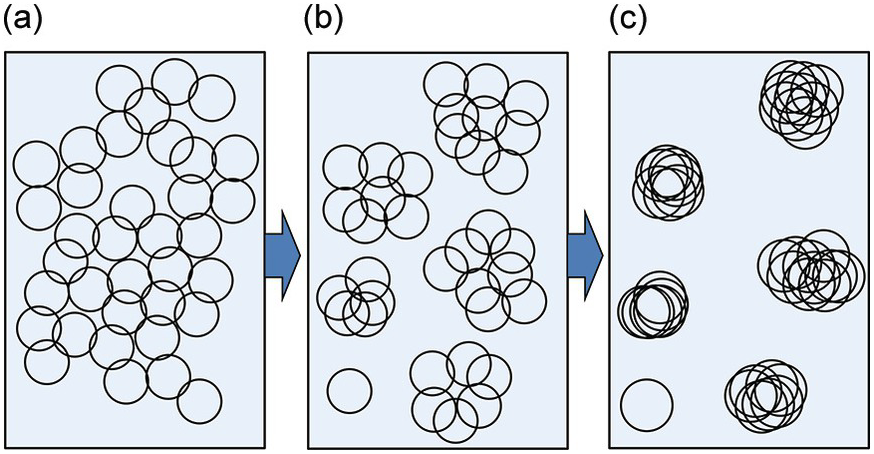
Figure 3.1 Convergence of groups of practitioners and their questions and ideas leads to cohesion around certain topics, and the abandonment of others. From left to right: (a) individual researchers all investigate different domains and issues; (b) through interaction they come to focus on certain kinds of information, certain methods and techniques, and certain questions to the detriment of others; (c) ultimately, they form coherent communities focused on more and more narrow domains.
A shared language emerged that linked these elements of understanding, and other signals were rejected as noise. This focused groups of scientists and scholars on the knowledge they shared, and what was signal in one group or dimension became noise in others. The overall process is one of aligning some signals by excluding others.
By the middle of the nineteenth century this reached a new stage, when universities were more formally organized, first in Germany under the impact of Wilhelm von Humboldt, and a little later in other countries, including the Americas (the “Harvard model”). This involved the creation of organized disciplines – consisting of groups of professors teaching related topics – and faculties – groups of related disciplines based on the convergence that had been growing for many years. The principal raisons d’être of these nineteenth-century university innovations were the creation of order and education – which gained recognition by the bourgeoisie and authorities as a way to promote innovation in industry and business – and thus to contribute to society at the time of the Industrial Revolution – but also as a way toward personal fulfillment and prestige. The departmental and faculty organization led to discussions among the members of disciplines and faculties about what it was that they all agreed should be jointly taught to their students. As a result, in most disciplines, two important categories of knowledge emerged as fundamental parts of the curricula: knowledge and methods.
Once these had been taught for a while, a major unintended consequence in the conception and practice of science emerged. Up to that time curiosity had driven research. Individuals tackled any problems and questions they thought were interesting, and methods and techniques were a spinoff and a tool (albeit an important one). But once students specialized in certain domains and were taught the “appropriate” questions to ask and the “correct” methods and techniques to tackle them, research became increasingly driven by these questions, methods and techniques rather than by the curiosity that had incited research until then. The result is illustrated in Figure 3.2.
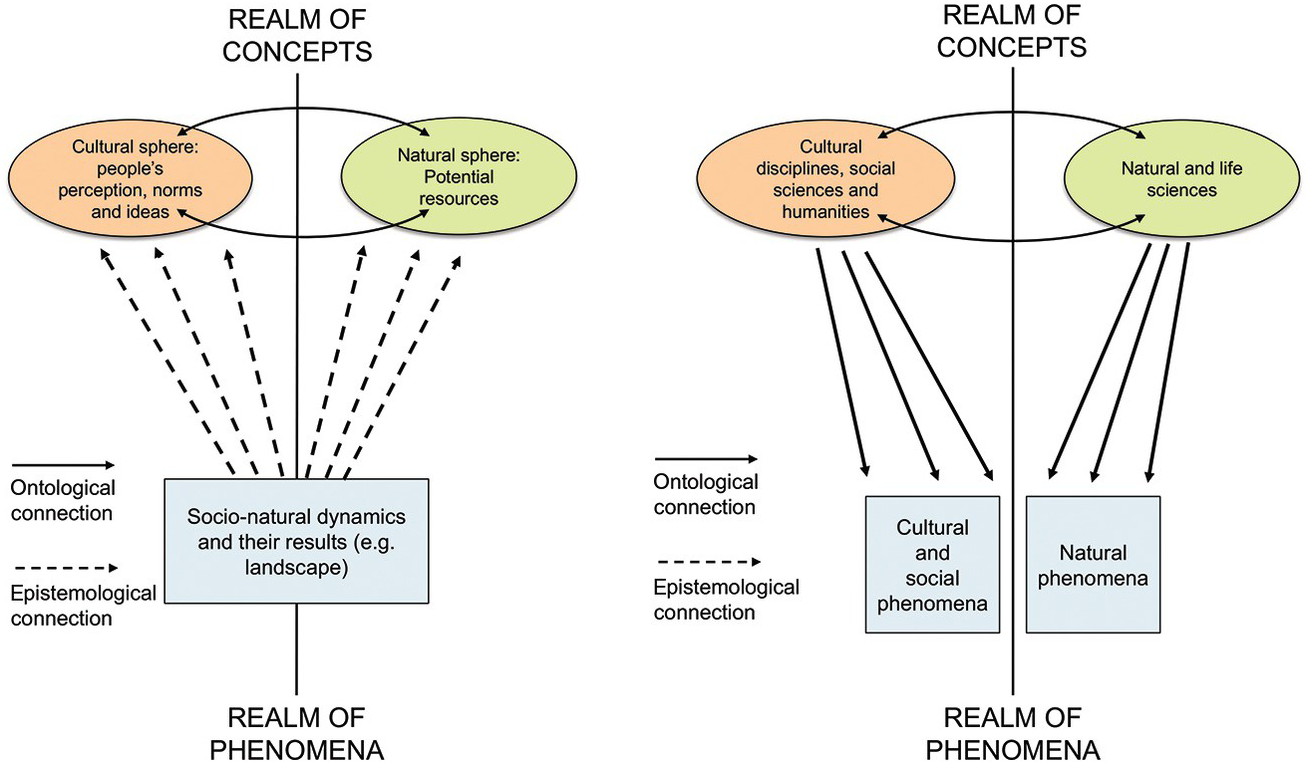
Figure 3.2 The emergence of disciplines inverts the logic of science. Whereas initially the link between the realm of phenomena and that of concepts is epistemological, once methods and techniques formed the basis of disciplines, these links became ontological: from that time on, gradually, the methods and techniques learned began to dominate the choice of questions and challenges to investigate. This stimulated increasingly narrow specialization, and led to difficulties of communication between disciplinary communities.
In particular, this shift from a science driven by shared curiosity and the will to better know or understand the natural and social phenomena that we live amongst, to a science driven by an acquired set of questions, premisses, assumptions, hypotheses, methods and techniques, had as a major consequence that the incomplete but holistic views that had characterized much of seventeenth- and eighteenth-century investigation were replaced by numerous, in themselves more coherent, but fragmentary perspectives on our world. And in particular, it solidified the differences between the natural sciences on the one hand and the humanities on the other.
In summary, the past hundred years appear to have witnessed the culmination of the impact of materialistic monism as an explanation and, through the industrial and technological revolutions, as a way of life. One of its crowning achievements thus far is the research on DNA and on the human brain. Between the pincer movements of on the one hand deriving Mind from Matter (Delbrück Reference Delbrück1986) and on the other having the essence of human individuality evolve from nonliving substances which govern the uniformity and diversity of all living beings, humanness seems inexorably trapped. Is it?
The trap that we are talking about is essentially a tangled hierarchy (see Figure 3.3), a situation of oscillation between two terms which, through the complex set of ties which link them, keep each other in a dynamic, approximately stable, equilibrium – not unlike two rivals, each alternately gaining the upper hand for a short time without ever completely defeating the other (Dupuy Reference Dupuy1990, 112–113). That which is superior at the superior level becomes inferior at the inferior level – inverting the hierarchical opposition within itself, according to the scheme presented by Dupuy. But, of course, such an inversion is not really a way out of the dilemma because all it does is maintain the same hierarchy and the same barrier, but from the other side.
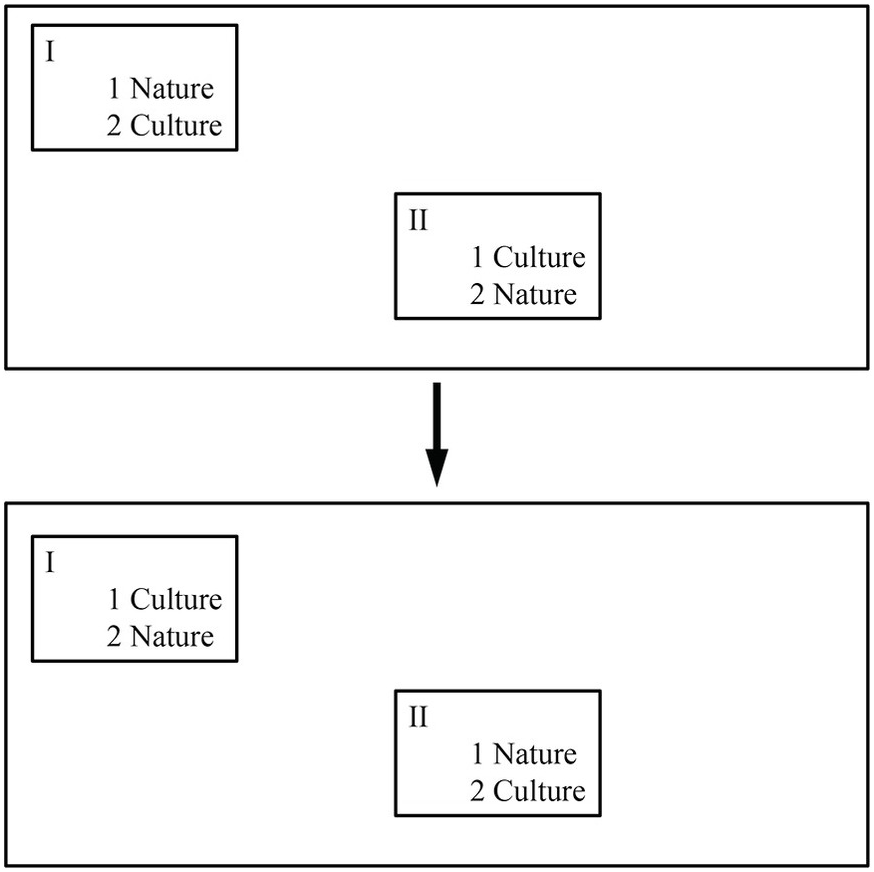
Figure 3.3 Two versions of the tangled hierarchy between nature and culture. Inverting the hierarchy (from the top to the bottom version) does nothing to solve the problem of the opposition of the two concepts.
The only way out is, of course, to negate the opposition and construct a kind of science that does not fall into this trap. In Chapter 4, I will propose that this requires a rethink of our analytical approaches and methodologies from a uniform, holistic perspective.
The Instrumentalization of Science
But before we discuss a possible way out of this dilemma, we must first have a look at how the societal context of science has changed, in particular over the last eighty years. Some of this is due to the evolution of the sciences itself, while other developments are of societal origin. The interaction between the two has had profound effects on both.
These developments have to be seen against the backdrop of two long-term trends. The first of these is the acceleration of innovation since the industrial revolution, and the second the increasing dominance of money as a societal value.
The industrial revolution, and in particular the increasing availability and use of fossil energy has hugely reduced the cost of innovation, which does to a much greater extent consist of the cost of integrating inventions in society than of the cost of producing the inventions themselves. This is an important point that has not usually been taken sufficiently into account in modern innovation studies. In archaeology, it is evident for example in the delay of seven centuries between the invention of ironworking in Asia Minor (c. 1400 BCE) and the transition from the Bronze to the Iron Age in Central and Western Europe (c. 700 BCE). Bronze manufacture is constrained by the availability of the necessary metals (copper and tin). Bronze objects were exchanged all over Europe from a few locations where these materials were found. Iron manufacture is not constrained materially, as iron is found everywhere in streams and marshes. But for some 700 years it was socially constrained because society in Europe was based on power structures related to bronze production. To lift that constraint society had to undergo far-reaching societal changes that broke down the existing power structure, which happened from around 600 BCE. In Scandinavia this proved much more difficult, and the Iron Age did not begin there until the Viking period (c. 700 AD).
An example in the modern period that makes this point with great clarity is the work of Lane and Maxfield (2009) on the effort the Echelon corporation had to expend to get some markets to open up to their major innovation, LonWorks, a distributed information processing package. This involved the creation and maintenance of what Lane and Maxfield (Reference Lane, Pumain, van der Leeuw and West2009) call “scaffolding structures” to maintain the innovative dynamic against very major conservative forces supported by the likes of Honeywell et al. In the United States, they did not succeed and Echelon initially lost the battle for the innovation, but in Italy they did succeed. LonWorks is still current In Italy, and that base allowed the corporation to survive and subsequently build out its presence in the United States with a focus on the Internet of Things.
A second dynamic that has contributed to the acceleration of innovation is the increase in population that has been enabled by developments in sanitation and health as well as education, particularly in cities. It appears that there is a clear positive nonlinearity between population size and the rate of innovation (e.g., Weinberger et al. Reference Weinberger, Quiñinao and Marquet2017), and in particular in cities (Bettencourt et al. Reference Bettencourt, Lobo, Helbing, Kühnert and West2007; Bettencourt Reference Bettencourt2013) when one applies an allometric scaling approach to this relationship. Although there is a debate about the nature of the relationship and the precise shape of the curves that it generates, in my opinion this relationship expresses the fact that the more people are together, the more ideas are generated. I think one can justifiably generalize this argument to apply to human interaction levels in general, as shown in Chapter 11. If that is so, one can argue that the limited interaction in the form of exchange and commerce since the Middle Ages has contributed to the absence of acceleration in innovation until the Industrial Revolution.
As part of that dynamic, I would argue that over the past several centuries we have also seen an accelerating shift from innovation that principally responded to explicit, conscious, and widely experienced needs, to innovation in which inventions meet demands that have not (yet) been widely articulated, or that future users are unaware of, as in the case of many uses of the smartphone or the vast numbers of newly assembled chemicals.
At the same time, in particular during the last eighty years, the increasing emphasis on productivity and more generally on wealth as the major indicator of wellbeing of people, communities, and nations, which has been one of the results of the take-over of many institutions by economists, has seriously reduced the value space by which we judge our wellbeing. This has led to a more and more short-term and financial valuation of many aspects of our societies.
As a – more or less arbitrary – starting point for sketching the changes in science and its role in society we’ll go back to the middle of the nineteenth century. Since the 1850s, major scientific discoveries have enabled new, major industries to emerge (e.g., anilin dyes in the 1850s; Bessemer process for the production of cheap steel in 1883; synthesis of aspirin in 1897; Haber-Bosch process for synthesis of ammonia for munitions and fertilizer in 1915), and this set in motion a trend in which the natural sciences and various industries developed a partnership that was highly profitable to both. In the years since, this has led to the ever-increasing imbrication of the sciences in many, many aspects of the wider economy that is part of our current societies, especially after the wave of innovations that was triggered by World War II: radar, airplanes, television and telecoms, medicine, and so forth.
Among other things due to the Manhattan project (the construction of the first A-bomb) and the victory over Japan that was closely associated with it, belief in the potential of the sciences was at its zenith in the 1950s to 1970s. Then, while the trust in science itself seems to have remained more or less stable (Funk & Kennedy Reference Funk and Kennedy2017), slowly but surely, a more critical attitude developed toward the contribution of science to wider society, possibly as a consequence of decreased understanding of current science (Royal Society 1985) or as part of a more general decrease of trust in society’s institutions (Turchin Reference Turchin2010, Reference Turchin2017; Jones & Saad Reference Jones and Saad2016; Rosenberg Reference Rosenberg2016) due to increasing instability of our socio-political systems.
In the political arena, the Mertonian scientific ethic (Merton 1973) emphasized that scientists should always give an impartial opinion based on research in order to keep the trust of society. That trust had led to an increasing use of science as an argument in political debates, and ultimately to a close relationship between scientists and many social and political institutions that paid scientists in order to obtain scientific results that could convince the wider public of the advantages of certain proposed measures. But that close bond over time turned into a source of mistrust of the sciences because they were increasingly seen as representatives of the established bureaucratic, top-down, order and thus as a threat to the bottom-up social order that many communities have established for themselves (e.g., Wynne Reference Wynne1993).
Since the 1990s, as the wealth of the developed nations is less and less able to meet the cost of their social and material infrastructure (including education, social security, armies, and bureaucracies), the above developments have had consequences for the funding of science. Such funding has changed character in these countries, shifting from government-funded fundamental research to more and more industry-funded applied research, and from strategic, long-term innovation based on new scientific discoveries to tactical innovation based on recombining existing technologies. This is for example visible in the patents that are accorded by the US Patent office, which increasingly concern the combination and elaboration of existing technologies rather than inventions that can lead to completely new technologies (Brynjolfsson and McAfee Reference Brynjolfsson and McAfee2011; Strumsky and Lobo Reference Strumsky and Lobo2015). This trend set in motion a feedback loop that caused governments to fund less and less research in response to the fact that scientists are seen as not sufficiently responsive to the needs of society, so that funding is increasingly undertaken by industries for their own sake.
Regaining Trust
Given the need for scientific leadership to find ways to respond to the accumulated challenges that humanity is facing in the twenty-first century, how might scientists regain the trust of society? One important, almost self-evident but often ignored element of such a way forward would be the realization that scientific results and opinions, just like all statements, are not evaluated in isolation, on their merits alone, but in the contexts in which they are shaped and received. There is no such thing as scientific objectivity or neutrality. Even if the ways in which answers are obtained to scientific questions may be objective, the questions themselves are subjective, as they are impacted by societal and cultural as well as individual institutions, norms, and values. Similarly, scientific opinions are evaluated against the backdrop of the situation in which they are expressed, but also against the institutional and personal credibility of the person expressing them.
Luhmann (Reference Luhmann1989, 99) has expressed this with respect to environmental understanding by asserting that “a society cannot communicate with its environment, it can only communicate self-referentially about its environment within itself” (1985, 99). He views society as a self-organizing (social) system of communications, based on complementarity of expectations among individuals. These expectations are guided by values and meanings, which in turn relate exclusively to other values and meanings, and their constitution prepares the way for further communicative alternatives. Communication is therefore not seen as a transfer of information but as the common actualization of meaning. In the process, the complexity inherent in social interaction is reduced by harmonizing or aligning the perspectives of the actors. Everything that functions as an element in the communications system of a group is itself a product of that system. I will return to this fundamental insight; at this point it suffices to point out that it implies that there are no absolute truths or realities.
It follows from this evident statement that we should, as scientists, accord much more importance to our relationships with the contexts in which our ideas function in society. An evident case in point is the idea – inherent in our current tactical thinking – that we have to find solutions for the challenges we are facing. As I have argued elsewhere (van der Leeuw Reference van der Leeuw2012, see also Chapter 10) most, if not all solutions create their own (unintended and unforeseen) challenges. As what we consider to be such solutions are dictated by the values of our society, we are indirectly also responsible for those challenges.
But this reconsideration will necessarily also involve the institutional contexts in which we do research, the ways in which we express our results, and whether or not we take positions on certain issues. If we have solid scientific evidence for a major future train wreck such as climate change, and we have ideas about how to avoid it, do we limit ourselves as scientists to presenting the dilemma to the general public, or do we argue for certain solutions, as opposed to others?
It is not the goal of this chapter or this book to delve into ways to improve the credibility of science. That is better left to colleagues in the Philosophy of Science and Science and Technology Studies. But it will be indispensable to work toward reflexively recognizing that science is conditional, in the hope that this will lead to a critical examination of our fundamental, pre-analytic assumptions that shape the character and content of our visions and scientific knowledge and understanding.
One of the fundamental aspects of any such examination is the fact that our knowledge of the natural phenomena that many of us consider to be independent of human behavior and impact, such as gravitational fields, the speed of light and similar phenomena, is in effect dependent on our observations, and thus on our cognitive capability. This is a relatively novel but highly important realization that is beginning to permeate the natural sciences through the writings of eminent scientists such as Hawking (see his Brief History of Time (Reference Hawking1998), and Wheeler’s introduction of the Participatory Anthropic Principle (1990), where recent research into the origin of the laws of nature indicates that conscious observation may play a role. By implication, even physicists might have to pay more attention to the cognitive and social sciences to understand what they are seeing.
In that examination, we must also more closely connect the different scientific and nonscientific communities in order to better take into account the social and societal context of our scientific constructs. Scientific reasoning and understanding are indeed impossible to control scientifically. But, as such a program is contrary to the thrust of modern science, which is directed at imposing a degree of control over the reasoning and the identity of science, we cannot expect that such reflexivity will be easily adopted by the scientific community, nor that the majority of humanity will greatly increase its “scientific knowledge and understanding.” But we must try.
Introduction
While it has been successful for a long time, reductionist, disciplinary, “linear” science is increasingly being confronted with highly complex problems that it cannot usually solve. This is partly because of the increasing fragmentation of the intellectual/scientific landscape into narrower and narrower disciplinary communities, following the institutionalization of science that I referred to in Chapter 3. This has hugely increased our understanding in certain areas, but at the same time it has left large, unmapped, and unexplored gaps in our understanding.
Another important contributing factor to this situation is the accumulation of unintended and unexpected consequences of earlier societal actions, which I will be discussing at length later in this book (Chapter 10; van der Leeuw Reference van der Leeuw2012). Unobserved for a long time, owing to the acceleration of innovation since the Industrial Revolution, these consequences are becoming noticeable in many domains, revealing the underlying complexity of the systems we are dealing with.
Hence a more diverse and multidimensional science is emerging, better at taking contexts into account, and exploring the domains that disciplinary sciences have not.
To place this development in context, I must go back to the emergence of modern universities and the concomitant structuring of academic disciplines into departments and faculties. As previously mentioned, this led to the fragmentation of our scientific worldview and to the tangled hierarchy of the sciences, the social sciences, and the humanities that is still a dominant feature of academia and the global research community.
Tangled hierarchies like this exist in principle between any two disciplines, because once a scientist is brought up within the constraints of a particular discipline, all other disciplines are “others,” and therefore themselves subject to the social, organizational, and administrative dynamics that distinguish it from any others. Insiders will thus value “their” discipline higher than outsiders, and outsiders will value theirs higher.
How can we disentangle such hierarchies? There are not many methods (van der Leeuw Reference van der Leeuw and van der Leeuw1995, 31–32). We have seen that for Dupuy (Reference Dupuy1990) disentanglement consists of a double reversal of the hierarchies entangled within themselves (Figure 3.3b), so that where nature was first, culture becomes first, and where culture was first, nature becomes first. But as I mentioned in Chapter 3, this would merely twist the tangle the other way around – responding to one of Jonas’ points (Reference Jonas1982, 17): “if humanity is just a part of nature, then what sense does it make to suppose that nature may not have properties similar to our own?” Jonas’s point has led to many developments in ethology, eroding boundaries between humans and nature; dolphins seem to have names, chimpanzees cultures, orang-utans dialects, etc. The fundamental question in all these cases is whether or not – and if so, how far – we project our own human characteristics onto the species concerned. After all, our understanding of the outside world passes through, and is constrained by, our human cognitive system.
One could also try to impose a sort of arbiter, as Aldo Leopold does with his “land ethic” (Reference Leopold1949). Central to Leopold’s philosophy is the assertion to “quit thinking about decent land use as solely an economic problem.” While recognizing the influence economics has on decisions, Leopold understood that, ultimately, our economic wellbeing cannot be separated from the wellbeing of our environment. It was therefore critical for him that people have a close personal connection to the land. “We can be ethical only in relation to something we can see, feel, understand, love, or otherwise have faith in.” Such a “land ethic changes the role of Homo sapiens from conqueror of the land community to plain member and citizen of it … it implies respect for his [non-human] fellow-members, and also respect for the community as such” (Leopold, Reference Leopold1949, 239).
But the problem with this is that humans cannot (and should not) devise the ethic for other beings, as we cannot experience them other than as “the Other” – i.e. without understanding or feeling or any other form of real contact. Thus, this option would lead to an acceptance of a natural chaos, in which for each living being, each aspect of nature, we would impose the same total and absolute freedom as Hinduism allows for cows in India.
Evernden (Reference Evernden1992, 94) proposes to radically admit the fictional nature of the opposition (see Figure 4.1). That is, if we want to prevent the realms of humanity or history from becoming subcategories of nature, we will have to admit to ourselves that nature is in fact a subcategory of culture – that we are, after all, the authors of the system we call nature. And moreover, that we are the authors of the dualism that facilitates the existence of humans and nature as separate and qualitatively distinct entities. We will have to admit our own role in the constitution of reality, which in turn means admitting something quite fundamental about the nature of our knowing (see Luhmann Reference Luhmann1989; van der Leeuw 1998 for two other lines of argument that come to the same conclusion), i.e. that it is self-referentially construed by society on the basis of its very limited perception of extremely complex phenomena. Then one would bring all disciplines to bear on the study of socioenvironmental dynamics, acknowledging that there is no social subsystem nor an environmental one, but that there are only human perceptions of, and actions on, the social and natural environment that are directed by the human cognitive system (McGlade Reference McGlade1995). This would necessarily mobilize the full range of disciplines and scholarship in an attempt to improve understanding of the complexities involved.
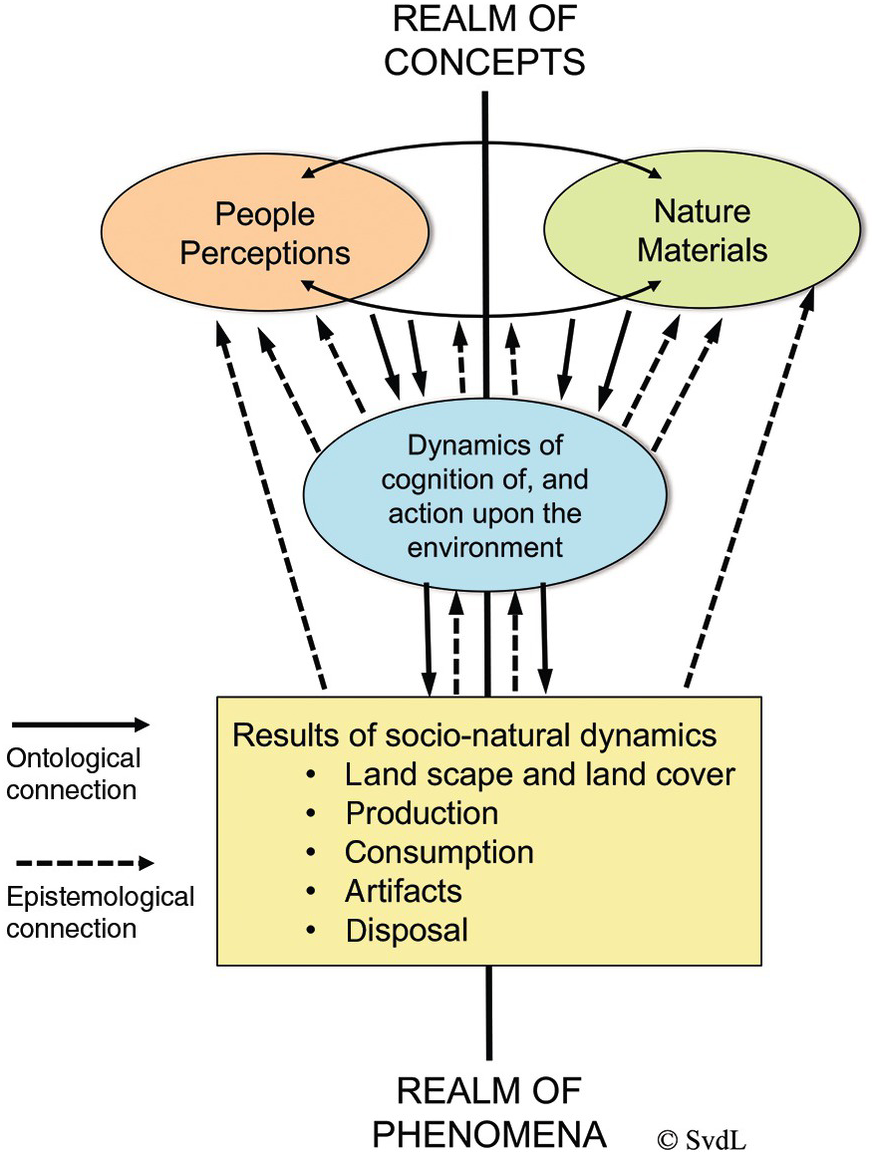
Figure 4.1 Doing away with the natural and the societal subsystems.
This seems in many ways the cleanest solution, but it raises an important question: “How would one realize such a reintegration of nature within the realm of culture, while acknowledging that we cannot go back to a state of innocence or naiveté in which vitalism is reinstated as the dominant doctrine?” Many scientists in different (combinations of) disciplines have tackled this issue over the last century or so, attempting to get to the point at which the implied integration of many disciplines into a holistic perspective is successfully completed.
Those attempts have gone through a number of phases, from inter-disciplinary to multidisciplinary’ to transdisciplinary and most recently proposals for undisciplined research. It is the goal of this chapter to discuss some of the challenges that transdisciplinary science has to deal with if it is to live up to its promises. But I will begin with a brief description of how I understand these concepts in order to clarify how they will be used in the remainder of this book.
Interdisciplinarity
The term interdisciplinary implies the use of methods and insights of several established disciplines or traditional fields of study, with a focus on questions that are not raised in the scientific disciplines themselves. Although eclipsed in the last two centuries by the disciplinary organization of scientific research that was brought about by university organization, interdisciplinary research has a long history, according to some going back to the ancient Greek philosophers (Gunn Reference Gunn1992).
Interdisciplinary research is about creating new ideas and approaches by crossing boundaries, thinking across them to connect and combine different academic schools of thought, professions, or technologies in the pursuit of a common task (such as investigating sustainability issues). Interdisciplinary strategies are often applied when a subject seems to have been neglected or even misrepresented in the traditional disciplinary structure of research institutions, creating gaps in our intellectual map. In other instances, interdisciplinary approaches are applied when the topics involved are too complex to be dealt with within single traditional disciplines (among them the so-called wicked or hairy problems mentioned in Chapter 2).
The main intellectual challenge in interdisciplinary research is that the different disciplines involved have their own specific perspectives, questions, methods, epistemologies, and sources of information. Combining these in a fruitful way requires proficiency in, and deep understanding of, the disciplines involved, and is therefore far from easy to attain. As long as the number of disciplines involved is limited, a single individual may be able to achieve this; but as we will see in the next section, it is much more difficult to achieve if it involves teams of scientists trained in different disciplines.
In Table 4.1, I point to some of the differences between the natural and social sciences, and a possible way in which we can look at them in an integrated manner.
Table 4.1 Differences between natural history and human history as an example of the differences between natural and humanistic approaches to environmental research, and suggestions toward creating an encompassing integrated approach to socioenvironmental dynamics.
Clearly, Table 4.1 covers only a very limited number of the differences, and the solutions proposed are very tentative. It merely aims to give a general idea of the complexity of what is required to truly integrate these two kinds of approaches.
Moreover, in an overwhelming majority of institutions there are numerous administrative and organizational barriers to such interdisciplinary work, but as these also hold for both multidisciplinary and transdisciplinary research they will be dealt with later in this chapter.
Multidisciplinarity Results in a Bee’s Eye View
Let us now look at the perspective that is gained by attempting to tightly bundle together the results of a much wider range of disciplines. Wikipedia (April 25, 2016) defines a multidisciplinary approach in much the same way as an interdisciplinary one: “drawing appropriately from multiple disciplines to redefine problems outside normal boundaries and reach solutions based on a new understanding of complex situations.” The difference seems to be in the number of disciplines involved and the difficulty of integrating them.
One widely used application of this approach is in health care, where people are often looked after by a multidisciplinary team that aims to address their complex clinical and nursing needs. In such situations, every person involved (except the patient) has expertise and a task of his or her own. The collaboration is effective because all tasks are devoted to getting parts of the patient better, and the patient’s body integrates the efforts into a synthetic one. This is also the case with sustainability, the study of the health of the planet, which involves a very large number of disciplines that each have (at best) a positive effect, while the synergy between the approaches is provided by the socioenvironmental system. In neither case is there intellectual fusion between the expert scientists involved.
Historically, the first practical use of the multidisciplinary approach was during World War II, when the Lockheed Aircraft Company set up its own special projects operation – famously nicknamed the Skunk Works – in 1943 to develop the XP-80 jet fighter in just 143 days. During the 1960s and 1970s, the multidisciplinary approach spread across the academic world, initially among disciplines with a practical purpose, an example being to architects, engineers, and quantity surveyors who worked together on major public-sector construction projects with planners, sociologists, geographers, and economists. Somewhat later, spearheaded by fields such as geography and archaeology that were defined by either space or time rather than by a particular approach or set of questions, multidisciplinary approaches quickly spread to many other scientific domains.
Each of the disciplines involved presents the observer with a (sometimes only slightly) different view of the subject of study because it brings to bear slightly different questions, as well as different methods and techniques. The information gained by each discipline is therefore in itself coherent, valuable, and focused on a specific question or topic, but it is couched in terms designed by the communities that are responsible for the different disciplines and is therefore not easily fused with information gathered by other disciplines. Bringing the results of such efforts together in a single perspective often has difficulty transcending the lowest common denominator, and tends to be more simplistic (and often functionalist) than one could wish for.
This is in part because the practitioners of such multidisciplinary research often have the wrong expectations. They expect “knowledge” and the possibility to seamlessly integrate results from different disciplines as if they were equivalent. In striving for clarity, such an approach loses sight of the fact that most complex phenomena are multifaceted and so rich in information that a single coherent picture of them is at best a very partial representation.
In my opinion all we can hope for is what could be called a “bee’s eye view,” a multifaceted picture that can provide some insights if one is prepared to accept the fracture lines between the facets and make a number of “leaps of faith” across them (van der Leeuw Reference van der Leeuw and van der Leeuw1995, Reference van der Leeuw, Audouze, van der Leeuw, Favory and Fiches2003). Although that goes against our (culturally determined) tendency to insist on clarity and simplicity of explanation, such a bee’s eye view is not necessarily a disadvantage in dealing with complex information: most insects that have faceted eyes manage very well with them. But it does require that the scholars involved are able to function while holding contrasting or opposing ideas in mind.
To distinguish the results of such an approach from the traditional and interdisciplinary ones, one might perhaps suggest that what we strive for is sufficient understanding (as opposed to knowledge) to be able to begin dealing with complex phenomena. This distinction is introduced to highlight the fact that multidisciplinary investigations do not aim for the same degree of coherence in their explanations as traditional disciplinary ones. Because we believe such coherence can only be achieved for very simple phenomena (if those exist), we hope to compensate for that by gains in the applicability of our understanding to the (inherently complex) real world.
Transdisciplinarity, Intellectual Fusion, and Linking Science and Practice
Transdisciplinary science is for the moment the latest acknowledged stage in this development, explicitly connoting a research strategy that crosses many disciplinary boundaries to create a holistic approach. Crow emphasizes that this requires “intellectual fusion” (Reference Crow2010).
Transdisciplinarity signifies a unity of knowledge beyond disciplines. Jean Piaget introduced the term in 1970, and in 1987 the Centre International pour la Recherche Transdisciplinaire (International Center for Transdisciplinary Research, CIRET) adopted the Charter of Transdisciplinarity at the First World Congress of Transdisciplinarity in Portugal.
As the prefix “trans” indicates, transdisciplinary science concerns that which is at once between the disciplines, across the different disciplines, and beyond each individual discipline. Its goal is the understanding of the present world, of which one of the imperatives is the overarching unity of knowledge. In its approach, transdisciplinary science is thus radically distinct from interdisciplinary and multidisciplinary science. These latter approaches concern the transfer of methods from one discipline to another, allowing research to spill over disciplinary boundaries but remaining within the framework of disciplinary research. Transdisciplinary science explicitly crosses these boundaries and strives for intellectual fusion among the ideas of practitioners of different disciplines and research and practice domains.
But it does more. Transdisciplinary approaches also attempt to cross the boundaries between the realms of ideas and phenomena, and between science and society, by including stakeholders from civil society in defining research objectives and strategies to better incorporate the diffusion of learning produced by the research. Collaboration with and between stakeholders is deemed essential – not merely at an academic or disciplinary level, but through active collaboration with people affected by the research and community-based stakeholders (Thompson-Klein et al. Reference Thompson Klein, Grossenbacher-Mansuy, Häberli, Bill, Scholz and Welti2012). In this way, transdisciplinary collaboration is expected to become uniquely capable of engaging with different ways of knowing the world, generating new knowledge, and helping stakeholders understand and incorporate the results or lessons learned from the research.
This kind of transdisciplinary approach is the only one of the three that can even attempt to deal with the “hairy” or “wicked” problems introduced in Chapter 2. What are they? The concept was first introduced by Churchman in 1967, to distinguish between those problems that could be solved once and for all and those that could not. As Xiang defines them (pers. comm. 2015), “Wicked problems can be suppressed or even overcome, but cannot be eliminated, and will recur, often in different and more wicked forms. Many, if not most, problems in human activity systems in general, and in socio-ecological systems in particular, are wicked.” Such wicked problems are highly multidimensional, and the various contributing dynamics are so unstable that there are no permanent solutions. They recur time and time again and are often the main staple for political decision-makers.
I will discuss the relationship between transdisciplinarity, complex adaptive systems approaches, and wicked problems further in Chapter 5, but for now I will move on to discuss some of the difficulties involved in transdisciplinary research.
Barriers to Practicing Transdisciplinary Science
Apart from the intellectual difficulties of overcoming tangled hierarchies and bringing the contributions of many disciplines together in an intellectual fusion, there are a number of other barriers to the practice of transdisciplinary science, which range from the cognitive to the psychological to the organizational. In the cognitive field, I have already referred to the limits of the human brain’s short-term working memory to deal with more than seven or eight sources of information simultaneously (Read & van der Leeuw Reference Read and van der Leeuw2008), which makes it difficult, if not impossible, to deal with challenges that are of a much higher dimensionality. Moreover, our theories are underdetermined by our observations (Atlan Reference Allen and Hoekstra1992), so that our reactions to challenges are usually overdetermined by past experiences. Another issue here is the bias in category formation toward either similarity or dissimilarity that I refer to in Chapter 9, based on the work of Kahnemann, Tversky, and others (Tversky Reference Tverski1977; Tversky & Gati Reference Tverski, Gati, Rosch and Lloyd1978; Kahnemann et al. Reference Kahnemann, Slovic and Tverski1982). At issue in the psychological field, for example, is the important debate about whether choices are primarily determined emotionally or rationally (Elster Reference Elster2010). From an organizational perspective, one of the important issues is the structure of the team, and in particular the extent to which the structure of the team network is organized along vertical and horizontal lines of communication, and its degree of redundancy. All of these are currently important subjects of research that are aimed at reaching a better understanding of the underlying dynamics in transdisciplinary teams (see Stokols Reference Stokols2006; Gray Reference Gray2008).
But there are also several issues that do not generally receive much attention. I will briefly point to some of these before moving on to a description of some of the qualities needed for true transdisciplinary research efforts and how we might promote these in higher education. In doing so I will begin with individual challenges, and then move toward organizational and administrative ones.
At the individual level, there are at least two major challenges. The first of these is a lack among many scientists of the skills that are necessary to effectively and efficiently implement transdisciplinarity. Education will help overcome this (van der Leeuw et al. Reference van der Leeuw2012; Wiek et al. Reference Wiek, Xiong, Brundiers and van der Leeuw2014; and many others). But there is an underlying problem that is at least as important that is not so often discussed: the challenge of changing identity.
Becoming a scientist is an important investment not only in time and money, but also in one’s own human capital. For at least a decade, but often much longer, a scientist will have invested herself or himself in learning the tools of a particular discipline, practicing it, publishing in it, and getting to be known in an increasingly wide community of scholars who are more or less aligned with his or her ideas. In the process, the scientist, if she is competent, will have acquired the respect of that community for the knowledge, understanding, skills, or other talents that constitute the requirements for a scientific career. In effect, the effort has given the person involved a scientific identity that is closely related to the field and the community that is his or hers. Over time, unless the scientist changes careers or disciplines, that identity will become stronger and stronger, in the eyes of the scientist concerned as well as those of the community.
Transitioning to inter-, multi- or transdisciplinary research forces the scientist to give up part of that identity in order to, slowly but surely, assume a new one. This is very difficult for many people; not only because it takes another major investment, but also because until that new identity has solidified, the person does not have a firm and fixed context within which to operate. In such situations, many people are insecure. They do not know the unwritten rules of the new game, have not yet become part of the new like-minded intellectual community, let alone gained the respect that was theirs in the discipline in which they were originally trained. When one adds to this the fact that many of the epistemological differences between disciplines are not clear to their practitioners, because they are buried deep in the core of a discipline’s thinking and are not explicitly acknowledged, it becomes easy to understand why many people are not very keen on wholeheartedly making this kind of transition. They will pay lip service to it, even be part of a transdisciplinary team, but have difficulty achieving the kind of intellectual fusion that is the goal of the operation.
All this is not made easier by the fact that over well-nigh two centuries, formal and informal scientific organizations, rules, and institutions have evolved that reinforce and constrain such disciplinary communities. These impose – often rather strict – rules in each discipline on topics that range from “Which questions can be broached and which are out of bounds?,” “What is the correct format for reporting scientific experiments and results?,” “Which are valid hypotheses, confirmations, or even proofs?,” to “Where to publish in order to gain stature in the discipline?” (see for example Ingerson Reference Ingerson, Gunn, Hassan, Ingerson, Marquardt, McGovern, Patterson and Schmidt1994).
One example that is of direct relevance to us, and in which such constraints have until recently confined the discipline very strongly within clear bounds, is (macro-) economics. As expressed by Gowdy et al. (Reference Gowdy, Mazzucato, Page, van den Bergh, van der Leeuw, Sloan Wilson, Wilson and Kirman2016, 325–328):
… its perceived scientific foundations focus generally on narrow concepts of representative agents or average behavior (vs. populations of diverse behaviors in evolutionary approaches), equilibrium (vs. innovation, surprise, and selection dynamics) and markets (neglecting social networks of nonmarket interactions between agents). Economists’ research often focuses on efficiency in a static allocation framework, assuming that institutions, norms, and culture are outside the purview of economic analysis. By the middle of the twentieth century the common definition of economics had become the science of the allocation of scarce resources among alternative ends (Robbins Reference Robbins1935). Issues of formation (i.e., how institutions, norms, and culture develop and how allocative mechanisms feed back onto them) received some consideration, but they were generally to be found at the margins rather than at the center of analysis. Their marginalization led to some quite spectacular shortcomings of economic models, such as their failure to consider, much less predict, the possibility of catastrophic financial crises.
But the impact of such constraints is not limited to economics. Economics may be an extreme case, but similar constraints have to varying extents impacted most disciplines, including physics, climate science, ecology, sociology, and anthropology. Indeed, they have helped the alignment of disciplinary scientific communities by creating intellectual constraints around the domains they are involved in, and are thus in a sense tools that have helped create the disciplines and their identities.
Since World War II, and as part of the wave of rapid and huge expansion of scientific investment and effort in the developed countries that followed the war, which went along with a conviction that science could do just about anything, this dynamic has been reinforced by increasingly strict and formal top-down administrative rules, not only concerning the practice of scientific research, but also the funding of research, the career structures, and the evaluation of the scientists themselves. These were made necessary by the rapid upscaling of research effort, and therefore of the size of the research community, but they also strongly reinforced the existing management of disciplines and thus fundamentally changed the practice of science, particularly in many universities but also in research funding organizations.
The core of the structure that has been created is the ‘peer review,’ about which a great deal has already been written. I will therefore confine myself to a few short paragraphs. This ubiquitous institution on the one hand aims to, and generally does, ensure the quality of scientific work that gets funded or published, and the quality and productivity of scientists at different stages in their careers. However, it also severely constrains, in many cases, the range of scientific topics discussed, the questions raised, and the methods applied. As long as the principal aim of science was the maintenance of quality within disciplines, these constraints were reasonable and acceptable. However, in the development of a wider range of topics and collaborations between disciplines (whether inter- multi- or transdisciplinary), such peer reviews have to some extent hindered the development of novel ideas.
This is in part a generational problem. The people invited onto peer review committees are generally highly respected and senior scientists who do not participate in the scientific culture of the younger generations, the champions of scientific innovation and novelty. Moreover, reduced funding, competition between more and more journals and funders, as well as the increasing call for transparency and responsibility have added stresses to the system.
For many funding institutions, political oversight is limiting the kinds of science that they can fund. Moreover, especially if they fund research with public money, they have a tendency to avoid risk, and therefore to favor research of which they can, at least to some extent, predict the outcome. In the case of journals, the publication of longer papers has become difficult (this is in the process of changing owing to the rise of electronic publishing), while the topics, format, and language of papers have all been narrowed by editorial policies.
From the role of peer review in assessing the quality and productivity of researchers and university faculty, we move into the domain of administrative barriers to transdisciplinary research. I want to begin this section with the statement made by a well-known professor in sustainability science about his home institution. When confronted with a plan to open up such research and to implement new ways of organizing it, he answered: “I’d love to do this, but I cannot – my institution is perfect.” Of course, he expressed not so much his own vision, but the image that his institution had of itself.
Such institutional self-images are maintained by rules and regulations, and by quality and performance assessments of junior faculty and students. These involve peer review based on predetermined criteria (number of publications, prestige of the journals involved, amount of research funding raised externally in competitions, patents, teaching performance judged by students, etc.). One difficulty with this system is that because the criteria are predetermined, people are increasingly focusing their activity on them, and a substantive reduction in the diversity of research can be the result. This has been one of the persistent problems with the UK’s Research Assessment Exercises, for example (Strathern, 2003, pers. comm.). Once such a dynamic has been set in motion, and an increasing number of people have invested in it, the criteria are very difficult to adapt.
Another problem is that these evaluations are often undertaken by relatively small committees with three- or four-year mandates. Because of their size, there is a substantive possibility that they will be asked to pass judgment on domains or approaches that are at best marginal to their own interests and of which they do not have any intimate knowledge. Moreover, the members of such committees are themselves part of the communities they evaluate, so they have their own agendas. Although I do not in any way want to cast aspersions on the members of such committees, who no doubt make decisions honestly and seriously, I believe that the institutional context in which they work urgently needs review. The current situation is not only hindering the exploration of new research areas and topics, questions and methods, but is also beginning to undermine the value of some of the existing disciplinary research.
Competencies for Transdisciplinary Research
Wiek and colleagues at Arizona State University in the USA and Lange and colleagues at Leuphana University in Germany are among a growing number of leading young scholars in select universities (Maastricht University, Lund University, Stellenbosch University, Technical University of Catalonia, University of Tokyo) that are developing outstanding approaches to transdisciplinary education and training in sustainability. In this section, I will discuss some of their ideas about the qualities that are necessary for effective and creative transdisciplinary work.
Because sustainability problems and challenges have specific characteristics that differ from problems addressed in other fields, analyzing and solving sustainability problems requires a particular set of interlinked and interdependent key competencies. In the case of sustainability these qualities are in fact “functionally linked complex[es] of knowledge, skills, and attitudes that enable successful task performance and problem solving […] with respect to real-world sustainability problems, challenges, and opportunities” (Wiek et al. Reference Wiek, Withycombe and Redman2011, 204). In practice, having these competencies means that people “are able to enact changes in economic, ecological and social behavior without such changes always being merely a reaction to pre-existing problems” (de Haan Reference de Haan2006, 22).
Wiek et al. (Reference Wiek, Withycombe and Redman2011, 205) distinguish five different competencies (Figure 4.2): (1) systems thinking competency, (2) anticipatory competency, (3) normative competency, (4) strategic competency, and (5) interpersonal competency. Together, these are thought to enable the development of an integrated (transdisciplinary) research and problem-solving framework. The following example, drawn from the same paper, shows how these competencies can interact to create real-world results:
Let us assume that the ultimate goal of a sustainability activity would be to develop, test and implement strategies for sustainable urban development. This calls for a well-founded strategic competence. These strategies are intended to redirect urban social-ecological systems from unsustainable trajectories toward a sustainable future state. To this end, the current state, past developments, as well as future trajectories of the city are analyzed systemically and key leverage or intervention points in the system are identified. This requires systems-thinking competence, and these points are assessed against sustainability criteria (to identify critical trajectories and consider trade-offs), which requires normative competence. Based on new knowledge and learning, the strategies are conceptualized as being continuously adapted in order to redirect path dependent future trajectories in the city toward visions of a sustainable future, which requires anticipatory competence. The collaboration among a suite of urban stakeholders, including scientists, policy-makers, managers, planners, and citizens is critical for understanding the system’s complexity, exploring future alternatives, crafting sustainability visions, and developing robust strategies in ways that are scientifically credible, create shared ownership, and are conducive for action – all of which requires strong interpersonal competence.
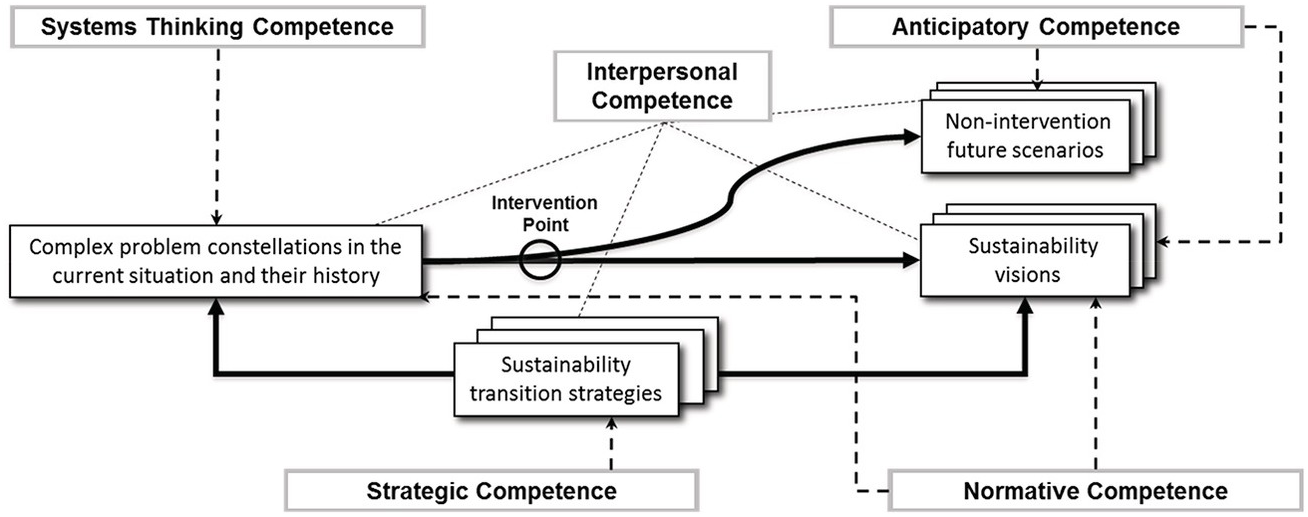
Figure 4.2 The five key competencies in sustainability (shaded in gray) as they are linked to a sustainability research and problem-solving framework. The dashed arrows indicate the relevance of individual competencies for one or more components of the research and problem-solving framework (e.g., normative competence is relevant for the sustainability assessment of the current situation as well as for the crafting of sustainability visions).
This is not the place to drill down into the ways in which the authors justify each competency in some detail, based on a wide survey of existing literature. For the purposes of this book, the above description must suffice, and the reader who is interested can find details in the paper itself. But there is one other important aspect of achieving transdisciplinary research and problem-solving that has not received enough attention – how we foster these skills and build sufficient capacity to deal with sustainability challenges across the globe.
For that purpose, based on work done in the medical sciences and in sustainability science in European universities (notably Maastricht and Aalborg), we have at Arizona State University implemented problem- and project-based learning (PPBL) to practice such competencies in real-world situations – dealing with challenges that were encountered in business, and by governments, NGOs, etc. (Brundiers et al. Reference Brundiers, Wiek and Kay2013). The key features of this approach are that it promotes student-centered, self-directed, and collaborative learning that focuses on real-world issues and involves stakeholder engagement. It does so by confronting a group of students who have different disciplinary backgrounds with an issue communicated by another organization. The students then unpack the issue and analyze aspects and elements of it, communicate with the stakeholders and among themselves – practicing each of the five competencies outlined above – and ultimately try and find practicable solutions. In the process, faculty will counsel and help, but the work is directed and executed by the students. PPBL thus requires students to actively and self-responsibly develop knowledge, skills, and attitudes, while being supported in reflecting on and deepening their learning experience and strategies. Furthermore, the outcomes expand beyond rich learning experiences by engaging cognitive, procedural, and affective knowledge domains, and also include the writing of policy-relevant reports, intervention manuals, and project proposals for submission to funding organizations (Brundiers et al. Reference Brundiers, Wiek and Kay2013).
In this manner, students are also confronted with the fact that they need critical thinking – or, to put it more starkly, that there are accepted immutable facts on which sustainability thinking is based, but that the complex links between them are always part of a particular perspective, and that there are always other perspectives. Once that is understood, they will realize that there are always alternatives to any choice made by the researcher. Such alternatives will have to be evaluated against each other from the perspective of intended and unintended consequences in order to make responsible decisions.
I would expect that once such approaches were commonly taught and practiced, the scientific community could set a further urgent, and in my opinion absolutely fundamental, step – from transdisciplinary to nondisciplinary or undisciplined research. Such research would bring all domains of knowledge and skills, academic, applied, and nonacademic, to bear on the fundamental issues our society is facing, mobilizing all talent available, for example by crowdsourcing answers to vexing questions or solutions to acute problems.
This would further be favored if people who are the best suited for such studies were to be recruited, with commensurate salaries, by businesses and positioned in senior executive functions where nondisciplinarity is practiced every day. In economics, finance, technology, law, trade, markets, industry, and government, issues such as the environment, human resources, strategy, long term vs. short term are among the topics that a senior executive is permanently dealing with. And a business can only be successful over the long term if its senior executives are able to fully integrate these various aspects.
Looking Far Back into the Past
Much sustainability science focuses on a relatively short period of human history, even though it may seem long to us, such as 50, or 100, maybe 200 years. That is justified on the one hand by pointing to the fact that the Earth and everything on it has undergone such drastic anthropogenic changes that the situation in earlier periods seems to be so different that at first sight it appears irrelevant. Another reason often invoked is that for periods beyond the last 100 or 200 years we do not have sufficient quantitative data about such things as the climate, the circulation of oceans, and other natural dynamics, so that in our increasingly quantitative science working on earlier periods is discounted.
But choices made in the past are the initial conditions of the dynamics of the present. Since their earliest days on this planet, human groups, whether as hunters, farmers, stock raisers, or urban residents, have continuously engaged in activities that alter and restructure the natural and societal order. Part of this process is a slow but fundamental change in the dynamic between man and nature that has occurred over a very long time (van der Leeuw Reference van der Leeuw, Berger, Nuninger, Kohler and van der Leeuw2007, see also Chapters 8 and 10).
At the beginning of the Holocene – some 10,000 years BCE – for example, we find in the Rhône Valley that there is only perceptible change in the terrestrial environment when both climate and people are pushing for such change in the same direction, such as is the case in the Neolithic (van der Leeuw Reference van der Leeuw1998b; Berger & van der Leeuw Reference van der Leeuw, Berger, Nuninger, Kohler and van der Leeuw2007). Currently, on the other hand, the overall socioenvironmental system has become so thoroughly integrated (“hyper-coherent”), that the slightest change in either climate or anthropogenic impact can push the terrestrial ecosystem out of balance. This is argued, for example, for the Little Ice Age in the sixteenth to nineteenth centuries CE, with three particularly cold intervals: one beginning about 1650, another about 1770, and the last in 1850, each separated by intervals of slight warming. They may have been due to volcanic eruptions that spewed such masses of various gases and fine dust into the atmosphere that the quantity of solar radiation reaching the Earth was temporarily reduced. The effect of this relative cooling of the Earth is noticeable in a number of economic and social indicators (Le Roy Ladurie Reference Le Roy Ladurie1967; Behringer Reference Behringer1999; Cullen Reference Cullen2010).
Similar long-term changes are noticeable in the spatial patterning of human activity. In the Neolithic (around 10,000 BCE), for example, settlement location in the Alpilles (France) was highly dependent on the environment, but over time the spatial aspects of human communication and information processing began to dominate and settlement patterns changed quite substantially. This is clearly visible in the European Iron Age (around 600 BCE) settlement pattern, when new, essentially trade-based, settlements emerged along rivers and at river crossings to complement the traditional settlements on hilltops that were based on agriculture and herding (Gazenbeek 1995).
Presently, humans are adapting less and less to nature; humanity is controlling the ecological dynamic - a symbiosis in which humans are responsible for the behavior and evolution of the natural environment has now developed in a number of locations. Landscapes have become “disturbance dependent”; that is, they have become dependent on human control to remain within a narrow range of states (Naveh & Lieberman Reference Naveh and Lieberman1984).
But, importantly, the consequences of past dynamics often still affect the present in many places, and we need to include them in our research. Hegmon et al. (Reference Nelson and Hegmon2001) show, for example, how the early indigenous agriculture in an area of the southwestern United States transformed patches of the landscape by systematically fertilizing them, creating black soils. Today, centuries later, these patches are still visible, and provide a better environment for agriculture than the areas around them. But in many parts of the world the reverse is also true, for example on northern China’s loess soils, which nowadays show spectacular erosion.
In summary, we must above all remember that complex phenomena such as the ones we are dealing with operate simultaneously at many, many different and interacting temporal rhythms and spatial scales, from seconds or minutes to seasons, years, decades, centuries, and millennia (see Allen & Star Reference Allen and Starr1982; Allen & Hoekstra Reference Allen and Hoekstra1992; Steffen et al. Reference Steffen, Sanderson and Tyson2005), and from microns to thousands of miles. Most research, however, has essentially been looking at a very limited number of interacting scales – most often only three (macro-, meso- and micro-). That has left most of the dynamics involved outside the scope of our investigations. Furthermore, the choice of scalar levels was often arbitrary from the perspective of the processes going on, but determined by the availability of either data or tools to analyze them, biasing the outcome of our researches and thus our understanding of the socioenvironmental dynamics.
As new techniques such as Arctic glacier coring, accelerator mass spectrometry radiocarbon dating, and isotope analysis of speleothems, among many others, begin to facilitate more precise measurement of climatic and environmental conditions going back tens of thousands of years, four major deficiencies of the focus on short-term dynamics are emerging.
The Importance of Slow Dynamics
Focusing mostly on the last couple of centuries overlooks very slow dynamics that may yet be important constraints or even drivers of shorter-term processes. One example is the millennial accumulation of low-level tectonic activity that shapes landscapes, such as in Epirus in Northern Greece. We are all familiar with major earthquakes, but often do not pay attention to the fact that in regions such as Epirus where they occur, there are also thousands of small shocks annually. The cumulative effects of such small shocks over thousands of years may shape the landscape more than heavier, rarer, earthquakes, and therefore constrain human action in and on the environment. Yet they are not noticeable as a major force when one only looks at their effects over years, decades, or one or two centuries.
Similar long-term dynamics impact the course of rivers, including the landscapes at their mouths. Yet another millennial phenomenon that is barely noticeable at an annual, decadal, or even centennial timescale is the rising or lowering of sea levels. Yet over time it too has (had) major consequences, in coastal areas, such as the western Netherlands, Northern Italy, the state of Louisiana in the USA, and most of Bangladesh and other river deltas, and for a number of low-lying islands in the Pacific.
But millennial effects are not limited to the natural environment. Human societies undergo long-term evolutions because of exogenous changes in the environment as well as endogenous changes that are inherent in society itself. Scientists are used to looking at the major changes that have occurred over the last few centuries, for example in technology and urbanization. But earlier periods have seen changes that, though much slower, are driven by fundamentally similar dynamics if one looks at them from a systemic point of view. From beginning to end, the Roman Republic and Empire evolved over 1,200 years, and the Chinese Empire even longer. Within such long periods the societal dynamics changed slowly but surely from expansion to contraction, to fragmentation to reconfiguration, and renewed expansion based on a different kind of organization. One can usefully think of this in terms of the approach proposed by Gunderson & Holling (Reference Gunderson and Holling2002) and the resilience community. They view any societal environmental system as a nested set of dynamic institutions. They see the dynamics that each of these institutions undergoes as constrained by potential and connectedness. In this discussion, potential is the extent to which a system can expand further while maintaining its structure, by increasing the scope of its organization and its energy flow. Connectedness represents, in the framework proposed here, the degree of alignment of the people, external processes, networks, and resources that constitute the information flow.
Much of the focus of the resilience community has been on studying the transitions that dynamic systems go through in their relationship with their environment. While not in the least arguing that history repeats itself, at the most abstract level they conceive of four major stages that the interaction between potential (= energy) and connectedness (= information) can drive any system through. By way of metaphor, they represent these phases as a lemniscate combining the four phases through which systems cycle, according to them. Because this metaphor is indeed a handy tool for thought (see Figure 5.1), I would like to discuss it briefly here, even though I am fully aware such metaphors are oversimplifications.
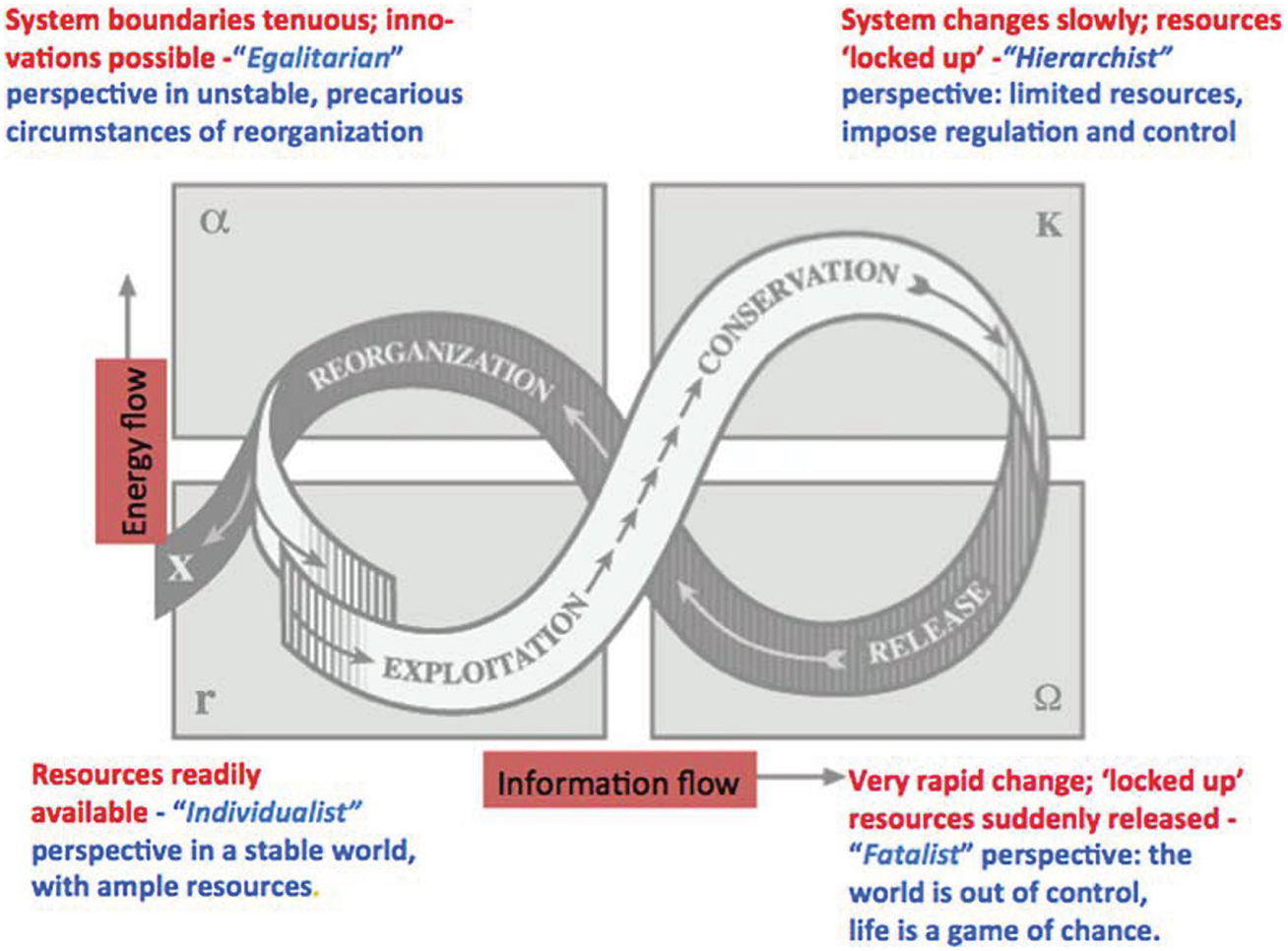
Figure 5.1 Schematic illustration of the resilience cycle. The red text describes the state of the ecological component of the system (after Holling Reference Holling1973, Reference Holling, Jantsch and Waddington1976, Reference Holling, Clark and Munn1986); the blue text describes the dominant perspective of the society (after Thompson et al. Reference Thompson, Ellis and Wildavsky1990). The interpretation in terms of energy and information flows is mine.
The first of the phases distinguished, exploitation, is the one in which a community grows based on a particular form of organization that permits an increase in energy flow in exchange for an increasingly coherent institutional organization, which increases its impact on the environment over time. As resources are overabundant, every individual has a chance to make something of his or her situation, and according to Thompson et al. (Reference Thompson, Ellis and Wildavsky1990), the culture is one of individualism. The phase of growth of the Roman Republic (until c. 200 BCE) and that of Europe between 1400 and 1800 are – to an extent – examples of this dynamic.
A crucial aspect of this phase is that the system suppresses structural innovation and institutional change because the dominant structure is (and later appears to be) so effective that there seems no reason to innovate. Because any institution is based on the exploitation of a limited set of resources, ultimately the growth curve involved levels off and the system’s effectiveness and growth decrease.
The next phase is that of conservation, in which the limits of expansion are appearing on the horizon and the community defends itself by becoming more regulated and hierarchical, as a consequence of the need to deal with increasing levels of conflict over resources (Thompson et al. Reference Thompson, Ellis and Wildavsky1990). Bottom-up power to achieve things is slowly but surely replaced by top-down power over people (see Foucault 1977) to control actions. We see this in Rome after c. AD 0, beginning in the political history of modern Europe after 1600, and coming to a head in around 1800. As the limits of the particular mode of organization become clearer, elements in the system may contemplate change. But generally, fundamental change is not implemented because the system as a whole is still aligned on the preexisting dynamics.
In the next phase, release, innovation is freed up once the system reaches a tipping point in which the potential for further growth of the existing structure collapses. The immediate result of that is a complete lack of institutional structure, a true chaos in which the system can transform in many different ways, but none of these profiles itself clearly enough to give a sense of direction. It is this phase that we have characterized as a crisis: the collapse of the existing structure results in the disaffection of people with that structure, and their inability to understand. This in turn leads, in Thompson et al.’s “cultural theory of risk” perspective (Reference Thompson, Ellis and Wildavsky1990), to a fatalist attitude. In effect, this is the kind of collapse that we see in Europe after the end of the Roman Empire, between 600 and 1000 CE. The fourth phase distinguished by the resilience community is that of reorganization – a phase of experiments with different forms of organization on a very local scale (Thompson et al. Reference Thompson, Ellis and Wildavsky1990). Once some of these succeed, one sees the slow but unstoppable growth of new forms of institutional organization bottom up, aligning more and more people. As the contours of the organization that will ultimately dominate are profiled, the institution itself will increase its potential, strengthen, and stabilize.
Particularly at the beginning of this part of the trajectory, people will seek local support, forming small and often egalitarian groups. With time, these will align with others, so that the structure can grow and form the basis for a new phase of exploitation – rooted in a different worldview and extracting a different set of resources from the environment.
Clearly, as presented here, this very schematic synthesis of such long-term evolutionary community transitions is insufficiently detailed to apply to any specific instance, but it accentuates the need to think over the very long term if one is to understand any present. One illustrative example of such an instantiation has been the work of the ARCHAEOMEDES team on the last couple of centuries of the history of the Epirus region in Greece (van der Leeuw 1998, Reference van der Leeuw, McIntosh and Tainter2000, Reference van der Leeuw2012, Reference van der Leeuw, Wilson and Kirman2016; van der Leeuw & Green Reference van der Leeuw, Green, Mazzoleni, Di Pasquale, Di Martino and Rego2004), but other instances abound, and have been studied worldwide (see www.resalliance.org/ and www.stockholmresilience.org/).1
We Need to Know the Healthy State of Our Planet
The second major problem with focusing on short-term dynamics is that looking back only one or two centuries limits our insights into the set of potential states of Earth’s socio-natural systems to those that have undergone major anthropogenic impacts, to the detriment of the system states that existed before any, or with little, human impact. It is as if a doctor were to look at a seriously ill patient without having any idea what a healthy person looks like. How could one then identify a sustainable future for the patient?
Over the last 300 years or so our planet has been thoroughly transformed by anthropogenic action, to the point that anyone living, for example, 2,000 years ago would not possibly recognize it in the present. Yet the state of the Earth system 2,000 years ago is a stage in the accumulation of initial conditions that have shaped the present. We need to know and understand such past dynamics between societies and their environments if we are to be able to fully appreciate what is going on today, because they enable us to widen our inquiry to a range of states of the Earth system that can no longer be observed today, and thereby change our perspective on the dynamics that have driven the changes involved.
For example, one would need to have a good idea of the state of socioecological interactions before the Industrial Revolution in order to be able to assess how the industrial paradigm that is currently dominant in the western world has changed agriculture by slowly, but surely, isolating the agricultural system from the wider ecology in which it was embedded, substituting artificial fertilizer and pesticides for the ecological processes that nourished crops and dealt with pests – in essence industrializing agriculture. And that process not only concerned what was happening on the ground, but also involved such things as mechanization and the emergence of modern marketing, transport, and other societal aspects of the system.
The Importance of Second-Order Change
Looking only at the short term ignores second order change in socioenvironmental systems – changes in the way change occurs and in the dynamics that drive it. This is a point that is of capital importance, yet is rarely discussed or taken into account. Over longer periods, the impact of drivers upon each other very often changes the process of change itself. Such second order change (the change of change) may concern a simple acceleration of certain dynamics or the emergence of one or more new feedback loops, but it may also be more consequential, for example when a conjunction of drivers tips a system’s dynamic into a different state altogether, as the crossing of several of our planetary boundaries threatens to do to the overall dynamics of the Earth system (Rockström et al. Reference Rockström, Steffen, Noone, Persson, Chapin, Lambin, Lenton, Scheffer, Folke, Schellnhuber, Nykvist, de Wit, Hughes, van der Leeuw, Rodhe, Sörlin, Snyder, Costanza, Svedin, Falkenmark, Karlberg, Corell, Fabry, Hansen, Liverman, Richardson, Crutzen and Foley2009b). An example from the sociocultural sphere, discussed in Chapter 3, is the way in which the Black Death of the fourteenth century initiated a transformation of the intellectual conception of the world in which people were living, leading to the “great wall of dualism” enabling and ultimately driving the overwhelming development of the natural and life sciences over the past six centuries (Evernden Reference Evernden1992).
Such second order changes are usually taking place over longer periods, and they can only be discerned by detailed study of the first-order dynamics over long time frames. That may be difficult, but this should not deter us from doing it. Understanding second order changes is fundamental to understanding the trajectories of societies and their environments, because such changes often reflect bifurcation points.
In an interesting study, Barton et al. (Reference Barton2015) have mapped the changes in the structure of the dynamics between corn production and urbanization in North America from the precolonial period (up to c. 1550), through the colonial (c. 1550–c. 1850) and the industrial period (c. 1850–c. 2000) to the present, with an extrapolation toward the future.
In that process, we see how the rapid growth of the urban population, especially in the USA, has both necessitated and been enabled by changes in the agricultural system, involving institutional, technological, legal, health, and ideational changes. What the study accentuates is how, through the whole period of almost five centuries, the feedback loops have evolved, mapping not only the dynamics within each of the three regimes, but also the second order changes between the regimes.
To explain these, and the path dependency that is the result, one has to go back to the precolonial period, in which the initial feedback loops between food production and urbanization were established. Only by doing that, and looking at the pressures and constraints at any particular stage, can one then understand the emergence of the next stage. Between the precolonial and the colonial stages, one aspect of the transition is, for example, the institution of the hacienda system, with concomitant changes leading to the commoditization of corn as a cash crop that is tradable in increasing volumes. It is part of a process in which. owing to a decrease in the indigenous population (and the know-how that it had), Spanish technology takes over, the indigenous population is looked down upon, and its health suffers.
In the next stage, driven by industrialization in North America, the ejido system replaces the haciendas; the scale of farming is drastically increased, in part enabled by increasing mechanization; local knowledge is ignored; corn becomes the universal staple, leading to more health problems but enabling the feeding of the increasing masses in the (mostly North American) cities, which entails in the end that many more people live in the cities than in the countryside that feeds them. International and long-distance trade (and the concomitant political and economic dependencies between nations) emerge and grow.
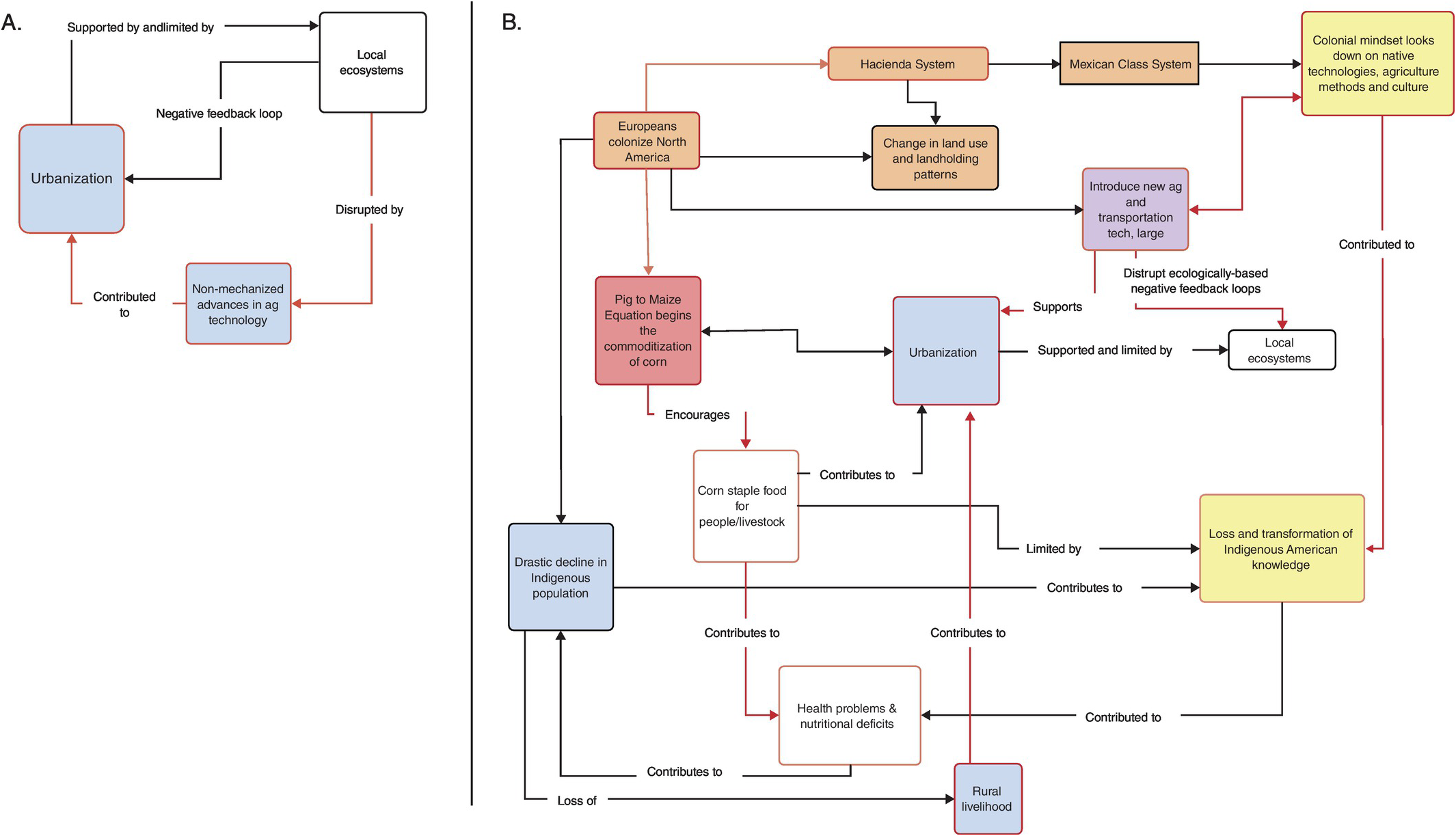
Figure 5.2a The relationship between food production and urbanization in precolonial Mexico. The red lines indicate feedback loops that are subsequently transformed.
Figure 5.2b The relationship between food production and urbanization in colonial North America (Mexico). The red lines indicate feedback loops that have emerged out of the precolonial situation and are subsequently transformed.
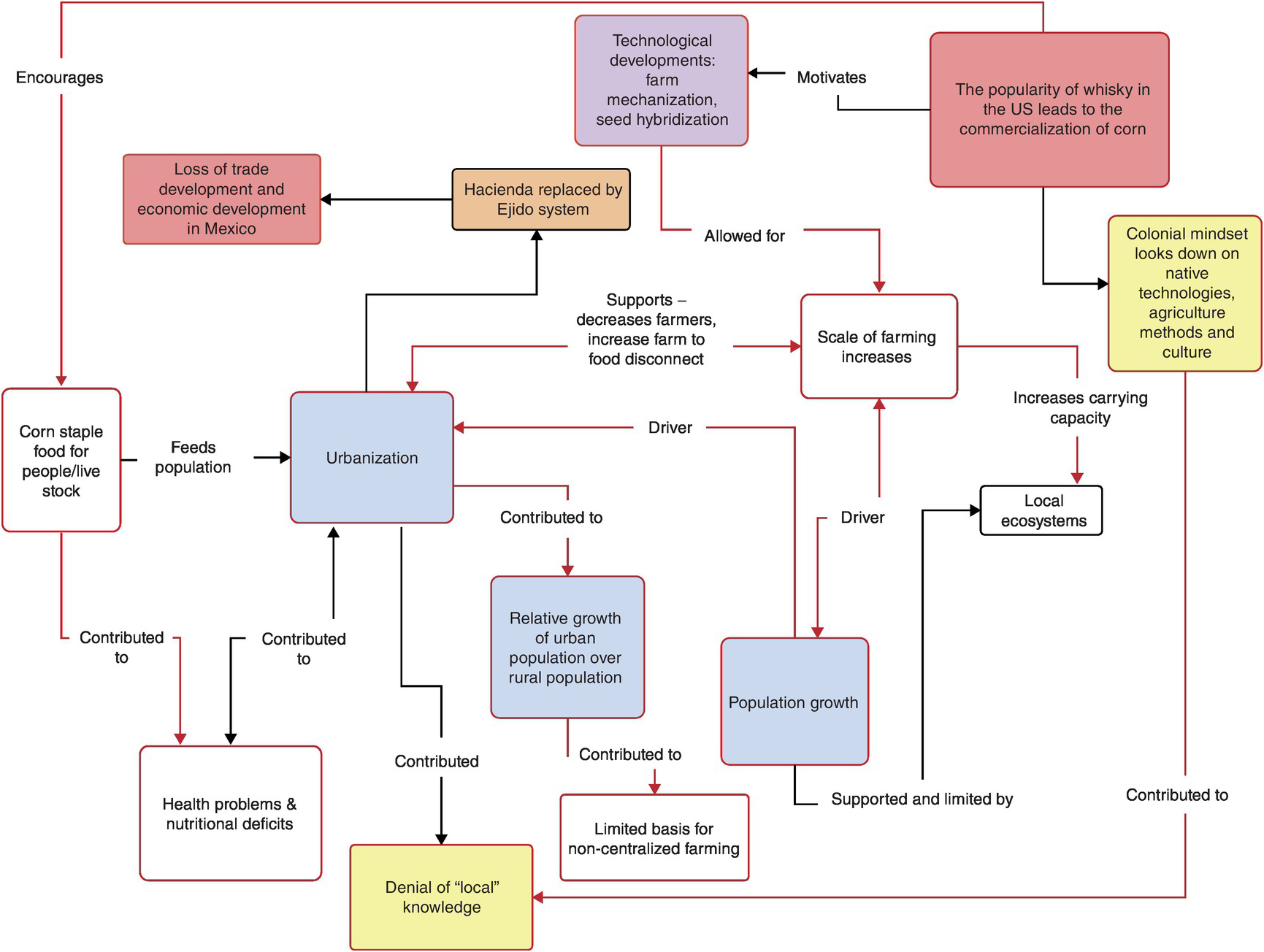
Figure 5.3 The relationship between food production and urbanization in Mexico under the impact of industrial North America. The red lines indicate feedback loops that have emerged out of the colonial situation and are subsequently transformed.
Essentially similar processes have of course been part and parcel of many instances of the emergence and collapse of complex societies, such as in China, Mesopotamia, Egypt, and Mesoamerica. The institutions and the relationships between them were different, but the underlying dynamics initially pushing such systems toward increasing complexity and then tipping them into disaggregation are the same. In Chapter 10 I present yet another historical case of this kind of dynamic in much more detail. But similar second order dynamics are of course also relevant to the present, as the last section of this book will show.
The Accumulation of Unintended Consequences
Short-term approaches, even if they include a century or two, leave long-term unintended consequences of human actions in the dark. We will deal with the importance of such unintended consequences extensively in Chapters 16–18, but a brief description is essential at this point. These unintended consequences result from the fact that as human beings we have only a very partial perception of our environment, and therefore undertake actions based on a biased and limited knowledge of the effects of those actions. These actions affect many more aspects of our environment than we are aware of. Some of these unintended and unanticipated consequences only emerge much later. When Henry Ford, for example, invented the serial production of affordable automobiles, he was not aware of the environmental and social consequences of having over a billion of them drive around the globe, heavily contributing to atmospheric pollution with CO2, NO2 and other greenhouse gases, but also leading to the rise of “new” cities, such as Phoenix and Las Vegas in the western USA, that cannot function without cars and other motorized transportation. I am arguing throughout this book that a failure to look at the unintended consequences of societal decisions has been an important cause of crises in human history, and is a major cause of the crisis in which we find ourselves. Some such unintended consequences may emerge centuries or even millennia after the event or process that triggered them. Yet for a full understanding of the long-term dynamics of a system, it is essential that these consequences are taken into account. Limiting our investigations to a century or two will at best catch a subset of them.
Summary
Geology, archaeology, and history can now provide the data and information to develop a more coherent long-term perspective that enables us to overcome some of these four categories of limitations (e.g., Berger & van der Leeuw Reference Berger, van der Leeuw, Nuninger, Kohler and van der Leeuw2007). Although the information presented by those disciplines is often too fragmentary or partial to deal with small-scale changes, it is able to provide an insight in long-term transformations in sufficient detail to outline a crude look at the genesis of the present (van der Leeuw 1998, Reference van der Leeuw, Costanza, Graumlich and Steffen2007). Therefore, combining such a long-term skeletal perspective with a short-term and more detailed perspective, which can be derived from studies focusing on the recent past and the present, we are able to understand socioenvironmental dynamics more precisely, putting meat on the bones. We can then begin to map path dependencies and take more than two or three spatiotemporal scales into account, for example. And all this is necessary to holistically understand the challenges that we are facing today.
Introduction
In order to strive toward sustainability, though we can profit from studying the past and the processes that led to the present, we also need to develop tools to look into the future itself. That poses another, very different, set of challenges.
As I argued in Chapter 3, the emergence of modern academic science and scholarship was, and still is, based upon the idea that one must be able to corroborate any hypothesis, demonstrating the correctness of any observation. This has heavily biased our scientific perspective toward the relationship between present and past, explaining present phenomena by offering a perspective on the past that could be interpreted as leading to present-day observations. Such a perspective could be informed by documents (in the widest sense) pertaining to that past, such as archaeological artifacts, historical texts, fossils of extinct animal species, etc. But of course that does not help us to elaborate a relationship between the present and the future. Nothing can be documented about the future, so from a scientific career perspective looking at the future is not very rewarding.
As stated in Chapter 1, it is one of the tenets of this book that thinking about the future must indeed be developed into a coherent approach, even though we may at present not quite see what that approach will look like. After all, it took western science four centuries to develop current scientific approaches to relate the present to the past and the past to the present. At the beginning of that process scientists were casting around without much sense of where their ideas might lead, just as is the case for scientists today who are looking at the future. There is therefore in my opinion no reason why we cannot develop approaches to thinking more systematically and coherently about the future. Moreover, in the last century and a half or so, many of the natural sciences have developed theories and models about processes of many kinds that are so accurate that they allow the (generally short-term) prediction of future behavior of a range of systems. A recent, but for many people rather abstract, example is the proof of the existence of gravitational waves. But there are many such examples: based on our knowledge of physics and mechanics, engineers can closely anticipate the performance of an engine, the solidity of a bridge, the destructive power of a nuclear bomb. Astronomers can predict the current and future position and many characteristics of planets and stars. Medicine can predict the efficiency of a new vaccine, the probable course of all kinds of epidemics, and the evolution of many illnesses. In all these cases, such predictions are based on (near) complete understanding of the dynamics involved.
Some of the predictive power of science applies to the very long term (billions of years), such as in astrophysics. But it can also apply to the very short term (microseconds) such as in the case of the complex processes leading to a successful hydrogen bomb explosion, or even ultra-short term (sub femtosecond) interactions such as in photon–matter interaction. Whether such predictions are dependable is related to the complexity of the phenomena concerned. Prediction is much less effective for complex systems such as phase transitions, self-organization (the emergence of snowflakes can be predicted, but not their structure), and the kind of physics treated in Chapter 7. Even in a limited domain such as the economy, scientific prediction is often more fantasy than reality because it is based on dynamic equilibrium models that assume that the current situation may change, but if it does, it will do so only incrementally.
The highly complex issues related to human individuals, societies and their environments generally involve many more dimensions and parameters than those I have just mentioned, so that explanations, let alone predictions, in these domains are very much more difficult. Yet, in view of the acceleration the world is currently going through, we can no longer delay the development of a deliberate strategy to learn from the past about the present and for the future in terms of socioenvironmental matters and the dynamics playing out in societies (Dearing et al. Reference Dearing, Braimoh, Reenberg, Turner and van der Leeuw2010; van der Leeuw et al. Reference van der Leeuw, Costanza, Aulenbach, Brewer, Burek, Cornell, Crumley, Dearing, Downy, Graumlich, Hegmon, Heckbert, Hibbard, Jackson, Kubiszewski, Sinclair, Sörlin and Steffen2011; Costanza et al. Reference Costanza, van der Leeuw, Hibbard, Aulenbach, Brewer, Burek, Cornell, Crumley, Dearing, Folke, Graumlich, Hegmon, Heckbert, Jackson, Kubiszewski, Scarborough, Sinclair, Sörlin and Steffen2012; van der Leeuw Reference van der Leeuw and Zhang2014). This being the case, how do we go about it?
Past Perspectives on the Future
When in our quest for understanding we have looked at the past to gain insights about the future, we have rarely used the resultant knowledge to its best advantage. We have derived different (often discipline-dependent) chains of cause and effect, which have been (more or less linearly) extrapolated via the present into the future. The future has thus been negotiated via uncertain and partial extrapolations from different visions of the past and the present, and this is clearly suboptimal. For one, this approach does not open the door to alternative historical trajectories. More importantly, it does not help us understand our relationship with the future. It views the past and the future as “foreign lands” (see Hartley Reference Hartley1953), rather than as projections in different (temporal) directions from the present – the point at which we have the ability to modify the social-ecological evolutionary process according to our ideas.
One conclusion from this state of affairs is that the perspective we develop should be a holistic one – we should not fall back into the trap of separating challenges and research topics into separate disciplines. Designing such a holistic approach requires that we find ways to simultaneously observe patterns in many dimensions, a kind of observation for which traditional Western science is not very well equipped. One way to illustrate this is by reference to the difficulty of solving the Rubik’s cube. One cannot get the cube “in order” (so that each side has one homogeneous color) by dealing first with one side, then the next, and so forth. The only way to arrive at order is by looking at the patterns on all sides simultaneously and not favoring any particular side at any time.
Analogue and Evolutionary Approaches to Understanding Past and Future
In a paper coauthored with Dearing and others (Dearing et al. Reference Dearing, Braimoh, Reenberg, Turner and van der Leeuw2010), we distinguish two different ways of relating the past to the present: an analogue and an evolutionary approach. The former is the one we have traditionally used to relate past and present (Meyer et al. Reference Meyer, Butzer, Downing, Turner, Wenzel, Westcoat, Raynor and Malone1998; Costanza et al. Reference Costanza, Leemans, Boumans, Gaddis, Costanza, Graumlich and Steffen2007). We compare the past and the present as different case studies and search for differences and similarities that might help us to better understand the present – how it came about, how it functioned, where observations about the past may serve as lessons for our own situation, and what we might do about undesirable aspects of that situation.
In a paper (van der Leeuw Reference van der Leeuw and Zhang2014) based on a study by Aschan-Leygonie (van der Leeuw & Aschan-Leygonie Reference van der Leeuw, Aschan-Leygonie, Svedin and Lilienstrom2005), for example, I briefly compare two economic crises in the southern French “Comtat Venaissin” region, in the 1860s and in the 1960s, and ask why the first crisis was quickly resolved and the second was not. This leads us to understand that the seeds for the first solution had already been sown before the crisis emerged, and that the crisis was immediately seen as urgent and threatening, so that coherent action was undertaken. The second crisis developed much more slowly, was not seen as urgent, and forced the region to adapt to a situation that was totally new, so that it could not draw upon preexisting marginal solutions as it had in the first crisis. As a result, the second crisis dragged on and had lasting economic consequences.
Though such analogues offer insights into differences and similarities between cases and sensitize the expert, past examples are by definition imperfect matches with the present, especially in view of the very rapid changes the Earth system (including many societies) has undergone over the last century or so (Wescoat Reference Wescoat1991; Meyer et al. Reference Meyer, Butzer, Downing, Turner, Wenzel, Westcoat, Raynor and Malone1998). As a result, many (but not all) such comparisons between past and present have engendered “just so” stories that alert their audience to potential dangers, often by overemphasizing similarities and underplaying differences between the past and the present.
In my opinion it would be more productive to compare the different cases from a systemic and evolutionary perspective, and to distill from such comparisons an improved general insight in the structure, dynamics, and evolution of the Earth system under different conditions. In such an approach, each case study serves as if it were a past experiment that, if followed in detail over at least some part of its trajectory with an emphasis on the emergence of novelty (novel technology, novel ideas, novel institutions, etc.), would have provided knowledge about the (un)intended outcomes of past dynamic interactions between the components of the system under different conditions. Such knowledge may permit us – once sufficient instances have been studied and their contexts, boundary conditions, structure, etc. have been brought to bear on the actual dynamics observed – to begin to outline models of the interaction of a number of the more general processes to which such systems are subject. A good example is the work of Zhang et al. (2007), who looks at how the accumulation of measures to improve the financial productivity of an economy (for example through streamlining the production chain) ultimately leads to an understanding of the need for fundamental change in the overall organization of labor in that chain. It seems to me that, ultimately, such approaches may enhance systematic assessments of postulated generalized complex system behaviors that can help us develop insights into the future states of these systems (Hibbard et al. Reference Hibbard, Janetos, van Vuuren, Pongratz, Rose, Betts, Herold and Feddema2010).
It is also useful for illustrative purposes to look at evolutionary theory in biology. Although biologists cannot make clear predictions about the emergence of new species, it is possible in genomics to point to probable gene modifications and their impacts, and thus to distinguish probable from improbable futures in the evolution of a species.
Such a systemic evolutionary view of the past focuses on a perspective in which the present remains continuously and strongly connected to the past (Carpenter Reference Carpenter2002). But owing to the systemic nature of the perspective, these connections are different from those usually developed by historians because the emphasis is on the dynamic structure of the system studied. They address processes that operate over longer time scales than the example mentioned above; they involve time lags, contingencies, emergent effects, and legacies that are integral to the functioning of the contemporary and future system.
By integrating observational, documentary, and reconstructed data, evolutionary studies could thus provide a developmental perspective on socioenvironmental processes that is critical to understanding all the elements of contemporary system dynamics, including the second order dynamics that are continuously modifying the boundary conditions within which socioenvironmental systems operate. Such long time-series of data and information may be the only way to confirm complex system behavior (e.g., alternative steady states, the adaptive cycle, contingent and emergent properties, and feedback mechanisms) in real-world systems. We can then ask fundamental questions relevant to managing socioecological systems: “Which ecosystem processes or services are apparently stable and resilient?,” “Which are trending beneficially upwards?,” “Which are on downward trends?,” “Which combinations of stresses have led to such current environmental degradation?,” “What are the predisturbance properties that could point to targets for environmental restoration?”
Finally, this approach is much better suited to deal with the no-analogue situation that we presently face with respect to the sustainability of humans and their societies on Earth.
Ex Post vs. Ex Ante Perspectives
There are of course fundamentally important epistemological issues with looking into the future. Whereas reductionist science has developed an ex post perspective that examines the origins of phenomena observed in the present, and summarizes those in terms of a limited number of dimensions – often in the form of cause-and-effect narratives or formalizations – that is of course not possible if one wants to develop perspectives on the future. Such perspectives must be developed from an ex ante point of departure, focusing on studying the emergence of novelty (new ideas, techniques, institutions, etc.) that is formulated in terms of possibilities or probabilities.
When I introduce this distinction in my classes, I ask students to think of the first time they fell in love. When that happened, most of them would have been trying to work out how their affair might evolve (developing an ex ante perspective on what was happening), and they would have found an overwhelming, and often contradictory, number of potential futures that confused their feelings. But looking back (from an ex post perspective) on the episode several years later, whether the affair had been successful or not, they would have constructed a very limited number of causal narratives about it.
This also happens to other events and situations, of course. In general, humans think and conceive of many different futures and they conceive of only one or a few pasts. They usually conceive of futures in terms of possibilities and probabilities, risks and uncertainties, involving a relatively high number of dimensions. But they tend to conceive the past in terms that involve a much lower number of dimensions, often only one or two, and construct narratives based on chains of cause and effect. Ex ante they speculate what might happen, but ex post they construct a causal chain about what did happen, describing the origins of where they are at that point.
For the moment, there are no firm ideas about how to assess the relative probabilities of such ex ante future scenarios. But thanks to the work of scientists such as Fontana (Reference Fontana2012), we can begin to sketch a roadmap that will bring us closer to our goal. In a paper by Bai et al. (Reference Bai, van der Leeuw, O’Brien, Berkhout, Biermann, Broadgate, Brondizio, Cudennec, Dearing, Duraiappah, Glaser, Revkin, Steffen and Syvitski2015) to which I contributed, we propose the outlining of a number of possible trajectories from the present into the future that are compatible with our understanding of the past dynamics that have brought us to the present, and then asking which of these futures is plausible. To determine this, we analyze which among the projected futures would run into internal or external obstacles, inconsistencies, or other challenges, to the point that it would not be realistic to expect them to materialize or persist. In essence, we look at the inherent affordances while trying explicitly to avoid what appears unsustainable, acknowledging that striking this balance is never easy and will always involve both uncertainties and values.
In the next step, we try to decide which of these futures is desirable, limiting the plausible choices further. This should lead to a wider societal and scientific discussion around the question about the kind of future we see for ourselves and our species (see Lévèque & van der Leeuw Reference Lévèque and van der Leeuw2003). In this discussion, the basic values of the society involved need to be made explicit, and linked to the desirable futures selected. Once such a discussion has focused its efforts on a limited set of specific scenarios for its future, we can ask what we need to do to achieve this or that future.
This approach is deliberately solutions-focused but does not aim for immediate solutions that perpetuate the current path dependency, because it is a core thesis of this book that the unintended and unanticipated consequences of every human action and innovation play such an important role that the future is ontologically uncertain. Rather, its goal is to identify potential out-of-the-box ways forward that seem plausible and desirable as well as sustainable over the long term.
Another approach, used for example by Saijo (2017), is to begin by looking at desirable futures by positioning oneself as far as is possible in the future, generating from that perspective a range of desirable futures, then back-casting to the present and designing a roadmap that might achieve the desirable goals by adopting probable trajectories. In this chapter, this is further elaborated in the section on scenario building.
In the end, one may have to develop ways in which these two approaches, forecasting and back-casting, can each be developed in their own right, followed by an episode in which their integration can be negotiated. In doing so, approaches used in engineering, business, and related disciplines would be adopted.
The Role of Modeling
Models (computer- and others) are important novel tools for thought and action (for an easy-to-read general summary of the concept model, see Apostel Reference Apostel1960). They can represent very complex dynamics in ways that allow us to look at them both ex post and ex ante. Such tools are now commonly used in a wide range of disciplines, including the natural, life, environmental, and economic sciences, and in contexts that range from academia to all the major financial and economic institutions (such as governments, central banks, the International Monetary Fund, the Organisation for Economic Co-operation and Development) and the defense establishments of many countries. Outside such institutions, they are known as computer games, and they may involve hundreds of thousands of actors.
Where it is possible to represent evolutionary processes as a set of rules, whether mathematical, numerical, or logical, there is the chance to create simulation models that can be used as management tools. The models used in the Limits to Growth studies (Meadows et al. Reference Meadows, Meadows, Randers and Behrens1974, Reference Meadows, Randers and Meadows2005) were developed around the idea of a world in which different social and environmental processes are interconnected through flows of energy, materials, and information. By creating a dynamic mathematical model, the authors were able to simulate future patterns of growth and decay in energy demand, resource use, environmental quality, etc. As the sustainability agenda grew stronger, there were increasing numbers of calls for similar modeling tools that can simulate alternative future states of socioecological systems at regional scales, and as a result a whole industry of such modeling emerged.
A key requirement for sustainable management is to be able to gauge the future risk that alternative strategies will transgress major environmental thresholds by looking at thresholds and tipping points, such as for example the minimum density of vegetation cover that protects the ground from runaway soil erosion. Therefore, modeling tools need to be able to operate over at least several decades (but to capture second order dynamics they may need to cover centuries or even millennia, see van der Leeuw Reference van der Leeuw, Berger, Nuninger, Kohler and van der Leeuw2007), and, importantly, they need to capture the likely big surprises that are inherent in complex systems (Dearing et al. Reference Dearing, Battarbee, Dikau, Larocque and Oldfield2006a, Reference Dearing, Battarbee, Dikau, Larocque and Oldfieldb; Nicholson et al. Reference Nicholson, Mace, Armsworth, Atkinson, Buckle, Clements, Ewers, Fa, Gardner, Gibbons, Grenyer, Metcalfe, Mourato, Muûls, Osborn, Reuman, Watson and Milner-Gulland2009).
Why Model?
We live in a complex world where human actions commonly have unforeseen and unwanted consequences. In the scientific as well as in the political arena two strategies have emerged to cope with this complexity: theory and computer simulation. Theories are ideas about causal relations that are used to inform understanding, choices, and decisions. Given that even the most brilliant theoretician has limited capacities for deductive reasoning, theories are necessarily of limited complexity. Computer simulations are also based on ideas about causal relations, but these are often so complex that only teams of highly trained specialists can put them together. Moreover, not even these specialists can claim to understand all their logical corollaries. Those are the ones that we model in order to understand them.
In a paper published in 2004, I give some reasons for modeling that in my eyes are important. For one, models enable researchers to economically describe a wide range of relationships with a degree of precision usually not attained by the only other tools we have to describe them: natural languages. Because each discipline has its own vocabulary and approach, one of the major difficulties in pluri- or transdisciplinary research is to find modes of expression that are acceptable to all the disciplines involved, and free from the connotations of any or all of them. Models can indeed be used to express phenomena and ideas in ways that can be understood in the same rigorous manner by practitioners of different disciplines, including the natural and social sciences and humanities. An example is the “percolation” model that I use in Chapter 11 to investigate transitions between information processing networks.
Another important advantage of formal models is that the domain of application of formal models is unlimited. It includes all aspects of any discipline. Thus, models may include, for example, kinship, ritual, choice, and behavior, alongside aspects of the dynamics between society and the natural environment upon which it is predicated.
Moreover, I find formal models particularly useful in a multi- or transdisciplinary context because they are sufficiently abstract not to be confounded with reality, and sufficiently detailed, rigorous, and (in the case of some computer models) ‘‘realistic’’ to force people with different backgrounds to focus on the same relational and behavioral issues. Models can therefore dissolve blockages and misunderstandings between disciplines by showing that the match between the phenomena to be predicted after running the model and the actual observed phenomena is close, non-existent, or somewhere in-between.
No less important in a social science context is the fact that formal models are formulated in a different language from the descriptions of the phenomena to be modeled. This has several advantages, of which the most important is possibly that it allows us to abstract in order to highlight features that are in our opinion relevant. It is a common assumption, for example, that one may not compare apples and oranges. Yet if one wishes to explain why oranges are better at rolling in a straight line than apples, one invokes an abstract dimension (roundness) and compares both kinds of fruit in terms of that dimension. The applicability of any particular model to a set of phenomena does not follow naturally from the nature of the phenomena but is defined by the person who applies the model.
Formal models can therefore, at least in theory, be useful in solving problems in which it is important to infer relationships between the observed behavior of certain phenomena and characteristics of these phenomena that remain to be identified.
Moreover, certain kinds of formal models are able to describe the changes occurring in complex sets of relationships with great precision and economy. I will give an example of this in Chapter 14. Owing to these properties, modeling is very suitable for formalizing dynamic theories about certain complex phenomena, which can then be compared with our observations. It facilitates putting flesh and clothes on the bare bones of sequential static data sets by helping them to link dynamic processes to their static outcomes. It should be noted, however, that this implies a somewhat different use and status of the models involved than is common in certain disciplines.
And finally, certain classes of formal models allow us to study how interactions between individual, non-identical entities at a lower level result in patterns at a higher level. This is particularly relevant in the study of many of the collective “hairy” or “wicked” phenomena that are the subject of the social sciences, where the interactions between individuals create the society, which in turn impacts upon the behavior of the individuals or groups concerned. Because of this property, such models are particularly interesting for those of us who study society from a self-organizing perspective.
Support Models and Process Models
Let us now look in more depth at the role of two different kinds of models (van der Leeuw Reference van der Leeuw1998b, 14). In politics, in industry, and in commerce, computer simulations are commonly used as support models: models used to infer the most likely consequences of given actions in some real-world-like dynamic system. Indeed, the computer science and modeling literature often implies that support models are the only rational way of using computer simulations. Computerized models, one learns, are abstract representations of concrete (i.e. real-world) dynamic systems. One will also read that a system is “a set of rules, an arrangement of things, or a group of related things that work toward a common goal” (www.yourdictionary.com/system).
In practice, these models hardly ever hold true over the longer term. In such models, causal relations manifested in the real world are only understood in quantitative terms. We know that poor communications and low food production may limit the growth of an urban center, for example, and can often specify a number of equally plausible mathematical relations that exhibit similar properties. But unfortunately we seldom have theoretical grounds for favoring one of these plausible sets as the definitive model to use.
There are other kinds of models. Process models are used to investigate ideas about a perceived, but imperfectly understood, dynamic system. By analyzing the model in a manner consistent with the perceived mapping between the model and the theory it represents, one searches for logical implications inaccessible by traditional hypothetico-deductive methods. If the underlying structure of the model is quite simple and the range of behaviors it can exhibit is considerable, the study of how the model operates will produce results that are more widely understood than those of support models.
It is equally important to realize that the same set of modeling tools can be used for two very different analytical tasks. Support modelers use computer simulations as test beds for policies, while process modelers build computer simulations as test beds for theories. It is conceivable that one who only ever builds support models could sustain the notion of a system as a group of components with a common purpose or that of a model as an abstract representation of a concrete system. For a process modeler, however, these ideas are manifest nonsense. For him or her, a model is a concrete representation (in the form of equations, marks on paper, switch states in a computer) of an abstract system (a theory).
The distinction between the traditional use of models as abstract maps of concrete systems and the use proposed here of models as concrete maps of abstract systems is not merely a nice rhetorical point. It has profound methodological and ethical implications. On the methodological front, it suggests that the principal function of a model is to evaluate theories and, ultimately, to suggest new theories for future evaluation.
On the ethical front, this distinction forces us to acknowledge that the output of any computer simulation is only as reliable as the theory it represents and the data it uses as input. That does not imply that the use of support models is inherently unethical. We live in a world where current policies must change for the better if humans are to avoid global disaster. Support modeling may be the only means by which complex political, ecological, or sociological theories can be harnessed and put to work. However, if we are to manage our affairs responsibly, we not only need the best support models available, but we also need to accept that the “real world” (whatever that is) may not endorse them.
In most sustainability science, models are common currency. They are used to extend into the future the analytical perspective that has allowed us to understand the socioenvironmental dynamics that have brought us to the present. Procedurally, they are therefore usually inserted at the end of a chain of reasoning, and serve to extrapolate from the present into the future. This leaves the whole construct heavily dependent on the (usually linear) scientific understanding of what drove the past and drives the present.
Challenges to Integrated Modeling of Socioenvironmental Dynamics
In a paper recently published by Verburg et al. (Reference Verburg, Dearing, Dyke, van der Leeuw, Seitzinger, Steffen and Syvitski2015), the principal kinds of models that are currently in use are outlined, with some of their characteristics, advantages and challenges (see Table 6.1) as well as some examples of each of these categories. First among these, and relatively rarely touched upon, is the fact that the data brought together in many models have been collected by different disciplines with different schools within each discipline concerned, and often for different purposes. They have been collected with different questions in mind, different disciplinary epistemologies, different methods, and different techniques. This is both a current and a growing problem, as ever-limited research funding forces us to increasingly rely on data collected in the past. We need to develop the practice of systematically extending the metadata commonly included in databases, to include (1) the questions the data were trying to answer, (2) the methods and techniques used in collecting and in analyzing them, (3) the sampling, units of observation, and units of analysis associated with the data, (4) the working hypotheses involved in the research, and (5) the epistemological status of the information derived from the data.
Moving beyond conceptual models. There are many examples of conceptual frameworks devoted to the description of socioecological systems in terms of causal frameworks or systems diagrams that conceptualize the interactions between different system components. Their development is an essential part of any research approach, but one could argue that they are granted too much importance in terms of their role in understanding how a system works, in forming a basis for modeling or even in deciding the sequence of research steps. Conceptualizing the real world is important, but we should remember that more often than not we are simply producing lists of key elements with probable links, and emergence tells us that these may all change through time. Frameworks and conceptual models should be treated as first steps in creating hypotheses that could be tested via a suite of tools and methodologies: they have limited value in their own right because they are the means to an end. This is particularly true in the case of integrated assessment models. Even when they have a generic set-up, they are often not well suited for addressing a specific problem or question and we should avoid defining our research questions by the structure of a (conceptual) model rather than focusing on the societal questions as these are emerging. The tail should not wag the dog! Any model building or application should start with a clear rationale for the choice of a particular model approach or system conceptualization based on the questions and hypothesis of interest.
Modeling safe operating spaces. A significant development in recent global environmental change research has been the introduction of the concepts of planetary boundaries and safe operating spaces for humanity (Rockström et al. Reference Rockström, Steffen, Schellnhuber, van der Leeuw, Liverman, Hansen, Lenton, Sörlin, Fabry, Noone, Lambin, Corell, Costanza, Scheffer, Folke, Svedin, Hughes, Rodthe and Crutzen2009a, Reference Rockström, Steffen, Noone, Persson, Chapin, Lambin, Lenton, Scheffer, Folke, Schellnhuber, Nykvist, de Wit, Hughes, van der Leeuw, Rodhe, Sörlin, Snyder, Costanza, Svedin, Falkenmark, Karlberg, Corell, Fabry, Hansen, Liverman, Richardson, Crutzen and Foleyb; Steffen et al. Reference Steffen, Richardson, Rockström, Cornell, Fetzer, Bennett, Biggs, Carpenter, de Vries, de Wit, Folke, Gerten, Heinke, Mace, Persson, Ramanathan, Reyers and Sörlin2014), in order to focus on identifying the critical limits or thresholds for major biophysical variables that steer the climate, biosphere, and hydrological systems that underpin social wellbeing. Modeling safe operating spaces to a level that can inform policy thinking will require information about the desirable and undesirable development pathways for humanity at a range of spatial scales. There is a gap between oversimplified toy models that can simulate complex social-ecological change at global scale (e.g., Motesharrei et al., Reference Motesharrei, Rivas and Kalnay2014) and global climate models that can capture complexity but only for the climate system. To inform the discussion on safe operating spaces, there is a need for a new suite of models that moves away from the conventional approach of driving models forward in time in the light of particular scenarios, and instead focuses on stable and unstable social-ecological dynamics associated with alternative development pathways. One recent example of such an approach is the project “The World in 2050” (Sachs et al. Reference Sachs, Nakicenovic, Messner, Rockström, Schmidt-Traub, Busch, Clarke, Gaffney, Kriegler, Kolp, Leininger, Riahi, van der Leeuw, van Vuuren and Zimm2018).
Feedbacks and emergent properties. Owing to the long, relatively independent history of most of the disciplines involved, we lack the systematic integrated, transdisciplinary, holistic, and in-depth knowledge of the feedbacks between the different parts of socioenvironmental systems. In designing (conceptual) approaches to address feedbacks, the issue of scales comes to the fore. The natural, earth, and life sciences have essentially gathered information at local, regional, and global scales and synthesized it to develop models to predict patterns globally. The social sciences and humanities have gathered their information and synthesized it at the local scale. There is thus a need for ways to downscale (provide higher resolution of) environmental information and to upscale the information on societies. The former is complex enough, but inroads are being made in that domain. The latter is much more difficult and probably demands substantive methodological development beyond simple statistical aggregation.
Connecting dynamics at multiple scales. In both the debate on different epistemologies and the discussion of feedbacks, different scales and scalar interactions play important roles. The current world is characterized by global scale changes in Earth system dynamics, emerging from local changes in human interactions with the environment. The emerging global challenges translate into impacts on local realities, and most solutions to manage these have to be implemented at local scales. This brings about the challenge to represent such cross-scale dynamics in modeling tools. Prompted by the fact that for a long time the climate and Earth sciences were the primary disciplines to study greenhouse gases and their consequences at the global level, the efforts of the United Nations were directed at finding global solutions to these challenges, for example suggesting the creation of a $100 billion Green Climate Fund. But in doing so, they did not take into account that this involved different cultures, different societies, and different economies. What was proposed was a uniform solution, a united effort of burden-sharing to avoid irreparable damage to our environment. If, on the other hand, the challenge is seen not as an environmental one but as a societal one, then it is clear that not all societies can deal with it in the same manner. As a result, the Green Climate Fund has only raised $30 billion a year. Introduced in the run-up to the 2015 United Nations Climate Change Conference (COP 21), the trend of allowing different societies to define their own contributions to mitigate climate change is, from that perspective, an improvement. To use models to assist in finding potential solutions to these challenges requires the capacity to represent the local societal dynamics in the context of global processes, and vice versa.
Codesigning models. While models are mostly used as tools for researchers aimed at expanding their mental capacity to explore system functioning, new perspectives and demands on modeling are emerging in terms of the interactions between the users and creators of models and society as a whole. Figure 6.1 provides an overview of different ways in which science and society may interact in the context of the design and use of models. Such codesign and coproduction of research has become important in global change research (Cornell et al. Reference Cornell, Berkhout, Tuinstra, Tàbara, Jäger, Chabay, de Wit, Langlais, Mills, Moll, Otto, Petersen, Pohl and van Kerkhoff2013), with repercussions for modeling. Codesign of research questions may change the nature of the questions and, therefore, have consequences for the suitability of the modeling tools available. While many modeling tools are built from the perspective of exploring system function, they may not be able, or are not optimally designed, to answer questions that emerge from the interactions between researchers and stakeholders. Research models need to be transformed into operational models so that choosing the right model for the question at hand becomes even more important (Kelly et al. Reference Kelly, Jakeman, Barreteau, Borsuk, ElSawah, Hamilton, Henriksen, Kuikka, Maier, Rizzoli, van Delden and Voinov2013). Apart from codesigning models to better address societal questions, codesign should also involve data-gatherers and non-modelers in the design process. This way, model design can be better matched to available data and data collection to the needs of the model.
Modular architectures. Most models are written to be stand-alone. The disadvantage is that investments in redesigning all model components make the development of new models extremely expensive. To tackle the challenges outlined in this chapter a diversity of approaches is needed. Component-based modeling brings about the advantages of “plug and play” technology. Models wrapped as components become functional units that, once implemented in a particular framework, can be coupled with other models to form applications. Frameworks and architectures additionally provide the necessary services such as regridding tools, time interpolation tools, and file-writing tools. A model component can communicate with other components even if they are written in a different programming language (Syvitski et al. Reference Syvitski, Peckham, David, Goodall, Delucca, Theurich and Fernando2013). Plug-and-play component programming benefits both model programmers and users. Using this framework, a model developer can create a new application that uses the functionality of another component without having to know the details of that component. Models that provide the same functionality can be easily compared to one another simply by unplugging one model component and plugging in a different component. Users can more easily conduct model intercomparisons or build larger models from a series of components to solve new problems. To ensure that one model’s output variable is appropriate for use as another model’s input, a precise description of the variable, its units, and certain other attributes are required.
Finally, we need to consider the position of the modeling effort in the chain of actions that leads to understanding the dynamics. Generally, thus far, in developing prognoses about the future, models have been positioned at the end of an argument that is built upon scientific understanding of extant conditions and drivers of the trends. But following what has been said about ex ante models, what would happen if models were taken as the starting point of the argument? Rather than present deviations from an existing trajectory, they could then inspire scientific research toward a better understanding of potential futures and their implications, including potential unintended consequences. This is the domain of scenario analysis.
Table 6.1 Different modeling approaches, with some of their characteristics
| Generic model category | Notable model types | Coupling | Scales | Data and computing | Complex dynamics | Policy tools | Validation and skill |
|---|---|---|---|---|---|---|---|
| Deterministic process-based biophysical models | Global climate models; Earth System models | Low potential; social subsystem often represented by plausible pathways and emission scenarios | Mainly global (20–200 km) resolution and long (decadal) timescales | Large data and computing requirements | Theoretically capture feedbacks and emergence in biophysical processes. Lack of feedbacks with other (socioecological) system components | Limited because of high complexity. Scenario results are input in intergovernmental processes | Difficult to validate. Comparisons against historical data and model inter-comparisons are common |
| Deterministic economic models | General and partial computational equilibrium models | One-way coupling in which biophysical subsystem often reduced to climate effect on the agricultural sector | Regional to global. Often limited spatial detail (world regions); timescales often limited to several decades. | Large data and computing requirements | Feedbacks only accounted for through market mechanisms | Dominant use in ex ante assessment of policy instruments | Difficult to validate. Comparisons against historical data are scarce while model inter-comparisons are common |
| Reduced-complexity social-ecological models | Integrated Assessment Models. Earth system models of intermediate complexity (EMIC). System Dynamics Models | Moderate potential but biophysical and social sub-models often simply coupled in an integrated model environment | Regional to global scale with decadal to sub-decadal timescales | Somewhat reduced data and computing requirements | Top-down usually lacking feedback or emergence (some EMICs can simulate abrupt changes). Social subsystem often reduced to profit optimization or simple heuristics | Scenario results are aimed at input into policy processes; models used for ex ante assessments | Limited as above. EMICs tested against paleo-climatic records (e.g., ice cores) |
| Agent-based social-(ecological) and cellular (social)-ecological models | Agent-based models (ABMs), land-use change models | High potential but not frequently implemented | Generally local to regional scale and relatively short timescales with often annual resolution | Rule based. Strong variation in data and computational needs. Strongly relying on either theory or empirical data | System-level dynamics often emerge as a consequence of low-level interactions and feedbacks | Limited application, but examples of participatory use exist | Either based on ability to reduce pattern and dynamics or particular empirical data. Increasing focus on validation of system behavior |
| Simple toy socio-ecological models | Conceptual models, games | Highly variable but high potential | Any scale | Mostly low. No use of empirical data | Able to simulate complex dynamics but with oversimplified assumptions | Low potential. Learning tools | Mostly not applicable |

Figure 6.1 Schematic representation of codesigned modeling.
Scenario Building
The other main tool that we have in thinking about the future is “futuring” or scenario-building. This is an approach that was initiated by Shell PLC at the time of the first oil crisis (1973). It has since been developed in a wide range of domains driven by the long-term planning requirements of certain industries (energy, reinsurance), and adopted by governments (e.g., Singapore, Dubai) and supranational institutions such as the World Bank. But it has also played an important role in thinking about sustainability, more or less in parallel with the development of modeling, such as for example in the work of the Intergovernmental Panel on Climate Change (IPCC); see the various IPCC reports (e.g., Nakicenovic & Swart Reference Nakicenovic and Swart2000) and the global research program “The World in 2050” (Sachs et al. Reference Sachs, Nakicenovic, Messner, Rockström, Schmidt-Traub, Busch, Clarke, Gaffney, Kriegler, Kolp, Leininger, Riahi, van der Leeuw, van Vuuren and Zimm2018), and also the various projects about transitioning from the present to more sustainable futures, such as Hammond’s “Which World?” (2000). Futuring is currently emerging as a discipline in a limited number of institutions in the academic world. It uses a mixture of modeling and scenario analysis techniques to coherently develop multiple perspectives on the future. In view of its increasing importance in considering futures, scenario analysis merits some attention.
Scenario design and scenario analysis are based on the assumption that anticipation is an oft-overlooked or ignored capability that we need to operationalize and use in the present situation. After all, we always talk about feedback, but only rarely about feedforward (Nicolis n.d. presents an early discussion), a point recently made very convincingly for economics by Beckert (Reference Beckert2016). It begins by qualitatively imagining a number of potential futures along the lines presented at the end of the last section, focusing first on futures which are the result of out of the box thinking and thus disconnected from the present, and then considering the plausibility of these. As these potential futures are analyzed and detailed, flesh is increasingly added to the various skeletons.
This is an exercise in imagining and logically analyzing the implications of alternative possible outcomes. It does not try to show one exact picture of the future. Instead, it deliberately presents a number of alternative futures and the roadmaps leading to them. In contrast to prognoses, scenario building and scenario analysis do not use a conscious extrapolation of the past. They do not rely on historical data and do not expect past observations to be valid in the future. Instead, they try to consider a wider range of possible developments and turning points, which may (but need not) be loosely connected to the past. In short, several scenarios are demonstrated in a scenario analysis to show possible future outcomes that can serve as goals to be pursued. It is useful to generate at least a combination of an optimistic, a pessimistic, and a most likely scenario, but a wider range of fundamentally and structurally different scenarios can also be useful.
Scenario analysis is different from modeling, but widely uses models. Models are often used to build scenarios, but scenarios are also often used to begin the process of model building. In the former case, the model is the link between the present and the future, and the forecasting scenarios are extrapolated from the models. In the latter case, the scenarios are exercises at designing out-of-the-box futures, and models are used to link the future with the present through back-casting.
What would the development of scenarios for analysis entail? In outlining this, I follow the paper by Bai et al. (Reference Bai, van der Leeuw, O’Brien, Berkhout, Biermann, Broadgate, Brondizio, Cudennec, Dearing, Duraiappah, Glaser, Revkin, Steffen and Syvitski2015) mentioned earlier. It should include recent advances in cognitive science, asking how the cognitive categories are formulated, and how decisions are made, both individually and collectively. Among other things, this would open up the question of the relationship between feedback and feed-forward (anticipation), which is fundamental to human behavior (we all live between past and future), but which has thus far not been given its due in how we model or construct scenarios (Montanari et al. Reference Montanari, Young, Savenije, Hughes, Wagener, Ren, Koutsoyiannis, Cudennec, Toth, Grimaldi, Bloschl, Sivapalan, Beven, Gupta, Hipsey, Schaefli, Arheimer, Boegh, Schymanski, Di Baldassarre, Yu, Hubert, Huang, Schumann, Post, Srinivasan, Harman, Thompson, Rogger, Viglione, McMillan, Characklis, Pang and Belyaev2013; Sivapalan et al. Reference Sivapalan, Konar, Srinivasan, Chhatre, Wutich, Scott, Wescoat and Rodriguez Iturbe2014). It would also imply exploring the role of creativity, intuition, and imagination in how to deal with uncertainty. Thus far, reductionist science has generally left these questions alone, or at least not studied them scientifically or integrated them in our scientific perspective on the world. Arthur (Reference Arthur2009) broaches this issue at the interface of technology and economics, which can be extended beyond those domains into the wider study of all our cultural and social institutions. What drives innovation in those domains? Are invention and innovation stochastic, as is often argued, or not (Lane et al. Reference Lane, Pumain, van der Leeuw and West2009)? These remain open questions until we have a better understanding of the possibilities for facilitating innovations, and the spaces within which innovations occur (see Chapter 12).
Exploring multiple dimensions of innovation spaces is challenging but essential. One approach I mentioned earlier is to take a set of phenomena and project them into a high-dimensional space to identify a large number of potential relationships between them (Fontana Reference Fontana2012). The space is then reduced to fewer dimensions by determining which of these relationships cannot explain the phenomena at hand. Coupled with the enhancing capacity to collect and relate big data, this might be a fruitful path to reduce the path dependency of scenario development. Computing power can in principle be used not just to reduce complexity (as in the case of statistical methods), but also to increase it, if the appropriate software is developed. A reconceptualization of the role of scenarios also includes a review of the field of economics, where discussion is often predominantly about the allocation of resources within existing (technological, social, institutional, and environmental) structures. For an excellent and, detailed discussion of the need to include anticipation in economic reasoning, see Beckert (Reference Beckert2016).
But in order to achieve desirable futures, more fundamental questions need to be asked as well: How did the structure come about, and how might it change? What are the regulatory mechanisms involved? What happens when an existing structure becomes more and more complex? Does it become more efficient and/or resilient? What does that mean for its adaptability, its capacity to change? A promising emergent field of study is therefore the attempt to bring evolutionary thinking and complex systems approaches together with behavioral and other kinds of economics and organization science in the design and analysis of scenarios (see Wilson & Kirman Reference Wilson and Kirman2016).
Regrettably, for all the potential power of scenario building and scenario analysis, as for example shown in the work of the Oxford (www.sbs.ox.ac.uk/faculty-research/strategyinnovation/oxford-scenarios-programme-0) and Singapore (www.csf.gov.sg) futuring centers, or in the many scenarios developed by business, finance, and non-governmental organizations, this approach has not yet reached a degree of maturity in academia that is sufficient to include it centrally in our most current toolset to think out of the box about multiple sustainable futures.
For one, a broader use of scenarios in public deliberations and collective decision-making would involve the option to explore multiple potential futures with the situated knowledge of multiple stakeholders (see Wilson & Kirman Reference Wilson and Kirman2016). But part of the challenge seems also to be that in the communities where they are used, many scenarios are too smooth, too formulaic, too predictable, and do not open up the full gamut of expectable and unexpected consequences of our choices between trajectories to move forward into the future. They seem not to be fully integrating the implications of conceiving the challenges in front of us in different domains as true complex systems, and are therefore subject to ontological uncertainty. Developing more advanced models would benefit from an academic effort that is not directly and immediately linked to applications in the real world and could delve into many advances in fields such as political, social, and cognitive science, including the idea that our individual choices are primarily determined by our emotions, rather than by reasoning, and investigations into the dynamics responsible for collective decision-making.
Introduction
The perspective that I am proposing in this book is firmly anchored in the so-called Complex (Adaptive) Systems (CAS) approach that has been developed over the last forty or so years, in both Europe and the USA. It is the approach that the multidisciplinary ARCHAEOMEDES team experimented with under my direction in the 1990s, looking at a wide range of sustainability issues in all the countries of the Northern Mediterranean rim (van der Leeuw Reference van der Leeuw1998b). In this chapter, I am heavily drawing on that real-life and real-world experiment, which was the first in the world.
Systems Science
In order to understand the approach and the context in which the CAS approach has emerged and is being used, I need to go back a little bit in the history of science, to the development of noncomplex systems science around World War II and its immediate aftermath. One cannot point to a single person to whom the basic ideas of systems science go back – some argue for predecessors as early as pre-Socratic Greece and Heraclitus of Ephesus (c. 535–c. 475 BCE). Clearly there were major scientists whose ideas were moving in this direction from as early as the seventeenth century: Leibnitz (1646–1716), Joule (1818–1889), Clausius (1822–1888), and Gibbs (1839–1903) among them.
For our current purposes, two names are forever associated with this approach, Norbert Wiener and Ludwig von Bertalanffy. The applied mathematician Wiener published his Cybernetics or Control and Communication in the Animal and the Machine in 1948, while the biologist von Bertalanffy launched his General Systems Theory in 1946, and brought it all together in General System Theory: Foundations, Development, Applications in 1968. But a substantive number of others were major contributors, among them Niklas Luhmann (Reference Luhmann1989), Gregory Bateson (Reference Bateson1972, Reference Bateson1979), W. Ross Ashby (Reference Ashby1956), C. West Churchman (Reference Churchman1968), Humberto Maturana (Reference Maturana and Varela1979 with F. Varela), Herbert Simon (Reference Simon1969), and John von Neumann (Reference Von Neumann and Burks1966). The approach rapidly spread across many disciplines, including engineering, physics, biology, and psychology. Early pioneers to apply it to sustainability issues are Gilberto Gallopin (Reference Gallopin1980, Reference Gallopin1994) and Hartmut Bossel (Bossel et al. Reference Bossel, Klaczko and Müller1976; Bossel Reference Bossel1986).
Systems science shifted the emphasis from the study of parts of a whole, on which mechanistic science had been founded in the Enlightenment, to studying the organization of the ways in which these parts interact, recognizing that the interactions of the parts are not static and constant (structural) but dynamic. The introduction of systems science, in that respect, is a first step away from the very fragmented scientific landscape that developed after the university reform movement of the 1850s. Some of the scientists involved, such as von Bertalanffy (Reference Von Bertalanffy1949) and Miller (Reference Miller1995) went as far as to aim for a universal approach to understanding systems in many disciplines.
An example of the importance of systems thinking in the social sciences is presented in Chapter 5, mapping system state transitions in the Mexican agricultural system under the impact of growing urban populations in North America. Such thinking focuses on the organization that links various active elements that impact on each other. They are linked through feedback loops that can either be negative (damping oscillations so that the system remains more or less in equilibrium) or positive (enhancing the amplitude and frequency of oscillations). In the earlier phases of the development of systems thinking the focus was on systems in equilibrium (so-called homeostatic systems, such as those keeping the temperature in a room stable by means of a thermostat) and thus on negative (stabilizing) feedback loops. However, from the 1960s the importance of morphogenetic systems (in which feedbacks amplify and therefore lead to changes in the system’s dynamic structure) was increasingly recognized (e.g., Maruyama Reference Maruyama1963, Reference Maruyama1977). Such positive feedbacks are involved in all living systems. This shift in perspective also implied that systems needed to be seen as open rather than closed because to change and grow systems need to draw upon resources from the outside, specifically energy, matter, and information. Positive feedbacks in open systems are responsible for their growth and adaptation, but can also lead to their decay. If living systems were only composed of positive feedback loops, they would quickly get out of control. Real-life systems therefore always combine both positive and negative feedback loops.
Complex Systems
The introduction of positive feedbacks and morphogenetic systems clearly prefigured the emergence of the wider Complex Systems (CS) approach. This is a specific development of General Systems Theory that originated in the late 1970s and early 1980s both in the USA (Gell-Mann Reference Gell-Mann1995; Cowan Reference Cowan2010); Holland (Reference Holland1995, Reference Holland1998, Reference Holland2014; Arthur Reference Arthur, Durlauf and Lane1997; Anderson Reference Anderson, Arrow and Pines1988, with Arrow and Pines), and in Europe (Morin Reference Morin1977–2004; Prigogine Reference Prigogine and Nicolis1980; Prigogine & Stengers Reference Prigogine and Stengers1984; Nicolis & Prigogine Reference Nederveen Pieterse1989). It is focused on explaining emergence and novelty in highly complex systems, such as those that create what we called “wicked” problems in Chapter 2. It has many characteristics of an ex-ante approach. Moreover, it is not reductionist, viewing systems as (complex) open ones, subject to ontological uncertainty (the impossibility to predict outcomes of system dynamics, cf. Lane et al. Reference Lane and Maxfield2005). It moves us “from being to becoming” (Prigogine Reference Prigogine and Nicolis1980), emphasizing the importance of processes, dynamics, and historical trajectories in explaining observed situations, and the very high dimensionality of most processes and phenomena.
When focused, as in this book, on integrated socioenvironmental systems and sustainability, the CS approach is focused on the mutual adaptive interactions between societies and their environments, and thus we speak of Complex Adaptive Systems (CAS). It emphasizes the importance of a transdisciplinary science that encompasses both natural and societal phenomena, fusing different disciplinary approaches into a single holistic one. It also shifts our emphasis away from defining entities and phenomena toward an approach that includes looking at the importance of contexts and relationships. This chapter will first briefly outline the most important differences between the Newtonian (classic) scientific approach and the CAS approach by means of examples drawn from different spheres of life. Then it will show, in the form of an example, how such an approach can change our perspective.
The Flow Is the Structure
The basic change in perspective involved is presented by Prigogine (Reference Prigogine and Nicolis1980) as moving from considering the flow that emerges when one pulls the plug out of a basin full of water as a disturbance (and the full basin as the stable system) to considering the flow as the (temporary, dynamic) structure and the full basin as the random movement of particles. He illustrates this by referring to the emergence of Rayleigh-Bénard convection cells when one heats a pan of oil or water.
As soon as a potential (in this case of temperature) is applied across the fluid, particles start moving back and forth across that potential (in this case the heat potential between the heated pan and the cooler air above it), that moves the hot particles in the liquid from the bottom of the dish to the top in the center of each cell, and the cooler cells back from the top to the bottom at its edges. That causes a structuring of their movement into individual, tightly packed cells. The flow of the particles transforms random movement into structured movement.
But the important lesson to retain from this example is the simple change in perspective on what is a structure and what is not, from which it follows that flows are dynamic structures (rather than static ones) generated by potentials. Irreversible direction (and thus change) therefore becomes the focus, rather than undirectedness or reversibility (Prigogine Reference Prigogine1977; Prigogine & Nicolis Reference Prigogine and Nicolis1980). Along with the perspective, the questions asked change as well, as do the kinds of data collected, and indeed the kind of phenomena that arouse interest. We will see in Chapter 9 that if we transpose Prigogine’s idea of dissipative flows (flows that dissipate randomness or entropy) into the domain of socioenvironmental systems, the idea of “dissipative flow structures” (as Prigogine calls them) provides us with a very powerful tool to develop a unified perspective on human societal institutions. For example, the banking system consists of a set of institutions and rules around the flow of wealth, from poor to rich and vice versa. Large migrations as we see today in Europe are flow structures triggered by a huge differential in ease of life between war-torn/poor, and peaceful/wealthy places.
Structural Transformation
As we see in Chapter 5, the problem of understanding the long-term behavior of (natural and societal) systems that undergo state changes is inextricably bound up with questions of origins and emergence (van der Leeuw Reference van der Leeuw, Fiches and van der Leeuw1990), which we might more generally and neutrally subsume under the heading of structural transformation.
The central issue in any discussion of complex dynamics concerns the problem of emergence, rather than existence (Prigogine Reference Prigogine and Nicolis1980). Understanding the structural development of emergent phenomena is not only the key to a better characterization of complexity, but to an understanding of the relationship between order and disorder. While these are easily defined and distinguished in physical systems, for example, this is much less obvious for societies. What is an ordered or an un- or disordered society? The same is true for the concept of equilibrium. Again, in physical systems one can observe the state of equilibrium (non-change) relatively easily, but in societal systems this is more difficult. Among other things it depends on the scale of observation.
How do such dynamic systems emerge? It is a characteristic phenomenon of complex systems that they are considered self-organizing, owing to the interactions between entities in the system. In societal systems, individuals interact in many different ways, and the result of those interactions is the (dynamic) structure of the society, which can be observed as a pattern (see Figure 7.1). That pattern, in turn, impacts upon the interacting individuals or other entities. To a large extent, these processes are also the ones that are implicated in the construction and evolution of the spatial inhomogeneity that we recognize in landscapes.
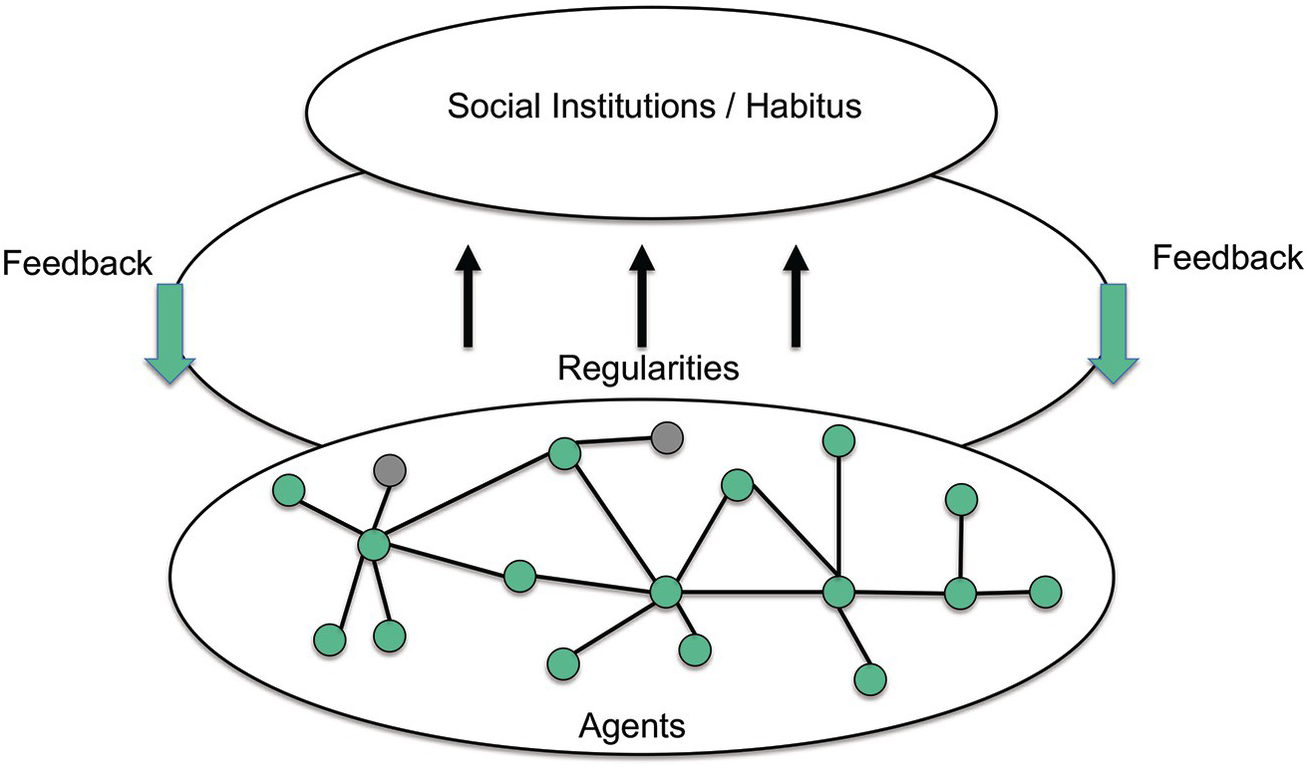
Figure 7.1: Interactions between individual entities at the lower level create patterns observable at the higher level which, in turn, impact on the interactions between individual entities.
The most important part of the realignment I propose by applying CAS is to actively supplant evolutionary ideas of progressive and incremental unfolding in favor of models that recognize the nonlinear dynamical aspects of structures, and thus underline the importance of instability and discontinuity in the process of societal transformation and -evolution. In that context, I also need to point to another essential concept that has played a major role in the development of this approach: the concept of phase transitions. The reader will encounter this concept extensively in the third part of this book. It is the idea that the underlying dynamics of a self-organizing system can reach a state in which they will change their behavior fundamentally. The conditions under which this happens may be predictable, but the result of the changes is not, and different states of the restructured system may emerge. For example, the temperature and humidity under which snowflakes appear are entirely predictable, but the geometric features of the flakes themselves are nevertheless entirely unpredictable. These are phase transitions that have, of course, been observed since the early history of mankind. But complex systems theorists have developed interesting and novel ways to understand such structural changes in dynamics, pointing out that zones of predictability and unpredictability can coexist. In the social sciences, such phase changes are generally referred to as tipping points. (For a detailed introduction to this topic see for example Scheffer Reference Scheffer2009.)
History and Unpredictability
A fundamental characteristic of the CAS approach to emergence is the fact that it emphasizes both history and unpredictability. By considering observed patterns at a macro-level as the result of interactions between independent entities at a level below, at once the relationships between these entities are of fundamental importance to explain the patterns observed, and because the entities are independent it is impossible to predict their collective behavior, so that in the case of complex adaptive systems the pattern observed is also unpredictable.
A good case in point is the major traffic jam that prevents one from getting to the airport that I mentioned in Chapter 2. All the drivers who are part of it have their own reasons for driving and their own planned trajectories. As their paths cross and intersect, there are points where their movements impact on each other to the point of immobilizing them. Situations like this cannot be explained a posteriori. The only way to understand them is by identifying and studying the history of the dynamics involved at the level of the individual participants. Helbing very successfully applied this approach to pedestrian traffic problems and has now been extending it to more general societal challenges (e.g., 2015, 2016).
The closest well-known theoretical position in the social sciences is that of Bourdieu (Reference Bourdieu1977) and Giddens (Reference Giddens1979, Reference Giddens1984), who emphasize the relationship between individual behavior and collective behavior patterns (habitus to use their term) that are anchored in a society through customs and beliefs. To understand a group’s habitus one needs to go back in time and identify the dynamics that were responsible for originating the habitus’s different components.
Because the complex systems approach is ex-ante in its study of the emergence of phenomena, it describes such phenomena in terms of possibilities and (at best) probabilities, in effect pointing to multiple futures and options. It can therefore not predict with any certainty as is done when a (reductionist) cause-and-effect chain is assumed. At best it can, under certain circumstances, point to places in a system’s trajectory when one change or another is probable.
Underlying this change in perspective is the following reflection. Any attempt to deal with the morphogenetic properties of dynamic systems must acknowledge the important role played by unforeseen events and the fact that actions often combine to produce phenomena we might define as the spontaneous structuring of order. The observation that apparently spontaneous spatiotemporal patterning can occur in systems far from equilibrium, first made by Rashevsky (Reference Rashevsky1940) and Turing (Reference Turing1952), was then developed by Prigogine and coworkers. These have coined the term “order through fluctuation” to describe the process (e.g., Nicolis & Prigogine Reference Nicolis and Prigogine1977).
The fundamental point is that non-equilibrium behavior – an intrinsic property of many systems, both natural and social – can act as a source of self-organization, and hence may be the driving force behind qualitative restructuring (state change) as the system evolves from one state to another. This assumes that dynamic structures rely on the action of fluctuations that are damped below a critical threshold and have little effect on the system, but can become amplified beyond this threshold and generate a new macroscopic order (Prigogine Reference Prigogine and Nicolis1980). Evolution thus occurs as a series of phase transitions between disordered and ordered states; as successive bifurcations generating new ordered structures (Figure 7.2). An interesting example of this is the logistic map developed to look at the dynamics between population reproduction (where the current population is small) and population starvation (where the growth will decrease at a rate proportional to the value obtained by taking the theoretical “carrying capacity” of the environment less the current population).
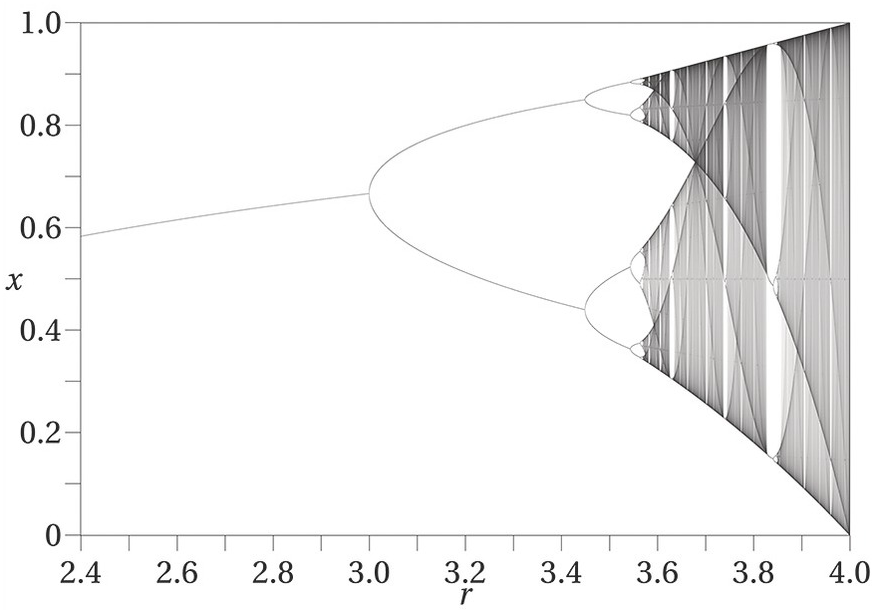
Figure 7.2 Bifurcation diagram of a logistic population dynamic. For a detailed explanation see https://en.wikipedia.org/wiki/Logistic_map.
In this perspective, instability, far from being an aberration within stable systems, becomes fundamental to the production of resilience in complex systems.1 The long-term evolution of structure can be seen as a history of discontinuity in geographical (or other kinds of) space; i.e., history not as a finely spun homogeneous fabric, but as being punctuated by a sequence of phase changes resulting from both intentional and unintentional actions, such as have been postulated for biological evolution by Gould and Eldredge (1972). Such discontinuities are in fact thresholds of change (“tipping points” in more recent popular parlance), where the role of agency and/or idiosyncratic behaviors assumes paramount significance in the production and reproduction of structures.
Chaotic Dynamics and Emergent Behavior
For biological, ecological, and, by implication, societal systems, the discovery of self-induced complex dynamics is of profound importance, since we can now identify a powerful source of emergent behavior. Far from promoting any pathological trait, aperiodic oscillations resident in chaotic dynamics perform a significant operational role in the evolution of the system, principally by increasing the degrees of freedom within which it operates. This is another way of saying that chaos promotes flexibility, which in turn promotes diversity.
In turn, this throws light on some of the problems inherent in the concept of adaptation, a difficult concept in the study of evolution. Briefly put, since the existence of chaos severely calls into question concepts such as density-dependent growth in (human and) biological populations, we might be able to see a theoretical solution in the coexistence of multiple attractors (see below) defining a flexible domain of adaptation, rather than any single state. We thus arrive at a paradox where chaos and change become responsible for enhancing the robustness or the resilience of the system.
From a philosophical perspective, it might be said that the first thing that a nonlinear, dynamic, or complex systems perspective does is to effectively destroy historical causation as a linear, progressive, unfolding of events. It forces us to reconceptualize history as a series of contingent structurations that are the outcome of an interplay between deterministic and stochastic processes (see Monod 2014). The manifest equilibrium tendencies of linear systems concepts also stand in contrast to their nonlinear counterparts by virtue of the fact that nonlinear systems possess the ability to generate emergent behavior and have the potential for multiple domains of stability that may appear to be qualitatively different.
Nonlinear systems can thus be described as occupying a state space or possibility space within which multiple domains of attraction exist. For societal systems, this is a consequence of the fact that they are governed by positive feedback or self-reinforcing processes, and that they are coupled to environmental forces that are either stochastic or periodically driven.
Diversity and Self-Reinforcing Mechanisms
Clearly, the conditions around which systemic configurations become unstable and subsequently reorganize or change course have no inherent predictability; the diversity that characterizes all living behavior guarantees this. It is this diversity that is critically important from an evolutionary perspective because it accounts for the systems’ “evolutionary drive” (Allen & McGlade Reference Allen and McGlade1987b, 726). The existence of idiosyncratic and stochastic risk-taking behaviors acts to maintain a degree of evolutionary slack within systems; error-making strategies are thus crucially important (Allen & McGlade Reference Allen and McGlade1987a). In fact, without the operation of such non-optimal and unstable behaviors, we effectively reduce the degrees of freedom in the system and hence severely constrain its creative potential for evolutionary transformation.
One of the enduring issues isolated by the above methods is the importance of positive feedback or “self-reinforcing mechanisms,” as Arthur (Reference Arthur, Anderson, Arrow and Pines1988, 10) has characterized them. Processes such as reproduction, co-operation, and competition at the interface of individual and community levels can, under specific conditions of enhancement, generate unstable and potentially transformative behavior. Instability is seen as a product of self-reinforcing dynamic structures operating within sets of relationships and at higher aggregate levels of community organization. This is clearly the case in a range of phenomena, from population dynamics to the complex exchange and redistribution processes such as occur in most food and trade webs. Of crucial importance to an understanding of these issues is the fact that networks of relationships are prone to collapse or transformation, independent of the application of any external force, process, or information. Instability is an intrinsic part of the internal dynamic of the system.
Focus on Relations and Networks
The relational aspect of the complex systems approach is another major innovation in its own right. Much of our western thinking is in essence categorization – or entity – based. In a fascinating essay, “Tlön, Uqbar, Orbis Tertius,” Borges (Reference Borges1944) evokes how nouns and entities (things) are essential to much of western thinking by arguing that in a world where there are no nouns – or where nouns are composites of other parts of speech, created and discarded according to a whim – and (thus) no things, most of western philosophy becomes impossible. Without nouns about which to state propositions, there can be no a priori deductive reasoning from first principles. Without history, there can be no teleology. If there can be no such thing as observing the same object at different times, there is no possibility of a posteriori inductive reasoning (generalizing from experience). Ontology – the philosophy of what it means to be – is then an alien concept. Such a worldview requires denying most of what would normally be considered common sense reality in western society.
Accepting that entities are essential to much of our western intellectual tradition raises a question about verbs. A language without verbs cannot define, study, or even conceive of relationships, whether between entities, different moments in time, or different locations in space. Verbs, and relationships, are essential to conceive of process, interaction, growth, and decay. In moving from being to becoming, emphasizing that structures are dynamic, the complex systems approach brings these two perspectives together, highlighting the need in our science, as in our society, to think and express ourselves in terms of both entities and relationships.
This in turn has triggered one of the major innovations of the complex systems approach: the conception of processes as occurring in networks that link participating entities. Currently one of the cutting edges of the complex systems approach, popularized by Watts (Reference Watts2003), this is an important innovation in many domains of social science research, with a certain emphasis on mapping the links (edges in network parlance) that link entities (called nodes in network science), and drawing up hypotheses about the ways in which the structure of the links impacts the processes driven by the participant entities (Hu et al. Reference Hu, Shi, Ming, Tao, Leeson, van der Leeuw, Renn and Jaeger2017). These networks can often be decomposed in clusters with more or less frequent interactions, thus allowing us to view the dynamics of interaction as occurring in a hierarchy of such clusters.
Whereas it is acknowledged in the natural and life sciences that the organization of complex systems in such clusters is a major factor in determining their trajectories, this is much less generally accepted in some of the social sciences, where the idea persists that looking at individuals and at the whole population (by means of statistical tools) is sufficient. Lane et al. (Reference Lane, Maxfield, Read, van der Leeuw, Lane, Pumain, van der Leeuw and West2009) argue for adopting an organization perspective in the social sciences, as identification of different levels of organization seems especially relevant because societies are composed of many different network levels between individuals and their societies. At each such level, the networked participants differ, and so do their ideas, concepts, and language.
Deterministic Chaos
The complexity of dynamical systems is in large part a consequence of the existence of multiple modes of operation. Much of the inherent instability in, e.g., exchange systems, reflects the dominance of highly nonlinear interactions. It is the role of such nonlinearities that has led to observations on the emergence of erratic, aperiodic fluctuations in the behavior of biological populations (May & Oster Reference May and Oster1976) and in the spread of epidemics (Schaffer & Kot Reference Schaffer and Kot1985a, Reference Schaffer and Kotb). These highly irregular fluctuations (often dismissed as environmental “noise”) are manifestations of deterministic chaos. The important contribution of this work (Lorenz Reference Lorenz1963; Li & Yorke Reference Li and Yorke1975) is that it demonstrates that chaotic behavior is a property of systems unperturbed by extraneous noise. As a result of subsequent observations in the physical, chemical, and biological sciences, we now assume that the seeds of aperiodic, chaotic trajectories are embedded in all self-replicating systems. The systems involved have no inherent equilibrium but are characterized by the existence of multiple equilibria and sets of coexisting attractors to which the system is drawn and between which it may oscillate.
Another important characteristic displayed by all chaotic systems, whether social, biological, or physical, is that, given any observational point, it is impossible to make accurate long term predictions (in the conventional scientific sense) of their behavior. This property has come to be known as “sensitivity to initial conditions” (Ruelle Reference Ruelle1979, 408), and simply means that nearby trajectories will diverge, on average exponentially. In popular language, this is known as the “butterfly effect” – the idea that the flapping of the wings of a butterfly somewhere in the world may engender major changes elsewhere. Or, in terms of the well-known science fiction writer Ray Bradbury (Reference Bradbury1952), that someone treading on a piece of grass in the distant past may have an impact on a presidential election of today …
Attractors
The evolution of a dynamical system is acted out in so-called phase space. Imagine the simple example of the motion of a pendulum (Figure 7.3a and b). If it is allowed to move back and forth from some initial starting condition, we can describe its state by recourse to speed and position. From whatever starting values of position and velocity, it returns to its initial vertical state, damped by gravity, air resistance, and other forms of energy dissipation. The phase-space in which the pendulum dynamics are acted out is defined by a set of coordinates, displacement, and velocity. All motions converge asymptotically toward an equilibrium state referred to as a point attractor, since it “attracts” all trajectories in the phase space to one position. Moreover, the system’s long-term predictability is guaranteed.

Figure 7.3 Different kinds of attractor. For explanation see text.
A second type of attractor common in dynamical systems is a limit cycle. The representation of this in phase space indicates periodic cyclical motion (Figure 7.3c), and like the point attractor it is stable and guarantees long-term predictability.
But, unlike the point attractor, the periodic motion is not damped to the point that the system eventually moves to a single, motionless, state. Instead, it continues to cycle.
A third form of attractor is known as a torus; it resembles the surface of a doughnut (Figure 7.3d). Systems governed by a torus are quasi-periodic, i.e., a periodic motion is modulated by another operating on a different frequency. This combination produces a time series whose structure is not clear, and under certain circumstances can be mistaken for chaos, notwithstanding the fact that the torus is ultimately governed by wholly predictable dynamics. An important facet of toroidal attractors is that although they are not especially common, quasi-periodic motion is often observed during the transition from one typical type of motion to another. As Stewart (Reference Stewart1989, 105) points out, toroidal attractors can provide a useful point of departure for analyses of more complex aperiodicities such as chaos.
There are many other ways in which various combinations of periodicities may describe a system’s behavior, but the most complex attractor of all is the so-called strange or chaotic attractor (Figure 7.3e). This is characterized by motion that is neither periodic nor quasi-periodic, but completely aperiodic, such that prediction of the long-term behavior of its time evolution is impossible. Nonetheless, over long time periods regularities may emerge, which give the attractor a degree of global stability, even though at a local level it is completely unstable. An additional feature of chaotic attractors is that they are characterized by noninteger or fractal dimensions (Farmer et al. Reference Farmer, Ott and Yorke1983). Each of the lines in the phase space trajectory, when greatly magnified, is seen to be composed of additional lines that themselves are structured in like manner. This infinite structure is characteristic of fractal geometries such as Mandelbrot sets (Mandelbrot Reference Mandelbrot1982).
As a final observation in this classification of dynamical systems and attracting sets, we should note that beyond the complexity of low-dimensional strange attractors we encounter the full-blown chaos characterized by turbulence; indeed, to a large extent, the quintessential manifestation of chaotic behavior is to be found in turbulent flows, for example in liquids or gases. Examples of this highly erratic state are a rising column of smoke, or the eddies behind a boat or an aircraft wing.
Multi-Scalarity
The links in a complex systems network can occur at very different spatiotemporal and organizational scales, and the multi-scalarity of the complex systems perspective is one of its important characteristics. Traditionally we select only two or three of those scales (macro, meso, and/or micro) to analytically investigate the processes involved. In most cases, that will give us a rather limited and arbitrary insight in what is actually going on. Hence, dynamic modeling of the interactions between many different spatiotemporal scales has become an important tool in CAS work. In landscape ecology, for example, Allen and colleagues (Reference Allen and Starr1982, Reference Atlan1992) have developed an approach in which they sort component dynamics of a complex system based on their clock time, distinguishing different levels in a temporal hierarchy. In such a hierarchy, components with a faster clock time can react more rapidly to changing circumstances, whereas the components with a slower clock time tend to stabilize the system as a whole.
This has in the last decade and a half led to the elaboration of novel tools to understand the dynamics of complex multi-scalar systems, drawing heavily on different modeling techniques, whether defining the dynamic levels in terms of differential equations or doing so in agent-based models through the definition of the rules that the agents follow.
Occam’s Razor
Yet another important aspect of the complex systems approach is the fact that we can no longer heed the old precept that, when confronted with two different solutions, choosing the simpler of the two is best. Indeed, that “rule of parsimony” – which is also called Occam’s Razor after a medieval Franciscan friar, scholastic philosopher, and theologian (c. 1287–1347) – is one of the important building blocks of reductionist science. It leads to striving for scientific clarity by reducing the number of dimensions of a phenomenon or process, and thus ignoring seemingly irrelevant yet pertinent information. That in turn facilitates the kind of linear cause-and-effect narratives that we find increasingly counterproductive in our attempts at understanding the world around us.
The complex systems approach, on the other hand, searches for the emergence of novelty, and is thus focused on increases in the dimensionality of processes being investigated. It is the fundamental opposite of the traditional reductionist approach. Rather than assuming that phenomena are simple, or can be explained by simple assumptions, it assumes that our observations are the result of interactions between complex, multidimensional processes, and therefore need to be understood in such terms.
Some Epistemological Implications
Before we conclude this chapter, we need to devote a few words to some of the epistemological implications of the complex systems approach. One of these concerns the nature of subject–object relationships. As it is acknowledged that the “real world” cannot be known, the object with which the person investigating a problem has to cope is no longer the real world, but his/her own perception of that world. Thus, new relationships are added to those between the scientist and the objects of his or her research, notably between the researcher and his perceptions of the phenomena studied: the observer’s subjectivity is acknowledged and taken as the basis of all understanding, even if the methodology involved is a scientific one (van der Leeuw Reference van der Leeuw, Renfrew, Rowlands and Segraves1982).
This change in perspective is of crucial importance because it loosens the (implicit and often unconscious) tie between the models used and the observed real world. Implied is an alternative to the search for the (one) truth that we have so long strived for in (neo) positivist science. Rather than study the past as closely as possible in the hope that it will be able to explain everything, we need to acknowledge that studying a range of outcomes, investigating a range of causes, or building a range of models of the behavior of a system is a more valuable focus. These models may be known, whilst the phenomena can never be known, if only because the infinity of the number of their dimensions implies that all knowledge must remain incomplete. Thus, the focus is on generating multiple models that help an essentially intuitive capacity for insight to understand the phenomena studied. It brings the awareness that models are at once more and less than the reality that we strive to perceive. Although explanation and prediction may be schematically symmetrical, and are argued by some positivist philosophers of science (e.g., Salmon 1984) to be logically symmetrical as well, the fact that the one uses closed categories and the other open ones implies that they are substantively absolutely asymmetrical. As scientists, we have to acquiesce in this because it is all we will ever be able to work with. And it opens up the potential to do much more than we have hitherto thought.
Other implications concern the nature of change. I have already mentioned that in the traditional approach change does, or does not, manage to transform something preexistent into something new. Change is a transition between two stable states. In the CAS perspective developed here, change is presumed to be fundamental and never to cease (even though the rate of change may be slow). This approaches the historical ideas of Braudel (e.g., Reference Braudel1949, 1979), who saw change as fundamental and relative, occurring at different rates so that compared with the speed of short-term change, long-term change may seem to equal stability. Stability is thus a research device that does not occur in the real world. Making use of it is concomitant with using an absolute, non-experiential timescale. One’s perception of time is necessarily relative and both dependent on the position of the observer and related to the rate of change that occurs. Both these aspects are part of our everyday experience, summed up by the anomaly that when we are very busy, we seem to be able to fit more experiences (thoughts, emotions) into what at the time seems a period that goes very fast, because we hardly stop to think. On the other hand, in a period when we have little to do, time seems to stretch endlessly. Yet, looking back on our lives, we seem to have been subject to a sort of Doppler effect, because the periods in which much happened seem longer than those in which little occurred, even though measured in days, months, and years they are not. Thus, to construct a state of absolute stability, it is necessary to avail oneself of neutral time or absolute time, which is independent of our experience.
The nature of change is – not surprisingly – also different in the two approaches. In the traditional systems approach (when the situation is not one of oscillation within goal-range), developments converge, so that diversity is reduced and information is made to disappear. In short, developments through time are thought to accord with the Second Law of Thermodynamics. But that approach is only suited to the study of non-living phenomena in closed systems. The dynamical (complex adaptive) systems approach, on the other hand, focuses on divergence, on growth. It is therefore best suited to research on change in an amplification network, such as the mutual amplification mechanisms that effect changes in ecosystems, whereas the analytical approach prevails in the study of the structure of established relationships, such as genetic codes.
Finally, the way in which the level of generalities and that of details relate to each other is quite revealing of the underlying approach chosen by a researcher. Owing to its after-the-fact perspective, the analytical approach has more of a tendency to stress the generalities to explain the details. On the other hand, a perspective that is not sure of its perception of the phenomena as they present themselves, or even of the fact that it perceives them all, is less able to point to specific general elements, but is more likely to see the result as the interaction of all (or most of) the perceived details involved. Such an explanation would be in terms of the patterns resulting from the interactions of individual decisions, their similarities, and their differences, as well as their relationships to each other. Such explanations would necessarily be of a proximate nature.


 Open access