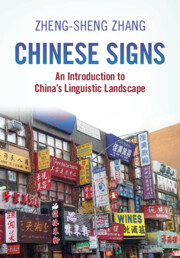


The first question a reader may ask is: Why devote a whole book to Chinese signs? At least three reasons can perhaps be given:
1. Signs represent an important part of the Chinese linguistic landscape.
2. The ability to read signs is essential for surviving and thriving in the Chinese world.
3. Signs make for good materials for learning Chinese.
Signs as Part of the Linguistic Landscape
Signs are seen anywhere in the world. But they seem more numerous in China, particularly if we consider the civic and political banners that are seen everywhere. With their omnipresence and easy access, signs provide an easy window into the world of Chinese language and society.
The contents of signs can reflect important social issues of the day, such as food safety, wastefulness, and environmental degradation. A glance at the current political banners will give you an inkling of what is going on in the country. There must be a reason why 文明 “civilization” is such a buzzword in signs. Signs are also barometers of changing times. The sightings of many foreign businesses such as KFC, Starbucks, Walmart, McDonalds, and Carrefour are concrete signs (pun intended) of the Reform and Opening up that started over four decades ago, while the recent plan to eliminate English translations in traffic signs once again reflects China’s vacillating attitude toward foreign influences.
The choices regarding language and form in signs also reflect language attitudes, and the cultural associations of these choices. What is official may not always be what is chosen. In Hong Kong, the author first saw Cantonese writing using the letter “D” in lieu of the Cantonese 啲 or the standard 点 to express the meaning “a bit” (Apart from the openness towards mixing scripts, “D” really sounds closer to the Cantonese word than 点 and is easier to type than 啲). Many overseas scholars originally from the mainland have chosen to write in traditional characters, which cannot be solely attributed to conforming to local preference.
The existing literature on the Chinese linguistic landscape (for example Guo and Li Reference Guo and Li2017; Shang Reference Shang2020; Wang Reference Wang2013) mostly focuses on ethnolinguistic and socio-political issues such as ethnic identity, semiotic functions, multilingualism, language choice, and language policy, but devotes less attention to the formal features of signs themselves, including their very distinct stylistic and rhetorical characteristics. Also lacking is the use of signs for the learning of Chinese. To complement existing work, this book aims to focus on the following aspects of signs:
Special lexical and grammatical features
Common rhetorical devices
Dialectal and foreign words and how they are written
Character styles and text orientation
The difference between the written and the spoken style in Chinese is so drastic that it is characterized as a “gulf” by Li and Thompson (1982). Signs are good examples of the written style, with its distinct lexical and syntactic characteristics. They are replete with classical Chinese elements. Even the sign for entrance 入口 contains the classical word 入. Signs can flaunt grammatical rules, in having more flexible syntactic function and word order. They often contain background-dependent “out of vocabulary” items such as aliases and abbreviations. Fleeting ad hoc abbreviations headed by numbers such as 五讲四美 are particularly opaque.
Signs accentuate rhetorical preferences deeply ingrained in the culture, such as the fondness for punning and the predilection for parallelism and symmetry. These rhetorical preferences are quite pervasive and are seen even in mundane contexts such as the warnings over urinals 贴近方便, 靠近文明 (see Chapter 17).
The cultural and regional diversity of China is inevitably reflected in signs, which can incorporate dialectal elements, especially from the more prominent Cantonese, Min, and Shanghai dialects.
More and more foreign elements are spotted on the Chinese linguistic landscape. The author experienced a shock when visiting a shopping mall in the coastal city of Ningbo a few years ago. In the whole shopping mall, not a single store had its name in Chinese characters, even though most of the stores were not foreign. Foreign-sounding names of businesses are also quite common.
Diversity is also seen in the choice of character style and text orientation. In mainland China, traditional characters are still occasionally used instead of simplified characters. It is not uncommon to see them on business cards, which convey the appearance of learnedness. Store signs sometimes also choose traditional characters to evoke a sense of nostalgia and of course tradition. Text orientation also varies, especially in places like Taiwan, where traditional vertical and right to left lines co-exist with the modern left-to-right orientation.
The Ability to Read Signs Is a Practical Necessity
Signs serve real-world functions; and ability to decipher them is essential in navigating the Chinese world. But there has been an apparent paradox regarding the use of signs for language teaching: the ability to read public signs is unquestionably necessary for survival; at the same time, there is a glaring gap in the typical language curriculum: students are hardly exposed to signs at all, even at the advanced levels of studies. Books on reading Chinese signs have been few (Kubler Reference Kubler1993 is a notable exception).
The general neglect may be attributed to the blind spots that native curriculum developers likely suffer from. Indeed, it took a non-native scholar to point out the paradox: the most basic survival skill is not taught. The avoidance of signs may also be due to the belief that they are too difficult for learners. Signs typically employ classical Chinese lexical and grammatical features. The difficulty in reading signs may be due to another kind of blind spot, the aforementioned “out of vocabulary” items (items typically not found in dictionaries) such as aliases of place names, somewhat ad hoc abbreviations whose interpretation heavily depends on knowledge of current affairs.
Signs Make Good Learning Materials
Even though they have not received sufficient attention in the standard curriculum, using signs as teaching material makes good pedagogical sense.
Signs are public, easily accessible, and thus provide free resources for learning about China and the Chinese language. Signs are authentic. They are not written by textbook writers, nor simplified in any way. They are more authentic than typical pedagogical materials in another way. To attract attention, many signs are rendered in artistically enhanced (cursive, outlined, or distorted) fonts, which may be harder to read than text in typical textbooks.
As the style of written Chinese is accentuated on signs, studying signs can heighten the sensitivity to stylistic difference between writing and speech. As they are replete with classical Chinese elements, signs can also serve as a more motivated and gentler introduction to classical Chinese, motivated by their practicality and made easier by the smaller dosage. In learning to read signs, students can acquire the most frequently used classical Chinese elements in modern contexts.
The practical nature of signs provides intrinsic motivation for learning them. Signs may be less daunting psychologically to learners, as they are typically short, often in fragment or phrasal form. They are also easier to remember as they are loaded with contextual information. Finally, bilingual signs and translation mistakes in them can accentuate the differences between the two languages.
General Learning Objectives
When used as teaching material, the general learning objectives include:
1. Increasing awareness of the style of public writing
2. Acquiring common classical Chinese elements
3. Gaining familiarity with ‘out of vocabulary’ items such as aliases and abbreviations
4. To gaining familiarity with rhetorical devices such as punning and parallelism
5. Exposure to the great diversity in China’s linguistic landscape
6. Gaining familiarity with how dialect and foreign words are written in China.
Intended Audience
With its wealth of authentic signs, the book can be used in a dedicated course on Chinese signage and for students and researchers interested in linguistic landscapes. The volume can also be used as a supplemental resource book for a course at any level in a Chinese curriculum. As the signs can differ in length and complexity, they can be selectively used with learners with a wide range of backgrounds and proficiency in Chinese. As the signs will be thoroughly annotated and explained in detail, they should be comprehensible to anyone, including travelers and tourists going to China. The practical aspect of this book should make it attractive to any potential student, who wants to be able to function in the real world of Chinese.
Signs Included in This Volume
In this volume, the definition of public signage is interpreted in the broadest sense. Road signs, traffic signs, warning signs, ads, banners, couplets, and advertising billboards have all been sampled. In terms of length, they range from a few characters to multiple lines.
For many years now, the author has been collecting images of signs from personal trips to various locations in China, including Beijing, Shanghai, Xiamen, Quanzhou, Yunnan, Xi’an and Xinjiang. During the winter break of 2019–2020, the author undertook another signs-collecting expedition to China and took more than 1,000 photos of various signs. Noteworthy examples are selected for this book. Greater attention is given to signs that show special cultural, linguistic, and stylistic characteristics.
Signs from Taiwan and Hong Kong are also included, collected from past trips. This provides an interesting counterpoint to mainland signs, with lexical and orthographical differences.
Selected signs from the Chinese diaspora are also included. They are particularly important for the study of linguistic landscape, as they are relevant to issues such as linguistic choice, multilingualism, immigration history, ethnic identity, and political allegiance. Bilingual or multi-lingual diaspora signs also need to resolve the problem of how to cope with other languages. Only the signs that show differences particular to diaspora contexts are featured in Chapter 19. Some diaspora signs can also be found in other chapters. The diaspora signs in this volume are mostly from English-speaking regions. The author also collected some signs in Dungan (a Northwest Chinese dialect) written in the Cyrillic alphabet from his 2021–2022 Fulbright year in Kyrgyzstan.
It needs to be noted that the signs included in this volume are by no means exhaustive. They are limited by the author’s personal experience and circumstances. An obvious lacuna is signs on sports and sports venues.
Presentation Format
The signs are all from original photos taken by the author, albeit cropped to save space and eliminate distracting elements. Annotations include the following information:
Chinese text will be typed out. Simplified characters and left-to-right and horizontal orientation will be uniformly used, even when the original signs are in traditional format and characters. This provides an opportunity for comparison.
Pronunciation is indicated in pinyin. The usual convention regarding the marking of tone changes has been adopted. Tone changes of third-tone syllables are not marked; the tone change rule should be applied when read. The changed tone of 不 and 一 are given. Neutral tones are marked.
Meaning gloss. Meaning glosses are separated from pinyin by a vertical bar “|”. Unlike typical vocabulary lists, which only gloss whole words, the glossing of meaning in this book is done in three different ways, depending on which is more appropriate for the item in question:
1. When the meaning of the whole word is predictable from the meanings of its parts, only meanings of the component characters will be given. Glossing the component characters can make the meaning of compound words more transparent and more relatable to other words sharing the same components. For example, 轻食 “light meal” will be glossed as 轻 “light” and 食 “food”, which can be related to and contrasted with compounds such as 熟食 “cooked food”. To save space and avoid duplication, glosses for the whole words will also be omitted, when the signs are bilingual with good English translations. Character-by-character gloss may be done selectively.
2. Character-by-character gloss sometimes is not possible with words whose meanings do not seem derivable from the meanings of their components in a transparent manner. An example is 经济 “economy”, the meanings of whose components are quite opaque (the classical etymological explanation 经世济民 notwithstanding.) Then only the whole compound word is glossed.
3. Sometimes, the meanings of the whole words are relatable to the meanings of their component morphemes, but there is enough difference between the two. In such cases, both meanings of the component characters and those of the whole words are given. The component characters are glossed because the meanings of the component characters obviously contribute to the meaning of the whole words. The whole words are glossed too because their meanings are not quite the same as the sum of the meaning of the component characters. For example, in addition to glossing 美食 as “gourmet food”, its components are individually glossed as beautiful (美) and food (食). The meaning of the whole compound word is given for accuracy, while the meanings of the components are given to help with understanding and retention. It may happen that even in the same sign, some words are translated component by component, while others are translated by the whole word. To distinguish between glosses on component morphemes and those on whole words, the latter will be enclosed in parentheses.
Also provided are notes about other noteworthy characteristics, including:
grammatical particularities
classical elements
rhetorical devices used
contextual and background information
style and stylistic alternatives
Learning Outcomes
To accentuate the main foci, some learning outcomes are given at the end of each chapter before the suggested learning activities.
Suggested Learning Activities
Some learning activities will be suggested at the end of each chapter. They include the following:
Using suggested key terms, search online for similar signs as presented in the chapter.
Using alternative character style to search for signs of the same kind from other regions.
Type out the text of the found signs.
Translate signs, to check comprehension and note the differences between languages.
Identify classical Chinese elements, aliases, and abbreviations in found signs.
Paraphrase written style in spoken style.
Identify foreign and dialectal elements.
Identify puns, parallelism, and other rhetorical devices.
Analyze translation strategies in bilingual signs.
Analyze mistakes in translation and correct them.
Ordering from the restaurant menus provided.
Use signs in a narrative on a related topic (e.g. a train journey.)
Design a sign by following models, with stylistically appropriate words.
Using a corpus (bcc.blcu.edu.cn/) to check the frequency and time of certain terms.
Using (part of) a line from a couplet, search online for the matching line.
Organization of the Book
The twenty-one chapters of the volume are divided into three parts.
The first part (Chapters 1–4) is a general introduction to the main linguistic, rhetorical, and formal characteristics of Chinese signs.
The second part (Chapters 5–15) presents essential and practical signs.
The third part (Chapters 16–20) will cover more advanced signs, such as ads, civic and political banners, and signs with dialectal and foreign elements. Chapter 19 is devoted to the Chinese diaspora; Chapter 20 covers foreign elements.
There is a supplemental chapter (Chapter 21) on translation mistakes in bilingual signs, which will be categorized and analyzed.
An alphabetically sorted index and an index of signs with Chinese and English keywords.
This chapter presents select signs that show several common stylistic traits of written Chinese. These include classical Chinese elements, mixed lexical compounds with both classical and non-classical components, and classical Chinese grammatical features. There are also many ‘out of vocabulary’ items not usually found in dictionaries. They include aliases for place names and the numerous ad hoc and fleeting abbreviations, whose interpretation crucially depends on background knowledge.
Classical Chinese Lexical Elements
There is an abundance of classical Chinese lexical elements in signs. An extraordinary example is the traffic sign below. Except for the first character 请 ‘please’, every one of the four remaining characters is from classical Chinese!

Figure 2.1 Please each go its way
请各行其道 qǐng gè xíng qí dào
Compare the spoken Chinese version: 请每(辆车都)在自己的车道上走.
There are of course exceptions to this prevalence of classical words in signs. But exceptions do seem to prove the rule. Those signs using the colloquial style are generally designed deliberately to flout the convention to achieve some special effect. In learning to read signs, one can acquire the most frequently used classical Chinese lexical elements in modern Chinese contexts. A few classical words are found in the following signs.

Figure 2.2 No person sell ticket
无人售票 wú rén shòupiào
This is on a conductor-less bus. 无 is classical Chinese for 没有;售 is classical Chinese for 卖.

Figure 2.3 Wait go zone
待行区 dài xíng qū
非机动车 fēi jīdòngchē | non-motorized vehicle
待, 行 and 非 are classical for 等, 走, 不respectively.

Figure 2.4 Again return head
再回首zài huíshǒu | look back again
好吃再回头hǎochī zài huítóu | good eat again return head
(If delicious, come back again)
泡椒牛蛙 pàojiāo niúwā | pickled bullfrog
Interestingly, both the classical and modern versions are given here to form a contrast: 再回首vs.再回头. 首 is classical for 头.
Mixed Compound Words with both Classical and Non-classical Components
Mixed compounds are disyllabic compounds that consist of two components, one classical and one non-classical. Although the two components do not have to be synonymous (for example, 进行 ‘proceed’), the ones that have the same meaning are particularly intriguing. An example is 购买, formed with a classical 购 and a non-classical 买, both meaning ‘buy’. With seeming redundancy, the raison d’être for their existence is their stylistic distinctness. They are stylistically distinct from both of their components which themselves are distinct from each other stylistically (classical=literary; non-classical=non-literary), forming a triple contrast: 买 vs. 购 vs. 购买.
One may expect the stylistic value of these mixed compounds to be somewhere between classical and non-classical. But such expectation is not born out by facts. Using the statistical method of correspondence analysis to visualize the two dimensions of style in written Chinese, the author shows that mixed compounds are more written in style than even their classical components (Zhang Reference Zhang and Tao2016, Reference Guo and Li2017). This can perhaps be felt in translation. While 买 (and possibly 购) is translated as ‘buy’, 购买 may best be rendered as ‘purchase’.

Figure 2.5 You already enter no smoke zone
您已进入无烟区 nín yǐ jìnrù wúyān qū
进入 is a mixed compound, both parts having the meaning ‘enter’ . 入 is classical for 进.

Figure 2.6 Pedestrian
行人 xíngrén | walk person
等待区 děngdài qū | wait area (waiting area)
Both parts of 等待 mean ‘to wait’; 待 is classical for 等.
Flouting Grammatical Rules
In addition to having classical lexical elements, signs also exhibit special grammatical characteristics, which in some cases can be traced to classical Chinese as well. All the examples here yield very few hits in the large BCC corpus with billions of words. It is possible that the corpus does not include many signs.
One example is the use of the buzzword 文明 seen everywhere in China. In addition to the usual meanings of ‘civilization’ and ‘civilized’, it can also be used in other unusual ways. The following two examples show two different usages.

Figure 2.7 Civilization ride vehicle
文明乘车 wénmíng chéngchē
This was in a high-speed train brochure. The translation mistake shows how signs can flout grammar rules. 文明 here is neither a noun nor an adjective; it is an adverb meaning ‘以文明的方式’ (in a civilized manner).

Figure 2.8 Up forward one small step
上前一小步 shàngqián yì xiǎobù
文明一大步 wénmíng yí dàbù | civilization one large step
Signs like these are posted over urinals everywhere. In parallel with the verbal 上前 ‘go forward’, 文明is used as a verb ‘to become civilized’.

Figure 2.9 twenty-first-century non-mobile property
21世纪不动产 21shìjì búdòng chǎn
服务中国 fúwù zhōnggúo | serve China
源于美国yuán yú měigúo | originate in the United States
始于 1971 shǐ yú 1971 | begin in 1971
服务中国 is quite unusual (服务社会 ‘serving society’ is more common), in contrast with the usual 为中国服务. 源于美国 and 始于 1971 both use the classical preposition 于 and the classical word order of verb + prepositional phrase.

Figure 2.10 Study Lei Feng
学习雷锋 xuéxí léifēng
奉献他人 fèngxiàn tārén | devote other people
提升自己 tíshēng zìjǐ | elevate self
Promoted by Mao Zedong sixty years ago, 雷锋’s name is still synonymous with a model citizen. Very unusual is the use of 他人 as the direct object of 奉献, in contrast with the usual 奉献给他人/为他人奉献. By analogy with 奉献自己 ‘devote self’, 奉献他人 can have the opposite meaning of sacrificing others!

Figure 2.11 Serious test discipline
严肃考风考纪 yánsù kǎofēng kǎojì
建设优良学风 jiànshè yōuliáng xuéfēng | build fine academic style
Based on the parallelism with the verbal 建设, the adjective 严肃 must be interpreted as a verb ‘to be serious about’.

Figure 2.12 Jingdong it
京东一下 jīngdōng yíxià
年味到家 niánwèi dàojiā | new year atmosphere arrive home
京东 is the name of an e-merchant and as such should not be followed by the verbal measure 一下. Hence 京东 is used as a verb, in the same way that the name Google has been used.

Figure 2.13 Speaking not loud
言语不喧哗 yányǔ bù xuānhuá
言语 can be neither a subject nor an object but seems analyzable as a topic, which is followed by the comment 不喧哗. Topic-comment is an important characteristic of Chinese grammar.
Abbreviations
Abbreviations are extremely common in Chinese. They present a particular challenge to learners. In the abbreviating process, the meaning can become very opaque. They can also be formed in an ad hoc manner and often have a short life span. Therefore, many of them cannot be found in the dictionary. Understanding them requires background knowledge and the constant updating of knowledge base.
Abbreviations may be motivated by the need to cram increasingly more information into a limited linguistic space. Many of them end up with two syllables, the preferred syllable count in the modern Chinese lexicon.
Abbreviations come in different types. Some of them simply result from truncation. Some are abbreviated from abbreviations, resulting in further opaqueness. The hardest ones use numbers, the interpretation of which is entirely dependent on background knowledge.

Figure 2.14 Supermarket
超市 chāoshì
Abbreviated from 超级市场, this is more frequently used than the full form.

Figure 2.15 Beijing satellite TV
北京卫视 běijīng wèishì
卫视 is abbreviated from 卫星电视, which is hardly used at all.

Figure 2.16 Nation speech
国话 guó huà | National drama theatre
This abbreviation is quite opaque in meaning. ‘National speech’ is the most likely (wrong) guess if you try to glean the meaning from the component characters. The full version 国家话剧院剧场 guójiā huàjùyuàn jùchǎng can be seen below.

Figure 2.17 National drama theater
It is amazing that this is abbreviated to two syllables.

Figure 2.18 High iron ride train direction
高铁乘车方向 gāotiě chéngchē fāngxiàng
高铁 is short for高速铁路, as 地铁 is for 地下铁路.

Figure 2.19 Inn move micro iron
驿动微铁 yì dòng wēi tiě | e-drive micro rail
This is on a shuttle bus. The abbreviation 微 ‘micro’ is used widely, as in 微软 ‘Microsoft’, 微推 ‘micro tweet’ and 微信 ‘wechat’. Also worthy of note is 驿动. 驿, abbreviation for roadside inn 驿站, is used because it sounds like E.
Abbreviations of Abbreviations
Figure 2.20 Winter Olympic 北京2022年冬奥会官方合作伙伴 běijīng 2002 nián dōngàohuì guānfāng hézùo huǒbàn Beijing 2022 year winter Olympic meet official cooperation partner 冬奥会 is short for 冬季奥运会. 奥运会 is itself short for 奥林匹克运动会, which is quite a mouthful. But only through this unabbreviated form can we see the connection between the transliteration 奥林匹克 and the original word Olympic. Figure 2.21 Pudong development bank 浦发银行 pǔfā yínháng 浦发银行 is short for 上海浦东发展银行 (Shanghai Pudong Development Bank). 浦is in itself an abbreviation for 黄埔江 Huangpu River. 浦东means east of the Huangpu River. It is the fast-developing financial area of Shanghai.

The most striking example of iterated abbreviations involves three steps of abbreviation.

Figure 2.22 Child program child art
童程童美 tóng chéng tóng měi
(children computer programming and children art)
少儿编程 shào’ér biānchéng | young child compile program
This company provides instruction to children on computer programming and computer art. The abbreviations 童程, 童美 stand for 儿童编程 and 儿童美术 respectively. Interestingly, 编程is itself abbreviated from 编写程序. The whole iterated process is thus: 编写程序➔ 编程➔程!
Abbreviations by the Numbers
One particularly opaque and fleeting type of abbreviations is headed by numbers. One good example is Sun Yat-sen’s 三民主义 ‘three people-ism’, which is from 民族 ‘nation’, 民权 ‘people’s right’, and 民生 ‘people’s livelihood’. In the1950s, two of the political campaigns were referred to as 三反 ‘three anti-s’ and 五反 ‘five anti-s’. 三反 stand for 反贪污 ‘anti-corruption’, 反浪费 ‘anti-wastefulness’, 反官僚主义 ‘anti-bureaucracy’; 五反 stands for 反行贿 ‘anti-bribery’, 反偷税漏税 ‘anti-tax evasion’, 反盗骗国家财产 ‘anti-theft of state property’, 反偷工减料 ‘anti-cutting corners’, 反盗窃国家经济情报 ‘anti-theft of state economic information’. In the first decade of the new millennium, the political platform of Hu Jintao and Wen Jiabao was presented as 八荣八耻 ‘eight to be proud of and eight to be ashamed of’. To make sense of them, one needs to be kept abreast of what is happening in China. The following example was seen in the southeastern city of Wuxi at the end of 2019. Common to many such locally produced banners, it is quite amateurish and by no means a model of elegance!

Figure 2.23 Carry out eight etiquettes four ceremonies
践行【八礼四仪】jiànxíng ‘bā lǐ sì yí’
争做新时代好少年 zhēng zuò xīn shídài hǎo shàonián | vie be new era good teenager
八礼bā lǐ | eight etiquettes:
- 仪表之礼
yíbiǎo zhīlǐ | comportment etiquette
- 餐饮之礼
cānyǐn zhīlǐ | eating/drinking etiquette
- 言谈之礼
yántán zhīlǐ | speech etiquette
- 待人之礼
dàirén zhīlǐ | treatment of people etiquette
- 行走之礼
xíngzǒu zhīlǐ | walking etiquette
- 观赏之礼
guānshǎng zhīlǐ | touring etiquette
- 游览之礼
yóulǎn zhīlǐ | sightseeing etiquette
- 仪式之礼
yíshì zhīlǐ | ceremony etiquette
四仪sì yí | four ceremonies:
七岁入学仪式 7 suì rùxué yíshì | seven years starting school ceremony
10岁成长仪式 10 suì chéngzhǎng yíshì |ten years growth ceremony
14 岁青春仪式 14 suì qīngchūn yíshì | fourteen years youth ceremony
18岁成人仪式 18 suì chéngrén yíshì | eighteen years adulthood ceremony
Without being spelled out, the eight etiquettes and four ceremonies would be quite opaque to outsiders. The two somewhat artificially created categories seems a clumsy attempt at symmetry, as they are based on the word 礼仪 ‘etiquette’.
Aliases
Public signs also include aliases for place names, knowledge of which is undoubtably important. Valued for their succinctness and literary association, monosyllabic aliases are preferred over multi-syllabic official names in many contexts, including license plates, names of highways and train routes, and names of restaurants. Except for a few that are simple abbreviations of the full forms, most are distinct in form, necessitating the need to learn them separately.
To complicate matters, there is no one-to-one correspondence between aliases and the official names. The same place name may have more than one alias. For example, 云南 can be 云 or 滇; 四川 can be 川 and 蜀; on the other hand, the same alias can also stand for different places. 宁can be the alias for 南京; but it has also been used for the province of 宁夏.
In this section, we will mostly use automobile license plates as examples (quite a few aliases used in restaurant names can be found in Chapter 10 on eating). All license plates in China start with the monosyllabic alias for the location where the vehicle is registered. The color is uniformly blue, except electronic vehicles, which have green license plates.
Aliases come in different types. The easiest kind is the abbreviated type, which retains part of the official name.

Figure 2.24 Alias for Guizhou
贵guì ‘expensive, noble, precious’ stands for 贵州guìzhōu, a Southwestern province known for its mountainous terrain.

Figure 2.25 Alias for Ningxia
宁níng ‘peaceful’ stands for 宁夏 níngxià, a Northwestern province with a mostly Muslim population. Note however 宁 is also the alias for 南京.

Figure 2.26 Alias for Jiangsu
Unlike the two earlier, 苏sū is the second syllable of 江苏jiāngsū, the province surrounding Shanghai. Note that it does not stand for 苏州, a city in the province.
Aliases Totally Different from Official Names
Totally different from the official forms, they are harder to learn than the abbreviated type. But this type is in fact the norm.

Figure 2.27 Alias for Hubei
鄂 è is the alias for 湖北 húběi (lake north) province.

Figure 2.28 Alias for Shandong
鲁 lǔ stands for the province of 山东 shāndōng (mountain east), where the ancient kingdom 鲁国 and Confucius’ hometown is located. 鲁菜 refers to one of the eight main cuisines of China. It was the cuisine of the court for the last two imperial dynasties.

Figure 2.29 Alias for Guangdong
粤 yuè stands for the province 广东 guǎngdōng. 粤语 yuèyǔ refers to the Cantonese language/dialect; 粤菜 yuècài refers to one of the best-loved cuisines known for its fresh ingredients and subtle flavors.

Figure 2.30 Alias for Shanghai
沪 hù stands for the city上海 shànghǎi. 沪剧 hùjù refers to the local opera. The green license plate shows it is an electric vehicle.

Figure 2.31 Alias for Fujian
闽 mǐn stands for the province 福建fújiàn.
闽菜 refers to the local cuisine and 闽语 is one of the main dialect families of China, known for its many archaic words.

Figure 2.32 Alias for Anhui
皖 wǎn stands for the province of 安徽 ānhuī. It can also be used to refer to the local cuisine.

Figure 2.33 Beijing-Shanghai Highway
国家高速 guójiā gāosù | national high speed
京沪高速(沪宁) jīng hù gāosù (hù níng)
Beijing-Shanghai High Speed (Shanghai-Nanjing)
Learning Outcomes
a. Gain greater awareness of classical Chinese elements in public writing.
b. Gain greater awareness of the pervasiveness of abbreviations in Chinese.
c. Gain greater awareness of aliases in Chinese.
Suggested Learning Activities
1. Give the non-classical counterparts to the classical 无, 非, 待, 行, 入, 于, 首, 售.
2. Using 标识 and 警示, search online for signs that include the classical Chinese elements 无, 非, 待, 行, 入, 于, 首, 售. Type them out and translate.
3. Abbreviate the full names of schools given in Chapter 12.
4. Find the abbreviations of government offices in Chapter 12.
5. Using 略语, search online for abbreviations and give their full forms.
6. Using 数字略语, search for abbreviations headed by numbers and give their full forms.
7. Search online for signs that include the aliases given in this chapter. Type them out and translate.
8. Give the official names for the aliases 粤, 鲁, 闽, 苏,皖, 贵, 宁, 鄂, 京, 沪.
9. Using 菜系 ‘cuisine system’, search online for cuisines that include aliases. Give the official names.
10. Find a map of China and put the aliases for place names where they belong.
The rhetorical devices used in a language reflect both its linguistic characteristics and the cultural patterns of its users. Due to the extensive homophony in Chinese, punning is extensively exploited. The predilection for even numbers may account for the fondness for symmetry and parallelism. The special characteristics of Chinese characters naturally lend themselves to clever exploitation of graphic shape.
As expected, rhetorical devices are seen more often in public writing such as advertisements and civic banners but less in strictly functional ones like road signs. Quite a few of the examples of punning in this chapter are for advertising purposes. Most of the civic signs in Chapter 17 exhibit parallelism.
Punning with Homophony
Due to the small syllabic inventory and short word length, homonyms abound in Chinese. Many words share the same sound. Consequently, punning, i.e., using one form to evoke two meanings, is very easy to achieve. This may explain the fondness for punning in Chinese and it has been used extensively (and sometimes too easily it seems), especially in ads and names of businesses. The Chinese term for punning is 谐音 xiéyīn ‘lit. harmony sound’.

Figure 3.1 Real heart fresh
真心鲜 zhēn xīn xiān
This is a grocery store, where freshness (新鲜) is very important. The substitution of 新 with the homophone 心 allows the alternative grouping of 真心 to mean ‘earnest’. When read rather than heard, the meaning of earnestness stands out, as the combination 心鲜 ‘heart fresh’ does not make sense.

Figure 3.2 Heart direction
心方向 xīn fāngxiàng
留学 liúxué | stay study 移民 yímín | move people
Study abroad immigration
Like the sign above, the pun lies in the homophony of 心 ‘heart’ and 新 ‘new’. A new direction is also the direction your heart desires to go in!

Figure 3.3 Scan one scan
扫一扫 sǎo yì sǎo
码上有礼 mǎshàng yǒu lǐ | code on have gift
码 and 马 are homophonous. 码上 ‘on the code’ sounds like 马上 ’immediately’. ‘Scan it and you will have gift right away.’

Figure 3.4 Clean plate campaign
光盘行动 guāngpán xíngdòng
不剩饭 bú shèngfàn | no leave food 不剩菜 bú shèngcài | no leave dish
文明餐桌从我做起 wénmíng cānzhuō cóngwǒ zuòqǐ
civilized dining table from me do start
光盘 originally means ‘laser disk’. But 光 can also mean ‘clean’ and 盘 ‘plate’.

Figure 3.5 Bao miss
包小姐 bāo xiǎojie
The shocking ad has two possible meanings. 包 can be a surname, so 包小姐 can mean Miss Bao. But who in their right mind would simply put a name with a phone number in an ad? More likely, 包 is intended to be a verb meaning ‘to exclusively retain a miss (for her various services)’.

Figure 3.6 Clear true
清真 qīngzhēn | Halal
宁夏马记 níngxià mǎ jì | Ningxia Ma’s
回乡情怀 huíxiāng qínghuái | return/Muslim village sentiment
宁夏 is an autonomous region in China with a Muslim majority. 回乡 can mean ‘return to village’, but it can also mean homeland of the Hui Muslim people. In this context, the latter is clearly the intended meaning.

Figure 3.7 Foreign country
异国yìguó | foreign country 他湘 tāxiāng | other Xiang
This is a restaurant in Boston’s Chinatown. 异国他湘 sounds the same as 异国他乡, which means ‘foreign country and place’. 湘 is the alias for Hunan known for its spicy cuisine.

Figure 3.8 Crab heaven crab earth
蟹天蟹地 xiè tiān xiè dì
蟹天蟹地 is homophonous with 谢天谢地 ‘thank heavens thank earth’. This ad shows some eaters’ extreme enthusiasm about eating crabs.
Punning with Partial Homophony
Sometimes, the homophony is not total, but this does not prevent the use of punning.

Figure 3.9 Real Kungfu
真功夫 zhēn gōngfu
This restaurant chain specializes in steamed (蒸) foods, which are deemed healthier. It exploits the association between 真 ‘real’ martial art and healthy lifestyle. Never mind that 真 zhēn is not really a homophone of 蒸 zhēng ‘steamed’. But for southerners, they may really be homophonous, as ‘n’ and ‘ng’ are hard to distinguish for them.

Figure 3.10 Nutrition still steam better
营养还是蒸的好 yíngyǎng háishì zhēngde hǎo

Figure 3.11 Steamed delicious
蒸的美味 zhēngde měiwèi
真的健康 zhēnde jiànkāng | really healthy
Apart from the near homophony between 蒸 and 真, ‘steamed’ and ‘really’ can trade places and it still makes sense: 真的美味 ‘really delicious’, 蒸的健康 ‘steamed is healthy’.

Figure 3.12 Journey purchase
途购tú gòu
This shop selling travel accessories has a rather ingenious name. Not only do the meanings of English and Chinese match, but the Chinese name also sounds almost identical to the English one (albeit with tones).

Figure 3.13 Come go flush flush
来去冲冲 láiqù chōngchōng
This reminder reminds people of the phrase 来去匆匆 ‘come and go in a hurry’. 冲 chōng and 匆cōng are near homophones. Their association implies that even if you are in a hurry, you should flush the toilet.

Figure 3.14 Rent eight borrow
租八借 zū bā jiè
单车出租站 dānchē chūzū zhàn | single vehicle out rent station
This is a bike rental in Taiwan. 租八借 is both a pun and an allusion to the classic 西游记 ‘Journey to the West’, in which the traveling entourage included 猪八戒 zhūbājiè the piggy, which sounds like 租八借 zūbājiè, especially to southerners, who find it difficult to distinguish the retroflex zhu from the non-retroflex zu. The allusion is easy enough for native speakers, who may have grown up with the story, but it could be quite baffling to non-native learners.
Clever Exploitation of Graphic Shape of Characters
Due to the special nature of the Chinese script, it is no surprise that the graphic shape of Chinese characters has been cleverly exploited.

Figure 3.15 Hot to touch
烫tàng
This warning was found on the table of a Yunnan restaurant serving piping hot rice noodles (过桥米线). Cleverly, it uses two colors for the two components of the character. The red at the bottom is the fire radical, certainly relevant to being hot. The blue on top 汤 is a sound clue tāng, its original meaning ‘soup’ not directly related to ‘hot to touch’. But here, what is hot is exactly a soup, thus highlighting the components serves to bring out the double meaning: 汤烫 ‘soup is hot’!

Figure 3.16 Warm warm and slow slow
暖暖和缓缓 nuǎnnuan hé huǎnhuan
一直希望有两个女朋友 yìzhí xīwàng yǒu liǎnggè nǚpéngyǒu
always hope have two female friend
一个叫暖暖一个叫缓缓 yígè jiào nuǎnnuan yígè jiào huǎnhuan
one call warm warm one call slow slow
Note the similarity in both the pronunciation (nuǎn and huǎn, which rhyme) and the shape of the two characters 暖 and 缓, sort of visual rhyming! Note the mixture of simplified and traditional characters.

Figure 3.17 Gallop gamy savory
犇羴鱻 bēn shān xiān
This is the name of a restaurant in Qufu, Confucius’ hometown. All three characters are formed by three copies of the same character 牛 ‘ox’ 羊 ‘sheep’ 鱼 ‘fish’.

Figure 3.18 Wood wood dusk wood eye heart
木木夕木目心 mù mù xī mù mù xīn
This store sign is a clever decomposition of 梦想 ‘dream’. The resulting string sounds rather nice!


Figure 3.20 I want to love her/him just like she/he loves me
我要像她/他爱我一样,爱她/他 wǒ yào xiàng tā ài wǒ yíyàng, ài tā
This insurance ad seen in the Beijing metro makes use of the total homophony and partial visual similarity between the two third-person pronouns. 她/他 are pronounced the same way and only differ in having different radicals on the left.
Symmetry and Parallelism
The Chinese predilection for even numbers may explain the indulgence in parallelism and symmetry in public writing. The Chinese term for parallelism is 对仗 duìzhàng. The fondness for parallelism has had a long history, as exemplified by the excessive attention to formal symmetry in 骈文 ‘parallel prose’ started in the Qin and Han dynasties. Widely seen in spring couplets, civic and political banners, parallelism can even be seen in more mundane domains such as advertisements and restaurant menus.

Figure 3.21 A cup of tea
阅读 yuèdú | read 香茗 xiāngmíng | fragrant tea聚会jùhuì | gathering
一个人yígè rén | a person
一本书 yìběn shū | a book
一杯茶 yìbēi chá | a cup of tea
一段回忆 yíduàn huíyì | a memory
In the second line, the uniform pattern ‘一 + measure word + noun’ is repeated four times, with four different measure words and four different noun phrases. Both simplified (1st line) and traditional (2nd line) characters are used.

Figure 3.22 Beauty at river south water
美在江南水 měi zài jiāngnán shuǐ
食在王兴记 shí zài wáng xīng jì | food at Wang Xing’s
This is found on the wall of the restaurant whose name is in the calligraphic scroll. The parallelism lies in having the same number of characters for both lines, the use of the same character 在 at the second position in both lines and following the same grammatical pattern: noun + 在 + location.

Figure 3.23 Today divide one divide
今天分一分 jīntiān fēnyìfēn | give it a sorting today
明天美十分 míngtiān měishífēn
tomorrow beautiful ten portion (much prettier tomorrow)
This is to urge people to sort trash. The presence of both parallelism and variation is unmistakable. The second and last characters of each line 天 and分 are identical; the first and the fourth character of each line are different words of the same category, 今 vs. 明 and 一 vs. 十. The middle characters of both lines are verbs: 分 ‘divide’ and 美 ‘beautiful’.

Figure 3.24 Fresh shrimp talent person small wonton
鲜虾才子小馄饨 xiānxiā cáizǐ xiǎo húntun
蟹粉佳人小馄饨 xièfěn jiārén xiǎo húntun
crab yolk beauty person small wonton
It is quite remarkable that parallelism is seen even here. The male 才子 ‘talented person’ in the shrimp wonton matches the female 佳人 ‘beauty person’ in the crab roe wonton.

Figure 3.25 Donkey meat bun
驴肉火烧lǘ ròu huǒshāo 肯得驴 kěndé lǘ | Kentucky donkey
人吃驴肉健康长寿 rén chī lǘròu jiànkāng chángshòu
people eat donkey meat healthy long life
驴吃百草浑身是宝lǘ chī bǎicǎo húnshēn shì bǎo
donkey eat hundred grass whole body treasure
天天新鲜 tiāntiān xīnxian | every day fresh
美味食品 měiwèi shípǐn | delicious food
This is on a wrapper for a ‘donkey burger’, a specialty of Hebei province. The format is almost like a couplet, with a four-character horizontal line on top and two pairs of vertical lines, which match in number of characters and structural patterns. Note the sly allusion to KFC.
Couplets
Spring couplets 春联 chūnlián are so named because they are often put up around the lunar new year and they come in pairs of vertical lines of mostly seven characters, along with a horizontal line typically with four characters. Traditionally, the horizontal line is read from right to left and the right vertical line before the left. The most notable feature is symmetry and mirroring and contrast between words of the two vertical lines in meaning and parts of speech.
In Figures 3.26–3.30, a few different variations of the form are given.

Figure 3.26 Couplet 1
富贵平安 fùguì píng’ān | wealth distinction peace
年年如意财进门 niánnián rúyì cái jìnmén
year year as wish wealth enter door
天天开心福到家 tiāntiān kāixīn fú dàojiā
day day open heart blessing arrive home
The top horizontal line should be read from right to left. Accordingly, the right vertical line should be read first. The parallelism between the two vertical lines is seen in:
1. having the same number of characters
2. repeating the first character
3. the first four characters follow the pattern: noun+noun+verb
4. the last three characters follow the pattern: subject+verb+location
5. the first four characters and the last three characters can stand alone

Figure 3.27 Couplet 2
万事如意 wànshì rúyì | ten thousand matter as wish (everything as you wish)
迎新春四季平安 yíng xīnchūn sìjì píng’ān | greet new spring four season peace
贺佳节五福临门 hè jiājié wǔfú línmén | congratulate fine festival 5 blessing arrive door
Even though the characters are in traditional style, the format is not entirely traditional, the top line being read from left to right instead of right to left. Accordingly, the vertical line on the left should also be read first. The obligatory parallelism between the two vertical lines is seen in the following ways:
1. both lines can be divided into two parts: three characters+four characters
2. the three-characters part in both lines has the structure verb+adj. noun.
3. the four-characters part in both lines has the structure number+noun+verb phrase
4. the first three characters and the last four characters can stand alone

Figure 3.28 Couplet 3
平安如意年年好 píng’ān rúyì niánnián hǎo
peace as wish year year good
人顺家和事事兴 rénshùn jiāhé shìshì xīng
people smooth family harmony matter matter prosperous
Even though there is no horizontal line to use as guide, the two lines should be read from right to left. The parallelism is seen in repeating the fifth character in both lines. In addition, the last three characters of each line follow the same pattern: noun+ noun +adjective.

Figure 3.29 Couplet 4
一顺百顺万事顺 yíshùn bǎishùn wànshì shùn
1 smooth 100 smooth 10,000 matter smooth
千福万福满堂福 qiānfú wànfú mǎntáng fú
1k blessing 10k blessing full house blessing
The left line should be read first, as the number one 一 should precede one thousand 千. Note the repetition of the two characters 顺 and 福three times. In the center one big 福 is accompanied by ninety-nine smaller ones in all the variant forms, making up exactly 100 福 characters.

Figure 3.30 Couplet 5
迎送远近通达道 yíngsòng yuǎnjìn tōngdá dào
greet see off far near through reach path
(All paths near and far can take you here or away.)
进退迟速游逍遥 jìntuì chísù yóu xiāoyáo
forward back tardy speedy wander leisure
(However you move, do it in a carefree manner)
The left line should be read first. It is obvious that the component ‘辶’ is common to all fourteen characters. It is not hard to come up with characters having the same component; what is challenging is to come up with two lines that still make sense and are even related in meaning.
Learning Outcomes
a. Gain greater awareness of the extent of homophony in Chinese.
b. Gain greater awareness of the prevalence of parallelism in public writing.
c. Gain greater awareness of the rhetorical potential of character components.
Suggested Learning Activities
1. Using the term 谐音, search online for more examples of punning.
2. In Chinese mode, type in ‘shi’ and count the number of homophonous characters.
3. In Chinese mode, type in ‘qing’ and write out characters with the phonetic component 青.
4. Design a sign with a pun.
5. Find examples of parallelism in Chapter 17 and explain how the parallelism works.
6. Using the term 对仗, search online for more examples of parallelism.
7. Using 春联 and 对联, search online for more examples of couplets. Identify features of parallelism in them.
8. Using 年年好, and 家和人和, search online for lines of couplets which match up with 年年好 and 家和人和 respectively.
9. Design a couplet.
10. Decompose the character 聽 and 赢 into components.
Reflecting the changes that Chinese writing has undergone during the last century, Chinese signs are neither uniform in character style nor text orientation. The mixing of different formats is also evident.
Traditional and Simplified Characters
Two kinds of Chinese characters are presently in use: traditional and simplified. While in mainland China, simplified characters have been used since the late 1950s, traditional characters are still the norm in Taiwan, Hong Kong, Macau, and most overseas communities.
It needs to be stated that not all characters have been simplified. Of the characters that have been, many correspond regularly to their traditional counterparts by having regularly simplified components such as 言>讠; 鳥>鸟; 馬>马; 魚>鱼.
Although most of the signs in this volume were collected from mainland China, where simplified characters enjoy official status, traditional characters are still more often seen than expected. They can be spotted on store signs, business cards, and especially calligraphy. They are apparently chosen for non-functional reasons. They convey an impression of tradition, learnedness, and general gravitas absent from simplified characters.

Figure 4.1 Grand Gateway Office Tower
港汇中心一座 gǎnghuì zhōngxīn yí zuò | Hong Kong assemble center 1 tower
恒隆广场 hénglóng guǎngchǎng | Henglong square
The Grand Gateway Complex is in Xujiahui district Shanghai. What’s interesting is the use of both traditional characters (on the left) and simplified ones (on the right). It turns out that the 恒隆 real estate company is from Hong Kong, where traditional characters are standard. The character 港 in the name probably stands for 香港 ‘Hong Kong’.

Figure 4.2 Green/red peppers
青灯笼椒 qīng dēnglóng jiāo | green lantern pepper
红色灯笼椒 hóngsè dēnglóng jiāo | red color lantern pepper
It is amazing that green pepper is in simplified characters and the red in traditional characters. This is seen in Auckland New Zealand.
Text Orientation
As seen in old newspaper headlines, text lines traditionally were either vertical or horizontal from right to left. While vertical lines are still common, the right-to-left format has mostly been phased out except in Taiwan where they co-exist with the new left-to-right format.

Figure 4.3 West sheep market
西羊市 xī yáng shì
Not only is the line read from right to left, the classical Chinese word for market 市 is used. In modern Chinese it is 市场. This is in the Muslim quarter of the ancient capital Xi’an.

Figure 4.4 Activity center
活动中心 huódòng zhōngxīn
This should be read from right to left. This is in a University in Taiwan.

Figure 4.5 Christian gathering place
基督徒聚会处 jīdūtú jùhuì chù
The name of this Christian church in Taiwan is written in two traditional formats, vertically and horizontally from right to left. The biblical passages on the side walls are also presented in vertical lines, moving from right to left. All the characters are in the traditional style.

Figure 4.6 National history museum
国立历史博物馆 guólì lìshǐ bówùguǎn
This is a good example of the transition from the traditional to the modern format. The name of the museum (on top) is the only line that should be read from right to left, while all others are in the modern left-to-right format.

Figure 4.7 All formats
时代语文 shídài yǔwén | Times language
科见美语 kē jiàn měiyǔ | Kejian American language
永久国际专案管理 yǒngjiǔ guójì zhuān‘àn guǎnlǐ
Forever international case management
通律法律事务所 tōnglǜ fǎlǜ shìwùsuǒ| general law office
All the possible formats are exemplified here. The topmost horizontal one is read from right to left; the two below with the same text are in both left-to-right and vertical formats; the two at the bottom are both read from left to right. This is seen in Taiwan.

Figure 4.8 Peach garden commune
This store in Shanghai really has outdone itself to be creative by using all possible formats, vertical and horizontal, right to left and left to right. The main sign at the top should be read from right to left as 桃园公社 táoyuán gōngshè ‘peach garden commune’. But the truly crucially informative part on the top right is in the normal left-to-right format: 家具 jiājù ‘furniture’ 家居 jiājū ‘home living’ (cleverly, 家具 and 家居 use two tonally different second characters). The four characters at the bottom left are still different, in the same format as in traditional books, vertically by character and right to left by line: 桃源茶社. 源 yuán ‘source’ is homophonous with 园on top and 茶 chá ‘tea’ replaces the 公on top.
Learning Outcomes
a. Know where traditional characters are used.
b. Know how traditional characters are simplified.
c. Be able to identify right-to-left text orientation.
Suggested Learning Activities
1. Find ten signs in Chapter 19 in traditional characters. Where are these signs from?
2. Find five signs in Chapter 19 in right-to-left format. Where are these signs from?
3. Using 书法, search online for five pieces of calligraphy in traditional characters.
4. Using 名片, search online for five business cards in traditional characters from China.
5. Using 简化字, search online for ten characters that are regularly simplified. Write out both traditional and simplified characters.
6. Using Google Translate or other apps, convert ten signs in Chapter 19 (the Chinese diaspora) into simplified characters.


