

The ads sampled in this chapter are of three types: commercials, classified ads, and the so-called small ads.
Commercials
Commercials can appeal to senses of good value, tradition and authenticity, novelty and popularity. To attract attention, they often employ rhetorical devices such as punning, parallelism, allusions to shared cultural knowledge, and unexpected juxtaposition for humorous effect. For more examples of punning and parallelism, see Chapter 3.
Formal Appeal

Figure 16.1 Heart of cognac
心中干邑 xīnzhōng gānyì | heart mid cognac
干邑中心 gānyì zhōngxīn | cognac mid heart
This ad plays on the reversal of 心中 ‘in heart’ and 中心 ‘center’. The two parts look like mirror images but for 干邑, and still manage to make sense.

Figure 16.2 Wanda
万达所至 wàndá suǒ zhì | Wanda arrive
中心所在 zhōngxīn suǒ zài | center be
(Wherever Wanda goes, that’s where the center will be.)
This ad employs formal symmetry, with four characters in each line and 所__ in both lines. 所 is a classical particle. 至 is classical for 到. The Wanda Group is a major multinational conglomerate.

Figure 16.3 I choose my taste
我选我味 wǒ xuǎn wǒ wèi
This is a fast-food ad. Both Chinese and English are four syllables long, broken into two disyllabic parts. 我 is shared by both lines. The symmetry lies between Chinese and English, as well as within Chinese.
Unexpected Twists

Figure 16.4 Quit smoke quit alcohol quit lover
戒烟戒酒戒情人 jièyān jièjiǔ jiè qíngrén
Quitting lover!

Figure 16.5 Add alcohol station
加酒站 jiājiǔ zhàn
This is from 加油站 ‘gas station’. 酒 and 油 also rhyme.

Figure 16.6 Luzhi drink alcohol training base
甪直喝酒培训基地 lùzhí hējiǔ péixùn jīdì
欢迎光临 huānyíng guānglín | welcome presence
可以喝酒 kěyǐ hējiǔ | can drink alcohol
可以发呆 kěyǐ fādāi | can stare into space
可以蹭网 kěyǐ cèngwǎng | can freeload on Wi-Fi
We are so accustomed to 不可以 ‘not allowed’!

Figure 16.7 This place forbids talking price
此地禁止讲价 cǐdì jìnzhǐ jiǎngjià
This is at a bazaar. Not to bargain here is almost a crime! 此地 is classical for 这个地方. Traditional characters are used even though it is in mainland China.
Allusions
Ads with these may be baffling to outsiders, as they attempt to appeal to shared cultural knowledge.

Figure 16.8 Friendly guest appearance
友情客串 yǒuqíng kèchuàn
The allusion is to cameo appearance in movie making. 串 ‘skewer’ is a favorite street food.

Figure 16.9 Happy little lamb
快乐小羊 kuàilè xiǎoyáng
One can hardly avoid the association with one of the most famous hotpot chains 小肥羊 ‘little fat lamb’.

Figure 16.10 Helen Keller
海伦凯勒 hǎilún kǎillè
眼镜 yǎnjìng | eyeglasses
Whether or not it is advisable, the allusion to the inspirational blind author is unmistakable.
Old, Homey, and Authentic!

Figure 16.11 Old Shanghai scallion oil pancake
老上海葱油饼 lǎo shànghǎi cōngyóu bǐng
顾寿刚 gù shòugāng | Shougang Gu
创始于 1983 chuàngshǐ yú | founded in 1983
This is the oil-stained wrapper of a local favorite.
于 is classical Chinese for ‘in’.

Figure 16.12 Ceremoniously push out (introduce)
隆重推出 lóngzhòng tuīchū
纯手工老面包子 chún shǒugōng lǎomiàn bāozi
pure hand work old dough steamed bun
让你找到小时候的味道
ràngnǐ zhǎodào xiǎoshíhoude wèidào
let you find small time (childhood) flavor

Figure 16.13 Hunan west grandma vegetable rice
湘西外婆菜饭 xiāngxī wàipó càifàn
This tries to appeal to nostalgia for family and hometown.

New and Popular!

Figure 16.15 Popular new product
人气新品 rénqì xīnpǐn
酸汤莜面鱼鱼 suāntāng yóumiàn yúyu
sour soup oat fish fish (spaetzle)
蘑菇汤莜面鱼鱼 mógūtāng yóumiàn yúyu
mushroom soup oat fish fish (spaetzle)
人气 ‘popular’ is from Japanese人気 (ninki).

Figure 16.16 Sales champion
销量冠军 xiāoliàng guànjūn
辣黄牛炒莜面 là huángniú chǎo yóumiàn
spicy yellow cow stir-fry oat noodle
葱油虾仁拌莜面 cōngyóu xiārén bàn yóumiàn
scallion oil shrimp mix oat noodle
Free and Cheap!

Figure 16.17 Non-alcoholic drink
非酒精饮品 fēi jiǔjīng yǐnpǐn
免费续杯 miǎnfèi xùbēi | no fee continue cup (free refill)
(限同款) xiàn tóngkuǎn | limit to same style
The operative word is 免费 ‘free’!

Figure 16.18 Super value
一杯咖啡的价格 yìbēi kāfēi de jiàgé
a cup coffee price
在这里搞定一套 zài zhèlǐ gǎodìng yítào
here get a set
货真价实好超值 hùozhēnjiàshí hǎo chāozhí
stuff real price solid so super value
‘Great value’ is conveyed by both 货真价实 and 超值.
Safe to Eat!
When restaurants resort to ads like these, there must be cause for concern!

Figure 16.19 Cow sheep meat
牛羊肉 niúyángròu
安全放心 ānquán fàngxīn | safe, be at ease

Figure 16.20 Our promise
我们de承诺 wǒmen de chéngnuò
面食不用洗衣粉 miànshí búyòng xǐyīfěn
wheat food not use wash clothes powder
调料不用防腐剂 tiáoliào búyòng fángfǔjì
seasoning not use preservative
做饭不用病死肉 zuòfàn búyòng bìngsǐ ròu
make food not use sick dead meat
炒菜不用地沟油 chǎocài búyòng dìgōu yóu
stir-fry not use earth ditch (recycled) oil
Amazingly, the disturbing message is conveyed through neat formal symmetry, which includes the consistent use of the topic-comment structure (topic=as for).
Job Ads: These Restaurants Are Hiring

Figure 16.21 Hiring
招聘 zhāopìn | recruit hire
服务员 fúwù yuán | server
厨房工 chúfáng gōng | kitchen worker
勤杂工 qínzá gōng | misc. worker (handy person)
名 míng | measure for people
包吃包住 bāochī bāozhù | include food include lodging
工资待遇面议 gōngzī dàiyù miànyì | salary treatment face talk
面议 ‘discuss face-to-face’ is a formulaic expression.

Figure 16.22 Hiring
招聘 zhāopìn | recruit hire
凉菜师 liángcài shī | cold dish master
墩子 dūnzi | cutting board (prep cook)
工资面议 gōngzī miànyì | salary face talk
服务员 fúwùyuán | server
工资 gōngzī | salary
奖金 jiǎngjīn | award gold (bonus)
开瓶费 kāipíng fèi | open bottle fee (corkage)
男女不限 nánnǚ búxiàn | male female no restriction

Figure 16.23 Hiring
掌柜小店 zhǎngguì xiǎodiàn
shopkeeper little shop
掌柜招聘 zhǎngguì zhāopìn
shopkeeper recruit hire
招聘岗位 zhāopìn gǎngwèi
recruit hire position
店长 diànzhǎng | general manager
主管 zhǔguǎn | kitchen manager
服务员 fúwùyuán | server
厨工 chúgōng | kitchen worker
Note the old-style word 掌柜 ‘proprietor’.
Classified Ads
Classified ads can be seen in newspapers or message boards at supermarkets. They are noteworthy for having a cryptic style, being short, and being full of abbreviations and formulaic expressions, sometimes without punctuation marks.

Figure 16.24 For rent
三居出租 sān jū chūzū | 3 room out rent
附近小区楼房三居 fùjìn xiǎoqū lóufáng sānjū
nearby sub-division building 3 room
房间干净整洁 fángjiān gānjìng zhěngjié | rooms clean tidy
家具家电齐全 jiājù jiādiàn qíquán | furniture home appliance complete
能洗澡做饭上网 néng xǐzǎo zùofàn shàngwǎng | can take bath cook go online
交通购物方便 jiāotōng gòuwù fāngbiàn | transportation shopping convenient
无中介费 wú zhōngjiè fèi | no middle introduction (broker) fee
三居 and 家电 are abbreviations for 三个居室 and 家用电器 respectively.

Figure 16.25 Hiring receptionist
请全职/兼职前台一位 qǐng quánzhí/jiānzhí qiántái yíwèi
hire full time/part time receptionist 1 person
有意者请电 yǒuyìzhě qǐngdiǎn | interested person please call
(有)意者请电 is formulaic, meaning 有兴趣的人请打电话.

Figure 16.26 Restaurant hiring
餐馆诚征 cānguǎn chéngzhēng
restaurant earnest seek
诚征前台 chéngzhēng qiántái | earnest seek front desk
服务生/帮厨 fúwùshēng/bāngchú |server/kitchen help
和外送人员 hé wàisòng rényuán | and delivery person
诚征 is a formulaic expression. El Cajon is in San Diego.
Small Ads
Small ads 小广告 are so called because they are extremely short, with just the name of the service and the phone number. Very informal, some are handwritten. They are put up in elevators, on lamp posts, anywhere people may see them, obviously without seeking permission or paying for them. They have become somewhat of a nuisance.

Figure 16.27 Store for rent
商铺出租 shāngpù chūzū
commercial store for rent
申先生 shēn xiānsheng
Mr. Shen

Figure 16.28 Cleaning
保洁 bǎojié | cleaning
公司 gōngsī | company

Figure 16.29 Unclog drain
专通下水道 zhuān tōng xiàshuǐdào
specialty unclog drain
管道清洗 guǎndào qīngxǐ
pipe/duct cleaning

Figure 16.30 Certificate and seal
办证 bànzhèng | do certificate
刻章 kèzhāng | carve seal
The ethics of 办证 seems questionable.

Figure 16.31 Provide egg surrogate pregnancy
供卵代孕 gōngluǎn dàiyùn
包生男孩 bāoshēng nánhái
guarantee birth male child
The guarantee is questionable.
Learning Outcomes
a. Gain familiarity with different kinds of ads.
b. Gain familiarity with different strategies used in ads for goods.
c. Gain familiarity with formulaic expressions used in classified ads.
Suggested Learning Activities
1. How many strategies are used in product/food ads in this chapter?
2. Using 诚征 and 招聘, search online for job ads. Type them out and translate.
3. Using 出租 and (有)意者请电, search online for rental ads. Type them out and translate.
4. Using小广告, search online for small ads. Type them out and translate.
5. Using traditional characters, repeat the above searches for other regions.
6. Identify classical Chinese elements and abbreviations in found ads.
7. Identify formulaic expressions in found classified ads.
8. Identify punning and parallelism in product/food ads.
9. Design an ad for a product/food. What strategies listed in this chapter will you use?
10. Write a classified ad. Use 有意者请电 and abbreviations if necessary.
11. Write a small ad.
Civic signs and political banners seem to be particularly numerous in China. They are used to extol civic and cultural values reflecting the current social and political climate. From their contents, one can get a sense of what are considered important at a particular time.
Like couplets, the rhetorical device of parallelism is frequently employed.
Conserve!

Figure 17.1 Please save water
请节约用水 qǐng jiéyuē yòngshuǐ
Please save use water

Figure 17.2 Be frugal
人人节约 rénrén jiéyuē | person person (everyone) frugal
家家有余 jiājiā yǒuyú | household household (every household) have surplus
福 fú | blessing
Both punning and parallelism are used. 余 is homophonous with 鱼 ‘fish’, which explains the image of fish. More often though, 鱼 is used to suggest 余 ‘surplus’. The first two characters of both four-character lines are repeated.

Figure 17.3 Save paper
少用一片纸 shǎoyòng yípiàn zhǐ | less use one piece paper
多留一片绿 duōliú yípiàn lǜ | more leave one piece green
Note the ample use of parallelism and contrast in this short sign. 片 in the second line is used metaphorically, meaning an expanse of green.

Figure 17.4 Scan code to get toilet paper
扫码取纸 sǎomǎ qǔzhǐ | scan code take paper
环保新方式 huánbǎo xīn fāngshì
environment protection new way
环保 is abbreviated from 环境保护.
Sort That Trash!

Figure 17.5 Types of trash
可回收物 有害垃圾 湿垃圾 干垃圾
kě huíshōu wù yǒuhài lājī shī lājī gān lājī
recyclable stuff harmful trash wet trash dry trash
Note 垃圾 is pronounced lèsè in Taiwan.

Figure 17.6 Don’t go to wrong door
不要走错门 búyào zǒucuò mén
not want go wrong door
垃圾也有家 lājī yěyǒu jiā
trash also has home

Figure 17.7 Sort trash green life
生活垃圾分一分 shēnghuó lājī fēn yì fēn | life trash divide a bit
绿色生活一百分 lǜsè shēnghuó yì bǎi fēn | green life 100 point
联洋社区 liányáng shèqū | Lianyang community
宣 xuān | announce
Both lines can be divided into a four-character and a three-character part. Both lines contain 生活; both end with 分, ensuring rhyming of the lines.
Be Civilized!

Figure 17.8 Be civilized and courteous
文明礼让 wénmíng lǐràng
civilized ritual yield

Figure 17.9 Create civilized town
创全国文明城 chuàng quángúo wénmíng chéng
create (in) whole country civilized town
做黄埔文明人 zuò huángpǔ wénmíng rén
be Huangpu civilized person
The line on the right is read first. Both lines follow the pattern: verb + place + civilized + noun. Huangpu is a district in Shanghai by the river of the same name.

Figure 17.10 Promote clean governing culture
弘扬廉政文化 hóngyáng liánzhèng wénhuà
共建和谐文明 gòngjiàn héxié wénmíng
together build harmony civilization
In addition to the similarity between the last words of each line 文化/文明, parallelism is also in the shared pattern for the lines: verb+modifier+noun.

Figure 17.11 Civilization come from one bit one drop
文明来自一点一滴 wénmíng láizì yìdiǎn yìdī
新风源起一言一行 xīnfēng yuánqǐ yìyán yìxíng
new atmosphere source from one word one deed
Note the parallelism and contrast between the two lines.

Figure 17.12 Lean closer to civilization
贴近方便 tiējìn fāngbiàn | lean close convenience
靠近文明 kàojìn wénmíng | lean close civilization
Unlikely juxtaposition of parallelism and the mundane context. 方便 is a euphemism for urinate.
Stay Away from Committing Crime!

Figure 17.13 Don’t drink and drive
醉(罪)在酒中 zuì zài jiǔzhōng | drunk (crime) in alcohol
毁(悔)在杯中 huǐ zài bēizhōng | ruin (regret) in cup
醉 ‘drunk’ and 罪 ‘crime’ are homophonous, as are 毁 ‘ruin’ and 悔 ‘regret’. But the puns are spoiled! Note the close parallelism.

Figure 17.14 Protect intellectual property right
保护知识产权 bǎohù zhīshi chǎnquán
开拓创新先进商户 kāituò chuàngxīn xiānjìn shānghù
develop innovative progressive business
Ironically, this is seen in 秀水街 in Beijing, known for its counterfeit goods.
Be Courteous

Figure 17.15 Line up
请在此排队
qǐng zàicǐ páiduì
please at here line up
此 is classical for 这儿 ‘here’.

Figure 17.16 Be patient
宁等一列车 níng děng yíliè chē | rather wait a car
不抢一扇门 bù qiǎng yíshàn mén | not crash one door
This is on doors of subway trains. Points of parallelism and contrast: 宁vs.不 (adverb); 等vs. 抢 (verb); 列 vs. 扇 (measure); 车 vs. 门 (noun).

Figure 17.17 Buy ticket
有我高 yǒu wǒ gāo | have I tall
(If you are as tall as I am)
请买票 qǐng mǎipiào | please buy ticket
Parallelism and contrast can still be seen in such a short sign. Both 有我 and 请买 are third-tone sequences with tone change. 高 and 票 rhyme but provide tonal variation.

Figure 17.18 Light sound quiet word I like
轻声细语我喜欢 qīngshēngxìyǔ wǒ xǐhuān
地铁行 dìtiě xíng | subway travel
文明行 wénmíng xíng | civilized travel

Figure 17.19 No dirty words
不说粗话脏话 bù shuō cūhuà zānghuà
not speak coarse word dirty word
杭州市文明办宣 hángzhōu shì wénmíngbàn xuān
Hangzhou city civilization office announce
办 in 文明办 is abbreviated from 办公室.

Figure 17.20 Civilized dining table action
文明餐桌行动 wénmíng cānzhuō xíngdòng
不剩菜 bú shèngcài | not leave food
不劝酒 bú quànjiǔ | not persuade to drink alcohol
不吸烟 bù xīyān | not inhale smoke
That there is need for such a reminder means that these behaviors are very common!
Core Civic Values
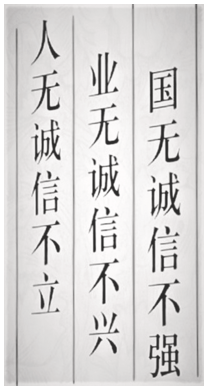
Figure 17.21 Honesty
国无诚信不强 guó wú chéngxìn bù qiáng
country not trustworthy not strong
业无诚信不兴 yè wú chéngxìn bù xīng
business not trustworthy not flourish
人无诚信不立 rén wú chéngxìn bú lì
person not trustworthy not established
The parallelism is extreme. The three lines share four out of six characters: 无诚信不.

Figure 17.22 Core values
社会主义核心价值观 shèhuìzhǔyì héxīn jiàzhíguān | socialist core value view
人民有信仰 rénmín yǒu xìnyǎng | people have faith 国家有力量 guójiā yǒu lìliàng | country have strength
国家 guójiā | country
富强 fùqiáng | wealthy 民主 mínzhǔ | democratic文明 wénmíng | civilized 和谐héxié | harmonious
社会 shèhuì | society
自由 zìyóu | free 平等 píngděng | equal 公正 gōngzhèng | just 法制 fǎzhì | rule by law
个人 gèrén | individual
爱国 àiguó | patriotic 敬业 dedicated | jìngyè 诚信chéngxìn | trustworthy 友善 yǒushàn | friendly
Political Banners

Figure 17.23 Not forget first heart
不忘初心 búwàng chūxīn
为人民谋幸福 wèi rénmín móu xìngfú | for people seek happiness
牢记使命 láojì shǐmìng | firm remember mission
为民族谋复兴 wèi mínzú móu fùxīng | for nation seek revival
--加强未成年人思想道德建设 | jiāqiáng wèichéngniánrén sīxiǎng dàodé jiànshè
strengthen adolescent thought and moral building
关爱未成年人健康成长 guān’ài wèichéngniánrén jiànkāng chéngzhǎng
attention love adolescent healthy growth
The first two lines have 4+6 characters each, with points of similarity and contrast.
The last two longer lines though are not quite perfectly symmetrical.

Figure 17.24 Strike black banish evil
保持高压态势 bǎochí gāoyā tàishì | maintain high pressure momentum
铁腕打黑除恶 tiěwàn dǎhēi chú’è | iron wrist strike black rid evil
人民安居乐业 rénmín ānjūlèyè | people live in peace and work in happiness
社会安定有序 shèhuì āndìng yǒuxù | society peaceful orderly
国家长治久安 guójiā chángzhìjiǔ’ān | country long-term stability
严打黑恶犯罪 yándǎ hēi è fànzuì | severe strike black evil and crime
弘扬社会正气 hóngyáng shèhuì zhèngqì | promote social justice
This is seen in the small water town 甪直 lùzhí near Suzhou. All lines are six characters long. Quite unusually, there is no attempt at rhyming.
Learning Outcomes
a. Gain awareness of the relationship between public signs and society.
b. Gain awareness of the relationship between signs and changing political climate.
c. Gain greater awareness of the use of parallelism in public signs.
Suggested Learning Activities
1. Using 节约, 环保, and 文明, search online for signs containing these words. Type them out and translate.
2. Identify punning and parallelism in the found signs.
3. Using the 历时检索 function from the BCC corpus (http://bcc.blcu.edu.cn/hc), find out when 打黑, 不忘初心 and核心价值 started to be used.
4. Using words from this chapter, design a civic sign.
Reflecting the cultural and regional diversity in China, signs may contain dialectal elements, especially those of the major dialects such as Cantonese, Min, and Shanghai/Wu.
Dialects can differ in vocabulary and grammar, and particularly in sound. The differences in sound can sometimes be seen in phonetic transliterations. Dialectal words are those that do not have counterparts in the standard language. They are often written by borrowing standard characters just for the sound without regard to their original meaning (Rebus Principle); they can also be written in specially created dialectal characters.
Dialects can also resemble classical Chinese, as they tend to retain features of older Chinese.
As dialectal influence is widely seen in the Chinese diaspora, more examples of dialectal elements can be seen in Chapter 19.
Cantonese
Among all Chinese dialects, Cantonese enjoys a special status, as it is spoken in Guangdong, Hong Kong, Macau, and diaspora communities all over the world.
Pronunciation Difference
Note that pronunciation is given in Mandarin, as romanization for Cantonese is not as standardized and may not be familiar to readers.

Figure 18.1 Zhou big blessing
周大福 zhōu dà fú
This is a jewelry chain from Hong Kong. Its Cantonese origin is reflected in the transliteration, which has the final ‘k’ in Fook. The other two final consonants are ‘p’ and ‘t’.

Figure 18.2 Prosperous pastry
兴盛糕点 xīngshèng gāodiǎn
Hing Shing is how Cantonese pronounces 兴盛. This is in Boston’s Chinatown.

Figure 18.3 Like tea
喜茶xǐ chá
In Cantonese, 喜is pronounced like ‘hey’ in English.
Vocabulary Difference

Figure 18.4 Please walk into compartment
请行入车厢 qǐng xíngrù chēxiāng
The classical 行 and 入 cannot be used this way in Mandarin; they can only be used in compounds such as 行人 ‘pedestrian’ and 入口 ‘entrance’.

Figure 18.5 Downstairs standing
楼下座位 lóuxià zuòwèi | downstairs seating
楼下企位 lóuxià qǐwèi | downstairs standing
This is on a double-decker bus in Hong Kong. 企 is Cantonese for ‘to stand’. In Mandarin it is used in the word 企鹅 ‘penguin’, which means standing goose!

Figure 18.6 Cooked dish
熟餸 shú sòng
外卖 wàimài | out sell
餸 is a bona fide Cantonese word. This is seen in San Francisco’s Chinatown, where the common language is Cantonese.

Figure 18.7 For food specialist
为食家 wèishí jiā | gourmand/glutton
为食 is Cantonese for ‘greedy for food’.
This restaurant is in Boston’s Chinatown.
Cantonese Words with Rare or Borrowed Characters

Figure 18.8 Drop ship take Hong Kong rail
落船搭港铁 luòchuán dā gǎngtiě
即悭$1.5 jí qiān $1.5 | instant save $1.5
(Take Hong Kong rail after disembarking from ship, save $1.5 right away.)
The rare word 悭 ‘to save’ is still used in speech in Cantonese. 落 is Cantonese for 下, 搭 for 乘 ‘ride’.

Figure 18.9 Eaten yet?
食左未 shí zuǒ wèi | eat particle not (eaten yet)
吃了没 chī le méi | eat particle not (eaten yet)
The Cantonese version in big characters is glossed with small characters in Mandarin. 食 and 未 are Cantonese (also classical Chinese) for 吃 and 没respectively. 左 ‘left’ is borrowed to write the sound of the perfective particle ‘tso’ in Cantonese.

Figure 18.10 Bull
牛 niú | bull 就係我嘅態度 jiùxì wǒkǎi tàidù | just my attitude
This was seen in a beef ball soup restaurant. The big character 牛 is a pun, as it can also mean ‘arrogantly awesome’. The line below reinforces the pun. 係 (=是) and 嘅 (=的) are created to write the dialect words.

Figure 18.11 Walk a bit faster
行快D 啦 喂 | xíng kuài D la wèi
全场七折 | quánchǎng qīzhé
D is used in place of the identical sounding 啲, a Cantonese character created by adding 口to show that it is used phonetically. 行 is Cantonese (and classical Chinese) for 走 ‘walk’.
Shanghai/Wu
The Wu dialect, with its most populous metropolis Shanghai, is one of the major dialect families of China.

Figure 18.12 Shanghai people
上海宁 shànghǎi níng
老玩具有伐 lǎo wánjù yǒu fá | old toy have question particle
This ad is from McDonald’s. The use of 宁illustrates the Rebus Principle. 宁 ‘peace’, not at all related in meaning to人 ‘person’, is used for its sound only. The same is true with writing the question particle with 伐, which otherwise means ‘chopping down trees’.

Figure 18.13 I/we Ningbo
阿拉宁波 ālā níngbō
With its disyllabic form and no resemblance to pronouns in Mandarin, the first-person pronoun 阿拉 is quite distinctively Wu.

Figure 18.14 Old mother’s brother
舅jiù | uncle 老娘舅 lǎo niángjiù
米饭要讲究 mǐfàn yào jiǎngjiū | be particular about rice
就吃老娘舅 jiù chī lǎo niángjiù | then eat at mother’s brother’s
老娘舅 is a regional chain restaurant known for its tasty rice (note the rice bowl icon). The Mandarin counterpart to 娘舅 is 舅舅. Note the repetition of the syllable jiù (究,就,舅), which no doubt is deliberate.

Figure 18.15 Nanxiang dumpling shop
南翔馒头店 nánxiáng mántóu diàn
This is one of the best-known traditional restaurants in Shanghai. To a northerner, 馒头 is plain steam bread; but in Shanghai, it is filled with meat inside.
Min/Taiwanese
The southern Min dialect and that in Taiwan are closely related. Not being mutually intelligible with other Chinese dialects, they retain many old phonetic and lexical features.

Figure 18.16 Old early taste Taiwan beautiful food
古早味台湾美食 gǔzǎo wèi táiwān měishí
中式料理 zhōngshì liàolǐ | Chinese style cooking
古早味 is a Min dialect word. 料理 is however Japanese in origin. This is seen in Vancouver’s Chinatown.

Figure 18.17 Grandma roast corn
阿嫲の烧番卖 āmà no shāo fānmài
阿嫲 is grandma in the Min dialect. 烧番卖, also written as 烧番麦, is roasted corn on the cob. 番is commonly used for things foreign, such as 番茄 ‘tomato’. Note the use of the Japanese particle の, instead of Chinese 的.

Figure 18.18 Lake view restaurant
湖景餐厅 hújǐng cāntīng
俗搁大碗 súgē dàwǎn | popular put big bowl
冷气开放 lěngqì kāifàng | cold air open release
俗搁大碗 is Min for ‘cheap and good’. 冷气 ‘AC’ would be 空调 in mainland China. This is near Sun Moon Lake in Taiwan.

Figure 18.19 House in little family village
厝内小眷村 cuònèi xiǎo juàncūn
This is a chain selling Taiwanese style milk tea. 厝 is a Min word and 眷村 are residential compounds built for Nationalist soldiers and their families when they first arrived in Taiwan. With people from all over China, 眷村 life developed its own characteristics including its foods.

Figure 18.20 Each piece 4 yuan
每粒4元 měi lì 4 yuán
水饺 shuǐjiǎo | water (boiled) dumpling
方记 fāng jì | Fang’s
The measure word 粒, usually used for small objects like sesame seeds or medicine pills, is used more generally in Min, including for watermelons!
Mandarin
It needs to be noted that Mandarin is not a single dialect, but a family of dialects. Largely mutually intelligible, they can nonetheless differ in sound and vocabulary. Of the many Mandarin dialects, the Northeastern and the Southwestern varieties tend to be used more often for comic effect.

Figure 18.21 Have matter no matter
有事没事 yǒushì méishì (for no reason)
整点乐事 zhěngdiǎn lèshì | get some happy matter (Lay’s)
整点 is distinctly Northeastern Mandarin. For some reason, this regional variety has been exploited extensively for comic effect.

Figure 18.22 Spicy those year
辣些年 làxiē nián
The name of this red chili shop uses a pun based on dialectal difference: 辣là is a mispronunciation of 那 nà and 那些年 means ‘those years’. The inability to distinguish between ‘n’ and ‘l’ is a distinguishing feature of the chili loving speakers of southwest Mandarin.
Learning Outcomes
a. Gain greater awareness of dialectal differences.
b. Gain greater awareness of the relationship between Cantonese and classical Chinese.
c. Gain awareness of the use of the Rebus Principle in writing dialect words.
Suggested Learning Activities
1. If you can, take pictures of signs containing dialectal elements. Type them out and translate.
2. Using the dialectal words in this chapter, search online for more examples. Type them out and translate.
3. Using the online Cantonese dictionary CantoDict (cantonese.sheik.co.uk/dictionary/), look up the numbers ‘one, three, six, ten’. Which consonants are not found in Mandarin?
4. Cite some examples of dialectal pronunciation, vocabulary, and grammar.
5. Cite some examples of Cantonese sharing similarities with classical Chinese.
6. If you are a speaker of a Chinese dialect, can you give examples of words that are unique to your dialect?
7. For dialect words that have no Mandarin counterparts, what characters tend to be chosen to write them?
Chinese can be found in most parts of the world. The signs in this chapter are mainly from the United States. A few are from Kyrgyzstan.

Figure 19.1 Flushing, New York
But for the few English words that give away the location, Flushing in Queens New York city could well be mistaken for Taipei or Hong Kong.
Signs in the diaspora contexts are distinguished by the need to negotiate between Chinese and the local language(s), as Chinese is used to represent local contexts. Both meaning-based translation and sound-based transliteration are used, as well as a combination of the two. Also notable are the dialectal elements (for more examples of dialectal elements in signs, see Chapter 18). The language of the Chinese diaspora in North America is heavily Cantonese, as the earliest immigrants were from Cantonese-speaking areas of China. Cantonese has also been adopted as sort of a lingua franca. For example, in San Francisco’s Chinatown, standard Cantonese as spoken in Guangzhou and Hong Kong is extensively used, especially with outsiders, even though the dominant dialect was Toishan, a sub-dialect of the Cantonese dialect family. Mandarin is increasingly common in the newer immigrant communities, for example in Los Angeles. Traditional characters are used as a rule, reflecting the dominance of traditional culture. The traditional vertical and right-to-left text orientation coexists with that of the modern horizontal and left-to-right format.
As seen in Boston’s Chinatown, there are also cases of ‘diaspora in diaspora’ in the sense that some of the diaspora Chinese, such as Vietnamese Chinese, had already been away from China before coming to America.
Landmarks
Many Chinatowns are marked by traditional archways like this one seen in Boston and Portland, Oregon.

Figure 19.2 Boston’s Chinatown
天下为公 tiānxià wèigōng
whole world for public good
The lines on the archway should both be read from right to left.

Figure 19.3 Boston’s Chinatown
礼义廉耻 lǐ yì lián chǐ
courtesy, justice, integrity, sense of shame
This is the other side of the same archway.

Figure 19.4 Portland’s Chinatown
砵崙华埠 bōlún huábù
The discrepancy between the transliteration bólún and Portland can be explained by the Cantonese origin of the transliteration.

Figure 19.5 Four seas one family
四海一家 sìhǎi yìjiā
The phrase expresses the utopian desire for universal brotherhood.
Streets

Figure 19.6 Elizabeth Street
伊丽莎白街 yīlìshābái jiē
陈宇晖路 chén yǔhuī lù | Danny Chen Way
This is seen in New York’s Chinatown. Elizabeth is transliterated by sound; ‘street’ is translated by meaning as 街. The sign below is in memory of Danny Chen, a Chinese American soldier who died in Afghanistan. The Chinese version is simply his name 陈宇晖 (in traditional characters) and ‘way’ is translated by meaning as 路 ‘road’ (photo credit: Eric Cheng).

Figure 19.7 Everett Street
西北 xīběi | west north 爱和烈街 àihéliè jiē | Everett Street
This is in Portland’s Chinatown. While àihéliè sounds quite different from Everett, its Cantonese pronunciation sounds closer.

Figure 19.8 South King Street
南景街 nánjǐng jiē | south scenery street
南第六大道 nán dìliù dàdào | south 6th Ave
This is in Seattle’s Chinatown. Everything is translated by meaning, except King, which is transliterated as 景 which means ‘scenery’. While 景 jǐng sounds quite different from king, its Cantonese pronunciation sounds quite close.

Figure 19.9 Beach Street
必珠街bìzhū jiē
This is in Boston’s Chinatown. It is quite an unexpected rendition!
Businesses

Figure 19.10 Boston Chinatown chamber of commerce welcomes you
波士顿华埠商会欢迎您
bōshìdùn huábù shānghuì huānyíng nín

Figure 19.11 Taste Chinatown food
品尝华埠美食 pǐncháng huábù měishí
支持华埠商户 zhīchí huábù shānghù
support Chinatown businesses
特价泊车 tèjià bóchē | special price parking

Figure 19.12 Waiwai
威威 wēiwēi
姜葱白切鸡 jiāngcōng báiqiē jī
ginger scallion plain cut chicken
This is in Boston’s Chinatown. Note how 威威 is pronounced in Cantonese. Also note the so-called chop suey font that Waiwai is written in.

Figure 19.13 Gold fortune
金财 jīn cái
Amazingly, Chinese, French, and English are all used, in addition to Vietnamese!

Figure 19.14 Great Wall winery
长城 chángchéng | great wall 酒庄 jiǔzhuāng | winery
Note the Vietnamese transliteration Truong Thanh for the Great Wall.

Figure 19.15 Chinese herbs
南北行参茸药材 nánběi háng sēnróng yàocái
south north firm ginseng antler herbal medicine
‘Nam Bac Hong’ contains both Cantonese ‘m’ and Vietnamese ‘c’ (for k).

Figure 19.16 Cantonese Sichuan food
华记huá jì | Hua’s 蜀餸shǔ sòng | Sichuan food
Both ‘Wa’ in ‘Captain Wa’ and 餸are Cantonese. But why is the food 蜀, the alias for Sichuan? Only possible in the Chinese diaspora! This restaurant is in fact in the heavily Chinese area of Richmond, Vancouver.
Alternative Romanization Schemes

Figure 19.17 Great harmony restaurant
大同饭店 dàtóng fàndiàn
This restaurant is in Seattle’s Chinatown. The discrepancy between Tai Tung and the Mandarin Datong is explainable in terms of dialect and alternative romanization, as大同is indeed pronounced like Tai Tung in Cantonese and the letter T in Tai is due to the alternative romanization.
饭店 is not the most common term for restaurant and it can also mean hotel (photo credit Xu Dongdong).

Figure 19.18 Fresh Chinese kale
新鲜芥兰 xīnxiān jièlán
The English translation surely looks unusual. Why is there ‘R’ in LARN? It is in fact 国语罗马字, an older romanization system using letters to spell tones. R marks the rising (2nd) tone. This is seen in Auckland, New Zealand.
Kyrgyzstan
A little-known fact is that there are Chinese-speaking Muslims in Central Asia called Dungans, scattered mostly along the Chui River dividing Kyrgyzstan and Kazakhstan. Their ancestors left Northwest China about 150 years ago after the failed Muslim uprising. A distinct characteristic of the Dungans is their use of alphabetic writing, including Arabic, Roman, and the current Cyrillic script.

Figure 19.19 Muslim Chinese
Хуэймин (回民)huímín | return people
This is a bilingual newspaper published by the Dungan Association of Kyrgyzstan. It is in both Dungan and Russian, using the Cyrillic script.

Figure 19.20 Lucky restaurant
йYнчи (运气)|yùnqì | luck
This restaurant is in Alexandrovka, the largest Dungan village 20 km west of the capital Bishkek. The Russian and Kyrgyz words, given above and below, mean ‘café’.

Figure 19.21 Hotpot
Хого (火锅) huǒguō | fire wok
This restaurant is in the Dungan village of Alexandrovka.

Figure 19.22 Dungan dishes
Лазы жу (辣子肉) làzǐ ròu | chili meat
Могу жу (蘑菇肉) mógū ròu | mushroom meat
Мыр жу (木耳肉) mù’ěr ròu | fungus meat
Му шу жу (木须肉) mù xū ròu | mooshoo meat
Цо дузы (炒肚子) chǎo dǔzi | fried tripe
Цоко жу (炒烤肉) chǎo kǎoròu | fried BBQ meat
This is part of a menu of a restaurant in Tokmok city. The lines under Dungan in smaller font are Russian translations.
Immigration Law and Accountants’ Offices
All three offices below are in Alhambra Los Angeles, which has one of the largest Chinese populations in the United States.

Figure 19.23 Same boat immigration
同舟移民 tóngzhōu yímín | same boat move people

Figure 19.24 American immigration office
驻美移民事务所 zhùměi yímín shìwùsuǒ
station US move people affairs office
(American immigration agency)

Figure 19.25 CPA
智达会计zhìdá kuàijì | wisdom achieve accounting
Associations
Many clannish and regional associations exist for diaspora Chinese. Earlier immigrants depend on them for support. Being older in style, the text orientation tends to go from right to left and the text is mostly in traditional characters. Sometimes, the English spelling reflects the dialectal origin.
The following associations are seen in the Chinatowns of Boston and Portland, Oregon.
Boston

Figure 19.26 Senior association
中华耆英会 zhōnghuá qíyīng huì
Chinese Senior Citizens Association

Figure 19.27 Vietnam Cambodia Laos Chinese Association
麻省越棉寮华人协会 máshěng yuèmiánliáo huárén xiéhuì
Massachusetts Vietnam Cambodia Laos Chinese Association
These Chinese had already been in Southeast Asia before coming to the United States.

Figure 19.28 Huang clan family association
黄氏宗亲会 huángshì zōngqīn huì
Note the name of the clan is Wong in Cantonese (Huang in Mandarin).
Portland, Oregon

Figure 19.29 Chinese Association
中华会馆 zhōnghuá huìguǎn
Chinese gathering place

Figure 19.30 Hip Sing association
协胜公会 xiéshèng gōnghuì
assist victory association
Note the difference in pronunciation between Cantonese Hip Sing and Mandarin xiéshèng.

Figure 19.31 Family and friend association
至孝笃亲公所 zhìxiào dǔqīn gōngsuǒ
utmost filial devote family association
至诚孝友 zhìchéng xiàoyǒu
utmost sincere and filial to friends
笃爱亲仁 dǔ’ài qīnrén
love family and friends
The traditional format is like that of a spring couplet.
Political Ads
Being two of the earliest regions of settlement for Chinese immigrants, San Francisco and Boston have a significant Chinese population. Even non-Chinese politicians are using Chinese-language campaign ads to attract votes.
San Francisco

Figure 19.32 Leno for mayor
重整市府 chóngzhěng shìfǔ | re-organize city hall
迈步向前 màibù xiàngqián | march forward
里诺 lǐnuò | Leno
三藩市市长 sānfān shì shìzhǎng
San Francisco city mayor

Figure 19.33 Vote for Martin Rawlings-Fein
在选举旧金山教育委员会一席
zài xuǎnjǔ jiùjīnshān jiàoyù wěiyuánhuì yìxí
In electing SF’s education board one seat
请投马文龙一票 qǐng tóu mǎ wénlóng yípiào
please cast Ma Wenlong a vote
The candidate’s Chinese name notwithstanding, 马文龙 (Martin Rawlings-Fein) is not Chinese.
Boston

Figure 19.34 Healey & Driscoll
希利&德里斯科 xīlì & délǐsīkē
为麻州的未来wèi mázhōu de wèilái | for Massachusetts state’s future

Figure 19.35 Fair pay tax
公平缴税 gōngpíng jiǎoshuì
Learning Outcomes
a. Gain greater awareness of the diversity in writing format.
b. Gain familiarity with the translation strategies used in bilingual signs.
c. Gain greater appreciation for the role of Cantonese in the Chinese diaspora.
Suggested Learning Activities
1. If you are close to a Chinatown, take pictures of signs in Chinese. Type them out and translate.
2. Using 中国城 and 唐人街, search online for landmarks, street signs, and names of Chinese businesses. You can target a specific location by adding locations such as 纽约 ‘New York’, 旧金山 ‘San Francisco’, 洛杉矶 ‘Los Angeles’, 伦敦 ‘London’, and 悉尼 ‘Sydney’. You can also use traditional characters to bring up more examples. Type out the text in the signs and translate into English if it is not given.
3. Do you notice any differences due to the locale? Comment on them.
4. Identify translation strategies and possible mistakes in bilingual or multi-lingual signs.
5. If you are ethnic Chinese growing up outside of China, is the English spelling of your name different from that in pinyin? Why is this the case?
In mainland China, Reform and Opening up in the last few decades has opened a floodgate of foreign infusion. Foreign businesses such as KFC, Starbucks, Walmart, McDonalds, and Carrefour are seen everywhere. The ones given in this chapter are by no means complete. For example, the British supermarket chain 乐购 (Tesco) and German 麦德龙 (Metro) are not given here.
There have also been many loanwords. Some of the loanwords have become so much a part of the Chinese lexicon that their foreign origin may not even be clear to all. The word for cookie 曲奇, an English loanword by way of Cantonese, is a particularly good example.
Apart from the social and cultural implications, the influx of things foreign presents quite a challenge to Chinese with its non-phonetic script. Various accommodation strategies have been used to represent foreign words with Chinese characters, including meaning translation, phonetic transliteration, or a combination of both, resulting in varying degrees of semantic and phonetic approximation. Incidentally, the fact that the Rebus (phonetic loan) Principle is extensively used for phonetic transliterations, whereby Chinese characters are used only for their sounds without regard to their meanings, show that the persistent ideographic myth concerning Chinese characters is untrue.
Since some of these foreign brands were first introduced into mainland China through dialect speaking areas such as the Cantonese-speaking Hong Kong, phonetic transliterations quite often do not sound very close the original foreign words in Mandarin Chinese. For more information about dialects, especially Cantonese, see Chapters 18 and 19.
Along with real foreign names, there are also some ‘pseudo-foreign’ ones. While this may reflect obsession with things foreign, there may also be functional reasons. One possibility is to overcome the inherent limitation in the choice of names. Chinese names are short while foreign ones can be much longer, which allows more combinatorial possibilities. Using foreign sounding syllables, which do not need to have transparent meanings, also obviates the almost obligatory need to choose auspicious characters.
Fast-food Restaurant

Figure 20.1 Kentucky
肯德基 kěndéjī
KFC ranks first in the number of stores and the earliest entry into the Chinese market. Note that the Chinese transliteration is only for the K of KFC.

Figure 20.2 McDonald’s
麦当劳 màidāngláo
Why is 麦当劳 used for McDonald’s when it doesn’t even sound close? The fact is that it came via Cantonese, which sounds much closer to English, down to the ‘Mc’ part (麦 is pronounced mak). The tonal pattern ‘low high low’ fits the stress pattern of McDonald quite nicely too. McDonald’s had entered Hong Kong earlier in 1975.

Figure 20.3 Pizza Hut
必胜客欢乐餐厅 bìshèngkè huānlè cāntīng
must win guest happy diner
The semi-transliteration 必胜客 also means: must win guest.

Figure 20.4 Subway
赛百味 sài bǎiwèi | exceed 100 flavor
This transliteration also has meaning. In Taiwan it is literally called a sub-marine burger: 潜艇堡 qiántǐng bǎo.

Figure 20.5 Domino’s pizza
达美乐比萨 dáměilè bǐsà | reach beauty happy pizza
While the whole name is based on transliteration, the first part 达美乐 tries to use nice-sounding characters, but 比萨 is pure transliteration.

Figure 20.6 Starbucks
想喝星巴克 xiǎng hē xīngbākè | would like to drink Starbucks
没时间排队 méi shíjiān páiduì | no time to line up
The Chinese name is a combination of meaning translation (星=star) and transliteration (巴克=buck).

Figure 20.7 Burger King
汉堡王 hànbǎo wáng | hamburger king
This is a mixture of transliteration (汉堡=Hamburger) and meaning translation (王=king).

Figure 20.8 Papa John’s
棒约翰 bàng yuēhàn | awesome John
Note the Chinese name of this American pizza chain deviates in meaning from the original name.

Figure 20.9 Carl’s Jr.
卡乐星 kǎlè xīng | Carl star
Although there is a star in the logo, it is not in the English name. The Chinese name does include it.
Chain Stores

Figure 20.10 Walmart
沃尔玛 wò’ěrmǎ
This is pure transliteration, without any attempt at choosing auspicious sounding characters.

Figure 20.11 Carrefour
家乐福 jiālèfú | home happy blessing
This is a French hypermarket chain.

Figure 20.12 Best Buy
百思买 bǎisīmǎi | 100 think buy
The meanings of the characters definitely do not mean ‘best buy’!

Figure 20.13 Watsons
屈臣氏 qūchén shì
This transliteration is via Cantonese. But it also sounds like a possible Chinese name.
A Few Food Items

Figure 20.14 Caffe latte
咖啡拿铁 kāfēi nátiě | coffee wield iron
美式咖啡 měishì kāfēi | American style coffee
杯bēi | cup
The characters 咖啡 both have a 口 component indicating its transliteration status. The transliteration nature of 拿铁 is not as obvious. The original meanings of the characters are rather scary: wield iron.

Figure 20.15 Cookie
杏花楼 xìnghuā lóu | apricot flower building
双色曲奇 shuāngsè qǔqí | double color cookie two-tone cookies
品位粤式糕点 pǐnwèi yuèshì gāodiǎn
high class Cantonese style pastry
曲奇 is a recent loanword from English via Cantonese, which pronounces it as kukkei. The Mandarin pronunciation qǔqí is quite different from English. As an instance of phonetic loan, the original meanings of the two characters ‘tune’ and ‘strange’ are quite irrelevant. 杏花楼 is a venerable Cantonese restaurant in Shanghai also known for its line of food products.

Figure 20.16 Minced
免治牛肉粥(中) miǎnzhì niúròu zhōu (zhōng)
minced beef congee (medium)
免治 is borrowed from English ‘minced’, possibly via Cantonese.

Figure 20.17 Toast and sandwich
厚片吐司 hòupiàn tǔsī | thick slice toast +饮品yǐnpǐn | beverage
(限30元以下饮品 xiàn 30 yuán yǐxià yǐnpǐn)
(limit to below 30 yuan beverage)
阳光三明治 yángguāng sānmíngzhì | sunny sandwich+饮品yǐnpǐn | beverage
(红茶、绿茶、奶茶 hóngchá lǜchá nǎichá | black tea, green tea, milk tea
吐司 and 三明治 are from English ‘toast’ and ‘sandwich’ respectively.

Figure 20.18 Ciabatta/bagel
巧巴达/贝果 qiǎobādá/bèiguǒ | ciabatta/bagel + 饮品 yǐnpǐn | beverage
(限30元以下饮品 xiàn 30 yuán yǐxià yǐnpǐn)
(limit to below 30 yuan beverage)

Figure 20.19 Morton salt
莫顿牌精制盐 mòdùn pái jīngzhì yán
Morton brand fine manufacture salt
未加碘 wèi jiā diǎn | not add iodine
源自于美国的百年品牌
yuánzì yú měiguó de bǎinián pǐnpái
source from in US 100 year brand
净含量:737克 jìng hánliàng:737 kè
net content: 737 gram
It is surprising that such a basic item is imported. 未, 自, and 于 are classical Chinese for 没有, 从, and 在 respectively.
Japanese
Japanese businesses are also very common in China.

Figure 20.20 Number 1 house
壱番屋 yìfān wū | Ichibanya
This is a Japanese-style restaurant also written as 壹番屋, featuring curry dishes.

Figure 20.21 Shabu-shabu
呷脯呷脯 xiāfǔxiāfǔ
Shabu-shabu comes from Japanese meaning ‘hotpot’.

Figure 20.22 Teppanyaki
铁板 tiěbǎn | iron plate
达人 dárén | master
铁板 is from 铁板烧 Teppanyaki.

Figure 20.23 Izakaya
日式居酒屋 rìshì jūjiǔwū
Japan style stay drink house
居酒屋 is from Japanese ‘izakaya’.

Figure 20.24 Whole family
全家 quánjiā
This is a Japanese convenience-store chain seen all over Shanghai. Its Japanese pronunciation is the transliteration of Family Mart: ファミリーマート.

Figure 20.25 Lawson
罗森 luósēn 便利店biànlì diàn | convenience store
Despite its Anglo sounding name, it is a Japanese company, albeit originally started in the United States.

Figure 20.26 Bento
六星便当 liù xīng biàndāng | six-star bento (box lunch)
便当 is a loanword from Japanese. It is used more often in Taiwan than in China.

Figure 20.27 Set meal
排骨定食 páigǔ dìngshí | rib set meal
香鱼定食 xiāngyú dìngshí | ayu set meal
鲭鱼定食 qīngyú dìngshí | salmon set meal
定食 is from Japanese teishoku ‘set meal’, comprising of rice, soup, and a side dish.

Figure 20.28 Story
暖冬物语 nuǎndōng wùyǔ
warm winter story
物语 is ‘story’ in Japanese.
Korean

Figure 20.29 Korean food
韩国食品 hánguó shípǐn
This is seen in Shanghai.

Figure 20.30 Korean BBQ shop
松鹤 sōnghè | pine crane 韩国烧烤店hánguó shāokǎo diàn
Note the similarity and difference in pronunciation for crane between Korean ‘hak’ and Mandarin ‘he’. ‘Hak’ is in fact borrowed from Chinese and retains the older pronunciation. This is in San Diego, United States.
Sinicization of Foreign Elements
An interesting phenomenon is the Sinicization of foreign elements after they enter Chinese. They come to be used as if they are native Chinese words. One such example is the use of 嗨 hāi ‘high’ as a verb, as can be seen in the examples below. It can even be followed by a resultative complement: 嗨翻 fān ‘get high to the point of being head over heels’; it can also be used as a resultative complement itself: 玩嗨 ‘have fun to the point of being high’.

Figure 20.31 High together
一起嗨 yìqǐ hāi | together high 海底捞 hǎidǐ lāo | sea-bottom scoop
This is a popular hotpot restaurant. The 嗨 comes from English ‘high’ but has become a verb meaning ‘be high spirited’. Not only does 嗨 sound like ‘high’, it also resembles the character 海.

Figure 20.32 High upside down Monday
麦当劳 màidāngláo | McDonald’s
嗨翻星期一 hāifān xīngqī yī | high upside down Monday
嗨 is followed by the resultative complement 翻 ‘upside down’. The nativized 嗨 can even be used as a resultative complement itself such as 玩嗨 ‘have fun till high’.

Figure 20.33 Most in
最zuì | most
Although we can say ‘the in crowd’ in English, ‘most in’ seems to be quite new!
Pseudo-Foreign
There are also pseudo-foreign-sounding brands such as ‘波司登 (bosideng)’ (see 20.38). Also seen is the mixing of scripts with direct inclusion of foreign elements, such as AA 制 ‘each paying for own share’ known to all in China but opaque to people outside. The profusion of (often gratuitous) foreign elements is a phenomenon worthy of serious study.

Figure 20.34 Home delivery
自助点餐 zìzhù diǎncān | self-order and 宅急送zháijísòng | home deliver
点餐不排队 diǎncān bù páiduì | order no lineup
随时随地享美味 suíshí suídì xiǎng měiwèi | anytime anywhere enjoy good foods
宅急送 is a Chinese company modeled on the Japanese 宅急便. This is used by KFC to promote their home delivery service.

Figure 20.35 Japanese fine image
和良形象 héliáng xíngxiàng
This Japanese-sounding name of a hair salon in Shanghai seems to be partly Chinese. Its owners are from Tokyo, Shanghai, and Seoul.

Figure 20.36 Youngor
雅戈尔yǎgē’ěr
This is a textile clothing company, headquartered in Ningbo Zhejiang province. While following the transliteration practice of using characters mostly for their sounds, the character 雅 does mean ‘elegant’.

Figure 20.37 Chlitina
克丽缇娜 kèlìtínà
This skin-care and beauty salon is founded in Taiwan. It is hard to tell what language Chlitina is based on, with its unusual consonant cluster at the beginning.

Figure 20.38 Bosideng
波司登 bōsīdēng
This pseudo-foreign sounding brand seems to pop up everywhere, on trains and airplanes. It is a major purveyor of down products headquartered in Changshu, Jiangsu province. It was ostensibly coined to sound like Boston, which is otherwise transliterated as 波士顿 bōshìdùn.

Figure 20.39 Wedome
味多美 wèiduōměi | taste much beautiful
It is a bakery based in Beijing. It is not clear how the spelling comes about.
Learning Outcomes
a. Know the difference between meaning translation and phonetic transliteration.
b. Gain awareness of the dialectal origin of some phonetic transliterations.
c. Gain greater sensitivity to the issue of character choice in phonetic transliteration.
Suggested Learning Activities
1. Search online for examples of foreign businesses translated into Chinese. Is phonetic transliteration or meaning translation (or a combination) used?
2. Are there alternative translations?
3. How are the characters chosen?
4. If there is a discrepancy between the Chinese rendition and the pronunciation of the foreign words, offer an explanation as to why that is the case.
5. Using Google Translate or other translation apps, translate some English signs into Chinese and judge the quality of the translations.
6. Translate signs from English to Chinese and decide whether phonetic transliteration or meaning translation (or a combination) is used.
7. Find examples of foreign words being integrated into Chinese grammar.
8. Find out if there are other pseudo-foreign names of Chinese businesses.
Many signs in urban areas are bilingual in Chinese and English. It cannot escape the notice of even the most casual bilingual observer that many such signs are woefully (and sometimes hilariously) mistranslated.
Mistakes can result from wrong segmentation, wrong word choice, wrong grammar, or inappropriate style, which is particularly important in Chinese. Mistakes can also result from missing crucial information or lack of understanding of English. There are also the ‘innovative analogies’, which give rise to non-existent English words. Also frequently observed are inconsistencies, wavering between the two strategies of pinyin transliteration and meaning translation.
The inclusion of mistranslated signs can be pedagogically useful in more than one way (Shang and Xie Reference Shang and Xie2020). Studying mistranslated signs is an exercise in contrastive analysis. Through detailed analysis of the causes of the mistakes, such signs can be used as negative examples in the teaching of both Chinese and English. They can also be useful to the study and practice of translation.
Wrong Segmentation
The Chinese writing convention is not to leave space between words. This presents a challenge to both readers and computers in segmentation, that is, grouping unbroken strings of characters into words or phrases. Mistakes in translation often result due to the wrong segmentation, especially when the translation is done by computers.

Figure 21.1 Early restaurant
早餐厅 zǎocān tīng | early meal hall (breakfast hall)
What is ‘early restaurant’? The mistake results from the wrong segmentation. The middle character 餐 can be grouped with the last character to mean ‘restaurant’ as well as with the first character to mean ‘breakfast’.

Figure 21.2 Carefully slide
小心地滑 xiǎoxīn dìhuá | small heart ground slippery (careful, ground is slippery)
This mistake results from grouping 地 with the adjective 小心 to mean ‘carefully’; 地 is used as an adverbial marker instead of ‘ground’.

Figure 21.3 Day and convenience store
天和便利店 tiānhé biànlì diàn | Tianhe convenience store
The English seems too outlandish to be believable, but this was actually seen in Lijiang Yunnan. The second character 和 is part of the name天和, but the translation software construed it as ‘and’, the most frequent meaning of 和. The owner of the store wasn’t entirely convinced when the error was pointed out to him, as he had paid good money for the translation.
Missing Spacing between English Words
The Chinese convention of not having a space between words has somehow been transferred to English. But the phenomenon is more common than expected.

Figure 21.4 Xinjianginternatioalbigbazaar
新疆国际大巴扎 xīnjiāng guójì dà bāzhā
Xinjiang international big bazaar
宴艺大剧院 yàn yì dà jùyuàn | banquet art big theater
The translation is not problematic, but no spaces were provided between the English words!
Incomplete Translation
Some mistranslations are incomplete.

Figure 21.5 Careful soup
小心汤烫 xiǎoxīn tāng tàng | small heart soup hot
(Careful. Soup is hot.)
The crucial part about the soup being hot is missing.

Figure 21.6 Shared bicycle access
共享单车禁止入内 gòngxiǎng dānchē jìnzhǐ rùnèi
shared bike forbid enter
Missing ‘forbid’, the sign has the opposite meaning.
Incomprehension
Some mistranslations seem to be due to insufficient command of English.

Figure 21.7 Glass care
小心玻璃 xiǎoxīn bōli | small heart glass (Careful! Glass is fragile)
‘glass care’ in English means ‘to take care of glass’, which is entirely different from the meaning in Chinese ‘being careful about the possible breaking of glass’.

Figure 21.8 Mainly preserved architecture
大连市重点保护建筑 dàlián shì zhòngdiǎn bǎohù jiànzhù
Dalian city key protect architecture
中国银行旧址 zhōngguó yínháng jiùzhǐ | China bank old site
大连市人民政府 dàlián shì rénmín zhèngfǔ
Dalian city people government
In addition to the wrong translation for 保护, 重点 is also mistranslated. That it was an official plaque put up by the city government is quite embarrassing.
Wrong Sense
Many characters or word forms in Chinese have more than one meaning. Choosing the wrong sense, most likely done by the computer, can lead to nonsensical or hilarious results.

Figure 21.9 Beware of to meet
当心碰头 dāngxīn pèngtóu | careful hit head
(Careful with bumping the head.)
In addition to bumping the head, 碰头 can also have the metaphorical meaning ‘to meet’.

Figure 21.10 Exports slide
滑道出口 huádào chūkǒu | slide path out opening (slide exit)
Unlike 入口, which can only mean ‘entrance’ and not ‘import’, 出口can mean both ‘exit’ and ‘export’.
Analogy Running Amok
There are mistranslations that don’t seem to be attributable to anything but sheer creative analogy.

Figure 21.11 Fresh your life
新鲜你的生活 xīnxiān nǐ de shēnghuó
This was seen in a store in Shanghai. Does it mean ‘freshen your life’? Note the Chinese, on which the translation is based, is also ungrammatical.

Figure 21.12 Heartness, loveness
用心yòngxīn | use heart (attentive)
关爱 guān’ài | concern love
愉悦 yúyuè | happy pleasure
Where do ‘heartness’ and ‘loveness’ come from?
Inconsistency in Road Signs
Shang (Reference Shang2020) observed that there is much ‘wrestling’ regarding language choice when signed are designed. Similarly, there are two competing strategies when rendering Chinese road signs into English: meaning translation and phonetic transliteration. To English speakers, meaning translation is easier for comprehension but not good for asking directions from Chinese people; the phonetic transliteration option is the opposite: opaque in meaning but easier for asking directions. Ideally, both phonetic transliterations and meaning translations should be given, as both are important for foreign visitors, for whom the English is intended after all. Unfortunately, only the phonetic transliteration option was adopted for Beijing’s subway signs ahead of the 2022 Winter Olympics.
There seems to be little consistency in rendering street names into English, as can be seen in Figures 21.13–21.17. Inconsistency naturally leads to confusion.

Figure 21.13 Jinshan middle road
堇山中路 jīnshān zhōng lù | Jin mount mid road

Figure 21.14 Middle Yanggao road
杨高中路 yánggāo zhōng lù | Yanggao mid road

Figure 21.15 Jinshan zhonglu
堇山中路 jīnshān zhōng lù | Jin mount mid road
All three signs above contain中, with the meaning of ‘middle’. But they are different in how 中路 is rendered. The top one translates it into ‘middle’ and puts it before the word road; the second one puts it at the beginning. The top one follows the Chinese word order, but the second one is more idiomatic English. The last sign simply gives the pinyin ‘zhong’, which is quite opaque in meaning but perhaps more helpful to foreigners asking directions.

Figure 21.16 South Qilianshan Road
祁连山南路 qíliánshān nán lù | Qilianshan south road

Figure 21.17 Nanyangjin Road
南洋泾路 nán yángjīng lù | south yangjing road
Both signs above are found in Shanghai’s subway. They both contain 南 ‘south’. The first sign uses meaning translation (also the more idiomatic word order for English), but the second one uses phonetic transliteration instead. One more difference: the 南 is placed before road in the first one but at the beginning in the second.
Stylistic Infelicity
As the style of public signs is quite specific, any deviation from the conventionally accepted style will appear strange.

Figure 21.18 Please have no no spiked shoes
请勿穿钉鞋 qǐngwù chuān dīngxié
please don’t wear nailed shoes
This was seen on the grounds of Confucius’ Mansion in his hometown Qufu. The Chinese is stylistically appropriate with the standard 请勿. But the English translation sounds like baby talk.

Figure 21.19 Women
妇人 fùrén | woman person
The Chinese translation is stylistically quite inappropriate, being quite old fashioned.
Carelessness
Typos are a common occurrence in bilingual signs.

Figure 21.20 No pest allowed
禁带宠物入内 jìn dài chǒngwù rùnèi
forbid bring pets enter in
Was it wrong choice of word or was it the careless reversal of letters (pets>pest)? Pet owners will not be pleased!
Learning Outcomes
a. Gain greater sensitivity to mistakes in translation.
b. Be able to analyze the reasons for mistranslations.
Suggested Learning Activities
1. Search online for Chinese signs with bad English translations. The website https://english.com/ has mistranslated signs from many languages.
2. Analyze the mistakes and identify the type of mistranslations.
3. Correct the translations.
4. Select some road signs in Chinese and translate them into English. Discuss available choices between meaning translation and phonetic translation and the pros and cons of each.
5. Using Google Translate or other translation apps, translate Chinese signs (including the mistranslated ones in this chapter) into English and judge the quality of the translations.


